



Abstract
In Nordic welfare states, progressive planning and housing policies have prevented the most severe forms of gentrification-led displacement. In this paper, we argue that eco-gentrification as a phenomenon is entering the Nordic countries. We illustrate this with a case study of the fast-growing, medium-sized Finnish city of Tampere, where the transformation of a former welfare city into a “sustainable city” is creating unintended gentrification. In the analysis, we identify three inner-city neighborhoods facing eco-gentrification where an increasing drive for urban densification has replaced the welfare state ethos of social equality. We name the types of eco-gentrification as retrofitting, remaking, and preserving. In the concluding part, we elaborate on the serious and multifaceted challenges of keeping welfare state ideals alive in times of green growth urbanism.
Keywords
Introduction
The social impacts of urban sustainability are currently a much-discussed issue in urban research and planning (e.g., Dooling 2009; Long 2016; Anguelovski and Connolly 2022). In the global North, postindustrial cities are adopting new strategies to draw in capital investments, improve the local economy and construct an image of a “sustainable city” (While, Jonas and Gibbs 2004; Jokinen et al. 2018; Rigolon and Németh 2020). As sustainability goals and cities’ growth imperatives intertwine in urban politics, city municipalities, and construction companies transform cities into “green growth machines” as Gould and Lewis (2016) have aptly described them (see also Molotch 1976; Garcia-Lamarca et al. 2021).
In Finland, this development is taking place within the context of the Nordic welfare state. The welfare state has been seen as a precondition for the developmental path combining social justice and the environment in governmental policies (Tunkrova 2008; Duit 2016). The famous “Nordic model” of the welfare state is based on theories of social and economic welfare. It was mainly founded on a social democratic vision of modernization, and economic growth has been a tool to achieve the societal goals of the welfare state (Leino et al. 2023). Over the decades, reforms have aimed at maintaining the sustainability of the welfare state, mainly by safeguarding the financial balance and carrying capacity of the system (e.g., Schoyen, Hvinden and Dotterud Leiren 2022).
However, in recent years, the policy core of the Nordic welfare state model has been under high pressure for several reasons. Global challenges such as climate change, sustainability, the globalization of markets and finances, the emergence of new technologies together with the intensified competition for investments, the ageing of the population, and the growth of immigration have affected lifestyles in cities (Mäntysalo et al. 2015). Simultaneously, the Nordic countries have been heavily influenced by the political ideology of neoliberalism, with the associated reorganization of governmental structures in terms of new public management (Mydske, Claes and Lie 2007). This has been analyzed in the Finnish context as a transformation of the planning culture from long-term welfarist planning toward local reactive practices (Hytönen and Ahlqvist 2019). Among these policy tools are public–private partnerships, which are often applied in urban housing projects (Mäntysalo and Saglie 2010).
In this setting, it is important to analyze what is happening in Finnish cities under the title sustainable urban development. In this paper, we will do this by focusing on the manifestation of eco-gentrification in a fast-growing Finnish city. Urban development in the Finnish welfare state has traditionally been strongly regulated to balance the social differentiation of neighborhoods. This has not prevented polarization but has kept levels of urban segregation and gentrification low compared to more liberal countries (Musterd et al. 2017). In a similar Nordic context, in Malmö, Sweden, sustainable urban development has been an important tool for re-directing welfare distribution to gentrified inner-city urban development (Holgersen and Baeten 2016). Our concern is: does sustainability open a new neoliberal narrative to create urban growth within the sustainability framework, disregarding previous efforts to balance social equity between neighborhoods?
Several phenomena are taking place in urban development that affect unequal urban development. For one, investments in eco-friendly public transportation often raise real-estate values, and profits trickle up to investors and affluent population groups (Padeiro, Louro and da Costa 2019). Similarly, inner-city brownfield sites cleaned and renewed into residential areas tend to attract higher-income residents (Frank 2021). In addition, historically conserved neighborhoods or protected green and blue areas are becoming increasingly desirable, as they keep their character in fast-growing cities. The global pandemic increased the importance of urban green even further (Venter et al. 2021) and affected residential differentiation (Pipitone and Jović 2021). This is in line with previous studies on housing preferences showing that the desired elements of urban everyday life are (1) the proximity of green and blue areas, (2) the availability of commercial and public services, and (3) easy access to public transportation (Winter 2019; Kuoppa et al. 2020). Sparsely built Finnish neighborhoods and housing estates have traditionally had green and blue spaces but have struggled with offering public services and easy access to transportation.
This paper presents a case study from a progressive “sustainable” Nordic city. We follow the enactment of eco-gentrification in a city currently undergoing transformation from a welfare city into a sustainable city. Tampere (pop. 248,000; region 407,000) has, in the course of a current re-orientation, evolved from a welfare city based on heavy industry into a sustainable city (Jokinen et al. 2018). The focus on sustainability has involved considerable investments such as a new light rail system, the redevelopment of brownfields, urban infill, and the promotion of urban greening. All these investments are being promoted as sound, sustainable urban development justified on the basis of the need for carbon reduction, urban densification, and improved mobility for a growing population (Davoudi, Kallio and Häkli 2021).
Various concepts are used to indicate the unintended or sometimes even deliberate negative social impacts related to urban sustainability: Ecological, environmental, climate, and green gentrification, to name a few (e.g., Dooling 2009; Kern 2015; Anguelovski et al. 2019; Shokry, Connolly and Anguelovski 2020). We use the term eco-gentrification to demonstrate how urban environmental improvements often cause the displacement of lower-income residents by higher-income ones (Rice et al. 2020). Eco-gentrification is, however, a nuanced and sometimes subtle process that (1) slowly changes the culture and social structure of the neighborhood, (2) displaces vulnerable population groups as part of regeneration, or (3) excludes low-income people as part of building elite enclaves, new-build gentrification (e.g., Anguelovski and Connolly 2022).
Several studies on eco-gentrification have oriented to single-neighborhood case studies or specific forms of eco-gentrification (e.g., brownfield regeneration or urban greening). This paper considers eco-gentrification as an inevitable effect of neoliberal sustainable city development and shows how the socioeconomic dynamic appears in diverse forms within the inner-city area. The analysis presents three neighborhoods with distinct types of eco-gentrification. The first one being an inner-city neighborhood that urban planners and developers have retrofitted to correspond the area with urban densification. Second example is a brownfield area that has been completely remade into an attractive lakeside neighborhood. The third one is a preserved traditional wooden neighborhood close to the city center and next to urban nature. This perspective has not been previously associated with eco-gentrification. However, we show that as architectural preservation guarantees the quality of urban nature and historic landscape, it simultaneously creates eco-gentrification in an era where the city is undergoing significant urban transformation.
In Tampere, the transition from a welfare city into a sustainable city started during the financial recession of 2008–2012 as the city government pushed for inner-city urban regeneration to create growth with sustainability-minded investments. Interestingly, a more recent political shift, the Finnish welfare reform in 2022, takes social and welfare obligations from cities to counties, which will decrease cities’ social policy responsibility and proportionally increase city governments’ focus on economic growth and urban development. Based on these developments, we argue that green growth urbanism is a novel challenge for keeping welfare state ideals alive in urban development.
The Concept of Eco-gentrification and the Nordic Welfare Context
Gentrification typically occurs when a working-class neighborhood starts to attract educated and affluent people (e.g., Glass 1964). This results in rising rents and real-estate prices, leading to the displacement of low-income people on a timescale that depends on the intensity of the gentrification. Gradually, local businesses and services also change to serve the newcomers. Even though the long-term residents can still afford to live in the neighborhood, they can lose their place attachment as the identity of the neighborhood changes (e.g., Kern 2015; Goossens, Oosterlynck and Bradt 2020). The most extreme form of gentrification is super-gentrification (Lees 2003), taking place in world metropolises such as New York and London. In these cities, the housing costs might rise so high that even the well-off population cannot afford to live in the neighborhoods where they have built their everyday lives.
From the economic perspective, gentrification occurs when the gap between the current and potential land and real-estate value is closed, usually by redeveloping buildings or other public or environmental amenities. The capital investors’ interest in seeking profit through urban development is referred to as the rent-gap theory, initially introduced by Neil Smith (1979). By renovating run-down buildings in deprived areas, real-estate developers can create an increase in land and real-estate values, which in turn leads to rising housing prices, displacement of the working classes, and changes in the social fabric of the city (e.g., Slater 2009; Van Gent and Hochstenbach 2020).
Anguelovski et al. (2019) have further developed Smith's theory to consider urban sustainability. They use the term “green gap” to indicate the potential value increase made possible by cleaning or greening the urban environment (Anguelovski et al. 2019: 1,072). Typical examples of sustainability-based land value increase are the clean-up and renewal of brownfield sites into residential and commercial use, or greening and uplifting historically disenfranchised neighborhoods. According to Anguelovski et al. (2019: 1,070), one reason for this development is “inverted suburbanization.” This refers to heavy industries’ move away from city centers and the influx of the middle-class populations that once had fled the polluted city centers into the suburbs. Currently, well-educated and high-income people are moving back to city centers with good public transportation, various services, and other environmental amenities (Rice et al. 2020). As a result, rising housing costs and the city's cultural change push low-income people to move out of city centers (see Quastel 2009; Anguelovski et al. 2019).
In critical urban research, eco-gentrification is understood to be caused by economic growth-driven urban sustainability that is indifferent to social justice and equality (Long 2016; Immergluck and Balan 2018; Anguelovski et al. 2019). We define eco-gentrification as neighborhoods’ “advancement” in the socioeconomic status hierarchy of neighborhoods, produced intentionally or unintentionally through symbolic or material ecological urban development actions. Symbolic urban development actions include, for example, the rebranding of a residential area and marketing it for dwellers with “sustainable lifestyles” (Kern 2015; Jokinen et al. 2018). Material ecological urban development actions include, for example, the renewal of brownfield sites into residential areas, the construction of new public transportation systems, and urban greening (Curran and Hamilton 2012; Pearsall 2012). Municipalities may have good intentions for making cities sustainable, but paradoxically end up increasing social inequalities. Sometimes, urban planners can intentionally use environmental values to justify the exclusion and displacement of vulnerable population groups such as homeless people (Dooling 2009).
Urban sustainability has become an unquestioned planning orthodoxy (Jokinen et al. 2018; Anguelovski et al. 2020), which is often represented as a-political, even though it has very real political and social consequences (Checker 2011). From Curran and Hamilton (2012), we have learned how new inhabitants in cleaned brownfield areas have been ignorant of the hazardous environmental past and their passive role in the gentrification process. In relation to these findings
Currently, the intertwining of gentrification and sustainable urban development is shaping welfare state countries’ sociopolitical practices. According to Friesenecker, Thaler, and Clar (2023), in Vienna, Austria, housing and planning regulation has thus far prevented significant green gentrification, but the city's strategic urban development policies show no awareness of the potential risks of environmental amenities and gentrification. We continue from this outcome and argue that we are witnessing a larger shift from a welfare city to a sustainable city, in which cities’ growth imperative is shifting focus from social cohesion to ecological aspects. By offering a nuanced case study example of the different manifestations of eco-gentrification in a welfare state context, we increase our understanding of the social challenges of the sustainable city. In addition, the study fills the research gap by balancing the geographical representation of case studies and medium-sized cities (see Anguelovski et al. 2019; Cucca, Friesenecker, and Thaler 2023).
The Case of Tampere: Context, Data and Methods
Tampere is a success story of a transition from a blue-collar city into a “sustainable” knowledge and culture city. The city is located in south Finland on an isthmus between two lakes with a rapid in the middle, providing energy for the factories early on. From the mid-1800s, the city grew into a major industrial city. After the Second World War, Tampere, as well as other Finnish cities, experienced a period of rapid population growth, industrialization, and urbanization, generating optimism toward the future and the welfare state. In the 1990s, Finland went through a serious recession, due to which the pulp and paper industries in Tampere were largely closed. The city's economy went through a fast transition to high technology and services. The population grew very steadily between 1960 and 1995, and the incoming population inhabited the suburbs and housing estates further away from the city center. The population growth rocketed from 2000, and for the last decade, the city has put great effort into intensifying the urban structure to prevent growth from slipping into neighboring municipalities.
From a governance viewpoint, the ruling coalition of Tampere became known as “the Brothers in Arms Axis” from the 1950s onwards. This was a coalition of Social Democrats and the conservative National Coalition Party, aiming to block communists from local decision-making and thus diminishing the internal threat to the independence of Finland. The Green Party gained its first members on the City Council in 1984. It took 15 years for the Greens to enter into the city government in 1999, and from the beginning of 2000, sustainability aspects entered the city's strategy documents. During the 2000s, political power shifted between the National Coalition Party (2000–2017, 2022-) and the Social Democratic Party (2017–2021). The main characteristics of Tampere's city government and politics can be described as a long-lasting power coalition between the two leading parties that has managed to collaborate with the Green Party when needed. The coalition system has created a wealthy city with a steady economic increase, qualified housing, and public services available to all citizens.
Measured against international standards, Tampere could be considered a model for a socially just, sustainable city, yet it has not escaped the general problems related to urban sustainability. Like other growing Finnish cities, Tampere is currently struggling with a paradigm change in urban development from urban sprawl to a compact city (Leino et al. 2023). For example, the light rail transit process in Tampere (2016-) has been considered a strategic instrument to make the city compact and lower climate emissions (Karppi and Sankala 2020). However, land value has increased substantially in areas where the light rail transit has been constructed, attracting construction companies and investors to build along the tramline (Leino et al. 2023).
The data of our analysis is twofold. The empirical data consists of quantitative and qualitative sets gathered from 2009 to 2021. The quantitative set served to build a base for the analysis of gentrification in inner-city areas that are within 5 to 10 minutes’ walking distance from the city center. Our empirical analysis of Tampere census data illustrates four sociodemographic shifts likely to be indicative of eco-gentrification in inner-city neighborhoods: Educational attainment, income, age, and housing prices. The first step of the quantitative analysis proved that the city of Tampere had six gentrified areas in the inner-city area. The next step of the quantitative analysis was to compare these six neighborhoods on how they filled the criteria for eco-gentrification. Thus, we compared the reasons for gentrification to the current literature on eco-gentrification and the types introduced in this literature (Kern 2015; Anguelovski et al. 2019; Winter 2019; Goossens, Oosterlynck, and Bradt 2020; Rice et al. 2020). One of the authors made a framework of the types of eco-gentrification presented in the international literature that helped our analysis reflect the findings from Finland (Wallin 2021).
The quantitative data analysis directed our focus to three neighborhoods, conducting qualitative research on two of them in 2014–2019 (Wallin et al. 2018; Leino, Wallin and Laine, 2022; Nyholm 2018). These particular neighborhoods manifest distinct types of eco-gentrification: Retrofitting the inner-city neighborhood of Tammela, remaking the brownfield area in Ratina, and preserving the historic green neighborhood in Lappi. Interestingly, the previous research literature has not connected architectural preservation with eco-gentrification, but our analysis reveals that it should be taken into consideration.
The qualitative studies conducted in these areas consist of interviews with the inhabitants, document analysis of planning process data, and participation in public hearings and other public events arranged in the areas. The qualitative analysis was further complemented with the study of the third neighborhood that was found on the base of the statistical analysis. This included interviews with the inhabitants, participatory observation of the area and participation in events arranged in the area in 2021–2022, as well as documents related to the conservation process of the neighborhood (RKY 2009; Paavilainen 2021).
Next, we first present the quantitative analysis that helped us recognize the gentrified areas. From there, we move on to introducing the three types of eco-gentrification case by case, and finally proceed to the conclusions, where we reflect on the relationship between the found eco-gentrified types and the welfare state policies conducted in Finland in order to increase understanding of the relationality of eco-gentrification.
Statistics Illustrating Finnish Eco-gentrification
From 2000, apartment prices developed steadily in all city areas until the 2008 financial crisis, but after the financial crisis, apartment prices in inner-city areas started to rise rapidly (Figure 1).
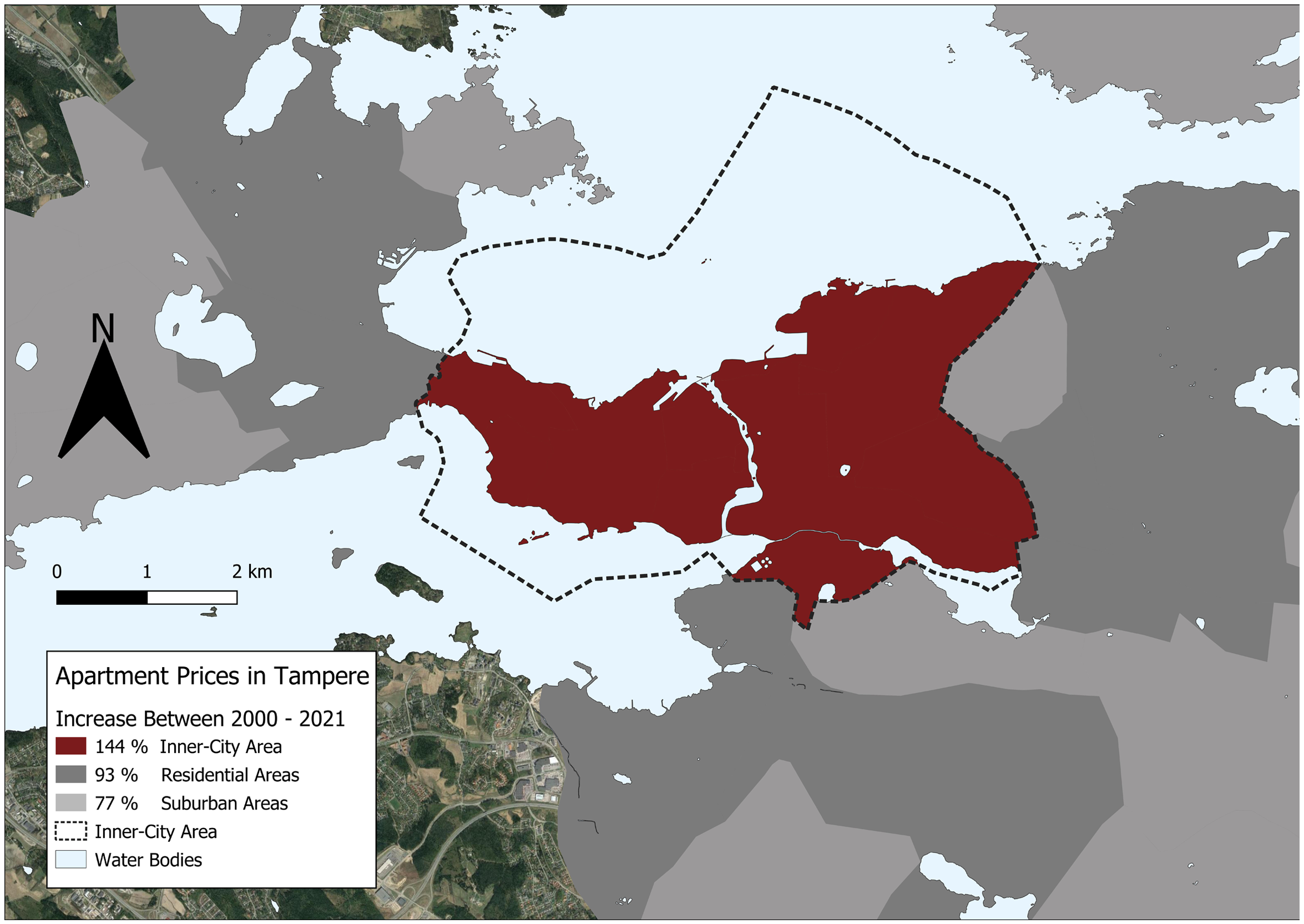
Increase in old apartment prices in housing companies in Tampere between 2000 and 2021. The map indicates the gentrification of the inner-city area. Map produced from Statistics Finland data.
For example, in 2009, the average apartment price in the inner-city area was 2518€ (2743 USD) per square meter, and in 2021, it was 4046€ (4408 USD) per square meter (Statistics Finland 2021). In residential and suburban areas, apartment prices have lagged, while in the city center prices have continued to rise. Under the welfare state model until the beginning of twenty-first century, Finnish urban planning in municipalities was more focused on developing the suburban areas further away from the city centers. A rapid shift in the urban planning strategies took place after the recession 2008. Since that, for the city of Tampere and private investors in urban development, the most significant land-value increase has been made with inner-city urban densification and brownfield development, resulting in skyrocketing real-estate prizes. The idea of sustainable city development became intertwined with urban densification strategies. Within the inner-city area, we have identified three neighborhoods where sustainable city development is causing gentrification, but in very different ways. These neighborhoods are Ratina, Lappi, and Tammela (Tammela A and B in the statistical registers), all with specific features that have led to eco-gentrification (see the basic information on the areas in Table 1).
Basic Information of Tampere and Three Gentrifying Neighborhoods.
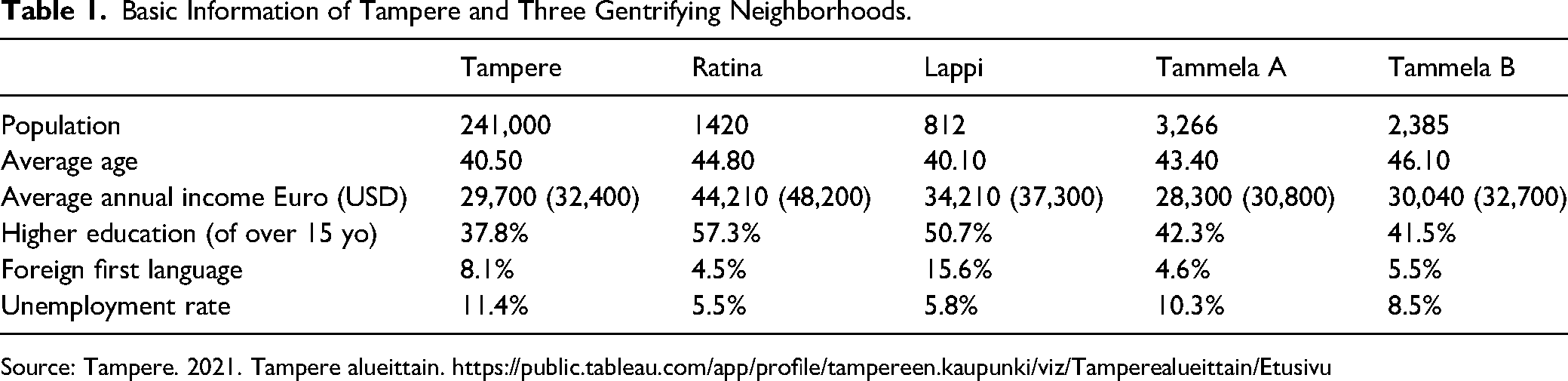
Source: Tampere. 2021. Tampere alueittain. https://public.tableau.com/app/profile/tampereen.kaupunki/viz/Tamperealueittain/Etusivu
The statistics give clues to how these areas differ from the average Tampere population. All three areas are located less than a mile from downtown, have clear proximity to green and blue areas, and use visible marketing of ecological values in the newly built apartments (Figure 2).
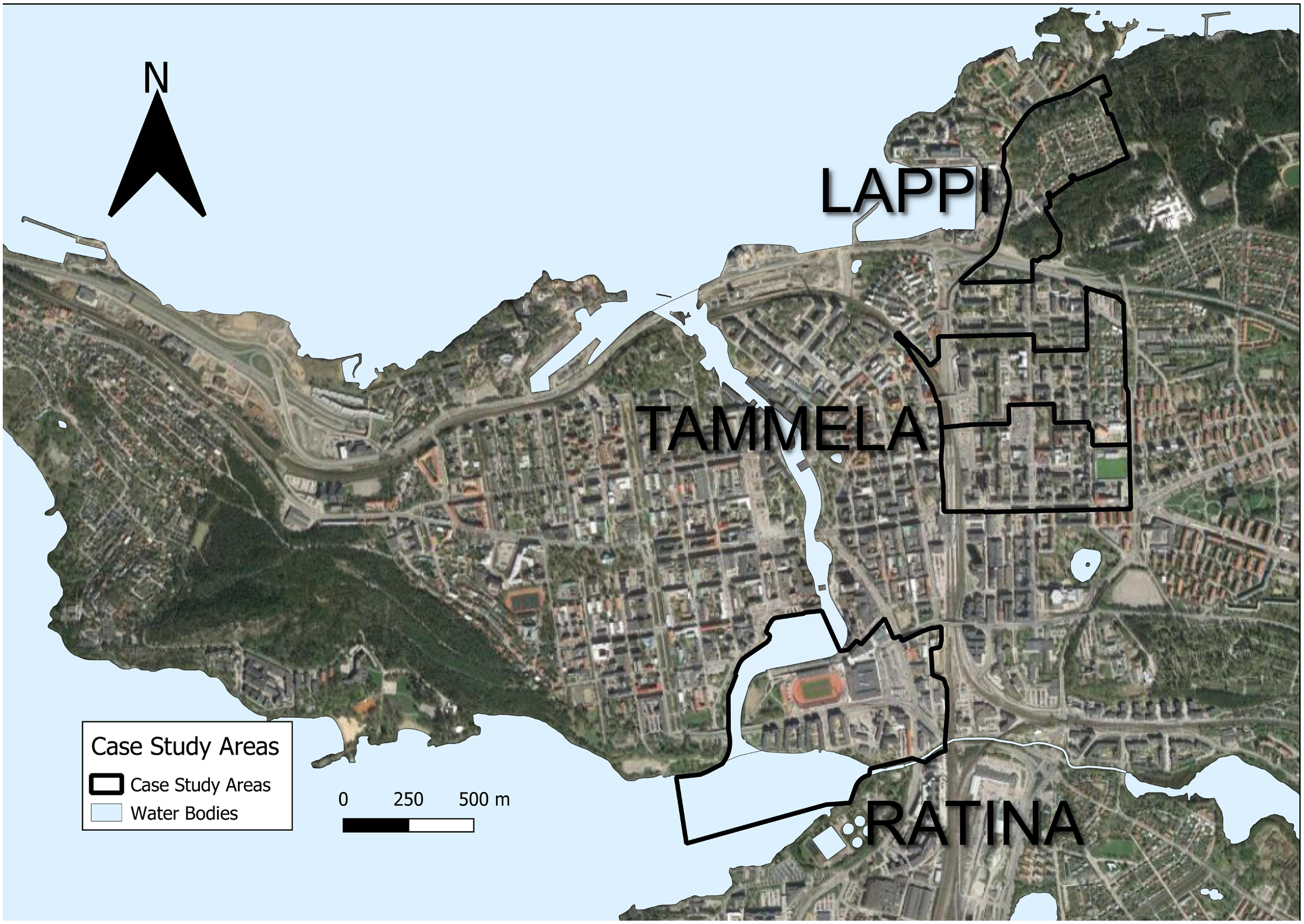
Case study areas Lappi, Tammela, and Ratina in inner-city Tampere.
Tammela is located north of Tampere railway station and consists mainly of apartment buildings built in the 1960s and 1970s. According to the city strategy, Tammela is one of the most important urban infill areas (Wallin et al. 2018) and, at the same time, one of the fastest-growing inner-city neighborhoods in Tampere. An old brownfield area, Ratina, is located next to the city center and new shopping center complex. The apartments built between 2008–2013 have been sold at high prices due to their location on the shore of Lake Pyhäjärvi and the lake scenery (Nyholm 2018). The third area, Lappi, was built between the 1910s and 1940s. The strengths of the neighborhood are the unified and protected wooden housing, close to the lake and the beaches in the west and the large city park in the north.
Retrofitting, Remaking and Preserving: Evidence of Eco-gentrification in a Welfare City
In the following, we will go through in detail the three different types of eco-gentrification in Tampere. Tammela is an area that has been retrofitted to meet sustainable city ideals and has undergone an intense urban renewal process. The former brownfield area, Ratina, has been completely remade in line with the new sustainable city development. The historic urban and green neighborhood, Lappi, is preserved, paradoxically creating a sanctuary from sustainable city development and thus resulting in eco-gentrification.
Tammela: Retrofitting an Inner-City Neighborhood
Tammela, an area consisting of predominantly wooden blocks of buildings, experienced its first radical transformation during the 1960s and 1970s. At the time, new concrete element buildings offered the best that the welfare state wanted to offer for citizens: Water closets and functioning kitchens in all apartments. The architecture of the buildings surrounded by large parking areas gave Tammela a suburban housing estate profile, although the area was very close to the city center. The next transformation phase started in 2013. Since then, the area has been a pilot site for the city's refurbishment and energy-efficient renovations (Laine and Helena 2013; Wallin et al. 2018). From the city's point of view, Tammela is an affordable urban infill area due to its existing infrastructure. There are several buildings that have gone through successful energy-efficient renovations. Tammela represents a typical area close to the city center that has the potential for sustainability-based urban renewal where local businesses and service structures, as well as public transportation, can be further developed (see Bouzarovski, Frankowski, and Tirado Herrero 2018; Wallin 2021).
In terms of climate change mitigation, Tammela is a good example: people are moving there because one can walk to services, the city's busiest marketplace is in the middle of the area, the railway station and the new tramway are operating within five minutes’ walk (see Figure 3). The investments have created an attractive residential area in Tammela for those who appreciate the services of the city center, as well as an attractive destination for real estate investors. There are plenty of rental apartments in the area. Tammela's location is central, close to large office buildings, the university and a wide range of services. The historic stratification of Tammela can be seen in the street scene, as old factories have been converted for residential use, and some of the building stock has been preserved for more than a hundred years. Tammela has several long-lived lunch restaurants, small repair shops, and various cafés, ethnic restaurants, and vintage shops as newer entrants. Nearby, there are two well-maintained parks. In addition, Tammela has easy access to the shores of Lake Näsijärvi and Kauppi Forest, the largest urban green area of the city.
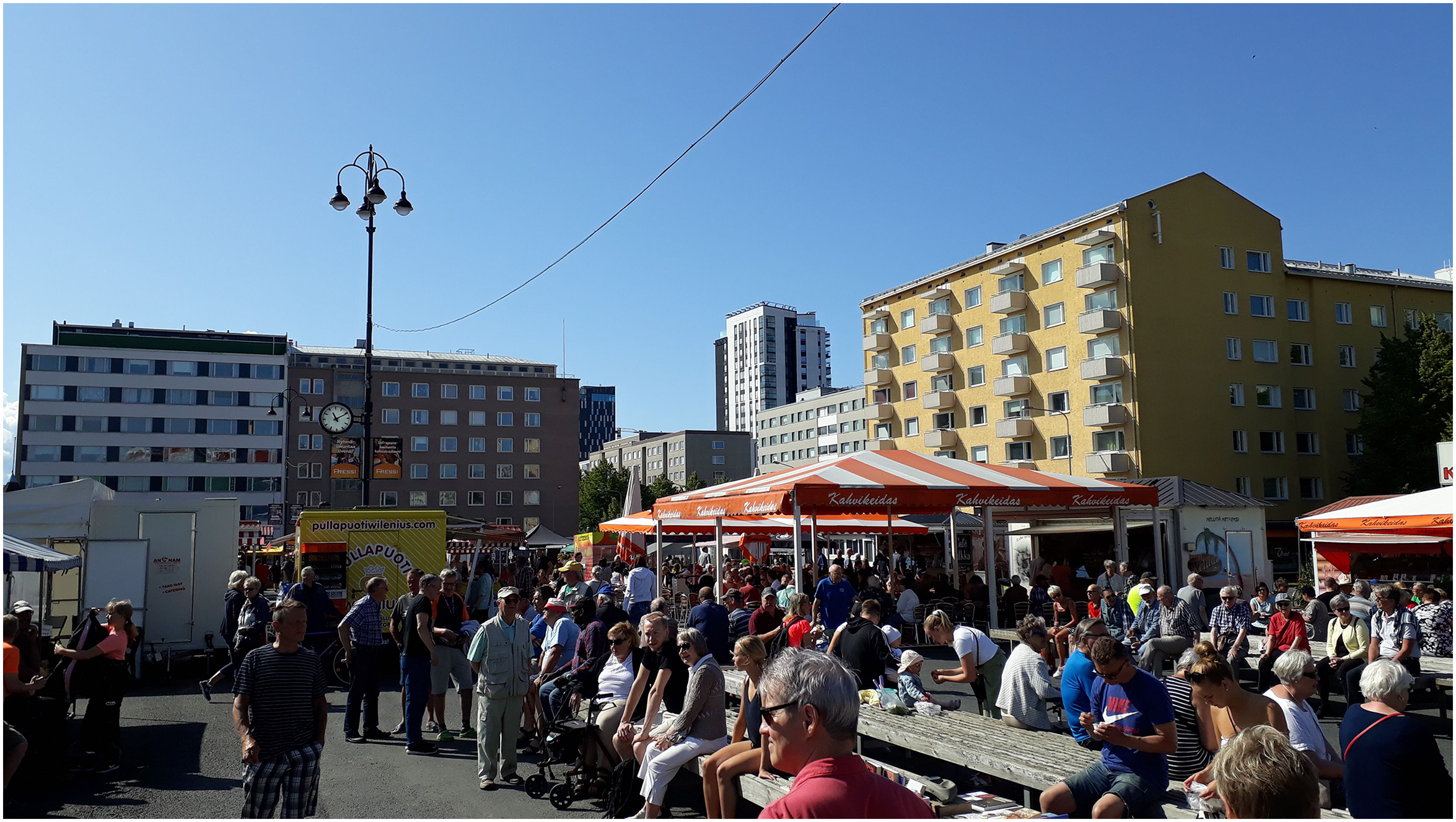
Tammela marketplace is a popular gathering place for older residents. Photo Antti Wallin.
Eco-gentrification is not only a result of concrete sustainability measures but also a symbolic development due to the changing lifestyles and housing preferences of urban dwellers. The changing areas of the city, such as Tammela, are also of interest to the dwellers in the format of new restaurants and other services, which have found customers in young and well-off residents. In such cases, long-term residents may experience the changes as alienating (Kern 2015; Wallin, 2018; Goossens, Oosterlynck and Bradt 2020). Usually, it is the high-income “creative class” that demands a cleaner and greener urban environment (Anguelovski et al. 2019). Awareness of climate change and the loss of biodiversity has affected people's lifestyles, especially in the urban environment. In the public debate, a “good carbon citizen” (Winter 2019: 14) considers individual consumption, chooses public transportation, cycles, walks, eats vegetarian and local food, and makes ethical choices (Winter 2019; Rice et al. 2020).
The Tammela area is changing in many ways, both physically and in the daily life practices of the residents. The dwellers who moved in in the 1960s and 1970s were mainly working for paper, cotton, machinery and shoe industries at the time. Strong urban infill and new residents have increased the supply of services and leisure activities in the area. Tammela is a Finnish example of eco-gentrification that combines Winter's (2019) results on the conscious life choices of high-income people and the diversity of services sought by knowledge workers illustrated by Rice et al. (2020), thereby increasing real estate values, changing neighborhood identity, and slowly pushing away working-class residents (Goossens, Oosterlynck and Bradt 2020).
Remaking Ratina: From Industrial use to Residential Area
Ratina is a typical area vacant from previous industrial use. During the welfare state's golden age, the area was on the outskirts of the inner city, providing space for industrial use with homeless shelters and other social services for marginalized groups. The value of the land and interest in investing in the area rose at the beginning of the 2000s. In Finland, as elsewhere globally, due to economic restructuring, former brownfield areas have been left vacant, and new urban development possibilities have opened up near city centers. This kind of refurbishment is taking place in several cities that are heading for sustainable city development strategy and want to attract capital to the city (see Curran and Hamilton 2012; Pearsall 2012). As a result, gentrification, in these cases, is often understood as a part of natural urban evolution (Curran and Hamilton 2012).
The transformation of Ratina from an industrial area into a residential area proceeded 2008–2013. All the residential buildings are apartment buildings, most of which are owner-occupied dwellings, but there are also some rental houses. In the past, the area has had industrial activities, such as the headquarters of the city power plant company. In Ratina, the infrastructure and architectural elements of the industrial period are still visible. Red bricks have been used on the facades of the new houses, respecting industrial history. The proximity of Lake Pyhäjärvi has been carefully taken into account in the design of the houses. The high-quality construction of Ratina received the Sustainable Stone House award in recognition of its planning and implementation (Simola 2011). Attributes related to sustainability, quality, and the lake landscape have been utilized in housing marketing in the area (Nyholm 2018).
The location of Ratina on the shores of Lake Pyhäjärvi, right next to the city center, has led to fast-rising land value and considerable building rights. The result is expensive housing and the goal of high-quality construction. The waterfront has private boat moorings, a green connection to the city center with dog parks and a popular outdoor exercise venue. In general, the average age of the residents is four years higher than the city average (Table 1).
According to the study by Nyholm (2018), Pyhäjärvi and its waterfront form a significant part of the place's identity in Ratina's living experiences and everyday life (see Figure 4). For many, the idea of the lake view opening from the windows has sealed their decision to move. Examples like Ratina can be found internationally, with construction companies and investors seeing the potential of former industrial areas (Gould and Lewis 2016).
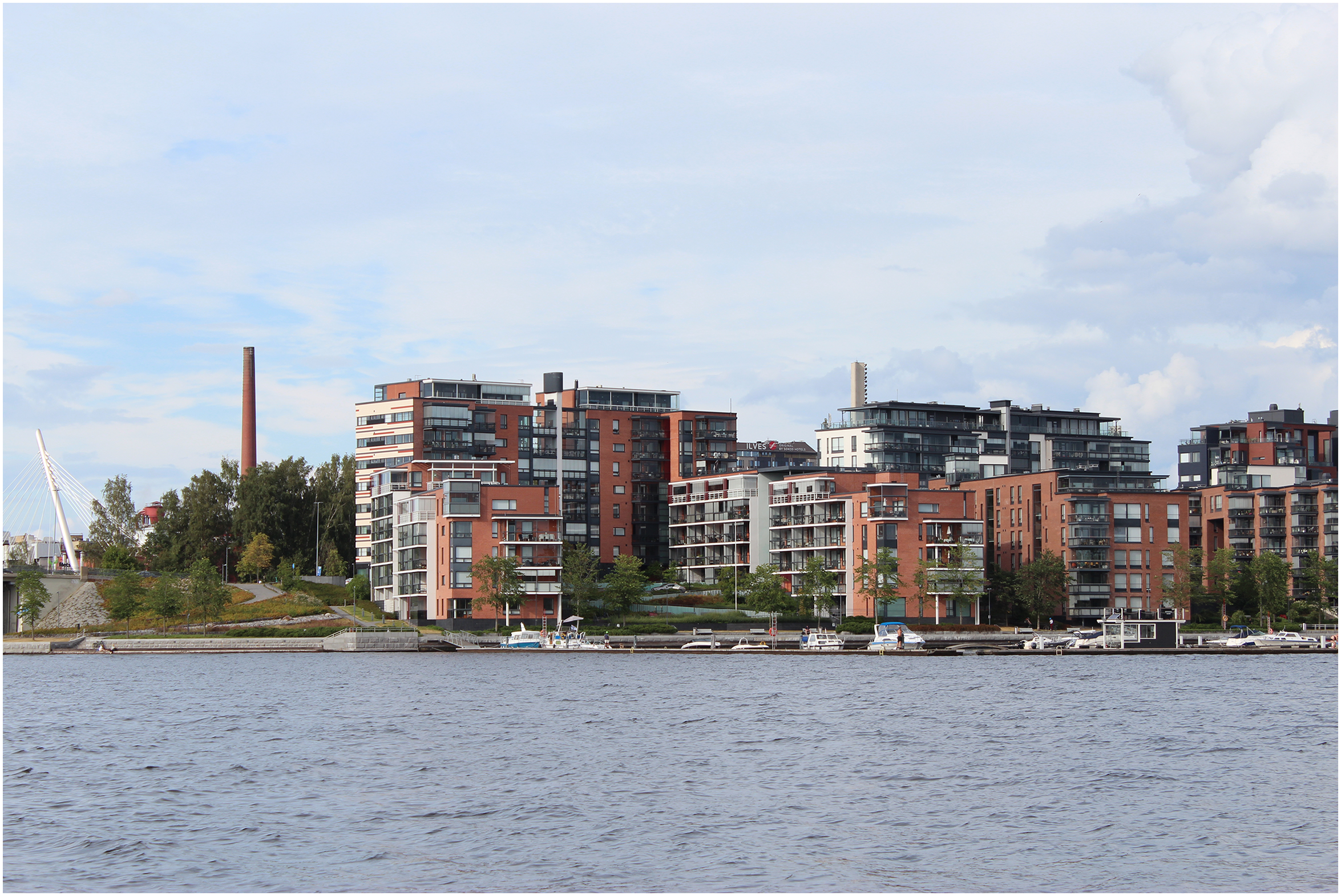
Ratina is remade on a brownfield site. Photo Antti Wallin.
The clean-up and revitalization of industrial areas are often aimed at well-off residents. This development also took place in Ratina, where the goal was to build a high-quality residential area for high-income residents, which can be interpreted as new-build gentrification. In such a case, low-income residents and smaller businesses are excluded from the development of the area. In Ratina, by cleaning up the traces of industry and using the existing architectural elements, it was possible to produce a significant difference in the potential land value (see Anguelovski et al. 2019).
Globally, the clean-up and redevelopment of brownfield sites have increased the value and rents in neighboring areas. As a result, retirees, ethnic minorities, and low-income residents suffer from the costs of redevelopment. Remaking brownfield sites into green neighborhoods is an essential part of sustainable city development that significantly stands out from the welfare ethos. In the welfare city, the public distribution of resources aims to balance socioeconomic differences between population groups and neighborhoods, but in the sustainable city, public investments are increasingly directed to benefit the well-off population (Holgersen and Baeten 2016).
Preserving Lappi: Nurturing the Cultural and Green Environment
The detached house area in the Lappi neighborhood is located northeast of the city center.
Houses are rarely available on the housing market, as they are sold directly without real estate agents. The wooden neighborhood was initially built for the working class between the 1910s and 1940s (see Figure 5). The buildings in the Lappi area are mostly log semidetached houses, almost all of which are now combined into single-family apartments. During the times of welfare state growth, the area did not face a similar destiny as Tammela, where almost all the wooden blocks were demolished and replaced with concrete element blocks of flats. However, Lappi was also not a trendy and favorable place to live in the 1970s and 1980s, but currently, the detached housing area in Lappi is a nationally valuable built environment site defined by the Finnish Heritage Agency (RKY 2009). The residential buildings are located close to the roads, making the area pleasantly varied and diverse. From Lappi, one can quickly get to the largest urban forest, Kauppi, and to the popular Rauhaniemi beach. In winter, the Rauhaniemi Folk Spa nearby is a popular public sauna (Haavisto 2013).
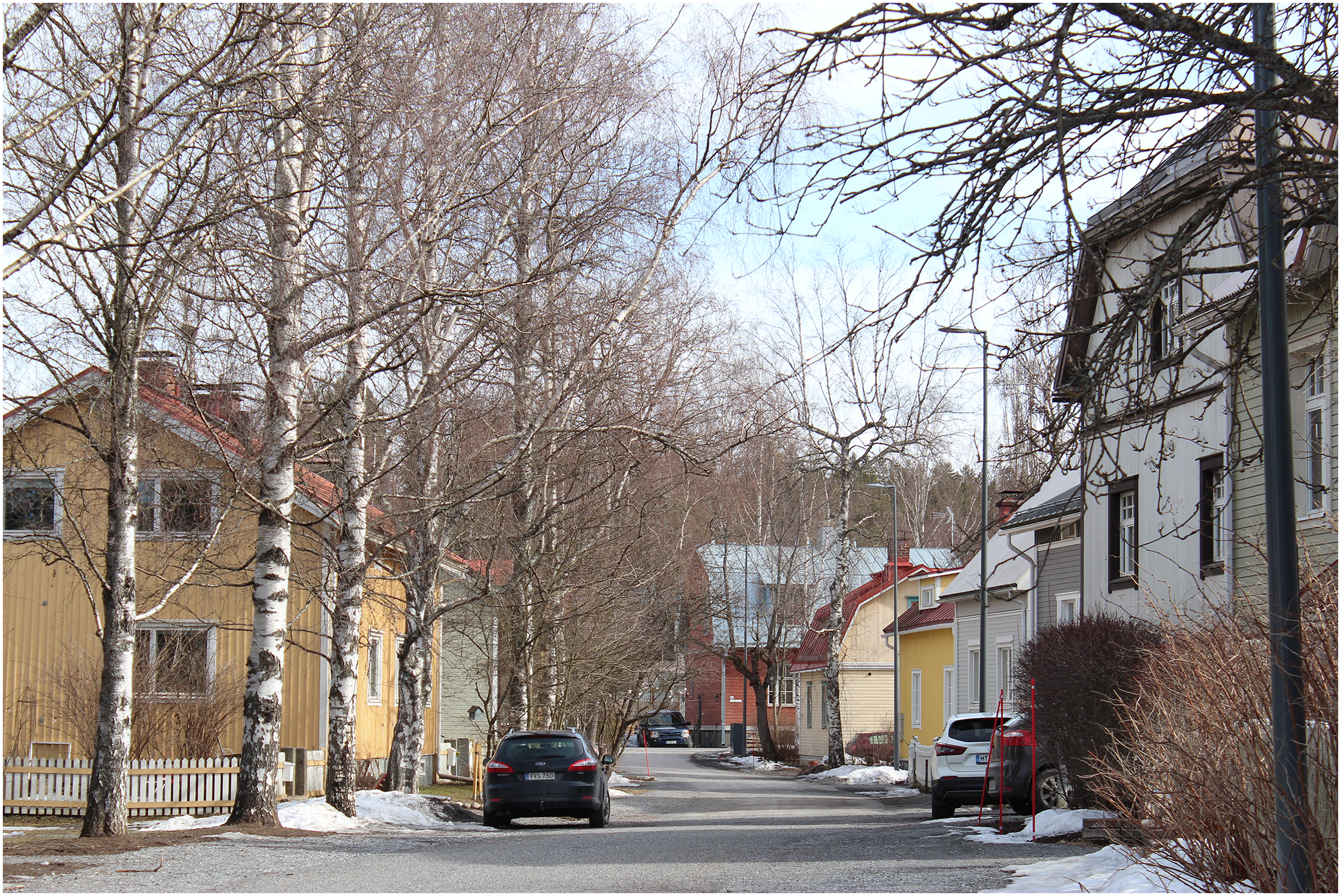
Lappi consists of preserved wooden buildings. Photo Antti Wallin.
The district is also a popular outdoor destination among other dwellers. The popularity is influenced by the historical environment of the area, the unity of the buildings, and the recognizable features of the historical era, as well as the green environment. It is not possible to drive a car through the neighborhood, making it safe for people of all ages to walk, cycle, and relax. The value of the area has risen in recent years as the city has grown vastly. As Lappi received a classification of a nationally protected area, it meant that the historic and green environments were protected from construction. In Finland, there are examples of neighborhoods consisting of uniform wooden houses in other cities as well. They represent a particular historical period and receive protection status in the city's zoning plan. The status of being a nationally valuable urban area functions as an assurance that these areas will not be subjected to urban development (Heininen-Blomstedt 2013).
In cultural studies, the link between the protection of cultural heritage sites and gentrification has been recognized (Grevstad-Nordbrock and Vojnovic 2019). In cities around the world, historic areas are often protected, which has raised rents and real estate prices (Huovinen 2017). According to our interpretation, the symbolic and material elements available in the Lappi district fulfill the signs of green gentrification. The national protection ranking from 2009 ensures that the area stays clear from urban development projects. The only buildings built during the welfare state's prime time were rental student houses. Currently, these buildings are being demolished and mostly turned into expensive houses for well-off citizens.
Although the neighborhood is not the best example of the city's sustainability policy in housing development or a hotspot for businesses and the creation of new capital, it is a highly eco-gentrifying area in terms of residents’ lifestyle aspirations. The desirability of the area has risen significantly during the rapid intensification of the surrounding downtown areas. Preserved areas became scarce in the course of the welfare city development and vigorous urban transformation. The area's rise in the city's symbolic neighborhood hierarchy shows that eco-gentrification does not necessarily depend on large-scale urban development but can manifest through changing middle-class lifestyles and nostalgic housing preferences (Kern 2015; Winter 2019). Eco-gentrification is associated with sustainable urban development, but paradoxically, the neighborhood's preservation status causes gentrification as the city transforms into a sustainable city.
As we reflect on how urban development proceeded under the welfare state model in the studied neighborhoods, the diverse historical trajectories leading to eco-gentrification become visible. Tammela, which is currently being retrofitted to meet the sustainable city ideals in densifying inner-city, was developed for blue-collar workers with standard housing during the prime of welfare state policy. The former brownfield area, Ratina, which has been completely remade in line with the new sustainable city development, was not part of welfare city housing development. The historic and nationally preserved neighborhood, Lappi, has through its stability resulted as an eco-gentrificated area. At welfare city housing policy's peak Lappi was ruled out from urban development as already then some of the buildings were considered to be relevant for architectural heritage conservation.
Concluding Discussion
Eco-gentrification has become a globally recognized and diligently researched phenomenon during the last decade. In the Nordic countries, the debate has been relatively absent thus far. Even though Nordic countries have a strong welfare state tradition in housing, it is evident that eco-gentrification is part of current city development. Rapid urbanization and the transformation of former industrial areas into sustainable use is an attractive narrative for the key actors of land use development. As Davoudi, Kallio and Häkli (2021) have argued, numerous reports have been commissioned and selectively used to support and legitimate the shift in the national policy from a consensus-oriented approach with a focus on welfare provision to a competitiveness-oriented approach with a focus on efficiency and growth (Davoudi, Kallio and Häkli 2021). Following the same line of thought, the new sustainable light rail transportation network is having a favorable effect on CO2 emissions in Tampere, but simultaneously, the new transport line has increased housing prices along the tramway line. Thus, sustainable city strategies not only enhance the sustainability objectives, but also intensify eco-gentrification.
Moreover, sustainable city development reinforces the segregation of residential areas that are left out of sustainability investments such as tramline connections or urban greening initiatives. An essential challenge for municipalities is enabling affordable housing in inner-city neighborhoods undergoing rapid transformation. It is extremely difficult to introduce affordable housing to areas where urban regeneration has already started, and land values have risen. Therefore, integrating affordable housing more strongly into urban sustainability measures is crucial. However, this is not always easy, even if the city municipality is determined to advance social mixing, as development companies can be reluctant to construct lower-profit housing.
The ongoing transformation from welfare cities into a sustainable city ethos has several serious, unexpected, and previously unnoticed consequences. City development policies have moved from regulation aiming to balanced societal progress toward market orientation and global investments. With these changes, eco-gentrification is likely to increase without strong national policy measures. What makes this an even more complex phenomenon to solve is the fact that neighborhood change is a relational question, meaning that the housing structure of specific areas can reject the applicability of national housing policy tools. This unintended outcome is visible in the case of preserved neighborhoods, where options to increase rental housing are almost nonexistent.
The Nordic welfare state tradition is still an essential value for national and local level politicians and civil servants. While welfare state development in cities was strongly led by national legislation, the implementation of sustainable development objectives is based on the idea that the state makes strategic recommendations and economic incentives to cities and city regions. These, along with the novel health and social service reform, will make cities more focused on the issues they can act upon, namely land use and planning, and attracting wealthy citizens that contribute to the local economy (Davoudi, Kallio and Häkli 2021; Leino, Wallin and Laine, 2022).
For welfare states to also fulfill the aspect of social sustainability, more research is needed to anticipate the social implications sustainability transition has on the city level (Wallin 2021). Urban greening and the wider goals of sustainable development are difficult to question in public. As Checker (2011) has argued, the urban development projects remain a-political, and do not provoke critical public debate that would focus on the economic interests inherent in development activities. This is also evident in the Nordic countries, where sustainable urban development's social implications are not critically discussed (see Holgersen and Malm 2015; Leino, Wallin and Laine, 2022). As urban planning is moving from socio-spatial welfare distribution to green growth urbanism, this is simultaneously creating a serious challenge for keeping welfare state ideals alive in urban development. Thus, raising awareness among urban authorities is crucial to losing the naïve belief that sustainable city development will automatically benefit all.
Footnotes
Declaration of Conflicting Interests
The authors declared no potential conflicts of interest with respect to the research, authorship, and/or publication of this article.
Funding
The authors disclosed receipt of the following financial support for the research, authorship, and/or publication of this article: This work was supported by the Research Council of Finland, (grant number 327161).
