



Abstract
This systematic review explores how the provision and experience of public toilets in urban spaces are gendered in North America, Europe, Australia, and New Zealand. A search of 4 bibliographic databases resulted in 19 articles for inclusion. Data were analyzed using a feminist critical perspective and the United Nations (UN) framework on standards to assess the provision of sanitation in public spaces. The framework criteria include availability; accessibility; affordability; quality and safety; and acceptability, privacy, and dignity. This review demonstrates that more public toilets that consider the needs of all genders are needed, and it offers guidance to policymakers, planners, and funders on what to consider when planning and building them.
Introduction
Understanding the ways that place and space are gendered is important not just as a theoretical exercise but because places and spaces actually construct or impede the ways that women, men, and persons of other genders use spaces and understand their place within them The very way that public spaces are designed, the symbols within them, the interactions they foster or prevent, construct our sense of place, and feelings of belonging within them (Massey 1994). Henri Lefebvre (1991) introduced the concept of the “right to the city,” the notion that public spaces are contested spaces where some hold rights and others do not but that city spaces should be for the common good for all. Fenster (2005) and later Beebeejaun (2017) expanded Lefebvre's concept of the right to the city to also consider how people's rights and experiences within public spaces are gendered, and that women's experiences of public spaces are different. Safety, rights, access, and the ability to move through public spaces are not the same for all individuals and this includes public toilets. Women also use public space differently, taking transit more often and therefore having less access to home, work, or other private spaces as they navigate urban streets (Afacan and Gurel 2015). Women's differing needs of public toilet provision impact their mobility, their feelings of safety, and their need for public toilet facilities are different because of menstruation, pregnancy, menopause, and caregiving (Greed 2016).
To understand how public toilets are gendered it is not sufficient to just look at the experiences of women and girls, to do so is to reinforce the hegemonic notion of a gender binary. As Doan (2010) argues, trans people, intersexed, and gender-nonconforming people have traditionally been left out of feminist geographers’ analyses of public space, even though they are subjected to a “tyranny of exclusion” because they do not conform to gendered norms. For the purposes of this article, we will use the terms women, girls, trans people, and gender-nonconforming people. We recognize that trans women and trans men are women and men, respectively, but also that public toilets are highly gendered places and trans people have very specific experiences of exclusion and oppression in spaces. It is therefore important to speak specifically to these experiences as opposed to just using the collective term of women (Doan 2010). We also use the term gender nonconforming to be inclusive of intersex and gender fluid identities, recognizing the limitations and shortcomings of any one or two terms to fully represent the complexity of gender representations outside of the binary.
Not all women, trans, and gender-nonconforming people experience public toilets similarly. Kimberlé Crenshaw's (1991) theory of intersectionality drawing on decades of Black feminist thought (Collins 1990; Davis 1972; Lorde 1984) contends that white women's experiences do not fully represent the different dimensions of discrimination and power that Black women and racialized women face and that any analysis needs to consider the dual impacts of racism and sexism. Intersectionality acknowledges various axes of power and differences that are inclusive of gender, race, class, age, and sexuality and how these intersections influence how people experience discrimination and exclusion (Collins 1990). It is important to note that intersectionality is not just about individual experiences of various forms of oppression, it is also about how history, geography, and shifting forms of power relations intersect with oppression (Smooth 2010). An analysis of how public toilets are gendered must take into consideration the varying experiences, power, and structural oppressions that impact particularly Black, racialized, and Indigenous women alongside class, ability, age, and culture. The authors of this article are both white, cisgendered individuals, one is a woman, and one is a man, and we acknowledge the limitations of these identities and positions in this analysis.
The history of how and where public toilets were built gives us context into how public toilets are highly gendered spaces and how women's experiences were excluded. In Victorian-era United Kingdom, toilets were built to encourage civility, giving men a place to go that was out in public but contained. Yet some Victorians resisted public toilets, thinking that what should happen in private was becoming “too public” and should not be given the kind of attention that public toilets presented. Given that women's proper place was in the private sphere of the home, their need for public places to use the toilet was not acknowledged in the United Kingdom, and they were excluded entirely from public toilet design for another forty years (McCabe 2012). Similarly in the United States, it was not until the twentieth century that public toilets accommodated both men and women (Ramster, Greed and Bichard 2018). The history of public toilets in New Zealand is similar, with men's toilets first being installed in public in 1862, while women's toilets were not introduced to the public for another sixty years (Cooper, Robin and Wood 2000). In an essay on the provision of toilets during the early twentieth century in London, Dublin, Toronto, and Chicago, Flanagan (2014) asserts how male-dominated organizations and municipalities explicitly set out to build cities that met the needs of its male citizens to preserve the city as patriarchal space. Black and racialized people in the southern United States were either excluded from using public toilets altogether, or forced to use racially segregated facilities that were not maintained to the same standards as white facilities. This exclusion persisted even after the Civil Rights Act came into effect (Anthony and Dufresne 2007) and set the stage for a continued lack of consideration of the needs of Black and racialized folks and public washrooms.
Toilets that meet the needs of people beyond the gender binary of men and women is a much more recent development as washrooms have typically and in many ways continue to be sites of exclusion and marginalization for trans and gender-nonconforming people (Cavanagh 2010). The first unisex public toilet was opened in the United Kingdom in 1964, although it was built to meet the needs of people with disabilities, not trans or gender-nonconforming people (Murib 2020). Human rights legislation in places like Ontario, Canada has confirmed people's right to use washrooms that match their gender and changes to the Ontario Building Code regulations in 2015 mean that there must be at least one universal washroom in new buildings or where renovations are done (Ontario Human Rights Code 2014). These universal washrooms are better at meeting the needs of gender-nonconforming people who do not identify as woman or man. There has been an increase of universal toilets or gender-neutral toilets being built or converted in North America but despite this, there are several states in the US enacting legislated discrimination in the form of “Bathroom Bills” against trans and gender-nonconforming people's use of washrooms that match their gender identities. These bills make it illegal for someone to use a washroom facility that does not meet their assigned gender at birth or what their perceived gender identity is and some bathroom bills go as far as to make it crime of “public indecency” (Murib 2020). Public toilets are contested sites where politics and power are played out and the issue of toilets and trans exclusion are clear expressions of this contested power.
Much of contemporary research on sanitation and gender focuses on the global South where the lack of provision and access to sanitation is urgent and critical to women and girls’ health (Jonnalagadda and Tanniru 2014; Reddy et al. 2019; Schmitt et al. 2018; Sharma, Aasavari and Anand 2015). Yet, the lack of public toilet facilities and an understanding of how public toilets are gendered is also an issue in North America, Europe, Australia, and New Zealand but it has not been studied to the same degree, which is why this systematic review has been undertaken inclusive of these places. Clara Greed has written extensively on the need for more facilities for women and girls and how toilet provision has not been taken up seriously by planners, politicians, and civic organizations (Greed 1994, 1996, 2016, 2020).
The United Nations Sustainable Goals identified sanitation as necessary to achieve gender equality. To address this, a 2019 report of the United Nations General Assembly highlighted the need for access to sanitation not just close to home but also in public spaces and a framework of standards was created to assess the provision of sanitation in public spaces. The framework includes the criteria of availability; accessibility; affordability; quality and safety; acceptability, privacy, and dignity (Human Rights Council 2019).
Given the importance of public toilets to gender equity and recognizing the gendered nature of public toilet provision and experiences, this systematic review uses a critical feminist analysis throughout. Feminist critical analysis in geography for this context is concerned with the interconnections of gendered space, power, and knowledge (Peake 2017), as well as disrupting notions of a gender binary (Sothern and Dyck 2009), all with an aim of social transformation and policy change. It involves being critical and reflexive from the very beginning of the research process inclusive of the formation of the research questions literature review choices, methodology, and onwards. It also requires understanding our own positionality as researchers with identities, experiences, and relationships to power and revisiting and troubling these relationships throughout the research process (Cupples 2002; England 1994; Kobayashi 1994)
The authors collected and analyzed the literature surrounding women, girls, trans, and gender-nonconforming people's experiences of public toilets within the context of the UN Framework with the recognition it does not impact everyone equally and is in fact gendered.
The UN criteria is equally of use in the global North as it is in the global South, and this article's analysis is particularly relevant in informing government bodies, policymakers, and planners to build public toilets on a scale and an approach that addresses the gendered need for public toilets.
Methods
Four bibliographic databases (SCOPUS, Gender Studies, Arts and Humanities Combined, and Sociological Abstracts) were searched in April of 2022. They were chosen for their relevancy to the research question. Databases such as GOOGLE scholar were not chosen as the authors deemed the findings would be duplicated through chosen databases. The search strategy was focused on qualitative, quantitative, and mixed-method studies, not book manuscripts or theoretical articles. The latter was included in the initial search criteria to inform background literature and context in the introduction. Databases and search terms were as follows:
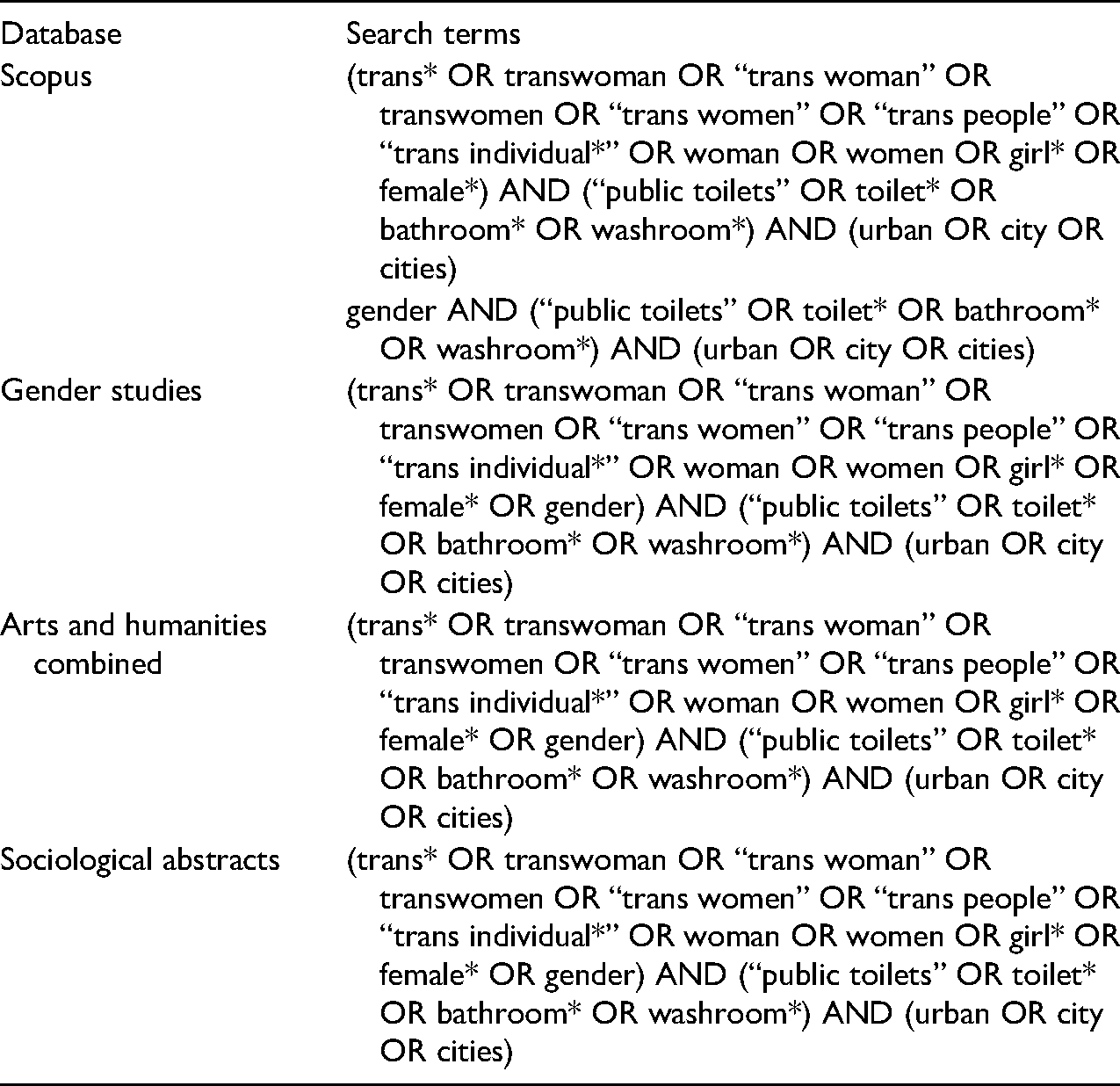
Inclusion criteria for analysis included: (a) a focus on public toilets including on-street, parks, libraries, markets, and public buildings; (b) the population or topic primarily considered women, girls, trans, or gender-nonconforming persons; (c) study location was North America, Europe, Australia, or New Zealand; and (d) the setting was urban. Articles were excluded if: (a) research of toilets was primarily within private settings such as private businesses, restaurants, shopping malls, and schools; (b) participants were exclusively or primarily cisgendered men; (c) geographically the research was within what is considered the global South; and (d) the setting was only a rural environment.
With the inclusion/exclusion criteria in mind, titles, and abstracts were screened by the two authors independently, and then a full-text assessment of each remaining article was conducted by the primary author. In addition, the reference list of each included full-text article was reviewed to identify potential additional articles.
From the articles remaining after full-text screening, direct quotes were extracted, analyzed, and synthesized using directed content analysis. Directed content analysis means starting with existing research findings or a theory as the basis for codes (Hsieh and Shannon 2005). In our case, the United Nations Framework on the Human Right to Water and Sanitation in Public Spaces and its corresponding five categories of criteria provided the directed content we searched for and extracted. The UN themes were extracted and tracked in a Microsoft Excel Spreadsheet, placed within columns reflecting the UN Framework categories. For the purposes of this article, the definitions used for each category were adapted and revised from the UN document and are as follows:
Availability—what location the public toilets are in, how that location is used, how many people use the space, and the demographic make-up of those people. In addition, the number of toilets, sinks, amenities, and menstrual hygiene facilities available to ensure people are not waiting and have what they need.
Accessibility—the structure of the building and public toilet facilities so that they are accessible physically for “for all people at all times” of different abilities. Open during times people use those spaces in terms of both hours and seasonality. Facilities must be available to all genders, inclusive of signage, where people are easily able to access facilities that matches their gender.
Affordability—facilities at no cost or low cost to ensure adequate provision for all. For this article, affordability is also understood to be the lack of public options setting up the need to pay for access through private facilities.
Quality and safety
Acceptability, privacy, and dignity
A feminist critical approach was taken throughout the research process. Feminist critical methods in this systematic review include the authors continual consideration of their own gendered identities in the research process (Cupples 2002; England 1994; Kobayashi 1994); the background literature included to understand how public toilets are gendered and intersectional; the inclusion criteria of gender, trans, and nonbinary terms in the systematic review; the interpretation of the results and discussion to explicitly understand its ties to gender and intersectional considerations; and lastly the social transformation aim of this article being policy change to create public toilets that work for all genders.
Results
The initial search of the four databases resulted in 2771 records. Initial screening to remove duplicates resulted in 140 documents and title screening further reduced the number of articles to 96. Title and abstract screening of those 96 articles by two reviewers left 73 articles and full screening resulted in a final total of 19 articles (see Table 1). The articles excluded after full screening were due to 17 articles not being a study (they were books or theoretical papers), 18 that that were not focused on public toilets, 13 because the study was outside the included geographical area, 4 of them were not focused on gender (women, trans, or gender-nonconforming people, 1 article's location was in a rural setting and one article was unavailable for a full screen. That left 19 articles that met all the inclusion criteria.
Summary of Included Articles and the UN Framework Criteria.
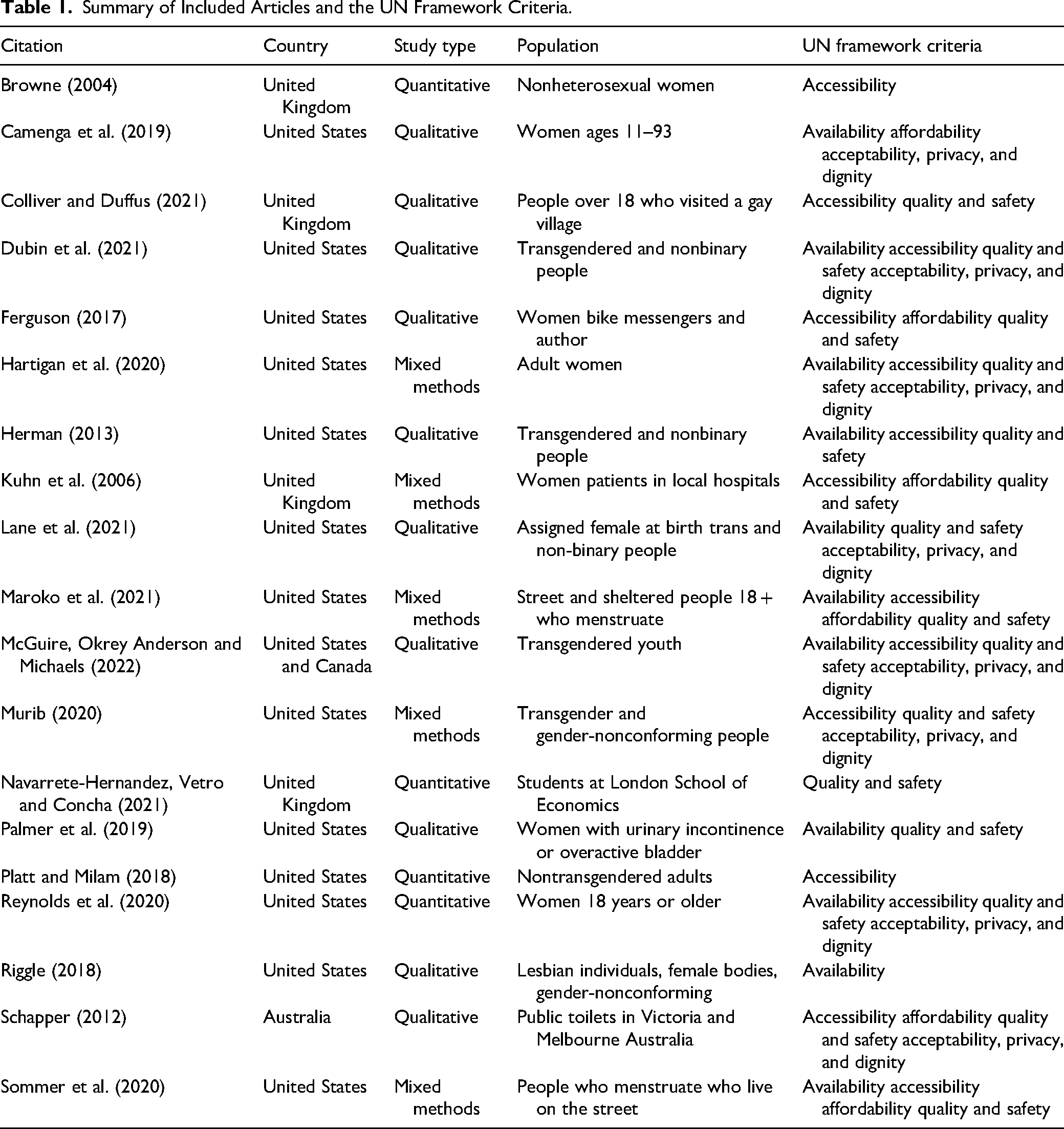
A total of 10 articles were qualitative, 4 quantitative, and 5 were mixed-method studies.
Geographically, 13 articles were from the United States, 1 from the United States, Canada, and Ireland; 4 from the United Kingdom; and 1 from Australia and New Zealand. A directed content analysis was undertaken for each section of the 5 criteria of the United Nations Framework: 11 articles addressed availability; 14 accessibility; 6 affordability; 15 on quality and safety; and 8 for acceptability, privacy, and dignity. From there, we inductively analyzed each of the criteria for more specific themes that emerged related to the main theme. Each author independently came up with a list of specific themes within each main theme criterion, we then came together as authors to compare these through discussions, work out disagreements and produced a final agreed-upon list of themes within each criterion. An example being in the theme availability, the more specific themes of proximity, available amenities, and behavioral impacts were found (see Figure 1). A PRISMA flow diagram in Figure 2 outlines the search process.
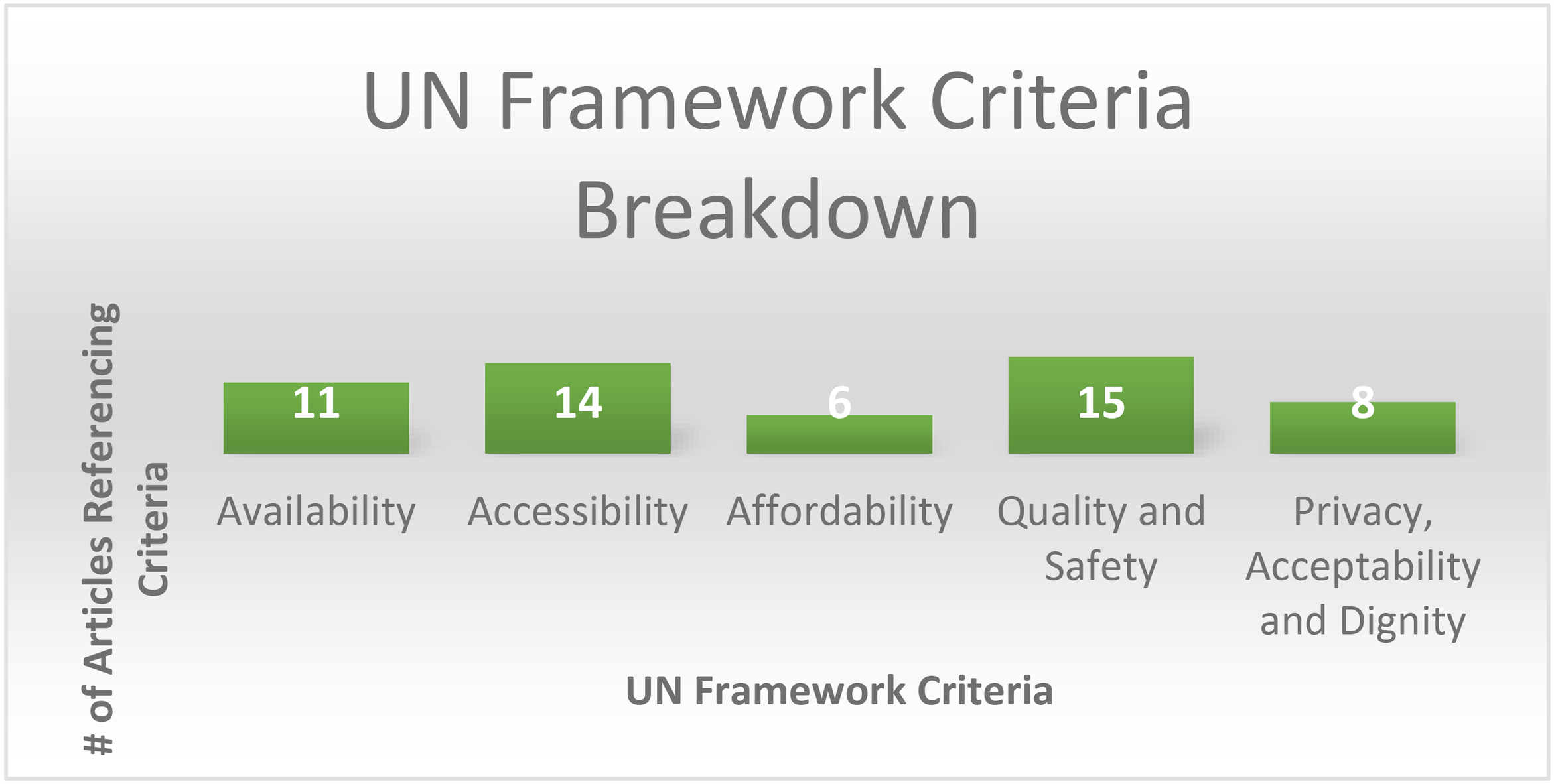
United Nations Framework criteria.
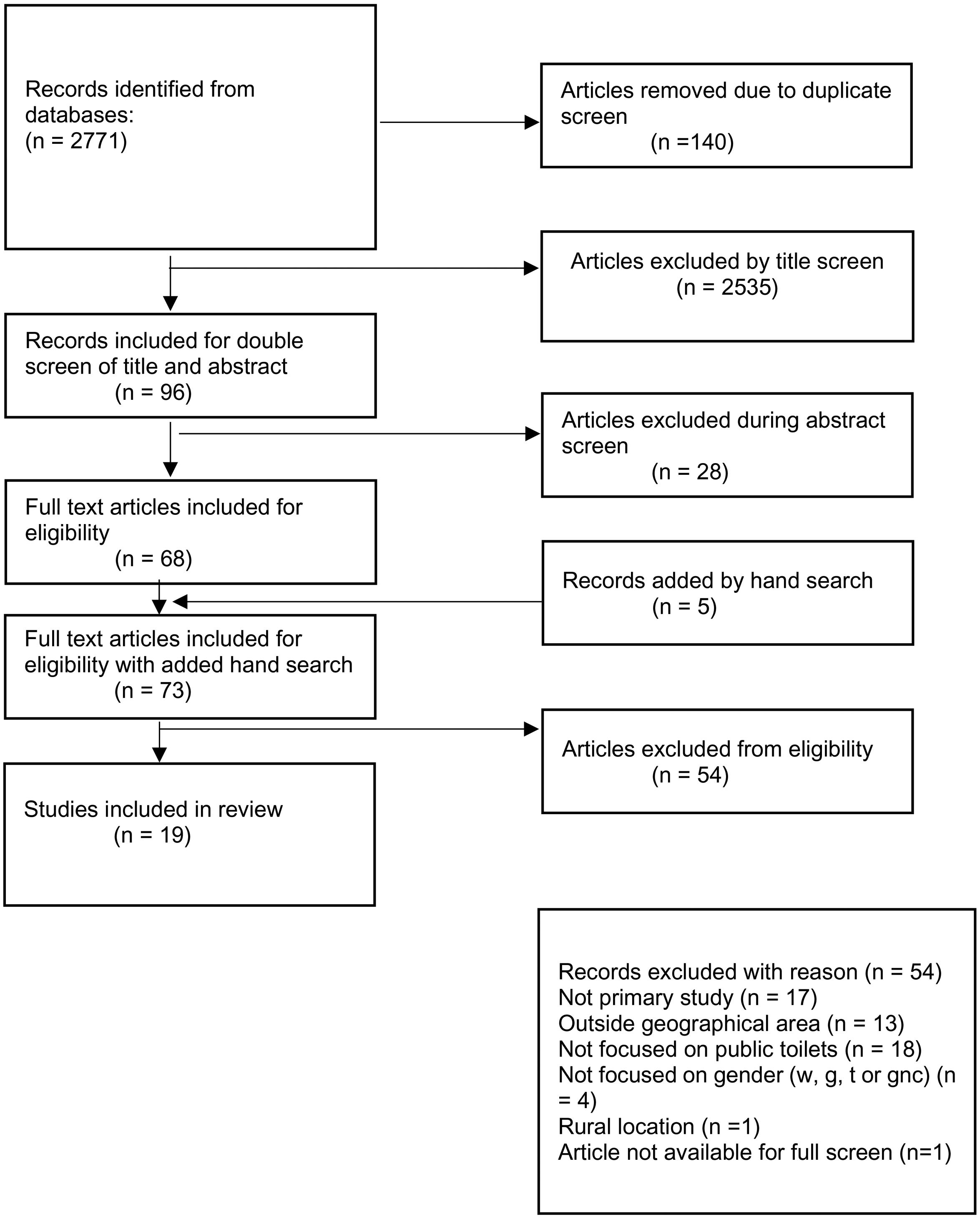
PRISMA flow diagram of study selection of public toilets and gender in urban spaces.
Availability
There is a lack of public toilet facilities in major centers such as New York City (Dubin et al. 2021; Lane et al. 2021) and Washington DC (Herman 2013), impacting certain communities more than others, including women, girls, people who are experiencing homelessness, and trans people. Within different studies, women and girls expressed concern about the general lack of availability of public toilet facilities (Palmer et al. 2019), the distance needed to travel to them (Hartigan et al. 2020), and longer wait lines even when there were public facilities available (Camenga et al. 2019). People who were homeless faced barriers finding public toilets to use in the areas they live in and this issue was compounded for those who menstruate (Maroko et al. 2021; Sommer et al. 2020). Issues around the scarcity of gender-neutral toilets for use were a concern for trans and gender-nonconforming people (Lane et al. 2021; Riggle 2018). Beyond the number of toilet facilities, having other needed amenities available within toilet facilities was an issue of concern among women, those experiencing homelessness, and trans people. Women expressed how public toilets varied in the provision of soap, hand sanitizer, paper products, and seat covers (Hartigan et al. 2020). In an audit of public toilets in Manhattan by Maroko et al. (2021), not all facilities had functioning stall doors (96 percent), locks on doors (92 percent), and only 60 percent provided a place to put bags, clothing, or other belongings. Menstrual hygiene bins and products were an issue with only 24 percent having disposal bins, 12 percent having vending machines for menstrual products, and none having free products. Even when menstrual hygiene management amenities were available, they were only available in gender-segregated women's washrooms, leaving trans men who menstruate without access (Lane et al. 2021).
Availability or lack of availability of public washrooms also changed the behavior impact of how women, girls, and gender-nonconforming people used public spaces. Women used the men's washroom if there were not enough facilities to meet their needs (Camenga et al. 2019; Palmer et al. 2019) and avoided public toilets altogether if basic amenities could not be counted on (Hartigan et al. 2020). For transgender youth, the lack of facilities impacted how much water they drank, when and if they went out in public, and the holding of toileting needs (McGuire, Okrey Anderson and Michaels 2022). In two other studies of transgender and gender-nonconforming adults, avoidance of events and planning specific routes through a city to access facilities were common ways of addressing the lack of safe public toilets (Dubin et al. 2021; Herman 2013).
Accessibility
Temporal barriers emerged as a common theme around accessibility. For people who are homeless, being able to access public toilets at night or having them not open when expected was a concern (Sommer et al. 2020). This issue was compounded for those who menstruate given the need to manage menstruation at all times of the day and the inability to do this privately in public outdoor spaces. An audit of public toilets in Manhattan, New York serving street and unsheltered adults who menstruate, only four facilities were open twenty-four hours a day, seven days a week all year, and each of those four facilities was inside a public building (police station or transit station) where not everyone felt comfortable accessing the building: “So, you have to, like, go to the subway to use the bathroom, and those are closed from midnight to 5am. They’re, um, they don’t even always open them at 5am” (Maroko et al. 2021).
It was also identified that even with perceived twenty-four hours a day seven days a week opening there would still be closings for cleaning and maintenance. In a study of public toilet access and women with urinary incontinence in Southampton, England, it was found that out of five public toilets located, four were locked or vandalized making them inaccessible and rendering them useless (Kuhn et al. 2006). For those whose jobs are situated in public spaces like bike messengers, finding unlocked public toilets is rare and can impact who takes on these roles (Ferguson 2017).
How public toilet buildings are physically designed and configured impacts accessibility and reflects how they are gendered, serving some populations better than others. Small stalls, lack of menstrual hygiene management facilities, and not enough privacy means that these facilities often do not provide what those who are menstruating need (Sommer et al. 2020). In a survey of women in the United States, it was found that for caregivers, who are often women, the lack of accessibility regarding parenting needs was an additional barrier to use: “I have a 14-month-old, and I often carry her into stores. If I have to use the restroom, I have nowhere to put her while I go” (Hartigan et al. 2020, 11). Issues of stall size and barriers for mobility were also concerns “The room is small, cramped and poorly laid out” (11).
The design of facilities should allow all genders to access facilities that match their gender identity, but this is often not the case given the tendency toward cisgender binary options in most public toilets. One way to get around this exclusion is inclusive signing that welcomes trans and gender-nonconforming people to enter the restroom that meets their needs (McGuire, Okrey Anderson and Michaels 2022), but given the surveillance, harassment, and policing of gender that happens in public toilets (Colliver and Duffus 2021; Herman 2013; Platt and Milam 2018), signage may not be enough. Schapper looked specifically at text and signage in public toilets in Victoria, Australia and found an example where signs were posted stating the arbitrary age of seven as being the cutoff for boys to be allowed into the women's washroom: Although I did not see a sign that excludes transgendered men/women or a sign that indicates toilets are only for those people who are biologically women, what I did see in this research were signs that designate seven as the age at which boy children can no longer share the space of women. (Schapper 2012, 14)
This signage reinforces a cisgender binary and the exclusion of trans and gender-nonconforming people in these spaces. In a study looking at trans and gender-nonconforming people's experiences of LGBTQ community centers in the United States, along with interviews of transgender youth and young adults in the United States, Canada, and Ireland, 26 percent had experienced some form of questioning, harassment, or denial while using toileting facilities. Because I’ve been like, yelled at so many times for going into the female bathroom and sometimes when I go into the male bathroom, I still get yelled at. Because some people notice that I’m gay and some people won’t. Some people notice that I’m actually female and going into the boy's bathroom or someone will notice that think that I’m a boy going into the girl's bathroom so. (McGuire, Okrey Anderson and Michaels 2022, 53)
The binary gender segregation of public toilets makes them inaccessible to people who are gender nonconforming and do not fit into cisnormative gender categories of woman or man, leaving them without a real choice that fits their gender identity and reinforcing gender binary identities (Browne 2004). When there are gender-neutral toilets that are accessible, gender-nonconforming people have expressed it is an affirmation of their identity and expression of feeling included (Colliver and Duffus 2021; Dubin et al. 2021). The move toward more gender-neutral toilets within many public facilities has been seen as one way of creating more accessible toilets for all.
Affordability
Affordability in public toilets has to do with whether one must pay to access the toilets, creating financial barriers for some who may not be able to pay. In the context of this article, it also means the way private corporate interests impact the provision of public toilets and how social class and race influence where public toilets are located. Having to pay to use public toilets directly was found in only one study located in Southampton, United Kingdom (Kuhn et al. 2006), but there were other studies that found people had to pay money to access public spaces that had toilets (subways) or needed to seek permission of an attendant (museums) (Maroko et al. 2021). Other studies specifically discussed the need to buy things to access private toilets in commercial settings because of the lack of available public toilets (Camenga et al. 2019), demonstrating that availability and affordability are linked because without available free public toilets, people are left with no option but to buy things to use facilities (Sommer et al. 2020).
Paying to access spaces also involves gatekeeping, who is seen as acceptable to use these spaces, and who is not: “…a lot of times they’re skeptical about letting people in the bathrooms because people in there go and get high and stuff, so they don’t let anybody use the bathroom” (Sommer et al. 2020, 4). Another theme around affordability has to do with where private toilets are built, what resources they contain, and who has access to them. Maroko et al. (2021) found that public toilets that had access to menstrual hygiene management products were in higher-income and higher-rent areas. Lower-income areas with higher concentrations of Latinx people were less likely to have well-serviced public toilet facilities, leaving them at a resource disadvantage. Private corporate interests creep into public facilities through advertising and signage, reinforcing the conceptualization of women as consumers (Schapper 2012).
Quality and Safety
The location or the design of the facilities had an impact on perceived safety and whether women, trans, and gender-nonconforming people would use facilities, expressing concerns about assault even without a history of an assault having happened (Hartigan et al. 2020). Trans people looked to the layout, privacy, and locking abilities of the public toilets and linked this to how safe they felt (Dubin et al. 2021). In Kuhn et al. (2006) study of women with urinary incontinence, women expressed they knew of public toilets that were typically vandalized and that vandalism was connected to feelings of safety. In a study with students from the London School of Economics in the United Kingdom using photo-simulated scenarios, it was found that women were most sensitive to improvements in public space and feelings of safety, but there was not a statistically significant enough result to determine that the presence of public toilets increases women's perception of safety (Navarrete-Hernandez, Vetro and Concha 2021). Location, lighting, and remoteness of toilet facilities impacted feelings of safety (Hartigan et al. 2020).
Trans and gender-nonconforming people have specific experiences of being harassed verbally, physically, or through aggressive gazing in public toilets: “People will sometimes say things or like tell me to get out of the women's bathroom or shake their head at me or say homo as they pass” (McGuire, Okrey Anderson and Michaels 2022). In Herman (2013), respondents from Washington, DC, reported being told to leave facilities and harassed in multiple ways, including having the police called, being followed out of facilities, and being directly confronted while using them. In the same study, it was found that gender and race were not specifically associated with harassment, but income was, with people making US$49,999 or less annually more likely to experience verbal harassment. In terms of physical assault, 9% of respondents in this study had been physically attacked and there was a small relationship to race/ethnicity as well as income. The impact of this abuse on trans people's health was significant with 54 percent of people reporting a physical health issue connected to holding in their toileting needs, as well as impacting how they travel through public spaces to avoid toilets. Gender-neutral toilets have been cited by Colliver and Duffus (2021) as a safer alternative for trans and gender-nonconforming people.
Cleanliness was an issue in public toilet use. In one national United States study, the most common reason women reported avoiding public toilets was because of cleanliness which led to them holding urine until they got home (Reynolds et al. 2020). In another United States study in North Carolina and Pennsylvania, women with urinary tract infections or overactive bladders expressed cleanliness as being one of their biggest concerns with public toilets. This concern led to hovering over toilets, not completely finishing voiding and avoiding public toilet facilities altogether (Palmer et al. 2019). In Hartigan's study (2021) of women across the United States, busy restrooms were associated with being less clean: “Since it has not been cleaned well (urine on the seat and floor which then dry and leave stains), I feel like I am dirty when I leave the bathroom” and issues with garbage and insects, “Our restrooms are filthy with dead roaches and there is no ventilation system present” (10). Gender-neutral toilets were associated with being less clean because of men's urine on the floor.
Acceptability, Privacy, and Dignity
Acceptability, privacy, and dignity have to do with the perception that a washroom meets one's needs culturally or socially. Women who have urinary health conditions may avoid public toilets because of their concerns about the lack of privacy if they pass gas, make noise, or have diarrhea (Hartigan et al. 2020). Sommer et al. (2020) also found the lack of public toilet facilities to deal with menstruation was an issue impacting the dignity of menstruating women and people who are homeless because blood is not easy to hide, and this visible transgression adds to their already precarious situation as people who are homeless, “… when you can’t clean yourself, you don’t want to be out, you don’t want to be seen, because you feel like everybody else can smell and see you” (5). It was also found that it was harder for women to use public toilets for hygiene such as bathing and laundering because of lack of privacy. The same was not true for men, but men's public bathing did deter women from using the same gender-neutral facilities because the facilities were left unclean by previous men users (Sommer et al. 2020).
For trans and gender-nonconforming people, typical facilities that have a large gap between doors led to feeling surveilled and judged, in facilities where there are line-ups for stalls there was a feeling of being pressured to hurry up which is difficult when doing menstrual hygiene (Lane et al. 2021). Suggestions to address this included adding better locks that indicate whether a stall is occupied, floor-to-ceiling walls to increase privacy, and eliminating gaps in stalls. The move toward gender-neutral toilets is an example of planners and policymakers better meeting the social and privacy needs of transgender and nonconforming people through design. In a study from the United States, Canada, and Ireland, McGuire, Okrey Anderson and Michaels (2022) looked at interviews with transgender youth who appreciated the option of gender-neutral toilets and how they provided anonymity as well as comfort but had concerns on where gender-segregated toilets were located and their distance from the women and men's washrooms as being inconvenient: “I just want to add though they actually have a gender neutral bathroom, but it's on the third floor. It's kinda like wow what if I’m trans and I gotta go pee now. I’m not gonna hike up all those stairs…what an inconvenience” (52). In a study reviewing transgender legislation between 2014 and 2018 in various states and cities across the United States, Murib (2020) raised concerns that having gender-neutral toilet facilities as a third restroom alongside gender-segregated facilities could reinforce the notion of gender binaries being normative, and those who are trans or gender-nonconforming as the other. Some states in the United States have enacted bathroom bills that reinforce gender segregation even when there are gender-neutral toilets in use. South Dakota passed a law requiring unisex toilets to put a sign on the door indicating someone from the opposite sex may be in the restroom. This reinforces the discriminatory belief that trans people do not belong in washrooms and may pose a danger (Murib 2020).
Although no studies addressed directly the specific cultural needs of women and girls, Schapper (2012) does discuss it as something that has developed historically and should be a consideration. How public toilets impact Black, racialized, and Indigenous people is not reflected in the literature and should be addressed in future research.
Discussion
This review focused on how the criteria of the United Nations Framework of standards on sanitation in public spaces was reflected in studies on women, girls, trans, and gender-nonconforming people's experiences of public toilets using a critical feminist analysis. The UN framework provides a measurement of how well public toilet provision in North America, Europe, Australia, and New Zealand meets the needs of these populations, and whether these standards are considered in the design of public toilet facilities. Other than a review by Moreira, Rezende and Passos (2021), no study has specifically used the UN framework, which is expected given the framework was only recently published in 2019. In Moirera et al.'s review, very few studies discussed gender, with most of the focus being on sex and biological needs, and even these studies were limited in number, thereby indicating more research related to gender and public toilets is needed.
Our own systematic review demonstrates a lack of public toilets in terms of actual facilities and the amenities provided within them; and the gendered impact related to health, wellbeing, and access to public space. Public toilets are not built in the numbers needed to serve people well, and for many women, girls, trans, and gender-nonconforming people this means they do not go to certain places or they put in a lot of energy to find routes where they know public toilets are available (Camenga et al. 2019; Dubin et al. 2021; Palmer et al. 2019). For those already marginalized due to lack of housing or shelter, the lack of public toilets is experienced on a daily basis and this is compounded further for people who menstruate (Sommer et al. 2020). Access to sanitation is a human right and one that is denied to those who lack access to their own private facilities through a home or reliable shelter space. The studies looking at people who are homeless or unsheltered took place prior to COVID-19, but Sommer et al. (2020) acknowledge that the pandemic likely had an additional impact. There is a need for research looking at the closure of public toilet facilities during the pandemic and the impact on various populations.
For people outside the gender binary, finding suitable gender-neutral toilets available is a struggle, although indications seem to be that they are increasingly available in some places and legislated in others. For those who menstruate or have health issues that make urgent voiding a reality, waiting in line or having others wait while you take care of your needs adds undue pressure and can impact whether someone goes out in public spaces or decides to stay home and avoid the risk. Available amenities were also a concern, the lack of soap, paper products, garbage bins, and menstrual hygiene facilities meant that women, girls, trans, and gender-nonconforming people either avoided certain facilities or they did not meet their needs when they used them (Maroko et al. 2021).
It is not enough to just have public facilities; they must also be open and physically accessible to all people. Public toilets that had limited hours, were open only seasonally, or were locked when they should have been open means a barrier to those who are counting on those facilities being available for use. For people who do not have housing or shelter they are essentially cut off from accessing a public toilet they have come to rely on (Sommer et al. 2020). Given most public washrooms are open in the warmer weather and closed in the colder weather in places like Canada, the northern United States, and Europe, means that there is no place for people to go to meet their needs in inclement weather. For those who have vaginas and menstruate, the extra clothing and layers could make going outside in public even more difficult. In addition, since public toilets provide access to public spaces, the lack of open facilities means that these public spaces may not be able to be used by those who are regularly in need of a toilet. Ideally, public toilets would be available twenty-four hours a day, seven days a week, all year round recognizing that people use public spaces and have toileting needs at all times and seasons. It was found that sometimes public toilets get locked and closed off to people because there has been vandalism. Rather than addressing the issue, the solution has been to close the facility and deny people access. This impact is gendered because women, girls, trans, and gender-nonconforming people have more complex toileting needs and have a higher need of public toilet facilities.
The lack of proper accessible facilities impacted women, girls, trans, and gender-nonconforming folks and how they used public spaces and planned their days. Beyond not having a place to go to the toilet when needed, lack of facilities meant avoiding certain events or places and putting work into travel plans to ensure access to toilets when needed. Given the additional caregiving and domestic responsibilities carried by women, they are responsible not only for their own toileting needs but also for those they care for. Not having enough toilet facilities available is a reflection that the needs of women, girls, trans, and gender-nonconforming people are not always taken into consideration when planning public spaces.
Accessibility of appropriate facilities that meet the needs of individuals was a big concern for trans and gender-nonconforming people. The dominance of binary gender-segregated facilities means that people who are not cisgender often do not have safe and accessible toilets to use (Murib 2020). Providing gender-neutral self-contained facilities with adequate amenities is one way to address this but even then, they are often limited in number or segregated from the women’s and men's facilities.
There was a lack of research explicitly looking at accessibility related to disabilities and gender except related to caregiver access to spaces. It was noted that stalls that are too small or limited in number prevented caregivers from being able to assist with the toileting needs of the person they are caring for (Anthony and Dufresne 2007). The physical layout and structure of the building need to be accessible to people of all abilities, recognizing that certain disabilities have more complex toileting needs, particularly for people with vaginas.
Most of the studies in this review, except for one (Kuhn et al. 2006), included public toilets that do not charge a fee to use them, which is positive considering women and girls go to the washroom more frequently. Toilet fees are an additional barrier for access and an obvious barrier to those who are street involved without shelter, who have no option of a personal toilet to use for day-to-day toileting needs. That said, the lack of available public toilet facilities means that many people must pay for products in a coffee shop, restaurant, or other commercial facility to access their toilets. This invisible fee is felt more readily by those who need to use facilities more frequently creating additional barriers based on gender and income. In addition, those who are street involved cannot always access private facilities as they lack the money to buy something and cannot easily slip in unnoticed given they may not conform to societal standards of dress and personal presentation (Maroko et al. 2021). People who are trans or gender nonconforming may also be more surveilled in private commercial toilets as there is more gatekeeping involved in gaining access.
Historically there was a shift away from the provision of public toilets by municipalities to a reliance on the private sector providing toilets (Sommer et al. 2020). Access to toilets in public spaces is considered a human right and there should not be a reliance on the private sector to provide something so fundamental to people's everyday needs. As Greed (2016) argues, women's needs are often overlooked in planning cities and the reliance on the private sector to provide toilets reflects patriarchal structures and decision-making that do not adequately take into consideration the impacts and exclusion of women, girls, trans, and gender-nonconforming people—particularly those who are most marginalized. Further studies looking at the impact of private toilets on access for various groups inclusive of gender, income, ability, age, and race would be beneficial.
Concern around safety is an issue that is highly gendered. Perceived safety impacts where women, girls, trans, and gender-nonconforming people will go to the washrooms, regardless of actual risk (Dubin et al. 2021). Women's restrooms have provided a space away from the male gaze and a place of sanctuary from the risk of male violence. These feelings of safety for cisgender women have been used to argue against gender-inclusive washrooms, inferring that trans women represent a risk to cisgender women, even though evidence does not back this up (Cavanagh 2010). This exclusion likely shows up in the practice of municipalities not including gender-inclusive washroom signage in some cases, but also more concerningly in anti-trans bathroom bills that criminalize the use of gendered washrooms by people who are not perceived to match that gender. Fear, harassment, and violence within public toilets were a common occurrence for trans and gender-nonconforming people in public washrooms. There has also been pushback around adapting existing gender-segregated washrooms into all gender washrooms as it leads to less access for women. Men's facilities usually have cubicles with toilets and a row of urinals, so almost double the number that women's facilities have. By opening women's facilities to all genders, it means more people using limited facilities in women's washrooms (Greed 2019). Rather than adapting existing women's facilities into gender-inclusive washrooms, the building of gender-inclusive, accessible self-contained rooms that have sinks and all amenities within them have been suggested as a best practice (Anthony and Dufresne 2007)
How well a facility is maintained, particularly in terms of cleanliness is gendered. Women will avoid restrooms if they anticipate that the facilities are not adequate and studies such as Reynolds et al. (2020) demonstrate this avoidance is connected to unhealthy toilet behaviors that can impact bladder health. Given that men stand to urinate, and women generally sit on toilets or hover, how clean the facility is impacts them in different ways. More research specifically on how quality and safety impacts use from a gendered perspective would be helpful.
Toileting is connected to disgust and shame. A lot of time is spent hiding one's toileting needs or activities and therefore privacy and dignity are important in the design of public toilets. For those with health issues and those who may not want their gender to be surveilled, privacy is a big concern. Culturally, there are differences in the way people use washrooms and the gendered impacts of this, but more research is needed to identify whether public toilets meet these needs or not. An assumption would be that more private, self-contained accessible toilets would be better as privacy is an issue for most people. Having available, accessible, affordable, clean, quality, private public toilets is connected to dignity. If people do not have a good and easily available place to go to the washroom there is a higher risk of accidents and since it is harder for women, girls, trans, and gender-nonconforming people to go to the washroom just anywhere, having public toilets is an issue of dignity.
There was a distinct gap in the literature surrounding race and intersectional considerations related to any of the United Nation's criteria. Given that race is a major determinant of marginalization in most facets of life, further research into how race and gender intersect around access to good-quality washrooms is urgently needed.
Recommendations for Policy Makers, Governments, and Planners
There are generally not enough public toilets to meet the needs of people in public places and this impacts the ways that people can use and enjoy urban spaces. Public spaces like parks, squares, downtown cores, and transit stops are meant to be used and enjoyed by all and everyone has ongoing toileting needs. The ability to move through a city to work, for pleasure and to just live is vital to people's health, and economic and social wellbeing. Without having good quality accessible public toilets available some people are impacted more than others. When planning public spaces or facilities, including the provision of public toilets that meet the needs of all people is important to creating vibrant, economically strong, and inclusive cities.
Many public spaces are used at all times of day, and in all seasons, therefore public toilets should aim for the same. Self-contained, accessible, gender-neutral toilets with their own door, locks, occupied status, full walls, sinks, bins, diapering facilities, and menstrual hygiene facilities are the best ways to meet the needs of all people. These facilities ensure access to everyone by being large enough to meet the needs of people with disabilities and people with caregivers. By being for everyone and self-contained, they ensure nobody is policed for using the wrong restroom, and full walls and locked doors ensure privacy and dignity. Having signs indicating the unit is occupied prevents others from knocking and trying of door and decreases feeling of pressure to hurry up. Having adequate amenities, including menstrual hygiene management facilities means these self-contained rooms meet the needs of all people including those who menstruate. Regular cleaning and monitoring are needed to ensure facilities remain clean and usable, which is true for any public facility.
One area of concern is that the increased privacy of self-contained units means they can become places for living or substance use. Needle bins are one amenity that should be readily available. In addition, since social issues intersect, providing support with social workers and wayfinding for people looking for housing and needed support around substance use in areas of need is important. A common response when substance use, habitation, or vandalism occurs in public toilets is to close and lock up the facilities, as opposed to addressing the underlying issues. This treats public toilets as building facilities as opposed to public services. Efforts should be made to address concerns as opposed to blocking access to a needed human right and need. More research is needed to determine how to maintain access and meet the needs of all people.
Limitations of Study
This systematic review of qualitative, quantitative, and mixed-method studies on public toilets and gender in public spaces in North America, Europe, Australia, and New Zealand provides a comprehensive look at how public toilet provision and access is gendered with a feminist critical analysis but there are several limitations to note. This review does not include gray literature from organizations and governments and instead focuses on academic studies. It should be noted there are also limited studies beyond the United Kingdom and the United States, limiting the applicability of the findings to the rest of Europe, Canada, Australia, and New Zealand. More research needs to be done to look at the provision of public toilets related to gender in these countries. Also, COVID-19 has shifted the understanding of public spaces and gender and there may be emerging research that was missed as part of this review. Disability, race, and culture are two factors that intersect with gender around public toilet use and provision and the absence of studies on this means that this review cannot fully account for these intersections and therefore more research is needed.
Conclusion
The United Nations General Assembly highlighted the need for access to sanitation not just close to home but also in public spaces and how this is a gendered issue. This systematic review highlights the gaps that exist in public toilet provision in the global North and how this systemic exclusion impacts women, girls, trans, and nonconforming people specifically. It is well understood that public spaces are gendered and the ability to move through urban environments is important to creating cities that increase people's health and wellbeing. A lack of available, accessible, clean, quality, safe, and affordable toilets that meet the needs of women, girls, trans, and gender-nonconforming people impedes these populations from being able to use public spaces. There are not enough quality public toilets and in the global North and instead, there is a reliance on the private sector to provide toilet access to people. This private sector approach to a human right leaves out certain communities who cannot afford, do not feel safe, or who are denied access. People who are homeless or street-involved who menstruate along with trans, and gender-nonconforming people face additional barriers to access and safety. Policymakers, governments, and planners can increase access to public spaces and gender equality by using the UN framework to plan and build public toilets that meet the needs of everyone. Good toilet provision needs to be done in the context of a full gender and equity-based planning approach that takes into consideration community needs, demographics, zoning, and mobility patterns.
Footnotes
Declaration of Conflicting Interests
The authors declared no potential conflicts of interest with respect to the research, authorship, and/or publication of this article.
Funding
The authors disclosed receipt of the following financial support for the research, authorship, and/or publication of this article: Graduate student funding was provided by Ontario Graduate Scholarship. Funders did not have any role in the analysis, writing, or publication of this study.
