




Abstract
In this article I illuminate the production and erasure of Queerspaces in Beirut as part of postwar gentrification. A dual Beirut has emerged within assemblages of sectarian power, sexual citizenship and political economy. Commercial Queerspaces tacitly incorporated into the neoliberal and sectarian state exist while the ‘Queer unwanted’– spaces and people deemed transgressive to the moral order – are violently erased by state and non-state actors. These dual spaces expose the limits on life for Queer communities. To analyse these dynamics, I turn to the testimonies of LGBTQ activists in Beirut in relation to the possibilities offered by Queerspace. While activists note the exclusions – class, gender and sexuality – of commercial Queerspace that restrain political agency, they have powerfully asserted radical intersectional politics into recent revolutionary anti-sectarian waves of protest. This politics is marked by articulating Queerness as a project of connecting marginality for all excluded groups in Lebanon’s postwar order and by a queering of sectarian/neoliberal space that has hitherto cleansed undesirable LGBTQ bodies. This article draws on extensive fieldwork in Beirut (2011 to 2020), thus permitting longitudinal research of LGBTQ activism.
Introduction
Two narratives iterate sexuality in Beirut, the capital city of Lebanon. In the first, international writers celebrate Beirut as ‘Gayrut’, the ‘gay paradise of the Arab world’ (Reid-Smith, 2012), an oasis noted for its purported sexual liberalism relative to the rest of the Middle East (Healy, 2009). The ‘gay scene’– coinciding in a select few bars and clubs – generates the ‘rainbow economy’, adding up to an estimated US$83 million annually (Sioufi, 2013). In the second narrative, Beirut is marked by state and non-state actors engaged in a joint enterprise to violently erase other Queerspaces and of harassment against LGBTQ individuals and activists framed as threats to morality. These acts of persecution are carried out under the auspices of Lebanon’s Penal Code, which criminalises sexual relations ‘against the order of nature’ (Helem, 2008).
Rather than contradictory representations, these two narratives expose the logic of the city’s postwar order wrought through uneven processes of urban reconstruction and gentrification which construct some sexual lives as useful and deserving of protection while others are cast outside of the body politic. On the one hand, gentrification has created a space of implicit tolerance for specific assemblages of sexuality, class and power, which are non-threatening to institutionalised homophobia, especially gender-normative and middle-class LGBTQ people (see Moussawi, 2018). On the other, this dynamic is mirrored by the ruthless, violent cleansing of spaces and forms of sexuality deemed to be transgressive. Working-class gays, sex workers, refugees and transpersons, and the spaces they inhabit, are brutally cast outside of the domain of acceptable sexual citizenship.
The reinforcing nexus between gentrification and Queerspace is one of the most significant bodies of research in urban studies (e.g. Brown, 2007; Castells, 1983; Doan, 2007; Doan and Higgins, 2011; Ghaziani, 2015; Hanhardt, 2013; Knopp, 2004; Nast, 2002; Oswin, 2005). A core debate centres on whether gentrified spaces can be harnessed for Queer counterpublics to emerge or if it channels LGBTQ activism into assimilationist and exclusivist politics that reproduce inequalities. These debates are often positioned within broader analyses of neoliberal forms of entrepreneurial urban governance that construct some queer lives as economically important while others are cast as worthless sexual citizens. Gentrification may open up opportunities for new Queerspaces but its corollary is a ‘tightening regulation of the types of sexualised spaces in cities’ (Bell and Binnie, 2004: 1818). Thus, rather than permit opportunities for LGBTQ rights to advance, critical scholars express anxieties with how ‘liberal queer strategies’ have become aligned with ‘urban modes of governance that are often inseparable from neoliberal, racist, nationalist, and militarist logics’ (Oswin, 2015: 560).
The relationship between gentrification and Queerspaces in postwar cities in which LGBTQ populations are criminalised is lacking in existing analyses (though see Moussawi, 2015, 2018, 2020), particularly in connection to activism. In the postwar city, the logic of gentrification is bound up with reconstruction, which drives new forms of social exclusion and violence rather than rebuilds peace (Akar, 2018; Fawaz, 2009; Nagle, 2016). It is to this absence that this article speaks. Towards this, I address two interrelated dynamics. First, I examine the coproduction and erasure of Queerspaces in Beirut within the context of postwar gentrification and reconstruction. Second, I turn to the testimonies and debates of activists in Beirut about the potentiality of Queerspaces as sites where new claims of local citizenship arise out of insurgent place-making (Greene, 2019).
Beirut is an important case study to examine these issues. Postwar Beirut has witnessed frenetic real estate activity, rapid gentrification and concomitant processes of social cleansing, population displacement, sectarian segregation and violence (see Akar, 2018; Fawaz, 2009; Krijnen, 2018; Krijnen and De Beukelaer, 2015). Gentrification in Beirut intersects with the colonisation of political and social life by sectarian networks and with the rise and erasure of various Queerspaces. Thus, rather than see Queerspace as bound up with entrepreneurial governance, in which sexual difference is increasingly marshalled for fostering urban competitiveness (Bell and Binnie, 2004; Hartal, 2019; Hubbard, 2013; Kanai, 2014), Beirut is marked by plural and uneven modes of governance characterised by sectarian groups exercising control over space. In this environment, the policing of sexuality is not always performed by state actors but is devolved to non-state groups.
Queer activism in Beirut has drawn significant scholarly attention, particularly since the first public queer movement in the Arab world emerged here (Merabet, 2014; Moussawi, 2018, 2020; Naber and Zaatari, 2014). Moussawi (2018, 2020), notably, analyses the different strategic choices deployed by activists contesting and engaging with dominant models of Euro-American LGBTQ organising. While some activists form professional NGO advocacy groups that pursue LGBTQ rights, others engage in more radical formations involved in intersectional struggles that embrace multiple political projects, including anti-imperialism, anti-racism and resistance to sectarianism and patriarchy (Naber and Zaatari, 2014). The potentiality of urban space for queer political projects is central to these analyses. Yet, while ‘gay spaces’ have emerged in Beirut, Moussawi (2018: 174) warns us not to assume that they can be read as evidence of societal tolerance since gender normativity and class shape LGBTQ individuals’ access to space. How, then, might activists engage in queering space, contesting and deconstructing its existing meanings and exclusionary usages in order for radical and intersectional politics to emerge?
The article is also more broadly positioned in postcolonial studies of gentrification and sexuality. While recognising the globalising trends of gentrification that drive the political economy dispossession, postcolonial perspectives stress the need to place diverse urban regimes within particular historical, contextual and temporal forces, and not just as component pieces in the identikit rolling out of neoliberal governance from the Global North to the South (e.g. Akar, 2018; Fawaz, 2009). Postcolonial work on sexuality refuses to impose ‘Western’‘neocolonial’ constructs of sexuality – particularly the fixed binaries of straight/homo – and progress onto places where sexuality is understood through a multiplicity of social and political processes (Meem, 2010; Moussawi, 2020). Yet, at the same time, the legacies of colonialism, globalism and transnational activism collide to create complex sexual epistemologies that are neither purely ‘local’ or ‘Western’.
The research in this article is based on eight fieldwork trips to Lebanon from 2011 to 2020, thus permitting longitudinal research of LGBTQ activism. It permits analysis of the development of activism in the critical immediate years after the emergence of public queer movements in Beirut. The research design focused on non-sectarian movements mobilising against Lebanon’s postwar power-sharing system. I draw on 40 interviews conducted with LGBTQ activists, human rights advocates, representatives of political parties and international actors (e.g. development agencies and embassies). Interviews spanned 30 minutes to 4 hours spread over a number of days. Interviews with queer activists ranged from leaders of professional NGOs to independent figures unaffiliated to advocacy groups. The age range of activists spanned college students in their early 20s to established leaders in their late 40s. As same-sex relations and non-normative gender is criminalised in Lebanon, resulting in the state harassment of activists, all interviews are anonymised. Purposive sampling was used for the selection of activists in order to gain inside-information-rich expertise. Since same-sex relations are criminalised, informal conversational interviews were conducted in a range of places specified by activists, including coffee shops and activist offices. An inductive approach was used to allow the data generated from interviews to determine common themes regarding strategies and spaces used by activists. These themes were then coded for analysis of emerging categories related to how activists perceive and use gentrified spaces for activism. The question of gentrification and activism, notably, was not one that I intended to research. It was an issue that activists often stressed in interviews as important in contextualising sexuality and activism in the city. I place this within a constructivist epistemology which focuses on understanding the social context in which individuals attach meaning to their social reality. I also refer to reports by activists, human rights groups and media outlets, including Helem, Meem, Arab Foundation for Freedom and Equality, LebMash and Human Rights Watch.
Sex in the gentrified city
LGBTQ populations represent central figures in debates about gentrification (Doan, 2015). Within the literature on the emancipatory city LGBTQ populations are agents of gentrification, constructing enclaves that provide safe havens for communities fleeing from ‘unjust geographies’ (Soja, 2013), places defined by homophobia and discrimination (D’Emilio, 1983; Ghaziani, 2015: 3; Knopp, 2004). As Doan and Higgins (2011: 22) summarises, such ‘gaybourhoods’ were ‘immensely attractive to young queer-identified individuals seeking to establish their non-normative identities and create an alternative and fully accepting community’. While recognising the liberating potential of Queerspaces within gentrification, the contested and exclusivist nature of these places looms large, particularly in terms of marginalising gender nonconformist populations, and by delineating neighbourhoods by class and race (Curran, 2017; Doan, 2007; Doan and Higgins, 2011; Nast, 2002; Oswin, 2005). These dynamics of exclusion are increasingly expedited by ‘entrepreneurial governance’, in which gay districts feature in place promotion strategies designed to ‘attract tourists, capital, and a select group of (homo)sexual citizens’ (Kanai, 2014: 1). Coordinated efforts between municipal and development interests conspire to cleanse Queerspaces of the ‘Queer unwanted’ (Bell and Binnie, 2004) – such as sex clubs and sex workers – in order to make them safe for capital investment (see Hubbard, 2013).
How might gentrification be used by activists to form sexual subcultures that resist their marginality and exclusion? As Valentine (2003: 417) notes, ‘colonizing and occupying space has proved an important queer tactic’. Gentrified districts form the basis for queer safe spaces, which not only provide physical security for members but also generate community consciousness, collective identity construction and localised political organising required to foster LGBTQ rights (Castells, 1983; D’Emilio, 1983; Ghaziani, 2015; Pascar et al., 2018). As safe havens from the violence of everyday life, Queerspaces represent ‘room for difference’, a utopic possibility that permits all members to act and look according to their own definitions without feeling disrespected or unsafe (Pascar et al., 2018).
Yet this conceptualisation of Queerspace as inherently dissident and progressive, for activist politics is disrupted by the realisation that such spaces can be used to privilege and render visible particular groups and expressions of sexuality while excluding others – transpersons, people of colour and working-class LGBTQ populations. The relationship between Queerspace and safe space exposes how activism can reinforce rather than disrupt the dynamics of exclusion. Queerspace as a safe space suggests havens for expressions of alternative sexuality, but this poses questions in relation to who is granted safety and who is vulnerable in such spaces? Oswin (2005, 2015) and Hanhardt (2013) critique the LGBTQ movement’s need for safety as colluding with broader liberal and neoliberal public safety initiatives which generate devastating effects along race and class lines, especially the surveillance and exclusion of ‘undesirable’ queer groups (see Hartal, 2019).
Yet, despite anxieties about the exclusivity and depoliticising effects of gentrified space, this does not mean that radical forms of activism are closed down. Ghaziani (2019) uses ‘cultural archipelagos’ to capture Queerpsaces as spatially plural and culturally complex, in which groups that have been erased by traditional ‘gaybourhoods’– lesbians, transgender individuals and people of colour – can develop new political imaginaries. Greene (2019) develops this analogy to illuminate – even within traditional gaybourhoods – emergent multiple Queer counterpublics that nurture new inclusive identities, discourses and practices (see also Brown, 2007; Warner, 2000).
Beirut: The postwar city
How do these debates about gentrification apply to cities that endure political violence?
Cities that endure political violence are those that have endured destruction to the urban fabric – districts have been destroyed, public services and goods are degraded, and ethnosectarian segregation is pervasive (Akar, 2018; Fawaz, 2009; Nagle, 2013). A legacy of conflict and division means that such cities typically lack the ‘modern infrastructure ideal’ (Graham and Marvin, 2001): centralised, sociomaterial systems for public goods and services that give political rule a consistent material form. Governance is instead expressed through plural and contested assemblages of formal and informal apparatuses, comprising state and non-state actors that together discipline and control urban populations (Farooqui, 2020). Non-state networks thus assume leading roles in providing security and policing, healthcare and other infrastructural goods.
The process of neoliberal urban regeneration in the postwar city illuminates these issues of plural governance. Postwar reconstruction often intersects with the ideals of the ‘capitalist peace’, an attempt to discipline cities into pacification through incentivising foreign direct investment, gentrification and privatisation strategies (Nagle, 2017, 2018). This privatisation of peace permits elites and warlords to capture economic, social and political institutions for the purpose of corruption and clientelism (Leenders, 2012).
These issues are evident in postwar Beirut. Urban reconstruction in the city came as the result of the civil war (1975–1990) and caused circa 170,000 deaths. Beirut was one of the main theatres of the war. While the conflict was not simply sectarian and featured leading roles for external actors, the war undoubtedly led to an amplification of sectarian divisions across Beirut. Sectarianism was essentially inbuilt into the postwar state through the construction of power-sharing institutions which rewarded the warlord elites with political and economic power (Cammett, 2014; Khalaf, 2012; Leenders, 2012). At the same time, endemic state weaknesses are deliberately cultivated by sectarian elites so that resources and services are placed under their control and subject to their coercive and extractive power. Sectarianised networks are primary providers of up to 60% of basic health services in Beirut (Cammett, 2014), while the supply of electricity and gas, microcredit, even the construction of roads, come under their influence (Nucho, 2016). This system of factional control is expedited by the postwar hybrid paramilitary-political organisations who continue to use these networks to extend their political and economic power (Akar, 2018; Cammett, 2014). Towards this, these groups have created ethnically homogeneous, self-contained and exclusive spaces in Beirut, which has the effect of maintaining communal solidarity and thus the localised power of sectarian factions (Khalaf, 2012).
It is within these assemblages of sectarian politics, neoliberalism and plural governance that postwar reconstruction and gentrification have taken place in Beirut. The most powerful instrument for this was ‘Solidere’, a private–public hybrid owned by Rafiq Hariri, then the Lebanese Prime Minister, set up to redevelop the downtown district (Fawaz, 2009; Khalaf, 2012). Solidere expropriated 120,000 original claimants to property rights and privatised 1.8 million square metres of the downtown and an additional 608,000 square metres of reclaimed seafront (Leenders, 2012). Despite the claim that the reconstruction of the downtown would attract multinational companies and provide job opportunities for Lebanese youth, this promise failed to materialise.
Running parallel is a broader, albeit uneven rollout of postwar gentrification across the city. While gentrification is funded by transnational capital and facilitated by state intervention, including tax breaks for investors and the liberalisation of rental contracts, its processes vary within Beirut depending on networks of capital accumulation, the legacy of sectarian conflict, and regional and global circuits of finance (Fawaz, 2009; Krijnen, 2018; Krijnen and De Beukelaer, 2015). Frenetic real estate activity has led to gentrification in many sectors of the city and concomitant waves of population displacement, especially established working-class communities (Akar, 2018). Postwar gentrification has been in two forms: new builds and renovation, with a role for creative entrepreneurs and commercial gentrification (Krijnen and De Beukelaer, 2015). Sectarian elites and networks are often the major beneficiaries of gentrification (Leenders, 2012). As investors they have accrued vast wealth from gentrification, while the permanent displacement of different groups into more homogenous neighbourhoods has reinforced sectarian divisions and thus the power of sectarian networks. Postwar urban planning in Beirut plays on fears and differences and permits paramilitary groups to organise everyday life via territorial contests for land sales and infrastructure projects (Akar, 2018). Gentrification in Beirut has not only buttressed sectarian segregation; it has expedited dangerous levels of socioeconomic inequality (Krijnen and De Beukelaer, 2015), displacement and urban violence (Akar, 2018).
While gentrification drives negative consequences for sectarian division, what is its impact on Queerspace and queer activism? As a growing body of research illuminates, Beirut has become a major hub for Queer activism (Merabet, 2014; Moussawi, 2018, 2020; Naber and Zaatari, 2014). While activism began online, a publicly visible movement emerged in 2004. The first and most notable of these is Helem (2008), which is the first ‘above-ground LGBT organisation in the MENA region’. Since then, further LGBTQ activist groups and NGOs have been formed, including Meem, LebMash, Arab Foundation for Freedom and Equality, and Mosaic. It is important to note that activist groups do not form a coherent and homogenous bloc but include more radical activist networks as well as professionalised advocacy NGOs. This often fractured landscape means that differences exist between activists, although intense expressions of solidarity are common in response to incidents of human rights abuse experienced by activists and members of the LGBTQ population (Moussawi, 2018, 2020; Naber and Zaatari, 2014). It is also important to note that some activist groups have undergone substantial change in personnel and leadership (e.g. Helem) since foundation, while others were in existence for a short period (Meem).
‘The government is giving us a certain kind of space to exist’
Commercial Queerspaces emerged in Beirut within districts undergoing gentrification, including Badaro, Gemmayze, Mar Mikhael and the Hamra. Beirut’s commercial Queerspaces are largely concentrated in a few places – bars, a yacht club pool and a nightclub. Rather than definable ‘gaybourhoods’, or gay enclaves, commercial Queerspaces are better described as positioned within a spectrum of spaces. Some are located within ‘Queer friendly neighbourhoods’ (Gorman-Murray and Waitt, 2009), localities that have a heterosexual majority in commercial and residential terms but where LGBTQ businesses and people are tolerated. Alongside these, there are liminal Queerspaces: cafes and bars which are not expressly ‘gay’ but where LGBTQ people are welcomed (Moussawi, 2015, 2018). The emergence of these commercial Queerspaces in the early 2000s onwards quickly drew the attention of Western journalists, penning Orientalist accounts of Beirut as ‘the ‘gay paradise’ of the Middle East, a safe haven in relation to rest of the MENA region, particularly as the authorities appeared indifferent to gay bars (Healy, 2009).
At the same time as the emergence of these spaces, and contradicting the premise of tolerance, was a campaign of intimidation by state and non-state actors against ‘undesirable’ Queerspaces. These spaces, in contrast to those noted above, were used by working-class LGBTQ people, Syrian refugees, sex workers and transpersons, and included ‘gay cinemas’, saunas and clubs in the suburbs that had not been gentrified. These acts of harassment were evident in a number of outrages. The first of these was a raid by the internal security forces (ISF) – the police – against a cinema in a working-class Armenian neighbourhood accused of screening gay movies. The police arrested 36 individuals, who were tortured and subjected to forced anal examinations at a police station (Moussawi, 2015: 600). The second police raid against a sauna in Beirut led to the arrests of 27 people, including several Syrian refugees employed in the establishment (LebMash, 2014). A third raid against a nightclub in a working-class suburb witnessed the arrests of one transwoman and five men suspected of homosexuality. The local mayor ordered the raid, accusing the nightclub of ‘promoting prostitution, drugs and homosexuality’ (see Moussawi, 2018: 183). The arrestees were subjected to severe beatings by the police before being transported to the mayor’s office. The mayor defended the use of extrajudicial means as necessary to cleanse his district as a militiaman against what he called ‘moral perversions’ (Rizk and Makarem, 2015). This overlapping authority – between state and non-state actors – is further exposed in reports that Hezbollah, the hybrid political party/paramilitary group, have ‘arrested’ men in their districts in the suburbs suspected of being involved in same-sex relations before handing them over to the police (Meaker, 2017).
A dual and unequal gay Beirut had arisen. On the one side exists a relatively protected and autonomous sphere of bars and clubs in districts undergoing gentrification; on the other are increasingly shrinking ‘undesirable’ Queerspaces subjected to surveillance and violence by state and non-state actors. These delineations between tolerable and intolerable spaces correspond to ideas about what types of sexual citizens inhabit and use these spaces, particularly ‘good and bad sexual citizenship’ (Bell and Binnie, 2004). ‘Good’ sexual citizens are seen to belong to the community of value, whose sexual behaviour conforms to traditional gender norms, intimacy and monogamy, while bad ones are constituted as holding sexual acts, behaviours, identities defined by the state as deviant, thus forfeiting their status as full citizens (Bell and Binnie, 2004; Hubbard, 2013). In order to understand these twin forces of tolerance – good sexual citizens and repression – I turn to the narratives and debates about these Queerspaces by LGBTQ activists.
Zain, a leading LGBTQ activist who had been a key figure in the growth of the movement, detailed the development of Queerspaces within gentrification. He explained that the emergence of what he described as ‘commercial Queerspaces’ coincided with a concerted programme of social cleansing of LGBTQ life deemed insalubrious by the state. To an extent this was bound up in the postwar gentrification of parts of Beirut: The process of the gentrification of Queerspaces has been the harshest … Beirut today does not have any non-commercial Queerspaces, which it had before. They did this in the Hamra with the closing down of the cinemas, the hammams [saunas] were closed down.
1
While ‘undesirable’ Queerspaces were being erased, activists considered why commercial Queerspaces appear to be tolerated in a homophobic state where same sex relations are criminalised and individuals are arrested and tortured. Fadi, an independent activist, argued that gentrified Queerspaces were incorporated into the logic of the sectarian and neoliberal state. He described how there appears to be a tacit consent for the existence of a certain type of LGBTQ population and identity in Beirut, which gives the appearance of freedom to some privileged LGBTQ people: The government is giving us a certain kind of space to exist. As long as it’s not known to be gay, there’s no illegal behaviour going on inside, there is no sex and there are no drugs, you can go there [bars and clubs]. But outside don’t ask for your rights. You find that most of the community think they are living their freedom, but they are not. They are just living in this bubble.
2
Zain argued that the state was even involved in ‘homo-entrepreneurialism’ (Kanai, 2014) – the promotion of districts and neighbourhoods as gay-friendly for tourism. He pointed out that the International Lesbian and Gay Travel Association held a symposium in Beirut in 2009, which was supported by Lebanon’s Ministry of Tourism, to encourage gay tourism to Beirut (see also Whitaker, 2011). This absorption into the state is further exposed, according to some activists, by examples of some bars and nightclubs located within the fiefdoms of militias which are required to pay ‘protection’ to these groups. Joey, a Helem activist, explained that the militias often provide ‘security’ on the doors. On the one occasion that the bar was raided, a writer noted that it was carried out ‘in order to gather the club owner’s bribes that were perhaps late that month’ (X, 2017). For these reasons, Zain argued that ‘The sectarian system can absorb anything in Lebanon, it’s in its own interests to do so’. 3
Social class functions as a key determinant regarding why some spaces could claim some autonomy. On this, Moussawi (2018: 184) explains that ‘having access to gay-friendly spaces and LGBTQ networks in Beirut requires having economic, cultural, and social capital’. These spaces, within gentrified districts, are exclusivist, reserved for affluent individuals, especially since the entrance fee to some clubs is prohibitively high. Activists affirm the saliency of social class: ‘These clubs were extremely exclusive; they would not let anybody in’.
4
A leading Helem activist asked: Is this freedom accessible to everyone? Definitely not. To enjoy this freedom, you need to be able to afford it. LGBT individuals and even heterosexual women from lower economical classes do not have the luxury to go to bars every day. (Azzi, 2011)
Individuals with high levels of economic, symbolic and social capital (Bourdieu, 2004) are afforded a degree of immunity from persecution in the sectarian system from state and non-state forces. Affluence endows you with the vital commodity of wasta: connections to key people in authority who are able to leverage their power to overcome formal rules. LGBTQ individuals who possess high amounts of wasta can use this, in some circumstances, to evade arbitrary detention, harassment and abuse at checkpoints (see Naber and Zaatari, 2014: 103–104). Mona, a human rights worker and activist, concluded that privilege: plays out in every single aspect of LGBTQ people’s lives: class, power, family connections and wasta in a country like this goes a really long way to the extent that they can even transcend some of the violence and the discrimination that any other person might experience.
5
For these reasons, Zain argued, commercial Queerspaces protect privileged individuals while simultaneously obscuring ongoing incidents of oppression for marginalised groups: ‘It is fine if you are gay in a controlled middle-class environment, like a middle-class bar, but it is not fine if you are outside of these spaces because you will not be protected’. Zain continued: those are arrested, such as the men arrested at the ‘gay’ cinemas and saunas (noted above), were the ‘lower class that don’t find space in other LGBT spaces that are becoming too expensive for them; it’s always the poor, lower social economic classes that are persecuted’. 6 Another activist noted that this idea of state accepting while simultaneously denigrating certain renditions of sexuality was confirmed in their interactions with a police representative, who distinguished between ‘the respectable gays who are from good families and go to respectable places, and the rabble who don’t go to such places and who might have sex in the street and are poor’ (see Benoist, 2015).
While particular formations of class provide some amount of protection for individuals, this intersects with gender, masculinity and ethnicity. Access to ‘gay friendly’ spaces required performances of normative femininities and masculinities, in addition to economic, social and cultural capital (Moussawi, 2020). Hakim, a leading activist, illuminated the dynamics of privilege: The particular layout of this country means it is possible if you have access to resources and contacts to exist as a gay person in Lebanon and to be fine. You have got your gay bars; the police don’t arrest you, they arrest Syrian refugees, transpeople, sex workers and drug users, the invisible part of the country that we work for.
7
Norms and performances related to gender and masculinity are reinforced through processes of inclusion and exclusion. Zain noted that there is a ‘fear of transgressing gender norms within the gay community’. He noted that ‘the policing in this area focuses on clean up: they focus on transgenders and gay men don’t matter’.
8
Ali, a young activist, pointed out that many men are wary of being seen as ‘effeminate’: If you are masculine, you are likely to be exonerated by the state of any sexual act. Homophobia is expressed more on a gendered level. It is not really a fear of sexual relations; it is more a fear of breaking a gender role and this is where the state freaks out.
9
Certainly, there is sufficient evidence to highlight how the state is particularly censorious of transpersons, and individuals whose appearances do not correspond to normative gender forms are targeted. In 2018, of 35 arrests and trials conducted under the aegis of Article 534, 27 – almost 80% – of these were transwomen (Human Rights Watch, 2019).
‘Why do you want to go and play with the hornets’ nest?’
The existence of bars and clubs in Beirut unmolested by the state stimulates debate among activists about how they can be harnessed for rights. For one group of activists these spaces require protection as they were owned by LGBTQ individuals and represented a focal point for community-building and activism. Habib, a former manager of one of the bars and an activist, explained the bars and clubs provided a safe haven for the community and a basis for activism to crystallise: ‘The gay establishments were doing their best to protect the people. They were providing safe spaces for people and they were connected to society’.
10
Ali confirmed this: ‘there is a small space, a safe haven, and you have war all around you’.
11
Hakim recognised the importance of ‘real’ rather than ‘virtual spaces’ in developing a movement. He explained that ‘In order for there to be rights there has to be a community’. Yet he asked: ‘if the answer is to create a community, how does one consciously do that?’. While the commercial Queerspaces represented something of a ‘gay ghetto’ in Beirut that are ‘incredibly expensive, exclusive and hyperconservative’, Hakim realised that they have the potential to provide the basis for community building in the same way that ‘gaybourhoods’ had elsewhere: The good thing about those enclaves in the United States, in Europe and wherever, is that you can have a lot of gay people move into a neighbourhood. Some people open up a barber shop, some people open up a supermarket, some open whatever, and all of a sudden you have a community that satisfies the needs more or less.
12
Rather than stimulate a rights movement, for a number of activists the commercial Queerspaces represented the depoliticisation of activism. Zain challenged the idea that these spaces were safe and impervious to violence. He had once been severely subjected to what he called a ‘gay bashing’ by militiamen in the Hamra, an area that has gay bars and is considered a cosmopolitan part of the city. Yet, as Zain asked, ‘how can you be safe in an unsafe environment?’. Recounting his beating at the hands of ‘militiamen’, Zain explained that ‘the state forces itself through sect militias. This is the second layer of state enforcement, and what they do is they force whatever morality they get out of the law’. 13
Zain recounted his resistance to the commercialisation process on the basis that it regressed rather than advanced activism: We were extremely critical of the commercialization going on. There were moneyed people who thought that there were privileges from having such spaces and thought that if we start opposing the state the state might hit you. And you always have to deal with this type of balance: confronting injustice could lead to a backlash.
14
In a forceful critique, Lara, an independent activist, viewed the gentrified spaces as, wittingly or not, complicit with the social cleansing of ‘undesirable’ Queerspaces. It was not only that commercial Queerspaces were exclusivist in relation to class; they also marginalised expressions of sexuality that were non-normative. This process of social cleansing, argued Lara, is done to make LGBTQ people tolerable for the state: This whole idea of cleaning up Queerspaces to be safe and then the state will say, ‘oh, ok, now we accept you’. A bar can agree to be gay friendly and have all gay staff, but they are not supposed to act gay. If they don’t look the typical gay man look, they don’t get into the bars. The problem is that these middle class gay men keep their privileges and to keep its semblance of liberalism, they have to do this: they have to clean out the space to be accepted and tolerated by the state. Some people prefer to protect this space at any costs, because this is our only space, rather than look to extend this freedom.
15
The comparative freedom for LGBTQ bars and clubs provided a problem for activists. Rather than provide a base for the emergence of an LGBTQ community and a social movement, these private and exclusivist spaces acted as a disincentive to many sexual minorities on becoming involved in public activism. In particular, gender-normative, middle-class and wealthy cis-males (see also Moussawi, 2018), were able to find a space of autonomy that they wanted to protect. Hakim explained: this country has created quite ironically a very difficult position for gay rights to advance because of the relative comfort that you have here. If you ask a gay man here, they would say, ‘why do I want go down and protest and attract attention to what is a perfectly comfortable and good situation that I have? I have the bars and the clubs that I need. I have the relative tolerance that I need. Why do you want to go and play with the hornets’ nest?’.
16
Queer futurity: ‘No homophobia, racism, sexism, classism’
These criticisms of commercial Queerspaces mirror wider anxieties regarding how queer movements are subsumed into dominant cultural and political-economic systems. Nast (2002: 874), notably, critiques activism that reaffirms ‘pre-existing racialised and politically and economically conservative processes of profit-accumulation’. Such activism risks dividing LGBTQ communities into hierarchies of belonging, with transpeople, queers of colour, queer sex workers deemed as an impediment the progress of rights (Doan, 2007; Oswin, 2005). In response to such critiques, Brown (2007) has called for research on Queerspaces that provide alternatives to the commercial gay scene. Brown alerts us to ‘queer autonomous space’ or even ‘mutinous eruptions’, in which members are avowedly anti-assimilationist and inclusive. These spaces and networks are Queer because members do not see sexual identities as fixed and immutable; instead, Queer is a statement of difference and opposition to mainstream society (gay or straight), even as it recognises that this distance is always incomplete. It is a vision connecting with what Muñoz (2019) calls ‘Queer futurity’: a utopian project entailing the construction of political imaginaries designed to dismantle systemic injustices while also illuminating alternative visions of community based on interdependency, vulnerability and solidarity. It recognises how dominant structures of power are not only profoundly complex but reproduce multiple forms of inequality which require intersecting struggles forging alliances across the most vulnerable members of communities. Returning to Beirut, I want to explore the possibility of radical Queerspaces both inside and outside of gentrification space.
Many activists have developed radical forms of political agency outside of commercial Queerspaces. A key part of this activism is to oppose the sectarian system. Dina, an independent activist, emphasised the importance of ‘avoiding collusion with the ruling elite and calling for the end of political sectarianism in protests and other sites of activism’. 17 Since, as Naber and Zaatari (2014) note, sectarianism is founded on asymmetrical systems of gender, class, race, ethnicity and sexuality, activism requires an intersectional approach that refuses to impose false binaries or hierarchies on a complex social reality. Such intersectional activism corresponds to what Mouffe (2014) calls ‘a chain of equivalence’: discreet political platforms aiming for a transformation of society come together, often momentarily, as actors that are equivalently disadvantaged by existing power relations. These movements, made up of allied groups seeking broad transformation of existing power relations, retain their different claims while coordinating around an agenda of equivalence. As Purcell (2009) argues, ‘equivalent’ in this case does not mean identical; actors are not disadvantaged in precisely the same way. The groups in the chain each have their own distinct relation to the existing hegemony, and each group’s interests are irreducible to the others.
Krystal, an independent activist, explained how contesting sectarianism involves understanding its intersectional dimensions, which in turn necessitate chains of equivalence in forms of mobilisation: If you want to look at the sectarian system, you have to look at it from an intersectional perspective. You have to look at in terms of how it effects your social class, your economic class, your race, your ability, your sexuality and if you look at that you will see how the layers are created.
18
This intersectional activism is witnessed in protests against the negative consequences of Lebanon’s postwar sectarian politics, particularly corruption, clientelism and a failing state. Two major waves of contention –‘You Stink’, in 2015, and the 2019 ‘Thawra’ (‘Uprising’) protests – brought hundreds of thousands of Lebanese from all sections of the population together to protest against the state’s sectarian elites. LGBTQ activists linked and articulated their claims within these protests, which encompass calls for political accountability and public services. Protesters fostered alliances between a variety of issues and groups marginalised by the sectarian system. In a celebrated piece of graffiti in Beirut’s downtown area these linkages between some of these issues were illuminated: ‘No Homophobia, Racism, Sexism, Classism’.
Through applying an intersectional perspective to Lebanon’s sectarian system, activists exposed its multiple inequalities. Struggles against racism, for class-based economic redistribution, gender equality and rights for LGBTQ people, refugees and migrant workers provide battle lines where it is possible to challenge the grammar of exclusion. It is in the Thawra protests in late 2019 that activists brought these intersectional approaches to the forefront. Lara, a key activist involved in the Thawra, explained: ‘We pushed for a discourse that’s intersectional: We curated intersectional chants that brought together non-normative sexualities, refugees and domestic workers’ rights’. 19
LGBTQ activists were able to not only find space within these alliances, but shaped the protest narrative. Lara explained: ‘Queer rights, anti-racist organizing, refugee organizing, coalition work: It all started to “come out”. Many of these activists’ embraced LGBTQ activism and they were at the frontlines of the protests’. 20 Activists led chants during protests: ‘We want to overthrow homophobia’ and ‘transphobia, classism, racism all must go’. Significantly, groups and individuals that have been cleansed from Queerspaces – working-class people, refugees and transpersons – were able to gain agency within the space of the Thawra protests. Activists involved in the protests viewed these spaces of contention as infused with Queerness and as Queerspaces. Queer, in this sense, is not merely a subject position of sexual identity; it is defined in terms of opposition to sectarian division and solidarity with all those who are excluded from rights. An earlier pamphlet explained that ‘Queers choose to be different from this social system and the racism and exploitation it represents, simply because we are “different” in a society ruled by sectarianism, sexism, classism, racism, and discrimination’ (Helem, 2010).
As part of a broad alliance of activists that span a range of groups in Lebanon, LGBTQ activists can negotiate their visibility in public space. Activists have captured this as being ‘ambiguously visible’, a position that ‘rejects the binary between the closet and coming out’ (Meem, 2010). In practical terms ‘ambiguously visible’ meant that activists creatively and spontaneously combine different approaches to being seen and concealed. LGBTQ activists are part of protests against the sectarian system but they are not necessarily reducing their activism to LGBTQ rights nor are they easily identifiable for the security forces, since elites have framed the Thawra as a ‘sodomy revolution’.
This tactic of ‘ambiguously visible’ has been exercised by activists through their involvement in the You Stink and Thawra demonstrations. These actions focused on the downtown district of Beirut, which has undergone extensive gentrification in the postwar era, accompanied by intense dispossession and social cleansing. These movements represent a ‘space of appearance’, a sphere of political action where citizens coalesce to produce agency, power and collective action. In the downtown district, LGBTQ activists painted graffiti and murals to announce their ambiguous visibility and intersectional politics: ‘No To Homophobia’, ‘Domestic Migrant Rights’, ‘Queers For Marx’, ‘Lesbians Against Homophobia’, ‘Strike Like A Dyke’ and ‘Black Poor Gay Trans’. By becoming momentarily visible in the gentrified space of the downtown district, activists engage in attempts to multiply the readings of the city: different stories that contradict hegemonic narratives (Figure 1).
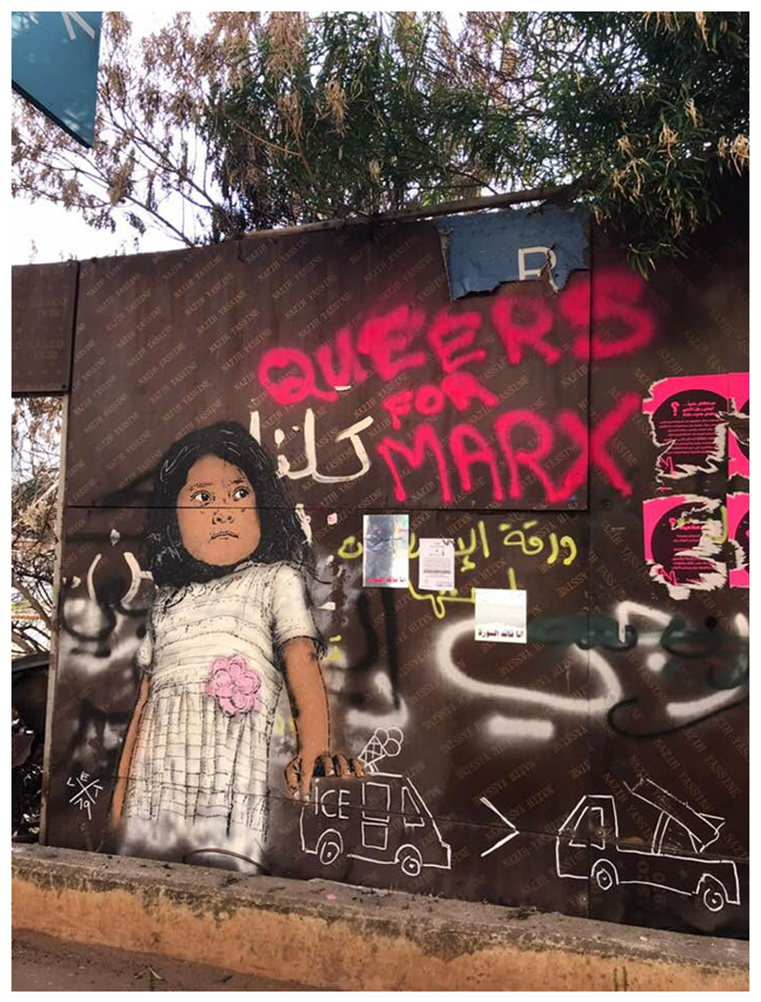
Wall mural in downtown Beirut, Lebanon, November 2019.
Conclusion: ‘Breaking the wall’
The potentialities of gentrification to produce Queerspaces for LGBTQ activism forms a rich research corpus within urban studies. Scholars debate whether such spaces nourish progressive forms of solidarity, if they reduce political projects to neoliberal modes of sexual assimilation and homonormativity, or are even multivalent and messy repositories of both. I have sought to extend these debates to cities that have endured political violence and where LGBTQ people are harassed and criminalised. Beirut is an important case study to examine these issues in the context of the rampant but uneven gentrification, dispossession, social cleansing and sectarian segregation that has characterised the postwar city. A dual Beirut has emerged within assemblages of sectarian power, sexual citizenship and political economy. Commercial Queerspaces are tacitly incorporated into the neoliberal and sectarian state, while at the same time the ‘Queer unwanted’– spaces and people deemed transgressive to the moral order – are violently erased. These dual spaces expose the limits on life for queer communities. These binaries between tolerable and intolerable Queerspaces are contingent and the state reserves the right to withdraw acceptance at any point. To help understand these processes, I unveiled the rich testimonies and critical debates articulated by LGBTQ activists in Beirut. Activists in Beirut, as in cities elsewhere marked by gentrification of Queerspaces, worry about its exclusionary effects and its regressive impact on the flourishing of political projects required to sustain rights. Yet, more importantly, in this article I note the multifaceted nature of inclusion/exclusion in the postwar city and in gentrification. It shows how the dynamics of Queerspace operate for populations that are criminalised and in which sexuality intersects with class, gender, sect and ethnicity to ensure that Queer life is determined within the space of the plural sovereignties inhabited by hybrid state/non-state actors. Yet, waves of national protest in Lebanon against the sectarian state have not only given new spaces for radical LGBTQ actors; these activists are leading agents of protest, forming intersectional ‘chains of equivalence’ between marginalised groups, creating new, though transient, Queerspaces and Queer counterpublics that engender Queer futurity. This activism has reinserted itself into gentrified spaces that have hitherto sought to cleanse the ‘undesirable’. It is in these spaces where the hegemony of the system is Queered and questioned. As Sara explains: ‘Our vision is to chip at the system so that one day it all crumbles. This is our aim. Breaking the wall through counter-narratives’. 21
Footnotes
Acknowledgements
The author would like to thank the anonymous reviewers for their kind and constructive comments to strengthen this article. The author is also grateful for the advice and suggestions provided by Bernie Hayes, Tamirace Fakhoury, Mary-Alice Clancy and Giulia Carabelli. Any errors, however, are the responsibility of the author.
Declaration of conflicting interests
The author declared no potential conflicts of interest with respect to the research, authorship, and/or publication of this article.
Funding
The author received no financial support for the research, authorship, and/or publication of this article.
