



Abstract
The premise of our research paper is that large (by the size of the population) municipalities are more complex to govern and manage, and this, in turn, calls for a more professional and apolitical local government. Using data from the largest European survey of mayors, we analyzed the influence of mayors and chief administrative officers in Europe and checked for correlations with the size of the local government. We present empirical evidence to support that the perceived influence of mayors varies with the size of the municipality regardless of the institutional configuration of power relationships. We found that very large municipalities (80,000 or more inhabitants) had weaker mayors. The presumption that a larger, more complex local (urban) environment calls for more professional leadership has been addressed in numerous publications; however, the answer was usually beyond the reach of the empirical tests.
Introduction
At the local level, politics is less ideological and focuses primarily on day-to-day public-service delivery policies. John (2001, 9) maintained that the “local government is perceived to administer things that others consider to be dull, such as bin emptying, street cleaning, drainage, and building quality, and it is assumed that the administration and decision-making of these activities is similarly tedious.” This has led to calls for local governments to be managed apolitically (Borja 1996; Doron 2000). There are some indices for which local governments, where administration takes a greater role than politics, perform better than those in which politicians take the lead (Carr 2015; Choi, Feiock, and Bae 2013; Nalbandian et al. 2013; Nelson and Svara 2015; Svara and Watson 2010; Wheeland, Palus, and Wood 2014). Leautier (2006) found that local governments led by a politician with extensive competences have inferior infrastructure and lower incomes than those led by a strong managerial team. Rauch (1998) and Svara (2003) concluded that cities with more influential urban managers (analogous to chief administrative officers [CAOs]) invest more in long-term projects than those with influential mayors. Several studies have indicated that CAOs also play a key role in the modernization of city administration (Daemen and Schaap 2000; Hambleton and Sweeting 1999).
Our primary interest is the influence of mayors and CAOs 1 in European municipalities. CAOs are the highest-ranking civil servants chosen by the mayor or local council. Comparative research on CAOs in Europe is scarce, with the last comparative survey having been conducted more than twenty-five years ago (UDiTE leadership study of 1996), 2 and only few studies exist on CAOs in individual European countries (Dargie 1998; de Borger et al. 1994; Sandberg 1999; Sancino and Turrini 2009). Conversely, a large number of studies exist on CAOs in the United States, which is perhaps because they are major actors in the council–manager type of government.
In this study, we utilize data from a mayoral survey (the POLLEADER survey) to observe the role of mayors and CAOs from the perspective of mayors. Generalizing the roles of mayors and CAOs within the frameworks of different local government systems demands particularly cautious interpretation. Although there is substantial proof that the perceived influences of mayors and CAOs correspond to the institutional configuration of different forms of government, there is also proof that they do not correspond fully or very substantially within individual countries (Heinelt et al. 2018; Klausen and Magnier 1998; Mouritzen and Svara 2002; Svara 2006). Thus, the aim of our analyses is to determine whether the size of the municipality is the underlying cause of these variations.
According to previous research conducted in the United States, there is a connection between the size and the type of government, but this is not very clear. There is evidence that managers tend to be dominant in smaller cities, whereas mayors are more dominant in larger cities (Morgan and Watson 1992). Meanwhile, a study on council–manager 3 cities with more than 200,000 inhabitants showed higher levels of involvement by managers than council members in mission decisions—in determining the goals and strategies of their government—as well as in other dimensions (Svara 1999). We examine the effect of municipality size by hypothesizing that CAOs are more influential than mayors in large municipalities, as the complex environment and challenges of large municipalities call for more professional leadership. Large municipalities are usually urban clusters or, at least, have an urban center. Therefore, for the purpose of our analyses, we presuppose that the larger the municipality, the greater the possibility that it is urban. This is important because urban agglomerations exceed other nonurban communities with regard to the complexity and heterogeneity of common needs. This complexity, in turn, calls for more managerial and less political leadership (Borja 1996; Borja et al. 1997).
Literature Review
Political-administrative systems differ across European countries. Different administrative traditions influence the contrasts between discontinuity and continuity in political and administrative areas. From hierarchically structured and highly formalized Germanic traditions to a more politicized civil service in Anglo-Saxon countries, the classical typologies of local governments distinctively demarcate geographical areas (Bennett 1989; Hesse and Sharpe 1991; Humes and Martin 1969). Although there is no local government typology built around the influence of mayors and CAOs, there are several typologies that mostly categorize local governments according to the power relationship between the mayor and the council (Bäck 2005; Heinelt and Hlepas 2006; Mouritzen and Svara 2002). Typically, there are three units in the local government structure: (a) the council, (b) the chief executive(s), and (c) the mayor. The mayor is the principal person responsible for coordinating the representative and staff aspects of local government operations. The mayor may share executive power with the CAOs, and their role varies significantly with respect to authority. They may perform functions of a ceremonial nature or play a significant role in preparing and formulating policies and implementing these policies after their adoption by the council—and all variations in between. The mayor is usually also at the apex of the administrative hierarchical pyramid and is tasked with supervising the employees responsible for city administration, which includes coordinating their activities and ensuring overall efficiency. However, the mayor often shares their workload with the CAOs (Humes and Martin 1969).
At the apex of the local administrative hierarchical pyramid is the CAO—the highest-ranking appointed civil servant. They may play a crucial role in not only implementing policies but also preparing them (Mouritzen and Svara 2002). It is imperative to distinguish between the two types of CAOs. The first type is the hierarchical superior of all or most department heads; the second is, in theory, one of the department heads responsible for running a nonline department, whose duties are such that they essentially undertake a general coordinating role and are, therefore, considered primus inter pares (Humes and Martin 1969).
The institutional configurations of different forms of government predominantly (but not completely) correspond to the perceived influence of mayors and CAOs (Heinelt et al. 2018; Klausen and Magnier 1998; Mouritzen and Svara 2002). The widely recognized typology proposed by Mouritzen and Svara (2002) suggests four governmental forms: (a) strong-mayor form, (b) committee leader form, (c) collective form, and (d) council–manager form. In the strong-mayor form of government, which is practiced in France, Italy, Portugal, and Spain, the elected mayor controls most of the city council and takes full charge of all executive functions. The CAO serves the mayor's will and can be hired and fired unilaterally without the need for ratification by any other politician or political body. Mouritzen and Svara (2002) have reported that CAOs in strong-mayor cities serve as policy innovators, with a particular emphasis on securing resources and improving productivity. In the committee leader form of government, which is practiced in Denmark, Great Britain, and Sweden, a single individual serves as the political leader of the municipality with or without the title of Mayor. They may or may not control the council, and executive powers are shared. This political leader may be responsible for some executive functions, while the responsibility of other functions rests on collegiate bodies, that is, standing committees composed of elected politicians and the CAO. “The CAOs in committee leader cities devote the most attention overall to offering advice to elected officials and politicians” (Mouritzen and Svara 2002, 124). In the collective form of government, which is practiced in the Netherlands and Belgium, the decision-making center is a single collegiate body or an executive committee 4 that is responsible for all executive functions, and the differences in CAO activities in this form of government tend to be the largest when compared internationally. In the council–manager form of government, which is practiced in Australia, Finland, Ireland, Norway, and the United States, all executive functions are carried out by a professional administrator appointed by the city council, and CAOs are highly active in terms of policy innovation and somewhat active with regard to administration. They are the designated policy advisers to the city council and have unparalleled influence over the organizational direction. While their focus on providing advice to elected officials is relatively strong, they pay more attention to dispensing technical advice and shaping the decision-making process than to giving political advice (Svara 2006). The POLLEADER survey (Heinelt et al. 2018) further confirms the typology proposed by Mouritzen and Svara (2002) typology as a good proxy for horizontal power relations in local governments. This is because it reports that mayors perceive their role and the roles of other actors (CAOs and local councilors) as being particularly congruent with the type of government practiced in their respective countries. The index of mayoral strength 5 developed by Heinelt and Hlepas (2006) is also used to categorize local governments. The index is “generally useful to capture basic differences in the strength of mayors of the four types of local government systems” 6 (Heinelt et al. 2018, 38). Therefore, both categorizations can be employed as effective proxies to assess whether the formal institutional configuration corresponds to the real-life influence of the actors in local governments. According to Heinelt et al. (2018, 39), mayoral self-perception and the influence of other relevant actors (e.g., committee leader, single influential councilor, and CAO) mostly correspond to the Mouritzen-Svara typology: “Nevertheless, the mayoral strength scores for individual countries were subsumed under the different local government forms very substantially.” This means that there is another variable that influences horizontal power relations in a municipality to some extent.
Our assumption is that the size of the municipality is the variable that influences this variation. Large (urban) municipalities 7 are faced with so-called urban problems, including (1) problems of uneven polarization and fragmentation (of society and goods), (2) high levels of pollution (environmental view), (3) deterioration of infrastructure (congestion and worn-out infrastructure), and (4) high levels of social deterioration (criminal and violence) (Businaro 1994). All these problems are closely related to both the high amount and density of the population in cities. Regarding the role of the administration (staff) in a city's government, Borja and Castells (2003, 188) observed that “urban problems are more and more complex and they tend to require the type of expert knowledge which is more likely to be found in staff than in the representative organs.”
Other factors could also influence the need for more administrative or political leadership. Lineberry and Fowler (1967) linked council–manager governments and, consequently, stronger CAO influence to cities with small and medium populations and fewer social cleavages. Svara (1999) found lower levels of conflict and higher levels of cooperation in council–manager governments than in mayor–council governments. Nunn (1996) concluded that council–manager cities have higher per capita infrastructure spending, and Coate and Knight (2011) found public spending to be higher in council–manager governments than in other local government types. We adopt these findings to identify two additional possible variables that could highlight the need for more administrative than political leadership: political conflict in the municipality and the financial status of the municipality. These two factors, as addition to formal institutional relations, were set as control variables.
Data and Methods
The data used in this study were obtained from the largest international mayor survey to date, which was launched by a network of scholars called the POLLEADER network (Heinelt et al. 2018). The survey targeted mayors of European municipalities 8 with 10,000 inhabitants or more. The threshold of 10,000 was arbitrarily set following the previous POLLEADER and UDiTE surveys, which used the same threshold. The threshold was approximately twice the size of the average European municipality, 9 indicating that the survey was focused on large municipalities.
This research is primarily based on a common questionnaire. The data collection process occurred from the beginning of 2014 to the fall of 2016. A team of experts from each country 10 translated the master questionnaire designed by an international team of academics and compiled a list of respondents according to common instructions. centrally designed instructions. The dataset used in this study was based on a random sample of municipalities from 29 countries. The study comprises 2,623 valid responses, 11 which is equivalent to an overall response rate of 30.7%. 12 Sampling weights were used to compensate for varying national response rates and ensure that each participating municipality appropriately represented the correct number of municipalities in the full POLLEADER population. Thus, inferences were made regarding the total population of European mayors (restricted to the participating countries). The data were analyzed using multiple logistic regression, and the context of interactions was addressed using Johnson–Neyman intervals, which are used to evaluate the significance of multiple regression slopes. Due to the imbalanced distribution of the dependent variable, the descriptive statistics of all the included variables and the retest of the final model using Firth logistic regression for rare events 13 are presented in the online appendix of this article.
Empirical Research
To assess the mayors’ self-perception of their influence and that of their CAOs on their local authority activities, we analyzed the responses to the following question: “Concluding, on the basis of your experience as a mayor in this city and independently from the formal procedures, please indicate how influential each of the following actors are over the local authority activities.” 14
The dependent variable, measured against self-perceived mayoral strength, exhibited a significant level of negative skewness (Figure 1a), which prevented us from performing a simple linear regression analysis. To overcome this issue, we recoded the dependent variable into a binary variable (Figure 1b) for analysis using binary logistic regression. Values 1–3 of the original variable were recoded as 0, indicating a weak mayor, whereas values 4 and 5 were recoded as 1, indicating a strong mayor. In the resulting dataset, there were 142 municipalities (6.7%) with a weak mayor and 1,973 municipalities (93.3%) with a strong mayor.
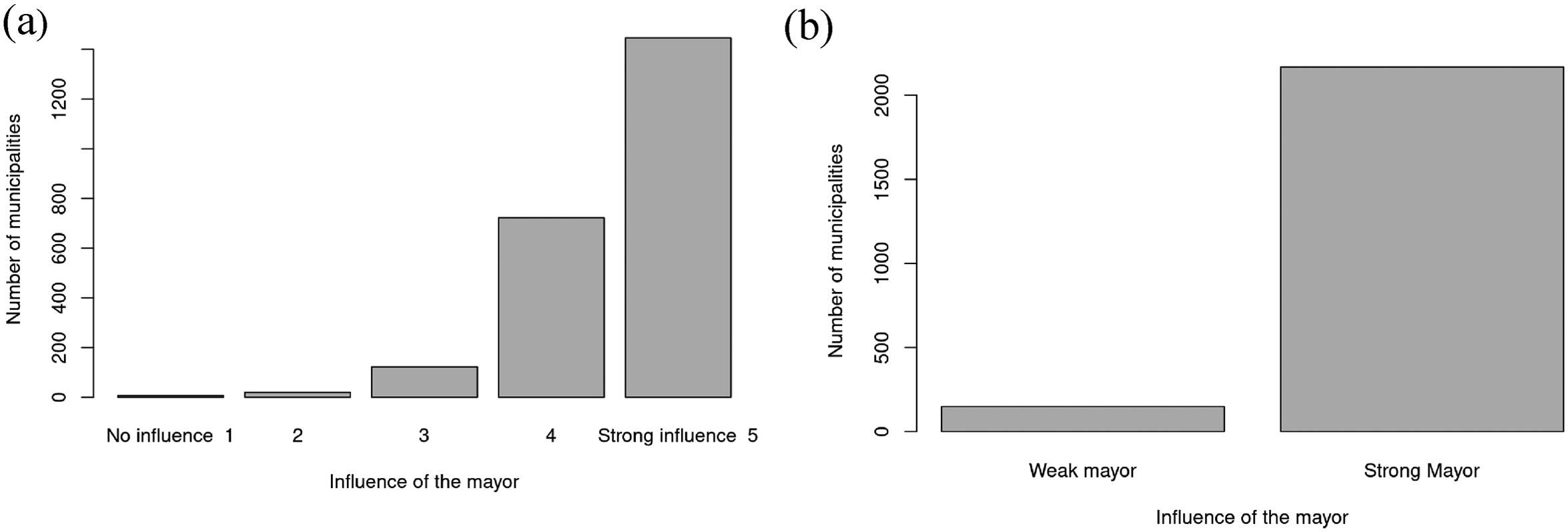
Distribution of the mayor's influence variable (a) before transformation and (b) after transformation.
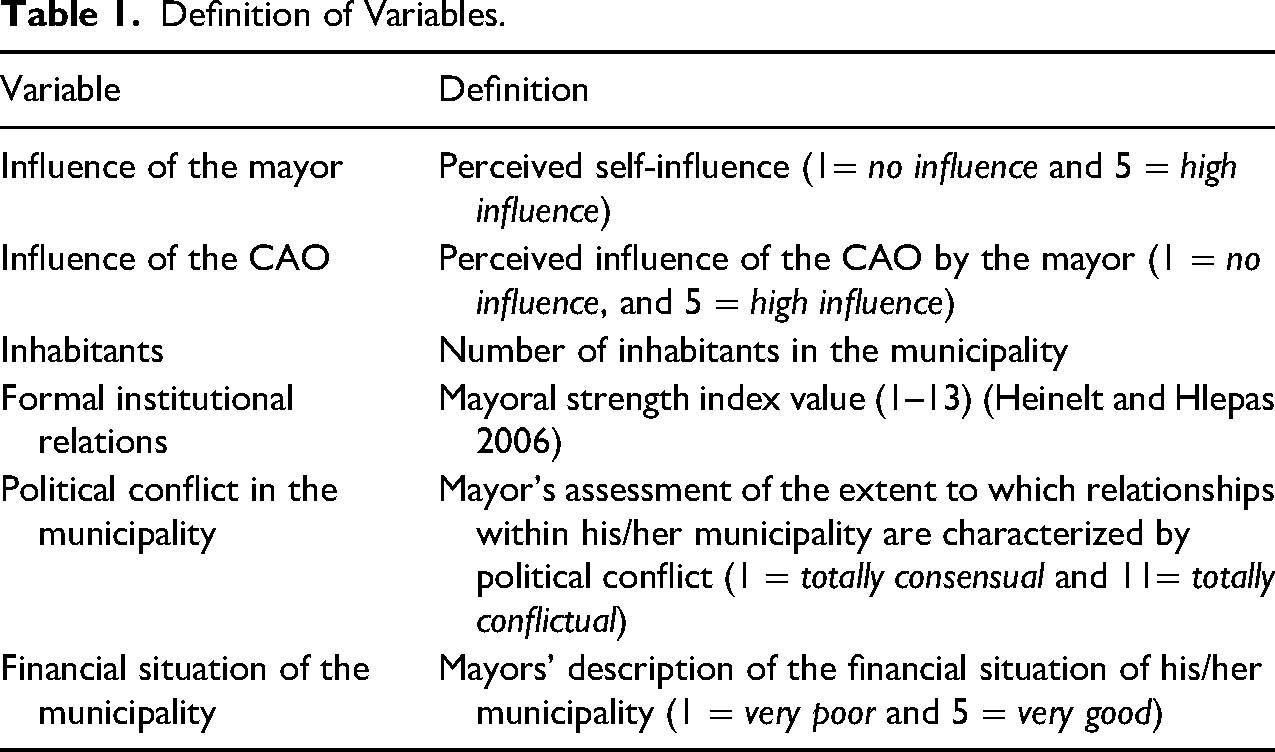
The analyzed model has two main explanatory variables: (1) the influence of the CAO as perceived by the responding mayor and (2) the size of the municipality in terms of population. In addition, three variables were included as control variables to consider the intervening factors that might alter the influence of the main explanatory variables on the probability of a mayor perceiving themselves as a strong mayor. These variables were (i) formal institutional relations, which was measured with the index of mayoral strength (Heinelt and Hlepas 2006); (ii) the mayor's assessment of political conflict in the municipality; 15 and (iii) the mayors’ assessment of the financial situation of the municipality (definition of variables are in Table 1). 16
In contrast to the dependent variable, population size was skewed in a positive direction (to the right) and was transformed using natural logarithm (Figure 2a). The influence of CAOs was measured on a five-item ordinal scale, and it had a close-to-normal distribution (Figure 2b); therefore, this variable was treated as a variable with normally distributed intervals. Moreover, the distribution of the control variables was close to normal; consequently, they were also treated as variables with normally distributed intervals.
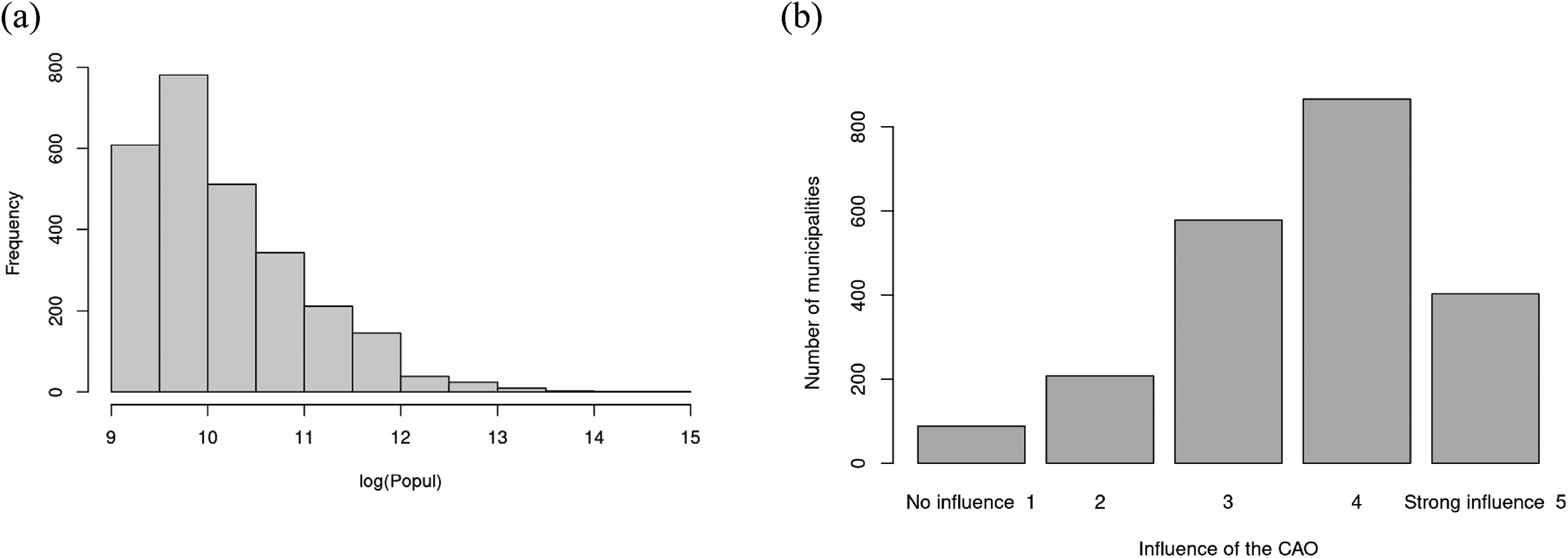
Distribution of (a) transformed number of inhabitants and (b) CAO influence.
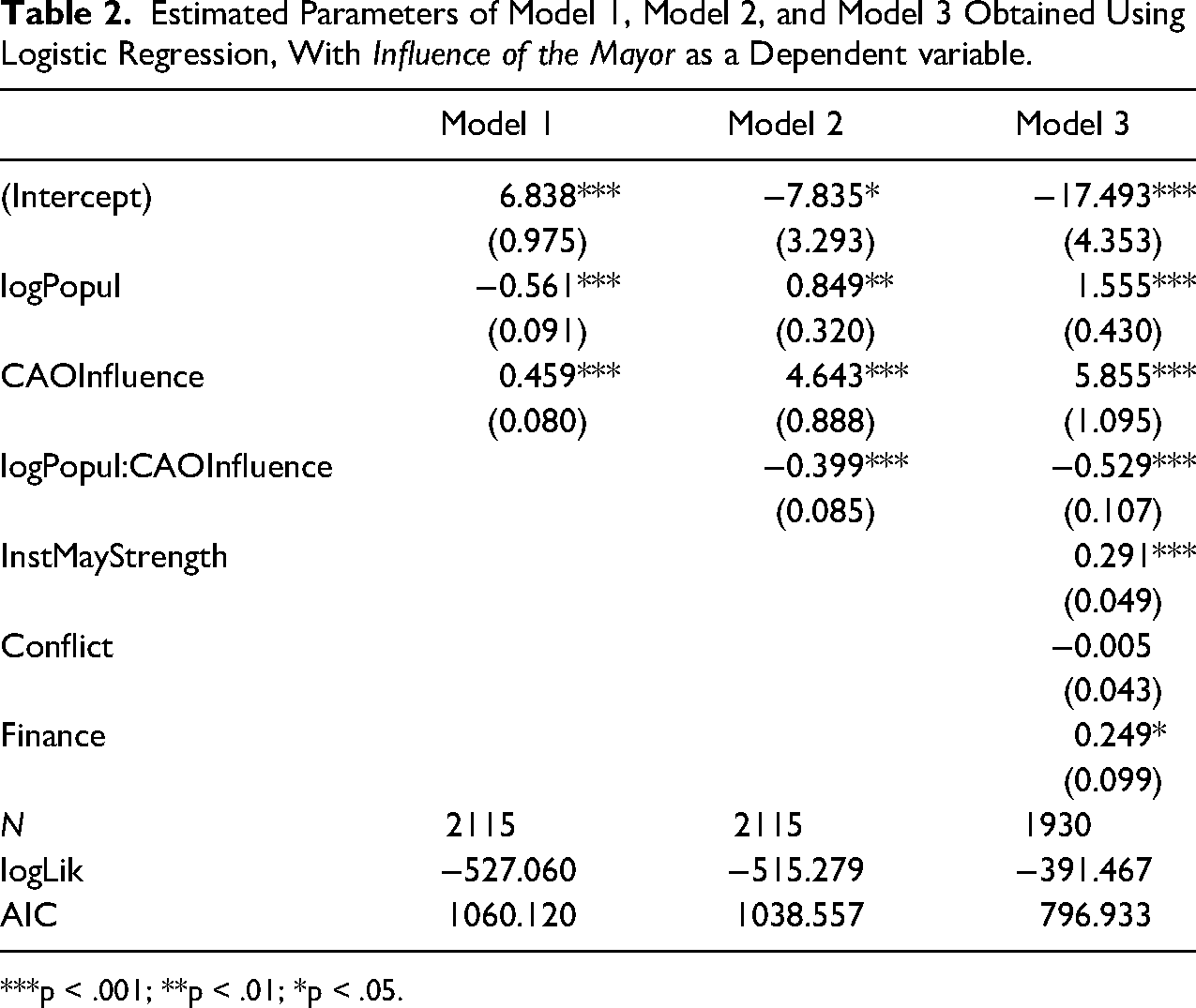
The analysis was performed in three stages, starting with a basic Model 1, which consisted of only the main explanatory variables: influence of the CAO (CAOInfluence) and size of the municipality (logPopul) without interactions. The estimated parameters of the models are presented in Table 2. The estimated effect of CAOInfluence was positive (0.459, with a standard error (SE) of 0.08) and highly significant, indicating that stronger mayors work with highly influential CAOs. In contrast, population size had a negative significant effect (−0.561, with an SE of 0.09), indicating a relatively high probability of larger municipalities having significantly less powerful mayors than smaller municipalities.
Definition of Variables.
Estimated Parameters of Model 1, Model 2, and Model 3 Obtained Using Logistic Regression, With Influence of the Mayor as a Dependent variable.
***p < .001; **p < .01; *p < .05.
In the second model, Model 2, a term was introduced for the interaction between the explanatory variables. We found that the interaction effect between the size of the municipality and the influence of the CAO was negative and significant (−0.399). This implies that the effect of the CAO's influence on the self-perceived influence of the mayor varies with municipality size. In small municipalities, the probability of having an influential mayor increases with an increase in CAO influence, whereas, in large municipalities, the probability of having an influential mayor decreases with an increase in CAO influence.
In Model 2, the plain CAOInfluence parameter remained positive and strongly significant, whereas the estimated parameter for the plain effect of the municipality size changed compared to the basic model and was insignificant (with a value of 0.849). The last model, Model 3, comprised all the main and control variables. Although the number of analyzed units decreased from 2,115 to 1,930 due to missing values in the added variables, the values of the main parameters remained stable and practically unchanged. The added control variable in the model, with a significant effect was institutionalized mayor strength (InstMayStrength), with a positive value, as expected (0.291, with an SE of 0.05). According to the Akaike information criterion, the full Model 3 provides the best fit.
Figure 3 illustrates the perceived influence of both actors on their local jurisdiction operations as the variable of size of the municipality. An obvious cleavage between the smaller and larger municipalities can be seen in the figure. The Johnson–Neyman intervals were computed to obtain the actual size of the municipality, where the probability of the mayor being influential and the increasing influence of the CAO stopped increasing—and even faced probability decline. The slope was positive for municipalities with up to 41,778 inhabitants and began descending for municipalities with more than 136,330 inhabitants. Within this interval, the slope of CAOInfluence was 0 (p = .05). According to the model, the absolute size of the municipality where the curves in Figure 3 meet was 63,847. There is no theoretical reference for this city size threshold.
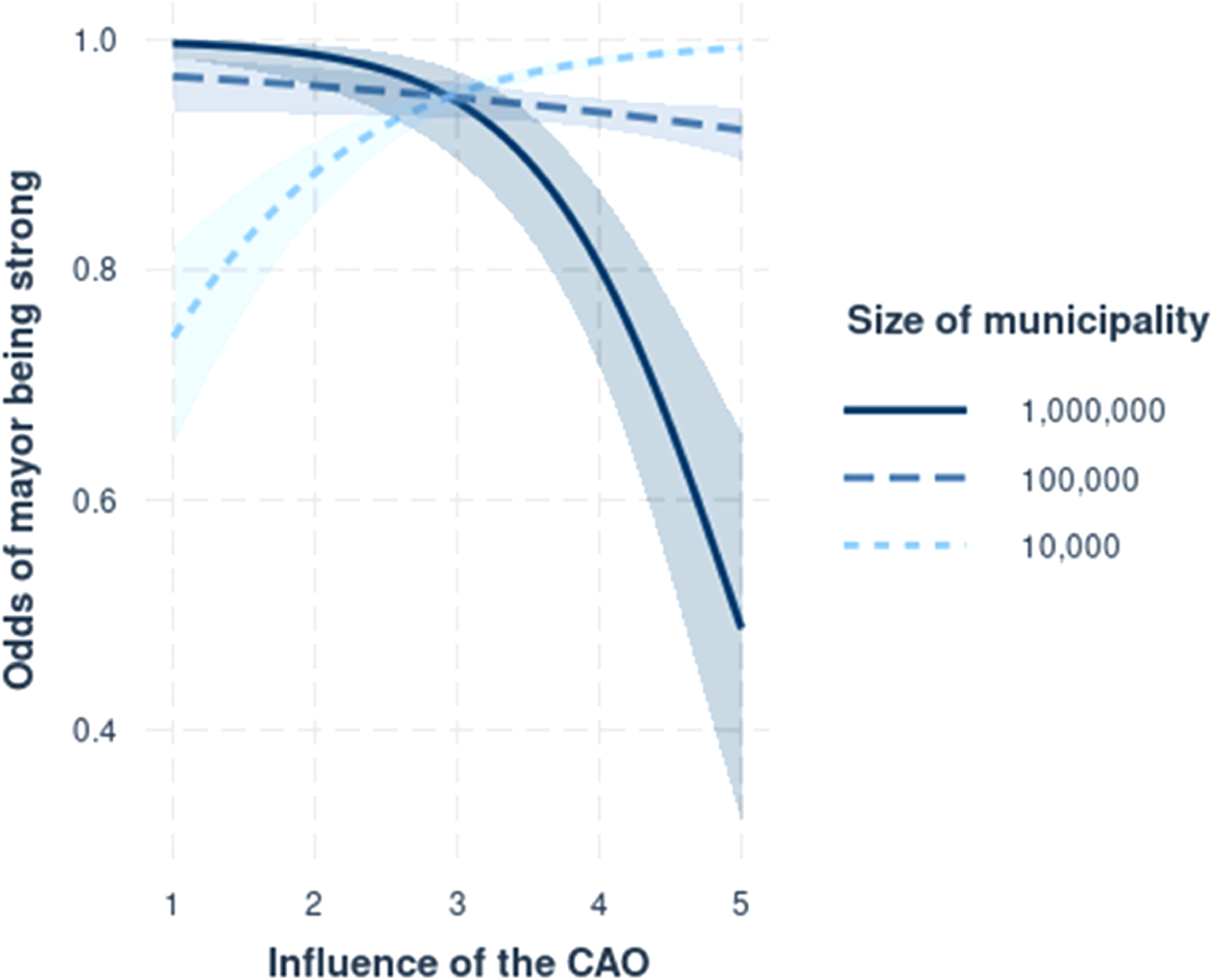
Interaction plot of Model 3.
From the hypothesis testing, we can conclude that the probability of self-perceived mayoral strength in small municipalities increases as the influence of the CAO increases, whereas the opposite is true for large municipalities. It is also worth noting the statistical insignificance of political conflict and the significant effect of the financial state of municipalities, as control variables, on the relationship between the mayor and the CAO. From our analysis, it is clear that these self-perceived relationships are determined independently of the formal institutional structures of the analyzed municipalities.
Discussion and Conclusion
In this study, we determined whether there is a greater need for apolitical leadership in larger (urban) municipalities. The presumption was that a larger, more complex local environment calls for more professional leadership. This presumption has been addressed in numerous publications; however, the answer was usually beyond the scope of empirical tests. Researchers generally acknowledge that the complexity of urban problems calls for professional leadership, but, at the same time, they claim that the elected political leadership, which holds high legitimacy, is also an important factor for addressing complex local (urban) problems.
The results of our analyses indicate that the influence of a mayor is affected by the influence of the CAO and the size of the municipality regardless of the type of local government. There is an indication that influential mayors tend to work with influential CAOs. This corresponds with the results of the studies on CAOs from the late 1990s (UDiTE), in which Mouritzen and Svara (2002) found no proof of a zero-sum struggle for influence between mayors and CAOs. Both actors appeared to collaborate, expressing their power (most probably) via other political figures in the local government. However, in Europe, this is true only until local governments reach a population threshold of 80,000 inhabitants. Beyond that, the mayor's influence becomes weaker. There is no theoretical reference for this threshold, and it could vary with a larger sample size. There are also other theoretical and empirical limitations to the presented analyses. In some observed countries, the CAOs are not necessarily professionals and might be linked to mayors’ mandates; however, we can argue that their role is still more administrative than political. Additionally, large municipalities are not necessarily urban. However, the definition of urbanity, from a purely Simmelian view, most probably occurs in localities with over 10,000 inhabitants, and this was the threshold set for the surveyed municipalities. An additional limitation presents the distribution of the dependent variable (see Figure 1b), as it is very unbalanced; thus, there are only a limited number of observations with weak mayors.
However, we can conclude that after a municipality reaches a certain size, it becomes too complex to be managed by a single political figure. Because localities with 80,000 or more inhabitants can be defined as cities, urban problems call for a specific institutional response. Borja et al. (1997) and Nalbandian (2006) called for more managerial and expert-driven responses to urban problems because they are increasingly complex and tend to require the type of expertise that is more likely to be found among civil servants than the representative organs.
Supplemental Material
sj-docx-1-uar-10.1177_10780874231165776 - Supplemental material for Depoliticization of Governance in Large Municipalities in Europe
Supplemental material, sj-docx-1-uar-10.1177_10780874231165776 for Depoliticization of Governance in Large Municipalities in Europe by Irena Baclija Brajnik, Luka Kronegger and Vladimir Prebilic in Urban Affairs Review
Footnotes
Declaration of Conflicting Interests
The author(s) declared no potential conflicts of interest with respect to the research, authorship, and/or publication of this article.
Funding
The author(s) received no financial support for the research, authorship, and/or publication of this article.

Supplemental Material
Supplemental material for this article is available online.
Notes
Author Biographies
References
Supplementary Material
Please find the following supplemental material available below.
For Open Access articles published under a Creative Commons License, all supplemental material carries the same license as the article it is associated with.
For non-Open Access articles published, all supplemental material carries a non-exclusive license, and permission requests for re-use of supplemental material or any part of supplemental material shall be sent directly to the copyright owner as specified in the copyright notice associated with the article.
