




Abstract
Why do some municipalities adopt ambitious climate action plans and others do not? This study examines United States cities that have signed the Global Covenant of Mayors for Climate & Energy, to identify the factors that have led some of them (37 percent, 63 cities) to adopt ambitious (Net Zero) climate action plans. It finds that two factors make the most difference: (a) whether the city has a paid city employee (or department) dedicated to environmental/energy management and (b) whether the city has a university. Other factors, such as per capita income, city revenue, state funding, size, partisan orientation, and membership in international climate networks, did not significantly influence how ambitious a city's climate action plan was. This study combines a statistical analysis of the signatory cities with a qualitative study Middletown Connecticut to explain why city energy managers and universities can have such a positive effect on city climate action.
The Intergovernmental Panel on Climate Change (IPCC) has warned that CO2 emissions must reach net zero by 2050 for global warming to be held to the 1.5°C threshold to prevent the most catastrophic consequences of global climate change (Rogelj et al. 2018). 1 Because cities consume more than two-third of the world's energy, emit more than seventy percent of the global CO2 emissions, 2 and contain 55 percent of the world's population (a share that is expected to rise to nearly 70 percent by 2050), 3 their efforts will be critical to the world's effort to combat climate change. This article aims to identify factors that are the most important in helping cities move from verbal declarations that climate action matters to the development of ambitious climate action plans, with a special focus on the role that city-university partnerships can play in that process.
We begin with a review of the literature on city-university partnerships related to environmental and climate policymaking and then move to a broader discussion of the factors that help cities develop ambitious climate policies. The literature review is followed by a discussion of our methodology. In brief, we first conduct a large-n study of the 169 cities in the United States that have signed the Global Covenant of Mayors for Climate & Energy, analyzing the factors that enable some of those cities to move from public commitments about the importance of climate change to concrete actions to address it (data publicly available here (https://doi.org/10.25438/wes02.19669098)). We then supplement the large-n statistical analysis with a brief study of the experience of the City of Middletown in Connecticut and the development of its 2019 Net Zero Climate Action Plan, to help illustrate how the factors revealed as important in the statistical analysis (the presence of a university, and the existence of full-time paid city staff dedicated to climate/energy policy) work together to help cities move from talk to action on climate change. We conclude our article with some recommendations for how city and community leaders can use our findings to help promote the development of more ambitious climate action plans in their own communities.
Explaining Ambitious Cities
In the field of urban sustainability, city-university collaborations have generally been a side story, often taking the form case study anecdotes in which university partners play the role of helpful side-kick to the more important city mayor or international organization (Barber 2013; Berry and Portney 2014; Fischer 2000; John 1994; Keck and Sikkink 1998; Miller 2020). Thus far, academic research into city-university collaborations about urban policy making in general, and climate/environmental policy in particular, has largely consisted of illustrative examples of successful partnerships, for example, the City of Vancouver and University of British Columbia (Munro et al. 2016; Pauer, Pilon and Badelt 2020), Pennsylvania State and University Park, PA (Knuth et al. 2007), and MIT and Singapore (Redmond 2011) to name just a few.
Perhaps the most comprehensive collection of city-university sustainability collaborations can be found in Ariane König's edited volume, Regenerative Sustainable Development of Universities and Cities: The Role of Living Laboratories (2013). In the volume, which consists primarily of case studies of city-university collaborations collected from around the world, König and her co-authors consider “living laboratories as a governance tool that links the academic capacity of universities with the sustainability challenges facing cities today” (König 2013).
More recently, researchers have begun to branch out from single case studies to research that gathers together a small number of example partnerships to focus on how city-university collaborations have advanced particular urban sustainability policy issues such as spatial development (Benneworth, Charles and Madanipour 2010), heat island mitigation (Hamstead et al. 2020), sustainability policy transfer (Withycombe Keeler et al. 2018), and capacity building (Keeler et al. 2019).
Additionally, a few teams of scholars have begun to place city-university partnerships into broader governance and public policy contexts, thinking theoretically and practically about how these partnerships fit into broader processes of urban policymaking. For example, one group of largely East-Asia based scholars discusses the role of city-university partnerships in “co-creating sustainability” (Trencher, Bai, et al. 2014; Trencher et al. 2017; Trencher, Yarime, et al. 2014; Trencher, Yarime and Kharrazi 2013). Another research team based largely in the United States has developed assessment tools and guidelines for city-university collaborations on sustainability policy (Caughman, Keeler and Beaudoin 2020; Caughman et al. 2020; Keeler et al. 2019; Withycombe Keeler et al. 2018).
Shifting from the role of city-university partnerships in creating urban sustainability policy to factors that promote ambitious climate policymaking in cities, we find an extensive literature. As discussed above, cities are now home to a majority of the Earth's population, and produce most of its climate-changing emissions, so many researchers are closely examining the factors that promote pro-environmental policy making in cities. Since cities are complex places, it is not surprising that scholars have identified a number of different factors that can help cities become more ambitious in their climate policymaking.
Of these, the economic explanations make the most intuitive sense, since they are rooted in the well-established (Sarkodie and Strezov 2019) (and sometimes-questioned (Dinda 2004)) concept of the Environmental Kuznets Curve (EKC). Named for Simon Kuznets, the basic hypothesis, drawn from observation, is that environmental pollution follows a curve pattern as a country becomes richer. The poorest countries tend to live low-polluting, subsistence-based lifestyles, and as they industrialize, their incomes and their pollution go up. When economies begin shifting to a service-based economy, and the level of environmental pollution becomes increasingly intolerable, citizens and consumers pressure their governments and companies to reign in pollution, and the curve shifts to a downward direction, so countries become cleaner again.
Although originally developed to explain cross-national variation, many scholars have found that the basic framework of the EKC holds up at the sub-national level as well (Fujii et al. 2018; Halliru et al. 2020; Sinha and Bhattacharya 2017). Other scholars have found that too many factors influence a city's pollution such that the EKC is not a good explanation for environmental policy or outcomes (Fujii et al. 2018; Harbaugh, Levinson and Wilson 2002). One recent study by Farmer (2021) focused on a slight variation on the EKC model, examining how the availability of financial incentives from the state might push municipalities through their EKC curve faster. It found that state-level economic incentives helped encourage cities to engage in sustainable energy policies, which enabled them to adopt more ambitious climate policies faster than they might have otherwise (Farmer 2021).
Other scholars have examined the role of city size. Although increasing population in poor cities can lead to environmental and human catastrophes caused by inadequate sanitation, waste, housing, transportation services (Azevedo, Scavarda and Caiado 2019; Klopp and Paller 2019; Gradus et al. 2019; Van Ginkel et al. 2018), these size-related problems are less evident in the United States. When studying US cities, as we are, scholars often examine the benefits of scale. Larger cities have larger budgets that they can use to make pro-environmental investments (Hsu 2018; Sun et al. 2017), they are in a better position to collaborate with other cities (Hawkins and Krause 2021), and they can take advantage of economies of scale for such investments as clean energy and transportation infrastructure (Sun et al. 2017; Wu, Levinson and Sarkar 2019). On the flip side, scholars examining smaller cities have found that they face both greater risk due to climate change as well as less capacity to adapt than larger cities (Paterson et al. 2017).
A more focused version of the EKC and population size hypotheses emphasizes the role of a city energy manager, who can serve as the focal point for the development of a city's climate action plans. Several studies have found a dedicated energy manager, (or sustainability director, or sustainability officer or similar titles etc.) can help cities develop and carry out more ambitious climate policies because they provide in-house technical expertise as well as institutional know-how to the problem of climate policy (Homsy 2018; Knuth et al. 2007; Roseval 2019). Energy managers and sustainability officers can also act as “policy entrepreneurs,” encouraging their cities to enact cutting-edge policies (Teodoro 2011). However, other scholars have found that the relationship between a city's policy making capacity and its engagement on climate issues is non-linear (Krause, Hawkins and Park 2021). Relatedly, some scholars have found that cross-departmental collaborations are more important than dedicated staff (Kalafatis 2018).
In the United States in particular, environmental policy has become increasingly politicized, and many scholars have investigated the relationship between party affiliation and environmental policymaking. Consistent with the mainstream media portrayal of the issue, scholars have found that Democratic-leaning cities tend to have higher citizen preference for clean-energy policies (Mayer 2019), higher support for water conservation policies (Gilligan et al. 2018), are more likely to adopt ambitious climate plans (Hui, Smith and Kimmel 2019), and engage in more robust enforcement of environmental regulations (Switzer 2019) than Republican-leaning cities. However, other scholars have found no relationship between partisanship and cities’ environmental policies (Berry and Portney 2017; Gradus et al. 2019; Portney and Berry 2014).
Addressing climate change requires a concerted, collective effort, and cities are increasingly working together to seek solutions. Cities are joining international networks that provide access to the newest information about urban policy, case studies of success, connection to peer cities facing similar problems, and access to high-level research relevant to their own particular situations. Scholars are studying these international city networks, and some have found that participation in these networks enhances a city's capacity and willingness to engage in more progressive environmental policies (Gordon and Johnson 2018; Rashidi and Patt 2018; Steffen, Schmidt and Tautorat 2019).
Our study aims to contribute to this rich literature on urban environmental policy making. To our knowledge, this will be the first study in which all the factors that might affect a city's ability to develop an ambitious climate action plan are combined into a single analysis. Additionally, it will be the first study to include the presence of a university along with well-researched factors such as city size, resources, partisanship, etc., to see whether a university might have an independent effect on a city's ability to move from a public declaration that climate change is important to the development of an ambitious, net zero climate action plan. Furthermore, our study will augment our statistical analysis with a case study to show how factors shown to be important in the large-n study interact with one another at a city-level to promote ambitious policy making.
Research Design
The fundamental question driving our research is why some cities develop ambitious climate action plans while others do not. In particular, we are interested in what it takes to get from talk to action: Once a city has indicated that it cares about climate change, what helps get it to act by developing ambitious climate policy in its city? To isolate our research on this question, we studied US cities that have signed the Global Covenant of Mayors for Climate and Energy (CGoM). The GCoM is essentially a Paris Agreement for cities, committing signatories to undertake an emissions inventory, create an action plan in line with the Paris Agreement, and report their progress under the Common Reporting Framework. 4 As of this writing, more than eleven thousand cities representing more than one billion people have signed. 5 By signing the GCoM, cities signal that they care about climate change and intend to do something in their own city to address it. Therefore, our study controls for city interest in climate action by including only cities that have publicly indicated that they care about climate. We can then focus entirely on the factors that contribute to variation in policy action.
To control for the myriad of differences across national boundaries, we are looking only at the 169 US cities that signed the GCoM by June 1, 2021. To ensure that our unit was uniform and eliminate redundancy, we omitted the handful of county cases when both counties and cities had signed the agreement (e.g., King County, WA and Seattle, WA are both signatories, so we dropped King County from the analysis). Our dependent variable is the level of ambition in cities’ climate policies. 6 One of the requirements of GCoM signatory cities is to develop a climate action plan, so most cities in our dataset had a climate action plan in the public domain. We then read their plans and ranked them according to how ambitious they were.
Following the IPCC's 2014 5th Assessment and its updated 2018 Special Report, we rated cities’ climate action plans in the following manner: Cities with no plan and no apparent intention to create one were coded as 0. Cities that currently have no plan but were in the process of creating one were coded as 1. Cities that had a weak plan, with emission reduction targets of less than the IPCC's recommended 80 percent by 2050 were coded as 2. Cities listing more ambitious emission reduction targets (e.g., 80 percent or net zero) but included no benchmarks, were also ranked as weak (2) plans. Cities with plans that set a target of 80 percent reduction in emissions by 2050 and included explicit benchmarks to reach the goal were ranked as 3. Finally, Cities were ranked as 4, “most ambitious,” if their plans committed to achieving net zero carbon dioxide emissions by 2050 or earlier and had explicit benchmarks to meet their goal. City plans were also ranked as a 4 if they if they had a net zero target and were in the process of updating their benchmarks from an old 80 percent reduction target to a new net zero goal.
Accountability benchmarks are an important policy tool in environmental policymaking (Arrowsmith, Sisson and Marginson 2004) that enables municipalities and their residents to measure progress and hold officials accountable (Bolli, Emtairah and Martins 2001; Shmelev and Shmeleva 2019). Furthermore, there is strong evidence that urban environmental policies that include benchmarks are more likely to generate improved environmental outcomes (Brugmann 1997; Trencher et al. 2016). Therefore, the inclusion of explicit benchmarks in the policies was one of the ways that we measured which cities had moved from “talk” (i.e., signing the GCoM but having no plan, having a plan that contains no benchmarks) to “action” (ambitious plan with clear benchmarks).
Most plans defined “net zero” as the greenhouse gas emissions produced minus greenhouse gas emissions taken out of the atmosphere. In the climate action plans we reviewed, cities commonly used both the terms “net zero” and “carbon neutral,” often defining them in the same way. Some cities discussed both total emissions as well as carbon offsetting, while others focused exclusively on emissions produced and did not include any offsetting. Cities with plans that did not include any offsetting, if their plan aimed to be “carbon free,” “produce zero carbon” or be “totally renewable,” indicating that the city will not utilize any carbon and gain all energy from renewable sources, were also classified as 4, along with those aiming to be net zero through a combination of emission reduction and carbon offsetting. This 0–4 ranking of the level of ambition of a city's climate action plan constituted our dependent variable.
Turning towards our independent variables, we used several sources. For city population and per capita income, we used the US census data updated in 2018, 7 with per capita income calculated as the city's income divided by its population. As an additional measure of city wealth, we included cities’ fiscal year 2019 total revenue data, which includes both program and general revenue. 8 The amount of state support for cities to pursue renewable energy and energy efficiency initiatives was taken from the 2019 Energy Scorecard put out by the American Council for an Energy-Efficient Economy (ACEEE) (Weston Berg et al. 2019). The 211-page report rates all fifty states and the District of Columbia on a wide range of state policies and incentives related to energy efficiency, from utility public benefit programs to state incentive programs. Their scores ranged from a high of 44.5 (Massachusetts) to a low of 4.5 (Wyoming).
We examined city government websites to identify whether or not a city had a dedicated, paid energy manager or equivalent position. Cities that had a city official dedicated to environmental policy (e.g., energy manager, sustainability officer), or an entire office focused on environmental policy (e.g., Office of Sustainability, Department of the Environment) were coded as 1. Cities without a clear indication that they had staff dedicated to environmental planning were coded as zero.
To measure partisanship, we looked at 2020 election data, both the state's Presidential vote, and the city's Congressional district vote. At each level, vote for the Democratic candidate was coded as a 1, while a Republican candidate vote was coded as a 0. If a city had multiple congressional districts, the share of the districts that went for particular parties were recorded (e.g., if a city had 4 congressional districts and Democrats won in 3 and a Republican won in 1, the city's congressional partisan code would be 0.75 at the Congressional level). Similarly, the state of Maine split its Electoral College votes, with the Democratic candidate receiving 3 of 4 electoral votes, so it was coded as 0.75 at the Presidential level. For the regression analysis we created an index variable that ranged from 0 (Republicans elected in all of the city's Congressional District(s) as well as the State's Presidential vote) to 2 (Democratic candidates won all races at both levels).
Although there are hundreds of international city-networks, we selected two of the most prominent as our measure of international networking: ICLEI is an international organization of more than 2,500 local and regional governments that was founded in 1990, and C40, which is an organization of megacities founded in 2005 that has 97 affiliated cities collectively responsible for 25 percent of global GDP. Cities that were members of one or both organizations were coded as 1. All others were coded as 0. Finally, we searched each city for signs that there was an institution of higher education located in the city. Cities that had an accredited college, university, community college, or a university branch campus in the city were coded as 1. All others were coded as 0.
For our statistical analysis, we first generated several descriptive statistics to give us an overview of the characteristics of our dataset. Then, we used both Ordinary Least Squares and Ordinal Logistic Regression analyses to examine which of our independent variables affected the level of ambition among cities’ climate action plans. We utilized both statistical methods as an added robustness check for our findings. We calculated the VIF (variance inflation factor) for each of the variables in both regressions and found no multicollinearity. The next section describes the results of our tests, and the following section discusses those results.
Results
Before we discuss our analysis of the factors that led some signatories of the Global Covenant of Mayors for Climate and Energy to develop ambitious, Net Zero climate action plans while others had weak or no plans, we offer a brief overview of the cities in our dataset. The 169 cities in the United States that had signed the Global Covenant of Mayors for Climate and Energy by June 1, 2021, came from all regions of the United States and represented the full range of populations from more than 8 million in New York City to just 257 in Eagle's Nest, New Mexico. Cities also represented a large range of income levels; some communities were very rich (Piedmont, CA has a per capita income of $108,000) and others were poor (per capita income is only $15,000 in Clarkston, GA).
GCoM cities were largely, although not exclusively, located in areas that supported Democratic candidates for national political office. In the 2020 election, 60 percent of the cities voted for Democratic candidates for their Congressional representatives and were located in states that supported a Democrat for President. About a quarter (26 percent) supported candidates for Congress that were from the party opposite from the one of the candidate that their state supported for the Presidency. Only 11 percent of cities voted for Republicans for both Congress and the Presidency.
Since developing a climate action plan is part of the commitment cities accept when signing the GCoM, it is not surprising that most cities (85 percent) had some kind of plan. Although 70 percent of cities had plans to meet the IPCC's 80 percent reduction target by 2050, only 37 percent had ambitious plans that included targets for Net Zero emissions by 2050 as well as clear benchmarks measuring progress (Figure 1).
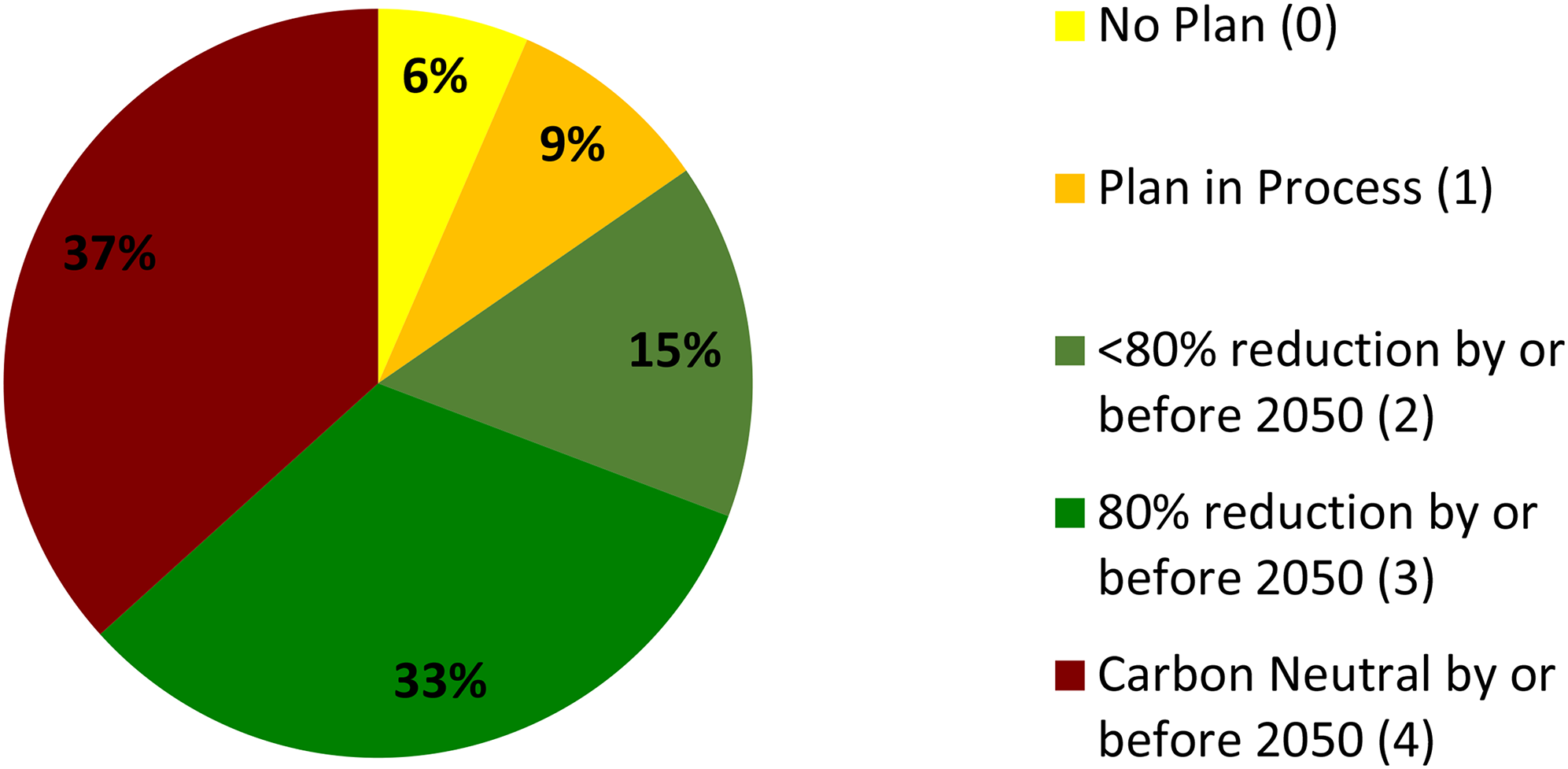
City climate action plans.
Turning from the descriptive relationships to the statistical analysis, the OLS and logistic regression analyses included all of the independent variables. Surprisingly, most of the factors emphasized as important by the literature—population size, per capita income, city revenue, state energy incentives, partisanship, and international networks—were not statically related to the ambition level of a city's climate action plan. The only factors that influenced the level of ambition in a city's climate action plan were (a) the presence of city staff dedicated to environmental policymaking and (b) the presence of a university or college in the city. (Table 1)
Factors Influencing the Ambition of City Climate Action Plans. 13
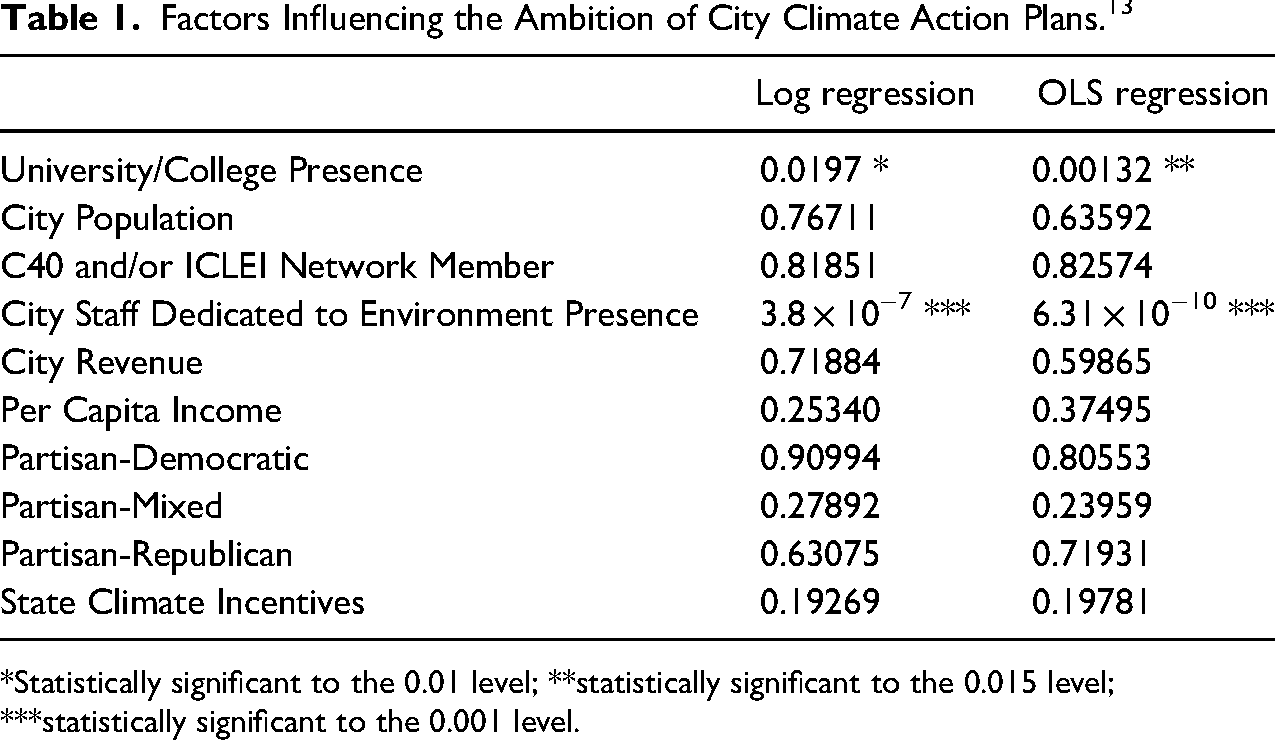
*Statistically significant to the 0.01 level; **statistically significant to the 0.015 level; ***statistically significant to the 0.001 level.
These results indicate that only two factors had a statistically significant relationship on the level of ambition in a city's climate action plan: the presence of an institution of higher education and the presence of a full-time city staff focused on climate/energy policy. Most (76 percent) of the US GCoM cities had paid staff dedicated to environmental policy in the form of an energy manager, sustainability director, or office of sustainability. Not surprisingly, they were particularly common in the larger cities—only 1 of the 45 cities with populations above 250,000 did not have paid city staff focused on environmental policymaking. Similarly, most (81.9 percent) cities had some kind of institution of higher education in their city, whether a 4-year university or college, a university branch campus, or a 2-year community college, and they were particularly common in big cities (only 30 cities with populations above 250,000 did not have an institution of higher education in their city). Figures 2 and 3 illustrate how strongly related these two factors were with the level of ambition in a city's climate action plan.
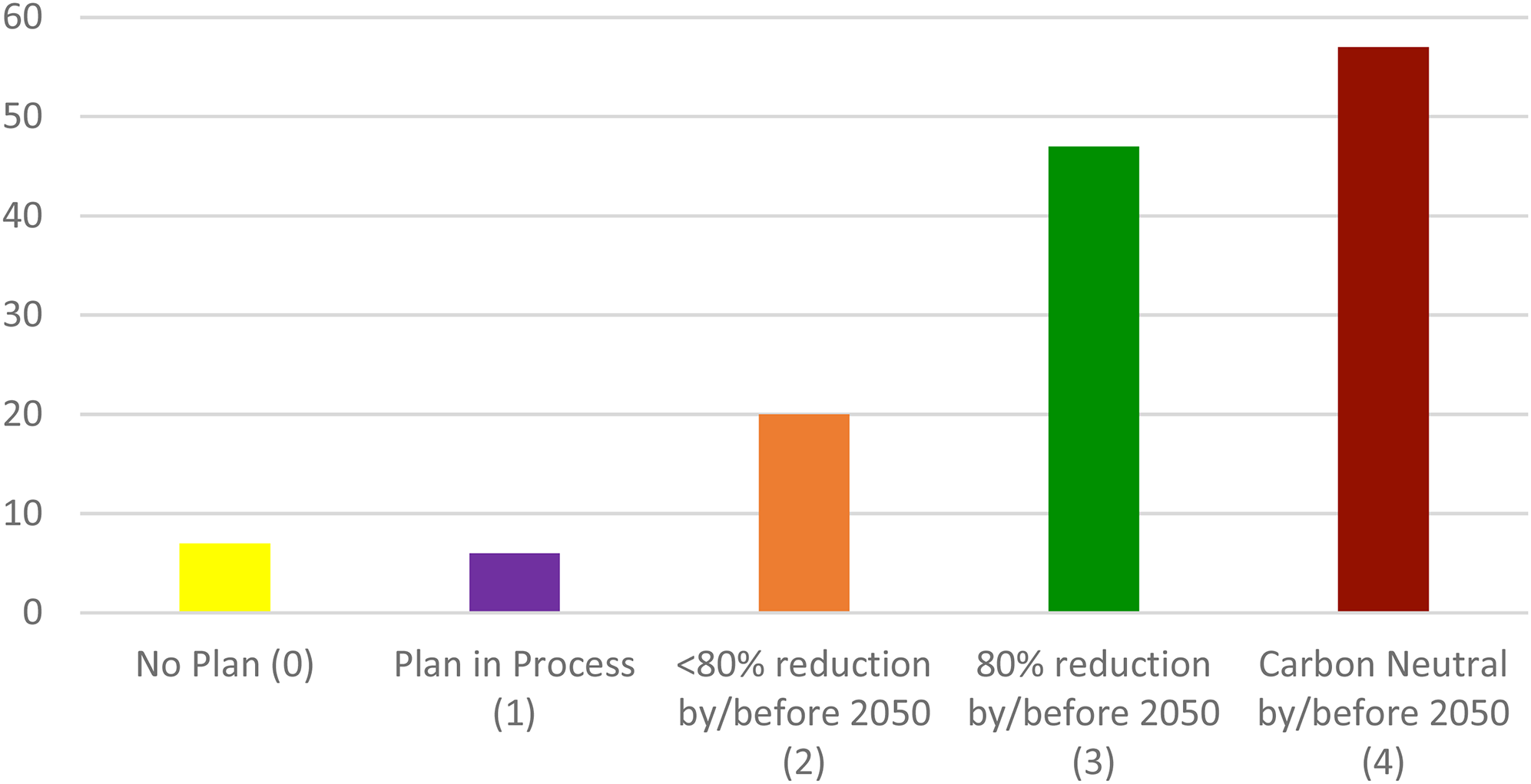
Cities with universities and their climate action plans.
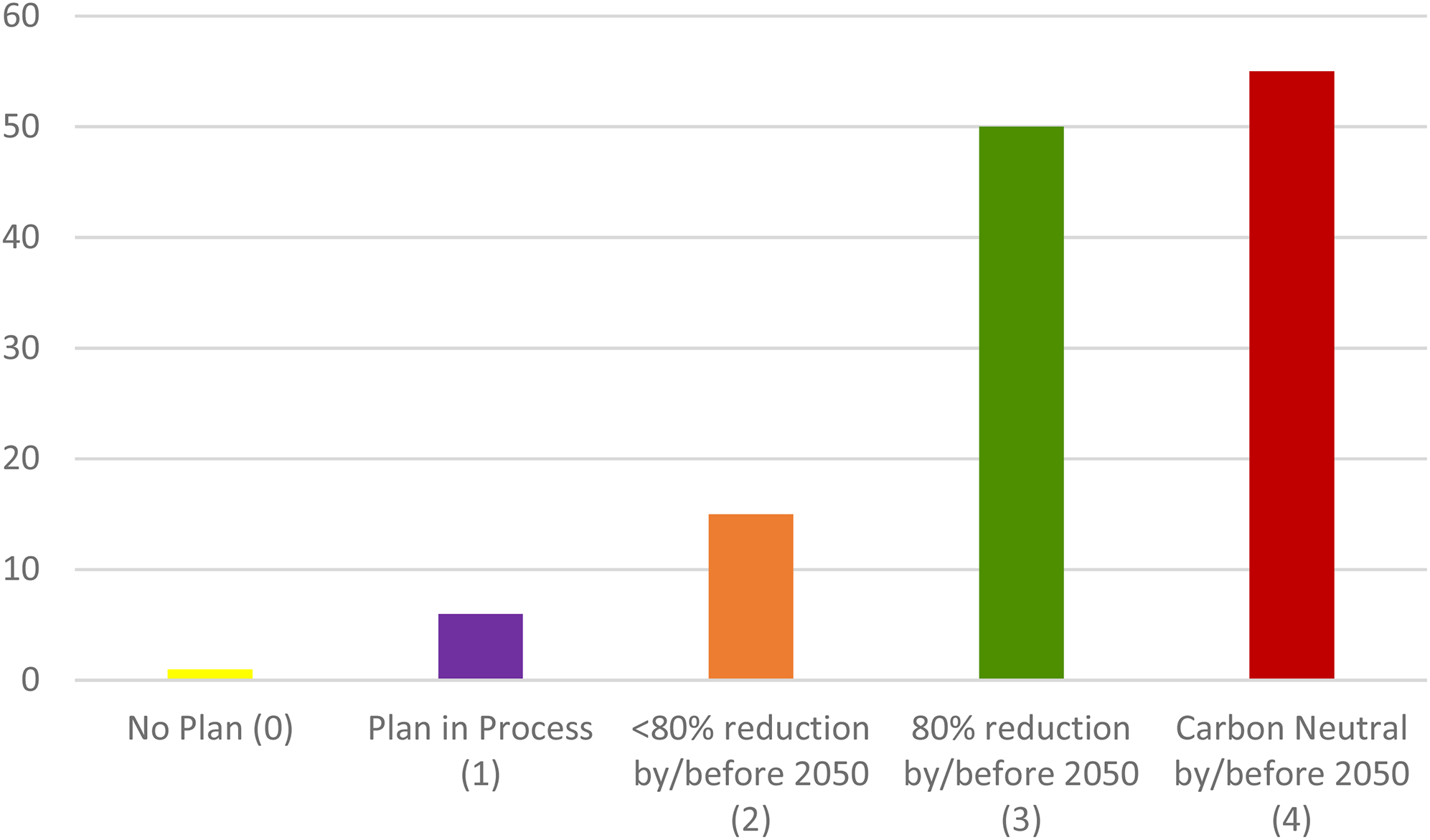
Cities with environmental staff and their climate action plan levels.
Discussion
Somewhat surprisingly, the factors that the urban environmental policy literature suggests should have the greatest influence over a city's environmental policy did not have a statistically significant effect in moving cities from talk to action. Population, per capita income, city revenue, partisanship, state incentives, and belonging to an international city network did not predict which US cities from among those that had signed the Global Covenant of Mayors for Climate and Energy enacted ambitious (Net Zero) climate action plans. Although we did not study it in this paper, it seems likely that these factors may be important in getting cities to take the important first step—from not caring about climate change to caring about climate change—even if they are not statistically significant in getting cities to take the second step—from talking about climate change as important to taking policy action to address climate change.
Only two factors—the presence of a university and having dedicated city staff focused on environmental/energy policy—had a statistically significant relationship to the level of ambition in cities’ climate action plans. In order to explore how the factors in the above large-n analysis play out in a specific city, we examine the surprising adoption of an ambitious (Net Zero) energy plan in 2019 in our own city of Middletown, CT. The reason we were surprised by Middletown's adoption of a net zero plan is that the city did not have many of the factors that the literature suggested should be important. The city is small, with a population of about 45,000. It is quite average in terms of income and poverty rate (a per capita income of $38,265 and a 12 percent poverty rate, compared to national averages of $35,103 and 11.4 percent respectively). Additionally, the city's population is more transient than usual, with an owner-occupied housing rate of only 53 percent, compared to the national rate of 64 percent. 9
Historically, the city and state have had mixed partisanship—one of the last three mayors was a Republican, 1/3 of the current Common Council is Republican, and half of the state's last ten senators have been Republican. The city is not a member of any international city organizations, and, until recently, did not have any paid city staff dedicated to energy and climate policy. However, it is home to Wesleyan University (student population 3,200), and the story of how Middletown's net zero climate action plan came about helps to illustrate how three of the factors in the statistical analysis—state incentives, paid staff, and the presence of a university—worked together to facilitate the city's adoption of an ambitious climate action plan.
The state of Connecticut is ranked number six in the country in terms of the number of energy efficiency and conservation incentives it offers (Weston Berg et al. 2019). Middletown joined Connecticut's Clean Energy Communities Program in 2005, and Wesleyan University pledged to purchase 1 Gwh of clean energy to help the city meet its 20 percent clean energy by 2010 goal (Resolution 47 2005). Two years later, Wesleyan University formed a Sustainable Advisory Group for Environmental Stewardship, made up of students, faculty and staff committed to sustainability. That same year the University's President, Michael Roth, signed the American College & University's Presidents’ Climate Commitment (now called Presidents’ Climate Leadership Commitments), which committed the university (but not the city) to be carbon neutral by 2050. The University also developed its own Climate Action Plan, which increased its commitment to greater energy conservation, greater development of renewable energy, and fuller integration of sustainability into the university's curriculum and campus life.
After the city reached its 20 percent renewable energy target in 2010, the city's Climate Energy Task Force began to formulate an Energy Plan, which focused on the importance of creating a culture of conservation in the city and establishing a position of City Energy Manager in the near future (City of Middletown 2010 Energy plan). Through a partnership with the local utility company, Middletown obtained an Energy Manager the same year and has had one ever since.
In 2017, Sustainable CT created a framework whereby cities could systematically track and certify their emissions, providing a focus for the city's next steps towards a revised Energy Plan. Soon afterwards, the city's Clean Energy Taskforce and the city's Energy Manager CCC worked on plans to achieve Sustainable CT “silver” designation. In order to promote both its on-campus commitment as well as support the city, the University created a new “Sustainable Middletown” internship position that funded a student dedicated to helping the city achieve bronze and silver certification. 10 In 2018, just one year after joining Sustainable CT, the city achieved bronze certification, and it received silver in 2019. 11
Middletown's 2019 Energy Plan was officially implemented in August 2019 with the ultimate goal of creating a 100 percent renewable energy city by 2050. In 59 pages the plan outlines three major ways it plans on achieving this aspiration: 1) improve public and private buildings energy efficiency, 2) transition transportation to electric vehicles and heating and cooling to high-efficiency heat pumps, 3) develop an optimal mix of locally supplied renewable energy by promoting the responsible development of solar energy, including residential rooftop solar, community shared solar, commercial solar and solar carports (City of Middletown 2019 Energy Plan). In November 2019, Middletown's elected a new Democratic mayor who had run on a pro-environmental campaign, including signing pledge committing to refusing any campaign contributions from the fossil fuel industry. One of his first acts in office was to sign off on the Common Council's declaration of a Climate Emergency.
Middletown's Energy Manager Michael Harris was critical to the development of Middletown's ambitious Energy Plan. He had the technical expertise, knowledge of city, and the institutional connections to turn the dream of Net Zero into a concrete plan of action. Indeed, Middletown's Net Zero Energy Plan was often referred to as his “brain child” or his “vision” when it was discussed by others involved in the plan creation. 12 The important role that Harris played in the plan's development is entirely consistent with Manuel Teodor's research demonstrating the vital role of public servant professionals in environmental policymaking (Teodoro 2009, 2011; Teodoro and Switzer 2016).
Michael Harris was strongly enabled by Wesleyan University. First, Jennifer Kleindienst, the University's Director of Sustainability and resident of Middletown, chaired the Clean Energy Taskforce, lending technical and organizational expertise as well as an intimate knowledge of how city-university collaborations might further the Net Zero goals of both. Additional university members, both faculty and staff, were part of the Clean Energy Taskforce in their private capacity as interested residents of the city (three of seven Taskforce members were affiliated with the university), adding their own time, energy, and expertise to the effort. The university funded sustainability interns to help the city meet its Sustainable CT benchmarks. These students were critical to successful implementation. Since the city had only one paid Energy Coordinator position, it lacked the staff capacity to complete all the research necessary to demonstrate compliance.
The university provided several additional ad hoc and more informal supports for the city's net zero ambitions. For example, in 2018, a geographic information systems (GIS) class mapped and analyzed where solar energy could be placed around the city. In 2019, students in an environmental economics class did a cost benefit analysis of the proposed expansion of a nearby power plant as one of their class projects. The university has frequently served as a testing ground for clean energy initiatives. For example, the university has a co-generation facility that operates as a microgrid for the university, which enabled the city to see how micro-grids might work in other places in the city. Finally, university students, and especially the local Sunrise Movement chapter, actively campaigned for the pro-environmental mayor, contributing to his electoral success and subsequent Climate Emergency declaration.
The case of Middletown highlights the important and interconnected ways that state energy incentives can provide the motivation for cities to develop ambitious climate action plans and city Energy Coordinators (or equivalent positions) can work closely with key members of the university to turn vague hopes into concrete plans. Through the financial contributions of the university (e.g., buying renewable energy from the city and funding sustainability interns), student labor, courses focused on problems the city needs to solve, and perhaps most importantly, through the voluntary efforts by committed members of the university who are also residents of the city, universities can provide important supports to cities as they seek to move from talk to action on climate change.
Conclusion
This article has investigated the question: Which factors help cities move from talk to action on climate change? We examined the 169 U.S. Cities that have signed the Global Covenant of Mayors for Climate and Energy and studied how the factors present in the urban environmental policy literature (population, income, city revenue, partisanship, state incentives, international partnerships, presence of city staff dedicated to environmental policy) as well as the presence of an institution of higher education in the city, affected the level of ambition of cities’ energy plans. We found that only two factors—(a) city staff dedicated to environmental/energy policy and (b) the presence of an institution of higher education—had statistically significant effects on the level of ambition of a city's climate action plan.
Therefore, this study supports the findings of previous research demonstrating the importance of dedicated city professionals in the development of actionable urban environmental policy (Homsy 2018; Knuth et al. 2007; Roseval 2019; Teodoro 2011) and the important role that city-university partnerships can play in supporting urban planning for climate change (Keeler et al. 2019; Trencher, Bai, et al. 2014).
Our findings lead us to make three recommendations for those who are interested in helping their city move from talk to action on climate change. First, the most influential factor determining whether a city was able to develop and implement an ambitious climate action plan was the presence of a paid staff member (or department) dedicated to environmental/energy policy. In many cases, perhaps even in most cases, these energy managers pay for themselves—helping their cities save more money than their salaries. Hiring a staff member or establishing a department dedicated to environmental policy making is the single most influential thing that cities can do to improve their capacity to develop and implement ambitious climate action plans.
Second, these findings have revealed that many cities can leverage connections to educational institutions to help them develop and implement ambitious climate action plans. Middletown and Wesleyan University's experience highlights the diverse ways that educational institutions and cities can mutually benefit from collaboration. There has been growing research on how city collaborations with nonprofit and private actors can improve environmental policy outcomes (Park, Krause and Feiock 2019; Scott 2015), and we have extended this to include universities and colleges. Although we looked at institutions of higher education for this study, it is easy to see how similar types of formal and informal relationships could be formed between cities and a wide variety of schools or similar institutions such as think tanks. City officials seeking to take more proactive action on climate would be well served by finding partners at nearby schools and institutions who can work with them to develop and implement ambitious climate action plans. Similarly, faculty and administrators who would like to see their cities do better should consider reaching out to city officials to see how they and their institutions can support city efforts to combat climate change.
Finally, perhaps the most important finding in this study is to debunk the myth that only big, rich cities can be ambitious in their climate action. A city's financial resources matter, but they had no statistical relationship to a city's climate action plans. In fact, in our study, the richest cites were more likely to have moderate (80 percent reduction) than ambitious (Net Zero) plans. The cities most likely to have ambitious plans were middle-income cities (city revenue of $100–$500 million), and three times as many of the poorest cities (city revenue of less than $10 million) had moderately ambitious or ambitions plan (6 cities) than no plan (2 cities) (Figure 4).
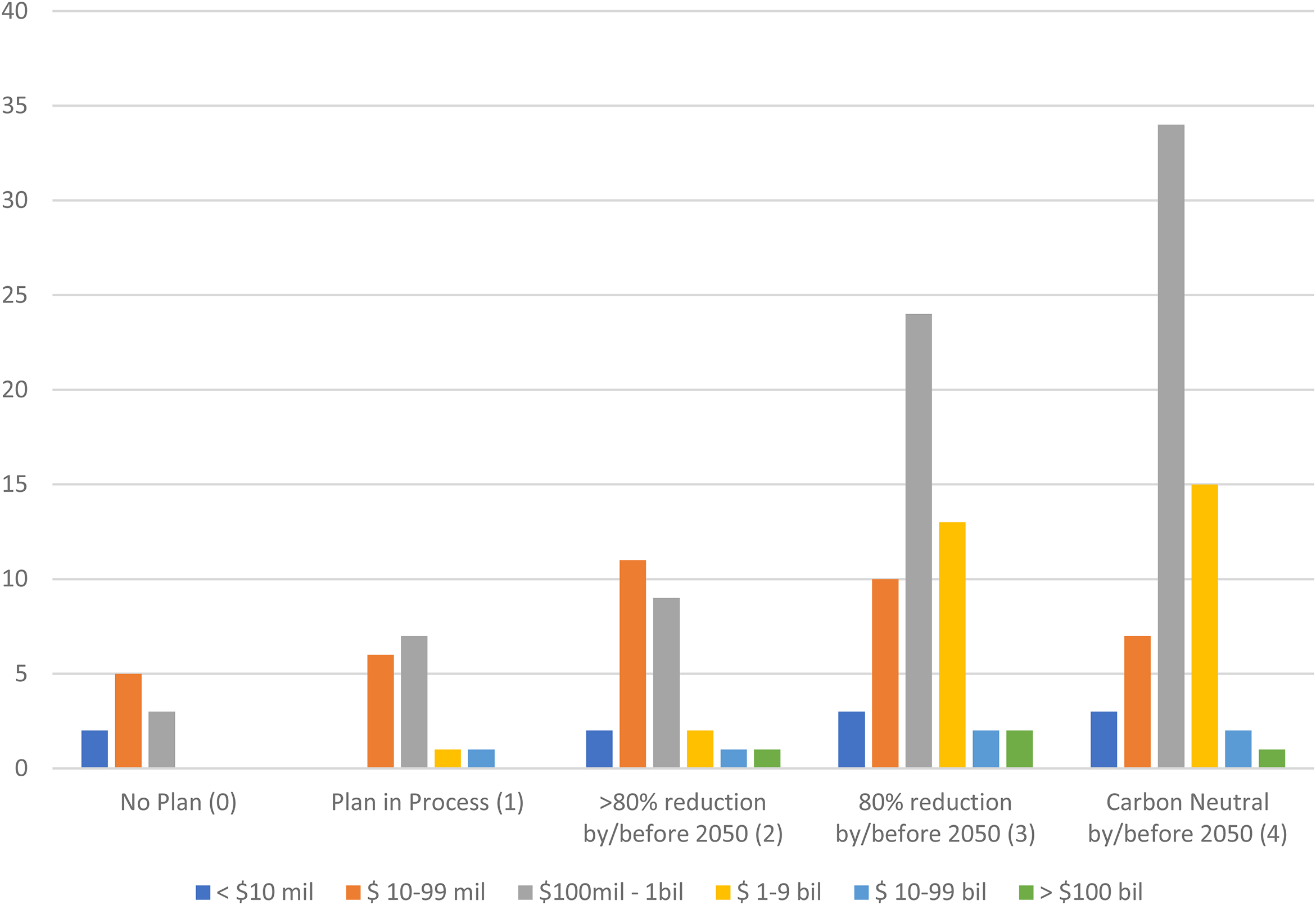
Number of cities by city revenue and plan ambition.
The experience of Middletown illustrates how dedicated collaboration among volunteers can overcome many of the challenges related to low levels of funding, especially when supported by technical and financial expertise of a university or similar institution. Cities should know that they can take positive action to combat climate change no matter what their financial resources are.
In sum, the IPCC has told us that we must reach Net Zero carbon emissions by 2050 to avoid the worst effects of climate change. This study has demonstrated that many cities in the United States have already risen to the challenge by developing Net Zero climate action plans with clear, measurable benchmarks to ensure timely progress. Furthermore, these ambitious cities can be found across all regions of the country, at all income levels, and they come in all sizes. Cities are responsible for most of the carbon emissions in the world. They must and can take positive, aggressive action towards a Net Zero future.
Footnotes
Declaration of Conflicting Interests
The author(s) declared no potential conflicts of interest with respect to the research, authorship, and/or publication of this article.
Funding
The author(s) received no financial support for the research, authorship, and/or publication of this article.
