



Abstract
Project-based housing programs and tenant-based housing programs (vouchers) may have differential effects on neighborhood outcomes for residents. Theoretically, vouchers should enhance access to low-poverty neighborhoods for low-income families thereby promoting economic mobility for children, though vouchers’ success may vary by race and ethnicity. Drawing on a national survey-administrative data linkage and a quasi-experimental approach, we examine the impact of project-based housing and vouchers on an index of socioeconomic neighborhood disadvantage among children. We find that living in project-based housing leads to greater exposure to neighborhood disadvantage while receiving vouchers leads to reduced exposure. Reductions in neighborhood disadvantage for children receiving vouchers are found only for non-Hispanic Black and Hispanic/Latino children. For non-White families, vouchers are associated with a reduced likelihood of living in high-poverty neighborhoods and increased likelihood of living in low-poverty neighborhoods, presenting an opportunity to narrow racial and ethnic differences in children's neighborhood attainment.
Introduction
Persistent racial and ethnic differences in socioeconomic status (SES) in the United States to a large extent reflect unequal access to advantageous social environments, including safe, high-opportunity neighborhoods (Chetty and Hendren 2018; Wilson 1987). Significant racial inequalities in exposure to neighborhood socioeconomic disadvantage reflect long-term racial segregation that characterizes the residential geography of U.S. cities (Massey and Tannen 2015). Throughout the life course, Black and Latino individuals tend to live in poorer, older, more economically disadvantaged, and more segregated neighborhoods than White Americans, even holding socioeconomic characteristics constant (Huang et al. 2020). Although Black-White differences in neighborhood disadvantage have narrowed in the past 40 years, high-income Black families still tend to live in neighborhoods with similar poverty rates to those of low-income Whites (Firebaugh and Farrell 2016). Similarly, Latinos are less likely than non-Hispanic Whites to successfully translate economic mobility into neighborhood opportunity (Riley, Hawkley and Cagney 2016). While high SES does not guarantee access to low-poverty neighborhoods for Black and Latino families, low-SES families of color often have few options for accessing high-opportunity neighborhoods (Huang, South and Spring 2017; Lee, Smith and Galster 2017). For example, recent estimates suggest that 20 percent of poor White children reside in neighborhoods characterized as very low opportunity, in contrast to 50 percent of poor Latino children and 66 percent of poor Black children (Acevedo-Garcia et al. 2020).
Federal rental assistance programs from the U.S. Department of Housing and Urban Development (HUD) offer the opportunity to improve access to high-opportunity neighborhoods for low-income families and reduce racial disparities in neighborhood disadvantage. However, the potential for rental assistance to improve neighborhood outcomes depends heavily on the type of program and the surrounding metropolitan context. For example, project-based housing programs (which include both public housing developments and privately-owned subsidized housing, typically referred to as multifamily housing) may limit geographic mobility and increase children's exposure to high levels of neighborhood poverty, family instability, and reduced economic opportunity. In contrast, housing vouchers are theoretically more flexible, and may provide access to high-opportunity, low-poverty neighborhoods by allowing families to rent in the private market. In practice, empirical evidence that vouchers reduce exposure to disadvantaged neighborhoods is mixed (Ellen 2020), and little is known about whether there are racial differences in the effects of rental assistance on neighborhood outcomes nationwide.
We draw on individual-level data from a unique national survey-administrative data linkage to assess the effect of major rental assistance programs on exposure to neighborhood disadvantage and opportunity among U.S. children. Specifically, we examine differences in neighborhood disadvantage between children who are receiving rental assistance and children who are not receiving assistance but will enter assisted housing in the near future. We compare the effects of project-based housing programs and housing choice vouchers on an index of neighborhood disadvantage, as well as the likelihood of living in high-poverty neighborhoods and low-poverty neighborhoods. Additionally, we examine whether effects differ by the race/ethnicity of the child. We find that living in project-based housing leads to greater exposure to disadvantaged neighborhoods while receiving vouchers is associated with reduced exposure to neighborhood disadvantage, both by approximately one-fifth of a standard deviation. Notably, we find that the effects of vouchers on reduced neighborhood disadvantage are limited to Black and Latino children.
Background
HUD Rental Assistance Programs
As of 2019, approximately 3,000 local Public Housing Agencies (PHAs) administer HUD rental assistance programs covering nearly 5 million households and 10 million participants (including 4 million children) in the U.S. (HUD 2020). HUD oversees two major types of rental assistance that are distinguished by several policy characteristics including their level of emphasis on spatial mobility. The first type of program, project-based housing, provides access to affordable housing through federally-funded, locally-administered housing developments. Project-based housing includes several types of programs that offer access to rental assistance at the level of the development (often called place-based assistance). The first project-based program is the public housing program, which provides assisted units in PHA-owned and operated housing developments. Although public housing developments were historically often high-density developments, contemporary project-based housing exists at a variety of densities, ranging from high-density towers to single-family detached housing (scattered site housing) (HUD 2020). The second type of project-based program is multifamily housing, which involves a number of programs—largely Project-based Section 8 (PBS8)—in which HUD provides subsidies or concessionary financing for private development owners to keep rents at below-market rates for assisted families. 1 Although administration differs for public housing and multifamily housing programs, 2 they both provide place-based rental assistance and tend to be more similar in terms of neighborhood characteristics (Fenelon et al. 2018). Project-based housing programs limit tenants’ neighborhood mobility, since programs provide rental assistance to families for particular units in existing developments.
The second type of program, housing choice vouchers, provides a housing subsidy through which assisted families enter the private rental market. Voucher recipients lease housing units with rents at or below the fair market rent (40th percentile rent in the metropolitan area), 3 provided the owner agrees to participate and the units meet standards of health and safety. The family is expected to pay approximately 30 percent of their income towards rent, with the voucher covering the difference, up to the fair market rent. The average voucher provides a housing subsidy of more than $800 a month, or $9,700 a year, a significant benefit for families whose incomes average just $15,000 per year (HUD 2020). Vouchers are attached to the family instead of the specific development, and if a family decides to move, they may take their voucher to a new suitable unit. Although ostensibly more flexible than project-based housing, voucher recipients typically must themselves identify a qualifying unit and a landlord that agrees to rent them the property. Estimates suggest that 30–40 percent of voucher recipients are unable to successfully lease up within the allotted period (Ellen 2020; Shroder 2002).
Project-Based Housing and Neighborhood Disadvantage
Although project-based housing programs include both public housing and multifamily housing, most evidence about the relationship between project-based housing and neighborhoods comes from the public housing program. Localities have largely maintained authority over whether and how much public housing investment to accept; wealthy suburban areas leveraged more resources to exclude public housing construction (Taylor 2019) and developments were overrepresented in less-resourced central city neighborhoods (Trounstine 2018). Additionally, lower-middle income White families left public housing for suburban homeownership in the 1950s-1970s, aided by enormous investments in federally-financed mortgages from the Federal Housing Administration and Veterans Administration which largely excluded Black families (Jackson 1985; Rothstein 2017). As a result, the average incomes of public housing residents declined precipitously during this period (Vale 2000). Between 1970 and 1980, real mean labor earnings of public housing residents declined by more than 50 percent (Newman and Harkness 2002). Beginning in 2001, changes in HUD's income requirements for subsidized housing specified that PHAs reserve 75 percent of vouchers and 40 percent of public housing units for families below 30 percent of the Area Median Income (AMI). This policy may have ultimately slowed the decline in the average socioeconomic status of families in public housing relative to those receiving vouchers (Leopold 2012). Distressed public housing has long served as a convenient scapegoat for many perceived urban social ills, in some ways serving as a symbol for the unseemly characteristics of urban slums (Goetz 2012; Meehan 1979).
Evidence from the 1990s indicated that public housing developments were disproportionately located in census tracts with low median incomes, high rates of unemployment, and low-quality housing compared to households receiving welfare overall (Newman and Schnare 1997; Reingold, Van Ryzin and Ronda 2001). A HUD report using data from 2000 indicated that only 7 percent of public housing units were in census tracts with a poverty rate below 10 percent, compared to 41 percent of all affordable rental units (Devine et al. 2003). Demolition of public housing developments as part of HOPE VI in large metropolitan areas in the 1990s and 2000s had only limited success in achieving poverty deconcentration (Owens 2015; 2016). By 2010, the average neighborhood disadvantage of public housing units had declined, but public housing units remained disproportionately in highly-disadvantaged neighborhoods with relatively low levels of walkability (McClure and Johnson 2015; Talen and Koschinsky 2014). These findings are consistent with concerns that public housing exposes residents to the negative effects of concentrated poverty. However, it is unclear whether these differences reflect the effects of public housing rather than the constraints in the housing market that low-income families face even in the absence of public housing (Oakley and Burchfield 2009). The few studies that examine multifamily housing programs indicate that neighborhood poverty is high for these programs relative to the US average, but slightly lower than for public housing (Kucheva 2018; Newman and Holupka 2021). Thus, while public housing and multifamily housing programs both limit spatial mobility, there may be some remaining differences between project-based housing programs in their impacts on neighborhood attainment.
Housing Choice Vouchers and Neighborhood Disadvantage
The predecessor to the modern housing voucher program originated in Section 8 of the 1974 Housing and Community Development Act (Meehan 1979). Vouchers saw tremendous growth following the reorientation of HUD program priorities in the early 1990s. Although vouchers are intended to provide location and unit-type flexibility for assisted families, there are a number of structural challenges that may limit their effectiveness. First, the generosity of vouchers is typically capped by the fair market rent, which may be insufficient to allow families to access higher-cost areas, particularly if zoning restricts dense development (Collinson and Ganong 2018; Lens 2013; Lens and Monkkonen 2016). Second, voucher recipients may face discrimination, since landlords are not required to accept vouchers (Graves 2016); landlords may be unwilling to rent to voucher recipients unless voucher recipients are a sufficiently large fraction of the tenant market. 4 Finally, for many families receiving vouchers, moving to new neighborhoods may expose them to prejudice and discrimination and may reduce connections to social networks (de Souza Briggs 1998). Families receiving vouchers may opt to remain in disadvantaged neighborhoods or may prioritize certain salient aspects of neighborhoods such as schools (Ellen, Horn and Schwartz 2016).
Perhaps for these reasons, evidence that housing choice vouchers are successful at allowing families to access better neighborhoods is mixed (Devine et al. 2003; Feins and Patterson 2005). Some studies compare neighborhood outcomes of voucher recipients to those of unassisted renters with no explicit attempt to account for selection into receiving vouchers. These studies tend to find that voucher families tend to live in neighborhoods with similar or higher levels of disadvantage than other renters, even families receiving welfare (Galvez 2010; McClure and Johnson 2015; Newman and Schnare 1997; Pendall 2000; Wang 2018; Wood, Turnham and Mills 2008). In contrast, other studies have examined whether voucher recipients live in less disadvantaged neighborhoods than they would otherwise, and findings are mixed as well. A few studies use data from particular localities and find significant improvements in neighborhood quality for voucher recipients relative to their neighborhood before receiving vouchers (Basolo 2013; Schwartz et al. 2020). Others find few short-term effects of receiving vouchers on neighborhood disadvantage, but show larger effects 3–5 years after initial receipt, perhaps owing to subsequent moves (Carlson et al. 2012; Eriksen and Ross 2013; Wood, Turnham and Mills 2008). Finally, others find no significant effects of vouchers on the characteristics of recipients’ neighborhoods, or that the effects depend on housing market characteristics (Ross, Shlay and Picon 2012; Wang and Walter 2018). In recent years, only about 20 percent of families receiving vouchers lives in a low-poverty neighborhood (McClure, Schwartz and Taghavi 2015).
When vouchers have been programmatically constrained to low-poverty neighborhoods, there is also mixed evidence (Ludwig et al. 2008; Sampson 2008). The HUD Moving To Opportunity (MTO) demonstration was a multi-city experiment in which families living in public housing were randomly assigned to one of three groups: an experimental group that received a voucher that needed to be used in a neighborhood with less than 10 percent poverty, a control group that was not offered a voucher, and a comparison group, that was offered a voucher with no neighborhood constraints. However, the majority of the experimental group typically moved in relatively close proximity to their former neighborhood, and more than 40 percent had returned to a high-poverty neighborhood 4–7 years after the initial move (Clampet-Lundquist and Massey 2008). In non-randomized programs, such as the Gautreaux relocation, short-term mobility gains were often reduced over time, as a substantial fraction of participants moved back to their original neighborhood after several years (Keels et al. 2005). Participants in the Baltimore Housing Mobility Program saw reductions in neighborhood poverty and racial segregation, and most participants were able to maintain neighborhood improvements in the longer term (DeLuca and Rosenblatt 2017).
Racial and Ethnic Differences in the Effects of Rental Assistance
In understanding racial inequality in health, education, and employment, research has often focused on the role played by individuals’ immediate neighborhood context, which can have implications for inequalities in outcomes such as schooling, health, and well-being. 39 percent of Black families and 31 percent of Latino families live in census tracts with poverty rates consistently above 20 percent since 1990, compared to just 13 percent of White families (Loh 2020). Given the reality that Black, Latino, and White families tend to live in highly distinct types of neighborhoods in the United States (Acevedo-Garcia et al. 2020), we may expect that rental assistance has differential effects on neighborhood attainment by race/ethnicity.
Several structural factors may ensure that Black and Latino families have less success than White families using a voucher in a high-opportunity neighborhood. First, minority families may experience discrimination in the rental market, presenting a challenge to renting in wealthy neighborhoods (Korver-Glenn 2018; Rosen 2014). Relatedly, White voucher recipients may be more likely to have social network connections in high-opportunity neighborhoods, while Black and Latino families’ social ties may be more limited to segregated areas (Ellen, Suher and Torrats-Espinosa 2019).
Importantly, Black and Latino families may have more to gain from housing vouchers given that they experience greater overall neighborhood disadvantage. Indeed, a study of voucher recipients and neighborhood crime showed that Black voucher recipients lived in safer neighborhoods than poor Black renters, while the same benefit was not seen for White voucher recipients (Lens, Ellen and O’Regan 2011). Galvez (2010) demonstrated that although the overall effects of vouchers on neighborhood attainment are modest, Black recipients tend to benefit more than Whites. In other studies, racial differences in the success in translating vouchers into improved neighborhoods were related to the racial composition of housing authorities (Finkel and Kennedy 1992). Black families also tend to have higher residential mobility than Whites even in the absence of vouchers (South and Crowder 1998; Teater 2009); experience with frequent moves may make it more likely that families are open to repeated moves in order to improve neighborhood quality once a voucher is received (Owens 2017).
Although project-based housing has often received criticism specifically because of its effects on concentrated disadvantage (Fauth, Leventhal and Brooks-Gunn 2004), it is not clear whether this effect differs by race. To the extent that project-based rental assistance leads to racial residential segregation, it may have larger effects on neighborhood disadvantage for Black and Latino families. In contrast, White families moving into public housing may be coming from less disadvantaged neighborhoods on average than minority families, and thus will see a larger average increase in disadvantage. Likewise, evidence suggests that Black and Latino families in subsidized housing tend to live in more disadvantaged neighborhoods than White families in subsidized housing (Newman and Holupka 2017; 2021). Given these differences, it is important to consider the effects of housing programs separately by race and ethnicity.
Data and Methods
Data Sources
We use data from the National Health Interview Survey (NHIS) linked to administrative records from HUD (Lloyd, Helms and Simon 2017). This linkage provides the first nationally-representative picture of health and demographic characteristics among HUD-assisted households. Public-use NHIS data were obtained from IPUMS NHIS (Blewett et al. 2016). NHIS is a multi-stage nationally-representative household survey that collects a variety of indicators of all members of sampled households. The NHIS sample covers the years 1999–2012. The HUD administrative records cover 1999–2014 and are linked to NHIS based on deterministic matching 5 (Lloyd and Helms 2016). The HUD file provides a longitudinal record of housing assistance entry and exit dates which can be used to generate housing episode histories for each NHIS respondent, including information on housing program (project-based housing, housing choice vouchers). While the NHIS sample is cross-sectional and respondents are not followed over time, the longitudinal HUD file provides precise information on the dates of future rental assistance participation for those who have not entered rental assistance at interview. This information allows us to construct our comparison group. For each respondent, we examine the timing of interview relative to entry into rental assistance to assess the causal effect of housing assistance entry on changes in neighborhood characteristics.
Sample
To be eligible for linkage, NHIS survey respondents must have provided sufficient personally-identifiable information: Social Security Number (either 4 or 9 digits, depending on what was collected), date of birth, and sex. To adjust for potential bias in eligibility for linkage, the National Center for Health Statistics (NCHS) created weights that account for both linkage eligibility and nonresponse to make estimates representative of the civilian noninstitutionalized U.S. population (Lloyd and Helms 2016). We limit our analytic sample to children with either current or future rental assistance experience. At the time of their interview, 2,311 children were receiving rental assistance: 901 in project-based housing and 1,410 in housing choice vouchers. Additionally, 509 children entered project-based assistance and 947 entered voucher assistance within 2 years of their interview, the mean waiting period to receive HUD housing (HUD 2020).
Neighborhood Measures
We merged the linked NHIS-HUD dataset with census tract information from the 2000 decennial census and the 2010–2014 American Community Survey (ACS), which provide socioeconomic, demographic, and spatial characteristics of children's neighborhoods. Relevant census tract characteristics are poverty rate, median family income, percent unemployed, percent college graduates, percent on public assistance, median household income, percent female-headed households, percent renter-occupied households, percent vacant, and percent living in a different house 5 years prior. We measure neighborhood disadvantage using an index calculated using principal components analysis, an approach that mirrors previous work on neighborhood economic disadvantage (Sampson, Raudenbush and Earls 1997; Schieman 2005). The disadvantaged index was loaded heavily with median household income, the poverty rate, the percent receiving public assistance, and percent female-headed households (see Appendix Table C1 for full component analysis and variable loadings). The index is normalized to have mean 0 and standard deviation 1, and thus is a continuous measure of standard deviations above or below the mean. In addition to the disadvantage index, we examine the component measures that contribute to the disadvantage index separately. Finally, we examine exposure to a neighborhood with a poverty rate above 30 percent (high poverty) as well as to a neighborhood with a poverty rate below 10 percent (low poverty).
Rental Assistance Status
Rental assistance status at interview is our primary treatment variable of interest. The HUD administrative record provides longitudinal information on rental assistance participation, including specific housing program (housing choice vouchers, project-based housing) for respondents who are linked. Unlike other government assistance programs for low-income families such as Medicaid and food stamps, demand for rental assistance in most housing markets greatly exceeds available units. Many more income-eligible families apply for housing subsidies than can be housed with PHA resources. Studies indicate that more than 75 percent of eligible families do not receive rental assistance (Fischer and Sard 2017), which creates the conditions necessary for a quasi-experimental approach. To manage greater demand for rental assistance than supply of units, most PHAs develop and maintain waiting lists for rental assistance. PHAs will periodically open waiting lists to new applicants and use lotteries to determine applicants’ place on the waiting list (Moore 2016). In other cases, some PHAs prioritize particular types of applicants for assistance, such as families experiencing homelessness, persons with disabilities, or persons with particular health needs (Keene et al. 2021). The overall result of the excess demand is long waits for assistance in most housing markets (Kingsley 2017). During the study period, the average wait time for assistance ranged from 18–26 months (HUD 2020). We exploit this waiting period for our empirical approach, since children in families in the waiting period prior to assistance represent a natural comparison group.
Empirical Approach
We examine the impact of receiving rental assistance on children's exposure to neighborhood disadvantage. Unobserved selection of families into receiving rental assistance is a particularly significant analytical problem for observational research. Assisted families tend to have high levels of economic disadvantage, high rates of family instability, and disproportionately experience homelessness (Helms, Sperling and Steffen 2017). HUD-assisted families have incomes that average 24 percent of the area median, have often lived in substandard housing or experienced homelessness, and are more likely than unassisted renters to have experienced negative life shocks (Fertig and Reingold 2007; HUD 2020). Comparisons to low-income renters often miss the multiple interacting sources of disadvantage faced by families receiving assistance (Helms et al. 2018).
We exploit the random timing of the NHIS interview relative to timing of entry into HUD rental assistance in order to assess causal effects. Using longitudinal information on rental assistance program participation, we use future treatment to adjust for unobserved confounding in the relationship between rental assistance and neighborhood outcomes. Conditioning on current or future exposure to the treatment has been shown to be a robust approach to estimating causal effects for social policy programs (Elwert and Pfeffer 2019; Schwartz et al. 2020; Carlson et al. 2019). We compare neighborhoods of children receiving rental assistance at interview with children in a pseudo-waitlist comparison group—those who will enter assisted housing within two years, the average HUD waitlist time during our study period (See Figure A1 for stylized view). The comparison group is a “pseudo” waitlist because our data do not contain information on whether individuals are on a waiting list for rental assistance. However, this approach has advantages relative to a direct observation of the waitlist, since many families on rental assistance waitlists are unable to successfully lease up (Chyn, Hyman and Kapustin 2019). In contrast, all individuals in the pseudo-waitlist comparison group receive assistance within 2 years of interview. 6
Since this approach accounts for unobserved time-invariant differences between individuals receiving rental assistance and those not receiving assistance, neighborhood characteristics for the pseudo-waitlist group are intended to reflect what neighborhoods of children currently receiving assistance would look like in the absence of rental assistance (Fenelon et al. 2017). A similar design has been applied in previous work on HUD rental assistance and health (Keene et al. 2020; Simon et al. 2017; Wong et al. 2019).
Statistical Analysis
Our primary analysis uses linear regression to predict the neighborhood disadvantage index as a function of rental assistance participation

In additional analyses, we examine the impacts of rental assistance programs on components of the neighborhood disadvantage index: median household income, poverty rate, percent on public assistance, percent female-headed households, percent in professional occupations, percent college graduates, and percent unemployed.
Finally, we use logistic regression to examine the relationship between rental assistance and the likelihood of living in a high-poverty neighborhood (>30 percent) and a low-poverty neighborhood (<10 percent). To adjust for potential selection in linkage eligibility, all analyses include weights constructed by NCHS to account for eligibility and models account for the complex multistage survey design of the NHIS.
Results
Table 1 presents descriptive characteristics of children in the pseudo-waitlist group for vouchers and those in the current vouchers group. For comparison, we also present characteristics for unassisted children, although this group is not included in the analysis. Both the current assistance and pseudo-waitlist groups are composed of highly disadvantaged children, and the demographic and socioeconomic profiles of these two groups are nearly identical. The only statistically significant differences between the two groups are the age composition (consistent with knowledge that currently assisted families may have waited 2 years for assistance), and region of residence. We include these two variables as covariates in the models. This level of similarity on observable characteristics provides support for the pseudo-waitlist comparison.
Descriptive Characteristics of Voucher Sample by Rental Assistance Status 1999–2012.
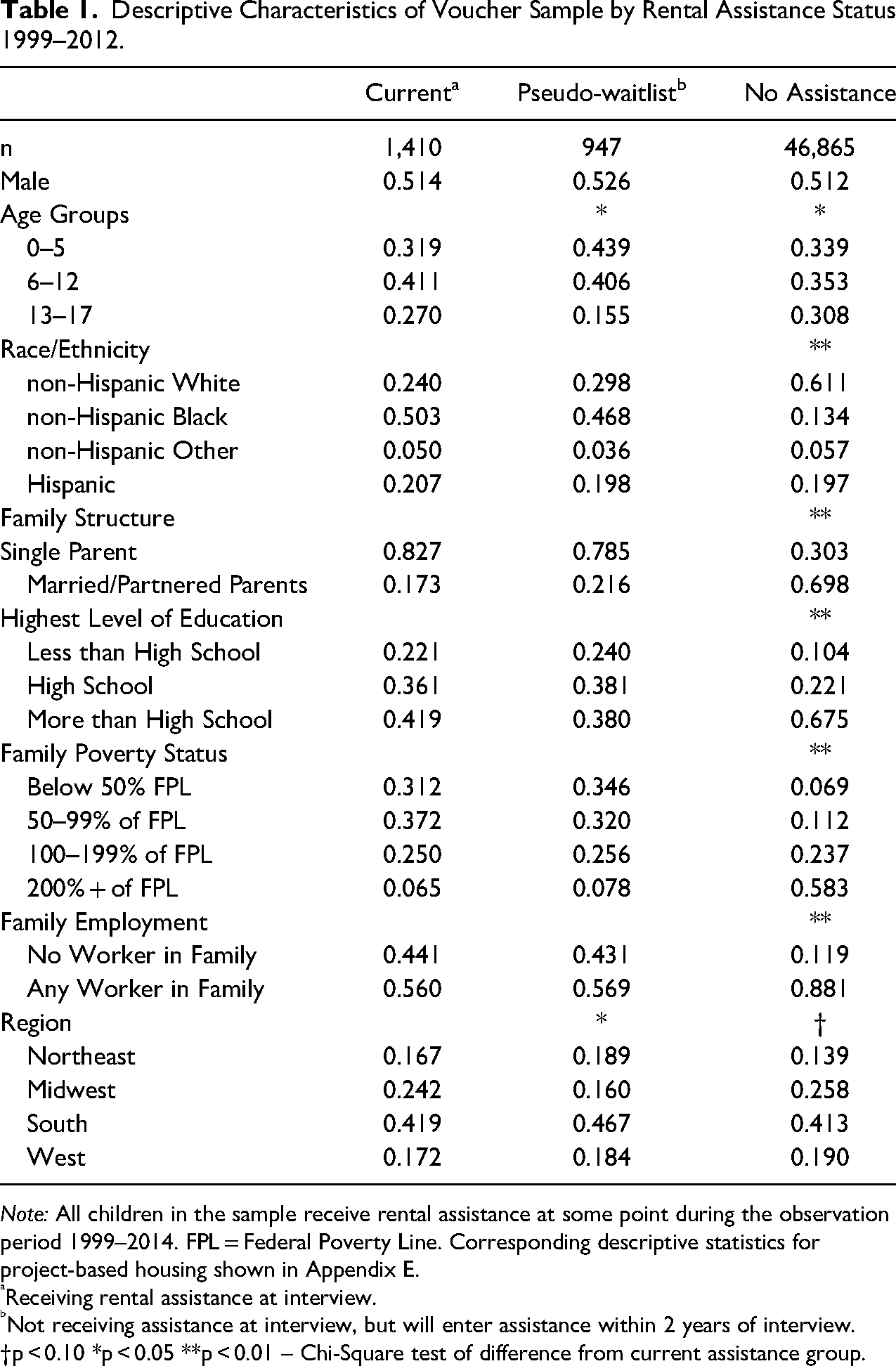
Note: All children in the sample receive rental assistance at some point during the observation period 1999–2014. FPL = Federal Poverty Line. Corresponding descriptive statistics for project-based housing shown in Appendix E.
Receiving rental assistance at interview.
Not receiving assistance at interview, but will enter assistance within 2 years of interview.
†p < 0.10 *p < 0.05 **p < 0.01 – Chi-Square test of difference from current assistance group.
In contrast, the characteristics of both the current assistance and pseudo-waitlist groups are highly distinct from those of children not receiving assistance. The non-assistance group has significantly higher family income, greater family education, and greater rates of family employment than either the current assistance or pseudo-waitlist group. The extent of these differences highlights the amount of selection into rental assistance. Descriptive characteristics of children in project-based housing and by race are presented in Appendix E, with similar findings.
Rental Assistance and Neighborhood Disadvantage
Table 2 presents the results of models examining the effect of current rental assistance on the neighborhood disadvantage index with separate models considering project-based housing and housing vouchers. These models compare neighborhood disadvantage for children currently receiving assistance and children in the pseudo-waitlist group—within two years of entering. The first column examines project-based housing. Although not statistically significant, children receiving project-based rental assistance live in more disadvantaged neighborhoods than children waiting to enter project-based housing. In contrast, the second column indicates that vouchers are associated with a statistically-significant reduction in neighborhood disadvantaged for children by 0.22 standard deviations (95 percent CI: 0.07–0.37). These coefficients are in the expected directions. (See Appendix A for full model results).
Regression Models Predicting Normalized Neighborhood Disadvantage Index as a Function of Rental Assistance Status.
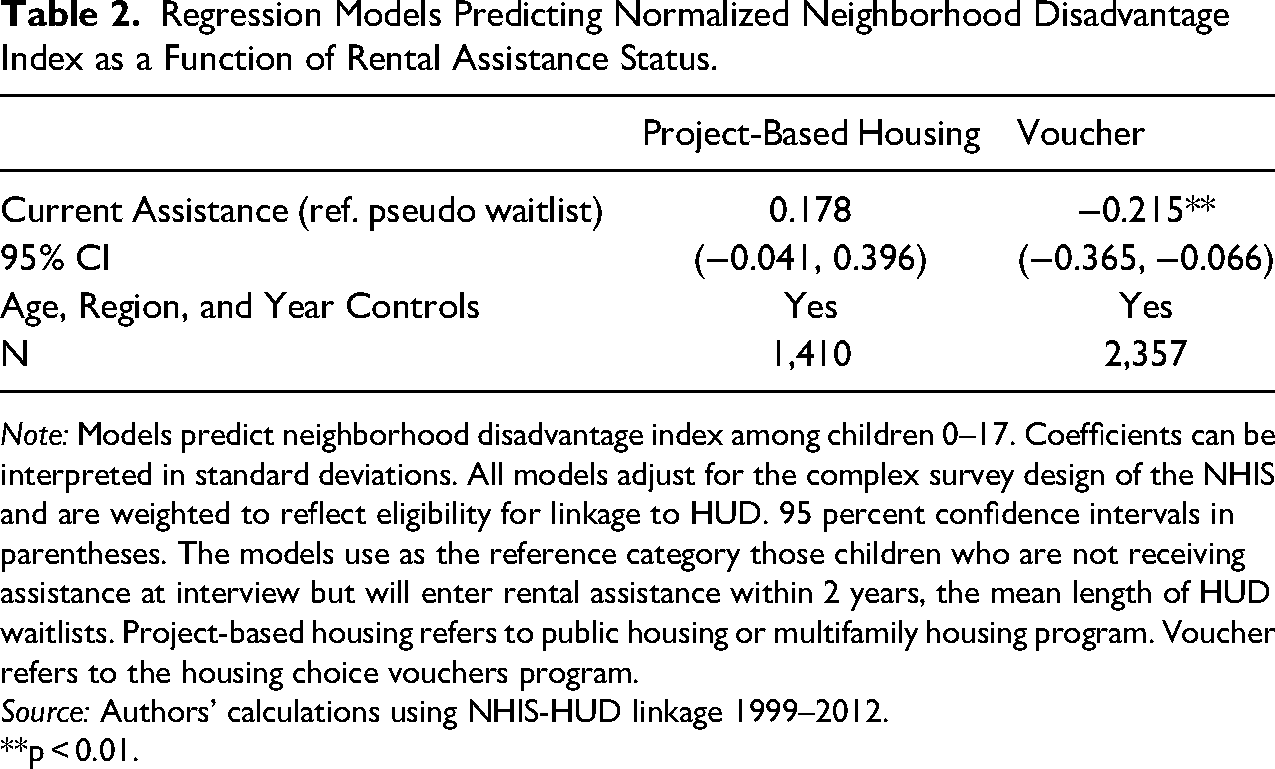
Note: Models predict neighborhood disadvantage index among children 0–17. Coefficients can be interpreted in standard deviations. All models adjust for the complex survey design of the NHIS and are weighted to reflect eligibility for linkage to HUD. 95 percent confidence intervals in parentheses. The models use as the reference category those children who are not receiving assistance at interview but will enter rental assistance within 2 years, the mean length of HUD waitlists. Project-based housing refers to public housing or multifamily housing program. Voucher refers to the housing choice vouchers program.
Source: Authors’ calculations using NHIS-HUD linkage 1999–2012.
**p < 0.01.
Predicted neighborhood disadvantage is shown by status (current vs. pseudo-waitlist) and housing program in Figure 1. Children in the pseudo-waitlist group—those who are within 2 years of entering assistance—live in similarly disadvantaged neighborhoods whether they eventually enter project-based housing (0.933, 95 percent CI: 0.79–1.07) or vouchers (0.880, 95 percent CI: 0.76–1.00). Among those who have entered project-based housing, disadvantage is 1.13 standard deviations above the U.S. mean. Among those receiving vouchers, disadvantage is 0.66 standard deviations above the U.S. mean (p < 0.01). Thus, while vouchers reduce exposure to neighborhood disadvantage relative to project-based housing, recipients tend to live in neighborhoods more disadvantaged than the national average.
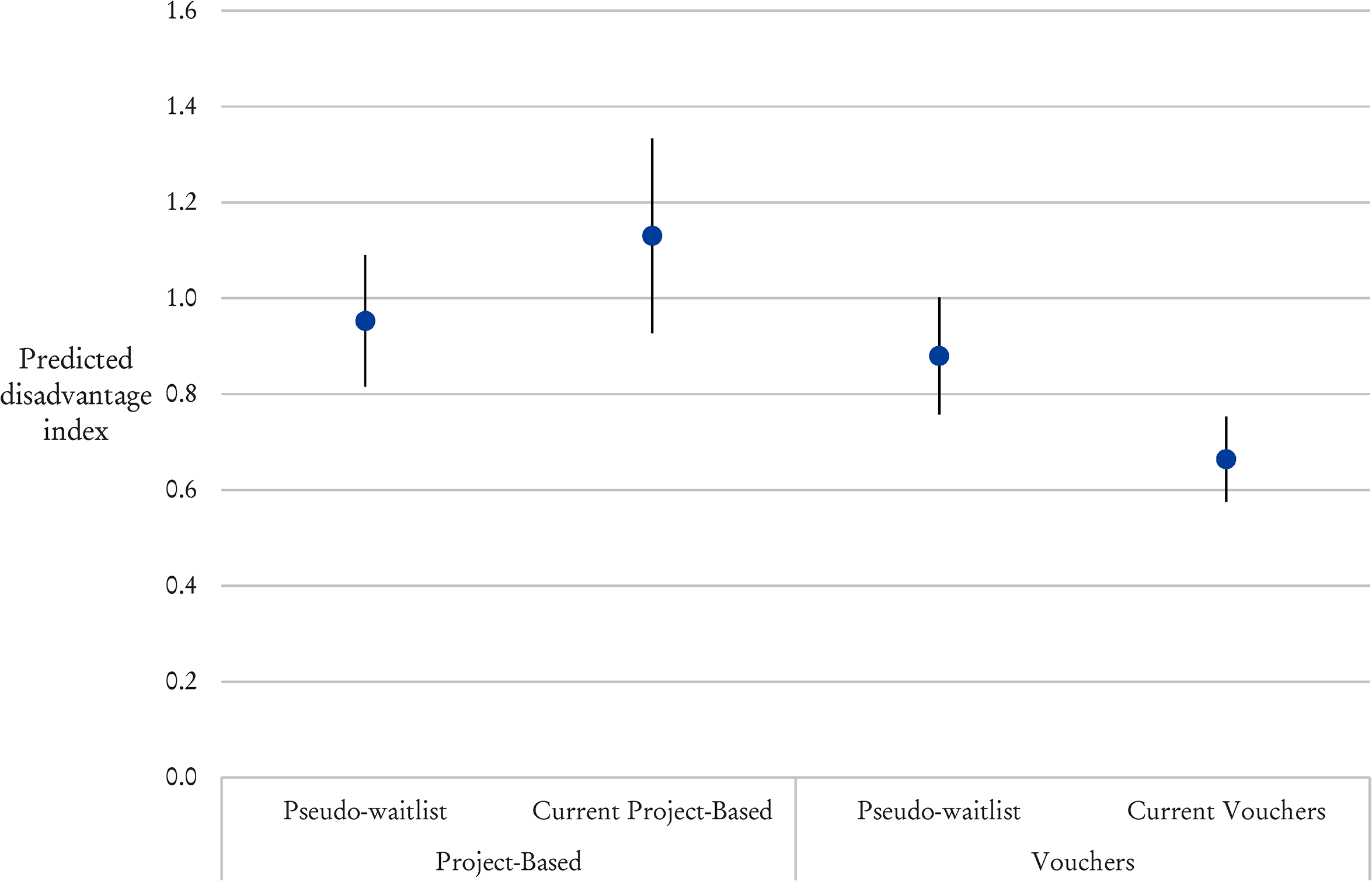
Predicted neighborhood disadvantage by rental assistance Status and program. Note: Predicted disadvantage index based on models in Table 1. Disadvantage index estimated using principal components analysis. Normalized to have mean 0 and standard deviation 1. Full component results in Appendix C. Pseudo-waitlist indicates children who will enter their type of rental assistance within 2 years.
Racial/Ethnic Differences in the Effects Rental Assistance on Neighborhood Disadvantage
The models in Table 3 examine racial and ethnic differences in the effects shown in Table 1, stratifying the model by racial/ethnic group. Each cell is a separate model predicting neighborhood disadvantage for current assistance children and pseudo-waitlist children. Project-based housing is associated with increases in neighborhood disadvantage for all racial/ethnic groups—0.20 sds. for White children, 0.30 sds. for Black children, and 0.12 sds. for Latino children. An interaction between rental assistance status and racial/ethnic group was not statistically significant (p = 0.22 for joint F-test).
Effects of Rental Assistance on Normalized Neighborhood Disadvantage Index by Housing Program and Race/Ethnicity.
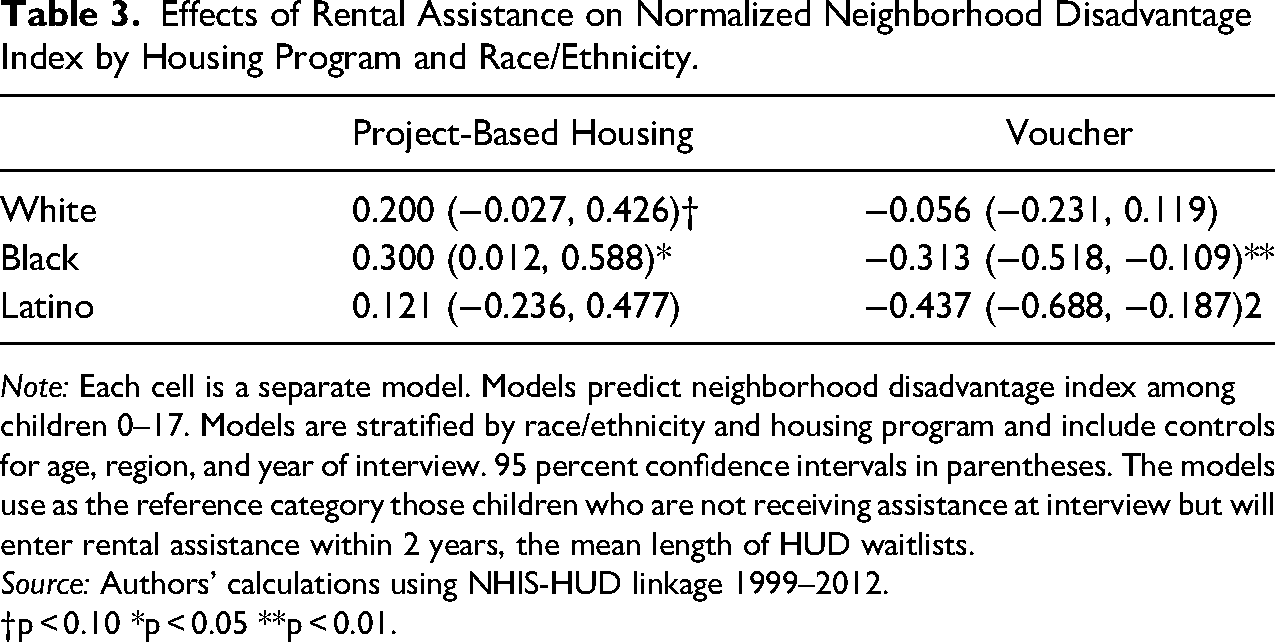
Note: Each cell is a separate model. Models predict neighborhood disadvantage index among children 0–17. Models are stratified by race/ethnicity and housing program and include controls for age, region, and year of interview. 95 percent confidence intervals in parentheses. The models use as the reference category those children who are not receiving assistance at interview but will enter rental assistance within 2 years, the mean length of HUD waitlists.
Source: Authors’ calculations using NHIS-HUD linkage 1999–2012.
†p < 0.10 *p < 0.05 **p < 0.01.
The models in the second column examine the effect of housing choice vouchers by race/ethnicity. Vouchers are not associated with a significant change in neighborhood disadvantage for White children. However, vouchers are associated with significantly lower disadvantage for Black children (−0.313 sds, 95 percent CI: −0.52–0.11) and Latino children (−0.437 sds, 95 percent CI: −0.69–0.19). Racial and ethnic differences in these coefficients were statistically significant (p = 0.035), indicating that the benefits of housing vouchers for reduced neighborhood disadvantage are largely specific to non-White children.
Predicted neighborhood disadvantage index by race/ethnicity and rental assistance status is shown in Figure 2. It is important to note the large baseline differences in neighborhood disadvantage between White children and Black and Latino children in the waitlist group. Vouchers reduce the Black-White difference in neighborhood disadvantage by 28 percent and the Latino-White difference by 41 percent. However, levels of disadvantage among Black and Latino voucher recipients remain significantly above those of White voucher recipients.
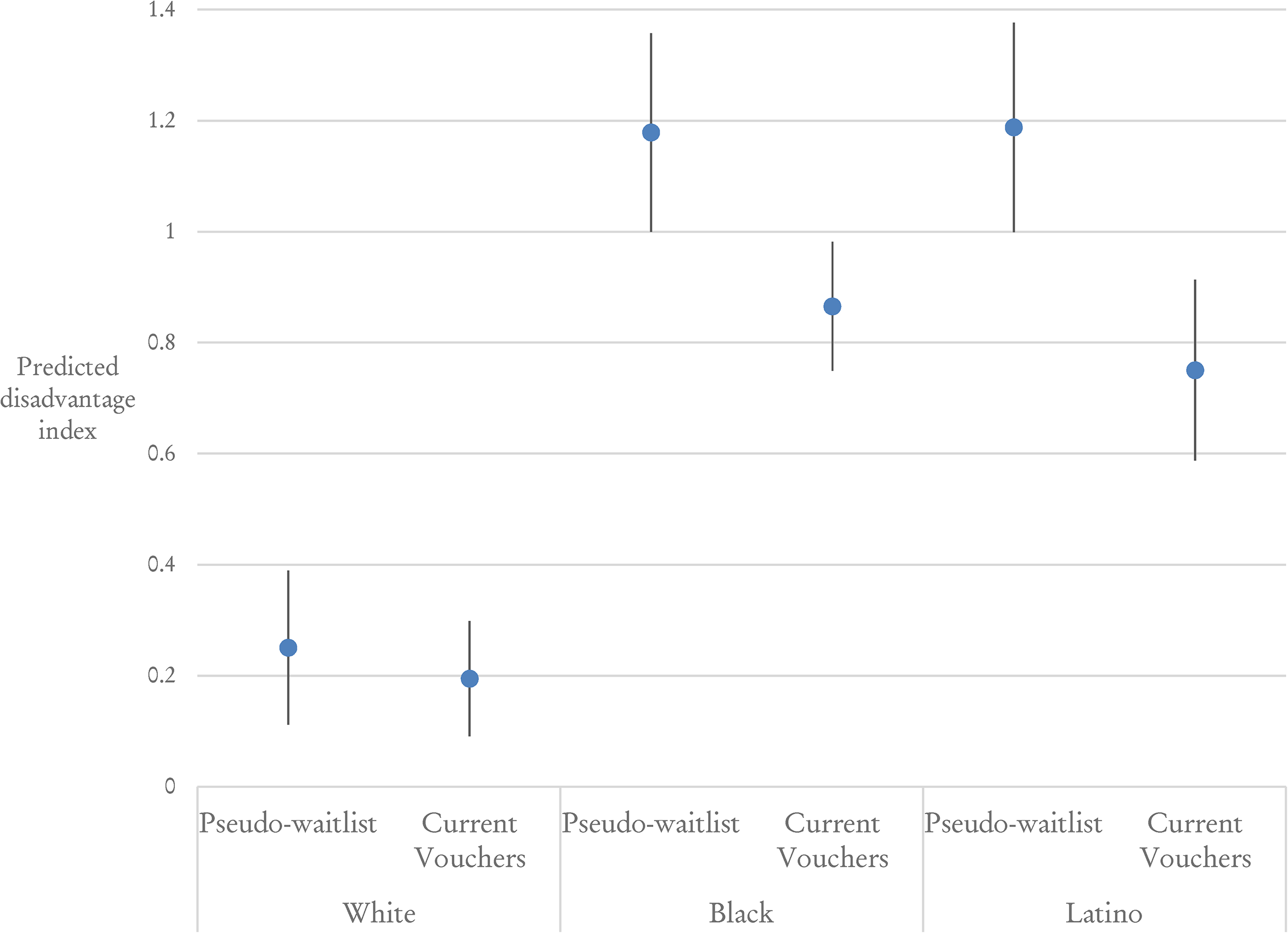
Predicted neighborhood disadvantage by voucher Status and race/ethnicity. Note: Predicted disadvantage index based on models in Table 3. Disadvantage index estimated using principal components analysis. Normalized to have mean 0 and standard deviation 1. Full component results in Appendix C. Pseudo-waitlist indicates children who will receive vouchers within 2 years.
Components of Neighborhood Disadvantage
The models in Table 4 examine the effects of receiving vouchers on individual components of the neighborhood disadvantage index—specifically median household income, poverty rate, percent on public assistance, percent female-headed households, percent in professional occupations, percent college graduates, and percent unemployed. The results are consistent with the analyses focusing on the disadvantage index. The models reveal no statistically significant effect of receiving vouchers on any of these components of neighborhood disadvantage for White children. In contrast, Black and Latino children see significant differences in each component of disadvantage compared to the pseudo-waitlist. For instance, Black children's neighborhood median household income is higher by $3,047 (95 percent CI: $629-$5465) and the poverty rate is lower by 3.6 percentage points (95 percent CI: 1.1–6.1). As with the disadvantage index models, Latino children again display even larger differences. Latino families receiving vouchers have a neighborhood median income that is higher by $6,136 (95 percent CI: $2284-$9990) and the poverty rate is 6.0 percentage points lower (95 percent CI: 2.1–9.9). Predicted values of the components of neighborhood disadvantage are shown by race/ethnicity in Appendix B.
Effects of Housing Vouchers on Components of Neighborhood Disadvantage by Race.
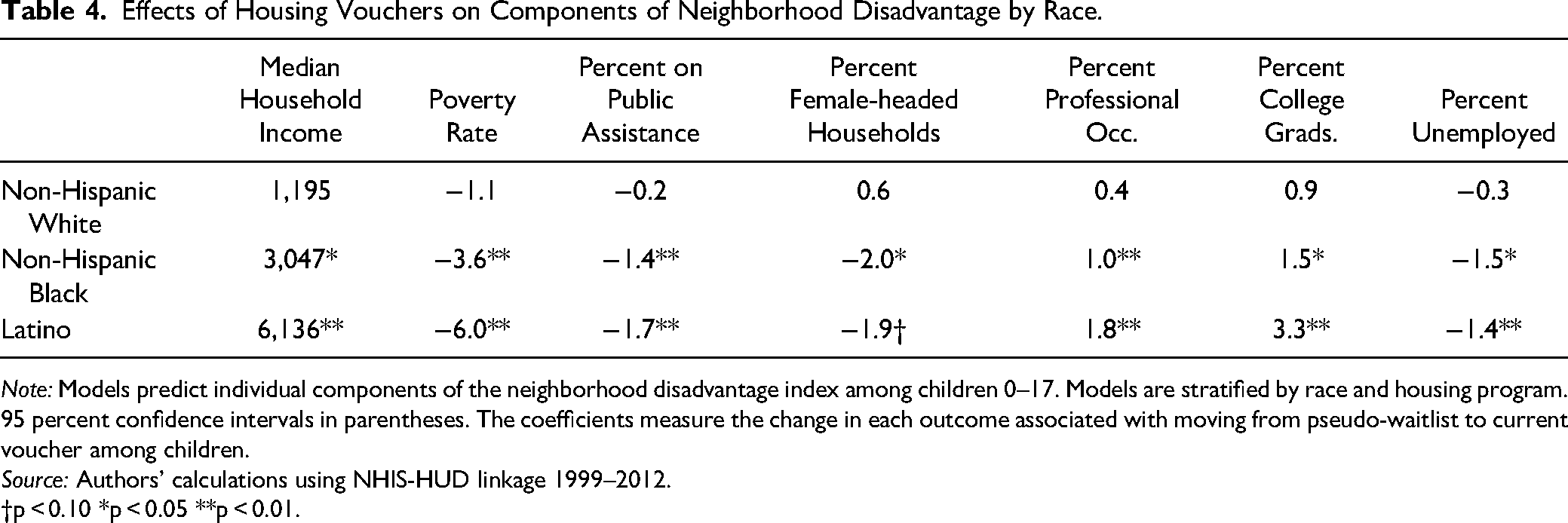
Note: Models predict individual components of the neighborhood disadvantage index among children 0–17. Models are stratified by race and housing program. 95 percent confidence intervals in parentheses. The coefficients measure the change in each outcome associated with moving from pseudo-waitlist to current voucher among children.
Source: Authors’ calculations using NHIS-HUD linkage 1999–2012.
†p < 0.10 *p < 0.05 **p < 0.01.
Neighborhood Poverty Estimates
Finally, we examine the likelihood of living in a high-poverty neighborhood (>30 percent poverty rate) or a low-poverty neighborhood (<10 percent poverty rate) as a function of voucher receipt. Table 5 indicates that vouchers are related to neighborhood poverty thresholds for Black and Latino children but not for White children. Vouchers are associated with a lower likelihood living in a high-poverty neighborhood (compared to the pseudo-waitlist group) among Black children (−10.5 percentage points, 95 percent CI: 2.0–19.0) and for Latino children (−18.5, 95 percent CI: 7.5–29.7). Likewise, vouchers are associated with a greater likelihood of living in a low-poverty neighborhood for Latino children ( + 9.8, 95 percent CI: 2.2–17.5). Corresponding neighborhood poverty results for project-based housing are shown in Appendix G. Results are consistent with neighborhood disadvantage models in that project-based housing is associated with an increase in living in high-poverty neighborhoods.
Average Marginal Effects of Vouchers on Likelihood of Living High Poverty Neighborhoods or Low-Poverty Neighborhoods Comparing Current and Pseudo-Waitlist by Race/Ethnicity.
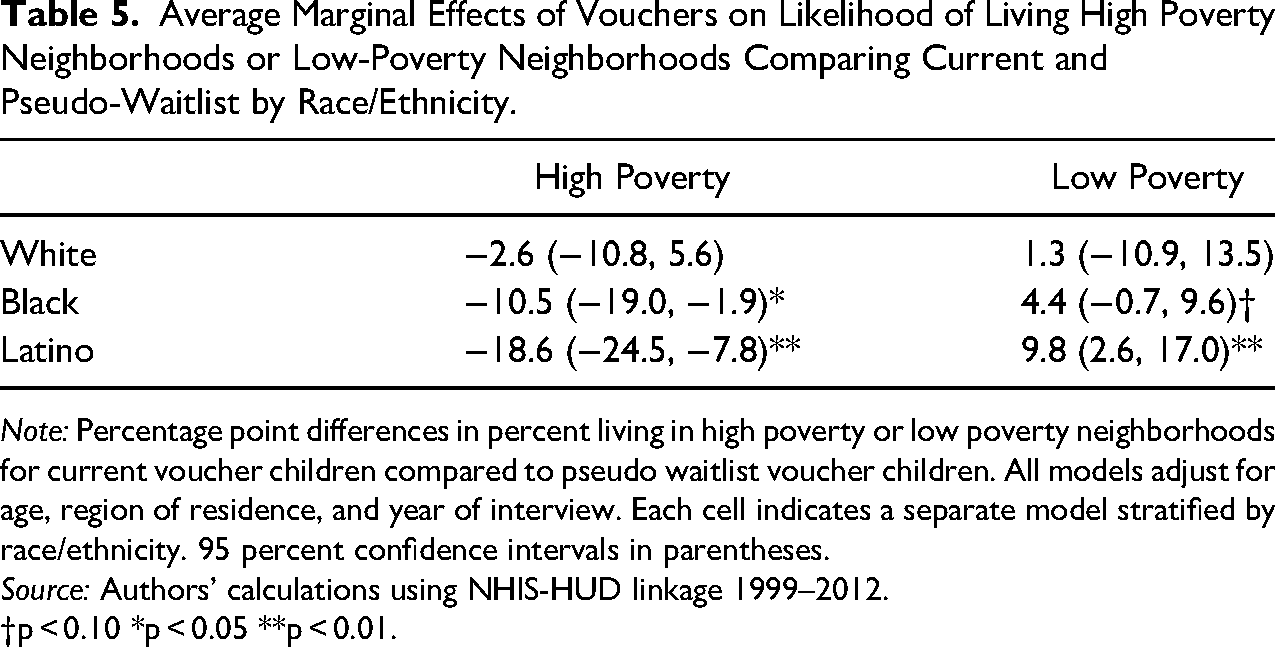
Note: Percentage point differences in percent living in high poverty or low poverty neighborhoods for current voucher children compared to pseudo waitlist voucher children. All models adjust for age, region of residence, and year of interview. Each cell indicates a separate model stratified by race/ethnicity. 95 percent confidence intervals in parentheses.
Source: Authors’ calculations using NHIS-HUD linkage 1999–2012.
†p < 0.10 *p < 0.05 **p < 0.01.
The patterns in Table 5 are shown graphically in Figure 3. Panel (a) shows the percent living in a high-poverty neighborhood by race/ethnicity and voucher status. Overall, children whose families currently receive vouchers are significantly less likely to live in high-poverty neighborhoods compared to those waiting to enter (32.0 percent vs. 24.2 percent). Black and Latino children see particularly large declines; the percent of Black children living in high-poverty neighborhoods declines from 41.2 percent in the pseudo-waitlist to 30.7 percent among current voucher recipients. The corresponding change is 42.9 percent to 24.3 percent among Latino children.
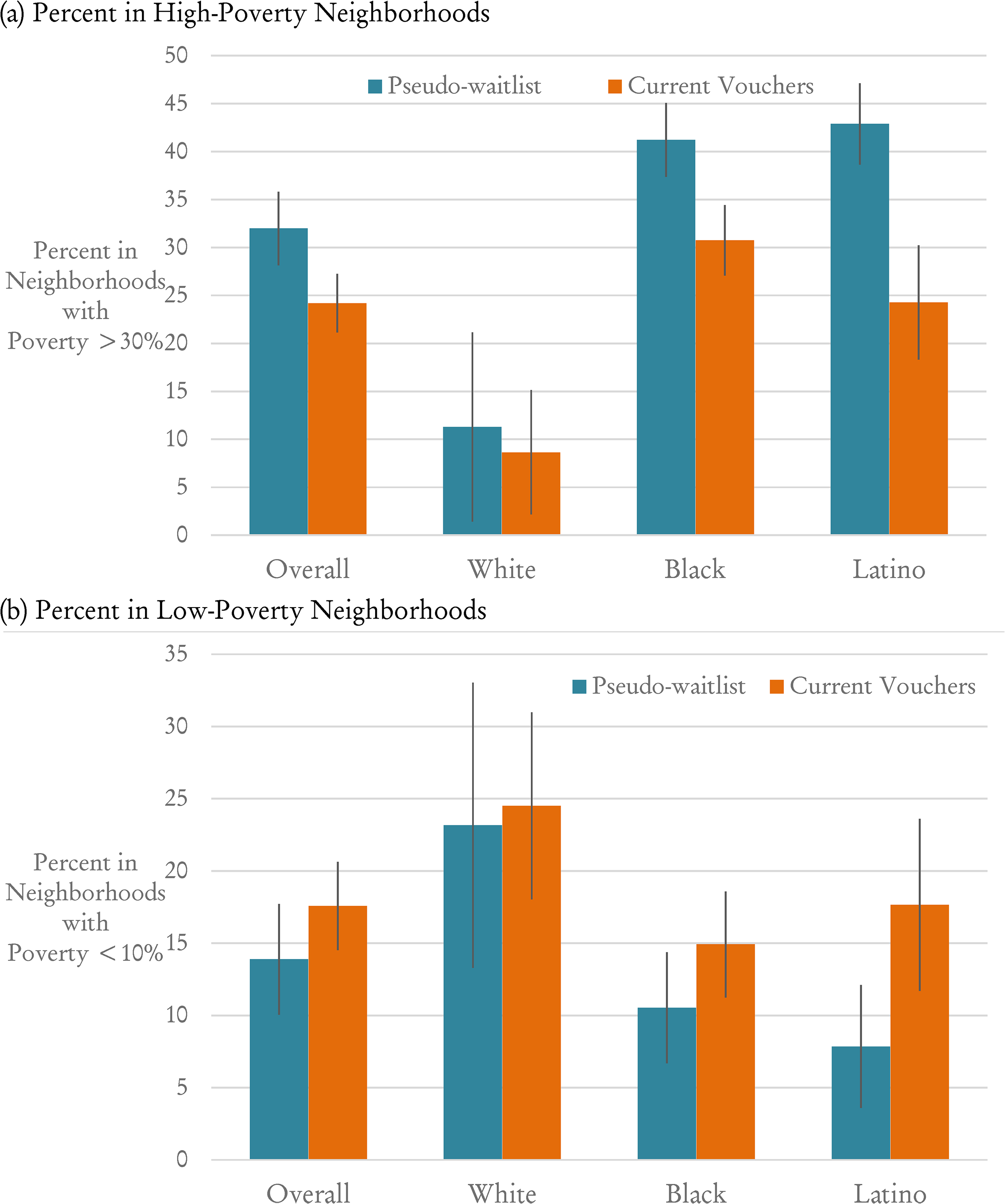
Percent in high-poverty (>30 percent) and Low-poverty (<10 percent) neighborhoods by race/ethnicity and voucher Status. (a) Percent in High-Poverty Neighborhoods. (b) Percent in Low-Poverty Neighborhoods. Note: Values predicted using logistic regression models stratified by race and housing program and control for age, region, and year of interview. Bars compare children currently receiving vouchers to children within 2 years of entering a voucher-assisted unit.
Panel (b) examines the percent of children who live in low-poverty neighborhoods (less than 10 percent poverty). Overall, there is a statistically-significant increase in children living in low-poverty neighborhoods after receiving vouchers only among Latino children. 17.7 percent of Latino children receiving vouchers live in low-poverty neighborhoods, compared to 7.8 percent in the pseudo-waitlist group (p = 0.012). As with previous analyses, there is no significant difference for White children. However, it is important to recognize in Figures 2 and 3 that even among families receiving vouchers, Black and Latino children are less likely to live in low-poverty neighborhoods and more likely to live in high-poverty neighborhoods than White children.
Robustness
There may be some concern that the characteristics of pseudo-waitlist children's neighborhoods are changing during the waitlist period before they enter HUD housing. Figure 4 presents an event study analysis of the neighborhood disadvantage index with respect to the timing of receiving a voucher or entering a project. The graph shows predicted neighborhood disadvantage coefficients in one-year intervals surrounding entrance into vouchers. There is no evidence of a trend in neighborhood disadvantage in the years before entering assistance; neighborhood disadvantage decreases for voucher recipients only after the child has entered housing (increases are seen for project-based assistance in Appendix Figure D1). Similar patterns are observed for Black and Latino children with no change over time for White children, as in other analyses (Appendix Figure D2). Additionally, we use inverse propensity weighting to increase the comparability of the pseudo-waitlist and current assistance groups and reveal very similar results (Appendix Table F1).
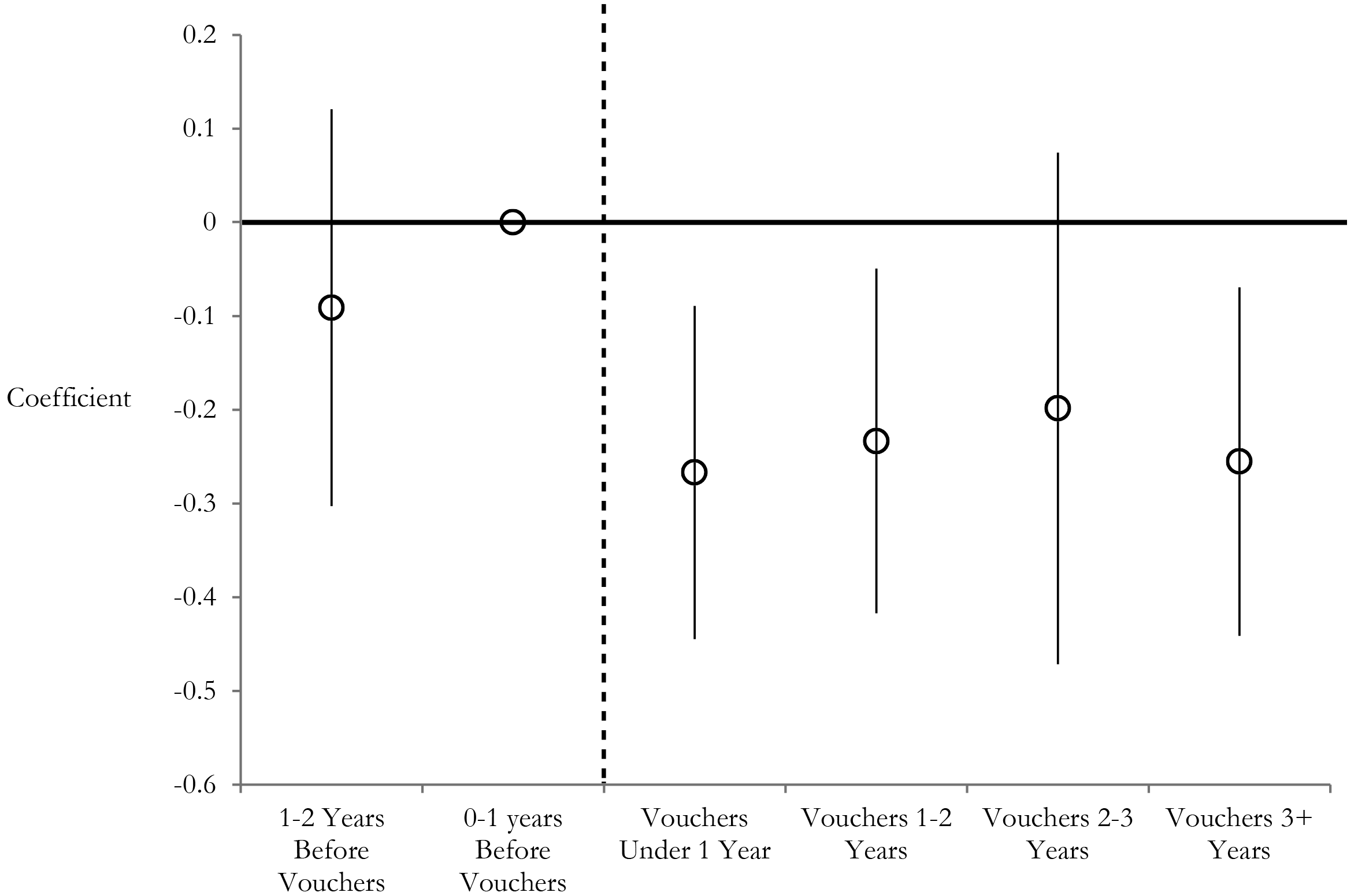
Event study model examining neighborhood disadvantage with respect to timing of entrance into voucher assistance. Notes: Graph shows coefficients for regression models predicting neighborhood disadvantage index by timing relative to entry into voucher assistance. ‘Before’ refers to the number of years from interview to entry into voucher assistance. ‘After’ refers to the number of years since entering voucher assistance, according to the data linkage. Reference category is the year before entry. Error bars shown are 95 percent confidence intervals.
Discussion
We examined whether federal affordable rental housing programs had significant nationwide impacts on the neighborhood characteristics experienced by children in assisted families. Exploiting a comparison group that is within the waiting period prior to entering HUD housing, we provide compelling evidence on the impacts of rental assistance programs on neighborhood disadvantage in a nationally-representative context. We find that project-based housing leads to increases in the neighborhood disadvantage experienced by youth while vouchers lead to reductions in disadvantage (each around one-fifth of a standard deviation change). Interestingly, we show that the mobility benefits of housing choice vouchers for neighborhood attainment exist only for Black and Latino children, while vouchers are not associated with significantly different neighborhood disadvantage for White children. Finally, we demonstrate that vouchers are associated with a lower likelihood of living in a high-poverty neighborhood for Black and Latino children and a higher likelihood of living in a low-poverty neighborhood for Latino children. But it is important to recognize that the role of vouchers in neighborhood attainment for non-White children occurs within the broader context of socioeconomic disadvantage and durable urban inequality (Massey and Kanaiaupuni 1993). Among families receiving vouchers, Black and Latino children continue to reside in significantly more disadvantaged neighborhoods than their White counterparts, a finding echoed in other recent work (Newman and Holupka 2021).
We improve upon previous research on this topic in several ways. First, we employ nationally-representative data to examine the relationship between rental assistance and neighborhood characteristics that is not limited to a particular state or metropolitan area. Second, we compare the effects of place-based programs (project-based housing) and tenant-based programs (housing choice vouchers). Third, we compare the effects of rental assistance on neighborhood outcomes for different racial and ethnic groups. Finally, the unique linked dataset allows us to exploit the timing of rental assistance receipt to plausibly adjust for selection into rental assistance. Our results indicate that not only do housing vouchers lead to reduced neighborhood disadvantage for non-White children, they are also associated with a reduced likelihood of living in high-poverty neighborhoods and increased likelihood of living in low-poverty neighborhoods. This is the first nationally-representative evidence that housing vouchers promote access to less disadvantaged neighborhoods specifically for Black and Latino children.
Project-Based Housing and Housing Choice Vouchers
We find some evidence that project-based housing exposes children to more disadvantaged neighborhoods than they would otherwise live in. Moving into project-based housing raises neighborhood disadvantage for children of all racial and ethnic groups, but for Black and Latino children in project-based housing, the average neighborhood is more than 1.5 standard deviations above the national mean. However, this finding does not necessarily imply that project-based housing is harmful or should not be preferred in many cases. Project-based housing has positive effects on children's health, social networks, and residential stability (Boudreaux et al. 2020; Fenelon et al. 2018; Kennedy-Hendricks et al. 2015; Lundberg et al. 2020), and may offer greater access to walkability than vouchers (Talen and Koschinsky 2014). Evidence from qualitative research in public housing developments and studies of displacement from high-rise, large public housing buildings in Chicago after demolition suggests that social networks of older residents suffer without the structured community of the housing project (Keene and Geronimus 2011; Keene and Ruel 2013). Thus, the impact of project-based housing on children's outcomes depends on the outcome in question, and has implications for federal policies surrounding investments in neighborhoods containing project-based housing developments.
Our results contrast with several studies indicating few and modest impacts of receiving housing choice vouchers on neighborhood disadvantage (e.g. Galvez 2010; Owens 2017). The specific research question—does receiving vouchers allow families to move to less disadvantaged neighborhoods?—requires an explicit attempt to identify the proper counterfactual for causal effects. In many cases, scholars compare locational outcomes of voucher households to those of renters (or low-income renters). Our analysis specifically compares the neighborhood outcomes of children in families receiving vouchers to those of children in families waiting to enter HUD housing. However, our results do not support the notion that vouchers facilitate widespread access to wealthy neighborhoods—only 18 percent of voucher children live in neighborhoods with less than 10 percent poverty. These results are consistent with previous studies that use a similar comparison group in particular localities (Carlson et al. 2012; Schwartz et al. 2020).
Racial and Ethnic Heterogeneity
Our results demonstrate that vouchers are associated with significant reductions in neighborhood disadvantage for non-White children while similar reductions are not seen for White children. Although this is consistent with some past work on the topic (Lens, Ellen and O’Regan 2011), it is not widely appreciated that non-White children may disproportionately benefit from vouchers as a means of reducing exposure to neighborhood disadvantage. Racial differences in neighborhood attainment among children whose families receive vouchers are narrowed substantially compared to waitlist children, but a substantial gap remains. 25 percent of White voucher recipients live in low-poverty neighborhoods, compared to 15 percent of Black children and 18 percent of Latino children. It is possible that for non-White children, voucher generosity represents less of a constraint for moving to less-disadvantaged neighborhoods, since these families reside in relatively poor neighborhoods in the waitlist period. In contrast, future White subsidized housing residents are more likely to live in advantaged neighborhoods, which limits the potential for neighborhood improvement from receiving a voucher. Thus, the racial/ethnic differences in the effects of the voucher may be driven in part by the characteristics of initial neighborhoods. Federal rental assistance can be a means to reduce racial residential segregation, but it also must contend with the extant structure of urban inequality.
Limitations
Our analysis has limitations that should be noted. First, our neighborhood measures are at the time of interview, and we do not observe changes in neighborhood exposure for individual children over time. Our results are consistent with a study employing longitudinal data in New York City (Schwartz et al. 2020). Second, our identification strategy is not random assignment, and there remains the possibility that other characteristics of sample children are changing alongside entry into rental assistance. Current residents may also be more likely to have experienced long-term poverty. The event study in Figure 4 suggests no changes prior to entry. Furthermore, our finding that children waiting to enter voucher assistance and project-based housing have similar neighborhood disadvantage levels before entering, but significantly different disadvantage levels after entering assistance, supports the notion that these differences reflect the effects of the programs. Third, because all participants either receive rental assistance currently or will enter within two years, we cannot generalize findings to families who have not applied for rental assistance, as there may be selection into applying for rental assistance. Furthermore, certain populations may have shorter waiting periods for assistance than others (Keene et al. 2021). To the extent that prioritized populations have different experiences with neighborhood attainment, they may bias our findings, although it is not clear that this bias would be in a specific direction.
Fourth, we may also be concerned that there are geographic differences between the pseudo-waitlist and current assistance samples that contribute to differences in neighborhood disadvantage. These differences may also be more acute in the race/ethnicity-specific models since there are large regional differences in racial population composition as well as the supply of subsidized housing units. As a result, race/ethnicity-specific results should be interpreted with some caution, as differences in the coefficients may partially reflect regional differences in the race/ethnicity subgroups combined with regional differences in the effects of rental assistance on neighborhood disadvantage. However, we also demonstrate that our results are robust to the inclusion of a full set of demographic and economic controls and state fixed effects (Table A3). Finally, in our analysis of project-based housing, we do not have any information on development type (e.g. high rise, scattered site), building age, or condition or management rating, which may differ across racial/ethnic groups within this program. Future research should examine how the process of finding a suitable unit and an agreeable landlord differs for Black, Latino, and White voucher recipients.
Policy Implications and Future Research
Our findings are relevant to recent research demonstrating the long-term socioeconomic benefits of moving to high-opportunity neighborhoods (Chetty and Hendren 2018; Chyn 2018) (Chetty and Hendren 2018; Chyn 2018). Although our results suggest that traditional housing choice vouchers represent a potential means to reduce racial and ethnic disparities in neighborhood attainment, recent developments in voucher policy may enhance these effects. HUD's Small Area Fair Market Rent demonstration indexes voucher generosity to rent conditions at the zip code level (as opposed to the metro area), which may increase the likelihood that voucher recipients are successful at moving not just to less-disadvantaged neighborhoods but to high-opportunity neighborhoods. Initial results have been somewhat mixed (Reina, Acolin and Bostic 2019), suggesting that greater voucher generosity alone may not be sufficient to greatly increase moves to low-poverty neighborhoods or reduce racial disparities (Reina 2019). A recent experimental study in Seattle suggests that voucher supplements combined with financial support and assistance with moves can increase the success of similar programs (Bergman et al. 2019). Additionally, outreach programs that incentivize landlord participation in voucher programs can reduce discrimination against voucher recipients (Garboden et al. 2018). Finally, future research should expand to the Low-Income Housing Tax Credit (LIHTC) program which is the largest producer of subsidized housing in the United States. While existing research suggests it is often sited in disadvantaged neighborhoods (Reina, Wegmann and Guerra 2019; Lens and Reina 2016), the causal effect on neighborhood access for tenants remains an important question.
Supplemental Material
sj-docx-1-uar-10.1177_10780874221098376 - Supplemental material for The Effects of Rental Assistance Programs on Neighborhood Outcomes for U.S. Children: Nationwide Evidence by Program and Race/Ethnicity
Supplemental material, sj-docx-1-uar-10.1177_10780874221098376 for The Effects of Rental Assistance Programs on Neighborhood Outcomes for U.S. Children: Nationwide Evidence by Program and Race/Ethnicity by Andrew Fenelon, Natalie Slopen and Sandra J. Newman in Urban Affairs Review
Footnotes
Declaration of Conflicting Interests
The author(s) declared no potential conflicts of interest with respect to the research, authorship, and/or publication of this article.
Funding
Funding for this research comes from the Eunice Kennedy Shriver National Institute of Child Health and Human Development awards R21-HD095329 and P2C-HD041025.

Supplemental Material
Supplemental material for this article is available online.
Notes
Author Biographies
References
Supplementary Material
Please find the following supplemental material available below.
For Open Access articles published under a Creative Commons License, all supplemental material carries the same license as the article it is associated with.
For non-Open Access articles published, all supplemental material carries a non-exclusive license, and permission requests for re-use of supplemental material or any part of supplemental material shall be sent directly to the copyright owner as specified in the copyright notice associated with the article.
