




Abstract
Municipal mayoral elections present a compelling puzzle: what happens when gendered stereotypes about level of government conflict with those about type of office? Although local politics is viewed as communal and more feminine, the mayoral office is a prominent, prestigious position of political leadership that voters may perceive as more masculine. We intervene by analyzing open-ended comments about 32 mayoral candidates from a survey of 14,438 municipal electors in eight Canadian cities. We argue gendered trait and issue stereotypes are embedded in voters’ assessments of mayoral candidates. We find no evidence that female candidates benefit from their perceived competence in local policy issues, and they experience backlash when they display the traits typically associated with strong leaders. We conclude that, even at the level of government frequently thought of as more open to women, female mayoral candidates are disadvantaged by an enduring association between masculinity and political leadership.
Women have ascended to a number of prominent political positions, but politics remains a predominantly male domain (Bjarnegård and Murray 2018; Inter-Parliamentary Union 2021). 1 Even so, there is a perception that municipal politics will be more open to women. Women's political style is thought to be more communal and community-minded and therefore better aligned with municipal politics (Bauer 2020b; Briggs 2000), while the issues that local governments address are stereotyped as feminine (Bauer 2020c; Brown, Heighberger and Shocket 1993; Deckman 2007; Holman 2015; Schneider 2014a; but see Hajnal and Trounstine 2010). Municipal office is viewed as less prestigious and desirable (Crowder-Meyer, Gadarian and Trounstine 2015; Holman 2017); it may thus be less competitive and potentially more hospitable to women. The practice of local politics is also seen as more compatible with women's domestic responsibilities because it is characterized as more part-time, closer to home, and less demanding than politics at other levels (Darcy, Welch and Clark 1994; Thomas and Bittner 2017).
Despite municipal government being viewed as more open to women, gender imbalance persists even at this level of office (Archenti and Albaine 2012; Bochel and Bochel 2008; Choi 2019; Eder, Fortin-Rittberger and Kroeber 2015; Holman 2017; Sundström and Stockemer 2015; Tolley 2011). Why the disconnect? It could be that leadership, in general, is stereotyped as masculine (Bauer 2020c; Eagly and Mladinic 1989; Koenig et al. 2011) and, while the premium on masculinity may be highest in national-level politics, all elected positions are viewed as leadership roles and, subsequently, stereotypically male trait and issue competencies are valued, irrespective of level of office (Bauer 2020c; Fowler and Lawless 2009; Huddy and Terkildsen 1993a). Consequently, male politicians “are seen as better able to make decisions, work with other politicians, and provide leadership” (Brown, Heighberger and Shocket 1993, 11–12). Meanwhile, women are stereotyped as better suited for council office and constituency service than for more powerful positions (Crowder-Meyer, Gadarian and Trounstine 2015). These within-level variations suggest that stereotypes are not just dependent on the level of government, but also the type of elected office. Whereas voters might view women candidates and municipal office as congruent, women candidates and the mayor's office are seen as less congruent.
Unsurprisingly, more men are mayors than women, and this gender gap in officeholding has persisted over time and across different contexts (Bochel and Bochel 2008; City Mayors 2017; Darcy, Welch and Clark 1994; Federation of Canadian Municipalities 2015; Smith, Reingold and Owens 2012). Thus, while women may be considered well-suited to local office, they are simultaneously seen as less compatible with positions that have the most prominence, power, and prestige. Voters may thus hold conflicting gender stereotypes about the level of government and type of office. Although some municipally-focused studies have looked at stereotypes in mayoral elections (Bird et al. 2016; Cargile and Pringle 2020), most look at council races (Bauer 2020c; Brown, Heighberger and Shocket 1993; Crowder-Meyer, Gadarian and Trounstine 2020; Higgle et al. 1997; Oliver and Conroy 2018). Our focus on mayoral office-seeking is therefore significant.
Specifically, we ask: how do voters assess mayoral candidates in a context of competing stereotypes where the level of office – municipal government – is associated with femininity, but the specific position – the mayoralty – is associated with masculinity? How do voters assess candidates’ suitability for office and issue competence in this context? Do women who seek the mayor's office benefit from a boost because of their perceived suitability for local office, or do they suffer from a backlash because of their perceived lack of leadership competence?
Drawing on what is, to our knowledge, the largest ever academic survey of municipal electors, we assess how more than 14,000 respondents across eight large Canadian cities evaluate 32 mayoral candidates. We take advantage of two qualitative questions that ask respondents what they like and dislike about each mayoral candidate. We assess these comments using a gendered lens. By examining assessments of candidates’ traits and issue orientations separately, we demonstrate how voters respond to different dimensions of gendered stereotypes. We find trait and issue stereotypes embedded in voters’ assessments of mayoral candidates in ways that disadvantage women. There is no evidence female candidates benefit from their perceived competence in feminine policy areas and, more worryingly, voters are significantly more likely to dislike female candidates’ traits and issues when compared to those of male candidates. When female candidates attempt to highlight the masculine traits that voters associate with leaders, voters punish them with negative evaluations. In other words, female candidates experience no boost from their presumed issue strength and face backlash when they attempt to conform to masculinized trait stereotypes. Although it is logical to assume political penalties will be lower for women in local politics, politics remains a masculinized space even at the level of government that is perceived as most woman-friendly. As a result, women candidates hoping to enter the political pipeline through the mayor's office must counter precisely the same gendered trait and issue stereotypes that they do at other levels.
Gendered Stereotypes as an Explanation for Women's Political Under-Representation
There is ample evidence that voters draw on a variety of heuristics, including gender, to simplify vote choice (Cutler 2002; Ditonto 2017; Fiske and Taylor 2013; McDermott 2005, 2009). The literature shows a clear association between power and masculinity, with men stereotyped as the most capable, competent, qualified, and likeable political candidates (Allen and Cutts 2018; Bauer 2020b; Butler and Preece 2016; Conroy 2015; Crowder-Meyer 2013; Ditonto 2017; Goodyear-Grant 2013; Holman and Schneider 2018; Pruysers and Blais 2018; Sanbonmatsu 2002). Nonetheless, much of the research on stereotypes focuses on the national and state levels (Alexander and Andersen 1993; Bauer 2020a; Bauer and Santia 2021; Conroy 2015; Dunaway et al. 2013; Fowler and Lawless 2009; Jamieson 1995; Windett 2014). Studies at the local level are mostly experimental (Bauer 2020c; Crowder-Meyer, Gadarian and Trounstine 2020; Huddy and Terkildsen 1993a) or of a single city (Cargile and Pringle 2020), in part because large-n observational surveys of municipal voters are rare. We therefore know comparatively little about municipal voter attitudes during actual campaigns, much less those about gender. As a result, theoretical insights derived from studies of national politics are frequently imported to local politics, even though the institutional context differs, and the factors affecting women's participation may vary between national and local levels.
Gender role theory posits there are socially ingrained and historically rooted views about gender-appropriate roles and behaviour. Expected gender norms affect voters’ assessments of candidates for elected office (Eagly and Karau 2002; Eagly and Mladinic 1989; Koenig et al. 2011). Gender cues may be used to infer candidate quality, issue priorities, or ideological commitments (Bauer 2020c; Crowder-Meyer, Gadarian and Trounstine 2015; Ditonto 2017; Ditonto, Hamilton and Redlawsk 2014; Holman, Merolla and Zechmeister 2011; Huddy and Terkildsen 1993a, 1993b). Whether gender stereotypes affect vote choice is more of an open question, and the answer is dependent on the electoral context and information environment. Gender cues are thought to be particularly important in non-partisan contexts and those where voters have less information overall (Crowder-Meyer, Gadarian and Trounstine 2015, 2020).
Research on gender-office congruency suggests women will be disadvantaged by stereotypes that associate masculinity with positions of political leadership (Conroy 2015; Dunaway et al. 2013; Fowler and Lawless 2009; Lawrence and Rose 2009). Most of this research looks at national and state-level contests. In mayoral contests, while there may be congruence between women candidates and the perceived femininity of local politics, there is likely to be incongruence between the mayoralty and women candidates. Although some evidence from local elections in Canada and Denmark suggests voters prefer female candidates over male candidates, the effect appears stronger for council positions than those for mayor (Kjaer and Krook 2019; Lucas et al. 2021), suggesting voters’ attitudes are conditioned by the type of office. We expect voters’ associations between politics, leadership, and masculinity to influence how they assess women candidates for mayor and that this will override any boost women might receive from their association with stereotypic women's issues, communal political styles, and perceived compatibility with local politics.
One theoretical contribution this study makes is to clarify how gender cues influence candidate evaluations when voters' gendered stereotypes about level and type of office are in conflict. There is a need to consider gendered stereotypes outside of national politics not just because gender might be more salient in local politics, but also because the decision-making environments differ. Local elections are a low-information context in which there is less media coverage, fewer partisan cues, and less intensive campaigning than in national campaigns (Breux, Couture and Koop 2018; Holman and Lay 2021; McGregor et al. 2017; Tolley and Paquet 2021). As a result, voters have less information about candidates, and stereotypes may exert a stronger influence on vote choice (Higgle et al. 1997; McDermott 1997, 1998).
Research on gender stereotypes in politics typically distinguishes between those based on traits and those based on issues (Alexander and Andersen 1993; Bauer 2020a; Bauer and Santia 2021; Brown, Heighberger and Shocket 1993; Dolan 2010; Huddy and Terkildsen 1993a, 1993b; Kahn 1996; Sanbonmatsu 2002; Schneider and Bos 2014). Trait stereotypes capture candidates’ perceived qualities, including their leadership abilities, competence, and integrity, while issue stereotypes relate to candidates’ perceived prioritization of certain beliefs or policy areas. Gendered assumptions influence the activation and content of both types of stereotypes, although some recent experimental evidence suggests that voters respond differently (and more negatively) to appeals that emphasize feminine traits than to those that emphasize feminine issues (Bauer 2020a; Cassese and Holman 2018).
In the first place, we expect female mayoral candidates to be associated more with traits than with issues. This is in part because media coverage reinforces this distinction, focusing more on who women candidates are and less on what they will do. Dunaway et al. (2013) find women candidates receive more trait coverage than issue coverage, overall, and there is more trait coverage in electoral races with women candidates than those that feature only men. There is also more trait coverage when women seek executive rather than legislative office (Huddy and Terkildsen 1993a). Other research finds that the media's coverage of women politicians is more personalized, including mentions of their physical appearance and other personal attributes (Goodyear-Grant 2013; Trimble et al. 2013). Voters also have fewer concrete views about the characteristics of women politicians than of men in politics (Schneider and Bos 2014), and uncertainty about women politicians’ attributes might be especially significant in a low-information context. Absent other substantive cues, voters might resort to more personalized or surface-level stereotyping about women's appearance, personalities, or seriousness, which is more readily accessible than information about their issue positions (Alexander and Andersen 1993).
A second question is whether women candidates will be associated more readily with masculine or feminine traits. Here, the literature is inconsistent. Some analyses of candidate messages and campaign materials find women candidates rely on feminine stereotypes more than masculine ones (Herrnson, Lay and Stokes 2003a; Panagopolous 2004; Schneider 2014b). Other evidence suggests women candidates engage in a “trait-balancing” strategy that highlights both their masculinity and femininity, but partisanship, incumbency, and electoral context condition this approach (Bauer and Santia 2021). Another study of municipal councillors found recruiters prefer masculine candidates to feminine ones, although it is not clear if this preference applies to voters as well (Oliver and Conroy 2018). One reason for the lack of clarity is that “voters hold more complex stereotypic impressions” of female candidates than of male candidates (Bauer and Santia 2021, 3), and whether gender stereotypes affect voters’ assessments of candidates depends on campaign messaging and other factors. However, even if masculinity is preferred, gender role theory suggests women will be associated with feminine attributes more so than men. Therefore, we expect voters’ comments about female candidates to emphasize traits and for these comments to highlight feminine dimensions more than trait comments about male candidates.
H1a: Female candidates are more likely to be associated with H1b: Comments about female candidates are more likely to contain words and phrases associated with
We also expect the direction of respondents’ evaluations of mayoral candidates to be gendered. Not only is politics viewed as a male domain, but agentic traits like leadership are intertwined with perceptions of masculinity (Conroy and Green 2020). Voters associate men with assertiveness, strength, and confidence and view them as more qualified, capable, and emotionally suited for politics (Bauer 2020b; Brown, Heighberger and Shocket 1993; Ditonto 2017; Schneider and Bos 2014). Women are thought of in terms of what they lack, including deficiencies in leadership and competence (Schneider and Bos 2014, 261). That is, it is not simply that men are preferred in politics, but rather that the attributes voters associate with men are the same as the attributes they associate with political competency and success (Bauer 2020c). Given the bias toward masculine traits in leadership positions and the association between these and male candidates, we expect voters to react more negatively to female candidates’ traits, in general.
H1c: Female candidates are less likely than male candidates to be associated with comments reporting
Research further suggests that women seeking positions of power violate gender-role expectations and consequently can face a backlash from voters (Eagly and Karau 2002; Koenig et al. 2011; Puwar 2004; Rudman and Glick 2001). For this reason, even in local elections, voters express a preference for female candidates with masculine traits over female candidates with feminine traits, but whether male candidates emphasize masculine versus feminine traits has no effect on voters’ evaluations (Bauer 2020c). Knowing this, women candidates sometimes opt for a campaign strategy that highlights their masculine qualities (Sapiro et al. 2011) because while male candidates are simply assumed to possess the (masculine) qualities necessary to lead, female candidates must prove it (Holman, Merolla and Zechmeister 2016). Indeed, this uncertainty about whether women are fit to lead is one reason voters seek out more information about female candidates’ experience and competence than is the case for male candidates (Ditonto, Hamilton and Redlawsk 2014). The catch, however, is that when women do behave in masculine ways, they face what Bauer and Santia (2021) call a “likability backlash.” That is, women candidates are disciplined for appearing too aggressive, too manly, and not likable enough (Gidengil and Everitt 1999; Jamieson 1995) even if voters demonstrate a preference for stereotypic masculine qualities. These findings complicate our expectations. Although voters generally prefer masculinity in candidates, if they are evaluating feminine traits, they are more likely to be positively disposed to female candidates who demonstrate these.
H1d: Female candidates are more likely than male candidates to be associated with comments reporting
Given research on the connection between women and trait stereotypes outlined above, we expect the opposite for issues, with female candidates associated less often with issues than their male counterparts.
H2a: Female candidates are less likely to be associated with
Just as traits are gendered, so too are issues, and these stereotypes prompt voters to associate female candidates with policy domains that are perceived as feminine, such as healthcare or education, while their male counterparts are linked to masculine areas, including the economy, military, foreign policy, and security (Holman, Merolla and Zechmeister 2011; Huddy and Terkildsen 1993a; Lawless 2004). Much of the literature on gendered issue stereotypes looks at national-level politics. Some caution against the view of local governments as more feminine, since they deal with infrastructure and economic development which voters may perceive as more masculine (Andrew 1991). Despite this, the municipal level is generally conceived of as more consistent with women's policy preferences, since it is viewed as more communal and deals with issues related to parks, public health, and community programming (Gidengil and Vengroff 1997). Therefore, when voters do connect female candidates to issues, we expect this to be gendered and to include a stronger emphasis on feminine issues.
H2b: Comments about female candidates are more likely to contain words and phrases associated with
The literature provides us with even less direction on how voters evaluate female candidates’ issue positions. The stereotype literature tends to focus on traits, and when issue stereotypes are incorporated, it is generally with policies that are under the jurisdiction of national governments. There is some evidence that feminine trait-based stereotypes may be more damaging to women candidates than feminine issue-based stereotypes (Bauer 2020a; Cassese and Holman 2018). However, this research deals with campaign messages and appeals rather than voter assessments. It also assumes a partisan political space where the connection between candidates and issues may be ideological as well as gendered. We therefore draw insights from the literature on traits, reviewed above, and expect that when voters connect female candidates to policy issues, the association will remain negative. Even without clear direction from the literature, we can reasonably posit that voters’ negative stereotypes about female candidates’ competence will affect their assessment of their policy priorities.
H2c: Female candidates are less likely than male candidates to be associated with comments reporting
Finally, to formulate hypotheses about voters’ assessments of candidates’ policy strengths, we extend findings from the issue ownership literature. Research on issue ownership finds voters associate political parties with specific policy areas and consider them most able to address these issues (Tresch, Lefevere and Walgrave 2015; Walgrave, Lefevere and Tresch 2012). Although this literature mostly focuses on parties, some have applied it to women, arguing that voters associate female candidates with stereotypically feminine policy areas, and this association is positive (Herrnson, Lay and Stokes 2003b). Women candidates are viewed not just as caring about feminine policy issues, but also as most capable of dealing with them.
H2d: Female candidates are more likely than male candidates to be associated with comments reporting
Data and Methods
Mayoral elections in Canada take place at different intervals, with their timing and rules set by each province. Mayors are mostly selected through at-large elections. We use survey data from the Canadian Municipal Election Study (CMES), which was conducted during municipal elections held in eight large Canadian cities (Toronto, Mississauga, Winnipeg, Calgary, Montreal, Vancouver, London, and Quebec City) in 2017 and 2018. 2 Forum Research administered the survey, and respondents were recruited through random digit dialing. 3 We pool the data from each of the eight cities, giving us a total of 14,438 respondents (see the online appendix for details on the number of respondents per city). The survey was conducted in English in Toronto, Mississauga, Winnipeg, Calgary, Vancouver, and London, in French in Quebec City, and in both languages in Montreal.
Some features of local elections (e.g., timing) are determined by provincial governments, which have responsibility for municipalities in Canada, while other features (e.g., the presence or absence of parties) are determined by the cities themselves, meaning there is some variation across the cities examined. The characteristics of the included cities are summarized in Table 1. In seven of the eight cities (all but Calgary), there was a woman candidate among the frontrunners, and two cities (Montreal and Mississauga) elected woman mayors. Six of the eight cities had incumbent mayors running for re-election (but only one of these was a woman). In five of these cities (Calgary, Toronto, Mississauga, Winnipeg, and Quebec City), the male incumbent mayor was re-elected, while in Mississauga, the re-elected incumbent was a woman. Three cities (Montreal, Quebec City, and Vancouver) use loose party systems to coordinate candidates, but we do not expect party system effects because the parties in these cities are largely local entities and often highly personalized; they are not formally embedded with ideologically-based federal or provincial parties and form (often for short periods of time) to support a mayoral candidate or particular slate of council hopefuls (Lucas 2022; Tolley and Paquet 2021). Although the cities vary in size, they are all major urban centres, and the mayor's office in all cases is a full-time, high-profile position. We therefore do not expect voters’ perceptions of the prestige of the office to vary much between cities.
City Characteristics.
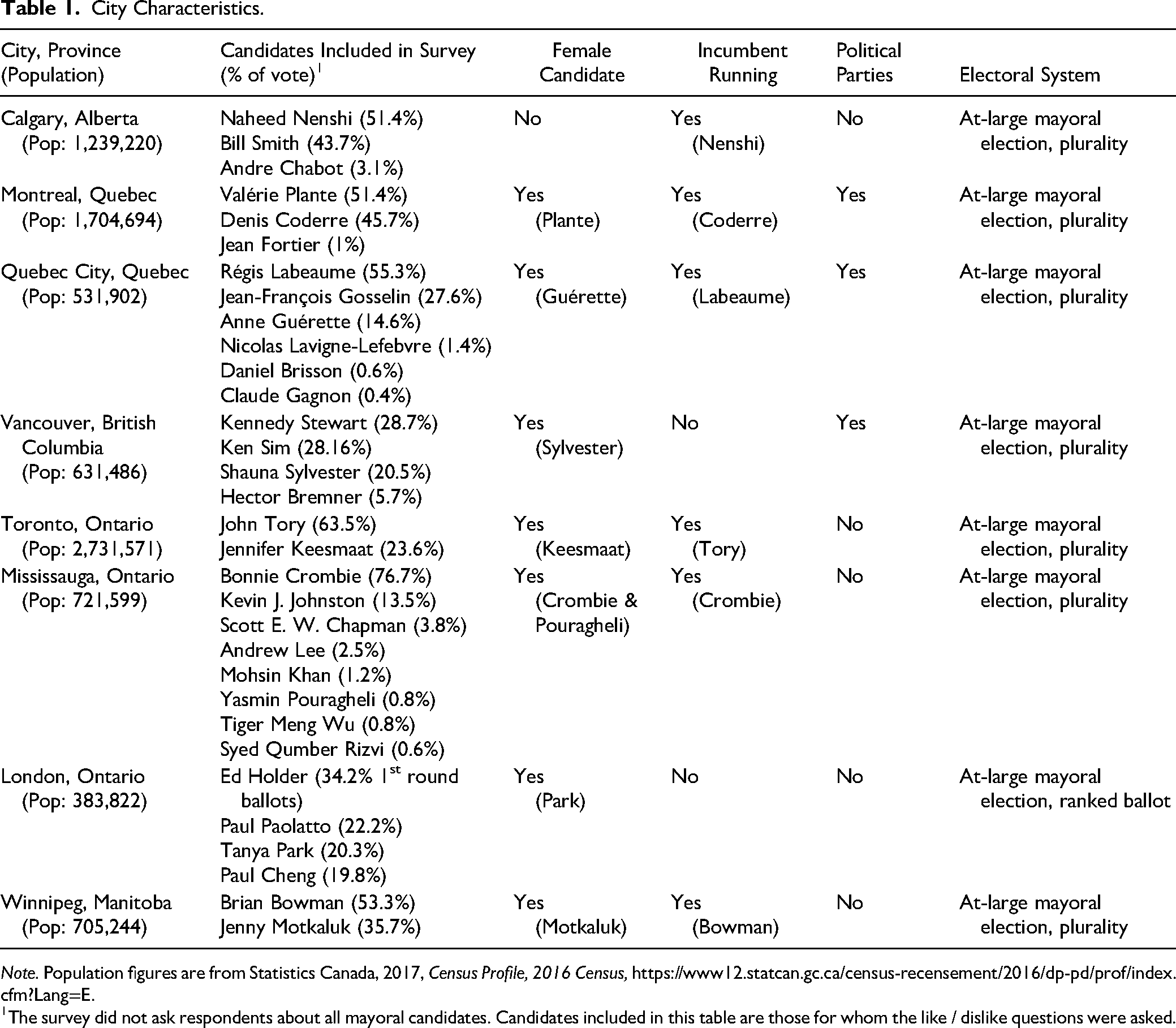
Note. Population figures are from Statistics Canada, 2017, Census Profile, 2016 Census, https://www12.statcan.gc.ca/census-recensement/2016/dp-pd/prof/index.cfm?Lang=E.
1The survey did not ask respondents about all mayoral candidates. Candidates included in this table are those for whom the like / dislike questions were asked.
The dependent variables are assessments of mayoral candidates drawn from two open-ended questions in the pre-election survey, which asked respondents what they like and dislike about the mayoral candidates in their city (see online appendix for question wording). Most analyses of voter responses to candidates rely on survey data that use close-ended questions to sort responses into pre-existing categories. In contrast, open-ended assessments allow respondents’ views to emerge unprompted, and this is a strength of this dataset. Additionally, the dataset separates out respondents’ comments into two categories – like and dislike – allowing us to conduct parallel analyses on the characteristics that respondents associate with each dimension. 4 This feature of the survey is advantageous because although anonymous online surveys dampen the propensity of respondents to conceal prejudicial beliefs, respondents may still feel pressure to answer in socially desirable ways (Berinsky 2004; Sniderman and Stiglitz 2009). For example, Krupnikov, Piston and Bauer (2016) found that when respondents were asked to explain their preference for a particular candidate, those who selected a white man over a white woman or Black man were more likely to use “face-saving” language. However, this impulse might be weaker in our research design, which invites both positive and negative impressions and therefore makes it more acceptable to express either.
The unit of analysis is the comment (“like” or “dislike”), which we have linked to candidate gender to understand gendered patterns of assessment. The text corpus is a rich source of candidate descriptions containing more than 137,000 individual observations (i.e., comments). In the survey, respondents were given the option to select “there is nothing I like/dislike about this candidate,” which could be interpreted as neutrality or a lack of information about the individual. Given this uncertainty about interpretation, we remove these comments, as well as others that contain no substantive views (e.g., “don't know” or those that were left blank). We are left with a corpus of 31,174 comments. Most descriptions were brief, ranging from a single word (e.g., “arrogant”) to two to three sentences. We evaluate the data using an automated content analysis.
The content analysis proceeded in two steps. First, we constructed two sets of keyword dictionaries based on a combination of inductive and deductive semantic analysis techniques that use the text corpus of comments to designate and populate thematic categories. This process includes an initial cleaning of the dataset using validated exclusion dictionaries that remove commonly used words (e.g., articles, prepositions) that would otherwise overwhelm the topic categorization. The remaining substantive words and phrases are then categorized inductively (Lawlor and Tolley 2017; Tolley 2015; Wallace 2018). To increase coherence and maintain a focus on dominantly occurring themes, the categorization includes words mentioned more than five times and phrases mentioned more than ten times in the corpus.
For the first keyword dictionary, we categorized terms according to the two categories of interest: candidate traits, which included mentions of personal characteristics, such as knowledge, experience, and qualifications, and issues, which included campaign promises, policy priorities, and challenges facing the city. Where words were ambiguous or could belong to more than one category, we used WordStat's Keyword-in-Context feature to identify the most common usages and then categorized them appropriately. As a final validity check, we drew a sample of 500 comments and manually verified their categorization. This procedure resulted in 19,189 comments categorized as containing either trait or issue mentions. 5
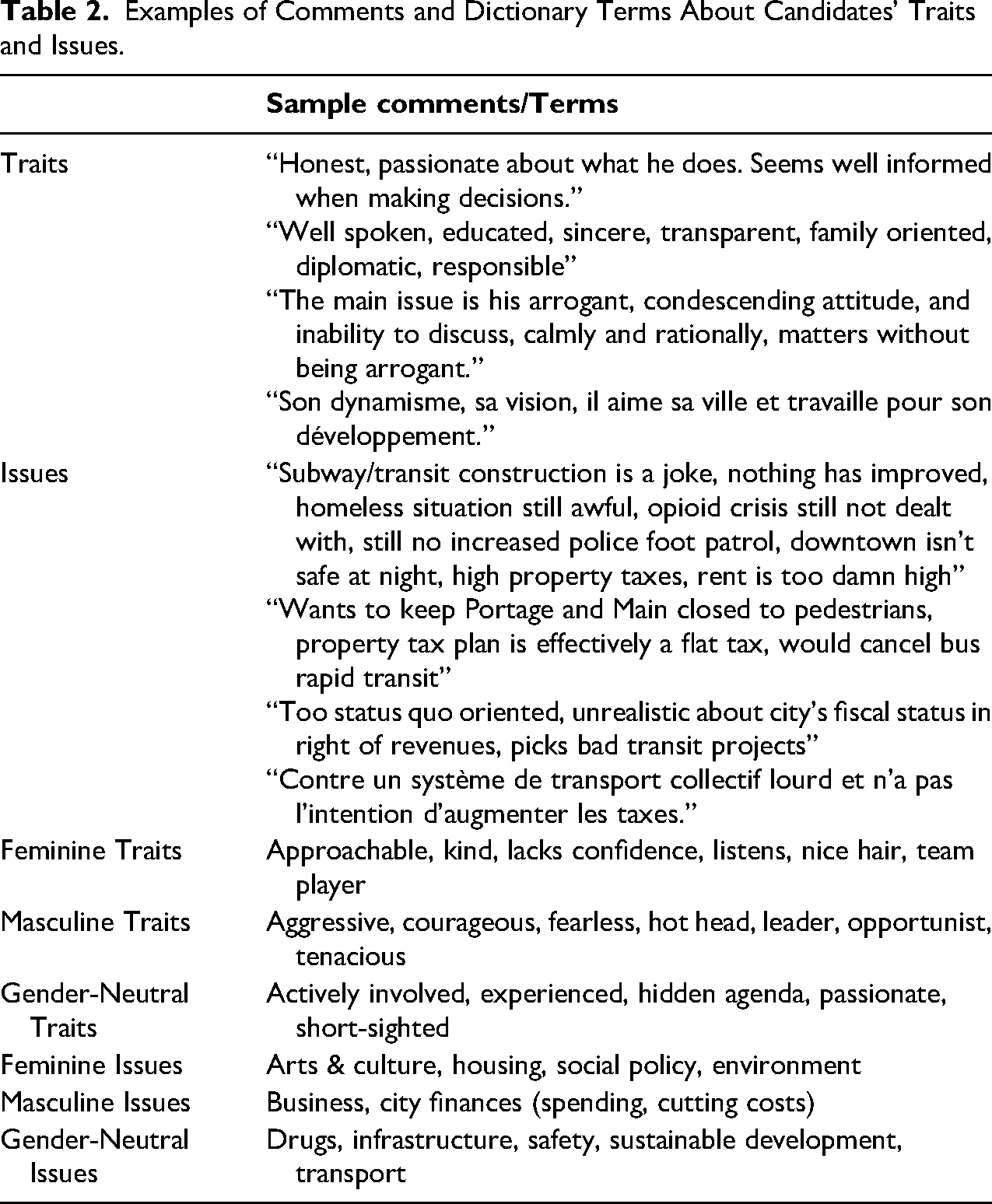
To identify how traits and issues are gendered, we constructed a second dictionary, which zeroes in on the masculinity and femininity of traits and issues. To identify gendered traits, we consulted Roberts and Utych’s (2020) dictionary of masculine and feminine terms, Conroy and Green’s (2020) categorization of agentic and communal political attributes, and the Bem Sex Role Inventory (Bem 1974). Using these previously validated inventories as guidance, we then took all trait words in the corpus and engaged in a triple-blind coding, categorizing each trait term as masculine, feminine, or gender-neutral. We then assembled the three sets of categorizations and jointly resolved any conflicts. More than 70 percent of trait terms were categorized identically by all three coders; the remaining terms had 66 percent agreement (i.e., two out of three coders agreed) and were resolved through discussion. To this, we added a gendered coding of issue terms. Drawing on existing categorizations (Bauer 2020b; Conroy and Green 2020; Huddy and Terkildsen 1993a), we coded all issue mentions as either feminine, masculine, or neutral. Where existing validated measures were available (e.g., Huddy and Terkildsen 1993a), we applied the validated coding. Because gendered issue ownership and categorization is less developed in the municipal context, there were some issues without pre-existing classifications. For these, we engaged in a triple-blind coding process. Just over 70 percent of the unvalidated issues were coded consistently by all three researchers; the remaining issues had the agreement of two researchers, and differences were resolved through discussion. Table 2 provides illustrative examples of comments associated with each category in the dictionary. Because the survey was conducted in two languages, we produced both English- and French-language dictionaries.
Examples of Comments and Dictionary Terms About Candidates’ Traits and Issues.
In addition to a set of variables associated with the like/dislike response for each of the main mayoral candidates, the dataset includes candidate gender, respondent gender, city, whether the candidate was an incumbent or a challenger, and attitudinal and socio-demographic indicators (see online appendix for information on included variables’ distributions). To provide a standardized metric for analysis, we adopt the percentage of categorized terms out of the total words in the comment associated with each candidate. This provides an assessment of what proportion of the conversation about a candidate relies on gendered traits and gendered issues.
To assess whether a gender gap exists in candidate evaluations, we engage in a three-step analysis. The first part considers the comparative application of trait and issue terms to candidates. Because the responses are unstructured text, the sample contains a mix of people who provided observations on traits, issues, or both. There are also people who provided comments that did not relate to any of the dependent variable groups (e.g., “I saw her speak at a rally once, but I didn't get a sense of her”). Although these individuals are not relevant for most of the analyses, they are instructive in terms of how individuals operate in a (comparatively) low-information environment. We exclude them from the multivariate analysis but conduct a brief assessment of whether and how these individuals differ from respondents who offered substantive commentary on the candidates.
The second part of the analysis evaluates the comparative proportion of comments for male and female candidates that contain content about masculine and feminine traits and issues. The assumption embedded within the hypotheses is that there will be congruence between gendered descriptions and the gender of the candidate. However, we acknowledge the possibility that the comparatively low-information environment associated with municipal elections may result in a smaller or non-existent effect. The final section of the analysis uses ordinary least squares multivariate regression models that estimate the proportion of feminine, masculine, and gender-neutral traits and issues in the respondents’ coded comments.
Although Canada is a single political unit, it is geographically large and ideologically varied with strong linguistic and regional cleavages. We therefore expect some city-based variation but given the number of cities we cover and the specificities in local context, we provide the full city-by-city analysis in the online appendix. This supplementary analysis also functions as a robustness check to determine whether specific cities are driving the results.
Results
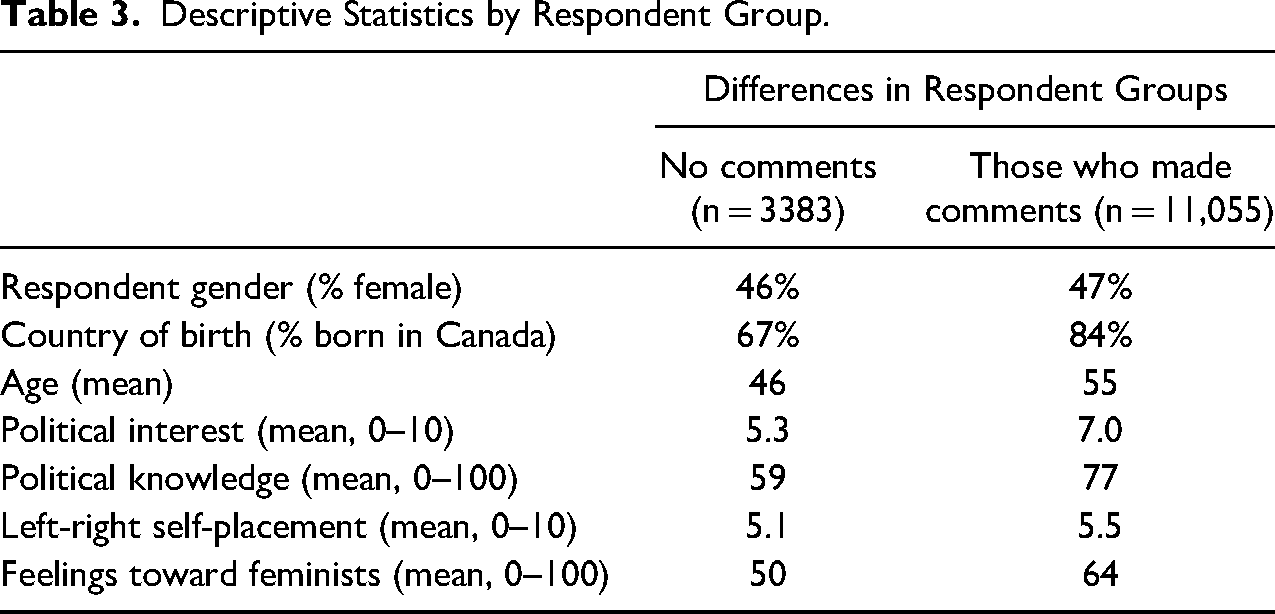
We begin by looking at the descriptive elements of the survey data. First, we assess whether there are substantive differences between those who provided comments and those who provided no comments on any of the mayoral candidates. Table 3 suggests there are slight differences between the two sub-samples. While there is no substantive gender difference between the two groups, those who did comment are more likely to be born in Canada; they also skew older than the “no comment” group, which comports with the behavioural literature on political participation. Unsurprisingly, those who commented are marginally more interested in local politics and score higher on measures of political knowledge. There is little difference in self-reported political ideology with both groups placing themselves in the centre of the left-right political spectrum, but those who provided comments on candidates do have more positive feelings towards feminists. Taken together, we should assume that those who provided no comments on mayoral candidates may feel slightly less engaged with municipal politics, though not dramatically so, and that the differences between the two groups are driven by the same factors that have routinely been noted to influence political participation, including age, education, and political knowledge (Blais, Gidengil and Nevitte 2004; Melo and Stockemer 2012).
Descriptive Statistics by Respondent Group.
To provide a baseline, we next observe whether there are any prima facie reasons for differences associated with each of three sets of dependent variables: associations with issues, associations with traits, and issues and traits broken down by gendered groupings (feminine/masculine/neutral). The first set of hypotheses looks strictly at how candidates are evaluated along gender lines. In these analyses, we are not interested in how often respondents use specific descriptors to assess candidates; rather, we are interested in the differences that emerge between male and female candidates relative to one another. Therefore, we present mean differences as a proportion of words associated with candidates by their gender (Figure 1).
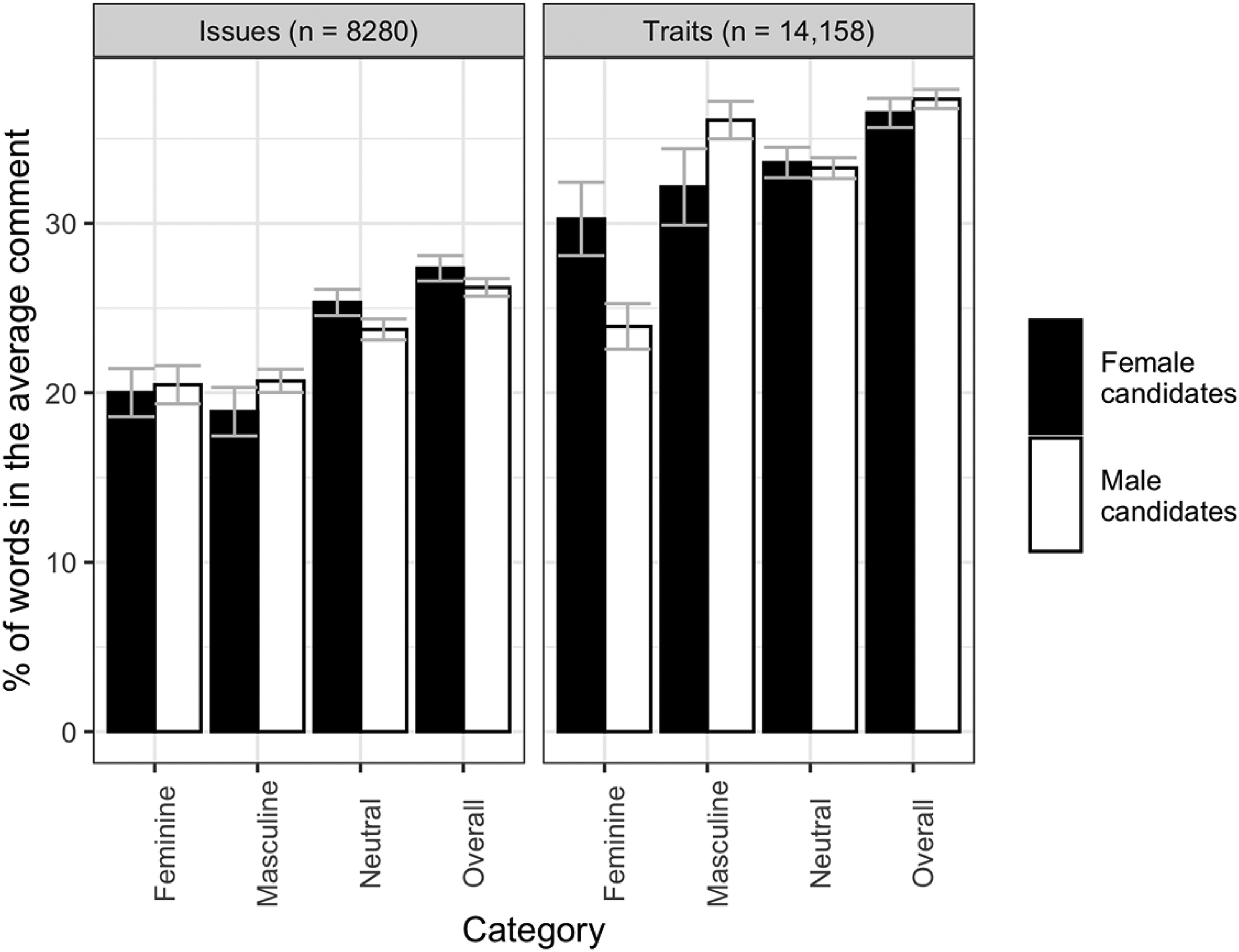
Percentage of masculine and feminine trait and issue comments, by candidate gender. Note. To standardize measurements across comments of varying lengths, we consider the number of words as a proportion of all words in the comment. Proportion is calculated as total trait or issue words/(total words − stop words). Confidence intervals are calculated using t-tests.
In the first stage of this analysis, we assess the likelihood that respondents associate female candidates more often with traits and less often with issues than their male counterparts (H1a and H2a). Contrary to expectations, female candidates are less likely to receive trait comments than their male counterparts, though the difference is minimal (less than one percentage point) and not significant. On the other hand, female candidates are slightly more likely to be associated with issues (1.1 percentage points, p < 0.01). Therefore, we see the inverse of the hypothesized relationships, but these differences are slight.
Figure 1 also breaks down the distribution of comments according to the application of gendered traits and gendered issues. Hypotheses 1b and 2b suggest the potential for affinity between candidate gender and gendered traits and issues. Indeed, female candidates are more likely to be associated with feminine trait descriptors (mean difference of 6.4 percentage points, p < 0.001 level). The inverse is also true. Male candidates are more likely to be associated with masculine traits when compared with their female counterparts (mean difference of 4 percentage points, p < 0.01). There is less support for H2b which hypothesizes an association between female candidates and congruently gendered issues. Instead, we find respondents associate female candidates with stereotypical feminine issues (e.g., health and social policy) less than their male counterparts, though the difference is minimal (−0.5 percentage points) and not significant. The inverse, however, is also true. Respondents more closely associate male candidates with typically masculine issues (e.g., business, finance) (mean difference of 1.8 percentage points, p < 0.05), suggesting that gender-issue affinity may be stronger for male candidates than for female candidates. This result may also reflect candidate presentation; female candidates, understanding they are disadvantaged by feminine stereotypes, may go out of their way to downplay their feminine issue strengths (Bauer 2020a). While we do not speculate on the associations between candidates and neutral issues or traits, interestingly, we find no difference between the application of neutral traits to men or women candidates. However, we do find women are marginally, but significantly more likely to be associated with neutral issues (p < 0.01).
As we are also interested in candidates’ perceived likeability, we break results down by positive comments (what respondents report they “like” about each candidate) and negative comments (what respondents say they “dislike” about each candidate; see Figures 2 and 3). Since politics is still a male-dominated space, and there is evidence citizens judge female politicians more harshly than male politicians (Schneider and Bos 2014, Brown, Heighberger and Shocket 1993), we expect respondents to associate female candidates less with liked traits (H1c) and liked issues (H2c) than is the case for male candidates. Both suppositions receive some support: respondents give more positive trait and issue references to male candidates than female candidates, but the differences are small (less than 2 percentage points each), and not significant.
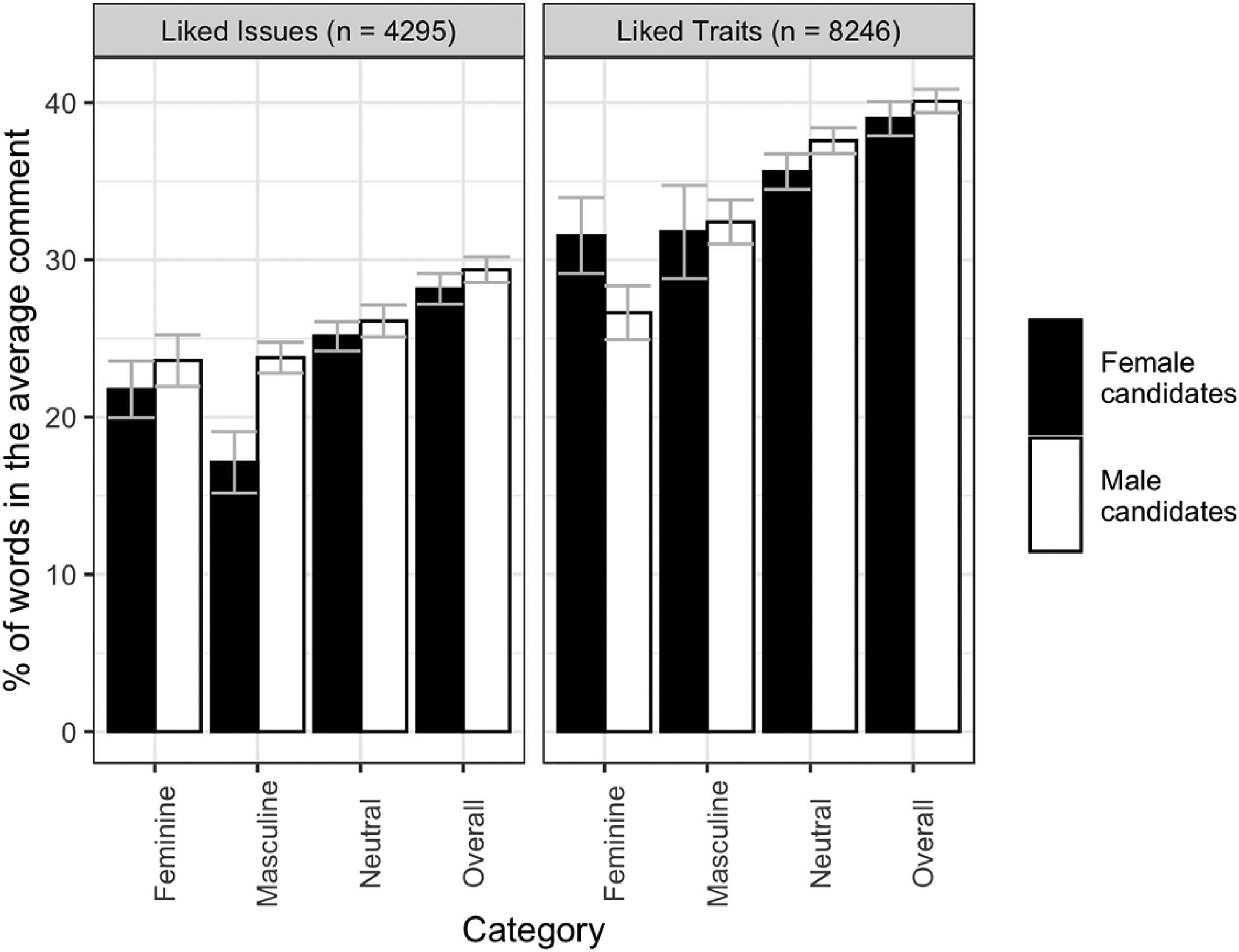
Percentage of liked masculine and feminine trait and issue comments, by candidate gender. Note. To standardize measurements across comments of varying lengths, we consider the number of words as a proportion of all words in the comment. Proportion is calculated as total trait or issue words/(total words − stop words). Confidence intervals are calculated using t-tests.
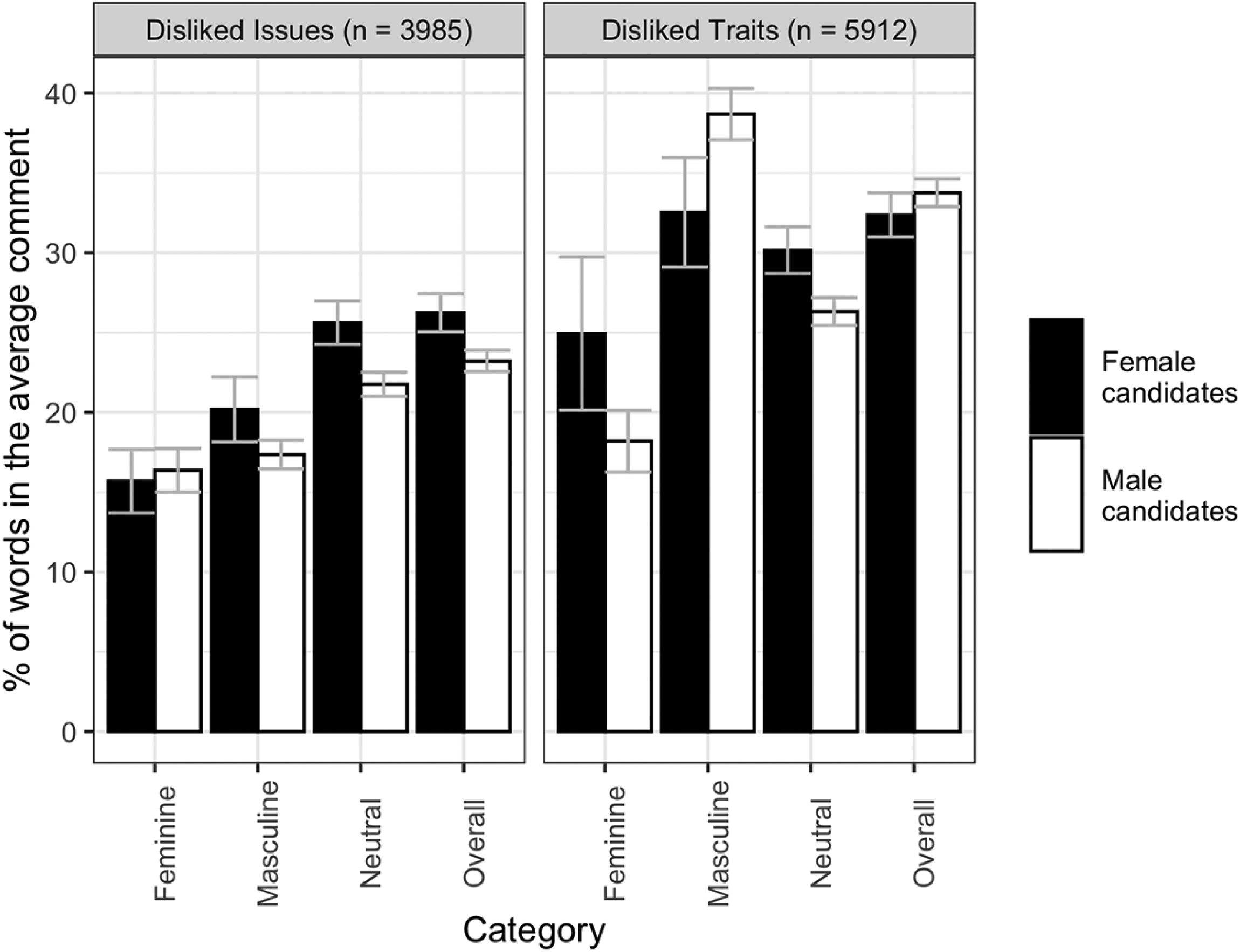
Percentage of disliked masculine and feminine trait and issue comments, by candidate gender. Note. To standardize measurements across comments of varying lengths, we consider the number of words as a proportion of all words in the comment. Proportion is calculated as total trait or issue words/(total words − stop words). Confidence intervals are calculated using t-tests.
Since we anticipate voters to view female candidates more positively when they “stay in their gendered lane,” we expect respondents to associate female candidates more than male candidates with liked feminine traits (H1d) and liked feminine issue positions (H2d). These expectations correspond with literature that suggests female candidates’ competence is rated most favourably in feminine issue areas (Huddy and Terkildsen 1993a), but that female candidates face a likeability penalty when they display traditionally masculine characteristics (Bauer and Santia 2021). What we in fact find is somewhat contradictory. Female candidates are more likely than male candidates to receive positive comments about feminine traits (a difference of nearly 5 percentage points, p < 0.01), but less likely than male candidates to receive positive comments about feminine issues (−1.8 percentage points), though this result is not significant. Male candidates, however, are slightly more likely to be associated with positive comments about masculine traits and considerably more likely to be associated with positive comments about masculine issues (though only the latter is significant, p < 0.001).
Comments that report on aspects of a candidate that respondents dislike are even more instructive. Since criticisms are often easier to cognitively access than compliments (Meffert et al. 2006), we expect to see stronger gendered effects in this part of the analysis. Here, we see only small differences between male and female candidates in the application of trait terms in general; however, female candidates are more likely to be associated with negative issue descriptors than their male colleagues (p < 0.001). Importantly, in the context of comments that report the “disliked” aspects of a candidate, there is a far stronger tendency to attach feminine traits to female candidates (mean difference of almost 7 percentage points, p < 0.05). Similarly, masculine traits are more likely to be associated with male candidates when dislike comments are cued (p < 0.01). In terms of issue descriptions, negative comments about female candidates are only marginally less likely to focus on traditionally feminized issues (the difference is not significant), though there seems to be an association between female candidates and negative descriptors of masculine issues (p < 0.05). Notably, female candidates are also more likely to have neutral descriptors applied when respondents discuss points of dislike among candidates for both traits and issues (p < 0.001). Thus, the data in Figures 2 and 3 suggest female candidates are connected more often to disliked traits and issues, except when voters discuss traditionally masculine traits; in that scenario, there is a stronger association with male candidates than female candidates.
Although these effects are clear, they do not account for potentially confounding factors or city-based effects. We use a weighted OLS regression analysis (Figures 4 and 5) to control for candidate characteristics (namely candidate gender, incumbency status, front-runner status), as well as for respondent features known to influence political engagement in local politics. 6 We do not engage in an in-depth analysis of city effects, but we include controls for cities, which may be driving results in some cases (covariates are omitted from the figures presented in-text and are available in the online appendix). Since we expect comments about traits and issues, in general, and comments about feminine and masculine traits and issues, in particular, to vary based on the characteristics that respondents like and dislike about the candidates, we run separate models for each dependent variable, separating like and dislike comments. The first set of models (Figure 4) illustrate the association between the number of positive (“like”) comments about traits and issues and candidate gender, while the second demonstrates the associations between negative (“dislike”) trait and issue comments and candidate gender (Figure 5).
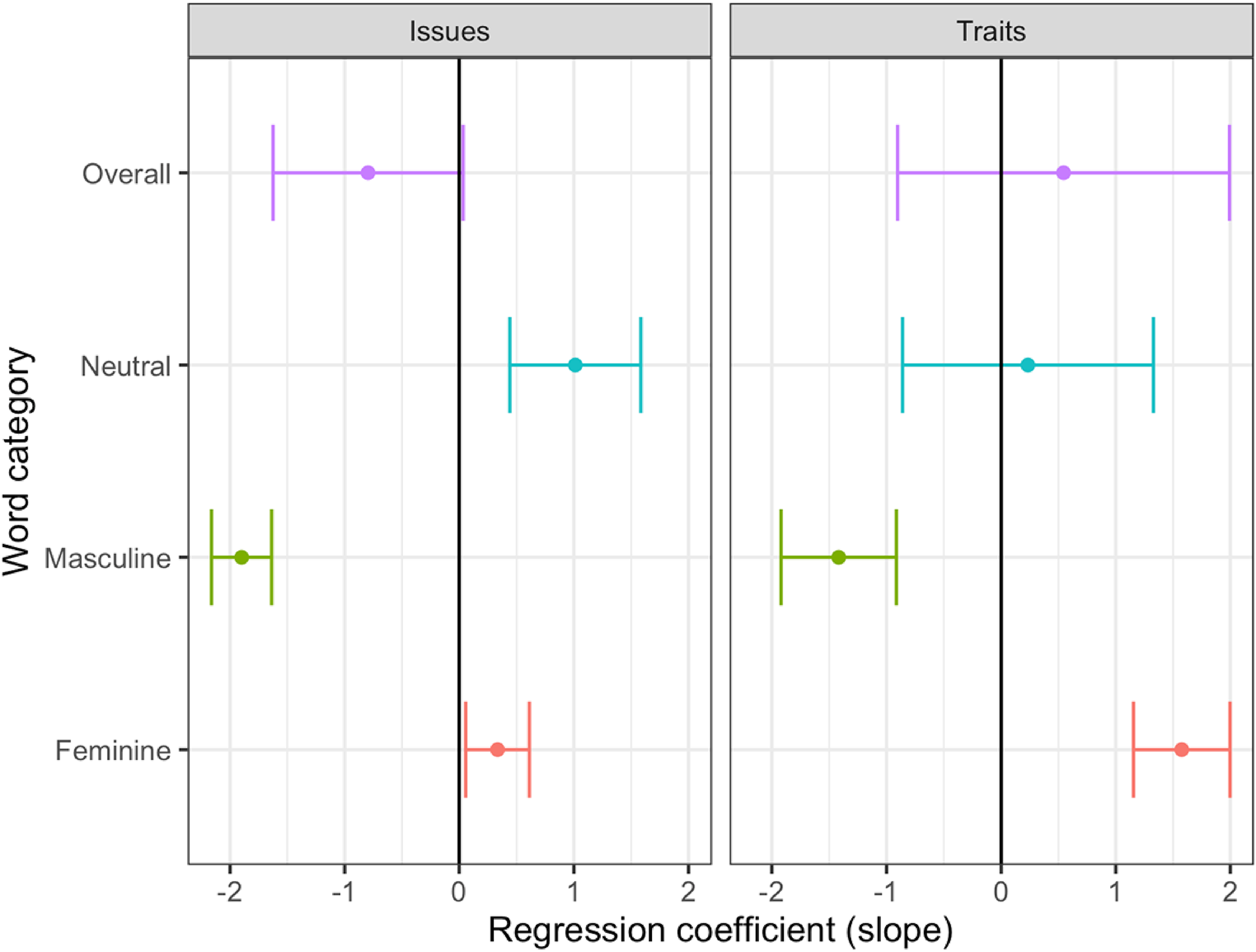
Multivariate analysis predicting respondents’ positive (“like”) evaluations of candidates (OLS models estimated using weights). Note. Controls omitted from tables; available in online appendix. Coefficients above 0 indicate an association with female candidates. Coefficients below 0 indicate an association with male candidates.
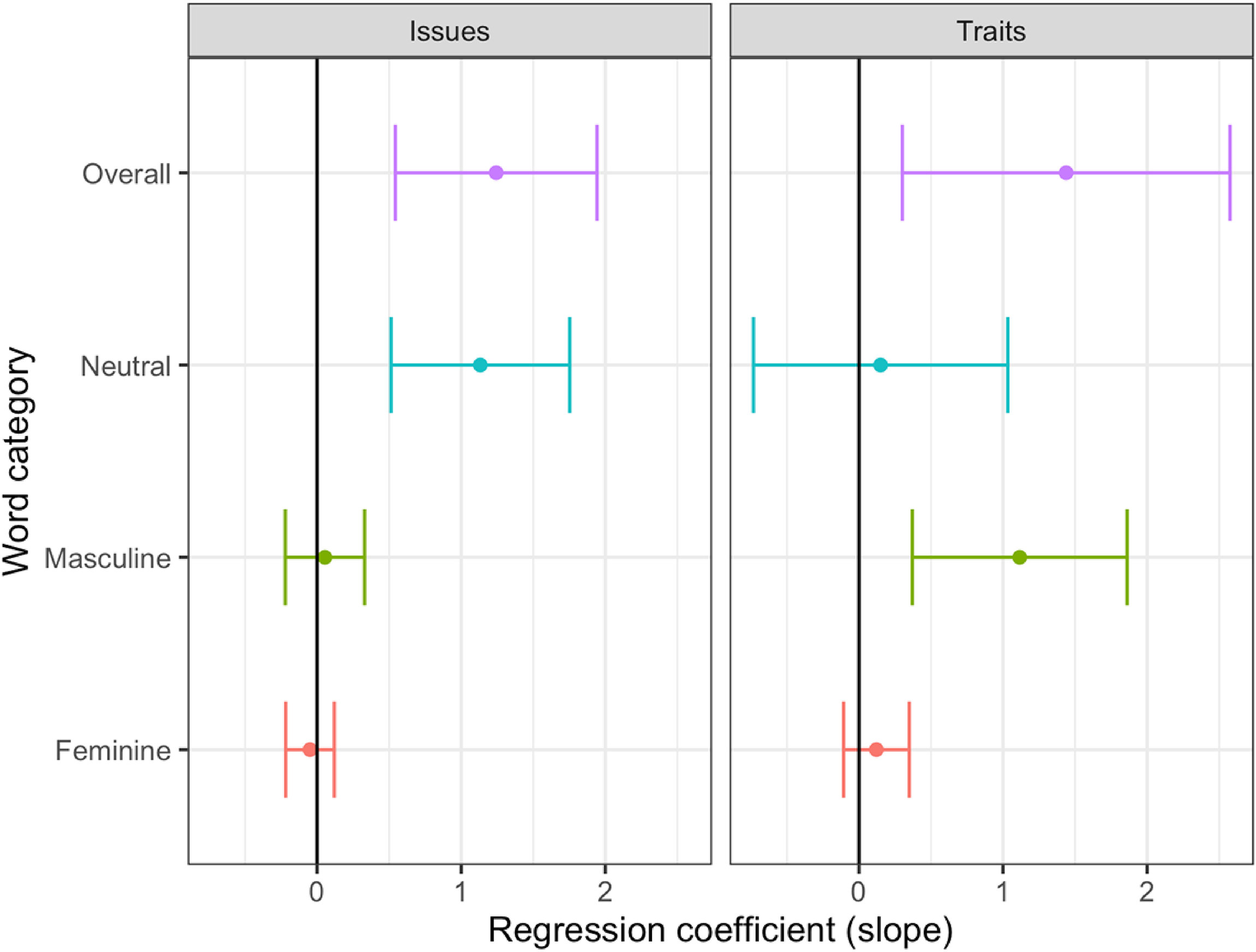
Multivariate analysis predicting respondents’ negative (“dislike”) evaluations of candidates (OLS models estimated using weights). Note. Controls omitted from tables; available in online appendix. Coefficients above 0 indicate an association with female candidates. Coefficients below 0 indicate an association with male candidates.
The models support what we find in the descriptive analysis and provide some added nuance. In hypotheses 1c and 2c, we expect female candidates to be viewed less favourably than male candidates (i.e., to have fewer associated “like” comments) on both traits and issues. The data presented in Figure 4 supports this hypothesis as it relates to traits, though not issues, and is insignificant in both cases. However, once potentially confounding variables are controlled for, the female incumbent is more likely to be associated with both positive trait and issue comments, which may point to the positive effect of familiarization with a female candidate. Notably, however, serving as a front runner does not result in an increase to their association with either dependent variable.
The models that look at the gendered nature of traits (Figure 4) illustrate an association between the application of feminine trait descriptors to female candidates and an inverse relationship between masculine traits and female candidates (both significant; p < 0.001). The same is true of issues. There is a gendered connection between traditionally female issues and being a female candidate (p < 0.05), and male candidates also seem to be associated more strongly with traditionally masculine issues (p < 0.001). Once again, being both female and an incumbent flips the direction of the relationship, increasing the likelihood of a female candidate being associated with masculine issues, though this may be less about the gender of the candidate and more about the likelihood of any issue being associated with an incumbent mayor.
The same models are reproduced for comments that cite respondents’ dislikes about candidates’ traits and issues. Here, we do see a strong gendered association between female candidates and trait and issue descriptors. Female candidates are more likely (and significantly so) to be associated with both negative trait and negative issue terms when compared with their male counterparts (Figure 5). There appears to be no affinity between female candidates and negative comments on feminine traits; in other words, feminine traits in female candidates do not seem to elicit negative assessments from voters. However, there is a stronger association between female candidates and negative comments about masculine traits, suggesting that when respondents are cued to consider what they do not like about a female candidate, they employ masculine terms to describe her. The same is true for issues. There is no association between female candidates and comments that negatively invoke feminine issue terms; however, female candidates are more likely to be associated with negative comments about traditionally masculine and neutral issues (though only the latter is significant).
In sum, there appears to be a clearly substantiated relationship between female candidates and trait comments, where women are more closely associated with positive feminine traits and less associated with positive masculine traits. In other words, when respondents are cued to think about things they like about women, they more readily invoke the language of care, compassion, and kindness compared with descriptions of male candidates, and less readily invoke the language of leadership, assertiveness, and other agentic terms. The inverse is also true; female candidates are more likely to be associated with negative comments about traits, and when respondents are cued to think of things they dislike about candidates, they tend to apply masculine traits to female candidates even more than they do to male candidates. This finding reinforces the conclusion that women candidates face a “double bind” (Jamieson 1995). Although masculinity is prized in politics, voters still react negatively to women who demonstrate these traits. When voters comment positively about female candidates’ attributes, these comments focus on feminine traits that are less valued in positions of political leadership.
On the issues side, female candidates are less likely to be associated with typically masculine issues when respondents discuss things they like about candidates, but they receive no reciprocal gender affinity effect for feminine issues. While there appears to be some positive association between female candidates and neutral issues, it is notable that women are not seeing any advantage in the gendered issues that are most readily associated with them in the literature. Yet, even this advantage is not absolute; female candidates are also more likely to receive negative comments about neutral issues. This suggests an absolute advantage in the number of associations with neutral issues, but not one that would advance female candidates’ prospects at the polls.
More strikingly, however, is the association between female candidates and negative commentary. Female candidates are more likely to be associated with negative comments about traits and issues in general, but respondents also appear more likely to describe female candidates using negative masculine trait terms. In practice, this suggests that when respondents deride female candidates, they do so by invoking typically masculine characteristics (e.g., “I don't like how aggressive she is”) or by negatively associating them with masculine issues (e.g., “She doesn't have a good handle on city finances”). Importantly, however, there seems to be a neutralizing effect when the female candidate is also an incumbent, as it inverts the relationship between female candidates and negative trait comments. This finding corresponds with research on trait voting in senate elections in the United States, which finds incumbency reduces voters’ reliance on trait-based assessments (Hayes 2010). Nonetheless, given there was only one female incumbent in the sample, we caution against making too much of this finding.
Discussion and Conclusion
By examining open-ended responses from a large-n survey of municipal voters, we sought to understand how voters assess mayoral candidates when their stereotypes about the level of government might conflict with their stereotypes about the type of office. The study's focus on municipal office broadens our knowledge of gendered stereotypes, which has primarily looked at the national and state levels (Bauer 2020a; Bauer and Santia 2021; Conroy 2015; Dunaway et al. 2013; Fowler and Lawless 2009; Jamieson 1995; Windett 2014). Often embedded in the literature is the assumption that women will “do better” in municipal politics because it is more compatible with their perceived trait and issue strengths (Tolley 2011). Despite this, women remain underrepresented in local politics, and particularly so in the mayor's office (Federation of Canadian Municipalities 2015). Alongside others, we argue stereotypes are contextual, and the low-information, mostly non-partisan environment of municipal politics might activate gender cues in a different way (Bauer 2020c; Crowder-Meyer, Gadarian and Trounstine 2015, 2020; Holman and Lay 2021).
By focusing on mayoral contests, we shed light on how voters assess candidates when there is gender congruence between the local level of government and women's skills, qualifications, and interests, but gender incongruence between women office-seekers and the mayoralty, which remains a powerful, prestigious, and prominent position of political leadership. The study has important theoretical, empirical, and practical implications.
The findings confirm that politics remain masculinized, even at the municipal level, and this association disadvantages women candidates (Bauer 2020c; Conroy 2015). Voters describe female mayoral candidates more frequently using feminine trait descriptors than they do for male candidates. Although the association between feminine traits and female candidates is often positive, this linkage offers little advantage because masculine traits are synonymous with leadership (Eagly and Mladinic 1989), and voters associate these with men. Our findings on evaluations of mayoral candidates comport with research on city council races, which shows that voters prefer more masculine candidates (Bauer 2020c). Although feminine traits do not explicitly disadvantage women candidates, they also do not offer a boost. Moreover, female candidates accrue no competitive edge based on an assumed competence in feminine policy issues. They are less likely than male candidates to receive positive comments about this purported issue strength, and they receive more negative issue-based comments, overall. Finally, when voters refer to masculine issues in their candidate evaluations, they draw a negative association between these and female candidates. Thus, on both traits and issues, female mayoral candidates are waging an uphill battle. There is little evidence gendered stereotypes benefit women mayoral candidates.
Differences in city council configuration and size, ballot types, and electoral rules abound in municipal politics, but the results reported here have implications for the study of local politics and elections elsewhere. Indeed, the empirical inputs (candidates) and outputs (results) in these eight municipal contexts contain a considerable amount of variation, but there is nothing unique or distinctly “Canadian” about these municipal environments; they reflect characteristics that can be exported to other locales. Our evidence suggests that while stereotypes about the level and type of office may conflict, the masculine nature of politics prevails. In this context, assumptions about the openness of municipal politics should be revisited. Moreover, while conventional wisdom might persuade female candidates to lean into feminine stereotypes when they run for office at the local level, our results suggest this strategy will be ineffective. Given the same conclusion has been reached in an experimental study of American council races (Bauer 2020c), there is some indication this finding is robust and not confined to a particular case study.
Incumbency may mute the effects of gendered stereotypes, increasing the likelihood that voters will associate female candidates with masculine traits and issues. Although we cannot fully test this theory given the limited number of female incumbent mayors, future research should investigate how voters' familiarity with a candidate transforms their perceptions; it is likely that small additional pieces of information will help to offset voters’ reliance on simple demographic or trait-based cues (Crowder-Meyer, Gadarian and Trounstine 2020; Hayes 2010). Reductions in trait-based assessments could be particularly significant for women candidates given their association with feminine traits diminishes voters’ perceptions of them as leaders.
Incumbency is also likely to alter candidate presentation as well as the media's coverage (Dunaway et al. 2013). Incumbent candidates can run on their records and experience, and the media is also more likely to accept the validity of these cues. Past research shows that although the media's coverage of non-incumbent racial minorities presents them as far less viable than their white counterparts, this difference disappears among incumbent candidates (Tolley 2016). We anticipate an analogous effect for female incumbent mayors. This suggests that female candidates – unlike their male counterparts – need to prove themselves before they are taken seriously, but it does indicate a candidate's performance can (eventually) alter perceptions.
One important caveat to these findings is the fact that many of the respondents in the sample had very little to say about the mayoral candidates in their city. Only about one-quarter of responses to the like/dislike question included substantive content. Many respondents selected “don't know” or a response that allowed them to say there was nothing they like/dislike about the candidate in question. These results confirm the understanding of municipal politics as a low-information environment, but also suggest voters either know very little or have few concrete opinions about their local office-seekers. Even so, when respondents do offer an opinion, the categorization of their responses demonstrates that trait and issue evaluations remain important. Although the bulk of research on gendered stereotypes has focused on traits, our findings and some others (e.g., Bauer 2020a) suggest stereotypic content might vary when traits and issues are examined separately. Interestingly, we do not find female candidates receive more trait comments and male candidates more issue comments. Respondents were in fact slightly more likely to make issue comments about female candidates than male candidates.
Future research should look more closely at the relationship between candidates’ presentation, media coverage, and voter assessments. The present research design only taps into the content of voters’ assessments. We do not examine how voters’ reliance on gendered trait and issue stereotypes affects their vote choice. Some research suggests that although gendered stereotypes are present, they are overridden by partisan concerns when voters arrive at the ballot box (Hayes 2011). However, given that municipal politics is often non-partisan or only loosely partisan, gender cues may continue to exert an influence on vote choice. Importantly, although some studies have concluded stereotypes are no longer an obstacle to women office-seekers, most of this research has been conducted in the high-information context of national and state politics where voters know comparatively more about the candidates (Brooks 2013; Dolan 2014; Hayes 2011). A richer message environment likely dampens voters’ dependence on gender cues and stereotypes. Untangling the relationship between stereotypes and vote choice requires research in a broader range of electoral contexts.
Integrating an understanding of the attributes and policy priorities that candidates highlight in their campaigns is also advised since past research suggests women candidates opt to emphasize masculine traits and issues so they appear more suitable to voters (Sapiro et al. 2011). Although we do not look systematically at candidate presentation, this trait-balancing strategy was evident in the campaign of one of the female candidates in the sample – Montreal's Valérie Plante – whose early ads showed her in grey suit, arms crossed in a stereotypically masculine pose, with the tagline “L’homme de la situation” or “the right man for the job” printed in blue, grey and black lettering (Tolley and Paquet 2021). Voters’ assessments of candidates draw on this message environment. As a result, the reliance on gendered trait and issue descriptors could reflect stereotypes, but also candidates’ own trait and issue presentation. The relationship is likely to be mediated by news coverage, which reflects candidates’ strategies but is also influenced by gendered stereotypes and assumptions (Goodyear-Grant 2013). Additional research should explore these questions alongside other identity markers, including race. More intersectional research is desirable but a tall order, particularly in observational studies because a larger pool of women and racial minority candidates is needed to facilitate meaningful inferences.
Finally, although the present study zeroes in on voters’ assessments of municipal office-seekers, this focus should be extended to examine how these attitudes affect vote choice. Some observational research suggests municipal voters favour female candidates (Kjaer and Krook 2019; Lucas et al. 2021), a finding that gives rise to the enticing conclusion that gender bias is no longer a problem for women in politics. However, this assertion must be squared against our research, which shows voters continue to harbour gendered stereotypes. National-level research on the gendered qualifications gap offers one explanation. It shows that women who run for office and win are, on average, objectively more qualified than their male counterparts. Even so, voters and the media discount their qualifications, with women winning by smaller margins than men (Bauer 2020b). In other words, female candidates do not win because there is no gender bias, but rather they win despite gender bias. This research should be extended to a broader range of electoral contexts. Research should also look at metrics beyond electoral outcomes, including the link between gender stereotypes and violence against women in politics (Krook 2020; Rheault, Rayment and Musulan 2019).
For women mayoral candidates, these results are discouraging. They suggest that on both traits and issues, female candidates face negativity from voters, even at the level of government commonly believed to be most open to them. Whereas female candidates are believed to have a competitive advantage given the congruence between municipal government and women's perceived trait and issue strengths, this does not play out in our data. Moreover, when voters are asked to describe what they like about female candidates, they resort to feminine trait descriptors that are incongruent with the agentic and more masculine qualities they seek in leaders. There is also evidence that female candidates who demonstrate these masculine traits face a backlash from voters. Whatever potential benefit women might gain from running at a less prestigious and less powerful level of government seems to dissipate when the position they seek is the most prestigious and powerful. This study contests the rose-coloured view that local politics is a kinder, gentler space for female candidates. Municipally, as elsewhere, female candidates are disadvantaged by gendered trait and issue stereotypes.
Supplemental Material
sj-pdf-1-uar-10.1177_10780874221090874 - Supplemental material for ‘Whiny, Fake, and I Don't Like Her Hair’: Gendered Assessments of Mayoral Candidates
Supplemental material, sj-pdf-1-uar-10.1177_10780874221090874 for ‘Whiny, Fake, and I Don't Like Her Hair’: Gendered Assessments of Mayoral Candidates by Erin Tolley, Andrea Lawlor and Alexandre Fortier-Chouinard in Urban Affairs Review
Footnotes
Acknowledgments
Thanks to Amanda Clayton, Meredith Conroy, and Jon Green for helpful suggestions at the early stages of this project, as well as to the journal's editors and anonymous reviewers who helped sharpen our focus and improve the analysis. This research was presented at the 2019 European Conference on Politics and Gender in Amsterdam.
Declaration of Conflicting Interests
The authors declared no conflicts of interest with respect to the research, authorship, and/or publication of this article.
Funding
This study was funded by the Social Sciences and Humanities Research Council of Canada (grant #435-2017-0993) and through a University of Toronto Mitacs Research Training Award.

Supplemental Material
Supplemental material for this article is available online.
Notes
Author Biographies
References
Supplementary Material
Please find the following supplemental material available below.
For Open Access articles published under a Creative Commons License, all supplemental material carries the same license as the article it is associated with.
For non-Open Access articles published, all supplemental material carries a non-exclusive license, and permission requests for re-use of supplemental material or any part of supplemental material shall be sent directly to the copyright owner as specified in the copyright notice associated with the article.
