




Abstract
This study explores how information and communication technologies (ICTs) influence transforming attitudes toward intimate partner violence (IPV) and women's empowerment in Pakistan and Nepal. By analyzing data from married women using recent Demographic and Health Surveys, the research reveals that owning multiple ICTs is associated with decreased experiences of physical IPV and reduced acceptance of wife-beating. Notably, increased ownership of ICTs corresponds to heightened participation in household decisions. Furthermore, regular internet use further diminishes the likelihood of experiencing physical IPV and justifying wife-beating. These findings underscore ICTs’ potential to empower women, reshape gender norms, and enhance decision-making autonomy. The study advocates for gender-inclusive policy interventions that leverage the transformative influence of ICTs in fostering positive sociocultural changes.
Keywords
Introduction
Intimate partner violence (IPV)—experienced by almost one in three women—is a key social welfare and public health challenge with profound global ramifications, particularly in low- and middle-income countries (LMICs) including Pakistan and Nepal (Stubbs & Szoeke, 2021; World Health Organization, 2021). Connected with numerous physical, mental, and reproductive health outcomes, over the past decades, heightened attention has been devoted to understanding the risk factors associated with IPV and developing strategies to mitigate its detrimental effects (Ellsberg et al., 2015). A prevailing view is that IPV is closely linked to the cultural and social norms that not only tolerate but also legitimate violence within intimate relationships (Abramsky et al., 2011; Herzog, 2007). These harmful norms perpetuate a cycle of male dominance and female subjugation and subordination, often reinforced by the endorsement of traditional gender roles and the acceptance of practices such as wife-beating to discipline women for unsatisfactory performance of household responsibilities (Islam et al., 2021; Jewkes et al., 2015; Michau et al., 2015; Uthman et al., 2009). Because individual behavior is strongly influenced by cultural and social norms, norms can either foster or discourage violence and its detrimental effects.
The acknowledgment of the pivotal role played by norms supportive of IPV has prompted global, regional, and national stakeholders to focus on strategies aimed at reshaping cultural and social norms (Cislaghi & Heise, 2018; World Health Organization, 2016). The potential of information and communication technologies (ICTs) to facilitate such transformations has gained prominence due to the success of ICT-based interventions in addressing various public health issues, including alcohol consumption, smoking, and HIV, suggesting their potential in the prevention of IPV (WHO, 2009). Leveraging edutainment strategies, which seamlessly integrate educational messages into entertainment platforms like video games, TV shows, and internet content, has proven effective in influencing knowledge, attitudes, and behavior. For example, edutainment initiatives in South Africa and Nicaragua have shown positive outcomes in altering social norms and attitudes connected with IPV and gender equality (Ellsberg et al., 2018). Therefore, to “achieve gender equality and empower all women and girls,” the UN Sustainable Development Goals set a target of ending all kinds of violence against women and empowering women by promoting the use of ICTs as well as by ensuring their full participation in decision-making (United Nations, 2020).
ICTs are universally recognized not only as tools for economic growth and development (Appiah-Otoo & Song, 2021; Farhadi et al., 2012; Karaman Aksentijević et al., 2021; Usman et al., 2021) but also as agents of women's empowerment, contributing to increased economic power (Cummings & O’Neil, 2015), independence (Mackey & Petrucka, 2021), and participation in household decision-making (Zheng & Lu, 2021). By providing women access to vital information related to healthcare, education, livelihood, and business opportunities, ICTs offer a gateway to enhanced empowerment across various domains (Hilbert, 2011; Mackey & Petrucka, 2021). However, despite these positive benefits, a persistent gender digital divide continues to hinder the full realization of ICTs’ advantages in LMICs. Women in these regions still face significant disparities in terms of owning mobile phones and accessing the mobile Internet (GSM Association [GSMA], 2020). South Asia, in particular, grapples with pronounced gender gaps in mobile phone ownership (23%) and mobile internet use (51%; GSMA, 2020).
The few studies (Jensen & Oster, 2009; La Ferrara et al., 2012; Pesando, 2021) that have investigated the association between the use of ICTs and women's status, each considered a single category of technology, either television or mobile phone. These studies have focused on either household ownership of ICTs (Cardoso & Sorenson, 2017) or individual ownership (Jensen & Oster, 2009; La Ferrara et al., 2012; Pesando, 2021). We are not aware of any studies, especially from South Asia, that have particularly focused on the association between household and/or individual ownership of multiple ICTs and the transformation of social norms regarding the acceptance or justification of wife-beating. Moreover, no studies from this region have been conducted to determine whether the use of ICTs contributes to reducing IPV victimization and increasing women's participation in household decision-making, both key to advancing women's safety and autonomy. To bridge these research gaps, this study utilizes nationally representative data to investigate whether household and/or individual ownership of diverse ICTs is associated with the likelihood of experiencing physical IPV, endorsing IPV justification, and engaging in household decision-making among married women in the two South Asian countries: Pakistan and Nepal. This inquiry is vital for the formulation of targeted intervention strategies aimed at curbing the cultural acceptance and intergenerational transmission of IPV while empowering women to challenge norms that perpetuate violence.
Method
Data Sources
This study is a secondary analysis of the most recent waves of Demographic and Health Surveys (DHS) in Pakistan (2017–2018) and Nepal (2016). We have chosen Pakistan and Nepal for our study due to the availability of pertinent data on the domestic violence module and variables related to ICT. DHS data are nationally representative, household surveys of ever-married women aged 15–49 years. Using a standardized questionnaire, this survey covers a variety of demographic, health, and well-being topics in LMICs. A two-stage cluster sampling method is applied to select urban and rural households. The detailed methodology regarding each survey is available elsewhere (Ministry of Health [Nepal], New ERA & ICF, 2017; National Institute of Population Studies (NIPS) & ICF, 2019). A subsample of these women who responded to the domestic violence module was analyzed. For this analysis, we dropped cases with missing data (86 and 538 cases for Pakistan and Nepal, respectively) for the variables included in this study, which left data for 3,999 and 1,884 participants for Pakistan and Nepal, respectively, as the analytical sample.
Measures
Outcome Variables
Physical IPV
The survey asked women whether their husbands had ever engaged in any one of the seven different behaviors indicative of IPV. These include (a) pushing, shaking, or throwing something at her; (b) slapping; (c) twisting her arm or pulling her hair; (d) punching or hitting with a fist or something harmful; (e) kicking or dragging or physically assaulting her; (f) choking or burning; (g) threatening or attacking with a knife, gun, or any other weapon. A positive answer to one or more of the seven items constitutes physical IPV in this study, coded as no (= 0) and yes (= 1).
Justification of Wife-Beating
To assess the attitudes regarding the justification of wife-beating, women were asked whether a husband is justified in beating his spouse under five circumstances: if she goes out without telling him, neglects the children, argues with him, refuses to have sex, and burns the food. For the study, a binary variable was created to identify women who replied yes to any of these items, coded as any justification of wife-beating (=1) and no justification of wife-beating (=0).
Household Decision-Making Autonomy
Women's participation in household decision-making was assessed based on household decisions, a woman made alone or jointly with her husband about the following: the respondent's healthcare, major household purchases, and visits to family or relatives. The response options were as follows: (a) respondent alone; (b) respondent and husband jointly; (c) respondent and other persons; (d) husband alone; (e) someone else, and (f) other. Each question was assigned a value of 1 if the response was (a), (b), or (c), and 0 for (d), (e), or (f). These variables were dichotomously coded to be full or partial participation, described in options (a), (b), and (c), and assigned a score of 1, and no participation, described in options (d), (e), and (f) and assigned a score of 0. Women's participation in decision-making is coded as 1 if the respondent participated in any of these decisions and 0 if the women participated in none of the decisions.
Exposure Variable
The exposure variable of interest measures household and/or individual ownership of four kinds of ICTs: mobile phone, fixed phone, television, and internet use (no = 0 vs. yes = 1). A count variable (range = 0–4) was created to calculate the number of types of ICTs in the household and/or individual ownership. The frequency of using the Internet was determined by asking how often the respondent used the Internet during the last 1 month: almost every day, at least once a week, less than once a week, or not at all. The responses were coded as not at all (0), irregularly (1, at least once a week and less than once a week), and regularly (2, almost every day).
Control Variables
A range of theoretically and empirically associated sociodemographic variables were included in this study (Alam et al., 2021; Cardoso & Sorenson, 2017; Uthman et al., 2009). Respondent's age was categorized as: adolescents (≤19 years = 0), young adults (20–24 years = 1), and adults (≥25 = 2). The women's educational level was defined as: no education (= 0), primary (= 1), or secondary or higher (= 2). The place of residence was categorized as: urban (0) versus rural (1). Wealth was categorized as poor (0), middle (1), or rich (2) category. The gender of the head of the household was coded as female (0) versus male (1). The number of living children was coded as no child = 0, one child = 1, two children = 2, or three or more children = 3.
Ethical Approval
The survey was approved by the ICF Institutional Review Board at Calverton in the United States and by the National Research Ethics Committee in the respective country. According to the DHS, all respondents gave informed consent before participation and all information was collected confidentially.
Analytical Strategy
All statistical analyses were conducted using IBM SPSS V24.0, with statistical significance set at p < .05 (two-tailed). Descriptive statistics for the predictive characteristics and outcome measures were estimated. The relationships between the predictive characteristics and outcome measures were assessed using cross-tabulations and the χ2 test. The multicollinearity of the variables was checked by examining the variance inflation factors (< 2.5) but found no evidence of multicollinearity.
To estimate adjusted odds ratios (AORs) and 95% confidence intervals to compare the strength of the associations between the outcome and exposure variables, we first designed three adjusted multivariate logistic regression models—one separate model for each outcome variable (physical IPV, justification of wife-beating, and household decision-making autonomy) with the ownership of ICTs. We performed another set of multivariate analyses to assess whether the frequency of internet use was associated with the likelihood of experiencing physical IPV, justification of wife-beating, and participation in household decision-making. All the covariates were entered simultaneously into the multiple logistic regression models.
Results
Descriptive Statistics
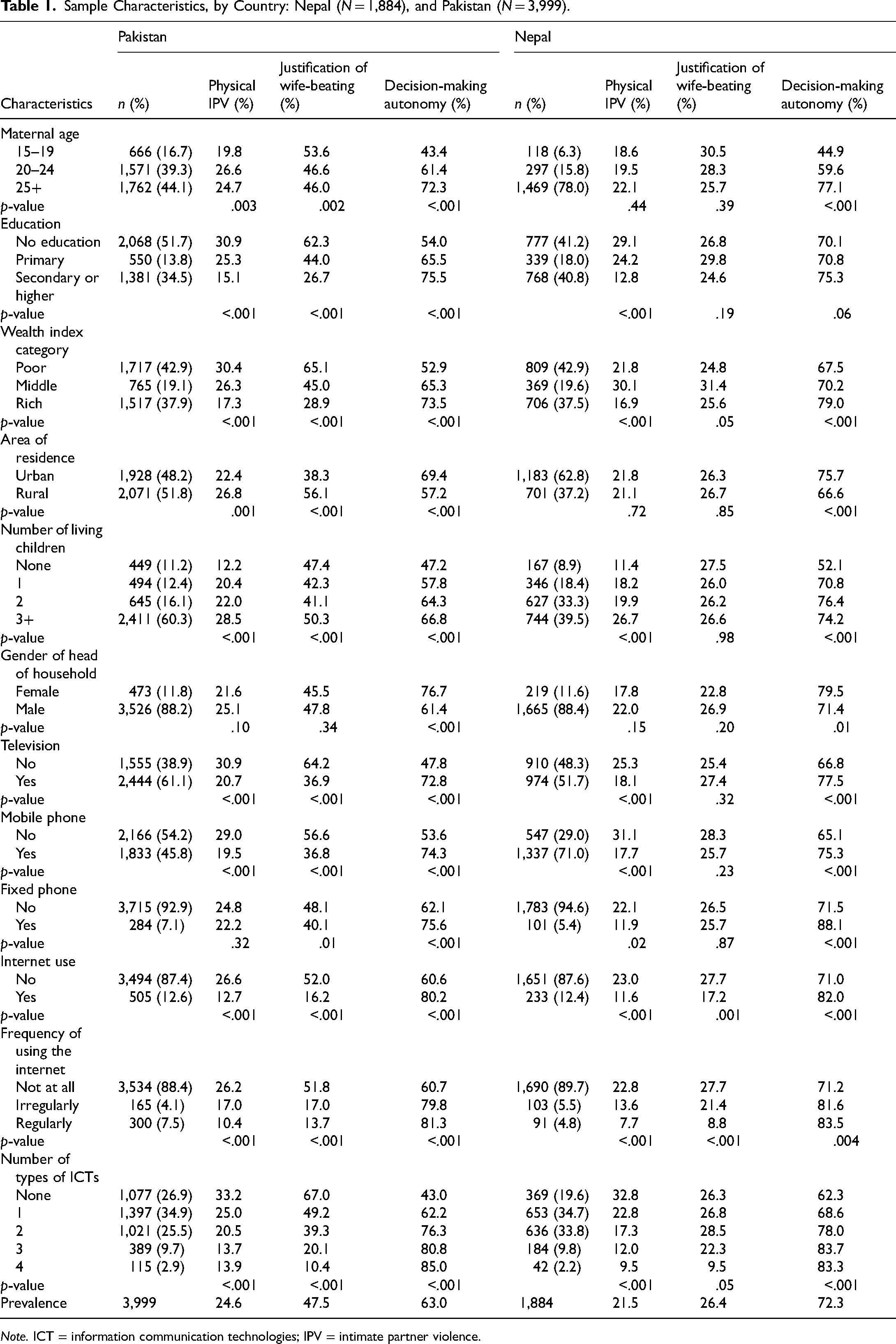
Table 1 provides an overview of the descriptive statistics for the sample characteristics and outcome variables in both Pakistan and Nepal. The sample comprised a mix of age groups, with the majority of women in Nepal categorized as adults (78%), while more than half of the Pakistani sample fell into the adolescent and young adult age bracket (55.9%). Education levels varied, with a higher proportion of women in Pakistan having no educational attainment (51.7%) compared to Nepal (41.2%). Women's wealth index was similar for respondents from both countries. Regarding residence, a large proportion of women in Nepal lived in urban areas (62.8%), whereas, in Pakistan, the majority resided in rural regions (51.8%). The gender of the household head was predominantly male in both countries (88%). Family size, as measured by the number of living children, was generally consistent between the two countries, with a significant proportion having three or more children.
Sample Characteristics, by Country: Nepal (N = 1,884), and Pakistan (N = 3,999).
Note. ICT = information communication technologies; IPV = intimate partner violence.
Ownership of ICTs varied, with televisions and mobile phones being the most common types in both countries. However, internet use was limited, reported by only 12.6% of women in Pakistan and 12.4% in Nepal. Approximately one in 10 women (13.6% in Pakistan and 13.0% in Nepal) in both countries reported owning three or more types of ICTs.
ICTs and Attitudes Toward IPV: Bivariate Findings
The prevalence of physical IPV was 24.6% in Pakistan and 21.5% in Nepal. The rate of justification for wife-beating was 47.5% in Pakistan and 26.5% in Nepal. Bivariate analysis revealed noteworthy associations between ownership and use of ICTs and attitudes toward IPV. Across both countries, ownership of individual ICTs was inversely related to the likelihood of experiencing physical IPV victimization in both countries. In particular, women with ownership of each type of ICT, except for fixed phones in Pakistan, were significantly less likely to report experiencing physical IPV. Regular use of the internet was also associated with a reduced likelihood of physical IPV in both settings. Moreover, the experience of physical IPV significantly decreased with the increase in the number of various kinds of ICTs in both settings (Table 1).
While Pakistani women who reported ownership of each type of ICT were significantly less likely to accept the justification of wife-beating, the relationship was not significant for women of Nepal, except for the individual reports of internet use. Regular use of the internet was highly significant for not accepting justification of wife-beating in both countries. In both countries, women who owned all types of ICTs were significantly less likely to endorse justifications for wife-beating.
ICTs and Participation in Household Decision-Making: Bivariate Findings
The rate of participation in household decision-making was 63.0% in Pakistan and 72.3% in Nepal. Bivariate analyses also demonstrated links between ICT ownership and women's participation in household decision-making. The rates of participation in household decision-making were higher among women who were adults, educated, wealthier, lived in urban areas, were household heads, and had higher parity.
Household and individual ownership of each type of ICT and regular internet use were associated with increased participation in household decision-making in both countries. Notably, a trend was observed: as the number of owned ICTs increased, so did the likelihood of participation in household decision-making. This trend was consistent across both countries, underscoring the potential of ICT ownership to empower women within their households.
ICTs and Attitudes Toward IPV: Multivariate Findings
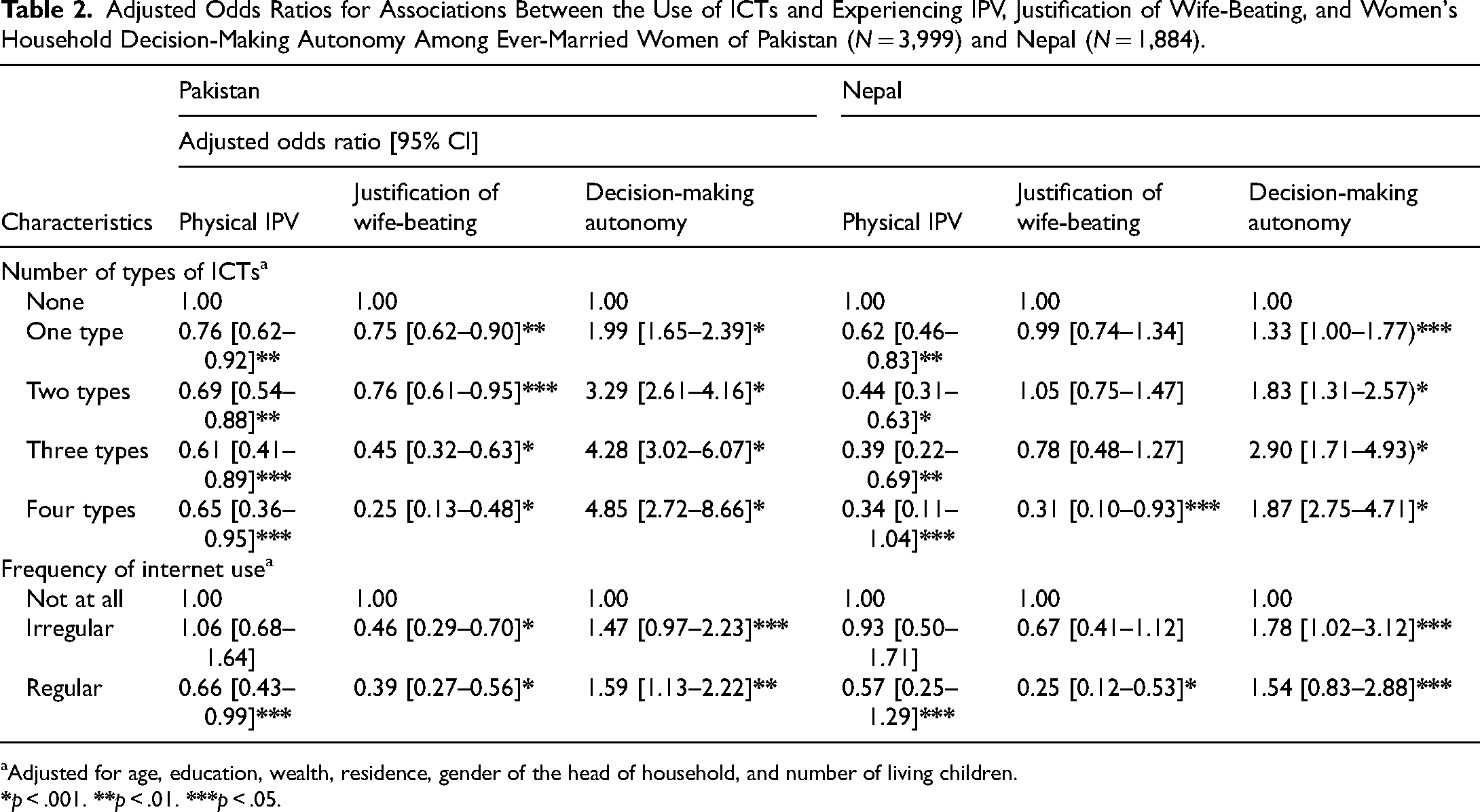
Multivariate analyses (as displayed in Table 2) further substantiated the relationship between ICT ownership and attitudes toward IPV. After adjusting for relevant sociodemographic characteristics, the odds of experiencing physical IPV and justifying wife-beating decreased as the number of owned ICTs increased. For instance, women in Pakistan and Nepal who owned all four types of ICTs were, respectively 35% (AOR: 0.65, 95% CI [0.36, 0.95]), and 66% (AOR: 0.34, 95% CI [0.11, 0.90]) less likely to experience physical IPV, compared to those with no ICT ownership. In addition, women who regularly used the internet were 34% (AOR: 0.66, 95% CI [0.43, 0.99]), and 43% (AOR: 0.57, 95% CI [0.25, 1.29]) less likely in Pakistan and Nepal (respectively) to experience physical IPV than those who had never used the internet.
Adjusted Odds Ratios for Associations Between the Use of ICTs and Experiencing IPV, Justification of Wife-Beating, and Women's Household Decision-Making Autonomy Among Ever-Married Women of Pakistan (N = 3,999) and Nepal (N = 1,884).
Adjusted for age, education, wealth, residence, gender of the head of household, and number of living children.
The same direction and pattern were observed between ownership of four types of ICTs and regular use of the internet and the acceptance of justification of wife-beating. Pakistani and Nepali women with all types of ICTs were respectively 75% (AOR: 0.25, 95% CI [0.13, 0.48]) and 69% (AOR: 0.31, 95% CI [0.10, 0.93]) less likely than those with no ICT to accept justification to wife-beating. Regular internet use also contributed to the reduced acceptance of wife-beating justification, with women who used the internet regularly being 61% and 75% less likely in Pakistan and Nepal, respectively, to accept such justification.
ICTs and Participation in Household Decision-Making: Multivariate Findings
As shown in Table 2, the odds of participation in household decision-making increased as the number of various types of ICTs increased. In Pakistan, for instance, women in households with one, two, three, and four types of ICTs were, respectively, 1.99, 3.29, 4.28, and 4.85 times more likely to participate in household decision-making compared to those in households without ICTs. The corresponding figures for Nepal were 1.33, 1.83, 2.90, and 1.87 times, respectively. Likewise, Pakistani and Nepali women who had at least some exposure to the internet (irregular use) were, respectively, 1.47 times (AOR: 1.47, 95% CI [0.97, 2.23]) and 1.78 times (AOR: 1.78, 95% CI [1.02, 3.12]) more likely to participate in household decision-making than women with no exposure. Additionally, those who used regularly were 1.59 (AOR: 1.59, 95% CI [1.13, 2.22]) times and 1.54 times (AOR: 1.54, 95% CI [0.83, 2.88]), respectively, more likely to participate in household decision-making compared with their nonuser counterparts.
Discussion
The current study examined whether individual and/or household ownership of ICTs would be associated with women's attitudes toward and experiences of physical IPV as well as their participation in household decision-making. Among a nationally representative sample of married women of Pakistan and Nepal, we found that ownership of ICTs was negatively connected with both victimization and justification of wife-beating, and positively associated with women's participation in household decision-making, even after adjusting for relevant sociodemographic characteristics. Overall, this study adds to the growing body of evidence on the impacts of owning ICTs on attitudes toward physical IPV and women's empowerment in LMICs. To the best of our knowledge, this is the first study in the South Asian region to investigate any association between individual and/or household ownership of ICTs and women's attitudes toward wife-beating and household decision-making autonomy.
These representative data suggest that approximately one in four women (24.6% in Pakistan and 21.5% in Nepal) experienced physical IPV and approximately 47.5% of women in Pakistan and 26.5% of women in Nepal had conservative attitudes toward wife-beating. As expected, findings from this study demonstrate that ownership of ICTs directly influences women's experience of physical IPV and attitudes toward it. For instance, irrespective of country, women with ownership of all four technologies compared with women with no ICT were 35.0%–66.0% less likely to experience physical IPV, and 69.0%–75.0% less likely to justify wife-beating. The negative association between ICTs and the justification of wife-beating is consistent with previous few extant studies (Cardoso & Sorenson, 2017; Jensen & Oster, 2009). Access to ICTs exposes women to diversified viewpoints regarding women's lives and their roles in the family and society, which in turn contribute to reshaping gender norms and attitudes, particularly in societies where strong conservative attitudes toward traditional gender roles prevail (Cardoso & Sorenson, 2017; La Pastina, 2004; Sengupta & Singhal, 2021; Zheng & Lu, 2021). In addition, women may receive positive values and more sophisticated gender perspectives through ICTs which may facilitate their awareness of gender equality and more constructive views relating to women's attitudes toward IPV (Zheng & Lu, 2021).
In both Pakistan and Nepal, a positive association was found between the increase in the number of various types of ICTs, as well as internet use, and women's household decision-making power. Evidence suggests that ICTs contribute to numerous social benefits, including better family relations (Chib et al., 2014), greater social support (Chib et al., 2014; Shaw & Gant, 2004), heightened psychological well-being (Chew et al., 2015), and higher levels of autonomy (Tacchi et al., 2012). These social skills developed by using ICTs enhance women's self-confidence, self-awareness, self-esteem, and problem-solving ability, which are conducive to acquiring resources and power in their families (Zheng & Lu, 2021). Research has revealed that women's participation in household decision-making decreases their likelihood of justifying wife-beating (Alam et al., 2021; Seidu et al., 2021), meaning that decision-making capacity allows women to exercise their rights and autonomy in the household, which in turn contributes to resisting IPV. Feminist theorists argue that the enhanced autonomy and power of women are instrumental in reducing violence against women (Islam et al., 2021; Schuler & Nazneen, 2018). Recent studies suggest that one of the strongest correlates of experiencing IPV is women's tolerant or supportive attitudes toward IPV (Shinwari et al., 2021; Tran et al., 2016).
This study has found that frequency of internet use significantly reduces the likelihood of physical IPV victimization and justification of wife-beating, and improves the likelihood of women's participation in household decision-making. For instance, women who regularly used the internet were 34.0%–43.0% less likely to experience physical IPV and 61.0%–75.0% less likely to justify wife-beating than those who had never used the internet. There are several potential mechanisms through which ICTs can influence women's attitudes toward IPV and autonomy. Research demonstrates that abused women usually experience social isolation from positive support systems, and limited access to information and adequate health services (Taillieu & Brownridge, 2010). Studies also have demonstrated that increases in women's loneliness and helplessness are connected with higher odds of experiencing IPV (Xue et al., 2018). This may be linked to lower levels of social support networks and low self-esteem, which are also implicated in IPV victimization (Islam et al., 2021). The use of ICTs plays a key role in building a strong social support network that in turn helps to improve women's self-esteem and self-confidence (Kong et al., 2015; Marshall et al., 2014). Therefore, the respective governments should strengthen the infrastructure for internet networks, reduce internet costs, and improve the availability of other ICTs. The imperative of bridging the gender digital divide must be emphasized to fully leverage the advantages of ICTs for women's safety and empowerment.
Strength and Limitations
The findings of this study should be interpreted considering some limitations. First, a temporal relationship cannot be established due to the cross-sectional design. Longitudinal and qualitative research is necessary to clarify the causal and temporal relationships between the ownership of multiple types of ICTs and the likelihood of experiencing and justifying wife-beating. Second, since the DHS data did not collect information on potentially important variables, such as traditional gender role attitudes, relationship with mother-in-law, husband's attitudes regarding wife's use of ICTs, and self-esteem, we were unable to include them in our analysis. Finally, self-reported data and cultural attitudes toward IPV may have also contributed to underreporting exposure to IPV and justification of wife-beating. Women may be reluctant to share this sensitive information, because IPV is by nature a personal and private matter, and women are often stigmatized. However, interviewers were provided extensive training beforehand to collect IPV data in a safe and private setting following ethical guidelines (Ministry of Health [Nepal] et al., 2017; National Institute of Population Studies (NIPS) & ICF, 2019).
Despite these drawbacks, a key strength of this study is the use of a nationally representative sample of married women from two South Asian countries to examine whether the ownership of multiple types of ICTs is associated with the likelihood of experiencing and justifying wife-beating, and women's household decision-making autonomy. The DHS used standardized measurement instruments and techniques that were pretested to ensure standardization and comparability across different sites and times. The present study makes an important contribution to the extant literature on the role of ICTs as potentially empowering tools for women in LMICs. In addition, the findings provide evidence of the potential of web-based and mHealth interventions for addressing IPV victimization.
Conclusions
This pioneering study sheds light on the significant role of ICTs in shaping attitudes toward IPV and enhancing women's empowerment in South Asian countries and demonstrates a robust relationship between married women's access to ICTs and the likelihood of endorsing wife-beating, experiencing physical IPV, and participating in household decision-making. By analyzing nationally representative data from Pakistan and Nepal, the research underscores a robust connection between ownership of various ICTs, reduced acceptance of wife-beating, decreased experience of physical IPV, and increased participation in household decision-making among married women. These findings emphasize the potential of ICTs as powerful tools for challenging entrenched cultural norms that perpetuate gender-based violence and inequality. The study's implications are far-reaching, suggesting the urgent need for policy interventions to bridge the gender digital divide and promote widespread access to ICTs for women in LMICs. Empowering women with technology can play a pivotal role in fostering a more equitable and safer society by reshaping attitudes and encouraging active participation in domestic decision-making processes. As the world strives toward achieving the United Nations’ Sustainable Development Goals of gender equality and violence prevention, this research offers a compelling rationale for prioritizing efforts that leverage the transformative potential of ICTs to create positive and lasting change in the lives of women, families, and communities. While these findings are promising, further longitudinal and qualitative investigations are warranted to illuminate the mechanisms underpinning this relationship and guide the design of targeted interventions aimed at eradicating IPV and advancing women's autonomy.
Footnotes
Authors’ Note
We are grateful to the MEASURE DHS for providing us with the data.
Declaration of Conflicting Interests
The authors declared no potential conflicts of interest with respect to the research, authorship, and/or publication of this article.
Funding
The authors received no financial support for the research, authorship, and/or publication of this article.
