




Abstract
Child sexual abuse (CSA) can have lasting negative impacts on one's sense of safety and trust, ultimately affecting the quality of relationships, and increasing the likelihood of future victimization experiences. The present study provides a qualitative description of the themes that were generated through interviews conducted with 23 mothers who experienced CSA (dis)continuity (12 continuity, 11 discontinuity). The mothers described a variety of experiences related to parent–child and romantic relationships and parenting behaviors, which could be further researched and targeted by interventions to reduce the risk of intergenerational cycles of maltreatment.
Child sexual abuse (CSA) is a type of developmental trauma that affects 8% to 31% of girls and 3% to 17% of boys worldwide (Barth et al., 2013). When a perpetrator sexually abuses a child, their actions interfere with the acquisition of developmentally important competencies on multiple levels (e.g., attachment, self-concept, executive functioning, and frustration tolerance; Ensink et al., 2020; Lund et al., 2020). CSA compromises healthy developmental trajectories, putting children at risk of immediate and long-term challenges, for example, anxiety, posttraumatic stress disorder (PTSD), depression, eating disorders, and self-harm (Bradley et al., 2019; Khadr et al., 2018), and can increase the risk of experiencing intimate partner violence (IPV) victimization later in life (Brassard et al., 2020). The long-term repercussions of CSA can also increase the risk of intergenerational maltreatment (e.g., Baril & Tourigny, 2015; Grunsfeld, 2018). However, there is limited research on cycles of CSA, especially using qualitative methodologies that explore and document individuals’ experiences and perspectives of intergenerational maltreatment. The current paper presents the findings of a qualitative study that was conducted to better understand mothers’ perceptions regarding their personal experiences of CSA and the impacts that this may have had on their attitudes, behaviors, and relationships with their children.
Cycles of violence can be defined and studied in different ways. Intergenerational continuity broadly encompasses victim-to-victim and victim-to-perpetrator cycles of abuse. Researchers studying victim-to-perpetrator cycles focus on parents who have a history of maltreatment and who are the perpetrators of abuse against their child; this has also been referred to as intergenerational transmission of maltreatment (Schelbe & Geiger, 2017). A victim-to-victim cycle is defined as when a parent has a history of maltreatment but is not the perpetrator of their child's abuse (Schelbe & Geiger, 2017). Furthermore, the term homotypic continuity is used when both the parent and the child have experienced the same type of abuse during childhood, as opposed to heterotypic continuity, which describes how a parent's childhood experience of one type of abuse may predict a different type of abuse reported by their child (e.g., parent experienced CSA and their child experienced physical abuse; Berzenski et al., 2014). Discontinuity is when the maltreated parent has a child who does not experience maltreatment.
There are in fact limited studies on the continuity of CSA specifically, thus our understanding of the ways in which this type of abuse may continue is limited. Several studies have shown that there is an increased risk of a child experiencing CSA if their mothers were also subjected to sexual abuse during childhood (e.g., Avery et al., 2002; McCloskey, 2013; Testa et al., 2011; Wearick-Silva et al., 2014). Some of the factors that have been investigated as playing a role in CSA continuity include mothers’ mental health (e.g., depression, anxiety, and posttraumatic stress symptoms; Baril & Tourigny, 2015; Langevin et al., 2021), relational functioning (e.g., attachment and parenting; Kim et al., 2007; Lange et al., 2020a, 2020b; Testa et al., 2011), and socioenvironmental context (e.g., income, education, and family status; Langevin et al., 2020). Recently, we presented findings from a cross-sectional study on mothers and their emerging adult children to identify factors that distinguished CSA continuity, discontinuity, and initiator dyads (only the emerging adult reported CSA; Marshall et al., 2023). We found that mothers’ psychological distress, PTSD symptoms, and mother-rated attachment to their child, but not romantic attachment, differentiated continuity and initiator dyads. There were no significant findings between continuity and discontinuity groups, thus the results are limited in identifying the characteristics that may help clinicians and families prevent intergenerational CSA. Other studies have also documented mixed results pertaining to risk and protective factors involved in intergenerational maltreatment more generally (e.g., Dixon et al., 2009; Williams, 2015). Furthermore, studies on intergenerational cycles of CSA have generally not differentiated trajectories of CSA to examine potential differences between homotypic, heterotypic, and discontinuity cycles. However, as Berzenski et al. (2014) note, adopting a multidimensional view of continuity is needed, and by studying different forms of continuity and discontinuity, we can identify potentially varying prevalence rates and unique combinations of risk and protective factors that may be associated with different trajectories, and which may lead to greater specificity and precision in terms of selecting clinical interventions. Indeed, research is mixed in terms of whether homotypic continuity is more prevalent than heterotypic continuity of maltreatment (e.g., Bartlett et al., 2017; Kim, 2009; Pianta et al., 1989), and studies on intergenerational maltreatment have been limited by using a composite of multiple maltreatment subtypes instead of single subtype investigations (Berzenski et al., 2014). Recent research has also documented heterotypic and homotypic trajectories of maltreatment (Langevin et al., 2023). For instance, in a meta-analysis, Madigan et al. (2019) found evidence for both homotypic and heterotypic trajectories while pointing out nuances between the continuity of different maltreatment subtypes. Importantly, the authors describe that sexual abuse in particular warrants more exploration, as this type of abuse is differentiated from other subtypes in that a parent with a history of CSA is typically not the perpetrator of their child's sexual abuse (Madigan et al., 2019). Other research suggests unique trajectories of intergenerational maltreatment. Langevin et al. (2023) highlighted the importance of evaluating maltreatment subtypes, as the study found a homotypic continuity pattern for physical maltreatment on the paternal side and a homotypic pattern for sexual abuse only on the maternal side. To illuminate insignificant and mixed findings in the literature and bring greater clarity to understanding the intergenerational impacts of CSA, qualitative investigations that highlight personal accounts are essential (e.g., Langevin et al., 2021; Marshall et al., 2022).
Qualitative studies on the experiences of CSA survivors have provided insight into mental health and parenting challenges. Mothers who experienced CSA have described various parenting difficulties, including a fear or discomfort with their partners’ contact with children, educating their children about abuse and being strict to prevent such abuse, and difficulties bonding with male children (Cavanaugh et al., 2015). Negative perceptions of motherhood, struggles with breastfeeding (e.g., triggering memories of abuse or being unable to view parts of their body as more than sexual objects), difficulties bonding with their children, and with having open conversations about sexual education have also been reported (Lange et al., 2020a, 2020b). It is important to note, however, that some women have also reported positive adaptation, in that they felt that having experienced CSA resulted in a more open and caring relationship with their child, viewed breastfeeding as an empowering experience through which they gained back control over their body, and avoided using corporal punishment (Lange et al., 2020a, 2020b).
Despite the many reported difficulties resulting from CSA that can span over the course of both a mother's and their child's life, there is evidence of coping and resilience, which emphasizes the need to consider protective experiences that support individuals to cope with the consequences of maltreatment, and which help them prevent the cycle from continuing with their children. Quantitative studies showing an increased risk of a child experiencing CSA if their mother reported a history of CSA have been limited to cross-sectional studies using bivariate and multivariate analyses (e.g., Baril & Tourigny, 2015; Marshall et al., 2023). The use of other methodological designs that allow for in-depth exploration of experiences is needed to better understand this problem. Qualitative data will enrich this area of research by expanding upon quantitative findings in the literature, and by providing explanations for insignificant results. Furthermore, with a better understanding of individuals’ lived experiences of CSA and of intergenerational maltreatment, important processes and behaviors can be identified and targeted through psychosocial interventions.
Current Study
The study was guided by the victim-to-victim model of intergenerational maltreatment proposed by Marshall et al. (2022), which represents a synthesized and unified model developed from a systematic scoping review of the literature on theoretical frameworks explaining victim-to-victim cycles of abuse. The model conceptualizes second-generation maltreatment as being influenced by a parent's history of maltreatment, which can negatively impact mental health and relationships, both of which can in turn affect parenting and the quality of attachment to others. The model also highlights the potential moderating roles of contextual (e.g., family status, education, income, and community resources) and neurobiological factors (e.g., genetics, epigenetic changes, and altered stress regulation). In line with this model, the current study examines the roles of relationships (parent–child and intimate partner) and parenting in the intergenerational continuity of CSA through a qualitative design. Given the qualitative design of this study, no specific hypotheses were formulated, rather, the goal of this research was to identify and document mothers’ experiences and perceptions. The objectives of the study were to: (1) describe sexually abused mothers’ experiences of parenting a child with and without a history of child maltreatment; and (2) to identify the features of parenting in the context of continuity and discontinuity of child maltreatment. A qualitative analysis of the narratives of mothers who experienced CSA homotypic continuity, CSA heterotypic continuity, and discontinuity of maltreatment is made in order to identify potential nuances in their experiences of intergenerational maltreatment. Qualitative data were gathered through individual interviews with mothers—all reporting a history of CSA—of emerging adults (18 to 25 years old). The study is part of a larger mixed methods project on intergenerational cycles of child maltreatment, while the data presented here represents only the qualitative findings of mothers who had reported experiencing CSA.
Methodology
Author Positionality
Scharp and Thomas (2019) contend that researchers should reflect on their own positions and experiences and how these can influence their interpretations of people’s lived experiences. This project was personally and professionally meaningful as researchers, psychologists, and trainees devoted to the well-being of children and families. The interviewers who co-generated the presented data are PhD students in counseling psychology, sexology, or child psychology programs at English or French universities, with research and clinical experience related to intimate relationships and trauma. We acknowledge our standpoints and social identities as educated individuals with varying professional experiences with victims/survivors of abuse. The role of social locations in data analysis was reflected upon both individually while coding, as well as discussed during team coding meetings to identify other potential interpretations of the data. We recognize that research on second-generation CSA is typically studied in terms of documenting how the impacts of CSA on survivors may contribute to an increased risk of intergenerational CSA continuity, however, it is the perpetrator of sexual abuse who is ultimately responsible. Furthermore, we acknowledge that one survivor's experience of sexual abuse may be different than another's, and there are likely many factors that play a role in CSA continuity, and the role of these factors could very well be perceived differently by different people. Our views have guided the selection of research methods and analysis by opting for a qualitative design that would highlight the voices of CSA survivors.
Design
The chosen design for this study was qualitative description (Neergaard et al., 2009; Sandelowski, 2000). This is an effective design for gaining a detailed understanding of a process, particularly the how and why of specific behaviors, and it is commonly used when researchers want to describe an understudied phenomenon (Sandelowski, 2000). To ground this study, we drew from theoretical and empirical literature on the (dis)continuity of CSA and other types of abuse (e.g., Langevin et al., 2021; Marshall et al., 2022). The research is approached through the view of social constructivism (Daly, 2007), which is about seeking an understanding of the world we live in, and the assumption that people develop subjective meanings of their experiences. We operated by the assumption that knowledge is cocreated through interactions between researchers and participants (Guido et al., 2010).
Recruitment
Participants were recruited from 2020 to 2021 through a convenience and purposeful sampling strategy (i.e., participants across Canada who were willing to participate and indicated a history of adverse childhood experiences). Participants were required to be residing in Canada, to be the mother of an emerging adult between the ages of 18 and 25, to report a history of adverse events or trauma, and to speak English or French. Those who already completed a quantitative component of our study indicated whether they agreed to be contacted for future studies. All participants from the quantitative study who agreed to be contacted for future studies were contacted to inquire about their interest in participating in the qualitative study. However, not all of these participants agreed to participate. Efforts were made to recruit participants from racially and socioeconomically diverse groups who have complex histories of trauma, such as through contacting community organizations (e.g., sexual assault centers and women's shelters) and posting advertisements in targeted Facebook groups (e.g., parent groups and survivors of abuse). Before scheduling the interview, participants completed informed consent, a brief demographic questionnaire (age, ethnicity, education, and income), and validated questionnaires to collect information about child maltreatment history. Participant responses on these questionnaires were used to screen for the presence of maltreatment experiences and to guide interviewers to ask further follow-up questions during the interview. The consent form was reviewed with each participant before commencing the interview and audio recording. A total of 40 mothers participated in individual interviews. Each participant received CAD$30 following the interview. The study was approved by the institutional Research Ethics Boards of all authors.
Participant Selection
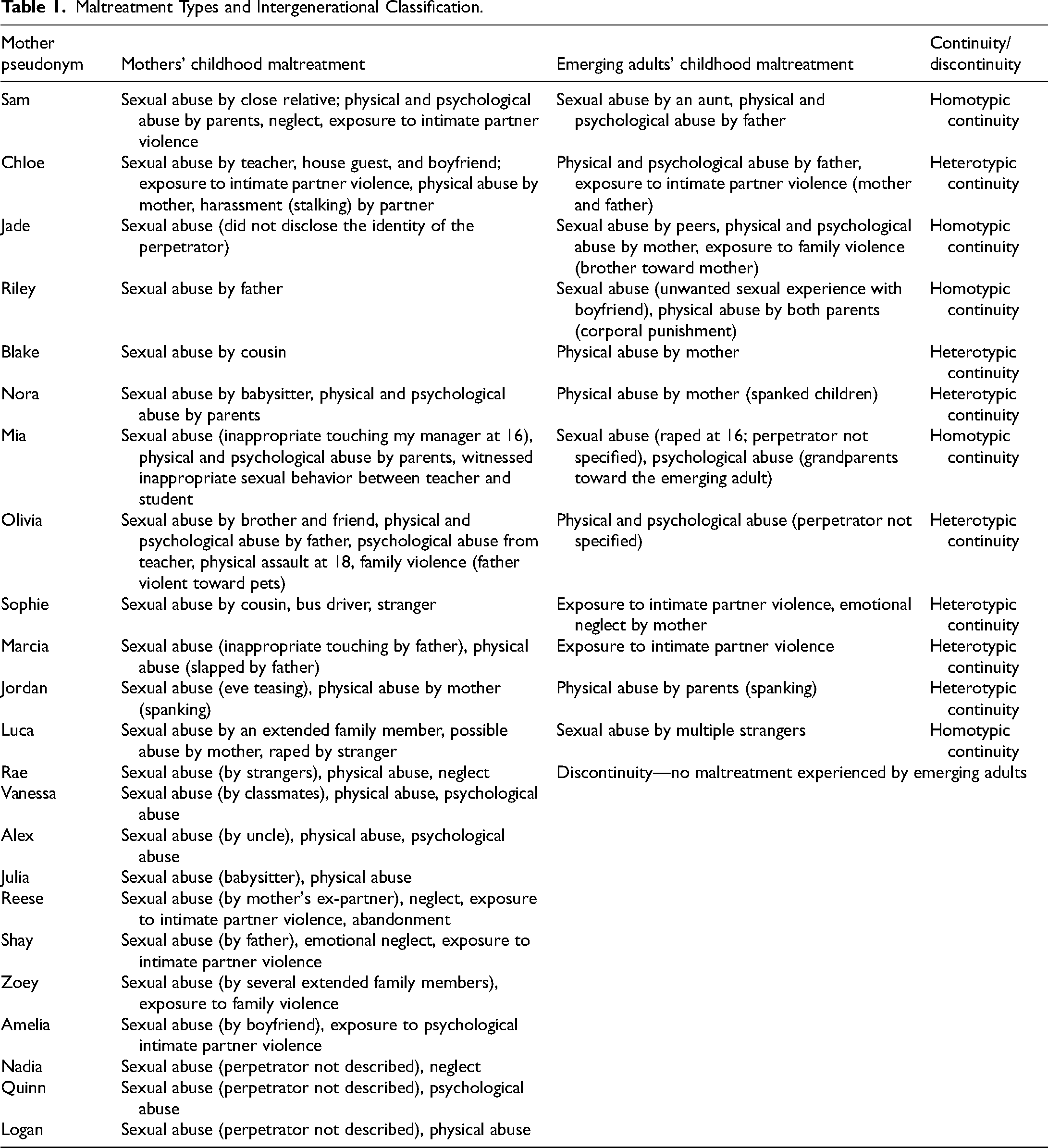
Participant selection for this study was based on a team decision that sufficient data had been collected to address the outlined research questions, as well as by consulting the literature. As the objective of the current study was to examine the intergenerational continuity of CSA, all 23 mothers who reported a history of CSA during their interviews were included in the analysis (Table 1), while the remaining 17 mothers were not included since they did not report a history of CSA. Twelve mothers who reported experiencing intergenerational continuity of abuse (regardless of type) were included in this study as the “continuity” group, which was then further divided into homotypic and heterotypic continuity types, depending on the type of maltreatment their emerging adult child experienced, according to the mothers. Eleven mothers who reported that their emerging adult child did not experience any type of abuse were included in the “discontinuity” group. Based on prior qualitative studies on CSA that used individual interviews, a group of 23 participants was deemed acceptable (Lange et al., 2020a; Mason, 2010). Each interview lasted approximately 1 to 2 hours (mean of 90 minutes), which provided a rich dataset. It was considered that information sufficiency to address the research questions was achieved (MacDonald, 2022). Participant recruitment occurred over the span of 1 year, the majority of which occurred during the COVID-19 pandemic.
Maltreatment Types and Intergenerational Classification.
Data Generation and Analysis
A semistructured interview protocol was designed through a combined effort of experts in qualitative research methodology, domestic violence, and sexual abuse. The literature on intergenerational transmission/continuity of maltreatment, and the effects of CSA on mental health, attachment, and parenting was also consulted to develop the interview protocol. Webex™ Video Conferencing software was used to record the interviews. The interviewers were all doctoral-level students in psychology or sexology programs with several years of experience working with clinical populations. They were trained on the interview protocol before beginning interviews, as well as in crisis intervention. Using a mix of open and closed-ended questions, the interview guide covered the following themes: current life, parenting and attachment (while growing up and with their own children), childhood experiences of trauma before the age of 18 (e.g., type of abuse, context, and perceived consequences; please see supplementary file for interview protocol). For example, mothers were asked: “Can you tell me about any abuse, neglect, or family violence that you experienced as a child?.” They were later asked: “Do you think the event(s) that you experienced during your childhood has/have had an impact on how you felt and behaved toward your child when they were growing up? If so, how? If not, can you explain why you think it did not have an effect?” Throughout the interviews, participants were asked to rate their level of distress on a scale from 0 to 10, and at the end of the interviews, a short debriefing took place to assess their distress. Participants were provided with a list of psychosocial resources, which was also included on the consent form. Additionally, the phone number and email address of the Principal Investigator, who is also a licensed psychologist, were provided on the consent form.
A traditional content analysis using a hybrid approach was used to analyze the data (Fereday & Muir-Cochrane, 2006; Hsieh & Shannon, 2005). This analysis involves both deductive coding (coding the interview transcripts based on the predefined coding scheme) and inductive coding (coding directly from the data to allow new codes and themes to emerge). Firstly, themes, categories, and codes were developed to summarize and classify interview extracts. A preliminary analysis using team coding took place from November 2020 to March 2022. Five graduate students, three of whom were also interviewers, classified and labeled the raw transcript data using the predetermined coding grid supported by NVivo software (QSR International Pty Ltd, 2018). The coding grid was modified by adding or deleting codes based on content from new transcripts and discussions during team meetings. Secondly, data were revisited for a process of categorization from April 2022 to August 2022, at which point codes reflecting similar concepts were grouped to form conceptual categories and subcategories. The analysis was an iterative process whereby the researchers continually revisited the codes, categories, and raw data. To address trustworthiness, the guideline provided by Guba and Lincoln (1994) was consulted and several strategies that could be feasibly integrated into the study were selected. For instance, investigator triangulation was implemented through the use of multiple researchers coding the data to establish intercoder agreement. This agreement was addressed using a codebook which the researchers used to independently code the transcripts and compare their work to determine how the codes and themes may have been applied in similar or dissimilar ways. Team meetings were held to discuss the coding process, specifically the coders’ experiences, ideas, and opinions on conducting the interviews and coding the transcripts, as well as their interpretations of the interview data and the rationale for making decisions to adjust the coding grid. An audit trail was used to track modifications to the coding grid. Pseudonyms for the participants were chosen by the researchers to maintain anonymity, and no identifying information was presented. Extracts from French interviews were translated for publication. The coding grid may be shared upon reasonable request from the corresponding author.
Results
Mothers in the current study were 48 years old on average. The majority of participants identified as White (87%, n = 20) and had obtained high levels of education, with 91% (n = 21) reporting a level of education above high school. Thirty-nine percent (n = 9) reported an annual family income of CAD$100,000 or more, and 26% (n = 6) had an income between CAD$60,000 and CAD$79,000. The remainder reported an income below CAD$60,000. In addition to experiencing CSA, 19 out of 23 mothers (eight continuity; 11 discontinuity) reported at least one other type of maltreatment, highlighting their experiences of polyvictimization. Of the 12 mothers who experienced continuity, five reported CSA homotypic continuity, as their emerging adult child had experienced CSA (Table 1). To understand how CSA may continue within families, the focus of this section is on how mothers’ experiences of CSA may have contributed to how they parented and bonded with their children as they grew up, as well as how they relate to intimate partners (see Figure 1 for features of continuity and discontinuity mothers). Both mothers who experienced continuity or discontinuity shared the desire for discontinuity and wanted to be a different parent than their own parents, as Rae expressed here: “I told my daughter that I was trying to be the mother to her that I didn’t have” (Discontinuity).
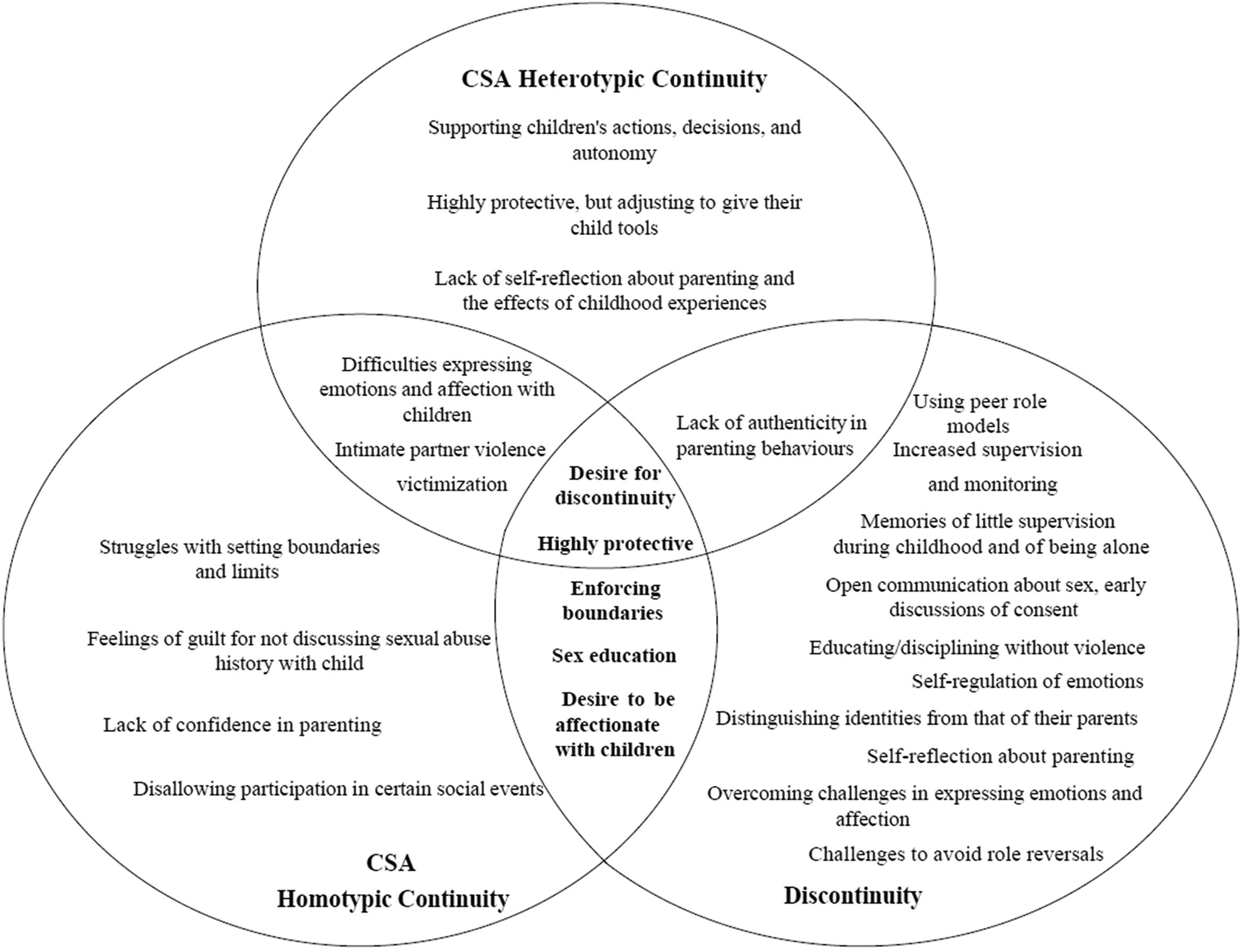
Comparison of mothers’ experiences of intergenerational maltreatment.
I think that was really what motivated me, that I had been so badly off that I wanted to make sure that I was available 100% of the time for them. I wanted to make sure that they didn’t have to go through this with me, that I could give them everything I could. (Heterotypic continuity).
Parenting Challenges Related to Experiencing CSA
Mothers’ experiences as parents with histories of CSA were shared, as well as their perceptions of how CSA may have played a role in intergenerational maltreatment. The conceptual categories comprising the parenting challenges theme are presented below.
Relational Challenges
Mothers’ Negotiation of Autonomy and Protection
When he tells me he needs to go somewhere I’m that kind of very strict mom, and for him he doesn’t always understand the reason, but in a way, it feels like I’m protecting him, it feels like he cannot take care of himself. (CSA homotypic continuity).
Well, sure, with my kids, I never let them go to sleep anywhere else. For me, that was a big no. It's like ‘your friends, you can spend the day with them, but go to sleep, we sleep at home’. I wasn’t putting them in a situation where that (sexual abuse) could happen. (CSA heterotypic continuity).
Mothers who experienced heterotypic CSA continuity, specifically Blake, Olivia, Sophie, and Jordan, also discussed efforts to support their children's decisions and actions, negotiating autonomy with a reassuring presence, encouraging their children to stand on their own two feet, as well as being protective but adjusting in order to give their child tools.
A friend of mine used to say, keep her (daughter) in a little absorbent cotton box. And maybe that's not the best way to raise a child. Maybe it's better to give them tools. So that's what I’m doing, I’m giving tools. (CSA heterotypic continuity).
I’ve always said to myself that I would never want that (sexual abuse) to happen to my children. Is that what makes me bossy? Maybe. I wanted my girls to be there. I didn’t let them go out, you know, sleep over at friends’ houses a lot. So, did that have an influence, I would say yes, probably. And I wanted to know where my daughters were at all times with whom at all times. (Discontinuity).
Along similar lines, one mother expressed that she monitored the clothes that her daughter wore to prevent her from being abused.
I would say that with my daughter, I’m very protective, because I don’t want her to be in an abusive situation where, I’m like too often commenting on how she dresses…. ‘Ah! Ah! Can you change your shorts? Your shorts are too short’. Things like that. (Discontinuity).
Although Shay and Zoey shared being protective of their children, they may have not been strict to the point of completely preventing their children from participating in social activities. Rather, they exercised caution and asked to be informed of their children's whereabouts, which appears to be a specific narrative characterizing mothers who experienced continuity.
There were really clear boundaries in terms of … well, maybe when we were together, he would come and sleep in our bed, and then everyone else, we were all together in the family bed, but when we separated, there were really limits that ‘no, your bed is your bed’. They (daughters) would tell me ‘oh, I wanted to go to sleep with daddy, then he really didn’t want to, he forced me to go to my bed’. So, it was like, okay, I see that clearly he set boundaries. To protect, probably, so there wouldn’t be any doubt. (CSA homotypic continuity).
With one of the uncles, that he was kind of sexually touching one of his nieces. So I was really careful with him because he's very friendly, very social. And so, I never left them (children) alone with him. (CSA heterotypic continuity).
Reese (discontinuity) also spoke about being careful with boundaries, specifically around bath time and not having her husband share baths with their daughter. Boundaries may be more difficult to establish for mothers who experienced continuity if they grew up in an environment where this was not enforced. Luca, who experienced CSA homotypic continuity, shared her struggles with setting boundaries and limits for her son, as this was not something she learned as a child. For instance, when she said, “I can’t offer what I didn’t have,” she described the difficulty in providing certain parenting behaviors which she did not receive.
Individual-Level Challenges as a Parent
[talking about sexual abuse] As a child, you know, you tell them to trust themselves, you teach them to listen to their intuition, that if they don’t feel right, it's important not to do something they don’t feel right. (CSA heterotypic continuity).
In contrast, Luca communicated feelings of guilt related to her son's experience of sexual abuse and blamed herself for not talking about her own CSA history.
Well, I have to say that. If it happened to my son, it's because I didn’t talk about mine (sexual abuse). I put it under the carpet all my life. (CSA homotypic continuity).
Beyond providing information related to sexual abuse, what may have supported Reese and Zoey to break the cycle of maltreatment is the open communication around healthy sexuality they reported having with their children. For instance, Reese reported a positive generational pattern of discussing contraceptives with her mother when she was a child, as well as with her daughter. One of the nuances between the narratives provided by Blake and Zoey is that Zoey explicitly mentioned having conversations about sexual consent at an early age with her children and shared her experiences of wanting to have open communication with her children.
I was definitely educating them, you know I told them from a very early age in a sense, it's your body, nobody touches it, there's no secret. (Discontinuity).
I was determined to teach my children, approach them in a teaching manner. You know, you’re there to coach, and teach, and help your kids, and promote physical and mental wellbeing. And you want to have better for them than what you had yourself. (Discontinuity).
Even if my kids were at their worst, I could not imagine taking a belt to them. I think I was very conscious of if I didn’t let my emotion escalate, and even when I did, because I’m an emotional person, I would be able to stop before. (Discontinuity).
I think we (daughter) have a good relationship, but it lacks depth, I would say. You know, I’m not able to be totally authentic with her, because I’m still … you know, I’m on my guard, not to hurt her, not to lose her. (CSA heterotypic continuity).
Although Amelia experienced maltreatment discontinuity, she struggled with a similar issue as Olivia.
She's (daughter) already told me, I’m maybe trying too hard to be better. She already told me that, what she would like is for me to be myself. (Discontinuity).
Insecurity, feeling insecure in the way I do my things, always questioning myself, is this the right thing. Maybe a little bit of insecurity too, as a parent. (CSA homotypic continuity).
On the other hand, two mothers who experienced discontinuity, namely Alex and Julia, reported positive aspects related to self-concept, specifically distinguishing their identities from those of their parents, which could have protected them against maltreatment continuity. An important point that Alex made is related to social learning—she gained confidence by looking at her friends who had children and observing how they were as parents. Therefore, she sought other positive role models of relationships that she then relied upon when she became a parent, which could have supported her in discontinuing the physical and emotional abuse that she had experienced.
I wanted my kids, I’m gonna teach them, I’m gonna play with them. Whether or not my parents play with me, that was them. But me, I’m not them, I’m another person. So my outlook on things, my positiveness, that's just who I became. (Discontinuity).
That's something I witnessed my father doing to my mother (denigrating her in front of the children). And it was part of a very unhealthy dynamic of conjugal violence. So at a certain point I took the time to think about it and to say ‘Oh, okay. I don’t like the way I’m acting’, this behavior really reminds me of how my father behaved with my mother and it wasn’t healthy. It wasn’t a good example to set for the kids either. (Discontinuity).
Quinn believed that she became more aware when she had her first child about the things she had experienced during her childhood and how she wanted to educate her children differently, stating that she “spotted the patterns.” On the other hand, when asked about parenting difficulties or concerns about reproducing certain patterns, Marcia, a mother who experienced continuity, did not engage in the same kind of reflection.
No! I didn’t have any difficulties at all at all. No, no, no, no! No, no, no! I taught my son well. I taught him the right things. I had good times with him. I talked to him, good! I raised him as best I could. In my opinion I raised him well. I’m sure I did! (CSA heterotypic continuity).
Mothers’ Perceptions of Parent–Child Relationships
The quality of parent–child relationships was explored in this study. The aim was to describe mothers’ perceptions about how they may have been impacted by their histories of CSA and to understand how these impacts might have contributed to the continuity or discontinuity of maltreatment. This theme was discussed by four mothers who experienced homotypic continuity (Jade, Riley, Luca, and Mia), three who experienced heterotypic continuity (Blake, Sophie, and Marcia), and five who experienced discontinuity (Amelia, Nadia, Reese, Shay, and Logan).
I know there were times where I was pretty checked out. I think overall I was fairly present. No, I wasn’t the best with emotions. They still sometimes make me uncomfortable. I still don’t like to be hugged, like saying I love you I have to make a concerted effort to remember to say that. (CSA homotypic continuity).
The difficulties lived by mothers who experienced intergenerational CSA point to the possibility that attachment insecurity in a parent–child relationship, and a lack of trust to be welcomed by a parent in times of difficulty or negative emotions, could have contributed to CSA continuity in these cases. Furthermore, a parent's emotional unavailability could deter a child from disclosing abuse to them, such as with Luca, who had delayed knowledge of her child's sexual abuse and was unsure if he had experienced other assaults.
In contrast, a distinguishing narrative of mothers who experienced discontinuity is that they were able to overcome challenges in expressing emotions, suggesting that this could be protective in preventing intergenerational maltreatment.
I decided to take a different path and to be there emotionally for my children, maybe too much so! I may have gone to the other extreme, but for me it was important that they felt loved at all times. I never heard ‘I love you’ as a child either. (Discontinuity).
Logan mentioned trying to give her daughter what she did not receive by communicating emotions and having a deeper relationship:
I try not to reproduce what my mother does with me, and I wrote to my daughter, I love you, while I never did that with my mother. I miss her, when I don’t have that with my mom, I write to (daughter's name), Hello, how are you? Even though it's only been two days, how are you? So I’ve deepened my relationship with (daughter's name) while I don’t have that with my mother. (Discontinuity).
Sometimes I can have very childish reactions. It's like sometimes, I don’t know, sulking or wanting to be comforted or whatever. And at that time, it's as if I would like my husband to be there more often or my children to comfort me and take care of me, all that. Before I did all that work on myself, if I hadn’t done anything, I would have found that, yeah, I would have fallen into the trap of wanting to be my children's friend. (Discontinuity).
Experiences of Intimate Partner Relationships
Both mothers who lived through continuity and discontinuity shared the desire to be affectionate with their children and to have a close bond with them but also felt attachment-related difficulties in their intimate relationships, which were perceived as playing a role in the continuity of maltreatment. For instance, the prioritization of one's own emotional needs at the expense of the child's was recognized by one mother:
I would say that it wasn’t fair that I stayed with somebody who really was not good for me. You know, and there was a bond. It was like, I felt good, you know, like, it was good between the two of us, we didn’t argue during that, but the rest of it was shit. My children saw the shit all the time, and that wasn’t fair. (CSA heterotypic continuity).
Chloe's experiences with CSA led her to seek protection from others, which resulted in another abusive relationship:
It was never exactly consensual with my kids’ dad at the start of that relationship, that was not, it didn’t start off consensual. So, I mean, I basically just gave up. (Heterotypic Continuity).
Although Mia, a mother who experienced CSA continuity, expressed feeling regret for not having ended an abusive relationship as early as she wished, she demonstrated strength for eventually leaving this relationship to discontinue her children's exposure to violence.
Discussion
The aim of this qualitative study was to better understand mothers’ experiences of intergenerational continuity of CSA and to identify how mothers with histories of CSA perceive and explain (dis)continuity. Despite maltreatment continuing in their families, the qualitative results highlight mothers’ best intentions to protect their children and prevent this cycle. All mothers who participated, whether they experienced heterotypic continuity, homotypic continuity, or discontinuity highlighted common experiences of wanting to discontinue abuse within their families, feeling highly protective of their children, working to enforce certain boundaries, providing education about sex, and a desire to be affectionate with their children. The narratives of mothers who experienced continuity underline the difficulties they faced regarding various parenting behaviors and close relationships. Polyvictimization is evident in our qualitative results, which is in line with the literature showing that experiences of more than one type of abuse are unfortunately common (Le et al., 2018). A relation between CSA and IPV victimization was reflected upon by some mothers, specifically how CSA may have contributed, from their perspective, to staying in an abusive relationship, which was then associated with feelings of guilt and regret for exposing children to violence. The themes identified in this study revolve around parenting, attachment, and intimate partner relational difficulties, all of which may play a role in the continuity or discontinuity of CSA. However, it is essential to acknowledge that these relational difficulties are the result of the perpetrators who sexually abused these mothers, who are then the ones who face the potentially life-long impacts of sexual trauma. It is crucial to identify ways of preventing CSA, which requires more efforts targeting perpetrators instead of victims. In addition to these necessary efforts, our results highlight that CSA prevention could involve clinicians supporting mothers in addressing their own unresolved traumatic experiences, and with their role as parents. The findings are in line with Marshall et al. (2022)'s theoretical model of victim-to-victim cycles of maltreatment by highlighting that mothers who experienced CSA may continue to face challenges with relationships, attachment, and parenting in ways that inadvertently play a role in CSA continuity.
In terms of parenting experiences, mothers described relational and individual-level parenting challenges, specifically related to negotiating autonomy and protection, establishing ways of educating children, their self-concept as a parent, and reflecting on themselves and their actions as parents. The results underline that regardless of the intergenerational pattern, all mothers experienced complexities related to feeling protective of their children. Mothers who experienced discontinuity noted more specifically that they engaged in monitoring and supervision of their children, rather than disallowing them to attend events. Uniquely, those who experienced discontinuity expressed confidence in their parenting and encouraging self-confidence in their children. Feeling confident as a parent might have been supportive and protective for mothers in terms of reducing the risk of maltreatment, for instance, by engaging in other positive parenting behaviors that these mothers mentioned, such as encouraging open communication and avoiding negative behaviors like physical abuse as a means to discipline. Imparting information about healthy relationships, sexuality, and sexual consent at an early age, and discouraging secrets, was also exclusively mentioned by a mother who experienced discontinuity. All mothers felt the need to set boundaries and limits for their children, though only mothers who faced maltreatment continuity shared that they had difficulty setting limits with their children, potentially because of their own upbringings or histories of CSA. This challenging experience of implementing limits could have unintentionally contributed to situations in which abuse may be more likely to occur. Exceptionally, only mothers who experienced discontinuity reported engaging in reflection about their own maltreatment experiences and parenting practices. Such awareness and reflection could have offered these mothers more choices when it came to parenting their children, leading to discontinuity of maltreatment. The findings show that all mothers reported feeling protective of their children and acknowledged the importance of enforcing certain boundaries, which may be viewed as contrasting some studies that have shown more permissive parenting practices among CSA survivors (e.g., DiLillo & Damashek, 2003; Jaffe et al., 2012; Ruscio, 2001).
The theme of parent–child and intimate partner relationship experiences highlights mothers’ desire to have close relationships with their children. Mothers with lived experiences of maltreatment continuity reported specific difficulties related to IPV victimization and inadvertently exposing their children to violence, as well as difficulties expressing emotions and affection with their children. The relational processes that may support the discontinuity of maltreatment, as they were uniquely discussed by mothers with discontinuity experiences, include overcoming challenges in emotional communication, displaying affection, and working to avoid role reversals with their children.
Among mothers who experienced continuity, it was observed that second-generation maltreatment of the emerging adult was either perpetrated by the mother (e.g., neglect and physical abuse) or by family members (e.g., exposure to IPV) (Table 1). This is in line with the conceptualization of CSA continuity that mothers with a history of CSA may experience difficulties with protecting their children from abuse, such as in the case of neglect or exposure to IPV (Berzenski et al., 2014). It is also possible, as documented in the current study, that mothers who experienced CSA face challenges with positive parenting, discipline, and self-regulation of emotions that might increase the risk of physically or emotionally abusing their children (e.g., Zvara et al., 2017). Mothers facing unresolved trauma, increased levels of stress or other mental health symptoms, as well as self-regulation difficulties, coupled with possible child behavior problems, may be more likely to respond more harshly with their children (Zvara et al., 2017).
Parent–Child Attachment and Parenting
Mothers’ experiences of their relationships with their children and intimate partners were explored in this study. Results show nuances in their experiences of attachment and parenting. Those who reported continuity described challenges with expressing emotions and affection with their children, which is consistent with insecure attachment (e.g., avoidant attachment; Powell, 2016). Mothers who experienced discontinuity shared their efforts to overcome challenges with expressing emotions, as well as trying to avoid engaging in role reversals, which is a documented theme among families in which sexual abuse has occurred (Alexander, 1992). Role reversals can also be indicative of disorganized and anxious attachment (Katz et al., 2009; Lecompte & Moss, 2014). A more secure parent–child relationship, one that is characterized by meeting the child's emotional needs, may have supported the discontinuity of CSA.
Attachment reflects procedural implicit memories of how to be in a relationship with others and is something that develops before language (Powell, 2016). Despite wanting a secure attachment with their children, many parents struggle to do so because they did not receive the responsive and consistent parenting early in life that would have given them this implicit relational knowledge of secure attachment (Lyons-Ruth, 1998; Powell, 2016). The difficulty with emotional closeness that mothers in our study described could reflect their state of mind and procedural memories of their own upbringings. For example, a child who attempts to seek comfort to meet their emotional needs from a parent who continuously rejects or redirects these attempts may eventually adopt an avoidant attachment strategy. As a parent, their responses to their children can be influenced by this unconscious procedure for avoiding rejection by similarly denying their children emotional connection (Powell, 2016). Future research is needed to explore what supports mothers in overcoming these challenges with emotions and closeness in relationships. As attachment security is associated with a host of positive outcomes for children (e.g., self-esteem, emotion regulation, problem-solving; Sroufe, 2005), it could serve as a mechanism through which maltreatment is discontinued.
In terms of parenting, the results support the literature that mothers with a history of CSA experience a wide range of difficulties as a parent (Lange et al., 2020a, 2020b). Mothers who experienced continuity especially struggled with how they see themselves as parents, with fostering the autonomy of their children, and with feeling protective and inhibiting their children's participation in certain events, likely to prevent them from experiencing CSA. We believe that individuals who have experienced abuse are highly committed to avoid replicating this cycle. Even with the best intentions, many mothers in our study still experienced intergenerational continuity. Unfortunately, the desire to do better may only guide them in what not to do with their children but does not necessarily help them with what to do to support them in their journey. In fact, knowing what not to do can result in the pendulum swinging too far in the other direction (Circle of Security International, 2020), as was seen with some mothers in our study who admitted to being highly protective or overcompensating to the extent that they felt a lack of authenticity as a parent. Mothers’ attachment styles and more specifically their state of mind (i.e., how they think, feel, and who they are in a relationship with others; Main et al., 1985) would ultimately influence how they behave with and parent their children, such as how they interpret and respond to their child's behaviors.
Intimate Partner Attachment and Victimization
The connection between maltreatment and attachment was a recurrent theme in this study and should continue to be further explored in the context of intergenerational continuity research. Seven mothers in our study reported being exposed to IPV in childhood, and four reported that their children were exposed to the same type of violence. Furthermore, mothers expressed feelings of guilt associated with not leaving a violent partner as soon as they wished. They also noted experiences related to their own attachment insecurity, such as prioritizing their romantic relationship over the emotional needs of their children and realizing that this was not fair. Thus, difficulties related to intimate partner relationships could lead to an increased risk of intergenerational continuity of maltreatment where the emerging adult child was exposed to IPV during childhood.
In adulthood, it is conceivable that mothers’ experiences of childhood maltreatment, exposure to IPV as children, and further adult IPV victimization are experienced as familiar, comfortable, and even validating in a sense (Perry & Winfrey, 2021). This normalization of violence may occur through the effect that trauma can have on negatively impacting one's expectations of others in relationships (i.e., their state of mind or internal working model). Exposure to domestic violence during childhood is associated with an increased risk of adult IPV victimization (Kimber et al., 2018). Attachment may partly explain this intergenerational cycle of witnessing domestic violence as a child and experiencing IPV victimization as an adult. Research has shown that children exposed to domestic violence are more likely to exhibit insecure attachment (Noonan & Pilkington, 2020). If support is not received to modify an insecure attachment during childhood, this insecurity in adult relationships (e.g., preoccupied attachment and attachment anxiety) may lead to an increased risk for IPV victimization (Sandberg et al., 2019) and perpetration (Spencer et al., 2021).
The qualitative results add to the literature that cycles of CSA or other maltreatment types likely continue through complex effects on attachment behaviors and parenting (Marshall et al., 2022). Prospective longitudinal or population-based studies are needed to quantitatively examine the multigenerational patterns of maltreatment within families. Future qualitative research exploring the continuity of specific maltreatment types would be an interesting contribution to the literature. Themes pertaining to IPV exposure as children and adult IPV victimization, polyvictimization, parenting, and attachment behaviors might be further explored in studies that are explicitly focused on CSA continuity. Qualitative research on parents’ help-seeking behaviors and their perceptions of recommendations to break cycles of maltreatment would be invaluable, as well as the inclusion of fathers or other caregivers (e.g., foster parents). Further research could be conducted to triangulate the qualitative narratives of both mothers and their emerging adult children.
Strengths and Limitations
Strengths of this qualitative research include the implementation of strategies to enhance the trustworthiness of the data (e.g., team coding and audit trail), as well as the researchers’ engagement in reflexivity throughout the process of data collection and analysis. A semistructured interview was collaboratively developed and discussed before beginning interviews. The analysis proceeded through an iterative process of deductive and inductive coding. A potential limitation of the qualitative design is that qualitative data generation and analysis did not occur concurrently (i.e., the interview protocol was not modified based on the analysis of new transcripts). Future concurrent data generation and analysis would allow for modification and improvement of the interview protocol for subsequent interviews.
The results are based on a predominantly White, cisgender sample of mothers with a high level of income and education. The study is limited by the use of retrospective reports of parent–child relationships. Future studies should aim to recruit diverse participants in terms of socioeconomic standing, as well as mothers of children at different developmental stages. Recruiting more diverse participants could have valuable research and clinical implications that speak to others’ lived realities (e.g., Black youth). It should be noted that the classification of continuity and discontinuity was established by relying only on mothers’ interviews, during which they reported on what they knew of concerning their child's history of CSA or other maltreatment. Not all mothers may be aware of their child's CSA experiences, therefore, some mothers may have been inaccurately classified as discontinuity.
Clinical Implications
It is pertinent for clinicians to keep in mind that by the time individuals reach adulthood, their reasons for seeking psychological services may appear unrelated to their history of CSA. PTSD is noted as a rare chief complaint, and families may not connect trauma history with current symptoms (Keeshin, 2021). Given the wide range of symptoms that can result from CSA (Bradley et al., 2019), clinicians should assess for trauma and abuse history when clients seek support and tailor interventions to meet their individual needs. Early screening represents a timely point of intervention with families that could identify those who may benefit from additional support to prevent maltreatment as well as intergenerational continuity. Although the sample of the current study is based on mothers of emerging adult children, early intervention and prevention are essential, particularly early interventions to build healthy attachments. The perinatal period is one that may reignite memories of CSA trauma (e.g., Lange et al., 2020a), therefore, working with mothers during this time could be an effective way to break the cycle of abuse. Other supportive interventions could include home-based and respite services and parent coaching. As mothers who experienced discontinuity noted working to overcome many challenges associated with parenting and attachment, interventions that foster parents’ relational functioning may be particularly impactful in terms of discontinuing a cycle of CSA. Specific targets, as highlighted by mothers who experienced discontinuity, could include communication (e.g., about sex and consent), identifying roles and boundaries to avoid role reversals, supervision and monitoring of children's activities, positive education and discipline strategies, expressing emotions and affection, caregiver emotion regulation, supporting self-reflection skills, and identifying positive peer role models. Examples of attachment-based interventions that could be helpful to support positive relationships and parenting behaviors include the Circle of Security (Hoffman et al., 2017), and the Video-feedback Intervention to promote Positive Parenting and Sensitive Discipline (Juffer et al., 2017). Providing psychosocial support and education to children within school settings could also help to prevent maltreatment. As many mothers experienced difficulties with parenting, such as with educating or disciplining their children, setting limits, communicating, and expressing emotions, additional supports offered might involve early participation in parenting classes that focus on positive parenting (e.g., Positive Discipline in Everyday Parenting; Durrant, 2016). If CSA has occurred, working with the child and caregiver together using an evidence-based intervention like trauma-focused cognitive behavioral therapy could be considered. As mothers in our study noted both psychological difficulties and trouble with expressing emotions and affection with their children, an intervention like emotionally focused therapy might help with this processing. Ultimately, supportive relationships, therapy of 6 months or longer, and supportive partners are factors that have been documented as making a difference in parents not passing on abuse to their children (Sroufe, 2005).
Conclusion
In summary, this qualitative inquiry provides valuable insight into the long-term impacts of CSA, which may impact mothers’ lives, perceptions, and behaviors in ways that contribute to contexts in which continuity of maltreatment may be more likely to occur. Mothers in this study described facing numerous challenges, as well as overcoming difficulties in their relationships. Their interviews allowed us to identify experiences and processes that characterized continuity and discontinuity dyads, which ultimately have important clinical implications for working with survivors of maltreatment and their families. Further research exploring individuals’ experiences of intergenerational continuity of CSA is needed, especially using diverse and robust methodological designs.
Supplemental Material
sj-docx-1-vaw-10.1177_10778012231216712 - Supplemental material for “I Was Trying to Be the Mother to Her That I Didn’t Have”: Mothers’ Experiences of Child Sexual Abuse and Intergenerational Maltreatment
Supplemental material, sj-docx-1-vaw-10.1177_10778012231216712 for “I Was Trying to Be the Mother to Her That I Didn’t Have”: Mothers’ Experiences of Child Sexual Abuse and Intergenerational Maltreatment by Carley Marshall, Mylène Fernet, Audrey Brassard and Rachel Langevin in Violence Against Women
Footnotes
Acknowledgements
The authors would like to express our heartfelt gratitude to those who took part in this research and shared their stories. The authors also want to express our appreciation to the members of our research lab for their contributions to this project.
Declaration of Conflicting Interests
The authors declared no potential conflicts of interest with respect to the research, authorship, and/or publication of this article.
Funding
The authors disclosed receipt of the following financial support for the research, authorship, and/or publication of this article: This research was supported by grants from the Social Sciences and Humanities Research Council of Canada and the Fonds de recherche du Québec—Société et Culture awarded to the corresponding author. The first author was supported by a Joseph-Armand Bombardier Canada Graduate Scholarship—Doctoral Award provided by the Social Sciences and Humanities Research Council of Canada; and an award offered by the Institut universitaire Jeunes en difficulté. The corresponding author is supported by a Chercheur-Boursier Junior 1 Award from the Fonds de recherche du Québec—Santé.

Supplemental Material
Supplemental material for this article is available online.
Author Biographies
References
Supplementary Material
Please find the following supplemental material available below.
For Open Access articles published under a Creative Commons License, all supplemental material carries the same license as the article it is associated with.
For non-Open Access articles published, all supplemental material carries a non-exclusive license, and permission requests for re-use of supplemental material or any part of supplemental material shall be sent directly to the copyright owner as specified in the copyright notice associated with the article.
