



Abstract
Romantic jealousy is a prominent trigger for intimate partner violence. Yet, there are few studies on this relationship in sub-Saharan Africa and none captures men's perspectives. To expand the existing knowledge on romantic jealousy and its relation to intimate partner violence, our study analyzed 30 in-depth interviews with male participants. Triggers of romantic jealousy included suspicion or confirmed infidelity, reduced attention from their partners, and challenges to male supremacy. Men reported that intimate partner violence was a frequently used response to triggers of romantic jealousy. Social norms and inequitable gender norms were key underlying factors to all those triggers.
Introduction
Romantic jealousy is a common emotion in intimate relationships (Harris, 2009). White defines it as, “a complex set of thoughts, feelings, and actions that follows a threat to self-esteem and/or threaten the existence or quality of the relationship” (White, 1981). Although romantic jealousy is present across all cultures and societies, it is highly dependent on the context in its interpretation (Buss, 2013). It can lead to the loss of self-control, especially when partners who suspect or confirm infidelity are unable to regulate their emotions and reactions (Mužinić et al., 2003). On the other hand, romantic jealousy is also often interpreted by men and women in relationships as an expression of love, and a sign that a partner cares about the other and the relationship (Boyce et al., 2016). Thus, understanding romantic jealousy can provide valuable insights into the occurrence of intimate partner violence (Foran & O’Leary, 2008).
Intimate partner violence is a critical public health and social problem, with far-reaching consequences for women's physical and emotional health and social well-being (Kapiga et al., 2017; Kyegombe et al., 2014). Globally, one-fourth of women are estimated to experience physical and/or sexual intimate partner violence in their lifetime (Devries et al., 2013), with some of the highest rates to be found in sub-Saharan African countries, ranging from 36% to 71% (Devries et al., 2013; Garcia-Moreno et al., 2006). In Tanzania, the reported prevalence of intimate partner violence ranges between 15% and 60% (Stöckl et al., 2012). In the baseline survey of the MAISHA trials conducted in Mwanza, Tanzania, 27% of women reported to have experienced physical and/or sexual intimate partner violence in the last year. Other forms of intimate partner violence reported in this study included economic (34%) and emotional intimate partner violence (39%) (Kapiga et al., 2017).
Underlying causes for intimate partner violence are best explained by the ecological framework, which describes factors associated with the perpetration of intimate partner violence at the individual, relationship, community, and societal level (Heise, 1998). The framework identifies several risk factors of intimate partner violence including romantic jealousy, economic and social policies that maintain socioeconomic inequalities, personalities, and childhood experiences of violence. In a revised version of the ecological framework, Heise included infidelity as a situational trigger of intimate partner violence at the relationship level (Heise, 2011). Despite romantic jealousy being a prominent cause of intimate partner violence operating at the relationship level, it is still barely explored especially in the sub-Saharan Africa region in intimate partner violence research and prevention (Pichon et al., 2020).
Gender Norms and Romantic Jealousy
The ecological framework integrates theories of gender norms and masculinity to understand how romantic jealousy is linked with intimate partner violence at the relational level while also elucidating how highly dependent it is on factors at the social level. To expand this framework, we focused on gender norms—social norms defining acceptable and appropriate actions for women and men in a given group or society and the roles they play in shaping relationships. Gender norms are internalized through social interaction and enforced through social mechanisms (Hyde, 2014). They can be formalized in rules and laws or exist solely in individuals’ consciousness (Cislaghi & Heise, 2020). In predominantly patriarchal societies, gender norms shape relationships and their dynamics including how men and women are treated and expect to be treated by their partners. As argued by Connell (2014) and Lazar (2005), inequitable gender norms are often reinforced in families and the larger social context and perpetuate inequitable power relations that are often disadvantageous to women. In many sub-Saharan African communities, gender norms are well embedded in the societal systems and structures. Hence, they inevitably influence decisions, beliefs, and acts at the relationship level (Howard-Merrill et al., 2022; Jewkes & Morrell, 2012).
In this article, we draw on the ecological framework to analyze how men reflect on romantic jealousy in their relationships with women and to understand the dynamics of jealousy at the relationship level. We engage the concept of gender norms to interpret the interaction of the men's perspectives with those at the community and societal levels. This study aims to address the existing gaps in the current literature on romantic jealousy in relation to intimate partner violence by focusing on the triggers for romantic jealousy and pathways to intimate partner violence, especially in relation to men's perpetration of intimate partner violence.
Methods
Study Design and Study Setting
This qualitative study was carried out in Mwanza, the second largest city in Tanzania located in the Northwestern area of the country. The main economic activities in Mwanza include fishing, subsistence farming, and cattle keeping, but also small-scale gold mining and industrial manufacturing. Sukuma is the largest ethnic group in the city, but due to its strategic location as an economic hub, it has attracted a wide range of different ethnic groups from other parts of the country. Patriarchy is common in Mwanza and other parts of Tanzania, giving men various advantages in relationships over women (Wight et al., 2005). In this context, intimate relationships are largely formed and maintained through social and gender norms—such as those requiring men to pay the bride price—and hence giving them power and authority over women (Wijsen & Tanner, 2002).
The high rates of intimate partner violence perpetrated by men in Mwanza (Kapiga et al., 2017) make this setting appropriate for exploring predictors and consequences of intimate partner violence. While the interviewers did not ask men directly about their perspectives on romantic jealousy in relation to intimate partner violence, these views emerged inductively from participants’ accounts of different forms of intimate partner violence.
Recruitment and Data Collection
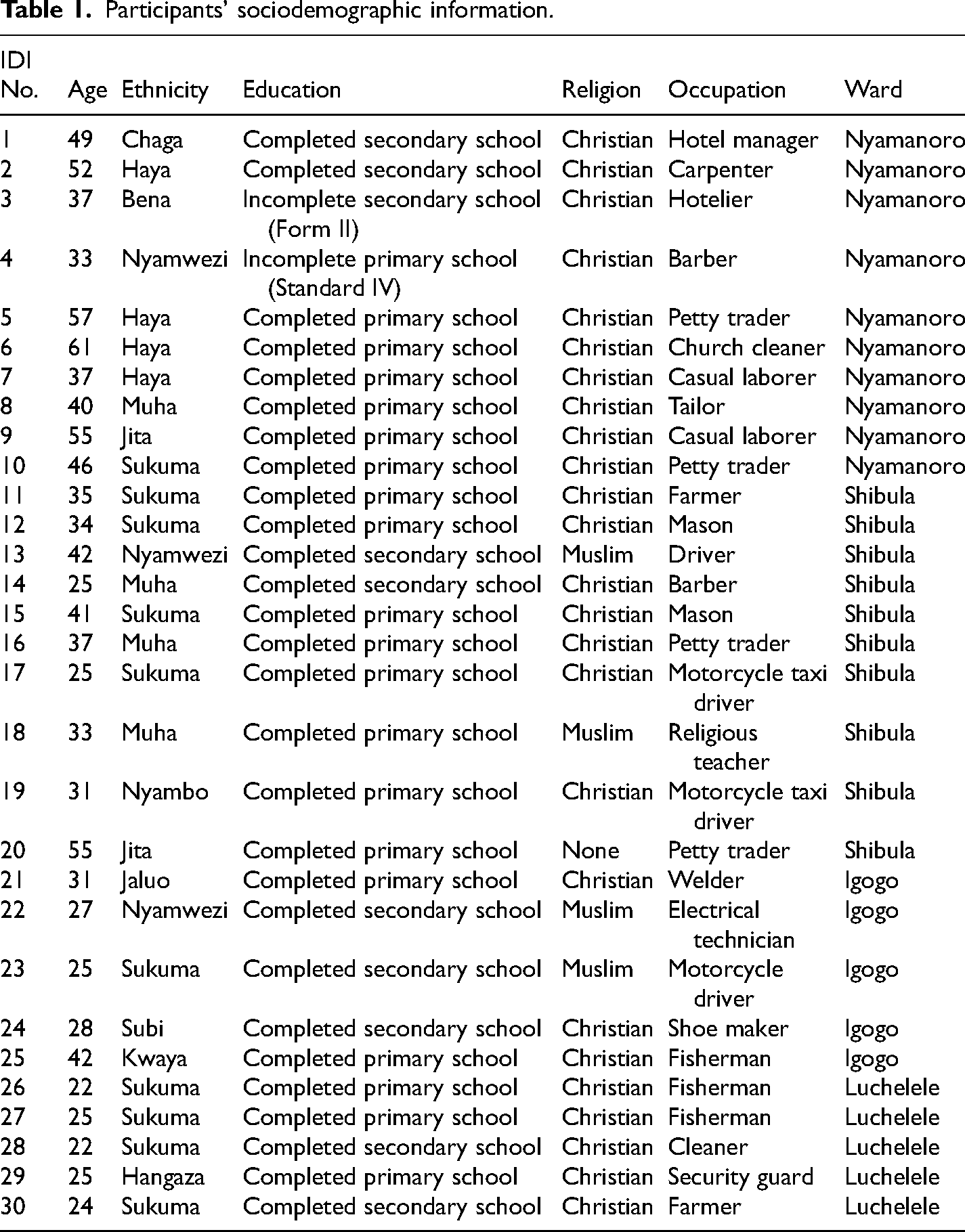
We conducted 30 in-depth interviews with purposively sampled male participants from two districts of Mwanza City between April and September 2019. To ensure diverse social and demographic representation such as age, ethnicity, religion, different levels of education, and nature of income generating activities, we selected participants from two densely and two sparsely populated streets. The street leaders assisted with the participants’ selection due to their familiarity with the majority of residents in their streets. Data were collected by a male social scientist with extensive knowledge and experience in qualitative research and intimate partner violence. The interviews were conducted in Kiswahili—the participants’ and interviewer's first language. The interviewer prepared detailed notes to capture issues and impressions that arose in each interview including participant's emotions. Any issues and impressions on data collection were discussed regularly during study team debriefing meetings. The research team reviewed the data as the interviews continued. After each 10 interviews, the team suggested to sample men with specific sociodemographic information when selecting the next round of participants to capture a wide range of viewpoints and insights. For instance, as the first 10 interviews were all with older men, younger men were included in the next 10 interviews. All participants were married and aged between 22 and 61 (Table 1). The interviewer informed the participants about the study and obtained their informed consent before the interview.
Participants’ sociodemographic information.
An open-ended interview guide was used with a range of questions including participant's demographics and upbringing, experiences of violence in their relationships, their daily lives, and social networks. Prior to the start of the interviews, the topic guide was pretested to establish clarity and participants’ interpretation and understanding of the questions. The interviews took between 1.5 and 3.5 hours and were conducted at a convenient and private location. All interviews were audio-recorded with participants’ consent and each received 8,000 Tanzanian shillings (equivalent to about 3.5USD) as reimbursement for their participation in the study. The study was granted ethics approval from the National Health Research Committee in Tanzania (NIMR/HQ/R.8a/Vol.IX/2991), the ethics committee of the London School of Hygiene and Tropical Medicine (Ref: 11918-3), and ethical approval from the Ludwig Maximilian University of Munich Medical faculty ethics board (Ref: 21-0508). The local government authorities also gave permission to work in their administrative areas.
Data Analysis
Data were analyzed in multiple stages. First, all the interview audio recordings were transcribed and translated verbatim into English. Three researchers (DA, EP, and DM) read half of the transcripts and identified commonly emerging themes. The theme of romantic jealousy emerged strongly from the data. Thereafter, four researchers (DM, EP, DA, and AD) examined the data further and sub-coded all information under the broader code of romantic jealousy using Nvivo 12 software [QSR International Pty Ltd, Melbourne, Australia]. DA went further through the romantic jealousy codes, followed by a thorough rereading of all 30 in-depth interviews to extract additional romantic jealousy-related excerpts. All authors discussed the emerging codes on romantic jealousy and their connection with intimate partner violence and conceptualized the data in an iterative process until a unanimous consensus among them was reached. Direct quotations from participants, highlighted in italics, are used to illustrate the findings, to highlight commonly held views, and to give voice to opposing viewpoints.
Results
Participants described romantic jealousy using Swahili verses such as “wivu wa mapenzi” or “wivu wa kimapenzi” which means jealousy specifically associated with love or romantic relationships. In some other cases, they used two Swahili phrases: “ana wivu” or “maswala ya wivu” meaning he is jealous or that he has issues related to jealousy. In their narratives, nearly all men spoke about romantic jealousy as a cause of intimate partner violence. Men spoke about their own experiences of romantic jealousy and they also provided observations of other men in their community. Findings are grouped into two broad categories: underlying reasons and triggers of romantic jealousy in men and consequences of romantic jealousy, especially with respect to different forms of intimate partner violence or other forms of interpersonal violence.
Triggers of Romantic Jealousy in men
The participants reported romantic jealousy in intimate relationships because of confirmed infidelity of a female partner, suspicions of infidelity, rumors, and gossips in the community about their partner's infidelity, reduced love or attention, threatened male supremacy and partner's intentional flirting with another man, and other perceived seductive acts that women used to make a male partner jealous (refer to Figure 1). Participants also framed those factors triggering romantic jealousy within the societal context of how men were expected to be treated by their female partners and societal expectations of women's behavior within an intimate relationship.
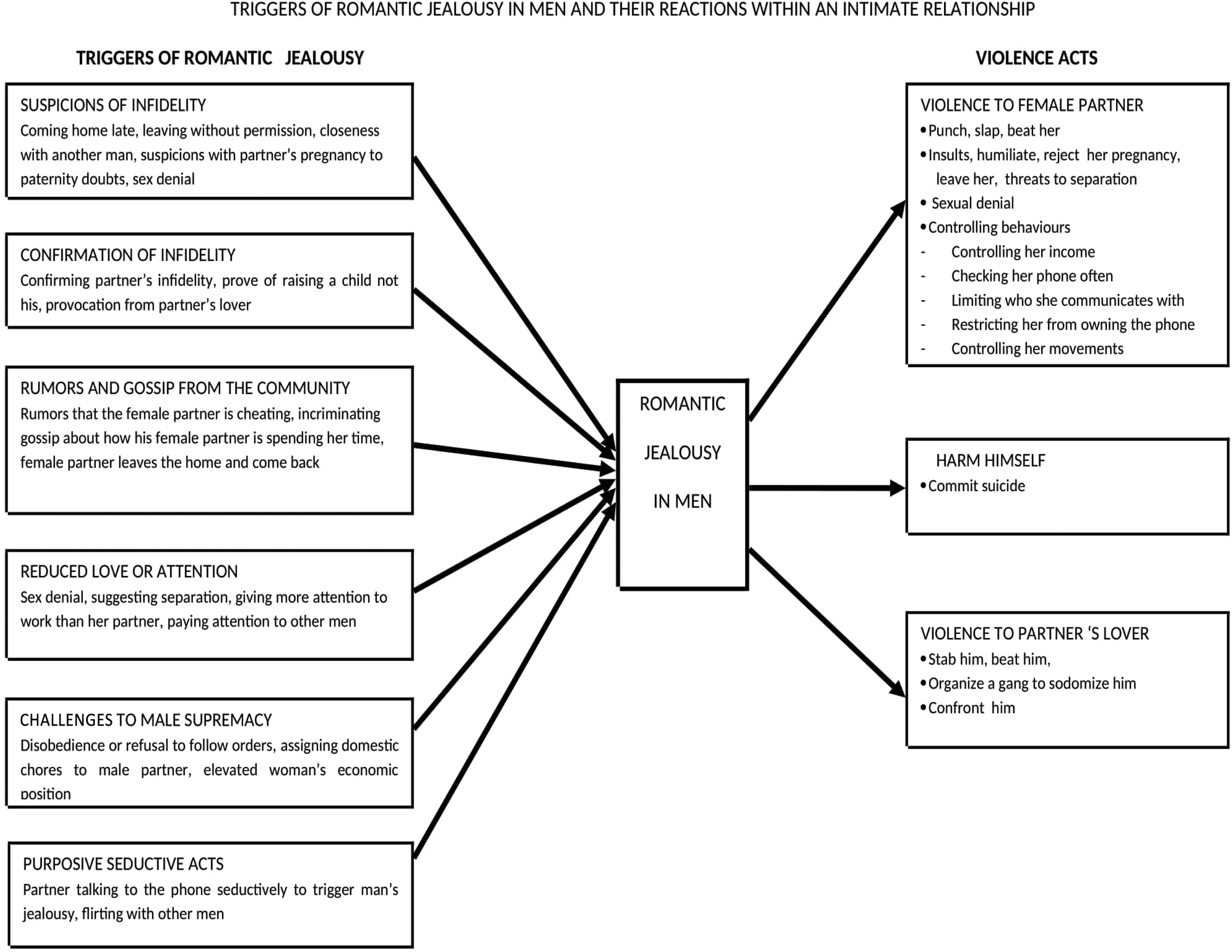
Triggers of romantic jealousy and its connections to intimate partner violence.
Suspicions of Infidelity
The participants emphasized that suspicions of infidelity were a strong trigger for romantic jealousy, often prompted by their partners’ changes in sexual and nonsexual behaviors in their relationships. These suspicions arose especially when their partner came home late or left their home without permission. The men described their anger, distrust, and alarm over these behaviors and feared that their partner could be spending extra time with another man. The participants also asserted that a woman's change in sexual behavior, such as denying their partners sex, cemented suspicions of their female partner's betrayal, suggesting that their partners probably had sex elsewhere and enjoyed spending time with other men. This was a particular issue for a few men in our sample who had doubts about their paternity, especially when the timing of their partner's pregnancy was unexpected.
Notably, many of the actions that raised suspicions in men were discussed in connection to how men normally expected their female partners to behave in their intimate relationships. For instance, with nonsexual behavioral changes, participants explained that they do not expect married women to come home late or leave home without their husband's permission. Failure to abide by this standard suggested to the interviewed men that their partners were engaged with other men, which in turn was described as unacceptable in the community. One participant explained how coming home late and leaving without permission could raise distrust in men and lead to violence.
I think the most hurtful behavior women face is that of not being trusted by their husbands. You may find someone beating his wife and hurting her or even killing her just because she came late or went somewhere without informing him. Although it is true that she must inform him first, he should not use too much energy to hurt her and rather calmly talk to her. (IDI 1, 49 years)
What I witnessed from my colleague is that despite them quarreling about a different matter; there was a time when this man had not had sex with his wife for at least three months. That led to a big fight. The man (husband) started claiming that she had another man. This made matters worse and increased their misunderstandings in their family. (IDI 02, 52 years)
Confirmation of Infidelity
The majority of participants discussed their partner's infidelity as an intolerable behavior that fueled their feelings of romantic jealousy. Yet, only a few of them had actual proof of their partners having an affair with another man. Some men reported being provoked by a partner's lover or realized that their children were the result of another partner. Confirming their partner's infidelity injured men's egos which led to anger, resentment, and ultimately violence.
Despite the majority of participants claiming that infidelity by their female partners was an ultimate act of betrayal, they minimized their own infidelity acts and discussed them as common behavior that women needed to accept. In the male narratives, women's infidelity was intolerable, and was seen as more hurtful and unacceptable in the community to men than men's infidelity would be to women. A participant narrated what extreme acts of violence a man was capable of after confirming their partner's infidelity.
Once a man hears that his woman is involved with another partner, he may end up hurting her. And with the thoughts that other people may know of his partner's infidelity he must hurt her…. He might poison her food, stab her with a sharp tool or anything that he will decide to use. (IDI 08, 40 years)
Another participant narrated how relatives informed a man of his partner's infidelity.
It reached a point that when he went to work, his woman knew exactly when his husband would come back, so the other friend of ours approached her and they started a relationship. After that, his relatives realized that his wife had an extra marital affair and told him. When her husband discovered this, it raised a big conflict. I mean what happened, you know, she was beaten. My friend, she was badly beaten. (IDI 03,37 years)
Rumors and Gossips From the Community
Notably, despite this being discussed by the majority of participants, few of them presented concrete evidence of women actually having affairs with other men. Instead, women's infidelity was established through rumors and accusations by their neighbors and friends. These rumors focused on who women hung out with, women they suspected to have an affair as well as on where and when these female partners went out and came back home in their partner's absence. These rumors and gossip either raised or cemented men's suspicions of their female partner's infidelity and were often regarded as proof of betrayal.
Participants discussed people gossiping and rumoring about people's affairs as a common occurrence in their community. They outlined different scenarios of how neighbors and friends inform men and even women of their partner's infidelity, their suspicions of their infidelity, or any other behavior changes of their partners that are regarded as a threat to their relationship or against social norms. Men seemed to care a lot about how their community regarded or spoke about their partners, and many times relied on the community's stories to judge or act upon their partners’ behaviors. Rumors could raise romantic jealousy in men even without the need of confirming or making further investigation about them. A participant narrated how he reacted after being informed about his partner's actions by a friend.
I got a phone call from a friend of mine saying that he heard that my partner was cheating around with a certain guy. He told me I should find some time after finishing my studies and go to him so that he can tell me more about it. As planned when I finished my exams, I went there…my heart was beating so fast while I was on the motorcycle from Nyakato to Bulyagh’uyu. I remember paying the motorcycle rider 2,000Tsh during that time. He (a friend) advised me that since I didn’t even bring a bag or anything, I should go and act like I want to book a room to sleep in and if I do find them in there (my heart was beating so fast), if they’re really there I should at least bring a machete to punish them. He literally gave me one. (IDI 12, 34 years)
Another participant explained how easy it was for neighbors to be aware of his partner's infidelity acts compared to the man himself.
A woman can engage with someone outside the wedlock without you knowing while your entire neighborhood [is] aware of it. In case you catch her in the act on a certain day, the neighbor might tell you, “You didn’t know about that, they have been together for long? (IDI 21, 31 years)
Reduced Love or Attention
It was reported that reduced love, care, or attention from female partners was another action that led to romantic jealousy. Behaviors such as refusing sex, suggesting separation, focusing on employment rather than her partner, and giving more attention to other men triggered emotions of romantic jealousy. The participants further emphasized the impact of disrespectful behaviors and actions that were not socially expected from women toward their partners. The men associated love with constant respect and obedience, implying that women should let men dominate and provide them with what was socially regarded as their right, that is sex. While not all men immediately associated their wives denying them sex with infidelity, they still viewed it as uncaring and disrespectful behavior from their partners as they otherwise would attend to their sexual urgency.
Yes, a woman can be beaten simply because of denying sex to her husband, but when you ask him, he will not tell you that she denied him sex. He will rather tell you that she was arrogant or disrespectful. (IDI 06, 61 years)
Challenges to Male Supremacy
Female partner's behaviors that challenged or threatened male supremacy in a family or relationship were other factors described to trigger romantic jealousy in men. Men felt emasculated when their partners failed to follow their orders or assigned them tasks or domestic chores. These actions threatened a man's position as the head of the family and raised insecurities in their traditional masculine role. These included failures to follow partner's orders or assigning tasks or domestic chores to male partners. These feelings of romantic jealousy heightened when a woman became financially independent or earned more than them. This was especially the case when women had good entrepreneurial skills and business growth, which men argued often led to changes in women's behaviors. These changes included women focusing more on their work, neglecting them, coming home late, giving women confidence to talk, argue, and confront their partners. The changed power relations through women's higher earnings made it harder for men to maintain their hegemony in the relationship and elicited the need to re-establish the status quo through violence.
Men also explained that women not fulfilling their expected roles in the relationship were interpreted as disrespectful, hurting men's feelings, and leading to jealousy:
First of all, [it hurts] when they are discourteous. It may happen that a man has left her some works to do and she doesn’t do it. When this happens, a man must feel hurt and after he feels hurt, fighting will follow. This may be the case, when he tells his wife to wash his clothes but comes back from the office tired and finds that she hasn’t washed them. Women like her might not even welcome him home warmly, not even by preparing him water for bath. This leads into problems. (IDI 28, 22 years)
Jealousy would also arise if women dared to assign domestic tasks or chores to them, tasks that were socially expected to be done by women themselves. Asking for support from their male partners was perceived as neglecting their own responsibilities. The participant explained
There are such things, you see? And sometimes it is not even about sex. You may find your wife treating you like a slave or ordering you around in your own family. You find her asking you to cook while she is there wandering around in the streets or even go to drink alcohol and leave you looking after the kids and cooking, as if her timetable says it is supposed to be your turn. That is so disturbing and it feels like a man is living opposite to the expected marriage life. (IDI 28, 22 years)
Deliberate Acts to Make Partners Jealous
Men also described that their partners would purposively provoke them to make them jealous by behaving inappropriately with other men in the community by acting seductively when they were approaching other men or flirting with other men in the street or on the phone. The motives men assumed women had for acting this way was to verify whether their partners loved them and were worried and cared about losing them to other men. Men argued that their partners would also spend a long time at a friend's place and intentionally come home late just to see whether they could provoke them and make them jealous. A participant described how a woman could act flirtatiously while talking on the phone just to catch her husband's attention and make him jealous.
A woman could be acting like she is talking to someone through the phone, you see! She could pretend like she is talking to a man just to hurt her husband, you see? “Yes I‘ll come” while being aware that her husband is listening but she will be talking like that to make him listen and get hurt. You see, “Don’t worry my dear, I’ll be coming. Eeeh, there is nothing like that, I am all yours.” When the husband hears that he must get hurt. He will feel that he is not the only one. He must get hurt. (IDI 04, 33 years)
Romantic Jealousy as a Trigger for Different Forms of Violence
Men reacted differently to romantic jealousy. While some men discussed the situation with their partners to clarify and settle conflicts, the majority reported reacting with physical, emotional, sexual, or economic violence toward their partner, their partner's lover, and in rare cases, against themselves.
Intimate Partner Violence as a Consequence of Romantic Jealousy
Participants depicted romantic jealousy as a core reason for them to humiliate or act violently toward their female partners. While not all men acted in the same way, similar patterns emerged, with emotional abuse toward their female partners being the most common consequence of romantic jealousy. As a result of romantic jealousy, some men reacted by insulting their partners, humiliating them in public, threatening them with separation, leaving them, or marrying another wife. Romantic jealousy was also the justification men gave for controlling their partners, especially when they sensed a threat to their relationship and wanted to dominate their partner. Such behaviors included controlling their partner's income, restricting them from working, making final decisions on their partner's money, controlling their partner's movements as well as controlling their partner's communication through checking their phones, restricting their phone ownership, and limiting who they communicated with.
You know these women get so confused with money. They become so arrogant when they earn a little money of their own. She will start seeing you as useless, thinking that she is the smartest, and things like those. This is why a lot of men like controlling their wife’s income, just to protect their marriages. (IDI 02, 52 years)
Physical violence was described as another common consequence of jealousy from men to women, especially when jealousy emerged out of the suspicion of infidelity, reduced love or attention, and threatened male supremacy. Acts of physical violence included punching, slapping, and beating, often combined with humiliating acts for the woman.
There is a guy who caught his wife having sex here in our street … He made his wife walk around the street completely naked after he had canned her… There wasn’t anyone to resolve their matter because that man was making her walk around while he held a machete and a stick. You see! (IDI 25, 42 years)
Sexual violence toward women was rarely discussed by participants as a reaction to jealousy and if so, it was in the form of them denying sex to their partners. This was different though when women denied them sex. A participant explained.
The last time I hit her to a point where she had to be admitted…She denied me of sex. I slapped her, she fainted, and they had to take her to the hospital. (IDI 12,34 years)
Violence Toward Their Partner's Lover as a Result of Romantic Jealousy
A considerable number of participants described violence toward their partner's lover as a consequence of romantic jealousy, especially after proving their partner's infidelity or being provoked by their partner's lover. This included confronting their partner's lover to leave their partner alone and men attacking their partner's lovers physically, for example, stabbing them with a sharp object or beating them. In one serious case, a participant narrated the story of one man who organized a gang to sodomize his partner's lover in retaliation for sleeping with his wife.
He caught his wife and that driver red-handed and told the driver that he was free to go and told him to remember that what he was doing wasn’t right… After a few days … the husband hired street thugs to (sexually) sodomize that driver. He was admitted to hospital after that incidence. He got psychologically affected. His brain never worked well after that, so his relatives took him to Kigoma region. That is the kind of a man to man violence that I have witnessed. (IDI 23,25 years)
Self-Harm as a Consequence of Romantic Jealousy
In rare cases, participants described men in their communities to hurt or harm themselves due to jealousy, which included grieving alone in sorrow and sometimes committing suicide. In these cases, the men had proof of their partner's infidelity but did not confront their partners or their partner's lovers.
Romantic Jealousy in the Pre- and Post-Relationship Phase
In addition to romantic jealousy within intimate relationships, participants inductively also discussed jealousy in the pre- and post-relationship period. In the pre-relationship period, participants described feeling jealous when they pursued a woman and found themselves in rivalry with another man who seemed to have an equal or even higher chance of winning the woman over them. The rivalry itself or rejection from the woman he was pursuing would also trigger jealousy in the man, especially in young men. In these cases, men demonstrated their jealousy by beating, stalking, and threatening the woman who rejected them or assaulted other pursuers, which in extreme cases resulted in stabbing. This was commonly discussed to occur among young men. Jealousy in men during the post-relationship period only occurred in rare cases, resulting in severe consequences. Men would feel jealous when their ex-partners started a new relationship, resulting in them insulting, beating, or stalking their ex-partner, especially when they had children together.
Men beat them [ex-partner]. For instance, for many of them the reason is always this one related to love affairs. You may find out that someone had a child with a certain man but later moves on to a relationship with another man. The one she had a child with, starts stalking her until he will catch her with another man and starts beating her. He might even beat her right there at the centre. Those are the things that I normally witness. (IDI 14, 25 years)
In extreme cases, men might also kill their ex-partner's new male partners out of jealousy.
I witnessed a person who killed his fellow because he was jealous. He was left by a woman then his fellow approached his woman, and she accepted. When the ex-boyfriend heard about it, he got angry, went and stab that other guy. The guy died on the spot. (IDI 22, 27 years)
Discussion
Romantic jealousy emerged as a key element in understanding the causes of men's perpetration of intimate partner violence in their relationships as well as other types of violence. Common causes for romantic jealousy in men in this study included suspicions of infidelity as well as actual evidence of it, rumors and gossip in the community about their partners, reduced love or attention, threatened male supremacy, and partners deliberately flirting with other men to make them jealous.
Like in many other sub-Saharan countries, in Mwanza relationships are framed along different gender norms and roles for men and women. In communities still subscribing to patriarchal ideals, men exercise more power and may resort to violence to enforce their authority (Howard-Merrill et al., 2022; Manji, 2018). In such settings, gender norms prescribe that women should acquiesce to her male partner's sex urges with the only exception being that they are sick or having their menstrual periods (Mchome et al., 2020). Also, women are expected to be faithful to their partners while it is the norm for men to have multiple sexual relationships. All these combined with the provision and care-taking roles that define men as the main providers and women caretakers of their family increase power to men and leave women submissive to them (Vyas et al., 2015). Failure to abide by these norms and expectations signals problems in marital relationships. Sometimes this leads community members to gossip about the relationship and most of the time pin the blame on women.
Social norms, specifically inequitable gender norms and norms of masculinity influenced men's expectations of how they believe they should be treated and how they expect women to act in relationships as was highlighted in Connell's theory of hegemonic masculinities (Connell & Messerschmitt, 2005). Nonconforming to these gender norms was a dominant cause to raised romantic jealousy in men. Men in this study believed that women who act contrary to these norms set a signal that there is a threat in their relationships, which in turn activated their feelings of jealousy. Men's aggressive behaviors resulting from these feelings of jealousy either aimed at disciplining or punishing their female partners and ultimately reinstating their dominance by forcing them to comply with the gendered expectations dictated by traditional gender roles, resulted in intimate partner violence.
These findings correspond to those of a recent systematic review on infidelity, romantic jealousy, and intimate partner violence where gender norms of male dominance maintained by patriarchal culture were highlighted as an underlying connection between romantic jealousy and intimate partner violence (Pichon et al., 2020). As observed in other studies, our findings showed that romantic jealousy is a complex emotion that is influenced by different factors linked to the sociocultural environment, such as gender norms (Martínez-León et al., 2017). Gender norms that dictate what is appropriate or expected behavior for males and females in the society are aligned with hegemonic masculinity, which in turn informs independent actions (Cislaghi & Heise, 2018).
As described in our results, community rumors about female partner's infidelity triggered romantic jealousy in men as well as shape and affect their attitudes and reaction over those of their partners regardless of whether they had proven their partner's infidelity or not. This portrays how expectations and conversations in the community can affect relationships and how the community internalizes hegemonic norms and exerts control over women's behaviors. Interventions on improving partner communication and relationships should include a topic about how couples handle rumors about their relationship. Understanding gender norms that lay a big influence on people’s beliefs and actions in different circumstances and altering the inequitable ones is crucial when dealing with violence against women. Examples of inequitable norms include those of accepting men's entitlement to multiple partners, men maintaining control over their female partners, expectance of women's submissiveness to their partners, acceptance of men's entitlement to sex, and increased power to take decisions in the household (Pulerwitz et al., 2006) as well as the expectation that men are the main economic providers in the household (Howard-Merrill et al., 2022). The findings of this study highlight that romantic jealousy that leads to intimate partner violence operates at all levels of the ecological framework, as romantic jealousy is highly influenced by social norms and other social-cultural factors operating at the community and societal level, but also by personal and relationship factors.
We acknowledge that a woman's attempt to leave a relationship has been identified in the literature as one of the major triggers for romantic jealousy in men that escalates into violence and can even lead to femicide (Campbell, 1992; Dobash et al., 2007; Wilson & Daly, 1998). In our analysis, this did not emerge strongly. This may be due to the fact that leaving their relationships is not a common option for most women in the Tanzanian context. In our study, very few men (3) reported their female partners threatening to leave the relationship. In the study setting, women's poor ability to leave abusive relationships can be explained by social constraints imposed through gender norms such as those that define women's roles in families as caretakers of their children and as the ones responsible for keeping their marriages and family together (Manji, 2018). Failure to that leads to blame from the community. In addition, Tanzania is largely a patriarchal society with children belonging to their fathers (and taking surnames from their father's clan). Hence in this context women may stay in abusive relationships believing that by doing so they are protecting their children and family—even at the expense of their own wellbeing and health.
In our findings, we also established a connection between romantic jealousy in men, violence perpetration, and their female partner's increased economic status. In their narratives, men associated their partners’ increased economic status with disobedience, coming home late, neglecting domestic responsibilities, and reduced care or attention to their partners. They suspected them to engage in extramarital affairs because of meeting different men. This in turn led to men becoming controlling or emotionally violent over their partners. In their systematic review, Pichon et al. argued that physical violence resulting from romantic jealousy functions as a mechanism to reassert male control and authority (Pichon et al., 2020). This association can be explained by a growing shift of norms that are giving emphasis on women empowerment strategies resulting in increased social and economic opportunities for women.
The multitude of women's economic empowerment initiatives implemented in the context of international development has allowed women to participate in financial decision making, occupy positions with many responsibilities and have better access to credit, land, and other properties (Cherry & Hategekimana, 2013). Women in Tanzania and other sub-Saharan African countries are gaining higher levels of education and economic opportunities, straying from traditional social and gender constraints. Studies have demonstrated that Tanzanian women who engage in microfinance programs have stronger control over savings and income generated from the business, greater role in decision-making, greater self-efficacy and self-esteem, and greater freedom of mobility and increased activities outside home (Mushumbusi & Jan, 2013). These gender shifts appear disadvantageous to men especially those in sub-Saharan countries who historically have been in the dominant position over women. Hence, the threat imposed by women's empowerment on hegemonic masculinities helps us in understanding men's negative attitude over women's risen social and economic position and why it escalates jealousy in them and leads to violence perpetration against their female partners.
This article contributes to the global knowledge of men's romantic jealousy and subsequent perpetration of intimate partner violence. The majority of studies on the topic are from America and Europe (Bevan, 2013; Pichon et al., 2020) with a lack of evidence from sub-Saharan Africa. Furthermore, only a few have explored insights from men. To the best of our knowledge, this is the first study in sub-Saharan Africa to extensively explore the triggers for romantic jealousy in men and how it leads to intimate partner violence against women.
This study has some limitations. Whereas jealousy was a topic that emerged inductively from the interviews, the study was not designed to focus on exploring romantic jealousy in men but focused on experiences and perpetration of intimate partner violence in their own relationships and in their communities. A stronger focus of the initial study on romantic jealousy would have allowed for a deeper exploration of the topic. In addition, these findings are applicable in Mwanza and other similar contexts. To ensure depth and representation of the different views from a wide range of social groups of men in the city, we sampled our participants from a variety of ethnic groups, age groups, and occupations. Yet, our study confirms triggers established in other studies of romantic jealousy in men and its association with violence against women elsewhere across the globe (Dobash et al., 2007; Pichon et al., 2020; Wilson & Daly, 1998).
Conclusion
In addition to addressing gaps in current knowledge, the findings of this study elaborate on the manifestations and consequences of romantic jealousy in men, especially the role of social norms and threats to male supremacy that shift the power equilibrium from men to women. Capturing the pathways of how romantic jealousy escalates into intimate partner violence against women will help to inform relevant gender-transformative interventions (Pederson et al., 2015) that increasingly consider social contexts in understanding social norms, men's controlling attitudes, and the underlying norms and power dynamics that shape them to deal with romantic jealousy in intimate partner prevention. Future studies should consider exploring romantic jealousy from couples of various cultural backgrounds to get a clear picture of the triggers of romantic jealousy in both men and women.
Footnotes
Declaration of Conflicting Interests
The author(s) declared no potential conflicts of interest with respect to the research, authorship, and/or publication of this article.
Funding
The author(s) disclosed receipt of the following financial support for the research, authorship, and/or publication of this article: This work was supported by the H2020 European Research Council (grant number 716458).
