




Abstract
The current study explores the personal stories of young women on their own experiences with adolescent dating violence and focuses on their perceptions of the relevant factors that maintained the relationship over time. To this end, we analyzed seven publicly available videos on YouTube of women explaining their experiences of adolescent dating violence, including how they perceived their relationships to be maintained over time. We identified four major sources these survivors perceived as contributing to the maintenance of adolescent dating violence: the Self, the Partner, the Relational Dynamic, and Other People.
Keywords
Intimate partner abuse (IPA) is marked by coercive and/or controlling behavior used to gain power and control over romantic partners, including physical, emotional, verbal, sexual, social, psychological, and financial harm (Walker & Gavin, 2011) and digital data abuse (Reed et al., 2017). Internationally, it is estimated that one in three women will experience IPA during her lifetime (Papadakaki et al., 2009). For many women, IPA begins in adolescence with prevalence rates of adolescent dating violence (ADV) 1 being estimated at 20% for physical violence and 9% for sexual violence (Wincentak et al., 2017). In the United States, 60% of adolescents aged 12–18 reported psychological abuse during a dating experience, and rates of victimization are estimated to be three times higher for teen girls than boys on all forms of ADV (Hébert et al., 2017). As with adult survivors, ADV places survivors at risk for negative outcomes, such as high-risk behavior (Roberts et al., 2003), lower academic achievement, and job and housing concerns (Adams et al., 2013).
Similar to adult survivors, adolescents who experience ADV are often revictimized, either within the same relationship or with subsequent romantic partners (Exner-Cortens et al., 2017). Adolescents in abusive relationships often stay in the relationship or will return after leaving their partner (e.g., Cui et al., 2013; Toscano, 2014), where some adolescents describe remembering better times and continued care and concern for their partners as reasons for staying (Toscano, 2014). The process of leaving the abusive relationship is often embedded with reluctance for adolescents, with multiple breakups before the final split (Toscano, 2014). ADV has been significantly associated with both perpetration and victimization in romantic relationships in young adulthood (Cui et al., 2013). Social learning theories provide some evidence for predictive factors of ADV among adolescents. The intergenerational transmission of violence (IGT) hypothesis posits that children who are exposed to violence are more likely to carry violence into their future relationships (Makin-Byrd et al., 2013). Furthermore, the Theory of Female Adolescents’ Safety as determined by the Dynamics of the Circle (TFASDC; Toscano, 2007) identifies additional predictive factors, including beginning and/or ending a relationship, dating an older boy, especially an adult, and being distant from or lacking a peer group. Yet, there appears to be a dearth of research on why adolescent girls stay in these relationships and/or return to these relationships repeatedly.
Related to adult women, Barnett (2000, 2001) suggests that external and internal inhibiting factors are central to decisions regarding relationship maintenance. External inhibiting factors refer to broader societal factors that influence women's decision to leave, such as the patriarchy (e.g., societal beliefs that normalize men's use of violence, gender roles that encourage women's compliance), economics (e.g., financial dependence on their partner due to the gender pay gap, lack of child support payments), the criminal justice system (e.g., fear of losing custody, fear of their safety if they report their partner's abuse), and inadequate social support from workplaces and community agencies (e.g., lack of specific IPA training). Internal inhibitory factors consist of beliefs about self and situation (Cravens et al., 2015), including the process and effects of socialization (e.g., gender role beliefs, dysfunctional thought patterns about their role in the abuse), survivor traits (e.g., depression, low self-esteem), and psychological and victimization events (e.g., fear, post-traumatic stress disorder, minimization, prior victimization, and learning variables; Barnett, 2001). Walker’s Cycle of Abuse (1979) consists of three phases. In phase 1, tension building, tension builds within the perpetrator until it reaches a breaking point. In phase 2, acute battering, the perpetrator strikes out at their partner with physical violence, which moves into phase 3, the honeymoon phase, where the perpetrator is shameful about the abuse, apologizes to their partner, often with a gift, and promises it will never happen again (Davhana-Maselesele, 2017). This cyclical nature of IPA can increase the woman's dependency and diminish her resolve to leave. It is unclear if these theories can be applied to ADV, as it occurs at a transitional developmental stage and teens are experiencing some of their first romantic relationships.
For adult women, the most notable internal empowering factor to leave an abusive relationship is a cognitive shift, often triggered by a significant event in the relationship such as a severe incident of violence. This event often leads the individual to reevaluate the relationship and acknowledge the deleterious nature of the abuse (Short et al., 2000). External empowering factors include material resources (e.g., employment and income), systems of support (Anderson & Saunders, 2003), and the motivation to protect themselves and their children (Barnett, 2001). Interestingly, adolescents who decided to leave an abusive relationship did so because of factors outside of violence (e.g., infidelity), citing abuse as forgivable while infidelity was unacceptable and crossed the line (Toscano, 2014). Previous work on relationship maintenance and abuse has focused on adult women, while much less is known about the maintenance of ADV relationships or if IPA theory can be applied to ADV. To address these limitations, we analyzed first-person, naturally occurring (i.e., unsolicited by researchers) stories of young women discussing their own experiences with ADV, focusing on their perceptions of what maintained that relationship over time.
Obtaining Information Online, YouTube, and “Storytime”
The use of the Internet to find information about health, human services, and support is widespread (Diaz et al., 2002) and significantly higher among those with stigmatized conditions (Berger et al., 2005). Based on this information and the stigmatized nature of IPA (Overstreet & Quinn, 2013), we can hypothesize that there is a high likelihood that adolescent and adult women who have experienced ADV and IPA, respectively, are using the Internet as a source of information about abuse. Thus, online sources of information are an important area for research examining what messages on ADV are available online. Previous research indicates adolescents are savvy when researching health information online (Ghaddar et al., 2011) and the Internet is an important source of such information given their lack of autonomy to access traditional health services, the confidentiality of online searches, and the amount of information available online (Gray et al., 2005). Notably, 95% of American teens have access to an Internet-enabled Smartphone, and 45% of adolescents reporting being online almost constantly (PEW Research Center, 2018). In Gray et al. (2005) survey of US and UK teens, most identified the Internet as their primary source of health information. Research on online sources of information about IPA focuses on the content and effectiveness of this information (Westbrook, 2007), understanding the victimization of women via technology (Brown et al., 2018), digital security, safety for survivors, and prevention of IPA via technology (Westbrook, 2012). Other researchers suggest that those who experience IPA may benefit from social support via online forums, such as bulletin boards (Westbrook, 2007), as women report hearing others’ stories of IPA is a helpful experience for healing (Sullivan, 2012). Yet, to our knowledge, no study has explored survivors’ first-person, online stories about the maintenance of their ADV relationships.
Much of the modern Internet-user's time is spent not reading static websites but on social media platforms, consuming, sharing, and commenting on content created by other users. Worldwide, there are 3.48 billion active social media users (out of 4.39 billion total Internet users), and social media platforms have reached 45% of the population globally (Chaffey, 2020). In the current study, we focus on experiences of ADV shared on YouTube using a video style that provides the sense of an intimate, personal conversation (i.e., “Storytime”). As mentioned, adolescents report seeking health information online and 85% of adolescents use YouTube, with 32% of them reporting YouTube as their most frequently used social media platform (PEW Research Center, 2018).
Little research has examined the use of social media as a platform to share experiences of ADV (or IPA). Recently, researchers conducted content analyses of Twitter hashtag use about IPA (e.g., #maybehedoesnthityou; McCauley et al., 2018; #metoo; Bogen et al., 2021; #metoomen; Hawkins et al., 2019; #notokay; Bogen et al., 2018). While informative, this research analyzed overall themes in social media posts rather than the use of personal story as a means to discuss how abusive relationships were maintained, with the exception of Cravens et al.'s research analyzing Twitter posts using the #whyIstayed and #whyIleft hashtags (2015). Further, this work has not specifically examined ADV.
In the current study, we examined the use of YouTube's “Storytime” to share first-person stories of female survivors’ experiences of ADV. YouTube is a social media website where users can create personal channels, upload videos, and share and comment on others’ videos. Uploaders can set videos as private, to be shared only with those the uploader chooses, or public, where it is implied the viewer intends for the video to be watched, gather views, and/or shared by the public (Germain et al., 2017). This platform enables popular culture and the everyday to be produced, presented, and archived (Burgess & Green, 2009). YouTube.com is the second most visited website in the world (Richter & Armstrong, 2019)—this wide reach, accessibility, and potential for active participation allow this website to cause and reflect cultural change (Jenkins et al., 2009). Jenkins et al. (2009) call this “participatory culture,” where individuals feel: (a) what they are sharing has value; (b) they are creating social connections with others; and (c) someone cares about what they shared.
YouTube offers a platform for users to be vulnerable and reach a level of intimacy that can be difficult in an offline space. Users can share personal moments and provide regular updates on their physical and psychological well-being, creating a sense of connection with the viewer (e.g., Lange, 2009). Using online data for qualitative research is valuable because it affords researchers the ability to collect data about topics that can be challenging to access through other means (Germain et al., 2017). In this study, YouTube allowed us to examine first-person stories of women's experiences of ADV and how/why their relationships continued. YouTube's “Storytime” is a user-developed video type marked by several defining features. Frequently, Storytime videos use the word in the title or use the hashtag #storytime. Storytime videos are monologues about a specific event in someone's life and can range in emotional tone from funny to serious. In general, Storytime videos have the YouTuber sitting in a room in their home (often a bedroom) talking directly to the camera as if having a one-on-one conversation with the viewer (Brown, 2017). Storytime videos often include personal information and, unlike videos of influencers (i.e., known YouTubers who provide recommendations and generate income) and vloggers (i.e., YouTubers who video journal their daily lives), have low production values. The Storytime style creates a unique, intimate experience with the viewer. To our knowledge, no other research on YouTube's Storytime format exists, including research on ADV.
Method
Data Sources and Analysis
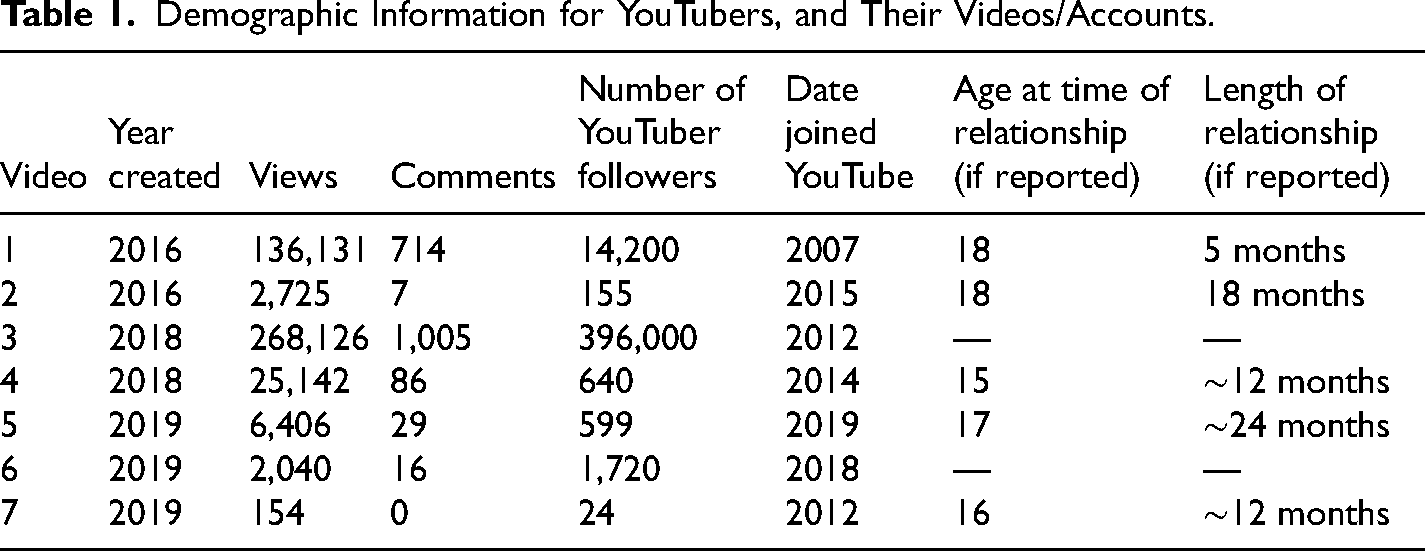
Seven YouTube videos depicting the user's experience with ADV were chosen for this study. All videos used the Storytime format and were located using key terms including “domestic violence,” “domestic abuse,” “intimate partner violence,” “intimate partner abuse,” and “storytime.” We also reviewed videos recommended by YouTube based on our searches for our inclusion criteria (i.e., topic and use of Storytime format). Each video was created by a female YouTuber speaking about her ADV relationship with a male partner. On average, videos were 16.62 min long (SD = 5.50) and were uploaded between 2016 and 2019. Table 1 provides further information about the videos and available demographic information about the YouTubers and their content. 2 YouTubers’ age at the time of abuse ranged from 15 to 18 and relationships lasted from 5 to 24 months. Three of these women were either pregnant with the perpetrator's child at the time of the abuse or mothering an infant.
Demographic Information for YouTubers, and Their Videos/Accounts.
We chose thematic analysis to analyze the data (Braun & Clarke, 2006). Initial drafts of transcripts were created using the YouTube transcript feature, with transcripts for each video being copied and pasted into Word documents to conduct quality control checks. We used theory-driven initial coding, focusing on data relevant to our research question, and a semantic approach to honor women's personal stories without incorporating our own interpretations. Themes were created from codes and sorted into an initial thematic map. Then, themes were defined, refined, and altered using a comparison of codes within and between themes (Braun & Clarke, 2006).
Results
Overall, YouTubers’ Storytime discussions focused on interpersonal constructs. That is, YouTubers discussed who (and then how) they perceived as responsible for ADV. Four “people” were held responsible for the maintenance of the relationship, varying in their degree of responsibility: the self, the partner, their relational dynamic, and other people within the social network of the couple.
Role of the Self
YouTubers described themselves as having contributed to the ongoing relationship. However, this theme was not about blaming themselves for the violence, but managing the balance between describing the role they felt they played and holding the perpetrator responsible. As one YouTuber noted, “you know, that's why I wanted to share my story with you guys, you know? I went back so many times, you guys. I know there's so many women out there like that, that just keep going back … There is no reason for any man to ever put a woman down, to ever put his hands on her….” Here, she noted that her return to the relationship maintained it, but that she was not to blame for the ADV. The Role of the Self has two subthemes: Personal Characteristics Perceived as Contributing to ADV and Behaviours Perceived as Enabling the Perpetrator. Although we describe what the YouTubers perceived as their role in the ADV below, we do not agree with any implication that they are to blame for the abuse.
Personal Characteristics Perceived as Contributing to ADV
YouTubers described personal traits they believed contributed to their stay in an ADV relationship, including low self-esteem, (e.g., “The whole time I realized I wasn't valuing myself. I had no self-worth. I was doubting my worth the whole time and that's why I stayed with him”); being weak-minded, (e.g., “I kind of feel like, you know, at the time I was very, you know, weak-minded because I had just had this baby … I had so many doubts if anybody else was going to want me with this child”); and feeling emotionally and psychologically broken (i.e., “I was just, like, so broken at that point”). Although YouTubers felt these characteristics made them vulnerable to ADV (e.g. “I just wanted to kind of have a sense of belonging with him. You just want to be with them because without them it feels almost impossible”), most maintained that this did not mean they were at fault for the abusive relationship, noting that the perpetrator held ultimate responsibility (e.g. “But an abuser will always be an abuser, you know? And so they’re just gonna be out there, in the world, doing what they’re doing, hurting other people”).
Behaviors Perceived as Enabling the Perpetrator
This theme described specific actions of the survivor that they believed the perpetrator used as a means to continue ADV. Some examples include: rationalizing their partner's behavior or the situation (e.g., “This is what happens. Nobody's perfect. They argue. They have disagreements like this, and it's okay”); hiding the abuse, (i.e., “… living this lie that I was, like, in this happy relationship with this guy, but coming home with bruises all the time that I was covering up on my leg”); feeling shame about themselves (e.g., “I always prided myself on how strong I was, because I would never let someone treat me like that and treat me in a way that I end up ultimately letting someone treat me. And I think that was one of the reasons I never wanted to talk about it”); and fear (e.g. “I was scared to mention certain people because I knew he didn't like them, and I didn't want him to get in a bad mood because I was scared of what would come with the bad mood. I was scared before anything had ever even happened”).
Role of the Partner
This theme described how the abusive partner contributed to the maintenance of the abusive relationship and was characterized by the subthemes of Personal Characteristics and Behaviours that Allowed Abuse.
Personal Characteristics
Several YouTubers described their partner as insecure (e.g., “Like, he loved the attention that he got, so—but I still feel like he was very insecure, because if I ever looked at anyone else … he would absolutely lose his head”) and jealous (e.g., “It started off like a ha, ha, you’re jealous and it's kind of cute thing to a now we’re full-on arguing about it type of thing”). Partners were described as prone to anger (e.g., “It's like—it was like Dr. Jekyll and Mr. Hyde, you know, with him, like, everything good, and then one second [roars] like, was crazy”) and aggression (e.g., “He's just a little aggressive, not during like sex or anything like that, it has nothing to do with that. He's just aggressive”). One survivor noted her partner's narcissism as contributing to ADV: “I suspect that this was a narcissist, and I’m—I’m not even going to lie. Like, he had the traits of a narcissist. He still has them.”
Partner's Behaviors
This theme described the actions of the perpetrator that allowed them to maintain the abusive relationship. Perpetrators were described as Convincingly Apologetic where, after abusing their partner, particularly physically, perpetrators provided convincing apologies (e.g., “He started crying. He was, like, literally grabbing hold on to my legs on the floor, sobbing like a baby saying, Babe, I’m so sorry. I don't know what got over me. Like, that will never happen again. And I was just like, Yeah, but it's happened before. And he was like, No, but I just promised you it wouldn't happen again”). Survivors described how their partner Devalued and Dehumanized them as well (e.g., “He never valued me at all, and when a person doesn't value you, they can just do whatever they want with no remorse”). YouTubers described this deception as a reason they believed their partner was someone they could trust and care for, influencing their acceptance of apologies following abusive behavior.
Relational Dynamic
This category included extracts describing processes occurring between the YouTuber and their partner (i.e., would not be possible without the other party). This theme consisted of four subthemes: Abuse Built up Slowly, Gaslighting, Experience in Relationships, and Power.
Abuse Built Up Slowly
YouTubers described the violence in their relationship as building up slowly over time, where they questioned behaviors that appeared to be warning signs of abuse (i.e., because of the inconsistency between the warning signs and the quality of the relationship thus far) and allowed the perpetrator to become increasingly more violent. YouTubers described their partner as being deceptive (e.g. “Initially, he was nothing like he turned out to be”) and as someone whose changes over time were confusing. One YouTuber captured this dynamic: “I think a lot of the time it starts off small and you ignore it, and you let it fly by, and then they run with that, and they get bigger, and bigger … you don't even realize that it's happening in front of you.” Another survivor described the abuse as a game for their partner, “He liked to play this game. It was like a choking game, and he would choke me until I couldn't breathe. He wanted to see how far he could choke me … this was just like him having fun.”
Survivors described the violence as building up slowly, saying they ignored the warning signs (e.g., “And then I started seeing like little red flags and I was just—I [pause] that just doesn't seem right, but to me, at the time, I was just like, maybe I’m being silly”) because of their initial strong feelings for their partner, who were characterized as committed, attentive, and nonviolent (e.g., “He was a supervisor, a college graduate, 3 he had his own home, he really seemed like he had himself together, and he pretty much swept me off my feet. I was really smitten by this guy”). Survivors described being in a state of shock and disbelief after the first instance of violence (e.g., “And I was just—like I said, I was just so baffled by all of this. I couldn't believe this was the guy I had fell for”).
Gaslighting
Gaslighting was defined as a relational dynamic where the perpetrator shifted blame and manipulated the survivor into thinking she was the responsible for the ADV: “When I approached him about this, he flipped the script on me and said, you know, that I hadn't been giving him enough attention, that I hadn't been showing him enough love … he really had a way of making me feel like the things that he was doing was because of something that I did.” Survivors described this blame shifting as becoming effective over time, with the perpetrator continuously making the survivor believe the abuse was their fault. For example: “I explained it to someone like this one time … I just told them that if I told you every day that the sky was pink every single day, multiple times a day, the first thing I told you and you woke up, and the last thing I told you when you went to sleep, you might not believe me, but you’re gonna start questioning why I’m saying that, or question why I think that, because if it's someone really close to you who you’re spending all your time with is saying that, you’re gonna question why they’re saying it, whether you believe them or not.”
Perceived Impact of Experience in Relationships
The third subtheme included the disparity in relationship experience between the YouTuber and perpetrator. Survivors often noted the perpetrator as older3 and “more experienced” than them, perceiving this dynamic as maintaining the relationship by allowing older, more experienced perpetrators to take advantage of their lack of experience. Ultimately, this gave the perpetrator the upper hand, as they had the opportunity to develop ways to control and manipulate their partner (e.g., “I was 18 years old … it was my second relationship”). This made the survivors feel they were too young and inexperienced to handle their situation (e.g., “It was just everything about his explanations were associated, but I was like the naive—like, an 18-year-old at the time”).
Power
The final subtheme under the relational umbrella was Power. This can be defined as the perpetrator's need for the control over the survivor and their demand of respect from the survivor (i.e., “I remember I think he said something to me and I like responded, but I was still on my phone … he just like slapped me in the face just to like make me look at him”), as well as the survivor placating the perpetrator's behavior to satisfy this need for power (i.e., “I was like, Just stop. Like, Okay. I’ll listen to you. Like, I’ll talk to you. Like, what do you want to talk about”). The perpetrator often exhibited power and control by creating rules the survivor had to follow: “And stopping me from playing with—I mean, like, hanging out with my other friends, like, who were then single because they didn't have boyfriends. So I shouldn't—I wasn't allowed to be friends with anyone who's single. I—I had—they have to be in a relationship because apparently they don't understand what it's like to be in a relationship. And they’ll be a bad influence to me”.
Influence of Other People
YouTubers described the influence of third parties on their relationship, such as how the actions of people outside of the relationship contributed to its maintenance. This theme consisted of three subthemes: Lack of Impactful Bystander Intervention, Reactions of Others, and Family Influences.
Lack of Impactful Bystander Intervention
This theme was defined as the reactions, or lack thereof, of people external to the relationship. This included those who had witnessed the ADV but did nothing (e.g., “And I don't know if people noticed we were arguing or not, but they were just like walking past us … Like, why isn't anybody helping me”) and those who reacted to the ADV but has their concerns explained away by the perpetrator (“We were in a corner and no one really saw it. I remember my roommate flipped out on him … and he reasoned it by saying, don't worry. [The YouTuber] likes it rough”). Many survivors explained that acquaintances knew of the perpetrator's past abusive behaviors, or knew the perpetrator was not who he portrayed himself to be, but did not communicate this to the survivor until after they had left the relationship (“Like, I don't know the extent that they knew, and I don't know how much they knew. [But] everyone else knew and I was so dumb. I felt so stupid because everyone else knew”).
Family Influences
YouTubers outlined how their family played a role in the maintenance of the ADV relationship. Specifically, they noted the perpetrator's family as supportive of the perpetrator (e.g., “I had tried so many times to leave, but his family wouldn't let me go … so the only way I could leave was leaving while he was at work and while his family couldn't stop me”). The survivor was often isolated from their own family, receiving little to no support: “I hadn't had contact with my mom. I wasn't—I didn't have my own phone. They ignored calls when my mom would call and wouldn't tell me when my mom called.” Removed from their support system, survivors were less likely to reach out to family members, staying in the relationship because they felt they had nowhere to go (i.e., “I had no family ‘cause I wasn't close to my family. They had no idea what was going on and he used that to exploit me”).
Discussion
Our thematic analysis of seven YouTubers’ Storytime videos about their experiences of ADV indicates that survivors describe factors influencing the maintenance of ADV in interpersonal terms. Survivors: (a) perceived their personal characteristics and behaviors and those of their partners as contributing to the maintenance of ADV; (b) perceived the interpersonal dynamic between themselves and their partners as crucial; and (c) discussed the influence of others in their social network. There appears to be little previous work on naturalistic explanations of ADV relationship maintenance, particularly described as an experience with multiple interpersonal influences.
The Self
YouTubers described personal characteristics and behaviors as influential in ADV, echoing previous research findings of adult women describing personal factors as reasons for staying with abusive partners (Eckstein, 2011). Our results appear to be the first to support Barnett’s (2001) theory as applied to adolescents, emphasizing internal inhibitory factors for staying in abusive relationships, including personal traits (e.g., depression, low self-esteem, minimization, dysfunctional thoughts about their role in the abuse). Recognition of the survivor's “role” in the abusive relationship is a difficult topic to discuss and describe, particularly for adolescents. Victim-blaming for IPA is pervasive (European Commission, 2010). Although we do not want to contribute to victim-blaming narratives by discussing survivors’ self-perceived roles in their abusive relationships, we believe it is necessary to pay homage to YouTubers’ full stories. This topic must be important to them as we recognize the time they spent discussing and reflecting on their perceived role of their own behaviors and characteristics. In previous research, adult survivors indicated that “accepting and taking responsibility for the past without blaming self” is an integral component of healing from IPA (Allen & Wozniak, 2010, p. 51). Our participants echoed this rhetoric; thus, this seems to be important for adolescents reflecting on ADV as well.
This personal reflection and assumption of responsibility can be dangerous, as it can place undue blame on the survivor for the abusive relationship. McKenzie-Mohr and Lafrance (2011) argue that women attempt to make sense of their experiences within dominant social narratives. These dominant social narratives often hold women responsible for the trauma that they experience (e.g., Gavey, 2005); thus, women's stories of their traumatic experiences can reify oppressive dominant discourse. Brown (2013) notes that researchers should consider how dominant discourse in our society produces vulnerability (Butler, 1997). It is important to note the strength and courage inherent in sharing one's story of ADV, while recognizing the patriarchal societal context (Barnett, 2001) in which these stories occur. Although reflecting on responsibility in IPA and ADV can be liberatory (Allen & Wozniak, 2010), it can be oppressive and reflective of an internalization of the dominant social script that blames women in abusive relationships (Barnett, 2001).
The Partner
Our results indicate that YouTubers identified characteristics and behaviors of the abusive partner that contributed to the maintenance of the ADV. This is an important finding, as research suggests that adult women attributing IPA as their partner's fault rather than their own are more likely to leave the relationship (Truman-Schram et al., 2000). In particular, the subtheme Convincingly Apologetic corroborates and extends Barnett’s (2001) research on the influence of learning variables to adolescents. Here, the abusive partner uses intermittent reinforcement (e.g., crying and apologizing) as a component of the honeymoon phase of Walker's Cycle of Abuse (1979), to manipulate the survivor and diminish her resolve to leave. Other characteristics of the perpetrator identified in YouTubers stories include insecurity/jealousy (Fernández-Fuertes & Fuertes, 2010), anger (Wolf & Foshee, 2003), aggression (Kerr & Capaldi, 2011), and narcissism (Caiozzo et al., 2016), which have all been identified in previous research as factors contributing to ADV perpetration. The subtheme of Devaluing and Dehumanization has been noted in previous literature to have a twofold effect on violent relationships. When perpetrators hold dehumanizing views of their partner, they are more likely to engage in abusive behaviors toward them. When female partners experience this dehumanization, they can internalize it, which contributes to decreased self-worth, autonomy (Pizzirani & Karantzas, 2019), and rendering them vulnerable and dependent on the perpetrator (i.e., less likely to leave the relationship; Packota, 2000). This appears to be the first study to extend these results to adolescents.
Relational Dynamics
There has been a recent shift in the literature to recognize the dynamics within the relationship (e.g., Giordano et al., 2010), a perspective that is compatible with interactionist theories (Felson, 2002). One recent interactionist theory is the victim–perpetrator interactive spin (VPIS) model (Bensimon & Ronel, 2012), suggesting that the survivor and perpetrator interact to exacerbate a spin process. Here, IPA is viewed as a chronic spin, trapping the perpetrator and survivor of this interaction. Without a crisis or external intervention, violence is perceived as the only option. This interactive spin preserves itself and the abusive relationship is maintained via these interactions. In the VPIS model, the state of powerlessness activates an “I must control” motive with a narrowed perception, leading to the perpetration of partner abuse (Bensimon & Ronel, 2012). In our results, this included strict rules for the adolescent, isolation tactics, and physical violence. In the VPIS model, the survivor also contributes to this “victim spin.” Filson et al. (2010) found powerlessness as an underlying mechanism for the effect of IPA on depression in women in abusive relationships. The spin progresses as the cyclical process of violence, powerlessness, and depression grows (Bensimon & Ronel, 2012). The survivor engages in behaviors in response to this exertion of power and control, the “I must stay” in the relationship motive, working to satisfy their emotional needs at all costs, even enduring violence (Sa’ad-Shenkar, 2010). The “I must stay in the relationship” motive was described by Walker (1979) as well, who attributed it to a state of learned helplessness from being “trapped” in a physically and emotionally violent relationship. Due to the powerlessness rendered by the abusive partner, women might ignore negative aspects of the partner's personality (Sa’ad-Shenkar, 2010). Similarly, in our sample, survivors spoke of the power their partner held over them (e.g., age, experience, mental), how they ended up placating the perpetrator's behavior, and ignored warnings signs of abuse to maintain the relationship.
Furthermore, YouTubers noted gaslighting as a specific abuse strategy. YouTubers noted how their abusive partners manipulated them to think they were responsible for the abuse. Gaslighting, which is receiving increased societal and research attention, is a type of emotional and psychological abuse that uses various manipulation tactics to undermine the target person's mental stability (Welch, 2008). The Gaslight Effect (Stern, 2007) is an interaction between a gaslighter, who seeks maintenance of control and power in the relationship, and the gaslightee, “who allows the gaslighter to define her sense of reality because she idealizes him and seeks his approval” (p. 3). The psychological manipulation of gaslighting includes strategies of denial by the gaslighter of previous abuse or staging events to disorient the gaslightee. Gaslighting tactics cause the gaslightee to experience confusion, increasing self-doubt, and the urge to retreat (Simon, 2010), all behaviors noted by YouTubers in our study. This technique is potent in maintaining abusive relationships due to the influence self-blame has on women's difficulty to identify and then leave an abusive relationship (Cravens et al., 2015).
Other People
Our final theme, Influence of Other People, illustrates the influence third parties have on the maintenance of ADV. Previous research suggests that social support is an important factor in the maintenance or dissolution of abusive relationships (Cravens et al., 2015; Davhana-Maselesele, 2017). Our results extend previous literature by providing examples of the roles other people can play in the maintenance of abusive relationships. YouTubers spoke of their abuser isolating them from their families, removing their support system, and making it difficult to leave the relationship. These results further Barnett’s (2001) theory to adolescents, focusing on external inhibiting factors where inadequate social support can lead to survivors’ reluctance to leave abusive relationships.
YouTubers noted that people in their lives (e.g., perpetrator's family, survivor's roommate) witnessed the abuse and/or knew of previous abusive or unhealthy behaviors of the perpetrator, yet did not intervene. The lack of social support and social denigration of the perpetrator's abusive behaviors appeared to contribute to the maintenance of the abusive relationship. Although the role of bystanders has been established in the literature, much of this research has been conducted in a “prevention framework” (p. 705), focusing on stopping or preventing abusive behaviors as or before they occur (Moynihan et al., 2011). Yet, there is a dearth of research examining survivors’ perspectives of bystanders and the role that bystanders can play in the maintenance of abusive relationships.
Implications and Future Research
Our study of first-person stories and the use YouTube Storytime videos to share them provides important information about the use of social media to disseminate ADV stories. This is important as other young women may watch these videos to seek help for their own experiences. Understanding the use of social media to share information and the parts of women's ADV stories instrumental in influencing other young women's decisions about their own experiences are important areas for future research. Understanding women's perspectives on their personal characteristics and behaviors contributing to the maintenance of ADV relationships is useful for developing intervention strategies. Our findings emphasize survivors’ recognition of the dynamic nature of ADV relationships. In their VPIS model, Bensimon and Ronel (2012) suggest that exiting the “spin” of an abusive relationship requires external intervention, where change is dependent on an immediate, intensive, and noticeable intervention stronger than the spin itself. This theory, along with our findings, can help in the development of bystander intervention training. As our findings indicate, it is not only stranger bystanders but people in survivors’ social networks, aware of the abuse, who are not intervening. This emphasizes the need for further research to understand why these individuals do not intervene. Lastly, our results provide support for the concept of social support being unnecessarily limiting and ignorant of the multifaceted nature of society's responses. We suggest that “social reactions” is more theoretically sound term to use when speaking about the role of others in survivors’ ADV experiences.
Strengths and Limitations
One strength of this project is the use of naturally occurring discussions about ADV. Storytime videos were not produced for research purposes, nor did they occur in response to researcher inquiries. They reflect the survivor's narratives about their own experience. Moreover, social media is a powerful tool for connection that shapes our online and offline lives. The intersection of ADV and social media, however, remains understudied. As natural observation comes with the limitations of being unable to collect helpful contextual or follow-up information, we were limited to what YouTubers chose to share, with no ability to collect additional information. Our analysis is also limited to YouTube; it is unclear how discussions of ADV might be similar or different on other social media platforms.
Conclusion
Using the stories of young women survivors, the results of this study provide valuable insight into the reasons ADV relationships are maintained in adolescence as well as the types of messages being shared by survivors of ADV and possibly received by survivors seeking information online. This study provides insight into the messages shared on social media platforms, the information in these naturalistic stories, and the concerns that can arise from seeking information online. Along with recent studies of other social media platforms, our work shows there is a large amount of information to be garnered from the stories of ADV survivors on this unique platform (i.e., YouTube).
Footnotes
Declaration of Conflicting Interests
The author(s) declared no potential conflicts of interest with respect to the research, authorship, and/or publication of this article.
Funding
The author(s) received no financial support for the research, authorship, and/or publication of this article.
