




Abstract
Globalization theories have proliferated over the past two decades. However, global developments have yet to be systematically incorporated into theories around violence against women. This article proposes to add a global level to the existing ecological model framework, popularized by Lori Heise in 1998, to explore the relationships between global processes and experiences of violence against women. Data from the Maldives and Cambodia are used to assess how globalized ideologies, economic development and integration, religious fundamentalisms, and global cultural exchange, as components of a larger globalization process, have affected men and women’s experiences and perceptions of violence against women.
Introduction
Violence against women is a complex and multi-dimensional phenomenon, and over the years, there have been a number of theoretical approaches that have attempted to explain this complexity (Crowell & Burgess, 1996; Miller, 1994; O’Toole, Schiffman, & Edwards, 2007). In 1998, Lori Heise published and helped popularize a theoretical model for understanding the etiology of violence against women that has influenced more than a decade of academia, research, and programming in the field. The integrated ecological model suggests that intimate partner violence (IPV) is influenced by a complex array of interconnected factors across individual, relationship, community, and macro-social levels (Heise, 1998, 2011). The most recently revised version of the model has been strengthened by up-to-date evidence on the risk and protective factors related to IPV and the inclusion of empirical evidence from low- and middle-income countries (Heise, 2011). It now summarizes factors associated with both women’s experiences and men’s perpetration of IPV. However, although the model continues to inform and inspire, the world within which it is realized has shifted.
The increasing interdependence of communities across the globe has created a new kind of world (Doyal, 2002; Giddens, 1990, 2003). Globalization is not merely an economic phenomenon of greater economic integration or an outflow of westernization. Rather, as Held, McGrew, Goldblatt, and Perraton (1999) suggest, it is
a process (or set of processes) which embodies a transformation in the spatial organization of social relations and transactions—assessed in terms of their extensity, intensity, velocity and impact—generating transcontinental or interregional flows and networks of activity, interaction, and the exercise of power. (p. 16)
Globalization is multi-dimensional and multi-directional. Globalized social transformation affects all types of societies (Castles, 2001), but as Mendieta (2007) explains, “not all in the planet are globalised in the same way. Some are more globalised than others, some are affected more than others, and some are globalised adversely while others beneficially” (p. 18). Furthermore, rejection and resistance to globalizing patterns and trends are constitutive elements of the globalization process itself (e.g., Dillon, 1995; Rege, 2003; Xu, 2009).
Globalization is also highly gendered, doing “contradictory work on sexed, raced, and laboring bodies: gendered family relations; and masculinized and feminized institutions, ideologies and identities” (Ferguson, Merry, & Mironesco, 2008, p. 2). There is an existing body of literature that addresses globalization’s complex and contradictory impacts on women, particularly in the areas of labor, livelihood and security, the household, sexuality, and the state (e.g., Adanu & Johnson, 2009; Doyal, 2002; Kabeer, 2001; Keck & Sikkink, 1998; Mehra & Gammage, 1999; Pearson, 2004; Rege, 2003). Masculinity scholars have also made visible the gendered character of the neo-liberal market agenda in global politics, diplomacy, institutions, and economics (Beasley, 2008; Connell, 2007). However, Padilla, Hirsch, Munoz-Laboy, Sember, and Parker (2007) suggest that there is a gap in the literature in terms of an examination of the linkages between macro-structural trends of globalization and the subjective experiences and local meanings of actors in specific cultural settings (but see Abaza, 2001; Featherstone, 1998; Robertson, 1990; Robertson & Khondker, 1998). Furthermore, there remain calls for further analysis on how violence against women specifically is affected by cultural and social factors related to globalization (World Health Organization [WHO], 2002). As Heise (2011) herself points out, there is little evidence available that demonstrates the impact of larger macro-social-level factors—such as militarization, conflict, war, and displacement—on prevalence of IPV.
This article tries to fill this gap by exploring the linkages and relations between globalized phenomena and women’s lived experiences of IPV, based on data from the Maldives and Cambodia. Our analysis attempts to move beyond static conceptualizations of globalization and connect global trends with tensions, resistance, and change at the local level (Connell, 2007). Importantly, we use these empirical links to expand on the ecological model so that it can effectively frame women’s experiences of gendered violence in reference to the “shifting terrain of globalizing processes” (Padilla et al., 2007, p. xii). This article proposes to include globalization as an overarching contextual framework of the ecological model, opening up an important analytical space to assess how global shifts interact with and influence the rest of the model.
Method
The data from the Maldives presented in this article are based on quantitative and qualitative research and participatory observation carried out by the author as part of a PhD between 2004-2008. This included approximately 20 key-informant interviews with government staff, police officers, magistrates, health care workers, activists, and UN workers; 20 in-depth semi-structured interviews with women who had experienced IPV; and 12 focus group discussions with men and women (grouped by age and sex). The quantitative data are from the Maldives Survey on Domestic Violence and Women’s Health, which the author coordinated in 2006 with the then Ministry of Gender and Family, Maldives. This was a nationally representative household survey on violence against women with a sample of 2,439 women aged 15-49, using the WHO Multi-Country Study methodology (Fulu, 2007a). The survey, focus group discussions, and in-depth interviews were conducted in Dhivehi, and the key-informant interviews were conducted in English. All interviews and focus group discussions were transcribed in the original language and translated from Dhivehi into English by a research assistant.
The data from Cambodia are based on qualitative research conducted in 2009 by Gender and Development, Cambodia (GADC), a well-established Cambodian community-based organization that has been working on gender and violence against women for more than two decades. The research was supported by Partners for Prevention (P4P): A United Nations Development Programme (UNDP), United Nations Population Fund (UNFPA), UN Women, and United Nations Volunteers (UNV) Asia-Pacific Regional Joint Programme for Gender-Based Violence Prevention, and the International Center for Research on Women (ICRW). Interviews were conducted with men and women aged 19-48 in three sites (two rural and one urban site) in Cambodia. The study design included 40 in-depth interviews (with women and men who had experienced and perpetrated violence and those who had not), 12 focus group discussions (grouped by sex and marital duration), and key-informant interviews with local stakeholders (GADC, 2010). Interviews were conducted by local GADC staff who were trained by ICRW on international ethical and safety standards. Interviews were conducted in Khmer, transcribed and translated into English. Analysis of the raw data for this article was conducted by the authors, with the permission of GADC, P4P, and ICRW.
Case Study: The Maldives
The Maldives is a chain of approximately 1,200 small coral islands in the Indian Ocean. Approximately 200 islands are inhabited with a population of 350,000 (Republic of Maldives, 2008). The Maldives is a Sunni Islamic state but has a Buddhist history and Hindu influences, and has often been described as moderate or liberal in its practice of Islam (Bell 1940; Heyerdahl, 1986). Traditionally, the Maldives was a seafaring nation, and fishing is still the second biggest industry in the country, after tourism. Although IPV is of concern in the Maldives, the prevalence is lower than in many other countries in the South Asian region, with 20% of women aged 15-49 reporting that they have experienced at least one act of physical or sexual violence by a partner (Fulu, 2007b). 1 It has been argued that there are three interconnected reasons for this low prevalence: flexible marriage and divorce practices, a history of relatively equal gender relations, and an ideology of masculinity that is associated with calmness and rationality where violence is not considered an acceptable means of dealing with problems (Fulu, 2014). However, the elements that have historically kept IPV low in the Maldives are being challenged by recent dramatic changes to the Maldivian social fabric. The impact of globalization in the Maldives is affecting the protective factors related to violence prevention across all levels of the ecological model.
Global Cultural Flows Alter Expectations of Marriage
Global communications and ideologies are influencing factors at the household level of the ecological model in the Maldivian context. The flexible and fluid nature of marriage and divorce has served as a protective factor against violence in the Maldives, enabling women to more easily leave abusive relationships. Historically, choosing a marriage partner in the Maldives has been based on love and attraction rather than being arranged, or based on family alliance or land.
2
There has also been a common expectation that marriage may not last forever, and divorce is commonplace and acceptable. Anthropologist Maloney (1980) contrasts the low-key weddings in the Maldives to the elaborate affairs in other Muslim communities in South Asia such as Sri Lanka and India:
In the Maldives, divorce is so acceptable that marriage is hardly a rite of passage and getting married means no change in status for the groom. Marriage can be dissolved at will. Hence, in the Maldives, an elaborate wedding ceremony would be dysfunctional. (pp. 341-342)
A senior government employee proposed that domestic violence may be lower in the Maldives because “we have a very high divorce rate, so women who experience violence can get divorced” (Fulu, 2014).
However, the nature of marriage and divorce is becoming more restrictive. With the introduction of cable television, imported DVDs, music, and the Internet, Indian films have become the primary contemporary reference point for words, tunes, stories, and images of love in South Asia (Dwyer, 2006; Orsini, 2006). Ideologies of love and relationships are being influenced by the global spread of Victorian style White weddings, and Bollywood love stories have become part of the Maldivian “ideo-scape” and “media-scape” (Appadurai, 1991). This has heightened expectations that marriage should last forever, and in recent years, weddings have become much more elaborate and important—a place where love is demonstrated and consumed. This expectation, combined with conservative state and Islamic discourses and the new Family Law (discussed below), is challenging the flexible nature of marriage in the Maldives. This is of particular concern because the Maldives Survey found that women who were separated or divorced reported a significantly higher prevalence of all forms of violence than currently married women (45% compared with 19%), suggesting that violence is likely to be an important cause of marriage breakdown in the Maldives (Fulu, 2014). If accessing a divorce becomes more difficult, either because of social stigma or legal restrictions, women are more likely to be trapped in violent relationships, which will likely contribute to an increase in violence. In fact, cross-cultural research suggests that one of the strongest predicators of domestic violence is women’s ability to get a divorce (Hajjar, 2004; Levinson, 1989).
Economic Development, Urbanization, and Social Isolation
The Maldives has experienced rapid economic development over the past three decades, an overall reduction in poverty, and a significant rise in social indicators related to health and education. However, economic development has also been accompanied by a widening gap in the distribution of wealth, particularly between Malé and the atolls (Republic of Maldives, 2006), and has marginalized women’s economic position in particular. This especially affects the community-level factors of the ecological model. Historically, women had a comparatively strong economic position, but with the shift in the Maldivian economy toward the service and tourism sectors, together with the technological modernization of the fishing industry, the female labor force participation rate fell to one of the lowest in the world, 21%, in 1995 (Republic of Maldives, 2005). Although the tourism sector has become the largest single contributor to economic development in the Maldives, only 4% of its employees are women, primarily because of cultural and social restrictions on women’s mobility (Republic of Maldives, 2005). Although women’s economic marginalization alone is not responsible for violence against women, it does appear to contribute to women’s inability to leave abusive relationships. One Maldivian woman respondent in the Maldives Survey on Domestic Violence and Women’s Health who experienced partner violence says, “Please get me a job. I don’t want to live with this man. I am only living here because I can’t support my children” (quoted in Fulu, 2014, p. 93). Many other women also disclosed that they felt trapped in a violent relationship because of a lack of financial resources.
With development opportunities centered in Malé, there has been a mass migration to the capital city causing rapid urbanization. The housing index for Malé and food security deteriorated sharply between 1997 and 2004, and the cost of housing is now so high that many people have to share small rooms and rotate sleep times (Republic of Maldives, 2006, p. xxi). Family homes used to be spacious and open with no clear divide between public and private in terms of women’s roles. However, the style and structure of houses have been reconfigured with high-rise buildings, and the degree of privacy assigned to the domestic sphere has increased significantly. Women are now more spatially constrained and isolated from friends and family, which enables IPV to take place more easily (Brown, 1992; Heise, 1998).
Data from the Maldives Study on Women’s Health and Violence Against Women indicate that women who lived close by and had regular contact with their family of birth were less likely to experience IPV (Fulu, 2014). For example, one woman, in an in-depth interview, explained that living with her family offered a form of protection: “My family didn’t bring me up by being violent, so they don’t want that to happen to me from him either. And as I live with him in my family home, he hesitates to get violent.” However, when she moved away from her network of support, the violence became worse. She said, “He asked me to go with him to his island. He took me there and was more violent than before. He even kept me at home with no food and didn’t give me anything” (quoted in Fulu, 2014, p. 70). A number of other studies have also found links between social isolation and shifts in family structure from three-generational households to nuclear families and IPV (Counts, Brown, & Campbell, 1992; Hoffman, Demo, & Edwards, 1994; Neilsen, Endo, & Ellington, 1992).
The Rise of Islamis 3
Rising fundamentalism is a particularly significant global-level factor that is affecting all levels of the ecological model in the Maldives. The rise of Islamism in the Maldives can been attributed to globalized religious education in the late 1970s and early 1980s, a resistance to Western influence, and a resistance to the authority of the dominant norms and structures set by former president Maumoon Gayoom and his government. It is also connected to Western-led “democratization” and the introduction of a multi-party democracy in 2005 (Fulu, 2014). Pateman (2008) argues that the promotion of democracy by international agencies, especially under the George W. Bush administration, is a prominent feature of globalization. A number of women in the Maldives have been critical of the process of democratization, which they believe has enabled fundamentalist Islamic discourses to spread in the Maldives through the likes of the ultra-conservative Adaalath Party. A senior government employee said,
Because there are political parties there is now a forum for such groups to spread their message. There are a lot of people in the Adaalath Party and people in that party are following that and spreading it in the atolls. That is helping get the message across more than it would if there weren’t political parties (quoted in Fulu, 2014, p. 81).
In recent years, the Maldives has seen an Islamic revival, which is part of a global movement in itself (see Mahmood, 2005, on the urban women’s mosque movement in Egypt; Ahmed, 2004; Hefner, 1997, on Indonesia). However, it also reflects a backlash against globalization, particularly global human rights and women’s rights discourses. International human rights discourse has promoted gender equality and work on violence against women, but at the same time, a conservative Islamic moral code is becoming more prevalent, redefining men’s and women’s roles within relationships. In focus group discussions, young men tended to support patriarchal family values more than older men and used religion to justify such beliefs. The influence of Islamism at the family level has meant that more women are expected to take responsibility for the home, be obedient to male authority, and be sexually available to their husbands. One woman explained,
I think the younger generation is more accepting of women’s rights. I think I definitely see fathers playing a more supportive role in raising children and a more supportive role in women working. But at the same time, probably because of religion, there seems to be a conflict. In recent years, there is a threat to what has been achieved in women’s rights so far, there are groups saying women shouldn’t be allowed to work . . . this is not something that people should assume will go away (quoted in Fulu, 2014, p. 96).
Divorce is also now seen by many as a challenge to Islamic principles, and the high divorce rate, although not new, is being newly interpreted as evidence that Maldivian families are “in crisis.” This led to the introduction of a new Family Law that attempts to reduce the divorce rate by making a ruju divorce
4
illegal—but it is wife-initiated petitions for divorce that are being denied by the courts (Velezinee, 2004). Aishath Shujune, a senior staff member at the Ministry of Justice, explained that under the new Family Law, magistrates often order the couple to reconcile, particularly if the wife initiated the divorce:
It happens often that the judge orders the husband and wife to reconcile even if there has been violence. The male is asked not to hit her and the woman is asked to go back and live with the husband even if she has sought refuge with a friend or whatever and she goes back and most often it is worse. So long as they are not divorced they are supposed to live together (quoted in Fulu, 2014, p. 76).
Women’s public roles are also being challenged partly because they destabilize the existing power relations and threaten those in positions of dominance (Bennett & Manderson, 2003). A proposal was made in November 2006 to introduce a female quota into Parliament to try to reduce the significant gender disparity in the political sphere (at the time women held just 6 out of 50 seats in Parliament). However, the Bill was rejected with virtually all male MPs voting against it. Many of the comments made in Parliament in response to the Bill were not simply against positive discrimination but condemned women being in Parliament altogether. For example, the South Huvadhu Atoll Member said,
I do object to having special seats for women. . . . They are not supposed to go out and campaign and play an active role in politics or anything else. The Almighty asks them to stay home, bring up their children and serve their husbands well, and they can’t evade these responsibilities. From a religious point of view, women who take up seats here are offenders. (quoted in Adduvas, 2006, p. 10)
Another visible manifestation of increasing religious conservatism in the Maldives is the increase in the number of women veiling. Although the veil cannot be defined simply as a form of oppression (Mahmood, 2005), one must question the reason for, and impact of, the dramatic increase in veiling. Some would suggest that there has been a concerted fear campaign in the Maldives targeting women’s attire. According to one government employee respondent, fundamentalist groups use various tactics to promote their agenda: “They have leaflets, with titles such as ‘cover yourself before it is too late’, and regular meetings and I understand that they are using Islamic teachers to preach their message” (quoted in Fulu, 2014, p. 103). Aishath Mohamed Didi, former Minister of Gender and Family, agrees that Islamic teachers are being used to instill fear and pressure women to veil. She explained,
For my eldest daughter, it’s school pressure. Her Islamic teacher’s pressure forced her to wear it. And I say forced her because she came home one day and said that we are wearing it, all of us class, none of us can stay at school without wearing it. I asked her why. She told me how for 3 days the teacher had been giving them lectures on why they had to cover themselves and the last thing they were told was to go home, light a candle, put their finger in the flame and see how much you can bear it. If they can’t bear it how will they bear hell? This is what I mean by fear (quoted in Fulu, 2014, p. 103).
The new scripts being written on women’s bodies in the Maldives, as Marcotte (2005) suggests in regard to Egypt, advocate a new veiling, a new segregation of public and private, a new domestication of women, and a conservative moral order.
Changing Masculinities
Other research has shown that at the social level of the ecological model masculinity linked to aggression and dominance is a risk factor for IPV (Fulu, Jewkes, Roselli & Garcia-Moreno, 2013). Although multiple masculinities exist, and vary across time, space, and cultures (Connell, 1995), hegemonic masculinity in the Maldives has historically been associated with calmness and rationality, rather than any form of aggression or violence (Fulu, 2014). This has contributed to a lower rate of partner violence in the Maldives compared with other countries in South Asia. However, men are learning new notions of masculinity through the global reach of television, film, music, and the Internet. A young film-maker in his early 30s said, “It seems as if violence has even become fashionable amongst the youth as the best way to demonstrate their authority and to settle scores” (quoted in Fulu, 2014, p. 120).
Typically, violence against women has been theorized as an expression of men’s power, domination, and control over women. However, Kimmel (2007) has rightly pointed out that men, as a group, may be in power, but individually they often feel powerless. One man explained, in an in-depth interview, that in the Maldives,
The general population also experiences a sense of powerlessness and many individuals do not have any sense of control over their own destiny. As a result of the huge cultural changes people are facing, individuals often do not have any idea of their place or usefulness in society (quoted in Fulu, 2014, p. 121).
As society changes, violence become a means by which men construct a new form of masculinity: a compensatory method of exerting control when they feel that their authority has been called into question. Many men are unable to fulfill their role as breadwinners due to socio-economic changes and shifting gender roles. Others live in cramped conditions and feel isolated and bored in the concrete jungle of Malé. Perhaps it is not surprising that violence has become a means by which men can perform masculinity to compensate for their disempowerment (Anderson, 2005).
Case Study: Cambodia
Entering the 21st century after decades of conflict, Cambodia has opened up to the global community, developing economic trade, democratic political participation, and regional representation (Öjendal & Lilja, 2009). However, violence against women14 remains a widespread phenomenon, and the past decade has seen a substantial amount of literature compiled on women’s experiences of violence in Cambodia (Brickell, 2008, 2011; GADC, 2010; Kingdom of Cambodia, 2005, 2009a; Nelson & Zimmerman, 1996; Surtees, 2003), as well as programmatic work to address the underlying social norms and inequalities, which drive perpetration of violence (Lilja, 2012). A survey on attitudes related to domestic violence in 2009 found that 58% of respondents knew someone who had experienced physical violence (Kingdom of Cambodia, 2009a). Violence-condoning attitudes were also found to be quite common with 50% of all respondents agreeing that violence was warranted if a wife behaved in an argumentative, disrespectful, or disobedient manner (Kingdom of Cambodia, 2009a). In 2013, the regional UN Multi-Country Study on Men and Violence in Asia and the Pacific released prevalence data on men’s perpetration of IPV and non-partner rape, from seven countries, including Cambodia (Fulu, Warner, Miedema, Jewkes, Roselli, & Lang, 2013). The Cambodia study included a population-based household survey of men aged 18-49 years across four regions of the country, as well as a comparable survey with women aged 18-49 years to validate men’s reporting. The survey found that 32.8% of men reported ever perpetrating physical and/or sexual violence against an intimate partner in their lifetime (Fulu, Jewkes, Roselli, & Garcia-Moreno, 2013). Women’s reports were slightly lower with 25% of women reporting ever experiencing physical and/or sexual violence by an intimate partner in their lifetime (Fulu, Warner, Miedema, Jewkes, Roselli, & Lang, 2013). It is worthwhile to note that the female sample was a validation sample, but is too small to be conclusive (Fulu, Warner, & Moussavi, in press); a replication of the WHO Multi-Country Study on Women’s Health and Domestic Violence (Garcia-Moreno, Jansen, Ellsberg, Heise, & Watts, 2005) is due to be completed in 2015. Finally, the UN Multi-Country Study in Cambodia also found that one in five men reported perpetration of rape of a woman or a girl, one of the highest recorded rates in the Asia-Pacific region (Fulu, Jewkes, Roselli, & Garcia-Moreno, 2013).
Gender Regimes in Cambodia
A number of risk and protective factors influence the perpetration and experience of violence against women in Cambodia. However, the Chbab Proh (rules for men) and Chbap Srey (rules for women) codes of conduct are frequently used to explain gendered behaviors and to rationalize gender inequitable practices (Wong & Sokroeun, 2010). These codes are widely articulated as historically derived and sanctioned as we see from a key informant interview with a civil society representative:
We have a culture of considering men as important in our society. So what men do is right. In Cambodia, we look at the ancient time starting from Nokor Kok Thlork regime to Queen Liv Yee regime
6
—The roles of men and women have been distinguished until now.
Female respondents associated womanhood with the need to be “friendly and kind,” “courteous,” and “honest, faithful and respectful” of their husbands and noted that women “shouldn’t cause trouble.”17 Men were expected to manage and financially support the family, make critical decisions, and embody characteristics such as bravery, strength, and discipline. The data reveal a number of commonly cited Khmer phrases associated with masculinity. The ideal man (otherwise translated as strong man or real man) is characterized as pram hadth, literally translated to mean five-chested man.18 An incomplete man, according to data from focus group discussions with married men, is pee hudt, or two-chested man.19 Another phrase, doeuk mok, translated as “take the lead,” was often used to describe relationships between men and women, and used to rationalize men’s role as decision maker and head of family. The data further suggest that these widely held codes on masculinity and femininity are perceived to sanction and propagate gender inequality and an environment conducive to violence, in line with earlier studies on gender and violence in Cambodia (GADC, 2010; Kingdom of Cambodia, 2009b; Lilja, 2010). However, the data also show how these oft-cited codes of conduct are challenged and negotiated on a daily basis by men and women in Cambodia.
The impact of globalization on the gender discourse of contemporary Cambodian society is complex, but the qualitative data show three key links between globalization and the etiology of violence against women in Cambodia. The first is the influence of the global women’s rights discourse on Cambodian legislation and political prioritization of violence against women as a social issue. Second, economic development related to globalization has resulted in mass urbanization and migration within the country, two trends associated in violence against women literature with women’s increased risk of violence (Adanu & Johnson, 2009). Finally, resistance to globalization through redefinition of Cambodian identity in the face of social change demonstrates the mutually constitutive nature of globalization’s impact on the ecological model.
Global Women’s Rights Discourse and National Legislation
The global discourse on women’s rights, particularly the right to freedom from violence, has resulted in an emphasis on violence against women as a social problem in Cambodia, influencing national Cambodian legislation on violence against women, and shifting perceptions of violence at the local level. As Cambodia opened to the international community in 1992, a multi-faceted process of internationalization began, within which the global women’s right discourse left a normative impact on the country’s political and legal development. Prompted by the UN and other international agencies, Cambodia ratified international women’s rights treaties. The country developed a women’s rights discourse that created opportunity for women’s political representation in governance and placed women’s rights on the development agenda (Alldén, 2009). International advisors are frequently credited with the diffusion of women’s rights norms, and indeed, many international advisors still sit within key Cambodian ministries, such as the Ministry of Women’s Affairs. However, the return of the Cambodian diaspora in the 1990s led to the emergence of a political elite. Influenced abroad by the international women’s rights discourse, this community became the backbone of the national women’s movement in Cambodia, and fostered the momentum to further develop women’s rights and agency within society (Alldén, 2009). The cooperative engagement between women’s rights civil society, government bodies, and international actors culminated in internationally sanctioned legislation on violence against women, notably the Law on the Prevention of Domestic Violence and the Protection of Victims, passed in 2005 (Kingdom of Cambodia, 2005).
The interview data reveal how the global women’s movement has influenced perceptions and attitudes of individuals through human rights discourses. The respondents revealed a general basic knowledge of the existing domestic violence legislation in Cambodia, and one government official key-informant respondent claimed that today, “more women know about their right[s] and freedom[s] . . . ” A number of respondents framed social norms related to women’s rights in terms of “then” and “now,” notably around access to education and work outside the home, illustrating how the global women’s rights discourse has influenced shifts in perceptions of gender equality down to the individual level. One female respondent explained “before I thought that there was the division of son’s and daughter’s job but now I don’t think so, I’ll do all things because now we have equal rights.” Although this increased perception of equality between women and men does not necessarily translate into more equitable practices and patterns of behavior, it does signal increased awareness and understanding of gender equality at the individual attitudinal level. The respondent’s awareness of legal frameworks demonstrates how a globalized women’s rights discourse—through national legal mechanisms—helps to foster understanding of violence against women as a social problem at the local level. Indeed, findings from the UN Multi-Country Study in Cambodia show that 93.3% of men knew of the existence of a law on violence against women (Fulu,Warner, Miedema, Jewkes, Roselli, & Lang, 2013). Yet, weak implementation of legislation, particularly at the grassroots level (So, Doung, & Sedara, 2012), and emerging findings around high rates of men’s impunity to legal consequences of perpetration of violence (Jewkes, Fulu, Roselli, & Garcia-Moreno, 2013) suggest that the influence of rights-based discourse is merely one component of the complex etiology of violence against women.
Economically Driven Migration and Urbanization
The data also provide further narrative evidence on how population migration and urbanization challenge, and sometimes reinforce, prevailing gender regimes across Cambodian society, which has the potential to influence women’s experiences of violence. Demographic and population literature on Cambodia illustrates the extensive migratory patterns of Cambodians over the past three decades, both internally and throughout Southeast Asia (Acharya, 2003). Although the forced migrations of the Pol Pot era left an indelible mark on the nature of movement within the country (Tyner, 2008), migration patterns today are more often for economic purposes, and national figures suggest that migrants make up 35% of the population (Acharya, 2003). One third of these migrants are young people, and migratory movement is frequently linked to poverty, as internal and external migration is undertaken in search of economic opportunity (Kingdom of Cambodia, 1998). The data collected from Cambodia point toward two spaces where migration movement at the population level affects the various levels of the socio-ecological model: (a) the impact of migration on family structure and internal family gender regimes, and (b) the association between respondents and migration-related risks of violence.
A number of respondents reported migratory movement within their families, often linking the necessity of migration with economic vulnerability. As one male respondent who had perpetrated IPV noted during an in-depth interview,
When we lived with our parents, we had some difficulties because we were poor. We did not earn enough to living. They were happy if we gave them money. I had to seek work as laborer near Cambodia-Thai border such as in a potato farm, in a soybean farm, in a corn farm.
Although the majority of Cambodian migrants move within rural areas, the most recent national statistics show increasing urban migration, with 30% of migrants moving to urban areas (Kingdom of Cambodia, 1998), and an urbanization rate of approximately 18% (Heinonen, 2006). In 1998, 30% of the total population of urban areas was made up of migrants (Kingdom of Cambodia). A female survivor of IPV reported,
My [mother] went to work far from home and she had to leave six other siblings for me to take care of. Each time she had gone, it was 2 or 3 years before she returned. We lived in Phnom Penh and she went to Kampong Cham
8
to work because she had a lot of debts at that time.
Women’s engagement in migration for economic purposes is likely to have impacted the prevailing gender regimes that structured families and communities across rural Cambodia. Derks (2006) reflects on how migratory movement has significantly affected how Khmer values are practiced and understood, particularly in relation to women’s role in society. Female migrants are seen simultaneously as “dutiful daughters,” contributing to the economy and family livelihoods, and as “loose women,” threatening Khmer values that place women firmly within the home setting (Derks, 2006, p. 193). Furthermore, in discussions of migration, respondents were quick to associate urban life—and its associated vulnerabilities—with domestic violence, although recent survey data on men’s perpetration of IPV show no significant difference in men’s lifetime reporting of IPV perpetration across urban or rural sites (Fulu et al., in press).
The narratives of urban migratory life suggest that respondents linked migration-related vulnerabilities with increased exposure to violence. One male respondent who had perpetrated IPV was 10 years old when he migrated—alone and with other migrants whom he met along the way—to Phnom Penh: “I worked for 5 months before I could meet an old man, and then I went to live with him. . . . During my stay in Phnom Penh, I saw domestic violence.” Another male perpetrator of IPV reflected on her mother’s concerns for safety within urban migratory communities:
[My mother] didn’t allow . . . [her] daughter to go out at night far away from home. She was afraid because there were a lot of gangsters outside. She worried about the security of daughters. It was not good for daughter to go out.”
The predominance of migration-related narratives among the interviews suggests that it was closely associated by the respondents with vulnerability to experiences of violence. The suggested relationship between migration and exposure to violence is consistent with existing literature on migration and violence, particularly among female migrants (Acharya, 2003; Adanu & Johnson, 2009), and related to trafficking and sex work (Chan, 2010; Smith, 2008). 9 Certainly, assessment of how a macro-level social force affects individual trajectories of gendered beliefs and practices is considered to be fundamental within gender studies research methodologies (Connell, 2010), although more research is needed to more fully assess how migration patterns influence the four levels of the ecological model.
Resistance to Social and Cultural Change Related to Globalization
A formative component of how globalization affects the lived experiences of men and women is through the resistance and frustrations that arise from change (Rege, 2003). Violence(s) exist across a continuum—from institutional and structural violence to individual experiences or perpetration of violence. Consequently, social change that targets the underlying norms, values, and governance systems, which perpetuate these violences, is likely to create a wide range of resistances. As Campbell and Teghtsoonian (2010) remark, “active involvement in practices of governing—whether collaborative or resistive—builds and contributes to, even as it reconstructs, the governing discourse and practices” (p. 181).
As globalization affects the various levels of social organization related to violence and gender, those who work to promote new gender norms, and those who resist this change, affect how masculinity and femininity come to be understood and enacted. Examples from Cambodia include resistance by Cambodian women who remained in country during the conflict toward the gender values of their formerly exiled sisters during the repatriation processes of the 1990s (Alldén, 2009) and high-level reinforcement of the continued relevance of Chbap Srey values. Within the data, the tension of resistance to change within gender regimes across the country was particularly visible when men considered the difficulties of upholding certain standards of gendered behavior in the context of a shifting social environment.
Respondents frequently reported that individual or collective behavior did not always coincide with social expectations around gendered behavior, particularly in the context of masculinities and men’s roles in society. Certainly, the literature shows that there is overlap, but also contradiction, between gender ideologies and gender norms (Finnemore & Sikkink, 1998; Wong, 2013; Wong & Sokroeun, 2010). Ideals do not always dictate social norms, and social norms do not always dictate behavior. This tension creates spaces in which men can challenge and negotiate gendered behavior. In a focus group discussion with urban married men, participants noted that “not all men can meet these social expectations” and expressed frustration when peers perceive men who fail in their prescriptive masculine gender roles as ounn, or cowardly and inferior. They also revealed that even if a man cannot achieve all elements of the ideal masculinity, they “cannot talk about these social expectations because they are afraid of being criticized and discriminated against.” Previous analysis of the present data set also highlighted the tension felt by men who participate in non-hegemonic activities, such as child care and household management, and frustrations with how this is perceived in the context of hegemonic social norms around masculinity, dominance, and strength (Miedema, 2011). In a focus group discussion with married women, participants also reported that they find it difficult to remain patient and non-argumentative (an ideal standard of behavior) when they did not agree with their husband’s behavior (such as excessive alcohol consumption or hyper-masculine behavior). These reflections show how ideologies and norms are influential but do not always dictate the ways in which women and men practice gender behaviors on a day-to-day basis. Underlying this tension are the globalized forces that continue to shape local gender regimes and foster new options of what it means to be a woman or a man in Cambodian society.
Implications for Theorizing Violence Against Women
Feminist theorists, having developed a “skepticism about world-spanning generalizations from the metropole,” have firmly prioritized empirical data as the evidentiary scaffolding needed to bolster theories of globalized social change (Connell, 2007). Following that tradition, this article uses evidence from Cambodia and the Maldives to demonstrate how social change related to globalization intersects with the etiologies of violence against women. This evidence is not isolated, nor unique. Nor do the four proposed thematic areas (global ideologies, economic integration, religious fundamentalism, and global cultural exchange) comprehensively incorporate all social phenomena related to globalization. Rather, the evidence presented makes the argument for adding “globalization” to the existing ecological model to “organize the research base into an intelligible whole” (Heise, 1998, p. 265) and provide a theoretical framework for more systematic analysis of globalization’s impact on the etiology of violence against women in the future (Figure 1).
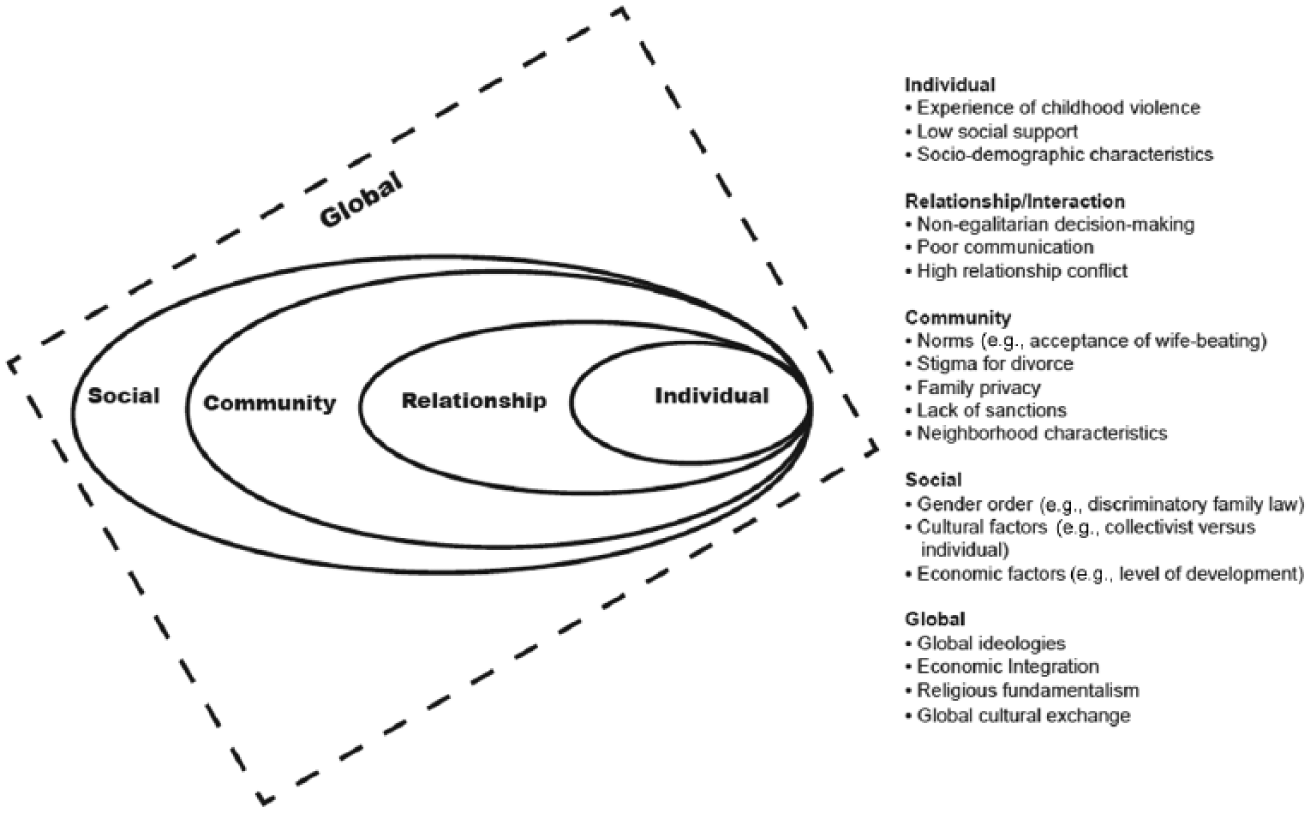
Ecological model with integrated globalized framework through which to analyze violence against women across levels of social ecology.
Global Ideologies
The cross-country analysis above offers an illustration of how two dominant global ideologies—women’s rights and democracy—and the processes that accompany them have interacted with social-level factors of the ecological model. In Cambodia, the impact of the international women’s rights movement on national legislation has generated debates and discussions that resulted in women’s and men’s increased awareness of women’s right to freedom from violence (Kingdom of Cambodia, 2009b). Moreover, the data suggest that a global discourse on women’s rights, and the resulting discursive practices of women’s rights organizations and political and legislative activity, foster the development of more equitable gender norms. But as the Maldives case study shows, a backlash against such global gender discourse also has the potential to lead to more patriarchal gender discourses and unequal gender dynamics. Similarly, the second global ideology prevalent in this article—democracy and the processes of democratization—is often believed to be a positive social force that offers potential gains for women. However, as evidence from the Maldives illustrates, democratization has contributed to a cultural crisis favorable for the development of religious fundamentalism, which becomes seen as an “anchor to provide stability . . . and coherent identity” (Moghadam, 2003; Sahgal & Yuval-Davis, 1991, p. 23). The extent to which global ideologies interact with all levels of the ecological model, and result in context-specific outcomes, further underscores the need for more research on the impact on globalization on the etiology of violence against women.
Economic Integration
In Cambodia and the Maldives, the impact of globalized economies on the influences of violence against women is most readily apparent through the establishment of financial decision-making power, as well as the increasing levels of economically motivated migration and urbanization. Women’s financial autonomy is seen as an indicator of ability to leave abusive relationships (Kishor & Johnson, 2004; Sev’er, 2002). However, the results of women’s participation in the wage economy are complex and contradictory. A number of studies have demonstrated that women’s access to wages is not a stand-alone indicator of empowerment, but rather needs to be understood in a larger context (Bates, Schuler, Islam, & Islam, 2004; Pearson, 2004; Rocca, Rathod, Falle, Pande, & Krishnan, 2009; Schuler, Hashemi, Riley, & Akhter, 1996). Moreover, men’s control over wealth as a situational factor for violence is also affected by global economic trends, such as unemployment. Jewkes, Levin, and Penn-Kekana (2002) argue that “violence against women is normalized as men lash out at women they can no longer patriarchally control or economically support” (p. 1612). Economically driven migration also shows how globalized economies influence the drivers of violence against women. In Cambodia, where economic necessity often drives migration, female and male respondents reflect on how population-based movement can lead to increased vulnerability and risk of violence, but also how the globalized impact on economic opportunity creates spaces for economic independence and autonomy. The proposed globalization level of ecological analysis thus offers the ability to map how globalized economic trends affect risk and preventive factors around violence against women, such as women’s participation in the workforce as well as other economically related activities that are a result of globalized forces.
Religious Fundamentalism
The rise of fundamentalism reaches beyond the Maldives and beyond the Islamic world with similar conservative trends developing strength in other world religions. The rise in fundamentalism affects women’s lives, changing the nature of intimate partner relationships, and transforming women’s roles in the broader society. The Maldives example briefly illustrates how Islamism affects various factors associated with violence including divorce laws, male dominance in the family, and women’s role in the public sphere. The increase in veiling, for example, is not unique to the Maldives, and many other countries in the Muslim world are undergoing similar processes, demonstrating the need for further analysis of how the growth of religious fundamentalism influences shifts across the social-ecological changes, and how these changes relate to women’s experiences of violence.
Globalized Cultural Influences
Finally, these case studies show how globalized cultural discourses influence notions of masculinity and femininity, particularly through the internalization of violence as a conflict-solving tool. Again, such global trends are relevant much beyond these two countries. Marchand and Runyan (2000) point out that globalization entails reworking the boundaries between and meanings of femininity and masculinity. Kimmel (2007) suggests partner violence becomes “more about getting the power to which you feel you’re entitled than an expression of the power you already have” (p. 102). Other research indicates that men often initiate violence against women when they feel a loss of power or are unable to fulfill a hegemonic masculinity (Eves, 2007; ICRW, 2002; Jewkes et al., 2002; Josephides, 1994). In India, Papua New Guinea, and East Africa, it has been found that partner violence is linked to “failed” masculinity and a backlash against changing gender roles (Eves, 2007; ICRW, 2002; Silberschmidt, 2001). Derné (2008) suggests that cultural globalization, in particular the proliferation of cable television and foreign movies, may be intensifying men’s attraction to violent masculinities. He notes that cultural globalization gives men new ideas about how to act out oppressive gender hierarchies (Derné, 2008). At the Asia-Pacific regional level, the UN Multi-Country Study discusses how “violence against women may also be triggered by men’s perceived disempowerment in environments in which rapid social and economic structural changes impact perceptions around women’s and men’s roles and rights within the society” (Fulu, Warner, Miedema, Jewkes, Roselli, & Lang, 2013, p. 106), which was also found throughout life history analysis of masculinities in two peri-urban sites in Vietnam (Duc, Cam, Trung, & Kanthoul, 2012).
Conclusion
Broad shifts in the way the world works, brought about by globalization, require a reformulation of our understandings of violence against women and the models we use to inform our analysis of and responses to this issue. No longer do the drivers of violence against women stop at national borders. For more than 15 years, the integrated, ecological model has evolved as a theoretical model to explore factors associated with violence against women. However, evidence from Cambodia and the Maldives demonstrates the need for an expansion of the model to incorporate the impacts of globalization. To address this lacuna, we propose to add an overarching “global” framework to the ecological model, to systematically link globalized trends with the rest of the model and develop a better understanding of how violence against women occurs in today’s world.
However, as Heise (1998) allows, “there is considerable room . . . for interpretation as to exactly where a particular factor most appropriately fits into the framework” (p. 266). We hope that future research will take this updated model further, to explore how globalization affects experiences of violence including and beyond violence against women. For example, the impact that global media responses to gang rape in India have had on rape legislation and implementation could be considered. Democratization and women’s rights can be traced through the recent events in the Middle East. The model can be used to explore the influence of international actors on gender and sexual norms in the context of homosexuality legislation in Uganda. The connections between militarization and the lives of women across the world, a link discussed by Enloe (2007), can be further explored in a theoretically systematic way. This updated iteration of the ecological model holds the potential to unpack the ways in which broader global movements leave their mark on the social structures, relationships, and experiences of individual men and women, providing a space to understand the multi-dimensional causes of violence, to better respond to and prevent violence against women and other social injustices.
Footnotes
Acknowledgements
The authors acknowledge Gender and Development Cambodia for providing access to the primary data for the Cambodia case study and the Ministry of Gender and Family and United Nations Population Fund (UNFPA) Maldives who were involved in the Maldives Survey on Domestic Violence and Women’s Health.
Declaration of Conflicting Interests
The author(s) declared no potential conflicts of interest with respect to the research, authorship, and/or publication of this article.
Funding
The author(s) disclosed receipt of the following financial support for the research, authorship, and/or publication of this article: The authors acknowledge the United Nations Population Fund (UNFPA) and UNICEF Maldives that provided funding for Maldives Survey on Domestic Violence and Women’s Health referenced in this article. They also acknowledge Partners for Prevention: A United Nations Development Programme (UNDP), UNFPA, UN Women, and United Nations Volunteers (UNV) Asia-Pacific Regional Joint Programme for Gender-Based Violence Prevention, and the International Center for Research on Women (ICRW) that provided funding to Gender and Development Cambodia to collect the Cambodia data set on which half of this article is based. EF was supported by funding from UK aid from the UK government and this is an output of the What Works to Prevent Violence Global Programme. However the views expressed do not necessarily reflect the UK government’s official policies.