




Abstract
This article proposes the concept of pluriversal mobilities. We use it to describe how creative practices, and people move across places, disciplines, and research traditions in ways that resist universalizing tendencies and one-way knowledge flows. Our theoretical perspectives draw on mobility studies and literature on artistic, participatory, and ethnographic methods. We apply them to the eVoices project, an AHRC-funded initiative carried out in 2018. The project’s outputs continue to circulate, long after its funding ended. We explore pluriversal mobilities in two areas: the movement of artistic artifacts, and the movement of stories and people. Our analysis is based on ethnographic fieldnotes and in-depth interviews to trace mobile lived trajectories. We define pluriversal mobilities around three dimensions: coexisting worlds (Brazil and Kenya), diverse research traditions, and intersecting disciplines. We argue that the artivist qualities of the eVoices’ outputs activated these pluriversal mobilities, fostering dialogues in South–North and South–South dynamics.
Introduction
In this article, we propose the concept of pluriversal mobilities. This concept refers to the multiple ways in which artistic practices, knowledge, and people move across geographies, disciplines, and research traditions in ways that resist universalizing tendencies and unidirectional flows of knowledge. We demonstrate that this concept is significant because it questions the dominance of Eurocentric and Global-North-centric perspectives that still shape much of the mobility literature. At the same time, “pluriversal mobilities” emphasize the value of embracing the unpredictable encounters between people, methods, ideas and disciplines. We argue that this orientation toward unpredictability invites a much-needed readiness to follow the unexpected directions that research may take. Such openness reflects a willingness to step beyond our comfort zones, allowing ourselves to be unsettled by the ways others think, work, and engage with knowledge.
We engage with the idea of pluriversal mobilities in two ways. First, we explore the mobilities of artistic artifacts and outputs, mainly animations, installations and exhibitions, produced during the eVoices project, funded by the AHRC UK. Second, we consider the mobilities of stories and people, tracing how participants’ trajectories intertwined with the project and continued to unfold across time and space. Our methodological approach draws from (a) Ethnographic fieldnotes, which provide insight into the mobilities of artifacts; (b) In-depth interviews with animation artists who reflect on the mobilities of stories and people.
We define pluriversal mobilities as revolving around three interlinked dimensions. The first concerns the coexistence of multiple worlds, whose diverse historical, cultural, and social realities inspired the eVoices project. The second dimension relates to the plurality of research traditions we engaged with, blending artistic experimentation, ethnographic sensitivities, and participatory practices. The third involves the blurring of disciplinary boundaries, blending arts, anthropology, and media studies. We argue that knowledge is not generated through one-directional exchanges from North to South. Rather, plural knowledges are generated through simultaneous, multi-directional encounters that cross borders and unsettle colonial (geographic and disciplinary) hierarchies.
Here, we adopt a writing tone that reflects our collective and situated authorship. We use the pronoun “we” when discussing our theoretical and methodological perspectives as well as when presenting the article’s empirical material. At the same time, in line with the collaborative spirit of the eVoices network, we also attribute ethnographic fieldnotes to their authors, writing in the third person and mentioning their names. The aim is to make visible the multiple positionalities and voices that shaped the work.
We argue that pluriversal mobilities can play a vital role in South-to-North and South-to-South flows, where knowledges and wisdoms often travel in unexpected ways. We also argue that the artivist qualities of the outputs generated by the eVoices project—their mixing of artistic expression and activist engagement—were crucial in activating their pluriversal mobilities. These mobilities came into being through art’s capacity to spark dialogue, contest the silences, inspire solidarity, and produce new collective histories in response to colonial erasure.
Mobility Studies and Pluriversal Mobilities
Mobility studies focus on the recognition that movement is not merely a background condition of social life but a constitutive element of social institutions, practices, and relations. Mobilities research investigates how social life is organized through diverse forms of movement. Sheller and Urry (2016, p. 11) identify five modes of mobilities and their combinations: corporeal travel of people; physical movement of objects; virtual travel often in real-time, transcending distance; communicative travel through person-to-person messages; and imaginative travel. Such diversity in modes of mobility challenges earlier social science paradigms that treated mobility as peripheral. Instead, we pay attention to how movement and stasis together are central to everyday practices, cultural imaginaries, and structures of inequality. Scholars refer to this as “the mobilities turn” (Sheller & Urry, 2006; Urry, 2007).
Sheller and Urry (2006, 2016) elaborated ideas on what became known as the New Mobilities Paradigm (NMP). The aim was to offer transdisciplinary and multi-scalar perspectives to address challenges such as climate change, energy transitions, and border governance in different parts of the world. The NMP destabilized traditional disciplinary boundaries, forging new assemblages of researchers and practitioners concerned with topics as varied as new media, education, security, borders, risk, citizenship, geopolitics, cosmopolitanism, disability, landscape, infrastructures, and surveillance, among others (Sheller & Urry, 2016, p. 14). This new mobility paradigm, offered theoretical and methodological tools for policy, planning, and applied research by emphasizing the need to examine interconnected flows of people, goods, information and capital. In applied research, this led to a recognition that we also needed methods on the move.
Büscher and Urry (2009, p. 103) argue that methods on the move can be useful in two ways. First, they note that researchers will benefit from tracking their research subjects in their journeys. This tracking includes physically traveling with the research subjects, following the many forms of intermittent movement of people, images, information and objects (Büscher and Urry, 2009, p. 103; Sheller & Urry, 2006). Second, by allowing themselves “to be moved by, and to move with, their subjects, researchers are tuned into the social organization of ‘moves’.” To cite Büscher and Urry (2009, p. 104), “by immersing themselves in the fleeting, multi-sensory, mobile and multiple, yet local, practical and ordered making of social and material realities, researchers gain an understanding of movement not as governed by rules, but as methodically generative.”
The notion of “methods on the move” is insightful in that it conceives mobility in plural ways: moving with people, with ideas, with objects, and unfolding across diverse geographical contexts. Yet, the new mobility paradigm and the methodological innovations that it inspires remain dominated by Anglo-Saxon, Global North and Eurocentric paradigms. Nogueira and Moraes (2020, p. 7) call attention to “the asymmetries of power that are characteristic of the modern-colonial matrix of scientific production, which create unequal circuits of production and diffusion of knowledge and restrict its application by those whose native language is not English.” Therefore, in this article, we join scholars such as Nogueira and Moraes (2020), Cheibub and Eugenio (2020), and Zirin (2014) in contributing to Latin American perspectives about the field of mobilities.
We engage with three strands that have been prominent in Brazilian scholarship. The first concerns the period of mega events (the 2014 FIFA World Cup and the 2016 Rio Olympics). During the years of preparations for these events, when Medrado was conducting her research on favela media activism (Medrado & Souza, 2015), the intense flows of people and investments generated a range of studies of (im)mobilities. These studies addressed questions of urban planning, social segregation, transport, arts, culture, and the broader impacts of mega events on policies and everyday life in Brazil (Zirin, 2014).
The second strand connects to debates about the rights of vulnerable and minoritized populations to freely and safely inhabit and circulate within the city (Cheibub & Eugenio, 2020). Medrado and Souza’s (2015) research on the construction of walls separating favela areas from non-favela, or so-called “asphalt,” areas in Rio represents an example of this phenomenon. Building on scholarship concerning the “right to the city” (Lefebvre, 1996), the research highlights how favela media activists reframed this claim as a “right to the favela.” Having the right to the favela would imply having the right to come and go in peace, without the threat of police operations that disproportionately target youth in these communities.
The third strand relates to how the qualities of community journalism have been incorporated into media activism. These forms of community media construct more positive and complex representations of the urban poor, countering the negative and reductionist narratives often reproduced by mainstream outlets (Medrado et al., 2020). These practices also strengthen solidarities in moments of crisis, enabling the circulation of ideas that are frequently marginalized (Medrado & Rega, 2023). In doing so, they facilitate the mobility of suppressed messages, allowing them to spread more widely and rapidly than mainstream media would typically allow.
In addition to these three strands, we aim to contribute to the mobilities literature from a South-to-South, and specifically Latin American, perspective. We propose the concept of pluriversal mobilities. Having already discussed the mobilities framework, the notion of the pluriverse is key. It emerges as a response to universality, which, as scholars such as Mignolo (2008) remind us, often masks Eurocentric, Western-centric perspectives as if they were universal standards for historical landmarks and cultural values. This universalizing tendency claims a superior position for itself, negating the legitimacy of other plural worlds, knowledges, and ways of living. In contrast, pluriversality draws from indigenous relational worldviews. It implies the existence of many interconnected worlds. It entails a vision with “many kinds of worlds, many ontologies, many ways of being in the world, many ways of knowing reality, and experimenting those many worlds” (Querejazu, 2016, p. 3). Our idea of pluriversal mobilities grows out of this vision: a desire to recognize this coexistence and allow ourselves to move across these multiple worlds and to value the wisdoms they bring.
At the same time, our framing of pluriversal mobilities is self-reflexive. Here, Ribeiro’s (2024) reflections on lugar de fala (translated from Portuguese as “where we stand”) are helpful. Drawing from standpoint feminism (Harding, 2004), being attentive to “where we stand” asks us to reflect on who we are, where we come from, and how these locations shape our engagements with the world. It also asks us to remain critically aware of the positionalities that grant us privilege and those that mark us as oppressed. But why is this relevant for the idea of pluriversal mobilities? Because this perspective reminds us that we always start from somewhere: a specific, situated place. When researching mobilities, when moving across geographies, cultures, and contexts, we carry that starting point with us. This means that any worldview, no matter how expansive, is always partial and incomplete (Nyamnjoh, 2017). Recognizing this incompleteness can help us cultivate an openness to other knowledges that emerge from other places where plural others stand (and move). It encourages us to let this knowledge transform our own, producing a more plural and pluriversal engagement with mobility.
Pluriversal visions are also about imagining more respectful ways of coexisting. Our proposal of pluriversal mobilities aligns with this spirit, but it also insists on embracing the unpredictability of encounters between people, ideas, methods and disciplinary boundaries, all on the move. In addition, the notion of pluriversal mobilities revolves around asking: which outputs will emerge from our exchanges? Where will these outputs lead us? This openness also invites us to be guided by disciplinary perspectives beyond our comfort zones. Pluriversality, then, lies both in the recognition of our positionality, as researchers and as people, and in the humility (Freire, 1972) to let dialogue and interaction reshape our trajectories. In this sense, pluriversal mobilities are not only about where we move from or to, but also about how encounters transform us and redirect our paths in ways we could not have foreseen. In the next section, we discuss how arts can be embraced in ethnographic and participatory methods but also shift from method to outcome in unpredictable ways. We also demonstrate how artistic, participatory and ethnographic methods combined can broaden understandings and representations of mobility.
The Role of Artistic Methods in Expanding Ethnography
Coming up with a definition of art has long sparked many heated debates. As we resist a single, fixed meaning, the question “what is art?” continues to challenge us. While acknowledging these challenges, yet not lingering on these debates, we begin with a working definition of art—one commonly found in anthropological writing—as that which gives objects “aesthetic and/or semantic attributes (but in most cases both) that are used for representational or presentational purposes” (Morphy, 1994, p. 655). Our interest lies in articulating the distinctive qualities of art and art-based methods, and in exploring how these can be integrated into ethnographic research to reframe and complexify our methodological and epistemological understanding of mobilities.
An important aspect refers to how art can enhance ethnography’s properties as a sensory and embodied method. This orientation emerged in the 1980s and 1990s as a reaction to the “reflexive turn” in social and cultural anthropology. The reflexive turn (Clifford & Marcus, 1986) was a shift that emphasized the positionality of the ethnographer, the constructed nature of ethnographic knowledge, and the need to reflect on how power, subjectivity and representation shape research. Such a shift also called for greater transparency about the researcher’s influence on the research process and outcome.
Sensory and embodied ethnography pushed the discipline beyond just reflexivity of thought and text toward engagement with the full range of human experience. Pioneered by scholars like Pink (2009), this approach emphasizes the body, the senses, movement, and emotion as tools for producing knowledge. Art is well-suited for sensory ethnography, as Pink argues, because it serves as a starting point for a way of thinking and doing ethnography that accounts for a multisensoriality of experience, perception, knowing, and practice. In this vein, the author also urges us to consider how sensory ethnography might develop in relation to explorations in art. Such explorations can be made possible by participatory research methods, visual methods and sensory ethnography representation (Pink, 2009, p. 21).
The reflexive turn is also associated with calls for a dialogical anthropology that brings more voices into academic representations. Combining a concern for the inclusion of more plural voices with new technological developments, anthropologists were prompted to produce innovative and reflexive projects using artistic forms, such as photography, video, drawing and hypermedia (Pink, 2006, p. 38). In addition, artistic methods offer alternative avenues to represent experiences of mobility beyond text, making aspects like emotions, affect and daily rhythms more tangible. These approaches allow participants to communicate embodied and nonlinear experiences, engaging with mobility through sound, movement, and visual composition that capture dimensions often missed by text alone. McPherson et al. (2024, p. 13), for instance, note that “artistic activities have unique affordances in opening space for critical conversation, enabling qualitatively different kinds of commentary and knowledge generation.” Using these artistic exercises, we can think about the working practices of research participants in nonlinear, generative, creative terms (McPherson et al., 2024).
However, artistic approaches to ethnography still face resistance from the more traditional strands of anthropology. Having worked with ethnographic film and image-based methodologies, Grimshaw and Ravetz (2005, p. 8), for instance, note that anthropology, which embraces art and other forms of visuality, remains marginalized and suppressed by text-oriented traditions. In addition, Calzadilla and Marcus (2006) observe a fear among anthropologists: if art becomes part of anthropological methodology, what will become of the discipline? Anthropologists may respond to this fear by establishing boundaries between ethnographic-based and art-based research methods, with the former often being placed higher in the hierarchy than the latter. Within anthropology, text-based or verbal approaches tend to be privileged because these methodologies grant the researcher an authoritative voice, while arts-based methods create data from multiple voices via multiple media that can create more possibilities to do research with and for communities rather than about them (Goopy & Kassan, 2019, p. 3). Ethnographic methods are often considered more rigorous because they revolve around the researcher’s expert interpretation. To some, arts-based methods challenge this authority, leading anthropologists to maintain a sense of hierarchy.
Despite the protective demarcations of methods that are used to define and maintain disciplinary boundaries, many disciplines keep borrowing “creative” research practices and techniques from art. At the same time, to cite Clarke (2014, p. 179), “art borrows from anthropology, and such developments demonstrate the plasticity of disciplines.” By borrowing artistic techniques, ethnographic research opens space for a greater plurality of voices, challenging hierarchies of authorship and authority. In doing so, these art-based methods contribute to redistributing power, transforming the research participant into an active co-creator, which is important when working with hard-to-reach communities (Goopy & Kassan, 2019). This transformation shifts ethnography from a centralized, researcher-led narrative to a more participatory approach and toward a more polyphonic understanding of media and mobility.
The notion of pluriversal mobilities offers a decolonial alternative to perspectives of mobility that are dominated by Eurocentric, Anglo-Saxon–dominated (Nogueira & Moraes, 2020). These mobilities are multipolar because they emerge from multiple points of departure. In addition, these points of departure cannot be described as fixed centers, nor as peripheries. Rather, all places can simultaneously function as both center and periphery. For example, while favelas are frequently framed as peripheral in relation to the rest of the city, for their residents, they constitute the very center, the core of everyday life. To think through pluriversal mobilities is thus to engage in a practice of reflexivity, grounding ourselves in humility (Freire, 1972), recognizing our own incompleteness (Nyamnjoh, 2017), and seeking completion by other places, wisdoms, and knowledges. Such an approach compels us to confront the intersections of privilege and oppression in the places where we stand (Ribeiro, 2024) and to recognize that these positionalities are relational. Pluriversal mobilities allow us to step outside our comfort zones and to be guided by people, ideas, and disciplinary frameworks that may lead us in unpredictable directions. In our case, with the e-Voices project, which will be explained in the next section, we chose to be led by art, a new experience for us. Art and artivism infused our research outputs with affective messages and qualities. This, in turn, enhanced their pluriversal mobilities.
The eVoices Project
We began developing the idea for the eVoices Project in 2016, when Medrado was based at the Federal Fluminense University in Brazil, and Rega was based at Bournemouth University in the United Kingdom. The aim was to analyze the uses of digital technologies in combatting marginalization across different Global South contexts. Our understanding of the Global South goes beyond the idea of a geographically located concept. To cite Moyo, the South is described as
a place that is exploited for its land, its resources, and its culture, but yet presented in the global discourses of Western modernity as a barren, impotent, and burdensome place. At the same time, the South is also becoming a vantage point for developing alternative political and epistemic projects from the experience of struggle and pain. (Moyo, 2020, p. 23)
The eVoices project drew on Medrado’s experience conducting research with favela (shantytown) residents, examining how they used digital media to foster community engagement and active citizenship (Medrado & Souza, 2015). Her work on the urban transformations faced by favela communities during the period of megaevents was particularly relevant (Medrado et al., 2020). It served as a pilot for developing a broader international study that could extend to other Global South contexts. Rega then proposed establishing a cross-cultural project to build connections between Latin America, particularly Brazil, and Kenya, where she maintained close collaborations.
The project focused on the two countries for two main reasons. First, both countries have significant levels of social media usage as their most popular online activities. As of January 2025, Brazil had approximately 144 million active social media user identities, a number that corresponds to 67.8% of the total population (Data Reportal, 2025a). If compared to Brazil, the social media penetration in Kenya is significantly lower, with approximately 15.1 million social media user identities in 2025, representing 26.5% of the total population (Data Reportal, 2025b). Yet, Kenyans are among the world’s most active social media users, averaging nearly four hours daily, as of January 2024 (Kamau, 2024).
Second, Nairobi and Rio are global cities marked by stark social inequalities. Their urban environments reveal State policies that tend to discriminate against the economically vulnerable populations with poor access to health and education, and public safety policies that often disrespect their rights. Extra-judicial killings are common in informal settlements in Nairobi and in Rio’s favelas as the “war on drugs” serves to justify the adoption of a “shoot first and ask questions later” logic (Villalobos, 2019).
In 2017, the eVoices project received a Networking Grant award from the Arts and Humanities Research Council, AHRC United Kingdom. The aim was to draw from the Brazilian and Kenyan case studies to analyze: (a) how favela residents in Brazil used digital media to foster active citizenship in a context of post mega events; (b) how Kenyan artists used digital tools to promote a dialogue around human rights in a context of post-election violence. 1 In January 2018, we launched the project with a kick-off meeting at Bournemouth University, bringing together the main partners: academics, representatives from the artivist (artistic and activist) organization PAWA254 in Nairobi, and media activists such as Renata Souza from Rio de Janeiro. In May 2018, Medrado organized an event at the Museu da Maré in Rio, which gathered favela media activists and residents, scholars from the eVoices network, students and researchers to debate issues of digital media and human rights. The Brazilian community was deeply shaken by the assassination in March 2018 of Marielle Franco, a city councilor and human rights advocate, along with her driver Anderson Gomes.
In response to the shocking events, Paula Callus, an animation practitioner and scholar from Bournemouth University, and also a member of the eVoices Network, proposed to focus on Marielle’s story as the theme for an animation workshop with Kenyan artivists. The project team held this workshop in August 2018 at the PAWA254 premises in Nairobi, led by Callus and the Kenyan filmmaker Ng’endo Mukii. The workshop resulted in the production of Portrait of Marielle, a short-animated film to honor Marielle Franco. Created on A4 sheets of paper, the animation frames were subsequently transported to Brazil and repurposed into an artistic installation, also entitled Portrait of Marielle. In December 2018, this installation was exhibited at the Museu da Maré, in an event featuring the participation of Ng’endo Mukii. Alongside the installation, we also presented the animated film Portrait of Marielle, which has since circulated widely on social media in Brazil and Kenya.
We have used the terms “media activist” and “artivist” (Medrado & Rega, 2023) to describe the participants of the eVoices Project, so a brief conceptual clarification is needed here. We understand media activism as the strategic use of media tools, platforms, and practices by activists to challenge dominant power structures, convey alternative narratives, and mobilize social movements (Mattoni, 2013). As for artivism, it refers to the combination of arts and activism. The term also refers to the fusion of “affect,” or the affective power of art, and “effect,” the desire to prompt social and political change through meaningful messaging. The combination of “arts” and “activism,” “affect” and “effect” generates an “aeffect” (Duncombe & Lambert, 2018). Finally, a caveat. Doing ethnographic research taught us to see things as much as possible from the perspective of the research participants themselves. Media activism and artivism were the terms that the media activist collectives in Brazil and the artivist organization in Kenya, respectively, chose to describe their work.
In addition to the activities organized throughout 2018 (see Figure 1), the eVoices Project employed a variety of research methods, which included (a) Digital ethnographic observations of favela media activist profiles; (b) Nine in-depth interviews with Kenyan artivists during the workshop in Nairobi and eight in-depth interviews with Brazilian media activists; (c) Ethnographic fieldnotes produced by the authors during the events organized by the project (Medrado & Rega, 2023, pp. 7–8). As we will discuss in the next sections, several academic, artistic and practitioner focused outputs have been (and continue to be) produced, such as a monograph, journal articles, a best practices guide, an ethics guide on how to work with marginalized communities, an animated short film (Portrait of Marielle) and two museum exhibitions (Portrait of Marielle and Marielle Marés), as well as other outputs that were produced independently by people connected to the network.
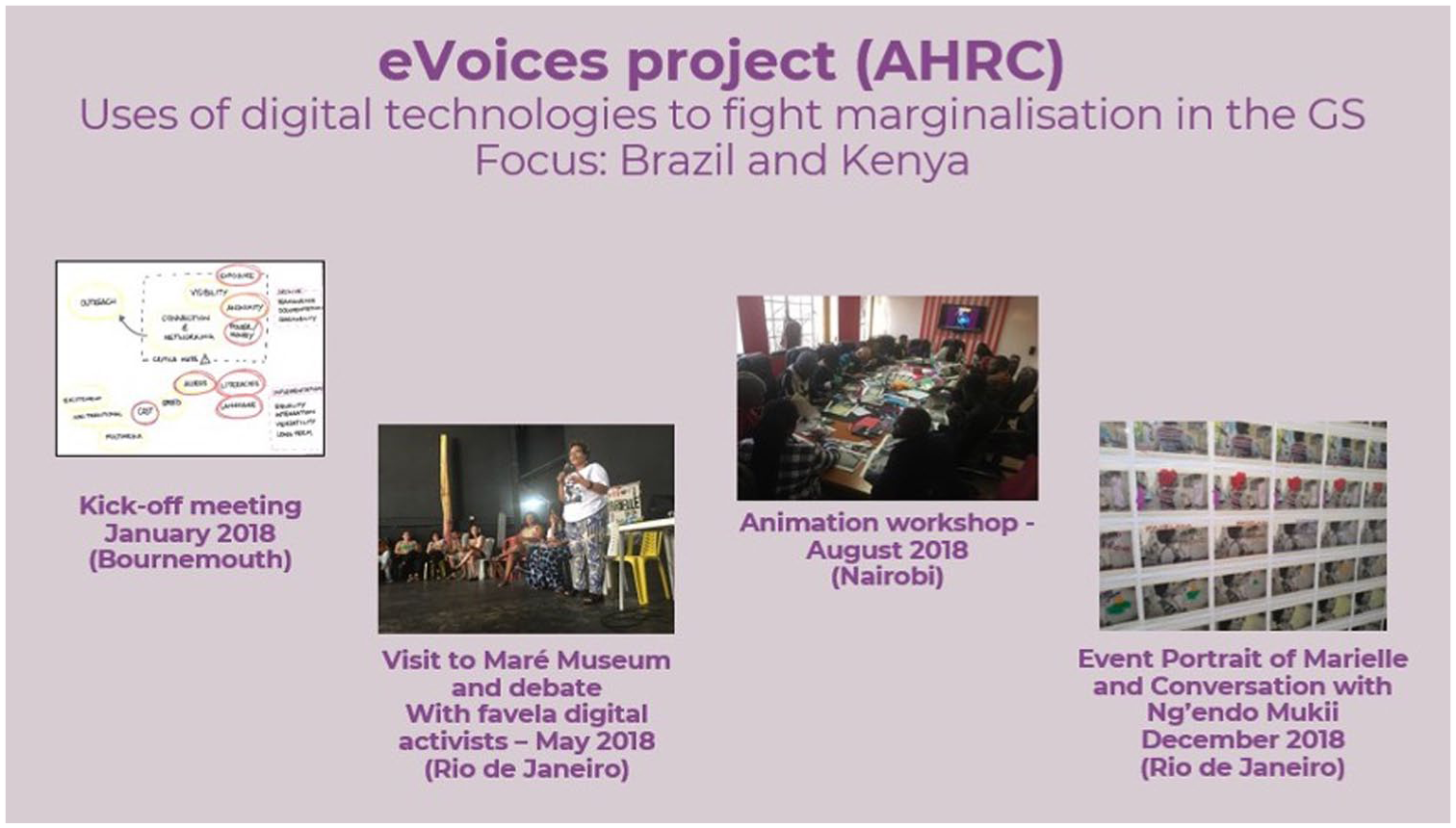
Summary of Activities Promoted by the eVoices Project in 2018.
As the project evolved, artistic methods began to play a central role. For Medrado and Rega, both of whom are academics rather than artists, this shift prompted a set of questions. What is it that distinguishes art from other practices? How can art’s unique qualities be meaningfully integrated into ethnographic and participatory approaches? We found that these questions came to the fore because networks inherently involve multiple forms of mobility. Networks are about the physical movement of people, traveling across countries, meeting partners, and allowing these encounters to reshape their perspectives (Büscher & Urry, 2009; Sheller and Urry, 2016). Networks are also about the circulation of ideas, findings, and outputs that emerge from collaborative processes. These dynamics led us to reimagine mobility beyond the conventional Western and Eurocentric frameworks that dominate the literature (Nogueira & Moraes, 2020). Engaging with decolonial perspectives and the concept of pluriversality (Escobar, 2018; Mignolo, 2008; Querejazu, 2016), we see mobilities as emerging from (a) coexisting worlds (Brazil and Kenya); (b) diverse research traditions (artistic, ethnographic, participatory); (c) intersecting disciplines (arts, anthropology, media studies). By proposing the concept of pluriversal mobilities, we wish to emphasize how knowledge is rarely the product of linear or unidirectional North-South flows. Rather, knowledge flourishes from simultaneous exchanges across geographies, epistemologies and disciplinary boundaries, particularly in South-North and South-South flows.
The Pluriversal Mobilities of Artistic Artifacts as Research Outputs
The eVoices project ended in 2019. At the time, we had several conversations with partners and participants about expanding the project. This could be done, for instance, by employing techniques such as those used to make the Portrait of Marielle animation to establish dialogues between groups in other Global South contexts, paying homage to important female Afro figures (as it happened with Marielle and Wangarĩ).
However, we were soon absorbed by other projects, moving countries, and family life. Fast forward to 2023. While scrolling down her social media feeds, Medrado had a surprise. She found out that the Portrait of Marielle frames were now being displayed in Museu da República in Rio. The frames were part of “Marielle Marés,” a much larger exhibition.
Curious to see how the frames produced as part of the small eVoices Project had made their way to a mainstream museum, Medrado visited Museu da República in August 2023. She also spoke with Claudia Rose Ribeiro da Silva, the Director of Museu da Maré. Da Silva explained how Portrait of Marielle became integrated into a much larger artistic circuit, feeding into the exhibition “Marielle Marés.” Curators who worked for Museu da República contacted Museu da Maré’s team, looking for input on how to organize an exhibition that honored Marielle Franco. The curators did this because Museu da Maré is located in the favela where Marielle was born. Marielle had strong connections with the institution, having participated in several of its activities. Immediately, Da Silva had the idea to share the frames used to make “Portrait of Marielle” and to screen the animation, combining them with other artworks that celebrated Marielle’s legacy.
Having gathered from Da Silva's background information about the exhibition, Medrado wrote ethnographic notes about the experience of visiting “Marielle Marés” (Medrado, ethnographic fieldnotes, 25/08/2023). After climbing several flights of stairs, the echo of her footsteps trailed behind her on the museum’s marble staircases. Looking down, she realized that she had already walked past many lavishly decorated rooms, reflecting early republican Brazil. Everywhere she looked, she saw portraits of prominent political figures. They were all men: Deodoro da Fonseca, Floriano Peixoto, Getulio Vargas. But what she saw on the top floor was remarkable. As Medrado’s heart rate normalized, and as she faced the main entrance of the exhibition, she saw a gigantic plaque with the words “Rua Marielle Franco” (Marielle Franco Street). Covering the entire entrance area, it contained a small biography for Marielle: “1979-2018, City Councillor, Defender of Human Rights and Minorities, cowardly murdered on 14 March 2018.”
The plain text, written in white on dark blue, following the pattern of Rio’s street signs, offered a bold contrast to the elaborate metal railings and the painted Renaissance-style fresco, situated below the plaque (see Figure 2). One would be tempted to think that the plaque did not belong in the museum. In fact, one could think the same thing about the presence of Marielle Franco’s image in that museum about Brazil’s political history: to put it simply, the image of a Black woman on the top floor, surrounded by white men in all the other bottom floors. Marielle was also someone born and raised in Favela da Maré. Most of the people featured in Museu da República’s artworks are upper-class. The presence of that plaque, so distinct aesthetically from the museum’s visual style, served as a reminder. The plaque represented a kind of visual analogy: just as the plaque seemed out of place, so too did Marielle seem out of place in the museum. Yet, a powerful message was conveyed through the plaque: Marielle does belong in Museu da República as an important political figure. The words “Mariele Franco’s street” marked territory in politics (and in the museum of politics) for someone who would not traditionally be accepted in Brazil’s male upper-class-dominated political sphere.
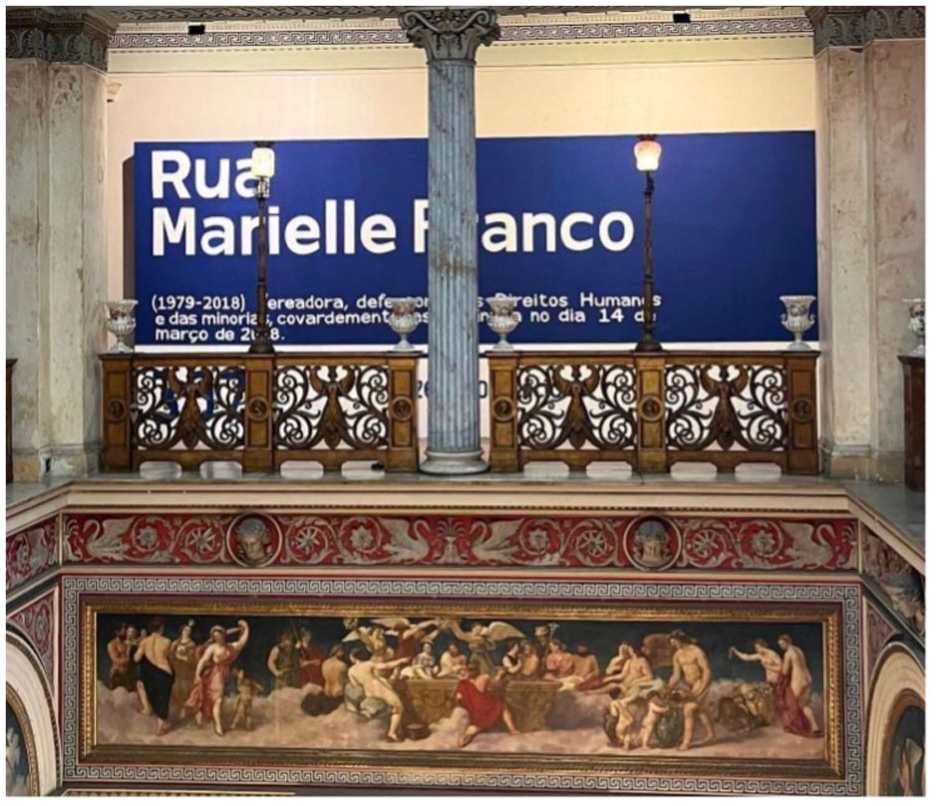
Sign That Marks the Entrance of the Exhibition “Marielle Marés” at Museu da República, Photo by the Authors, August 2023.
Sadly, this lack of acceptance, combined with Franco’s activism against police brutality in the favelas, led to her murder, along with that of her driver Anderson Gones. The murder happened in March 2018, slightly over a year after she started her term as Rio’s only Black woman city councilor. Their assassination was met with protests by human rights, feminist and civil society groups. Activists created thousands of “Rua Marielle Franco” plaques, placing them in Cinelândia in front of the Municipal Chamber of Councilors, and in other areas of Rio. The plaques were constantly vandalized by right-wing politicians, such as Rodrigo Amorim and Daniel Silveira, who were filmed smashing them at a public rally. In response, activists kept reinstalling the plaques as well as holding them up during public demonstrations and protests.
Moving from the streets of Rio to its placement as a large-sized replica in Museu da República, the “Rua Marielle Franco” plaque held strong meanings for Medrado. As she reached the top of the museum staircase to see the Exhibition “Marielle Marés,” she thought about the journey with the eVoices Project that led her there, all the steps that the project required. She remembered (literally) its ups and downs. As we discussed earlier in this article, everything started with a debate in Museu da Maré. As Marielle’s murder had taken place one month before the event, the community was shaken by what had happened. After the debate, Paula Callus, an animation practitioner and researcher and a member of the eVoices network, had the idea to organize an animation workshop with Kenyan artists to produce a short film honoring Marielle. Callus felt that Marielle’s story—and how she represented what it meant to be marginalized in many intersectional levels—could serve as a narrative connective thread between the plights of activists in Brazil and Kenya (Medrado & Rega, 2023, p. 129).
The animation workshop took place in Nairobi and lasted 4 days (see Figure 3). After the 2-minute animation “Portrait of Marielle” was completed, several members of the eVoices Network watched it at the premises of PAWA 254, the artivist organization that hosted the workshop. The animation literally moved all participants. It was made from scanning hundreds of frames printed on letter-sized paper, which contained images of Marielle with manual artistic interventions made by the Kenyan participants. These frames were then scanned and animated. The film was widely shared on social media accounts. 2 In November and December 2018, the eVoices team organized two events in partnership with Museu da Maré—Portrait of Marielle and a Conversation with Ng’endo Mukii. In the first one, the animation was screened for favela residents and activists. The frames used to make the animation were displayed in an artistic installation (see Figure 4). For the second event, in addition to the screening and installation, the filmmaker, Ng’endo Mukii, had a conversation with the favela activists and residents about her creative processes. She also screened a second animation, Homage to Wangarĩ Maathai, which we will discuss in the next section.
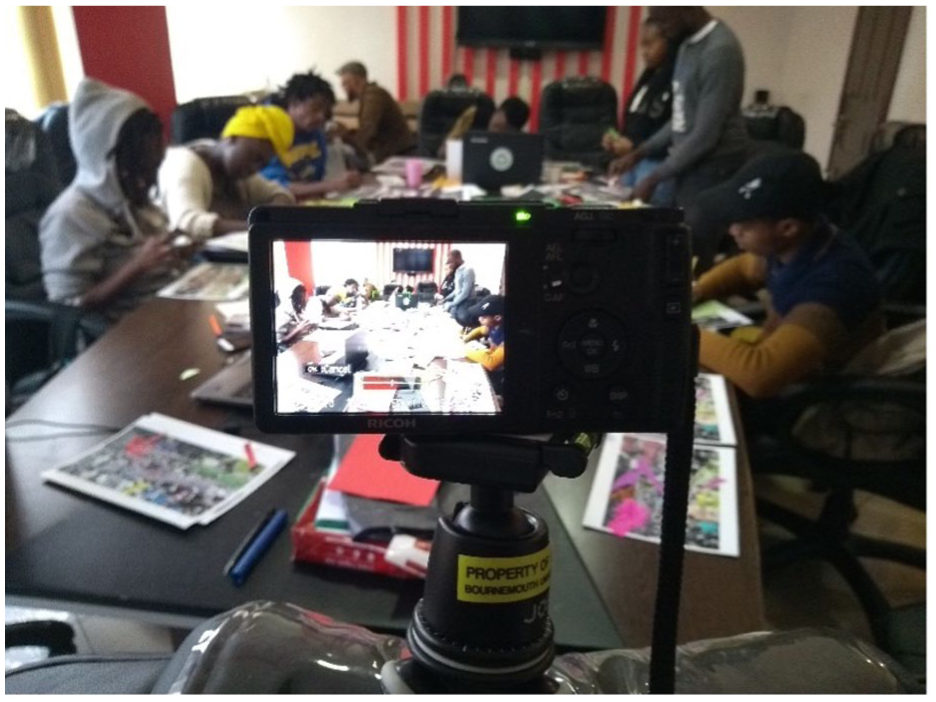
A Group of Kenyan Artists Working on the Frames for the Animation “Portrait of Marielle” (Photo by the Authors Taken in August 2018).
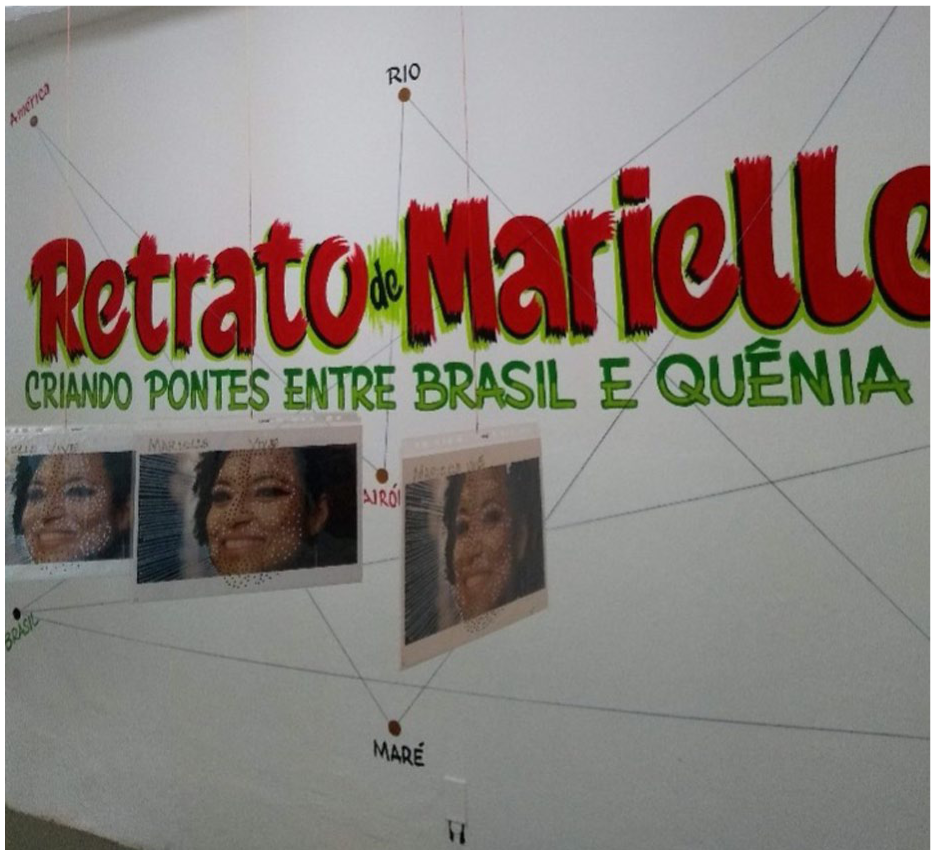
Artistic Installation in Museu da Maré Using the Frames From the Animation Portrait of Marielle (Photo by the Authors Taken in December 2018).
We felt that it was rewarding to have played a role in sparking something beautiful, something with the special qualities that we are calling pluriversal mobilities. In Museu da República, Medrado felt deeply moved by looking at the frames that had crossed the Atlantic, from Kenya to Brazil. The same frames had moved in time, fast-forwarding from 2018 to 2023. They had also moved physically with Medrado, as she physically transported them in a box from Nairobi to Rio. And in Rio, they had moved from Maré (Museu da Maré) to the Catete Palace (Museu da República). Who knows where they are heading next?
Once the eVoices team gifted the frames to Museu da Maré they let them go completely. They no longer belonged to a project or to specific people. As Medrado watched the Portrait of Marielle animation play on a TV screen, surrounded by the exhibition frames, she also found the exhibit label (see Figure 5). The animation was credited as being a “collective production by Kenyan artivists during a workshop promoted by members of the eVoices Network in Kenya and directed by Ng’endo Mukii and Paula Callus.” (see Figure 6).
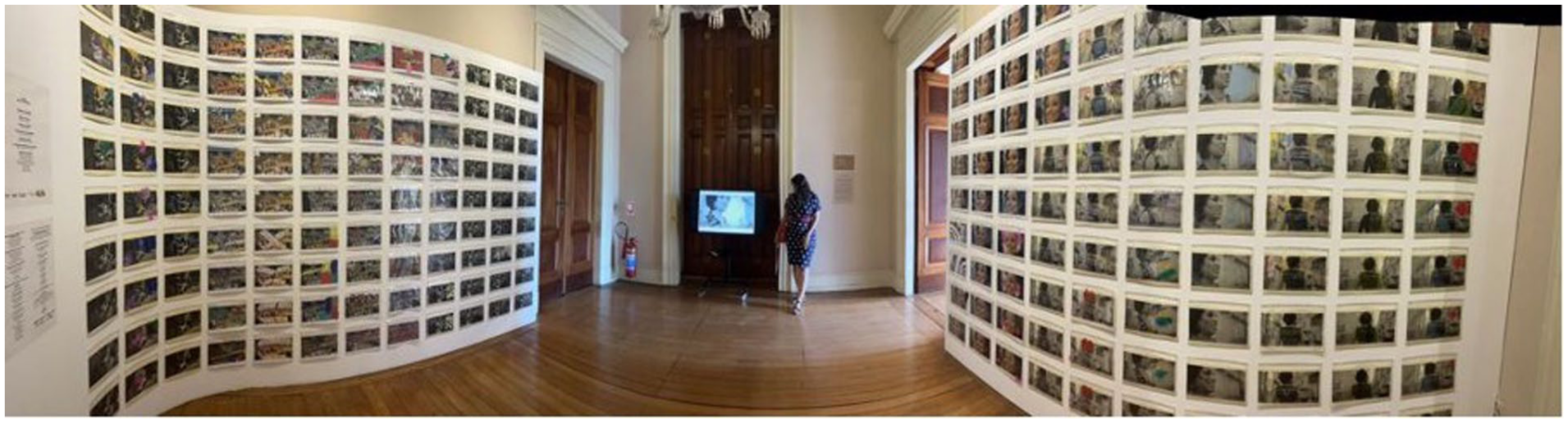
Medrado Next to the Screening of the Portrait of Marielle Animation, Surrounded by the Animation’s Frames at the Exhibition Marielle Marés (Photo Taken in August 2023).
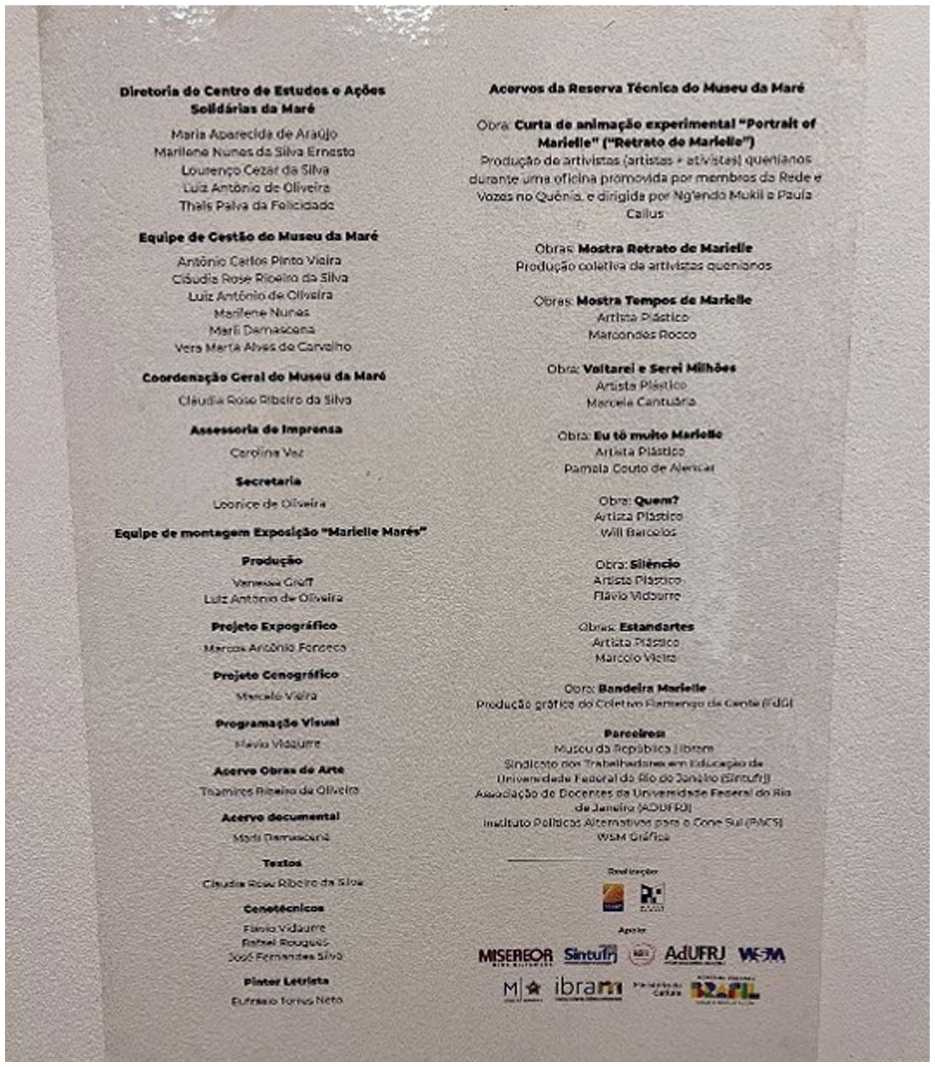
Marielle Marés Exhibit Label (Photo by the Authors in August 2023).
The word “process” also matters here. By emphasizing process, we can highlight the empirical work we do as anthropologists and/or artists on display, rather than focusing on the output or product. To cite Pussetti (2018, p. 7), “it is the ongoing questioning, learning and discussing that leads to the construction of knowledge and mutual understanding. Clarke (2014, p. 185) adds that focusing on the process rather than the outcome affords practitioners “other invaluable ways to observe, experience and understand things,” creating a type of resistance to an overemphasis on artistic aesthetic elements.
We agree on the value of cross and multi-disciplinary, collaborative, and participatory processes, as well as caution against being deterministic about aesthetic values. At the same time, the eVoices Project made us realize that the transformative potential of art-based methods lies not only in the power of the processes but also in the journeys and qualities of the artifacts themselves. In projects where artistic and collaborative practices are foregrounded, the outputs—installations, exhibitions, animations, or other forms—take on a life of their own, revealing their value beyond the logic of processes. They can generate new meanings, dialogues, and pluriversal mobilities across time and space. Our decision to release the entrustment of the curation of the animation frames to our partner Museu da Maré shows an epistemic commitment: a letting go that honors the agency of the communities, the artists and the artworks themselves. In doing so, we advocate for a radical openness to the unpredictability of artmaking, and its potential to move—emotionally, geographically, politically.
In conclusion, with collective art-based methods, the power of the collective narrative is such that individual names may dissolve into the background. As Medrado saw when looking at the exhibition label, individual names were subsumed by the words “a collective production by Kenyan artivists.” To echo Freire (1972) and Nyamnjoh (2017), we can approach this realization with humility, embracing incompleteness, and recognizing our role as agents who spark movement and possibility. Even if our names are lost in the process, what matters is that the work travels, that it lives, that it continues to create movements and pluriversal mobilities.
The Pluriversal Mobilities of Stories and People
In this section, we propose the notion of pluriversal mobilities to acknowledge the multiplicity of ways in which people gather, move, and transform through processes of artistic co-creation and research. We ask: what draws researchers, activists, artists, and community members together? What moves them together? To address these questions, we will focus on the transformations that we witnessed among some of the participants of the Wangarĩ Maathai animation workshop. The workshop took place in Salvador, Brazil, in December 2018, led by Ng’endo Mukii. Mukii employed the same techniques that had been used to make “Portrait of Marielle” in Nairobi in August 2018. This time, she gathered a group of Brazilian artists to make a film that paid homage to Wangarĩ Maathai, a Kenyan politician, environmental activist, and scientist. Maathai was awarded the 2004 Nobel Peace Prize for her pioneering work on environmental conservation through the Green Belt Movement.
Mukii led the workshop and directed the Wangarĩ animation with support from the Goethe Institut in Salvador, and with support from a local organization called Acervo da Laje. At the time, the eVoices Project was in its last month and had run out of funds. The creative techniques used in the Marielle animation in Nairobi and later in the Wangarĩ animation in Salvador demonstrated how artistic methods can have impacts that extend beyond the duration of funded research projects. In the eVoices case, they not only inspired similar initiatives but also played a vital role in fostering dialogues between Kenyan and Brazilian artivist groups.
To understand the impact that the experience had on the Brazilian artivists, we interviewed two artists who took part in the Wangarĩ workshop, Milena Anjos (on 12 May 2021) and Marina Lima (on 14 May 2021). In their answers, the artists pointed to the centrality of art—not as a supplement to ethnographic methods, but as the very foundation of connection for the participants. Art was perceived as key because several workshop participants explained that they only joined the workshops out of interest in practicing or learning new artistic skills, rather than out of interest in the workshops’ topic. As Milena put it (Interview, 12/05/2021), “what brought the participants together were the acts of drawing, painting, manually intervening upon the images, imagining together other worlds we did not know before.” This reminded us that art was more than a means to an end; it was the connective tissue and a powerful form of resistance to colonial erasure. It was a form of healing colonial scars. In these shared creative practices, the participants, many of them Black Brazilian women, engaged in articulating their own conceptions of human rights and environmental justice. Therefore, we witnessed an enactment of pluriversal methodologies and epistemologies (Escobar, 2018), where knowledge production resisted colonial hierarchies and instead flourished through horizontal, relational, and embodied exchanges.
In addition, the workshop participants acknowledged that they knew nothing about Wangarĩ Maathai before the workshop. The women we interviewed spoke about how Wangarĩ, a Nobel Laureate, a scientist and environmental activist of monumental significance, has been outside their frame of reference up until that moment. They found this realization deeply disturbing. Milena Anjos noted that these “blind spots” kept Brazilians from seeing just how interconnected with Kenya their struggles and stories were. She was excited about having the opportunity to build new South-South stories and histories. To cite Milena, “together we managed to build a meaningful memory of a woman, Wangarĩ, that had been unknown to us. We learned histories, but we also made histories. We need to recognize ourselves in our stories and histories to become stronger.” (Interview, 12/05/2021).
Talking about the importance of learning shared living histories, Marina Lima, who wrote a poem that became the animation’s song, added: “In the poem, I say that Wangarĩ’s eyes are alive, sparkling over the Bahian Sea. This is about ancestry. Ancestry can really move us.” (Interview, 14/05/2021). Her words communicated how art can animate histories silenced or forgotten by colonial circuits of knowledge. This was also a moment of emotional intensity: “When the workshop was over, we all cried so hard,” Marina said, “Wangarĩ was wonderful, Ng’endo was wonderful. These women are the references we were long missing.” (Interview, 14/05/2021). Here, the artists make an explicit reference to the importance of pluriversal references—figures and stories that had been rendered invisible to each other across plural South(s) due to colonial legacies of ignorance.
To conclude, we would like to return to the issue of lived trajectories and experiences of the people involved in the eVoices Network, considering a timeline that goes beyond the period of project funding and implementation. Indeed, the encounters continued to reverberate after the final frame of the Wangarĩ animation had been drawn. For Marina, the workshop experience became a catalyst for a personal transformation. Inspired by the workshop, she pursued and gained admission to UNILA—the Federal University for Latin American Integration. “I loved UNILA,” she said, “because it has an Afrocentric curriculum” (Interview, 14/05/2021). Thus, joining UNILA was not just about gaining access to higher education; it was about finding a space where her story and her references were no longer peripheral. Marina’s journey exemplifies the decolonial potential of these encounters: they are not just moments, but pluriversal mobilities of thought, of becoming, and of reclaiming hopeful futures.
Concluding Thoughts
By proposing the concept of pluriversal mobilities, we aim to challenge hierarchies between ethnographic and art-based research. We have also offered a pluriversal vision that is grounded in reciprocity, sensory engagement, and shared knowledge production (with participants). Inspired by our and our participants’ lived experiences in the eVoices project, we have focused on the transformative potential of integrating participatory art-based methods with ethnography. Rather than viewing art as a supplement to ethnographic inquiry, we argue for how its centrality can generate unpredictable epistemological and methodological pathways.
Pluriversal mobilities unfold by moving along two intertwined trajectories: the mobilities of outputs and the mobilities of people and stories, which evolve by building new memories and histories. These mobilities are activated when research embraces art’s collective and unfinished dimensions. Importantly, we can also see a shift in positionality—from control to humility, from hierarchy to what we are referring to as “letting go.” In this article, we hope to have demonstrated how artistic artifacts like the animations Portrait of Marielle and Homage to Wangarĩ Maathai can catalyze political memory, South-to-South solidarity and epistemic reparation.
The concept of pluriversal mobilities also brings challenges. It inherently involves addressing the difficulties associated with mobility. If/when projects unleash their full mobility, they highlight the distinctive qualities of art while placing researchers and artists in the background. But can this dynamic be considered empowering for all the participants involved? On one hand, the artivist message can be more widely disseminated and travel further. On the other hand, the diminishing visibility of authors and researchers is counterintuitive to the fundamental goals of both academia and the arts, where the contributions of creators are typically celebrated. To conclude, in the interplay of art, participation and ethnography, stories can transcend borders and voices can echo in a collective call for social change. In these places where we stand and sometimes meet in meaningful ways, we can discover the essence of pluriversal mobilities and be open to the transformations that can arise when we let the arts lead the way.
Footnotes
Acknowledgements
The authors gratefully acknowledge the participants of the eVoices project who generously shared their time and insights, as well as colleagues at the partner institutions.
Declaration of Conflicting Interests
The authors declared no potential conflicts of interest with respect to the research, authorship, and/or publication of this article.
Funding
The authors disclosed receipt of the following financial support for the research, authorship, and/or publication of this article: This work was supported by the UK Arts and Humanities Research Council (grant number AH/R003785/1).
Ethical Approval and Informed Consent
Ethical approval for this research was obtained from Bournemouth University Social Sciences & Humanities Research Ethics Panel (Reference No. 21265). All participants provided written informed consent prior to participation.

Data Availability Statement
The experimental animation “Portrait of Marielle Franco” is available here: https://www.youtube.com/watch?v=rPsqlwZ2_WY&t=1s