



Abstract
This article navigates a counter-historical turn in postfoundational qualitative research. Re-reading the philosophy of history through radical black, Indigenous, and decolonial traditions, the article premises the counter-historical turn on a cosmologica pluralization and deformalization of historical experience. The authors elaborate the contours of the counter-historical turn in relation to recent projects with young people on unceded Indigenous lands in the Australian cities of Naarm (Melbourne) and Djilang (Geelong). Focusing on the affective power of the image in shattering the representational logic and sense of imperial history, the article offers practices of fragmentary encounter, rupture, and re-assembly in working toward the responsible production of counter-histories on sovereign Indigenous lands.
Keywords
Introduction: What Is History, and Who Gets to Make It?
The speculative and ontological turns in postfoundational inquiry have put an unrelenting emphasis on the future. These turns have worked hard to instantiate a break from earlier projects committed to working the ruins of qualitative methodology from a range of critical feminist (Lather, 2002, 2017; MacLure, 2011), poststructuralist (St Pierre & Pillow, 2002), antiracist (Collins, 2002), and decolonial perspectives (Bhattacharya, 2009; Nakata, 2007; Smith, 1999). For Elizabeth St Pierre (2013, 2023), the ruins of methodological history must be abandoned to think and practice new modes of inquiry that are responsive to poststructuralist philosophies of immanence and associated undoings of qualitative method’s positivist foundations. Yet, as numerous decolonial scholars have argued (cf Mbembe, 2019; Nakata, 2007; Todd, 2016), turns to the speculative, the ontological, and the new have the potential to overwrite the plurality of place-based cosmologies and life-ways which have always been envisioned and practiced beyond, beneath, between, and against Enlightenment logics. What is ruinous or new for European histories of thought is not necessarily ruinous or new for modes of thought that come from elsewhere and otherwise (Whyte, 2018).
Turns to affect theories have similarly been interrogated by decolonial scholars such as Tyrone S. Palmer (2017, 2020, 2023), who refuses predominant logics of affect which renaturalize white forms of immanence and relationality as the basis for a shared history and world. Stefano Harney and Fred Moten (2021) make an appeal for “a blackening of the Earth” in refusal of a world-image defined by the logistics of whiteness, while Arturo Escobar (2019) elaborates ways of thinking-feeling with the Earth through pluriversal cosmologies and onto-political struggles in the Global South. John Drabinski (2019) refers to these as divergent geographies of reason, contingent not only on inherited relations of place, culture, and language but also on their diasporic movements, deviations, dispersals, and intermixtures in the wake of colonial violence and trauma. He suggests that there is always “a specific, nonuniversalisable geography of thinking” being inscribed through encounters with “this history, this place,” an ongoing production of counter-histories through which “certain things become readable, even in their illegibility” (p. 12).
Counter-historical theories have specific and significant implications for us as migrant and settler scholars practicing postfoundational inquiry on stolen Indigenous lands in the Australian context. We respond to Gerrard et al.’s (2017) provocation that “without explicit attention to power and history, the (non)representational logics of postqualitative inquiry risk operating less as ‘new’ mechanisms for generative and subversive posthumanist research and more as processes of closure and erasure” (p. 393). We also recognize that postfoundational research approaches can open radical alternatives to traditionally critical projects that remain premised on the integration of oppressed peoples and knowledges into the universalizing history of European humanism and modernity (c.f. de Freitas et al., 2022; Dixon-Román, 2023; Lather, 1991, 1996, 2022; MacLure, 2021; Nxumalo, 2021; Rosiek, 2021). Our proposal for a counter-historical turn turns on this postfoundational rupture of majoritarian sense and representation at the contested interface of Indigenous, migrant-diasporic, and settler cosmologies of historical time. We propose that the question of how historical time is cosmologically framed, encountered, and imaged (along with where, by whom, and by what means) is crucial for enacting postfoundational research in settler colonial contexts.
This question has become central to our research with children and young people in the cities of Naarm (Melbourne) and Djilang (Geelong) in Southeastern Australia, both located on unceded lands of the Eastern Kulin Nation. 1 We have to date collaborated as two teams working collectively with several cohorts of children and young people on projects relating to history and natural-cultural heritage in public spaces and institutions across these two cities. David, Gideon, and Kelly are working in Naarm (Melbourne) on a series of long-term counter-historical projects with children and young people in galleries, museums, schools, and parklands along Birrarung river. David (he/him) is a white migrant of mixed European ancestry born on the east coast of Turtle Island (North America); Gideon (he/him) is a black migrant born and raised in Kwaprow within the Cape Coast area on southern coast of Ghana, Africa; and Kelly (she/her) is a white settler of mixed European ancestry born and raised across Jagera and Turrbal lands (Magandjin/Meanjin, Brisbane).
The other co-authors are located in Djilang (Geelong), a regional city just over an hour by train from Naarm. Julianne, Eve, Merinda, and Trevor are working with young people on projects relating to migration, cultural heritage, and deindustrialization on unceded Wadawurrung lands. Julianne (she/her) is a researcher and teacher educator who grew up in Lutruwita/Tasmania; Eve (she/her) is a white non-Indigenous woman of Russian and British ancestry who has lived on the continent known as Australia since she was 12 years, and in Djilang since 2016; Merinda (she/her) is a white settler woman of mixed Anglo-Celtic and European descent raised and still residing on the unceded coastal lands of the Wadawurrung in regional Djilang, Victoria; Trevor was born and raised in Belfast, Ireland and now lives and works primarily on Wadawurrung lands.
We acknowledge that our respective histories of migration and settlement are complicit with the regimes of coloniality that structure the institutions in which we live and work, and at the same time, contribute to the ongoing pluralization of histories and cultures which currently typifies these two cities. Although the continent now known as Australia has always been diverse, with over 250 distinct language groups prior to colonization (AIATSIS, 2024), in the past two decades, Australian cities have become some of the most super-diverse urban centers in the world (Vertovec et al., 2024). Children and young people growing up in these cities are positioned at a planetary crossroads of negotiation and exchange between Indigenous, diasporic, and settler histories and their associated cosmologies and geographies of thought (Rigney, 2023).
Our work actively witnesses children and young people creating counter-histories of their cities and entwined connections with more distant places, often through photographic and other visual means (Mayes et al., 2020; Rousell & Hussey-Smith, 2024). We are learning continuously about how participatory visual methods can produce counter-historical images which express affective, and often improvised, forms of encounter and relationship with Indigenous sovereignty and the ongoing impacts of colonial occupation (Rousell et al., 2024). Through our varied projects, we are invested in how children and young people come to understand their city “as an always already Indigenous place–a sovereign Aboriginal City” (Porter et al., 2020, p. 221). We are particularly interested in how children and young people themselves might come to resist the coloniality of the image by becoming architects of their own counter-historical photographic archives (Sealy, 2019). Our work is both a call and a proposition for participatory techniques through which children and young people can take up the task of generating potential histories of their cities (Azoulay, 2019). 2
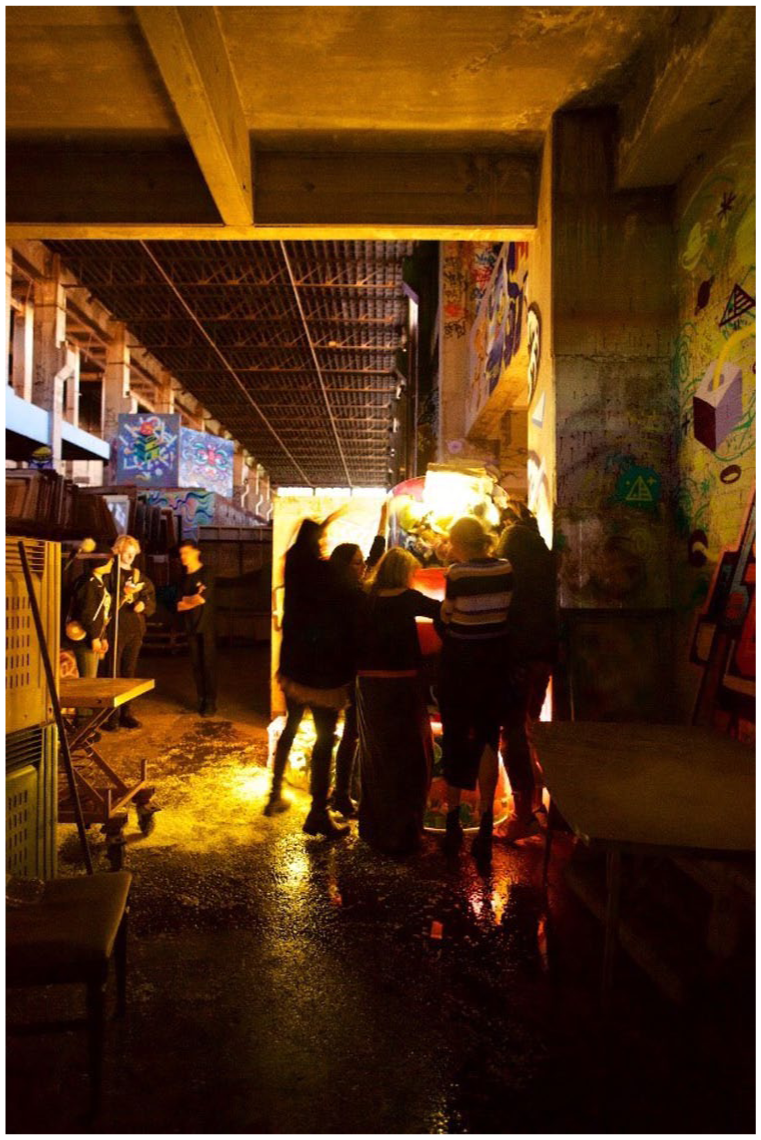
Young People From Tread Collective and Merinda Kelly Perform Counter-Histories in a Takeover of Former Powerhouse B, a Site of Urban Ruination and Participatory Re-Imagining in the City of Djilang (Geelong).
In what follows, we open our discussion in the ruins of Euro-western dialectical history and follow the emergence of counter-historical theory and practice in relation to two foundational events in the genealogy of coloniality: the Middle Passage and Terra Nullius. We elaborate a series of propositions for the counter-historical turn through readings of radical black, Indigenous, and decolonial philosophies of history and their influence on postfoundational scholarship across the humanities, arts, and social sciences. This leads to a more detailed analysis of the affective frequencies of the historical image, using examples from our work with children and young people in conversation with decolonial theorists and counter-historians of the visual archive, including Saidiya Hartman, Ariella Azoulay, and Tina Campt. The article concludes by proposing a trifold approach for navigating the counter-historical turn through affective practices of fragmentary encounter, rupture, and re-assembly, and outlines the recursive challenge this turn poses for postfoundational inquiry in settler colonial contexts.
Counter-Histories and/of the White Possessive
In Australia and the broader Oceanic region from which we are writing, counter-historical scholarship has often focused on the incommensurability between the logic of white possession and continuous histories of intergenerational place-relation which constitute Indigenous sovereignty (Fricker et al., 2024). While the Middle Passage between Africa and the colonies established the infrastructure for modern supply chains, credit–debt relations, and insurance policies through the fungibility of human cargo (Harney & Moten, 2013), the white lie of Terra Nullius enabled the extension of this logistics to every outposted corner of the globe. “Terra nullius” translates from Latin into “land belonging to no one” and was instantiated by British colonizers of Australia in 1835 to legitimize the genocide and dispossession of First Nations peoples from their sovereign Country. Goenpual scholar Aileen Moreton-Robinson (2015) describes how the possessive racial logics at play in the application of terra nullius work circuitously to rationalize possession by invoking white patriarchal Western standards as measures of civilization and astoundingly finding that Indigenous owners of the land do not possess them (p. 68).
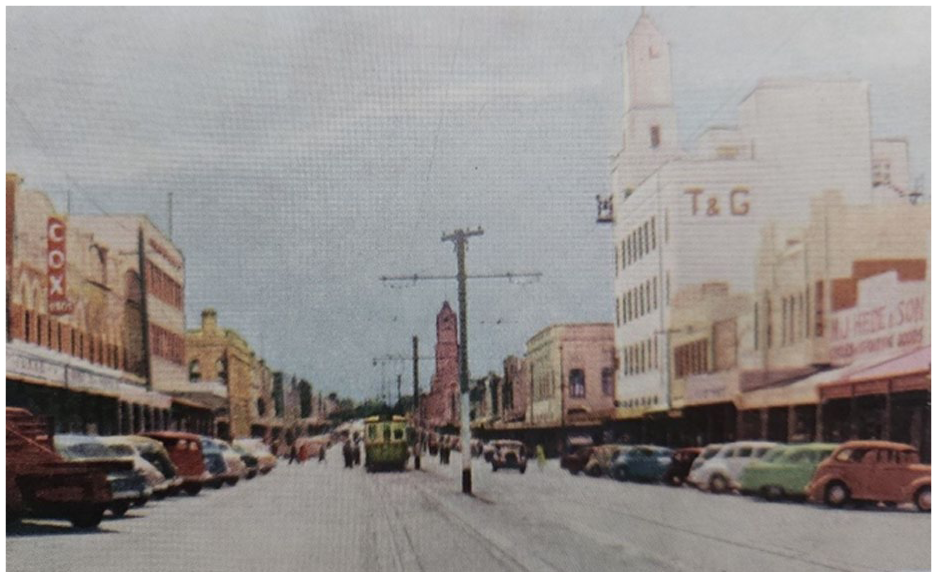
Mid-20th Century Colourised Photograph of Moorabool Street in Djilang (Geelong), a Historic Postcard From Miranda Kelly’s Personal Collection.
Photographic images have played a significant role in sustaining this white possessive logic of imperial expansion and historicization (Lydon, 2020, 2021; Miles, 2020). When establishing colonial Australia in the late 19th century, European photographers framed the landscape as “beautiful, available and empty,” disguising “the ancestral ownership and continuing presence of First Nations peoples, turning their homelands into a wilderness through a photographic sleight of hand” (Hore, 2022). These representations not only perpetuated and circulated the myth of Terra Nullius but created new myths of settler belonging and entitlement. The photographic image was, and continues to be, an example of what Azoulay (2019) calls an “imperial shutter” that severs relations between peoples, histories, and lands. 3 First Nations artists have played a crucial role in challenging the imperial logics through which this severing and repossession of sovereign Indigenous Country has been naturalized (c.f. Briggs, 2021; Corr, 2021; Harkin, 2020; Sheehan, 2011), often working with photographic archives to establish wider public understandings of Indigenous sovereignty as a continuing practice of belonging to the land, rather than one of possessing it.
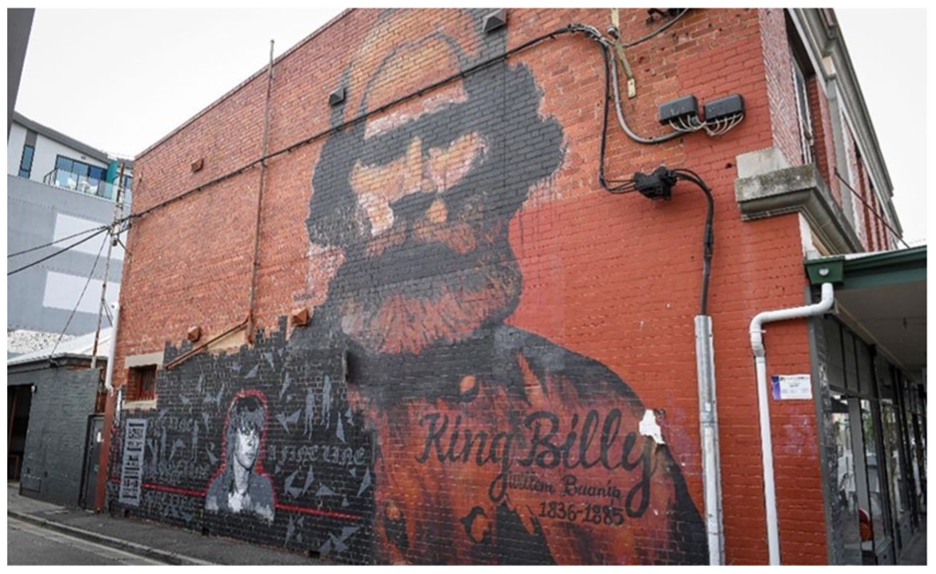
Mural Depicting Wathawurrung Man Willem Baa Niip, Also Known as King Billy, in an Alley Just North of the T & G Building Featured on the Postcard of Geelong.
Our counter-historical work with children and young people has focused on the power of the image in rupturing the colonizing structures and atmospheres of settler archives, institutions, and curricula through which the possessive logic of white modernity is learned (Sriprakash et al., 2022). We take up this irruptive notion of counter-history through a series of photographic ruptures scattered across the sections of the article. These photographic ruptures attempt to exemplify how we have encountered and participated in turns toward the counter-historical in our work with children and young people. Each rupture offers a concrete example of how counter-historical images are constituted. They suggest that historical rupture does not simply entail the replacement of one dialectical interpretation of history with another, but a deeper fragmentation and re-assembly of the logic of sense through which histories are constructed and reproduced (Drabinski, 2019). We offer the rupture as a counter-historical technique which generates partial, incomplete images from the fragments and traces of historical sense, consciousness, and representation (Azoulay, 2019). 4
The Ruins of Dialectical History
Our work with diverse groups of children and young people continuously raises questions about whose histories are (re)produced when Indigenous, migrant-diasporic, and settler peoples come into contact. At stake in the counter-historical turn is a refusal to let the radical plurality of historical inheritances and potentials that arise through these encounters become assimilated into Western History and its universalizing account of Man and his world. The ongoing entanglement of Indigenous, Southern, and diasporic histories with the colonizing histories of the imperial North and West cannot be avoided or simply critiqued from a distance (Rosiek et al., 2020). As researchers, we are both implicated and empowered by the coloniality we loathe but continue to benefit from, attempt to refuse, but find ourselves continually enmeshed with (Shotwell, 2016). This impossibility of escape or transcendence leaves us no choice but to keep working the ruins of history in which we and our young collaborators find ourselves. The critical question, as Maggie MacLure (2011) argued over a decade ago, is how we not only critique or supersede the ruins of coloniality but actively work to bring about the ruination of imperial sense and representation that structures the regimes of legibility through which we are authorized to speak and act.
It is important, I think, for those of us who have advocated, and tried to practice, postfoundational research to keep on questioning how far we have brought about those ruins that we have conjured so many times. If we fail to put that question to ourselves, our ruins risk being merely decorative. A picturesque gloss on the same old edifice. (MacLure, 2011, p. 998)
To move beyond a “merely decorative” engagement with colonial ruins, we need to interrogate the way inherited systems of language and thought are shaped by particular philosophies of history. In systems of thought shaped by the European Enlightenment, history is conceived as study of and about a past which no longer exists. While historians recognize evidential traces and remnants of the past in the present, the past itself is considered nonexistent in any material, empirical, or realist sense. The study of history, in this case, requires consideration of varied ways of conceiving a past reality (ontology) followed by attempts to interpret how that reality was ethically and aesthetically perceived by those who lived in that past (axiology). This in turn informs how western historians conceive historical knowledge (epistemology) and make and interpret histories (methodologies).5
Hegel’s (1861) dialectical materialism remains a powerful catalyst for dominant western views of history, which treats the spatialized actions and thoughts of humans in the past as the proper object of historical inquiry. In the Hegelian view, all history is the history of human thought within circumscribed states and territories, and it is precisely the rational and civilized (morally directed) nature of such thought which gives the past a “sense” to be interpreted as history. For Hegel, rational and civilized thought is predicated on a negative dialectical structure which distinguishes one thing from another through its binary opposition. Marx’s historical materialism builds directly on Hegel’s model, but inserts the dialectical relation of labor and capital as the primary driver of historical action and thought within circumscribed spatializations of time (the nation state, the institution, the factory, the labor union, the protest movement, and so on).
An aberrant thread of process-orientated western philosophy disrupts this dialectical account of history, running from the ancient Stoics through the works of Spinoza, Nietzsche, Bergson, Whitehead, Deleuze, and Guattari (see Grosz, 2017 for a philosophical history). This has produced a range of historical philosophies which diverge wildly from Hegel’s account, emphasizing emergent historical processes arising from more-than-human assemblages of matter and meaning rather than the dialectical interpretation of discrete human actions and thoughts (cf Lampert, 2006). Feminist materialisms have become cutting edges of this work in recent decades, with Rosi Braidotti’s (2017) histories of critical posthuman knowledges and Karen Barad’s (2017) queer quantum histories as prime examples.
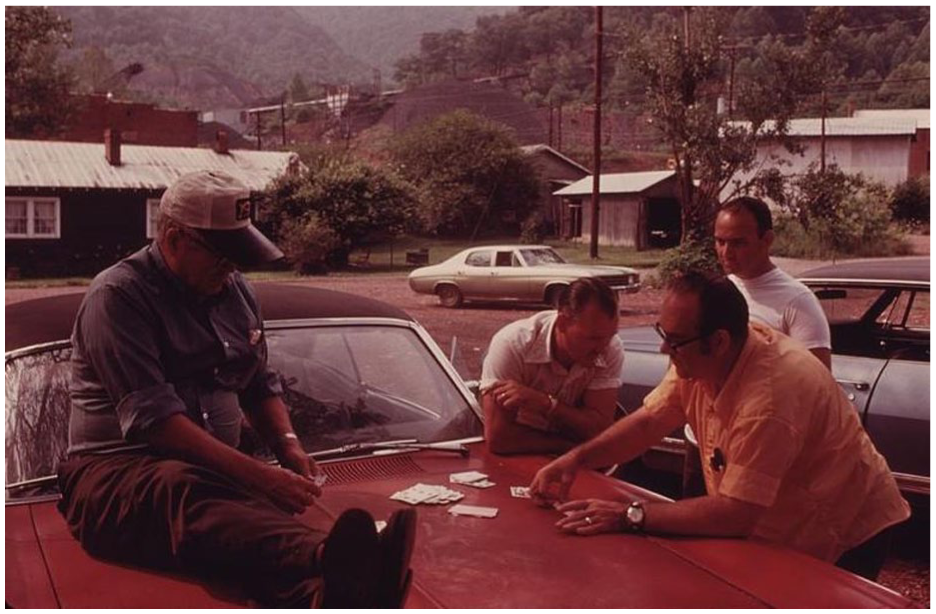
Picket Line at the Brookside Mine Company in Harlan County Kentucky, With Strikers Playing Cards on the Hood of a Car in June, 1974.
Postcolonial and decolonial philosophies also offer significant counter-images of history through a range of nondialectical, counter-intuitive, and poetic means (cf Glissant, 1997; Mbembe, 2023). These philosophies tend to disrupt the formality of dialectical structures as the basis of historical analysis and interpretation, proposing instead an inseparability of histories from the inchoate messiness of life-living. Mbembe (2022), for example, describes the emergence of singular and varied counter-histories across postcolonial Africa from the mid-20th century onwards: Because history was being produced in a unique way each time, the politics of the future— without which there would be no full decolonisation— required the invention of new images of thought. This was only possible if one committed oneself to a long apprenticeship in signs and their modes of encounter with experience— an apprenticeship in the time specific to the sites of life. (p. 3)
The West African philosophy of Sankofa offers an illustration of Mbembe’s view, emphasizing the importance of retrieving collective forms of cultural memory through the ongoing informality of communal life. The Sankofa symbolism of a bird facing backward with feet forward articulates the view that cultural memory and retrieval of knowledge from the past are critical to revisioning the present and future (Odamtten & Getz, 2019; Temple, 2010). Sankofa challenges Western historiographical practice rooted in enlightenment thinking and scientific rationalism as characterized by linear narratives and the idea of historical progress driven by privileged ideological actors (Watson & Wiggan, 2016). This offers an alternative to dialectical historiography by promoting a deformalized approach to understanding history and time and has, in recent decades, acted as a methodological bridge between African, Indigenous, and Afro-Diasporic modes of counter-historical production (Dei, 2012). Central to the Sankofa philosophy is the inclusion of oral histories as sources of historical knowledge which influence cultural and spiritual practices across generations, acknowledging the role of informal social practices in history as a living continuum of relational sense-making and communal memory (Asante, 2007; Temple, 2010).
This relational deformalization of history-making is also central to counter-historical practice within the radical traditions of black activism, music, art, and scholarship in North America (Hartman, 2008; Sharpe, 2016). Harney and Moten (2013) elaborate this radical tradition in The Undercommons, where they locate histories of study in street corners, factory floors, jam sessions, and late-night ramblings of improvised sociality and speculative intellectual experimentation.
When I think about the way we use the term “study.” . . . it’s talking and walking around with other people, working, dancing, suffering, some irreducible convergence of all three, held under the name of speculative practice . . . The point of calling it “study” is to mark that the incessant and irreversible intellectuality of these activities is already present . . . that recognition allows you to access a whole, varied, alternative history of thought. (Moten, in Harney & Moten, 2013, p. 110, emphasis added)
While these informal philosophies of history begin in different places and diverge from one another in important ways, they tend to share a commitment to an apprenticeship with temporal events that connects any single historical moment with all possible others. Rather than seeing history as a linear progression premised on the formality of dialectical distinction, histories are interpreted as improvised encounters scattered across space and time and inseparable from the vicissitudes of life-living. This “whole, varied, alternative history of thought” blows the dialectical regime of signs wide open, not least because it collapses the foundational distinction between human and natural histories inherited from the Enlightenment bifurcation of rationalist idealism from empirical studies of nature. Moreover, without a dialectical structure to regulate the rational and civil interpretation of history as ideological progression, nondialectical histories tend to rely on affective, performative, and intuitive (noncognitive, speculative, divinatory, animistic, poetic) forms of thought to make sense of the inchoate fragments and traces of historical events (Bergson, 1896/2012; Glissant, 1997).
Our proposal for a counter-historical turn both recognizes and calls for research which puts these nondialectical philosophies of history to critical work. While the speculative, ontological, and post qualitative turns have emerged under the influence of nondialectical philosophers such as Deleuze, research emerging from these turns has focused largely on the projection of futures in contradistinction from more conventionally critical projects focused on addressing past harms. J. Palmer et al. (2022) argue against the “haunted future of a white settler society that suppresses or denies knowledge of the ‘founding wound’ of colonial invasion and its ongoing legacy for Indigenous peoples,” a future often predicated on a desire to move on so as to inhabit “new” spaces of aesthetic, political, and intellectual freedom. Decolonial scholars have diagnosed this desire to move on as a key driver of the turn toward posthumanist philosophies over the past three decades (King, 2017), where the disavowal of the “human” in favor of “the new” risks further marginalization of peoples and histories which have not been counted as human (Erasmus, 2020; Wynter, 2003). Posthuman desires for the new potentially foreclose and sidestep the difficult and important work required to unsettle and displace imperial histories, while occluding possibilities for mapping minor correspondences between feminist materialisms (for example) and Indigenous and diasporic philosophies of history rendered pre- or ahistorical by Euro-western logics and systems of thought (Glissant, 1990, p. 64). This relegation of Indigenous peoples to prehistory and diasporic peoples to an ahistorical status (itself a dialectical opposition between rooted and rootless peoples) remains key to the securitization and institutionalization of white futurities (Gilchrist, 2018; Moore, 2024), as elaborated in recent decolonial analyses of “planetary” (Mbembe, 2023) and “post-Anthropocene” (Yusoff, 2018) imaginaries.
Navigating the Counter-Historical Turn
If the counter-historical turn pivots on the refusal of a universal History created according to the dialectical logic of white futurity, it nonetheless re-affirms the critical project of subaltern history-making in addressing contemporary issues of social and planetary justice (Lobo et al., 2024). As a collective of scholars with different geographies and histories of thought, we have struggled to articulate the philosophical contours of the counter-historical turn while resisting the urge to simply correct imperial claims to a universal History with a better version of the past. Our readings of foundational scholarship in the radical black, Indigenous, and decolonial traditions have been critical touchstones for navigating this turn, as have our counter-historical projects with children and young people who bring many different histories of migration, settlement, and place-relation into our work. Over the past year, we have met weekly to discuss our readings of counter-historical scholarship in connection with what we have learned from working with children and young people on related projects over many years. Through these discussions, we have developed five propositions which give navigational definition to our mapping of the counter-historical turn:
counter-histories begin in the ruins of dialectical sense and representation;
counter-histories are inseparable from the cosmologies and geographies of place through which they are produced;
while coloniality has violently severed and fragmented relations with place, counter-histories resist subsumption and explicability under the colonizing image of history;
the fragmentary nature of counter-histories means that affective, intuitive, and poetic methods are required to reassemble, interpret, and make sense of them;
the practice of making counter-histories is radically pluralist and micropolitical in nature, turning on the production of counter-intuitive images and readings of history which continuously redisperse and reassemble the fragments of which they are composed.
We adopt the proposition that all counter-histories begin in ruins from Antillean philosopher and poet Eduard Glissant (1990, 1997), and more recently, the works of Cameroonian historian and philosopher Achilles Mbembe (2022, 2023) and Arabic Jewish political theorist Ariella Azoulay (2019, 2024). For Glissant, the abyssal ruination of sense and representation wrought by the Middle Passage between Africa and the colonies produces a paradoxical fragmentation of dialectical history. Dialectical sense of the past can no longer be made in the wake of this unimaginable trauma. Mbembe (2023) brings this proposition up to the present from an African perspective in his recent work Brutalism, where he argues that the anthropogenic extraction of planetary ecosystems produces a coeval ruination of Earth and subjectivity which is the only legitimate starting point for contemporary historical thought. Azoulay offers an allied argument regarding the politics of counter-histories vis a vis the photographic image. For Azoulay (2024), the photograph is an image cut from historical time through which the ruins of imperial sense and representation are shared.
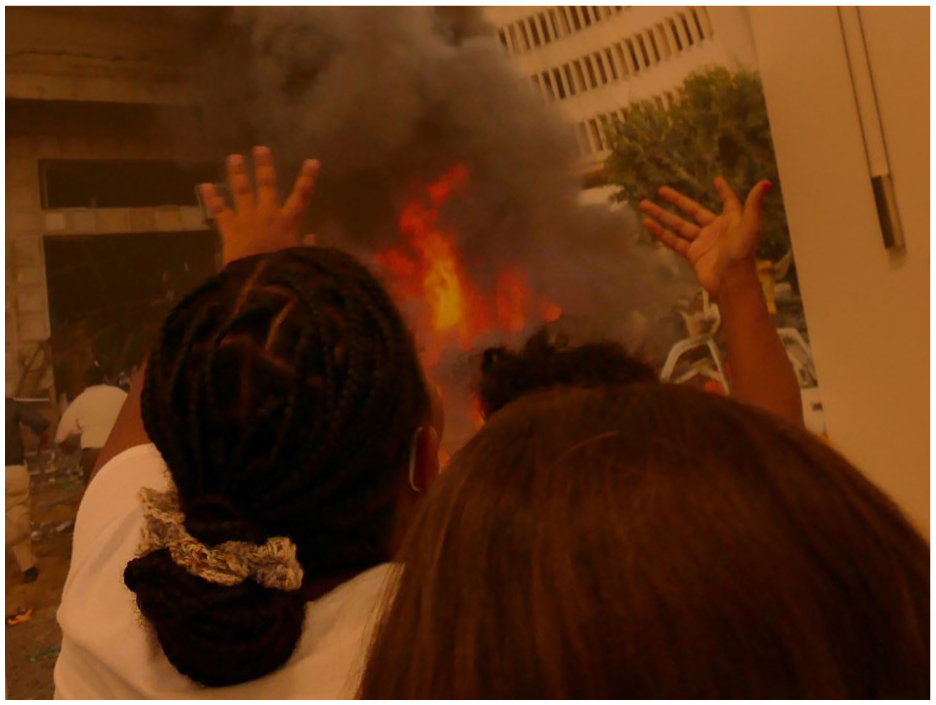
Photograph Taken by Child Researchers During the ‘Sensing Change’ Project With David Rousell and Kelly Hussey-Smith at the National Gallery of Victoria.
For each of these historical thinkers, the obligation for history to begin in trauma and ruination is transformed into a generative rather than a carceral proposition. Glissant’s (1997) abyssal beginnings in the unspeakable horrors of the Middle Passage are relayed into an archipelagic counter-history of a Creolized Earth, moving continuously toward the beckoning horizon of a limitless dispersal and intermixture of planetary geographies, cultures, and languages. Glissant’s inconceivable loss of the past breathes out into a mist of indeterminate futurity. Mbembe (2023) locates Africa as ground zero for the brutalist extraction of Earth and subjectivity which powers modernity. However, he simultaneously argues that the extraordinary “animistic reserves” released by this ungrounding are producing a cosmological “Africanization of the planetary condition.” Azoulay (2019) demonstrates how the photographic archive is a common repository of imperial trauma and loss which nonetheless opens a political potential for the disavowal of imperial histories and temporalities imposed by archival regimes. In each case, an (un)grounding in the shared ruins of thought is a necessary precursor for potential counter-histories to be assembled and lived.
Counter-histories are not revisionist corrections of dialectical History writ large, but ways of inhabiting the parahistorical question of how life can (and might already) be lived otherwise through “the endlessly generative space of the counterintuitive” (Campt, 2017, p. 6). As alluded in the previous sections, we see theories of affect as crucial to the construction of counter-intuitive practices allied to these philosophies. Affect brings awareness to the felt registers of change taking place through the differential passages of historical time (Rousell, Mayes, & Verlie, 2024). By attending to how the internal dimensions of historical events always exceed representational capture, studies of affect have the potential to open historical documents, archives, memories, and practices to the minor histories of shared time, feeling, sociality, and memory (Trafí-Prats, 2024). If futurity is the memory of histories being reconstituted by affective means, then the creation of affective counter-histories is crucial for materializing more just and pluralistic futures in the passing present.
Affective Counter-Histories of the Photograph and Archive
Over the past decade, our varied research with children and young people has employed affective practices of counter-historical inquiry in public galleries, museums, and other institutional archives and collections. In 2017, David Rousell (Author 1) established a collaborative research platform called Local Alternatives for re-imagining urban histories and futures with children and young people (see www.localalternatives.org). The platform has since seeded 15 projects in eight cities across Europe, North America, and the Asia-Pacific region. The Inheriting the Anthropocene project (2019–20) was an early example and prototype emerging from this platform, bringing together a collective of children, researchers, and museum educators to re-imagine the archival and public interfaces of Manchester Museum in the United Kingdom. The project generated a series of affective ruptures and reconfigurations of the museum’s historical collections and public modes of encounter over a 12-month period. Work included a redrawn museum map and “blotwalk” marking spaces of colonial extraction and trauma, wearable coats prompting visitors to rethink their relationships with imperial archives, and interactive sound and video installations which remixed children’s recordings from subterranean museological archives never seen by the public (see Hohti et al., 2023; Rousell et al., 2021).
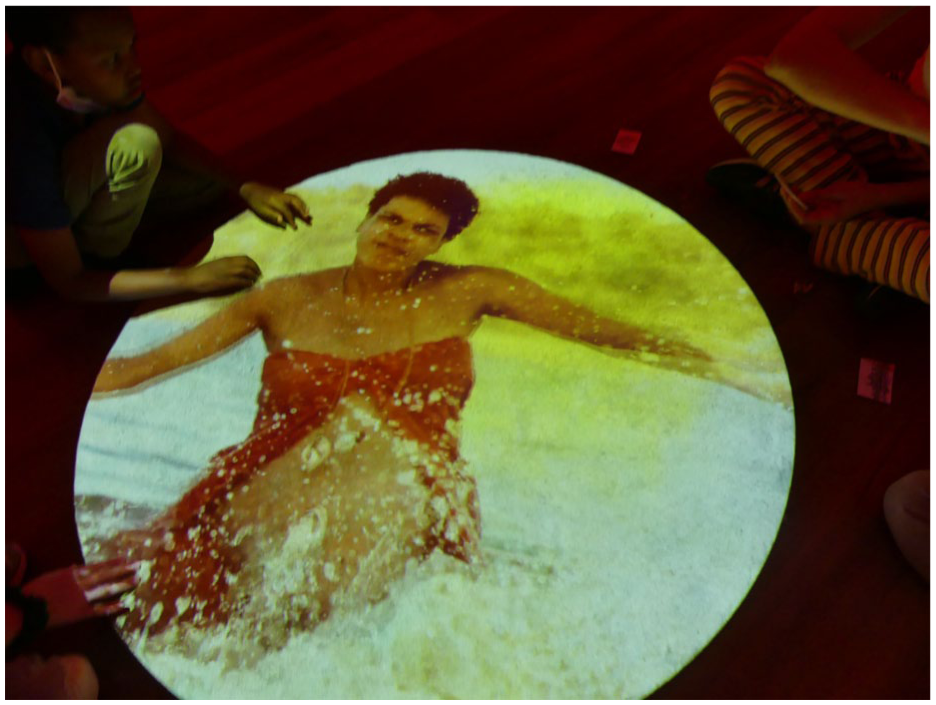
Photograph by a Child Researcher (Age 8) of Hannah Bronte’s Audio-Visual Installation ‘Heala’ in the National Gallery of Victoria, During the ‘Sensing Change’ Project (2022–23) Developed by David Rousell and Kelly Hussey-Smith.
More recently, David has worked on a series of counter-historical projects with Kelly Hussey-Smith and Gideon Boadu focusing on diasporic and Indigenous counter-histories in inner urban Naarm (Melbourne). In the Sensing Change (2022–23) project, children and young people worked as counter-historians in the National Gallery of Victoria as they encountered decolonial and anticolonial artworks. Then, over a 6-month period, they created their own exhibition based on the affects transmitted through these encounters, including paintings, montages, sound works, animations, and video installations exploring war, resource extraction, colonial violence, and the more-than-human relationalities of place (Rousell & Hussey-Smith, 2024). The Sensing Rivers (2023–24) project extended this work with a focus on diasporic and Indigenous relationships with place along Birrarung river, a waterway of great cultural, historical, and spiritual significance for the five language groups of the Eastern Kulin Nation. This involved river walks with Kulin Cultural Custodians, hikes into the river’s upper catchments and tributaries, and workshops for an exhibition called Wild Hope featuring works by contemporary Indigenous artists. A local school also emerged as an important site of historical loss and regeneration following the unexpected demolition and clearing of a community mural and garden marking the seven seasons of the Kulin calendar. In the wake of this loss, children created an immersive installation which made refuge in the curves of the river and gave voice to their relationships with the more-than-human sovereignties of the river.
Miranda Kelly, Eve Mayes, Julianne Moss, and Trevor Mcandless have carried out related counter-historical projects with young people in museums and urban spaces in Djilang (Geelong). Durationally occupying a series of urban ruins with young people in Djilang between 2014–17, Kelly’s New Wilderness Project explored how experimental, social, and more-than-human relational practices can rupture dominant historical narratives and the systemic inequalities they reproduce. Young people aged 18–25 years were invited to participate in a series of artist-run collaborative experiences, workshops, and field trips designed to prompt them to respond in multimodal, creative ways to their rapidly transitioning and de-re-industrializing city of Geelong. Enacted durationally between 2014 and 2017, the New Wilderness Project showed how experimental, social, and more-than-human relational practices and pedagogies can work to disrupt dominant historical narratives and the systemic inequalities they reproduce. Subsequent projects inspired by New Wilderness include youth engagement with the work of Twarlwoolway artist, Julie Gough, whose work subverts colonial collections and archives in museums in Australia and overseas. Gough (in Gough et al., 2016) notes that objects stolen from dispossessed First Nations People from different places and times are often presented in museum collections as “decontextualized,” as “one story reduced, simplified, dissolved,” a practice she asserts as “uncanny, fraudulent, even dangerous” (p. 18). More recently, Kelly, Mayes, and Moss have worked with Djilang-based young people in the National Wool Museum to critically explore the introduction of sheep to Wadawurrung Country and subsequent trampling of Indigenous food staples such as the Murnong Yam daisy (Mayes et al., 2023).
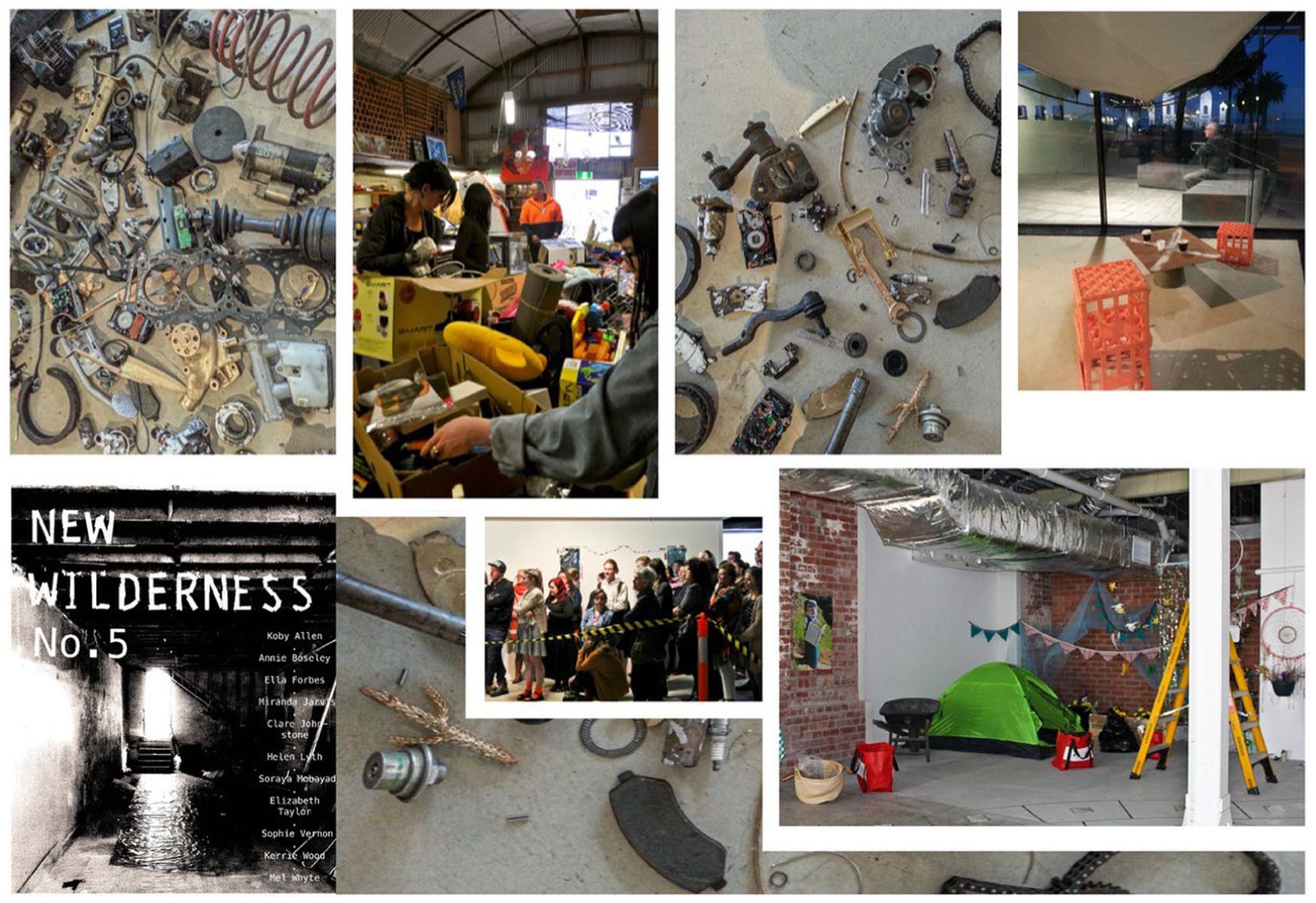
Images From Miranda Kelly’s New Wilderness (2014–17) Multi-Sited Socially Engaged Art Projects With Youth 18–25 Responding Creatively and Critically to Historical Transition and Flux in the De-Re-Industrializing City of Djilang (Geelong).
Across these varied projects, our ongoing work with children and young people has taught us about the centrality of photographs in producing counter-historical images of inquiry and/as creative practice. We have also been inspired by radical black, Indigenous, and decolonial approaches to historiography which have marshaled the speculative powers of the image to reshape the future by transfiguring the past (cf Campt, 2017; Corr, 2021; Fleetwood, 2019; Hartman, 2019). Tina Campt’s (2017) method of listening to photographs by attending to their haptic registers, affective frequencies, and plural temporalities has been particularly influential. Campt describes her method as the production of a sensuous “relief” which enables the felt contours of the historical image to be both sounded and touched. This relief mapping of the historical image juxtaposes the “sonic, haptic, historical, and affective background and foreground through and against which we view photographs” (p. 8). Bending and redispersing Azoulay’s (2010) earlier proposition, Campt urges us to learn how to “watch” photographs rather than “look” at them. Such methods are as much about producing counter-intuitive modes of historical consciousness as they are about retraining perceptual habits of apprehending vibrational frequencies, giving full recognition to the affective power of aesthetic experience in reconstituting the ethics and politics of encounter with historical images.
The photographic archive has also become a significant site of unsettling and re-imagining in black feminist practices of counter-historicization. In Wayward Lives, Beautiful Experiments: Intimate Histories of Social Upheaval (2019), Saidiya Hartman creates a radically reimagined historiography of young black women living in the ghettoized neighborhoods of New York at the turn of the 20th century. Her primary material is a fragmented archive of photographs culled from carceral case files which simultaneously pathologize and exploit these young women as a problem for the state and white society at large. Her method looks to crack open and rewrite the archive through counter-histories which recast these young women as visionaries whose errant experiments with living otherwise set off a minor series of revolutions in radical politics, sexual liberation, and social thought. Her approach utilizes a wide range of multimodal techniques (including dramaturgy, poetics, visuality, haptics, speculation, and fabulation) to draw out fugitive traces of affect that move through the archive while resisting its carceral capture. By reframing early 20th century “ghetto girls” as agents of social upheaval whose “collective endeavor to live free” changed the very image and sense of modern life (p. 24), Hartman constructs an alternate history of the revolutionary social movements that continue to catalyze subaltern political movements to this day.
Hartman’s affective historiography provides a powerful example of the counter-historical turn we are currently navigating in our work with children and young people in museums, schools, archives, and other settler colonial institutions. In her earlier work Lose Your Mother, Hartman (2008) writes that “every generation confronts the task of choosing its past. Inheritances are chosen as much as they are passed on” (p. 100). We are similarly invested in how children and young people learn to choose their pasts from the fragments of histories they have inherited (Hohti et al., 2023), and specifically, the role of photographic practices and archives as a concrete and empirical means for doing this affective work. As Aislinn O’Donnell (2022) writes, “images circulate and produce different kinds of affective lives and experience, depending on stories, lived experiences, intersections, and histories of different bodies within the social body” (p. 2). By reassembling the dispersed fragments and traces of historical time, images become vectors of affective transmission for a historical consciousness arising from richly variegated geographies of feeling and thought (Drabinski, 2019). Attending to these affective dynamics of the image has particular urgency for settlers and migrants like us, for whom the question of when, where, and how it is appropriate to take or engage with a photograph requires constant sensitization to very present histories of loss and survivance on stolen Indigenous lands.
Conclusion: Fragmentary Encounter, Rupture, Re-Assembly
This article offers an initial mapping and a set of navigational contours for a counter-historical turn in postfoundational qualitative inquiry. This turn does not seek to correct universal History or set the record straight, but to rebegin the very question of what history is, and how it is made, at the crossroads where different geographies of cosmological time, place, and experience meet. It is important to note that what we describe as the counter-historical turn is by no means an unprecedented phenomenon or a new scholarly trend. What we name as the counter-historical has been given many other names, in many other places and times, where it finds expression whenever people gather to make their own histories from the affective fragments and traces of events. The counter-historical turn maps a different way of answering Deleuze and Guattari’s (1994) call for work which addresses a people to come who are also the missing peoples (never solely or even primarily human) so often occluded in turns to the speculative, the ontological, and the post qualitive (Braidotti, 2020). The children and young people we work with in Naarm (Melbourne) and Djilang (Geelong) are among those whose histories are missing, but they are also among those with the potential to choose and make histories in ways that will inevitably come to generationally define the futures of their cities.
Over the course of this article, we have elaborated three connected processes of doing counter-historical work. First, we have suggested that counter-histories begin at the nexus of dispersed and fragmentary encounters between differential cosmologies and geographies of thought. Second, we have proposed the figure of the rupture as a technique which unsettles linear inheritances of history as the dialectical apprehension of a universal past. It is through rupture that we become capable of rebeginning the process of making history again and again, each time opening possibilities for affects to be circulated anew through fragments and traces of the past. Third, we have articulated practices of re-assembly through which photographs, archives, and other remnants of the past are brought together to produce new and different images of history. By creating new images of history, we also create new circuits for affect to time travel, transforming counter-historical apprehensions of the past into alternate memories of the future (Rousell et al., 2025).
In considering the intercessions of these three techniques into one another, it becomes apparent that the middling, nondirectional status of the rupture retains significant agency. Akin to a break, lapse, suspension, or reset of historical time, the rupture throws the chronological sequencing of historical events up in the air and waits to see where they might fall. A stabilized image of history such as a photograph is re-encountered as fragmentary and transitory, unsettling the perceived facticity of the image as evidence of a past that no longer exists. We can never know in advance where the rupture will land us or what image of history it will carry through this encounter. The rupture may just as well take us back to dialectics and other grand narratives of universal History as forge new pathways into subaltern and creolized historical reroutings. We are reminded of the inseparability of minor counter-histories from the monolithic histories they unsettle and displace. If universal History is a wall of self-supporting stones that compose a bounded territory, then counter-histories are the weeds that grow in the cracks. The cracks don’t exist without the wall, but when the cracks become ruptures and the wall crumbles down, we have no choice but to rebegin the task of making histories again and again.
Footnotes
Declaration of Conflicting Interests
The authors declared no potential conflicts of interest with respect to the research, authorship, and/or publication of this article.
Funding
The authors received no financial support for the research, authorship, and/or publication of this article.
