




Abstract
Anti-Blackness, as a sociopolitical matrix, fails to acknowledge Black livingness, necessitating a departure from traditional representational modalities to engage with Black “living” in its fullness. Black aesthetics emerge as imaginative spaces, inspiring change and expansiveness, challenging normativity by centering Blackness. Mikael Owunna embodies this tradition, melding visual media, engineering, and African cosmologies in projects like Infinite Essence. By illuminating Black bodies in darkness, Owunna disrupts notions of Blackness as void, offering a method to envision Blackness beyond racialized and colonial violence. This conceptual exploration foregrounds Black methodology. Specifically, Owunna’s process illuminates several dimensions, or what I refer to as commitments, for taking up Black aesthetics as artful inquiry in research practices that I denote as forecasting, shuttering, tenderness, and gravitation.
To encounter aesthetic production by Black artists is to step into Black worlds, art that talks back to power, “talks around and in between its silences and absences” (Campt, 2021, p. 5). Whereas anti-Blackness as a sociopolitical matrix cannot assume Black livingness (McKittrick, 2021; Quashie, 2021), those who desire to attend to something called Black “living” must do so in excess of traditional representational modalities and frames. In this way, Black aesthetics enter as methodological otherwise—a capacity to inspire and curate change, to be, explore, and imagine something else and elsewhere, to live expansively, and more fully—militating against the normative world by first stepping outside of it in the figurative sense, and beginning from Blackness in the literal. More pointedly, the methodology otherwise engendered by, with, through, and in Black aesthetics is a form of artful inquiry, a mode of thinking that shifts how we know, do, encounter, and orient to inquiry. The tradition of artful inquiry as a provocation of ‘how’” is consistent with the genealogy of Black aesthetics as a method of talking back to power. Stretching from the Harlem Renaissance to the Black Arts movement of the 1960s and 1970s, Black poets, writers, and musicians were involved in art-making that affirmed the complexity of Black living. Precisely, Black artists compelled the public to grapple with the question, what does it mean to see through the complex positionalities of Blackness and to work through the implications of Black being therein? Artist and engineer Mikael Owunna exemplifies this tradition as he works at the nexus of visual media and engineering, optics, Blackness, and African cosmologies. In the Infinite Essence project, he sees in the dark, which is to say, he turns off the lights.
With this series, I’ve set about on a quest to recast the Black body as the cosmos and eternal. I hand paint the models’ bodies with fluorescent paints and using my engineering background I have augmented a standard flash with an ultraviolet bandpass filter, to only pass ultraviolet light. Using this method, in total darkness, I click down on the shutter. (Nicole, 2021, para. 5)
By setting Blackness as the condition for viewing (i.e., total darkness), for a fraction of a second or otherwise, dark bodies are iridescent, as Owunna introduces a method for thinking and being Black in excess of the violent domination of no-thingness. This conceptual exploration is concerned with that fraction of a second as a question of how. From the space of Blackness as invention, worlds are made/constructed and possible, over and against the colonial violence that intended to strip Blackness of meaning-making potentialities. I observe in Owunna’s approach the essence of Black methodology (McKittrick, 2017), or methodology that begins in, and dreams in Black, in that “the dynamism between our biological selves (our flesh, our blood, our hearts, our muscles, and neurons) and the stories we tell about ourselves about our identities and our sense of place” (Prescod-Weinstein, 2021, para. 12) become praxis for living and doing freedom. In this way, Black aesthetics as artful inquiry, beginning in and from elsewhere, enables us to say and do something otherwise different in research practice; as artful inquiry, Black aesthetics compel an affective rendering that makes available more ethical ways to be in relation with the complexity of Black living. And so, as Black aesthetics shift how we see, I sit with Owunna’s art-making, and the elaborations of artful inquiry as a process that it provokes to consider the ways Black aesthetics invites researchers to differently orient, encounter, and move in their inquiry processes.
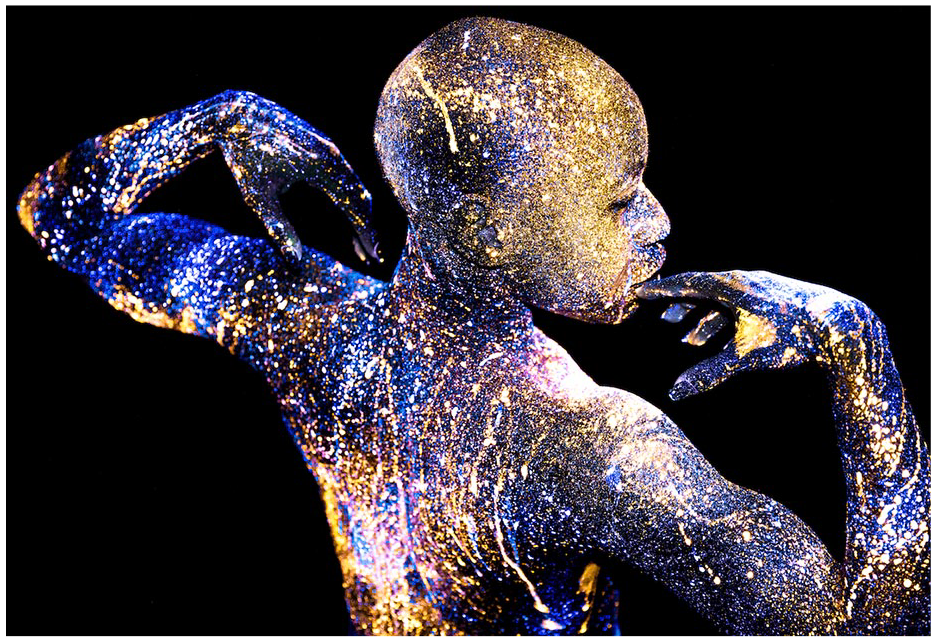
Nommo Semi, Guardian of Space by Mikael Owunna. Used With Permission of the Artist.
Out of this World: A Genealogical Tracing of Blackness
The methodological project of knowledge production is governed by modes of knowing that are overdetermined normative frames of sight, otherwise understood as reason, which is to say that society is structured by the logics of universal reason. The dominant and overlapping epistemology that was forged at the nexus of colonial ambition, imperialism, and transatlantic enslavement codified Blackness as that which held no recognizable value; it is a directive that understands that the “New World unorders the relationship of the human to place, time, [and] other humans[s]” (Quashie, 2021, p. 13). On this premise, uneven power relations enclosed Black being, subjecting Black people to dispossession, fungibility, and product in the service of accumulation—non personhood (Weheliye, 2014). This equation would be the defining feature of the biocentric order and racial economy, recursive insofar as society was disciplined, auto-arranged, to reproduce anti-Black violence, or the world of anti-Blackness excludes the possibility of Black humanity. One should read that reproduction as epistemic, informing physiological, neurobiological, psychic, and affective responses to Blackness. On these terms, Blackness is of alienation—outside of the world of Western humanism—historically and geographically (McKittrick, 2006; Patterson, 1982; Wynter, n.d.).
Alienation provides the grounds for different types of noticing, one that brings into view creative activities that reconstitute Black being in alienation. We might say, then, that the architecture of the New World ejects Black people from it, and yet, the total negation of Blackness, ontological terror (Warren, 2018) was not, and does not evacuate the vibrational ethic (always movement) that is Black flesh. The routine and quotidian, everyday instantiations of disregard produce a desire, a necessity for existing outside of this world–otherwise (Crawley, 2017). This work, the “unwriting of our present normative defining” of the World (Wynter, 1984, p. 22) is not facilitated by the terror that calls it into existence. That is, Blackness is of more than the terror which beckons and attempts to shape its ends; rather it is the rich remainder. To get beyond the world, to call forth different worlds, we must end the modes of thought that think the world; we must think artfully—as flight, activity, loophole of retreat, and marooning.
imagine a world a Black world fluorescence and incandescent, oscillating between never been and every orbits possibility i want a world a Black world out of this world cosmic escape, free of capture and raptures, where flight is routine, and death has no sting.
While “the active violence in reality distracts us from knowing it,” there is a creative, poetic force that courses, shivers, and rambles about in the depths of our being (Glissant, 1990, p. 159). That force resonates with what Spillers (1987) called the flesh. Black flesh (i.e., the instinct for otherwise) is not reducible to the realities of terror. I am thinking here of the ways artful inquiry, as a mode of thinking, believes that there is more—however small, fragile, undocumented, or wholly ignored (Hartman, 2008, 2019). Where the Western order of knowledge is epistemically affixed to Black objecthood and absence, artful inquiry motions for a what else (Okello, 2024a, 2024b); it is “an alternative instantiation of humanity” that does not rely on Western conceptions of knowing and being. If, following Spillers (1987), the flesh is prior, before the current predicament, and always, the grounds by which liveliness and living occur, then a capacious rendering of Blackness might understand it as hinged to the liberatory demands of ongoing movement, refusal, and beating restiveness. Blackness, here, refuses to be still, is still moving, still loving, still dancing, and doing joy. Or, the impulse of Blackness, indeed, the inward pulse of Blackness exemplifies artful inquiry, is toward otherwise—creative activities—radical performance practices of being, illuminations of humanity, and a set of conditions—poems, fictional tales, dances, and music making (McKittrick, 2021)—and practices that enunciate Black being.
As McKittrick (2021) noted, “what the creative text is, does not matter as much as what it does” (p. 58). So, more than resolution, or seeking to reconcile the epistemic tensions of living in the current order of knowledge as constructed by Western humanistic protocols, following artful inquiry, theorizing process—how, over what—can expose the limitations of Western knowledge production, while making explicit otherwise possibilities located in the complex dimensionality of art and aesthetics (Osei-Kofi, 2013).
Furthermore, whereas legitimate knowledge is often tethered to white logics and methods, artful inquiry invites considerations of knowing that exceed authoritative claims and frames. Shifting how we see might begin from an elsewhere staged by otherwise lines of inquiry, such as what are the philosophical assumptions directing how we come to know? How might we undo, unthink the categories of thought, of Blackness, anchored in scientific reason and Western humanistic framings of knowledge production that define the contours of what counts as legitimate knowledge and knowing? Might a different conceptualization of how to know, an epistemic departure, usher in an otherwise ethical mandate? Herein, Blackness enters as otherwise praxis, enabling a genre of looking that refuses the tools of reason and instead reaches for futures and worlds not yet (Campt, 2017; da Silva, 2014). A methodological otherwise, thus, is an orientation, an insistence on looking for and locating methods of being and doing.
In the work of Black artists, artful inquiry is more than opposition, or the rejection of something; rather, artful inquiry engenders a creative, otherwise expansive vocabulary for theorizing the quotidian, everyday practices of doing. Artful inquiry undoes grammars of the present, constitutive of acts or actions; it is a practice insofar as it is honed by those socially dispossessed in the service of critiquing Western humanism’s overemphasis on rationality, objectivity, and linearity, and setting for Black futurity. By setting, I am thinking of both geographies, as the space or positioning of an occurrence, and setting as a particular set of arrangements that make something possible, or likely to occur. In these ways, Black aesthetics as otherwise—artful inquiry—can orient researchers toward praxes of liberation.
Black Aesthetics as Otherwise
One way of understanding Owunna’s approach to otherwise seeing, to noticing that which escapes to and beyond the gravity of this world, is through Black aesthetic tools. Following Ferreira da Silva (2014), Black aesthetics can announce a “range of possibilities for knowing, doing, and existing” (p. 81) over and above constructions of Man-as-human, and thereby knowledge production and being (Wynter, 2003, 2006). Taking up the task of Black Study (Harney & Moten, 2013), Black aesthetics is concerned with dismantling Western thought and reason, and in doing so, necessitates an understanding of Blackness as that which epistemically organizes society. More specifically, Black aesthetics takes seriously the ways Blackness has been deployed as a social, political, and economic amalgam that structures humanity. As noted, this structuring confirms Black subjugation as affectively and psychologically normal. Thus, Black aesthetics engender a “deciphering practice” that recognizes the tendency to read and represent Black people in relation to racialized and colonial violence and refuses those instantiations as the sum of Black living (King, 1992).
As a deciphering practice, Black aesthetics labor to creatively make visible the multiple and varied ways that Black people refuse anti-Black disregard (McKittrick, 2017). They are “freedom-making practices” that, while tethered to anti-Blackness, model an otherwise reading practice that allows us to locate methods of living, doing, and imagining the world; it is laboring to paint as full a story as possible within constraint (McKittrick, 2017). In research and methodological practice, this nuance marks an important ethical break from extractive tendencies that, too often, advance recursive racialized and colonial logics; instead, Black aesthetics function as sites of memory, learning, and study. Differently situated, Black aesthetics assist in narrating that which exceeds the lens of capture, taking up “stories and ideas” in the service of Black futurity (McKittrick, 2017, p. 10). Within these stories and ideas, in, across, and beyond dominant systems of knowledge, are coordinates for otherwise living. Moreover, Black aesthetics contextualize and uncover the range and multiple dimensions of Black living—the contradictions, layers, and tensions, terribleness, and beauty—that offer us, its viewers, clues about living in the world.
Black aesthetics as artful inquiry cohere on notions of the process for the purpose of annotating the ethical question of “how to be,” or how do we exist in the now and into the future (Okello, 2024a)? I am drawn, then, to what Black aesthetics allows us to see and brings into view as they move between instances of clarity and purposeful opacity, to lift self-defining praxes. Said another way, oscillating between clarity and opacity is reflective of the contours of Black being, that might signal ways of plotting, planning, and inventing otherwise worlds, Black worlds.
Black Aesthetics as Artful Worldmaking
Black aesthetics as artful inquiry exists within and outside of the racialized and colonial imagination indexes what Quashie (2021) so astutely referenced as Black worldmaking. Staging Black worlds as a question of science is elusive and demands a different set of tools than those used by physicists. The latter might suggest the following when describing the cosmos: in the beginning, there may have been no beginning. The spacetime that humanity calls its universe may in fact be one bubble of an infinite number of bubbles, all of which may be inaccessible to us except for the one we’re in. (Prescod-Weinstein, 2021, p. 74)
The invocation of and to a Black world is an invitation to imagine Blackness as totality, and to remark on the ways Black people have called upon new worlds to supersede the ways Blackness is so readily linked to death. The idiom of a Black world is where there is no for or against being, Blackness can just be. These worlds presume a sense of presence and presentness with Black perspectives, an effort to understand the world through the eyes of Black communities. A Black world is “compassed by being alive, where aliveness sets the parameters for understanding loss, pain, belonging, for countenancing love, grace, healing” (Quashie, 2021, p. 10). In being alive, Black worlds are making definitive claims about what it means to be outside of the logics of anti-Blackness. Or, Black aesthetics are putting forth working definitions of how to be in a world that is “free of air”—existing in the throes of anti-Black antagonism as the constant and unrelenting social, political, and economic threat—and yet “full of ways to breathe” (Quashie, 2021, p. 11). Black worlds are of heterogeneity, difference, and possibility, without surrendering to fixity and enclosure. There is, in this space, the expectation of multiplicity and iteration and range, held together by relationality—“a mode of experiencing ourselves in which every mode of being human, every form of life that has ever been ever enacted, is a part of us” (Wynter & Scott, 2000, pp. 196–197). Mikael Owunna’s Infinite Essence series is a Black World.
Black Aesthetic Methodological Groundings
To bear witness to Infinite Essence may invite questions about the formation of galaxies and worlds and how they are brought into view. Turning briefly to physics, we know that nuclear chain reactions “light up the universe in many frequencies, including those frequencies that the human eye was later tuned to, which is what we call the visible” (Prescod-Weinstein, 2021, p. 83). Furthermore, because the “infrared spectrum is a set of wavelengths just outside of what is visible to the human eye” (p. 88), critical tools and processes are necessary to detect the luminosity of the universe. Returning to Owunna’s Infinite Essence series on the premise that Black aesthetics are a critical tool for calling forth Black worlds, to view the photographs is to be transported by what physicists term spectroscopy, the practice of breaking light down into various frequencies. In this domain, taking stars, for example, examining the frequency of visible light and light that is missing from a spectrum, is telling of what elements are present in stars. While an in-depth explanation of observational astronomy and cosmology is beyond the scope of this paper, the interaction between light and matter offers important insights for Black methodology (McKittrick, 2017, 2021). Analytically working with this collision of light and matter in the ways I am thinking draws inspiration from what Ferreira da Silva (2017, 2018) discussed as Blacklight.
Working through that fraction of a second as a question of how Blacklight becomes a useful heuristic because of what it makes known and available to visible worlds. Specifically, one way of thinking about Blacklight is by its potential as a modality for un/thinking, storying, and re/telling on the assumption that matters/objects at hand have meanings that exceed capture, or that are represented by the traditional logics and the order of knowledge that structures knowing. In other words, what and how of something—its materiality—legitimates a different frame for detecting its fullness. Thus, a process concerned about compositions can bring clarity to the composite structure, or the myriad elements that compose its representation—its knowability. According to Ferreira da Silva (2018), Blacklight dissolve[s] determinacy, which grounds the Kantian rendering of aesthetic judgment, shifting the focus to the elusive, the unclear, the uncertain—the scent—thereby making it possible to dislodge sequentially and expose the deeper (virtual) correspondence comprehended (but not extinguished) by the abstract forms of modern thought. (para. 1)
Deploying Blacklight as a tool “dissolves determinacy,” or the fixity imposed on an object or thing by history or sociopolitical conditions. Whereas Blackness is anagrammatical (Sharpe, 2016) and fundamentally changes the meaning of terms—old meanings fall way, and new definitions proliferate—qualitatively, Blacklight enters, perhaps, as an interlocutor—a partner in study that listens to and for the unsaid, the understated, and overemphasized—and, in doing so, causes the subtle, undetected elements of a thing to be visible. I am drawn to the ways Blacklight, as ultraviolet radiations, encounter, work through, and represent an object, such that the object illuminates more of what it is, and less of what is imposed onto it. Blacklight, at a molecular level, is absorbed and re-emitted at a different frequency (da Silva, 2017, 2018). Whereas Black people are uncritically associated with dark matter—that which light does not absorb or engage with the electromagnetic field; difficult to locate; fleeting, if recognizable at all—Blacklight as a Black aesthetic mechanism proposes a different reading that is able to name the onto-epistemological frames of reason that strain the ability to see normative anti-Black frames. Once extricated, reflection on Blackness can be “released to the imagination” (da Silva, 2017, p. 251). More precisely, Blackness can render its own offerings, its infinite essence, a sentiment that affirms astrophysicist Prescod-Weinstein’s (2021) claim that Black people are “luminous matter” (p. 129).
Black Aesthetic Commitments
An orientation to the luminosity of Blackness untethered from the damning definitions of Western humanism that figure Blackness as dark matter, removed from the scripts of personhood, necessitates a Blacklight type viewing practice exemplified by Owunna. In what follows, I think with Owunna to outline the various doings of Black Aesthetics as methodological gaze shifting (Callier & Hill, 2019; Campt, 2021)—artful inquiry. Specifically, Owunna’s process illuminates several dimensions, or what I refer to as commitments for taking up Black aesthetics as artful inquiry that I denote as forecasting, shuttering, tenderness, and gravitation.
Forecasting
To pursue the Infinite Essence project, Owunna detailed part of his how as a matter of setting the conditions for photography. One way of interpreting this process is as a cutting through the ever-evolving atmospheric conditions of the anti-Black visual field that dominates representations of Blackness and Black people, and consequently, relegates Black liveliness to the plane of the unseen and unthought. For this reason, we must adjust how we see. Elsewhere I have discussed the ways endarkenment can help set the conditions for otherwise ways of knowing (see Okello, 2024a). Theorizing with what Dillard (2000) discussed as endarkenment, there is a “distinguishable difference in cultural standpoint” (p. 662) concerning the lives of African ascendant people that shapes and ought to be central to how inquiry unfolds. I read endarkenment, as a project of specificity, a political work that calls forth qualities of aliveness that are unrecognizable in the glare of protocols that bend to rationality and objectivity. Owunna’s process, thus, reckons with atmospheric conditions as enduring and ever-present, by forecasting, or, he anticipates the anti-Black climate and makes provocations, preparations for new ecological possibilities.
Whereas weather conditions call for improvisation, Owunna fluorescently coats Black bodies, which is to say he gathers materials, and devises principles for negotiating precarity. Forecasting, as a doing of artful inquiry, insofar as it possible, accounts for what is known—temperature, cloudiness, exposure, moisture—and for what cannot be known—shifts in patterns, afterlives of patterns. In this way, one is not simply responding to the conditions; rather, it’s the refusal to wait and see, as the conditions become a palpable foreground, felt, and animating component to inquiry.
More to the point, Owunna, again, coheres more-than-human optics of and for looking by adjusting the flash. Importantly, augmenting the flash is a specific fidgeting to allow for a particular set of conditions to unfold. Forecasting, too, is the activity of determination, as artful inquirers make decisions about how much, or little, of the self, the scene, background, vibration, and sonicity (to name a few considerations) might pass through a project. On these terms, the possibility of Infinite Essence is the relationship between the specificity of the flash and the responsiveness of (the) shutter. In research practice, artful forecasting might ask, how can we augment the proverbial flash to allow for particularities to unfold in the inquiry processes? Wherein we are enmeshed in unpredictable atmospheric conditions, how can we incorporate improvisational tactics to prepare for and be responsive to the shifting climate?
Shutter
If the series is conjured first by forecasting, setting the conditions of possibility with an immersive exploration of Black knowledge systems, then it is materialized—made to appear in its splendor, density, and cosmic grandeur—by the activity of (the) shutter. The shutter in photography is the cover that hinges over the lens. On its hinges, it is malleable, able to and expected to move when triggered to do so. Practically, the shutter constitutes an opening, or is the passage one might understand as leading to an opening, the door between light and opacity. Importantly, I understand opacity as a filtering method that reveals, as necessary, lessons and clues about “how to be” in the world (McKittrick, 2021). The shutter, working in unison with the augmented flash, foregrounds an ethic that says, if we are to create seeing, to be known in public or otherwise, then let it be on our terms. Enacting a temporal shift, the shuttering movement, is an exercise in durationality—the time in which something continues. What occurs in a fraction of a second has implications for futures not yet; they are “testaments,” according to Owunna (2023), of a lived reality—that something was and is here. It is the material essence of what Campt (2017) called a Black feminist tense of futurity, a future real conditional tense that considers how one might live the future in the present. Owunna’s process, perhaps, is an invitation to think about the infinite—possibility and time unbounded—as accessible in the quotidian, everyday acts of noticing otherwise. That is, what’s created in small durations, can be infinite, interrupting our sense of time and space as it relates to methodological processes.
Owunna’s process also draws our attention to an ethics of care. The viewing practice is one that resists consumption, looking upon Black bodies as objects of capture (read: the ledger, cargo, data points). This process reveals the nuance of Black visual practices. It focuses on the dynamic and creative expressions, both obvious and subtle, of Black individuals. These expressions counteract the tendency to capture, control, and define Black people (see Harris, 1993). In research practices, considering artful shuttering, as activity of duration, might ask how our understandings of time and space are impacting our methodological processes. Furthermore, how might researchers resist consumption and the objectification of Black life, and, instead, pursue (visual) practices that desire to honor an individual’s expression and opacity?
Tenderness
Before the flash, and before the shutter, there is the looking. One could agree that the moment of transfiguration occurs on the back end of the process, after the flash, and in line with the shutter. As a motion for methodological ethics that courses from the moment of ideation through each step in method, Owunna’s artful inquiry process defamiliarizes a familiar qualitative theme, which is the act of looking (see Callier & Hill, 2019; Campt, 2017). Owunna asks us to do more than simply see; he invites us to dance, to reach, glide, push, leap, to sit and ponder, to be. It is a method of tender looking that accounts for specificity—details, line, points of insignificance, the excess; it is a politics of looking that reorients the viewer to optics of looking at, and toward a process of “looking with, through, and alongside” (Campt, 2021, p. 8). Tenderness, here, is a form of gentleness, as the opposite of harsh, rigid, or coarse; instead, tenderness is a delicate beholding, compassionate, and sensitive to the muted and expressed desires of Black liveliness and living; tender is akin to humane and responsive, and kind, and caring; tenderness, as Owunna teaches is a modality of attentiveness that is attuned to Black desire. It is a mode of patient composition that is concerned with how we are with the ones we are in process with. Otherwise stated, tenderness is a form of presencing, a method of being with. Following, Campt (2021), there is a degree of slowness instantiated by tenderness that begs for a different ethical orientation, one that asks that we look, and care, and notice otherwise at the onset and throughout our methodological process. Whereas tenderness, as artful inquiry, is a pursuit, to take up tenderness artfully in qualitative research practice, might ask, in what ways can we reorient our foci from observation to looking with, through, and alongside those we are in relationship with? Moreover, how can we cultivate an approach to patient composition that is attuned to the specificities and excesses of data and analysis?
Gravitation
The universe is composed of forces pulling and pushing. It is the force of gravity that pulls an object toward the earth’s center; gravity is the “force by which all things with mass and energy are brought toward one another” (Campt, 2021, p. 52). We might then understand gravitation as the attraction between objects, as gravitational force depends on the space between objects. To be sure, Owunna’s tender looking is instructive for how inquirers might approach artful processes, but it is gravitation that responds to the question of how to produce work in the service of larger commitments. Owunna’s process has an afterlife with an orbit and gravitational pull all its own.
Here, Owunna takes up Blackness as that which enables one to sharpen their focus on a principle subject, here, the luminosity of Black being. Gravitation, therefore, is consistent with what the labor of redaction as operationalized by Sharpe (2016). Redaction builds on the notion of editing a text, or obscure portions of a text. For Sharpe, redactions are tools that enable cultural workers to bring other ideas into sharper relief. Or, the act of blotting out engenders a different kind of looking. Owunna’s process assumes that Black being maintains a dynamic gravitational pull, and, what’s more, the project is an offering of Black interiority—that which exists but is not accessible to the white gaze—to Black subjects. The process does not center on white subjectivity, which is not an inversion, but a departure from white logic and methodological frames, effectively positioning whiteness as “neither subject nor recipient” (Campt, 2021, p. 74) of the forces pulling inward into Blackness. Regarding gravitation artfully in research practices might ask, how can redaction be deployed to bring other elements into sharper relief? One might also consider how a shift away from whiteness as neither subject nor recipient can be operationalized across the research process?
Infinite Essence: Toward Artful Inquiry as Praxis
For Owunna, the question that instructed what would ultimately become his methodological process, was “how can I transfigure Black bodies from sites of death and state violence into transcendent forms, into vessels of eternal, cosmic life?” (Humble Arts Foundation, 2020, para. 8). Black aesthetics as artful inquiry is an invitation to creatively rework the terms that have come to define what it means to be human. I understand this reworking to be a praxis of working out, of practicing “how to be,” and more specifically, “how to do.” Owunna offered some details on such a praxis: I began by experimenting with light painting. I would stage my camera on a long exposure and stream lights around them. This created energetic auras around the figures but did not transfigure the bodies themselves. Seeking to transform the body, I turned then to projectors and projected patterns . . . In both instances, I failed to produce images that resonated as responses to my original question. I turned to my childhood to seek additional inspiration . . . This unleashed a tidal wave of ideation beginning with glow-in-the-dark paints, followed by—ultimately—fluorescent paints paired with ultraviolet light . . . This entire process unfolded over the course of several months of serial testing and experimentation. I then spent several more months experimenting with painting techniques, from tribal paints to the celestial forms we now see.
For the researcher, the immediacy of Owunna’s question is paramount. It is in the clarity, the resolve to commit oneself to expressions of Black living that exceed normative lenses and protocols of social science inquirers, that exemplify the how of artful inquiry. Black aesthetic commitments, detailed above as forecasting, shuttering, tenderness, and gravitation provide methodological considerations for taking up Black aesthetics as artful inquiry in methodological practice. As methodological principles and anchors, doing Black aesthetics, necessitates praxis. By praxis, I am referring to wayward, nonlinear, and iterative doings that keep at center unrelenting decisions (commitments) to seeing that which does not readily appear because of how researchers are socialized, and the normative discourses that would undo critical seeing in research processes. Praxis does more than acknowledge that something exists because it is at work in manifesting otherwise.
Footnotes
Declaration of Conflicting Interests
The author(s) declared no potential conflicts of interest with respect to the research, authorship, and/or publication of this article.
Funding
The author(s) received no financial support for the research, authorship, and/or publication of this article.
