




Abstract
Working with Black feminist concepts of Black futurity and Black refusal, this article seeks to illustrate what is possible when early childhood research does not begin with the anti-Blackness that is pervasiveness in early childhood education. My focus is on the liberatory potential of attending to quotidian relational world-making practices in the places and spaces of Black childhood. Thinking with a photo essay on Black boys and with images of a young Black girl from a place-based research project, I gesture toward the otherwise worlds that are made possible by experimenting with wayward methods as a practice of listening for Black childhood futurity.
Keywords
refusal: a rejection of the status quo as livable and the creation of possibility in the face of negation i.e. a refusal to recognize a system that renders you fundamentally illegible and unintelligible; the decision to reject the terms of diminished subjecthood with which one is presented, using negation as a generative and creative source of disorderly power to embrace the possibility of living otherwise. (Campt, 2019, para. 17)
We Are Drowning in Anti-Blackness
Anti-Blackness is central to understanding ongoing conditions of Black life in North America. Anti-Blackness manifests in the ongoing exclusion of Black people from humanity—exclusion that is foundational to the structuring of Eurowestern concept of Man (Wynter, 2003). The brutality and ubiquity of anti-Blackness endure in myriad ways, including “skewed life chances, limited access to health and education, premature death, incarceration, and impoverishment” (Hartman, 2007, p. 6). I am writing this article from what is currently Toronto, Canada, after a summer of widespread resistance to police brutality and amid overwhelming evidence of the disproportionate impacts of the pandemic on Black communities. In this place and at this moment in time, anti-Blackness feels particularly intensified and unrelenting to me. At the same time, there are all too many examples of the enduring temporality of anti-Blackness. For instance, in my field of early childhood education, pervasive anti-Blackness continues despite decades of research that has shown the ways in which education can be a site of hyper-surveillance, dehumanization, and criminalization of Black children. This pervasiveness persists in a multitude of ways from the everyday traumas enacted by the disciplining of young Black children in early childhood classrooms, to the ways in which narratives of achievement gaps circulate, endure, and re-attach to Black children and families in new ways disguised as seemingly benevolent educational practices and policies (Dumas & ross, 2016; Nxumalo & Adair, 2019).
In encountering and writing against what has felt like an overwhelming intensification of anti-Blackness both within and beyond education recently, I have repeatedly found myself in deep embodied resonance with the sentiment that “we are drowning in ‘the facts’ of inequality and injustice” (Benjamin, 2016, p. 2). I have experienced multiple affective responses as I have witnessed video loops of Black people being harmed or killed at the hands of police. I recognize that these harrowing visuals of Black death have been important in mobilizing broad-based protest actions. At the same time, I remain in question about whether the empathy that might emerge from these traumatizing visuals of Black people’s suffering can result in the necessary justice that unravels structural anti-Black racism. This doubt is further underlined by the observation that there is a long history of White people passively witnessing Black people’s suffering and premature death without accompanying relief from White supremacy (Samudzi, 2020; Sharpe, 2016).
Brought to the context of early childhood education research, I am similarly concerned about the limited transformative effects of ever-more research focused on revealing racial injustice in the early childhood education experiences of intersectionally marginalized Black children. I worry that while this important work can provide tools to interrogate White supremacist structures, it can also circulate and be taken up in ways that perpetuate rather than disrupt deficit pathologizing frames of young Black children. In questioning the effectiveness of ever-more revelations of injustice against Black children, I join others who have articulated the potential of refusing damage-based narratives and visual images of the suffering of marginalized communities (San Pedro & Kinloch, 2017; Tuck, 2009). In research, such a politics of refusal includes interrogating the assumption that circulating narratives of communities as damaged is a worthwhile means of effecting change. Put another way, theories of change that rely on pathologizing communities call for an ethos of refusal that includes asking whether this research is what a particular community wants and needs (Tuck & Yang, 2014).
Another important impetus for my interest in early childhood research that shifts away from documenting harm is that we are in a current moment where the interconnected crises of climate disaster, racial injustice, and a global pandemic have further underlined the urgency of a radical break away from “business as usual.” This “business as usual” includes the normalization of human and more-than-human injustices that are sustained by racial capitalism. Here, injustice is understood in its broadest sense and includes the ways in which Black children and families are the subject of individualist interventionist discourses that circumvent structural culpability in producing inequity. That is to say, the current moment of reckoning is a turning point that demands movements, at multiple scales, toward more livable futures. The current moment demands refusals to return to what Dionne Brand (2020) describes as an “awful normal that is narrativized as minor injustices, or social ills that would get better if some of us waited, if we had the patience to bear it . . .” (para. 2). Early childhood research is one such site for disrupting the idealization of a normal filled with suffering for Black children. Early childhood research is an important space for imagining and materializing new livable worlds.
In orienting toward inquiry that can imagine and materialize new worlds, I am interested in exploring a particular kind of disruptive early childhood research. The kind of inquiry I am interested in foregrounds speculative, fugitive, and creative ways that young children, educators, and researchers can make new worlds—worldmaking that envisions emancipatory Black futures, despite the overwhelming climate of anti-Blackness (Sharpe, 2016). I view responding in speculative, situated, creative, and subversive ways as crucially important because anti-Blackness, particularly in its entanglements with colonial and neoliberal formations, is always on the move and takes shape in multiple ways—attaching to things, people, and places in, at times, unanticipated ways. This includes anti-Black formations that are subtle—disguised as progress or even freedom.
Storying Concepts in Early Childhood Research
In considering the generative ways in which Black feminist concepts can be put to work toward re-imaginings of early childhood research, I draw from recent work that has engaged with the generative potential of working with concepts as method in disrupting “normative humanist qualitative methodology” (Lester, 2021, p. 221). The philosophies underpinning these approaches to research are primarily grounded in Eurowestern philosophers such as Deleuze and Guattari, Karen Barad and Michel Foucault, and particularly in critical posthumanist conceptions of the human subject (Braidotti, 2018). Therefore, it could be argued that these approaches are incommensurable with the Black feminist thought that I aim to engage in this article. Indeed, “both the human and the post-human are causes for suspicion within Black studies” (King, 2017, p. 166). Constructions of the human in Eurowestern humanism as well as turns beyond the human in critical posthumanism are haunted by a universalization of the category of the human that sidesteps ongoing dehumanization of Black people in an anti-Black world (King, 2017). While staying with the tensions brought by these hauntings, I have found it generative to bring Black feminist and more-than-human perspectives into conversation to grapple with the ways in which decentering the human subject and paying attention to material-discursive intra-activity (Barad, 2007) can simultaneously consider human injustices, such as those due to anti-Blackness and settler colonialism. My interest is in the inventiveness that more-than-human inquiry brings to research, as well as the ways in which it brings attention to the intrinsic interconnectedness between and distributed agency of material/discursive and human/more-than-human assemblages (Barad, 2007). In this article, my particular interest in more-than-human modes of (re)thinking research is in the provocation that they bring in engaging with philosophical concepts not as representations of the present, but rather as a mode of materializing orientations toward thought that has the capacity to shift reality (Lenz Taguchi & St. Pierre, 2017). This world-making capacity of concepts is resonant with Black feminist insistence on the creative and transformative capacities of theory (King, 2019). This includes thinking with theories that can be found in Black cultural production, including music, literature, poetics, and visual art (Jackson, 2020; King, 2019).
Importantly, underlining the creative potentials of theoretical concepts does not imply their abstraction from reality. On the contrary, concepts emerge “from the problems or plane of thinking in which we find ourselves . . . [and] . . . also reconfigure or reorient the plane precisely by being prompted by a problem” (Colebrook, 2017, p. 654). In this regard, concepts function as a method because they emerge from specific lived experiences. Black feminist concepts-as-methods then, can be encountered as inseparable from Black life, rather than being viewed as simply a tool used to study life (McKittrick, 2011). Black feminist concepts thus have the potential to open early childhood research toward thinking the material-discursive problem of anti-Blackness through imaginaries of what just futures might look like, feel like, and sound like in the pedagogical places and spaces in which young Black children growing up in North America. The connection between just futures and pedagogy is an important one—imagining how early childhood education research might generate new worlds requires attunement not only to pedagogical encounters with young children, but also how the concepts that are used to think with these encounters are also pedagogical and can shift the terrain of what currently is seen as mattering in young children’s learning.
Thinking with Black creative expression underlines the potential of attending to transmodal stories in early childhood research. In previous work, I have examined the potential of engaging with place stories as part of anti-colonial pedagogies and research practices that center Black and Indigenous land relations—what I call refiguring presences. I have engaged this work as an invitation to early childhood educators and researchers to pay attention to and seek out marginalized or erased stories of the places encountered with young children (Nxumalo, 2019). In this article, I extend this work to consider what a methodology that centers storied concepts might open up for liberatory early childhood research, when theory is not a separate realm from everyday life and its creative expressions. For the remainder of the article, I draw on Black feminist concepts of futurity and refusal to enact a methodology grounded in visual and textual storytelling. I discuss the potential of these concepts for (re)imaginings of inquiry in early childhood places as practices of hope for and affirmations of Black childhoods.
Listening for Black Childhood Futurity
Black futurity is an important place to start in thinking about concepts that can attend to Black children’s lives through radical imaginaries. There are several ways in which Black feminists have expressed the ontological and epistemological commitments of Black futurity (see, for example, Frazier, 2016; Maynard, 2018; Nxumalo & ross, 2019). Here, I focus on the work of Tina Campt (2017) as one example of the expression of Black futurity as onto-epistemological concept that can be put to work in early childhood research. Campt (2017) describes Black futurity as “a grammar of possibility” that is not simply an expression of what will happen in the future (p. 17). Instead, Black futurity includes attention to the conditions that are necessary for that future to be realized, where The grammar of black feminist futurity is a performance of a future that hasn’t yet happened yet but must . . . [i]t is the power to imagine beyond current fact and to envision that which is not, but must be. It’s a politics of prefiguration that involves living the future now—as imperative rather than subjunctive—as a striving for the future you want to see, right now, in the present. (p. 17)
The complex temporalities of Black feminist futurity, as described in the preceding quote, offer an important antidote to the focus on linear progression in understanding Black children’s learning and growth. This linear temporal framing constructs Black children as always already behind—measured against developmental and academic achievement standards that are put forward as universal. Paradoxically, not only are Black children more likely to be seen as lagging developmentally, they are also more likely to be adultified, not seen as children (Bernstein, 2011). Despite decades of research on the sociocultural foundations of children’s learning, the White supremacist foundations of what counts as “normal” childhood and its accompanying normative temporalities remain largely intact. The consequences of the “impossibility of Black childhood” (Sharpe, 2016, p. 79) are well documented both within and outside of education. Here, my intent, rather than documenting the harms perpetuated by these discourses, is to underline the necessary temporal ruptures that can be brought by a focus Black childhood futurity.
What can a method of Black futurity look like in researching Black childhoods? As is to be expected given the situatedness and nimbleness of practices of Black futurity, there is no universal approach to thinking with Black futurity as a method. Furthermore, Black feminists have warned against methods that begin with the already-known premise of Black dehumanization. For example, Katherine McKittrick (2019) powerfully describes the limitations of research that begins with Black suffering: Part of the trouble is that when researching Black and other vulnerable communities we have been taught to use methodologies that are designed to prove oppression and racial violence. My concern became more and more intense as I noticed that the method whether this be the data collection, surveys, discourse analysis, participant observation, ethnography, theorization or whatever; the method understood in advance that Black people and Black communities were less than human. The method, I came to realize was already invested in Black social death . . . This means of course that the method cannot in any way imagine and illuminate Black life, Black livingness or a Black sense of place. This means that Black nonhumanity is a scholarly requirement. (n.p.)
I take this as an invitation to engage methodological possibilities that do not begin with the dehumanization of Black children and families. This is an invitation to enact wayward methodologies focused on liberatory Black childhood futures rather than a reproduction of current societal norms. Enactments of Black futurity are not necessarily found in large-scale resistance movements. Instead, one can engage methods and methodologies that look out, listen for, and sense the affective capacities of Black futurity practices that emerge in the quotidian and mundane (Campt, 2017). Such practices can be understated and barely perceptible. I am reminded of a powerful essay on summer friendships between Black boys from Mississippi and Black boys from New York:
On the ground of that garden, covered in vegetables and dirt, coated in so much laughter, I want to say that the Mississippi and New York in our Black boy bodies were indistinguishable from each other. That would be a lie. We absolutely contrasted. But the sight, tastes and smells of our contrasts felt like safeness.
Not safety.
Safeness. And safeness sounded like love. When we stood up, the rain dropped thicker. (Laymon & Wagner, 2020, n.p.)
In this excerpt, Black boys from New York and Mississippi, their joyful affects, vegetables, soil, rain, memories of New York, the smell of the Mississippi forest . . . and more, all come together to affirm Black boyhoods and their embodied relations with the more-than-human world in ways that elude capture by the linearity of child development. From my perspective, this story is an enactment of Black futurity as “living the future now” (Campt, 2017, p. 17). This story offers pedagogical and methodological lessons for early childhood educators and researchers about what it can look like to think with Black futurity in ways that disrupt harmful temporal framings of Black childhoods. This excerpt shows that stories are methodological and can do the important work of affirming Black livingness in an anti-Black world (King, 2019; McKittrick, 2011, 2014).
Tina Campt’s (2017) work on listening to images for a “polyphony of quietly audible questions” (p. 33) that gesture toward Black futurity and fugitivity is a methodology that can be brought to early childhood research. The essay that I discussed above, written by Kiese Laymon, is accompanied by stunning photographs by Andre D. Wagner of Black boys in a multitude of scenes of everyday life in New York City; there is a group of friends about to embark on the subway, a boy on a bike, a boy holding what looks to be several leaves on a white notepad in the midst of laughter alongside two smiling boys; a Black woman with a hand gently placed on the shoulder of a young boy as they walk together; several images of boys that look to be friends being together in joyful encounters with each other and the city, a group of teenage boys looking pensively at the camera . . . these are just some of the images that collectively story of Black childhood and youth livingness in contemporary New York City. Following Tina Campt (2017), listening to these images for questions that orient toward Black futurity and futurity might include asking what Black childhoods are made possible through the affects that the photos register? How do these images subvert already-known narratives of Black childhood?
Cartographies of Black Refusal
Black futurity can also be enacted through quotidian practices of refusal (Campt, 2014). Returning to my discussion of the limited potential of revealing yet more Black suffering, an ethos of Black refusal is a necessary escape from the unrelenting pathologizing of Black children and families in education research and practice. The word escape is important here; Black futurity can be enacted as situated fugitive practices (Campt, 2014, 2017). These nimble and creative qualities of Black futurity-as-refusal mean that it is well suited to subverting anti-Black formations in early childhood education research and practice. Returning to the photos of Black boys, a method of Black refusal brings an important analytic that raises further questions. What everyday practices of Black fugitivity can be heard and seen in the photos? In researching Black childhoods, what worldings might looking, reading, and listening to Black children’s pedagogical encounters for futurity, refusal, and fugitivity make possible? Such a research practice might require looking outside the early childhood classroom for visualities of Black childhoods. For instance, the photos I described above, when placed alongside documentation of Black children’s everyday encounters in the early childhood classroom have the potential to create new emancipatory stories of Black childhoods, creating movement away from stories focused on gaps, deficits, and narrow learning outcomes. Just as I previously described the mundane and quotidian as a site for researching Black childhood futurity, Black refusal can also be enacted through imperceptible research and pedagogical acts of witnessing Black childhoods in everyday encounters with places, things, people, and other more-than-human beings.
In my recent work, I have documented a group of kindergarten children’s relations with a creek close to their school in suburban Austin, Texas. Marleen Villanueva, a Pame and Coahuiltecan educator and researcher, taught the children to water songs that honor the creek, it’s liveliness and its relatedness to humans (Nxumalo & Villanueva, 2019). Long after Marleen has stopped working with the children, the songs continue to be sung as part of planned curriculum-making and in spontaneous moments at the creek. In the moment pictured in Figure 1, some of the class, including Simone 1 who is a young Black girl, are standing facing the creek singing accompanied by different instruments.
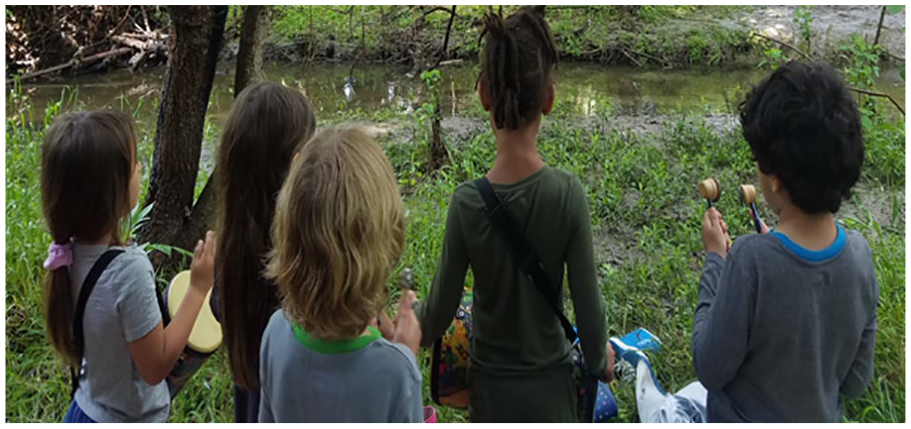
Singing to the creek.
This small moment in an early childhood outdoor education context can be easily read in terms of expected kindergarten developmental and learning outcomes related to language, social-emotional, physical, and cognitive development. It can also be read in ways that disrupt a focus on the individual developing child. Reading Simone’s creek encounters through the lens of Black refusal shows that there are multiple possibilities for subverting deficit constructions of Black children and childhoods. For example, thinking with a mode of refusal that I call testifying-witnessing, I have shared stories of Simone’s ways of being with the creek and surrounding more-than-human relations as refusals of deficit constructions of Black children’s relations with the more-than-human world (Nxumalo, in press). These modes of refusal take seriously the inherent spatialization of Blackness (McKittrick, 2006). Therefore, testifying-witnessing as a mode of refusal affirmatively inquires into Black children’s place relations while intentionally subverting discourses of nonbelonging. This work also refuses discourses that position nature as a way of “fixing” Black children’s so-called achievement gaps and behavior.
I return to Simone’s pedagogical encounters to do a closer reading of her relational creek encounters through analytics of Black refusal and Black futurity. As stated at the beginning of this article, my desire is to inquire into research practices that can create movement away from documenting anti-Blackness. Accordingly, a focus on Black refusal and futurity brings analytic attention to Black unbounded life and unruly Black subjectivity. This is a research practice that asks in what ways representation can work as liberatory enactments of Black life. I witness Simone’s small spontaneous act of leaping into the creek waters (Figure 2) as unruly Black subjectivity. I see this in the joyful affects that come together in relation with splashing creek waters, rubber boots, water bottle-in-hand, Simone’s body-in-motion, the presence of her classmates . . . and more. Read as quotidian registers of refusal and futurity (Campt, 2014), this small moment matters as a refusal of the anti-Black conformity that is sutured into linear “progressive” and developmental modes of understanding Black childhoods. Simone’s relations with the creek through joyful playful encounters matter for affirming her Black childhood and Black childhoods more broadly.
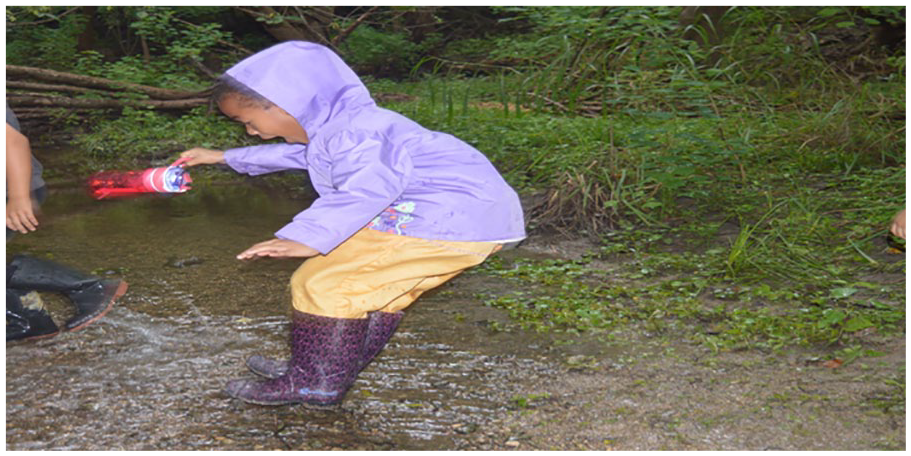
Simone jumping in the creek.
Following Tina Campt (2017), listening to images as Black refusal means that I notice not only what is visible by looking at the images of Simone, but also the ways in which the images affect me and move me. These modes of attending to images are a practice of looking beyond what we see and attuning our senses to the other affective frequencies through which photographs register. It is a haptic encounter that foregrounds the frequencies of images and how they move, touch, and connect us to the event of the photo. (p. 9)
The images collectively and individually register as affirmative affects can be (inadequately) described as positive embodied sensations, memories that are not focused on Simone as an individual developing child. As an alternative, listening for Black refusal requires making affective connections to the material-discursive things, beings, knowledges, and “happenings” that came together in the making of the image. In this example, this includes noticing Simone in relation to the materialities of objects, place, lands, and waters; Simone in disruptive embodied relation to discourses of Black childhood unbelonging in places and of noninnocence (Bernstein, 2011; McKittrick, 2006); Simone in relation with her classmates as together, they sing to the creek; and Simone in pedagogical relation to Indigenous presences and knowledges. Listening to images as Black refusal activates sensorial, temporal, spatial and material-discursive cartographies of Black childhood futurities. As seen in the example of Simone’s relationalities, cartographies of Black refusal are not interested in universality or researcher objectivity. They are affective, subjective, and creative practices of immersion in the visualities of research and pedagogical events with the intention of listening for, looking out for, and feeling Black refusal as futurity. They are embodied practices of Black storytelling.
Relationality and Black Childhood Futurity
In illustrating what cartographies of Black refusal in early childhood research might involve, I have purposefully focused on researching Black children’s embodied relationality with places, materials, and discourses. In addition to subverting dominant individualist narratives of the developing child, I view a focus on human/more-than-human relationality as a necessary orientation in current times of ecological precarity. Indigenous studies scholars have powerfully shown the necessity and urgency of pedagogies that foreground radical relationality with the more-than-human world, where radical relationality encompasses multiple situated modes of recuperating damaged lands and waterways and ways of living that are incommensurable with current extractive relations (Todd, 2016).
Inspired by Indigenous knowledges, radical relationality with the more-than-human world was an important pedagogical and research orientation for my work at the Austin school attended by Simone. This collaborative and participatory research with teachers aimed to engage the children in anti-colonial water pedagogies aimed at presencing Indigenous lands and water. For instance, Marleen and I have recently written about the children’s singing water songs in relation to the decolonial resonances of presencing Indigenous waters and water relations (Nxumalo & Villanueva, 2020). We have also engaged with the significance of the singing as water pedagogies that enact relational affects that matter for children learning with and responding to anthropogenically damaged lands and waters (Nxumalo & Villanueva, 2019).
In extending this previous work, I draw inspiration from Black studies scholars who have provided relational understandings of Black life. These orientations include attending to the ways in which relational Black life subverts the logics of Eurowestern humanism (Crawley, 2021; Jackson, 2020; King, 2019). As Ashon Crawley (2021) describes, Blackness can be understood as “a presence that is about marking relation, existence, or being with, a presence that is about sociality as the ground of irreducibly plural existence” (p. 21). For example, Tiffany King (2019) powerfully puts to work porosity and fugitivity as theoretical and methodological concepts that highlight Black relational entanglements with more-than-human life while simultaneously disrupting the use of labor as the primary way to understand Black relations to land in plantation landscapes. King’s work underlines the ways in situating Black people within multispecies entanglements can simultaneously pay attention to power dynamics within these entanglements.
I also draw inspiration from work that has made visible past and present stories of Black relationality with land, and of relationality between Black and Indigenous people (Crawley, 2020; Tuck & Guess, 2017). Taken together, this work foregrounds an inherently relational understanding of Black life that ruptures normative epistemologies and ontologies of the individual human while also interrogating the anti-Black foundations of Western humanism. Drawing from Sylvia Wynter, Ashon Crawley (2020) points to the potentialities that emerge from this rupture, stating that This disentanglement, of Man from human, is the dance and play in and as the always irreducible, always open and ongoing, otherwise possibility . . . When we want to imagine otherwise possibilities—otherwise worlds—we must abolish the very conceptual frame that produces categorical distinction and makes them desirable; we have to abolish the modality of thought that thinks categorical distinction as maintainable. To attend to anti-Blackness, we must be committed to considering the ways the very concept of Blackness depends upon the theologically and philosophically assigned category about who can and cannot be Man, and therefore human. (pp. 28–29, emphasis in original)
Pedagogical and research practices that carefully attend to the relationality of Black life therefore hold potential for making visible and materializing Black futurity. Holding close the interconnectedness Black refusal and Black futurity, I am interested in possibilities for imagining and noticing Black relational subjectivities in affirmative ways. This resonates with Ashon Crawley’s (2020) contention that seeking otherwise relationality is not a denial of the ongoing suffering and dehumanization of Black people under White supremacy. Instead, an affirmative and liberatory orientation to relationality aims to push against the boundaries imposed by conceptualizing relationality “through suffering as a logic and organizing principle” (p. 34).
All of the visual and textual stories that I have shared thus far, including the excerpts from Laymon and Wagner’s essay on Black boyhood, can be read and listened to through a method(ology) of Black relationality. This method would include paying close attention to the affirmative potentials of noticing and becoming affected by the specificity of Black children’s everyday unruly relationality with things, people, places, spaces, air, land, and other more-than-human life. For example, listening for Simone’s unruly relationality leads to noticing her wonderings about the ways in which the creek responds to the water songs. Listening to the many images I have taken of her creek relations and encounters over the 2 years of the research project, I notice many small acts of care for and reciprocity with the more-than-human life in and around the creek—the wild onions, wildflowers and trees that grow by the creek bed, the tiny crawfish that inhabit the creek, the creek waters. I notice her enthusiastic participation in our ongoing efforts to clean up the creek—heavy rains often wash discarded items into the creek and the creek bed is also a place where discarded household items are regularly dumped. I notice her relationality with the creek’s vitality through water songs, and water drawings (Figure 3).
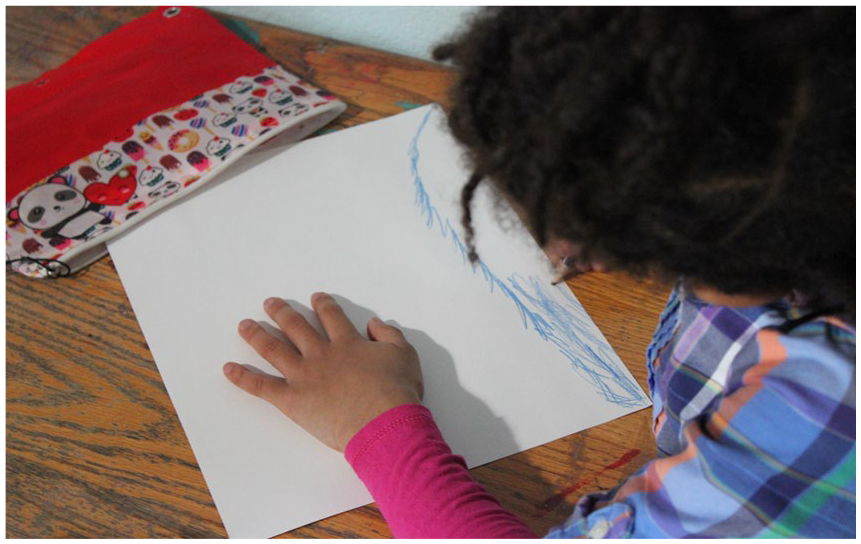
Drawing creek relations.
In describing Black children’s human and more-than-human relationality, I use the word unruly with intention. It is to foreground a research orientation that create fissures in conformity and normativity. Conformity and normativity are entangled with anti-Black logics that normalize the subjection of Black children’s ways of being with the world to unrelenting surveillance (Wesley & Ellis, 2017). Gesturing toward unruliness is also an invitation to researchers of young Black children’s world-making to consider the ways in which the knowledge that is produced from their work can be a site of refusing the confines of anti-Blackness. In this way, qualitative research, including its underlying conceptualizations of Black children’s subjectivities, holds potential as a liberatory practice of knowledge making.
My descriptions of relationality, with their focus on acts of care and joy, underlie two interconnected sources of tension within in a method of Black childhood futurity. The first is that in the move to disrupt deficit constructions of Black childhoods, there is a risk of inscribing childhood innocence. The second is that a focus on the Black child may reinscribe the humancentric developmental discourses that I aim to interrupt. It is therefore important to consider how Black children’s becomings can be affirmed without recourse to childhood innocence and human centrism. Childhood innocence has been shown to be steeped in a long pastpresent history of anti-Blackness (Bernstein, 2011). Inclusion of Black children within discourses of childhood innocence allows for an erasure of the racist underpinnings of childhood innocence. Rachel Bernstein (2017) explains, The problem, however, is that every time we insist that the gates of innocence open to children of color, we limit ourselves by language, a “frame,” as the linguist George Lakoff would say, that is embedded in racism. When we argue that black and brown children are as innocent as white children, and we must, we assume that childhood innocence is purely positive. But the idea of childhood innocence itself is not innocent: It’s part of a 200-year-old history of white supremacy. (n.p.)
My contention is that research methods grounded in human and more-than-human relationality help to create needed shifts away from childhood innocence and human centrism. I am also interested in thinking with research encounters that attend to Black children’s relational care and joy not as a romanticization but instead as a recognition that nurturing these affects and practices is part of the difficult work of sustaining Black life amid ongoing anti-Blackness. As Cree poet Billy-Ray Belcourt (2020) states, “Joy is an art is an ethics of resistance” (p. 9). In my work with young children and educators, I have also intentionally situated our pedagogical encounters within colonized and ecologically damaged places. Centering research and pedagogical inquiry as responding to ecological precarity and settler colonialism, including the erasure of Indigenous land and life, is another important move toward unsettling human centrism.
Toward Researching for Black Childhood Futurity
In this article, I have engaged with some possibilities for how early childhood research can be a site for affirming Black childhoods. A key intent of this work has been to underline that in the face of overwhelming anti-Blackness, it is important to create more space for research that refuses to begin with the effects of oppressive forces on Black life and their formations in early childhood education. In this regard, I have worked with Black feminist theories of futurity and refusal as methodological concepts that hold possibilities for researching Black childhood outside of the striations of anti-Blackness. Put to work to produce otherwise knowledge about Black childhoods, Black futurity provides an important disruption to the anti-Black linear progressive temporalities of child development. To illustrate what thinking/listening with Black refusal and Black fugitivity might open up, I have focused on visual and textual stories of Black children’s small, quotidian, and ordinary place encounters and how they can be witnessed through creative and speculative practices of listening for the otherwise (Campt, 2014, 2017; Crawley, 2020). Holding close to the need to avoid reinforcing developmentalism’s human centrism, I have traced how a focus on Black children’s relationality can be tethered to Black futurity in ways that disrupt both coloniality and human centeredness. I see this article as an invitation to early childhood researchers that are researching Black childhoods to consider what concepts might be generative for listening to, materializing, and sustaining their world-making practices. Black children cannot wait.
Footnotes
Declaration of Conflicting Interests
The author(s) declared no potential conflicts of interest with respect to the research, authorship, and/or publication of this article.
Funding
The author disclosed receipt of the following financial support for the research, authorship, and/or publication of this article: This work is/was supported in part by Planet Texas 2050, a research grand challenge initiative of The University of Texas at Austin.
