




Abstract
Relational education design advocates for whole-person exchange between teachers, students, facilitators, and participants. In this essay, we discuss what an emphasis on the relational allows and provide suggestions for its conditions including, space, time, authenticity, trust, dialogic development, and institutional support. The co-authors demonstrate how relational education experiences are highly situational, and conclude by suggesting that a relational education design is capable of providing an orientation to education design suitable for our highly complex contemporary socio-political conditions, one that has the capacity to engage all parties in the educational space in dialogic, authentic, and, necessarily, relational experiences.
Keywords
Introduction
How has relational education design revealed itself in two different disciplines, and three diverse sites? In this article, we are working across, through and from within an Australian university’s School of Design and School of Education, through a study on creativity in higher education and industry in Hong Kong, and into the educational experiences of young people in Delhi’s urban slums. As co-authors, we came together as a supervision team and PhD candidate in what we might now frame as a successful relational education experience. We value and make transparent the ontological differences and synergies between our disciplines, as well as the ways in which language is used differently, processes and best practices are at times different, and yet productive overlaps emerged. For example, discussing the value of relational education in Design is very different from the value and contribution of relational education in Education (or, for that matter, relational design in Education).
By extension then, what constitutes relational education design as both a process and a product in these three different contexts remains quite distinct as well. Relational education is at the heart of formal learning despite the many neoliberal constraints of standardized testing and curriculum that continue to plague the creative relational (Wyatt, 2018) work of “good teachers,” “good designers,” and “good students” (Harris, 2016). Education design encapsulates the ways in which pedagogy, learning spaces, learning technologies, and systems are modified to suit specific audiences (Van den Akker et al., 2006). In this article, we discuss ways to incorporate design and design approaches to support the relational in education, along with the creative needs of 21st-century skills acquisition. In Design, the principles and practices of design approaches are core business and well understood. However, the efficacy of relational education approaches that focus on whole-person exchanges between teachers, students, facilitators, and participants has the potential to disrupt assumptions in the Design field and expand and enhance its disciplinary commitments.
In this article, we begin by exploring what we term as relational education design across three different case studies based on each author’s distinctly different context. We then discuss what “relational education design” might offer, and how readers might apply this to their own contexts. We conclude by highlighting the ways in which this kind of transdisciplinary and transcultural collaboration can benefit diverse contexts, communities, and research approaches, providing there is sufficient dialogue about ontological differences. The labor this requires is fruitful and expansive, and we leave readers with the article itself as a modeling of how to approach such collaborative encounters.
Unpacking Difference: Disciplines, Contexts, Discourses, and Worldviews
Disciplinary orientations reflect who we “are,” how we see the world, and the language structures that construct it. We understand this as one challenging aspect of working across disciplines, because they are not “just” disciplines. We intentionally write across these differences in this article, as a means of modeling the labor and intentionality required in doing relational education design collaboration, as well as curriculum or pedagogical approaches. According to Akama and Light (2018), good co-design practice requires contingency as intentional. This is central to our understanding of relational education design, which is necessarily improvisational, reflexive, responsive, and contingent upon its context and time (Appadurai, 1996; Ehn et al., 2014; Escobar, 2017; Harris, 2021).
The role of the researcher/facilitator/participant is pivotal in relational education design. This can be typified by the difference between the idea of “reflection” on practice that focuses essentially on the self as practitioner, the engagement as process, and “reflexivity” in a participatory practice that attempts to also address the holistic socio-politics of the encounter. All these considerations and interpersonal/transdisciplinary “moves” require flexibility and curiosity on the part of the researcher/facilitator/participant. That is not to say there haven’t been excellent models which attempt to formalize approaches to education that privilege a relational education design approach. For example, Nalin Sharda’s (2009) diagram (Figure 1) depicts a productive intersection of storytelling, game design, and user experience.
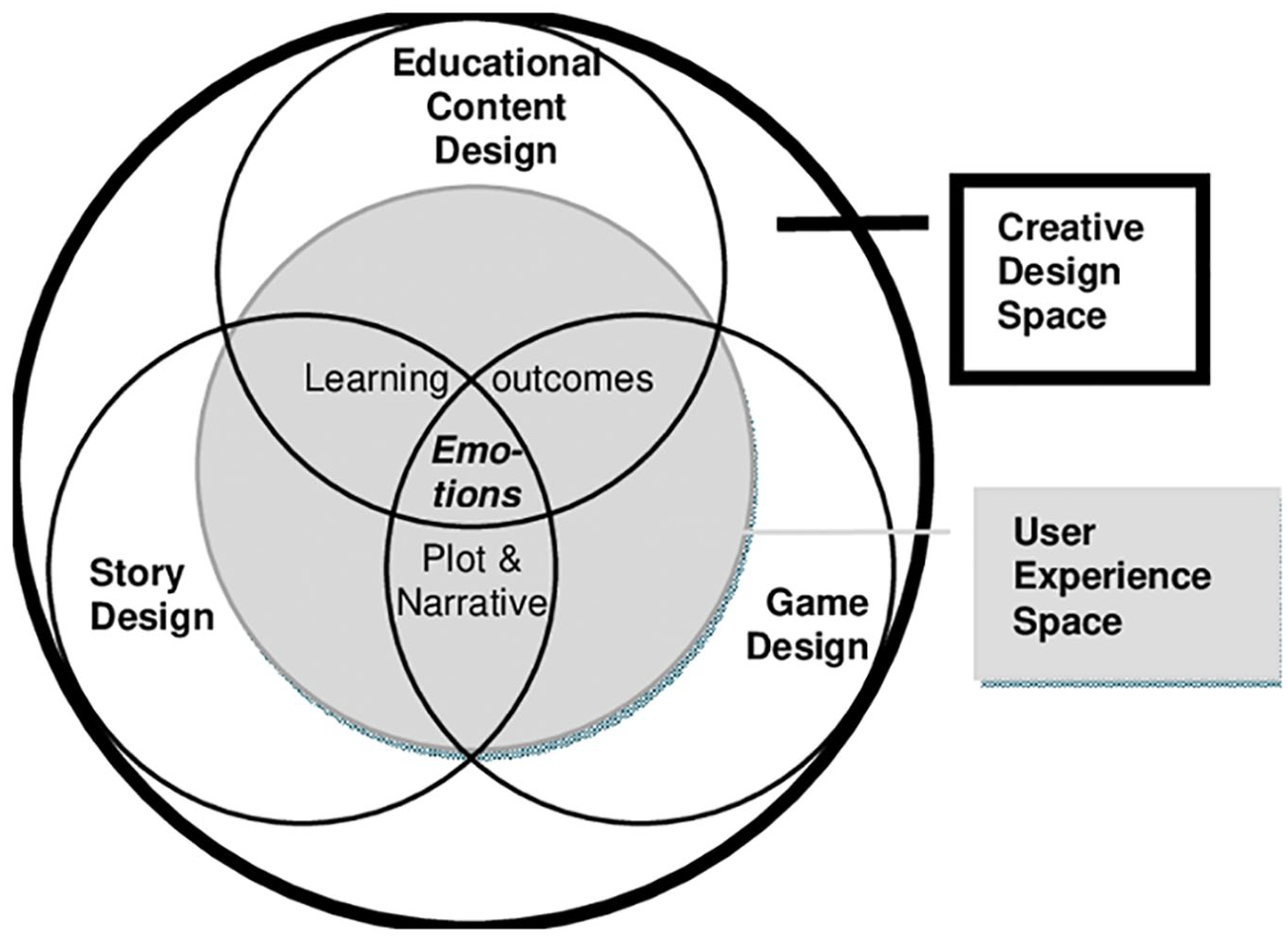
Example of Relational Education Design, Combining Storytelling, Games, and User Experience (Sharda, 2009).
Sharda (2009) argues that “educational games can use storytelling as the underlying model for designing their content and narrative to enhance learning outcomes” (n.p.). However, we interrogate the possibilities that fall between useful heuristics such as this that account for emotion, storytelling, and their implicit relational aspects, to discuss a relational education design which attends to relationality explicitly. In this sense, we offer (Harris, 2016) “creative ecologies” model (Figure 2) which has been adapted to a range of contexts, always with relationality at its center.
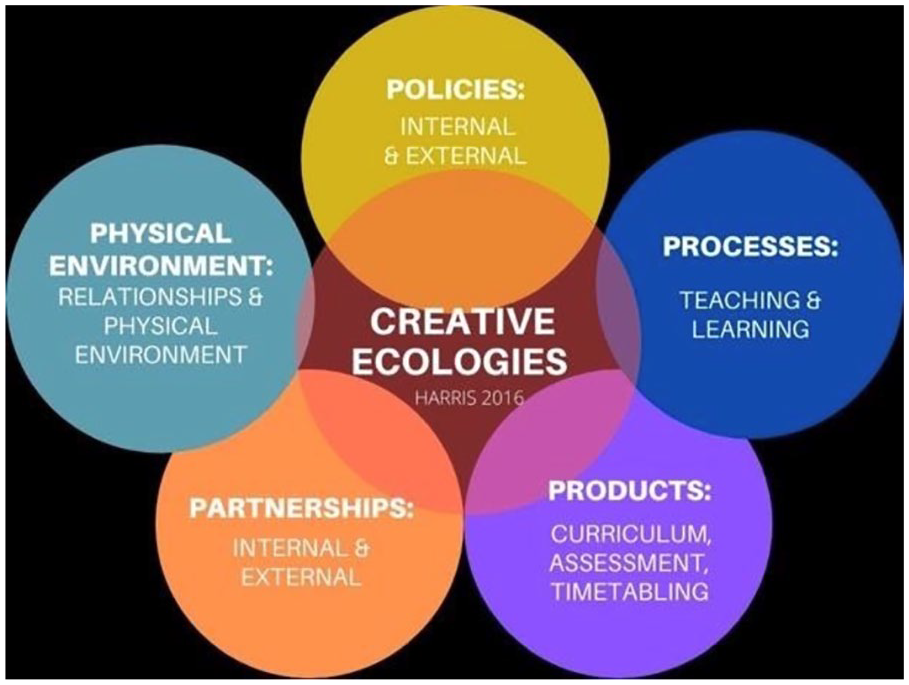
Creative Ecologies Model (Harris, 2016).
A creative ecological approach recognizes the interdependence of multiple actants in any ecosystem or event. For the purposes of relational education design, we draw on the five areas of creative ecological attention seen above (Figure 2). This encourages researchers/facilitators/participants to attend to the interconnections of partnerships, place, products, processes, and policies (among other factors). These are exemplified in Radhika’s case study focusing on the processes and products of inner-city education at one location in India, Neal’s case study focusing on student support in higher education at one university in Australia, and Daniel’s case study about the partnership between creative industries and university training in Hong Kong. For a design-informed discussion of relational education, we argue that—as in the creative ecologies heuristic—not only is the human relationality core to this work, but relationality between human and more-than-human actants as well. In other words, these human-focused relationships are not the only factors that are improvisational, responsive, and contingent: the settings, resources, and culture-specific influences in all relational education design experiences are equally impactful. Then why have a model at all? We suggest that heuristics like Figure 2 are often more appropriate to a commitment to relational education design than granular, more instructional models like Figure 1. However, the ways in which such tools are applied are of critical importance.
Adding design to relational education seems in some ways to change the very concept offered by relational education—to render it less “relational” and more “rational,” “top-down,” and “hierarchical” and in this way acts against some of the tendencies and aspirations that have become apparent in our own case studies. For us, the promise of relational education is aspirational: it speaks toward possibilities for holistic and authentic education experiences, dialogic learning environments, and experiences that allow learners and teachers to open to their personal contexts and be fully present. We co-authors have felt energized and enlivened by the dialogic space of our own relational education design where delicate flashes of critical thought were given license to grow into energetic generators of conversation. This article is a collaborative effort to discuss these moments to better identify their conditions, to perhaps foster those conditions, and, importantly, to activate an interdisciplinary community of practice around the concepts, conditions, and aspiration for relational education design.
While relational education design might be diagrammed to attempt to describe its optimal conditions, what has become clear as more important is how to remain in a state of responsiveness to the specificity with which to foster those conditions situationally. Upon reflection, we feel that diagramming explicit conditions for relationality might disallow the improvisational aspects that we identify as valuable. The delicacy of early relational stages with carefully managed minor strategies and situation specific work is clear. Also clear is that remaining open to the risks naturally present in an authentic dialogic engagement is critical to the conditions which allow a spark to come into being. On the other hand, it becomes clear that the “spark” can be easily extinguished due to small moves that do not ring true to the initial aspirations.
So often when we speak of design we use the word to mean a fixed “solution,” an idea made concrete, and transferable. Yet if relational education design is going to be a useful aspirational term then the design it describes needs to be a design of process, of constant renegotiation and essential situational specificity. This is design as a verb, an act of situational negotiation and co-dependent responsiveness as opposed to the more common use of design as noun, indicating a fixed product able to be applied interchangeably to manifold and diverse situations as an off-the-shelf solution guaranteed to make education better.
As bell hooks (2010) states, students often are more “comfortable” with passive educational experiences, ones with known outcomes, clear monologic experiences with guaranteed economy of time, and return on investment. Relational education design has different requirements to this and can be challenging to some, but to others a relief as they become holistically involved in a relational experience. Ontological design, as a radical reframing of the role design plays in making our world, reminds us that “we design our world, while our world acts back on us and designs us” (Willis, 2006, p. 1). In making a design move we incorporate, whether intentionally or not, an ontological perspective into that move, as well as the inherent bias in how a particular design “sees” its use value. In this manner an ontological design awareness allows us to see how the education we design designs us; however, this does not necessarily lead to an ability to predict these effects. Ontological design lets us know that the impacts of our design decisions are often unforeseen and have the capacity to make explicit previously concealed power structures, assumptions, and roles. We now turn to our three case studies, which detail diverse examples of relational education design in which intentional design processes vary from explicit to minimal.
Case Study 1: Radhika
Relationality as Connection in a Transformational Learning Experience
Background
I write from the perspective of a social design practitioner focusing on education and employability for young adults who are rural migrants and first-generation learners in India’s rapidly growing cities. My recently completed PhD research looked into my practice and through employing a participatory design methodology led to my involvement in a series of relational participatory experiences with a small number of the young people I have previously worked with at much larger scales. It was these radically relational interpersonal experiences—so different from my former practice designing curriculum and learning materials for massive numbers of vocational students—that led to the prompt for this co-authored article as I wished to continue a discussion around relational education design.
Half of India’s population is estimated to be under the age of 30 years, approximately 800 million young people (Macrotrends, 2024). Rural to urban mobility in India grows at approximately 2% each year (NFHS, 2021). The size of the youth population and the complexity of the delivery mechanisms for education and employability across a diverse socio-economic and geographic span have resulted in a vast network of government and non-government institutions that work toward access and quality of education and preparation for work in an environment of globalization in India’s urban complexity.
While the planning and implementation of initiatives in education and skill development originate in the higher echelons of policy and administration, how do they translate into lived experience for the youth who are the subjects of these initiatives? The scale of operations has skewed the focus of data gathering toward quantitative measures: how many schools, how many enrolments, how many completed, how many accessed skills training, and so on. So far there has been less focus on qualitative data of youth in their own voice that narrates their experiences of transformation into formally educated, digitally active individuals, whose imaginaries are beyond the boundaries of their traditional social historicity.
The Case Study
In 2019, I embarked upon doctoral research to explore participatory methodologies with rural migrant youth in the National Capital Region of Delhi, and explored how they perceive their emerging identities in the assemblages of a city with a population of over 30 million, that grows by approximately 900,000 each year. The city infrastructure has been and continues to be built on the agricultural lands of the villages that are subsumed in an urban expansion plan, leaving the original village infrastructure as dilapidated, poorly resourced, low-income housing for the poorest migrants. The new residential and commercial infrastructure that houses wealthier urban migrants remains alongside these, creating a juxtaposition of socio-economic communities that co-exist in close proximity to each other. The participants of the research and I were positioned differently in the mobility spectrum; they as rural migrants between the ages 18 and 27 years located in the low-income areas of the city, and I as the researcher, located and practicing in the developed infrastructure of Delhi, but experiencing life as a doctoral candidate and temporary visa holder in Melbourne, isolated from my roots and family during the disruptions of the COVID pandemic. The purpose of this research was to explore participatory methodologies in a complex, changing social context and interrogate aspects of power and positionality that occur in the engagement. The participants were recruited in partnership with a skills -based foundation working across India, in keeping with the ethical guidelines provided by RMIT University.
The purpose of this aspect of my PhD research was to co-construct imaginaries that interwove our disparate but connected experiences of living and working in the city through relational themes that were recorded through art, poetry, photography, and mind maps. My case study specifically narrates an encounter with a young woman (referred to in this article as RK) and how in the discussions around the interpretation of each of our images and poems we discovered a relational connection that transcended the socio-economic differences of our positioning in the city.
RK is 24 years old and had relocated to the city from a remote village at the age of 12, when she accessed formal education for the first time. As a first-generation learner, whose parents had never been formally educated and who belonged to a socio-economically disadvantaged rural community, she had completed an undergraduate degree and was working as a clerk in a government office to support her parents and siblings.
It was difficult initially to find an activity within which we could collaborate. In our initial conversations, it was clear that RK saw the engagement as a learning experience for her, where I would “teach,” and she would “be taught” as an extension of the learning experiences that she was familiar with. She was skeptical about an open-ended collaboration and unclear what she had to offer. Over a few conversations it emerged that RK documents the city through photos that she takes as she navigates through it every day, an activity that she was very passionate about. I saw this as a trigger for collaborative engagement, to each select photographs that we had taken and write about what they meant for us. We agreed that we would send each other the photo and the writing, and then get onto a zoom call to discuss what we had sent.
The first picture RK shared was of a metro station before dawn, probably the only time in the day that it is empty. Accompanying it was a poem in which she spoke of feeling crowded and of being constantly watched. In the discussion she spoke of how she sees the metro trains as a metaphor for the transience and movement in her life: “my life is moving forward so fast, and I feel that there are so many things I am leaving behind that I don’t have time to carry with me. This is the migrant experience!”
The picture I shared was from the window of a high apartment tower, looking down at the city of Melbourne below. I shared how it represented my feeling of isolation during the lockdown in Melbourne, being alone and away from family. RK’s response to this picture, and my explanation, was both soothing and perceptive. She said, “from your picture I see that in this crowded world you find yourself in a corner, where you feel alone, but still, even in your loneliness you are finding something to learn.” The sharing of pictures and poetry and the discussions of our own and each other’s interpretations became a deeply emotional and rewarding experience for both of us. RK later described the collaboration as a transformational experience, saying:
If I hadn’t met you, I would have lost a lot of learning. I had forgotten about how I used to write earlier—reflective writing, writing my thoughts in a journal about what was happening around me. I stopped writing quite some time ago. I stopped speaking and expressing myself. Since starting this project, I feel re-ignited . . .
Over the next weeks during our meetings once a week, a total of 12 pictures were shared. Through dialogue, we discovered facets and depth to our understanding of each other and a relationality in the way we constructed meanings and metaphors in the visuals, poetry, and interpretations. For instance, in RK’s poem about the picture of clouds that I sent her from my balcony in Melbourne, she wrote:
“The clouds say . . ..
You change your colours just like I do.”
For her, the clouds are a metaphor for the way the perception of identity and place can change for an individual. She spoke of how she is constantly “changing” and her relatives and friends are always “angry” with her because her aspirations are outside of what they can comprehend. She says that “it is only when I speak with people that I realise the impossibility of my dreams.” For her the changing of colors is her transition from being an uneducated girl child to being a young adult with a college degree, who shares her photographs and poetry on Instagram and aspires to be a lawyer. The necessity for constantly re-structuring the contours of her self-perception within the imaginaries of possibility is something that I felt very connected with. For me, my “impossible dream” was the opportunity to take the time out of a life steeped in professional and domestic responsibilities, to travel halfway across the world as a mature-age student, and to reconstruct my own self-perception within the imaginaries of possibility in my practice of design. Her transformation takes place within the context of her changing identity in the city of Delhi, and mine takes place within a self-imposed exile in Melbourne during the uncertainty and travel restrictions of the pandemic, but we are both participants in each other’s journeys and are strongly aware of the sense of isolation that is the underbelly of such a transformation.
The importance of this research experience was in its contrast to other experiences within my practice, which involved creating learning experiences for youth who are socio-economically disadvantaged within the institutional frameworks of education and skills, in a socially hierarchical environment such as India. Youth development is funded either through government initiatives or by private entities, and there are clear lines drawn between disadvantaged beneficiaries as recipient actors and agents of government and private funding agencies who exert power over the design and implementation of learning content and policies within this development network. Relationality emerged as an outcome of this experience, revealing the ecological nature of the city, and how “speed and scale,” which is the mantra of a developing economy with a huge youth population can, through its transactional nature and quantitative measures of success, overpower the transformative capability of an educational experience.
Blurring the lines of socio-economic positioning to reveal the liminal spaces in-between became a methodological tool in this relational co-creation initiative where the researcher is also a co-participant in the creative process, responding affectively (Jacobs, 2023) to the experience of the research, as well as reflexively (Pihkala & Karasti, 2013), through the minute, intentional, responsive readjustments in positioning that Akama and Light (2018) refer to as readiness or attuning, or the capacity to be responsive in a participatory encounter. This is what I carry back into my social design practice in India, the infusion of relational experiences within the learning-training cycle that includes all aspects of a creative ecology.
Case Study 2: Neal Haslem
Student Assistants Enabling Relational Education Through Creating a “Middle Tier”
I write from the position of professional designer and Design educator. Following a traditional fine art degree with graphic design major, I worked in commercial design, then came back to the academy to teach and undertake my research qualifications. Most recently, I have been engaged in middle-management roles leading my communication design department but have now returned to research and teaching role. We are a large discipline, with over 600 students in our undergraduate degree, and almost 200 in two graduate programs.
Our programs negotiated COVID and repeated lockdowns remarkably successfully. Our student numbers reduced slightly during 2020 and 2021 but have bounced back and are somewhat higher currently. Negotiating the pandemic revealed insights into our practice and I expand on a particular instance of this below, that of instigating a “middle tier” of Student Assistants within our education ecology.
Relational education design, as an aspirational concept, offers a chance to articulate values that sometimes seem in danger of becoming undermined in design education. As a design discipline we can be seen to “own” studio pedagogy (or at least tussle with art schools for this ownership). Studio pedagogy, with its emphasis on project-based learning and supportive group critique, seemingly guarantees authentic—and relational—education. At its best I believe it does. However, design education may not have, historically, a strong affinity with relationality. Instead, it has evolved very strongly from industry, a practice that has valorized individual talent and demonstration of skill, innovation and authorial ascendency, thinking like a designer, becoming a designer, and cultivating the “x-factor.” Although the previous century’s concept of designer as the creator of show-stopping visual identity systems might be moving into the past, newer practices like user experience and service design continue to maintain the designer’s role as situated in the position of knower and/or creator of knowledge through practice. Participatory design, codesign, human-centered design, and “more-than-human-centered” design attempt to redress this balance through an incorporation of a greater context into a design situation. I would argue that a concept of relational education design has the potential to bring relational design more clearly into the scope of design education and, with this, a capacity to mature design practice and education.
I want to reflect on the instigation of “Student Assistants” into the discipline as a case study demonstrating relational education design and its impact on higher education pedagogy. Student Assistants were recruited from final year cohorts or recent graduates and given small amounts of time to support our student cohorts based on their knowledge of the program, even individual assignments and their capacity to relate as peers to the student body.
Relational education design seeks a deepening of relation between students, educators, and the systems of education they inhabit and create. It aspires to extend the “educational contract” toward authentic interpersonal interaction and commitment with a resulting shift in the nature of that educational experience. This contrasts strongly with what can sometimes seem to be an accelerating slide toward a transactional mode in contemporary education, in which rubrics define the terms of engagement, time-on-task from all sides is minimized, and interactions between the involved stakeholders are as brief and transient as possible, while still managing to achieve “success” in the form of a degree testamur.
As the size of programs increases, the capacity for design educators to be in authentic relationship with their students has decreased concomitantly. I suggest that the activation of a “middle tier” in the education environment, in the form of Student Assistants, allowed the conditions for relational education to become reactivated and revealed. This in turn allowed a change in what “being a design student” meant and consequently “being a design lecturer” also became freer. Relationality became evident, communication became dialogic, and more authentic engagement, of all, facilitators and participants, became supported in the new ecosystem.
The Student Assistants were initially instigated to focus on supporting international onshore students to continue to be engaged in their study when they found themselves stranded offshore due to the pandemic. As students were plunged into fully online learning environments, Student Assistants stepped in to provide support via online video and text-based synchronous and asynchronous chat channels. By mid-2022, we were almost wholly back on campus. The Student Assistants now worked through our expanded “maker space.” This space has equipment that allows the Student Assistants to help with printing and making hard-copy artifacts for students’ assignments as well as providing the kind of peer support that they were originally providing online.
Although the Student Assistants were activated to provide practical support, what is of interest to this article, and relational design education, is another, less expected, aspect of their role. The Student Assistants provided a different level within the higher education environment—a “middle tier” between academics and students. This allowed peer-based support from a group who had recently been engaged in the same projects with the same challenges. In this new tier within the education space, Student Assistants’ roles liaise directly with students and staff fostering a new level of communication and connection, a new relationality.
A role such as Student Assistants might well “come between” students and staff, creating further distance and reducing relationality. Yet instead we found that they forged greater connection, forged better communication, and brought increased relationality. This may be due to who those Student Assistants were. They were recruited from current final year or recently graduated students in the undergraduate program. They had recently experienced the degree program courses that the current students were going through. On the one hand, they knew intimately what it was like to be a student in the program, and, on the other, they knew, with hindsight, the lecturer’s aspirations. They could advocate for both parties, and frequently took on this role of increasing authentic communication. In “doing their job” and supporting the students, they also provided support for lecturers and, through this, supported the conditions for relational education within the design program.
Post-COVID, the Student Assistants remain. It had been revealed what a necessary and critical role they could play in bringing relationality back into the discipline, allowing personal connection, which in turn supports a relational student–staff connection that has suffered during the period of high growth in numbers and pandemic-led disconnection. In this manner, Student Assistants help the conditions for relational education design to exist. They offer engaged, informed one-to-one support, both into the student cohort and to the staff cohort. Rather than create a barrier, they brought staff closer once again to students and to the student experience.
Relational Education Is an Education of Engagement
The relational education design made possible by Student Assistants also suggests different ways of doing design, and being a designer, and with this, a reorientation toward engaged pedagogy. The relational education design context welcomes students into an activated dialogic engagement with their lecturers and their institutions. The students themselves take part in forging the future of design and design education and we saw instances of co-designing curriculum together. The discipline starts to become a space within which the future of design education and the future of design practice are collectively re-designed.
A relational education design environment, enabled through innovations like Student Assistants, supports (and to some degree demands) the kind of capacities that Biggs, building on Bloom’s taxonomy, defines as the highest level of educational experience, the extended abstract: “the essence of the extended abstract response is that it goes beyond that which is given” (Biggs & Tang, 2007, p. 78). Students whose responses move into the “extended abstract” gain the potential to problematize fixed knowledge. An educational environment which welcomes this level fosters an understanding that, as future practitioners of design, students are taking part in education to move into the world as producers of knowledge—along with all the challenges this role comes with.
Arturo Escobar (2017) states in Designing for the Pluriverse that we are “at a moment when many design schools are feeling the pressure to adapt to the mounting ecological and social challenges of today’s world” (p. 153). His “overriding concern is with difference, and how difference is effaced or normalized—and, conversely, how it can be nourished” together with the need for “an ethical and political practice of alterity that involves a deep concern for social justice, the radical plurality of all beings, and non-hierarchy” (Escobar, 2017, p. xiv). Escobar’s clear articulation calls for 21st-century design education to educate critical practitioners for a complex and challenging world. I suggest that relational education design provides a methodology and ethos which foster the conditions for this to occur.
Case Study 3: Daniel X. Harris
Relational Education Design in Creative Hong Kong
As a professor of creative education in a School of Education, I am deeply involved in developing and advocating for more relational, collaborative, and co-designed creative learning experiences. My research is largely focused on these concerns in a range of formal and informal learning environments: schools, theaters, community centers, galleries, refugee and migrant support networks, and public spaces. This case study will draw on one recent Australian Research Council-funded study, a 6-year multi-sited ethnography titled Creativity in East Asia and Australia, based in Hong Kong, Singapore, and Australia. For the purposes of looking at relational education design, this section focuses on the Hong Kong site only, and draws on my creative ecology model (Figure 2), which was used to look at five interrelated areas of need when considering the creative efficacy of any “unit” (i.e., school, department, organization, or even family). Together, the notions of relational education design, through the lens of creative ecology, shine a unique light on contemporary Hong Kong and its self-perceptions of how Hong Kong performs, and educates for, creativity.
Participants from three distinct cohorts were interviewed: university departments including Design, Art, Cultural Industries, Business, and Education; self-identified freelance or commercial artists; creative and cultural industries professionals including from theater, tech industry, museums and galleries, festivals, and design organizations. The overall study investigated what characteristics of creativity and creative practice predominated in Hong Kong, what were the inhibitors, and what were the facilitators, as well as enquiring into creative education at both secondary and tertiary levels. The 25 interview participants in Hong Kong (and 150 university student survey respondents) reported a range of ways in which a relational approach to education and design (and design education) was often minimal or missing from their education experiences, and could contribute to the creative component of their training. They also reported that while outward-facing international creative initiatives, developments, and products were flourishing, the more “local,” relational opportunities that had flourished in the previous quarter century were now becoming scarce. Of greatest concern was space: not space only as a means to produce “products,” but space as a facilitator of connecting, of collaborating, and of productive relationality. These included a range of factors including a lack of resources, approaches to training, funding, policies, and expectations. “For young emerging artists in Hong Kong the most important [obstacle] is the limited resources and limited space” (E, female). One respondent talked about the ways in which space limitations present a major inhibitor to creative collaboration: . . . there are few places in Hong Kong where there are clusters of artist studios, and from what I’ve observed there’s not even a lot of community going on there. You know, people are in their little spots but there’s no communal space—they are actually industrial buildings, and you might have a printer on this floor and, you know, there’s still industry going on in there and an artist here and there. (AG, female)
Hong Kong continues to evolve culturally due to migration factors, its relationship with the British and Chinese superpowers, and its regional neighbors, including Australia. From a business and investment perspective, says one head of a prominent university Business Management School “Hong Kong is not as attractive as it was 10/20/30 years ago.” But this study, and a relational approach to educating his Business students, might consider: attractive to whom? The Business professor reflects: I’m a sceptic about government over-involvement in projects directing things. And I think the government here has so much excess money, they don’t know what to do with it. So one of the big projects they decided to do was develop this cultural district. . . . I don’t think there’s much support for it from the community. They’ve brought in people that didn’t understand the local culture, that came from Britain and, I think Australia. They didn’t realise this place is not Australia or Britain. You can’t get the same kind of support, you don’t have the same kind of culture around there. And I think the people that have been brought in are largely very experienced, but some at the end of their working careers. So this is a pre-retirement gig and not highly motivated. So I think lack of leadership would be one reason, I would say. And culturally tied to that, just a lack of understanding of the Hong Kong Chinese culture.
The obstacles to quality relational design (especially inside of higher educational institutions) impede many facets of the work: effective collaboration, the use-value of the final product, and the educational potential for all stakeholders. In Hong Kong, and other transcultural centers, this lack of relational aspect to design work is informed by cultural diversity of stakeholders. One participant stated: At the moment, a lot of Australians are leading a lot of multi-national organisations across APAC [the Asia Pacific region]. So, I had a chat to a guy yesterday who’s Australian. He’s heading up Visa and he said, “Our diversity problem is not men and women. It’s Australians.” In APAC Google, our diversity problem is not men and women. It’s white women and expats and Australians. What actually happens at a certain point, particularly in places like North Asia, is you’ll find that the local leaders will get to a certain level and unless they’ve worked outside of the market, and they’ve adopted some of the very American ways of doing business, and the way to show up in a meeting and the way to make a decision, being a little noisier. We call it the bamboo ceiling. So, for women in Australia, it’s always been the glass ceiling. In Asia, it’s a double whammy effect for both men and women, particularly if you’re from a North Asian or a Southeast Asian background, culturally because of this reluctance to step forward. It means that we see fewer local leaders, unless they’ve been educated in the UK, Australia, US, Canada. (interview participant PT)
Tech industry managers, too, noted the ways in which local Hong Kongers don’t “ideate” in the same ways in which many Western work teams do, a cultural difference perhaps that has its roots in education. This response was from a Design lecturer at a major Hong Kong university: I also use some new technology like uReply . . . I think it’s a Hong Kong developed software, which is for the classroom. Basically every student has a cell phone so they can simply scan the QR code that I show on the screen and then they can log into that place, and then they can answer my questions secretly on their phone. So they respond better than asking them to raise up their hands. That is some Asian thing, because I think in Western countries students are more active, but here students are more passive. If you ask them questions, they smile, look at the others, and smile, don’t say anything. They try not to speak out, so that’s why we do this kind of thing for them, develop this kind of software. (interview participant JL)
Due to the flexibility of technology-informed workplace changes, and ongoing cultural shifts within Hong Kong, the employment landscape is changing, even when at times the education landscape is not. Some of the participants addressed these more family-based changes, but their interconnection with education—especially relational education design—is evident: Many young people don’t need to be more responsible for the family economy, the finance of the families, and so now they can free themselves, they can choose different kinds of jobs or ways of making their living. We have more freelancers in Hong Kong now, or they can work at home, or they work in the café sometimes. They can develop their own brands or products, or they try to do more start-ups in different industries. Because technology is one thing that is very convenient to work with people, to communicate, and there are more chances in Hong Kong, the values are changing because I think the most important thing behind it is the value of the young people, because they can’t see their future if they follow the old way, how they just stick to their company, or to stick to one job for their whole life is impossible for them now. So now they just want to live a more meaningful life, so they choose to do things their own way; and then they’re not thinking of earning very big money because they can’t buy the flats anyway. You wouldn’t dream of buying an apartment for yourself, because in Hong Kong it’s impossible, so they choose other dreams. (interview participant EY, The Creativity School)
This view may be growing, but it still represents a dualism of “rejecting” more traditional forms of advancing, including standardized schooling success, and “choosing” an alternative path, a kind of binary that relational education design tries to get away from through attending to both the relational (processual) and practical (product-required) aspects of education design. Education itself is seemingly caught in a both/and straitjacket: many want to succeed in standardized international measures, while acknowledging that global (and even many local) industries are no longer seeking these kinds of graduates. Some research suggests that this dichotomy is the result of a global education sector that wants to believe it is education for the “whole person” and the “education lifespan,” but in practice demonstrates how woefully the “relational” is missing. One Education scholar reports, There’s a strong gap between the education system and the needs of society or what we prepare students for. We find that the education system in Hong Kong is so packed and still very traditional, focusing on spelling . . . exams, assessment. Teachers have a fixed mindset that their role is to complete what they are assigned to teach, instead of what the student needs. (interview participant LKC)
For many participants who teach in creative and cultural industries’ faculties, collaboration for relational education design in universities needs stronger links with industry, particularly in cultural management. Even the non-traditional structure of a festival class taught in conjunction with the actual festival has made some students uncomfortable (and had others flocking to the course): Ken’s very good at teaching creativity to his students. A lot of them, when they first come to Ken, they come out of these boring institutions, “Sit there, shut up, don’t talk, don’t think, just regurgitate everything that we’ve told you.” And then they come in and you ask them questions, and they just stare blankly at you. They’re like, “What? You want to hear what I think about something? No one’s ever asked me what I think before.” So Ken spends a lot of time with his first year students teaching them how to think independently, respond to questions, right. It’s hard, you have to teach them how to think creatively first. (interview participant BS)
For some students who have come from more traditional, rote learning educational contexts, learning how to work and learn relationally is a shock. This case study in Hong Kong asks readers to consider: what does cultural context have to do with relational education design? Is support for relational learning culturally contextual, and if so, how might intercultural—as well as interdisciplinary—relationships in education design improve teaching and learning practices?
Discussion: Is There a Best Way to “Do” Relational Education Design?
Our first case study examines the design of relational education experiences by documenting the unfolding of such an experience between two individuals who could be considered opposite ends of the migrancy spectrum in the rapidly expanding city of Delhi. In this specific context, traditional socio-economic categorizations are complicated by the potential of digital imaginaries and cosmopolitanism (Appadurai, 1996) to blur the lines and re-define aspirations in an assemblage approach to emerging social structures. The simultaneous co-creation within a shared creative space, and interrogation of the subtle ways in which power inhabited perceptions of self and other in the encounter, gave rise to relational imaginaries that transcend socio-economic boundaries, to instead explore the liminal spaces of connection within a creative exchange.
The recognition of this experience as relational happened retrospectively; it was not a case of relationality by design. In retracing the experience of this research encounter, I acknowledge some critical factors that influenced the experience of relationality:
The practice of “readiness” (Akama & Light, 2018) as a recognition of one’s positionality within the research encounter, through self-awareness or “poise” and the aesthetic or “punctuation” of how one approaches a participatory encounter. The reflexivity that I spoke about in the case study was a constant engagement and adjustments with these through the process of engagement.
Creating generative spaces for responsiveness in which dialogue could originate. In the case of this research experience, the ability to use photographs of daily life occurrences and imbue them with meaning in a language of familiarity created an opportunity for affective responsiveness.
Our second case study, detailing the impact of Student Assistants on a large communication design undergraduate degree, offers a number of insights to this discussion around relational education design. The innovation of Student Assistants—and the “middle tier” they added to our institutional system—demonstrated a lack that was creeping into our work as design educators. As the design faculty, we model “studio pedagogy” for the whole university; a pedagogy which seems to naturally demand full engagement and ensure academic integrity through a relational engagement with every student in a curriculum that deliberately asks them to draw from their own knowledge and background and bring themselves authentically into all their project work. However, we found that we were slipping away from this ideal due to our large student numbers, our growing “distance,” and something I might frame as the risk-averse “repeatability” of our studio briefs. It was almost as though the more we could guarantee the success of a particular project, the less we all became engaged and the further away from our aspiration for relational design education we found ourselves. Student Assistants enabled us to see these changes as their new relationship acted to help reconnect staff and students into a relational education ecology and a collaborative curriculum project.
If we are to suggest, as we do in the introduction to this article, the conditions for relational education design then this might include:
provision of space for relationality; time, authenticity, the capacity for peer learning, and the courage on all sides to participate in this
support from students to authentically engage in their education, to question assumptions, and to take part in the co-design of the curriculum
support from staff, their trust in student cohorts, and their capacity to engage in authentic dialogic development of the space of education, including making real changes
institutional support of some kind, even if incidental
a space which supports relational interaction, as opposed to transactional, institutional actions.
Our third case study, based in Hong Kong, demonstrates a number of relevant considerations for relational education design. First, as the creative ecology model shows, manifold elements of any one situation/event/context are interrelated. In the creative ecology model, this includes space/place, partnerships/people, process, products, and policies. Moving toward a more relational education design in Hong Kong university training requires (according to this study) more robust partnerships with industry cohorts, with a back-and-forth information exchange. A successful relational education design also requires space and time to build these less transactional, more collaborative, partnerships between teachers/students, universities/industry stakeholders, and processes that enable that cross-pollination, which must inform more fit-for-purpose processes and products that respond to peoples’ broader needs. Finally, there needs to be greater communication between the creative/cultural industries policies, and education policies, which are often at odds (Harris, 2021; Lee, 2020).
Not Tools but Relational Guidelines
We commenced this discussion, and this article, imagining that we would conclude with a toolkit for relational education design, upon reflection a toolkit seems reductive, even potentially antithetical. Each of the case studies demonstrates the efficacy of relational and ecological approaches to educational design. Each case highlights different domains within the creative ecologies approach and provokes a relational lens through which to view the influences of place, processes, products, people, and policies, as interconnected spheres of relationality.
Both relational education and relational education design are aspirational; they help guide us toward creating conditions and adopting attitudes that are conducive to the creative-relational “good” education we describe in the introduction to this article. Adding “design” to relational education creates the capacity to bring material thinking, the more-than-human and heightened authentic engagement through project-based learning (Ehn et al., 2014; Escobar, 2017). The challenge we have indicated here is that adding “design” can lead us to designing standardized toolkits, which unintentionally move away from the contextually specific conditions required for relationality.
To conclude, we are not attempting to define a standardized model for relational education design, although as co-authors when we began the conversation we had this possibility in mind. Instead, through reflection and inter-disciplinary conversation we realized the delicate contextual nature of relational education experiences. This in turn demonstrated that relational education design—rather than providing prescriptive solutions—needs to remain radically open to context and potentiality, needs to attempt to open dialogue across institutional—and hierarchical—structures, and needs to be ready to seize opportunities as they become apparent. Indeed this relational education design aspiration speaks to design practice itself as it demonstrates that a design process, even an educational design process, that can meaningfully contribute to the needs of our contemporary, diverse, transcultural, transdisciplinary, collaborative lives and workplaces, will by necessity need to be a design action that is sensitive to all collaborators, to specificity of place, policy, products, processes, and people and in constant negotiation with these actants as they continually emerge, grow, and diversify.
This is expanded practice for design and education, and it has different ontological orientations, and indicators for success. It is no accident, we suggest, that these experiences of relational education design, or the lack thereof, come about now, in the third decade of the 21st century, as the world expands exponentially from a singular, colonial, Eurocentric, market-driven grand narrative toward the pluriverse.
Footnotes
Declaration of Conflicting Interests
The author(s) declared no potential conflicts of interest with respect to the research, authorship, and/or publication of this article.
Funding
The author(s) received no financial support for the research, authorship, and/or publication of this article.
Author Biographies
 . Harris is editor of the book series Creativity, Education and the Arts (Palgrave), and has authored, co-authored or edited 22 books and over 150 books and articles as well as plays, films and spoken word performances.