




Abstract
The following brief paper is an evocative autoethnography of the lockdown life of an academic and the impact on his home and family, presented as a poem. It is followed by a reflection on relevant literature and some practical ethnographic research questions arising.
Keywords
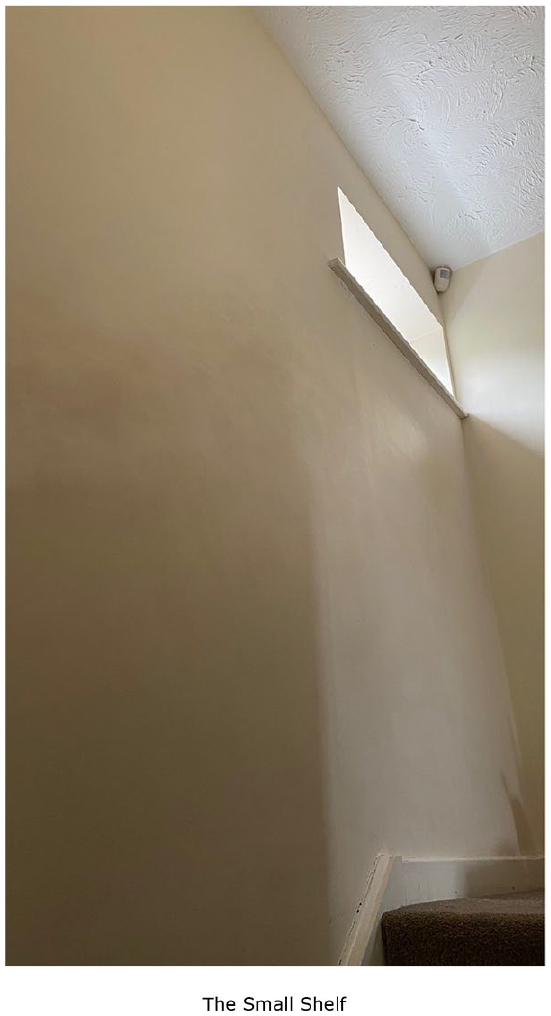
The house becomes the university The study becomes the office, the kitchen the lecture theatre The pointless high small window outside my room Has a previously pointless high small shelf A conveniently flat surface now takes an empty mug When someone goes downstairs, they might take it with them International video lectures, ni hao cameras on Breakfast in my time zone silk pyjamas in theirs The small shelf gains a porridge bowl setting hard in the sun Late night research meeting, dinner to the side off-camera Roll my chair against plates of the day, onto the small shelf they go When someone goes downstairs, they might take them Family members in their rooms listen to discipline through thin walls Texting drink requests and unsolicited opinions Ethically questionable but an amusing distraction I serve the printing, I serve the refreshments I serve my colleagues at a distance Stack the empties slide them between someone’s on the small shelf The best hours for writing, Seven till Nine in the evening On a day exactly like the day before And the day before that A mint tea after dinner has nothing to go in Contemplating the gravy boat But I know where someone’s mugs are sitting Cut the call clear my head Students I will never meet grieving for people I will never know Stand in the hallway listen to my life Stare down the stairs Rearrange the memory, it seems I am the Someone Reach up, left hand right hand, empty the small shelf
Afterword
The above is an evocative autoethnography of my Covid lockdown experience as an academic, personal tutor, manager, Dad, and husband. I offer it as an object of reflection for academic colleagues and as a statement of events of life at that time, which made permanent changes to the fabric of our home, as represented by the “small shelf” that had gone largely ignored in our house until lockdown. The minutiae of lockdown life presented here are not unique to me but will find surely parallels in the lives of most academics at that time.
For the first time, I was practicing my profession in my own home, but it was not only my home—it was my family’s home. Their home had become part of the University, the University had become part of their home. The fabric of their home and home routines had become a site for university work, the performance of teaching, and provision of pastoral care. There is emergent research on situation of Higher Education during lockdown (e.g., Bao, 2020; Pokhrel & Chhetri, 2021). However, personal perspectives of academics are less common, particularly including the family of the academic. Some notable examples are Leal Filho et al. (2021) and the autoethnography of Godber and Atkins (2021).
According to Kossek and Lautsch (2012) classification of boundary management styles, I was acting as in integrator in that work merged with homelife as the tasks I performed in the office were quite performable in the home, but also a blender, creating definite spaces for work in the home, but trying to compensate by serving my family. My boundary choices impinged on my family and their experience of me, even of their home. Kossek et al. (2021) provide an excellent female STEM academic perspective on lockdown homelife. However, the literature seems bereft of male perspectives. Rare also is the perspective of the fabric of the home—the university pushed into the home; the home pushed back. This led to innovation, putting existing things put to new uses, like my small shelf.
From the academic’s point of view, we are used to having our teaching performance evaluated by peer evaluations and student surveys. However, for the first time in my life, my teaching and managerial performance was exposed to my wife and daughter. They were pursuing their own work and lockdown lives in their own rooms around my study where I was working, or the kitchen, where I delivered lectures. As we passed in the house, drove in our car, sometimes even through the door of my study, they offered their observations and raised questions.
Unlike the general tone of the lockdown research, that academics were suffering adverse impact on their work and disruption of daily routines, with Godber and Atkins (2021) reporting disconnectedness from and loss of a “regular” daily routine being “disturbing with mental ill-health negatively impacted for many,” I was having a lovely time. This was so much so that my wife told me not to go on about it. Everyone I cared about was with me and protected by decisions I’d made having had advance warning of lockdown from my doctor. I think I had been preparing for this my whole life. As a child, I was laughed at by my family for my “hypochondria” but now society was faced by a real health crisis, I was almost serene. However, the comforting rhythm of banal routine is interrupted in the final stanza as I am caught for a moment in the liminal space between the tragedy of Covid for students that I would never meet in-person and the “normal” noise and life of my home and my safe loved ones. The small shelf brings me back with physical routine. Even though things have returned to “normal,” the once-pointless small shelf has become a permanent feature of the function of our home.
Situations like mine stimulate practical ethnographic research questions. Theories of audience experiencing a performance do not cover the unintentional experience of performance, like that experienced by my family, which impinges on them and may draw them, willingly or unwillingly, into participating in the teaching and learning experience. There is an institutional perspective—the challenges of professionalism and also confidentiality/ethics—How does my experience affect policy for future home-based working or pandemics? There is a family perspective—How should institutional home-working policy include or compensate for the presence of family members? What are the compensating routines of the family and how do they negotiate boundaries—I might be an integrator/blender, but are they? There is even an architectural perspective in the bricolage/modification of homes, furniture and other physical objects.
Footnotes
Declaration of Conflicting Interests
The author(s) declared no potential conflicts of interest with respect to the research, authorship, and/or publication of this article.
Funding
The author(s) received no financial support for the research, authorship, and/or publication of this article.
