




Abstract
This article brings a posthuman approach to assignments and assessments as they are configured in and by normative practices in educational institutions, including schools and universities. Composed as a collaborative posthuman autoethnography, we use the figuration of the AcademicAssessmentMachine to illuminate how educational assessment-as-usual positions, hierarchizes, grades, and disposes human bodies—both teachers and students—in ways that are affectively damaging and socially unjust. In rethinking educational assignments and assessment as a more-than-human affair, we swerve its purpose and doings toward more affirmative possibilities. We ask how might we disrupt the AcademicAssessmentMachine while being caught within it ourselves?
Keywords
Introduction
As a supervisor and student on a Doctorate of Education (EdD) program, we are entangled within assessment practices that position us as assessor and assessed. We mark, and are marked. We score, and are scored. We grade, and are graded. In this article, we use posthumanism to think differently about assignment and assessment practices in education; as we collaborate and think together, we are provoked by our entanglements in rubrics, assessment criteria, syllabi, moderation meetings; and as we write, the AcademicAssessmentMachine rumbles on, marking, grading, scoring. Our experimental thinkings-doings—our desires for new possibilities for an education otherwise—always take place in the AcademicAssessmentMachine’s grasp and shadow. The AcademicAssessmentMachine is us, it has colonized us—our bodies and minds—and we are continually implicated in its re-production. How might our radical dreams intra-act with what is possible when caught within the AcademicAssessmentMachine?
We imagine, How to do assessment differently to disrupt the idea of the assessed/assessor as independent, separate, bounded, singular, individuated entities engaged in processes and practices that are “objective,” “reliable,” “valid”?
We question, What might emerge when we contest humanist, colonialist, masculinist assignment and assessment presumptions, processes and practices?
We work, Against neoliberal normativities that simplify and reduce learning and knowledge to pre-packaged and easily assessable, measurable outcomes.
We speculate, How to bring a posthuman approach to exploring the time-space-matterings and human-nonhuman relational possibilities. of assessment processes and practice? How to figure assignments and assessments as messy, emergent, entangled becomings?
We wonder, We are educators caught in the AcademicAssessmentMachine wondering what does assessment produce? What does assessment make possible? What does the rubric do? What does the mark do? How does judgement, interpretation etc materialise in assessment practices? How does power operate in assessment?
We ponder, (How) can we write a collaborative post-authorship posthuman auto/ethnography to hail the possibilities of posthumanism to help us pluralize assignments and assessment practices? How can we reimagine the AcademicAssessmentMachine in order to undo assessment as usual?
The AcademicAssessmentMachine Marks and Makes Marks
TheAcademicAssessmentMachine marks and makes marks The mark of the mark on the student The mark on the body The mark on the page The mark on the screen Indelible, im/material A virtual etching Pleasure-pain The desired in subjection We are standardised We are assigned We are marked We are standardised, assigned, marked by/within/with the AcademicAssessmentMachine.
We develop the concept of the AcademicAssessmentMachine from the AcademicConferenceMachine, a term Benozzo et al. (2019, p. 89) use to draw attention to academic conferences as “regulatory, structured organizational space, a space of (non)repetition—which runs the risk of becoming so regulating, normalizing and standardizing that it might lose the possibility to produce different knowledge and to produce knowledge differently.” This concept of the AcademicConferenceMachine alludes to and draws from Henderson et al.’s (2016, p. 6) academicwritingmachine, which conceptualizes the “workings and conventions of academic writing-publishing-performing” that academics must comply with “to be counted and recognized as legitimate.” As educators, we are connected to and work within the AcademicConferenceMachine and academicwritingmachine, they shape who we are as academics. So too does the AcademicAssessmentMachine. Henderson et al. (2016, p. 6) ask of the academicwritingmachine, “what does it mean to be a cog, a wheel, a lever or a pulley intricately caught up in this machine?” And we ask, What does our entanglement in the AcademicAssessmentMachine entail? What does it do? What does it demand of us? How can we disrupt its normalizing, standardizing force? Yes, disrupt. Try to disrupt the AcademicAssessmentMachine. Forget trying to detach ourselves Forget separation. Forget stepping outside the machine
As Henderson et al. (2016, p. 6) note, “we cannot separate ourselves from this machine. We are not outside of the machine. We are an intricate part of the machine. We are ‘incapable of making movement except as part of the machine’ (Deleuze & Parnet, 1987, p. 104).” As educators, we are entangled within the AcademicAssessmentMachine and our movements, even as we move against or away from it, are made possible by our entanglement within it.
Paper’s Nostalgia, and The Educator’s Assignment-Assignation: Mark!
My surface is blank and clean Well, almost clean Last night when she got me out Extracted me from my companions She placed a cup of coffee on my corner Its delicate impress a half-ring Its aroma seeped and then mingled in air She is agitated Hovers over me with sharp nibbed pen A scratch A line A curve She’ll never know how those grooves tickle Or sometimes hurt When force moves more strongly through hand She leans over me Time passes I stretch out sleepily as sunny warmth Moves over the desk My surface is being marked quickly now Her hand races to capture her speeding thoughts I am the centre of her universe For now Suddenly she stops Moves me to the side I linger longingly I like company Soon another like me is placed underneath me Slightly askew We shuffle and shift and fold towards each other Then there are three and four and five of us Paper-clipped together Her gaze is on us Over and over she looks us over Do we tell her what she knows What she wants to say? Are we good Or satisfactory? Perhaps we are excellent? As she reads us We rustle in the slight breeze Our cellulose fibers Remembering our vegetal beginnings Wood, grass, hemp Before we were pulled and stretched and separated and mulched Before we were watered and starched and inked and dyed Future generations of us exist only virtually Not bodily or materially Their texture flattened Their appearance uniform Their size and shape utterly regular How will their educator-markers relate to them? Will they not miss the touch of hand The softly falling flakes of skin The almost imperceptible slip and slide of a strand of hair That caresses an awaiting surface They might say we were too supine That we had curled edges While they are often upright Flat and utterly uniform But why might that be considered a virtue? They might relish the computer’s background chat and incessant hum The neat storage solutions Free from dust, dirt and detritus They might enjoy conversion into one’s and zero’s Endless number chains Into infinity Looking coolly out of their flattened screen What will they see and feel and know?
Un/Grading
A post pops up on Twitter, shared by the progressive education non-profit organisation Human Restoration Project: NEW: We are excited to offer a new course through the ISEA and Drake University: Ungrading to Break Barriers Toward Learning. 3 graduate credits or licensure renewal. This class dives into the history, research, practice, and implementation of ungrading.
I sign up for the course. I learn about the ungrading movement, a response to obsession with grades in modern school systems, that seeks to reframe and reimagine assessment as more personalised, more student-centered, more humane. But, as I consider “ungrading,” I notice my continued entanglement within the AcademicAssessmentMachine. I learn about methods of creative noncompliance and strategies for appearing to satisfy the demands—from parents, administrators, students—for numbers and letters and measurable outcomes while also de-emphasising the importance of grades. I learn how to redesign learning and assessment tasks so they are “ungraded,” for example self-assessed project work. But, in redesigning learning and noncomplying, we are still responding to the AcademicAssessmentMachine. As we tinker around, the machine still moves us.
A Collaborative Posthuman Post-Authorship Auto/Ethnography
We are two educators writing together. One of us is a university professor whose teaching career has entailed assessing, marking, grading student assignments and theses at undergraduate, master’s, and doctoral level. The other of us is an international school teacher who assesses, marks, and grades students as part of their secondary school courses. We are also supervisor and student on a Doctorate of Education (EdD) program, we are entangled within assessment practices that position us as assessor and assessed. Both of us are, in multiple and different ways, thoroughly immersed and enmeshed within the AcademicAssessmentMachine: while we continue as educators, there is seemingly no “escape” from it. Even though assessment rubrics get periodically revised and assessment formats updated (more students presentations, fewer 6000 word essays!), assessment continues to do its ineluctable and cruel work: stamping and sorting bodies-minds-hearts with a sign of academic “worthwhileness” and “worthiness” (or not).
We are also writing this article with, just as we are doing our assignments-assessments with, a host of nonhuman collaborators: computer screen, daylight lamp, books, paper, pens, air, skin, dog fur, overhead airplane, carpet mites, plastic stress balls, mouse and mousemat, stained coaster for coffee and tea cup, delivery van and car fumes from an open window, biscuit crumbs, chocolate wrappers, memories switching sparking synapses, lower back pain, on-and-on. Who/whatever “we” are, we are not alone as we assess or submit ourselves to assessment through our assignments. Our human bodies work in confederacy with, and are dispersed among, a host of nonhuman others all of which have agential force, albeit in very different ways, in enacting what comes to matter in the materialities of assessment practices. These posthuman orientations disrupt the idea of the assessed/assessor as independent, separate, bounded, singular, individuated entities, hence we write this article as a collaborative posthuman post-authorship auto/ethnography in recognition of the objects, bodies, materialities, and spaces that constitute entangled assessment processes and practices.
Post-authorship, as we use it here, is “a means to interrogate, critique, and undo the representationalist modes of normative authorship” (Taylor & Benozzo, 2023, p.1) with its presumptions of self-centered authorial intentionality and originality. Our allegiance to post-authorship as an experimental mode of “academic writing otherwise” is akin to our desire to do assessment otherwise. Our writing and our orientation to assessment call into account the performative reward and recognition systems and requirements of the “hyper-quantified machine of the neoliberal university” (Henderson et al., 2016, p. 5) which shapes us as academics and as educators.
Post-authorship practices and posthuman theoretical orientations both critique and seek to undo the “self” of the hu/Man and the “Man” of classical Humanism. As Braidotti (2022, p. 19) notes, this “Man” has enacted “epistemic and symbolic exclusion” and real-life ruthless violence toward all the “others” (those categories designated not “Man”) deemed disposable, and whose “existence, activities, practices” have been deselected and edited out. Taylor and Benozzo (2023) suggest that post-authorship is a means to “work ethically and productively against (while being enmeshed within) the normative prescriptions and governmentalizing deformations of the academic-writing-machine” and, we contend, the AcademicAssessmentMachine. We write-with nonhuman collaborators, companionable theorists, and you (our imagined reader) as we engage in experimental disturbances and disruptions of the AcademicAssessmentMachine. In proliferating authorship as post-authorship to explore the doing of collaborative posthuman auto/ethnography, we humans are entangled, intra-active, emergent, cut-together-and-apart, unfixed. We create posthuman personae and narrativize nonhuman entities as character-ful multiplicities that displace ‘selves’: an assignment, a book, spectacles, assessment criteria and syllabus, and so on.
Becoming Rubricized
We are told that the use of rubrics, otherwise known as mark schemes or assessment criteria, will bring “objectivity” or “neutrality” to assessment processes and make assessment fair and efficient. Teachers can read books with titles like Introduction to Rubrics: An Assessment Tool to Save Grading Time, Convey Effective Feedback, and Promote Student Learning (Stevens & Levi, 2011) or A Complete Guide to Rubrics: Assessment Made Easy for Teachers of K-College (Quinlan, 2012). The promise of rubrics: Assessment made easy! Save grading time! Teachers can log onto websites like iRubricTM to sign up for an “easy to use package” for rubric development: “Click. Click. Done. Scoring rubrics cannot be made any easier. Just pull up a rubric from the gradebook, click, click, and you’re done,” the website declares (iRubric, n.d.). “Over 816,000 rubrics and growing . . .” (iRubric, n.d.). Rubrics made easy! Click, click, done! This narrative around rubrics promises to “boil a messy process down to four to six rows of nice, neat, organized little boxes” (Wilson, 2006, p. 2).
But what do those neat little boxes do?
Those neat little boxes “both compel and constrain student performance,” resulting in work that is high-scoring—compliant with the rubric—but “vacuous” (Mabry, 1999, p. 676).
Those neat little boxes turn learning into “recipes to be followed by the learner” (Parkison, 2015, p. 55), whose response to a new idea arising in a classroom discussion might be to ask, “How will we be scored on this? What’s on the rubric?”
Those neat little boxes see teaching as technocratic and pre-determined, based on simplistic assumptions that cause and effect is so predictable and linear that “if we just get the factors and weightings right, teachers can plug in the numbers and the rubric will reliably predict good and bad writing” (Wilson, 2006, p. 32).
Those neat little boxes “turn teachers into grading machines” (Kohn, 2006). “Robo-teachers” (Macur, 2021).
From school to college to university undergraduate degree to masters to doctorate. The cogs grind on.
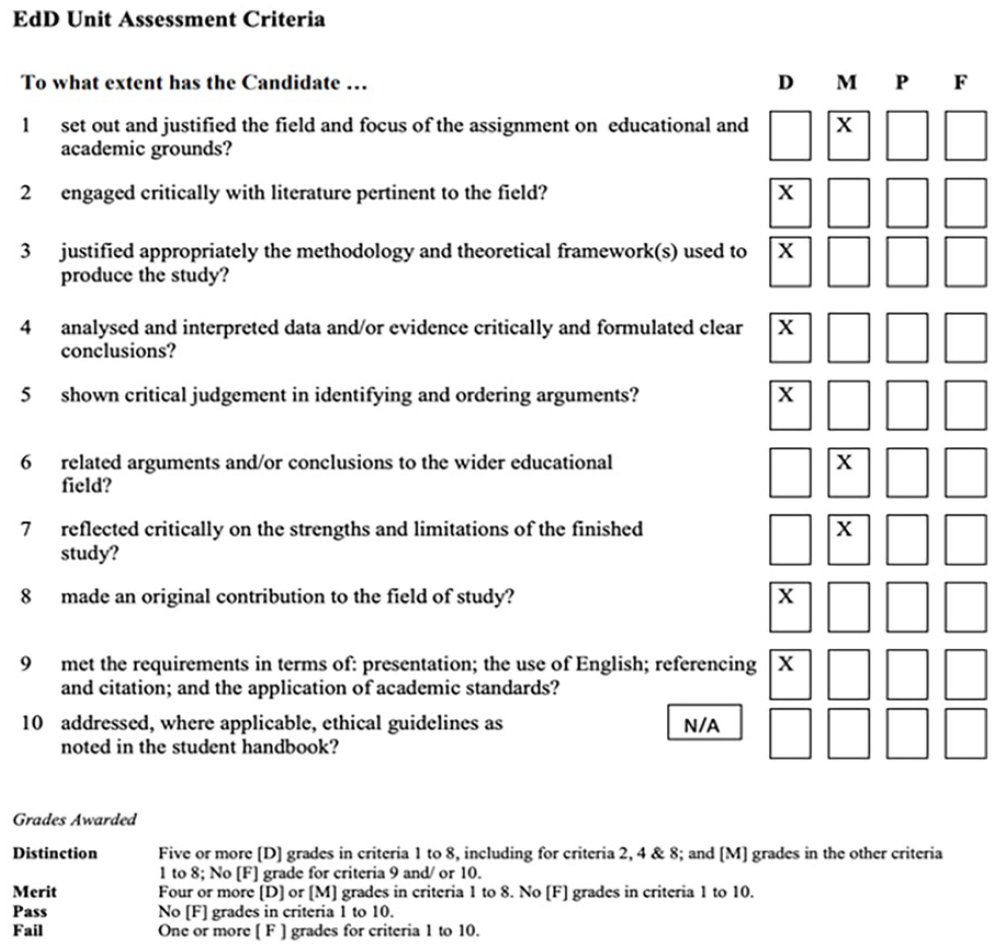
Neat little boxes. We’re lining up. Four by ten. D, M, P, F. Neat little boxes! Stand to attention. Attention! Waiting. Waiting for our X. Expectantly. Expecting X. Expectantly expecting X. X me up! Waiting for our X’s so we can do what we do. X marks the spot. X marks the work. X marks the student. X marks the teacher. Does X mark the end or the start? X X X X X X X X X X
What are the critics and defenders of rubrics missing? They see rubrics as tools. For their critics, rubrics are tools that are unfit for purpose, unconfigured or inadequate to deal with the richness or complexity of students’ writing, or they are tools whose use has negative side-effects, impacting the quality of teaching and learning. For their defenders, rubrics are tools that are generally effective, even if they sometimes break down, or are sometimes poorly designed, or are sometimes misused, “even wielded as weapons” (Spandel, 2006, p. 19). But, from a posthumanist perspective, a tool is never neutral.
A tool is never just a tool.
To reduce objects to tools is to fail to recognize “the full range of powers possessed by nonhuman bodies,” denying the truth that objects are “things” with “thing-power” that have “the ability to make things happen, to produce effects” (Bennett, 2010, pp. 39, 35). Things like rubrics or mark schemes are “vibrant” in the sense that they “act as agents or forces with trajectories, propensities, or tendencies of their own” (Bennett, 2010, p. viii). The mark scheme directs, leads, blocks; it transforms those who work with it. Rubrics create lines of descent (Bergson, 1998) as they lead us to “think in fixed, categorical terms” (Davies, 2014, p. 7), as we approach student work not to be challenged and provoked and inspired and . . . but to ask which of our categories suits. In which of those neat little boxes does it fit? “Is it this, or that, or the other thing? And ‘this’, and ‘that’, and ‘the other thing’ are always something already conceived, already known” (Bergson, 1998, p. 48).
In doing what they do—in exerting their thing-power—rubrics with/through/in us enact agential cuts, enact “determinate boundaries, properties, and meanings” (Barad, 2007, p. 340). As we mark work with rubrics, they mark the work, transforming it into this and not that. Effective not limited, satisfactory not good. In the intra-action of rubric assessment, the work becomes something and not something else, as cuts are made, and boundaries are enacted. Tools are not just tools. We question the separation of tool/object and rubric/essay. This essay as this satisfactory essay and that essay as a partially relevant essay only exists through its intra-action with the rubric. A different rubric, a different essay, a different set of Xs. “Different agential cuts produce different phenomena” (Barad, 2007, p. 175).
So, too, are we humans—those of us who intra-act with the rubrics—becoming differently through assessment intra-action. The rubrics mark us too. We are rubricized.
In 1948, Maslow used the term “rubricizing” to describe “humans” predisposition for classification and categorization,’ arguing that by attending and responding “in a manner that immediately classifies or categories any (or all) aspect of a particular reality . . . that person is being rubricized” (Tenam-Zemach, 2015, p. 2). As we teach, learn, and assess with rubrics, we are rubricized. To be rubricized is to be prescribed a packaged identity of assessor or assessed and to engage in “partial, token, or nominal response[s]” to reality (Maslow, 1954, p. 206). To be rubricized is to become attuned or programmed or calibrated to notice what the rubric notices and respond as it responds. To see an essay and see effective or limited. As Patterson and Perhamus (2015, p. 30) write, “The cells [of the rubric] are now part of how teachers think, create, understand, and define. There is a blurring of cells. In the cells of our beings are the cells of the rubrics.”
Blurring of cells. Blurring of assessor and rubric. Rubricization complete.
Becoming
Dig through the pile of papers to find the mark scheme. Crumpled, with one of its corners torn off. Read its descriptors for the first criteria, neatly organised in a continuum:
limited
partially effective
effective & mostly accurate
mostly accurate & very effective
The next criteria:
mostly irrelevant
mostly relevant
consistently relevant & convincing
On the examination marking website, click on Standardisation Script 1, and read the piece of work. Partially effective or effective? Mostly relevant? Consistent? I enter ’23’ A message pops up on the screen: “Your marking is out of tolerance.” Your score: 23 Agreed score 28 So, it’s very effective and convincing. Standardisation Script 2. “Your marking is out of tolerance” Your score: 18 Agreed score: 13
Partially effective
Then Script 3, then 4, then 5. Play the game, trying to get those two numbers closer together. “Your marking is within tolerance.” “Congratulations! You have passed standardisation and are ready to begin live marking. Standardisation complete.” I tape the mark scheme to the wall above my desk. I am interpellated. I am successfully standardised. Cogs grind on.
Becoming Reproducible/Reproduceable
What knowledge does assessment aim to assess? What does assessment do to knowledge? What does assessment do to the knower? We remember the subject “Geography” at school. Tracing paper laid over maps, the map visible underneath but blurry. The sharpened point of the pencil threatening to rip through the paper if pressed too hard. Lines traced carefully and diligently. But don’t press too hard. The patient silence as we bent over the paper, absorbed in the work, just the occasional crumple of the smooth tracing paper slipped carefully between small fingers. Tracing the outline of the United Kingdom to know our place in the world. But how small it looked! Tracing to become a knower of your place in the world and how to inhabit its cultural, economic, political formations of power. We hand our books in. They are taken away. They are returned the following day, each page with a bright red tick in the corner. Learning, effort, energy transmogrified into bright red ticks. Tick and flick. Teacher: Tick and flick.
Assessment requires knowledge to be traceable. Assessment requires knowledge to be chunked, contained, and codified so that it becomes reproduceable. So that we become reproduceable. Assessment turns the wonder of the learner and the learner’s wonder into that which is reproduceable. Reproducing = reducing and extracting. Leave curiosity and wonder at the door, leave those odd questions outside. Just trace, reproduce, assess, trace, reproduce, assess . . .
The AcademicAssessmentMachine and the Power of Number
Last week, hundreds of students in UK gathered in front of the Department for Education and chanted “f**k the algorithm.” Within days, their protests prompted officials to reverse course and throw out test scores that an algorithm had generated for students who never sat their exams due to the pandemic. (Kolkman, 2020) They hold us high. Chanting. Their words scrawled on us in fury:
YOUR ALGORITHM DOESN’T KNOW ME.
F**K The Algorithm.
I’M A STUDENT NOT A STATISTIC.
FAIR GRADES? COMPUTER SAYS NO.
TRUST OUR TEACHERS.
WE ARE BETTER THAN THIS!
HOW CAN I VALUE A SYSTEM THAT DOESN’T VALUE ME?
AN ALGORITHM DECIDED MY FUTURE! I’M PISSED OFF
During the COVID-19 pandemic, when GCSE-, AS- and A-level examinations were canceled in England, teachers at secondary schools were asked to make “rigorous, objective and fair” (Ofqual, 2020, p. 15) predictions of “the grade that each student is most likely to have achieved if they had sat their exams” (Ofqual, 2020, p. 4). They were then asked to “rank order” their students so that a “statistical model” could be applied to “standardise grades” (Ofqual, 2020, p. 11). The grades that resulted from this process caused widespread outcry and, amid students’ chants of “fuck the algorithm,” the Office of Qualifications and Examinations Regulation (Ofqual) later suspended the system and reverted to teacher assigned grades rather than those resulting from the algorithm.
An important victory: to shift of control back to teacher assessment and away from the depersonalized quantificational work that algorithms do. We know, or at least dimly sense, that algorithms do educational work that is largely unseen in being behind the pedagogic scene. We also know the work that algorithms do in shaping profound social effects—their unseen quantificational work produces differentiations in life chance and affective in/exclusions. McKittrick (2021, pp. 109–110) demonstrates that predictive algorithmic models on crime, policing and neighborhoods in U.S. cites “are underpinned by differential racial histories and privileges” which re-produce the mathematical logics of colonialist and plantocratic systems, mentalities, and practices. In education, algorithms are spectral data bodies which attach themselves to, tag and mark human bodies with profound effects for those subject to their effects. Fairchild et al. (2023) talk about “the dividualization of algorithms” in academia that turn our bodies into “code, number, frequencies” which “denote our worth, affect our promotion prospects, produce, binarize and mark us a good/bad scholar” (p. 25) in mechanisms such as the h-index, citations and the £ and $ of grant capture. Similar processes would have been at work in the Ofqual statistical practices in schools, enacting “racist, sexist, ableist, classist algorithmic patternings which repeat and reproduce necro-capitalism’s organizing power” (Fairchild et al., 2023, p. 25).
Teacher assessment via assigned grades rightly “won” in the face of the application of algorithmic statistics, comfortingly introjecting a human element into the faceless, nameless spectrality of algorithmic numbering. Teachers did their work of marking, moderating, standardizing so that they could produce rankings, orderings, and hierarchies, albeit more “true” to the work and the student effort, more “rigorous” in that it entailed actually looking at work students had produced, and ostensibly more “fair” and “objective” in that teacher assessments worked within the material-discursive regimes of truth or rules of the game that attend any mode of educational assessment: And so. And yet. The quantified self produced by assessment was not disrupted or disturbed. The work of assessment to predict, rank order, standardise was affirmed. The value of assessment as rigorous and unbiased was evident and credentialised. The work of the AcademicAssesmentMachine roll on its not-so-merry way: Separating, dividing, assigning. The power of number remained intact.
In pondering the power of number, Helen Verran (2014, p. 110) tracks the “birth” of a particular number—the number which purports to measure “the value of the world’s ecosystem services and natural capital” (110). You may be interested to know that in 1997 this number was an average of US$33trillion per year, based on economic estimates of Gross National Product. Verran traces this particular number’s intervention in market-led environmental policy around the world and repudiates the work it had been made to do in gearing this number’s meaning to the instrumental value of nature in a market economy, and displacing concepts of nature’s value as immeasurable and in perpetuity. She contends that this number is a “dodgy number,” a number that enacts modes of “political spectacle” in that “in the guise of rationality” speaks to a “politics of affects” (Verran 2014, p. 112).
But what if we also accept that many of the numbers produced by the educational AcademicAssessmentMachine are also “dodgy” numbers? Not “accurate” evaluations of quality of worth but “culturally relative social constructions” in Verran’s (2014, p. 112) terms, which do their mean and nasty work as material entities, agencies, actants to reframe our identities (as lacking, as failing, or as successful, or just satisfactory) in a deeply flawed constitution of a damaging reality. As educators, we are made to care about certain numbers—PISA country school hierarchies; national Research Excellence Framework; The Times Good University Guide position of our own university. Such numbers are made to matter by the forces of power that produce them and the material-discursive mattering they produce, the cuts the make, the bodies they shape. Marks, assignments, assessments create who, and what matters in the here-and-now. If we let them, numbers produce failures that travel with us into futurity.
Un/Becoming Cogs
In our EdD doctoral positionalities of assessor/assessed—a binary assignation for assignment production as supervisor/student—the AcademicAssessmentMachine assigns us roles. One marks/one is marked. That is true and untrue. Just so and unjust. We try to inhabit the space of assignment-assessment as a non-neutral, non-objective ethico-onto-epistemological space of push-and-pull, while moving as parts of the machine. Fluid un/becoming cogs in a well-oiled machine.
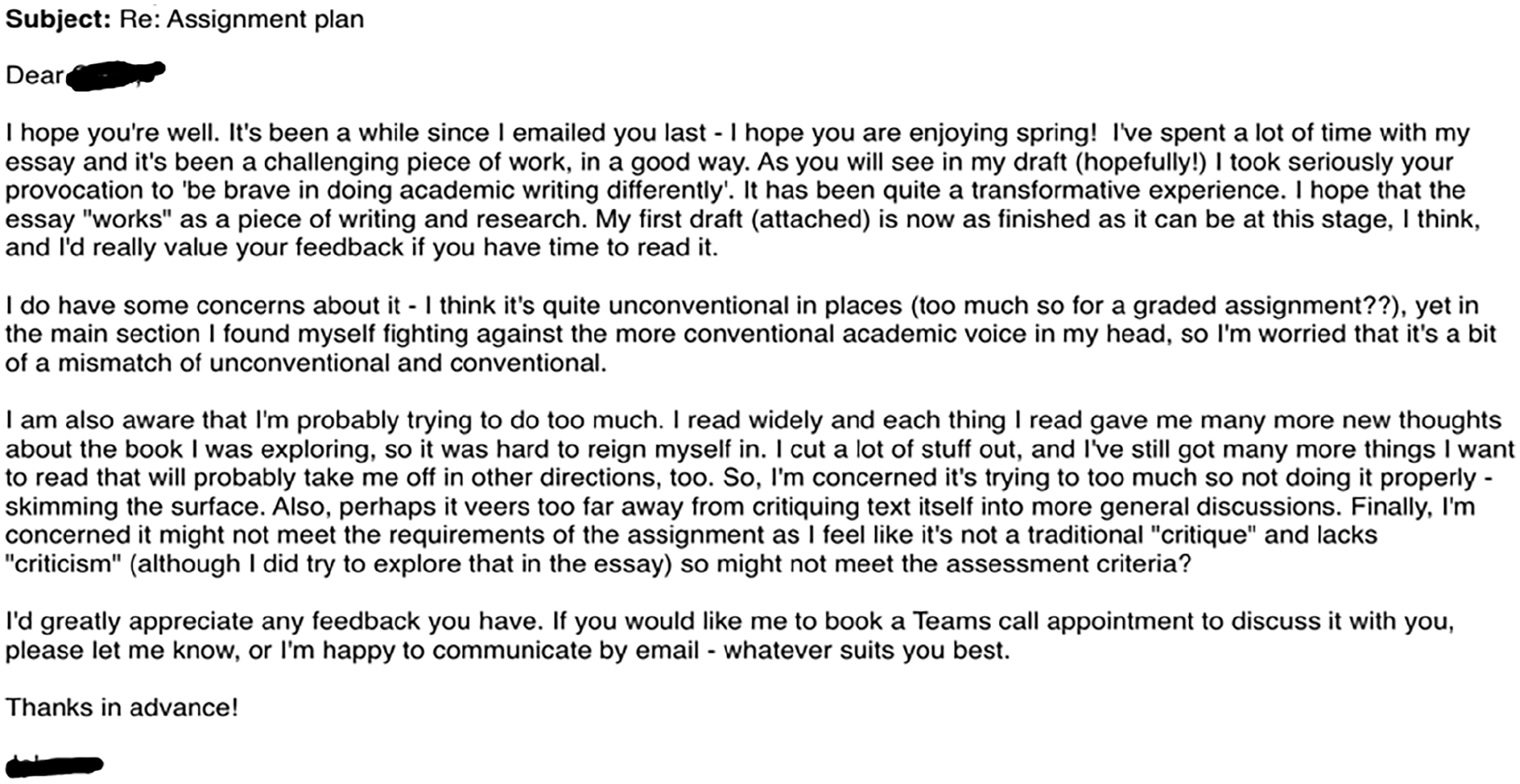
The e-mail above points to Jacob’s desire to push back against the predetermined learning outcomes within the syllabus and the constraints of the assessment criteria to attempt to write something different. Carol’s advice was to be brave in doing academic work differently. Together launching potential lines of ascent that widened the rubric-space and welcomed, invited, and enabled the emergence of new thoughts. But, as lines of ascent and descent are mutually dependent, the possibility of doing doctoral work differently within the rubric-space is a fearful and worrisome task. Is it too much for a graded assignment? Will it meet the assessment criteria? “An apparent line of ascent” can always “plunge you into a binding, apparently fixed line of descent” (Davies, 2014, p. 32). The task is to remain response-able, to stay with the trouble (Haraway, 2016), to stay critically attentive to the ways in which we are standardized, rubricized, marked as we intra-act within assignment and assessment practices. Is this a way (one way) to disturb and disrupt the AcademicAssessmentMachine? For Barad, response-ability is “not about the right response, but rather a matter of inviting, welcoming, and enabling the response of the Other” (Kleinman, 2012, p. 77). Pursuing Barad’s thought that “the range of possible responses that are invited, the kinds of responses that are disinvited or ruled out as fitting responses, are constrained and conditioned by the questions asked” (Kleinman, 2012, p. 77), then we need to pose new questions to make the rubric-space, the assignment and assessment practices, more inviting, more welcoming and more enabling. Even so, such moves mean we are still caught within the AcademicAssessmentMachine.
Exam Paper 1: Did you hear that? Did you hear the students asking “When are we going to get our exam papers back? When will we know our scores?”
Exam Paper 2: Does that mean we’ll be getting out of this envelope soon?
Exam Paper 3: Nah, we’ll be here for a while yet. I heard him telling the students he needs to moderate us first. He’s not allowed to give us back until next week.
Exam Paper 4: So, we just wait here in this envelope then? I can sense the students looking over at us all the time, can’t you? They know we’re over here in the corner of the classroom.
Exam Paper 2: So what do we do while we wait then?
Exam Paper 3: Get ready. Prepare yourselves.
Exam Paper 4: Prepare for what? What will happen when we’re handed back?
Exam Paper 3: You’ll find out what they think of you.
Exam Paper 2: What do you mean?
Exam Paper 3: Your student. Instantly you’ll know.
Exam Paper 2: Know what?
Exam Paper 3. You’ll know when you know.
Exam Paper 2: How?
Exam Paper 3: Just look at whether their shoulders drop. Notice whether they put their head down on the table. See whether they fold over your corner where the score is written so no one else can see it. Pay attention to how they walk out of the room when they carry you out. You’ll know how you’re marking their bodies, changing their life chances.
Will the AcademicAssessmentMachine break down? Can it be undone? Maybe the best we can do is to enact a thousand tiny disruptions while we wait for a breakdown that may (or may not) come. In this durational meantime, we remember that “lines of ascent and descent are not mutually exclusive lines of thought . . . they continually affect each other and they depend on each other” (Davies, 2014, p. 7), and we remind ourselves that while lines of descent “may foreclose the emergence of new thought,” they may also “create a coherent space in which the new can emerge” (Davies, 2014, p. 7). As Bergson suggests, creative evolution requires us both to know and to develop the capacity to let go of the status quo. We wonder what might emerge if we choose to intra-act differently—response-ably—within the entanglements and spacetimematterings of the AcademicAssessmentMachine.
It’s easy to see assessments as separate from us. We print them out and file them away. We drag them into desktop folders. We package them up in envelopes or filing cabinets. But, when we approach identities from an agential realist perspective, we see that nothing we do can be apart from us. As Barad (2007, p. ix) puts it, “individuals emerge through and as part of their entangled intra-relating.” As we intra-act within the AcademicAssessmentMachine assemblage, as we intra-act with rubrics and exam papers and moderation meetings and assignment proposal forms and red pens and feedback posts on Moodle and and and . . . we are shaped through and as part of this entanglement. We emerge within the Machine.
Posthumanizing Assignments and Assessments
To posthumanize assessment is to be attentive to the ways in which we and others (our students) are emerging within this entanglement so as to “increase our own power of acting” (Dahlbeck, 2017, p. 30). The ethical task in a posthumanist paradigm is “to track lines and cultivate response-ability in the ‘muddle of thinking’” (Osgood, 2019, p. 203). To posthumanize assessment is to attend to the ways in which the AcademicAssessmentMachine is shaping us and cultivate ways of acting response-ably within it. Haraway (1994, p. 62) writes that “the point is to get at how worlds are made and unmade, in order to participate in the processes, in order to foster some forms of life and not others.” To posthumanize assessment is to foster better forms of life by the ways we participate in its processes. We are reminded by bell hooks (1994, p. 13) that “the classroom, with all its limitations, remains a location of possibility.” By intra-acting response-ably within the AcademicAssessmentMachine, we open up new possibilities from within its confines.
New possibilities can emerge from small cracks. Momentary intra-actions within the Machine can become powerful forces. To posthumanize assessment is to be alert and open to those moments. To find the cracks, to look through, to prise them open.
Disrupting the AcademicAssessmentMachine might look like a supervisor advising her student to “be brave in doing academic work differently.” It might look like a teacher “engag[ing] in dialogue with students so that grading is not an experience that is ‘done’ to students but a democratic and participative endeavour” (Passeport, 2023, p. 74). It might look like an invitation to write or make a creative piece rather than a traditional essay. It might look like a space in which the excitements of thought do not settle and ossify in canonical catacombs but buzz and take flight to make new nomadic connections. It might look like a dance, a display, a tiny detonation.
We Wonder If . . .?
The AcademicAssessmentMachine might be undone in the interstices, cracks, and fissures created by minor practices of relationality, kindness, care, and love. When a doctoral supervisor advises her student to “be brave in doing academic work differently,” what cracks? When a teacher counsels and encourages a student “don’t worry—it’s just a grade, it doesn’t define you, look at how much you’ve learned, see how the grade ignores that”—what cracks? When assignments are enfolded with life and become cognizant of affects, what cracks? “A crack is the perfectly ordinary creation of a space or moment in which we assert a different type of doing” (Holloway, 2010, p. 21). These practices in the cracks and practices that crack are prefigurative practices (Suissa, 2014) as they foreshadow and embody different and better ways of being, doing, and learning that might be built in the ruins of the AcademicAssessmentMachine. Through these minor practices, we create cracks within the AcademicAssessmentMachine and begin to prise those cracks open as we assert different types of doing.
Assignments and assessments are supreme examples of educational doors—they are symbolic, material, psychic, affective doors—and, as Derrida (2000, p. 14) notes, “if there is a door, there is no longer hospitality . . . as soon as there are a door and windows, it means that someone has the key to them and consequently controls the conditions of hospitality.” The AcademicAssessmentMachine works to keep the doors in place and the keys firmly in their locks and the gatekeepers (educators) ensuring they control (through myriad complicities) when, how, and who to turn those locks for and open those doors to. But what else can we do with a locked door? We can peep through the letter box. We can bang on it until someone opens up. We can prise it open at its crack. We can shove our foot in before it is slammed shut. We can change the locks. We can take it off its hinges. Perhaps we (educators) need to be more canny, more curious, and more combative in our doings and dealings in-with The AcademicAssessmentMachine.
The AcademicAssessmentMachine seeks to force its short-termism and acceleration upon us, chunking time into school and college terms with fixed marking deadlines and set assessment period which we lurch between as assessment hurtles on. However, we need to be attentive to changes on different time scales. As we go about the work of finding and creating cracks, perhaps slowly slowly we contribute toward the AcademicAssessmentMachine’s break down. In the long meanwhile of waiting for it to break down and collapse, perhaps we can consider how we can care for it by enabling it to transform into something other. Machado de Oliveira (2021) writes of “hospicing modernity” and we can use the same metaphor here: perhaps we are called to hospice the AcademicAssessmentMachine, offering “palliative care for a dignified death for the old system and assistance with the gestation and birth of new, potentially wiser systems” (p. 88).
Footnotes
Declaration of Conflicting Interests
The author(s) declared no potential conflicts of interest with respect to the research, authorship, and/or publication of this article.
Funding
The author(s) received no financial support for the research, authorship, and/or publication of this article.
