




Abstract
This article seeks to extend discourses of embodiment by deploying Alaimo’s concept of transcorporeality in the context of our grappling with complexities of bearing witness to deforestation and ecological destruction in Alberta’s Tar Sands. Transcorporeality captures senses of porosity among human, nonhuman, and more-than-human bodies and constitutes a productive perspective from which to ethically engage with ecological destruction. Through our artwork and dialogic exchange with each other, and our embodied thinking with the works of other artists and scholars concerned with ecological atrocity, we attend to challenges, nuances, and possibilities of witnessing in ways that both attune to our embodiment and seek to decenter the human. We contend that arts-based practices of being, knowing, and doing offer openings for re-figuring the toxic entanglements that pervade current ecological relations and illustrating pathways toward more regenerative futures.
Keywords
Introduction
Given this special issue addresses embodied reflexive inquiry, and curriculum studies’ emphasis on lived experience (Pinar & Grumet, 2014), I enjoy your idea of proceeding with dialogic writing, Diane. It is a generative alternative to abstract scholarly writing. In awareness that ecological justice cannot be separated from social justice, our thematic topic involves bearing witness to deforestation in Alberta’s Tar Sands through the arts. In deploying a more vulnerable, dialogic, situated approach, even with its attendant risks (Behar, 1997), we believe that knowing and affect, arise, circulate, and manifest within, between, and through human, non-human, and more-than-human bodies (Brennan, 2004). Writing-in-dialogue acknowledges a relational atmosphere in which we can grapple with complexities of transcorporeal witnessing in contexts of ecological atrocity. In witnessing, I find myself often caught within webs of insight and ignorance, understanding and misunderstanding, masking and unmasking. A meaningful education in these times of somatic crisis and unsustainability may be one devoted, among other practices, to interminable pathways of unconcealing societal and self-concealing (Heidegger, 1993, p. 448)—to unpackings, unmaskings, unlearnings, and undoings—in humility and without closure, finitude, and/or grand assertions of truth.
Yes, as we move forward in our complicated conversation (Pinar, 2019), let’s attend to these dynamics. The editors of this special issue describe embodied reflexivity as the ongoing process of consciousness that is cultivated within our bodies. I hope our images, poetry, and dialogic exchange with each other and our thinking with the works of other artists and scholars who bear witness to deforestation and the Tar Sands will engage with the nuances of our transcorporeal obligations to our human and more-than-human relations.
From Embodiment to Transcorporeality
For Ray (2008), a Buddhist yoga practitioner, our current global situation is steeped in a “crisis of disembodiment” (p. 22). He asserts that many of us modern human beings have “lost our connection with our bodies and our physical existence,” in part tied to our living “in a dominant culture that survives through exploitation” (pp. 22–23). On such terms, educational unlearning beckons somatic re-engagement. This means moving beyond the superficial and working/playing not with the “body we think we have, the body we conceptualize as part of our ‘me’ or my self-image,” but rather, “the body that we meet when we are willing to descend into it, to surrender into its darkness and its mysteries” (Ray, p. 12). The bodywork Ray emphasizes, the forgetting of which he roots in “forests sold to multinational corporations and quickly cut down” (p. 11), constitutes a re-attunement and remembering. Indeed, while still a yoga novice grappling for alignment, despite decades of practice, I’m ceaselessly surprised at what my body teaches and how my thinking can obstruct insight.
I have enjoyed practicing yoga with you these last years, Claudia. In ways that resonate with Ray’s (2008) writing, our yoga teacher encourages deeper bodily engagement and flexibility, but I question the extent to which our embodiment and alignment matters, when we, as human beings, are destroying the Earth-body.
Our yoga teacher’s questioning is key, and part of the way forward here may involve rethinking embodiment in ways more intertwined with and responsive to/responsible for the biosphere. While embracing Ray’s (2008) call for somatic remembering, individually and culturally, I distrust individualized, romanticized, apolitical, and celebratory usages of embodiment, usages that assume transparency, elide discomfort and shadows, and are human-centric. Contemporary societies are marked by disavowals of not only bones, flesh, and skin but also generative tangles of human, nonhuman, and more-than-human bodies. Modernity has produced shell-shocking webs and permeations of disease and destruction. In this regard, we might invoke the term toxic embodiment (Cielemęcka & Asberg, 2019) to acknowledge not only pollutant-filled human and nonhuman bodies but also discourses exploitative of nonhuman and more-than-human life-worlds. Such discourses can activate educational reflection, resistance, and innovation (Weedon, 1987). Here, we might work/play to re-figure toxic entanglements through education and the arts.
I find Alaimo’s (2010) scholarship valuable in this re-figuring. She underscores how the “human is always intermeshed with the more-than-human world” (p. 2). For me, her concept of transcorporeality really captures the sense of porosity between human and more-than-human bodies; it entails,
thinking across bodies [which] may catalyze the recognition that the environment, which is too often imagined as inert, empty space or as a resource for human use, is, in fact, a world of fleshy beings with their own needs, claims, and actions. (p. 2)
Transcorporeality may offer us a productive perspective from which to ethically engage with ecological destruction. It invites rethinking ontology in terms of interdependence and reconsideration of epistemological boundaries. In other words, how can our entanglements with other bodies inform our knowing and unknowing? How can we attune to the knowledge shared with soil, trees, and rain? What might it mean to know together with, through or alongside other bodies as we witness environmental destruction and hope for some mutually sustainable future? As Hern et al. (2018) contend, drawing on Indigenous decolonizing politics, “through a relationship with the land and other-than-human beings . . . we can recover a reconstituted understanding of what . . . living might mean today” (p. 30).
Conjoining Alaimo’s (2010) understanding of transcorporeality with the language of witnessing is fruitful, I think. Witnessing directs us to ethical and pedagogical engagement with suffering and trauma while also, I believe, heralding mindful and creative attentiveness to (conditions for) Life’s flourishing. Moreover, it points to the limits of rational knowing and the necessities of bearing witness to bodies (Felman & Laub, 1992). I am also reminded of Barad’s (2007) posthumanist scholarship, in which she cogently details that “knowing is not a capacity that is the exclusive birthright of . . . a self-contained rational human subject” (p. 379). It is not about humanist intellectualism. She calls for rethinking an ontology of knowing in terms of a “differential responsiveness (as performatively articulated and accountable) to what matters” (p. 380). A point Indigenous scholars have long made, eh?
Yes, it’s true. Indigenous peoples have always understood that knowing originates in relations between people and landscapes (Sheridan & Longboat, 2006). Might our search for a non-dualistic, ecological re-figurement of embodiment and for transcorporeal witnessing of ecological destruction . . . in ways that do not preclude possibilities for hope (Hern et al., 2018; Solnit, 2016) honor these relationships? I appreciate Tsing’s (2015) conviction that “amidst the terrors of indeterminacy . . . [there are] possibilities of coexistence” (pp. 1 & 4).
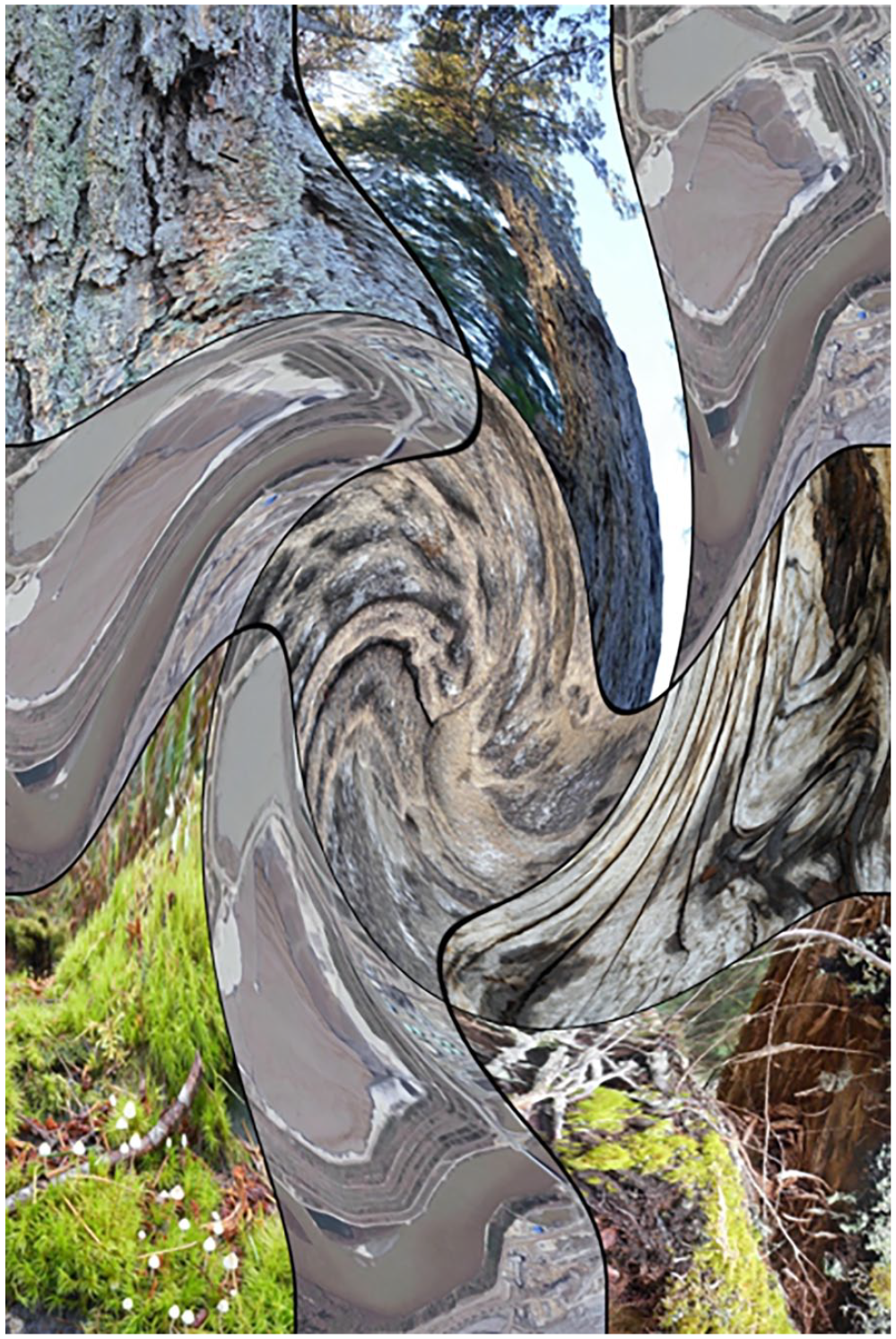
Landscapes: Conrad, 2022, Used With Permission & Remixed Image Athabasca Tar Sands Detail—Athabasca River, May 2005 (https://www.flickr.com/photos/skytruth/4168599603), by SkyTruth (https://www.flickr.com/photos/skytruth/) Licensed Under CC BY-NC-SA 2.0 (https://creativecommons.org/licenses/by-nc-sa/2.0/).
Between vitality and exhaustion is a place to call home. A place to return to, – at least I hope so. Being shackled by destruction, I forsake my relations. Instead, I look for fugitive moments of fertile entanglement. A few scattered seeds bring a flurry of avian companions to greet the day. A walk in the forest’s depths reveals the mossy suppleness of renewal. The shoreline’s crashing waves promise dynamic endurance. The dark night sky holds the stillness of longing.
Transcorporeal Witnessing of Deforestation
Your image of the tree, bark, and fir needles amidst Tar Sands destruction is compelling, Diane. Sigh. Along with countless others, I’ve always loved trees, and spent much of my early years playing in the woods. Now I grieve the earth’s increasing desertification (Eppert, 2020). Since the 1990s, forests worldwide have decreased by more than 80 million hectares (Food and Agriculture Organization of the United Nations, United Nations Environment Programme, 2020, p. xvi). I wonder about ways of bearing transcorporeal witness to deforestation, specifically.
I share your love of trees. Growing up in the Niagara Region in Ontario, fruit trees were our livelihood and lifeblood. My childhood memories are filled with fruit orchards bursting into blossom in spring, giving way to summer branches generously laden with cherries, plums, peaches, and apples. I recently spent 4 months in British Columbia’s temperate coastal rainforest among massive Cedars, Douglas Firs, and the largest Maples I have ever seen. How I was enlivened walking amongst those impressive beings and the life they support, inhaling their gifts. My experiences there, my intimate presence in nature, as we were beginning to write this paper, shaped my understanding of transcorporeal witnessing and the offerings I share here.
When responding to environmental destruction, I suggest, notions of witnessing may need to expand. I like the idea of wit(h)nessing for the way it brings abstract conceptions of environmental destruction close to home: To wit(h)ness one must cross a threshold into an intimacy that embodies both close encounter(s) and distant or aerial point(s) of view (Ettinger, 2005). Entering altered state(s) we wit(h)ness with close(d) eyes what is within and beyond our grasp. (Bickel et al., 2011, p. 160)
If we take seriously the interdependence of all beings and the porosity of bodies, then lands and beings situated on those lands are not distant or separate from our bodies. If our bodies are continuous with environments that have been destroyed, we might ask: How are we the trees? How are we deforestation? Or, as Tsing (2015) poignantly asks, “how shall we make common cause with other living beings?” (p. 254).
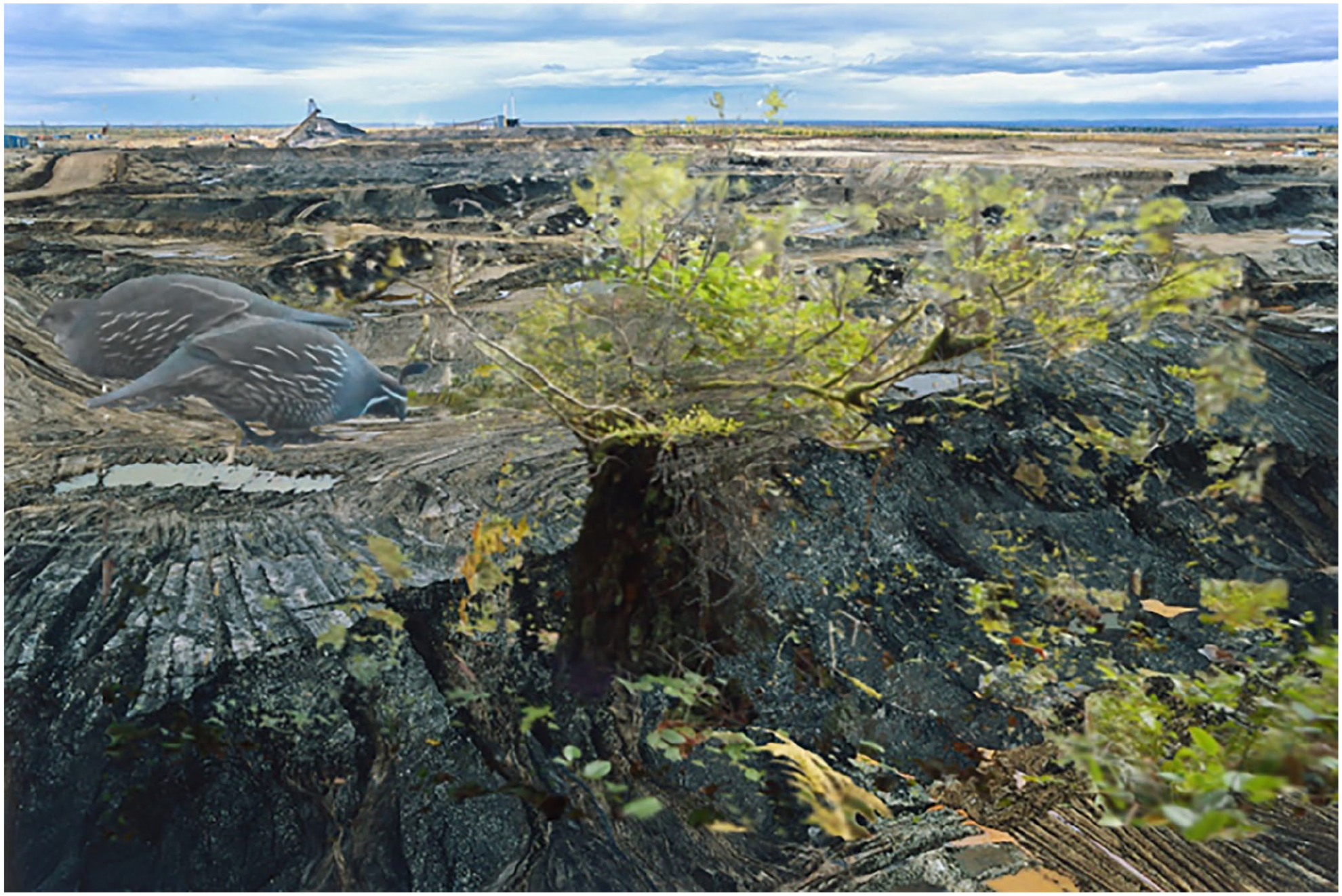
Archaeologies: Conrad, 2022, Used With Permission & Remixed Image Alberta-Tar-Sands (https://www.flickr.com/photos/visionshare/6078917188/) by Lou Gold (https://www.flickr.com/photos/visionshare/) Licensed Under CC BY-NC-SA 2.0 (https://creativecommons.org/licenses/by-nc-sa/2.0).
Agreed. While extensively deployed in genocide studies, for example, conceptualizations of witnessing have yet to fully engage ecocide. My growing interest these last years has been on ecological witnessing (e.g., Eppert, 2009, 2023). This article has me debating resonances and differences between transcorporeal and ecological witnessing, an ethics rooted in enmeshments of interdependence and alterity, and contestations of voyeurism and spectatorship (Simon & Eppert, 1997).
Wit(h)nessing reminds me of artist Cecylia Malik’s (2017) Polish Mothers on Tree Stumps, a performative response to extensive logging of Poland’s richly biodiverse Białowieża forest. Photographed by Tomasz Wiech, the performance involves women breast-feeding their babies while sitting on tree stumps in a forest clearing (Malik, 2017). Their bodies conjoin with and also symbolically, materially—intimately, endeavor to substitute for and re-figure felled tree-bodies. They nourish not only their infants but also, coterminously, the tree stumps, inasmuch as the logged trees once sustained them. Yet, the difficulty this act indirectly signals, in the face of deforestation, is that humans can’t take the place of trees, despite deep inter-/intra-relation—and it also tragically illustrates an alienating, starved, and ungraspable human future. The performance thus gestures toward continuities and discontinuities—fullness/lack, intimacy/estrangement, sustenance/deprivation—and shows the critical need for forests in our interdependencies and differences. Cielemęcka (2020) observes how the performance challenges grammars of purity, explores “embodied, nourishing practices of human and nonhuman care” (p. 72), and opens up the “sedimented boundaries of what counts as reproductive labor” (p. 72). In my view, it intricately poses difficult questions of how we both are and are not trees, are and are not deforestation. While I lack artistic and digital know-how, Malik’s performance, along with Cielemęcka’s broader analysis of dispute regarding the Białowieża forest, inspired me to attempt these photo collages.

Loggings/Lodgings I: Eppert, 2022 Used With Permission.
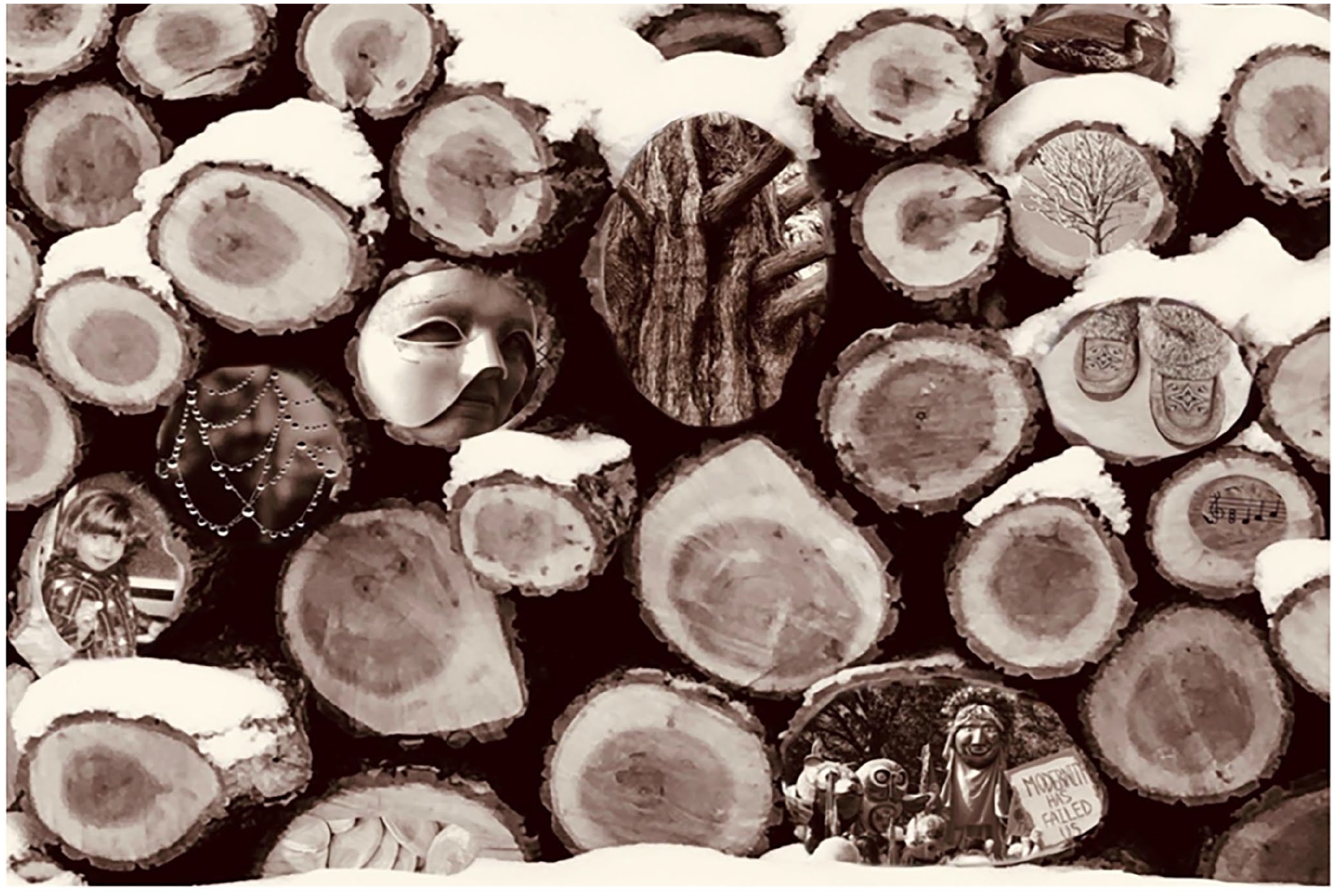
Loggings/Lodgings II: Eppert, 2022 Used With Permission.
Transcorporeal Witnessing of the Alberta Tar Sands
Malik’s (2017) work and your images, Claudia, speak to me of the socio-ecological integrity that is lost through deforestation . . . As is the case with Alberta’s Tar Sands, which are regarded not only among the world’s worst environmental disasters (Peterson & Sizer, 2014), but also, given their proximity to Indigenous communities, a site implicated in the imbrication of genocide-ecocide (Arnold, 2018). The boreal forest, so vital for maintaining ecosystems that give life to diverse plants and animals, for storing carbon critical to mitigating climate change, and that has served as home for Indigenous populations, has been devastated. Indigenous inhabitants within the Tar Sands region—those “living within the so-called Tar Sands ‘sacrifice zone’” (Vannini & Vannini, 2021, p. 184)—speak of losses of wildlife, of natural environments and processes, and their cultural traditions—a slow industrial genocide (Huseman & Short, 2012).
As a long-time resident of northern Alberta, I feel particularly implicated in the destruction in the Tar Sands as the 141,000 km2 (almost the size of New York State) are situated only 500 km from my doorstep. While I’ve tried to distance myself from a political environment that thrives on ecological destruction and extractivism, I feel tainted by association, having been able to sustain my livelihood in this setting for many years. I feel an obligation to begin our exploration through attunement with this massive destruction so close to home.
I’ve never been to the Tar Sands despite having resided in Edmonton, Alberta since 2007, in part concerned that the drive (or flight) there would entail me reductively participating in what I have elsewhere critiqued as tourist-learning (Eppert, 2004).
While it’s difficult for me to relate to the Tar Sands, I’ve long experienced senses of being haunted by them. Barad (2007) identifies remembrance not as “mind-based capacities but marked historialities ingrained in the body’s becoming” (p. 393). I wonder in what measure transcorporeal witnessing might not only attend to human and nonhuman fleshiness, but also make space for the more than human and dis/embodied uncanny—hauntologies (Derrida, 1994) that simultaneously reveal and conceal.
Hmmm . . . a good question. Transcorporeality refers to material relationships of bodies (Alaimo, 2010), but what is at stake in our union/disunion with the immaterial, the incorporeal, in considering social and ecological justice?
I think hauntologies call upon us to deconstruct material/immaterial, past/future, representable/unrepresentable, and other socially-constructed polarities—illustrating plural pathways to nondual witnessing. When I engage aerial photographs of the Tar Sands, such as those in Helbig’s (2018) Beautiful Destruction, I visualize ghosts wandering in the un/seen and un/seeable of these deforested wastelands. These ghosts are human and nonhuman bodies ravaged by disease and death from Tar Sands habitat loss and destruction. They also include human bodies (and systems) bent on destruction due to insatiable craving, akin to what in Buddhist cosmology are known as hungry ghosts. Ghosts are haunted and haunting witnesses that address us . . . I recognize and misrecognize the Tar Sands’ spectral effects in/on my body and locale—pollution, indoor warmth in –34℃ winter, smoke from boreal fires, and more. I still remember when, in 2008, more than a thousand ducks died in one of Syncrude’s human-made lethal tailing “ponds”—a naming the Vanninis (2021) describe as woefully inaccurate (p. 170). And, north of us, in the hamlet of Fort Chipewyan, residents—predominantly Cree, Dene, and Métis—testify to high levels of illnesses, cancer among them (Vannini & Vannini, 2021). Hauntings speak to spirits, dispiritedness, and reckonings, calling us in/to question (Derrida, 1994). How do we live (and belong), learn from and act in this, the Capitalocene, “a world-ecology of capital, power, and nature” (Moore, 2016, p. xi)? Tsing (2015) writes that “ghosts can paralyze you, taking away your ability to move or speak” (p. 74). Perhaps witnessing through the arts provides a means for testifying to and also moving through toxic paralysis.
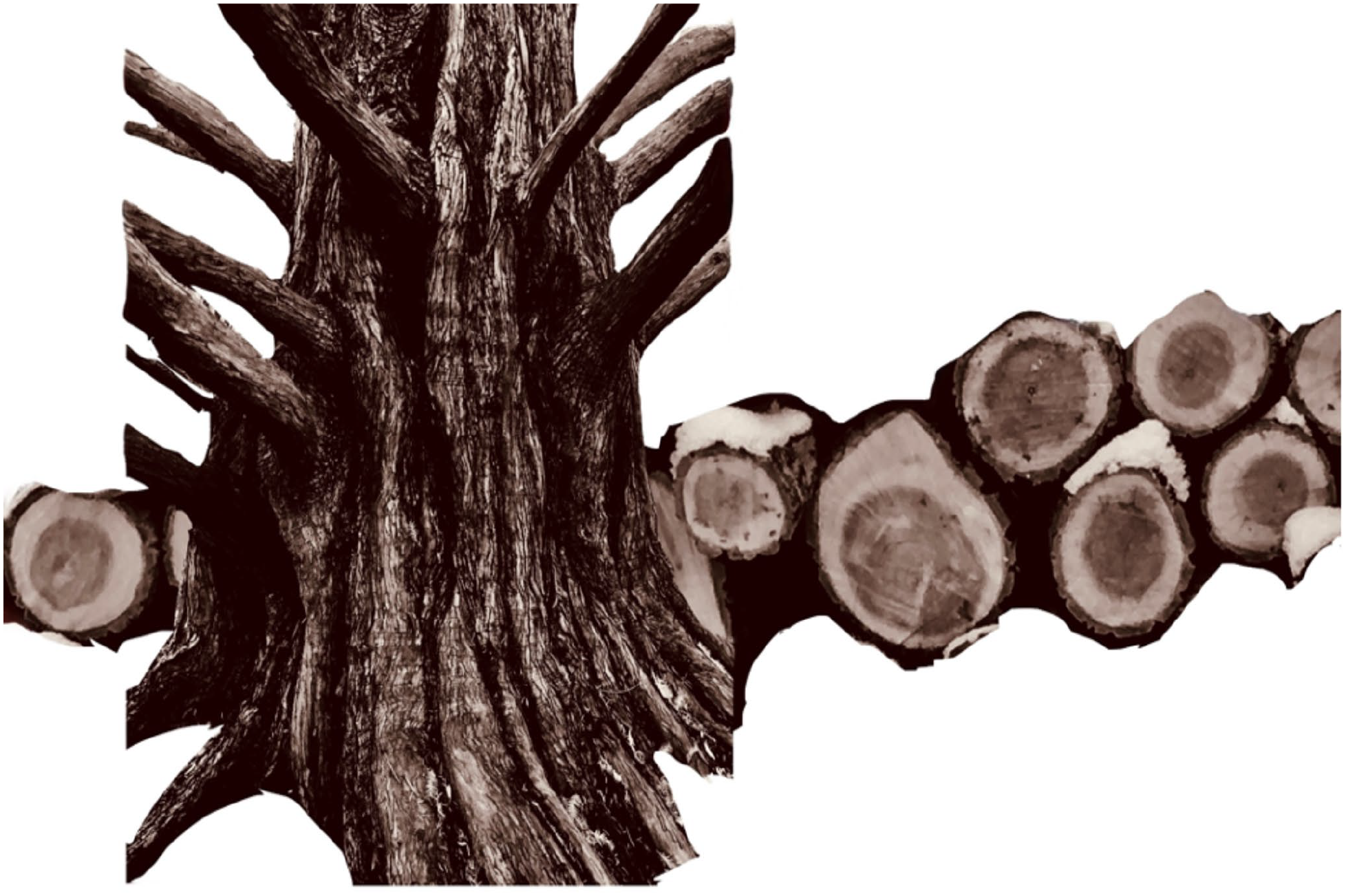
Loggings/Lodgings III: Eppert, 2022, Used With Permission.
To me, aerial images of the Tar Sands are both haunting and provocative. As accounts of those who’ve visited the site claim (Helbig, 2018; Hern et al., 2018; Vannini & Vannini, 2021), one does not get a sense of the extent of destruction from the ground. As the Vanninis (2021) recount,
the notion of a private flightseeing plane trip over Alberta’s Tar Sands was starting to make perfect sense for the sake of our visual comprehension of the place. Although we had driven on the highway crossing the tar sands before, we had been told that there was nothing like taking it all in from the air. (p. 169)
I was struck by Helbig’s (2018) and others’ aerial photographs, and yet, as the Vanninis (2021) continue, although pictures may be worth a thousand words, a thousand pictures would be worthless in describing the tar sands from the air. They would be useless in capturing the ocean of dirt, mud, slime, grease, and gunk being tussled, dug, kneaded and vomited by armies of excavators, loaders and men. They would be worthless in portraying the immensity of the dreary holes filled with bleak waters that are no longer made of water. . . (p. 170)
Aerial images, along with written accounts, are likely the closest I’ll ever come or want to come to that site of destruction. These sources are enough to spur my imagination to seek alternatives, to recompense, and to envision landscapes that sustain life rather than poison it—as if sheer will were enough to undo the harm.
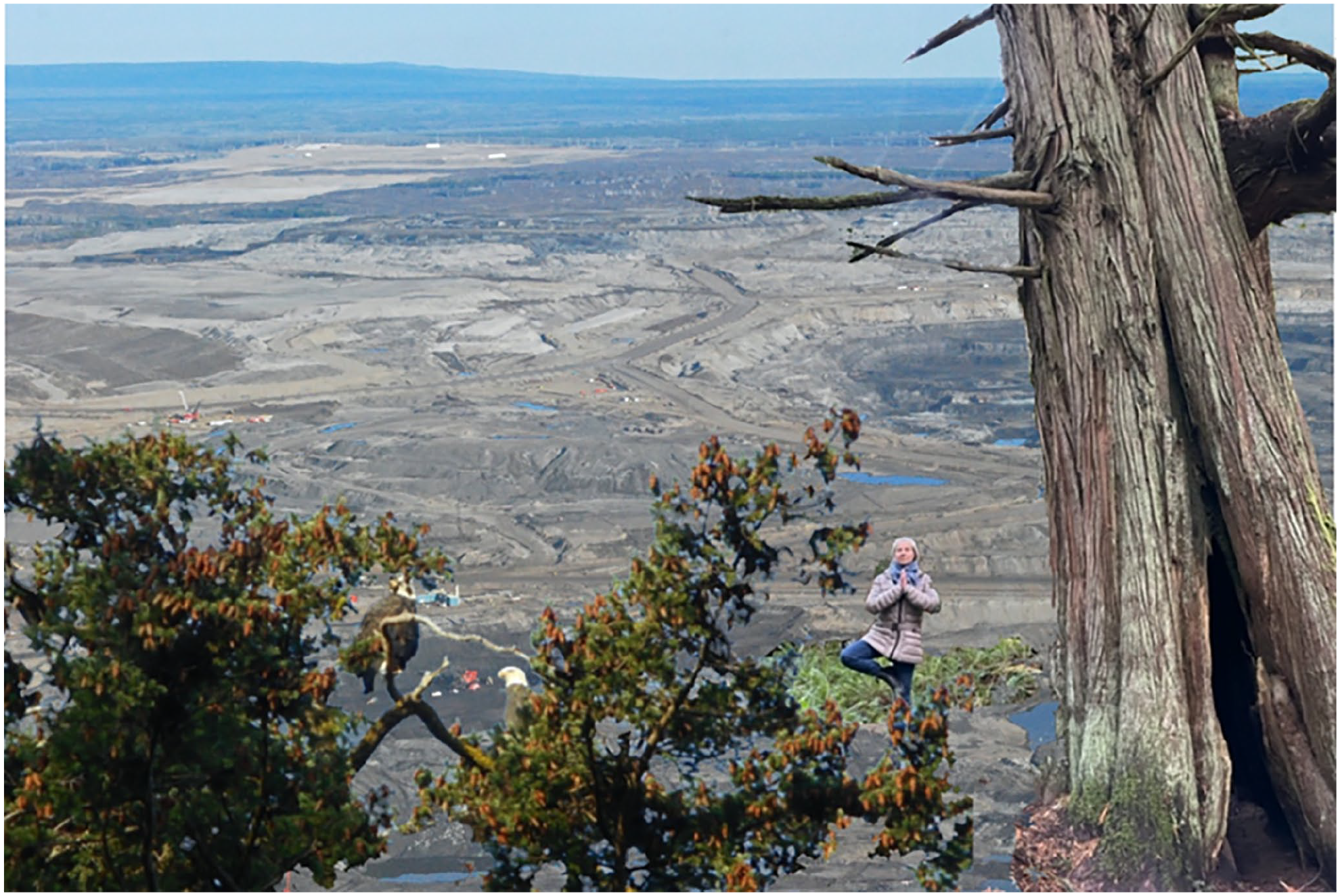
Wit(h)nessing: Conrad, 2022, Used With Permission & Remixed Image Tar Sands, Alberta, (https://www.flickr.com/photos/67952496@N05/6544064931), by Howl Arts Collective (https://www.flickr.com/photos/howlcollective/), (cc) Dru Oja Jay, Dominion, licensed Under CC BY 2.0 (https://creativecommons.org/licenses/by/2.0/).
Just a twinkle spinning on the edge of space/time. And into that void a sky dancer’s limbs flail just a toe hold on solid ground. Bipedal efforts ever labouring against gravity’s draw. Precariously straining to balance a tyrannical cranium aloft. Inhale a breath (while I still can). Exhale wonder.
In viewing Helbig’s (2018) aerial images, I note a striking absence of animal life, and yet the Tar Sands are visited by waterfowl, and, for example, inhabited by the Tar Sand Beetle (Monochamus scutellatus). Moreover, according to the National Wildlife Federation (Lafontaine, 2016), they threaten the Woodland Caribou, Gray Wolf, Black Bear, Canada Lynx, Sandhill Cranes, Walleye, Moose, and Lesser Scaup. Alaimo’s (2010) transcorporeality embraces these fleshy bodies, their participation in the life-world, and their actions and needs. Thus, while exhibiting the Tar Sands at large, aerial images simultaneously conceal—not revealing the life that, however small, exists there. In considering embodied reflexive inquiry, in what ways might we, to deploy a cliché, see the forest for the trees and vice versa? The tailing ponds are so extensive they are visible in space. The Tar Sand Beetle is so small as to rest comfortably in my hand.
If, according to the notion of transcorporeality, our bodies are continuous with environments, which would include bodies that have been destroyed and the toxic environments that destroyed them, we might say Tar Sands “R” Us. As Hern et al. (2018) remind us, “while the Tar Sands have a particularly startling visage, we are all implicated in the oil economy; every single one of us is bound up with petro-logics. We are all simultaneously witness, victim and perpetrator of climate crimes” (p. 43).
I appreciate how current trauma scholarship nuances previous witness, victim, and perpetrator positionings and introduces the term implicated subjects (Rothberg, 2019). Doing so calls for questioning sociopolitical obligation, and consideration of “multiple implicated subject positions, multiple figures of implications” as well as “forms of indirect participation” (Rothberg, 2019, p. 13). I am curious about diverse artists’ relationships to the Tar Sands, and about what artists’ works reveal about their own embodied reflexive inquiry and witnessing. Tanya Kalmanovitch’s (The New School, 2017) docu-theatre Tar Sands Songbook, for example, bears witness to the Tar Sands through testimony of her lived experience in Fort McMurray and in-depth engagement with newspapers, accounts of nearby residents, archival research, and so on. Dialogue and story-telling intermingle with resonant violin (and piano) music—I move (am moved) in response. Her Songbook creatively engages complexities of witnessing—contesting grammars of safety and risk, identifying differentials of truth, attesting to vital triages of the communicable and incommunicable, incommensurability, lives lost, deformed, ill, and disappearing, political absurdities and disgrace, knowing and ignorance, multiple subject implications, as well as the visibility and invisibility of human-initiated disaster. At one point, the performance debates: what if the Athabasca River flowed past Edmonton instead of Fort Chipewyan, because “we are just 1200 people here, like, who gives a shit?” (1:00:34–1:00:39).
The Arts’ Contribution to Re-Figuring Toxic Entanglements
Engaging testimonial accounts of the Tar Sands, I am sometimes doubtful about our future, humanity, and aesthetic potential. I also doubt discourses of change, hope, joy, even inasmuch as I engage and explore these words/concepts. I recognize an ethical imperative in ecological witnessing not to engage in elisions, denials, foreclosures, reductions, and disavowals of atrocity. To abide in the inconsolable. Concurrently, I experience forest joy, and prosaically embrace the crazy play and dance of life/death. Not only grief and its cousin despair, but also joy possesses transformative potential, and this calls for acknowledgment (Eppert, 2020). But, dwelling upon the Tar Sands, I note wellings up, knottedness, senses of futility, amidst awareness that here I’m drawn to focus, yet again, on a habitual my of response amidst the past, present, and imminent future disease, death, and destruction. With regard to ecological atrocity, I struggle to connect with light (however nondual), and debate “the cremation of our hope” (Schama, 1995, p. 19). Diverse wisdom teachings, however, tell of joy beyond suffering. Hern et al. (2018) advocate a sweetness of life that can be found “where relationships are predicated on fidelity, not domination; on generosity, not exploitation” (p. 173). Perhaps I should acquaint myself with the hardy Tar Sand Beetle more, alongside my despondency. Drawn to decaying trees, and sites of bitumen exposure, this tiny, black, long-tentacled beetle with its sawtooth jaws imbibes burnt wood, transforming it into soil—thereby regenerating the earth, refiguring toxicities. As such, it illustrates creaturely possibilities—a kind of active after hope (Eppert, 2023) amidst anthropogenic atrocity.
I share some of your despair, Claudia, but reach more towards hope when it comes to our planetary future. We can learn from Indigenous scholars and artists to inform our responses (McGregor, 2018; Simpson & Klein, 2013; Wildcat, 2009), as well as other scholars who seek hope despite destruction (Hern et al., 2018; Tsing, 2015; Vannini & Vannini, 2021). Michi Saagiig scholar Leanne Simpson seeks life-promoting alternatives to the kind of extractivism that characterizes the Tar Sands and the consumption that dominates our everyday lives. This, she suggests, involves nurturing meaningful intimate relationships with human and more-than-human others. While not evading the terror of imminent environmental collapse, and acknowledging that transitioning away from our destructive practices will be difficult, the move towards a better life does warrant expressions of joy (Simpson & Klein, 2013). It’s important to keep on developing relationships of love with the land and seeking its beauty. Tsing (2015) suggests that what we need is “patience to mix with multispecies others without knowing where the world-in-process is going” (p. 264). Along with active resistance to processes of destruction, survival requires acts of faith. Tsing (2015) concludes,
the ruin glares at us with the horror of its abandonment. It’s not easy to know how to make a life, much less avert planetary destruction. Luckily there is still company, human and not human. We can still explore the overgrown verges of our blasted landscapes. (p. 282)
I have faith that arts-based ways of being, knowing and doing offer openings for re-figuring the toxic entanglements that pervade current ecological relations toward more regenerative futures. Wake work dream repeat. Tumbling in the wash cycle of self preservation. Meanwhile the game of thrones persists: us clear-cutting scars across her visage; her contagion culling our tribe out. I cower from the carnage and instead dream a flowing river, a forest path, a dancing tree, delight in feathered backyard guests, budding apple’s leaflets, hands deep in humus scent of garden plots conjuring herbs and wildflowers to flourish. I make-believe she desires my embrace the way I need hers; satiating my hunger for a connection to more-than a ravenous march of progress, as balance hangs in balance. Will we dance with integrity, ready partners in the frolic, or will my liabilities come due, unruly garden pest, welcome outstayed? There is solace, dreaming trees will dance despite me.
Footnotes
Acknowledgements
We’d like to thank our yoga teacher, Carleen Ellis, for her patient yoga instruction and sharing her wisdom with us. Claudia thanks Daphne McCormack and Daniel Vokey for their helpful feedback on her images.
Declaration of Conflicting Interests
The author(s) declared no potential conflicts of interest with respect to the research, authorship, and/or publication of this article.
Funding
The author(s) received no financial support for the research, authorship, and/or publication of this article.
