




Abstract
This qualitative case study methodically explores ethical tensions that arose in the Research-based Theatre (RbT) project, Alone in the Ring (AitR), as a case. We borrowed Elliot Eisner’s set of tensions in Arts-Based Research (ABR), exploring the extent to which they manifested as ethical tensions in AitR. Following analysis of in-depth interviews with key project members, we identified five areas of ethical tension in AitR, adapting Eisner’s framework to account for the ethical dimensions of the tensions, their generative quality, and their temporal and social dimensions, as they manifested in AitR. Complicating Eisner’s general tensions for ABR, this article advances an adapted, RbT-specific framework with meta-language to reflect on the ethical terrain of RbT using the richness and specificity afforded by a case study. The framework is particularly useful for RbT practitioners seeking to maximize the benefits of RbT for knowledge translation, arts-based inquiry, and community engagement.
Introduction
Research-based Theatre (RbT) has been increasingly employed as a method for disseminating research in scholarly settings and as a methodology through which research is conducted (e.g., Beck et al., 2011; Belliveau & Lea, 2020). This has generated discussions within the field of RbT about maintaining a balance between the ethical responsibilities of the researchers to their participants and data, and the artistic responsibilities of the theatre makers to the art form (e.g., White & Belliveau, 2010).
Discussions of ethical tensions were also prevalent in our team members’ RbT production, Alone in the Ring 1 (henceforth AitR), which was based on a previous research study exploring the barriers to, and facilitators of, access for people with disabilities in health practice and education. AitR was designed to promote inclusion in health professions by changing the discourse around disability among health professionals (e.g., Bulk et al., 2020). RbT was employed as a tool for affective learning, including increased empathy for people with disabilities in health professions. Using moments of humor and conflict, AitR dealt with external and internal stigma about students and clinicians with disabilities, disclosure, and a sense of belonging. The stories of four different characters were shared by way of creative monologue (an occupational therapy student, a physiotherapist, a social worker, and a nurse). In these monologues, different theatrical conventions were used to externally represent the inner experience of these characters, each living with a different form of disability. The first iteration (October 2018) was 10-min long and used collaboratively created vignettes, tableaux, and a song about stigma to draw audiences into deeper affective understandings of the experiences of students and clinicians with disabilities. Following team reflection and discussion, as well as audience feedback (collected in pre- and post-performance feedback surveys, in-depth interviews, Q&A sessions, and talkbacks), five team members, joined by playwright Scott Button, composed a new script. This 25-min iteration followed the experiences of the four characters and expanded upon the themes of external and internal stigma, processes of disclosure, ableist perceptions in health professions, and development of professional identity while living with a disability. Finally, the abrupt shift to virtual environments during the COVID-19 pandemic fostered the co-creation of AitR: The Vloggers, an online iteration of the play that involved both synchronous and pre-recorded portions (e.g., vlogs from the four characters).
The purpose of this article is to methodically explore the ethical tensions that arose in AitR. Using a case study methodology (Yin, 2018), we interviewed members of the team and conducted a reflexive thematic analysis (Braun & Clarke, 2006, 2020) of the interviews. We borrowed Elliot Eisner’s (2008) extensively referenced set of tensions in Arts-Based Research (ABR) as a conceptual framework for analysis, exploring the extent to which they manifested as ethical tensions in AitR. During analysis, our conception of the term “tension”—and our approach to Eisner’s (2008) framework—evolved, as we explain in the sections below. We discuss the ethical tensions our team members experienced and share our modifications to Eisner’s (2008) framework based on our analysis of AitR as a case of RbT. Our work contributes an adapted framework of Eisner’s tensions which highlights their ethical dimensions and draws from the unique features of RbT practice, especially RbT’s tendency to rely on interpersonal relationships (the social dimension) and on the evolution of a performance over time or across multiple iterations (the diachronic temporal dimension), facets that were absent from Eisner’s original framework. Our refined framework contributes empirically based meta-language to support the RbT community in navigating and reflecting on RbT’s vast ethical terrain.
Literature Review and Conceptual Framework
“Ethically Important Moments” and Reflexivity
Our study is informed by Guillemin and Gillam’s (2004) distinction between procedural ethics, the standards that are regulated by institutional research ethics boards, and ethics in practice, a fluid landscape of “ethically important moments” that arise during research with other people. Ethically important moments can be understood as situations “where the approach taken or the decision made has important ethical ramifications, but where the researcher does not necessarily feel himself or herself to be on the horns of a dilemma” (Guillemin & Gillam, 2004, p. 265). Such moments live outside the purview of institutional frameworks and call on researchers to respond ethically based on “personal knowledge” that is developed through a practice of reflexivity (Guillemin & Gillam 2004). This reflexive approach to ethical practice, critical reflection on the kind of knowledge produced and how we go about producing it in an ethical manner (Guillemin & Gillam, 2004), does not circumvent the core issues of regulatory frameworks such as informed consent, anonymity, confidentiality, and risk but recognizes the experiential knowledge of researchers grappling with the tensions of day-to-day practice.
Tensions and Ethics in ABR
In ABR, reflexivity has been a part of the discourse for many years as researchers have reflected upon their own practice to address issues, challenges, and tensions with potential ethical implications (Boydell et al., 2012; Leavy, 2015; Ord, 2016; Scotti & Aicher, 2016). In his extensively referenced chapter, Eisner (2008) identified five “persistent” sources of tension in ABR practice. We paraphrase these tensions as follows: (a)
The Ethical Landscape of Research-Based Theatre
A growing body of literature has emerged that explores ethical tensions uniquely encountered within a theatre context. Mienczakowski and Moore (2008), as well as Sinding et al. (2008), explored areas of tension in performance that included the effects of catharsis on fragile audiences, stereotyping or cliché (e.g., a “hollywood-style” representation of mental illness), and the emotional toil placed on participant performers. Saldaña (1998) posed questions around issues that arise during play development such as the ethics of inclusive casting and producing scripts that might reveal too much about participants. Gallagher (2006) pondered the power relations inherent in the act of researchers claiming to perform the stories of “others” through drama. Goldstein et al. (2014) offered 30 questions for RbT practitioners to consider in project conceptualization. Bishop (2014) provided ways to address tensions in RbT through examining one’s “moral imperatives” (care, justice, profession, critique, and integrity).
Recently, Belliveau et al. (2020) offered a framework of project phases to reflect on ethical issues, which they used to explore one RbT production. Key ethical dilemmas that they identified included the extent to which a researcher/artist’s own experiences may be present in the work, the ethics of accessibility for audiences, and the integration of informed consent and evaluation within the theatre experience.
Currently, empirically based meta-language that serves to capture the vast ethical terrain of RbT projects remains sparse. To contribute to this emerging area of inquiry, our case study of AitR as a “story from the field” (Warr et al., 2016, p. 1) methodically explores ethical tensions that arose in AitR, borrowing Eisner’s (2008) extensively referenced framework of tensions in ABR as an analytic lens. In doing so, we examined Eisner’s set of tensions for their substantive ethical meanings and their application in a context of an RbT project. In returning to Eisner’s work, we intended to connect, question, and adapt his framework by exploring the extent to which those tensions manifested within the ethically important moments of one RbT project, AitR. With Eiser’s set of tensions as a conceptual framework, we set out to explore the following research question: What ethical tensions arose in the RbT project Alone in the Ring?
Method
Participants, Design, and Procedure
The purpose of the study we report on in this article was to methodically explore the ethical tensions that arose in AitR. It involved in-depth interviews with seven AitR team members, also co-authors of this article, the director (Christina) and six performers. Of these performers, four were health professionals who were part of the original research project that led to AitR and had lived experiences with disability (Yael, Laura, Michael, and Tal), and two were professionally trained actors who joined AitR through the Research-based Theatre Collaborative of the University of British Columbia (Laen and Hila).
A case study methodology (Yin, 2018) was employed to provide rich, in-depth, context- and case-specific data, with the case being the RbT project AitR. As a qualitative case study, this research was not designed to generalize to a population (all cases of RbT) but rather to facilitate analytic generalization (Yin, 2018), informing existing conceptual frameworks that can later be examined in different contexts. We employed individual in-depth semi-structured interviews (conducted by Amir), ranging from 45 to 90 min each and conducted online via Zoom. We employed purposeful sampling, that is, a strategic selection of participants who are most relevant for addressing the study’s goal (Patton, 2014). The interview protocol design was guided by the research question—What ethical tensions arose in the RbT project Alone in the Ring?—and an initial literature review about ABR and RbT.
Ethics approval for this study was provided by the university’s Behavioral Research Ethics Board.
Data Analysis
Reflexive thematic analysis was conducted collaboratively using ATLAS.ti 9 in combination with Microsoft Word, following the six phases of reflexive thematic analysis as specified by Braun and Clarke (2006, 2020): (a) familiarization with the data set; (b) coding; (c) generating initial themes; (d) developing and reviewing themes; (e) refining, defining, and naming themes; and (f) writing up. Each interview transcript was commented on in Microsoft Word by two authors, one of whom was Amir. We inductively commented on any tensions we identified, whether (and why) they were ethically important moments, and their potential connections to Eisner’s (2008) tensions. We operationalized Eisner’s framework of tensions in ABR as an analytic lens to make sense of ethically important moments that we identified inductively. Amir then integrated all comments in ATLAS.ti, coded the transcripts while taking others’ perspectives into account, wrote analytic memos, and drafted the emerging themes. Data analysis included continuous consultations with the team.
Braun and Clarke (2020) defined reflexive thematic analysis as relying on researcher subjectivity as a resource and on “meaning and knowledge as partial, situated and contextual” (p. 3). This meant that our collaborative approach did not consist of trying to homogenize our interpretations, such as through measuring agreement on a preconceived code list; rather we aimed to maximize the diversity of interpretations that each team member brought as assets contributing to a more thorough and comprehensive interpretation of the data.
Findings and Discussion
The meta-language offered by Eisner’s (2008) framework helped us navigate and reflect upon the complex terrain of tensions in AitR, as we worked to tease out the ethical significance and meanings of those tensions. However, during analysis there was a growing discomfort among group members around two aspects of Eisner’s (2008) original framework. One was a premise that tensions exist in dichotomies where the researcher is being pulled in two distinct directions. This did not properly reflect the complexity of ethically important moments in AitR, so we decided to discuss these as areas of ethical tension. Second, we were also concerned that the term tension was emphasizing the negativity of these experiences, while ethically important moments in AitR consistently offered an opportunity for growth and discovery. We therefore adopted the term generative tensions to represent both the challenges and the growth that they generated for our team members over the course of developing and performing AitR.
We ultimately modified Eisner’s (2008) framework in four ways: (a) we accounted for the ethical significance and meanings of the various tensions we identified in the data; (b) different from Eisner, we accounted for the diachronic temporal dimension (AitR’s evolution over time, beyond just a synchronic, single iteration), as well as the interpersonal social dimension (the collaboration and interdependence among team members, beyond the focus on the intrapersonal, the solo practitioner’s praxis), both of which may signal part of RbT’s unique quality as a form of ABR; (c) we moved away from Eisner’s framing of tensions as dichotomies (e.g., “aesthetics” vs. “truth,” or “metaphorical novelty” vs. “utility”) by framing them as areas of tension; and (d) we accounted for the generative quality of the ethical tensions experienced in AitR, as mentioned above. We identified five thematic patterns, areas of ethical tension that included the generative quality that manifested as they were addressed. Each of these is discussed below in the form of an ethical question.
To What Extent Is the Performance Accountable to Audiences?
Although this area of ethical tensions incorporates Eisner’s (2008) first tension (the imaginative and the referentially clear), it goes further to consider the broader ethical implications of RbT practitioners’ relationship with audiences in RbT productions, as they manifested in AitR. This area integrates team members’ recollection of ethically important moments in which they attempted to make sure that ideas were clearly expressed, especially considering their direct relationship with the audience in the room. Importantly, this included ethical concerns about how to mitigate potentially difficult experiences of audience members, especially considering the affective power of theatre. This area of tension also included post-performance interactions with audience members, which could be validating for performers but also invasive, raising an additional form of ethical tension.
Members of our team mentioned an ethical obligation to be clear; they felt that they needed to make sure they were communicating ideas clearly to the audience rather than confusing them or creating misunderstandings. This also led to the broader question of whether the performance was sufficiently accessible to all audiences. The ethical responsibility to be clear and accessible is particularly relevant to theatre, where the immediacy of the form creates intimacy with audiences that heightens performers’ sense of accountability to them. As Hila mentioned, “This just reflects the power of live theatre because you get that direct reaction from people.”
Importantly, the multiple iterations of AitR performances (the diachronic dimension of time) provided an opportunity for team members to address many of these tensions around accountability by modifying their artistic choices (e.g., for clarification), often based on audience feedback. For example, in the first iteration, team members tried to convey the emotional labor of health professionals with disabilities in “putting on a happy face” by staging a tableau (see Figure 1), but when audience feedback suggested that this notion was not clear, team members decided to communicate the idea explicitly in one of the performers’ lines. The ethical tension thus proved generative as the iterative, diachronic nature of the project (beyond the synchronic moment, as Eisner’s framework implied) allowed for insightful modifications to the performance, in response to ethical concerns about accountability to audiences (e.g., clarity).
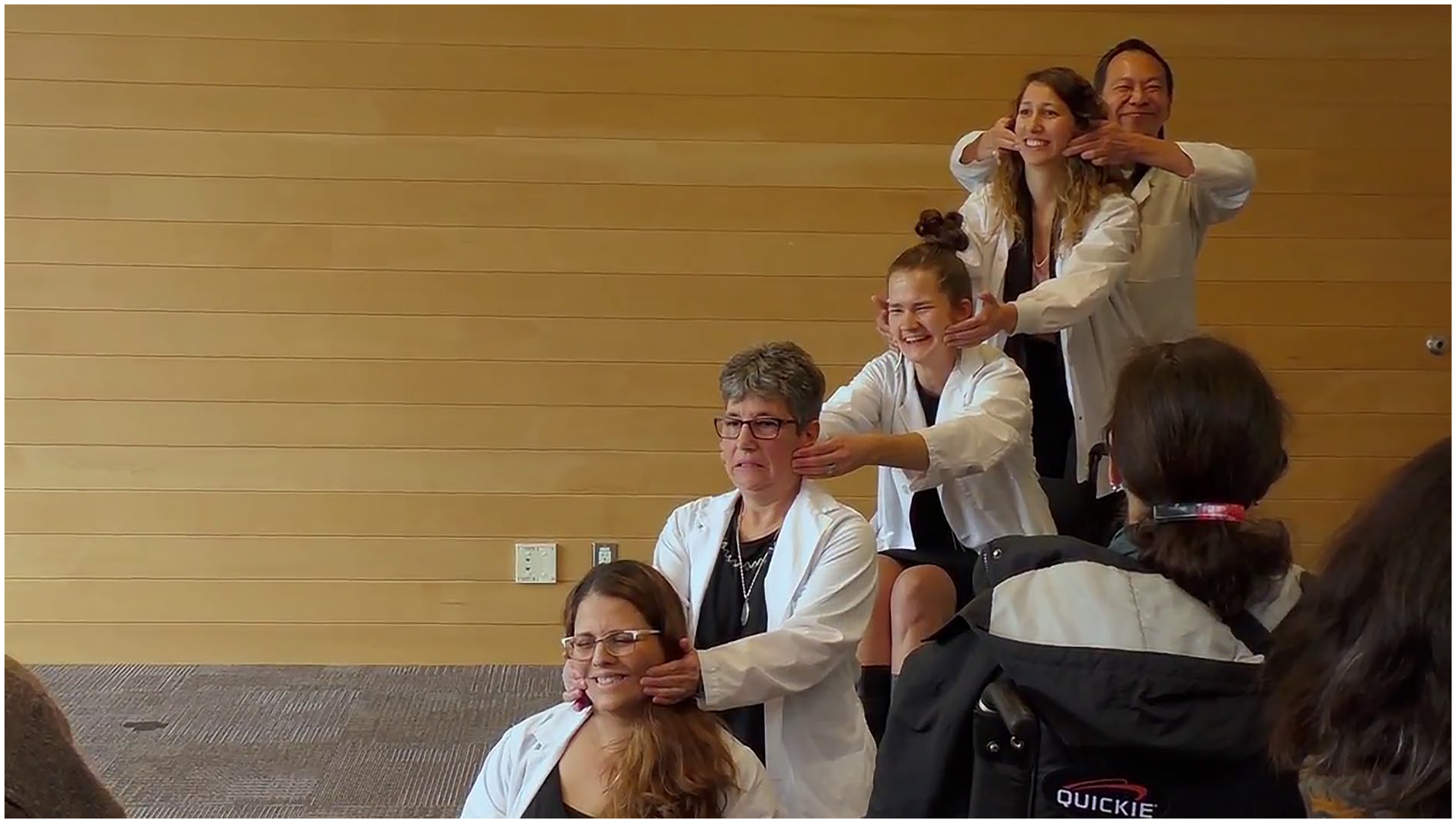
Tableau from the first iteration.
Another ethical angle to this area of tension was managing the potentially harmful affective power of theatre in its impact upon audiences, especially when involving the discussion of sensitive topics. To address this, the team created opportunities for audiences to voice their concerns and offer feedback through post-production Q&A sessions or talkbacks, and two team members who work as mental health professionals were also available for audience members to speak to. This was an interpersonal social response to a tension that was not suggested in Eisner’s (2008) framework. To offer an example, in the latest iteration on Zoom, our team members decided to represent the concept of stigma as a Zoom troll, but some members of the audience conflated the performer of the Zoom troll with a real person, which was triggering for at least one member of the audience. In response to the concerns raised during an audience feedback session, the team added an explanation in the introduction to the play that some actors will use the Zoom chat.
Finally, team members found themselves interacting with the audience after the show, which could sometimes lead to uncomfortable situations. Mostly, interactions were validating, but in certain cases questions could be invasive and raised unexpected ethical concerns for our team members. For example, at one point an audience member assumed that Laen had the same lived experience as the character he portrayed, and reached out to offer support. The team considered this an ethical concern around transparency to audiences and the need to clearly disclose that all performers were portraying characters, not their own personal experiences. This concern was addressed through collaborative team discussions (the social, interpersonal dimension), which resulted in a decision to make an announcement at the beginning of each show to clarify this point.
This multifaceted area of tension, ethical in relation to performers’ accountability to audiences, was often mitigated through the adaptations made possible through both the diachronic (multiple iterations across time) and interpersonal dimensions (feedback sessions with the audience and supportive, collaborative discussions among team members) of RbT. Moving beyond Eisner’s (2008) narrow focus on the synchronic (single iteration) and intrapersonal (the solo practitioner’s praxis) allowed us to engage with the generative potential found in this area of tension. This thematic pattern reinforces findings in previous studies that highlighted the need for accountability to audiences (Goldstein et al., 2014), considering the potential effects of catharsis on fragile audiences (Mienczakowski & Moore, 2008), the level of accessibility to audiences, or the integration of evaluation within the theatre experience (Belliveau et al., 2020).
What Gets Included and What Gets Excluded?
This area of ethical tension involved questions about team members’ selection of data to represent in the performance. By design, qualitative research—and arguably, RbT as well—is less concerned with (external) generalizability, understood as the extent to which the findings apply beyond the sample studied (Maxwell & Chmiel, 2014). Therefore, different from what we would assume based on Eisner’s (2008) second tension (the particular and the general), generalizability was not an issue for AitR team members. That said, doubts and concerns around the extent to which the performance fairly represented the analyzed data, including participants’ perspectives, were ever-present to team members and—at least partially—addressed over the course of the AitR project. Therefore, in our framework, we have extended Eisner’s second tension to reference a broader area of ethical concern that includes all the moments in which team members grappled with decisions about what data from the original study was included or excluded in AitR.
An example of this area of ethical tension was expressed by Yael, when she recalled how in one of the first RbT workshops, she had said “I don’t understand how from this huge amount of data we’re going to have a play of 20-30 minutes.” Another example is Tal’s mention of the team discussions about how to represent the concept of disability: “knowing that we had very diverse voices among our participants, so how do you bring all those diverse voices and different types of disabilities [ . . . ] in particular the issue of visible vs. non-visible disability.” In the first iteration, the team used a wheelchair to depict disability, but decided upon additional reflection to remove it so as not to overshadow and misrepresent the range of diverse types of disability represented by research participants, especially invisible forms of disability (e.g., depression, chronic pain, learning disabilities). They also added references in the script (e.g., dialogues, monologues, setting) to allow the disabilities to emerge implicitly—as they did in the participants’ lived experiences of invisible disabilities—rather than solely depending on explicit representations (e.g., wheelchair). Another example of how this ethical tension was addressed emerged in scriptwriting discussions after the first iteration, when it was noted that important themes of participant resilience and strength had been excluded. This prompted a rewriting that included more emphasis on these themes.
Therefore, through additional iterations (the diachronic nature of the project), the team creatively resolved these ethical issues around potential exclusion of participant voices in the performance. These included removing clichéd artifacts such as the wheelchair, purposefully incorporating stories of invisible disabilities, and having the performer forcefully pound a cane on the stage to protest her invisibility and communicate her resilience.
This area of tension about what data are included echoes Belliveau et al.’s (2020) ethical question about how to include narratives beyond the chosen structural narrative frame and previous studies that highlighted the dangers of stereotyping and cliché (Mienczakowski & Moore, 2008). However, our analysis extends beyond that, considering also the generative quality of this tension, as team members who analyzed data in the original study continuously revisited the data (the diachronic dimension of time) to check whether important facets might have been excluded from the performance. These team members, working collaboratively with the artists (the interpersonal social dimension), held what we called “data expert” roles through which they carefully addressed whether or not important pieces had been excluded.
To What Extent Are Participants Being Honored During the Transmediation of Data?
Transmediation, defined as the “translation of content from one sign system into another” (Suhor, 1984, p. 250), was an integral component of the AitR development process, where interview transcripts were transformed into a theatre script and performance event. This process involved ethical tensions around the extent to which team members were able to honor the perspectives shared by research participants. In other words, when had the performance strayed too far from the data or when was it moving too close to the data? Included in this area of tension were Eisner’s (2008) concerns around the degree to which aesthetic conventions or attempts to introduce novel representations might compromise a perceived fidelity to the data. Importantly, we felt that “aesthetics” and “metaphorical novelty,” which Eisner considered as separate tensions (his third and fifth tensions), were too entangled in AitR. Hence, we included them both under transmediation. In AitR, this area of tension also included the ethical tension of the extent to which performers’ embodied interpretation of data, based on their own experiences (with disability or beyond), strayed too far or moved too close to the stories, perspectives, and people in the data.
At each new instance of transmediation, ethical questions would surface in relation to how data were being represented, both in terms of how far team members were straying from the data but also how close they were moving to it. As Yael described, transmediation was sometimes experienced as a “leap,” especially when a new version of the script was drafted. As a data expert, Yael felt that she had to “digest” the novel dramatic adaptations. For example, she mentioned that the second iteration introduced a scene wherein the concepts of stigma, systemic ableism, and professional identity were personified differently from previous versions. Interestingly, Laura highlighted the concern about moving too close to the data, when she mentioned how certain performance choices, such as staging a story shared by a research participant, introduced the possibility that their identity might be exposed.
Beyond the concerns about novelty and aesthetics driving the transmediation of data, an additional ethical concern occurred when performers brought their experiences (with disability or beyond) into their theatrical interpretation of the data. In AitR, the data were transmediated from interview transcripts into the performers’ bodies, and thus filtered considerably through their own identities and lived experiences. As performers embodied clinicians or students with disability, this immediately raised an ethical tension around the fact that their lived experiences were not always similar to those of the characters they were performing. This was of particular concern in AitR given the limited opportunities for people with disabilities to perform on stages. Even more so, this form of embodiment, unique to RbT, raised the ethical tension of performers bringing their own lived experiences to bear on the production process and the performance, which also introduced the question of whether it is ethical for researchers to allow findings from their other studies to enter the creative transmediation process without these other participants’ informed consent.
As an example of this ethical tension around embodiment, in the first iteration, Hila, who did not have lived experience with disability, brought the metaphor of a “mean girl” to her depiction of stigma, which she developed into a song: I started having fun with the word [ . . . ] stigma, stigma, stigma, stigma [ . . . ] I got really jumpy and I created this character at the moment of this really perky young person [ . . . ] this mean girl from high school who looks very sweet and very nice, but is basically here to really bother and harass everyone, and that was [ . . . ] the metaphor we chose as a group.
This metaphor was not present in the data itself, and on the surface depicted stigma about disabled students and clinicians in a lighthearted way, which introduced an ethical dilemma for data expert team members. However, those team members found that the metaphor still resonated with patterns they had identified in the research study. As they learned from audience members’ feedback, the duplicitous nature of this “mean girl” embodiment of stigma—insidious and hurtful but attractive and popular—was particularly effective in depicting stigma’s thorniness and viciousness. Such responses, which demonstrated how novel metaphors and aesthetic conventions could still maintain fidelity to the data, led us to move away from Eisner’s (2008) strict dichotomies (“aesthetics” vs. “truth,” or “metaphorical novelty” vs. “utility”).
Importantly, as both AitR and the team’s composition evolved over time (the diachronic dimension), the transmediation of different concepts changed too, such as stigma’s representation shifting from “mean girl” to a boxer in a ring to a Zoom troll. Thus, this tension too was generative, because data expert team members revisited the data over time, verifying compatibility and deepening their understanding of the data in an embodied and personal way, including their positionality and how they brought themselves into data analysis.
Transmediation as an area of ethical tension echoes concerns raised by ABR and RbT practitioners previously (beyond Eisner), such as Saldaña’s (1998) concerns about producing scripts that might reveal too much about participants, Gallagher’s (2006) concern with researchers claiming to perform the stories of “others” through drama, Goldstein et al.’s (2014) questions about the identities of the artists (e.g., whether they come from communities similar to the research participants), and Belliveau et al.’s (2020) mention of the ethical dilemma around the extent to which a researcher/artist’s own experiences may be present in the work. Our analysis shows the complexity of these tensions as they relate to transmediation processes of RbT. However, we also highlight transmediation’s generative quality, as team members with expertise in the data worked collaboratively with artists (the social, interpersonal dimension) to interrogate the appropriateness of various representations in multiple iterations (the diachronic dimension of time).
To What Extent Do Performers Feel Safe in Navigating Ambiguity and Risk?
Another area of ethical tension in our framework involves team members as they navigated through a “road full of choices” (Yael)—not necessarily knowing where they were going at different points in the development of AitR. Since team members had different levels of experience and comfort with performing, this tension became ethical around how to create a safe space for them to experiment and experience ambiguity—which was necessary for the ongoing development of AitR—while mitigating personal risk. This area expands beyond Eisner’s (2008) fourth tension (the formulation of better questions and the formulation of definitive answers) to consider not just the ambiguity of the product (in our case, an RbT performance), but also the team members’ experience of it throughout the process (including development, production, and performance). In AitR, a need (among audiences) for more answers than questions, which Eisner (2008) was concerned about, was less apparent than team members grappling with uncertainty, ambiguity, and vulnerability. We thus moved from a focus on the product to the process (from the synchronic to the diachronic dimension of time), drawing attention to the ethically important moments in this process.
Although the iterative and emergent qualities of RbT are shared with qualitative research (e.g., Silver & Lewins, 2014), the extension into multiple modes of meaning-making led to a larger volume of choices to navigate in relative uncertainty. Christina, as the facilitator, pointedly reflected on their role in navigating this ethical terrain: We’re meant to follow a step by step process and get somewhere [ . . . ] but it’s less linear than that [ . . . ] it’s a circle that we’re always returning to [ . . . ] and so it can feel totally disorienting [ . . . ] so I looked at myself as trying to hold a little bit of a lantern up with essentially, trying to say as much as I can that [ . . . ] we’re going to find out a little bit more with each step we take, so I think that was a tension early on, but as we continued in the process, people became more and more comfortable.
Team members sometimes experienced this ambiguity as a tension, which became ethical in its relation to their vulnerability through their involvement in the project. This echoes Kuri’s (2020) mention of the tension that can be introduced by creative uncertainty to procedural ethics.
This ethical tension related closely to the varying levels of experience of team members with performance. Inexperience with theatre sometimes led team members to worry about losing face. Hila mentioned hearing from other team members at the very beginning of the process, saying “how am I connected to theatre, why am I going around the room doing all these silly games, making weird noises and what not.” Laen spoke about the tensions that may arise in the collaboration between seasoned and novice performers. For example, novice performers may feel insecure about memorizing lines and blocking, as well as improvising, all of which may entail moving away from their comfort zones and increasingly feeling self-conscious, while seasoned performers may feel more self-conscious, as they try not to dominate: “it’s like asking [ . . . ] a basketball player to like not play as hard [ . . . ] and you can do that but [ . . . ] when you get into the moment it’s hard not to just do what you know how to do.”
Importantly, this area of ethical tension was addressed in AitR through the diachronic dimension of time, the multiple iterations that allowed our team members to gain more experience as performers (and as artists working with less experienced performers), along with a growing recognition of the value of this particular medium for engaging deeply and bodily with the data. Team members mentioned time (the temporal, diachronic dimension) as contributing to a sense of certainty and trust in the process. Furthermore, they mentioned the importance of facilitation by experienced artists (the social, interpersonal dimension) and the positive feedback from audiences, which supported their confidence as performers.
How Are Power Differentials and Group Dynamics Affecting the Collaborative Process?
This area of ethical tension considers the ethically important moments that surfaced during the collaborative experience of researchers, artists, and community members working together on AitR. Researchers held power in some ways (e.g., through funding, knowledge of data), artists held power in other ways (e.g., through their expertise in theatrical performance), and community members held power in yet different ways (e.g., legitimating and validating the performance as viewers or as community members with relevant experiential knowledge, expertise in RbT, or expertise in the area of research). Collaboration among these different people was essential for AitR, considering their interdependence at every step of the way, but the inherent power differentials introduced ethical tensions: To what extent were artists, researchers, and community members represented in the development process? Who got to sit around the AitR-development table?
Ethically important moments mentioned by Christina, Yael, and Tal in relation to this area of tension concerned the question of how to navigate the different “languages” that team members brought to the table (e.g., “language of artists,” “language of researchers”). This was an ethical question for researchers and artists on the team around how to best navigate their differences and power differentials while maintaining a respectful and fruitful collaboration. This tension was acutely evident when a new draft of the script was introduced in the second iteration by some of the artists involved and was received fairly critically by performers. Yael and Christina interpreted the tension as a conflict between languages that necessitated code-switching. The team was ultimately able to resolve this problem by talking openly about what they liked or, alternatively, felt uncomfortable with in the new script. The tension thus became generative for the group, despite the moments of discomfort and ethical concerns, which Christina perceived as pivotal in their learning process as a facilitator: That tension was very tangible to me, and I’m sure it was to other members of the team, where the different values that theatre artists and researchers have were coming into kind of almost conflict with one another because [ . . . ] there were multiple languages being spoken almost on top of each other at the same time in the room [ . . . ] it caught me off guard. It was one of the few times [ . . . ] in the whole process that I felt lost.
This area of ethical tensions found in power differentials and group dynamics echoes Saldaña’s (1998) question about the ethics of inclusive casting, Ord’s (2016) discussion of power dynamics, Scotti and Aicher’s (2016) discussion of empathy and intimacy in the intersubjective space, and Leavy’s (2015) discussion of emotional vulnerability and trust. Importantly, the social (interpersonal) dimension was clearly manifest in this area of tension, as “code-switching” between different “languages” was achieved due to team members’ collaborative and open-minded approach. But the diachronic nature of AitR was no less important; trust among team members could not have been established without sufficient time. Continuously discussing interpersonal dynamics was considered by members of our team as a useful way to address these ethical tensions that arose when team members holding different positions of power felt that they were not adequately communicating with each other.
Conclusion
Toward the end of AitR, a character, Alex, encourages the audience to consider the diverse experiences of students and clinicians with disabilities by asking questions. In the same spirit, this article encourages readers to consider the diversity of different RbT projects—as well as ABR projects more generally—and adopt a stance of curiosity and reflexivity. Complicating Eisner’s (2008) general tensions for ABR, this article advances an adapted, RbT-specific framework with meta-language to reflect on the ethical terrain of RbT using the richness and specificity afforded by a case study. Meta-language must be art-form specific: The ethical terrain of ABR involving live theatrical performances looks different from the terrain of ABR involving painting or found poetry, as the tensions suggest.
We identified five areas of ethical tension in AitR, extending and modifying Eisner’s (2008) framework to account for the ethical dimensions of the tensions, their generative quality, and their temporal and social dimensions, as they manifested in AitR. This revised framework, which advances meta-language to reflect on the ethical terrain of RbT, can strongly inform the development of ethical guideposts for RbT practitioners (Guillemin et al., 2020), and guide practitioners’ journeys. Facilitators can use this framework to lead team discussions, team members can use it to reflect on their processes, and scholars can examine its relevance to their particular contexts.
The ethical stakes of not addressing these areas of tension are high. First, not addressing accountability to audiences might create misunderstanding, impreciseness, and inaccessibility in the translation to the dramatic form, thereby causing more harm than good to audience members (e.g., emotional stress). Second, neglecting to disclose all decision-making processes (e.g., narrative selection) or provide access to excluded data will do an injustice both to the original research participants and the broader field (in this case, equity in health professions). Third, it is imperative to thoroughly examine the relationship between the artistic “leaps” and the data, the congruency between the identities of the performers and their characters, as well as to protect the confidentiality of participants in the dramatized forms, to avoid harming research participants and the trustworthiness of the RbT project. Fourth, it is crucial to support less experienced performers in navigating the potentially harmful ambiguity and uncertainty inherent to the theatrical creation process. Finally, it is essential to recognize and address the embedded power structures and the different languages of research and theatre, to hold a safer space for all stakeholders involved.
We hope that our extension and modification of Eisner’s (2008) tensions will help RbT practitioners, and the RbT and ABR communities more generally, to better address the ethically important moments that they experience as they explore their way in the land of endless creative and generative possibilities that these methodologies may offer.
Footnotes
Declaration of Conflicting Interests
The author(s) declared no potential conflicts of interest with respect to the research, authorship, and/or publication of this article.
Funding
The author(s) received no financial support for the research, authorship, and/or publication of this article.
Notes
Author Biographies
