




Abstract
Through this pulsating textual exploration, I viscerally uncover the potentialities of positionality and reflexivity in the context of research and pedagogical practice by tending to the emergent tensions of my own lived/living body. I weave in and out of the interstitial intimacies of embodied, performative, and living inquiries in situating myself amid my multi-identities and social locations to unearth how embodied arts-based approaches cultivate sensorial, cultural, and critical consciousness and invite multidimensional representations of human experience that transgress fixed dichotomies of insider/outsider status in qualitative research. This sensorial inquiry dwells in the in-between sites of breath and bone, ambiguity, and paradox, to reveal how embodied arts-integrated inquiries offer transformative possibilities for (re)humanization, healing, and social justice in arts-based and qualitative research and educational practice.
Sat Sri Akal Ji
With a Punjabi greeting that has been uttered for generations upon meeting and parting, I welcome you, my guest, to this space. I invite you into a visceral exploration where I hope to unearth how embodied ways of knowing and arts-integrated approaches offer ethical, relational, and multidimensional pathways for the development of positionality and reflexivity within arts-based and qualitative research and educational practice. I will navigate the emergent tensions of my own lived/living body in situating myself amid my multi-identities and social localities by attending to my sensorial, cultural, and critical awareness. Since positionality and reflexivity grow out of the lived experiences of bodies across socio-political locations, and since the body is the place where our truths live and may be storied (Snowber, 2016, 2021), I center the complex rhythms of my own living, breathing, and sweating body. In this way, I draw from the arts-based researcher, dancer, writer, and poet, Celeste Nazeli Snowber, who theorizes from and through the flesh in conceptualizing the body as a place of knowing and wisdom (Snowber, 2018). Snowber has been dancing at the forefront of bodying forth embodied ways of knowing in educational and arts-based research for decades (Snowber, 2007, 2012a, 2012b, 2016, 2018).
Since my re-search journey did not start with my body, but with the bodies who came before me, bodies on whose shoulders I stand, I first situate myself genealogically. My great grandparents were among the first waves of migrants to arrive in Vancouver from Punjab in the early 1900s after a treacherous months-long oceanic journey via ship. Full-throated songs and medicinal chanting meditations buoyed their spirits as they navigated a sea of uncertainty in search of a radical vision for their kin: to live in a safe, healthy, and vibrant society rife with equitable opportunities. But the palpability of artistic resonance could not keep their spirits afloat, for when they set foot on the shore of Vancouver, they realized that Punjabi-Sikhs, brown bodies, were not welcome in these lands. Forced to the fringes of society, my ancestors’ dignity dissolved having to live under a bridge in a cramped trailer with no heat. After over three generations of my lineage residing in the same Greater Vancouver suburb, I humbly trace the veins of my scholarship to my ancestors. Through my research that interweaves embodied forms of arts-based research and decolonizing perspectives on the entangled themes of identity, healing, and social justice, I carry closely the seeds of my ancestors’ vision, just as they carried the seeds of Guru Nanak, the founder of Sikhi, who imagined an equitable world fuelled by radical love (Singh, 2019).
As a Punjabi-Sikh, brown-bodied woman and the first in my lineage to pursue a doctorate degree, I often reflect on the nuances of my positionality as a researcher and educator. Since my re-search is interdisciplinary in nature, I have grown familiar with multimodal ways in which qualitative researchers make visible power dynamics during the research process in reference to, for example, insider/outsider researcher status (Holmes, 2020; Reich, 2021). Becoming cognizant of such power dynamics carries substantial import for my culturally responsive re-search as I seek to cultivate capacities for critical and relational consciousness in adopting respectful, reciprocal practices to foreground Punjabi–Sikh worldviews. Through my re-search, I have come to comprehend how embodied ways of inquiring disrupt stagnant categorizations of positionality as researchers may be invited to tend to emergent formations of critical, relational, and embodied investigations that breathe (Snowber, 2018), sweat (Ahmed, 2016), and awaken (Greene, 1995) in accordance with the inherently dynamic rhythms of lived experience and meaning-making.
Within the landscape of qualitative research, positionality “implies that the socio-historical-political location of a researcher influences their orientations . . . [and] that they are not separate from the social processes they study” (Holmes, 2020, p. 3). Positionality, which qualitative researchers have regarded as integral to effective qualitative research (Reich, 2021), is predicated on a researcher’s ongoing capacities for reflexivity (Holmes, 2020; Smith et al., 2021). Given that a researcher’s worldview is shaped by a dynamic constellation of factors such as ethnicity, race, social class, gender, sexuality, and political and religious views (Holmes, 2020), a researcher’s positionality is continually in formation and, thus, necessitates an ongoing reflexive approach (Smith et al., 2021). To make transparent the possibilities of researcher bias and the potential influence of personal belief systems on the research process, qualitative researchers have used positionality statements (Holmes, 2020; Pope & Patterson, 2019) to articulate their situatedness surrounding the insider/outsider status, personal philosophies, and descriptors of race, ethnicity, social class, and gender (Holmes, 2020; Lu & Hodge, 2019).
In this moment, I am detecting constriction in my breathing, an emerging choppy rhythm. I am curious about this shift. As an embodied intellectual (Weibe & Snowber, 2011), a full-bodied researcher (Bergonzoni, 2021), I attend to the subtle changes in my body, in my muscles and tendons, gut, and breath, as a way of practicing embodied listening (Snowber, 2016) in becoming increasingly responsive to rhythmic resonances that reverberate from inner and outer landscapes.
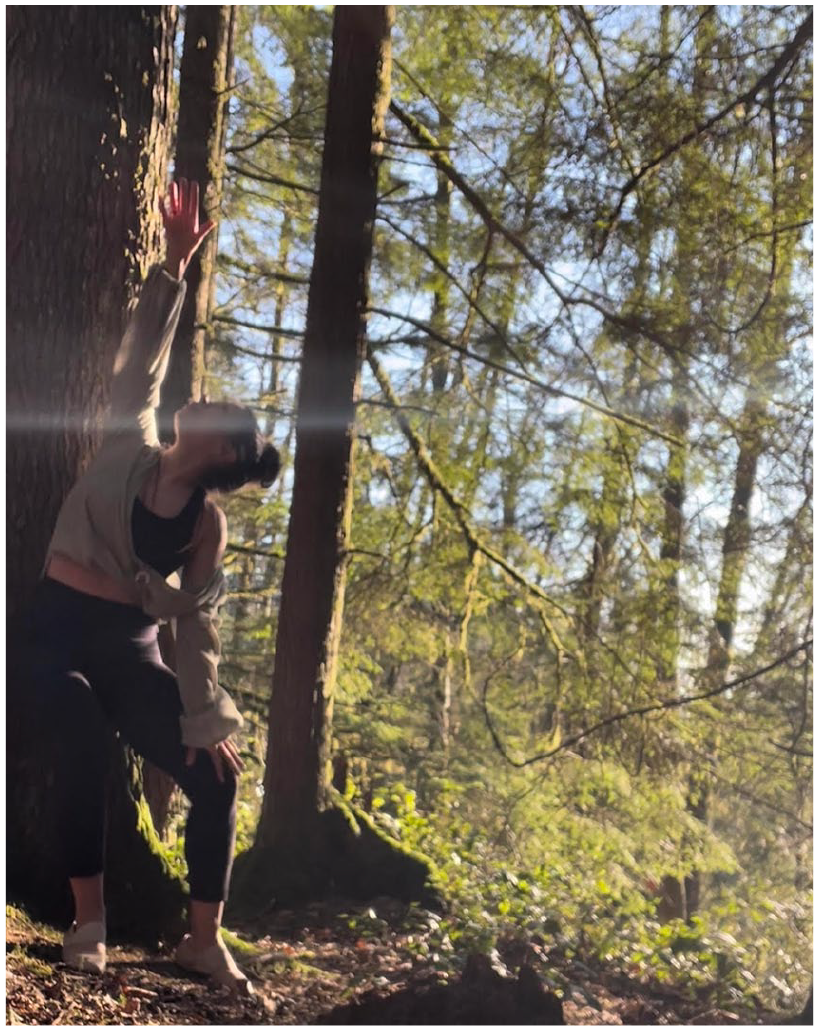
Presencing With and Through the Body.
I lean into and linger with the cues of my breath, my bodily intelligence (Snowber, 2018), for clues about what my body is communicating. I am finding it difficult to differentiate between the splintering of my researcher status as an insider or outsider, privileged or oppressed. Although my patrilineal line is traced back multiple generations in Canada, my mother was born and brought up in Punjab. In Canada, my family internalized the indelible imprints of classism, racism, and sexism that have taken a harsh toll on their health and well-being. Yet, at the same time, I have had the profound privilege of having accrued and benefited from 15 years of postsecondary studies at the University of British Columbia and Simon Fraser University. As I reflect on these implicit in-between interstices that transgress positional bifurcations, I make space for emergent questions to burst and body forth so they may sprawl . . . If positionality and reflexivity are of prime importance throughout the research process, how can positionality statements capture the full complexity and dynamism of human experience? Is it always possible for the identification of insider/outsider research status to be clearly delineated? If not, how may researchers dwell in in-between spaces?
My staccato breaths have subsided as my expressivities have had the chance to exhale, but another wondering surfaces. Maybe my sharp breathing is signaling the violence historically inflicted on bodies, bodies of women, queer bodies, (dis)abled bodies, bodies of color, bodies that have been silenced and denied multidimensional representation in research and societal discourse (Ahmed, 2016, 2021; Caldwell & Leighton, 2018). Bodies like mine, South Asian women’s brown bodies, have either been boxed away, sparsely represented in research studies and Western society (Gill, 2003; Handa, 2003), or boxed in through Eurocentric, patriarchal, and colonial gazes by which bias is reinscribed (Aujla, 2000; Bannerji, 2020; Gill, 2003; Handa, 2003). I am beyond tired of having to oscillate between these boxes, of code-switching like a chameleon to fit into boxes that were designed to compress my chest far before I took my first breath. But, like my ancestors, the arts have served as a sacred and visceral lifeline for my full-bodied revival. The arts have been a place . . .
where I
feel and sense
listen and attune
intuit and discern
where I move and write
my sacred-sensorial self
into being
into b r e a t h i n g
where I am rebirthed time and time again with a sense of
Dignity
where I am awakened
to the rawness of my lived and living realities
my feral and
d
e
e
p
rooted imagination
where “I find myself moving from discovery to discovery” (Greene, 1995, p. 4), where I “find myself revising, and now and then renewing, the terms of my life” (Greene, 1995, p. 4)
in locating
HOME
at the
center of my chest
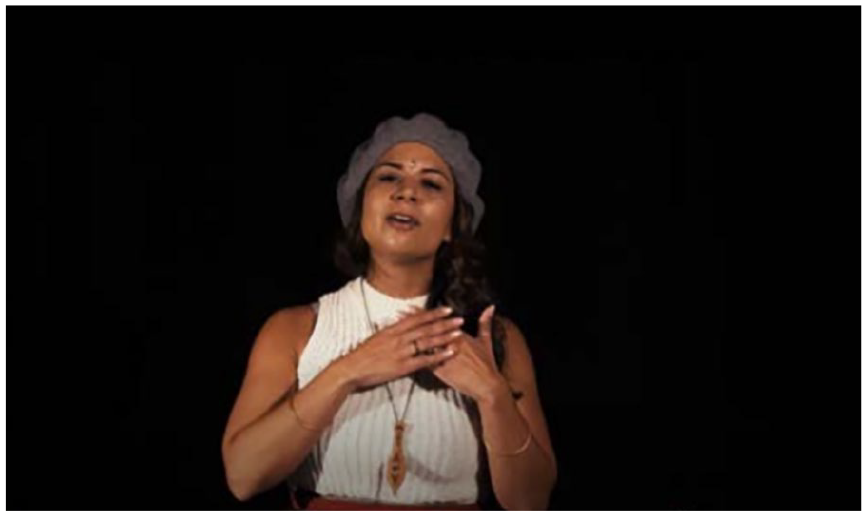
Spoken Word Articulations.
Art holds the possibility of alchemically restoring the fullness of my breath, of inspiriting me to move from and through raw textures of pain and into expansive realms of agency and authenticity. Arts-based approaches make space for the full-bodied humanization of research and education and have also been creatively used to address the complexities of positionality and reflexivity within the landscape of qualitative research (Bhattacharya, 2013; Faulkner et al., 2016; Pope & Patterson, 2019). Arts-based approaches crack open fresh potentialities for reflection and reflexivity as researchers’ intrarelationships and interrelationships may be holistically explored, excavated, and expressed in their dynamic resonances where relationality can breathe without rigid borders.
Since the arts are wide open to the varied pulsations of one’s lived and living particularities across social locations (Greene, 1995), arts-based approaches also offer the possibility of raising critical consciousness (Finley, 2008; Leavy, 2020). A justice-oriented qualitative researcher, Kakali Bhattacharya (2013), who shares with me a similar social and scholarly locality as a racialized female and de/colonial and arts-based scholar, punctuates the potency of arts-based research in its critical and transformative capacities to disrupt grand narratives and subvert systems of oppression. Bhattacharya (2013) accentuates the need to integrate arts-based approaches throughout the entire qualitative research process to be aware of the power dynamics and the inherent messiness and multidimensionality of human experience. Similarly, critical arts-based researcher, Susan Finley (2008) elucidates how arts-based inquiry is “uniquely positioned as a methodology for radical, ethical, and revolutionary research that is futuristic, socially responsible, and useful in addressing social inequities” (p. 71). More specifically, within arts-based research, embodied forms of knowing have provoked critical conversations about the politically, socially, and culturally inscribed body (Cancienne & Snowber, 2003) and its visceral entanglements with gender roles and constructions, disability and dance, and (anti)racism and white supremacy (Bergonzoni, 2022; Cancienne & Snowber, 2003; Heavey & Jemmott, 2020; Migdalek, 2014).
Through my graduate studies, I have had the privilege of being immersed in multidisciplinary arts practices in which “each art form acted pedagogically on me” (Kelly, 2015, p. 49). I have come to understand my body as the birthplace of critical, relational, and social consciousness.
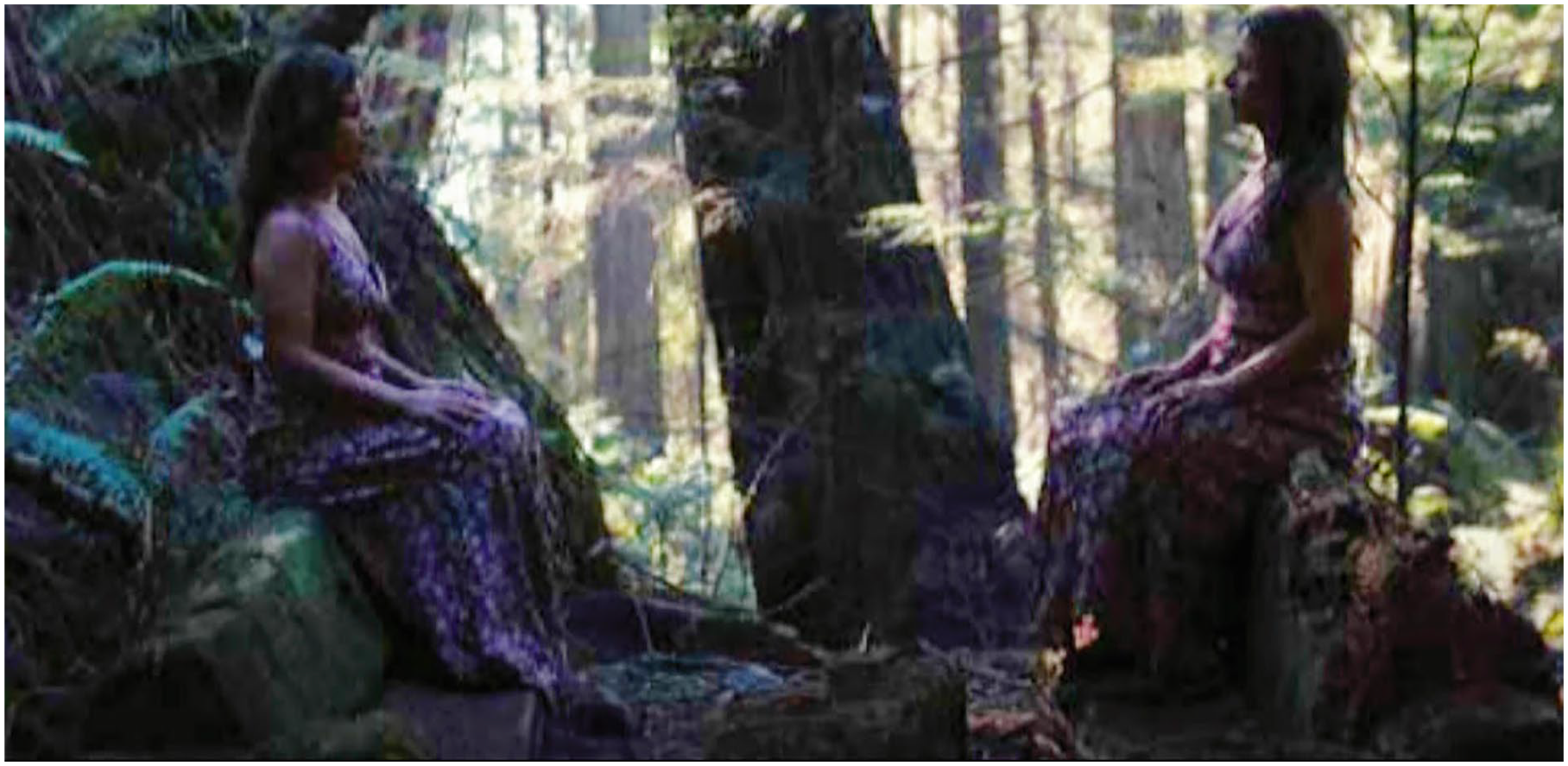
Embodied Pathways to Self-Reflexive Illuminations.
My positionality, which encompasses my multi-identities as a researcher, student, artist, educator, activist, mother, Punjabi-Sikh brown-bodied woman, is tied to the interstitial tissues of my living body. In other words, situatedness is sensorial as I “cannot make sense apart from the body” (Weibe & Snowber, 2011, p. 104). The late, beloved poet, Carl Leggo (2015), also gives voice to the viscerality of contextual meaning-making in sharing that, “we are bodies rooted in locations, geographical and historical and social locations [from which] we engage in standing in the world . . . [and] understanding the world” (p. 150). Embodiment, it seems, comprises the pulsating heart of positionality and reflexivity, yet, due to the entrenchment of mind–body distinctions in education and research (Snowber, 2018), bodies continue to be silenced, abused, overpowered (Cancienne & Snowber, 2003; Snowber, 2018), or absent in education (Bresler, 2013; hooks, 1994; Snowber, 2018). This absence marks an unsettling presence in my gut, a stinging, visceral tugging at my sleeve (Fels, 2010). Through Lynn Fels’ arts-based research on performative inquiry, I am able to recognize these moments of significance as stop moments, moments that invite me to pause and listen, to be awake and responsive (Fels, 2010, 2015a). My gut has tightened ever so slightly, and I must listen from the messaging of my gut sense . . . . . . if we indeed are bodies as opposed to have bodies (Snowber, 2012b), and in Parker Palmer’s (1998) words, we “We teach who we are” (p. 2), then is it not an ethical imperative to call forth the knowing body in our classrooms? . . . if we indeed experience life from and through the intelligence of our vibrating cells where our truth, authenticity and full expressivity are stored and storied (Snowber, 2007, 2012b, 2016, 2018), is reflexivity not innately a form of embodiment itself, a way of “living from an integrative place of body, heart, and mind”? (Snowber, 2018, p. 249)
The release of these reflective fragments has not settled my unsettled body. I feel the throbbing of my heartbeat. My limbs are restless. I need to dance. For as long as I can recall, dancing has been my way of deeply listening to and from my body akin to the rhythmic emulations of embodied listening and writing from the body (Snowber, 2012a). My body is my teacher and a primary site for re-searching and learning (Bickel, 2005) where I theorize through the skin and also hone critical capacities to sense and name what gets under the skin (Ahmed, 2021). When I dance, I am able to linger with the erratic pulses of oppression and limitation, openness and liberation, liminality and ambiguity, in learning the lexicon of my visceral signatures. When I dance, I grow closer to the wisdom and messaging of my body and the bodies that came before me.
My earliest recollections are of dancing in our first family home, in the room with an evergreen shag carpet, where I would dance myself into visibility and out of the fragility of being thrown by the world (Ahmed, 2016). At school, invisibility was safer than being othered, so each day, dancing revived my broken spirit and reconnected me to ease, flow, joy, and agency. When I dance my re-search . . . D I S P A R A T E Curiosities questions sensations memories uncertainties Joy anger sorrow surprise co-mingle and shapeshift integrate and arrive ripe for the revealing of the intellectual architecture of my work
My Sensorial Signature
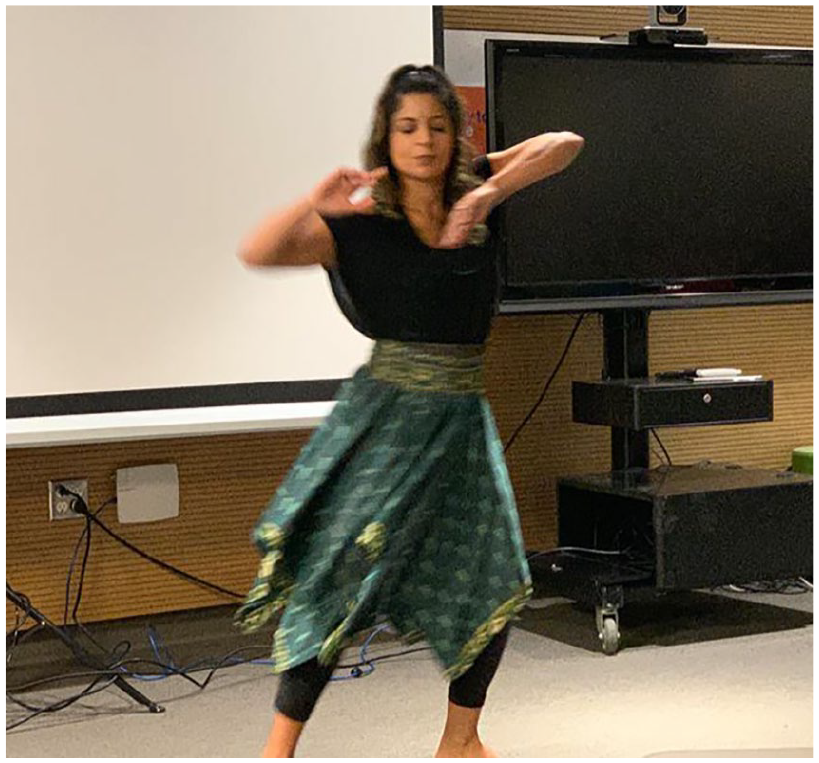
Dancing my Re-search: Re-imagining the Role of the Body in Teaching and Learning.
Over the past two decades, as a high-school English teacher, I have encountered many students who, like me, must move to think. Through the integration of embodied ways of knowing, I have witnessed students become wide awake (Greene, 1995) not only to their learning but also to their whole selves. bell hooks (1994) speaks of this kind of engaged pedagogy, one that embraces the heart, mind, body, and spirit, and where the classroom may provide “the most radical space of possibility” for teachers and students (p. 12). Embodied reflexivity allows for the transgression of passive pedagogical methods like Freire’s notion of the banking system of knowledge that continues to pervade classrooms (Freire, 2018; Waks, 2015). I remember the ways I have situated myself in the classroom and how the experiential nature of embodied learning not only allowed for exciting pedagogical opportunities but also decentralized power imbalances and recentralized authenticity and relationality. My heartbeat quickens as I reimagine educational practice as embodied and (re)humanized. What if . . . . . . students were provided opportunities to walk with their questions, curiosities, fears, vulnerabilities, perplexities and paradoxes, from the dynamism of their living inquiries (Meyer, 2010) as a form of authentic learning? . . . students were invited to dance and walk in the shoes of characters and historical figures through the literacies of their own bodies (Snowber, 2012a) in experiencing the curriculum as lived (Aoki, 1993) where they themselves may echolocate amid their own personal and social locations (Hasebe-Ludt et al., 2009)? . . . students were able to experience culturally responsive ways of attending and attuning through embodied listening practices that encompassed their hearts, bodies, minds, and spirits (Archibald, 2008; Cajete, 1994) in fostering cultural inclusion and a sense of community?
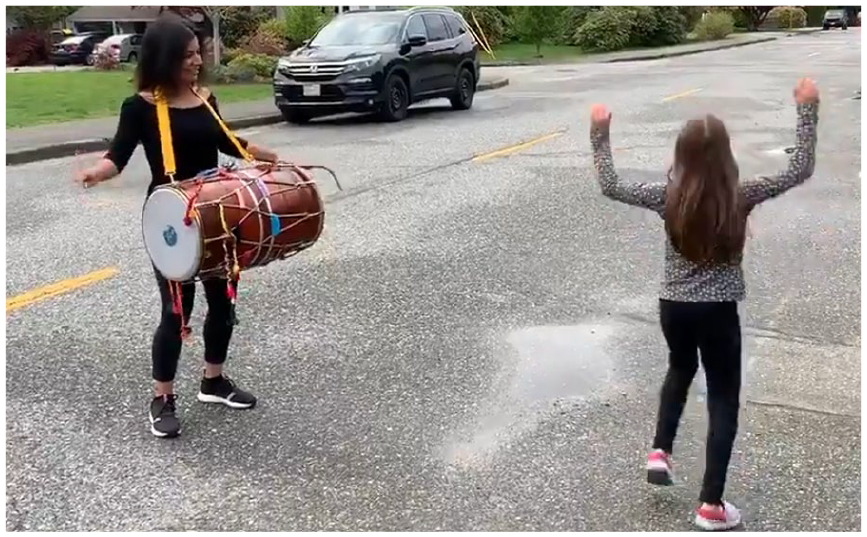
Mother and Daughter 7:00 pm Cheer for the First Responders during the COVID-19 Pandemic.
The words spill out of my body, and I am reminded of the agency that comes with honoring sensorial rhythms in syllabic form. When I write from my body, my words dance the way my heart pulsates. Writing from the body is an extension of my expressive body and allows my re-search to live from the inside out (Snowber, 2016). Writing from the intimacy of my interstitial tissues has also amplified my critical consciousness where I have been able to “name the world” for myself (Freire, 2018, p. 88). But in the beginning, it was difficult for me to see my words staring back at me. To write myself into visibility meant I had to grieve generations of invisibility. Naming my world began with the reclaiming of my Punjabi name in one of my first doctoral courses.
On the first day of class, I recall how Anishinaabe and Métis artist and Indigenous scholar, Dr. Vicki Kelly, glanced up from the class roster with inquisitive eyes after taking note of the discrepancy between my Punjabi name, Sandeep, and the name I went by, Shauna. When I was born, my Punjabi-born and Punjabi-raised Sikh mother had gifted me the name, Sandeep, but my Canadian-born relatives selected a name more conducive to life within a predominantly white society. So, since birth, everyone had come to know me as Shauna, while my official birthname, Sandeep, had remained dormant within the archives of documentation. I remember Dr. Vicki Kelly’s gentle words that tugged at my heart just as they do now, words that altered the trajectory of my re-search and life, “May I call you Sandeep?.” At this moment, this tugging at my heart, this stop moment (Fels, 2010, 2015a) calls for my attention, and I am being invited into, what I call, a sensorial snapshot, a living memory that flows from my visceral imagination (Weibe & Snowber, 2011) . . . I hear Dr. Lynn Fels’ voice. She tells me to Inhale and exhale, to “be present to this moment, here, now” (Fels, 2010, p. 6).
I see Dr. Vicki Kelly embracing me with her compassionate eyes and my body feels primed for what is to follow . . .
“May I call you Sandeep?”
I am surprised by the single syllable that flows out of my mouth with such ease.
“Yes,” I am saying.
After thirty-eight years of life, I am saying yes to Sandeep. Where has she been?
Dr. Vicki Kelly chases my word with yet another loving nudge.
“Sandeep,” she says . . .
“. . . this term, I invite you to explore the story of your name within the context of your spiritual and cultural ecology.”
At that moment, my body knew what my mind did not (Snowber, 2012b). I did not recoil like I did during many school years when teachers were faced with Sandeep on class rosters and their eyebrows would furrow, their noses would furl, as though my name had an offensive smell. Internalized racism had seeped into my veins, and I found myself becoming offended by my own brownness and culture, my otherness. When I started re-searching and re-claiming my name in the context of my cultural and familial lived experiences in Canada, which remarkably spans almost four generations within the same suburb, that is when the stories that had been lodged in my body for lifetimes (Snowber, 2021) began to speak up, to scream, to throb in textures of painful expressivity. I was removing scabs of my suppressed, silenced past where I was faced with a question that burned my ears . . . What if I am not inherently flawed? What if my family is not inherently flawed?
I wanted to make sense of my dizzying pain, shame, and the confusion that came with inhabiting a brown body. My inquiry led me to women-of-color scholars who detailed their lived experiences of oppression. And again, I found the arts. Within their research, Hartej Gill (2003), bell hooks (1994), Audre Lorde (2012), Sara Ahmed (2016, 2021), Kakali Bhattacharya (2013), and Valarie Kaur (2020) had in varied ways integrated poetry, performance, dance, and narratives to move and write into the abyss of the pain and silence of injustice. As I lingered in their words and worlds, I was able to locate my story amid their storied resonances and recognized with excruciating clarity that Shauna had sensed these dynamics of sexism and racism all along but had been unable to name them. When the weight of guilt set into my gut for not having recognized these oppressive dynamics, my guilty conscience was assuaged when I learned that sensing preceded naming and that naming took time, emotionally laborious time (Ahmed, 2016, 2021). I also began to see that the sensual was structural and that intergenerational repetition was pedagogical (Ahmed, 2016, 2021).
As I sensed to name and named to sense through dancing and embodied writing, I would inevitably become emotionally overwhelmed. This is when stop moments were crucial. With my breath as a guide, I could listen with agency from the interstices of in-between moments in choosing to engage and go deeper or not. In this way, “performative inquiry acts as a pedagogical vehicle of social change [where] educators and researchers [have] the opportunity to make visible political, social, economic, cultural, communal and individual injustices” (Fels, 2015b, p. 2). Stop moments, too, helped to soften the edges of pain, where I began to practice self-compassion, and remember the fierce love of Guru Nanak, my ancestors, family, and courageous women of color whose voices still echo and embolden. Healing has never been a solo endeavor. Through sensing and naming, I have been able to name my world (Freire, 2018) by finally remembering and writing my Herstory into existence, finally breathing into being my genealogical, lived and living body.
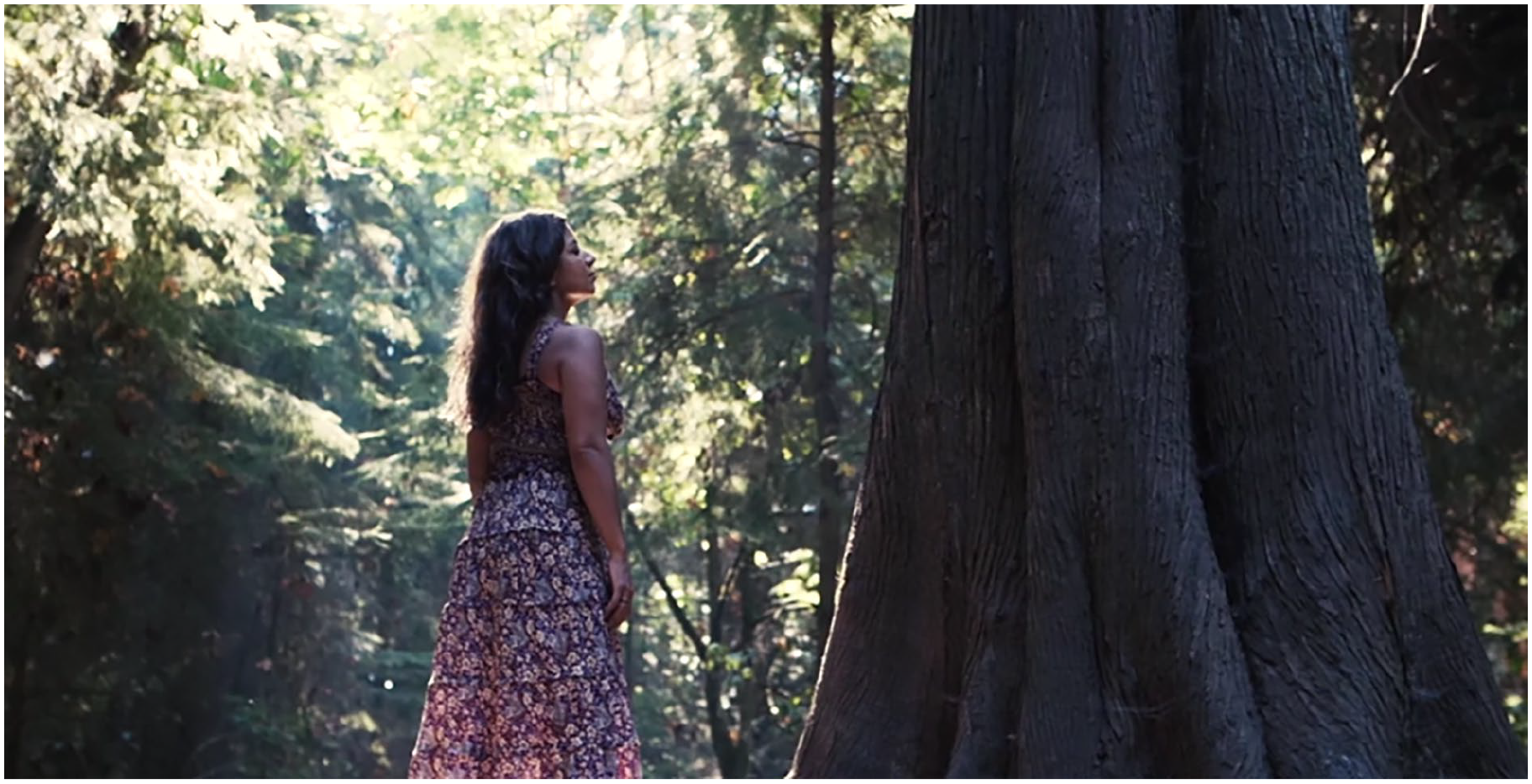
Rooting and Rising Through the Ancient Wisdom of My Herstory.
For years now, through my arts-based and decolonizing re-search, I have been dancing, sensing, attuning, and writing from and through my living body. Although the emotional terrain has been tumultuous, it has been profoundly healing and transformative to be able to reach into and release stories that have been buried in my body, so I may dance and re-story them by rewriting myself and reimagining society anew. Through embodied arts-based approaches, I am able to show up and situate myself within my re-search, teaching, and life as a multidimensional human being in navigating the raw range of expressivity from elation to excruciation and the nuances and paradoxes in between. Although I must say, like Kakali Bhattacharya (2016), vulnerability has never felt entirely safe for me, especially as racism continues to follow my family like a shadow. But in this same breath, I know that my silence will not protect me (Lorde, 2012) and that vulnerability is the wellspring from which healing, authenticity, and agency flow. Arts-based embodied practices have revealed radical possibilities for sensing and naming, unlearning, reclaiming, disrupting, and reimagining and have enlarged my visceral view of the liberating and ethical potentialities of positionality and reflexivity in teaching and learning, arts-based research, and more broadly, qualitative research.
My heart feels heavy having to conclude this exploration, but I hope that we may have opportunities to further this conversation by following the threads that have been unraveled. With a parting phrase in Punjabi to honor my ancestors, I thank you for sojourning with me.
Sat Sri Akal Ji
Footnotes
Acknowledgements
I would like to thank Simon Fraser University Department of Education for supporting my doctoral studies through graduate fellowships.
Declaration of Conflicting Interests
The author(s) declared no potential conflicts of interest with respect to the research, authorship, and/or publication of this article.
Funding
The author(s) received no financial support for the research, authorship, and/or publication of this article.
