




Abstract
Photovoice is a community-based participatory visual research method often described as accessible to vulnerable or marginalized groups and culturally appropriate for research with Indigenous peoples. Academic researchers report adapting the photovoice method to the sociocultural context of Indigenous participants and communities with whom they are working. However, detailed descriptions on cultural frameworks for transforming photovoice in order for it to better reflect Indigenous methodologies are lacking, and descriptions of outcomes that occur as a result of photovoice are rare. We address the paucity of published methodological details on the participant-directed Indigenization of photovoice. We conducted 13 visual research group sessions with participants from three First Nations communities in Northern Ontario, Canada. Our intent was to privilege the voice of participants in a mindful exploration aimed at cocreating a transformation of the photovoice method, in order to meet participants’ cultural values. Gaataa’aabing is the Indigenized, culturally safe visual research method created through this process. Gaataa’aabing represents an Indigenous approach to visual research methods and a renewed commitment to engage Indigenous participants in meaningful and productive ways, from the design of research questions and the Indigenization of research methods, to knowledge translation and relevant policy change. Although Gaataa’aabing was developed in collaboration with Anishinaabek people in Ontario, Canada, its principles will, we hope, resonate with many Indigenous groups due to the method’s focus on (1) integration of cultural values of the respective Indigenous community(ies) with whom researchers are collaborating and (2) placing focus on concrete community outcomes as a requirement of the research process.
Introduction
Photovoice is a visual research method used in community-based participatory research (CBPR; Nykiforuk, Vallianatos, & Nieuwendyk, 2011). According to Chilisa (2012), CBPR methods include community participants in all phases of research design and implementation and often commit researchers “to an action-oriented research process” (p. 227). Photovoice is seen as an empowering research method as it offers a space for community members to come together and share their concerns through a format that is collaborative, creative, and enjoyable (Palibroda, Krieg, Murdock, & Havelock, 2009). This focus on engaging and privileging grassroots knowledge in the quest to solve community issues makes photovoice well-suited for use in CBPR.
According to Wang and Burris (1997), specific objectives of photovoice projects include:
“(1) to enable people to record and reflect their community’s strengths and concerns, (2) to promote critical dialogue and knowledge about important community issues through large and small group discussion of photographs, and (3) to reach policymakers” (p. 370).
As a method, photovoice consists of participants and facilitators (1) convening to establish research topics, which speak to the needs of the community, and guide the photography of participants; (2) instructions on how to use a camera (if required); (3) allotting time for participants to take photographs; and (4) reconvening to discuss the photographs participants feel are most significant to the research topic. Participants may also plan an exhibit to share their photographs with a wider audience (Wang, 1999).
Research With Indigenous Peoples
Indigenous peoples often view academic research critically as past research has routinely failed to incorporate Indigenous values and brought little-or-no benefit to the Indigenous individuals and communities with whom the research was conducted (Canadian Institutes of Health Research, Natural Sciences and Engineering Research Council of Canada, and Social Sciences and Humanities Research Council of Canada, 2014). Smith (2012) describes academic research as an activity “inextricably linked to European imperialism” that is associated with “the worst excesses of colonialism” (p. 1). Smith states that researchers ought to apply a decolonized lens to Indigenous research and further emphasizes that “Indigenous methodologies tend to approach cultural protocols, values and behaviors as an integral part of methodology” (p. 15). Similarly, Lavallée (2009) describes decolonizing the academy by incorporation of Indigenous knowledge into research rather than relying on Western theories. She further states that the ways in which Indigenous research principles are enacted in research are “left to the researchers and community to decipher…Therefore, it is crucial that literature be further developed to gain a better understanding of the ways of conducting research among Indigenous communities” (p. 25).
Many consider the basic tenets of the photovoice method culturally appropriate for use with Indigenous participants and it has been used extensively in this context, in Canada and internationally (e.g., Badry & Wight Felske, 2013; Castleden, Garvin, & First Nation, 2008; Genuis, 2015; Lemelin et al., 2015; Moeke-Pickering, Heitia, Heitia, Rolinda, & Cote-Meek, 2015; Moffitt & Vollman, 2004; Pearce & Coholic, 2013; Shea et al., 2013). According to Brooks, Poudrier, and Thomas-MacLean (2008)”, photovoice
“…empowers participants to share an understanding of their needs and share stories and narratives visually—privileging Indigenous knowledge, validating diversity of the participants and deepening opportunities for participants and researchers to explore personal, social and political experience and wisdom” (p. 209).
However, researchers have had to adapt the photovoice to fit with various Indigenous cultural perspectives. For example, Castleden, Garvin & First Nation (2008) found that the “classic” (p. 1401) photovoice methodology that applies a research structure without inclusion of cultural practices, over a relatively short period of time, was not culturally appropriate for the Huu-ay-aht First Nation on Vancouver Island, Canada. Thus, they included cultural practices and a longer trust-building engagement process and offered more methodological flexibility, with resulting positive feedback from participating community members. Although such adaptations are common, we have not found any literature describing a transformational decolonizing approach to photovoice research that focuses on the incorporation of Indigenous knowledge and the creation of an Indigenous research methodology, thus the reason for this article.
In our project, the academic researchers were invited to collaborate with three First Nations communities in Northern Ontario, on the community-identified problem of intimate partner violence (IPV). During preliminary discussions, the researchers learned from the Indigenous community partners that IPV is a consequence of colonial policies, such as the Indian Residential School system, and was a sensitive subject; a decolonizing research approach, informed by Anishinaabek values and focused on meaningful engagement of participants, was essential to ensure that research would not harm participants.
During preparations for our research, we reviewed potential methodological approaches, in collaboration with our community advisory group (CAG). Collectively, we became interested in exploring the photovoice method, particularly due to its potential to simultaneously open a community dialogue on intimate relationships and address the research objectives of the First Nations communities in a culturally safe manner.
The collaborating First Nations are experienced with academic research. Together, the First Nations communities in the region operate an Indigenous research ethics committee, the Manitoulin Anishinaabek Research Review Committee (MARRC; M. Maar, Sutherland, & McGregor, 2007; see http://www.noojmowin-teg.ca/SitePages/MARRC.aspx). The committee ensures research projects do not simply incorporate minor cultural modifications to make them more palatable to participants and university research ethics boards. The intent is to ensure meaningful engagement of community by academic researchers and embodiment of Anishinaabek values, including the Seven Grandfathers Teachings (M. Maar et al., 2007), in the design and implementation of research projects.
During the planning process with Indigenous community collaborators and participants, we realized that the published papers on photovoice we reviewed were often not culturally appropriate for our setting, despite some of the valuable lessons shared therein. For example, Poudrier and Mac-Lean (2009) noted how the photovoice method (and its visual and nonvisual products) became a source for relationship building between participants and key stakeholders. McHugh, Coppola, and Sinclair (2013) described the importance of engaging participants in the analysis of visual materials more than once. But we did not find any information to ensure the methodology would embody Anishinaabek values in research. Instead of attempting to adapt photovoice ad hoc, we decided to allow space in our research for the participating Anishinaabek women to cocreate a new visual research methodology, in collaboration with the research team, and based on the photovoice method.
Background
In January 2016, at the invitation of a First Nations health organization located in Northern Ontario, Canada, two of our university-based researchers, M. Maar and B. Bennett (M.M, B.B.), attended a meeting of frontline health and social services staff to explore community research needs. During a research priority-setting exercise conducted with these community workers, IPV was identified as a community health issue associated with acute injuries and chronic health problems such as anxiety, depression, and addiction (M. Maar & Bennett, 2016).
IPV is rooted in historic colonial violence, which has manifested in Indigenous communities economically, socially, culturally, and spiritually (Barlow et al., 2008). These historic forces of colonization have compromised mino-bimaadiziwin (Craig & Hamilton, 2014), the Anishinaabek concept of one’s ability to lead a healthy life (Lavoie & Forget, 2011). Colonial conditions have been linked to an increased likelihood of experiencing IPV, whether as a perpetrator or victim (Fulu, Jewkes, Roselli, & Garcia-Moreno, 2013; Garcia-Moreno, Jansen, Ellsberg, Heise, & Watts, 2006; Matamonasa-Bennett, 2015; Valdez-Santiago, Híjar, Rojas Martínez, Ávila Burgos, & Arenas Monreal, 2013). Despite such adversity, Indigenous peoples demonstrate a resilience rooted in culture and a renaissance of Indigenous identity (Kirmayer, Dandeneau, Marshall, Phillips, & Williamson, 2011).
To address IPV, university-based researchers collaborated with First Nations partners and an Indigenous theater group, The Debajehmujig Storytellers (Debajehmujig; see www.debaj.ca for more information). Debajehmujig’s role was to support the promotion of the project at the community level, to conduct video recording at the learning circles, and to assist with knowledge translation, once the data collection was complete. Together we developed a collaborative research approach rooted in the principles of cultural safety and CBPR, and inspired by the photovoice and ethnography methods.
Cultural safety in health care means it is the patient who decides “whether they feel safe with the care that has been given” (Papps & Ramsden, 1996, p. 494). Thus, cultural safety in this research is evaluated through whether-or-not participants felt safe with research processes and objectives. When applied in this project, cultural safety involved “respecting the worldviews of those being researched, recognizing their culturally-driven differences, and including these in the design of the research” (D. Wilson & Neville, 2009). It also meant being open to a fundamental transformation of methods, if required. Applying the concept of cultural safety to research required that researchers regularly reflect on power relationships between academic and Indigenous research processes.
During early planning sessions, we discovered that the photovoice method needed significant changes in order to maintain cultural safety. Specifically, although community members found an arts-based research method to be compelling, the photovoice instructions that called for collection of photographs, followed by group discussion sessions and analysis, were felt to be prescriptive, rigid, and investigator-driven, thus clashing with Anishinaabek values for research. To meet the criteria of a culturally safe methodology, from the perspective of the participants, we needed to commit to incorporate Anishinaabek worldviews and processes and support the co-development of a new Indigenous visual research approach. This article describes the qualitative research that led to the development of the Gaataa’aabing method, a culturally safe visual research method inspired and informed by a braiding (Donald, 2012) of Western and Indigenous knowledge and research methods (see Figure 1 for a time line of the process).
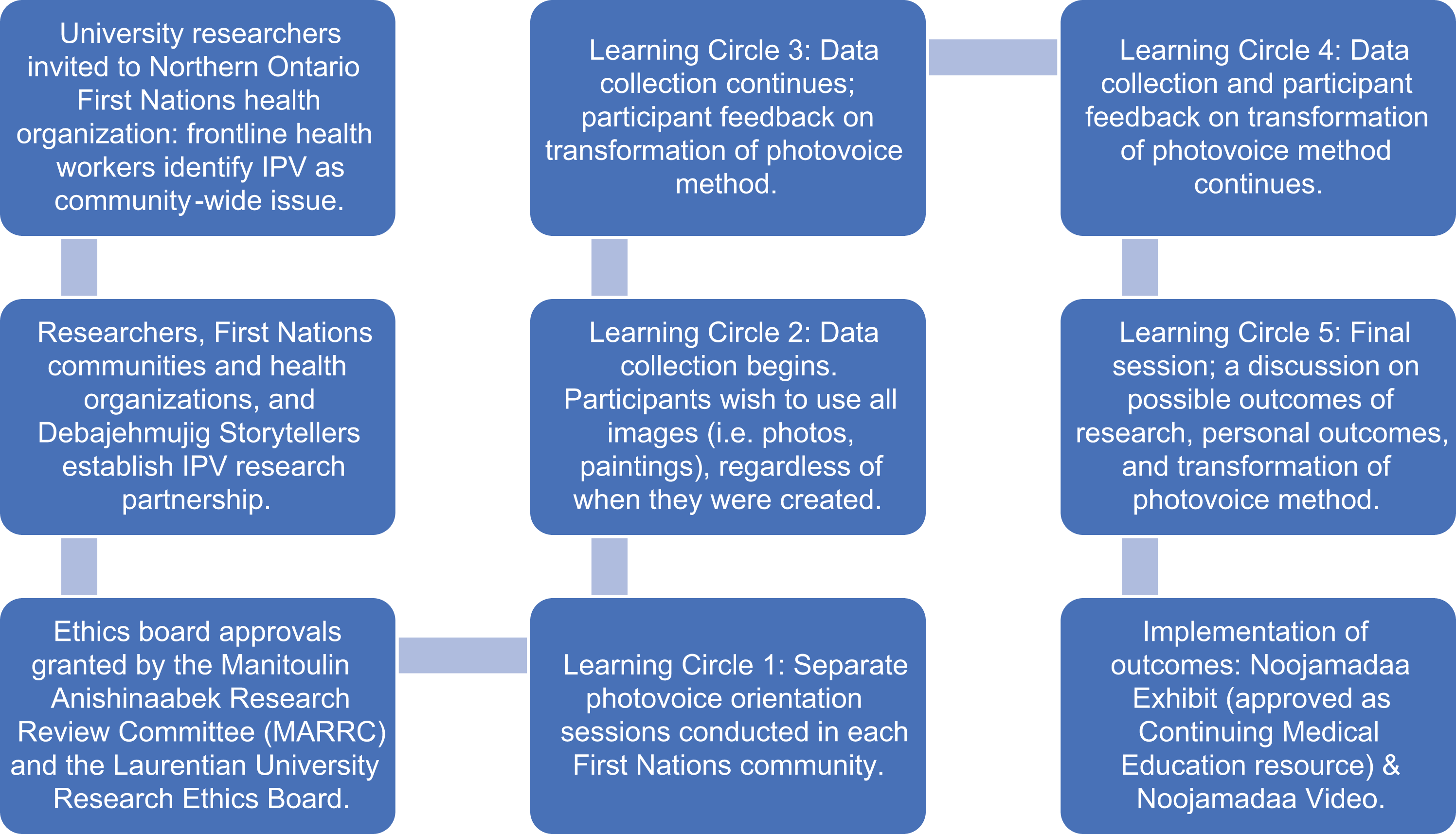
Time line: Initiation of research, transformation of photovoice, and development of Gaataa’aabing.
Method
The method we used to cocreate a visual arts methodology began with an in-depth dialogue with First Nations health service providers and our CAG (which was established to monitor the research). We then conducted 13 sequential photovoice-inspired learning circles in three Northern Ontario First Nations. The dialogue was rooted in the Indigenous values and worldviews necessary to transform the photovoice method, through consensus with participants, into an Indigenous visual research method. The name Gaataa’aabing was selected by elder Doreen Trudeau-Peltier, who was a participant in this project, and a member of the CAG. Gaataa’aabing is a word from Anishinaabemowin, the language of the Anishinaabek people, and translates to “looking or searching in a circular fashion” (field notes, May 29, 2017).
Recruitment, Consent, and Data Collection
A CAG of elders, community members, and local health workers provided community-based oversight for the project and served as a venue for member checking. Community advisory group members were selected by the leadership of one of the participating communities. Together with the lead academic researchers (M.M. and B.B.), the CAG liaised with the lead health staff in each community and supported the promotion and knowledge translation of the project.
We conducted sequential, separate weekly group learning circles in each of the three First Nations communities (Table 1). Participants (n = 23) were recruited from each community (n = 3) through convenience and snowball sampling. All participants were women—their ages ranged from teenagers to seniors. Data collection consisted of video and audio recording of group discussion sessions. The learning circles focused on various subtopics on the subject of healthy relationships (e.g., “balance” or “resilience”); the subtopic addressed at each learning circle was selected by each respective community group, through consensus. Each learning circle was approximately two hours long and was video recorded by Debajehmujig staff. The lead author transcribed all audio recordings verbatim. Participants consented to audio and video recording of group sessions.
Statistics on Participants and Learning Circles.

Community Immersion With Elements of Ethnography
Methodological components of ethnography, a research method designed to facilitate cultural understanding (Asad, 1986), were important in this study. Fetterman (1998) defines ethnography as “the art and science of describing a group or culture” (p. 1). Peacock (1986) further describes ethnographic field work as a way in which one establishes oneself, or becomes known, in a community. Ethnography and photovoice have been combined in past studies (e.g., Fleming, 2009; Moffitt & Vollman, 2004). Moffitt and Vollman (2004) describe photovoice as “a natural fit with ethnography because it is a way for people to tell others about themselves” (p. 193). Although ethnography has since shifted away from the researcher “writing with a distinctive voice of disciplinary and personal authority” to “collaborative and dialogic writing” (Marcus & Fisher, 2014, p. xvii), there is still an intrinsic problem with researchers portraying Indigenous culture with authority (Raheja, 2007). We therefore used the immersive experience of ethnography as a learning tool for the university-based researchers. To this end, the lead author lived in one of the communities and regularly visited the other two participating communities, which were nearby. This form of community immersion was facilitated through a homestay with a Debajehmujig staff members who lived in one of the partner communities.
The lead author maintained a field journal which served as an important record of lived experiences and documented reflections upon these experiences. The long-term immersion in the community also provided context to the research questions from an emic perspective (Ninnemann, 2012) and enabled the researchers to demonstrate commitment to, and develop trust with, community members. Given the largely negative history of academic research in Indigenous communities (CIHR, NSERC, & SSHRC, 2010; Smith, 2012) and the sensitivity of the community-selected research topic of IPV, trust was especially important.
Gaataa’aabing Learning Circles
Participants’ co-creation of an Indigenous visual research method began in each of the three groups with an orientation to the core principles and method of photovoice, as first described by Wang and Burris (1997). To facilitate the discussion, we used a learning circle approach similar to that described by Nabigon, Hagey, Webster, and MacKay (1999). A learning circle is a circle of research and healing that allows for stories and substantive information of a group to be retold. It represents an adapted version of the Sharing Circle Ceremony of the Anishinaabek. It differs from a focus group or group discussion, Nabigon states, in that participants do not become the means to collect data. Instead, the emphasis is on sharing.
During each learning circle, participants were able to share their perspective on methodological issues of photovoice, with respect to their Anishinaabek culture and values, and thus informed a culturally safe visual research method congruent with Anishinaabek culture.
Data Analysis
We analyzed field notes and transcripts for themes which would assist the development of the Gaataa’aabing method and then at each session brought findings relevant to the development of this new method to participants and members of the CAG for feedback and further refinement. We continued until participants had shared all necessary feedback and reached consensus on the methodology. Finally, we collaborated with two participants in the write up of the methodology (D. Trudeau-Peltier. and S. Trudeau).
Results
Our study revealed that a culturally safe transformation of the photovoice method, for use in collaborative community-based research with Anishinaabek communities, contained seven key components: (1) the research method and cultural protocols are adapted to the respective Indigenous community context; (2) the community immersion of the academic team grounds the researchers in the day-to-day realities and culture of the community; (3) participants define what visual media to include, in order to deepen participant involvement in the research process; (4) the acadmic researchers support participants in their technology use, thus facilitating participation from a variety of tech comfort levels, (5) the research team works to diminish/confront social hierarchies common in academic research by including researchers as “discreet” participants, (6) a focus on participant aspirations forms the basis for intended research outcomes, reaffirming the objectives of CBPR, and (7) a final group learning circle provides an opportunity for reflection and concluding remarks. These seven components comprise an Indigenous approach to visual image research: the Gaataa’aabing method.
Gaataa’aabing Research Method and Cultural Protocols
During the orientation sessions, participants at all three sites decided that data collection (i.e., the presentation of photos and the ensuing discussions) should be conducted in the spirit of a learning circle instead of the photovoice interview, focus group, or presentation commonly described in the literature. This is a significant departure from the original photovoice methodology. Nabigon et al. (1999) explain that the Indigenous methodology of the learning circle “is not easily understood from a Western research perspective…It is not oriented to extracting data but rather to acts of sharing” (p. 126). Most importantly, the difference lies in “the meaning [circles] have in many Indigenous cultures and in the growth and transformation bases for the participants” (Lavallee, 2009, p. 29).
The cultural protocol components established by participants can be summarized as follows: (A) a ceremonial opening, (B) a process of group sharing at learning circles, (C) sharing a meal at each sharing circle, and (D) participant-established group guidelines.
Ceremonial opening: Smudging
Participants determined that every group session begin with a ceremonial opening: in our case, this opening was a “smudging” of the participants and facilitators. In Anishinaabek culture, a smudging “involves the burning of sage as a purification cleansing ritual so as to cleanse the person’s mind, spirit, body, and emotions of negative energy” (Watts, 2016, p. 151). The smudging was conducted by an Indigenous community worker and was followed by a prayer in Anishinaabemowin. “I think it was great that you did a smudging,” commented a participant. “It cleanses your soul and takes away all your negative energy…it starts the meeting in a great direction” (field notes, May 24, 2017). “I do smudge before I start anything…just always have to think positive,” noted another participant, during a learning circle (November 15, 2017). The smudging and prayer formally marked the beginning of each learning circle and shifted the focus to the often emotional task of discussing relationships.
The ceremonial opening also represents an important balancing or shifting of power in research: out of respect for the lived experience and traditional knowledge of the Indigenous peoples of the region, as well as for the fact that we were guests in their communities and on their land, academic researchers relied on First Nations community staff and participants to open the learning circle.
Learning circle: Structure and etiquette
The orientation session established the structure and social etiquette for future learning circles. Participants were seated in a circular fashion and took turns speaking. “When you are in a circle you are not behind anybody or in front of anybody,” stated a participant. “Everybody knows that once you go to the circle that is your time to share and when you are talking about it you are letting go…you are healing or helping someone else heal” (field notes, May 24, 2017). “Sitting in a circle is for equality for everyone,” added an elder, “It can be the Queen or the President of the USA—it’s human-to-human” (field notes, July 14, 2017). Information shared in circles is not normally disseminated beyond the circle. However, in this case, the discussions at learning circles were recorded and analyzed, with the explicit permission of the participants.
In later sessions, any participant could volunteer to start sharing the meaning of an image they wished to share or the meaning of an image another participant shared with the group. Other participants then shared what meaning they took from the image, usually following the circle format, with the option to pass. In this sense, group discussions were open-ended and allowed the discussion to be rooted in the perspectives of participants, not the interests of researchers. Encouraging participants to answer prescribed questions would be considered intrusive and disrespectful in this particular cultural setting. Our group sharing model respected the cultural traditions of the Anishinaabek women participants and acknowledged their ways of knowing.
Nabigon et al. (1999) describe other subtle protocols for a learning circle, based on the teaching of the Anishinaabek: The leader [facilitator] behaves in a humble manner, may be the brunt of jokes, and openly discloses his or her own weaknesses…Each person is free to speak without interference, interruption, or questioning. Everyone waits for someone to finish speaking in turn, around the circle in the same direction as the dance, clockwise. The clock is not honoured. People are prepared to stay for as long as it takes. The communication is understood to be between the person and the Creator. Each speaker is allowed to complete their thoughts before the next person’s turn. There is an air of light-heartedness or fun; it is not serious, yet deeply serious, and this is the presence of the Trickster. (pp. 126–127)
Sharing a meal
Participants decided by consensus that every learning circle would begin or end with the sharing of a meal. This became a time when group members could socialize informally (i.e., the conversations were not being audio or video recorded) with one another and the facilitators. “I look forward to learning and sharing and listening. And the food is good,” commented one participant, during a learning circle (November 15, 2016). The act of sharing a meal also helped to build trust and reinforced the equality of all present, whether researcher or participant. Participants and researchers became increasingly comfortable with one another, which supported relationship building.
Group guidelines
As the final component of the Gaataa’aabing method’s cultural protocol, participants decided to establish group guidelines unique to each community’s learning circle: The common purpose: Why are we here? Finding out what community women think a healthy relationship looks like, so that we can prepare future generations; How do we do this? By sharing our stories about healthy relationships and keeping in mind that we are seeking solutions to a community-identified issue. We are looking for strengths that would help us get to those solutions; Respect one another, even if you differ in opinion; Be mindful of where others are at in their healing. Listen with open minds. We are not here to judge one another; Confidentiality. Trust our process. What is said here, stays here. (Facilitators provided the caveat that, as part of a research study addressing IPV, there was a need to share substantive findings, in an attempt to address IPV in the community); Support one another. Be sensitive. Check-ins and check-outs. How is everyone doing today? Right to pass; Starting our sessions with a smudge; Patience; Have a good time. Have fun; Being kind to yourself; It’s OK to take a break. Taking breaks to refresh; Revisit these guidelines throughout the project.
The group guidelines were a dynamic document and reviewed at the beginning of each learning circle.
Community Immersion of the Academic Team
The importance of community immersion of the academic researchers was identified in early discussions with community advisors, before the research even began. The lead author’s (B.B.) immersion in community life lasted approximately four months (before, during, and after the data collection), during which time he billeted with a family in one of the First Nations, 1 visited the two additional communities frequently, and participated in day-to-day life. This included attending social occasions, ceremonies, and land-based activities like fishing and woodcutting. B.Bennett also visited participants regularly to check in about upcoming research sessions. These visits continued after the data collection was completed. Other members of the research team included an academic and community member (D. Manitowabi) who lives in one of the participating First Nations and an academic (M.M.) who had worked locally with various local and regional First Nations for two decades. Thus, the community immersion of the team preceded—and extended beyond—the data collection period.
Participants provided positive feedback related to the community immersion. “Seeing you drive around, knowing that you are in the community, knowing that you are trying to help is a positive thing,” commented a participant (field notes, May 24, 2017). An elder noted that, by living in the community, B.B. “got to see the real community” (field notes, May 22, 2017). A note from the field journal provides perspective, from the researcher’s point of view, on the community immersion, the way it is practiced, and the learning that takes place as a result: “[It] is more about listening, engaging, participating…One almost needs to turn off parts of the mind…think, but don’t overthink” (field journal, December 12, 2016).
Community immersion raised awareness and instilled trust around the research project. The importance of a trusting relationship to the research process had already been identified in the same communities (M. A. Maar et al., 2011). Immersion also facilitated more nuanced insight into our research topic. For example, a community member took B.B. out to set gill nets in a nearby lake and noted how daily boat trips with his partner to set fish nets “limited the intensity of [their] conflicts, because they knew they would be spending the next morning together in the boat and would need to rely on each other” (field journal, November 14, 2016). In this sense, the immersion allowed the researcher to deepen his understanding of relationships and allowed him to hear emic perspectives (Ninnemann, 2012), outside of the scheduled learning circles. Learning more deliberately about the values and norms of the participating Indigenous communities allowed the researchers to become more open and attuned to cultural incongruences inherent in the research methods and value cultural protocols. Overall, our analysis shows community immersion of the academic researchers is a cornerstone of the Gaataa’aabing method.
Participants Select Visual Media Types
In the original description of photovoice (Wang & Burris, 1997), participants take pictures after the orientation meeting and these pictures become the project data. But participants in this study felt that this was too restrictive. One participant shared a strong emotional response when initially presented with this method: I guess at the [orientation session] I felt a little pissed off because to me it was like how do you [provide your perspective on relationships using only photos]. I have such a broad scope or a perspective and then to pinpoint it through a little funnel such as photos, I felt really flustered. Well, how do you do that, you know? (Participant, November 15, 2016) …being here for me has been somewhat therapeutic and looking into my, I call them the Pandora boxes, but I have two chests of pictures at home and I just grabbed this one bag and I could pull out any picture and a memory will come back or an experience or a person that I once knew. So it’s good. It’s reflecting back on my life I guess. Chi-miigwetch. (Participant, November 29, 2016)
For another participant, a photovoice project that was open to all kinds of visual arts meant that she could share a painting meaningful to her and her family, one that highlighted the cultural strengths in her life and the strong relationships she shares with her family: …this is a painting of our family…in a traditional perspective. So there is my spirit name, my kids’ spirit names are in there, and our clans. So I am Bear Clan and the kids and [my husband] are Turtle Clan. And the hummingbird is my daughter and the loon is my son. And the otter was [my husband’s]. And the eagle and the pine tree, those are my two spirit names. (Participant, December 1, 2016)
Researcher-Supported Digital Technology
At the time of Wang and Burris’s (1997) foundational photovoice project, analog photographic methods were the norm. They noted how creating photographic slides facilitated group discussion and “literally enlarges the visual impact of the images” (p. 379). Photographic technology is rapidly evolving. In our study, participants chose to use digital photography. Those participants who did not possess a cell phone or camera were provided with an inexpensive digital camera. Images were uploaded to a computer and then displayed using a computer linked to a projector. Participants also brought printed photographs or pieces of artwork, and these were passed around the circle.
In order to receive the digital image files for projecting during group sessions (or, later, for their printing in order to be included in an exhibit), facilitators provided technical support to participants. Technical support occurred between sessions and required B.B. to meet with participants and assist with downloading or e-mailing images. Having a researcher live in one of the participating communities made this process feasible.
Researchers as Discreet Participants
At the request of the participants in each community, the university-based researchers also participated in the study by presenting, and reflecting upon, their own images. One participant noted how this component built trust between participants and researchers by flattening hierarchies between them: If [researchers] are there and a part of the group, it opens doors. It is a way of connecting with everybody in a good way…you are not showing that you are above anybody. You are actually just like us, no higher level than anybody…you are letting [participants] into your world. (Participant, August 5, 2017)
A Focus on Participant Aspirations as Research Outcomes
From the outset, participants wanted the research project to be a catalyst for change—given the evolving nature of the project, these aspirations developed over the course of the sharing sessions and reflected the research topic of healthy relationships. For example, there was a desire to see the photovoice study serve as a platform that could challenge stereotypes about Indigenous peoples and contribute to the healing of relationships between Indigenous and non-Indigenous peoples. “I think it would be informative to the non-Natives and it would enlighten them,” commented one participant, in reference to the images and stories that emerged (December 1, 2016).
S. Wilson (2008) states that, along with respect and relationality, reciprocity is one of the three “r’s” of Indigenous research methodologies. A focus on the aspirations of the participants with respect to research outcomes is therefore a key aspect of Gaataa’aabing, even after research funds have run out and publications are completed. In this project, emerging aspirations of participants were documented by facilitators, in order to keep track of outcomes desired by participants.
In our study, we collectively created The Noojamadaa Exhibit (Bennett, Maar, & Han, 2017), a traveling exhibit which grew out of this research and features some of the stories and images shared by the Indigenous women who cocreated and participated in this project. The exhibit has been featured at the Chiefs of Ontario Health Forum and the Ontario Legislative Building in Toronto, Canada, and many other venues. It has been accredited as a Continuing Medical Education tool for health and social services providers, and converted into an educational video intended for high school and university students. At a local level, it has become the impetus for a joint exploration of the roles of primary health care in addressing IPV. Research with Indigenous men on similar topics related to healthy relationships is ongoing.
Closing the Circle: Group Reflection
A final learning circle served as a last “check-in” with participants: in short, an opportunity for sharing reflections on the research process, ending data collection, and closing the learning circle. Researchers learned from participants their final thoughts on the cultural safety of the research and its objectives: “I really enjoyed being at this program…I feel like I know Sarah [a circle participant] now. And I feel comfortable sitting beside her. I feel comfortable with everybody…” (Participant, November 29, 2016). This participant’s comments highlight a strengthening of social networks of support and underscore the supportive nature of the learning circles. Another participant commented on the positive impact the study had on interpersonal relationships: …hearing everyone’s stories and…everyone’s struggles you know you are not alone. And I really like that. And especially listening to my grandma talk, now I know why like our family is the way we are. Because at first I was like why…don’t we hug and stuff like when my mom says I love you I’m like eww…no. But I say it back…now I know…I understand a little bit more why that is. And I thought that was…it’s awesome…(Participant, November 29, 2016) I just want to share with you that being here and listening and learning from each one of you has brought more peace to me and brightened my way of thinking…And I hope that this continues and that it gets bigger. (Participant, November 29, 2016)
Discussion
This research demonstrates that the cultural safety of a participant-generated visual arts project conducted in three Northern Ontario Anishinaabek communities hinged on a transformation of the photovoice method. This transformation incorporated Anishinaabek values and practices, as well as a commitment to concrete outcomes that addressed the community-identified issue of IPV and met the needs of participants. An elder highlighted the need for commitment to Anishinaabek values in research: “We are always being studied. There is so much about abuse all the time. But when you came we didn’t want that and you were open enough to go with the flow” (field notes, May 22, 2017).
Participants in this study felt that to adhere to a particular method would compromise their perspectives and their cultural safety—minor adaptations would not be able to resolve these concerns. Castleden et al. (2008) note a similar limitation in their photovoice work with a British Columbia First Nation: “[It] quickly became apparent that the ‘classic’ photovoice approach was similar to the academic trend of doing ‘parachute’ research in Indigenous communities” (p. 1401).
The Gaataa’aabing Method
As we mentioned, Gaataa’aabing translates to “looking or searching in a circular fashion.” Elder D. Trudeau-Peltier elaborated on the name she chose: “The way of thinking is to always consider the grey area, instead of looking at something in just one way. You [need to] look at all possibilities and resources” (field notes, May 29, 2017). This emphasis on looking “at all possibilities and resources” is borne out in the Gaataa’aabing method, through an approach to qualitative research which considers all aspects of the research—and all who are involved—as autonomous voices and valid sources of data. The Gaataa’aabing method is based on Anishinaabek worldviews and values in research, which may resonate with other Indigenous groups, although the details of the cultural protocols may need to be adapted to different Indigenous peoples and cultures. Its principal strength is that it was cocreated by Indigenous participants through reflection on methods during 13 learning circles, while participants were actively engaged in visual research and thus testing the emerging methodology on a weekly basis.
The significance of a community immersion approach
Community immersion was a key aspect in the development of the Gaataa’aabing method. Without it, it is unlikely that we would have succeeded in developing the strong relationships with participants we required in order to gain understanding of the issues surrounding our research question. Community immersion increased researchers’ competence by helping them to understand “the unique community and organizational context, circumstances and challenges, as well as the cultural dimension” (M. Maar et al., 2015, p. 10) within which the research question was nested. M. Maar et al. (2015) argued that strong working relationships hinge on research teams who have an “in-depth understanding of one another’s needs, resources and expectations related to research and action” (p. 10). Living in the community was an important part of nurturing relationships with participants and with other community members. Community immersion also allowed us to better reflect on researcher’s assumptions and biases. Finally, the immersion helped with identifying supports (e.g., transportation or child care) that participants sometimes required, so that they were able to attend a circle. This resulted in low attrition among participants.
Indigenizing the group process
In photovoice, group discussion sessions serve as a venue where people “reflect on the images they have produced” (Wang & Burris, 1997, p. 379). During our research, the weekly learning circles became the project keystone, a place where participants gathered, shared with one another, reflected on each other’s images and stories, and helped one another identify strengths and sources of resilience in their own relationships and communities. Participants not only researched healthy relationships, they fostered good relationships. In short, the sessions were “not oriented to extracting data but rather to acts of sharing” (Nabigon, Hagey, Webster, & MacKay, 1999, p. 126). The final learning circle enabled participants to reflect on the research process and provide concluding comments.
Little attention is given to the role that the image plays, in the context of group sharing, contemplation, and reflection, in helping participants become aware of—and reflect on—their “tacit knowledge”; this in turn resulted in transformative reflections for participants. In the Gaataa’aabing method, therefore, engaging in visual research creates space where change is possible, for the participant and the community. Gaataa’aabing’s culturally safe approach to visual research enabled participants to verbalize their tacit knowledge. Polanyi (1966) described the significance of tacit knowledge: I shall reconsider human knowledge by starting from the fact that we can know more than we can tell. This fact seems obvious enough; but it is not easy to say exactly what it means. Take an example. We know a person’s face, and can recognize it among a thousand, indeed among a million. Yet we usually cannot tell how we recognize a face we know. So most of this knowledge cannot be put into words. (p. 4)
This is reaffirmed by the elder’s comments mentioned earlier: “The way of thinking is to always consider the grey area, instead of looking at something in just one way you look at all possibilities and resources” (field notes, May 29, 2017). Through tacit knowledge, participants enabled consideration of “grey area,” and together the group’s collective strength and wisdom was amplified. Finally, including researchers as discreet participants in the sharing circles created a more egalitarian relationship between researchers and participants and demonstrated researcher commitment to the tenets of CBPR.
Gaataa’aabing outcomes: Beyond policy implications
We documented participants’ aspirations for outcomes throughout the research process and strived to ensure that they were realized. Despite a focus on sharing outcomes with policy makers, as described in the photovoice (Wang & Burris, 1997), we found community members desired more concrete outcomes. Aspirations articulated by participants included personal growth and community action, which are consistent with outcomes of learning circles (Nabigon, 1999). Positive change or transformation at a personal and external level became a central outcome of Gaataa’aabing.
Participant experiences
Several participants stated that the experience was therapeutic for them, which is consistent with the desired outcome in Indigenous research methodologies, where research intertwines with a healing component. If research exists to create change, then the logical place to begin striving for change or healing is where it is most practical, at the level of the participant. Ultimately, participants’ experiences in research are an essential component in evaluating whether the process was beneficial and culturally safe. Follow-up comments confirmed positive changes. “It made me really proud of myself,” said a participant, in reference to her participation in the study, “It was a healing journey…I felt like I was awakened. I felt really empowered” (Participant, May 24, 2017). (This participant was later offered a full-time position with Debajehmujig, a meaningful employment opportunity that was facilitated by her participation in this study.) Finally, there was a safe channel through which participants could share negative impacts of the research with community staff; to the best of our knowledge none were reported.
Sharing results outside of the circles
Participants decided to share the images with others in a public exhibit, but their objectives grew much beyond raising awareness on their perspectives. They desired to promote healthy relationships in their communities and to move the public discourse in mainstream community away from negative narratives of violence in Indigenous communities. Participants expressed a desire to challenge such negative stereotypes through the sharing of their images and stories—data which emerged from the Gaataa’aabing project—that focused on healthy Indigenous relationships, and the strengths that existed in relationships in their First Nations communities.
This exhibit was named by elder D. Trudeau-Peltier who was a member of the CAG and a participant: The Noojamadaa Exhibit (an Anishinaabemowin word which translates roughly to “let’s heal”). The Noojamadaa Exhibit is a living exhibit (Bennett et al., 2017) which currently includes more than 55 pieces and opened to the public for the first time in March 2017, at Laurentian University’s McEwen School of Architecture. At an opening ceremony, Debajehmujig shared traditional teachings on relationships and participants had an opportunity to address members of the public. The exhibit was well attended: community members, students, health workers, members of the legal community, and others visited the exhibit. The exhibit opening was covered by various media outlets. More recently, The Noojamadaa Exhibit has been certified as Continuing Medical Education for physicians, in an effort to educate primary care providers about cultural safety and IPV. Plans are underway with galleries and health organizations for more exhibits, furthering the opportunity for social change and a broadening of this research project’s impact. The exhibit has received favorable public reviews (Erskine, 2017; Fahner, 2017; Radio-Canada, 2017). The video and art materials produced during this research were used as the foundation for The Noojamadaa Educational Video: Indigenous Women’s Perspectives (Bennett, Maar, Osawabine, Manitowabi, & Cardinal, 2017), an educational resource for students and health-care providers.
The key point to keep in mind in emphasizing outcomes in Gaataa’aabing is that researchers and collaborators are committed to working toward the objectives of participants, beyond data collection. This is illustrated in this succinct statement by a participant:
“You know keep in mind that we are looking for solutions. I guess when I say solutions I mean like things that would draw strengths or help us…to get to those solutions” (Participant, November 8, 2016).
This commitment requires an allocation of human and financial resources beyond the collection of data and likelybeyond the typical funding cycle of a project.
Conclusion
Our research demonstrates that the cultural safety of Indigenous participants in this study of IPV using a visual research method hinged on the transformation of the photovoice method, including a dedication on behalf of university-based researchers to producing real outcomes that addressed the community-identified issue of IPV and met the needs of participants. The result of this adaptation is the Gaataa’aabing method, a method which represents (1) the Indigenization of a visual research method in order to fit the community that has elected to use it, and (2) reinforces the need for real, tangible research outcomes, led by community members.
Outcomes that emerged from this project occurred on two fronts: (1) personal change or transformation in the lives of participants, and (2) social change as a result of participants’ desire to share the project with a wider audience, in the form of an arts exhibit open to the public, and as an educational video. Our findings suggest the Gaataa’aabing method has good potential to be adapted in other studies, where a visual research method is warranted, and that this method could be used in other Indigenous communities, whether in Canada or abroad.
Footnotes
Authors’ Note
We followed ethical research standards and incorporated Indigenous and academic ethics board approvals from The Manitoulin Anishinaabek Research Review Committee, which evaluates research projects working with local First Nations, and the Laurentian University Research Ethics Board. This study adhered to the Tri-Council Policy Statement on conducting ethical research with humans (CIHR, NSERC, & SSHRC, 2014) and respected Ownership, Control, Access, and Possession principles (OCAP|FNIGC, n.d.). The three participating communities granted band council resolutions approving the research. All knowledge translation methods were approved by participants.
Declaration of Conflicting Interests
The author(s) declared no potential conflicts of interest with respect to the research, authorship, and/or publication of this article.
Funding
The author(s) disclosed receipt of the following financial support for the research, authorship, and/or publication of this article: This work was supported by Canadian Institutes of Health Research (155885) and Women’s College Hospital.
