




Abstract
In this article, we reflect on our teaching practices that include the development of an artist-in-residency program in one teacher education course and one graduate course in the Fall of 2022 at The University of British Columbia. During these residencies, Carrier Wit’at artist and printmaker Whess Harman and Indigenous scholar and a/r/tographer Jocelyne Robinson of the Algonquin Timiskaming First Nation demonstrate through their art practices how love and land are central tenets to relational ethics. We engage with Cherrie Moraga and Gloria Anzaldua’s theory in the flesh alongside the artists-in-residencies as we consider an anti-colonial future in art education. We propose the concept of relational ethics through the flesh as a reflexive, embodied, social justice–oriented way of being in the world.
Keywords
. . . we cannot just think, write, or imagine our way to a decolonized future. Answers to how to rebuild and how to resurge are therefore derived from a web of consensual relationships that is infused with movement (kinetic) through lived experience and embodiment.
In attending to embodied reflexivity through the arts, we engage with and consider the possibilities of what an anti-colonial 1 future in art education might look, sound, and feel like. In Canada, decolonizing art and teaching practices are considered essential calls to action for art-educators that respond to larger policy and curricular commitments to Truth and Reconciliation and to the decolonization of Turtle Island (National Inquiry Into Missing and Murdered Indigenous Women and Girls, 2019; Truth and Reconciliation Commission of Canada, 2015). These important calls to action require an intentional commitment to raising up and honoring voices, stories, practices, and ways of being that have historically been absent in predominantly White and Western-centric classroom spaces. Furthermore, in British Columbia where we reside, the public education system is incorporating the First Peoples Principles of Learning into classroom curriculums that emphasize the necessity of “holistic, reflexive, reflective, experiential and relational” learning (First Nations Education Steering Committee, 2007, n.p.).
In this article, we engage with the concept of relational ethics through the flesh as an embodied, social justice–oriented way of being in the world. Reflecting on our teaching practices, which include the development of an artist-in-residency program for one graduate course and one teacher education course at The University of British Columbia, we propose that relational ethics through the flesh are grounded through the body by acts of love and practices of care for all our relations (LaDuke, 2015; Van Horn et al., 2021). As both Indigenous and settler teacher candidates and graduate students engaged with the artist-in-residencies over the course of a semester, questions of how to nurture embodied and relational practices of anti-colonial researching, teaching, and making are investigated. We believe that anti-colonial practices in art education require a deep commitment to embodied-relational ethics and pose the following question: How can art-educators engage with and nurture relational ethics through the flesh inside and outside of the classroom?
Situating Our Work in Relational Ethics Through the Flesh
Radical feminist scholarship has long emphasized the importance of reflexivity for nurturing and creating practices that call attention to situated knowledges, and for disrupting the tranquility 2 of Western-centric ontologies, methodologies, axiologies, and worldviews. In their ovular 3 co-edited anthology This Bridge Called My Back: Writings by Radical Women of Colour, Cherrie Moraga and Gloria Anzaldua (1981) formed the foundations for contemporary intersectional theory and the politics of relationality. The anthology helped to bring forth a shift in feminist consciousness, away from the predominately White and Western-centric frameworks of second-wave feminism that had managed to cling to some of the hegemonic myths of modernity and colonial stories of progress. 4 Moraga and Anzaldua (1981) proposed the concept of theory in the flesh to trouble normative conceptions of identity, body, and place stating, “A theory in the flesh means one where the physical realities of our lives—our skin colour, the land or concrete we grew up on, our sexual longings—all fuse to create a politic born of necessity” (p. 23). Moraga and Anzaldua’s anthology has been with us for four decades but remains an important piece of scholarship from which to evoke and imagine an anti-colonial future in art education—a future where learning, artmaking, and teaching are grounded in relational ethics (Donald, 2009) and a radical relatedness (Bickel et al., 2011).
It is interesting to consider what a practice of relational ethics through the flesh might mean in the context of either and both arts and Indigenous education. When we connect this to the project of considering what it means to have BIPOC 5 artists visiting a (post) secondary art education classroom, it seems to become easier to reckon with this highly nuanced proposition. One may consider art as an act of love. Art is a deeply embodied form of communication, of communion, an expression of passion borne of the urgent need to manifest thought, to bring forth into the world the realization of our ideas. 6 As hooks (2001) suggests, “The word ‘love’ is most often defined as a noun, yet all of the most astute theorists of love acknowledge that we would all love better if we used it as a verb” (p. 4). If making art is considered an act of love, then it absolutely fulfills the mandate of hooks’s words. For her, “to begin by always thinking of love as an action rather than a feeling is one way in which anyone using the word in this manner automatically assumes accountability and responsibility” (p. 13).
Like hooks, Robin Wall Kimmerer (2015) writes about love as a verb and considers how Western science and education have undervalued or ignored the grammar of animacy. She believes that learning through and with love brings a heightened sense of responsibility to learners. In a podcast interview, Kimmerer shares a story of how she teaches her students to embrace the love and aliveness of the natural world: In talking with my environment students, they whole heartedly agree that they love the Earth. But when I ask them the question, “Does the Earth love you back?,” there is a great deal of hesitation. Like, “my gosh I don’t know, are we even allowed to talk about that” . . . When we love somebody, we put their well-being at the top of the list. We want to feed them well. We want to nurture them. We want to teach them, to bring beauty into their lives. We want to make them comfortable and safe and healthy . . . It’s a really liberating idea to think that the Earth could love us back, but it also opens the notion of reciprocity that with that love and regard from the Earth comes a real deep responsibility. (Kimmerer, quoted in Tippett, 2016, n.p.)
In The Symposium, Plato (1999; 285 B.C.E.) tells a story of a great feast where speeches are given in praise of Eros. Eros is both recognized as erotic love and as a phenomenon capable of inspiring wisdom, truth, morality, and goodness. At the feast, Socrates describes a conversation he had with the prophetess Diotima. Diotima speaks of Eros not as a God, but as a spirit that is halfway between God and man. She believes that spirits are “intermediate between the other two, they fill the gap between them, and enable the universe to form an interconnected whole” (Plato, 1999, p. 39). She tells Socrates about Eros’s birth from the god Resource and the deity Poverty. Diotima asks Socrates why is it that love is always that of beautiful things. She reveals that beauty is not the end but the means to something greater, the achievement of a certain production of birth: “Love’s function is giving birth in beauty both in body and in mind” (Plato, 1999, p. 43).
Plato’s storying of Eros, of love as embodied erotic energy and a universal life force that moves all things toward peace, perfection, and divinity deeply resonates with how art education scholars have considered love in the curriculum and classroom. 7 The feminist-historian Sylvia Federici (2018) believes that Plato’s account of the effects of love in The Symposium, “gives an ontological dimension to this view. Eros is the great magician, the daemon that unites earth and sky and makes humans so round, so whole in their being, that once united they cannot be defeated” (p. 29). Eros invites us deeper into our own bodies, while reminding us of our ever interconnected and interdependent web of relations. Is this not the love at the heart of relational ethics?
As educators enter into and create spaces of embodied, relational, and loving learning, we are reminded of Leanne Simpson’s writing on land as pedagogy and Nishnaabeg intelligence. Simpson argues that to come into a loving wisdom, we must break from existing educational systems that uphold individuals over community and that uphold the violences of settler colonialism. Simpson (2014) shares a story about loving wisdom through a young girl, Kwezens, and her learning with the maple tree and with her Aunties. Of the story, she reflects, “It’s one of my favourites because nothing violent happens in it. At every turn, Kwezens is met with very basic, core Nishnaabeg values—love, compassion, and understanding. She centres her day around her own freedom and joy” (p. 6).
Without homogenizing, flattening, or misrepresenting the complexities and multiplicities of Indigenous Knowledges and worldviews across Turtle Island, we recognize that love is a central praxis and way of being across many Indigenous cultures. Furthermore, love is deeply intertwined with the land and the more-than-human inhabitants of the land. In their work, Spirit Gifting: Ecological Knowing in Métis Life Narratives, Jennifer Adese (2014) quotes Métis Elder, Adrian Hope, who said, “we belong to the land—the land does not belong to us” (p. 61). Simpson (2014) pushes this further in stating “the land, aki, is both context and process” (p. 7), and “if you want to learn something, you need to take your body onto the land and do it” (pp. 17–18). Not only do we belong to the land, but it is our teacher, our mother, the body on which we all depend. To bring this back to art and artists, all we are and all we make comes from the land. To truly understand what it means to decolonize and to reconcile, to teach in anti-colonial ways, the first act of love we need to make is to help our students break free of their disunity with land.
Embodied Reflexivity in the Classroom: Love, Land, and Learning
In the Fall semester of 2022, two Indigenous artists were invited to participate in artist-in-residencies in two art education courses at The University of British Columbia: Carrier Wit’at artist and printmaker Whess Harman, and Indigenous scholar and a/r/tographer Jocelyne Robinson of the Algonquin Timiskaming First Nation. Through their time in the classroom, each artist uniquely highlighted through story and the sharing of their art practices how love, land, and decolonization are central tenets to relational ethics through the flesh. When artists come to our classrooms to speak about their work, especially when they are explicit about the relationship of their work to the lands they occupy (and have occupied), this is an act of love that lays bare the motions of both giving and receiving. Artists share the work they make from what the land has given them, no matter the form it takes. It is a means whereby we can demonstrate to our students the ways in which all things are connected and interrelated and an approach that we can use in our work with students to support the reciprocal acts of giving and receiving that we need on the road to decolonizing and reconciling.
Whess Harman 8 came into the classroom on two separate occasions to share their work and to discuss with students the possibilities of an anti-colonial art future. They situated decolonial art within a framework of slow scholarship 9 and within considerations of Indigenous futurism. 10 They shared personal stories about the interrelationship between their activism and art, and about other artists who inspire them. In a deeply intimate and embodied practice that included video clips and a record player, Whess invited students into an evocative sonic landscape of documentary, story, and Indigenous karaoke. Visually, students were invited to consider conceptual art installations, dance, and folklore. They shared their hopes for an anti-colonial future that, as Harman emphasized to the students is, “somewhat banal . . . it is about belonging, and having a sense of belonging to your place and homeland.” Furthermore, they emphasized gaining and re-claiming a sense of belonging in spaces where BIPOC artists have traditionally been excluded from.
Whess shared their diverse and emergent collection of art including the text-based work rewilding (Harman, 2019) that compelled students to think about love, animacy, and settler-colonial accountability. Written in graffiti-like pink lettering with a purple outline rewilding reads: . . . it is my hope that I’ve been able to prompt questions; why is this so difficult, where is my place in viewing this, should I laugh once I’ve deciphered the text? . . . What this short work looks at is the assumption that the places we are in are places that want us . . . considering the land too as itself holding spirit and will for or against those who occupy its borders. (Harman, 2019, n.p.)
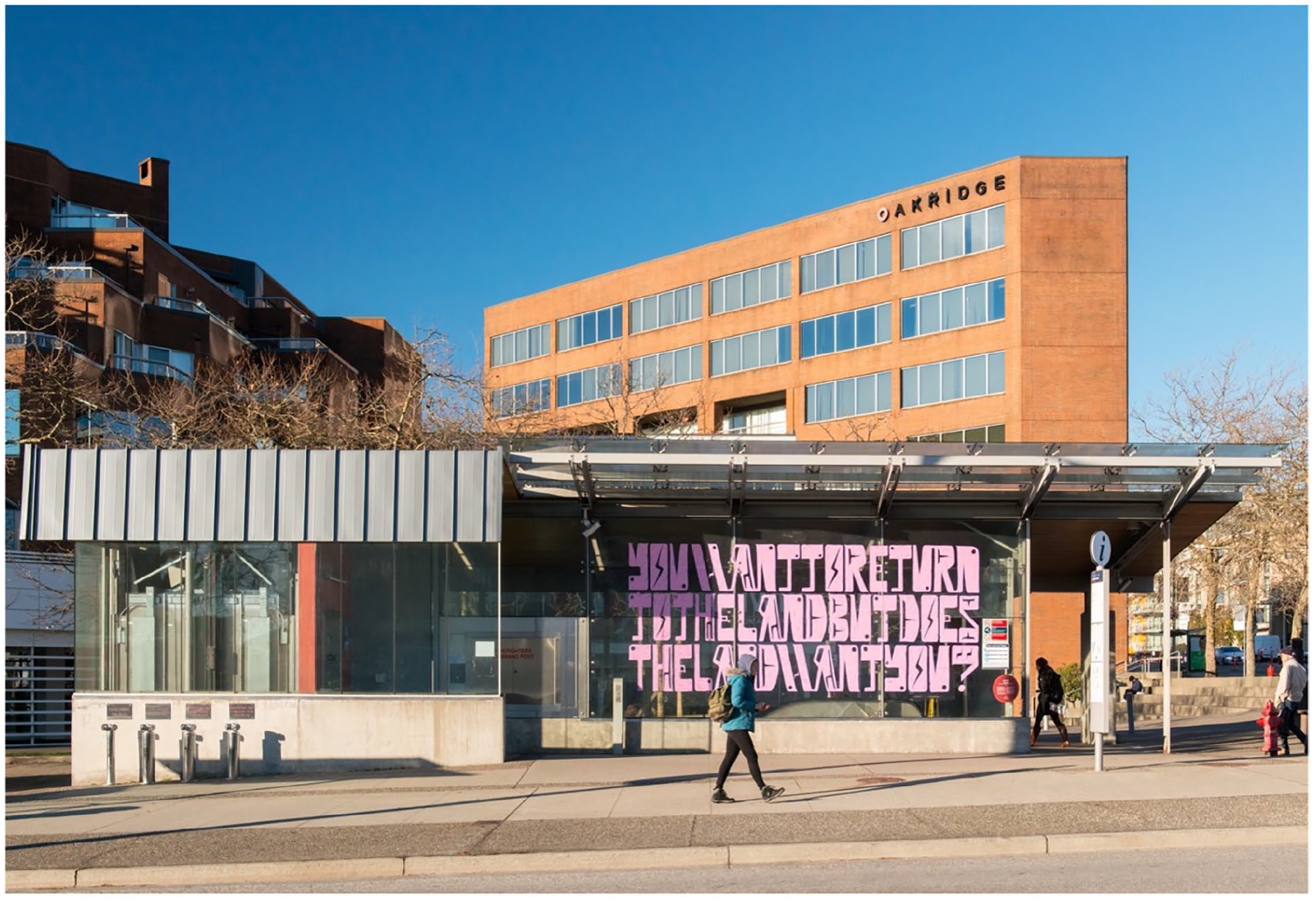
rewilding.
Whess’s statements raise difficult but important relational ethics questions to consider: Are we automatically wanted or unwanted by the lands we inhabit? What are our responsibilities to the lands, and to the cultures and peoples that have sustained them for millennia? How can we relate in better ways? How does this work feel in our bodies? Whess’s work also calls attention to the ways public institutions have begun to formally recognize land through adopting land acknowledgements. In a recent op-ed, Cherokee Nation Citizen and Indigenous studies scholar Joseph Pierce (2022) troubles institutional commitments to land acknowledgements stating that without embodied action, they remain empty gestures: This is what settler institutions do not understand: Land does not require that you exist, but that you reciprocate the care it has given you. Land is not asking for acknowledgement. It is asking to be returned to itself. It is asking to be heard and cared for and attended to. It is asking to be free. (https://hyperallergic.com/769024/your-land-acknowledgment-is-not-enough/)
While Whess Harman visited an art teacher education class, Jocelyne Robinson, 11 a member of the Algonquin Timiskaming First Nation in Abitibi region of Quebec, visited a graduate class in arts education focused on a/r/tography. Robinson (2015, 2019) came to share her dissertation research that spanned Indigenous storytelling (Archibald, 2008) and a/r/tography (Springgay et al., 2008), detailing perspectives gathered from three Indigenous and three non-Indigenous scientists as well as three Elders from her community, as she created a dynamic learning framework that brought together Indigenous and Western science, elevating ecological concerns. Robinson shared stories of her relations with Elders across her lifetime. This intergenerational respect is grounded in honor, respect, and love for the Elders in her community. It was in this context 12 that she created her dissertation research, a study that embraced scholarly and artistic practices as she explored Indigenous and Western scientific knowledge systems.
Braiding Indigenous storywork (Archibald, 2008) with a/r/tography (Irwin & Springgay, 2008), Robinson’s dissertation research was called the Algonquin Ekwânamo Matrix Project (AEMP) and while a number of themes were developed, one stands out for our discussion here on embodied reflexivity and relational ethics through the flesh. The AEMP drew upon the metaphor of breath, or as she called it, “subtle energies” (Robinson, 2019, p. 3), that transforms across time to weave through and with physical, emotional, and spiritual ways of being. Stories detail this and other metaphors, expanding our ways of coming into knowing and being as embodied humans living with ecology, and with a living-breathing Mother Earth. Breathing the air that we all breathe as humans is essential to all more-than-human life. It spans all. Appreciating this holistic perspective pervades her work and underscores a relational ethics that is essential to Indigenous storytelling (Archibald, 2008) as well as a/r/tography (Springgay et al., 2008). For her, learning in a good way “means different things in different contexts; however, it most importantly refers to learning with an ethical responsibility for all that is living” (Robinson, 2019, p. 2). Stories and art became complementary ways of learning that reach across both methodologies in fair and evocative ways.
Sharing the essence of her work was important to the students as several were Indigenous students and several more were including Indigenous principles in their work. Many were committed to decolonizing their teaching and learning practices, always sharing the importance of Indigenous epistemologies and ontologies. Learning about the intertwining of Indigenous storywork and a/r/tography opened up pathways to conceptualizing their projects for the course, and possibly further into their programs. While her dissertation research was inspiring, her recent artistic inquiries laid the groundwork for further explorations with students. Working with textiles and alternative forms of materials, Robinson creates fashion items that help her to transform her understanding of her social environment. She describes her work as studying the tensions between the natural world and the world of humans, while pursuing artistic forms that metaphorically create an evocative engagement with the aesthetics of space and place, urging all of us to embrace the beauty that abounds around us, despite the fragmented histories and memories that reside in each place. For a recent art exhibition, she posed the following questions: Are we prepared to jettison the baggage of ego and consequence to make space for the beauty of who we are in relation to all the exists? Who constructs, transforms, addresses the world becomes an inquiry about “all my Relations.” (Robinson, n.d., n.p.)
These are essential questions as we seek to decolonialize our teaching and learning practices as artists, scholars, and educators.
Grounding Ourselves in Connection and Living Alongside
It feels like a relational ethics through the flesh comes down to caring for ourselves and one another in ways that also care for everything that contributes to our well-being . . . all of which comes from the land. And that needs to be at the center of our caring. Love, as an action, as a verb, is the only way to manifest this caring. And if our students are not in tune with the ways in which they are connected and interconnected and in relationship with the Earth itself, then they will not be able to model that care for their own students.
To invite those passionate souls who make art into the classroom to share their thoughts and practices with the land to future teachers seems to be a great act of love and an enactment of relational ethics through the flesh. Jocelyne Robinson’s relationship with the land is a powerful metaphor for all human and ecological relations with one another. She conveys a deep sense of connection that holds a particular kind of reverence that is inherently embodied and ethical in nature. While change is inevitable, it is the need for stories through dreams, songs, and myths that carry us along to a place of learning with the land. The emergence of relational ethics is tied to these stories, to our own living inquiries of coming to learn alongside and to be with other living entities.
Whess Harman’s willingness to be honest, open, and even vulnerable in sharing their struggles with their work, and the tensions that can present in their work–life balance offered clear evidence of embodied reflexivity and relational ethics. They showed us what hooks (2001) means when she says, “to live our lives based on the principles of a love ethic (showing care, respect, knowledge, integrity, and the will to cooperate), we have to have courage” (p. 101). This courage to decolonize, to love and teach in anti-colonial ways, remains a challenge within higher art education contexts. In Unsettling the University, Sharon Stein (2022) argues that engagements in decolonial critiques and decolonial learning are often misunderstood or misused: . . . pre-existing intellectual scaffolding is not in place that would support rigorous, reflexive decolonial inquiry . . . many of us lack the capacities to hold space for the affective difficulties and discomforts inevitably involved in facing the depth, complexity, and magnitude of problems that have no immediate, feel-good solutions. (p. 6)
We believe that the creation of artist-in-residencies with those who share their relational practices and stories is one of the ways in which we may develop the stamina and courage required in our teaching, making, and learning toward the development of an anti-colonial future in art education. It is also a way in which students may learn about and engage in relational ethics through the flesh—a process grounded through the body, in relationship with the land, and driven by eros, love. We will give the last words here to hooks (2001): . . . there is an animating principle in the self—a life force (some call it soul) that when nurtured enhances our capacity to be more fully self-actualized and able to engage in communion with the world around us. To begin by always thinking of love as an action rather than a feeling is one way in which anyone using the word in this manner automatically assumes accountability and responsibility. (p. 13)
Footnotes
Declaration of Conflicting Interests
The author(s) declared no potential conflicts of interest with respect to the research, authorship, and/or publication of this article.
Funding
The author(s) disclosed receipt of the following financial support for the research, authorship, and/or publication of this article: The authors received financial support from the Social Sciences and Humanities Research Council of Canada, Insight Grant, ‘Retracing, Reimagining and Reconciling Our Roots’.
