




Abstract
This article interweaves recent personal, embodied, often deeply emotional events regarding kin and rivers and memory with reflections on how inquiry into such things summons up mixed and contested ancestors and the joyous, sometimes-painful, difficult task of working through such things in the art of writing.
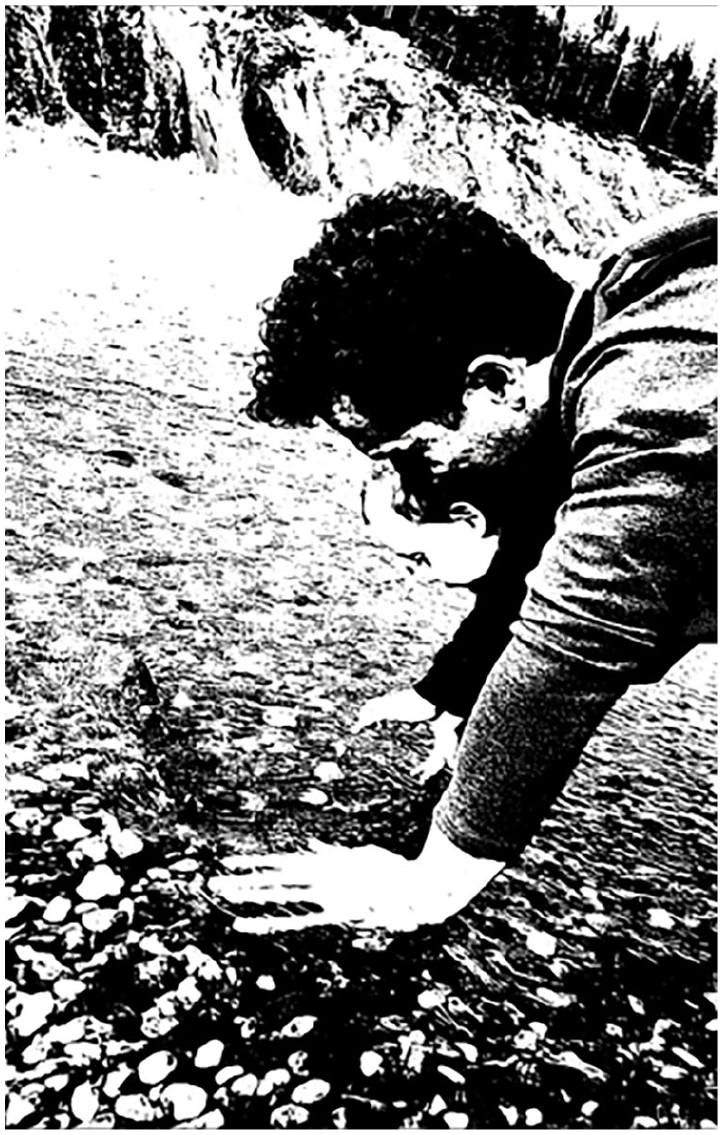
(photo, E. Jardine, used with permission) Let me introduce you to the waters You knew well and know Still. Still waters running. Water, wells and flows. Bent over ancient actions, father son. Water. Touched and touching. These two so near to me and my own Little-boy-asthma love of air, of water. These two arc an old act of rippling grace notes. Under fingers and palms and reach The water sings. Under freshed air. And pleasure. Hit by the cold glacial melt. Astounded. Ex-tonare—“to thunder out” (Online Etymological Dictionary, 2022, under “astound,” this reference to be read like a very old part of the very same family tree). —Ahh, cold! Laugh! Stand up! Laugh.
Inquiry, in this simple sort of work, sniffs out songlines (Chatwin, 1988) that are already well-strung well before we arrive—multiple, contested, ambiguous, intermingling. A photo sometimes, but only sometimes, becomes a singular plectrum up against sometimes taunt, sometimes slackened, strings, “interweaving and criss-crossing” (Wittgenstein, 1968, p. 32). And I cite these things here, in the midst of this moment so intimate, because they give voice, in the lineages of my raising and writing and study, to “kinship” (p. 36) and “family resemblance” (p. 33), instead of the older philosophical habits of sharp-edged, clear, unambiguous is or is not.
As you’ll see, too, things get tumultuously self-referential and reminiscent, having not only been turned a grandfather, but having them all move close by.
An echo up off the water surface: The bewildering abundance and recognizable resemblances of the world and its creatures (irresolvable to either of the extreme simplifications of identity or difference—Jean Piaget (1965, p. 6) noted Henri Bergson’s early 20th century “surprise at the disappearance of the problem of ‘kinds’ . . . in favor of the problem of ‘laws’”). Hans-Georg Gadamer’s (1989, p. 114) thoughts on “verisimilitude”—“likeness.” Not surprisingly, there is a “kindness” [here] at the heart . . . (D. Jardine, 2012, p. 224)
Looking for kindness. Again, . . . that anciently perceived likeness between all creatures and the earth of which they are made. (Berry, 1983, p. 76)
A look-see into how I carry kinship and affection for more than those two over the river, who have helped me sing over my nearer-by loves. They start a quiet gathering around that photo’s heartstrings.
Adumbrations. And Jodi whispering to me and to him and to his, a little, remembered help-quell, “hush, child . . .” (Latremouille, 2014, p. 31). I want to get the page exact so that the trail has a small mark for you, reading. For me, remembering and honoring.
And the dark arcs over Elbow River water. A single photograph can sometimes make rise up great nightmares of water, of plastic vortexes and swirls, of guilt.
Of sorrow over my son and grandson’s hands feeling the still-fresh.
North Atlantic Right Whales disappearing right there not-so-very-hid in the Hymnal singsongs of a nearby river:
eubalaena glacialis
oh sorrow
only with you do we matter. (Seidel, 2014, p. 111)
Pang: Any beautiful thing has a radiant elegance about it which . . . points beyond itself and drives us to look for further elegant unities in other things. (Dawson, 1998, p. xxvi)
It’s beauty, its ugly reminder, that a beautiful thing “attract the longing of love to it. [It] disposes people in its favor immediately. The beautiful . . . has its own radiance” (Gadamer, 1989, p. 481). This ghastly ecological countenance welled up in that boy’s eyes bent over hidden joy-sorrow. His boy’s too.
Stop. Gathering. Take a breath. This is how this work works. A simple picture, a deeply intimate portrait, but then come cluster the things I’ve read or written myself, the voices I’ve heard and recall, the stories, the dreams and nightmares, both. The ones that come to mind in the water chill hit of son and grandson in the river nearby. Ecological reminders of how art works, how beauty works: Only beauty can save the planet. Even the strongest combination of guilty feelings, economic reasoning, and scientific evidence are not enough to turn the tide so that our planet’s life may continue. Nevertheless, if you love something, you want it to stay around and stay close, and keep radiantly well. And it is precisely beauty that makes you fall in love. [It] gives you the feeling that what is here is to be treasured and not misused or harmed, and certainly not to be regarded in terms of functional usefulness or economic return, for such is to look at the world as a slave or a whore. (Hillman, 2006, p. 192)
My own age wells up, my own measure of summers left to me, this, too, a familial matter full of far too many stories to count—personal commiserations, poems of poise and laceration, scholarly mediations, and tear and tear beckons over what I know full well, that this summer is far more likely my last than any summer has been.
In these “ecologically sorrowful times” (D. Jardine, 2015, p. xv), what, pray, am I waiting for? I’m waiting for this: “Where you are is a place to practice” (Tsong-kha-pa, 2004, p. 191). And especially, for the tough, ongoing work of inquiry that helps keep me out of the mire of self-indulgence, keeps me seeking links through written breath in traces of ancestors, wisdoms, and cautions, into the arts of the image and the arts of writing. My work is deeply biased in favor of maintaining a glimpse of dependent co-arising, despite its howls of emptiness and finitude: Oh, emptiness, tell me about your nature Maybe I’ve been getting you wrong. (Lenker, 2020)
“Texts are instructions for practice” (Tsong-kha-pa, 2000, p. 52). Well, they can be if you watch for this. Shun those other texts that prattle and skitter and distract. Seek out what instructs on stilling, on beauty. Learn to read this way, to read for this. My work is deeply cut on this bias of things, of these boys, this water, being my own flesh, as is the echo of the water off the far cliff, my ear whorls being proof enough.
So, the quality of this sort of inquiry: to take rest and comfort and pleasure in this eco-ecstatic feel of being outlived, outdone, outstripped, where the play outplays the player (Gadamer, 1989, p. 106) over and over again. This be a strange freedom, a strange affection.
Something awakens me, catches my eye or ear or skin, and then the question of what befits this something can follow—an old Aristotelean mensuratio ad rem, in the measure of the thing. This is why Gadamer (1989) railed in such detail against “the subjectivization of aesthetics” (pp. 42–100) that he had inherited, because it short-circuits the experience of being summoned and drawn out and thrown into question, for example, that photograph possessed. It short-circuits how his hermeneutics places aesthetics at the heart of any venture bent on coming to understand: Does one have to choose one’s own standpoint and firmly hold to it? No, one must seek out the point from which “it” best comes forth! The point is not one’s own standpoint. One makes oneself a laughingstock if in front of the artwork [in front of the river, the Raven, if one says what one otherwise could [have already said], that one is [. . .] standing at one’s own standpoint. If an artwork exercises its fascination, everything that has to do with one’s own meaning and own opining seems to disappear. (Gadamer, 2007b, p. 214)
Thus, a hidden second point: When we say about the artwork that to be an artwork “it” must come forth, then I think one would do better to compare it to nature, which lets the flower come forth. The work of art is precisely not a product that is finished when the artist’s work in it is done. (p. 214)
Regarding the work itself, then, this very writing (to use this nearby example that, if you happen to be still reading) is clearly and obviously not done when the writer’s work is done. What you are reading, just like that photograph, just like that song of Adrianne Lenker’s cited above, is not done with me and thus, it is necessarily likewise undone, unfinished, and open and susceptible to being read and re-read, open to being ignored, adored, scorned, dismissed, forgotten, found useful or trite. This sort of inquiry and writing deliberately attempts to keep this livewire open and vulnerable, because that is what it is—open and vulnerable—this father, grandfather, rivers, memory, entwining, love, sorrow, song, ancient new things: To use the hermeneutic adage, the world has become open to interpretation to exactly the extent that I am open to the interpretability of the world. And here is the great, seemingly paradoxical situation: “keeping ourselves open” and “keeping the world open” (Eliade, 1968, p. 139) are the same thing. As we become experienced, having cleaved with affection and made ourselves “roomier,” the world’s roominess can be experienced. (D. Jardine et al., 2008, p. 53, as cited in D. Jardine, 2016, p. 81) My heart is broken, Open. (Fields, 1990)
Thus, I am right at the center of this in practicing my own vulnerability to the interpretability of the world—what Buddhism would call my ability to experience the lines of dependent co-arising (pratityasamutpada) bristling around the simplest of things—but this center is not subjective in character. I myself get exploded outward into these lines of dependence and inquiry following these trails as my blood trails behind. When it works, I myself “break forth as if from a center” (Gadamer, 1989, p. 458). I can’t contain myself! That’s when I know it is working. That is when I know that I have to get to work and not just sail with abandon.
And if this starts to sound like easy, off the cuff, dimwitted, overly emotional ecological babbling, go read those passages in Truth and Method (1989) or The Great Treatise (2000) for all they are worth, for all they ask of you, and trace the dozens of penstroke colors of reading them and re-reading. This sort of work can have a lovely (or vaguely nauseating) poetic face full of lilts and swoops.
Watch out, though. A phrase just tossed out above has more teeth than expected, has more depth than I have the life to fully follow. Outplayed in this lovely, gentle pitch, hot potato now in your lap: It is necessary that a man should dwell with solicitude on, and cleave with affection to, the things which he wishes to remember. (Thomas Aquinas, paraphrasing the Ad Herennium, cited in Yates, 1974, p. 75)
Might you happen to be Catholic? Watch what happens, because this reminds me of Thomas King’s (2003) lovely pitch that I remember with affection: Take [this] story, for instance. Do with it what you will. Tell it to friends. Turn it into a television movie. Forget it. But don’t say in the years to come that you would have lived your life differently if only you had heard this story. You’ve heard it now. (p. 61)
See why I might want to have not forgotten it?
Then this: If one’s sight is clear and if one stays on and works well, one’s love gradually responses to the place as it really is, and one’s visions gradually imagine possibilities that are really in it. Vision, possibility, work, and life—all have changed by mutual correction. (Berry, 1983, p. 70)
And this: To know the world, we have to love it. (Berry, 2013, n.p.)
And I’m deliberately stringing them out this way because I don’t want to simply give you referential information that you can store. This sort of inquiry is bent on affecting those who come upon it, stimulating a sense of energeia rattling along these lines of song, multiple, interweaving, and criss-crossing.
This is another not-so-secret about this work. To do full justice to all this is a goal I have to give up. However, I am obligated, as a scholar and an inquirer into the quality of our shared and contested ancestries, to get the page number correct, to open readers to Yates’ extraordinary book and how Aquinas seems to nestle there, that tree, that species of winged flight that give me comfort, make me re-cite about you, reading: “Cultivate love for those who have gathered” (Tsong-kha-pa, 2000, p. 64). Pathways. Sidetrails. Cultivate love for a grandfathers’ heart grown warm, grown cold. One has to learn to pick one’s way and fail at it, too—this, too, eventually left in the hands of readers, in the hands of a future that is not especially certain or clear.
And with this sense of openheartedness, it makes better sense why Gadamer uses the language of play in stepping beyond subjectivization, to recover something of the commonplace aesthetic stirring: at the heart of coming to try to understand anything, work of art or otherwise, we sense that “something is [already] going on, (im Spiele ist), something is happening (sich abspielt)” (Gadamer, 1989, p. 104). We are called out (of the skin of our selves, our interior experiences), not just to play, but to find ourselves played, elaborated, changed by what I experience in this way.
Grandson rapt by the hose shower garden sun giggling. And him walk out there and eat the first peas right from the pods, that, too, an old story. We make sure to toss the pods in the compost afterward, part of the Spiel. When it works, the works’ artfulness works on me as much as I on it: [It] is an Ereignis—an event that “appropriates us” into itself. It jolts us, it knocks us over, and sets up a world of its own, into which we are drawn, as it were. (Gadamer, 2001, p. 71)
And, just to push Gadamer’s provocation the whole way, I find a delicious passage like this one, one that I adore but don’t yet quite adequately understand. It his abrupt portrait of the “the intimacy with which the work of art touches us”: Disclosed in a joyous and frightening shock . . . it . . . says to us “You must change your life!” (Gadamer, 2007a, p. 131) And yet, here we bend and stand. Riverbent waterplay, breathing all around, Its and his and his and now mine and Now words, the moist of your very own eye tripping over this very work to make a giggly stream that Might stop You Too.
This, then, another clue in inquiring in this manner. Not every photograph, not every tree, not every moment, and there is no method for making this happen, making something rise up and open up and flint and tear at my experience: I invoke the concept of energeia here [regarding “what truth, aletheia, or unconcealment, really means”], which has a special value. With this new conceptual word Aristotle was able to think a motion . . . something like life itself, like being aware, seeing, or thinking. All of these he called “pure energeia.” (Gadamer, 2007a, p. 213)
Energeia. Energy. And how my knees are buckling a bit reading this because of how much energy comes near one’s first birthday, how much loving exhaustion and sweet sleep deprivation and shared commiseration over such matters. Ordinary. Like life itself, like water bubbled up, still welling after decades.
In an alternate translation, Sheila Ross (2006) renders part of this passage of Gadamer’s as “something like aliveness itself” (p .108). And how this aliveness now includes boys and their boys and a river and Aristotle, musing. Statics and lightning hits and night-terror awakenings of an old man jolted over a baby’s living and dying.
Dead ordinary, all this. Stories of it are everywhere, the sky full of birds and singings. I write. Cultivating love best I can. Betraying myself in the process in ways I can’t even imagine alone. Composing this to compose myself in its presence. Yet another old Tsong-kha-pa idea: I compose this in order to condition my own mind. (Tsong-kha-pa, 2000, p. 111)
Settling down to take care of it settles me in its presence. And—surprise!—it seems that it is something I already knew long before I read him: There is something about such gathering that is deeply personal, deeply formative, deeply pedagogical. As I slowly gathered something of this place, it became clear that I was also somehow “gathering myself.” And as I gathered something of the compositions of this place, I, too, had to become composed in and by such gathering. And, with the help of cicadas, I did not simply remember this place. Of necessity, I remembered, too, something of what has become of me. A birding lesson: I become someone through what I know. (D. Jardine, 1998, p. 95)
The fact that I forgot this seems to be part of this work as well, remembering and forgetting—Gadamer suggests that this is how one’s self is composed and re-composed. In doing this work, one slowly becomes caught up in the quickening re-quickening of the world. It does something to you, this.
This, then, another clue: This sort of work links directly to a sort of whiling or “tarrying time” (Ross, 2006, p. 108; see D. Jardine, 2008; Ross & Jardine, 2009)—time-taking over experiencing, sitting waiting, studying, over words and reading and writing and re-writing. As one would do with a work of art, an old photo, an old song. You don’t just gobble it up and be done with it. You return. The multitude of the one’s gobbled up disappear from view.
Practice has helped me learn that the ones that beckon returning are the ones worthwhile. And this means that it takes its time, “beyond my wanting and doing” (Gadamer, 1989, p. xxvii), over and over again. Me re-reading Gadamer, Tsong-kha-pa, my own writing, even, here, in the face of these boys’ arrival. Re-reading in ways I could not have done, would not have done, had this not happened. We all know, too, that the better the book, the better the art, the more likely is re-turning. That likelihood is one of the nests of our affection for it.
That is why this got summoned: Cold bites. Elbow River. Vague memory of an old book (Jardine, 2000), an old photo taken under the tough old sun, of this father, young boy circa 1992.
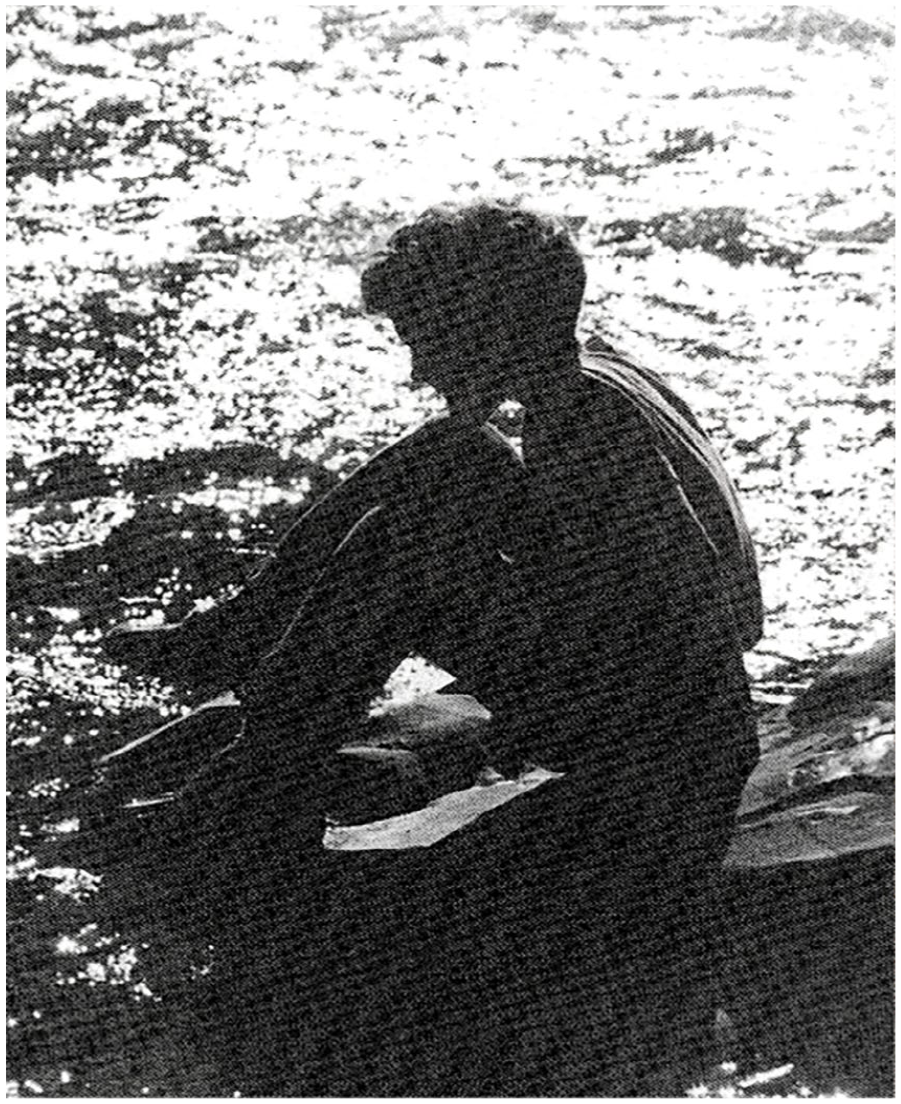
(there, in the midst of things his whole family listening). (Wallace, 1989, p. 11)
Of course the water is part of this well of midst, as is Bronwen’s long-gone breath. She’s sung in my ear 33 years and counting: to find it here, where it seems impossible that one life even matters. (Wallace, 1989, p. 112) It matters. But stop it. Stop.
I myself tossed shards of broken glass into this water memory. My boy and his and his lovely come back home. I can’t just revel.
So, then, this, too, for every father, every mother bereft of such returns, every child buried unmarked, writ right here on this unceded land and water whose name I do not know: . . . 215 unmarked graves near a former residential school near Kamloops, British Columbia (Paperny, 2021), reported on May 28, 2021, . . . . . . 182 unmarked graves of children discovered near Cranbrook, British Columbia (Migdal, 2021), reported on June 20, 2021, . . . . . . 751 unmarked graves on the Cowessess First Nation in Saskatchewan (Eneas, 2021), reported on June 25, 2021, . . . And these, now, of course, are already out of date [but leave the urls there even if they have disappeared . . . that, too, is a hint of something nearby]. Years and years ago, in a reference I can no longer trace, Canadian author Robertson Davies said something like this, that becoming educated means becomes haunted by more ghosts. This, of course, is good news and bad news. Composing oneself is always haunting. Stuffed toys are lined up along the Tsuutʼina Nation fence nearby. Thought and Memory. “Everything is teaching you. Isn’t this so? Can you just get up and walk away so easily now?” (Chah, 2004, p. 5). (D. Jardine, 2022, p. 4)
Bloody, meager start, how that river now clouds red, now clouds tears spent and tears in fabrics. I have to beg forgiveness for enjoying this newly arrived photo oh so much, given recent events, breaking forth in every direction, Kamloops, Uvalde, of children not returning and me so exhilarated over Elbow River photos and returns: And I have to let myself enjoy this more than I might have ever imagined, given those very same recent events. This and writing are all I’ve got, a meagre, little, quiet witness, useless, inadequate in a surround where there is no adequacy. (D. Jardine, 2021) I’m gonna shine out in the wild kindness And hold the world to its word. (Berman, 1998) Crouched in the same river always the same river twice. Cradled right here, waters he knew well and knows. Welled up. Still. Hold the world do its word! Pick a pea! All we can do is try to speak it, try to say it, try to save it. Look, we say, this land is where your mother lived and where your daughter will live. This is your sister’s country. You lived there as a child, boy or girl, you lived there. Have you forgotten? All the children are wild. You lived in the wild country. (LeGuin, 1989, p. 47)
Footnotes
Declaration of Conflicting Interests
The author(s) declared no potential conflicts of interest with respect to the research, authorship, and/or publication of this article.
Funding
The author(s) received no financial support for the research, authorship, and/or publication of this article.
