




Abstract
In 1994, Denzin and Lincoln suggested an immediate future for qualitative research, very akin to collage. This article begins by examining a seminal early collage work by Kurt Schwitters and ends with an example of the author’s own meta-collage as a means of exploring the model as both a “borderlands epistemology,” an art form, and a research practice. Claims for collage’s potential for rich data collection plus iterative, inclusive, critical practice are made, as with that of bringing the “unthought known” using synecdoche and serendipity to the surface, championing arts-based, “And” methods.
In 1994, in the first edition of their Qualitative Research Handbook, Denzin and Lincoln suggested an immediate future for qualitative research that is very akin to collage. They anticipated that “messy, uncertain, multivoiced texts, cultural criticism, and new experimental works will become more common, as will reflexive forms of fieldwork, analysis, and intertextual representation” (Denzin & Lincoln, 1994, p. 15). Notwithstanding the increasing neoliberalization and corporatization of the academy (espousing quantity over quality and limiting creativity; Fasenfest, 2021), this prediction has been realized in innovations of method and methodology, and attempts to carry out research that meaningfully interrogates the practices of researchers themselves (Denzin & Giardina, 2016; Lenton et al., 2021).
Collage, a versatile art form that accommodates multiple texts and visuals in a single work, has been proposed as a model for a borderlands epistemology: one that values multiple distinctive understandings and that deliberately incorporates nondominant modes of knowing, such as visual arts. As such, collage is particularly suited to a feminist, postmodern, postcolonial inquiry, one that values multiple distinctive understandings generated by different cultures and that deliberately incorporates nondominant modes of knowing and knowledge systems. Not an “or” method, but an “and.”
By this point in the twenty-first century, the fallacies in positivist reasoning have become evident. No one method reveals single “truth” and picturing what research might be has shifted considerably. “Working the ruins” or “traps” of former qualitative methodologies has inspired Elizabeth St. Pierre and others to think afresh into “post qualitative research” founded upon a “philosophy of immanence,” “concerned not with what is but what is not yet, to come” (St. Pierre, 2019). Similarly reaching beyond the boundaries of conventional methods, the creative and the scholarly have increasingly come to be regarded as one and the same (Krauth & Nash, 2019), including in terms of research. In fact, in the sense that “truth” is as messy as artists suggest (multiple, partial, context dependent, and contingent), one could argue that only multimodal research can do justice to truth’s complexities.
Arts-based methods refer to “any social research or human inquiry that adapts the tenets of the creative arts as a part of the methodology” (Jones & Leavy, 2014, p. 1) and can be used in different phases of research: as methods for data collection, in analytical processes, and in interpretation and wider dissemination of research outcomes as communicative or aesthetic elements. In their critical collection, Seppälä et al. (2021) suggest that arts-based methods can contribute to decolonizing the processes and practices of participatory research by challenging hierarchies, fostering pluralism, increasing multivocality, and facilitating dialogue in research. For Natalie Loveless, arts-based research practices are more vital than ever in the current ideologically compromised climate as they offer “modes of sensuous, aesthetic attunement, and work as a conduit to focus attention, elicit public discourse, and shape cultural imaginaries” (Loveless, 2019, p. 17).
Founded on the principle of “images of thought” (Deleuze, 1968/1994) and thinking-with collage, this essay begins by examining a seminal early collage work of art and ends with a critical account of an example of the author’s own meta-collage as a means of exploring the model of collage-making as both an art form and a research practice. Claims for collage’s potential for rich data generation and collection, plus situated, iterative, critical practice with inclusive, interdisciplinary cultural critique are made, as with that of “thinking synecdochally” 1 (Dalke & McCormack, 2007) and bringing the “unthought known” (Bollas, 1987) using metaphor to the surface for our research.
Collage as an Art Form
Rosa Cran claims that “Collage is about encounters. It is about bringing ideas into conversation with one another . . . it is multidimensional and interdisciplinary: artistic systems of order.” That order is not just an illustration, visual list, or patchwork, but arranged by “some intuitive grasp of how the world might be put together”; what the Russian artist Malevich called “an intuitive self-definition of the artist among objects.” Cran points out that collage not only “declares the continuity of realms, it also declares the contiguity of realms, and carries the implication of life beyond art” (Cran, 2017, pp. 4–5).
Reflecting on the origins of collage, the Spanish artist Picasso commented that he and Braque had been seeking a form of representation that enabled in the viewer a trompe l’esprit—a kind of ontological strangeness—instead of the more familiar, painterly trompe l’oeil. As Picasso expressed it, in collage the displaced object has entered a universe for which it was not made and where it retains, in a measure, its strangeness. And this strangeness was what we wanted to make people think about because we were quite aware that the world was becoming very strange and not exactly reassuring. (Cited in Brockelman, 2001, pp. 117–118)
As Kathleen Vaughn (2005) puts it, “Here are the foundations of a critical practice, inchoate” (p. 31). Picasso was questioning the very meaning of representation. There are correlations, too, with the “strangeness” of research inquiry and publication, and how often its fixed and formulaic processes are “not exactly reassuring” to researchers themselves.
German artist Kurt Schwitters’ Das UndBild [The And-Picture] of 1919 can exemplify some of collage’s key characteristics and challenges for representational meaning and research potential (Figure 1). In Das UndBild, Schwitters explores how not necessarily what we see, from an unexpected and jumbled perspective of production/consumption/waste. Schwitters’ work constantly used the human association of his junk, its lost history, and transformation through choice and distribution. Using deliberately discarded or seemingly impoverished materials, Das UndBild offers a rich complexity of thinking about thinking and value.
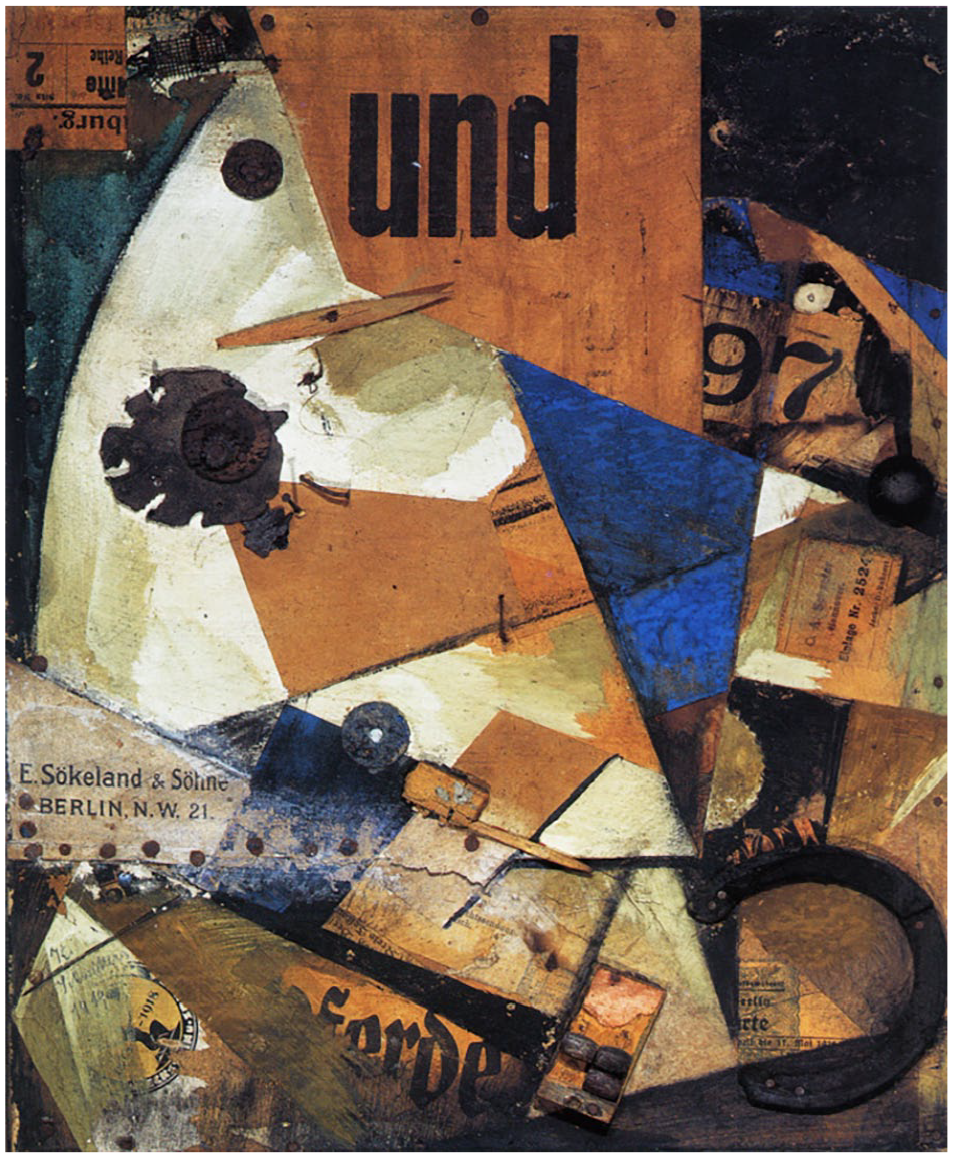
Das UndBild [The And-Picture].
In that collages use the Dadaist 2 tactic of mocking materialistic concerns, using the nonsensical and irrational as tonics for the relentless instrumentalization of what we purchase and consume, Nagel’s (1987) minute phenomenological study of Das UndBild shows how Schwitters’ “MERZ” 3 reveals an “encyclopaedic method of overlay or concurrency” through the component scraps of found paper [that] “stand on behalf of their original whole and complete selves.” He points out that when visual elements are distributed in such a way, they necessarily assume what Barthes would call an “atopic” existence; they cannot be pigeon-holed, centralized, or categorized into any particular single classification or hermeneutic system. In fact, the collage functions as a “double visual synecdoche” (Nagel, 1987, p. 354).
The first synecdoche is the title itself, where the Und is a part (in grammar) standing for the whole (artwork process). Humphreys (1985) argues that the wholeness of the synecdoche also transcends its own historicity, as by insisting on the relativity and equality of all his materials . . . (Schwitters) was directing attention away from possibly literary and political allusions and underlining the autonomy of aesthetic work in which particular objects lose their “essence” and are marshalled in the interests of “wholeness.” (p. 13)
For Schwitters, history itself was relative and iterative. After World War 1 (WW1), the world that he knew was in a state of collapse and his fractured time period was that of a second war, exile, migration, incarceration, with his continual struggle to make art. In Schwitters’ words, “Kaputt war sowieso alles, und es galt aus den Scherben Neues zu bauen.” [Everything was destroyed in any event, and what counted was to build something new out of those same fractured bits and pieces] (Gohr & Schwitters, 1985, p. 21).
Along the lower edge of Das UndBild, the word Pferde in Gothic print can be seen partially overpainted, with an actual horseshoe nailed to the surface to its right. The partial obscuring of the German word for “horses” allows for a second reading, “-erde,” which can mean “ground,” “world,” or “earth.” As a horseshoe mediates between the horse and the ground on which it stands, it becomes an earthing device; the second visual synecdoche. As mentioned earlier, Schwitters’ title (also found in the collage Das UndBild) is deliberately made up of lexical fragments: the size and typography of the “und” working like an invitation to the viewer, as if asking an unfinished question, “and . . . what on earth do you think?” Le Grange’s (2016) metaphor for a reconfigured sense of subjectivity suggests the subject of post qualitative research: Is not an atomised individual but is ecological; embedded in the material flows of the earth/cosmos, constitutive of these flows, making the subject imperceptible. [Research] . . . [is] not performed on the earth but bent by the earth. (p. 34)
Similar to the allusions to earth and a fragment itself, the “und” functions as the integral element within a work comprising fragments, playfully inviting the viewer to create verbal and visual links between an odd assortment of found objects and bits of text, constructed connections with pieces of discarded rubbish, text fragments, numbers, torn paper, colors, and textures assembled on a series of diagonal and curved planes. As part of the new century’s postmodern, material turn, Karen Barad and others have challenged researchers to question “How did language come to be more trustworthy than matter?” (Barad, 2003, p. 801). Schwitters’ use of actual nails are a concrete physical attempt to lay hold of and emphasize the corporeal aspect of phenomena; to let matter speak for itself. Yet the collage threatens at any moment to dematerialize along its outer edges, which themselves appear to be only thresholds rather than fixed, reliable frames.
Harold Rosenberg’s comment that “Schwitters’ finds are art intended ‘to cure human beings of the raging madness of genius’” (Rosenberg, 1972, p. 74) should remind scholars of the need to cure ourselves of the mistaken assumption that academic research searches for, or is desirous of, singular notions of “originality,” “genius,” or “truth.” If we are honest, many of the metaphoric or hermeneutic aspects of our research work remain endemically mobile and elusive. For Schwitters, each scrap he used became a working part of an entire social system. In this way, collage research practices reflect not only our commonplace findings, our messy indeterminate thinking, but also our unique, original flashes of insight: what every individual brings to their own research, in their own way, and what they make of it.
Dynamic Data Generation and Collection
Collage can feature in research as part of a layering of method, such as with participant interviews to produce richer, more insightful data. Monika Kostera’s (2006) “narrative collage,” where participants create fictional stories on a given topic, or Gerstenblatt’s (2013) “collage portraits” are then interpreted by the researcher, contrasting obvious readings with interpretive ones toward a narrative thematic analysis. They argue that collage offers the opportunity to move beyond the traditional research methods or outcomes of publication in a journal that participants may never read, to sharing the results of the inquiry and feeling an active part of the process from beginning to end, including developing their own artwork beyond the study.
Cordelia Freeman’s study of collage as a methodological framework in geography critiques triangulation as an outdated method to conceptualize multiple-methods research, proposing collage as an alternative, resisting the banality of coding and categorization or the “habitual reading of data” (Lather, 2013, p. 639) that characterizes much conventional research. Criticisms of this include that it could lead to theoretical weakness, or messy research. However, through what he calls the “craft attitude,” Sanscartier (2018) argues that researchers can navigate the “mess” that enters multiple-methods research. Sanscartier’s craft attitude is designed to adapt to changing research contexts, not least those of “synecdoche and surprise,” or what Dalke and McCormack (2007) see as the “serendipity” possible in transdisciplinary research.
If “the process of (literal, artistic) collage as inquiry is what helps researchers to make sense of their data, to synthesize it, and to further their analysis,” for them, “[t]he resulting visual juxtapositions frequently reveal new connections and understandings that have previously remained tacit.” The collage process makes our results “strange,” perhaps showing us associations that we had not expected . . . Thus, “collage forces us to think and work in a non-linear way in a jumble or a network; as with artistic collage the pieces are connected but sprawling” (Butler-Kisber & Poldma, 2010, pp. 3–4). Similarly, Freeman cites openness to spontaneity as an important strength of the collage method and argues that collage in fact “excels through its messiness” (Freeman, 2020, pp. 17–19).
Pointing out that collage lays bare how messy research actually is, namely, the scrabbling about and collection of data, the cutting, pasting, and reworking of literature and reference, yet researchers tending to feel pressured to hide gaps and messiness to “highlight neatly packaged findings,” she argues that collage as a methodological framework “necessitates a careful consideration of how the variety of information collected through research is presented. Indeed, it can be the overlaps and the blank areas that still remain that can provoke the most interesting critical reflections” (Freeman, 2020, p. 339). Collage involves celebrating these diverse fragments brought together in the research and the edges, messiness, and spaces in-between the fragments which are just as important as when the patches fit together neatly. Noting what certain methods cannot tell you can be as interesting as what they can. (Freeman, 2020, p. 335)
Collage can therefore be used not only literally, as data generation and collection, but also in its metaphorical or synecdochical sense, as a framework to analyze multiple method research around a broad and potentially shifting research area, or whole—piecing together several concurrent understandings—whichever may be most fruitful. Collage—by its process—is a layering of theoretical, artistic, and intersubjective knowledges.
Collage as Assemblage Arts Research Method
Collage practices also relate strongly to the posthumanist philosophical approach of assemblage theory or assemblage thinking; framing social complexity through exchangeability and connectivity. For example, philosopher Manuel DeLanda thinks with Delueze and Guattari’s theory of assemblages to analyze all entities through their components (also themselves assemblages) in a theory of heterogeneous “variable repetition” (DeLanda, 2006). New materialist Karen Barad reminds us that researchers cannot stand apart from the assemblages of their study and are embedded and implicated in what is produced, causing what she terms “agential cuts” (Barad, 2003). If one views the “doings” of assemblage as a research method it reminds us dryly that assemblage “doesn’t work” (as a straightforward mechanism with all the cogs fitting together), which is precisely why “it works as a piece of art” (creating messy associations).
Assemblage thinking is increasingly employed in challenging “governmental desire to control and tame educational and research practices” (Sandvik, 2010) and decentering the (adult) researcher in research about and with children. This may be by using children’s drawings or other childhood material arts practices to “open up new understandings” (Sackett, 2021) or viewing agency as assemblage (Garlen et al., 2022), raising questions about the meaning of childhood itself. Over 40 years of working with children using collage, I have observed, like Sandvik, “hooking up on the energies, intensities and speed in an assemblage can then be a research strategy to explore an alienation from our usual expectations.” Sandvik goes on, Being a part of a research assemblage, a researcher has to let go of his/her desire to control and conduct the whole process from above and outside the material. Instead, we acknowledge the performative agencies of the material, be this field notes, video tapes, photographs or whatever irrelevant elements (as for example paintings) are included in the assemblage. Simultaneously researchers still have to critically investigate the various power productions in research processes (Larsen, 2007) and to construct research that works in decolonizing ways. (Andersen, 2005; Otterstad, 2007, cited in Sandvik, 2010, p. 37)
Inclusivity and Interdisciplinarity
Brockelman (2001) links collage to a postmodern knowledge system rooted in paradox. His description of the epistemic contradictions of collage is as follows: Collage practices—the gathering of materials from different worlds into a single composition demanding a geometrically multiplying double reading of each element—call attention to the irreducible heterogeneity of the “postmodern condition.” But, insofar as it does bind these elements, as elements, within a kind of unifying field . . . the practice of collage also resists the romanticism of pure difference. . . . Collage depends upon a new kind of relationship between these two shards of the traditional concept of worldhood—and, as a result, it promises a new sense of truth and experience, potentially revolutionizing both epistemology and aesthetics. (pp. 10–11, emphasis in original)
Collage thus proposes a provisional, postcolonial view of our worlds and the representations we offer of them, also invoking an interdisciplinarity in its juxtapositions representing “the intersection of multiple discourses” (Brockelman, 2001, p. 2). Thus, collage—with its overlappings, juxtapositions, and shifting centers and margins—can be seen as a transborder practice with epistemological implications: “The borders here are not really fixed. Our minds must be as ready to move as capital is, to trace its paths and to imagine alternative destinations” (Mohanty, 2003, p. 251). As with new materialist approaches, the binaries between natural and human sciences become blurred and demands interdisciplinary rethinking, as do the binaries of language and material chosen and used for research (St. Pierre, 2019).
Bearing in mind that written and spoken versions of English, whose use in colonized cultures tended to exclude local, primarily oral, Creole languages, Kathleen Vaughn suggests that collage’s interdisciplinary practice is “like a Creole, bursting with hybrid vigor, asking questions rather than making statements” (Vaughn, 2005, p. 42). Similar to metaphor, collage glues/pastes/places or maps several ideas together. Take the idea of “contagion”: in one respect associated with medicalized disease, another historical plagues, another literary, with Hamlet imagining graveyards breathing “contagion to this world” and so on, ever-changing in setting, language, and frame. Kathleen Stewart’s poetic critical thinking reads “ordinary affects” in “forms of persuasion, contagion, and compulsion, in modes of attention, attachment, and agency” (Stewart, 2007, p. 2), similar to those of the researcher, novice or not.
Collage can address complex intersections, work simultaneously with varied data, allow for contradictions, and reconfigure knowledges and norms. Dennis Summers’ (2016) collection exploring the use of collage in Science begins with the categories of the gap, the seam, and contested space, which characterize the unique aesthetics of collage, which he sees as a robust and flexible tool for visualizing knowledge. For Charles Garoian and Yvonne Gaudelius, Instead of a totalizing body of knowledge, the composition of collage consists of a heterogeneous field of coexisting and contesting images and ideas. Its cognitive dissociation provides the perspectival multiplicity necessary for critical engagement. Dialectical tension occurs within the silent, in-between spaces of collage, as it’s fragments, its signifying images and ideas interact and oppose one another. Such complexity and contradictions represent the substance of creative cognition and cultural transformation. (Garoian & Gaudelius, 2008, p. 63)
Collage as Iterative Practice
If “all things, even physical objects such as desks and computers are in-becoming—rocks, human beings as well as systems of thought and language do not have fixity but are always changing” (Le Grange, 2018, p. 45), then methods “in-becoming” are required to represent nonrepresentational research, or as Tim Ingold puts it, “correspondences”; suggesting we might do better research by “answering them with interventions, questions, and responses of our own” (Ingold, 2015, p. vii).
Collage uses multiple, provisional, and interdependent products, as the components of a collagist inquiry aim above all to reveal the practice. The interdisciplinary work is embodied, not simply described, in each component. Part of a “methodology-to-come” (Lather, 2013, p. 635) and as a post-qualitative flat ontology that forms a nonhierarchical assemblage (of researcher, theory, and subject matter), visual collaging can be a circular methodology as they can be made (and be part of) any stage of a research project.
Collage can propose a methodology (particularly at the initial stages of the research process); not so much as a strategy to look for “solutions” to the research problem, as to uncover the problems themselves, suggestive of a “readiness” for emergent learning and knowing. Think of how Schwitter’s Das UndBild throws up the problems of representation, reliability, and readability, not to “solve” anything but knowingly as turmoil. One of the arguments for using such a visual method as collage is that we live in an increasingly tangled “ocularcentric” culture (Mitchell, 2011), and that visual images “encode an enormous amount of information in a single representation” and have the capacity to reveal “what is hidden . . . the taken-for-granted ‘reaching’ beyond and beneath common understanding” (Grady, 2004, p. 20).
What is iterative about the process is that collage has the capacity to act as a means to help conceptualize ideas (Roberts & Woods, 2018), while also the ability to both “shock and surprise” (Burge et al., 2016, p. 735). The practice encourages defamiliarizing and refamiliarizing one’s own and “given” concepts; in other words, thinking outside (our own) thinking. Collage creation allows the participant to engage physically and have agency in the process—they are conveyors of meaning in their own right—and can help in how research is searching for means to better express our stories (Roberts & Woods, 2018).
Collage as a Situated Practice of Cultural Critique
As arts-based educational theorist Finlay (2001) proposed, “the structures of collage simultaneously emphasize personal meanings, history, culture, and tradition in such a way as to bring disparate voices of the internal-personal and external-contextual to a common place” (Finlay, 2001, p. 17), giving the individual artifact a broader resonance. In this sense, curiosity is everything where we do not find our ground by looking for stability, but by relaxing into instability, and getting out of alignment with norms allows the mind to get back into alignment with itself. Similar to its antecedent fine arts form of expression, which incorporated bits and pieces from popular culture and everyday life, a collage methodology is linked to daily life. In this sense, it has aspects familiar to qualitative researchers from naturalistic inquiry: specific circumstances, particular experiences, and, given its arts grounding, individual creations.
Thinking with the way women saved and collected leftover bits and pieces and scraps, Schapiro and Myer’s 1977 term “femmage” encompassed decoupage, collage, photomontage, and assemblage. Defenders of “slow” early childhood pedagogies (e.g., Clark’s “Mosaic” approach 2017, and Tishman’s “Slow Looking,” 2018) have employed collage as visual, participatory research frameworks for listening to young children’s views and experiences, and as a means of enquiry and representation. This is political transformation through practice, as bell hooks (1995) has described it, where we “create space where there is unlimited access to pleasure and power of knowing” (hooks, 1995, p. 145).
Suzanne Culshaw’s method where individual participants placed (rather than stuck down) materials in a collage while interviewed, stimulated visual rather than linguistic thinking, and created metaphors that “stood for” experiences. By a method of impermanence and unpredictability, Culshaw could “maximize the serendipity” (Taleb, 2007, p. 204). Aware that arts-based and visual methods are increasingly positioned as “effective ways to address complex questions in social science” (Kara, 2015, p. 3), Culshaw (2019) employed an ontological position of constructivism, where social phenomena and their meanings are continually being constructed and revised and argues that the fractured nature of collage allowed participants to reflect on teaching as a “temporary fractured state” (p. 268). It allowed her—as a researcher—to empathize and revise her own view of struggling as “a set of complex interactions—with other people and objects in constant motion” (Culshaw, 2019, p. 280).
The “Unthought Known”—What Cannot Easily Be Spoken or Written
Psychoanalyst Christopher Bollas’s notion of the “unthought known” (1987) as manifestations of preverbal, unschematized early experiences that may determine behavior and understanding unconsciously, yet are barred to conscious thought or direct expression, is useful in relation to collage, and why they can be used therapeutically. The Surrealists saw collage as means to “lift the veil” of the unconscious as what was chosen and (perhaps irrationally) juxtaposed or reintegrated together were messages from, or poetic workings of, the unconscious mind, mirroring the construction of dreams. During the process of semi-randomly, semi-deliberately selecting and arranging a collage, overt thinking does not take place, so what emerges can often be as surprising to the maker as if something outside oneself made it. “I felt what I do not yet know how to place into language. Art, Camille Turner (2019) contends, is a way to say the unsayable” (Turner in Springgay, 2020).
Supporting this suggestion, in her research study involving collage, Culshaw (2019) notes that participants included emotive elements (such as metaphors of drowning) in their visual collages that they did not refer to verbally in interview at all, suggesting that collage creation offered participants an entirely different language through which to make sense of their experience and feelings (Bailey & Van Harken, 2014). These elements unlock the potential for qualitative research to introduce variation that would otherwise remain fixed, captured by (neurotypical) norms, or hidden; Erin Manning’s “minor gesture” (2016) that can transform the field of relations.
Choosing an old Stingray 4 annual for the background pages of my collage, it similarly did not occur to me why I had chosen a page of underwater deep-sea images to manipulate. Placing articles (in the object sense) together (as well as the synecdochical title, The And Article, where the writing of an article argues for an “and” process) (Figure 2), the fish become swimming dictionaries or spout academic text, modeling where the making process can make use of playful serendipity, suggestive of attempting to “swim” through information and research and being “out of my depth.” On some unconscious level, the underwater setting doubtless informed my choice of other images: the path at the seashore, for example. Given collage is metaphorically “pathfinding in the making” (Manning & Massumi, 2013, n.p.), I wanted to indicate the research process as one of blurred borders and uncertain boundaries, a sand painting becoming lines of the road, a tarmac road cut short into a winding path at the seashore, the edges of the collage frayed, the frame incomplete. The frame is an important aspect of collage in the sense of whether or not to leave off the work at its edges.
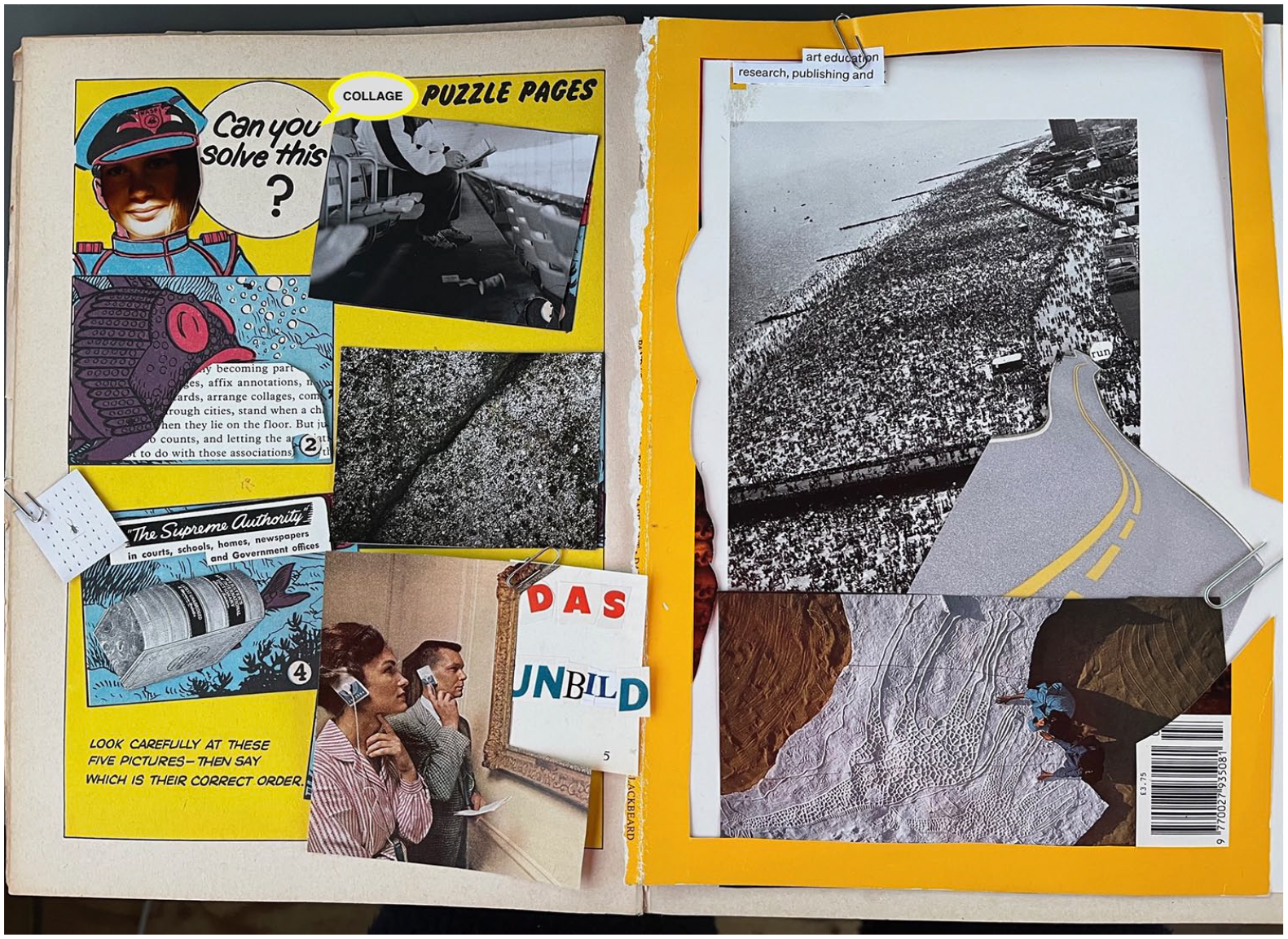
Author’s collage Der Und Artikel [The And Article].
Bollas’ “unthought known” evokes a psychological heuristic exercise known as “the Johari window” (1955). 5 This imagines a person with four rooms or faces: “open” (known known), “hidden” (known unknown), “blind” (unknown known), and “unknown” (unknown unknown); a concept that has been picked up in project management and strategic planning. In my collage, there are “unknown knowns” (sketchy brainstorming), “known knowns” (the analogies of the puzzle for the brain, paths for the journey of study), there are “known unknowns” (building questions toward a hypothesis linking arts practice to research—as yet an incomplete theorem), and the absolute “unknown unknowns” of unchartered research exploration that has no examples for the researcher to lean/learn on. As with transdisciplinary knowledge, these processes add up to the journey of realizing what the connections might be.
Collage reveals that there is more than what is known (Figure 3). What is experienced in the material every day, such as my use of paperclips to attach scraps of text and image, harks back to paperclip’s original use in institutional, educational contexts, and still today as the standard image/icon for an attachment in an email. But collage also exposes what is felt. The “feltness” of collage can create conditions of relationality, reciprocity, critical reflexivity deeply embedded and entwined, as in Springgay’s “doings of research” (2020), or the practice of research-creation. My paperclipped image of insects pinned in orderly rows points to the tendency for rigid classification and category in our current metrics culture, both of which I have written about critically in recent years (e.g., in de Rijke et al., 2021).
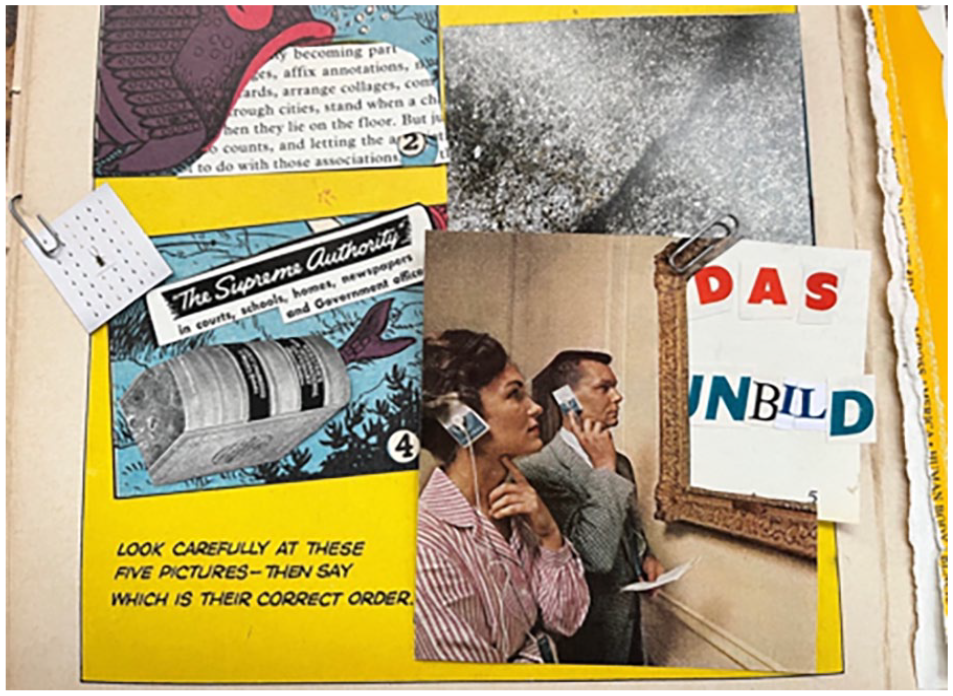
Paperclipped Fragments and Reference to Das UndBild.
Citing Alice Walker’s essay on first going to Cuba, Patti Lather described such new understandings in the form of pastiche or collage of fragments of multiple voices and mixed genres that is “neither definitive nor complete” (Lather, 1991, p. 28); a process that allows Walker to reflect on her “own perverted categorisation” (Walker, 1997, p. 212). My collage fragment of insects pinned in orderly rows raises similar questions about “policing the proper” (Maclure, 2003, p. 113) as regards method and data: how do we collect it, order it, and classify it? Are dubious ethical, colonial, Western, patriarchal tropes (some notion of a “Supreme Authority”) imposing a false order, sequence, or classification to its presentation? Is relying on checklists and guidelines a misguided attempt to ensure methodological rigor? My reference to Das UndBild as just a paperclipped title in a broken frame with viewers wearing audio-guides reveals the concerns I feel (and again have written about, for example, de Rijke & Sinker, 2015) about gallery audiences being told what to think about art. As Natalie Loveless asks, surely, “to do research—of any kind—is not simply to ask questions, it is to tell stories-that-matter” (Loveless, 2019, p. 54). Perhaps at the back of my mind was the worry all researchers have: I may have written about these things, but have they really been seen or felt?
No Fixed Conclusion
There are clearly countless other ways of thinking to positivist research. Indeed, if we are brave enough to admit it, perhaps very little is fixed or universal in research at all. If the arts “makes truth out the multiple” (Badiou, 2000, p. 22), then collage can offer multiple and holistic ontologies, where the knower and the known are interactive epistemologies. Not only are we now accepting artistic practice as the production of knowledge or philosophy in action, but arts-based methods can explore the agency of matter like no other research practice has before. It follows that “the fields of qualitative inquiry and qualitative research are themselves in transition, always in flux” (Denzin & Giardina, 2016, p. 7). With its potential for academic research culture-jamming and the opening up of transitional space, collage can accommodate that flux, resistant to the passive cultural politics of neoliberalism and its pervasive effects.
Collage embraces the inseparability of ethics, ontology, and knowledge; what Barad calls “ethico-onto-epistemology” (Barad, 2007, p. 409). It is an inclusive arts method, as it does not produce anxieties about being “good at” drawing or other artistic skills. In a new materialist or renewed materialist sense (as Coole and Frost, 2010, describe an ontology of matter as agential rather than inert), the work is visually messy, unframed, and post-presentational. Collage as research can be used by the researcher privately, for concept mapping or to reflect on one’s own process with critical reflexivity as researcher standpoint really does matter.
If a researcher is one who pieces together a close-knit set of practices that work toward a “solution” to a “problem,” then collage is already that process in our heads, if not on paper. Mirroring the processes of intuitive, somatic brain function, it is “relational soup” (Manning & Massumi, 2013), an associationist style of thinking, a possible (winding, inconclusive) path to knowledge, and a means for the researcher to put writer’s block aside and let the thinking process become lateral, visual, material, tactile, spatial.
As a kind of visual Creole or Patois, collage is also the art of the space between, or of crossing, boundaries; in its inclusion of diverse voices, it takes a necessarily plural approach, suggesting new models of representation and interpretation; a multiple mapping of one space or one schema onto another using the inclusivist function of “and.” This is particularly vital if we are indeed at the edge of “a new colonialism, a new era, one that we did not fully choose” (Denzin & Lincoln, 2018, p. 927) as we are in dire need of methodologies-in-becoming that offer us futures without closure to qualitative research. Sensemaking as we go, these are not safe spaces but brave spaces.
Operating through its connection and interrelations in which the part represents the whole, the potential of collage for thinking synecdochically in reciprocal loops makes possible nuanced appreciation of where research emphasis actually lies, at the heart of the researcher’s multimodal understanding. Through its interruptions of temporal, visual, and semantic continuity, collage agitates the eye and mind as well as the fixed politics of research method and methodology, provoking surprising encounters for the researcher and the research process.
We can be confident by now that qualitative research methods can learn from arts-based critical, cultural practice in strikingly imaginative and innovative ways. Challenging what we think of as distinctions between method (tools and techniques) and methodology (analysis of them) through the entanglement of art-in-process with research-in-process, the Und/And of collage could be the very thing for opening up qualitative inquiry as creatively as we dare.
Footnotes
Declaration of Conflicting Interests
The author(s) declared no potential conflicts of interest with respect to the research, authorship, and/or publication of this article.
Funding
The author(s) received no financial support for the research, authorship, and/or publication of this article.
