




Abstract
With a pedagogical aim, we offer an overview of some, though certainly not all, of the potential initial framing considerations in forced displacement research. We then engage with several of the key terms currently in use by international agencies before discussing how those terms can be (re)interpreted as they are taken up in transnational contexts. In attending to the ethics of naming throughout, we suggest that terms developed by international policy bodies should be approached situationally in disasters as part of humanitarian aid. Just as document-specific definitions need not go beyond the document, situation-specific terms should not become oppressive labels that have the potential to stigmatize people for the rest of their lives. Thus, we caution against assigning such terms as fixed identity categories, as they have the potential to reduce a person to a situation in which they may have once found themselves.
Keywords
Introduction
The continued rise in forced displacement globally calls for an urgent re-engagement with practice. The United Nations High Commissioner for Refugees (UNHCR, 2022b) currently estimates that 82.4 million persons already have been forcibly displaced across the globe. Over the next 30 years—due to interrelated intensifications in climate change, ecological degradation, natural disasters, economic shocks, conflict, and risks and insecurities involving food and water—the Institute for Economics and Peace (2021) expects that the number of people who have been displaced will rise to 1.2 billion worldwide. The rates of displacement are accelerating, and quickly at that. In 2000, one in 161 persons had been displaced globally; in 2020, it was one in 94; and by 2050, it may be one in 12. A range of responses (and responders) will continue to be needed. In addition, amid the exigency and velocity of these challenges, it will be important to attend to ethics throughout. For myriad reasons, the challenges involved in forced displacement are highly complex, and it can be helpful to develop an understanding of the challenges before attempting to respond.
We offer this article as a gesture toward better understanding vocabularies within forced displacement so as to facilitate conversations and deliberations in policy, practice, and research. We hope this article provides an initial entry into contemporary matters in, and vocabularies of, forced displacement for those who may be interested in contributing to this body of work. Given that forced displacement studies are often transnational and transdisciplinary in scope, it can be challenging to enter into the many different conversations that are occurring in research all at once. Furthermore, in these multiple discussions regarding forced displacement, certain terms take on different meanings, depending upon the context. Thus, when contexts are not always made explicit, miscommunications around fundamental presuppositions can happen, sometimes without anyone even realizing that this has occurred. As scholars doing work within a particular area of study, we might believe we are all speaking the same language, when, in actuality, we are not.
For instance, in the field of migration studies, the term migration itself has undergone redefinition by some. Some contemporary scholars working in this field have rightly pointed out that the field includes among its concerns people who are unable to move from one nation to another and are therefore displaced internally. In some contexts, this has led to the redefinition of the term forced migration such that it includes those whose migratory movement is in some sense constrained. In this way, migration becomes a contranym. But, for readers who are aware of this expanded definition, what would happen when reading a contemporary piece of scholarship that used the term migration without explicit definition? Should readers suppose the expanded, contranymic definition of migration, or should readers suppose a definition that only involves those who are able to move, for example, from one nation to another? Moreover, what qualifies as movement in these contexts, and are nations the primary unit of governance to which migration scholars attend? Here, it becomes apparent how a lack context-specific definition can cause difficulty in evaluating claims being made in contemporary scholarly exchanges, for it is often unclear who means what. This can be especially troublesome if readers infer a meaning that is not only different from—but can literally be the exact opposite of—what was meant. To use another contranym as an example, if there were unanimous agreement to sanction something, there really would not be a consensus if some people voted for something to be disallowed, and other people voted for that same something to be allowed. To sanction can mean either.
So how, then, might we find a balance between maintaining epistemological openness and participating in scholarly conversations about policies and legislation that require communicative precision? For this, we suggest that applying a writing practice drawn from policy has potential. Policy documents authored by personnel at entities such as governmental and nongovernmental organizations, think tanks, and centers for research—which contribute to the gray literature (Paez, 2017)—tend to put forth document-specific definitions at the outset. We suggest that scholarship should do the same. We suggest that it should be scholarly practice to give document-specific definitions when various meanings for disciplinary terminologies exist, particularly within the realm of international and transnational policy research. This helps readers of scholarship to connect different pieces of the body of literature in a coherent way; not make connections where connections may not exist; and avoid equivocation. Accordingly, we turn to the gray literature in this paper not only as a data source, but as an underutilized genre of research writing. Other than putting forth document-specific definitions from the outset so as to be clear about which terms are in use and how those terms are being used, another hallmark of the gray literature involves the use of reader-friendly formatting in which main ideas are clearly organized, offset, and identifiable within the text. This is why the writing that follows may appear, at times, less in the form of a traditional scholarly article and more in the form of a policy overview report.
With a pedagogical aim, we offer an overview of some, though certainly not all, of the potential initial framing considerations in forced displacement research. We then engage with several of the key terms currently in use by international agencies before discussing how those terms can be (re)interpreted as they are taken up in transnational contexts. In attending to the ethics of naming throughout, we suggest that terms developed by international policy bodies should be approached situationally in disasters as part of humanitarian aid. Just as document-specific definitions need not go beyond the document, situation-specific terms should not become oppressive labels that have the potential to stigmatize people for the rest of their lives. Thus, we caution against assigning such terms as fixed identity categories, as they have the potential to reduce a person to a past situation.
Framing Forced Displacement Research
We begin with some initial considerations in contemporary forced displacement research (the main ideas of which are presented in italics below). In attempting to navigate through some of the definitional aspects of forced displacement here, we turn to language from agencies within the United Nations. In addition to the UNHCR (2005), we also turn to the International Migration Organization (IOM) and UN Human Rights Organization (UNRHO). The UN and its agencies tend to use carefully constructed language, some of which has been codified into international law (e.g., United Nations [UN], 1948; UNHCR, 1951/1967; United Nations Human Rights Office [UNHRO], 1954). While this work has been debated and may not reflect global consensus, the extent to which that could be achieved (on a planet that, at the time of this writing, is estimated to have nearly eight billion people) remains an open question. Nevertheless, many would suggest that initiatives led by UN agencies and, at times, the UN General Assembly itself, reflect some of the most collaborative, participatory, and widest reaching efforts to date. Moreover, the terms these organizations use can also offer more inclusivity—and more clarity—than some of the alternatives elsewhere. In drawing from international policy terms, then, the following considerations offer a few modest and interrelated framings for how we, as researchers and researcher-practitioners, might respond. Examples follow.
Why Shareable Vocabularies Are Needed
A Shareable Vocabulary Expedites the Delivery of, and Increases Access to, Disaster Assistance in Real-Time
In recognizing that disasters have the potential to require sudden and immediate decisions—some of which involve imminent matters of life and death—one way to prepare is by attempting to ensure a shared understanding of what is meant by relevant terms. This is part of what helps humanitarian workers to quickly and effectively provide assistance. Having access to a shareable vocabulary also helps people who have been forcibly displaced to identify, locate, and access the services they need. For people who may be searching online for assistance as disasters unfold, it is important to be able to find easily recognizable, translatable, and search engine optimized (SEO) terms. Given that disasters are time-sensitive and involve multiple moving pieces that may operate across different contexts, clarity is key. This is not to suggest, however, that clarity is an end in and of itself. It is not. Rather, clarity is a precursor to engagement, action, and access. Whether researchers are involved in the prevention, mitigation, preparedness, response, or recovery phase of disaster management, researchers should be mindful of the ways in which people potentially benefit from a shared understanding of terms.
A Shareable Vocabulary Shapes the Conceptual Landscape of Fields of Study
As mentioned above, there can be multiple meanings in migration studies with regard to the term migration itself. In migration studies, migration often entails movement, usually from one nation to another. Yet, migration can also involve moving from place to place internally within a nation, sometimes, though not always, under duress (Oh, 2019). There is internal displacement, too, in which, for various reasons, people cannot leave their immediate situation of having been forcibly displaced. Still, there are yet other conceptualizations of migration (including immigration, exile, diaspora, climate-induced migration, and more). As these examples show us, sometimes fundamental concerns of a field of study can expand beyond its own initial terminology. When this happens, (re)considering vocabularies can offer a way to not only (re)shape fields, but also the constraints and possibilities within them.
Forced Displacement
Forced Displacement Can Offer a More Inclusive Way to Think About Issues Related to What Had Initially Been Defined as Forced Migration
While movement may be the most salient term within migration studies, the concerns of migration studies are not limited to movement alone. People who do migration studies engage with issues that go beyond movement, for, as we have been indicating, not everyone who has been forcibly displaced will be able to migrate. There can be variables related to safety, food, water, shelter, money, transportation, ability, health, caregiving responsibilities, other family members and loved ones, general uncertainty, and the quality of the information that may or may not be available, among many other considerations. Consequently, in situations of forced displacement, some people will not be able to move from their situation (either yet or at all), while others will not be able to cross an internationally recognized border, even after what may be multiple attempts.
The processes, outcomes, and timelines involved in migration vary, often from person to person; migration does not tend to be a linear process with easily identifiable beginnings and endings. For instance, some people will become internally displaced or stateless and remain in place, whereas other people who have reached borders will experience refoulment, or forced return. Migration can also take great amounts of time, and openings in which to leave are not always immediately available. These experiences are often named in the literature as “migration failures,” a naming which seems to place the blame on individuals for not having been able to successfully secure refugee status, as if aspects of meritocracy were involved. We disagree with this phrasing, as “migration failure” shifts responsibility to individuals rather than to any of the multiple systems that have collectively failed and caused people to be forcibly displaced. In other words, it is not that forcibly displaced people have failed at migration, but that systems have failed those who have been forcibly displaced. With this in mind, displacement potentially offers a broader, more accurate, and more inclusive perspective on what can and also what cannot happen when people become forcibly displaced. In keeping with international policy language, therefore, we use the term forced displacement rather than forced migration here.
As such, we keep with the following IOM agency definition of forced displacement, in which forced displacement is defined as The movement of persons who have been forced or obliged to flee or to leave their homes or places of habitual residence, in particular as a result of or in order to avoid the effects of armed conflict, situations of generalized violence, violations of human rights or natural or human-made disaster. (International Organization for Migration [IOM], 2022, n.p.)
In these ways, just as forced displacement can come from disaster, forced displacement can be a form of disaster, too.
The Challenges of Forced Displacement are Complicated, Both With Respect to the Potential Contributing Factors and the Mixed Movements of People That Can Ensue
In other words, just as many people who are being forcibly displaced may attempt to cross some type of border, the challenges that create the conditions for forced displacement also have the potential to challenge the notion of borders themselves, whether they are thought to be conflict-induced (caused by humans), disaster-induced (caused by nature), or, more precisely, sometimes both. The effects of climate change, conflict zones, economic shocks, and natural disasters alike have the potential to extend beyond certain conceptual demarcations. Hurricanes, typhoons, and cyclones, for instance, are not such that they must heed political borders; nor does a volcanic cloud in the atmosphere after a major eruptive event. Zoonotic diseases may or may not cross political borders, and whether or not they do can be the result of political interventions, such as border restrictions, quarantines, and programs of vaccine development and distribution. But it should be obvious that pathogens themselves do not respect national borders. Furthermore, in the midst of conflict, geopolitical borders can change (especially given that the contestation of borders can be a reason for conflict in and of itself).
The Determinacy of Political Borders
Borders Vary in Their Levels of Stability, Immutability, and Permeability and, as Such, Have Various Degrees of Determinacy
Whether by land, air, or water, people can sometimes be compelled to travel into one or more nation states in which they may not have citizenship. When this compulsion is not at the level of desire, but basic need, it is at the point—in what may have already been a very long journey—of the first internationally recognized border crossing that humanitarian aid usually starts to become available. This presumes that people are not turned back at a particular political border and that humanitarian assistance is available at all. It is at that point, after meeting eligibility requirements, undergoing an application process, and being formally accepted into a host country, that asylum seekers then gain recognition—under the protection of the UN 1951 Convention relating to the Status of Refugees and its 1967 Protocol—as refugees. Yet, humanitarian assistance is not always consistently available, for, as the UNHCR (2022f) observes, “Refugee emergencies frequently occur in fragile contexts in which the vulnerabilities of the [prospective] host country are high” (p. 3). For however seriously we might take political borders, political borders are not always as stable as they might otherwise seem.
The Varying Degrees of Determinacy Regarding Political Borders Can Also Be Found Within the Transnational Lexicon of Forced Displacement
Some terms have been codified into international law and are interpreted within narrow contexts; others are not. Refugee is a specific and shared international legal term, for instance, whereas newcomer, in contrast, is an alternative term used in several different national policy contexts. Both terms fall under the larger umbrella of terminology involving migration, but conflating the terms refugee and newcomer with migrant, stateless person, or asylum seeker is something that some international agencies specifically warn against. The interchanging of specific, legalistic terms has the potential to create confusion that can ultimately be unhelpful for the people seeking aid and assistance, who are often attempting to do so in difficult settings while navigating languages other than their own. It is in this spirit that we address the lexicon of forced displacement and related discourses here.
There are Several Competing Discourses of Forced Displacement Currently in Circulation in the Media, the General Public, and in Policy, Practice, and Research
Discourses in the media and the public often conflate many (if not all) of the terms together, as if anyone who has ever been forcibly displaced is part of one monolithic category in which the circumstances and the outcomes are the same. We have also noticed that the discourses within policy, practice, and research often do not align. There are times when, perhaps due to funding mechanisms, different practices align with different policies (with transnational variations occurring between them). Nevertheless, the discourses within research often seem to be going in many different directions, sometimes even in many different directions all at once. In this regard, the literature on migration as a whole and the specific bodies of literature on forced displacement within them seem to both cross and be constrained within borders of a different sort. Accepted terms in one body of literature, such as precarity or precariousness, are contested in others (ex., Banki, 2013). This is further complicated by the range of relevant literature, which is impressive in breadth: from critical refugee studies to human geography to political science, international relations, law, social work, sociology, psychology, environmentalism, labor studies, gender studies, history, comparative education, youth studies, disaster management, peace and conflict studies, and more, the relevant bodies of literature—and the terms within them—widely vary.
A Path Forward Might Situationally Use International Language From the UN Refugee Agency and, When Appropriate, Selected Partner Entities
The UNHCR influences the global refugee agenda, as well as the vocabulary that is used in forced displacement policy and practice. The UNHCR (2022a) describes itself as a “global organization dedicated to saving lives, protecting rights and building a better future for refugees, forcibly displaced communities and stateless people” (para 1). When the office of the UNHCR was established in 1950, it was charged with a 3-year humanitarian mission: to help millions of people who had been forcibly displaced by World War II. More than seven decades later, the work of the UNHCR continues.
Collaborative and Participatory Practices
This Work is Collaborative, as No One Person, or Even Entity, Can Address Forced Displacement Alone
The UNHCR, for instance, notes that current partners include governments, nongovernmental organizations, the private sector, civil society, sports partners, and refugee communities themselves (UNHCR, 2022d). The UNHCR also coordinates with other UN agencies, inter-governmental agencies, and NGOs as part of the “so-called ‘cluster approach’ to IDP (internally displaced people) emergencies, whereby different agencies take the lead in their area of expertise while working together to help those in need” (2022e, para. 3). If the UNHCR is a lead agency, then the vocabulary they suggest might, where appropriate, be of use to researchers, too. Much of the language that the UNHCR and partner agencies use to describe forced displacement, for instance, can be found in Table 1.
Some (Nonexhaustive) Key Terms in Forced Displacement Policy.
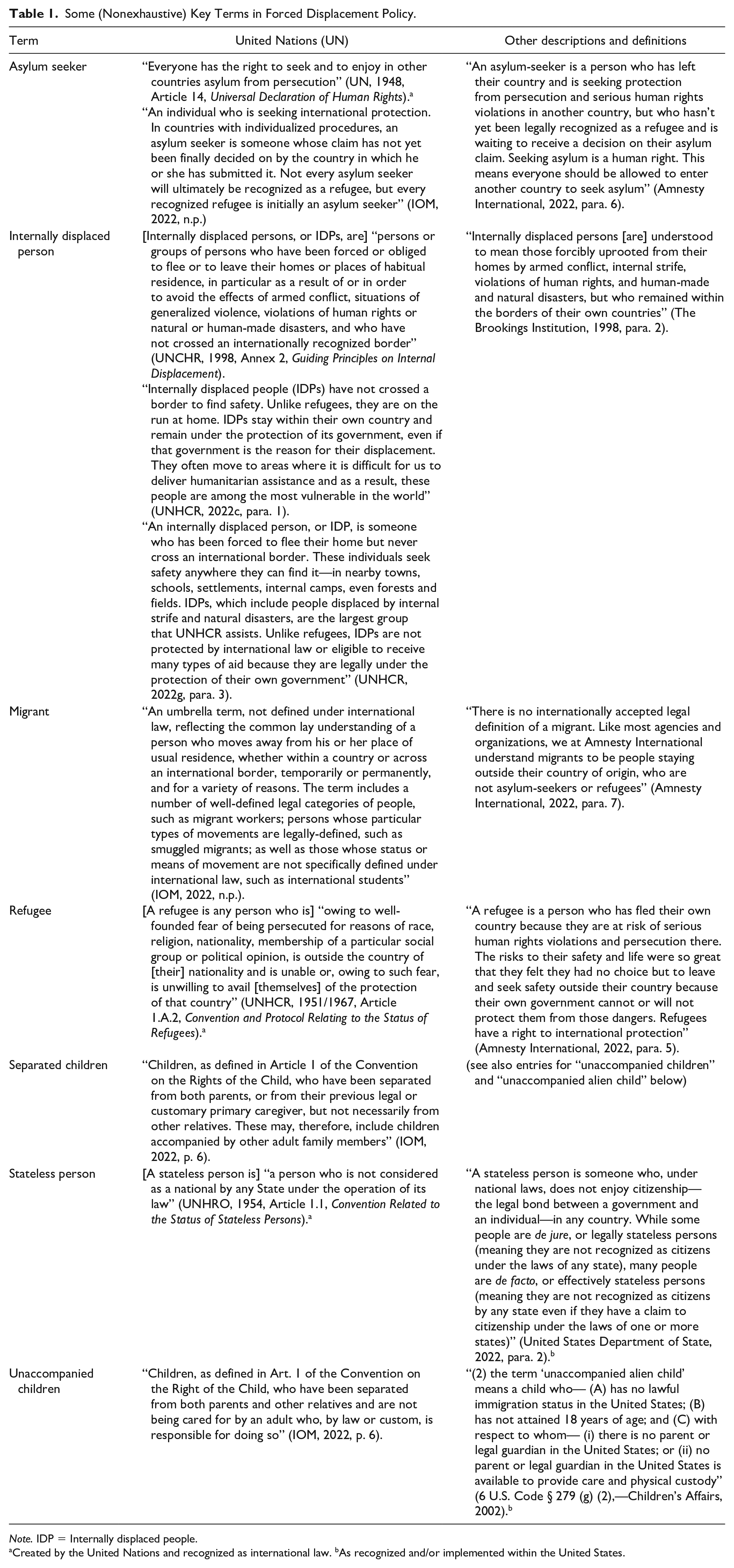
Note. IDP = Internally displaced people.
Created by the United Nations and recognized as international law. bAs recognized and/or implemented within the United States.
Shareable Language Could Then Facilitate a Cluster Approach to Transdisciplinary Research
Given the complexities of forced displacement, and the many disciplines from which the literature already draws, there is the need for a transdisciplinary approach. Transdisciplinary clusters have the potential to address forced displacement from multiple perspectives and areas of expertise. That is, they have the potential if the people involved can agree on a shareable language from which to begin. Even within interdisciplinary research—or research that occurs between disciplines—this can be challenging. One recommendation, as Anders and Lester (2015) suggest, involves “following participants, rather than leading with our disciplines” in this work (p. 739).
Participants Should Be Involved as Partners and Collaborators; In So Doing, Participants Should Also Have Input Into How They are Named
We have found this to be a pressing issue in recent work. By way of example, Dhillon’s dissertation was a critical participatory qualitative inquiry study, and it included 12 youth between the ages of 13 and 18 who had been forcibly displaced from Ethiopia, Iraq, Sudan, Syria, and other nation states. All had been approved for Convention Refugee status; some participants were living with other relatives and/or guardians because, in making their journeys, they had been separated from one or both parents. Thus, when it came time to obtain consent to participate from parents and legal guardians, many people were involved. As Dhillon (in Dhillon et al., in press) has written elsewhere, the youth needed signed consent forms to participate, and the consent forms—which were in English and translated into several regional dialects of Arabic—used the term “refugee.” Yet, many participating youth in this study neither identified as refugees nor had a firm understanding of the term. When asking their parents and guardians to sign the forms so they could participate in the study, some participants asked: “what’s a refugee?” Some of the participants simply did not know what the term meant or how and why it was being used. According to the youth who asked their parents and guardians about the term, they were told that it is a word that goes on paperwork that allows them to enter into a host country and be safe; the parents and guardians suggested that it is a positive and safety-generating term that the youth should go along with and not question, especially when in official settlement-related situations where paperwork is being presented and processed. They also suggested that if youth are being called a “refugee,” the youth should be thankful. Other youth in the study, however, were not only aware of the term, but aware that it can also carry stigma. . . Rather than adopt the term to describe themselves and their journeys, the participants decided that while being labelled as a refugee may be necessary and even beneficial, it does not need to be a permanent “shadow.” Put simply, the youth self-identified as individuals, not as refugees. (n.p.)
When we assign participants labels on their behalf, even when those labels come from policy, we may be using labels that participants would not use to describe themselves. We should be careful, then, to ask participants, and people more broadly, how they would like to be named.
Just Because Language is in Circulation, Then, Does not Mean That Researchers Need to Use, Condone, or Perpetuate Harmful Terms
As mentioned earlier, Table 1 illustrates language in use by UN agencies and NGOs. It also, in part, highlights a small sampling of how international language can then be taken up and sometimes reinterpreted by other nation states. For example, whereas the IOM uses the term unaccompanied children to describe children who have been separated from their parents and relatives, the US Code, which is comprised of federal statutes, makes reference to the “unaccompanied alien child.” While it is important to understand the technical language and the policy contexts in which we conduct research, there are conceptualizations that we should not uncritically reproduce for the reason of their harmful connotations. “Unaccompanied alien child” is one such conceptualization, and we posit that the youth participants in Dhillon’s (2017) study—some of whom had been separated from both parents and other relatives—would have found this conceptualization hurtful and would have rejected it outright. Beyond ignoring harmful and stigmatizing language, then, this is a perhaps an opportunity in which researchers can advocate for changes not only for how we discuss forced displacement terms in the general public, media, research, and practice, but also in policy. In other words, within the broader lexicon of forced displacement, if researchers feel strongly that newcomer and undocumented are preferrable to refugee and alien, then part of the contribution of research should be to formalize kind, inclusive, and humanizing terms for policy, too.
Situational Applications
International Terms in Use, When Relevant and Beneficial, Should Be Approached Situationally
More specifically, the international terms can be useful in disasters in that they clearly create pathways for humanitarian assistance in the situations that individual people might experience. How the terms should not be applied, however, are as permanent fixed identity categories that follow people beyond the duration of their experiences. Being in need of asylum and refuge should neither be, nor become, a permanent condition. When terms such as refugee are assigned as a fixed identity category; therefore, they have the potential to reduce a person to a situation in which they may have once found themselves. At some point, this can become the danger within newcomer, too.
Situational applicability can apply to the terms in forced displacement studies that researchers use, as well. In other words, if we approach a situation in which we understand that the labels in use are temporary, this might recenter the people who are in the situation of forced displacement rather than centering the situations themselves. This is important to remember in the midst of disaster, when it can be easier to imagine a specific drought, or a particular earthquake-turned-tsunami-turned-nuclear-disaster, or what we find more convenient to name as a single war, than it can be to imagine the millions, and eventually billions, perhaps, of people who will have been displaced. For many, especially for those who have never been involved directly, disasters are abstractions. For the people who have been forcibly displaced from disasters, however, the disasters are lived experiences. As researchers, we would be ethical to approach people themselves not as abstractions, but as people with lived experiences. Situational applications of terms that retain and underscore the humanity of people are but one way to begin.
Critical Qualitative Inquiry Can Contribute to Fostering a Situational Methodological Approach
As Cannella and Lincoln (2021) write, “Critical qualitative inquiry can become an instrument for maintaining an ethical stance while both constructing conditions that avoid and, when unescapable, surviving real-life disasters” (p. 1). Beyond a sharable vocabulary in forced displacement research, then, sharable methodologies are needed, too. Adopting a similar approach to the conceptual and methodological terms in use is useful, as writings on forced displacement in critical qualitative inquiry methodologies across disciplines—while having much to offer—are similarly diverse. Within the context of forced displacement, critical qualitative inquiry methodologies are continuing to develop and be applied in disciplines such as education (Hauber-Özer & Call-Cummings, 2020; Vellanki, 2019), human geography (Lohvynova, 2019; Miller & Vu, 2021), environmental sustainability (Zickgraf, 2021), sociology (García, 2018), and more (Gemenne, 2018; Hailu et al., 2022; Zapata-Barrero & Yalaz, 2018, 2020). As this occurs, many critical methodological directions are available.
A Shareable Vocabulary Can not Only Shape the Conceptual Landscape of Fields of Study, but Also the Situational Methodologies and Theories Used Within Them
It is often the case that methodologies issue forth from how fields define terms, as those definitions become foundational concepts within methodologies themselves. As illustrated in recent scholarship, for example, critical qualitative inquiry methodologies are continuing to extend outward from key terms in forced displacement research. This includes terms such as migration (Dennis et al., 2020), borders (Gildersleeve & Sifuentez, 2021), and transience (Gomes, 2021), among others. A sharable vocabulary lends itself to well-aligned situated methodologies, which can draw from aligned theories, too. Here, researchers might also turn to the theoretical writings of Anzaldúa (1987) and others.
There are, of course, far more considerations than are listed here, and we encourage readers who might be interested in forced displacement research to join us in this work and continue building shareable frameworks. An ethics of naming can help along the way.
Conclusion
This article has not been intended to be exhaustive or written with the weight of final authority. Not even lexicographers claim conclusive authority when defining terms for dictionaries, for they understand that language itself is ever-changing as it responds to ever-changing contexts. In also acknowledging this, scholars give themselves the freedom to redefine terms when necessary, too. When scholarship is democratic, redefinition can come from diverse theoretical frameworks. It is a good thing that no one person or theoretical perspective has an epistemological monopoly, but this also means that disciplines do not have the convenience of general definitional consensus that something like a dictionary or discipline-wide glossary could offer. So while maintaining definitional openness is equitable and inclusive, it can cause confusion at the level of simply trying to be on the same page, so to speak. When we engage in policy deliberations, we do so with other people because there is not consensus. After much deliberation, even though we may never achieve consensus, it should at least be the case that, while deliberating, each party had understood what the other had meant.
In some cases, scholars might be arguing not because of differences in opinion, but because scholars simply did not understand what the other party was attempting to communicate. Sometimes, then, it is not that disagreements exist at the level of ethics, values, or proposed practices, but that they emerge from miscommunications regarding basic definitions. Moreover, mistaken presumptions can make it difficult for conversations to move forward in a way that is necessary to benefit those for whom the conversations are meant to benefit, here the people who have experienced, are experiencing, or will experience forced displacement.
Finally, as transdisciplinary researchers who have a focus on practice, we should be attendant not only to disciplinary borders, but to the borders between research and policymaking. While these borders are borders of human construction, at the present moment, practice and research is not such that the borders are particularly permeable. From a researcher perspective, whether we care to admit to it or not, policymakers largely create the frameworks for policy. If, as researchers, we want to make a difference in the world, then we need to work to extend our conversations beyond ones that primarily happen only among ourselves. Policymakers are tasked with addressing crises, and it is easy to critique responses from the position of research. To put this into a more concrete context, when there is a conflict or natural disaster, it is often necessary to have responses and make decisions within hours, if not minutes. To put it bluntly, in situations of exigency, there is not enough time for humans alone to create an academically sound literature review. As such, if we wish for there to be more traversable borders between practice and research, researchers should create better bridges into policy rather than expect policymakers to come to us. In other words, we need to learn to communicate in the language of policy rather than expect policymakers to engage in the many different dialects belonging to academic disciplines, which can already be difficult enough for researchers to navigate in transdisciplinary contexts. If we want policymakers to use our research, it should be presented in a language that is recognizable as a language that policymakers already use. A first move toward this includes, but is not limited to, researchers becoming fluent in the language of policy.
Coda: Travelers Without Borders and Other Possibilities in an Open World
Before we close with insights from Dhillon, however, we would return to a point we made earlier in this article, one upon which—specifically with regard to examples of future possibilities—the guest editors of this special issue had asked us to elaborate. We had observed that the fundamental concerns of a field of study can expand beyond its own initial terminology and, when this happens, reconsidering vocabularies can offer a way to not only reshape fields, but also the constraints and possibilities within them. In engaging with possibilities here, we would (re)turn to the words of Robin Wall Kimmerer (2013), who writes: “Imagination is one of our most powerful tools. What we imagine, we can become” (p. 184).
The language of forced displacement reflects what has been consistently and collectively imagined thus far. From national borders to transnational policy phrasings to disaster responses (and the lack thereof), what has happened is what has been thought, written, enacted, enforced, and what—through thoughts, words, and (in)actions—continues to be reinscribed. There are differences between pragmatic approaches to policy in the urgency of the here and now and reimaginations of what, in both the near and distant futures, might one day become possible. If the possibilities and constraints within a field—in this case the field of forced displacement—are to change, then one way this can happen involves holding onto multiple thoughts simultaneously. How things are now is not necessarily how things were, or, later on, how things will be. Moreover, our futures can be informed by our pasts.
Language is something that humans have constructed, and geopolitical borders are, too. The challenge of forced migration is largely a challenge of borders—borders that function to include and exclude, sometimes simultaneously so. Geopolitical borders serve to keep some people out while holding other people in through restricted passage: as sites of walls, fences, gates, checkpoints, and other barriers—particularly for people without documentation—geopolitical borders are sites of control. But if we have collectively been able to imagine so many borders into existence in this world, then perhaps we might also imagine worlds without so many borders. Some might imagine worlds without any borders at all.
Dhillon, for example, envisions a world of travelers without borders. It is a vision situated within nomadic cultures of wanderers in which people are not only world citizens, but in which human movement is considered to be a natural product of nomadic life. As she shares: Travellers position themselves in the natural world and use their internal compass (rather than maps) to create a meaningful connection to flourish. Human flourishing is vital to wellbeing and can often be found in and through movement experiences. Structural barriers often hinder the process, especially amidst climate crises, terror, and war, and the labelling of groups of individuals for safe passage can often be subjective. This is why systems and structures need to be reassessed to (re)evaluate the criteria determining who is allowed in and who is not. By starting with our connection to the land and as travellers (world citizens), we may begin to reverse the narrative of privilege and expectations. Our engagement in the world as citizens is socially constructed; therefore, we must work together to realign expectations as a collective.
Footnotes
Acknowledgements
The authors thank the guest editors, Gaile Cannella, Chris Brown, and Yvonna Lincoln, for their thoughtful prompt and for including this paper in the special issue. We also thank James Salvo and Harbhajan (Bubba) Singh for their insights in the framing of this manuscript.
Declaration of Conflicting Interests
The author(s) declared no potential conflicts of interest with respect to the research, authorship, and/or publication of this article.
Funding
The author(s) received no financial support for the research, authorship, and/or publication of this article.
