




Abstract
This article explores questions of im/probability of/as post/authorship in postfoundational inquiry. Inspired by Deleuzian philosophy, the article instantiates post/authorship and academic writing otherwise as a means to interrogate, critique, and undo the representationalist modes of normative authorship. Through a series of playful im/probabilities, the article suggests and enacts a writerly mode of post/authorship that reframes notions of authorial intentionality and origination.
Reviewer 2: “… your contribution … needs to be more clearly stated at the outset”.
In paying attention to writerly invention as inquiry without method, the article’s provocation is, “What might happen if/when we go rogue and become post/authorship imposters instead of authors?”
Keywords
Entrée— Enter— in Tray— Entry— Entrata
Inspired by Deleuze’s philosophical discussion of “equal and unequal probabilities” in the painting technique of Francis Bacon (Deleuze, 2002, pp. 76–77), this article explores questions of im/probability of/as post/authorship in postfoundational inquiry. The article has two entangled aims: one, to propose a writerly mode of post/authorship that reframes notions of authorial intentionality and origination and, two, to offer a demostration and instantiation of post/authorship in the writing of the article.
Reviewer 3: “… your contribution … needs to be more clearly stated at the outset”.
To this end, the article includes multiple dialogic encounters, textual irruptions, reviewer comments recently received by one of us on an article submitted to a Q1 journal, and accidental occurrences in which we disturb the authority of author(ship) and the representationalist modes of normative authorship. Our disturbances invite and entangle “us two” and “you” our reader, companion theorists, and nonhuman kin in the postfoundational critical endeavor of proposing and instantiating the im/probabilities of post/authorship.
The article outlines and critiques the self-centeredness of traditional academic authorship; discusses post/authorship (Benozzo et al., 2016) and its alternative values, practices, and promises for postfoundational inquiry; and alludes to post/authorship and experimental writing practices (Benozzo et al., 2019; Taylor et al., 2019; Carey et al., 2021; Fairchild et al., 2022). The article’s postauthorship instantiations can, we suggest, be valuable in postfoundational inquiry, as a means to work ethically and productively against (while being enmeshed within) the normative prescriptions and governmentalizing deformations of the academic-writing-machine—Henderson et al.’s (2016, p. 5) felicitous phrase for the “hyper-quantified machine of the neoliberal university” that individualizes us as performative writing units, counts our outputs, and then grants us recognition as “proper” academics. Our article disturbs the presumptions of, and undermines the foundations of, the academic-writing-machine in its central provocation: What might happen if/when we go rogue and become post/authorship imposters instead of authors?
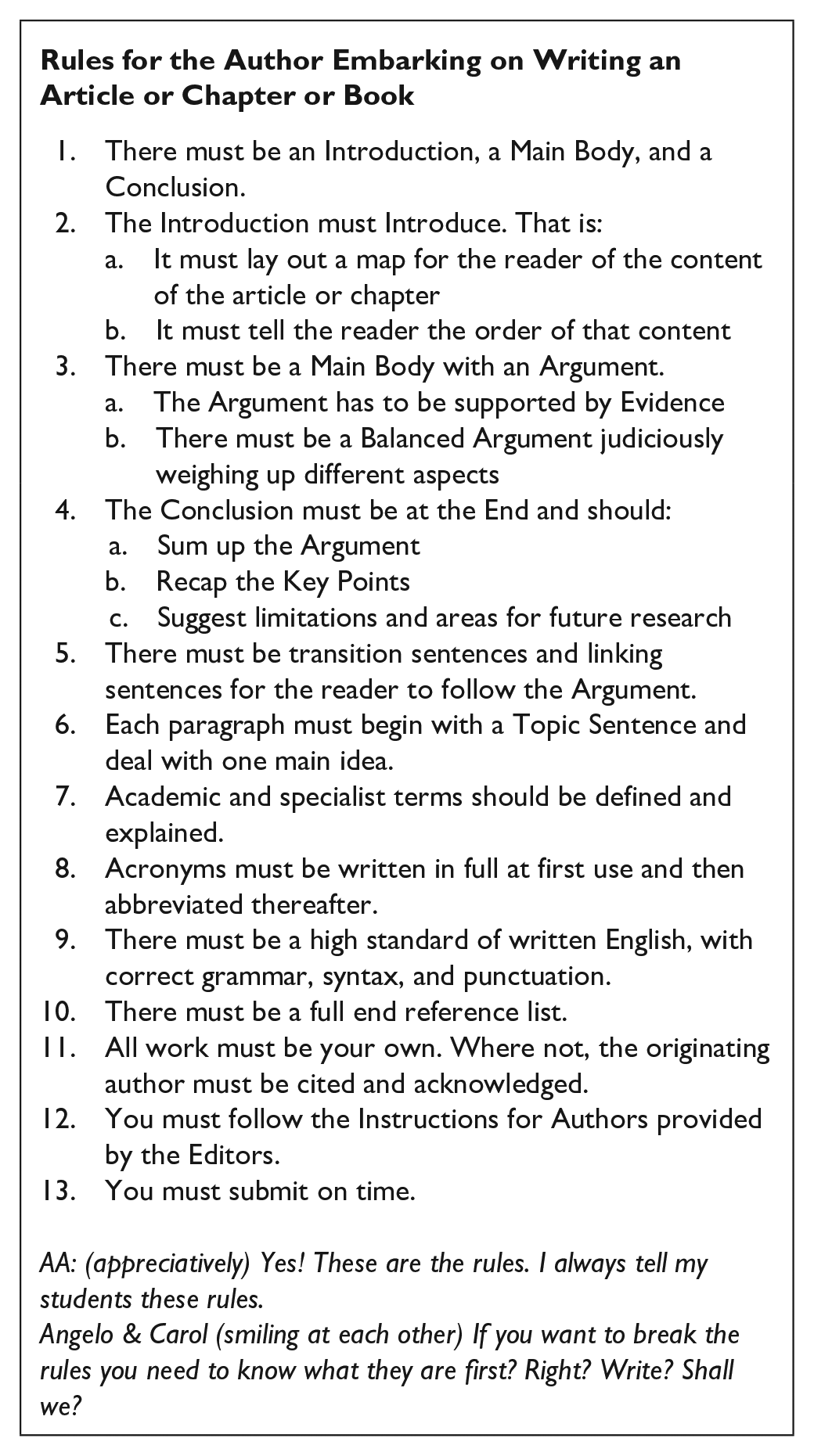
Write. Right. Pay Heed to The Rules! Author, Write Your Research Story
In graduate school, we are urged by our supervisors to ensure that our research tells a story, a story that describes and accounts for the unfolding of the research journey, which attends to the trajectory of the researcher (ourselves) who are constructing, undergoing, or (sometimes) suffering on that journey, and which offers an accurate, authentic, and truthful representation of the journey undertaken. Doctoral theses, research articles, and book chapters relate such research stories, often contained in the methodology section in traditionally organized writing modes. Such research stories are cossetted things; they are tales into which time and love are poured; their contours smoothed; their unproductive byways erased. Their storied form works to demonstrate that as researchers we possess and/or have developed competence, skills, honesty, trustworthiness; that our style accords with our theoretical and methodological intentions and orientations; and that they accurately record and represent the particular ways in which our research story has generated novel insights and produced new knowledge—because if it doesn’t, then we won’t pass our doctoral viva, right? or we won’t get our article or chapter published. We won’t count or be counted. But. The “telling the research story” doesn’t finish here. To make the thesis an article, you have to think about a paper’s pipeline and when the article is finished it must have “key research storyline” with an introduction, a development, and a conclusion; we are told it must be consistent; we are advised that the research story line has to have a hook. Have you been told this? Have you learned these rules? The need for telling the story, for having a key storyline, and for constructing the hook of the paper are all illusional effects—productions of pan/optical deformations and research fictions that condition us to believe that we as researchers are grasping reality and that our research story is mirroring reality. These illusional effects are resonant of a foundationalist approach to research and inquiry.
The “rightness” of writing our research stories must Pay Heed to The Rules (capitals intentional, important, and significant!). If it doesn’t, then rejection beckons. For doctoral theses, The Rules include strictures on length, layout, contents, and reference format. Articles are bound by The Rules of the particular journal. One of us is Editor for the international journal Gender and Education that has detailed Instructions for Authors.
One of us recently had a book published (anonymized) that was required to comply with the publisher’s (anonymized) “Graphic and editorial norms,” which stated the manuscript delivered to the publisher must be/should be
definitive in the writing
uniform, meaning that all the graphic and editorial standards indicated by the publishing house must be respected and maintained for the entire course of the text;
ordered, meaning evident in its structure and in the succession of its various parts . . .
Likewise, this article has been crafted to accord with certain ruling orientations, if not Rules per se, including referencing conventions. Paying Heed to The Rules entails adhering to textual, graphic, and representational precepts that shape, interact with, and sometimes delimit content, meaning, and expression. When writing (when we were writing this), questions arise: Do authors notice what work The Rules do? Do authors desire subjection to The Rules? Do authors feel bounded and hounded by The Rules?
Hold on a moment. Stay a while. Let’s sit with these questions and refuse to hurry on by.
We wonder if you nod in quiet or enthusiastic agreement with these three questions: “Yes! Those damn rules. I follow them, they annoy me, I rail against them, but in the end and for an ‘easy life’ I comply with them.” We also wonder if you go “Grrrrrr! I am a free thinker. I reject rules. I will only publish in a journal where I can do as I like’” Are you, we want to ask, always able to do that? At the same time, we also wonder if, for an early career researcher with little knowledge of publishing conventions and the broader fields, The Rules provide a comfort blanket, and work as handholds or footholds in the slippery slopes and unknown landscapes of academic publishing. We—that is we two who are writing this as collaborative co-authors—are confident in how and where and when to push back against, ignore, play with, or comply with the rules. But we know this because we are experienced and have been in the mangle of the academic-writing-machine for many years. Because of our entangled mangling as co-authors, we suggest that The Rules offer foundational precepts that school our bodies-minds-hearts such that working with/in the academic-writing-machine requires modes of subjection and perhaps even occasional abjection: It produces schooled writing bodies and even docile academics.
AND BUT SO. Pondering these three questions, the answer seems to be variable and multiple: yes, no, sometimes, often, maybe, perhaps.
It seems, then, that the author’s dilemma in postfoundational inquiry is around questions of how and to what extent is it possible to navigate a space of and for freedom of expression while accepting that some strictures will probably be necessary? In The Psychic Life of Power, Judith Butler (1997, p. 1) comments “to be dominated by a power external to oneself is a familiar and agonizing form power takes.” In taking issue with Althusser and Foucault’s omission of “the entire domain of the psyche” in their understanding of the formation of the subject, Butler (1997) suggests that the psychic life of power helps shape subjectivity through its production of psychic effects of ambivalence, risk, and haunting. In post/authorship, power (The Rules) is felt/enacted as a paradoxical process, as an oppression to which one (willingly) submits and as a desire to play, produce otherwise, write differently. Postfoundational inquiry in/as postauthorship modes, then, aims to de-form and perform authorship not as subjection or opposition but as contested and entangled relation with/in The Rules. In which case, the desire in post/authorship enfolds psyche-body-page-text-environment-computer, and the desire to go rogue, to become-imposter, materializes bodily and sensorially as a “relation of power” that is at the same time a relation of “bodies, multiplicities, movements, desires, forces” (Foucault, 1980, p. 73). These knotted-nots of power shape practices of post/authorship as nomadic experimentation as/in inquiry without method.
In a recent journal special issue on seductions as theory and praxis, Linda Knight (2022, p. 99) argues that “creeping conservatisms and micro-fascisms make seduction vital for the survival of free thinking” in a contemporary academic context that favors the strait-laced and controlled. Knight’s argument speaks into the knotted-nots of subjection and desire we ponder in this section and play with in this article’s multivoiced enactments. And yet . . . Knight appears to presume a human authoring academic connected to the practice of “free thinking.” The question of how to author writing that refuses
Reviewer 6: “… you have to clarify the explanations of the study’s method and analysis and justifying your choices for these…”
creeping micro-fascisms is a provocation to both of us (and we hope you too?) to become un/authored – that it serves as an invitation to the more fugitive im/possibilities and unbounded im/probabilities that sidle and slide around us as we continue to pursue our postfoundational postauthorship evasions of capture by the academic-writing-machine.
In what follows, we pose rogue-ish imposturings that seek to reorientate authorship as a starting somewhere else—as a mode of postfoundational writerly inquiry.
A Micro-Manifesto: Passionate Wrestlings
Oh, to write that which becomes un/palatable, in/digestible, dis/approved, im/moderate Oh, to write with pulsing blood and cracking bone and thumping heart Oh, to write irruptions and eruptions Oh, to disarm, enchant and entertain Oh, to have fun, to whicker and whacker and gander and gallop Oh, reader, our reader, beloved reader Shall we?
Characters
Carol
Angelo
Gilles Deleuze & Felix Guattari
Francis Bacon
Rosi Braidotti
Authoritative Academic
The Author as Hero, Or a Bloodily-Bloodless Tale of Academic Anemia
The Idea of The Author—singular and single-bodied, boundaried, brain enclosed in a separable human body—is a cold dish, a historical leftover of a Romanticism that lauded individual creativity, notions of genius, and the spontaneity of the imagination. This notion of the author also finds a genealogical inheritance in Enlightenment Man—the human at the center, looking over and overlooking the world, impressing his mind on all things, shaping nature, and disposing of beings (women, animals, Black and Indigenous populations) who did not look like him. This is authorship as appropriation in which He who is White and Male gets to tell the Only Stories that Matter, that is stories that center Him in justified narratives of capitalist, colonialist extractivism. There are not too many hops from these conceptualizations of authorship to contemporary knowledge practices that rely on the authority of authorship (citation, H-Index, metrics, quality ratings) to tell us how “good” certain academics are, how research should be done, what it means, and what value it has.
Reviewer 3: “Moreover, the ideas in the paper need to be referenced. For instance, in the first paragraph of the introduction, many ideas are presented without citing a single reference to support them.”
Dialogue: Nomadic Roots 1 and Authorial Rootlings
Hello Rosi. You have written a lot about subjectivity and about the posthuman and also about the nomadic condition. We are writing about authorship in postfoundational inquiry, and we are trying to entangle the posthuman with the idea of author. Who is or what is the nomadic author or the posthuman author?
The nomadic or posthuman author creates an open frontier. It constructs a centre without a centre, it is a loose nucleus. . . The author is always in relation with. Relationalities are constitutive of human becomings . . . there is no human being . . .
Always human, always man? . . . this is weird . . .
And annoying, and false, a fiction, a tale told by an idiot . . .
Rosi, which are your roots? Where are they? In term of author and authorship, where do you think are your roots?
I really do not know. This is a very complex question. I was born in Italy, and together with my family I emigrated to Australia, and then I came back to Europe in Paris with a grant . . . As an author I am at the same time my uncle, and I am Michel, Baruch, Gilles . . . I imbibe and become the papers and the books they wrote. Many books have penetrated my flesh.
Authorship is becoming, is moving, is multiple, is many, is confederate, is a confluence.
Is an author a transhuman being?
Mnnnn that’s interesting. The transhuman is a kind of cognitive capitalism promulgated by such as Elon Musk who try to improve the human but with heavy technological intervention. There is a belief in perfectibility which re-turns Enlightenment ideals of progress. The transhuman is the exaltation of the idea of author in that it is dedicated to self-centeredness and self-perfectibility. Instead in the posthuman condition, the author disappears or it is dispersed. It is dead as Barthes wrote. But it is even more than dead, it never existed, and we need to live without that idea. We need to live as if the idea of authorship never existed.
Authorship and/in Post-Structuralism
In 1967, Roland Barthes’s essay Death of the Author was first published in Aspen: The Magazine in a Box. It was “an invited piece for a box darts journal that also included mazes, phonograph recordings, musical scores, films, and poetry” (Moore Howard, 2016, p. xi). In 1968, Death of the Author was translated and published in France. This event gave rise in 1969 to Foucault’s rejoinder and critique before the French Philosophical Society, in which Foucault (1969/1984) tries to unravel the enigma: What is an author?
We do not consider the idea of the death of the author in a literal sense—certainly sooner or later every author dies—but as a question that has been debated in the social sciences and in poststructuralism for five decades now (Robillard & Fortune, 2016). This debate represents an attempt to overcome the modern notion of the author, that is, the idea of an individual (a single and singular person) who is responsible for, gives birth to, and composes a text in perfect solitude and is the inventor and creator of that text. This vision brings him closer to the Creator, to God the Father: He is an Author with a capital A, one who can claim ownership rights over the work and who possesses the right to give the ultimate interpretation of it. For Foucault, however, the author as subject and originator is not important and indeed a presumption of their presence constraints and limits the multiplicity or polyvocality of the text.
Foucault evokes Beckett in asking, “What does it matter who speaks?” Rather than worrying about the authenticity, originality, desires, or intentions of the author, or the truth, correctness, deepness, and authenticity of interpretation, Foucault suggests turning attention to questions of discourse, the modes of existence of discourse, and how power is instantiated, circulated, and appropriated in discourse. If the Author is dead and texts are discursive constructions, then what difference does the author make? The author’s name might endure but its function is to draw the boundaries of the text and manifest the presence of a text. For Foucault, an author is an ideological and discursive product; it is a strategic positioning. The author is “the dead man in the game of writing” (Foucault, 1969/1984, p. 103). Post-structuralism disavows the sovereignty of the Author as speaking subject, absolute and present to itself.
Dialogue: Starting Somewhere or Other, Or Starting Here and Now
We have been thinking of writing something together for a while.
Some-thing . . . yes . . . we needed, were waiting for, the right moment for something to emerge.
And that moment came along with this article, whether it is “right” is something we will find out as we write.
We can . . .
(interrupting) When we were writing Anti-Oedipus “since each of us was several, there was already quite a crowd” (Deleuze & Guattari, 1987, p. 3).
(pondering) So, for us, who is this “we,” who/what is/are this “us” doing this writing? What “I’s” comprise this “we”?
And how are these multiples doing the “knowing” and “authoring” and “writing”? Where do “I” end and “we”—you’ and “they” (our future, imagined and already beloved readers)—egin?
(irritated) Oh, my giddy aunt, stop! Too many “ . . .” already.
(amused, channeling Ed Norton’s character in Fight Club) Ha, ha, the only Rule of postauthorship is that There Are No Rules.
And Who Are You, Dear Reader?
Reader 29. Push off, go away, leave me alone. I’m simply dipping in. Look! I have five minutes between this Skype meeting and the next Zoom meeting. Can you just buzz off! I want to find a bit of space, and let my head wander in your words. Stop asking such ridiculous questions of me.
Reader X. I’m musing. I’m immersed. You challenge and provoke me and then you run away and hide, you cowards, behind some fancy phrases and some obscure f***ing jargon. I’m mad at you. Tell me. Tell me. Tell me what you mean.
Reader 9. There is a book I read that makes me feel better. It is a book on art that collects numerous writings by an art critic. I don’t know if it is the content that has this effect or if it is touching those thin pages like those of a breviary that reassure me or, even, the pictures that are described.
Reader $$$. I paid $40 for this book and its rubbish. Useless. I read the back and the waxing lyrical about the this it does and that it does and how indispensable it is for people on the very course I am doing. I’m writing my assignment, which is due in precisely 42 hours. I’ve stayed up till all hours. I just want some nice quotes to show that I can support my arguments, and can I find them?
(Barthes, 1967/1977, p. 148) “The reader is the space on which all the quotations that make up a writing are inscribed without any of them being lost; a text’s unity lies not in its origin but in its destination. Yet this destination cannot any longer be personal: the reader is without history, biography, psychology; he is simply that someone who holds together in a single field all the traces by which the written text is constituted . . . the birth of the reader must be at the cost of the death of the Author.”
Reader . . . My baby is finally asleep. I hold her against my heart. I’ve walked the floor with her for hours trying to soothe her. She’s teething and cranky and exhausted. I’m just exhausted. My love for her confounds all my being. I look at her and melt with love. With LOVE. She surpasses all I know. Barthes talks of the pleasure of the text. Jouissance. What a man thing. He surely never knew the rich, deep, unsurpassable joy of a sleeping child. My book lies on the floor face down, its cover crumpled.
Reader 342. Looking out at the dark. Tired eyes. Body drooping at the end of a long week. Lights of the city down in the valley. A glass of wine in my hands, I cradle this book in my arms. It is my beloved companion. I heard its author was a pedophile in Algeria. That’s problematic but should it stop me reading it?
Reader 4@. I never start a book from the beginning, and I don’t even read it all. I skip pages and chapters (chapters? Why chapters?) and I go to the end when I feel bored. Then, I can also go back and pick up some pieces, some random fragments. Here and there. Without a claim to understand the history, but instead with the pleasure to build another story, the one between white and black, that which is impossible to decipher.
Reader 3. She speaks to me. She writes as if she knows me. She helps me think. She casts a line to me across time and space. She wants me to dive into her ocean of wise words. And I do. She encourages me, in the sense of gives me heart. She inspires me, in the sense of breathes life into me. My pen, my fingers on the keyboard, are afire.
Reader@Imposture. Make it up. Make it make sense. Make it count. Make it bleed. Make it known. Make it.
Authorship and/in Posthumanism
Her annoying wrinkled hands
Why you do not speak?
They annoy. Stop abruptly. Make her lose everything.
You are the device that makes my ideas clear. My thoughts are transported into you and transferred to you. You make my work. You write my writing. There is no separation of you and me are not separated; we touch each other so frequently. My writing capability depends on you and you depend on me when I turn you on. Why do you not say any words?
That sanitize smell is arriving. Today detergent and duster have changed. Illusion of cleanliness: mites and viruses always circulate on the screen and on the keyboard.
It seems that you are an extension of me, sometimes I feel lost without you. Without you I am definitely something else, but above all I can’t be “myself” or perhaps ourselves. What am I becoming with this hand lying on the keyboard? Fingers touching and feeling.
Materialism, bodies, spaces, the paper, what do we rest our writing on—oh, yes, that thing we name a table. In posthumanism, authorship becomes something else. A human–nonhuman becoming in a relational assemblage in which multiple bodies swirl and intra-act. Braidotti (2019, pp. 38–40) characterizes this posthuman “materialist immanence” as fractured, dynamic, vulnerable, contradictory, distributed, transversal, partial and situated. The author dis/appears and is utterly changed, dispersed, present, absent. Sweat, hair, fingernails, fibers, air, skin, screen, keyboard, pen, phone, coffee cup, sweet wrapper, exhausted, refreshed, alive, dying, ongoing. Post-humanist authors are postfoundational becomings-with in which/whom everything potentially enters. Politics. Geophilosophy. Extinction. Sex. Survival. Friendship.
Do I (human) tell the computer’s story or does the computer tell me? Perhaps we (computer-me-we-us) are hybrid, cyborgian? Perhaps we are a technologized-fleshy-bloody becoming? Or perhaps this new becoming-assemblage is an alien phenomenologist, a “plastic and metal corpse with voodoo powers” (Bogost, 2012, p. 9), which possesses “its own unique existence worthy of reflection and awe” (Bogost, 2012, p. 16). In elaborating the philosophy of speculative realism, Harman (2011) and Bogost (2012) talk of how objects withdraw, of objects’ estrangement from human capture, of objects’ weirdnesses. What postfoundational procedures, practices, or methods might help us (humans) apprehend the strange lives of objects? None. No go. The computer refuses narration in human terms and perhaps all we can do is selfishly and foolishly anthropomorphize a plastic case with precious metal hardware inside. But there is a human–nonhuman story that matters here, concerning the material reality of digging and dirt and land exploitation and resource extraction and colonialism and capitalist waste.
Posthuman authorship poses textual possibilities as endless, as unfurling becomings with no origins or end, as im/possibilities and im/probabilities. And what do “we” who write about textual im/possibilities and im/probabilities become what when-and-as-we-write? Benozzo et al. (2016) suggest authors are impostors. We, the impostors, by entering into relationship with texts, probe the possibilities that open up when the author is unknown and unrecognizable, absent and irrelevant, that is, when the author is dead. The numerous possibilities when encountering a text proliferate, no one reading can arrive at the original intentionality, no one interpretation can disclose the meaning. Text is interwoven with countless other texts. Fairchild et al. (2022) ask: Whose words are these? Does it matter? The text fragments and becomes questionable. Research stories are mutable and multiple: they are not there to represent but to provoke, stimulate the imagination, question, destabilize, experiment, create, and on and on.
Who and what are you virus? You have been with me (in me) since October 2021, infecting my body in ways I know and don’t know. I feel your presence. You live with me, I with you, second, minutes, hours, months. You have changed me at cellular level: disturbing my cytokines and disrupting my autonomic immune system. You are in my blood. You elevate my immune responses, put me on high alert. You disturb my sleep, disarrange my thoughts, delay my responses. I am different, disturbed, a body re-distributed in a thousand different ways. Me/not me. I am virus-we. Do you have fun? Are you impassive and impervious to my suffering: prolonged exhaustion, brain fog, bodily aches, dizziness, headaches. I counted up that my virused body had 21 of the over 100 symptoms listed on the NHS website for Covid-19 and Long Covid. Virus, you are with me now as I write these words, you have been with me during the evolving drafts of this article, a shaping presence in the ongoing conversations with my friend and co-author, Angelo. Virus-imposter in helping to write this article and orchestrate this text. Did I write this? Or did Covid-19/Long Covid? Covid-imposter-me: an interference, and infection, and infusion. A cellular human-nonhuman perturbation.
We invoke the earthworms as conceptual personae (Deleuze & Guattari, 1991), whose nonlinear compos(t)ing (Fairchild et al., 2022) disrupts the view that readers (and us as writers) “are subjects, stable narrators, which can articulate phenomena unambiguously” (Hein, 2019: 88). We become-with the earthworm as posthuman kin. Together we become imposters in our authorial earthwormings: Oh, earthworm! Divine textual collaborator Creative co-author and agitator Mundane turner and tunneller You Compose Decompose Provoke and connect You compost New formations Enabling New problems and new flourishings To emerge Oh, earthworm! Bingo!
What happens to the academic-writing-machine if we become imposters instead of authors? Perhaps writing, the action of actual writing and the academic mechanization of our writing is unveiled, dismantled, and deconstructed, and we become a little, perhaps just a little, more aware of the mechanisms in which we are trapped. These are the machinations of the academic-writing-machine, of writing paper after paper to get published as soon as possible, and we even forget or don’t care less about the content of what we wrote. These are the obsessions of getting a certain number of citations. In some way if we become imposters, we unveil the rule of the game that we are obliged to play.
Doing Authorship Otherwise in Postfoundational Inquiry
Our ponderings, provokings, demonstrations, and instantiations take off, in philosophical terms, from Deleuze’s discussion of “equal and unequal probabilities” when considering the painting technique of Francis Bacon (Deleuze, 2002, pp. 76–77). Deleuze proposes that the arrival of painterly marks on the canvas (once the painting is begun) is a negotiation of chance and choice—yes, the artist and their hand makes marks but the marks constitute an engagement with the “accidental” which, in Deleuze’s view, approaches the condition of the “improbable itself.” The artist cannot know in advance what the brush stroke will look like until it appears and materializes itself on-and-with the canvas. The author cannot know in advance what their words will “be” until they materialize on paper—or im/materialize digitally on screen—and the author cannot know in advance, or later, or ever, what those words will do and mean. Interpretation and authorship collide expressively not representationally, enabling postfoundational postauthorship to reach at and enable academic writing practices to resonate with modes of research-creation (Manning & Massumi, 2014); to produce research writing that is an immanent doing of inquiry in the space-times of writing’s human-nonhuman co-compositions; and to ensure that such writing stays on the move in order to keep on being/becoming a challenge to normative modes of layout, typesetting, and publications. Postauthorship thus makes an “improbable” appearance on the page.
Hey, Angelo, I Guess We Should Have a Conclusion? Sure, Carol, Why Not. Although
Un/authorings Write on the move Write move-ingly Write curiously Write furiously Write questioningly Furnish writing with multiplicities Write in glances and sidelights Write in murmurings and whispers Write with dog, cat, ferret, parrot, threadworm, rat, spider, mites, ants, dirt, dust, fur, feathers, biota, morning light, sundown, dusk, dark, air, water, fire, heart, feet, tongue, hair, skin, bone Come Let us Kindle and choreograph nonhuman un/authorings For Doing research differently.
Footnotes
Declaration of Conflicting Interests
The author(s) declared no potential conflicts of interest with respect to the research, authorship, and/or publication of this article.
Funding
The author(s) received no financial support for the research, authorship, and/or publication of this article.
