




Abstract
In this article, we take our thoughts for a walk through our three different doctoral journeys and experiences with the Post Philosophies and the Doing of Inquiry Webinar Series (2020–2021). The webinars presented an example of Slow scholarship, enabling us to think deeply and differently from others and develop new ideas to take further. The online connections offered opportunities for extending learning spaces beyond traditional bounded structures. Here we explore the rich learning gained from each other’s experiences of research, learning, and teaching in different higher education settings and ways in which these intersected with the webinars during the global COVID-19 pandemic. We contend that the generosity of senior academics in leadership positions who embraced global networks of communication, connected students with experts, and learned with and from their students through communal egalitarian spaces has enormous potential to support students as they traverse often demanding and challenging doctoral journeys.
Keywords
Introduction
The COVID-19 pandemic caused major disruptions in all spheres of life across the globe. In schools and universities, traditional educational processes were halted as institutions went into lockdown, and educators were forced to find emergency online alternatives to traditional teaching and learning. While scholars called attention to issues of equity and inequality in the sudden “pivot” to online learning (Czerniewicz et al., 2020), the move online also promoted opportunities and allowed new communities of inquiry (Christie et al., 2007) to emerge. One of these was the 14-month Post Philosophies and the Doing of Inquiry Webinar Series 1 that was presented on Zoom through “corona-time” (Bozalek et al., 2021) in 2020 to 2021, a time that felt out of joint and dislocated from routine time (Barad, 2017). This webinar series, a collaboration between the University of Missouri and the University of the Western Cape, hosted a range of global scholars with varied perspectives on and experiences in postqualitative research.
We, the authors, are currently or recently graduated doctoral students who had previously met through our shared supervisor. We found this online series particularly inspiring and helpful, enabling us to consider existing and potential intersections and resonances with our own research projects and teaching endeavors. The academic resources made available through the webinar series and the exchanges between the guest speakers, their students, and ourselves, offered unexpected possibilities for enriching our learning, research, and pedagogical practices. We sensed a process of opening up to new experiences that seemed to pull us into different and relational ways of thinking, doing, and becoming (Manning, 2016).
In this article, rather than examining a specific guest presentation or the sum of the parts, we explore what mattered and became meaningful to us through the webinars. Iteratively building on our conversations and interactions through the webinar series, within reading groups and other on- and offline spaces, we suggest that a collaborative research process provides a generative alternative to traditional individualized doctoral research journeys. We explore the relationships that have mattered to us and the openings and the closures that have emerged—individually and collectively—through our studies and the webinars series.
The primary question guiding this article is what contribution did the webinar series offer to us as doctoral students? Threaded throughout the article are our thoughts and insights into our becoming-with the learnings gained from and through the webinars. We show how these ideas connected to our own research projects through drawing on the thoughts, experiences and practices of each of the three authors. However, rather than seeing these as individual contributions, we aim to bring to the reader an emerging collective sense of empowerment and enhancement.
Our Doctoral Journeys
We are three mature doctoral students from diverse disciplines and backgrounds. Lieve works as a psychologist with students around mental health issues at a Belgian University. Having witnessed and experienced challenges and inequities within academia, she is motivated to continue questioning and unsettling established practices through her doctoral research. Located in Disability Studies, her research highlights the importance of working with and through students’ lived experiences. She builds on her own experiences in higher education to explore what affirmative moves could promote student well-being (Carette et al., 2018). Lieve’s doctorate is self-funded and so she works to support herself through her studies; this is not the norm for most doctoral students in Belgium. She is currently immersed in the messy middle of her research project.
Veronica is a physiotherapist who later moved into human rights education with undergraduate medical students. A disruptive experience in 2008—witnessing a colleague cheating on student marks—triggered her research into medical students’ experiences of unprofessional practices in the health system. That ethical dilemma opened up new opportunities for Veronica to work with students, engaging with discomforting dialogues around their own ethical dilemmas, such as when students witness mistreatment of patients by health professionals. In Veronica’s obstetrics workshops with students, she frequently hears about harrowing experiences related to obstetric violence. 2 The intensity and frequency of these narratives led to her doctoral research, questioning students’ capacities in responding to abusive practices by those who ought to be their role models (Mitchell, 2019). Veronica completed her doctorate in 2019.
Sue worked as a personal assistant in large corporate organizations in Cape Town and London for several years. Her growing awareness of gender stereotyping and racial inequities tipped her move into academia via life-coaching and counseling. In her master’s in Adult Education, she explored students’ experiences of “learning service” through their engagements with poor and working-class Cape Town communities (Gredley, 2015). This research and her teaching in two very differently positioned universities in Cape Town, one “historically white” and privileged, the other “historically black” and disadvantaged, brought her face-to-face with pervasive inequalities in South African higher education institutions. This triggered her doctoral research which considers how a social justice lens can be used to support pedagogies that can foster meaningful personal and social change (Gredley, 2020). Sue is in the final stretch of her PhD having submitted her thesis for examination.
As our narratives illustrate, while our experiences are diverse, what is striking is that our learning, teaching and research have been shaped through our immersion in systemic injustices enacted within and beyond academic spaces. As a collective, we desire to unsettle and disrupt traditional unjust pedagogical practices through our doctoral research; in other words, we aim to foster possibilities for doing academia differently (Bozalek, 2022). Perhaps we all feel a bit “mad” (Price, 2011) about the current state of higher education. “Madness” is a reminder of mental health issues as well as feelings of frustration, anger, and dissent. However, it can also be a productive term for opening up alternative imaginaries for higher education pedagogies (Shefer, 2019). As Price (2011) explains, Mad and crazy are offensive terms, but they are also rhetorical indicators, useful both to expose discrimination against people with mental disabilities and to chart the road not yet taken to arrive at classrooms attentive to the mental diversity of students and teachers in higher education. (p. xi)
This mad desire to contribute to changing higher education pedagogies and practices is reflected in our doctoral studies, guided by the following questions:
How can we find other ways of doing higher education and bring students’ own knowledge into academic progress? (Lieve)
What forces render students in/capable in their responses to injustices they may witness in obstetrics? (Veronica)
How might the social justice framework of participatory parity contribute to better understanding injustices and promoting justice in higher education? (Sue)
Our doctoral research journeys have evolved and shifted over space/time through numerous connections and disruptions. One aspect of this has been engaging with one another over the past few years. A serendipitous meeting and discussion about our dogs in a sauna at a writing retreat led to Sue and Veronica connecting. A love for dogs brought us together and continues to do so regularly on Thursdays when conversations and kinship are nurtured. Sharing working-from-home space with our four dogs uplifts our spirits, especially during COVID-19 lockdown times. We met Lieve when she visited South Africa from Belgium in 2019. We joined forces to participate in a nationally funded research project related to socially just pedagogies. That time together later expanded through Zoom and WhatsApp which allowed us to continue our relationships and work together through regular reading groups and sharing online experiences like the Webinar series.Geographical distance appears to become erased through our digital networks; however, Lieve admits to feeling the impact of land and ocean separating us. Despite the distance, we continue to connect with each other in unexpected ways. Virtually, we watch Lieve cycle through Bruges’ landscape, see Veronica walking along mountain trails and among vineyards with her dogs, and join Sue running through cityscapes, along mountain paths and seashores around Cape Town. Our activities in Cape Town remind Lieve of the months when our touching was a physical closeness rather than virtual touching, described in a collaborative publication (Bozalek et al., 2021) in which we explored our collective activities with Zoom-mates at the start of the COVID pandemic.
Through our interactions over time, we have learnt more about each other and the challenges of research and collaboration in the context of the market-centered neoliberal university which promotes efficiency, competitiveness, and education as a commodity (e.g., Bozalek, 2021; Hames & Lewis, 2021). While doctoral research can be an exciting and exhilarating journey, students also confront many challenges in part due to the traditional individualistic nature of the process. David Ben Shannon (session 13), a doctoral student himself, titled his webinar Trajectories Matter. Taking this prompt seriously, we explore our journeys as doctoral students and in relation to the trajectories of others, such as the students who participated in the webinar series.
Intersection of Our Research With the Webinars During Corona-Time
it is in events and relationships, and more particularly in the in-between or interstices of what happens, that potentials come into being. (Bozalek, 2021, pp. 5–6)
Our sisterly relationship of kinship has enriched us over the past few years as we have, individually and within reading groups, shared and explored socially just pedagogies over time and through a range of texts. COVID-19, attendant lockdowns and the shift to online collaborative tools like Zoom unexpectedly deepened our relationships, allowing more time for us to think together in relation to our research and academic resources. The webinar series became a regular meeting space in our becoming-with others. In sharing our learnings and difficulties, one frequent / common challenge was that of time.
Lieve struggled with time. Different periods of closure during Belgian and South African lockdowns complicated the difficulties of navigating the bureaucratic requirements and processes of two universities in establishing a joint institutional doctoral project. During her research, she found that meetings with participants were delayed and timings became distorted as lockdown restrictions hindered their communication and often needed rescheduling.
Veronica felt grateful that her research study in medical education was completed before the COVID-19 lockdowns. Her study, which related to abusive practices by qualified health professionals in obstetrics, already occupied a precarious path. As such, every step was approached with extreme caution due to the sensitivity of the topic. She realizes that the lockdowns would have destabilized her already precarious doctoral journey.
Sue became frustrated as the months passed too quickly. The COVID-19 lockdowns and competing demands resulted in deadlines being shifted and extended. At the start of 2022, the end of her doctoral journey is in sight. It has been a bumpy and often solitary journey requiring perseverance. Over time, through engagements and consultations, from moments of tangled confusion, clarity has emerged.
While linear time is so entrenched in academic institutional practices, corona-time forced change. Barad (2007) refers to timespacemattering to indicate how a relational ontology does not consider us as preexisting, independent individuals but that we are co-constituted in space, each moment through our engagements with others (both human and the more-than-human). Our research experiences have traversed in-between spaces infused with our relations to others through our teaching and learning endeavors. What we have recognized is that we are not apart from our research but in the middle of what we are studying amid time/space matters. Our own past and present experiences become part of our research projects and future efforts. We cannot undo what has been nor erase how it has impacted our being and becoming.
As our brief histories show, the challenges and constraints emerging throughout our doctoral journeys have, at times, become enablers, pushing us in new directions and facilitating our progress and prompting us to focus on certain pathways and leave others aside. Shannon (2021) reminds us that these enabling-constraints 3 “propagate the research-creation process in particular directions by closing down other avenues” (p. 64). In terms of the webinar series, we found that enabling-constraints seemed to thread through the guest speakers’ discussions with their own students too.
Zooming in to the Postphilosophy Webinar Series
The journey of traveling with/through our individual research journeys alongside each other was highlighted by Kakali Bhattacharya (Session 5) who pointed out that we need to identify what drives our research in terms of theory and philosophy. She encouraged us to “chunk” information to help us to dig deeper into our research, describing this move as threshold traveling.
Entering Different Worlds
The webinars brought us as early-career scholars unexpectedly close to experts in the field. In a way, it felt that they entered our homes and we visited theirs. We traveled the world virtually to their spaces and observed their workplaces, mostly in their homes due to COVID restrictions. While helping us to take research seriously and develop and expand our “research sensibility,” as suggested by MacLure, we had playful moments observing the unusual. For instance, we noticed MacLure sat in a very relaxed manner at her busy desk (Figure 1), de Freitas was in New York with sirens blaring and a puppy seeking attention (Figure 2), Manning’s cat joined the webinar for a few seconds (Figure 3), and we heard St. Pierre’s clock chime for 12 noon, 12 times, reminding us that we are in one time on Zoom yet other times across the globe.
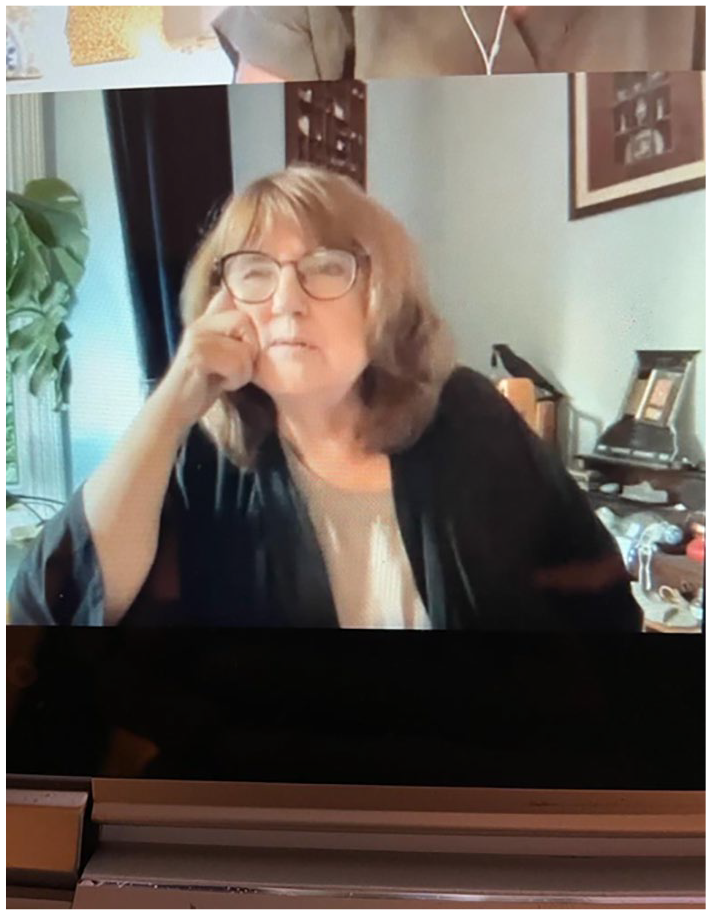
Maggie MacLure had an engaged yet relaxed approach..
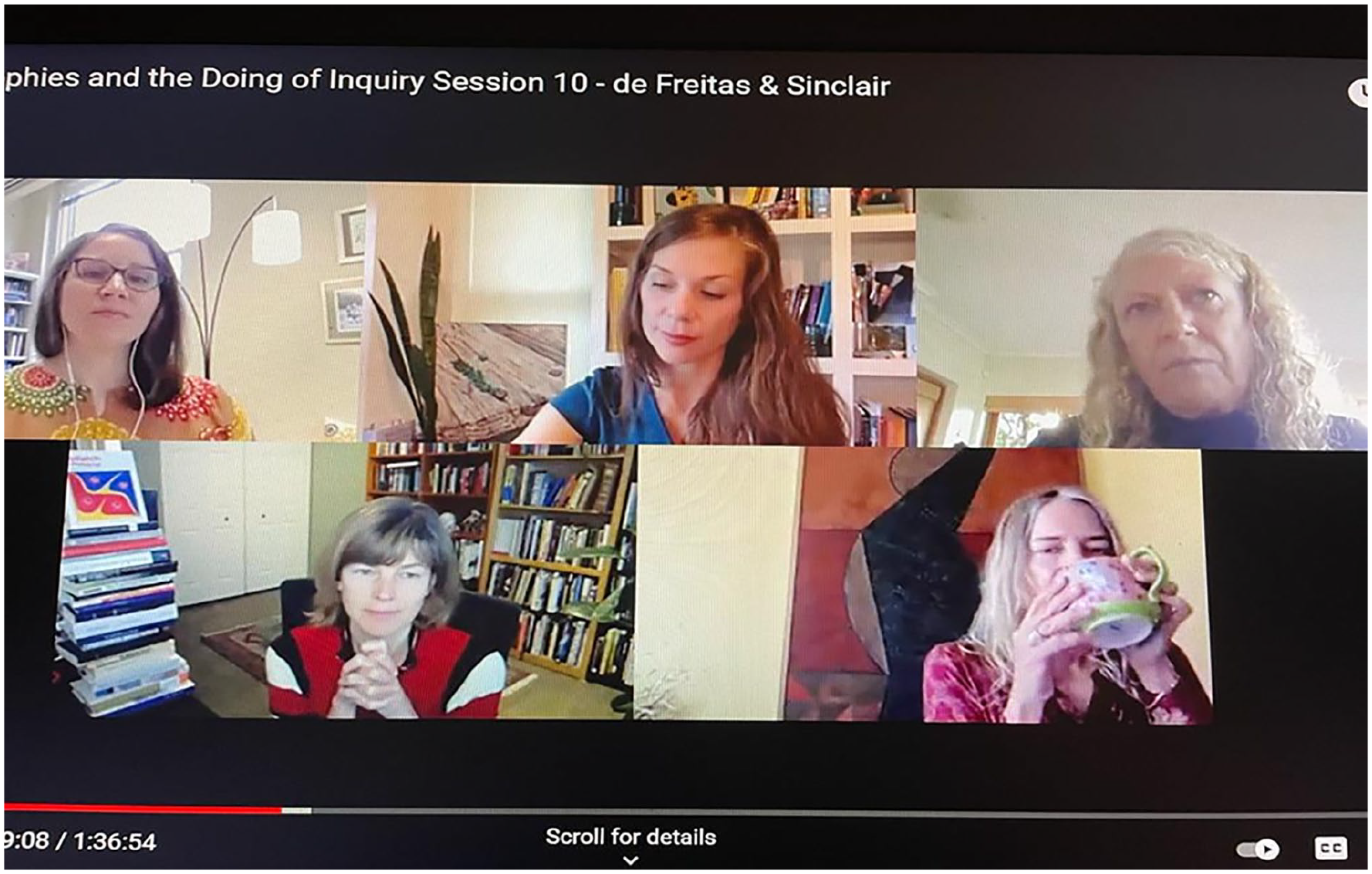
Nathalie Sinclair in Vancouver and Liz de Freitas in New York, with sirens in the background and her puppy underfoot.
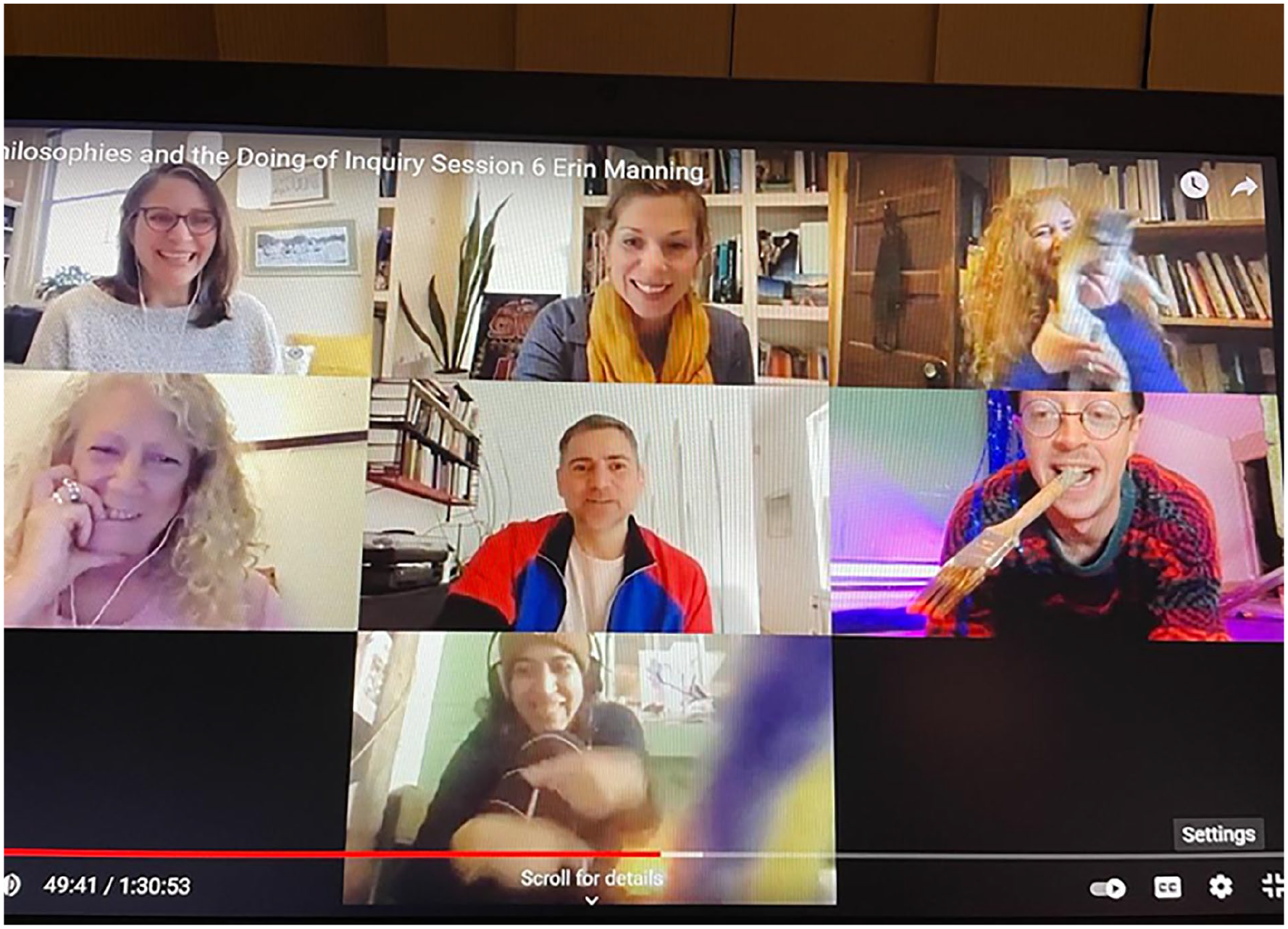
Erin Manning with some of her students and her cat.
Bhattacharya used a Zoom background that created fascinating patterns that moved with her at times, especially when she talked animatedly (Figure 4). Although it concealed any personal context, it also provided an unintentional affective force that we found inspiring. At the start of her live session she explained that she had tried various backgrounds before settling on one she found bright and interesting. We noted with interest that this short informal conversation was later cut when the video was made publicly accessible. This felt like a form of censorship, enforcing conventional, formal, structured ways of being in academia.
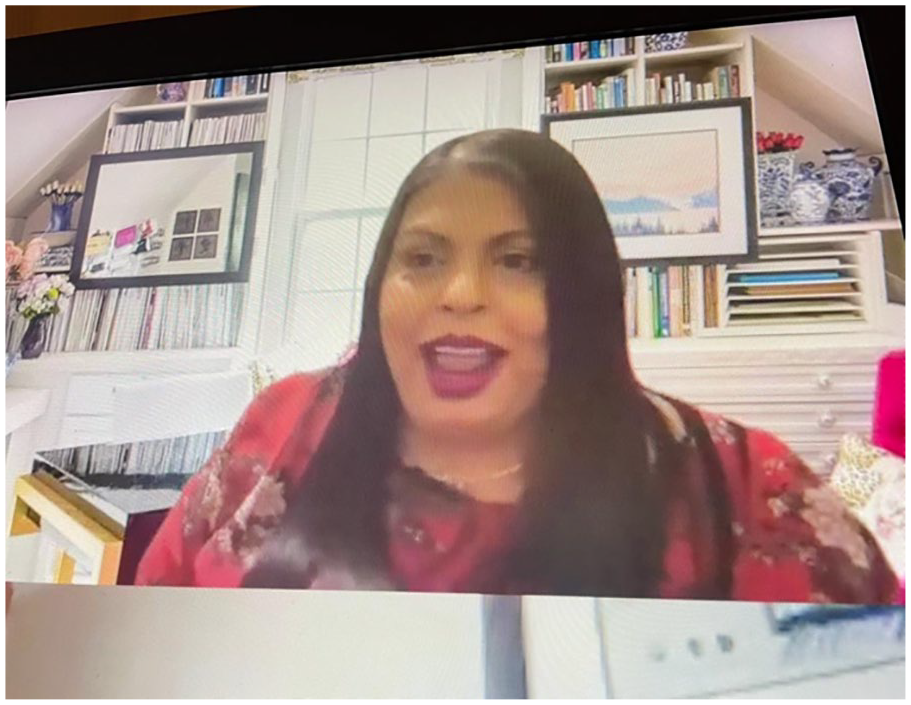
Kakali Bhattacharya and her colourful background which shifted as she moved.
Such intimate contacts with globally renowned scholars are unusual in academia. For us, as early-career research scholars, we are accustomed to the hierarchical power relations that persist in our institutions. These webinars were examples of doing academia differently; traditional power differentials appeared flattened as relaxed behaviors and open conversations were welcomed.
Supervisors and Students
A striking feature of the webinar series was that it opened up unusual conversations and activities between supervisors and their doctoral students. These challenged conventional, static text-based approaches. The dynamic creativity of different relational processes between human and more-than-human others was highlighted by Erin Manning’s session (Session 6). Her students, Helga, Fiego, and Mayra, painted on the floor, wound cord and sticks around their legs, and reorganized objects against a wall. Mayra’s analogy of working with dough was a moment that glowed for us. MacLure (2013) encourages us to be alert to such hotspots in our research. Mayra explained that when others have already massaged the dough, it is then easier for her to add her contribution. In other words, her thoughts about dough-making transferred to thinking about iterative processes where collaborative ideas can emerge more easily when we think from groundwork laid out by others. Mayra expressed how much more comfortable it was for her to follow on from her fellow students’ conversations, echoing Manning’s description of students’ confidence growing through collective endeavors.
The materiality of dough-making highlighted in a creative and fun way the benefits we as students have gained from working with each other and modeling our work on what others have shared, including our supervisors. We are reminded about Barad’s (2015) explanation of lightning striking. It arises suddenly, often unexpectedly. It is not unidirectional but a process involving forces from above and below put forward as “charged yearnings and the sparking of new imaginaries” (Barad, 2015, p. 387). We use an object like dough to think with material that enables us to connect with the thinking and ideas of others. This is a move toward research-creation, a process that Manning and Massumi use to describe their work enacted in the SenseLab, “a laboratory for thought in motion” (http://senselab.ca/wp2). Such an emergent process was enacted through the relationships between the authors, the video recordings, and the sequence of student speakers. We appreciated the students’ public expressions of honesty in sharing vulnerabilities often silenced in academia. These often resonated with our own sense of precarity, such as the reality of funding constraints that affect all aspects of the doctoral journey.
Our doctoral studies, supported by our supervisors, have sought to promote social justice within unjust systems following our individual and collective awareness of the injustices pervading academia. Sarah E. Truman (session 12) referred to Harney and Moten’s concept of the factory-academy. Thompson and Harney (2018) point out the problematic nature of institutional practices, such as the “privatization of reading” and the practice of outsourcing readings to students. The assumption that students have done the readings prescribed to them is entrenched in our learning systems (both in schools and higher education institutions), yet, as they point out, such assumptions are also problematic (Thompson & Harney, 2018). In contrast, our current experiences of interventions such as the webinar series and our reading groups address these issues through fostering collaborative ways of working.
Ezekiel Dixon-Roman (Session 7) shared his own experiences as a student involving openness and generosity. He described how his relationship with his supervisor, Edmund Gordon, a particularly humble person, now 100 years old, spurred him on with his research work. Dixon-Roman is now following his role model in offering a similar mentoring role to his students. As his student Nicole noted, she felt “so lucky to come into the community.” Stephanie Springgay’s (Session 3) student, Andrea Alarcón, explained that she came from Peru and had extra challenges with English as a second language. She expressed her appreciation for Springgay’s generosity, noting how an ethics of care and appreciation for the shared reciprocity resulted in a co-authored article in which Alarcón is the lead author. In this article, drawing on Martin et al. (2015) discussion on the politics of care, Alarcón and Springgay (2020) argue that to foster a caring relationship requires a willingness to engage and the capacity to respond. In contrast to an ethic of care, Springgay recalled an experience in which a senior colleague used her ideas for a publication without including her as a co-author—a common occurrence in academia and an example of power, privilege and unethical behavior. In her webinar, while Springgay supported Andrea she also encouraged her to step into a risky space, to experience the speculative middle. 4
Nicole’s and Andrea’s experiences resonate with our own. Nicole attributed hers to good fortune. We ask ourselves if it is luck or privilege that takes us forward into these unforgettable learning spaces. We are all white women, and the majority of students engaging in the webinars were too. Furthermore, we acknowledge how our work has grown through the generosity of our supervisors who have been willing to deviate from conventional strict academic pathways . They have connected us with experts in fields related to our research, facilitated travel opportunities and enabled playful times together. Acts of generosity have included writing retreats and other thinking/sharing/creating spaces and activities, collective swims, saunas and walks, and travel which provided opportunities to interact with others and develop meaningful relationships. Lieve traveled to South Africa, Sue was part of a two-month exchange program in Norway, and Veronica participated in an affect theory conference in Lancaster, United States.
These face-to-face connections, collaborations, opportunities of networking, and meeting inter/national academic colleagues allowed us to be treated as colleagues in egalitarian spaces rather than simply students. They enabled opportunities to move beyond the usual, particularly in South Africa where academic collaborations are not common (Bozalek et al., 2017).
WEBing
Professors Candace Kuby and Vivienne Bozalek invited their present and former students to engage with additional conversations about the webinars that became known as WEBing sessions. These more intimate, creative and playful collaborative online events deepened our engagement with other students by linking discussions and images (including art-making) to what had emerged from the webinar guests and their invited students. The Google Docs became an open space on which we all shared our learnings and questions on the same “page,” whether through texts or images—a very different experience to being in a lecture hall where the professor holds the power and knowledge taking up a position of center stage at the front. All WEBing participants became equal in the Zoom Gallery view as we shared new insights gained from the Zoom webinars. Our community of enquiry was enriched in multiple ways even as we talked about the unusual enactments that can become real through Zoom meetings, such as the student painting on the floor while presenting to us all.
As we gesture toward different futures through the present, we have wondered about how digital corona-time has connected and separated us during the 2020–2021 period and what is to come. Ethical questions continue to be with us and more so through digital platforms where time and space seem open to infinity. Although webinars have become more frequent as alternatives for on-campus teaching, in-person presentations, and in-house seminars and workshops, we note the discomfort in not knowing what can happen with the recordings and how these might take on a life of their own. Liz de Freitas (2017), for example, addresses sensor technology that can “steal” data from the individual body. In Session 10, de Freitas argues that technology is no longer a surrogate for a human faculty of capacity but instead operates directly on the sensibility of the whole environment that precedes and underlies our own corporeal phenomenal experience (de Freitas, 2017), expanding the distribution of more-than-human sensation.
Connections With Others
During the 14 months of the webinar series, we felt connected which was unusual during that period of uncertainty and lockdowns. Even the act of not having to wear masks during the webinars was important to us and valued. There was a sense of upliftment at the openness that we all yearned for during that time. We felt the benefit of viewing facial expressions as well as a sense of collegiality and collaboration which was a particularly generative experience for each one of us. Additionally, we appreciated being able to listen to and engage with a range of global scholars without having to pay the fees required by most academic conferences.
Through exchanging messages on WhatsApp during attending the webinars, Lieve felt a closer connection with her PhD supervisor, fellow students, and colleagues. She felt happy she could leave behind her geographical location and at the same time have a sense of being with the group she used to sit with reading/writing together in Mont Fleur, Stellenbosch, the Neville Alexander building on the campus of the University of Cape Town, South Africa, and the Jardin-group usually gathering in the “jardin bohemien” or “het moment” in Ghent, Belgium, But she was also pleased to be able to rewatch and re-turn to those recordings where English was spoken at a faster pace, making it more challenging for non-native speakers like herself.
Veronica was delighted to have a chance to see the speakers’ faces and expressions, something that is not possible in the physical space due to her eyesight limitation.
Sue’s competing commitments prevented her from watching many of the webinars; however, the recordings allowed her to catch up and not feel abandoned or excluded. She plans to come back to the webinar sessions after finishing her PhD to delve deeper into the post philosophies.
Another connecting force that kept us tuned in each month was our commitment to our reading group (Bozalek et al., 2021). Our work was enriched by seeing and hearing academics whose work we have read together/apart over the past few years. Our reading and discussions brought to life their concepts which are “intensive: they do not gather together an already existing set of things (extension); they allow for movements and connection” (Colebrook, 2005, p. 1). For Deleuze and Guattari, concepts are not an end point but should provide a way for moving us beyond what we experience so that we can think of new possibilities. Rather than bringing things together under a concept, [they are] interested in relating variables according to new concepts so as to create productive connections. Concepts ought to express states of affairs in terms of the contingent circumstances and dynamics that lead to and follow from them, so that each concept is related to particular variables that change or “mutate” it. A concept is created or thought anew in relation to every particular event, insight, experience or problem, thereby incorporating a notion of the contingency of the circumstances of each event. On such a view, concepts cannot be thought apart from the circumstances of their production, and so cannot be hypothetical or conceived a priori. (Stagoll, 2005, p. 53)
Postqualitative research is immersive and unpredictable. Carlson et al. (2021) point out the vitality, entanglement, and experimentalism involved in postqualitative research. It tends toward immanence rather than being prestructured and bounded. It knots up our ideas about data where we lose the predetermined structure of other methodologies like grounded theory (Ralph et al., 2015). Yet, it does not come without criticism, as pointed out by Petersen (2018) who questions the belief that data and researchers find each other.
Erin Manning (2016) aptly suggests being pulled into something through a sense of sympathy, which “involves exploring, from within the process of study, what the work does, asking the work to open itself to its own field of relations” (p. 38). That movement during the unexpected lockdown time can also be likened to Karen Barad’s (2007) explanation of lightning. Barad explains bolts of lightning as enactments through charged yearnings that gesture outward toward something new.
MacLure (2013) reminds us that we need to take a novel stance in our own relations with our emerging insights, suggesting that we allow data to invite us in 5 ; “to be attentive to data’s invitation; and alert to its capacity to force thought” (MacLure, 2017, p. 51). Thinking through the whole webinar series, we felt the value of building on the work of others. For instance, Shannon and Truman frequently referred to their work with Springgay, and De Freitas and MacLure and St. Pierre all mentioned how they had built their career on top of foundations set out by others ahead of them.
Generating Ideas
The experimentation required in post qualitative inquiry cannot be accomplished within the methodological enclosure. This experimental work is risky, creative, surprising, and remarkable. (St. Pierre, 2018, p. 604, italics in original)
Postqualitative research opens up new potentials for thinking differently and does not confine us to a fixed representational structure. As Carlson et al. (2021) suggest, “the field of the post-qualitative remains disperse, divergent, and riddled with tension” (p. 151). Furthermore, the process of research-creation is complex and contested. Chapman and Sawchuck (2012) identify four different modes of research-creation namely, research-for-creation, research-from-creation, creative presentations of research, and also creation-as-research. While each of these modes seems relevant to our engagement with the webinar series, we focus more generally on research-creation as a valued process that “operates through the tripartite expression of an artistic practice, theory, and research” (Truman, 2021, p. 152). Aaron Kuntz (Session 8) encouraged us to challenge our imaginations to seek elements of creativity which he termed conceptual creative courage.
Our research projects have all included elements of research-creation as described below.
Lieve is involved in a collaborative project creating MadZines in which she experiences how exchanging artworks, scrapbooks, litho prints, and poems allows people to express and share what could not be disclosed before (https://madzines.org/mad-students-call-for-zine-submissions/). Unfortunately, MadZines have no impact factor in terms of the measured value in academia and are therefore not often archived in a library, let alone re-turned or cited as valuable resources for research. Thinking with the adage a picture is worth a thousand words, she is puzzled about how to explain the process of creating together as it needs even more words.
Veronica’s art-in-the-making with research participants creating drawings enabled her to elicit new thoughts that often did not emerge in the conventional dialogues happening in the interviews and focus groups. The relationship of paper-pens-midwife/clinician enacted new ideas, revealing hidden messages of subjugated knowledges. The quote below illustrates the disruption of power differentials that play out within the deeply established hierarchy of medicine, particularly in obstetrics: Actually, what keeps coming back to me is a kind of little weird because it’s not what I thought I’d draw, but it is this—I’m going to draw a little green man. I need to do it this way, this person, this is me and I am doing lots of talking and being very -. Ooh nee [no], that wasn’t supposed to happen. This is supposed to be my eyes, I don’t know. And [I’m] getting all flushed and excited because I am very enthusiastic about what I’m talking about. And I think that I have all the students’ attention. This is my impression; they’re all there and they’re all listening to me and they’re hearing what I’m saying. And then comes somebody who has more authority, more experience and is better educated—“educated” is not really a good word to use, but has higher qualifications than I have. So this person is a lot “bigger,” is what I am saying and they might even frown upon students who might ask questions related to what I’ve said. And then I think all of what I’ve said is [laughs] minimised. (Midwife educator interview transcript, 2015)
Sue has worked on an undergraduate course that employs a photovoice methodology (Wang & Burris, 1997); students respond to a research question, gathering data through taking photos and writing narratives on aspects of their own lives. The photos provide a visual display and force through which students can share their findings more widely, such as in a public exhibition or shared writing project (e.g., Ngabaza et al., 2015, 2013).In addition to allowing educators a glimpse into students’ lived realities, the material agency of the photographic exhibition offers possibilities for enlightening students about aspects of each other’s lives that tend to be hidden, such as mental health issues, food insecurity, differences in gendered chores during the lockdown, and so on.
Truman’s (Session 12) and Shannon’s (Session 13) explanations of their sonic endeavors and walks with music illustrated to us the huge untapped potential in using creative unstructured methods to gain deeper insights into our research projects. Similarly, a focus on process has been important to us. This relational approach was reinforced and demonstrated by many of the guest speakers and their students in the webinar series. A number were inspired by radical French philosophers Deleuze and Guattari who, for example, sought to foster nonhierarchical relationships between carers and those in care in clinical settings through everyday collective activities such as walking together. Such forms of care invited individuals in rather than viewing them as patients with a certain identity needing to be observed and diagnosed. A connected, iterative relationship was developed that valued process.
We recall St Pierre’s (Session 2) crucial advice to “read, read, read!” Reading texts and more texts, recommended by our supervisors, peers and through the webinar series, has enabled us to grow our work and move it in different directions through shifting our thoughts and experiences. Our supervisors have learnt alongside us in efforts to minimize conventional hierarchical academic structures. Our learning together has involved a focus on readings to help us all open up toward multiple perspectives for deeper engagement, particularly with issues of justice in education. Reading—alone and together—has given impetus to our shifting thoughts and actions. We agree with Truman (2021) who notes that the “politics-of-reading . . . reading together, and thinking together, alongside conducting arts practices has been central to the success of [my] project” (p. xix).
Lieve looks back at her master’s thesis that focused on bilingual language acquisition feeling surprised about how that literature alerted her to see how language colors one’s experiences of the world. More reading encouraged her to focus on issues of belonging and diversity as most studies were limited to monolingual language acquisition.
Veronica notes, when I began my master’s degree I was taken aback when one of the first questions that was asked of me, was which theoretical framework had I chosen. This request caused me anxiety then, and along the journey. However, with more reading I found myself switching from action research to grounded theory and then to non-representational approaches.
Sue had a similar experience of discomfort at the start of her master’s degree. For her doctorate, she read Nancy Fraser’s (2013) work and found getting into new theory challenging. At the same time, she was pulled toward postqualitative and posthuman theory but realized that despite St Pierre’s injunction to “read read read,” being pulled in disparate theoretical directions was complicating an already difficult process. As she said: “It is hard to hold lots of things in one’s head.”
Over the 14 months of the webinar series. we felt a back-and-forth movement through the different readings, research activities, and associated new knowledges. Karen Barad’s work is embedded in our emerging, indeterminate practices as we seek out different ethico-onto-epistemological relationships. In terms of the injustices we find in higher education practices, we feel tensions that act as forces disrupting the status quo reminding us about the effects of lightning as we seek out new and more ethical lines of flight. “Because method desires to engage with time . . . it has the capacity to produce a new kind of duration, an alternate temporality.” (de Freitas, 2017, p. 38) As a second disruption, temporal becoming is a facet of learning that tends to be denied in the conventional deficit model attached to student learning and the matter-meaning mixtures that new materialism includes (de Freitas & Sinclair, 2021, p. 11).
Refusals and Disruptions
What became apparent to us was that refusals appear to be a necessary component of academic projects. Eve Tuck’s (Session 11) refusal in her webinar to accept further questions illustrated the setting of boundaries, a skill that we are still learning. Truman (2021) also refers to refusals in terms of her song-making, saying, The songs themselves are the research-creation practice and an engagement with theory: for example, one lyric says, “it’s okay to say no,” which is not a direct rebuttal to Derrida’s “yes,” but in conversation with it; and lyrically/musically many of the compositions engage with queer theory and affect theory. (p. 140)
Lieve thinks about the consequences of saying no which often lead to her being caught up in difficult situations. She remembers being told that others also find it difficult to accept a no because it is not anticipated, and others refuse the no as their expectation is acceptance. Even a no to time spent on work-matters during the European summer holiday is difficult. Such a request seems to be like a barb to those still working in the south during their winter. There is sometimes a need to negotiate refusals, such as when the Cape Town group announces a reading / writing schedule that excludes some colleagues in other time zones.
Veronica recognizes that from a personal perspective she pushes herself not to refuse opportunities that open up for her. She recalls the many limitations imposed on her in her early career due to her impaired vision. For instance, not having a driving license made certain workspaces and learning opportunities inaccessible. She is acutely aware of transport variability influencing student learning even in current times when e-hailing options are available. In her work with students, she continues to grapple with ways to facilitate refusals. The students frequently face a sense of incapacity to say no to various harmful practices that they witness. What is apparent is that the force of curricular tasks directs them to rather become silent bystanders—a practice that will enable them to smoothly move through the obstetrics learning rotation toward reaching graduation.
What has been important for Sue has been the ability to watch the webinars outside of the allotted times, many of which conflicted with her other commitments. The conflict between yes/no is expressed by Sue, saying, I want to say yes for the experience of learning something new, but I don’t want to let people down when I can’t do it. For instance, I said yes to the webinar series but then time commitments meant that it was really a no, but it can still—fortunately—be a yes of sorts as I can go back to them.
This zigzagging movement is not unusual for us as doctoral students as we experiment with different thoughts and actions in our becoming-with others. It is not a straight, linear journey. Maggie MacLure (Session 14) explained the shifting and changing nature of such research, acknowledging how she continues to wonder with changing thoughts.
Possibilities and Struggles
Many possibilities became apparent to us through the intersection of our doctoral studies, the webinars, and our different student teaching endeavors. Despite our struggles, especially through corona-time, we recognize the untapped potentials that are emerging, enabling us not to create sameness as tends to occur with representational approaches to academic research but to move beyond the traditional bounded practices. Kuby and Christ (2020) encourage us to provoke speculative thought from our pedagogical practices. MacLure (2021) has coined the notion of divinatory practices that are speculative, experimental, creative, and affirmative in seeking out unforeseen outcomes. She refers to a quote from Deleuze and Guattari that seems apt for our work: “If thought searches, it is less in the manner of someone who possesses a method than that of a dog that seems to be making uncoordinated leaps” (Deleuze & Guattari, 1995, in MacLure, 2021, p. 502).
The webinars took us out of our institutional containers with their inherent restrictions and boundaries and expanded our learning in a lively and engaging manner. Over 14 months they offered scholars, emerging and established, a form of Slow scholarship, foregrounding values such as attentiveness, depth, openness, generosity, conviviality, collectivity, and process over product (Bozalek, 2021). As such, they have helped us to think more deeply about and beyond neoliberal university processes that emphasize competitiveness, individuality, efficiency, and quantity over quality (Bozalek, 2021). In the more open spaces of the webinars, we felt empowered and disconnected from everyday bureaucratic constraints such as the hierarchies and power dynamics inherent in the ivory towers of academic theory and practice.
We take up the issue of funding that permeates all academic activities and was mentioned in the webinars by Manning, Jackson and Mazzei, and Springgay, among others. There are many different strategies for seeking funding, however, as these scholars noted, there are also many challenges despite funding being critical for research with students. From our point of view, we have been fortunate in many respects. Sue and Veronica both secured scholarships that were useful contributions to living expenses. However, Lieve must fund her own studies by working to be able to study, a common and precarious position to be in. All of us have benefited through our supervisors assisting with travel and/or conference grants. Lieve for instance received a grant to visit South Africa and become part of her supervisor’s reading/writing group, and Sue was part of an exchange to Bergen University in Norway.
We are left curious and wondering what would have incentivized established scholars and educators to participate in the webinar series? Is it an inherent generosity to promote rigorous academic endeavors? Has COVID-19 encouraged them to think about and do things differently, for example through promoting postgraduate students’ research journeys online to an international audience? Or is it also a form of free labor entrenched in academic practices such as peer review processes?
While the acceptance of the product of a doctoral thesis is the end goal for postgraduate students, the process of the research project is often experienced as a bumpy journey and at times a shock to our ways of living. The processes and relationships are never static but rather emerging and dynamic. Barad (2007) reminds us that process is integral to a relational ontology, which also relates to research endeavors that draw on the post philosophies. MacLure (Session 14) promotes a practice of research sensitivity that fosters networks to take research seriously. Our three doctoral research projects resonate with her recommendation that research ought to promote a public good as well as being an intellectual activity. As noted earlier, we all address issues of justice, namely, social injustices witnessed by students in clinical encounters in obstetrics, mental health issues limiting students’ success, as well as aspects of student marginalization, silencing, and exclusion.
Ending Without Concluding
It is the not yet, the yet to come—the immanent—that marks post qualitative inquiry. (St. Pierre, 2019, p. 2)
In this article, we have re-turned to the 14-month webinar series that entered our homes and offices during the COVID months of 2020 and 2021. We consider what work it has done for fostering our scholarly journeys, as three early-career researchers and teachers in higher education. We referred to our own thoughts and experiences as mature students. The webinars offered a sustained online community and created a global knowledge network that could be live-streamed or accessed at later stages through a YouTube channel. Our different research journeys coincided in interesting and unexpected ways during corona-time. We have described how our learning and asynchronous involvement with the webinars has been diffracted through time past, present, and future—thanks to the YouTube recordings that extended conversational times to enable us to expand our understanding of important concepts. We found the webinar series inspiring with honesty from the presenters that revealed cracks in the system that are usually covered up.
In writing this article, we have drawn on the comfortable interpersonal relationships developed over the past few years through serendipitous meetings and connections involving our common supervisor and one of the lead hosts of the webinar series. Open and honest expressions of achievement as well as anxiety and troublesome encounters have permeated our working spaces.
Academia places a great deal of status on doctorates, however, as our narratives illustrate, students’ journeys are uniquely different and often challenging in a range of different ways. We contend that the webinar series enacted a process of collective thought-making that is affirmatively generative and transferable to other academic settings. Despite geographical distancing, we experienced the value of a process that enabled becoming-with others, including material forces.
Footnotes
Declaration of Conflicting Interests
The author(s) declared no potential conflicts of interest with respect to the research, authorship, and/or publication of this article.
Funding
The author(s) disclosed receipt of the following financial support for the research, authorship, and/or publication of this article: This work is based on the research supported by the National Research Foundation of South Africa (Grant Number: 120845).
