




Abstract
Individuals with intellectual disability are often left out of and overlooked in discussions on sexual health and sexuality. Given this, we undertook a participatory theatre research project to better respond to the needs of the individuals with intellectual and developmental disability regarding their sexual agency and sexual citizenship. The project, entitled Romance, Relationships, and Rights arose when the executive director of a community living agency approached researchers at the University of British Columbia’s Canadian Institute for Inclusion and Citizenship to learn about how they, as an agency, could better support their community. To disrupt sexual ableism and traditional theatre hierarchies, we collaboratively turned to participatory and disability theatre with the aim to advance and promote the sexual citizenship of individuals with intellectual and developmental disability, who refer to themselves as self-advocates - those who speak and act with agency. The challenges of equitable co-creation arose throughout the theatre process; the themes of deconstruction/co-construction and uncertainty and liminality reveal the iterative process of centering self-advocate voices.
Keywords
“The message was despite your circumstance or disability you have the right to love and be loved” (Self Advocate Co-Creator).
“Why is the sexuality of those with intellectual disabilities often seen as ‘risky’ or ‘inappropriate’ by teachers, parents, support staff, professionals, judges and the media as well as those with the most daily contact with them?” asks Gill (2015: 2). This question is at the heart of a theatre-based research project, which arose when the CEO of a community living agency approached researchers at the University of British Columbia’s Canadian Institute for Inclusion and Citizenship (CIIC) to learn about how they, as an agency, could better respond to the needs of the individuals with intellectual and developmental disability (IDD) they support regarding their sexual agency and sexual citizenship. The project, entitled Romance, Relationships, and Rights (RRR), entailed a participatory theatre process with individuals with IDD who refer to themselves as self-advocates (SAs) - those who speak and act with agency. The theatre process culminated in public performances for SAs, family members, support workers, researchers, and other stakeholders in New Westminster and Victoria, British Columbia.
SAs are often viewed as lacking cognitive capacity for sexuality, rather than being seen as sexual agents with diverse sexualities. Such beliefs are products of sexual ableism (Gill, 2015). Sexual ableism refers to the systems that imbue sexuality with “determinations of qualification [based on criteria] of ability, intellect, morality, physicality, appearance, age, race, social acceptability, and gender conformity” (Gill, 2015: 3). Sexual ableism produces IDD as a characteristic or condition that disqualifies one from sexual agency and negates the rights of these individuals as sexual beings (McCarthy et al., 2020; Theodore et al., 2018). Moreover, it denies an understanding of disability as a valuable difference that yields unique perspectives of personhood, competence, agency, sexuality, and ability (Gill, 2015: 3). To disrupt sexual ableism, we collaboratively turned to participatory and disability theatre through performative inquiry (Fels and Belliveau, 2008), with the aim to advance and promote the sexual citizenship of SAs. This paper illuminates the experience of SAs, theatre artists, and community partners in creating theatre to disrupt normative assumptions of SAs’ sexual agency. The challenges of equitable co-creation arose throughout the entire theatre process demonstrating how the themes of deconstruction/co-construction, and uncertainty and liminality were enabled by the theatrical devising process, but also challenged that process and its traditional implict hierarchies.
Sensitizing lenses
In Canada, stigma around disability is pervasive and perpetuates inequality in accessing sexual health resources and education.
[D]isability inequity arises from biased notions of dis-ability as a form of tragedy and abnormality, and of disabled people as incapable and dependent. These notions are so deeply entrenched in mass and popular culture that they have come to dominate the collective Canadian psyche. (Delgado and Humm-Delgado, 2017: 111)
Our work is explicitly informed by critical disability studies (CDS) and disability justice “foreground[ing] the experiences and perspectives of people with disabilities, maintaining that disability is a political and cultural identity, not simply a medical condition” (Dolmage, 2017: 10). Rather than viewing disability as something that disqualifies or stigmatizes, CDS affirms disability as a positive, shared identity, a valued part of human diversity (Dolmage, 2017). CDS is a movement that challenges ableist normativity and privilege and is committed to “revolutionary and accountable praxis” to incite radical justice (Erevelles, 2014: 2).
Disability justice activists are engaged in building an understanding of disability that is more complex, whole and interconnected than what we have previously found. We are disabled people who are people of color; women, genderqueer and transgender; poor and working class; youth; immigrants; lesbian, gay, bisexual and queer; and more. . ..organizing and community spaces that are mixed-ability, cultivating solidarity between people with different disabilities. We are working to move together, as disabled people, through a world that wants to divide us and keep us separate. (Mingus, 2011: 11)
Framed by CDS then, IDD is understood as a valuable difference that “yields unique perspectives of personhood, competence, sexuality, agency, and ability” (Gill, 2015: 3). SAs identities are complex and multilayered, not just defined by disability (Lipkin and Haddad, 2018). The term intersectionality (Crenshaw, 1989) centres the complex intersections that constitute a person’s identity and is a key principle of disability justice (Berne et al., 2018).
However, there remains a focus on limitations associated with IDD, erasing the sexual agency and sexual diversity of those with IDD (Gill, 2015). Those with IDD are seen as not possessing the requisite intelligence for sexuality; they are sexually disabled because of such assessments of intelligence. As a result, those with IDD are excluded (Gill, 2015: 41). Positioning IDD as a valued part of human diversity upsets normative assumptions and promotes pluralistic embodiments of sexual agency recognizing the privileges and sexual rights that ableism affords non-disabled persons (Schnellert et al., 2019). Individuals with IDD are demanding and reclaiming their rights. Through self-advocacy, they are exercising self-determination and making known their goals and desires, demonstrating resilience and resistance to oppression (Anderson and Bigby, 2017). In this theatre-based project, we therefore strove to centre the voices and experiences of SAs to disrupt societal misperceptions about their abilities and rights to advance their sexual citizenship.
Researchers across diverse fields are increasingly turning to theatre-based practices to co-create with and share the voices of SAs to illuminate inequities (Delgado and Humm-Delgado, 2017; Lipkin and Haddad, 2018; Massa et al., 2020). Socially-engaged theatre aims “to improve the lives of individuals and create better societies” (Nicholson, 2014: 3), defying tropes of the expert “Artist” (7) and recognizing the artistic potential in each of us. From using participatory theatre to legislate inclusive consent laws for people with IDD in Ireland (Arstein-Kerslake and Flynn, 2016) to creating a Forum Theatre scene to engage audiences in “Reimagining Parenting Possibilities” in Canada (Ignagni and Fudge Schormans, 2016), theatre can be an effective tool for SAs to share their own stories on their own terms. Participatory theatre can create spaces for constituent groups to claim agency and shed light on issues that are too often ignored (Kuppers and Robertson, 2007; O’Connor and Anderson, 2015), in particular sexual health (Garbutt, 2009; Löfgren-Mårtenson, 2012). However, intersections with sexual health and acknowledging SAs’ rights as sexual beings remains an under-explored and under-researched area (Garbutt, 2009; Ignagni and Fudge Schormans, 2016). For SAs, who are often denied access to sexual health education and deemed by society as non-sexual, the use of theatre can illuminate these injustices and spark a dialogue to foster social justice. A community-based participatory approach is key in that “designing programmes to sensitise the public about [IDD] and their sexual and human rights can bring about positive attitudes towards such individuals” (Phasha and Runo, 2017: 367–368). Yet within previous theatre initiatives that espouse the importance of SAs holding power in the creation and research process, the problematic use of the phrase “giving voice” (Garbutt, 2009: 19) unwittingly reinforces the power inequity between disabled and non-disabled folks where SAs’ agency cannot be claimed but only granted.We looked to disability theatre to challenge and expand participatory theatre research approaches. Disability theatre “interrogates society’s – and theatre’s – overwhelming preference for whole, independently functioning, rational-minded persons. . .[that] challenge both the form theatre takes and the normative concepts that underpin its enduring structures” (Hargrave, 2015: 9–10). By embracing disability justice, disability theatre can decentre normative concepts underpinning socially-engaged theatre practices (Beck et al., 2011), not only its performance/product but in development processes as well. Aligning with the “ethos of community-generated theatre circumvents the inescapable problem of representing or speaking for marginalised communities. . .effort is made, instead, towards self-advocacy enabling others to represent themselves” (Preston, 2009: 67). Processes must be responsive to community needs and align with CDS values in constantly re-evaluating accessibility and equity at each step. We sought “to shift our focus from the central stories we constantly recycle and, instead, hold space for diverse stories, ways of being, and seeing the world” (Schnellert et al., in review). Therefore, our (emergent) theatre form approach in RRR incorporated practices from previous innovations and recognized the need for SAs to co-develop theatre interventions/research.
The original proposal for RRR outlined a participatory theatre approach in which SAs would play integral roles as actors and advocates in sharing the message about the sexual rights of individuals with IDD. Leavy (2018) argues, such approaches can “unsettle stereotypes, challenge dominant ideologies, and include marginalized voices” (10). Participatory theatre aims to empower co-creators to “make and perform theatre themselves. . .[however this] might involve a high level of facilitation by an applied theatre artist to enable decision making and performance by a community” (Prentki and Preston, 2009: 10). We drew together theatre practices that engaged SA co-creators as actors in performative inquiry (Fels and Belliveau, 2008) and facilitated the play-building process through storytelling, guided imagery, and improvisation. “Playbuilding is a participatory dialogic form of research that seldom remains static” (Norris, 2016: 46).
The theatre/research method transformed through discovering and responding to ethical challenges within the devising and aesthetic production aspects of RRR. We discovered that even in participatory theatre, the “contours of ableism” (Kumari Campbell, 2009) are persistent. Theatre with individuals with IDD must be seen “as theatre, rather than as theatre merely in the service of something else, namely therapy, socially engaged practice, or normalization and inclusion. The aesthetics of this form of theatre is in many ways its politics” (emphasis in original, McCaffery, 2020: 2). Particularly for SAs, claiming agency over the work is integral; it is the role of ally partners to encourage without overstepping. Instead of recreating systems of inequality by making theatre for SAs, SA perspectives and stories should be central to the research as collective creation. Of particular importance is recognizing SAs who identify as LGBTQIA2S+ who often face a double burden of stigmatization (Lipkin and Haddad, 2018; McCarthy et al., 2020). In this project, we sought to recognize intersectionality across identities to reflect the unique experiences of SAs and from “stage to page” have continued to centre SAs’ voices and experiences throughout this article.
Theatre Project: Design
We received a three-year grant to engage in a participatory action research project with two phases. Phase One encompassed a qualitative study interviewing SAs and sexual health educators about sexual health, and focused on developing cross-organization collaborations with CLS, CIIC, and the City and its Theatre. Phase Two involved creating a participatory theatre production. A steering committee with representatives from all the partner organizations was established and met to plan for SA involvement, recruit undergraduate and graduate theatre students and professionals, and negotiate logistics. Three members of the steering committee took up the role of inclusion facilitators in the participatory theatre production to provide support to SAs regarding safety, consent, and advocacy.
To begin Phase Two, theatre facilitators (including LS) offered drop-in workshops introducing participatory theatre techniques to SA non-actors. No mention of a research project or sexuality and sexual health was taken up during the drop-in workshops; however, an opportunity to join a theatre Company was advertised. Fall drop-in workshops featured Boal’s (2002) theatre games for non-actors and activities regarding communication and consent to build SAs skills in theatre-making in a safe and supportive environment. Based on experiences in the drop-in workshops, SAs could choose to be part of the theatre Company that would start rehearsals in January. Joining the Company involved participation in the research where theatre creation was positioned “both as a means of meaning-making and as a form of presentation” (Norris, 2016: 42). Instead of relying on the personal stories of SAs to inform the theatre process, the Company utilized “critical distance” (O’Connor and Anderson, 2015: 37) to explore SAs’ sexual health based on “external resources” (Norris, 2016: 45). This included working with a sexual health educator to brainstorm and discuss the barriers and challenges that face SAs in accessing sexual health resources and asserting their rights as sexual beings, as well as sharing stories from community members about SA romantic relationships. To examine these external resources, the Company used a floor-to-ceiling whiteboard to brainstorm important themes, opportunities, positive stories, and needs. We then identified messages we wanted to send to audiences regarding misconceptions, assumptions, and barriers regarding opportunities for relationships, romance, and citizenship.
Through a practice of play-building, we developed these messages into scenes by creating tableaux, then bringing them to life (Norris, 2016), amplifying issues that are under-discussed in families and community-living contexts (Gill, 2015). Within this performative inquiry, members of the creative team “develop[ed] the ability to listen for and recognize moments of learning, moments of risk, moments of possibility where participants learn about each other’s perceptions within present and imaginary worlds” (Fels and Belliveau, 2008: 35). During this time, a production team of theatre artists joined the project to assist with mounting scenes created by the SA co-creators in a traditional theatre setting. All involved were introduced to the emergent participatory theatre form, and yet had to design a technical traditional production. Based on the desires and vision of the SA co-creators, the performances consisted of three scenes related to romance, relationships, and rights to sexual citizenship, and less about sexual encounters, sexual health education, and consent.
Methodology
This study took up participatory action inquiry (PAI) (Reason, 1998) seeking SA co-creators’, theatre artists’, inclusion facilitators’, and steering committee members’ thoughts, experiences, and perspectives regarding their experience in and through participatory theatre. Within this participatory paradigm (Heron and Reason, 1997), we centered SAs’ perspectives and experiences within the research just as we did within our participatory theatre process. Our commitment to an emergent, community-engaged process allowed us to evolve the scope of the project in response to the needs and vision of SAs. Critical PAI recognizes that collaboration between community groups and researchers strives for social awareness and change (Garbutt, 2009). “For action researchers, social inquiry aims to generate knowledge and action in support of liberating social change” (Greenwood and Levin, 2000: 94). This methodology supports our commitments to disability justice.
In this paper, we focus on the experiences and insights of the SA co-creators, theatre artists, inclusion facilitators, and steering committee members and only include minimal audience perspectives. While the tensions of aesthetics are explored here, we more fully articulate the art form and its integrity in another publication, as well as highlight audience impact (Schnellert et al., in review).
Methods
When taking up performative inquiry within PAI, the collective creation process is a form of data in itself. To understand this, six post-performance focus groups were conducted with thirteen SA co-creators, five front of house and technical support SAs, three inclusion facilitators (IF), three researchers, and five theatre artists (TA). The steering committee included one SA, three inclusion facilitators (IF), three researchers (one of whom was also co-director) as well as two community organization representatives (see figure 1). Additionally, one TA participated in two focus groups. Focus group questions involved exploring participants’ experience with the project/production. Focus groups were digitally recorded and transcribed verbatim. Additional data were the process of theatre-making itself. Ethics approval was granted by the University of British Columbia’s Behavioural Research Ethics Board.
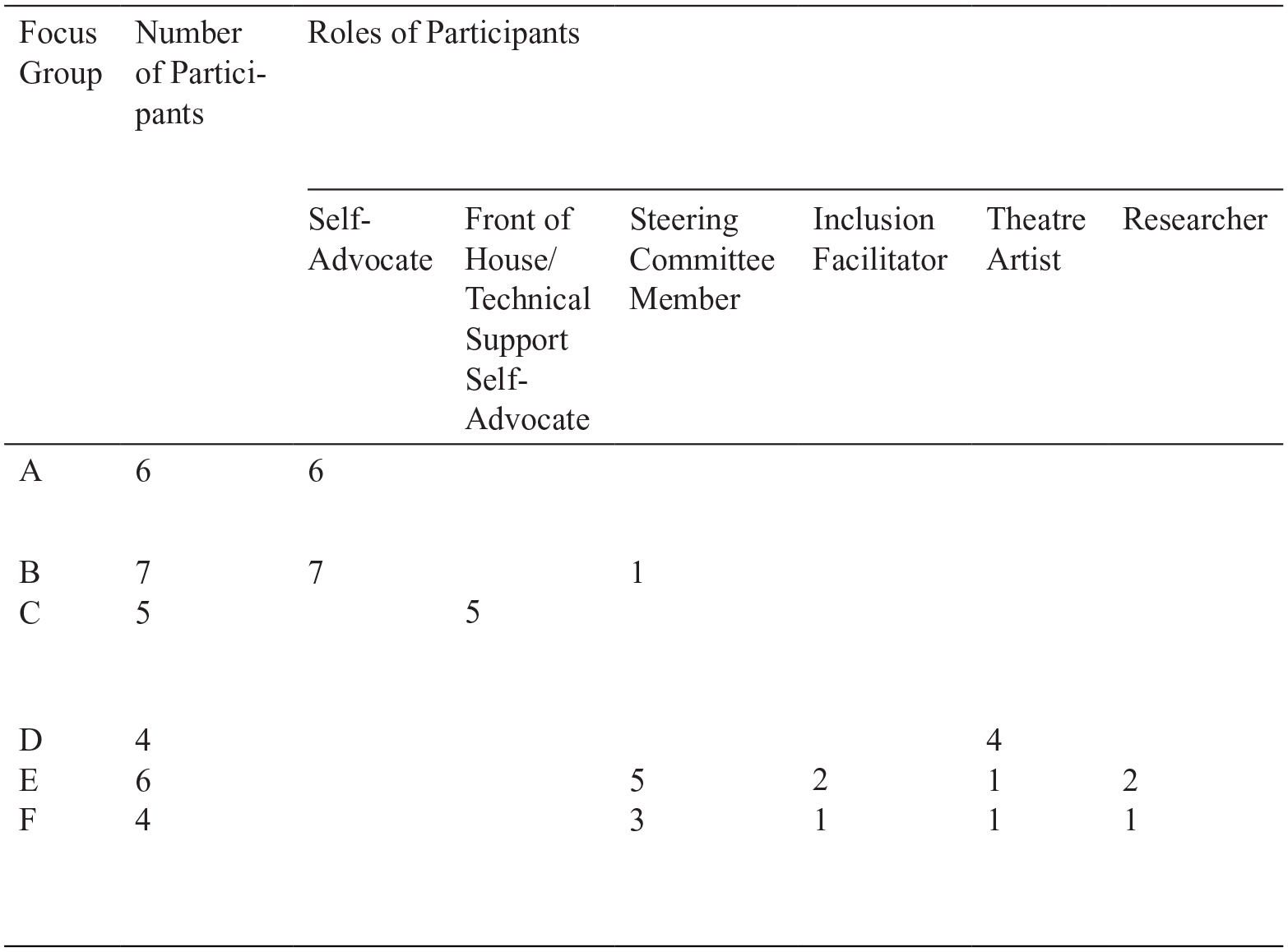
Focus Group Participants and Roles in Romance Relationships and Rights.
Some participants held multiple roles as depicted in figure 1 as well as figure 2, many of which emerged as the project evolved.

Multiple Roles of Research Participants in Romance, Relationships, and Rights.
Additional data collected included audience member post-performance feedback surveys, six phone interviews with audience members, researcher field notes, documentation of the performance, after-performance talk-back with audience, media coverage, and audience members’ post-performance feedback forms. Data from the focus groups and research field notes are the primary data analyzed for the purposes of this paper.
Data analysis
Interviews were transcribed and inductively analyzed. With the research questions in mind, LT open-coded six transcripts, while LS and RH open-coded three transcripts respectively. The researchers met to share codes, and generated categories to ensure that all relevant data were adequately described. Subsequently, we reviewed all remaining transcripts. Content of categories was reviewed for coherence, and candidate themes were tested by creating coding trees. The most salient themes were confirmed and supported with illustrative transcript extracts. To reduce the risk of bias and address analytic validity, we reviewed the descriptive accounts of categories and cross-referenced data using the transcripts with disagreements resolved via consensus. In this paper, we use participant quotes to support the interpretive validity of the analysis.
Our analysis reflects our collective creation process that was emergent and multilayered. Through the themes of uncertainty and liminality and deconstruction/co-construction, we offer a framework in which to share understandings of a complex and evocative project. While we have separated our findings into two themes, they are not discrete but rather interlocking, informing each other to deepen our understanding of each.
Findings
Navigating Liminality and Uncertainty
Liminality arose as a prominent theme throughout the theatre creation process. The emergent drama process provided a “liminal space of interaction” (Fels and Belliveau 2008: 25) of learning and unlearning. Through SAs engagement in this participatory theatre form, ideas and issues related to sexuality emerged within this liminal space. Offering a creative space to address the taboo subject of SAs’ sexuality normalized conversations about healthy sexuality and shifted perceptions. Almost every SA reflected on theatre’s unique ability to share their message regarding sexual rights. One SA co-creator stated, “Everyone should get the chance to love. That’s an issue for people with and without disabilities.” Another SA, whose mom was an audience member, shared, “I taught her lots. I got to be a teacher for my mom. It’s cool that drama can do that.” Furthermore, collaboration between SAs, TAs, SC members, and IFs reconstituted roles and repositioned SA co-creators as knowers and “experts” within the emergent theatre form. SAs experienced a strong sense of ownership and belonging: “I felt really happy to be part of a group, a company. We built a community of friends” (SA). However, there were unsure moments on the part of TAs and IFs regarding how the participatory theatre process would result in a polished production. Reflecting on the process, one TA suggested, “I think it would be exciting to be even clearer from the get-go about what we understood the final product should, how ought it to look and what will make everyone feel good.” Additionally, an IF remarked on the perceived uncertainty some SAs felt about the process: “I think they were anxious, she [a SA] was one of the people that was anxious to actually get on with the production instead of all the learning about the theatre.” Although honouring the diverse voices and abilities of SAs produced experiences of uncertainty, the iterative positioning of SAs as co-creators was essential.
One strength of holding our creative and research process in this space of uncertainty and liminality was the ability to respond with dexterity to each idea and issue that arose. The not-knowing process led to innovation, addressing challenges in practice with immediacy. The process required immense adaptability and creativity: “We also need[ed] to be creative and roll with and make decisions at the last second” (TA). While the performances themselves were placed in a traditional proscenium theatre space, the creative process was far from traditional. Instead of re-creating public education structures around sexual health, we offered a unique opportunity to challenge these structures through participatory theatre. The project represented an “education and paradigm shift in people’s ways of thinking out into the community. . . [and demonstrated] that creatively you can do things differently that will have a huge impact without necessarily thinking inside the box” (SC). However, working with uncertainty and liminality offered challenges in the process and the transition into the performance product.
For SAs, TAs, and IFs, there was a high level of uncertainty in how our work together would develop and what the performance would look like in its final form. An IF remarked on their uncertainty in how theatre production and diverse community partners could come together: “I mean I’ve been involved in producing theatre in the past and I’ve worked in the community living sector for a really long time, but I hadn’t really seen a way that these two worlds intersected.” The hybridization of diverse theatre/research processes required an environment of recursive discussions about what the process would entail, how it would evolve to meet the needs of everyone involved, especially SAs. Patience was required throughout tensions and misunderstandings. As one TA reflected, It’s a learning process as well from the steering committee and the research committee essentially coming from two different worlds and being like, “I thought we were doing this.” And “I thought we were doing this!” And then trying to figure out that middle ground.
The collision of diverse worldviews required building trust between all collaborators to balance what they perceived as the boundaries of their roles with a shared commitment to centre the feedback from and needs of SAs.
In traditional theatre, there are often delineated roles and a hierarchy of decision-making that facilitates the smooth transition from rehearsals to performance. However, participatory theatre unsettles the rigidity of roles (see figure 2) and disrupts hierarchies to encourage collective decision-making: “It was like every single aspect of this beast was devised, even our design jobs” (TA). The collision of diverse theatre worlds became an ongoing negotiation regarding who had creative control as to when the devising process was over. Another TA underpinned the tension between participatory and traditional theatre: “There were too many goddamned cooks in the kitchen in terms of creative decisions.”
While there is an ongoing debate between process and product amongst theatre practitioners (Leavy, 2018; Norris, 2016), this tension in our work revealed a discomfort with uncertainty even as it led to learning. One SA stated, “I learned so much about being a show-off, a professional.” This “learning cannot be scripted but emerges in the interactions between those engaged in inquiry” (Fels and Belliveau, 2008: 35–36) and collective creation. Key moments of learning revolved around the multiplicity of each collaborator’s role and the ability to adapt roles to meet the needs of the community/SA co-creators. The tensions between theatre worlds resulted in reflections from many of the TAs about how their practice grew to be more inclusive: It was really cool to work with people that I normally wouldn’t work with in this collaborative form that turned out actually quite rewarding and really beautiful because it was like they [SAs] were able to hear their voices for the first time, and have their voices be heard by other people in this really like, tangible form.
Another TA reflected, “The fact that the self-advocates really produced and were part of [the project] at the end was probably the most rewarding part of the process.” The tensions throughout the process revealed issues in traditional theatre that privilege non-disabled perspectives on stage. The inclusion of SAs as central actors—theatrically and as agents of change—demonstrated that theatre can be transformed from an elitist space to an inclusive environment.
Deconstruction/Co-construction
Working from a space of inclusivity requires an acknowledgement of power and how dominant narratives are constructed and deconstructed. For folks with disabilities, too often this results in a denial of agency, people speaking for SAs and not “recognizing wholeness” (Berne et al., 2018: 228). One SC member indicated this power dynamic: We have a long history of doing things to people with disabilities. And the next easiest thing is to do it for them. And this production would have been a lot less work to just do things for them. But it would have lost its purpose. And instead, you did it with them.
The time committed to co-constructing with SAs instead of re-creating power inequities on stage led to a deconstruction of stereotypes about SAs and sexuality. As we sought to remove the capital A in “Artist” (Nicholson, 2014: 7), the artistry and expertise of each collaborator was acknowledged as essential to creating a performance that reflected the community itself. One SA co-creator distilled this idea into a single phrase: “We were all the students and all the teachers.” As mentioned in the previous section, this method of collective creation challenged TAs’ expertise and previous knowledge about theatre-making: “It was a huge learning process for me for sure” (TA). Learning to hold space for each collaborators’ contributions was a cyclical process of examining assumptions and adapting to an evolving creative process.
In addition, there was a range of diversity amongst SAs that highlighted various perspectives. One SC member stated, “I was struck by the diversity of disability.” With a commitment to disability justice, “the diversity of the actors” (IF) was crucial in highlighting the complex and interconnected ways in which disability and sexuality construct our understandings of self and representation. Indeed, an audience member reflected that there was an “amazing range of abilities present here.” The diversity amongst SAs was also remarked on by SAs themselves in working together as co-creators: “I learned how to work with different levels of disability.” This internal diversity led to a richer process of co-construction and allowed for nuanced lived experiences to be shared on stage. The representation of diverse abilities and intersectional identities illuminated a unique quality of the project centering our commitment to inclusion and disability justice: I’ve definitely been involved in theatrical projects that. . . involved people with diverse abilities in the past but I hadn’t seen [such diversity in terms of disability], actually. . .I think I learned a great deal about how social theatre and devised theatre can work in a truly meaningful inclusive way. (IF)
A telling example of deconstruction and co-construction by SAs is highlighted by a change in name. The original name for the production, as decided by the steering committee was Sex, Lies and Citizenship. This title became a point of tension and needed to be changed to reflect the areas SAs wanted to explore and their comfort with the topic. After much brainstorming by and discussion with SAs, a new title, Romance, Relationships and Rights, was chosen. The previous title that included “sex” became a barrier to involvement for SAs working as co-creators, partially “because their families didn’t approve of the message, even though they didn’t know what the message was going to be” (IF). As one IF stated, the transition from the “aggressive” title to one that “was a lot softer” reveals deep-seated stigma about SAs’ sexuality while simultaneously offering a title that was “a lot more inclusive in terms of the range of topics that could be under that umbrella” (IF). The shift from “sex” to “romance” was a key distinction that SAs chose and indicated a transition of ownership over the project by the SAs. The change in title also demonstrated that each aspect of the participatory theatre process, even the name of the project, was open for exploration and reflexive to the needs of SAs.
The process evolved each day to reflect the ideas of SAs and sought to deconstruct the social stigma of SAs’ sexuality. Therefore, offering a safe environment for creative expression and exploration was vital. Many devising rehearsals, and well into the production itself, focused on understandings of consent and what that looks like in a theatre setting and in a sexual encounter. In the dual role as researcher and theatre facilitator, LS worked in partnership with a sexual health educator to facilitate “consent work [in] every workshop but. . .until you live it, how do you know what the opportunities and the risks are” (LS) in unpacking sexual experiences? Using questions such as, “What are you comfortable with and what’s appropriate?” (LS), allowed collaborators to examine what consent looks and feels like in a theatrical space that could translate into more intimate settings. Two SA reflections underpin these ongoing conversations about consent: “How people with disabilities and limitations can socialize, be in relationships, and try dating. We all have rights. The right to say no, the right to have relationships within our desire and consent” and “You have the right to say no. . .I could kiss every guy here but I got to ask them, because of consent.” As discussed in the literature review, the discourse of SAs’ sexual health is often centered upon risk and abuse (Finlay et al., 2015; Gill, 2015), a sentiment reflected in one SAs’ statement: “We have to let the community know to respect other people’s boundaries. You have rights. You have to say and do what you want.” While recognizing risk and statistics on experiences of sexual abuse amongst folks with IDD, we strove to balance these important conversations with an emphasis on relationships, pleasure, and love. The recognition of SAs as whole sexual beings was reflected in an audience member’s feedback on the performance: “Even when a person is non-verbal, they can still communicate love & happiness and consent.” The intersection of love, happiness, sex, and consent fostered strong emotional understandings of consent beyond legal jargon.
Within these co-constructed understandings of consent that were negotiated throughout the creative process, rights-based language arose as it was in the newly-created title and indicated the agency of SAs. Rights-based frameworks offer the potential for change where SAs can lobby to address the divide between who has rights and whose rights are actually upheld. However, rights-based language has its own critique, and many disability scholars are shifting towards disability justice (Berne et al., 2018; Onazi, 2020). The use of rights-based language and interventions is problematic since “many labeled people [or SAs] do not have access to rights information. . .[and] when such information is at hand it is not always in an accessible format” (Ignagni and Fudge Schormans, 2016: 252). The creative process therefore strove to utilize accessible methods of knowledge sharing and lived experience that expanded upon rights and instead turned to disability justice.
The co-constructed process meant that stories were shared, examined, and explored on stage through various drama activities, including tableaux and still image work, group brainstorms, improvisation, and co-writing scenes. The use of various and adaptable drama techniques strove to illicit ideas for scenes from SAs. As one SA stated, “We did lots of improv at the beginning and I got to create the first scene.” Throughout these exercises, finding accessible means for each SA to share their ideas was integral: “I really liked brainstorming on the wall, it was all our ideas, instead of just [Author]’s ideas” (SA) and “I got to create a scene and learn about online dating. My stuff made it into the play” (SA). Furthermore, one of the SC members depicted the evolving nature of the process: I think the way that [SAs’] stories informed the scenes and then the ways that the individuals who are in the cast took those stories and actually turned them into workable scenes and then acted those scenes, I mean I think there was a way of just really, full involvement from start to finish at every level of this from like the interviews that were sourcing these ideas that were turned into scenes and then you know the decisions around the dialogue and all that, like really, the ways that folks were involved at every level of that, in a really meaningful way and in no way did it at any point seem tokenistic.
Instead of tokenistic, our process strove for true collaboration where SAs’ voices were heard in their various forms. As one SA reflected on their experience, “It was wonderful to co-create. I can actually do theatre.” The iterative process of creation offered an examination of SAs’ sexual rights and expression that went beyond surface-level collaboration and instead fostered a sense of ownership over the project.
Furthermore, the evolving nature of roles in the process became a central component that amplified SAs’ voices and challenged each collaborator to adapt to the evolving needs of the community. For example, as SAs became more central in the creative process, the IFs shifted from being primarily support workers to advocates as part of the creative team. Their supporting roles evolved to become co-creators who asked questions about accessibility and inclusivity as SA allies. One IF described this evolution, “At some point I got pulled into other areas which was fantastic and wonderful, [and] there was lots of learnings working with so many different groups of people.” The layering of roles became a strong indication of the intersectional identities and strengths that each collaborator brought to the process while also challenging preconceived ideas about participation and artistic creation. For one SA, playing the role of a caregiver was especially impactful and allowed them to explore experiences outside of their own through theatre: “I liked being a caregiver. I liked being someone else. I got to be in charge. I showed that caregivers can learn. They can teach me, but I can teach them.”
Yet, critical engagement with our own roles and how to truly collaborate without overshadowing the voices of co-creators was key in co-construction and deconstruction. In focus group discussions, a critical dialogue arose about optical allyship versus being a true ally and indicates hooks’ call to be “deeply critical of the colonizing impacts of attempts to ‘liberate’ and speak ‘for’ oppressed communities” (as cited in Preston, 2009: 67). This distinction can also be made in the difference between holding space for SAs’ voices to be heard as opposed to “giving voice” (Garbutt, 2009: 19). For some collaborators, there was an uneasiness with the shifting roles of IFs and the issue was raised that there were moments where attempts were made to speak for SAs instead of to speak on behalf of SAs. One SA stated, “I want people to know that I like when people help me, but I can communicate for myself too.” Since the topic of support workers infringing on SAs’ sexual rights became a key theme in the performances, the irony was indicated that perhaps the IFs “were a lot like the caregivers that the self-advocates were complaining about in the show” (TA). The distinction was made though not in how IFs were working with SAs, “but it was how they talked to us about the SAs” (TA). Several TAs had limited or no experience in working with SAs before this project and stated that while this is what they perceived, they felt that they did not have enough experience to raise their concerns. As discussed previously, there was also tension around the collaborative nature of the theatre-making process that may have contributed to this critical observation.
Discussion
In each phase of RRR, navigating uncertainty and liminality and deconstruction/co-construction was a constant. Working with multiple community partners required a reflexive praxis where various forms of knowledge and experience were woven together. Participatory theatre relies on decentralized power structures that, while messy, often result in more honest depictions of the stories that co-creators want to share (Fels and Belliveau, 2008). Meaningful engagement with SAs led to learning for each collaborator involved and built towards transformative insights. SAs were more than participants, they were co-creators in the process, collaborating with theatre practitioners, in addition to researchers from UBC’s CIIC and community partners from CLS. As we reflect on our process, however, we are struck by the tensions in advocating for SAs to be central to such processes while recognizing our own limitations in not doing enough to include SAs voices in the planning phases.
While project planning and partnerships were formed in fall 2016 in preparation for a Vancouver Foundation Grant proposal in early 2017, SAs did not have true voice in the project until January 2019. Due partially to grant application requirements and the uncertainty of receiving funding, the early planning process occurred with minimal input from SAs as there was no assurance that the project would occur. As allies leading the planning process, our intention was to align resources and partnerships to offer a structure for co-creation. We recognize now that by striving to establish a structure for SAs, we limited SAs’ full participation as co-creators. Indeed, some of the SAs voiced a desire to be more involved in every aspect of the work. For example, the creative team met in the mornings prior to devising workshops and rehearsals; to continuously hold SAs voices as central to the process, interested SAs should have been invited to those meetings. As researchers and theatre makers working with SAs, we must strive to answer Preston’s (2009) call: “[W]e have a responsibility towards ensuring that the representations that are made are produced through a climate of sensitivity, dialogue, respect and willingness for reciprocity” (65). Creating with instead of for SAs is an important contribution of participatory research/disability theatre practices, with respect as essential to the process.
The aim was to hold space for SAs’ experiences and expertise to guide our creative process through the disability justice principle of “Leadership of Those Most Impacted” (Berne et al., 2018: 227). By working from this paradigm, uncertainty and deconstruction were almost guaranteed and even sought after. SAs, IFs, SC members, and TAs all expressed the challenges (e.g., time) and benefits (e.g., SA engagement, pride, and ownership of the work) of making space to be responsive to SAs’ ideas and needs. As Ladkin (2005) argues, when working collaboratively, there is always “an edge of uncertainty about the whole process, a wondering of where it all might be leading, but an acceptance (by most members of the group) to carry on without needing a fixed endpoint” (115). The edge of uncertainty was particularly evident among TAs with traditional theatre backgrounds who were adjusting to inclusive co-construction practices within a participatory paradigm. Our dialogic themes of uncertainty and liminality and deconstruction/co-construction reflect a participatory theatre approach that challenged traditional theatre hierarchies, asking all involved to adapt to iterative processes of theatre-making with equity-seeking communities.
Processes of disruption in this project exposed “contours of ableism” (Kumari Campbell 2009) that perpetuate sites of oppression within well-intentioned partnerships and participatory theatre practices. For example, it was only as we moved to dress rehearsal that it became evident that the contributions of three SAs were not translating to the audience within the sound design. Projections were inserted to articulate the words/perspectives of SA co-creators within the scene. By realizing these practices of exclusion and taking action, heteronormative and speech-centric assumptions and structures were communicated to the audience and revealed to the Company. Transformative understandings and practices were derived through cycles of tension, reflection, negotiation, and co-creation. These processes inform our ongoing work together as SA co-creators, TAs, IFs, researchers, and organizations.
Participatory theatre cannot be positioned as a panacea that will ensure social justice and equity in research with diverse populations (O’Connor and Anderson, 2015: 31). As Freebody et al. (2018) argue, “like public policy, applied theatre for social change has to establish a problem that needs to be solved” (139). However, such problems are due to deep-rooted social issues that require ongoing attention to their complexities and contradictions. We do not want to suggest that theatre projects such as RRR create solutions that solve these issues. The stereotypes and stigma surrounding SAs’ sexual rights has created disparity in access to sexual health resources and often has resulted in SAs being denied agency in negotiating their own sexual health needs and desires (Garbutt, 2009; Ignagni and Fudge Schormans, 2016). While previous research has focused on SAs’ rights to become parents and challenged ignorance regarding sexuality, parenthood, and IDD (Theodore et al., 2018: 191), there remains an underlying and under-researched issue regarding SAs’ sexuality and rights and the need for disability justice. “Disability Justice is a vision and practice of a yet-to-be. . .in the width and depth of our multiplicities and histories, a movement towards a world in which every body and mind is known as beautiful” (Berne et al., 2018: 229).
Within this practice of the yet-to-be, we posit that participatory theatre offers a platform in which a myriad of ways to communicate and be in the world can be honoured. As one SA shared, “It was a new way to communicate, through acting. I was really proud of what I did. I think I got better at acting. I felt it in my heart.” Theatre has the power to bring SAs and community partners together to create and share stories through diverse modes of communication. RRR engaged co-creators, partners, and audience members beyond spoken language; collaborative theatre with SAs can utilize body language, music, movement, and multimedia (Goodley and Moore, 2002, as cited in Garbutt, 2009) to evoke strong emotional connections with audience members. It has the potential to extend “participation to individuals who might otherwise be disabled by the research approach taken, rather than by their ability to communicate” (Garbutt, 2009: 12) and bring diverse SAs’ stories to centre stage. Research participants highlighted the impact of SAs’ nonverbal voices on their own and audience members’ assumptions about sex, sexuality, consent, and citizenship. The ability to communicate through theatre offers new possibilities for connection and understanding, as well as a sense of agency and of pride over the work itself. Hybrid forms of participatory/disability theatre derived through iterative, responsive processes can create space for transformational experiences, stories, and knowledge-making: “I got to act with my face, my hands, and my heart” (SA).
Conclusion
Through our social justice lens, we agree that “[T]he voices of people with disabilities themselves must lead social change related to disability” (Arstein-Kerslake and Flynn 2016: 231). In our work together, SAs were therefore not only central to the creative process but also to the larger goal of authentically engaging with audience members to spark an ongoing dialogue on sexuality and rights. As we reflect on our process as researchers in RRR, we recognize that our work is a step towards disability justice but is only part of the longer journey ahead. We are committed to continuing our multi-partner participatory theatre approach as we embark on another grant-funded three-year project with SA co-creators examining employment, entitled “We Deserve to Work!”, applying what we learned in this project to enact a more equitable co-creation process with SAs from the beginning. A transformative understanding derived from this PAI is that SAs need to be part of all aspects of creative partnerships. Addressing access issues that transform aesthetic and ethical approaches requires reflexivity with an ongoing attention to ableism and how power relations are continually at work but can be disrupted through critically-oriented performative inquiry. Uncertainty and co-construction are undoubtedly part of our ongoing journey, but as a SA reflected on the central aim of our work together, “It means that there should not be any restrictions when it comes to love. People with disabilities and without disabilities, there should be no barriers.”
Footnotes
Funding
The author(s) disclosed receipt of the following financial support for the research, authorship, and/or publication of this article: This work was supported by the Vancouver Foundation Grant [UNR16-0453].
