




Abstract
In this article, I explore the potential emerging from writing-with a parasite (Pityriasis Versicolor) living on my skin at the time of writing. My parasite and I respond to the invitation to engage with Sarah Truman’s techniques for thinking about research-creation and Aaron M. Kuntz’s conception of methodological parrhesia. Together, we co-parasite (through para-citation, perhaps?), jointly and diffractively between the pages of Truman and Kuntz so as to experiment with our own situated entanglement and intra-actions with the process of inquiry by asking: how might we engage inquiry, not as a mode of static and distanced observation but as a process of change attuned to our own material intermingling? We do so by posing questions about emergence: (a) How might we activate the productive tensions between situated knowledges and the notion of emergence? (2) How might we engage the ever-emergent material-relational dimension of inquiry through an in-actment of “middling”? (c) How might we conceive of inquiry as the practice of parrhesia—a mode of care-full truth-making with-in emergence?
This article serves as the starting point for my PhD in Higher Education Studies. I am grappling to find an entry point into research as an educational practitioner who has only ever worked within private higher education institutions, privileged to have been granted meaningful positions where I experience a level of freedom and agency that I have come to understand as different to the norm. When considering how to operationalize the layers of histories that have led me to this privileged point of departure, I turn to the materiality of my skin that perceptually encloses me with-in Whiteness. I become attentive to blemishes, scars, and discolorations that remind me of the hauntings that live in Whiteness, despite legacies of colonial Eurowestern discourse that aim to render Whiteness as the neutral, non-color norm. I endeavor to open up toward inquiry by tending to this skin—storied by privilege, complicity, and noninnocence—that seemingly seals off my subjecthood from the world I wish to come to know.
(Elizabeth Wilson, 2015, p. 32)
Initially, this article was conceptualized under the working title: “writing with a parasite feasting on one’s flesh.” However provocative, and telling of my insecure urge toward dramatization, 1 this forgone title presumes a murderous violence not necessarily at stake to the particular parasite in question. This is, after all, not the haunting tale of Tsafendas and his tapeworm. 2 Despite not posing a historically significant appetite, this parasite is neither a metaphor nor a mere narratological device. This parasite lives and surely nourishes itself. He is a very real fungal infection living on the skin of my back at the time of writing. 3 In this article, my parasite and I respond to the invitation to engage with Sarah Truman’s techniques for thinking about research-creation (Truman, 2022) and Aaron M. Kuntz’s conception of methodological parrhesia (Kuntz, 2015, 2019, 2021b). Together, we co-parasite—through acts of para-citation—jointly and diffractively between the pages of Truman and Kuntz so as to experiment with our own entangled intra-actions with the process of inquiry and its relation to material change. 4 Our aim is to pose questions to Inquiry, not so much through the lens of why—which so easily dissolves into wild goose chases for primary causes and the mythologised linear unfolding of their effects—but rather, alongside Kuntz (2019, p. 3), through the activation of the “what, how and effects of inquiry.” In attunement with our dynamic material intermingling we aim to engage inquiry not through the supposed stasis of so-called objective observation, but as a process of and for change.
Following Truman (2022, pp. 19–23) and Kuntz (2021a, p. 216), our starting point is one of refusal/affirmation, 5 infused with curiosity: the decision not to cure my unsightly companion, and with the same fervor, to refuse allegiance to the reproduction of the normalized prescriptions of Method. 6 This experiment in inquiry commences not as a stand against all methods as such, but rather from the awareness of the dangers rooted in the proceduralization of methodology which relegates notions of responsibility to the question of adherence to established methodological protocol (Kuntz, 2015, p. 11). This disciplinary enforcement of methodological compliance (a mere checking of boxes) seeds epistemological violence when taking precedence over the vital “ethico-political choices” (to use the words of Foucault, 1983, p. 231) one makes as a response-able researcher (Kuntz, 2015, p. 12). 7 When narrowing the scope of ethico-political accountability through the prioritization of checking the proverbial boxes one fails to question the assumptions from which these very “boxes” are constructed (Barad & Gandorfer, 2021, p. 14). The “boxing” that occurs in “conventional humanist qualitative methodology” (St. Pierre, 2020, p. 163) promotes a practice of separation (an ordering into discrete boxes) through the enactment of Cartesian bifurcation. 8 The Cartesian splitting of reason and matter reproduces a normalizing sense of human exceptionalism that assumes a separation between Man and “his” seemingly static, inert surroundings open for observation, classification, and measurement (St. Pierre et al., 2016, pp. 100–101). This “god trick,” “seeing everything from nowhere” (Haraway, 1988, p. 581), promotes values of distanced “objectivity” and fixed “truths,” and reproduces what Kuntz refers to as a “logic of extraction” (Kuntz, 2015, p. 12). 9 It is the refusal of this logic of extraction that serves as the focal point of our argument.
In thinking otherwise, this article explores the possibility of a different logic, one characterized not by extraction, but rather by addition, or attunement to excess or surplus. The parasite as surplus—the more-than of my own body—thereby serves as a fortuitous starting point. 10 In this article, my parasite and I set off to explore and sustain the material relations that compose our dynamic temporal entanglement by asking: how might we engage inquiry, not as a mode of static and distanced observation but as a process of change—attuned to our own material intermingling? We do so by posing questions about emergence: (a) How might we activate the productive tensions between situated knowledges and the notion of emergence? (2) How might we engage the ever-emergent material-relational dimension of inquiry through an in-actment of “middling”? (3) How might we conceive of inquiry as the practice of parrhesia—a mode of care-full truth-making with-in emergence?
These questions serve as propositional probes for our engagement with the process of inquiry. In place of the finality of a conclusion, we leave this article with a return to the tale of Tsafendas to sustain the questions raised by one parasite through those of another.
While preparing this article, my parasite and I, together with the illuminating screen of an iPad, mingle late at night to read, think, draw, and engage with free-writing as exploratory practices of inquiry, thereby figuring the conceptual lures to be expanded in the writing that follows.
Situated Emergence: Inquiring From the Rash (or the Ruins)
(Donna Haraway, 2016a, p. 61)
We’ve come to call them “sweat attacks,” my partner and I, as a way to add the endearment of something almost “sweet” to the nightly occurrences that leave me drenched, shivering, and wide awake at the hours where one—according to most common advice—is supposed to get one’s best sleep. 11 It is this excessive nightly perspiration that creates a hospitable milieu for the multiplication of my Pityriasis Versicolor. 12 The treatment for this infection is rather simple, a mere ointment applied repeatedly over a number of days. However, we are sensitized (by reading Karen Barad and their allies) not to be fooled into the simple logic of unilinear cause and effect. When tracing the entanglements of the parasite as phenomenon we enter into an endless loop of iterative intra-actions. Parasite > Sweat > Anxiety > Sweat > Parasite > Ointment > Anxiety > Sweat > Parasite ad infinitum. When thoroughly tracing the entanglements of this phenomenon, this loop grows into an ever-expanding web, that urges us to commence our investigation through the question of location by asking, from where should our inquiry proceed? (Figure 1).
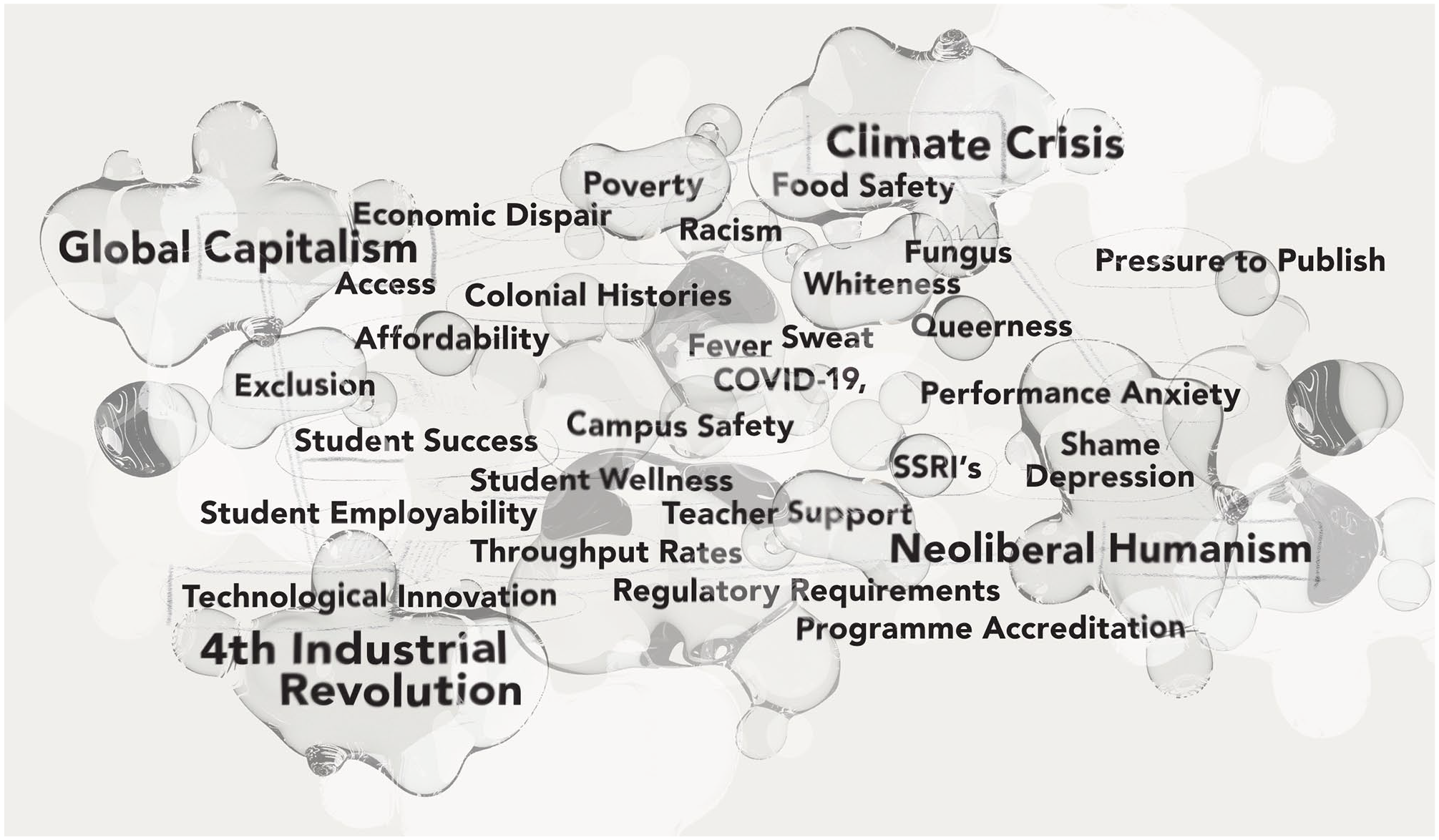
Entangled genealogy (after Rager Fuller and Barad). 13
When considering the parasite as entangled in phenomena, the simple task of applying a salve becomes a Sisyphean battle, repetition without difference in the face of material entanglements that spread to the very foundation of our current world order—or the ruins that occupy the space of a world-yet-possible. Nevertheless, Kuntz reminds us that this very act of “losing faith in our present moment” holds the potential to serve as a generative seeding ground for hope of a different future (Kuntz, 2019, p. 1). This attitudinal shift away from the stasis of enclosure toward the dynamism of emergence brings into question how we might engage with inquiry through the liveliness of material configurations, and the power relations they are intertwined with, as an opening up to alternative figurations of embodied subjectivities outside of oppressive and exclusionary norms that leave us twisting and turning, shivering in humid anxiety. 14
As a movement toward such an “opening up” we turn to the unfolding of skin and its dynamic microbiome that is anything but static. 15 While considered as a large, unified organ, skin demonstrates an exceptional ability for plurality, by hosting a multiplicity of “ecological niches,” varying in temperatures, humidity, and pH level depending on the particular site of measurement (Boxberger et al., 2021, p. 1). This diverse microbiome is inhabited (or “colonises” to use Boxberger’s words) by a variety of commensal microbes, including Malassezia yeast which occurs as the only common eukaryotic inhabitant of the skin flora (Boxberger et al., 2021, p. 1; Gaitanis et al., 2012, p. 106). 16 Currently, there exists a controversial indeterminacy as to whether Malassezia pose a pathogenic threat, or a benign commensalism per se, as it is probable that varying circumstances could result in either (Dawson, 2019, p. 345). Pityriasis Versicolor, in particular, develops when Malassezia undergoes morphogenesis (presumably due to the presence of an excess of sebum) converting to its hyphal form (Brand, 2012, p. 2; Renati et al., 2015, p. 1). The presence of such hypha confers the ability of this fungus to penetrate host tissue, which leads to the presentation of hypopigmented or hyperpigmented macules due to a decreased uptake of melanin by affected keratinocytes (skin cells) (Brand, 2012, p. 2; Thappa & Gupta, 2014, p. 32).
Approaching the situated location of the researcher through the body, its skin and the microbiome it hosts opens up a dynamic, in-between transversal middle or generative “region of relation” (Massumi, 2015, p. 50). Skin becomes thinkable as a penetrable (non)limit, both active host and consumable feeding ground. All the while, skin cells continuously regenerate and much like the ship of Theseus with its reconstructed parts, we might ask as a refrain; “is this still the same skin?” The notion of distanced stasis becomes phantasmic as subject–object relations dissipate through the mingling of bodies in multi-species becomings.
This conception of the skin as a location of intra-active middling presents a productive ecology from which to think through the connections between situated knowledges and emergence. For Truman, emergence is ontologically “viral” as its yet-unknowable quality cusps against the present nature of being, as much as it seeps over into the virtual potentialities of the continuous unfolding of becoming (Truman, 2022, pp. 15, 16). Being situated in the middling of emergence, therefore, demands the acknowledgment that one is not an “outside [observer] of the world [nor] simply located at [a] particular [place] in the world; rather, [one is] part of the world in its ongoing intra-activity” (Barad, 2007, p. 184). Truman furthermore draws on Raymond Williams’s description of emergent culture to emphasize how that which is emergent distinguishes itself, always-already in relation to that which is dominant—the status quo (Williams, 1977, p. 122, cited in Truman, 2022, p. 16). Embracing emergence, therefore, demands a practice that proceeds from the intelligibility of hegemonic norms so as to move beyond their boundaries of inclusion by meddling with their assumed self-evidence.
Building on Donna Haraway’s account of feminist objectivity as situated knowledges (Haraway, 1988, p. 581), one might therefore argue for an objectivity of situated emergence that manifests as the result of embodied and emplaced partial perspectives that operate from a particular dynamic location of spacetimemattering 17 —that is both middling and meddling—instead of distancing the researching subject from the “passive” objects they observe (Haraway, 1988, pp. 582–583). This alignment of objectivity with situated emergence, however, in no way, proposes an “anything-goes” attitude associated with relativism, as the singularity of (material-discursive) location and the partiality of what this location makes knowable is rooted in the material relations within which they are entangled, while these materially embedded entanglements foreground contingency, responsibility and non-innocence. 18
Inquiry, when in-acting from situated emergence, refuses a logic of extraction and brings into scrutiny the manner through which traditional research practices reproduce normative onto-epistemological assumptions about the researcher and their implied neutral objectivity. We therefore endeavor to ask with Truman (in her phonological playfulness) where is the emergency? (Truman, 2022, p. 16), when approaching the situated emergence of the researcher vis-à-vis their practice of inquiry. We ask this not from a vantage point of distanced observation, but from within this moment of sweats and shakes and stumbling around “what matters?.”
Erin Manning identifies a shared state of emergency, characteristic of our contemporary moment, as a “new kind of personal is political” that emerges from “[t]he weight of the world we compose with . . .” (Manning, 2020, p. 141). The weight of a world in which my white body lies in a warm bed, next to a man I can openly call my partner. In a house that we own and pay for, largely, with my full-time academic job at a private higher education institution that I had the privilege to help establish. I wouldn’t be able to afford to study at my own institution. 19 The majority of our population are excluded on this basis. Many bodies are not in a bed like this, many bodies face violence when their sexuality differs from the “norm,” many bodies bear the weight of unemployment, homelessness, hunger, racism, sexism, ableism, xenophobia, exploitation, and the risk of extinction. Together, differently specied bodies carry the weight of a damaged planet, yet the many, already weighed down are made to carry the brunt. Some bodies die from neglect while others take joy rides in Outerspace.
Our situated emergency is one of disorienting contradictions, affective hauntologies, stultifying overwhelm, and deeply felt social anxieties, fear, and docility (Kuntz, 2015, p. 95). Emplaced and embodied in globalized neoliberal capitalism, we confront “a simultaneity of contrary truths [. . . and] the collapse of micro and macro perspectives” (Kuntz, 2015, p. 94). Amid this state of emergency, our situated emergence can neither be operationalized as a voice for others, 20 nor does our voice seem to be completely our own. As a researcher, one feels the pressures for one’s voice to be a commodity (the consumable intelligibility of expert authority), a marker of individuality (the consistency of fully formed independent thought), and hyper-visible (through citationality and one’s public profile congealed with the brand image of a corporatized institution). 21 Amid this state of emergency, it is less than surprising that extractive methodological prescriptions proceed as the norm. The prefiguration of procedurized ways of doing seems to salve (be it superficially) our confrontation with the pressure to perform and the pervading sense of discomfort in the face of uncertainties. However, as Kuntz points out, these very mechanisms with their “pre-approved” predictable comforts (of familiarity and acceptability) are culpable in the “overproduction of extracted truths that contribute to the affective state of disorientation that has come to dominate our contemporary moment” (Kuntz, 2015, p. 95).
In their promise of ordering chaos into intelligibility the prescriptions of Method foreclose emergence and thereby limits the possibility for much-needed material change. How then, we ask, might our intermingling voice be operationalized otherwise? How might we account for our dynamic intra-active, situated emergence in the face of emergencies that lay our present moment in ruins and our skin discolored by rashes?
Hyphal Middling: Inquiring Through Relations
(Brian Massumi, 2015, p. 51)
Through the disciplinary enforcement of prescriptive pre-formed procedures—what John Weaver and Nathan Snaza (2017, p. 1056) refer to as “methodocentrism”—traditional humanist methodological practices reproduce normative limits around what constitutes legitimized knowledge or truth. As machines of truth-production, methodological practices thereby verify the value of the knowledge they produce through their adherence to the prescription of their established techniques (Kuntz, 2015, p. 101). In this sense, procedural enactments of methodological protocols are taken as markers of “quality scholarship” (Weaver & Snaza, 2017, p. 1056). What amounts as truth, therefore, results from the enforcement of methodological truth-machines, yet the manner in which such truths serve to reify normalized assumptions remains largely unchallenged (Barad & Gandorfer, 2021, p. 14; Kuntz, 2015, p. 101).
When inquiring from a logic of extraction a double-cut is enforced between: the “field” (or subject/phenomena that serves as the object of the study), the supposedly neutral methodological truth-machines (or apparatuses of inquiry), and the externalized truths that result from the analysis of data that takes place outside the messiness of relational entanglements (Kuntz, 2015, p. 99). When considering conventional tensions stemming from such inside–outside (split)relations, we find it useful to return to the ability of Malassezia to produce, through morphological transformation, filamentous hyphae that enhance its spread by enabling entry into the skin (Brand, 2012, p. 1). This process of morphogenesis is “reversible” which offers the fungus a “choice of two lifestyles within the host” (Brand, 2012, p. 5). Hyphae production results as, what Alexandra Brand (2012, p. 1, 5) deems, an “opportunistic” response to a scarcity of nutrients. Through hyphal growth, cell production occurs sequentially, from the tip of the hypha, thereby widening the reachable area from which to gather nourishment, eliminating the need for cells to compete over the limited nutrients available in a single location (Brand, 2012, p. 5). Despite being short, Malassezia hyphae enter deeper regions of the skin by penetrating keratinized skin cells, where growth might revert to yeast form and new colonies might develop (Brand, 2012, p. 2). It is this entry into the skin that differentiates Malassezia as a pathogenic agent, leading to the development and spread of Pityriasis Versicolor. This morphological occurrence of filamentous hyphae serves as a generative metaphor through which to surface our internalized conditioning to normalized assumptions of the how and what of inquiry, as well as a matterphorical site from which to imagine inquiry otherwise.
In one way, hyphal growth could be read as an illustration of the normative temporal assumptions embedded in conventional research practices. The search for “knowrishment” (particular knowledges that answer predetermined questions or epistemological desires) seemingly commences from a discrete “outside,” from which linear probing is undertaken as an act that progressively moves closer to the prefigured destination it seeks to find. A simple teleological progression; need > search > discover > extract > “knowrishing” reward. This unilinear teleology of a logic of extraction presumes, in advance, to know what one is looking for, and proceeds by merely tracing the assumptions about how its discovery will lead to particular desired meanings, outcomes, and benefits (Truman, 2022, p. 6). We might think of this as epistemic gluttony treating the field/phenomenon as à la carte menu, thereby limiting the results of inquiry to that which resembles static preexisting figurations of knowledge (Manning, 2015, p. 54).
This oversimplified figuring of the metaphor of hyphae-as-method, however, presents an extractive opportunistic move on our part. “Materiality,” after all, “is always something more than the object itself or the inclusion of this object into the conversation” (Snaza & Sonu, 2016, p. 32). Building on the radical empiricism of William James, Erin Manning (2015, p. 55) emphasizes the need for middling; starting from within “the mess of relations not yet organized into terms such as “subject” and “object”—a field immanent to actual relations—what James deems “pure experience” (James, 2003, cited in Manning (2015, p. 55)). Our preceding metaphor veers away from such middling through its simple reversal of subject-object relations. What is needed, rather, is an agential realist account that acknowledges that “phenomena are ontologically primitive relations—relations without preexisting relata” (Barad, 2007, p. 139). 22
In this light, we return to hyphal growth as a dynamic, relational, co-constitutive worlding event. For Karen Barad (2007, p. 179), “iterative intra-actions,” such as the morphogenesis of hyphal development, “are the dynamics through which temporality and spatiality are produced and iteratively reconfigured in the materialization of phenomena and the (re)making of material-discursive boundaries and their constitutive exclusions.” The hyphal mingling of fungus and skin dynamically draws and re-draws boundaries, configuring and refiguring various exclusions; cell/hypha, commensalism/pathogenesis, subject/object.
For Barad such iterative reconfigurations of boundaries are “the changing conditions of possibility of changing possibilities” (Barad, 2007, p. 179). 23 We are therefore limited when thinking of hyphal development as the formation of discrete multiplicities (one cell from which develops another, from which develops another, and so on, in a mere linear, unidirectional filamentous progression). When taking seriously, Elizabeth Wilson’s assertion that “there is no intrinsic orthodoxy to biological matter,” thereby questioning the notion of biology as predetermined evolution (Wilson, 2015, p. 27), requires one to consider this particular material mingling as aleatory—continuous multiplicities (one cell from which might develop another, or a hyphal strand which might continue in its hyphal state, or revert to its yeast cell form, without predetermined directionality or clear linear progression, all alongside and with the doing of skin and its contractions, expansions, secretions, and regenerations). 24
When re-turning the morphogenesis of hyphal development not as a metaphor for inquiry, but as a site of matterphorical richness, 25 we are urged to evoke the notion of continuous multiplicity as a force of potentiality, not so much through a tracing of what has emerged, but rather by staying with the act of emergence itself as an orientation toward immanent and dynamic relationality.
When considering methodological-machines as apparatuses of hyphal intermingling one has to draw attention to the fact that they are entangled in the phenomena they seek to uncover. As material-discursive boundary-making practices, methods (as apparatuses of inquiry) “enact agential cuts that produce determinate boundaries and properties of ‘entities’ within phenomena, where ‘phenomena’ are the ontological inseparability of agential intra-acting components” (Barad, 2007, p. 148). The application of methods should therefore be thought of as “formative of matter and meaning . . . constituted and reconstituted as part of the ongoing intra-activity of the world” (Barad, 2007, p. 146). In this light, the binary distinction of inside–outside demands collapse into transversal, relational middling, or what Springgay and Truman (2018) refer to as a “speculative middle.” 26
As an alternative to a logic of extraction, inquiry as situated, emergent and middling positions methods “inside the research event” (Springgay & Truman, 2018, p. 204) so as to understand methods relationally as a “distributed, immanent field of sensible processuality within which creative variations give rise to modifications and movements of thinking” (McCormack, 2013, p. 25, cited in Springgay and Truman (2018, p. 204)). Staying with the speculative middle demands response-able methods and attentiveness to change. What is required is not the fetishization of Method as “neutral” truth-making machines, but the acknowledgment of methods as entanglements of epistemology (coming to know) with an ontology of immanence (the emergence of material-relational becoming), and an ethical orientation (urging toward difference in the face of emergency). We turn, therefore, to Kuntz, for whom inquiry as an ethico-onto-epistemological practice presents generative attunement with the notion of philosophical parrhesia.
Response-Able Truth-Making: Inquiring With Care-Full Hospitality
Kuntz (2015, 2019, 2021) develops the notion of methodological parrhesia through para-citation with Michel Foucault (2010, 2011).
27
According to Foucault (2010, p. 43), One of the original meanings of the Greek word parrēsia is to “say everything,” but in fact it is much more frequently translated as free-spokenness . . . free speech, etcetera . . . it designated a virtue, a quality . . .; a duty . . .; and a technique, a process.
Foucault distinguishes parrhesia from other rhetorical maneuvers such as persuasion and pedagogy due to its nature as an ethical determination that is practiced materially in a manner that affects the truth-teller (Kuntz, 2015, p. 104). Parrhesia is therefore not the act of convincing or demonstrating but rather an ontological orientation made manifest by the affirmation of truths through practices of becoming (Foucault, 2010, pp. 53–54), thereby a performative in-actment. Inquiry, when considered as parrhesia, can be contrasted with methodocentrism, as it occurs not through the proceduralized reproduction of normative assumptions but rather by diagrammatically opposing such reproduction through its cusping against (and through) the immanence of becoming, so as to challenge (or meddle with) the hegemony of the status quo. In this way, parrhesia is “always a new approach animated by a potential future built on difference” (Kuntz, 2021b, p. 491). Parrhesia operates in the activation of refusal/affirmation, always in defiance of the already-known, as an opening up toward the potentiality of the unknown as well as the risks that such openings might unearth (Foucault, 2010, pp. 62–63). 28 Risk is inherent when inquiring with parrhesia as one forgoes reliance on the legitimating forces of methodocentrism in favor of interruptive openings toward the yet-unknown, thereby fracturing the boundaries of exclusion—the “limits of regimes of truth” (Kuntz, 2015, p. 102) to make known the surplus, the more-than of what pre-exists as intelligible. For Kuntz, parrhesia, in this light, is an act of truth-making that does not endeavor to “enlighten others to some previously unknown truth,” but rather destabilizes “normative formations of power” through the open-ended unfolding of becoming otherwise (Kuntz, 2021b, p. 498).
In attunement with situated emergence, parrhesiastic inquiry activates a speculative middle through the performative engagement—a hyphal mingling—with “an immediate, yet unfinished now [and] the useful collapse of past and future in the present [. . . thereby] challeng[ing] conventional repetitions of the status quo to make way for new becomings unbound by the possible” (Kuntz, 2019, p. 77). “[E]mergence meets emergency” (Truman, 2022, p. 19), as parrhesiastic inquiry refuses established and intelligible practices of being as an ethical commitment to a different future, placing the researcher outside of the comforts awarded by methodological-machines, affirming instead the potentiality and the precarity of uncertainty (Foucault, 2010, pp. 63–63; Kuntz, 2019, p. 78). This is a care-full middling that tends, in each moment, to “what matters” (Truman, 2022, p. 19).
As a performative orientation to inquiry, parrhesia, therefore, shares a commonality with the practice of a political ethics of care, formulated by Joan Tronto (1993, pp. 102–103) as a practice of (a) de-centring oneself, or “troubl[ing] oneself” (Schrader, 2015, p. 666), (b) acknowledging and accepting the full weight and responsibility (or risks) of care, and (c) enacting care through material engagement (Tronto, 1993, p. 103). As with care, the in-actment of parrhesia demands change, as it manifests through the figuring of truth—a truth that cannot leave material relations unchanged, once entangled with them (Kuntz, 2019, p. 77).
In its commitment to change in the face of uncertain risk, parrhesia calls for an openness, evocative of Jacques Derrida’s notion of hospitality. Derrida suggests an ethics of radical hospitality that “say[s] yes to who or what turns up, before any determination, before any anticipation, before any identification” (Derrida, 2000, p. 77—original emphasis). Such hospitality refuses to question “who is there?” in a manner that expects that which arrives to make itself known through the language and customs already familiar to “us” (Lucy, 2004, p. 19). This hospitality, however, does not suggest a mere “waiting by the door” for something (or someone) to arrive, but rather relies on the active, yet patient practice of radical openness. As a care-full practice, parrhesiastic inquiry is anything but passive: neither purposeless waiting nor undirected wonder. For Kuntz (2021a, p. 216), this orientation to inquiry is more akin to “standing at one’s post” by “articulat[ing] an overt ethical orientation towards change, one animated by . . . mapping the contemporary terrain, arranging newly productive relations and generating different effects.” This radical openness that fosters relations affirmative of difference demands active care—the effort of “collective and accountable knowledge construction that does not negate dissent or the impurity of coalitions, [but] speaks [instead, affirmatively] of ways of taking care of the unavoidably thorny relations that foster rich, collective, interdependent, albeit not seamless, thinking-with” (Puig de la Bellacasa, 2017, p. 79).
From this stand-point (or post), inquiry must anchor itself in the acknowledgment that “care matters in knowledge politics—as contributing to the mattering of the world” (Puig de la Bellacasa, 2017, p. 71). Care, as a condition for inquiry situates one in emergent relationality, yet acknowledges that inquiry proceeds through disconnection—“the cuts we make” (Puig de la Bellacasa, 2017, p. 78). However, when grounded in care one is urged to interrogate cuts, not as severing but as the iterative (re)creation of “new” patterns of connection that relate as opposed to divide (Puig de la Bellacasa, 2017, pp. 78–79). For Barad, this is the agential cut that . . . does not disentangle the phenomenon into independent subsystems [but rather] provide[s] a contingent resolution of the ontological inseparability within the phenomenon and hence the condition for objective description: that is, it enables an unambiguous account of marks on bodies, but only within the particular phenomenon . . . there is only a single entity—the phenomenon—and hence the proper objective referent for descriptive terms is the phenomenon, (Barad, 2007, p. 348) [where] a phenomenon is a specific intra-action of an “object” and the “measuring agencies” [that] emerge from, rather than precede the intra-action that produces them. (Barad, 2007, p. 128)
Writing-with the parasite and the changing coloration of skin—the materiality of bodies mingling—expose the undeniable way in which one is “directly implicated (and co-produced!)” (Truman, 2022, p. 19) within the practice of inquiry, emerging from the middling/meddling intra-action inside phenomena.
When asked recently about my “anxiety-management regime,” as a probe of concern at my “condition,” it made me question: Why do we so easily assume the need to numb affective states (of worry, uncertainty and fear) to “do the work” when these felt realities serve as the very markers of the caring relations of the work’s intra-active doing? Through the affirmation of uncertainty (and its various affects), we find ourselves in generative, hospitable relations of situated emergence that refuse the demand for simple conclusion that typically forecloses, so neatly, a logic of extraction (Kuntz, 2015, pp. 99–100). In our attempt at care-full truth-making, we opt therefore not to conclude, but rather to continue our process of unfolding by opening up to additional questions.
Re-Turning to the Tapeworm
(Maria Puig de la Bellacasa, 2017, p. 77)
In lieu of a conclusion (following Truman, 2022, p. 23), we thought it meaningful to re-turn to where we started, at the material–relational entanglement of Dimitri Tsafendas with his fictional tapeworm that lives on in the South African imaginary as the instigator behind the assassination of Hendrik Verwoerd. Whereas my parasite serves as a companion in thinking, Tsafendas’s tapeworm acted as a bifurcating scapegoat, masking radical political action with supposed material-madness.
While Verwoerd’s remains rest peacefully in the honored surrounds of the “Heroes’ Acre,” Tsafendas was only memorialized on the 20th anniversary of his death (on October 7, 2019) by the South African Communist Party, at what was at that time his still unmarked grave. When South Africa became a democracy in 1994, Tsafendas had been the country’s longest-serving prisoner, having spent 23 of his years of incarceration in a cell that was specifically constructed for him to be within earshot of the chamber where death-row convicts were executed (Dousemetzis, 2020). Despite being classified as a “patient of the state,” he had never received any medical treatment for his supposed schizophrenia (Dousemetzis, 2020).
In 1996, human rights lawyer Mr. Krish Govender appealed to the Truth and Reconciliation Commission for further review and investigation of the Tsafendas’s case, however, Chief Justice Michael Corbett rejected the suggestion as “pointless and absurd” due to the supposed “overwhelming evidence” of Tsafendas’s mental illness (Dousemetzis, 2018, pp. 1649–1650). As a result, Tsafendas remained in a secure psychiatric facility at Sterkfontein Hospital until his death (Dousemetzis, 2020). Tsafendas continues to be largely misremembered and unacknowledged for his act of radical parrhesia, due to the disavowal of his political action through the mythologising of biological matter. We, therefore, echo with Haraway that “[i]t matters what matters we use to think other matters with; it matters what stories we tell to tell other stories with . . .” (Haraway, 2016b, p. 12). Matter matters politically, while the political matters through matter.
In the telling of stories, should we not refuse the danger of single stories, while affirming the value of the singularity of stories in their entangled specificity? Should we not refuse individual authorship in favor of a speculative engagement with situated emergence in a manner that fosters “the subversive character of thinking with care”? (Puig de la Bellacasa, 2017, p. 76). Writing-with the mattering of matter urges one to be care-full in the interrogation of the boundaries of exclusion that replicate themselves so insidiously when splitting nature from culture, knowing from being and the researcher from the world (as a supposed static object of inquiry).
In the face of emergencies that urge “us” toward the familiarity of a logic of extraction, we ask, how does one attune to the excess of emergence, always anew, so as to activate continuous multiplicities—the in-act of hyphal mingling-with the not-yet? How does one enrich the material hauntings of the past with an ethical orientation toward a future grounded in difference? How does one practice care-full “cuts” with response-ability, while acknowledging one’s middling/meddling location inside and as part of phenomena? For Kuntz (2021b, p. 498) such potentiality exists in “small moments . . . the interstices of the everyday,” rather than “grand gestures . . . lauded . . . as stirring challenges to despotic rule.” Is this the lesson we learn from Tsafendas, that radical truth-telling begets radical disavowal?
In our refusal of a logic of extraction, my parasite and I attempt to figure our orientation toward this minor work, by starting with the intimate act of truth-making through care-full thinking-with, writing-with the mattering of matter. We start and stay-with the question of unbound location—the “from where?” of inquiry, the materiality of white skin with its hauntings of privilege and complicity. We acknowledge our non-innocence while patiently building rigor amid the risks and uncertainty—the disorienting a/effects of our shared state of emergency—motivated, inside each move, by the potentiality for doing inquiry differently, doing inquiry with, in, and for change.
Footnotes
Declaration of Conflicting Interests
The author(s) declared no potential conflicts of interest with respect to the research, authorship, and/or publication of this article.
Funding
The author(s) disclosed receipt of the following financial support for the research, authorship, and/or publication of this article: This work is based on the research supported in part by the National Research Foundation of South Africa (Grant Numbers: 120845).
