




Abstract
The challenge of autoethnography is using my personal experience to explore broader social and political themes and to find a subjective voice to make sense of the impact of the Covid 19 lockdown. Using the optic of aging, I explore how I accommodated to quarantine life. Sitting and letting the world swirl around me in my house, I explore the altered physical and mental spaces in which I lived. Despite my own privileges, I have felt vulnerable and frightened but I have also felt angry and frustrated at the hubris and incompetence with which this crisis has been handled.
“But the real matter and let’s have a grown-up conversation here is the fact that we can’t cope. There is a finite number of people we can handle in these islands and if you look at the statistics you can see the way that old people go on and on living these days means that the population is going up and up and up. This puts a massive pressure on society as a whole”
1
I am—we are—living through a truly global pandemic, an unprecedented moment in contemporary world history especially for the West. 2 The first cases of the novel coronavirus in Britain were reported on January 31 yet in the middle of February, I was traveling in India with a group of Australians and Brits, aged in our 60s and 70s, enjoying a musical tour of Rajasthan. I returned to London toward the end of the month. On March 16, the Conservative government in Britain finally imposed social lockdown and deemed pregnant women, people over the age of 70, and those with certain health conditions as “particularly vulnerable” to Covid 19. From then on, I lived under conditions of “self-isolation” and spent 8 weeks totally alone in my home. On March 23, the entire country was put into lockdown. It has been an intense experience.
One, a person, is many things. The individual is “intersectional” in ways that shift during a lifetime. 3 Our social roles change. Our identifications may thicken, alter, become more numerous. Our beliefs, cultural practices, and modes of consumption may become richer, more nuanced. One grows into oneself in a process of individuation. There are many strands of my life that I could use to interpret my Covid experience but I will concentrate mainly on retirement and aging, as those became central and which I shared with many friends. I want to explore writing from inside such a positionality and the complex of feelings, imaginings, and articulations that this period has produced in me, or which I have produced in this period.
One sits more with age. I got tired of all that standing. Standpoint 4 is an active projection, perhaps somewhat masculine. Standing allows one to see over others, makes a claim to authority, and is a work pose. I don’t disavow the need to articulate from where one sees things; I’d just prefer to sit to do that. I want to claim my “sitting point,” a still center in a whirling world. A place from which to contemplate, from where to wander (even just imaginatively) and to wonder 5 ; what follows is a meander through some of the things that I’ve been thinking about.
From Individual to Collective Retirement
I was an academic for much of my adult life but retired a few years ago. I maintain some of the elements of academic life that I enjoy such as writing, reviewing, even winning research money and can disregard the rest (no meetings!). But I nonetheless have experienced a retraction of a professional community. I miss intellectual collective life in a university setting, embodied in seminars and conferences, in collective research activity. I was quite shocked to discover how large a hole in my life this retreat from paid work would create. There are times when I have felt left out, increasingly invisible, of little use. Of course, in comparison to the growing precariat of young academics, I have been fortunate to enjoy an academic career.
The social lockdown required under U.K. government guidelines meant that society as a whole experienced a sudden and dramatic retrenchment. There was a collapse of work, of social interaction, a slowing down of life as usually lived, a collective hibernation. The zone of restriction seemed to be an equalizer until all the pre-existing inequalities of space, time, money, children, disability, age, and so on came rolling in. Each of us was affected but each in our own way. Time slowed, life cooled, society retired.
But one of the many paradoxes of Covid was that time both crawled in endless repetition and also flew. The entire experience was so novel that it was exciting at first but quickly settled into an endless repetition of the same. Hence, different things seemed to be true at the same time. I had already lived without the rigorous schedule of academic work: lectures, seminars, office hours, meetings, research time mapped out across the week. Since retirement, I have lived a far sloppier unregimented life. Covid only exacerbated that. One day rolled into the next, one week into the next, the months flew. People started to say things like “this feels like a perpetual Tuesday.” To me, it just felt like a continuity of my life but with no outside.
“Zoom” that was once a pretend noise for an airplane was suddenly a household verb. Everyone was zooming with Zoom quizzes, Zoom yoga, Zoom exercise classes. I became caught up in a swirl of online activities that crowded my days so it became important to organize moments that broke up the week and to make appointments—“G&T o’clock”—with friends. So although I was used to living a slower life on my own, that still didn’t fully prepare me for the stringent social limitations of Covid.
Age as a Privilege and a Concern
The public discourse immediately claimed me as “vulnerable” because of my age, seventy. It was a strange feeling to be interpellated by a government in this specific manner. There was much murmuring about the crudeness of such a numerical cut-off. I certainly felt that I was healthier and more robust than many people younger than me, thanks to all the boxing I had done with my personal trainer and my regular yoga. But early evidence suggested age was a significant factor in Covid morbidity (although other factors have become as key) so I and my friends took the idea of self-isolation seriously. I kept wondering how I could allow a government that I detested and its suspect science define me, why did I accept this interpellation of me? But I did. There was little choice.
The more that I learned and thought about the pandemic, the more fortunate I felt. I live in a house, one that I could hardly afford to buy then and could not afford now if I wanted to buy it today. But my children’s generation don’t have access to such space, housing being one of London’s big social issues. Generational inequality is a growing concern as the baby boomer generation is viewed as particularly fortunate. 6 From being societal winners for most of our lives, we suddenly became potential virus losers in our retirement years. My entire ground floor is essentially a single space, from the front door through to the glass wall onto the back garden, so I live in one room, although my view of the world is far more extensive than Virginia Woolf’s or E.M.Forster’s ever were. 7 I have a patio garden and became quite tanned over London’s hot spring days as I planted tomatoes and strawberries, courgettes, and sweet pea.
I write this to both highlight and think through my various privileges—white, straight, educated—with material benefits such as space (inside and out), time (my own), and a guaranteed pension while so many others are out of work with no financial support. I’m not sure what it means to check these. If this set of elements define who I am, from where I sit to view the world, then they cannot be “checked,” neither as in “limited” but also not as “parked.” Rather, those privileges have to be articulated, thought through, used to clarify parts of a specific socio-economic position. Indeed, autoethnography offers “a means to enhance existing understandings of lived experiences enacted within social locations situated within larger systems of power, oppression, and social privilege” (Boylorn & Orbe, 2014).
I have come to think that age is itself a privilege. My own father died at 52, a refugee doctor who became a GP in the very new National Health System (NHS). My ability to enjoy older age is testament to my living in a stable political and climatic environment, to the NHS that has looked after me, to avoidance of the worst catastrophes of the 20th century. My life has been for the most part fairly risk-free. Avoidance of risk should probably be included in the definition of privilege. Most of my friends are similarly aging middle-class Labour or Green supporters, old radical hippies with histories of political involvements, the generation of 1968. We are not badly off, albeit mainly as house-owning millionaires-on-paper with little discretionary income. Most of us would rather have paid more tax to live in a more equitable society, putting our own class interests aside. This is where I sit and how I situate myself now.
But age suddenly implied a profound vulnerability. The Prime Minister had warned the nation in early March that “many more families are going to lose loved ones before their time” and notions of “herd immunity” were bandied about until more sensible science persuaded the government that eugenics was not the best strategy. 8 There were rumors, not fully denied, that people over 60 were not to be resuscitated if very ill. It was scary.
Numerous friends agreed with me that the best thing we could do during this period was to remain healthy and not become another burden on the NHS. The Tory government’s slogan of “protect the NHS,” that came before the ostensibly more important “save lives”, had become our unconscious mantra of how to live. 9 When lockdown eased, the messages about wearing masks were very confused and new spikes of infection appeared in specific places so appeals were made to younger people that they should wear masks, in order that they “don’t kill granny”!
Contact
Being physically separated under such frightening conditions made mediated social contact and friendship all the more important. Despite Turkle’s (2013) anxieties about the loss of togetherness in a highly social-media mediated world, they were reinforcing relationships and supporting intimate conversations.
For many years, I have lived with even my closest family relationships extended across national boundaries; as 21st-century global citizens, we’ve managed WhatsApp linkings across New York, London, Paris, Berlin, and Tehran. But I was consumed with considerable anxiety about my family. My younger daughter was pregnant in Brooklyn as the number of cases in New York skyrocketed. My elder daughter lives in a nice Paris apartment but with no outside space to cope with a rambunctious 2-year-old boy. Becoming a grandmother has been the most joyous part of the last few years, which includes watching two daughters settle down and build delightful families. One of the visual responses I drew to a Massive:Micro project prompt shows me with many sets of arms, each encircling people that matter to me, a kind of earth mother. I was saddened to see my friends being progressively cut off from their families, in a way that I had already endured for a long time.
I experienced powerful mood swings and found that the smallest upset or poignant film sequence could easily reduce me to tears. I wouldn’t tell my daughters that. But perhaps because I’d had lots of practice at being on my own, I was fundamentally ok. But not everyone I knew was, as the Covid 19 life lived indoors and at a distance was very hard and came on top of other issues. All my friends of a certain age were feeling anxious. I spent much longer on the telephone than usual. I established almost daily catch-ups with a couple of girlfriends and considerable time doing emotional work with friends who were periodically panicked; equally, sometimes they had to calm me down. We were anxious, constricted, and lonely. But for me these conversations had the effect of enriching our friendships, not thinning conversation.
In the course of my memory work, the desire to reconnect with old friends, cut across with worry, was strong. The “gang of four” women with whom I had passed through high school reunited on Zoom after a hiatus of many decades, and we found much to talk about and much shared. Older problems didn’t disappear. One friend was facing challenges at work; one was bowled over by the awfulness of the British government; one was losing a partner to forgetting.
Sitting alone in my house, nonetheless death seemed to swirl around me. There were the escalating numbers; the TV images of ambulances, hearses, coffins, funerals; the fear that was circulating. I have over the past few years been part of a “death group” where a few women friends meet to discuss not so much death itself or our attitudes but the useful preparation one might make to leave one’s affairs in order for those who come after. The irony of Covid 19 was not lost on us, prompting some delayed actions such as updating a will. I had started to think much more about death after retirement and for the very first Massive:Micro project prompt that focused on time, I found myself writing about death as the final punctum. I feel even now that as a society, we have not had a serious public discussion about death nor have we properly acknowledged the enormous pall of grief that sits over all of us, indeed over the world.
From the start of the pandemic, British media have offered us quite extraordinary statistics about deaths. It used to be that the crash of one jumbo jet with 300 deaths shocked the country; yet we were now hearing of higher figures day on day without any obvious response. In August, the British deaths formally acknowledged are over 41,000, having just be rounded down by 5,000 because not all deaths were caused by Covid. Yet another mode of calculation suggests Britain has had over 65,000 deaths and the worst excess death rates in Europe, if not globally.
Sadly, two people I know have died from Covid, although both were elderly and infirm. In comparison to the news stories and the lives around me, I was fine, while there was so much danger and fragility in the world outside. I knew I was fortunate and that my experience was not so widely shared.
Education as a Privilege
Sitting still, I have also come to think how much education functions as a privilege. And one that helps with solitude. I write this as an ex-academic, even if I’m trying hard to not write in an academic voice. During Covid, I have lived inside my head even more than usual. The slowed pace of life offered, indeed perhaps demanded, an increased opportunity for interiority. How lucky I felt to have all this time to sit and think, how privileged I am even today. To read. To listen to music. To think about how society could still change to become more equitable. My privileges should not prevent me from supporting the struggles of other groups of people.
I did a lot of memory work and extended soul-searching, induced by these long periods of isolation. I actually enjoyed finding my inner introvert in the slowing down, the time for contemplation, although I can imagine that for many people this was hard. 10 Our society has not encouraged abilities to sit quietly, to be alone; indeed, we know that loneliness is a major social problem and source of mental crisis while the mindfulness industries are just turning into new forms of consumption and guru-making.
I enjoyed the slothfulness, slouching in tee-shirt and sweat pants and not having to make the efforts of dress and comportment that social life requires. Growing informality has often been taken as an index of modernity. It was interesting to see journalists and scientific experts appear on television in more casual clothing, making the visual distinctions between home and work quite evident. I found that I was amused when friends dressed-up for Zoom meetings.
Age and the Digital
One of the great paradoxes of pandemic life in 2020 is that without actual embodied encounters, our contemporary environment offered many ways to keep in touch. The on-line was my/our savior. I found this particularly interesting since, in December 2019, the Labor election manifesto had included an eye-catching pledge from Jeremy Corbyn to provide free super-fast broadband for every home and business in the country by 2030. The infrastructure would have been brought into public ownership with a massive upgrade to solve patchy and slow coverage, all too be paid for through the party’s Green Transformation fund, saving every consumer an average of £30 a month. How he was ridiculed at the time. “Where’s your money tree?” mocked the Tories; and “what’s the point of that?” many people scoffed. It was deemed a crackpot scheme and, sinisterly, it was described as “communist”! 11
But instantly, at the point of lockdown, innovations in platforms and improvizations in cultural practice brought a wealth of cultural goodies to our screens. I could watch Met operas from New York, National Theatre plays from London, concerts from Vienna, opera from Glyndbourne. YouTube offered daily Joe Wicks (https://www.youtube.com/user/thebodycoach1) workouts that literally hundreds of thousands of people joined; when I simply could not persuade my legs to do frog walk, I could downgrade to exercises for the “over 50s.” Streaming platforms such as Netflix, Amazon Prime, Mubi, and Curzon were godsends, with evidence of considerable uptake of memberships. My phone conversations quickly moved from books one was reading to TV series (Babylon Berlin! Call my Agent!) one was watching. Gifs, memes, and cartoons all circulated, from friends in Australia to friends in NYC and back again; I particularly enjoyed animals mooing Pergolesi and train engines huffing Satie! WhatsApp, already useful, must have heated to molten as I sat and chatted, drummed across the English Channel with my grandson in Paris, read books at bedtime.
Thus, at the very same time as society thinned and social interaction was limited, the wider world encroached and was monitored, visible on the screens in my private space. While living for weeks in isolation, hardly seeing anyone face-to-face, I have had a rich and geographically unbounded online life.
One highlight was watching live on Instagram a performance by an Indian musical family of Manganiyar whom I had visited in Rajasthan in February; see Figure 1. Throughout their live-streamed performance I shared memories with their nephew who was the tech guru setting up the live stream from their village. I sent him photographs of them from our earlier visit, while he returned photographs of us, the tourist gaze turned back on me.
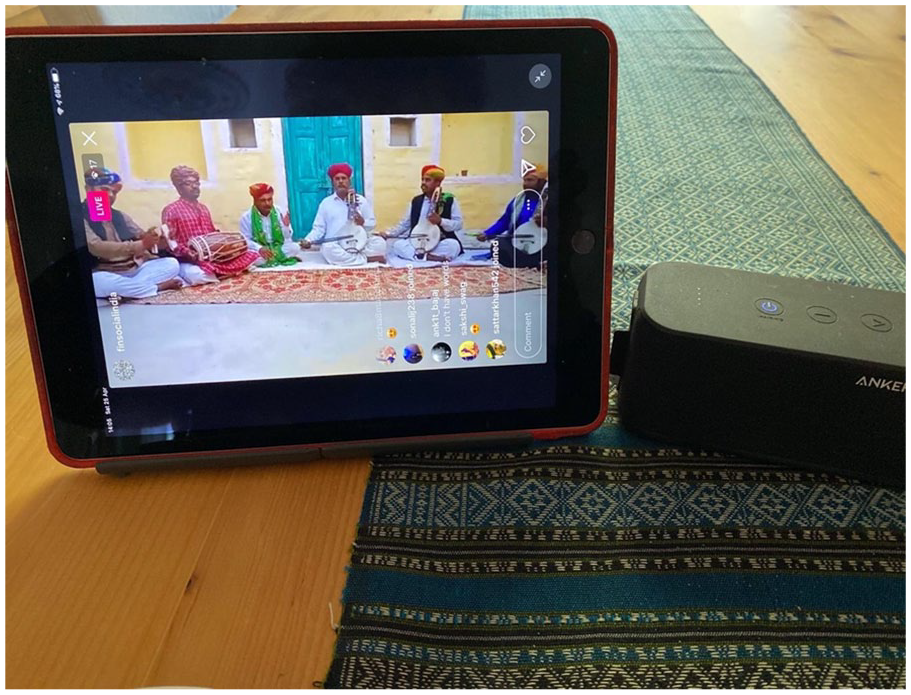
Watching the Manganiyar in Rajasthan live-streamed to my kitchen table.
Another evocative moment was participating in a Zoom seder night organized by progressive Jewish groups from London that included over 200 participants from around the world. The ritual Passover meal centers on a collective reading of the story of the exodus from Egypt and the eating of symbolic foods, a yearly practice I much enjoyed as a child. As a Jewish atheist, it was poignant to see in a Zoom window many tiny images of each of us sitting with our versions of the ritual Passover plate and drinking the four cups of wine.
I have always loved Islamic architecture and pattern, so I took up Islamic geometric drawing. I found myself in long classes with people around the world, all silently working with compass and straight edge to map out intricate patterns; see Figure 2. This demanded complete concentration and precision, and took me to a meditative realm away from Covid. I pinned some to my wall as evidence of something I had actually done during this long durée. They perhaps provided me with some minor sense of control in a context where I had little; while the world seemed mad, these ancient symmetries spoke to a shared harmony that we wished to retrieve.
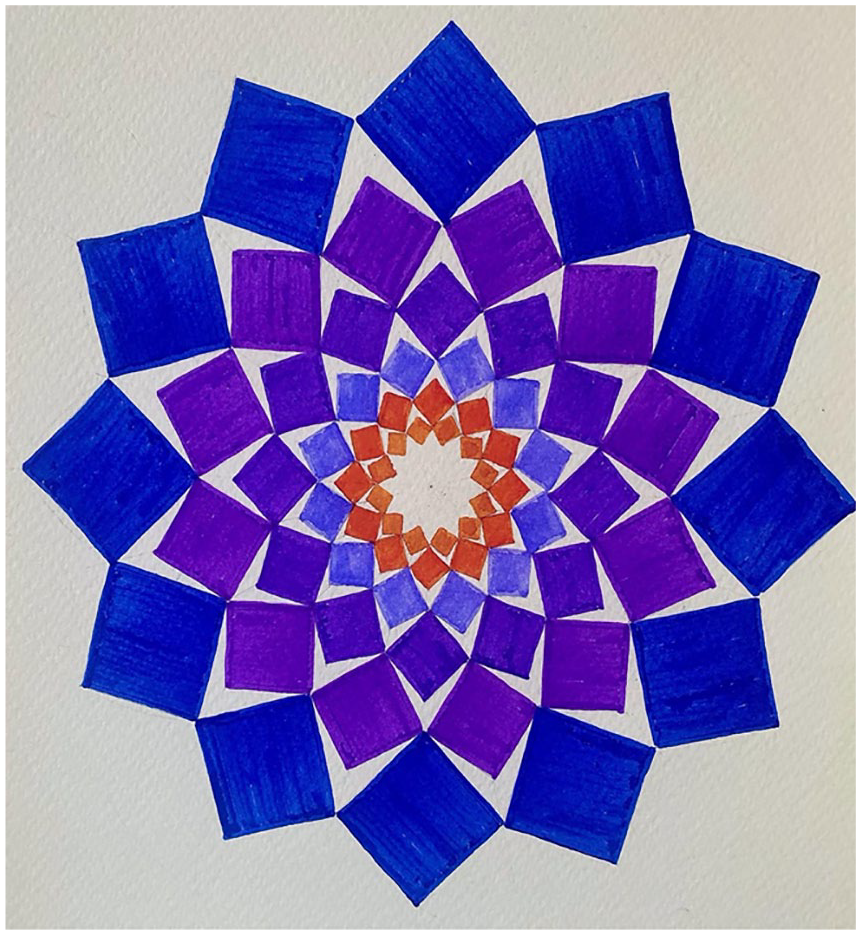
Image created in an online class with Richard Henry of Art of Islamic Pattern.
But it is well documented that, even in Britain, unequal digital access because of cost and poor infrastructure meant that many families were not able to use online classes and other resources, so that lack of broadband access worsened the class divide, a global dynamic. 12 It’s not so clear if it worsened the existing age-based digital divide as more older people learned to use such digital tools precisely to reconstruct familial and social relations cut off by Covid. For me, while I experienced a further shrinking of space for embodied interaction, the possibilities of connecting with the world expanded. Culture flowed into my living room.
The Shifting Spatial Coordinates of Covid
Sitting at home, I found that my mental geography began to shift. Instead of living in the engaging metropolis of “London” with its theaters, art galleries, and restaurants, I began to live in “Highbury,” north London.
Despite the government’s woeful ineptitude about the whole crisis, local responses to Covid 19 produced a flowering of community self-help groups that offered different kinds of support: delivering food and other necessities; phone contact for people who were feeling very isolated; home production of food and of face masks. So even as my/our cultural boundaries were expanding well beyond the nation, in my part of north London, the “local” took on a new vitality. 13 My borough, Islington, has been very well organized and provided residents with regular multi-lingual online and printed up-dates on support available, suggesting activities to occupy children at home and generally recognizing the many difficulties that Covid 19 produced.
I realized that I was also starting to live more on my road, not just on Thursday evenings when we all emerged from our domestic bunkers to clap for the NHS. Neighborliness grew, as I swapped info with people I didn’t really know about where to get toilet paper (the imagined scarcity of which produced panic buying in the first weeks of lockdown), flour, and fresh bread. We chatted about which grocer would deliver. Sometimes, taking out the accumulated rubbish of just one week of isolated living, I found myself surprised by the physicality of neighboring houses and cars: ah yes, there is life outside my four walls. A joke that circulated among my women friends was “what should one wear to put out the rubbish?”
Many days I didn’t leave the house. I’m generally happy to stay at home anyway and don’t feel the need for a daily peregrination. I did walk masked in local parks and met with friends in open spaces, but not that often. And while I’m a keen photographer and enjoy street shots, I didn’t once venture into the center of London to capture an empty city. Fear of the virus swirling outside kept me home.
A Nationally Mediated Global Pandemic
Sitting in my living room, most of my emotional reactions were in direct response to mediated politics which I experienced mainly through the Guardian on-line and Channel 4 news. I was, we were, living a media life (Deuze, 2012) even more intensely than usual.
There was confusion at the start. The government mooted notions of “herd immunity” and a catastrophic death count sounded inevitable. These ideas were abandoned, and later actually denied. After a belated start, the government established daily BBC television briefings, usually with one cabinet politician flanked by two scientists. I found these infuriating. Their timing fluctuated, which seemed a profound way of disrespecting the audience. To begin with, journalists were allowed a single question which was often batted away by the politico of the day and there was no recourse; later, a follow-up question was allowed, which often simply produced a replay of the dynamics around the first question. I found myself shouting at the television: “answer the bloody question, you wanker!.” The politicos repeated ad nauseam that they were “following the science” but when an alternative panel of scientists established themselves (called Independent Sage) to offer different readings of the disease, the politically embedded nature of science became an issue. For the most part, we as the general public accepted lockdown and undertook basic measures to keep safe. It was the revelation that Dominic Cummings, a maverick advisor to the government, had broken the lockdown regulations at the end of May but was not penalized that trust in the government truly evaporated. People started breaking the rules with flash musical gatherings and crowded beaches, and tensions across the generations increased. Younger people seemed to be more sanguine about getting the disease, less mindful of social distancing, less inclined to wear masks. In my park, the tension between aging walkers and younger joggers was palpable, with occasional shouting matches. The government dithered about making masks mandatory, so it took a great deal of persuasion through social media to get people to understand that they were not only protecting themselves but other people. Even now, mid-August, the messages about masks are changing. But the public argument says that masks and social distancing are so that you “don’t kill granny”—again making the elderly the key group that needs protection.
I have taught and written a great deal about the news media which I have excoriated for their lack of international coverage. From the start, media language embraced the idea of a “global pandemic.” In Britain, we would probably share an unfolding narrative of the early global movement of the pandemic: from Wuhan, China (did they act fast enough?) to South Korea, Taiwan (both deemed very competent), Iran, Italy, Spain (all three deemed incompetent) to Germany (Merkel as one of a handful of successful female leaders). By June a further geography opened up with the mounting death toll in the United States and the impact on indigenous peoples in Brazil, One news story of a mother and her children walking 300 km to their rural home as work vanished in Lima, Peru, paralleled the Indians having to leave big cities as Modi declared a sudden lockdown with no warning or preparation. I have lived in Iran, I have just visited India, my younger daughter spent her gap year in Brazil, I have many friends in the United States, and so on; these transnational connections have added great poignancy and anxiety to my news-watching and I have literally wept at many of the stories. The sense of so many innocent people around the world dying at the hands of careless right-wing governments is unbearable.
Our government treated us to international comparisons in daily graphs, suggesting that Britain was “two weeks behind” some countries or “two weeks ahead” until our national figures were revealed as so bad, with the highest death rate per capita in the world, that suddenly such comparisons were deemed statistically unreliable and stopped. Sometimes I took my anger to Twitter or Facebook 14 where likes and shares helped me to feel less alone. And of course because of the almost obsessional focus on Covid 19, other on-going international issues (war in Yemen; Israeli land annexation; billionaire money-making, for example) received scant attention, creating a narrow media agenda.
So as time both slowed and speeded up, so too did my spatial world both become much smaller and much bigger.
Anger and the Lack of Care
On top of fear, anxiety, and loneliness, I often felt considerable anger. Most of my phone conversations broke into extended analysis of the hubris, hopelessness, and hypocrisy of the Tory government. We had instant critiques and raised questions about the slow start, the absence of a good test and trace system, about poor policy, about incompetency. I had to talk down one old friend from her hysterical anger at their callousness and incompetence and the fact that we would have to endure four more years of them. And, inevitably, our attention ran to the dynamics and problems of Covid 19 around the world. We were frustrated in our political inactivity and angry as slow and incompetent policy-making. A British “test and trace” app, touted as going to be the best in the world, has never appeared. It is evident that if lockdown had started sooner, lives would have been saved. Our very British pandemic is a mix of ideological policy-making and hubris.
A terrible and tragic story opened up around the misnomer that is the “care home” sector. We learnt that the daily death toll had not included those who died in such homes; we learned that some patients had been released from hospitals into care homes, only to infect other residents; we learned how poorly paid carers, predominantly female, are. 15 An “ethics of care” is deemed a core feminist attribute (see Gilligan, 1990; Tronto, 1994)—and there does seem to be considerable evidence that women political leaders—Ardern, Merkel, Tsai Ing-Wen, KK Shailaja, the health minister of Kerala, India 16 —have done a far better job than their male counterparts. By July, the government was forced to offer pay awards to NHS workers and teachers, but offered none to the care sector. Yet there are strong intimations that much of the NHS will become privatized despite all the public clapping. So while we have personally and locally cared for each other behind the curtains of our private spaces, it seems that the state is busy dismantling public provision for our care. Care and compassion look to become a new political battleground. 17
At some point, hard to pin down, the rhetoric surrounding the elderly dissipated as other categories of people—those with pre-existing health conditions, the disabled, the obese, those from BAME backgrounds, men—came into sharper focus and as “self-isolation” shifted to the rhetoric of “social distancing.” People are often constructed as objects of public discourse; having been an early marked category, “the elderly,” it felt rather as though we had been forgotten and left to fend for ourselves, just another example of the mixed and confusing messages from the government.
Black Lives Matter
Suddenly into this already rich global mix came the killing of George Floyd on May 25 in Minneapolis, the video of his slow death with a policeman’s knee on his neck going viral and triggering a super-fast global response. A wave of solidarity around the world produced huge demonstrations in many countries, placards with Floyd’s last words, “I can’t breathe” made even more poignant during a pandemic that makes it hard for sufferers to breathe. A movement of global solidarity was created around the slogan “black lives matter.” Perhaps the Covid 19 context provides some explanation for why this killing, one of too many over the years, provoked such a fast and transnational response. The video of the killing was distributed across many digital platforms and viewed by thousands of people in lockdown. The slowing of social life meant time to watch, think, and discuss. There was growing evidence that Covid 19 was hitting the poorest, BAME and indigenous groupings the hardest in every country so now police brutality was added to the infrastructural and medical inequalities that many were experiencing, a combustible mix. With a certain sense of resignation about how repetitious our struggles are, I joined a couple of local demonstrations where local politicians joined a variety of community voices in reflecting on how BLM played out on Britain; see Figure 3.
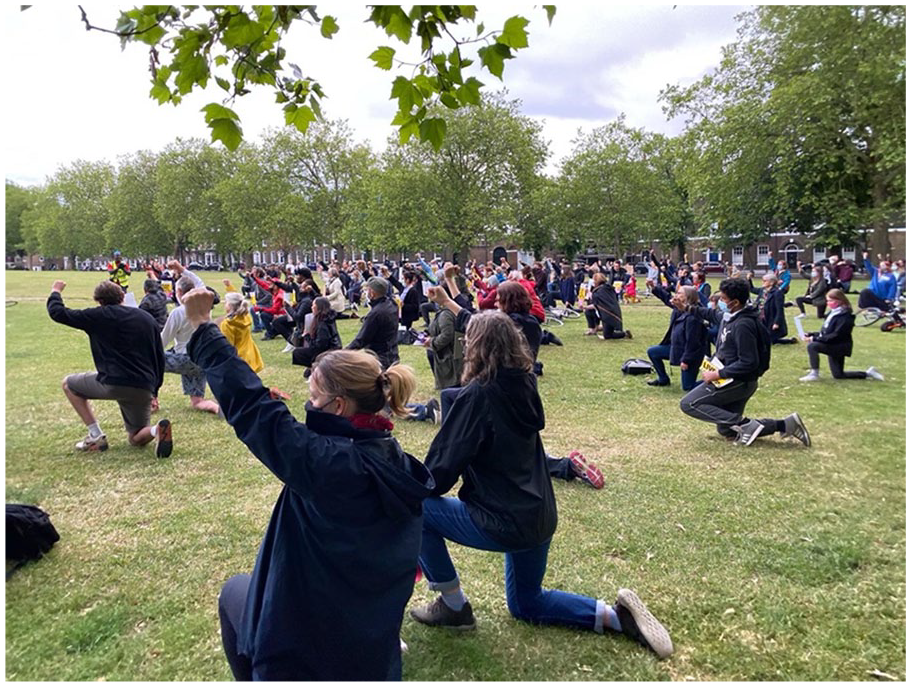
Participating in a local #BLM protest in Highbury, London.
The response suggests the renewal of an ethics of care, of a global solidarity with those
Toward an End(ing)
The virus is clearly not finished, despite over 965,000 deaths globally. Part 1 of the drama seems to be ending but it’s not clear what Part 2 will involve, nor how many parts there are. There is much talk of “second waves.” There is concern in Europe about the winter when ordinary flu will compete with Covid for our bodies. “Unfinishedness” evokes the experience of living in Covid, where we are “continually challenged by the figuring out, disfiguring, and refiguring of lifeworlds and subjects . . . to consider the uncertain and unexpected in the world, and to care (!, my exclamation mark) for the as-yet-unthought that interrogates history and keeps modes of existence open to improvisation” (Biehl & Locke, 2017). There can be no simple return to normal, which was terrible. A global panic might just produce new political possibilities where young and old, Black and White, me and you, act together in solidarity once again.
I also feel an unfinishedness in my thinking, a dis-ease with my own rigidities and unthought-through privileges. I’ve written this from a claimed position of aging while knowing full well that this is intersected by my other statuses, especially class, that are not fully articulated. While age remains a significant variable for Covid mortality, again it is by no means the only one. Indeed, more men seem to be dying than women—and BAME men are especially hard hit—and as we have learnt more about the virus, age has probably diminished in significance. I am fortunate that I have remained fairly aloof from the chaos that Covid has wrought. Perhaps here I encounter some of the limits of autoethnography in the highlighting of single individual experience over big data and other forms of collective story-telling. Drawing geometry patterns offers precision and finality, producing a beautiful end product. Writing my own account of thinking in and through Covid is a far messier process, humbling and also always unfinished.
Alone, yet together. Crazy times.
Footnotes
Declaration of Conflicting Interests
The author declared no potential conflicts of interest with respect to the research, authorship, and/or publication of this article.
Funding
The author received no financial support for the research, authorship, and/or publication of this article.
Notes
Author Biography
