



Abstract
In a 2016 special issue on the relationships between ethnography of education and social, economic, and material precarity, Geoff Bright and John Smyth were critical of ethnographic researchers, for concentrating on discourses and discourse production only, rather than on material conditions to develop activism and processes of transformation against oppression. Instead of only identifying and critiquing precarity, and deconstructing taken-for-granted ideas to give voice to ingrained forms of oppression and marginalization, critical ethnography they wrote, should really be about changing, not only describing and analyzing, oppressive conditions. In the present article, we attempt to identify and explore cases where researchers have overcome the reluctance toward activism and transformation. Using empirical examples we will try to illustrate what characterized these efforts and what seemed to support their success.
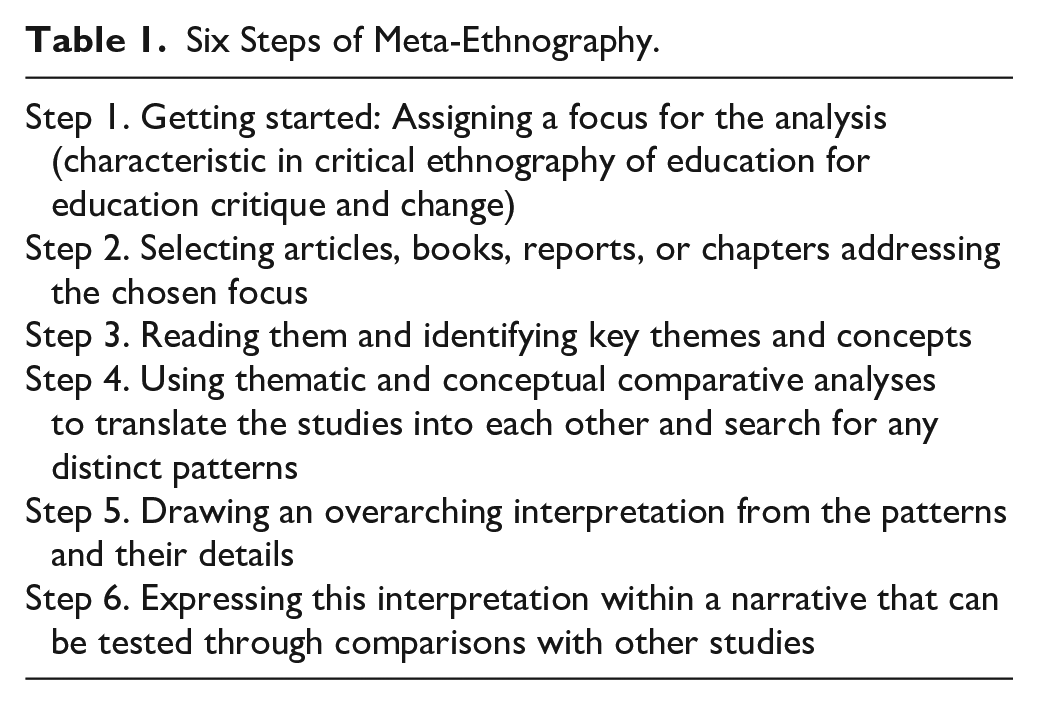
Searching the ERIC database provides many examples of critical ethnographic research in/of education (almost 15-hundred). Just searching QI publications reveals more than 500 titles, such as “When Critical Ethnography and Action Collide” by Ulichny (1997), “Notes on Terrible Educations: Auto/Ethnography as Intervention to How we See Black” by Hill et al. (2019) and Vannini and Vannini (2019) “Artisanal Ethnography: Notes on the Making of Ethnographic Craft.” Their abstracts and keywords allude to works deconstructing and/or critiquing discourses and practices in education that contribute to social reproduction and marginalization in education spaces, practices and outcomes, and/or contributing to the interests of social justice in education and culture, and social transformation. Yet while Thomas (1993) suggests that critical ethnography is simultaneously both hermeneutic and emancipatory, the overriding goal of the research examples in the majority of instances was not explicitly to free individuals from sources of domination and repression. Some of them did claim this however, and they became of key interest to us for this reason and subject to an extensive individual and comparative meta-ethnographic reading and re-reading. We used a six-stage approach to meta-ethnography developed from the seven-step process introduced by Noblit and Hare (1988) to these ends (Table 1). Our aim was to identify similarities and differences in the aims and outcomes of the ethnographic examples and describe what was characteristic for research for social and educational transformation.
Six Steps of Meta-Ethnography.
To downscale the investigation, we concentrated at first on work we had published ourselves using critical ethnography in the past decade, and added to this closely related research by others. We relied largely on familiarity with the field in question but we also used a search in QI (2009–2019) to locate other examples and position the article within the journal. Table 2 presents our total data corpus. It includes 37 peer-reviewed research articles, six book-length works, and four book-chapters in three different languages and from five continents.
The Data Corpus.
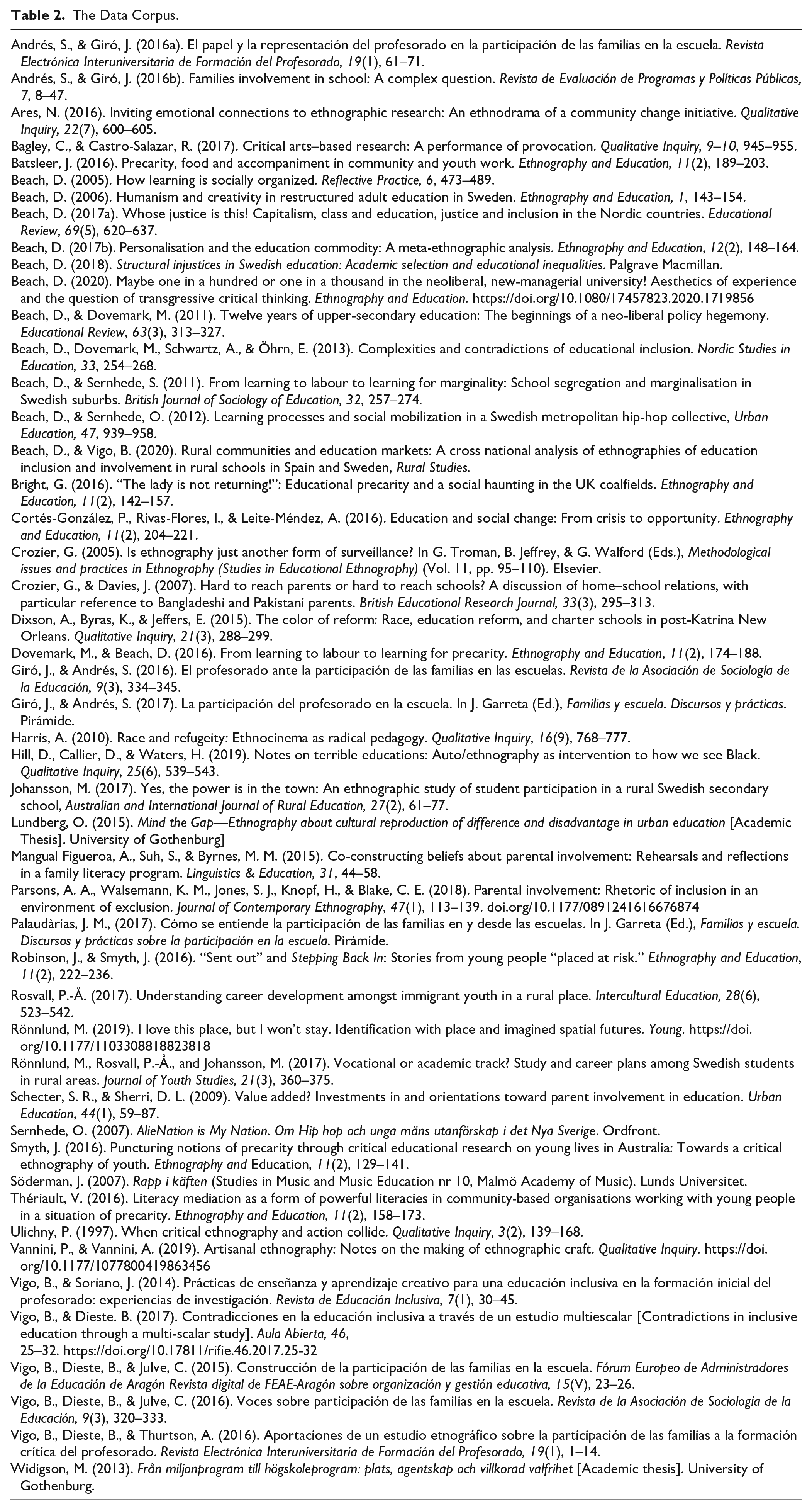
The research examples in Table 2 involved many thousands of hours of participant observation, interviews, and informal conversations with school inspectors, pupils, teachers, head-teachers, parents, and other stakeholders, and for one project, also living full-time in the research neighborhood for half a year. This is unusual. A hundred years ago anthropologists lived with the groups they researched, but this has become less common, and educational ethnographers have never really done it (Eisenhart, 2018). Yet the unfolding analysis confirmed that spending time with/in researched communities was an important theme for the research in Table 2. The discovery of this and other common themes form the investigation results below.
Results
Time to Be Fair
In the first decades of the 20th century, ethnography involved spending extensive time becoming immersed in the daily lives of a culture or group, while writing field notes, conducting interviews, collecting artifacts, and analyzing the data produced, to construct illustrative accounts of alternative cultures for the Western world (Eisenhart, 2018). There was an expressed need to experience material conditions at first hand to
develop familiarity with local conditions and perspectives;
gain trust and resist temptations to quickly plunder fields for data;
begin to analyze the data in the field close to the people there.
There are both empirical and theoretical analytical reasons for making such a strong commitment to “being there,” embedded in this continuous way in the field in ethnography. Trondman et al. (2018) give a good account of them. One is that the structural circumstances at research sites may have very special and different characteristics that researchers need to experience firsthand, and talk with locals about, to understand them fully (Sernhede, 2007). This applies of course not the least with regard to the conditions of social and cultural exploitation and oppression, such as those often experienced by groups researched in critical ethnography (Bright & Smyth, 2016), the kinds of which middle-class White researchers would not normally have grown up in or lived through (Beach et al., 2013; Dixson et al., 2015; Lundberg, 2015). Agier (2009) describes these kinds of places as marginal peripheries and stigmatized territories for abandoned lives with low levels of cultural capital, where people are materially exploited, symbolically violated, and struggle for various reasons to develop a critical perspective on their oppression.
Freire (1970) calls this process of gaining critical consciousness a process of conscientization. The first step is to take sides and commit to working in the interests of change (Ares, 2016; Beach, 2010) and with as much mutual trust as possible (Beach & Sernhede, 2012; Dixson et al., 2015; Harris, 2010). High familiarity with and extensive firsthand knowledge about the social and material conditions and interests of those whose lives are being researched and represented, helps to close social distance and establish strong objectivity (Harding, 1995; Thomas, 1993; Weis & Fine, 2018). It helps overcome the risk of researchers:
Remaining distinct from the researched and maintaining all control and power over the research and its products;
Exploiting the firsthand stories provided by community members as data but not giving them recognition as co-producers of knowledge and ideas;
Giving recognition of creativity only to the researcher(s) as expert(s).
Weak rather than strong objectivity in ethnographic research may be a new norm in educational research, even in ethnography today (Batsleer, 2016; Thériault, 2016). However, there were very few examples of this in the research in Table 2. This is not surprising. Such research is unjust according to critical ethnographers, as it uses the labor of others to produce value without publicly recognizing or compensating them fairly, which is both dishonest and unethical (Dennis, 2018). The examples in Table 2 are very clear about this point and they all express commitments to be fair to participants and to develop not just rapport but trust (Ares, 2016; Beach, 2020; Vannini & Vannini, 2019), by taking the time needed to recognize value in the places researched and the people there. They marked two further common research characteristics. These were (a) accepting that all places and the people in them have value and (b) taking time to identify and form solidarity with local values. However, through them there was also a third characteristic, which was that critical researchers never accept marginalization as either inevitable or dependent on the faults of the marginalized and oppressed people themselves.
Struggling Against Traditional Intellectualism Toward Critical (Research as) Praxis
Accepting marginalization in society and culture as resulting from weaknesses in marginalized groups from territorially stigmatized areas is a common misunderstanding in education research (Beach, 2017a, 2017b; Dixson et al., 2015). Yet it is also ridiculously out of touch with reality (Ares, 2016; Beach, 2006; Beach & Sernhede, 2011, 2012; Dixson et al, 2015; Harris, 2010). Marginalization always has other grounds than those inherent in individual shortcomings, because although many marginalized and oppressed individuals will have played the high-stakes education game and lost (Sernhede, 2007), this “loss” is not because of their own inabilities. Schools are places where the possibilities created for achievement are insufficient for all to do well, and although there is an understanding that pupils compete over these possibilities based on nominal equality, they differ markedly in terms the resources they can access to support their performances (Beach, 2017a, 2017b; Widigson, 2013). Most of them will therefore not have been defeated because of their inabilities, but by the system and the achievements of their competitors (Ares, 2016; Beach, 2018; Beach & Dovemark, 2011; Dixson et al., 2015).
Schools generally work in these ways by separating pupils into two types; of capable intellectual learners, on one hand, and those defined as less intellectual and more practical, but the gradation is not a natural quality, it is cultural, socially constructed, and interactively maintained (Beach & Dovemark, 2011). It begins in school and extends into higher education as a function of a normalizing of ideology through the production of “images” of human beings that operate as hierarchy-legitimizing myths that stabilize oppression, keep people in their place, and are difficult to overcome. Earlier research by Gorski (2012) confirms their sociocultural basis.
Gorski (2012) described four main stereotypes about the poor in relation to their educational attainment. One was that the poor were unable to find value in education. The second was one that parents were not interested in the education of their children. The third was that the poor are lazy in school and in life outside school, and that this, together with their low intelligence and lower commitment, accounted for their lack of educational, social, and economic achievements. The fourth was that the poor are substance abusers and do not raise their children well (also Jonsson & Beach, 2015).
Gorski could find no material evidence for any of these four ideas. For instance, while it was true that things such as measured IQ and the reading speed of low-income pupils were lower than average, this says nothing about their learning skills or the interest of parents in helping children learn. Moreover, when asked, low-income parents expressed as much interest in the education of their children as other parents did, but they also worked on average 1.2 full jobs a year in low-income, zero-hour, flexi-time contracts as casual (i.e., easily disposable) labor, just to make ends meet. They were therefore far from lazy, but by the nature of their work, they might not always have the time to engage in school at the beckon call of school authorities (Gorski, 2012). Finally, regarding substance abuse, statistics show a positive correlation between alcohol and income and no significant differences regarding income and other substance abuse.
Despite no evidence, these stereotypes persist and often with powerful socialization effects in schools. Common in- and out-group attributes described by successful middle-class pupils are an example (Jonsson & Beach, 2015). These successful (often White, middle-class) learners describe themselves as hardworking, compliant good thinkers from good backgrounds, with clear career orientations, high motivation, good performances, and good language skills. They describe others in the opposite way, as average or below average, lazy, suffering from poverty and substance abuse, with low-level language and learning skills, and no interest in education.
Instead of notions of equity and equal value, the school system had thus nurtured myths among the youth who were most likely to become academic, political, cultural, civic, business, and community leaders in the future and understanding this, and being suspicious about the purported “good” and equal value for all of national school systems, were further common research characteristics in Table 2. However, also suggested there is that it is possible to intervene into the relationship between schooling and social structure, and to promote interventions that can lead to fairer education and societies (Hill et al., 2019; Widigson, 2013).
Firsthand experiences of the depth and power of the creativity and learning of marginalized people from territorially stigmatized areas were important for researchers when they made this recognition of these educational possibilities (Beach, 2017a, 2017b). They worked in two ways. On one hand, the experiences demonstrated that although the people of marginalized communities may not have been as formally successful as others at school, these people did not need special help to learn (Dixson et al., 2015; Dovemark & Beach, 2016; Lundberg, 2015; Sernhede, 2007; Söderman, 2007; Widigson, 2013b). They could and did do this already: and often very well indeed (Dixson et al., 2015; Dovemark & Beach, 2016; Lundberg, 2015; Sernhede, 2007; Söderman, 2007; Widigson, 2013b; Beach & Sernhede, 2012, 2013; Harris, 2010), even while using a “new” (second or even third) language as a medium of communication (Beach, 2006; Beach & Vigo, 2020; Bouakaz, 2007) So not only could they learn, they were also very capable learners whose learning forced researchers who were researching them to develop their own critical reflections about how educational organizations work for or against the interests of those they are normally understood to exist for. There was a process of double conscientization (Léonard, 2015), within which researchers transformed their grasp of reality and their work. What became important was not what they could add to scientific knowledge about the plight of marginalized groups. It was how they could instead use their knowledge to engage with these people in processes of change in the interests of education justice.
The researchers no longer saw themselves as uniquely privileged venerable possessors of expert knowledge, but as co-learners and co-constructors of knowledge for social justice and social change (Ares, 2016; Dixson et al., 2015; Ulichny, 1997; Vannini & Vannini, 2019). There was a change within their habitus of organic intellectualism in other words, in the form of new embodied understandings about responsibilities in relation to how to identify, understand, rationalize, and re-rationalize about social conditions (Dixson et al., 2015). They recognized that there was a need to change schools in the interests of justice more than there was a need to change the people in them. This is actually quite logical of course. If schools do not work in community interests but in the interests of the dominant state ideology, recognizing the necessity to take control of them is a further characteristic in research for educational change, as is recognizing one’s role as a researcher in support of this process and there are also sound reasons for shaping this role in a very particular way.
In the Prison Notebooks, Gramsci (1971) is very distinct about social transformation and the role of intellectuals. Having an acknowledged societal function as an intellectual by occupation he wrote is not what makes an intellectual. Instead, all people have an intellect and are able use it, not just academic scholars. Being intellectual includes anyone who is organically important in formulating problems, discussing solutions, interpreting findings, and overcoming divisions in society (Dixson et al., 2015; Weis & Fine, 2018) and revolution depends on this too of course. The transformation from capitalism to socialism requires mass participation, mass consciousness, and a mass consent and effort of a population that is aware of what it is doing and why, as it is only under these conditions that the processes of transformation can be ethically and democratically initiated and successful (Gramsci, 1971). Simply sharing an analysis and taking into account participants’ opinions on researchers’ interpretations of their reality by creating a space of conversation for the refinement of knowledge will not do under these circumstances (Ares, 2016; Beach & Vigo, 2020; Dixson et al., 2015; Vannini & Vannini, 2019). Acts of liberation require other changes too, including changes to the oppressive characteristics of traditional intellectual relationships (Dennis, 2018; Denzin, 2018; Gramsci, 1971).
As expressed in work about the “Theater of the Oppressed,” research normally operates as a model of the conventional theater where audiences watch and actors act (Ares, 2016; Denzin, 2018; Harris, 2010) and the conception of revolutionary action for social transformation is blocked by this (Vannini & Vannini, 2019). It requires two further principle points of recognition and action from all involved parties. The first relates to researchers not being outside (or above) the common world, on some kind of pedestal, but part of it (Dixson et al., 2015; Freire, 1970; Lather, 1986; Vannini & Vannini, 2019). The second is that as justly responsible subjects they should not only strive to make a difference by contributing dialectical understandings of the content, media, history, and processes of class rule and class power but also act based on this knowledge to shake the basis of power that supports all forms of privilege including their own.
In Table 2, parental participation research in schools in rural Spain provided several examples of successful shifts in these respects. It investigated creative teaching practices in classrooms in different types of school with children of different ages and from families with different histories and relationships to education and showed how parental/community involvement was important to the quality of learning interactions and even the survival and vitality of the school to the community (Vigo-Arrazola & Dieste-Gracia, 2017; Vigo-Arrazola, Dieste-Gracia, & Julve, 2015, 2016; Vigo-Arrazola, Dieste-Gracia, & Thurston, 2016; Vigo-Arrazola & Soriano, 2014, 2015). There were some clear common characteristics in this research. Researchers concentrated on material conditions and change, recognizing participant’s voices, promoting reflection, and constructing spaces through which to promote and engage in social transformation with/in research (Beach & Vigo, 2020).
Agency and Voices in/and/for Critical Ethnography for Change
Aiming to give voice to participants is really a standard of ethnographic research (Eisenhart, 2018). However, in the parental participation research in Spain, giving voice was not just about letting people express themselves, it was also a practice of representation, identity, and power (Ares, 2016; Fabricant & Fine, 2012, 2013; Fine, 1991; Harris, 2010) in the development of agency (Horvat & Antonio, 1999; Parsons et al., 2018). Work by Bouakaz (2007), Crozier and Davies (2007), Crozier (2005), Jacobs (2008), Parsons et al. (2018), and Schecter and Sherri (2009) provides examples we are familiar with that tried to do this. The researchers listened to parents and teachers when formulating research questions and ideas, but moreover, they also gave regular reports about their own actions to open a window of discussion and reflection not only as feedback about what it was that researchers thought they had found out, but also on how they had done their work and might have done things differently from the perspective of others. They then listened to feedback and applied it, monitoring developments and communicating this back once again, to get feedback once again, in a cyclical way (Vigo-Arrazola & Dieste-Gracia, 2017; Vigo-Arrazola, Dieste-Gracia, & Thurston, 2016). Speaking at a summer course at the university, one of the researchers said, There was a strategy for increasing research involvement with regular meetings and a commitment to try continually to expand the research collective when discussing possible alternative courses of action. We worked hard at this and there was a change in our ways of interacting. Teachers and families said they began to feel genuinely recognised and valuable and that we did things at the end differently to in the beginning and that they spoke differently about school and what they expected and desired from it and with different people. Actions “had become more joined up” and there was greater conviction concerning the right courses of action to develop school activities for the children and the community not just, as before, for the sake of doing the formal curriculum.
Studies by Crozier and Davies (2007) and Crozier (2005) demonstrate similar attempts at trying to engage with teachers and parents when looking for patterned and interrelated phenomena that can open spaces for broadened engagement. Yet not quite in the same way! In Spain, the researchers described attempts to shift away from a perspective of a researcher as a member of a traditional intelligentsia that regarded itself as venerable and different from the rest of society. Researchers were committed to be fair to participants and to overcome the hierarchical differentiation between researcher and research subject. They worked toward a new conceptualization of the researcher, not as venerable and elite, but as a public intellectual collaborating with members of a community in their efforts to confront and take control over history (Bagley & Castro-Salazar, 2017). A teacher from one of the schools talked about the cross-project meetings at the university as a place where the project accomplished this: Researchers were more like people and instead of being a place where we went to listen to them telling us how things were and what to do, meetings at the university were places for thinking about, discussing and even trying out ways of encouraging the participation of parents . . . We also talked with each other and the parents about researching our teaching . . . We began to work together to develop community pedagogy. (Teacher)
These are not simply expressions about developing communication and reflection. They are expressions about ways to build bridges between the institutions of the university, the home and family, the school, and the people there, through critical ethnography in an action research collective. Research by Jacobs (2008), Parsons et al. (2018), and Theodorou (2008) ran along these lines too. However, while they tended to reinforce the teachers’ convictions about the value of a reflective, cultural, and critical educational practice for familiarity and familiarization in support of pupils learning from the traditional curriculum, they did not explore and overcome the challenges of deconstructing and changing existing relationships and suturing new ones. They tended to leave the power relations, structures, and ideologies that normalize social positions within social hierarchies unchallenged. Such hierarchies include those between the state and its citizens, universities and schools, researchers and teachers, and schools and homes, and within them researchers risk remaining experts who are in charge of research, which is then also research that risks being research done (or led) by them on others. Placing too little effort on deconstructing the power relations involved in processes of intellectualization versus cognitive marginalization and the role of personal experience of research as a public rather than a private activity proved a problem.
Developing Trust in/and Critical Ethnography
What is emerging here is that while many projects exist that try to connect the life of children and their families to the curriculum in meaningful ways, they seem to have been more successful in creating and sustaining significant changes in social relations of education when efforts to physically (socially and materially) deconstruct and reshape spaces of interaction (and not only taken-for-granted worldviews and practices) were present, along with ways of integrating stakeholders into the knowledge network of the research (Bagley & Castro-Salazar, 2017). Researchers being committed to developing trust not just rapport was important too (Ares, 2016; Beach, 2020; Vannini & Vannini, 2019), as was the integration of different actors into different domains of activity, including integration in the cognitive domain of the research process for the community members and into the socioemotional domain of the community for researchers, by developing a sense of belonging to a common humanity, sharing values, and responsibilities such as empathy, solidarity, and respect for differences. Together they comprised foundations for a new behavioral domain of action (for acting collectively and responsibly for a more enriched, sustaining, and sustainable community) where researchers engaged with teachers and families in making revolutionary sense of their experiences and knowledge for educational activism in the interests of the community and social transformation. The activities described in Ares (2016), Bagley and Castro-Salazar (2017), Beach and Vigo relating to communitas schools (2020), Dixson et al (2015), and Vannini and Vannini (2019) provide examples.
One example of success in the Spanish research was when teachers and parents developed their own action research project in one school that was successful at including stakeholders and in developing educational change and ways of sustaining it. The head-teacher at the school expressed to researchers how pleased the teachers and parents were with this outcome. Many different members of the community were involved, and though the project started simply, as a “free-text” experiment in school-based language learning, expansions took place to include over time art and small-scale theater, music, crafts, artisanal skills, and sports activities in the school, which became a natural place for bringing people together to converse and learn with/in these activities. Science fairs and language workshops added to the activities over time in this experiment of broadening the school to the community and the community of learning in the school. Teachers and parents in the project invited researchers back into the community to observe and comment on interactions and contribute ideas to further developments (Vigo-Arrazola & Dieste-Gracia, 2017, 2019a; Vigo-Arrazola, Dieste-Gracia, & Julve, 2015, 2016). The researchers wrote comments back to them and said, The horizontal playing field created earlier seems not only to have been sustained but extended. Teachers and parents together with pupils have discovered new capabilities in themselves and the community and have generated a capacity to confront history and begin to change its course. More people enter to the school and their knowledge and experiences have contributed to form ideas about how schools can respond better to their communities. The researcher role has shifted from identifying, describing and analysing what happened in the complex institutional assemblages of modern schooling in and for their community. An action-reflection cycle similar to that in critical action research has become part of everyday praxis.
One important initial feature in the developments at the school was that researchers, teachers, parents, and pupils had obtained economic funding to buy time to initiate a project and establish an initial platform for building familiarity, respect, solidarity, and collective action from. This platform formed a foundation then for establishing a community of critical practice that enabled interactions that helped researchers to grow in confidence concerning teachers and other community members, so that they were able to give up control and give their time instead to supporting the development of research and action by others. The researchers gave up their authority over research and teachers gave up their sole right to interpret and teach the curriculum. Teaching and research became acts of public intellectualism and learning began to take place both within and beyond school walls with people from many varied walks of life, thus linking schools and their pupils to other formal and informal institutions and public spaces (Bagley & Castro-Salazar, 2017). Broader conceptions emerged for supporting and developing school pedagogy for community needs (Beach & Vigo, 2020).
Although modest, these actions represented significant interventions into micro-social relations around teaching and/as research (Beach & Vigo, 2020). Ares (2016) and Bouakaz (2007) connected such actions also with the problem of dissemination and the challenge of reaching multiple audiences outside academia. Ares used a one-act ethnodrama from a critical ethnography of a community change initiative to do so, which allowed active roles for participants and audiences to produce emotional connections with a potential for active/e/ist responses to social change. Researchers in Spain had introduced and used the concept at workshops along these lines with the same outcomes intended, but the community extended activities in all kinds of other ways as well. There was a community play, sports events, arts and crafts events, language workshops, and science shows staged by community members, at the school, to express local (global) skills, interests, values and ideals, and commitments to the future of the community, the school within it, and the broadening of horizons and collective ambitions (Vannini & Vannini, 2019). The play was about the school and the many living activities that went on there now. Learning enlivened by living content had extended and to some extent even replaced a repressive curriculum dominated by the content of dead bourgeois generations (Beach, 2018, 2020).
Discussion
The present article has tried to identify different characteristics in critical ethnographic research for social transformation. They vary from ones that
Barely break free from traditional intellectualism and producing explanatory criticisms of the workings of social relations of power, to ones that
Engage with and learn from people living and learning in adverse conditions in territorially stigmatized spaces for economically poor families and
Actively work to engage in change to the social orders of discourses about and practices of teaching and research in schools there in community interests.
Giving voice was fundamental of course to all the examples of critical ethnography. It is a minimum requirement in critical research from Gramscian perspective (Gramsci, 1971; Lather, 1986). Yet within it there were also further shifts, from merely listening to people and documenting and analyzing their actions to disclose valuable critical knowledge about them, to engaging with them to learn with and from them, develop respect and learn to engage in their actions in their interests. In the successful cases, this development of respect materialized in practices where researchers not only respected the value of others’ intellectual contributions to research as potentially as strong as their own. They also included ones where researchers were happy to take a supporting rather than leading role in the development of activism and became actively involved in creating spaces of interaction where this change of roles was likely to take place (Bagley & Castro-Salazar, 2017).
This shift to supporting activism instead of trying to be its main architect and driver (its “Director”) is perhaps the most significant dividing line in relation to the works we have analyzed. Instead of doing research about education relationships, processes, and outcomes in conditions of precarity in impoverished and marginalized areas and their schools, researchers engaged with the community to change school and community conditions in the interest of education justice as public intellectuals (Bagley & Castro-Salazar, 2017). Yet there was again a consistent pattern in this switch in practice. First, researchers took a research role, exploring contexts and their social relations. Then they took an initiating role regarding the development of research funding and applications for financial support for it. They acted as initial coordinators of these projects, but they also actively looked for ways to create greater responsibilities for others, to whom they then successively took a supportive role. The community became the subjects, following Lather (1986), of their own research as praxis.
Some members of these groups were of course public intellectuals already at the beginning of the projects in Spain, such as the head-teacher at one of the local schools in the parental involvement projects (Vigo-Arrazola & Dieste-Gracia, 2017, 2019b; Vigo-Arrazola, Dieste-Gracia, & Thurston, 2016; Vigo-Arrazola & Soriano, 2015). Others became so successively through taking increasing levels of responsibility in and for research and its growth and sustainability. However, the point here is that what people needed was support for their activism from researchers rather than control (Bouakaz, 2007). They understood the nature of their oppression and they wanted a better life. They did not need researchers to think for them; they could think already. Nor did they need researchers to guide them in their actions; they knew how to act. Nor did they need researchers to provide them with the key knowledge about their communities and their place in the world. They knew about their communities already. They did not even really need fresh resources; they had them, in the community and the school. They just needed a way to activate these resources in their own interests instead of in the interests of what might ultimately be a repressive state apparatus (Beach, 2018). The researchers learnt how to be a support in this process, in the end, and they learnt too that what can perhaps often stand against this is the will of researchers to always be venerable and to seem to be the most knowledgeable subjects who are always in control (Vannini & Vannini, 2019).
This realization of the need to step back and support instead of always being venerable and in charge may ultimately be the most critical point of suture for successful social transformation projects according to the meta-ethnography of the ethnographic narratives in Table 2. Researchers always run a risk of contradicting their aims in practice, and similar risks existed for others too. Some community members struggle to recognize a full and equal equivalent value of all community members, for instance (Bouakaz, 2007). The Roma seem in Spain to suffer this most often, but it affects the multiethnic agrarian sub-proletariat too (Beach & Vigo, 2020). Socialization effects in relation to race, gender, ethnicity, or social class background are not always easy to undo (Bouakaz, 2007) and stereotypes connected to laziness, criminality, and substance abuse attach themselves easily to people when poverty presses down on their lives and their learning (Gorski, 2012). Creative workshops using art, crafts, and theater played an important role in overcoming these problems.
The origins of the researcher desire to uphold control are probably many. One is of course the obfuscating tendencies of traditional intellectualism (Harding, 1995). This is possibly the easiest one to deal with however. As noted by Harding (1995), in traditional relations between researchers (as experts) and practitioners (as reflective professionals) in knowledge production, the researcher always benefits. The expressed objective is validation but the outcome is weak objectivity and the reproduction of existing structural relations of privilege (Harding, 1995), which it applies, moreover, regardless of whether the analysis may have helped participants to become “more informed” (to a degree), more “refined,” and (to a degree) better able to compare their experiences and connect them with a contextual reality or not (Ares, 2016; Beach, 2005, 2010; Dixson et al., 2015; Harris, 2010). Reflexivity is not emancipation (Freire, 1970; Gramsci, 1971). Awareness is needed to help researchers to seek other rewards than those that the system they belong to and the profession they are part of make them feel dependent on (Lather, 1986).
More subtle and difficult structures of opposition to change are the ones that are actually internal to organic intellectualism itself. They evolve through structurally homological social relationships that can form within this perspective, at times, to those of the vanguard tradition in Marxist revolutionary theory (Gramsci, 1971). The vanguard considered the (physical) working class (the mass) as in need of militant leadership toward and through revolutionary struggle, against the capitalist state, and they positioned themselves in a forefront position in that struggle as ground-floor leaders of the revolution. The role of critical researchers in the operationalization of research for change can take on elements of this positioning in the beginning of a research project for social transformation, but the emerging narrative from the meta-ethnography also troubles this position. It points out that researchers who take a vanguard-like role always risk suturing their practices permanently to a form of leadership that can oppose the material realization of their aims, by falling prey to a power-geometry of domination based on hierarchical structures of privilege and associated hegemonic roles, and relationships (Beach, 2005).
The successful examples of research in the projects connected to parental involvement in education all illustrate the struggle toward successive emancipation, not just of the local community from their marginalization, but also of researchers from their venerability. Yet there are also other examples of work in Table 2, where, though the projects did not have transformation intentions initially, following deep engagement in communities, researchers nevertheless began to develop them. They did so once researchers had recognized the full scope of the challenges participants faced and the full depth of the skills and knowledge they brought to bear when facing these challenges (Beach, 2006, 2017a, 2017b; Beach & Sernhede, 2012, 2013; Sernhede, 2007).
This recognition came from deep participation and involvement in the community and deep objectivity along the line described by Harding (1995), but it also forms a point that Beach and Vigo (2020) make. Moving from a “vanguardist” to a co-intellectual role in a shared process of public intervention is not just a point of recognition, it is also a point of transition in the unfolding local history of educational practices (Vigo-Arrazola & Dieste-Gracia, 2019a, 2019b). It takes place when researchers become more aware of the community, its conditions, its individual members, their challenges and experiences, their coping activities, struggles for recognition, and what really motivates them and why (Bagley & Castro-Salazar, 2017). Such research is not just about discourse production (Bright & Smyth, 2016). It concerns material conditions and processes that can transform lives.
Conclusion
The article has identified a number of points for consideration about overcoming the division of labor in expert societies between research and practice for the development of public intellectualism, and as an example of a continual struggle toward education justice and social transformation. It acknowledges that researchers can go some way toward destabilizing these hierarchical relationships if they are aware of the need to do so, and experienced enough in the lives people lead to be confident in their capabilities. It recognizes also how this involves researchers being able (and we mean here not just in terms of intellectual and ideological preparedness but also in career terms structurally and materially able) to resist investing in what they think will pay off with respect to their reputation and future funding as professional researchers. It has to do (to an extent anyway) with their education and their understanding of class positionality (including their own) and class relations of domination and subordination, respectively. Where do we belong (in the class structure), whose interests do we share, and how is this reflected in our labor are key questions and also very difficult ones. Being venerable is not a position to strive for in these respects.
Few of us critical ethnographers of education have been educated as revolutionary intellectuals (Thomas, 1993). Not everyone seems able to develop these capacities, and the structures of an increasingly managed and alienated academic landscape do not usually encourage them to do so either (Lather, 1986). Career by publication has to come second to commitment to social transformation and recognizing, talking about, and treating others as public intellectuals: and in the current structures of academic life, this is easier to say than to do (Ulichny, 1997). It expresses itself in terms of catalytic validity, (double) conscientization, and challenges to the metaphors of conventional theater in the everyday practices and social relations of research as praxis (Bagley & Castro-Salazar, 2017; Denzin, 2018; Lather, 1986).
Footnotes
Declaration of Conflicting Interests
The author(s) declared no potential conflicts of interest with respect to the research, authorship, and/or publication of this article.
Funding
The author(s) received no financial support for the research, authorship, and/or publication of this article.
