



Abstract
The article introduces the concept of the “intertwangle,” a concept grounded within the gentle collisions of delegates at the 13th International Congress for Qualitative Inquiry at the University of Illinois and the simultaneous retelling of multiple autoethnographies of such encounters. Through such encounters and “retellings,” perhaps a different way of thinking about autoethnography is developed. The article presents a story of a journey to and through the 13th Congress. A journey of no answers and no certainty—this journey is not a collaborative sharing of data but more of the gentle collisions and the recounting of different stories located within shared experiences. It is a simple journey bounded by way-markers of uncertainty, at times self-deprecation, loss, and death. It is a journey of new beginnings, of no ends—of uncertainty rather than certainty, revealing rather than obscuring and expanding rather than reducing.
Introduction
In the contemporary moment, critical qualitative scholarship—including and perhaps critical auto ethnography- is asking the same question: How can we go on telling the same kind of stories in the same kind of ways. (Jones, 2017b, p. 2) I/We must not only listen but we must hear the stories of others. (Alan) The statue looked at the people and thought, “Why are they all moving about?” . . . Brendan Kennelly (1995)
1
Autoethnography was something I enjoyed reading; it motivated me but was something I did not truly understand. Urged to action by autoethnography, I needed to tell a story in a different way . . . a more meaningful way (see Jones, 2017b). Here, though

—as the me is inverted the we that the I in the me had been looking for materializes. Not the hierarchical team, one with captains and lowly water carriers but . . . something perhaps different.
However, I am mindful that the I is also still very important to some researchers and is crucial to understand if we are to get a sense of the we in such teams. As Asli accounts,
To me, a researcher’s role is to channel the voice of societies, communities/groups, and individuals. To me, a researcher needs to be as objective as possible distancing her/himself as much as possible from her or his object of inquiry, without losing her or his sociological imagination and personal empathy . . . Therefore, I do not use “we” when the object of inquiry is the society of my country of origin. To me, it is necessary to be able to look at the object of inquiry and yourself as the researcher from a certain distance. It is positively important to alienate yourself to it so that you can only aim to comprehend it through the concepts and theory. To me, this is the only way to be the voice of the disadvantaged/oppressed universally. In fact, with this manner, I managed to communicate and understand Germans, Finnish, Americans, etc. in Illinois because at the end, to me, the common language is the “science” and the aim is solitary.
The following story, therefore, is not mine but reflects how people live and how our lives collide. As Homan Jones details, autoethnography is an affective force, it is “a surging rubbing, a connection of some kind that has an impact” where “people’s bodies literally [affect] one another” (Stewart, 2007, p. 128). Lives where a singularity of meaning is spurious in any given situation/moment there are multiple mediated meanings which exist, coexist, disrupt, and decide. Revealing multiplicity appeared to me to be a “moral responsibility.” We may not always be aware of this multiplicity but it is always there. A ghost, of experience, is always present in any given historical moment (see Hodkinson, 2019). Words we wanted to say but did not. What we thought, but could not express but scream to do so now. The I/we needed to write, not an autoethnography but a multiple of such ethnographies. Of gentle collisions, multiple meanings and the walking of one and many paths at the same time. Paths revealed in, and through, the writing of multiple versions of individual historical moments. This story morphed interdisciplinarity into a disruptive and sometimes comical term, one which gained traction in an hysterical historical moment in Murphy’s Bar, Green Lane, Urbana and through multiple moments experienced because of the International Congress for Qualitative Inquiry (ICQI). The term in question is the “intertwangle.” This article defines and mobilizes the intertwangle through a journey constructed around the 13th Congress. This journey though is not one of the answers, certainty or grand unifying claims. It is a simple “experimental” journey bounded by uncertainty, self-deprecation, loss, and death. It is a journey of new beginnings but no ends—uncertainty rather than certainty, revealing rather than obscuring and of expansion rather than reduction.
Journeys: Ends and Beginnings –
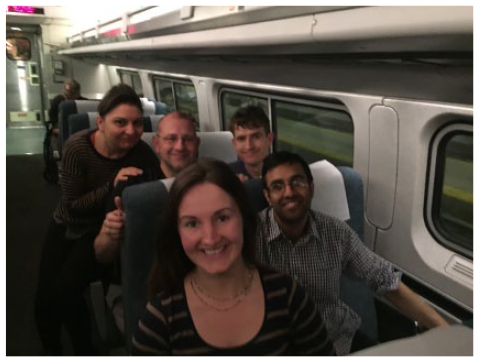
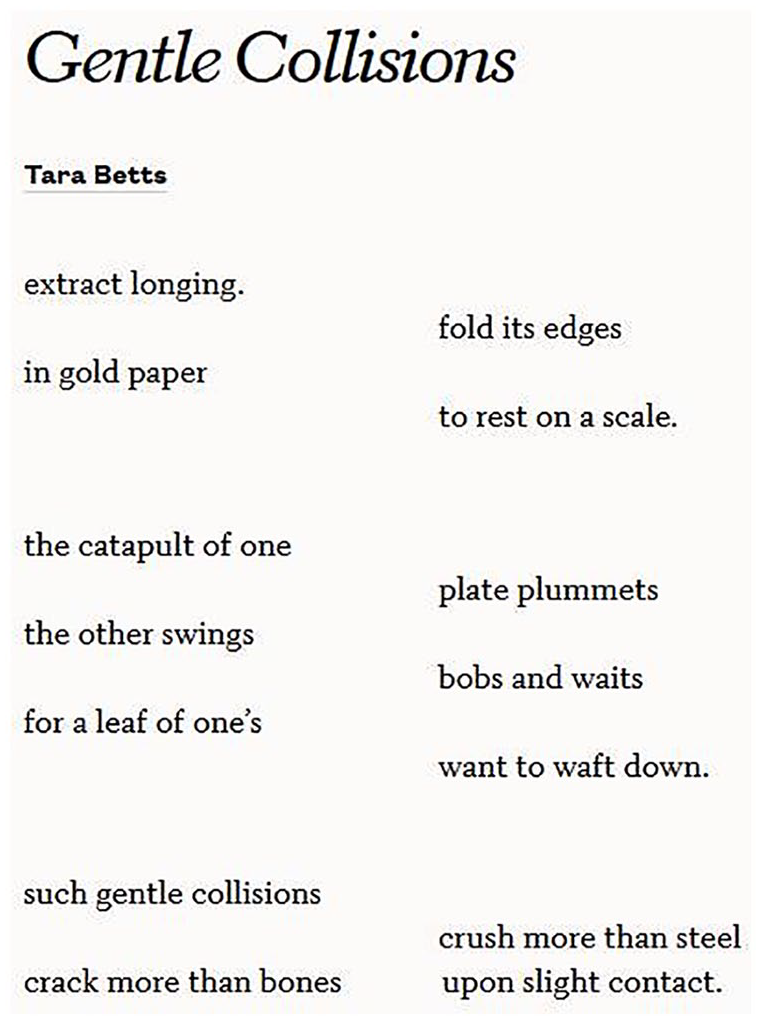
A journey end brings a new beginning . . . Amtrak, I love you, a silver moving box . . . sidings . . . reversing . . . sidings . . . sidings . . . conversations like fireworks explode as the colors of culture blast, scatter, collide . . . and the carriage is lit with the bright light of dialectics and discourse, dissonance and then perhaps defiance . . . “such gentle collisions crush more than steel, crack more than bones.”
“Hey are you from England?”
“I love your accent. . .”
“Hi I’m Ben from Poland . . . ”
Sat still . . . but moving fast as Illinois passes the window, a silver framed picture of lives and people I will never meet, never know . . . a glimpse of a child’s face fast replaced by a lumbering truck, “these folds and edges,” “extract longing”—a longing to stay still not to move fast. The carriage bursts into life as we discuss authenticity and politics—authenticity and qualitative research and authentic authenticity (Alan).
Another dialectic though crashes in . . . it is a forced collision, it disrupts the hyphen of authenticity—the soft bridge of the hyphen is replaced by a hard union (Serres, 2007). A gate of foreclosure forms an enclosure whose boundary is marked by the statute 3 of disciplinary experience. The boundary stone raises as tombstone to the discourse, a fallen angel with marble moss encrusted hair . . . “ we all wear stereotype badges, symbols of bigotry—whatever we might profess . . .” (Alan) echoes around the carriage. Here then were “castaways who sought to drop anchor and grow roots elsewhere, thus changing elsewhere into here” (Serres, 2015, p. 38).
Particles and collisions—life’s Hadron Collider—a search for a connection . . . a search for dark matter (here read meaning 4 ) but the particles skittered, bounced . . . and then scattered. They collided but did not connect. This was not molecular chaos theory. 5 My thoughts turn to ripples and pebbles—bouncing pebbles/bombs—bygone youth through to papers on loss, regret and new beginnings and searches in many forms for meaning. The hard boundary is reached. The angel is fallen—a conversation dims and the color of beginning explosions fades, dies and is no more. (Alan)
The conversation on authenticity, named here as an “intertwangle” was a clineman, 6 but its Gordian knot was not lucky, in its tightening, it became unbound. This though was not death but merely a transition. Loss enveloped this silence, a pause, a stop . . . the journey to the Congress continued . . .
Gilman is near—the conductor paces—“Gilman, Gilman, Gilman is our next stop . . .” the tannoy crackles to life as the discourse dies.(Alan)
Paul’s journey though began in a different time and place—a gentle collision yet to be had . . .
Running through Fort Wayne at Heather’s place, midwest, a week before ICQI, past broken teeth and factory windows . . . same shame, same recognition . . . later I filled up buckets of compost for Heather’s hubby . . . more shit . . . (Paul).
Siding One—An Attempt to Define an Intertwangle 7
I’m thinking lots of words, but very few sentences (Gingrich-Philbrook, 2017, p. 10). I have never found a concept that was grasped in a word (Derrida, 2005, p. 83) Defining a Definition (?)
Inter- “a Latin prefix meaning between, among, in the midst of, mutually, reciprocally, together”
Verb- third person present—place (a corpse) in a grave or tomb. . .
Tangle: to bring together into a mass of confusedly interlaced or intertwisted threads, strands to involve in something that hampers, obstructs, or overgrows
Entangle- to make tangled, ensnare, enmesh, to involve in difficulties, to confuse or perplex
Intertwangle: a sematic gentle collision; a “word crash”
Noun: the intertwangle was a lengthy one.
Verb: they were intertwangeling for quite some time.
Following Jean Luc Nancy (1996) in defining the intertwangle I point beyond the word itself. The words inter, tangle, entangle in collision are both a “fold and a leap” (Stronach, 2010). This language is “out of joint” (Derrida, 2001) but the intertwangle joints together “ . . . person to words, concepts, stories and theories” (Stronach, 2010, p. 177). Out of joint—but joining—with and against, inside and outside, a singularity but also a plural. A concept, “. . . in movement; of opposition; sequence and coalescence—a story that won’t hold still across the ‘empty’ space of [its] disconnections” (Stronach, 2010, p. 179). As Stronach (2010) might account it is “. . . discursive magnetism, that at-tracts and dis-tracts the other” (p. 176). The hyphen, as a soft bridge, has importance here as meaning and value constantly move, forever, re/un/writing the other as in “relationless relating” fold and unfold, knot and unravel (See Critchley, 1998 in Stronach, 2010).
“. . . one plus one is three” (Stronach, 2010, p. 181) but with the intertwangle one plus one can also be four, five, six and counting . . . “the stories multiply rather than add.”
The journey begins again—statutes at crossroads . . . Sculpture bears ancient witness to the anthropological genesis of experience in general. It carves, drills, fashions. Rodin is right: gate is the true name of the sculpture’s ark. (Serres, 2015, p. 48) The voice is imprisoned in a complicated bureaucracy of networks and gates. Articulation is a set of strangulations; consonants strangle voices. They squeeze them (Serres, 2007, p. 189).
Statues and gate to bridge- enclosure to opening—hinge- joint flexing to become a drawbridge—not pulling up the drawbridge . . . (Alan) a suspension bridge launches a passage from one bank to the opposite, from one country to the foreign, from one language to another . . . (Serres, 2015, p. 49)
A statute of experience is Cartesian logic. Is this the I of which Ken Gale speaks? Perhaps, but is it the I inside -inter—or the I in between—intra that’s important. Why can it not be both simultaneously? Changing inside into outside and outside into inside at the same time (see Gale, 2017) . . . marked by a boundary stone- a tombstone to interdisciplinarity- two roads- boundary stone (gravestone of experience 8 ) marks the crossing the way—why not take both roads simultaneously or create a third (many roads) and walk all three (see China bridge 9 )

. . . bridges . . . utilitarian pathways to gentle collisions . .
Need to integrate this (the poem by Serres below) Ella- but love the shapes and bridging not blasting . . . (Alan)
I put the above comment in the margins of a draft of this article that I needed to integrate the next image more fully—but why—it is just there, it is beautiful, the bridge the shape . . . so in the words of the Beatles can we not just “Let it be?”
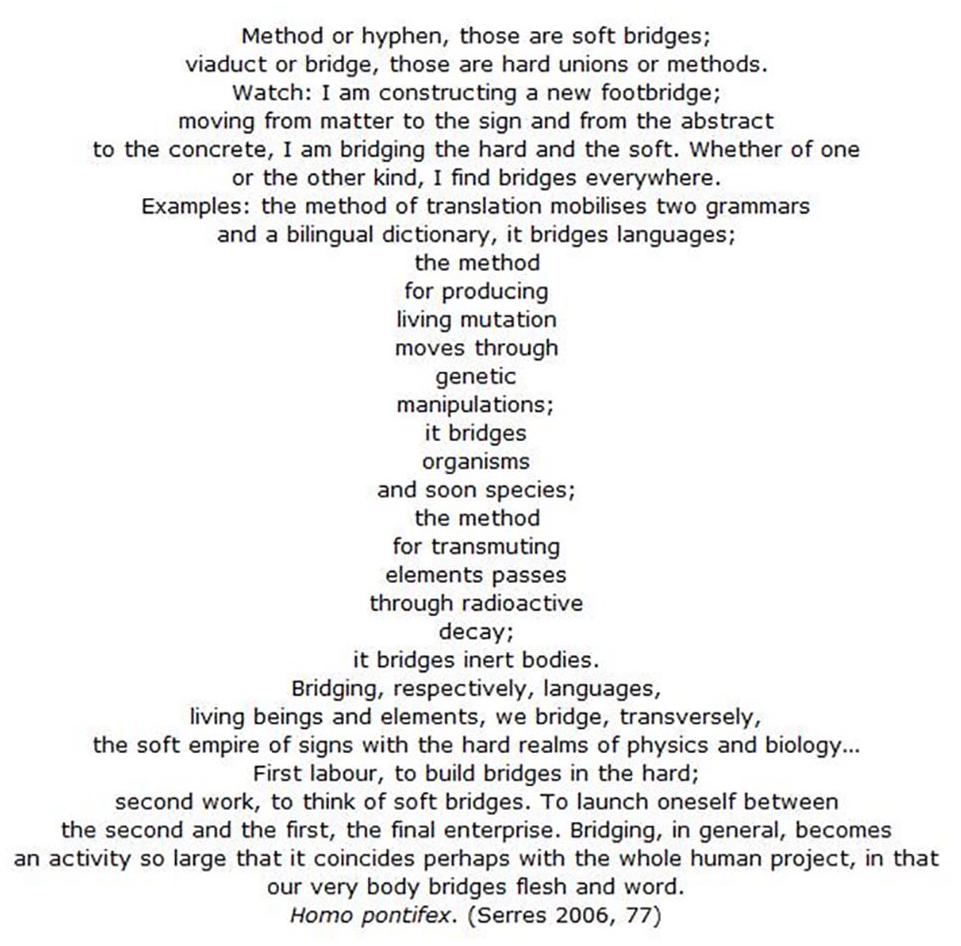
Ella though reminds me that bridges are not just pathways. As she said, they knot together collisions. In this sense they have a beginning but no end. Bridges are dead, in engineering terms, they are designed to carry dead loads, but they also live carrying ‘live loads’—people. They also deal with “dynamic loads” as they work with and against nature. In some countries people put small locks on bridges to symbolize love but people also use bridges to end life. The bridge becomes a metaphor for life, of life—death, life and dynamism existing simultaneously.
Dead statues mark the crossroads. This “Cartesian mediation eliminates, expels banishes everything” (Serres, 2007, p. xvi). Here, then, at the space of the crossroads; place “is strewn with simple arrows pointing only in one direction” (Serres, 2007, p. 27). At the crossroads each of us carries our shadow, an associated ignorance, the brilliance of our knowledge but we must “pass through these absent unnoticed connections” (Serres, 2015, p. 13). But it is, or is it, the hardness of experience that “holds up” a new space—for there is no “softness without the hardness” (Serres, 2015, p. 35)? We have to explore the paths not yet explored and knot these experiences together into a new whole. A whole that we do not yet, nor may ever really, understand (Serres, 2015). As we pass through this space, we must invent new places (Serres, 2015). The crossroad presents choices—it is the location of a potential intertwangle (note a g but no “gerr”—it has to be gentle collision, we must “fold its edges in gold paper”). With the intertwangle, the space becomes metaphysical/ philosophical/ physical. You can walk both roads—all roads. At the crossroads, the statute blindly points the way. One way, one road, a dead end foreclosed by a law and enclosed by a narrow and narrowing gate. 10 A gate whose enclosing action ensures rarity is made even rarer as it serves only to produce reproduction (Serres, 2007). The gate here encloses a threshold and forecloses a law. Pass through the gate into the next enclosure, put down roots, make there here (see Serres, 2015). The gate counterbalances the laws as they “each cancel each other out as on the flat beam of a balance” (Serres, 2015, p. 47). The new space becomes the old, the law counterbalances and the gate replicates itself again and again Ad nauseam. This destiny follows a path defined by a death.
Heather pushes this thinking about the crossroads further:
Reading Alan’s incorporation of crossroads as boundaries, my thoughts veered into liminal spaces. In European fairytales, derived from ancient Celtic tales, crossroads are places for changing your direction. At the center point, you hold the potential to go in two or more directions—maybe only for a moment, and maybe you never consider it, but the possibility is there. In these cultures, crossroads represent places that are neither one thing nor fully another—places of in-between. Liminal places, beyond, outside or in between boundaries. Liminal encompasses both places such as cemeteries—where the dead are remembered, and thus still live a bit, or times, such as dusk or dawn—neither day nor night. A person approaching you at a crossroads beside a cemetery, as the sun sets, is a good sign that everything is about to go sideways. Such events are full of power and transformation, but with no promises of safety.
I was beginning to first form these ideas during a class taught by Elizabeth St. Pierre in 1999, in conjunction with conversations about marginalization. In my journal that year I wrote:
“[drawing from an exploration of African traditions during a course on southern visionary artwork] . . . liminal is a place beyond binaries; (i.e., dusk is neither day nor night). African traditions held that these liminal spaces are places of great power—where the world is constantly destroyed and recreated. Spiritual practioners frequently live in these places, like marshes (neither and both land & water). Interesting overlap with ecological science documenting marshes, and especially saltwater marshes, are the nurseries of life. [Western] observers have previously assumed spiritual practioners were forced to live in these places they were outcasts, feared for their power, and strangeness. However, the spiritual practioners themselves say they chose to live, or at least work, in these liminal places because they are full of power; places of transformation. They are places of power specifically because they are edges, liminal beyond binaries. This is their generative, transformational power.”
This brought me to a different reading of Alan’s use of crossroads, not as boundaries, but as openings to some other, currently unknown thing. Go back and read through this piece again, applying this concept of liminal to the crossroads symbology—how does that change the evocations YOU see in the piece?
An intertwangle then alters the gate’s hinges . . . rise and fall—tilt and turn . . .
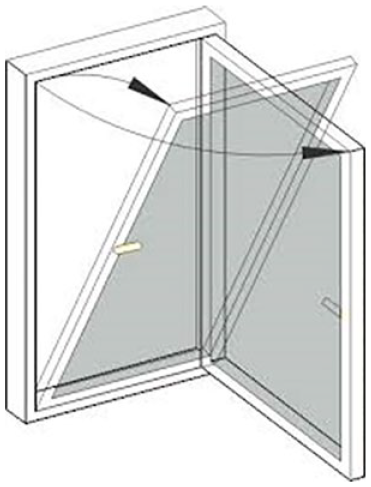
The gate here reforms itself moving from the horizontal tombstone position to make a bridge—a drawbridge—a funnel—an opening. What was once a potential hard enclosure is not foreclosed but presents a possibility of an opening a hard end-point into a softer bridge that suspends itself over the two/three/all roads—making both/all choices possible. To corrupt the words of Serres (2007, p. xviii) the intertwangle is river “like. It is forking, branching, slewing, slowing, rolling back on itself . . . a complex volume that folds over on itself, and in the process does not merely transform” dialogue, but itself gathers up and releases dialogue. The intertwangle has formed an opening at the crossroad—but it is the I, the me, and the we that must walk though . . . The hinge enacts a recognition that the trace, or rather tracing, differing and articulating, is performative: to begin is to open; to open is to inaugurate; and to inaugurate is to create (again, a new). (Protevi, 2005, p. ix)
The hinge must be broken, it must be reformed a new. I must become we—the one must become the many—the inside must become the outside inside as the insider outsider forms a new space of places.
The journey continues . . .
Siding Two—The Jacket, a Scarf, and 30-Degree Heat
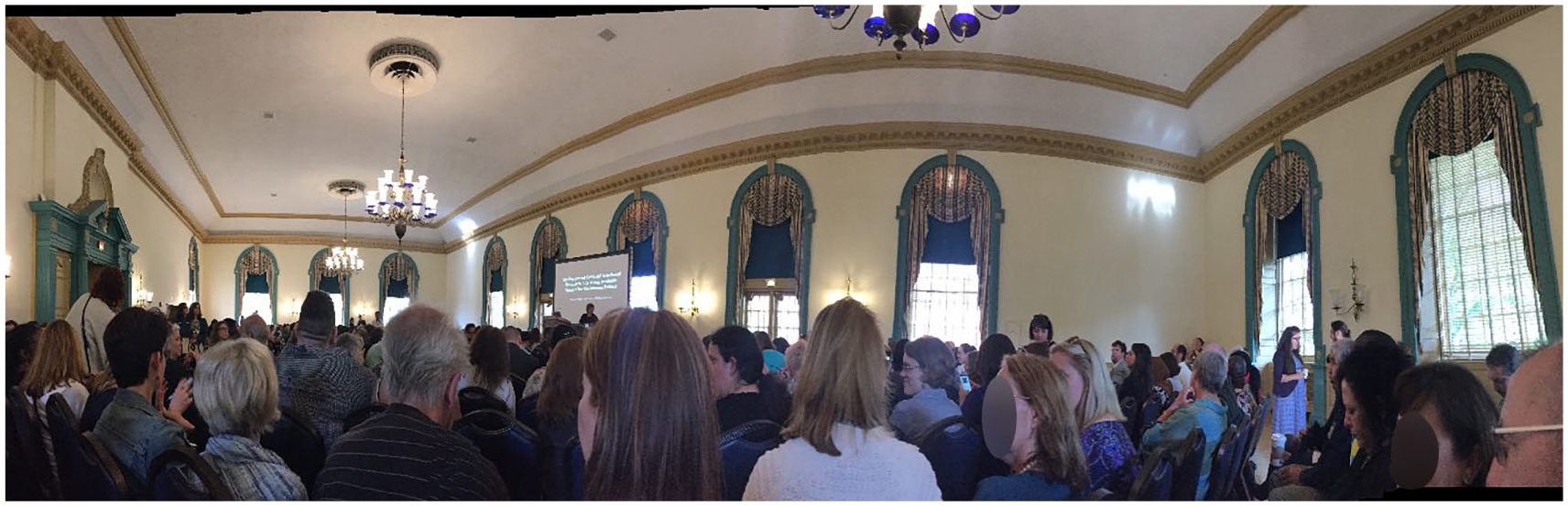
11 We arrive and scurry to the main hall of the Illinois Union- we must register, get to the keynote—get our conference bag—the amazing bags that mark people out—and out people as members of the Congress on bus, train, and airplane. An instantly recognized symbol of a multiple of historical moments. Key note speeches- haste- stress- must get moving. Then, one of the group spots Norman, I had not seen him, he was sat perched on a chair, stick by side and smile on face. A tension comes to the group (Alan)
“the plate is ready to plummet- we bob and wait” a gentle collision imminent . . .
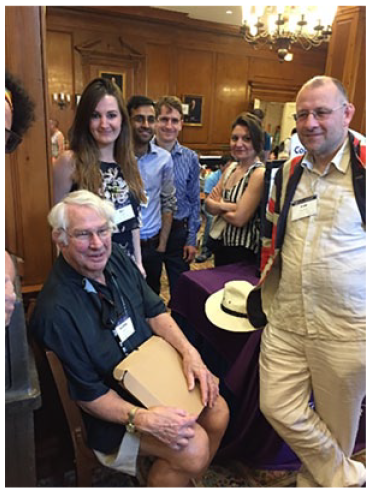
Taken by surprise, Norm—secreted around a corner behind a pillar sat on a chair—looms into view. Perched like a wise old owl. Now I must not get this wrong—cannot make a mess of this—would he remember me? I had had no time to prepare what I would say. Thoughts race and collide around in my head. The group of young academics congregate. They seem to look to me, in anticipation and with deliberation. I represent our University, I represent them and I represent myself. Christ, this makes it worse—better start with Ian, if in doubt start by using Ian as the key to unlock a conversation. Everybody seems to know Ian, Ian is a better writer than me, he’s got a reputation . . . Hi, I say to Norm, I have been to Conference before with Professor Ian Stronach. Norm checks my badge, remembers a name . . . a conversation starts, the intertwangle folds, deepens and tightens. Oh lucky me. One of the groups reminds me of the scarf and photograph; a corporate but these days necessary nonsense moment. We have to justify our visit, justify the expense and time away from undergraduate teaching. This justification is symbolized by a photograph taken and a scarf delivered in 30-degree heat. How silly that must seem. Norm is helpful with my embarrassment, “the colours match your jacket” he says. One of Norm’s colleagues pitches in, “it gets really cold here in Winter.” This helps, we assemble for the photograph, smiling faces. The helpful colleague attempts a photo bomb. I cannot help but smile—corporate marketing photograph, photobombed—that’s just beautiful. I check the photograph—a quarter of a head represent the photobomb—not enough to spoil corporate sensibility but enough for us to know it is there. Then it’s done, time to go, Norm must be busy. Norm says something about my work—wow he likes my work—my pride swells but my mouth refuses to work. I mumble something quickly and thoughts of the fish tank crash in- must get to the fish tank- arranged to meet Heather- must get away- cannot think of what else to say. We move quickly away—Heather said later I was like a mother duck with the ducklings lined up after me—Yes . . . I march forward—but cannot remember where the fish tank is . . . (Alan)
As we meet Norman Denzin, we hand him a scarf emblazoned with our university logo. This small offering was the result of toing and froing—do we gift him a cap? Would a t-shirt be more appropriate—what size does he take? Cufflinks would be nice. Eventually, we settled on a scarf—the most appropriate choice we decided—overlooking the counter-intuitiveness of gifting a scarf during summertime. We offer Prof. Denzin the scarf. Now, we surround him for a photo opportunity. I hastily place my cup of tea and biscuit out of sight. We stand to attention and smile. Should we ask him to wear our scarf? Does this mark our ICQI landing? Could this be our equivalent of the lunar flag assembly on the moon? (Ella)
12 The purple pink Liverpool night time sky hovers over a Champaign sunset, glimpses the red, white and blue union flag jacket, a lovely scarf, a gift, a reaching out, flushed faces, handshakes, embraces, a gentle collision, the band plays on, the yellow submarine disappears around a corner (Norman).
Ian’s story—a journey not taken
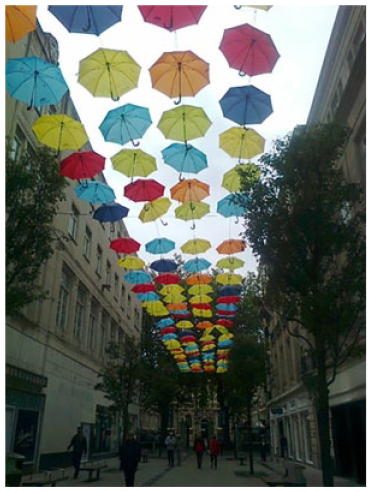
Ian, our professor, was meant to be leading the party to the conference—it was though not to be. As we sat in Urbana, Ian walked through the streets of Liverpool and looked at an exhibition which represented 50 years of the Beatles album-Sergeant Peppers Lonely Hearts Club band . . . I wanted to be Urbane in Urbana,
In hand a glass of Champaign. . .
But the doctor said no, ye canna go
I’ve got to be sterner aboot yer hernia.
And invite yis to consider yir arthritis
So after all these years as a Absent-Presence
Please excuse my Present-Absence
(And this thing that the doggerel brought in).(Ian)
The journey continues with revelations . . .
While for all the scarf held importance and for us “standing to attention,” perhaps corporate responsibility corralled our responses. For others, it was the jacket, reaching out and Liverpool that dominated. This historical crossroad moment then had many paths, and while one of the performers seemed to travel many of these paths, some perhaps only saw a path marked by a boundary stone of corporate responsibility.
Siding Three—“Meet Me By the Fish Tank”
Paul’s journey continues—at a distance but our paths are converging now—ever closer. . .
At ICQI indoor running track, hot, the sound of T-Pain, round and round, a collider too, lines of flight, cracks . . . and again sitting in a restaurant talking to Wasem, first woman I’ve ever spoken to in Hijab . . . cracks.
Sitting in a classroom of Phd students in Chicago, all south side blacklives, working moms, first gen scholars, from incarcerated parents and prostitute sisters, telling me their stories . . . gentle encounters . . . (Paul).
Heather’s Story
2:23pm on my third day at ICQI, and up pops a message on my phone: “Hi Heather—In Urbana—think you are here too/ would be great to say hello. Might see you tonight. All best—Alan from England!” An absolutely wonderful surprise! We arrange to meet at the fish tank in the lounge area later. Alan appears, in his ubiquitous Union Jack jacket—reminds me of how the British Queen always wears a bright outfit, so she can be easily spotted. He leads the way, with several students in tow, a bit wide-eyed. A boisterous greeting and we fall immediately into our usual, high-speed, tangential, slightly irreverent conversation—delightful!
Alan played a key role several years ago, when I turned to him and another colleague regarding the repeated rejection of a manuscript. I felt the piece was the best thing I had written, but repeated rejections with sometimes confusing feedback caused me to doubt my own assessments. I trusted Alan and another colleague from ICQI, Brendan Gogh, to provide an honest and expert assessment of the piece. Random collusions at Murphy’s leading to purposeful connections. Alan enthusiastic assessment “bloody brilliant!” was the emotional balm I needed to keep going. They both encouraged me to submit it to the newly minted “Qualitative Psychology.” I balked at the idea of it being in that league of work, but Brendan told me to stop being such a girl—a tongue in cheek reference to women’s tendency to undersell their work. One week at ICQI, and the man knew exactly how to tweak me! The manuscript was published in “Qualitative Psychology” in 2015, and referenced in a best practices text this past year as an exemplar of applying operational definitions . . . It might have ended on a pile of “might have been” pieces without these collusions.
These types of collusions, collisions and connections, and conversations are not part of administrative assessment of cost-benefit ratios for supporting conference attendance, nor professional service in hosting conferences. Such assessments focus on presentations given, workshops hosted/attended, and coauthored works. Nor will Alan and Brendan’s time investment show up in any count of professional service. Yet these connections, real and yet intangible in official form, kept me moving not only on the manuscript, but bolstered my flagging confidence in myself as a scholar. As the only qualitative researcher in my program—a common theme for many of us—these external connections have proven to be essential for my career, and my work as a whole. Yet, they started randomly, as groups shifted and formed around tables and corners in Murphy’s Bar, outside the official spaces of the conference, at a place that has become the informal, secondary staging area for ICQI.
Siding Four—Murphy’s Bar
Part One . . .
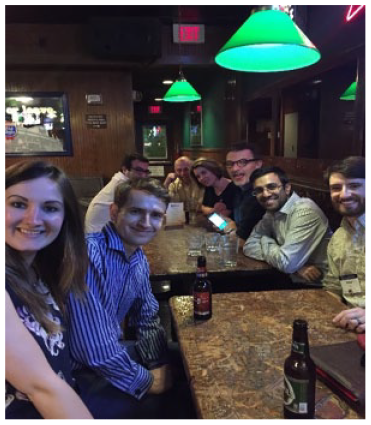
Collisions, collusions and conversations with sharp, hard angles piercing each other, and neither giving way. As people milled about in the hallway after the session, Alan approached me, enthusiastic about the issues raised and my incorporation of environment resolutions for disabilities. We met up again at Murphy’s, chattering away to and over each other happily. And so, a different collusion emerged and grew. (Heather)
Ella begins her first conversational journey at the Congress . . .
“So, what do you research?” I use the standard academic line as a friendly “ice-breaker” to the man sitting at my right side in Murphy’s Bar. When in conference-mode, this question falls from my mouth as in auto-pilot fashion. “Suicide” comes the reply. I was not expecting that one . . . My momentary surprise is replaced by intense interest. In fact, I have never been so curious about another person’s research. Something real. A gritty subject. Not-just-in-the-confines-of-academia. “Oh wow, interesting . . .” comes my reply. “So, what about suicide do you research, kind of dominant constructs and understandings of suicide?” There I go, my penchant for social constructivism coming out. He replies: “Er, I suppose why people do it?” I nod my head, wanting to hear more. He asks, “do you know anyone who has committed suicide? Most people know someone who has committed suicide.” I scroll back through my mind, I tell him no, I don’t directly know anybody. But I can think of friends of friends. It’s so sad. My grandfather just died yesterday, I tell him. Back in the U.K. He was ninety three—had a good life . . . Different to when a young person’s life is cut short . . . When he was dying, it was the first time I’ve seen my dad—his son—cry. Strange to see; I’ve never seen my dad cry. “Yeah, I don’t cry,” Peter adds. “Men are taught not to, aren’t they?” comes my response. In our conversation, sharing stories of death acts as a dialogic bridge between two people. In Serres’ words, “from the abstract to the concrete,” we move from offering disciplinary perspectives to sharing stories about our personal lives and experiences. Stories collide and act as bridges for making sense of and sharing our world-views. (Ella)
Ella, tells me she just spoken to someone who works in Suicide Studies. I flippantly account that I once shared a car journey with a scholar who worked in Death Studies. That takes me nowhere and the conversation is dying. This is important, though, I can tell . . . Ella’s grandfather has just died and I have just heard that a friend’s, at this conference, sister is close to death. Death is surrounding and enveloping me-its icy chill lays heavy on my shoulder a statue of death stalks the room . . . but Ella’s words take me in a new direction. I am determined to listen but my thoughts wander to my own mortality and then fast locate to my grandfather’s death nearly ten years ago. The raw emotion surfaces again . . . pain and grief. I get it—I am in the space of my own feelings about death and how I idolized my grandfather who shaped my life in so many special ways. Trains, planes, museums, motorbikes, the Isle of Man. I need to say his name to remind myself of him . . . Doug . . . Special times with a very special man. I engage in conversation that takes me to new spaces and places about the study of death—it’s a special conversation, one that I would have never had, had it not been for this moment. A chance conversation about suicide and death provides a chance of life and a new way of thinking. “This catapults the one . . . the plate plummets” (Alan).
Interlude . . .
Coarse, riveted, rough-hewn: very rough—but also quite respectable. (Leave your British value-judgments at the door.) Something about “Welcome to Our Micro-Urban Community.” Murphy’s Bar: micro Urbana. (Joseph)
Murphy’s Bar—Part Two
Paul and Alan’s—paths gently collide . . .
The same gentle encounters, metaphors for the recognition of ourselves in others, of parts we want for ourselves, mutual influence/cannibalism/, the kind of borderland, fuelled by alcohol, where we can make ourselves up, cutting and pasting whatever we want . . . like Gergen’s identity, depression is the absence of something, isolation, without others we disappear, we aren’t there, like Guy Diamonds teenagers living after the breach, cutting themselves out . . . snakes shedding skin, ready to kill again, ready to hide, or little angels revealing themselves for a second, in Murphy’s Bar, Angelo’s Lines of Flight, Heather pensive . . . I met a feminist autoethnographer running, at the lights . . . like meeting a gazelle, strange creature . . . I met a indigenous Professor in the juice bar, buying a peanut butter smoothie . . . hahahahaha!! When you meet someone you want to be like, then you come back next year having stolen a bit from them . . . we get tangled up in each other . . . (Paul).
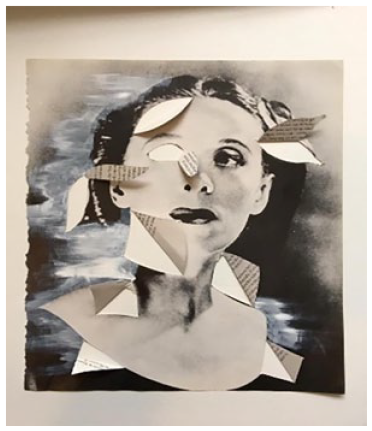
Waiting in line with Paul at Murphy’s Bar, “hey you want to try a Jagarbomb” he says. Thinking its Paul’s favorite drink I agree. We move from the bar and sit on the graffiti laden benches marked by students old and new. A mark that they—someone—was here in a time and place different to our own. Our world’s collide . . . the Jagar bomb is awful and Paul passes his over. He does not like it—not a favorite—but I drink both anyway. We begin to talk about our day at conference . . . juice bars . . . Paul receives a text—conversation changes. “Hey my daughter needs some philosophy to explain her art work.” The alcohol swirls and I feel dizzy cannot cue up my thoughts. I look at the picture—love it—Panofsky and perspective. Quayson, aesthetic nervousness -Martin Bubbles and skulls self-consciousness and Dutch still life paintings envelops our conversation. Paul takes notes which are instantly relayed across the world into the electronic ether to Australia. They fly to a person I have never met and perhaps will never know. I do not know her name but she too has made a mark in this space from a place and time different to my own. The conversation slows as Kakali quickly enters the space . . . what is it about my hair . . . why do people keep wanting to touch my hair . . . “Don’t touch my hair unless we have swapped saliva should be the rule” she says . . . (Alan)
The next day arrives, so many sessions I could go to, so many interesting themes. Then Ella tells me she is going to a session on Female ejaculation. My interest is captured and I trot along after her . . . (Alan)
Siding Five—The Union Jack Jacket and Friends Made
I cringed inwardly . . . then poked Davina in the ribs and whispered loudly, “Who on earth would wear a Union Jack suit?” And then there he was sitting in the middle of our presentation listening to me share-all. Laughing along with the others at my jokes—breaking the tension of the embarrassment? . . . I was not pointing the finger and staring but appreciating the support, camaraderie that traveling across the Atlantic to a conference can bring. A group of Brits- together, solidarity for the cause. Uncomfortable ourselves in the brashness of the stereotypical American. Unsure if we really should be in America—is that endorsing Trump’s America? Yet standing up and sharing stories, stories of female sexual power and of friendship through living-with-shame. That shocked a few of the establishment, even the radical establishment.
Like bees to the honey we attracted a crowd, new friendships gelled and commonality arose.
I love performing, reading aloud my poetic lines trying to catch the eye of the audience.
As a teacher and regular space holder my senses are alive as I talk. Do I have the audience with me? Are they ok? . . .
And as I stood forward each time to read my soliloquy I would smile and enjoy my cheeky jokes as much as the audience. It was only when I stood there—oh so vulnerable—looking into Davina’s eyes when she started the line, “For you, young and free in your 30s . . .”that my hackles rose a little and I realize I was truly letting the audience in. Into my inner sexual being, my naivety, my hedonism, my power and my shame. . . (Kirkpatrick & Mendus, 2017, May) What were they thinking of me? What would people who know me but do not know my stories be thinking of me now? Like coming out . . . An initiation into the true power of my sexual liberation. And how was this any different than my soliloquy?
I think when I step forward I am the performer, the poet, the storyteller—telling a tale, dancing a dance. My vulnerability hidden by jokes and clever phrases. As I face Davina, I look into a mirror, and diffracted pieces of my soul scatter in multiple directions. I cannot hide from the phrase,
For you . . .
And the funny thing is I wrote those lines she speaks, she may think them too.
But the line that triggers me most . . .
I wrote.
And then I lift up my eyes to the audience and feel held in that moment . . . Proud . . . Sharing stories however triggering for me or edge-pushing for others helps unravel the intertwanglings of our existence a little bit more. (Alys)
I surveyed the flagged jacket fabric that had been pointed out to me, the wear and tear, the cut—vintage I surmised. My ability to spot vintage clothing, interesting fabric from across a room has never left me, the echoes of a previous existence as a costumier has trained my eyes, seems will stay with me. How many traces of previous skills, desires, passions color the veil of myself that I see the world through?
I’d spent the previous day re-editing our paper trying to trim the time without losing sense and impact while Alys attended a workshop. I was glad to be here with her about to deliver the paper we had called into being—my stomach fizzy with fear/excitement, so similarly experienced in my body. I had resisted writing beyond the abstract. I wondered if that resistance had contributed to my slipping and falling in Wales resulting in the Colles’ fracture and subsequent cast that now encased my right wrist? No time for regret now, just a diving in, committing to being in the moment, delivering with passion a performance of friendship, taboo, what we risk when we tell stories and with whom.
Having the audience vocally respond with sounds of approval, amusement confirmed a sense of empathetic listening at our tales of dubious consent, finding equivalent moments of intensity to the intensity of grief through sexual encounter (the subject of the last chapter of my PhD thesis) held and supported us. I felt safe, seen, gladdened that new conversations would spring from the crafting of words and emotion. Glad to have found a buddy at QI 2015, who was focused, fearless, and bold and with whom I was now sharing this experience. (Davina)
Conclusions: Home and Home Comings
For Serres (2007, xiii) conclusions should not be too “well-varnished,” life it seems, should be experimental and not analytical “not cumulative and aggregative but discursive; not linear but meandering, doubling back on itself to remind itself of stones left unturned.” The intertwangle and the journey it facilitates, we believe, allows space and place for such meanderings and doubling back. The intertwangle attempts to provide a “new language” of an “emergent epistemology.” An epistemology “expressed in words, concepts, and spaces between narratives and theories” (Stronach, 2010, p. 189). Like Stronach, we believe, “these new ways of making sense have to be performed rather than represented” (Stronach, 2010, p. 189). Such a representation is performed here by Ella:
In the earlier stages of my PhD, when I was beginning to analyze participant data I had collected via interviews, I remember my supervisor advising me, “put yourself in their shoes. Try to see the world from where they stand.” I thought about this advice for a long time—it frequently came into my thoughts when I was trying to interpret my participant’s words.
I’ve never really worked out how to do it: how to take my own assumptions, beliefs and experiences out of the equation and think—really think—from someone else’s viewpoint.
The concept of the intertwangle provides an answer (of sorts) to my dilemma. I do not think it is about trying to step in someone else’s shoes and try to find your way into their viewpoints. Rather, richer ground can be found when thinking about how your views jangle, twingle and twangle with the views of others. Trying to see the world from another’s perspective is imitative. It’s a shot in the right direction but a bull’s-eye will never be achieved. Instead, by thinking about our own experiences and viewpoints as moving alongside, under, over and, at times, in collisions with the views of others, we stop trying to own the positions of others. We move toward an appreciation of the ways in which our experiences, memories, and reflections sometimes sit aside, sometimes bounce off and sometimes intercept those of other peoples.
A statue apparently cannot move, it cannot speak, it cannot “open its eyes, nod, or call out, cannot tell a story, dance or do work.” It stands and points the way. Through the intertwangle though the statue’s “solidity and repose” is banished. The statue becomes animated, it steps down from its pedestal, its stillness and silence transgressed, abandoned . . . broke, it enters the sphere of “exchange and intention” and by doing so diminishes (Goss, 1992, p. xi).
“These things cannot happen: a statue cannot move or speak; . . . Or run away, banishing its solidity and repose . . . What crisis does the animation of the unmoving statue thereby entail, what is lost or gained [?]” (Goss, 1992, p. xi)
Hard narrowing gates to soft bridges—closed to open . . . rise and fall . . . tilt and turn. Conversations as gentle collisions folded in gold paper—waft down . . . like the earlier pictures of the umbrella’s suspended over the street, the intertwangle hovers over the sentence (Ian). . . The statue has stepped down, and moved on . . . Live the intertwangle, escape . . . run free . . .
I turn the key in the lock of my front door—home—my children charge down the corridor. Not so much a gentle collision but a hard thud—as they throw themselves into my arms. Dad, was the conference good? Dad what did you bring us back? Part of me wanted to say a scarf . . . but I didn’t—one journey was over but another had just begun. (Alan)
Footnotes
Declaration of Conflicting Interests
The author(s) declared no potential conflicts of interest with respect to the research, authorship, and/or publication of this article.
Funding
The author(s) received no financial support for the research, authorship, and/or publication of this article.