




Abstract
The adoption of generative artificial intelligence (Gen-AI) in newsrooms has stirred discussions about its implications. This paper critically examines the adoption of Gen-AI tools by newsrooms in Zimbabwe. Through interviews with 30 journalists, this study demonstrates pragmatic adoption despite organizational ambivalence and limited resources. Journalists across mainstream and digital media start-ups are using Gen-AI tools to support news production. A key finding was that young journalists were more likely to use Gen-AI than their older counterparts. Respondents lamented Gen-AI’s lack of conscience, Western-centric content, and limited accommodation of African languages. They recommended investment in small language models and contextual awareness.
Introduction
The integration of generative artificial intelligence 1 (Gen-AI) in newsrooms across the world presents both challenges and opportunities for journalism practice. Adoption of new technology in newsrooms is always shaped by context (Oyedeji & Uthman, 2024). The challenges and opportunities associated with this adoption necessitate contextualized research that reevaluates the role of journalists in the digital age. As Gen-AI increasingly permeates the news ecosystem, concerns regarding the erosion of journalistic integrity, the homogenization of news narratives, and the exacerbation of existing power dynamics within the industry have emerged (Gondwe, 2023a, 2023b). In Zimbabwe, where the media landscape is characterized by a complex interplay of state control and economic constraints (Mare, 2019), the dynamics of technological adoption like the impact of Gen-AI on newswork remain understudied. This research, thus, investigates the intersection of Gen-AI and newswork in Zimbabwean newsrooms, with a particular focus on how journalists navigate the opportunities and challenges presented by Gen-AI tools.
The advent of Gen-AI has been accompanied by optimistic and pessimistic accounts about the future of journalism. Some scholars are of the view that Gen-AI will be the next big thing that swoops in to “save” journalism, while others fear it will replace it (Herrman, 2023). The “savior discourses” that continue to influence Gen-AI talk within Silicon Valley often ignore that technology alone cannot fix contemporary journalism’s intractable challenges. In many ways, AI represents a continuation of the advancement in the world associated with the digital revolution, raising questions about how much it will replace labor or augment its abilities (Schiffrin, 2024). This is because Gen-AI systems are intelligent entities that can interpret data accurately, learn from it, and provide feedback. Writing from a global North context, Simon (2025) argues that journalism is experiencing more of a retooling of the news through AI rather than a fundamental change in the needs and goals of news organizations. Given that AI increasingly permeates newsroom operations and workflows, its impact will likely depend on news organizations and managers’ decisions and the sociopolitical and economic conditions at play (Mudavadi & Mare, 2025). Drawing on rich data gathered through interviews and newsroom observations in Zimbabwe, this study examines how Gen-AI is reshaping the routines, processes, and tasks that sustain news production in an African newsroom. By exploring the complex dynamics between Gen-AI and newswork within this context, this study contributes to a deeper understanding of the implications of AI-driven journalism, highlighting both the potential benefits and drawbacks of this emerging paradigm. By doing this, the research informs a nuanced discussion regarding the future of journalism in the age of AI, one that prioritizes the agency, autonomy, and creative labor of journalists in the face of rapid technological change.
This article is structured as follows. First, we begin with a review of existing literature on the use of artificial intelligence in journalism, with a focus on both global trends and developments in the Global South. The literature reveals that while there is growing interest in AI’s potential to transform news production, there is a significant gap in empirical studies from underrepresented contexts such as Zimbabwe. Second, we present the technological appropriation model as the theoretical framework guiding this article. This model moves beyond deterministic views of technology adoption by emphasizing how users actively reinterpret, modify, and integrate technology into their social and professional contexts. The third section outlines the qualitative research methodology adopted for the study. We then present and analyze the findings, which are organized thematically to highlight patterns of use, key challenges, enabling factors, and the broader implications for journalistic norms and routines. The discussion section draws connections between these findings and the technological appropriation model, offering a deeper understanding of how AI technologies are reshaped through local use.
Literature Review: Artificial Intelligence and Journalism Practice
The integration of Gen-AI in newsrooms is a growing trend globally (Makwambeni et al., 2023; Munoriyarwa et al., 2023), with countries in the Global North at the forefront of newsroom AI adoption and research on it. Research from such countries has cautioned that the reliance on Gen-AI for journalistic purposes raises concerns about the extent and impact of the potential dependence that it may bring to newsrooms (Cools & Diakopoulos, 2024; Simon, 2024). Opinions are, therefore, varied on this phenomenon (Makwambeni et al., 2023), because whereas some argue that AI can enhance newsgathering, production, and distribution, other thinkers are skeptical about its benefits, particularly in the context of African newsrooms (Kothari & Cruikshank, 2022; Mabweazara & Mare, 2021; Mudavadi & Mare, 2025; Munoriyarwa et al., 2023). This is because, in Africa, the uptake of Gen-AI in newsrooms is still slow and varied, with Zimbabwe being a notable example, and this contrasts sharply with trends in developed countries.
Research from developed countries shows that journalism scholarship is still trying to understand the impact of Gen-AI in the newsroom (Schiffrin, 2024; Simon, 2024; Whittaker, 2019). For example, in Denmark and the Netherlands, the integration of Gen-AI tools, such as ChatGPT, Bard, and DALL-E, in newsrooms has sparked intense debate (Cools & Diakopoulos, 2024). While these tools promise improved efficiency and data handling capabilities, concerns persist regarding their potential impact on journalism’s accuracy, credibility, and ethical standards. Recent research by Cools and Diakopoulos (2024) sheds light on journalists’ perspectives on the perils and possibilities of using generative AI tools in the newsroom. Cools and Diakopoulos’ (2024) study reveals that journalists from the Netherlands and Denmark, who identify themselves as early adopters, utilize Gen-AI tools in 16 distinct ways across the news reporting process, primarily in production and distribution phases. Decisions by journalists to use (or not use) Gen-AI in the newsroom are often guided by intuition and gut feeling, rather than explicit criteria set by their employers. This echoes broader concerns about the lack of transparency, uniformity, and accountability in Gen-AI-driven decision-making in journalism (Almakaty, 2024). Journalists’ concerns regarding Gen-AI tools center on accuracy, credibility, and algorithmic bias. These concerns align with existing literature highlighting the risks of Gen-AI-driven misinformation and the need for ethical guidelines in Gen-AI-assisted journalism (Thomson et al., 2024).
Coming to Africa, researchers in South Africa identified three approaches to AI adoption in South African newsrooms (Munoriyarwa et al., 2023). These approaches are the holistic approach, exclusively technological approach, and task-specific approach (Munoriyarwa et al., 2023). The holistic approach involves integrating AI across multiple stages of news production as part of broader organizational and editorial strategy. The exclusively technological approach centers on the technical adoption of AI tools, with limited transformation of newsroom culture or workflows. The task-specific approach, by contrast, applies AI to journalistic functions, such as content generation or data processing, without embedding it across the entire newsroom. It is important to be aware of these findings for South Africa since, as a regional technological trendsetter in Southern Africa, the country’s AI adoption strategies serve as a critical reference point for understanding the challenges and opportunities facing peer nations, such as Zimbabwe. Findings from South Africa also showed concerns about job losses, high costs, limited training, ethical issues, and AI’s potential negative impact on the democratic process (Munoriyarwa et al., 2023). This means that in contrast to the optimism about AI in newsrooms from the Global North, the situation in African newsrooms is more complex and may only become clearer with time and continued research.
Another African study in Ghana and South Africa revealed that most newsrooms in the two countries have not formally incorporated AI tools into newsroom practices, and AI use remains an initiative of individual journalists (Adjin-Tettey et al., 2024). This means that journalists in these countries use AI tools at their discretion in a non-complex manner, such as transcription, research, generating story ideas, and fact-checking. This is because of practical limitations to the formal integration of AI technology into newsroom operations that include cost, language barrier, and aversion to change (Adjin-Tettey et al., 2024). Accordingly, journalists from Ghana and South Africa recognize the advantages of employing AI for newsroom tasks, although they are also concerned about the ethical quandaries of misinformation, improper attribution, and intellectual property (Adjin-Tettey et al., 2024). The insights from this study are important in the context of this study because they offer an opportunity to compare Zimbabwe and its African peers in terms of AI’s role in African journalism, especially in the light of its advantages, obstacles to its integration, and concerns about ethical journalistic standards.
Similarly, Gondwe (2023a) conducted qualitative research by interviewing journalists from Congo DRC, Kenya, Tanzania, Uganda, and Zambia, exploring their experiences with AI tools. The study revealed various perspectives, from enthusiasm to skepticism regarding AI’s reliability and representativeness. Building on these findings, Gondwe (2023a) proposes an Ubuntu-inspired normative framework for responsible AI adoption in journalism, emphasizing relationality, social progress, harmony, and human dignity. This philosophical approach prioritizes interconnectedness, communal responsibility, and collective well-being, aligning with African values of social cohesion and collective flourishing. The study by Gondwe (2023a), like this current study, is important because both studies are among the first ones in the growing body of literature on AI in journalism in their respective locales. This underlines the need for context-based, culturally sensitive, and ethically informed AI integration in diversified African newsrooms. Additionally, by couching the integration of AI in the newsroom within the Ubuntu paradigm, Gondwe’s (2023a) research shows the potential for equitable technology landscapes that participate in reducing the African digital divides, while promoting diverse voices in fledgling African democracies, like Zimbabwe.
It is necessary to delineate the journalism context in Zimbabwe that is structuring the adoption of Gen-AI in the newsroom. The media landscape in Zimbabwe comprises both public and private players operating in print and electronic forms. The coexistence of these two sectors spans both pre- and post-independence periods, although they have historically performed divergent roles within the public sphere. At independence in 1980, the new government inherited and consolidated control over state-owned print and broadcasting institutions. In broadcasting, radio and television were used for legitimation purposes, much as the colonial authorities had done (Ndlovu, 2015). The private press in both colonial Rhodesia and independent Zimbabwe has historically served as a watchdog of the state, challenging official narratives and promoting accountability (Dombo, 2018). In the contemporary era, this watchdog function has expanded through the rise of digital-native publishers such as 263Chat, CITE Zimbabwe, Pindula, and NewZimbabwe.com , which use online and social media platforms to amplify critical voices and broaden the space for public debate despite persistent political and economic constraints. This shows that despite constitutional guarantees of freedom of expression, successive governments have maintained tight control over the media through restrictive laws and regulatory frameworks that enable surveillance, censorship, and limited editorial independence. The cumulative effect of these instruments has been a culture of self-censorship, editorial caution, and limited investigative autonomy (Mhiripiri, 2020). Resource constraints further compound these challenges. For example, declining advertising revenue, shrinking audiences, and inadequate digital infrastructure have pushed journalists to multitask across beats and rely on low-cost technological tools to meet deadlines (Mabweazara, 2011). Recent scholarship on Zimbabwean journalism has conceptualized media capture in the country as going beyond mere overt censorship or direct political interference. For instance, Zirugo (2025) reconceptualizes it as a structurally embedded and normalized condition in which political and economic power operates through institutional routinization. In this formulation, capture does not appear as an episodic distortion of otherwise autonomous journalism; instead, it is sedimented within regulatory design, patterns of resource allocation, and professional incentive structures that subtly preconfigure journalistic practice. Such mechanisms delimit not only what can be reported but also the epistemic horizons within which journalists understand their own professional agency. Within this climate of media capture, and economic austerity, newsroom innovation often emerges from the bottom up rather than through institutional reform. For example, long before the advent of Gen-AI, Zimbabwean journalists had already begun appropriating digital platforms such as Facebook, Twitter (now X), and particularly WhatsApp as professional tools for sourcing, verification, and audience engagement. The appropriation of social media in this way laid the groundwork for journalists’ current engagement with Gen-AI tools such as ChatGPT, Meta AI, and Google Gemini, which similarly promise efficiency amid resource scarcity. These structural and cultural particularities make Zimbabwe an ideal case for examining Gen-AI through the lens of the Technology Appropriation Model (TAM), which foregrounds how technology use is shaped by sociopolitical, economic, and cultural conditions rather than by deterministic innovation narratives.
Theoretical Framework: Technological Appropriation Model
The TAM views users as active agents who adapt technologies to meet their specific goals and contexts, moving beyond simple adoption to encompass integration into daily practices (Carroll et al., 2002). Originally developed in the context of information systems and human-computer interaction, TAM was proposed as an alternative to more linear models of technology adoption which emphasize users’ intentions to use technology based on perceived usefulness and ease of use. In contrast, the appropriation model focuses not just on whether technology is adopted, but how it is domesticated, modified, and embedded in everyday routines (Fidock, 2006). The main supposition of the TAM is that there is an iterative process that defines the relationship between users and technology. This happens in three stages: initial adoption, adaptation, and stabilization. This last stage is characterized by the routinization of the technology usage. The TAM also explains how technology users reinterpret and creatively repurpose tools, sometimes in ways never anticipated by designers. Central to this reinterpretation of technology is the now accepted idea that the value and function of a technology are socially constructed over time, shaped by individual goals, cultural norms, institutional constraints, and material conditions (Umejei et al., 2025). These basic tenets of the TAM, which show its flexibility and contextual sensitivity, make it an ideal theoretical framework for examining how Zimbabwean journalists are deploying Gen-AI in their daily routines. This is because the model becomes particularly effective in studying environments where technologies are introduced into settings that differ significantly from where they were developed, which is the case with most Gen-AI tools in use in Africa.
The TAM model, thus, allows us to investigate not just whether Gen-AI is used, but how it is integrated, transformed, resisted, or even abandoned depending on the users’ needs, newsroom cultures, and broader sociopolitical environments. It also invites critical reflection on the unintended consequences of Gen-AI appropriation, such as ethical dilemmas, deskilling, or shifts in professional identity. TAM is, therefore, useful in that it foregrounds the complexities of technological engagement in real-world settings, making it particularly apt for exploring the layered and localized ways in which Gen-AI is being taken up in Zimbabwean newsrooms. Considering the reviewed literature and this TAM framework, we ask the following questions in this study:
Methods
This study utilized a qualitative approach to examine the integration of Gen-AI tools and systems in Zimbabwean newsrooms. This approach was deployed because we sought to explore the newsroom practices, perceptions, and experiences of journalists who are using these tools. This exploration was thus only possible through a contextual and interpretive inquiry of how journalists interact with Gen-AI tools, something possible though a qualitative approach. A targeted purposive and convenience sampling strategy was employed to select research participants with experience in reporting, subediting, media management, and editorial leadership. The researchers interviewed 30 journalists, reaching data saturation, which in some cases required re-interviewing participants on multiple days. These interviews sought to gather nuanced insights into the experiences of newsroom staffers with Gen-AI-powered technologies. Research participants were chosen from legacy media in Zimbabwe as well as from other emerging internet-based media organizations. This was done so the perceptions on Gen-AI use in the newsrooms could be gleaned from across the whole spectrum of the media in Zimbabwe that include publicly owned and privately owned organizations. Represented organizations in the research sample include Zimpapers, Alpha Media Holdings (AMHs), Associated Newspapers Group, the Zimbabwe Broadcasting Corporation, CITE Zimbabwe, 263Chat, Pindula, NRTV, and 3KTV.
To contain the limitation of self-reported data from the interviews, the researchers also carried out informal newsroom observations and reviewed selected outputs from these newsrooms to gauge the extent of Gen-AI use in news stories. These two strategies were not systematic, as they were only employed to lend support to the primary data-gathering technique, the interviews. Data collection was done to the point where thematic saturation was achieved, and this ensured a comprehensive understanding of Gen-AI adoption in Zimbabwean newsrooms. Interviews probed how newsrooms are using Gen-AI tools for content generation, dissemination, and improving the revenue of media organizations, as well as the challenges and opportunities arising from Gen-AI integration. The exploration also encompassed the strategies and models employed by newsrooms to harness Gen-AI and its impact on journalistic practices and business models. A thematic analysis approach was used to analyze patterns and themes from the data, which were then presented in a narrative format to provide a detailed understanding of AI’s role in shaping Zimbabwe’s journalism landscape. The thematic data analysis was done through a reflexive approach. First, we transcribed the interview verbatims and repeatedly went through them to achieve familiarization. Manual coding then followed inductively as we allowed the themes to naturally come out of the narratives. Applying the TAM, we managed to streamline the themes further so that the thematic topics could be refined in relation to the research questions and the full corpus of data. The final themes thus represent analytically constructed patterns of meaning rather than mere topic summaries. The researchers addressed ethical issues by obtaining consent from research participants. Participants signed informed consent forms to this effect. The anonymity of the respondents was also be protected to ensure that the principle of trust was reinforced (Figure 1).
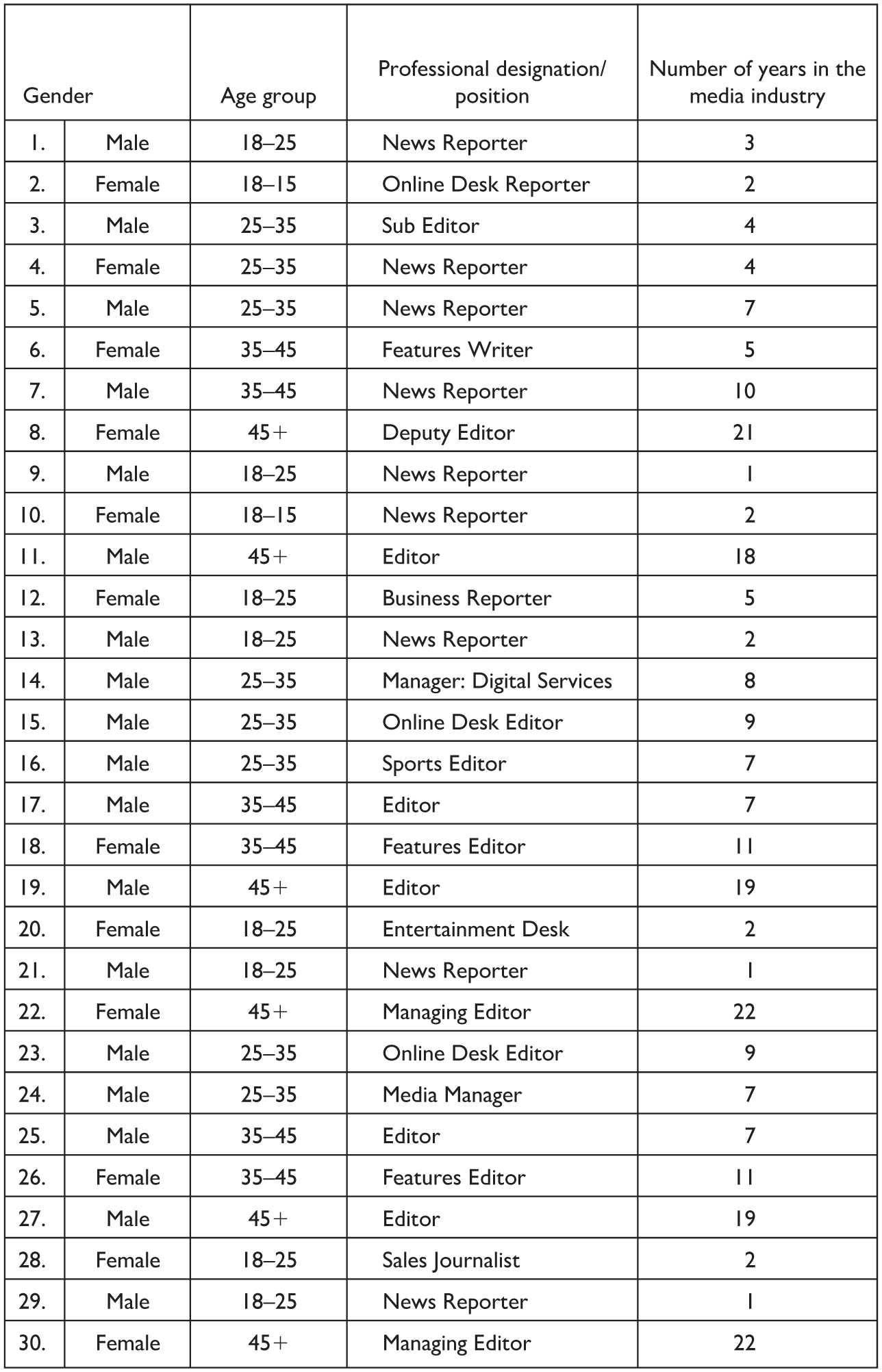
Disaggregated data of interviewees.
Findings
The findings in this section respond to the following questions: How are journalists in Zimbabwean newsrooms using Gen-AI tools in their daily work practices, what contextual factors influence the pace and nature of Gen-AI adaptation in Zimbabwean newsrooms, and how are journalists in Zimbabwean newsrooms appropriating Gen-AI tools across the stages of adoption, adaptation, and stabilization? This section presents the study’s findings thematically, drawing on patterns that emerged from the interviews and guided by the TAM. The analysis is organized around three interrelated themes: individual experimentation and early adoption of Gen-AI tools; institutional ambivalence and policy gaps; and ethical and professional tensions shaping Gen-AI appropriation in Zimbabwean newsrooms.
Individual Experimentation and Early Adoption of Gen-AI Tools
Under this theme, we consider how individual journalists experiment and begin to adopt Gen-AI tools in their everyday newsroom routines. Narratives from interviewed journalists showed that the use of Gen-AI in Zimbabwean newsrooms is still at the early adoption phase of TAM, while gradually reshaping traditional journalism routines. One research participant remarked that:
I usually use ChatGPT to help write intros or break down a complicated press release. It saves time, especially on busy news days. Most of us here are trying different tools quietly, though management hasn’t officially adopted them (Reporter, Newsday, Harare, 24 December 2024)
This narrative shows the experimental use of Gen-AI tools at mainstream media like NewsDay. This trend was also established at born-digital start-ups that are also increasingly using different Gen-AI tools to support their routines like news production, research, writing, editing and coming up with catchy headlines. Narratives from the research participants also indicated that the most used Gen-AI tool is ChatGPT, developed by OpenAI. It is widely employed for several newsroom tasks such as quick background research and writing and editing newsworthy stories. It is also handy when summarizing lengthy texts and brainstorming ideas for news stories. Journalists find it particularly useful for quickly completing the ideation and writing process under tight deadlines. An interesting aspect to note form the narratives is that individual journalists are always informally experimenting with these tools to make their work more convenient and efficient. This means that even in the face of uncertainty over newsroom policies or ethical concerns, once a journalist adopts a Gen-AI tool for its efficiency, they find it difficult to go back to the manual and tedious days of the past.
Although ChatGPT is the most used Gen-AI tool in the studied newsrooms, narratives also admitted to the frequent use of Meta AI, a tool embedded on WhatsApp and Facebook. Given that WhatsApp is the most popular messaging application for many Zimbabweans, Meta AI has become a handy and readily available tool for journalists gathering news in the field. Journalists admitted to using Meta AI for quick research, content ideation, editing, and even drafting initial write-ups. This shows that the tool is versatile and easy to integrate into everyday routines of these journalists. It is also remarkable to note that even before WhatsApp had the Gen-AI tool embedded within it, it had been widely accepted by journalists within and outside Zimbabwe as a platform of choice serving professional journalism (Boczek & Koppers, 2020; Chiridza & Mare, 2025). Before it had this Gen-AI tool within it, WhatsApp was used for photo and video exchange, coordination with editors, and even conducting remote interviews. The coming of the Meta AI tool within WhatsApp, therefore, means that its functional utility within journalistic routines has been expanded. Since one does not require an extra data bundle to use the Meta AI within the messaging application, it means that the Gen-AI tool is affordable and mobile based, thus further heightening its level of convenience.
Research participants also pointed out the other expansive repertoire of AI tools employed by journalists in Zimbabwe outside ChatGPT and Meta AI. Once participant noted that:
I use tools like Copilot, ChatGPT, Litmaps, You.com and Consensus. I use AI for video editing, voice-over generation for documentaries, and reading news (The Herald Journalist, 22 October 2024).
This narrative is notable because it notes the multifaceted purposes of Gen-AI tools in Zimbabwean newsrooms. For example, beyond grammar correction and research, the tools are being deployed for video editing, voice-over generation, and news reading. The utilization of Gen-AI for video editing and voice-over generation highlights the growing importance of multimedia storytelling in the Zimbabwean newsroom, which is becoming more convergent, beyond the traditional print domain that used to dominate Zimbabwe’s mainstream media in the past. Narratives from research participants also showed widespread use of Google Gemini, which is often used for fact-checking, verifying trending topics, and proposing alternative story angles that journalists may not have initially considered. Its integration with Google’s search capabilities makes it a convenient and accessible tool for journalists working on time-sensitive content.
Individual experimentation was shown to be pervasive in junior reporters who pointed the fact that these tools are especially helpful to them because they are still growing and finding their teeth at the workplace hierarchy. This also means that they can only afford free versions of Gen-AI tools that are popular among journalists in the global South. Unlike in the global North, where journalists have access to the paid versions of Gen-AI tools, free versions are affordable and accessible for journalists in resource-constrained settings. The use of all these cataloged Gen-AI tools shows the ever-changing nature of journalistic practices in the modern era where the need for speed, accuracy, and multi-platform content delivery demands embracing new technology. It also seems that new technology is often embraced to fit into existing workflows, while individual reporters choose Gen-AI tools that match their beat, skillset, and deadline pressure.
Institutional Ambivalence and Policy Gaps
Under this theme, we consider the role of media organizations, their policies, and public policies on the use of Gen-AI tools in newsroom. Findings reveal that the use of Gen-AI in Zimbabwean newsrooms is underpinned by institutional ambivalence and policy gaps. Findings show that journalists have started adopting Gen-AI tools in their routines, but the absence of clear policies and guidelines from their employers hinders more widespread and effective adoption. Under the TAM microscope, this reveals the barriers between early adoption and stabilization. To show this, a journalist from the Daily News remarked that:
My organisation doesn’t promote it. It is my initiative which helps clean documents fast. The organisation is still lagging in terms of adoption; however, it does not prohibit the use of AI in an individual capacity (Daily News Journalist, 13 November 2024).
This narrative from the Daily News reiterates individual experimentation and innovation in Gen-AI use in the Zimbabwean newsroom, while illustrating the lack of institutional support from the organization. The proactive use by the journalist to correct grammar, expressions, and refine story development shows how the agency of individual journalists in the newsroom can be central in the adoption of emerging technologies, even in the future. Under the lens of TAM, this shows how any technology that is deemed useful and easy to use can quickly be taken on board even before the organizational authorities have formalized it. The narrative also notes that while the organization does not prohibit Gen-AI use, it has not yet established policies or frameworks to guide it. In the absence of such policies and frameworks, we can only assume that if these newsrooms were to formalize and support these individual initiatives through structured frameworks like ethical guidelines, codes of conduct, and the provision of newer smartphones and laptops, the adoption of Gen-AI would transition from fragmented use to an institutionalized and stable phase. This would facilitate wider acceptance and stabilization within the TAM framework of technology use. To show this norm in other newsrooms, another research participant remarked that:
So far, my organization is not clear on how these tools can be used and incorporated into the day-to-day operations of the business, as there is no written agreement regarding their usage. However, they can also stifle one’s creativity. Sometimes, content generation may not be contextually suitable; for instance, voice generation can struggle to pronounce certain Shona words correctly (Herald Digital Services Journalist, 22 October 2024).
This narrative reveals deep institutional inertia within Zimbabwe’s mainstream news publishers. The absence of policy or an internal framework governing the use of Gen-AI tools reflects organizations that are flat-footed, reactive, and struggling to keep pace with technological practices already being adopted by their journalists. As a result, Gen-AI use emerges largely through individual initiative rather than organizational strategy, with journalists informally appropriating these tools to meet everyday newsroom demands. Their reliance on free versions of Gen-AI tools, something shaped by low remuneration and broader economic constraints, points less to personal preference than to the lack of financial, technical, and policy support from employers. In the absence of organizational investment, journalists are left to navigate emerging technologies individually, without clear ethical guidelines, structured training, or institutional backing. From a TAM perspective, this situation indicates a stalled appropriation process in which Gen-AI use remains at the level of individual adoption and adaptation, without progressing to organizational stabilization. Decision-making structures dominated by senior newsroom managers, whose narratives in this research show that they are cautious and skeptical about new technologies, contribute to delayed policy responses and limited strategic vision. Consequently, innovation occurs unevenly and at the margins of the organization rather than being formally embedded into newsroom routines.
A slightly divergent finding was at AMHs where narratives pointed to a moderately supportive newsroom. A research participant noted that: Yes, they are beginning to encourage us to use it for research purposes and on certain issues. We are also being taught to use AI for writing stories from speeches. Google search and other search engines are the most used AI tools in the newsroom. (Newsday Journalist, 17 November 2024).
This narrative shows a promising attitude at AMH, which encourages individuals to start experimenting with Gen-AI in their news routines. The organization is also offering minimal training especially to journalists on its digital desk, something that can enhance efficiency and creativity in the newsroom. Although all this is commendable, the newsroom at AMH cannot be seen as having moved past the adoption phase in TAM, since the support is still minimal and restricted to selected journalists in the newsroom.
The organisation promotes AI use at very minimal levels, through training on digital content creation and the provision of a few gadgets that enable such but only for a few people in the digital desk team (Newsday Journalist, 17 November 2024).
This narrative underlines the challenge of limited resources which was observed in all the studied newsrooms. This challenge does not allow the AMH organization to afford to train every journalist. With better funding, the AMH can be able to democratize access to training and digital innovation to everyone in the newsroom, which would be a good move toward the higher stages in TAM.
Ethical and Professional Tensions in Gen-AI Use
In this thematic category, we show how Gen-AI use in Zimbabwean newsrooms is tied to ethical and professional tensions. Ethical tensions are seen in the apprehensive attitude of editors and seasoned journalists who participated in the study. To show these tensions, one editor at the Daily News noted that:
Disadvantages are that it does not have a conscience, it has Westernised content and languages from the native African continent are still not accommodated in its algorithms. Promotes laziness and creativity (Daily News Journalist, 13 November 2024).
This narrative points to a hesitation by seasoned newsroom staffers to use Gen-AI tools with concerns about creativity, authenticity, and credibility. This is coupled with a general dislike of using machines to perform creative or editorial tasks traditionally associated with their human judgment as seen in this narrative.
Some information is not accurate, so one needs to read thoroughly information sourced from AI. It can pick wrong information regarding a subject and you publish falsehoods. It removes or reduces natural journalistic creativity as the computer does all the work for the journalist. So, there is not much originality in some of the work that journalists produce if they rely on AI (Daily News Journalist, 13 November 2024)
These two narratives illustrate the professional tensions in the observed newsrooms since younger subordinate journalists, as shown earlier in this study, are readily willing to use these tools. To these rookie newsroom staffers, Gen-AI offers opportunities to simplify routine tasks, speed up production, and enhance creativity. This generational divide reflects how differing professional years of service, ethical values, and levels of digital literacy shape attitudes toward Gen-AI in the newsroom. The dislike of these tools by seasoned newsroom staffers stems from several perceived pitfalls of these tools. First, these seasoned research participants lamented Gen-AI’s lack of conscience, its Western-centric content, and its limited accommodation of African languages, echoing concerns about the global digital divide that are often noted when scholars discuss technology appropriation in Global South settings. This mirrors the argument from Ofosu-Asare (2024) who emphasizes the need for a counter-cognitive approach that fosters inclusivity. Such an approach critiques the dominance of Western epistemologies on the globe and highlights the risks of bias associated with this dominance. Ofosu-Asare thus argues for a participatory approach that includes African indigenous perspectives to ensure the AI benefits all. The approach would also lessen the deepening ethical and professional tensions now common in mainstream newsrooms in Zimbabwe. For editors and seasoned journalists, relying on Gen-AI for news routines defeats the very foundational values of truth, verification, human judgment, and creative authorship that define the journalism profession. Younger journalists, on the other hand, are enthusiastic about these tools, creating a divergence that the researchers observed in the newsrooms.
As a result of this divergence between young reporters and their seasoned counterparts, some young reporters use the tools surreptitiously, since in many cases they are subordinates of their seasoned counterparts. This leads to hidden practices and issues of mistrust within the newsroom hierarchies. This dynamic encapsulates both ethical tensions, over what constitutes acceptable journalistic practice, and professional tensions through a hide and seek approach to the use of Gen-AI in an evolving digital environment. Under the microscope of TAM, this dynamic shows that newsrooms in Zimbabwe are still negotiating the early adoption phase of Gen-AI integration until organizations establish clear frameworks balancing innovation with ethics.
These tensions are also shown even at AMH which has a progressive attitude as shown earlier in this study. A senior journalist from Newsday said remarked that:
Its disadvantage is that it needs more human attention for the correct version of what is required especially when we talk of the transcriber (Newday Journalist, 17 November 2024).
This narrative reiterates how seasoned journalists in Zimbabwe distrust Gen-AI because it needs meticulous human oversight to ensure accuracy. Specifically, the editor notes that AI transcribers may misinterpret audio cues, resulting in incorrect words or phrases that can significantly alter the story’s context. This emphasis on human attention shows the importance of post-editing and fact-checking in Gen-AI-assisted journalism. While AI can streamline transcription processes, human journalists must remain vigilant in reviewing and correcting AI-generated content to prevent errors and ensure narrative fidelity (Amponsah & Atianashie, 2024). Moreover, the narrative shows a concern about contextual integrity, thus raising questions about the semantic nuances of language and the limitations of AI in capturing subtleties of human communication. Gen-AI transcribers may struggle to distinguish between homophones, idioms, or colloquialisms, potentially leading to misinterpretations that compromise the story’s meaning (Amponsah & Atianashie, 2024). The narrative also suggests that Gen-AI-powered transcription tools may exacerbate existing power dynamics in newsrooms, particularly between editors and reporters, especially when the need for human attention and oversight may create additional workload and stress for already overburdened editors, potentially reinforcing hierarchical structures and workflows. This is seen when Gen-AI transcription:
may miss some words sound resulting to wrong words being put and this needs the serious attention of the reporter in case this may change the whole context of the story (Newsday Journalist, 17 November 2024).
This illustrates the tension arises from the fact that while younger journalists emphasize the speed advantages of Gen-AI, which allows them to quickly complete tasks like drafting stories, summarizing speeches, or generating content, editors and seasoned journalists see little to no speed advantage, as they scrutinize the work to ensure Gen-AI got it right. In effect, the speed benefit is partially neutralized, since reporters must invest additional effort to ensure that the final product meets journalistic standards. This creates a workplace environment where speed and accuracy pull in opposite directions, a tension that can only be effectively addressed once organizations establish clear guidelines for the use of Gen-AI in their newsrooms.
Another area of divergence and potential tension that was observed in the newsrooms is how reporters belonging to different news genres appropriate Gen-AI tools. The differences are mainly due to differences in institutional capacity, newsroom culture, and content production demands. Print journalists, especially those from legacy media, showed a cautious but sustained use of Gen-AI, with individual reporters using tools like ChatGPT for writing support and grammar correction. In contrast to print, journalists from upstart digital media that are on the rise in the country showed the most robust and experimental use of Gen-AI, which they use for convenience in terms of speed, high content volume, and multitasking. In the broadcast sector, narratives from journalists showed that Gen-AI tools are used for transcription, and there seems to be a dependency on the tools since no journalist expressed interest in going back to manual transcription. The noted differences between the three genres are interesting because they show how technological uptake is both shaped by structural conditions and functional necessity. Journalists from born-digital media start-ups are, therefore, quicker to embrace technology because of their demanding jobs, while they also understand the need for volume to boost their traffic and metrics. Meanwhile, journalists from print, where editorial tradition casts a heavy shadow upon their work, are slower in embracing the innovation. However, for journalists in broadcast, Gen-AI is not a convenience but a necessity in the production process, a fact that shows how newsroom labor roles are shifting, with automation threatening jobs by taking over tasks that were human centered in yesteryears.
Discussion and Analysis
This study’s exploration of the usage of Gen-AI tools in Zimbabwean newsrooms has illuminated critical insights into the complex and non-linear adoption of technological innovation in journalistic practice in a Zimbabwean cultural context. Using the presented three thematic signposts, the study has revealed that the adoption of Gen-AI in Zimbabwean newsrooms is still at early adoption phase with a lot of barriers hindering progression to higher stages of TAM. Young journalists are adapting to the technology quicker when compared to their seasoned counterparts who are still circumspect. The integration of Gen-AI so far seems to be an individual-driven initiative by digital natives (early career journalists) who are always the first to adopt new technologies. This shows how unlike in the global North where news organizations are often the first to urge their employees to adopt new technologies, in Zimbabwe, there is a bottom-up approach. This contrasts with what previous research has shown elsewhere (Broersma & Singer, 2021), where top-down implementation strategies are the order of the day. The advantages of using TAM in the current analysis become clear here. It has allowed us to determine that many newsrooms in Zimbabwe are still at the early adoption stage, with signs of appropriation in progress, especially among younger journalists. This shows that while the higher phases of TAM have not yet been fully reached, achieving them in the long run in a non-linear process that may go back and forth, while differing between one news publisher and the other. Worrisome remains the fact that movement to higher phases will take a long time, given the absence of formal organizational policies, training initiatives, and infrastructural support that limits the routinization of Gen-AI in legacy media houses. This uneven trajectory highlights how appropriation in resource-constrained and politically constricted contexts may develop asymmetrically, with early adopters displaying adaptive behaviors while structural and institutional barriers prevent broader stabilization. This study, therefore, demonstrates that appropriation is not only about linear movement across stages but also about the tensions between individual agency and organizational ambivalence that shape whether technologies become embedded in professional practice. While TAM emphasizes iterative adaptation, the study finds that appropriation varies across newsroom contexts, with private, digital-first publishers demonstrating a stronger culture of Gen-AI experimentation and integration, whereas legacy media, constrained by hierarchical structures and limited policies, lag. The absence of formal AI policies in many legacy news media in Zimbabwe can be attributed to the recent launch of the national media policy that has sections addressing AI in the media sector. Introduced in 2025 by the government, the policy highlights the need to leverage AI for innovation and sectoral development within Zimbabwe’s media landscape. It also emphasizes mitigating risks to information integrity through digital literacy initiatives and regulating AI’s impact on creative and intellectual property rights. It is anticipated that legacy media will use this national framework to develop their own newsroom policies, guiding AI adoption in a manner similar to digital-first newsrooms, which have proactively established AI guidelines and actively encourage its use. This contrast illustrates how legacy media typically operate under the direction of national policy, while newer, digitally native publishers move more swiftly to embrace emerging trends.
Under the theme of institutional ambivalence in Gen-AI adoption in the newsroom, the study’s findings reiterate global concerns about Gen-AI’s cultural and linguistic biases, particularly in the context of African languages and perspectives (Adjin-Tettey et al., 2024). The limitations of Gen-AI tools in capturing and pronouncing local languages and nuances means that the new technologies will continue to face resistance from seasoned journalists, who remain cautious about fully embracing these technologies. The findings, therefore, converge with calls for more inclusive AI development and diverse training datasets culturally sensitive to African contexts (Cools & Diakopoulos, 2024). The tension between AI-driven automation and human journalistic expertise is also a pervasive motif in the study’s findings. Gen-AI’s capabilities in enhancing precision and productivity are offset by its shortcomings in contextual understanding and narrative creativity, hence the need for rigorous human editorial scrutiny. This shows that training gaps and hierarchical editorial controls play a large role in the generational divides in embracing Gen-AI in the newsroom. Legacy newsrooms in Zimbabwe are still traditional and thus privilege judgment from veteran editors over experimentation by younger journalists, often perceived as upstarts. These long serving editors are also more wary because over the years, they have seen how the brutal political interference in Zimbabwe can jail journalists, denying them bail; hence, they opt to play it safe. On the other hand, younger journalists are by nature at home with digital gadgets as they gather skills everyday informally through online learning or peer exchange. As such, the divide is not simply generational but also institutional in ways that reflect the gaps in training, editorial freedom, and exposure to global digital trends.
These concerns are particularly pertinent in the Zimbabwean context, where media diversity and pluralism are essential for democratic discourse, yet diversity has not been achieved. Another important concern is the ethical risks associated with Gen-AI in the newsroom. As the findings have shown, many journalists are still fearful of misinformation, loss of creativity and the risk of the creation of half-baked reporters beholden to Gen-AI to be functional. Such journalists can only work with Gen-AI-assisted writing, but as the findings in this article have shown, such writing, if left unchecked, is prone to inaccuracies and homogenized articles that kill the zeal of reading in news consumers. For this reason, some Zimbabwean journalists believe a Gen-AI code of conduct is needed, though it is uncertain how one would resolve the ethical risks highlighted in this article.
Recent scholarship, however, views the integration of Generative AI into newsrooms as going beyond the conversation of simple ethics. This is because in today’s news ecosystem, the authority of a journalist is no longer guaranteed by their institution or traditional professional status (Loosen et al., 2025). Instead, this authority must be constantly earned within a crowded digital space where many different voices compete for credibility. In this environment, professional standards like objectivity are no longer fixed guarantees but are tools that journalists use to defend their reputation and prove they are trustworthy (Loosen et al., 2025). This means the traditional role of the journalist as a “gatekeeper” is being challenged by both internet users and computer algorithms. The main question is no longer whether journalists still hold power, but how they actively build and defend that power as technology changes. Consequently, professional rules should be seen as flexible strategies rather than rigid laws, helping journalists remain relevant in a world driven by social media. These insights are quite pertinent to the current study focusing on Zimbabwean newsrooms. Here, journalists must manage the impact of content created by algorithms. The use of AI disrupts traditional ways of checking facts and controlling the flow of news. As a result, reporters in Zimbabwe must re-establish their credibility by blending their professional judgment with these new technological tools. In this changing landscape, professional norms serve as adaptive tools that help journalists maintain trust of their audiences.
These findings of the study contribute to the small body of existing literature on Gen-AI in journalism in several ways. First, it provides a nuanced understanding of Gen-AI adoption in Zimbabwean newsrooms, addressing a significant gap in existing research. Second, it highlights the importance of contextualizing Gen-AI tools development and implementation within local linguistic and cultural contexts. Finally, the study emphasizes the need for organizational frameworks and policies to support responsible Gen-AI integration in Zimbabwean journalism. Looking ahead, this study’s findings, like empirical evidence from elsewhere, recommend that Zimbabwean newsrooms must prioritize AI literacy, training, and capacity-building to harness AI’s potential while mitigating its risks (de-Lima-Santos et al., 2024). News organizations should develop strategies to balance AI-driven efficiency with human oversight and editorial rigor, ensuring that Gen-AI-assisted journalism prioritizes accuracy, context, and narrative integrity. It is also recommended that collaborative efforts between journalists, technologists, platform companies, and policymakers should be promoted in order to develop Gen-AI tools that account for local languages, cultural specificities, and local knowledge systems (Jafari, 2023). Through promoting inclusive and contextualized AI development, Zimbabwean journalism can harness Gen-AI’s transformative potential while preserving the integrity, diversity, and creativity that define the profession.
Conclusion
In conclusion, the findings of this study on the integration of Gen-AI tools in Zimbabwean newsrooms reveal interesting dynamics shaping technological innovation and journalistic practice in a particular socioeconomic cultural context. Through three clear thematic categories, the findings demonstrate that Zimbabwean journalists are starting to adopt Gen-AI in the newsroom. The early adoption is tempered by concerns about lack of clear organizational guidelines, resource-constrained newsrooms, and ethical and professional tensions. This study has contributed toward a nuanced understanding of AI’s role in shaping the future of journalism in Africa, highlighting the need for contextualized AI development, collaborative innovation, and critical reflection on the intersection of technology and journalistic practice. As Gen-AI platforms continue to evolve and influence the media landscape, this study’s findings offer valuable insights for various stakeholders who seek to promote inclusive, responsible, and innovative AI practices in African journalism. This research’s conclusions reaffirm the study’s initial premise that the integration of Gen-AI tools in Zimbabwean newsrooms presents both opportunities and challenges that necessitate careful consideration and strategic action. Zimbabwean journalists, with the necessary support, thus can use these tools to enhance their work and contribute to diverse storytelling that strengthens the role of journalism as the Fourth Estate.
Footnotes
Declaration of Conflicting Interests
The authors declared no potential conflicts of interest with respect to the research, authorship, and/or publication of this article.
Funding
The authors received no financial support for the research, authorship, and/or publication of this article.