



Abstract
This study sought to understand the emotional, and potentially traumatic, experiences of 23 school public relations (PR) practitioners throughout the United States as they navigate a changing, and increasingly politicized, educational landscape. By arguing that school PR constitutes a high-risk profession, we sought to understand PR practitioners’ processes of communicative resilience and the degree to which it includes trauma-informed principles. Findings from this study include recognizing the need to include emotional safety in the crafting of normalcy and the use of strategic non-transparency as an alternative logic. We also argue that legitimizing negative feelings is a form of productive action.
Keywords
A core work motivation for many school public relations (PR) practitioners is to tell stories of the good work happening in the school district. However, the story of public education itself has become more contentious in the United States (Walker, 2023), creating new workplace challenges for school PR officials. In the past few years, the most notable challenge facing schools, and by extension school PR practitioners, was the COVID-19 pandemic. Schools and teachers were forced to redesign educational delivery models (Huck & Zhang, 2021) and enforce continually changing masking mandates and vaccine requirements (Taddeo, 2021). In the middle of all this confusion were school PR practitioners trying to communicate these changes to students, parents, staff, and other stakeholders. One initial positive impact of the COVID-19 pandemic was that March 2020 was the first March in nearly two decades without a school shooting (Lewis, 2020). However, school shootings remain another salient crisis communication context in which school PR practitioners are operating.
Lowe (2011) discussed the potential of both major disasters and critical incidents within the school context to cause trauma. While major disasters such as COVID-19 and school shootings receive more public attention, smaller-scale critical incidents, such as the death of a student or faculty member, happen regularly in schools. The long-lasting trauma that this continual crisis context causes for students and educators is well-documented (Asbury, 2022; National Education Association, 2021). Yet, little to no research has yet been conducted on the emotional impact, and potential trauma, that this may be causing for school PR professionals who find themselves on the frontlines of these challenges as well.
The journalism field has explored the ramifications of communicators engaging with emotional and traumatic issues more in-depth (Dworznik & Grubb, 2007; Smith et al., 2018), including a recent special issue on Trauma Literary in Global Journalism in the Journalism & Mass Communication Educator (Ogunyemi & Price, 2023). As an extension of this work into different areas of mass communication, this study seeks to understand the emotional, and potentially traumatic, experiences of school PR practitioners as they navigate a changing, and increasingly politicized, educational landscape and the communicative resilience employed in this work.
Literature Review
The following literature review provides a brief overview of the history and typical functions of school PR that align with high-risk professions. Then, the relationship between crisis and trauma is discussed, as well as defining trauma-informed approaches. Finally, research on the communication theory of resilience (CTR) is introduced to expand and connect with trauma-informed principles.
School PR as a High-Risk Profession
Kowalski (2011) defined school PR as “the application of PR in the context of organizations having a primary mission of delivering educational services” (p. 13). Importantly, “[s]chool public relations goals are long-range” to “create public understanding which will result in moral and financial support sufficient to provide the opportunity for high quality education” (Rings, 1971, p. 62). Yet, there are often differing expectations from the public surrounding the role and function of schools, and decisions schools make are likely to alienate some groups (Overton et al., 2020; Yim & Kim, 2024) and sometimes communicative crises come from these differing expectations. As such, crisis communication is also an essential, yet challenging, responsibility for school PR professionals. These professionals are expected to “be prepared far before the crisis in knowing how they will communicate with the media and other constituencies” (Kowalski, 2005, p. 52) and be ready and available to communicate the necessary information and explain issues with the community once a crisis unfolds.
Schools are a unique context, and crisis research findings in other settings may not transfer well to the school context (Barker & Yoder, 2012). The types of crises that school PR practitioners deal with can include inclement weather, traffic accidents, alcohol and drugs on campus, weapons and violence on campus, controversies over school logos and mascots, and student and staff death on- and off-campus (Barker & Yoder, 2012; Gainey, 2009). In a study of the post-crisis communication challenges after a school shooting, Thompson et al. (2017) reported that “[o]ne key challenge is managing emotional aspects of crises experienced by administrators, teachers, and students in the months/years following a crisis” (p. 535). Research has shown that occupations with direct exposure to children experiencing crises or trauma may be particularly distressing to employees in those positions (Sprang & Garcia, 2022; Sun et al., 2024). Yet, school communicators’ experience with direct and vicarious trauma has largely been unexplored.
As such, we argue that school PR should be considered a high-risk profession, which is defined as one that experiences “chronic workplace stressors and/or frequent acute adversity” (Biss & Barrett, 2024, p. 318). This label is frequently applied to professions such as teaching, nursing, and emergency response positions because of the emotional labor, role stressors, and frequent tragedies that these types of workers face (Blaney & Brunsden, 2015). Considering school PR as a high-risk profession is not meant to equate the actual work of PR with that of an emergency responder—as the popular moniker goes; it’s PR, not ER. However, understanding school PR as a high-risk profession can help us to seriously consider the adversity and stress faced by practitioners in such roles, particularly as it relates to crises and concomitant trauma. This, in turn, can potentially help provide more emotional support and training for practitioners in these roles.
Crises and Trauma
Crisis situations may be traumatic when they present “significant challenges to individuals’ ways of understanding the world and their place in it” (Tedeschi & Calhoun, 2004, p. 1). PR practitioners must communicate with high emotional intelligence during emotionally charged events and crises (Ulmer et al., 2019). Emotional intelligence includes the ability to manage one’s own emotions and recognize others’ emotions (Goleman, 1995). As crisis managers, school PR practitioners may play a key role in helping stakeholders “cope psychologically with traumatic events” (Coombs, 2007, p. 239). Yet, less is understood about how school PR practitioners, as crisis managers, cope psychologically with traumatic events themselves. This may “possibly [be] due to the traditional emphasis on rationality in organizations and bias toward cognitive factors in the current public relations research” (Zhang & Adegbola, 2022, p. 1).
Even in normal circumstances, PR work can be very emotionally demanding (Yeomans, 2016). In one of the only studies we found related to workplace adversity in the PR profession, Guo and Anderson (2018) found that the types of adversities that PR practitioners described focused on issues such as ethically problematic clients/management, time pressure, marginalization of the PR function, and unrealistic expectations of PR. As they noted, “[w]e did not hear about adversities on a community or societal level that would involve external publics” (Guo & Anderson, 2018, p. 24). Guo and Anderson (2018) reflected on many reasons for this, which could have been an underrepresentation of community-focused practitioners in their sample. As such, school PR provides a valuable niche of PR, with a heavy community focus and societal role, to further investigate workplace adversity—as well as potential trauma.
It is also important to note that “[f]eeling, in and of itself, is not ‘traumatizing’—even when those emotions or sensations are intense” (Haines, 2019, p. 74). Haines (2019) provides an encompassing definition of trauma that grounds this study: Trauma is an experience, series of experiences, and/or impacts from social conditions, that break or betray our inherent need for safety, belonging, and dignity. They are experiences that result in us having to view between these inherent needs, often setting one against the other. (p. 74)
Trauma does not just impact individuals, but it can also impact communities (Norris & Wind, 2012). Given the community role of school PR, situations that happen both inside and outside of the school building may take a toll on communicators. Furthermore, trauma can be experienced indirectly through the storytelling of someone who experienced a traumatic event firsthand (Comstock & Platania, 2017), and school PR practitioners are often the ones to listen to and share those stories with others, such as the media.
Post-crisis communication challenges include managing the emotions of those directly involved, identifying impacted students, coordinating with hospitals and law enforcement, and communicating with the larger community and media (Crepeau-Hobson et al., 2012; Stein, 2006). School crises may have a tremendous emotional impact on those charged with the associated communication responsibilities (Stein, 2006), yet this remains an understudied area. Past research on journalists has shown there may be an expectation for people in these positions to compartmentalize and suppress an emotional reaction to the situation to get the job done (Simpson & Boggs, 1999). As awareness of the longer-term impact of trauma grows, though, it is necessary to understand and reflect on the specific emotional challenges of school PR and develop ways to assist in managing or mitigating the ongoing emotional toll.
Trauma-Informed Approaches
Trauma-informed approaches are commonly associated with K–12 educational contexts, but more from the perspective of supporting students in cognitive and socioemotional development (Perfect et al., 2016). The Substance Abuse and Mental Health Services Administration (SAMHSA) branch of the U.S. Department of Health and Human Services Trauma and Justice Strategic Initiative (2014) developed six core principles of trauma-informed care: (a) physical and emotional safety, (b) building trust through transparency, (c) developing peer support through shared lived experiences, (d) recognizing power differences through collaboration and mutuality, (e) identifying capacity and strengths through empowerment, voice, and choice, and (f) recognizing and addressing cultural, historical, and gender issues that lead to bias. As recognition of the prevalence and costs associated with trauma has increased, there has been a push to make systems (local, state, and federal) trauma-informed (Lang et al., 2015). Poole and Greaves (2012) explained that “[i]n trauma-informed services, professionals are not required to treat trauma; rather, they approach their work with the understanding of how common trauma is among those they serve . . .” (p. xvi).
However, what makes something “trauma-informed” has not always been clearly operationalized or consistent across research. Based on one of the most widely used frameworks from SAMHSA’s Trauma and Justice Strategic Initiative (2014), a trauma-informed system is one that: (a) understands the widespread impact of trauma; (b) recognizes the signs and symptoms of trauma; (c) fully integrates knowledge about trauma into procedures, policies, and practices; and (d) actively resists re-traumatization of those in the system (p. 9). Hanson and Lang (2016) identified three domains essential to trauma-informed systems: (a) workforce/professional development; (b) organizational changes; and (c) practice changes. In this study, we focus specifically on the workforce/professional development aspect.
As part of trauma-informed approaches within K–12 schools, there is an increasing recognition of the need to support teachers who are supporting troubled students (Luthar & Mendes, 2020). Yet, other staff—such as school PR practitioners—within K–12 school systems may not receive the same support and training as teachers because they have less direct contact with students. While not specifically related to the K–12 school context, there is a small but emerging body of work on trauma-informed practices in PR. Madden and Del Rosso (2018) explored trauma-informed pedagogy in PR education, although this was related more to the classroom environment than a professional PR context. Place et al. (2023) also explored the role of trauma-informed listening in PR. Madden and Eng (2022) offered a model for trauma-informed management for crisis communication, but this has not yet been empirically tested. We argue that trauma-informed practices are inherently communicative, and as such, we turn to organizational communication to shed light on trauma-informed practices as part of the adaptive-transformational process of resilience (Buzzanell, 2018).
Communication Theory of Resilience
High-risk professions, such as school PR, face a perpetual need for resilience (Biss & Barrett, 2024). Biss and Barrett (2024), drawing upon Richardson (2002) and Buzzanell (2010), defined resilience as a “process activated by ‘trigger’—or critical–events, transformative in nature, and constructed through communication” (p. 318). Buzzanell (2010) reframed resilience from being viewed as an individual trait and instead was part of a communicative and social process focused on (a) crafting normalcy, (b) affirming identity anchors, (c) maintaining and using communication networks, (d) putting alternative logics to work, and (e) legitimizing negative feelings while foregrounding productive action. By enacting these five processes and through the different resources (mental, social, and/or material), people cultivate both reactive and anticipatory resilience (Wilson et al., 2021). It is argued that such resilience is curated through stories, phrases, interactions with others, and memories (Buzzanell, 2019 cited in Wilson et al., 2024).
To briefly summarize these five communication processes, people seek ways to cultivate a “new normal” (Biss & Barrett, 2024) at either individual or communal levels, if not both. For instance, at the individual level, this process could involve carrying on with existing routines from the “mundane” times to re-establish the previous “normalcy” or creating new routines to develop a new sense of “normalcy” (Biss & Barrett, 2024). At the communal level, examples of such processes may include practices like sharing experiences, communicating to provide support to one another, and collective sensemaking (Biss & Barrett, 2024). Overall, the process of crafting normalcy is about “juxtaposing hope with reality” using language, interactions, rituals, and storytelling (Buzzanell, 2017, p. 101).
Second, identity anchors are the discourses that individuals and their familial, collegial, or community members rely on to make sense of their identities, both for themselves and in relation to each other (Buzzanell, 2010). These may include gender identity and gender roles, religious identity, national identity, cultural identity, racial and/or ethnic identity, and more. By affirming such anchors while communicating with others, people enact what is the most meaningful to them and re-construct those images like how things were before the crisis events (Buzzanell, 2017). Various identities may intersect within the identity anchors, and the resilience process may call for affirming them all.
The process of maintaining and using communication networks as a communicative resilience practice is about building and utilizing social capital (e.g., resources embedded in social relations) (Biss & Barrett, 2024), which, as Buzzanell (2010) argues, are essential to resilience. This process enables people to draw upon their bonds through face-to-face or mediated communication for emotional support, advice, or assistance (Buzzanell, 2017; Biss & Barrett, 2024). The use of social media platforms such as Facebook and Twitter (now X) has been providing means to check on others’ wellness, find relevant news about events, and express emotions or advice (Buzzanell, 2017). People often aim to stabilize their strong salient networks, but over time, they seek to expand and reconfigure their networks via collaboration and different means of connection (Buzzanell, 2017).
Fourth, putting alternative logics to work emerges from the need to adapt to the situations within the crises in which the existing patterns or routines may make no sense and fail to work (Buzzanell, 2017). These situations then call for action to incorporate “seemingly contradictory ways of organizational work” or “reframe the entire situation” (Buzzanell, 2010, p. 6) as part of the adaptive-transformative resilience process. It invites people to move beyond the conventional ways of thinking/acting and seek alternative recovery responses, such as using humor to cope during crisis events (Biss & Barrett, 2024).
Finally, the process of legitimizing negative feelings while foregrounding productive actions is about one’s conscious decision-making toward prioritizing positive and constructive actions over “counterproductive” negative emotions (Buzzanell, 2010, 2017). These negative feelings could involve anger, frustration, mourning, and other potential negative feelings that do not let the person move on (Buzzanell, 2010, 2017). Through this process, people create resilience as they deliberately choose to take certain actions that would help them accomplish goals and to focus on the positive, while still acknowledging the negative feelings emerging from the ongoing critical events but not make those emotions the focal point (Buzzanell, 2010; Wilson et al., 2024). Backgrounding negative feelings in this process does not mean to suppress or deny them or simply cope; it means to embrace those provoked emotions while not letting them lead to unproductivity (Biss & Barrett, 2024; Buzzanell, 2010, 2017).
While each process may provide different mindsets and resources for people to draw on while creating resilience, these processes also feed off each other (Wilson et al., 2024). For example, Wilson et al. (2024) mention that reaching out to communication networks may help people to have conversations about alternative logics, rechannel their focus to reframe the situation under a positive light, and foreground the positive actions. These processes also allow developing resilience in the past and/or present (Wilson et al., 2024). The communication networks may bring stories from the past on how one may have overcome a critical event or allow people to overcome the current disruptive events together. Another example could be the lessons learned from testing alternative logics during a past or current crisis event.
Cultivating resilience is deeply rooted in communicative actions but at the same time, these actions, and thus the resilience process, may be affected by external conditions, such as economic and structural realities (Betts et al., 2022). Especially when it comes to the school PR practitioners, the politicized education environment they work in with various stakeholders demands attention to the conditions in which these practitioners need to create resilience in response to the traumatic parts of their job.
Based on this review of the literature, we propose the following research questions for this study:
Methods
This study utilized in-depth interviews with school PR practitioners conducted between December 2022 and February 2023. A total of 23 school PR practitioners were interviewed, representing 16 different states in the United States (Table 1).
Interview Participant Overview.
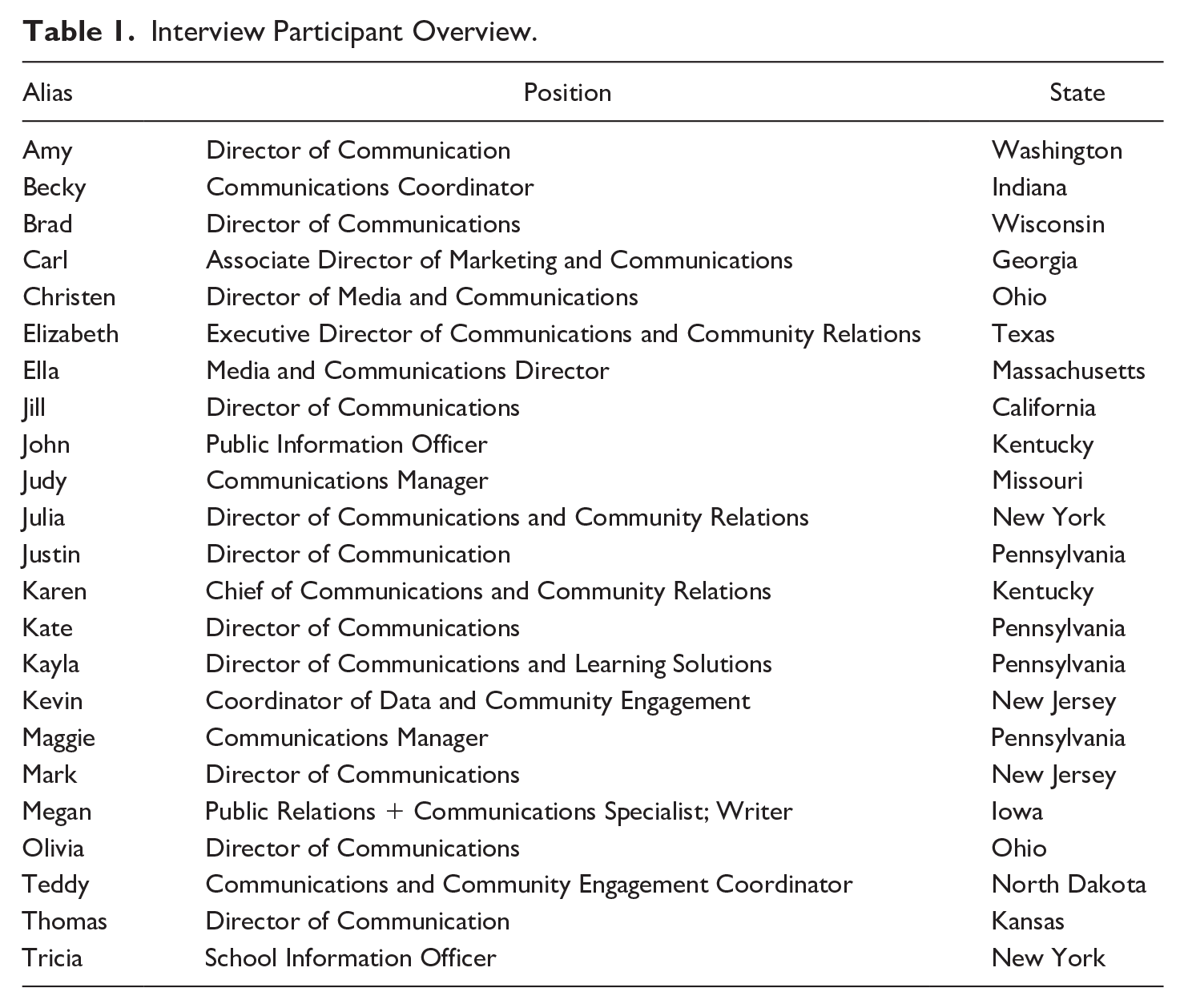
None of the interviewees worked for the same school district or schools. Representative titles for participants in these positions included director of communication, communications manager, public information officer, director of communication and community relations, and director of media and communication. Pseudonyms are used for this study to protect the anonymity of the participants. This study received IRB approval from the researchers’ university. All participants were offered a $25 gift card for their participation.
Data Collection
Interview participants were recruited using purposive and snowball sampling (Berg, 2009). First, a list of potential interviewees was assembled by the lead researcher by looking up the publicly available email addresses of the presidents and officers of the National School Public Relations Association (NSPRA) and its 34 officially chartered chapters across the United States. This initial list consisted of approximately 50 people who were sent emails describing the purpose of the project and informed consent language. This yielded three interviews, although a few people responded to the cold email by forwarding it to other communicators. Once interview data collection began, one of the interview participants offered to post the study information on a Facebook group for school PR practitioners. This yielded the most additional participants for this project.
Since participation in in-depth interviews was not limited to a specific geographic region, a combination of Zoom and face-to-face semi-structured interviews was utilized based on the location of the school PR practitioners. Twenty-two interviews were conducted via Zoom, and one interview was conducted in person. The average length of interviews was 43 min. All interviews for this project were conducted by the lead researcher.
The interviewer began by asking the participants about the participants’ general job responsibilities, with a focus on crisis communication and changes to the job over time. As the interview progressed and rapport was built, the questions turned toward the participant’s own experiences processing news about school shootings and emotional experiences on the job. Participants were asked how they would define trauma and then reflected on whether they would describe any of their experiences as school PR practitioners as traumatic or not. Participants were also asked if they felt that they had been trained as PR practitioners to respond to the emotional aspects of their jobs at all. After conducting the first few interviews, the interviewer felt an ethical obligation to add one additional question: What is your favorite part of your job? This was to end the interview on a more positive note and not unintentionally leave the participant in a negative emotional state after the interview.
Data Analysis
All interviews were recorded and transcribed through Otter.ai. The second author of this study listened to all the recordings and edited the transcripts for accuracy. In places where the second author could not understand the recording, the lead researcher re-listened to try to provide extra clarification. Once the interview transcriptions were edited, the transcripts were divided between both researchers for a first round of open coding. The initial data were coded through constant comparative and line-by-line coding to establish emergent themes (Corbin & Strauss, 2008).
After this initial coding, the researchers debriefed and decided that this analysis had yielded themes not entirely relevant to the purpose of this study, in which they wanted to focus more on how the practitioners reflected on the emotional aspects of their job as opposed to simply crisis communication logistics. Therefore, the researchers reanalyzed the data using Saldaña’s (2013) coding methods, specifically Emotion and Descriptive. Emotion Codes focus on labeling the emotions recalled or experienced by the participant or inferred by the researcher in some cases. Descriptive Codes were used in conjunction with Emotion Codes to help place the emotions in context, for example, between those experienced by the practitioner versus those having to deal with the emotions of their stakeholders. As part of this process, the researchers wrote an analytic memo after coding each interview to help track the emotional journey of the participant or notice any additional connections between Emotion and Descriptive Codes.
From here, a second round of Pattern Coding occurred to group together codes into a smaller number of categories. Researchers looked for similarities among codes that could be condensed into a more meaningful label. Researchers met regularly to discuss the categories developed from this second round of coding, which ultimately developed into the themes for the first research question.
The second research question developed through an abductive process, so the researchers reanalyzed the data for a third time using Buzzanell’s (2010) CTR framework and the six SAMSHA trauma-informed principles as guiding categories. Using these categories as part of a deductive reanalysis helped with distinguishing overlapping concepts and developing themes. As part of this process, the researchers wrote an analytic memo after coding each interview to keep track of the commonalities between the CTR processes and SAMSHA trauma-informed principles. The researchers met regularly to compare the reanalysis codes and memos to discuss the emerging connections and develop updated themes recorded in the results.
Results
RQ1: How, If at All, Is School Public Relations Experienced as a High-Risk Profession?
There were two primary themes that helped to explain how school PR practitioners experience their job as a high-risk profession. The first was a recognition that “you’re dealing with kids,” creating a parental feeling of responsibility toward this primary stakeholder group in a crisis. Secondly, school PR practitioners experience a climate of relentlessness when it comes to handling crises as they happen so frequently.
“You’re Dealing With Kids.”
Many school PR practitioners experience a heightened emotional weight around their professional role because one of their primary stakeholders is children. As Brad stated, “but gosh, I imagine being in school PR, the stakes are a little bit higher and more relevant because you’re dealing with kids and lives and potential.” Many practitioners expressed a parent-like role in their job and perception of the students at the school where they work. When asked what their favorite part of the job was, most of the answers included students, their accomplishments, and/or their memories about them. Sometimes, the practitioners referred to students as “my kids” (Karen) or “our children” (Elizabeth) during the interviews, stemming from parent-like feelings toward the students.
Related to the crisis preparation piece of the job, Thomas, who got choked up during the interview, discussed the pressure he feels to keep kids safe and “loving 5,800 kids that we have here, two of them in particular who are my kids.” Like Thomas, many participants’ own children, nieces, and nephews attended school in the same school district where they worked. Julia described the unique context of this PR position as follows: “it’s not like I’m going to work at IBM and I don’t see my kids all day. And you know, it’s like you’re in a place where my kids are being affected the same way.”
Student deaths were a particularly tragic context for school PR practitioners because they are just kids. Sometimes, these student deaths intersect in additional personal ways. Teddy helped her niece navigate the loss of a classmate in the school district where she works. In talking with her niece and helping her process the situation, Teddy recounted the following conversation: Niece: Is this what you do for a job? Teddy: Well, not all the time, it doesn’t happen like this. But if there’s a really hard day and somebody passes away at school, I am there to help. Niece: I think you have the worst job in the world.
Julia discussed a situation where a student died in a car accident involving a drunk driver, who was another student, which involved “the trauma around a student dying, but then also the three students who were still alive, one of which was going to jail . . . That was like, that’s probably the worst thing I’ve ever had.” Adding to this, Julia’s own child was friends with the student who died.
Student deaths by suicide were also discussed as particularly traumatic events for them to communicate about. It is not only public-facing communication about the situation but also getting a behind-the-scenes look at how it affects school leadership. In talking about a student suicide, Justin said: It was traumatic to work with the administrators, just to experience their sorrow and grief. And it’s hard to . . . they would never want the public to see that. I suppose that happens in those closed meetings, but they so much deeply care about that to lose somebody like that, it’s like losing part of their family.
A Climate of Relentlessness
We began this project under the assumption that the epidemic of school shootings in the United States would be a particularly salient traumatic context for school PR practitioners. Becky did have a personal experience with a school shooting and was very much still impacted by that experience: “I think even still talking about the shooting that we had; it was so traumatic. Even when I go back to the school, and I go into that stairwell, I remember.” For most participants, though, preparation for school shootings was not the most traumatic part of the job, although discussions related to school safety preparation with their own children were emotionally challenging.
Instead, COVID-19 emerged as a prominent traumatic experience for school PR professionals. As Tricia stated, “the pandemic was a nightmare game changer.” On the extreme end of the experience, Kevin discussed getting threatened and having his car scratched and tires slashed for enforcing government-mandated vaccine requirements and mask mandates in his school district. Kevin reflected on this, saying, “it’s not out of the realm of possibility to think that somebody would show up and shoot you.” Adding to this perspective, Karen said, “If you don’t work in this, I don’t think people realize how much trauma that school PR folks see, how many crises a day you’re dealing with.”
Related to the hostility that Kevin discussed, Kayla mentioned how dealing with COVID as a communicator also coincided with negative discourse surrounding schools and critical race theory: And before Delta and Omicron hit that, that June and July, our board meetings were some of the most contentious that we had ever seen. And it wasn’t about COVID anymore. Now it was about CRT and equity, and what books do you have our children reading, and we were all just like, ‘Seriously? You can’t give us like two months?’ And then it rolled right back into Omicron and Delta. So, then it rolled right back into COVID. And when COVID then started calming down again, we were all still like, oh yeah, but that means that they’re just going to refocus back now onto the book banning and the CRT and equity issues.
Teddy referred to these groups as the “anti-everything coalition. Because if they’re not upset about this, they’re gonna be upset about something else.” Mark mentioned the role of parents as “taxpayers” (providing funding to schools) and the school being a “public entity” bringing a different level of relationship and expectations from parents regarding the transparency and nature of communication, in particular a “sense of entitlement” toward specific topics and issues.
It is not even simply an increase in crises, but an increase in threat of crises. Judy talked about increasing hoaxes because of social media, particularly on Instagram, Snapchat, and TikTok. Her school district frequently must send out messages that say, “There was a threat being investigated by the local police department.” Even for situations that turned out to be nothing, such as one Olivia described as someone carrying a black umbrella that was mistaken for a gun, “that was maybe a 20-minute crisis, but when we were already getting dozens of phone calls from parents and social media is blowing up . . . and kids are scared. It was a short one, but it was still just . . . these are becoming daily.”
RQ2: How, If at All, Are Trauma-Informed Practices Present in School Public Relations Practitioners Communicative Processes of Resilience?
Using Buzzanell’s (2010) communicative resilience framework and the six SAMHSA trauma-informed principles to guide analysis, themes developed around crafting normalcy primarily focused on physical safety, legitimizing negative emotions focused more externally than internally, identity anchors as a form of emotional safety and trustworthiness, centrality of peer support and collaboration in communication networks, and enacting alternative logics that focus on employee empowerment.
Crafting Normalcy Primarily Focused on Physical Safety
Crises are a normal part of life and school PR practitioner responsibilities. Interviewees seemed most comfortable at the start of the interviews discussing their general processes and procedures for crisis situations, which often focused on having templates and folders for various types of crisis messaging. Templates for various crisis situations streamlined communication, but the existence of so many types of crisis templates also crafted using them as a normal expectation. The ability to be resilient hinged on being prepared, particularly as school PR practitioners were dealing with crises on a regular basis.
These templates primarily focused on instructing information (Sturges, 1994), which tells people how to “physically react” (p. 308) during a crisis. Interestingly, Maggie mentioned that “we kind of restructured when we put these messages out after the pandemic, not only ‘this is what happened’ and ‘no, you can’t bring a knife to school,’ but also, ‘if your child is struggling to return to school in person, please contact your guidance counselor for resources.’” This may indicate the pandemic created more awareness of the need for adjusting information, which focuses on corrective action and expressing concern (Coombs, 2007). During reanalysis, it struck us how normal discussions of active shooter trainings and first response within schools had become, which was vastly different from our public education experience 20 to 30 years ago. Almost every communicator mentioned programs such as the ALICE Training or Run-Hide-Fight and some even talked about staff being trained in first aid and tourniquets. It was not a discussion of if but when such training would be enacted. As Kevin stated, “eventually someone you know if going to be involved in [a school shooting] and you just pray that it’s not going to be yourself.” Brad mentioned this focus on physical safety from external threats for students was not entirely unique if we consider students hiding under desks during the Cold War, but what was different were the media systems now and the desire and expectation for constant communication.
Legitimizing Negative Emotions Focused More Externally Than Internally
School PR practitioners foregrounded productive action by focusing on their work and compartmentalizing emotions. As such, the legitimization of negative emotions appeared more toward the stakeholders they communicate with than themselves. While school PR practitioners work through many crises that are often traumatic in different ways, they recognize what emotions may follow those crises, and they “turn off” their emotions (i.e., disassociate from the emotional aspect of the crises) and focus on the logistical responsibilities. John said, “I’m a lot more effective at my job when there’s not that emotional attachment to what’s going on.” Most interviewees mentioned the need to focus on wearing their “PR practitioner” hats, and while doing so, they did not see time to feel their emotions. There are different reasons mentioned for these practitioners’ approach to these traumatic experiences of crisis management. It is sometimes due to the need to create a boundary and protect their mental health or due to not being given the chance to accept it as part of their job responsibilities. For example, Karen said, “You have to kind of put on that brave face and put things in a little box.” Similarly, Jill responded, “I guess it was traumatizing to have to say, ‘I can’t be a human right now. I need to go perform and do my job’ [emphasis added].”
Because school PR practitioners deal with so many crises, and there is a feeling of a climate of relentlessness, they may not get the chance to step back and process their own emotions. During most interviews, there was a palpable shift between asking participants about the logistics of crisis communication at their jobs and getting to reflect on how the more emotional side of it impacts them. For example, at one point during the interview, Thomas indicated that it felt like the interview was becoming a “therapy session.” In many ways, Thomas’ analogy was an example of the school PR practitioners frequently putting on their PR hat first and their human hat second. Many interview participants had previous careers in journalism and talked about that as training in controlling their emotions to remain objective. As Thomas said, “As a journalist . . . you have to put up a wall around yourself. You’re trained to do that because it’s part of your job. You’re going in, you’re an objective observer of whatever situation you’re in, whether you truly are or not, you try to be right.” As Karen also expressed, “you can’t get in your own feelings about it. You have to do what is best for the district, the students, and the staff.”
Identity Anchors Creating Emotional Safety and Trustworthiness
While many school PR practitioners disassociate from the negative emotions experienced as part of their job, they fully embrace the positive emotions (i.e., joy, pride, excitement) and memories associated with their roles, particularly as it relates to students. As Karen said, “I just like to focus on we’ve got so much good that I love pulling up a story we did on kids doing something amazing and saying, ‘okay, you know, it isn’t all sad.’” Two of the most prevailing identity anchors throughout the interviews with school PR practitioners were their love of children and desire to be helpers. In the interview with Teddy, she disclosed that she learned that she got her job in school PR the same day as the Sandy Hook shootings happened, although her position was in a different part of the country. She came from a first responder family, and as she was thinking about what she would do if she was in that school system, she thought “I want to be one of the people that would run towards [the crisis] and want to be able to help, so they’ve been in my mind since the very beginning.” While there might be risk in choosing this profession, knowing that the school PR practitioners can help make a difference for children leads to resilience. Olivia described this as believing “in the mission of this district” and “growing [kids] to be the next leaders.” Similarly, Kayla affirmed identity anchors back to loving the students and loving the work helping the most vulnerable and disenfranchised students. This reaffirmation of what anchors the school PR practitioners to their positions provided emotional safety and resilience. Kevin disclosed the impact that coming out as gay in high school in the 1980s, which “was a scandal,” and experiencing the height of the AIDS epidemic: You know, nowadays, it’s much easier, and it’s because of the work that we did over the past 40 years. So those are the things you know, you have to take the experiences of trauma and try to find the silver lining in that you can help other people going through the same thing. It’s really the only benefit that you can get out of it.
His own traumatic experiences of being marginalized for his identity as a student pushed him to make the future better for the next generation of students in whatever ways he could in his professional role.
While many school PR practitioners had careers as former journalists, that was not the only path they had taken to their current careers. Practitioners felt that aspects of their identity helped build trust with their publics. For example, Brian was the only school PR practitioner interviewed who was a former teacher. He said, “I’m trusted and maybe welcomed as one of us when I’m asking teachers for help. I try to be mindful of the challenges increasing every day on teachers.” In addition to that trustworthiness created through shared career identity, school PR practitioners also discussed their shared parenthood as creating a sense of trust with others when other parents reached out about the safety precautions that the school district was taking in the case of an emergency.
Centrality of Peer Support and Collaboration in Communication Networks
More than anything, though, school PR practitioners relied heavily on their professional community for advice, camaraderie, and emotional support. Many participants mentioned the resources and meetings that their state associations offer as a source of learning how to cope with emotional aspects of their jobs that are trauma-associated. These associations provide practitioners with a space to provide each other emotional support, advice, additional personnel support in active crisis situations, and further training on how to handle crisis communication. For example, there are regional teams meeting monthly or quarterly as part of the Texas School Public Relations Association that provides assistance in dealing with crisis communication (Elizabeth), Iowa School Public Relations Association has two annual meetings offering crisis seminar-like meetings in which the practitioners learn how to process the trauma associated parts of their jobs (Megan), Ohio School Public Relations Association has annual conferences, and Christen told that participating in that conference was “invigorating” and that she felt “more alive” and got a chance to “reconnect with a mentor.” Mark mentioned that the New Jersey School Public Relations Association provides workshops in crisis communication, and Amy talked about her efforts in providing wellness and mental health sessions and resources in the Washington School Public Relations Association conferences. Along with the state-level school PR associations, the NSPRA has been mentioned as another source by the participants, which provides a professional network (Brad), wellness emails with self-care tactics (Elizabeth), and conferences and symposiums that are treated as a space by practitioners to share their stories and seek advice (Justin). Brad said that “a group of us found each other on a Twitter DM chat and there are 10 of us and we talk every day. I have this support group of some of the best minds in the business.”
Enacting Alternative Logics That Focus on Employee Empowerment
While school PR practitioners work to be prepared for crises, there is an inherent lack of control that crises bring. To regain some semblance of control, many PR practitioners are also fighting back against a 24/7 work culture that feels expected by setting boundaries on their time and engagement with media. As Ella said, “I know that for me, like the background that I have, I take my self-care a little bit more. I also think maybe it’s also a generational thing. I’m a millennial like; I think we’re kind of more like that. Millennial, Gen Z is like more of like the work life balance.” Although there is an expectation in PR to monitor the environment, one boundary Kate had set for herself was not watching the news.
Because crises and threats were so common in these positions, there was at times a strategic non-transparency in communication. For example, Kayla discussed not wanting to create panic amongst parents and students for potential hoaxes, so they would not send out communication for non-credible threats. In another example, Kayla discussed decisions about including certain words like “equity” in emails and agendas that could be right-to-know requests. She discussed how certain groups are “targeting teachers and principals and communication people and equity directors on Facebook. They’re getting phone calls with death threats, and it’s just like, all I’m doing is promoting the good works that we’re doing in our school and all of a sudden I’ve become, and the people I’ve worked with have become, the enemy.” In such situations, transparency may be at odds with safety.
Unsurprisingly, leadership from the top levels, in this case, the superintendent and principal, played a key role in how mental health was addressed amongst district employees. Brad noted that his superintendent models “mental health” and “self-awareness in individual leadership development.” Brad went on to say that “the principles that any leader would apply to managing their own mental health and work-life balance would apply to a school PR role.” Kate said, “my boss is great. The district realizes that we see and hear about a lot of trauma, and he’s very big on take the time to connect, go outside, go breathe. Very big on that. Take care of yourself. Work hard. We need to get the job done, but we also can’t have burnout. We need you. We need you up.”
Discussion
It is imminently clear from the interviews that COVID-19 had a profound impact on school PR professionals. Several participants in the interviews seemed to be processing their experiences during COVID-19 for the first time during these interviews, possibly because it was the first time they had thought of it as a traumatic experience. This could relate to the compartmentalization of emotions discussed previously (Simpson & Boggs, 1999). This is in alignment with research that has found evidence of a rationality bias in organizations (Zhang & Adegbola, 2022) that requires compartmentalizing emotions to get the job done. However, as mental health effects of COVID-19 are still manifesting, there needs to be continued conversation within the PR profession about how to address and manage emotions and potential trauma post-crisis. This needs to be on a larger professional level than simply piecemeal conversations by sympathetic organizational leadership or wellness seminars by professional associations, although those approaches have offered an important starting point. For school PR, though, the challenges come not simply from being overworked. There is a concerted attack on public education that has left many school PR practitioners in the crosshairs.
Workplace Adversity From a Community and Societal Level
Biss and Barrett (2024) defined a high-risk profession as one that experiences “chronic workplace stressors and/or frequent acute adversity” (p. 318). Based on our interviews, we believe that school PR is undoubtedly a high-risk profession. This study adds important depth to the work started by Guo and Anderson (2018) and highlights the need for trauma-informed approaches in this field. While Guo and Anderson’s (2018) findings regarding unrealistic expectations for PR and the marginalization of the PR function did overlap with some of our participant experiences on the job, most of the adversities discussed in these interviews were at the community and societal level. School PR offers rich insight into managing workplace adversity for community-oriented PR positions, particularly those where children are primary stakeholders. The impact of COVID-19 on communication positions that find themselves at the intersection of political polarization in the United States cannot be understated as this creates an unsustainable climate of relentlessness. From death threats to being bombarded by Freedom of Information Act requests, school PR practitioners were being taken away from what they enjoyed about the position—the kids—to deal with community members with certain political agendas. While there is frequent discussion about teacher burnout in this climate of public education (Huck & Zhang, 2021; Taddeo, 2021), it was clear from this study that this level of polarization, negativity, and antagonism was having a negative impact on the well-being of school PR practitioners. There seemed to be emotions-focused coping strategies related to distancing (Finstad et al., 2021) for those in this position, as well as strategies related to hardiness as described by Buzzanell (2010) focused on finding a sense of meaning and purpose. For the school PR practitioners, the children who they got to know and support provided this important sense of meaning and purpose, even on hard days.
Another important element to consider about workplace adversity within the school PR profession is that many practitioners work in the same school district that their children or other family members attend. School PR offers a unique employment context where that work-life balance may not always be possible because of work situations that may impact their own children. It was imminently clear that the school PR community, both through online and in-person connections through state chapters, offered vital professional and emotional support to this niche community of PR practitioners who understood these unique workplace adversities. This was counter to the findings in the work by Guo and Anderson (2018) that found participants in their sample of PR practitioners rarely mentioned communication networks as a path to resilience. For school PR practitioners, though, these professional communication networks were paramount for their ability to cope with the stressors of the position. A key theoretical, and practical, takeaway from this research is the way that trauma-informed practices can provide additional guidance for emotional support in communicative resilience.
Trauma-Informed Communicative Resilience
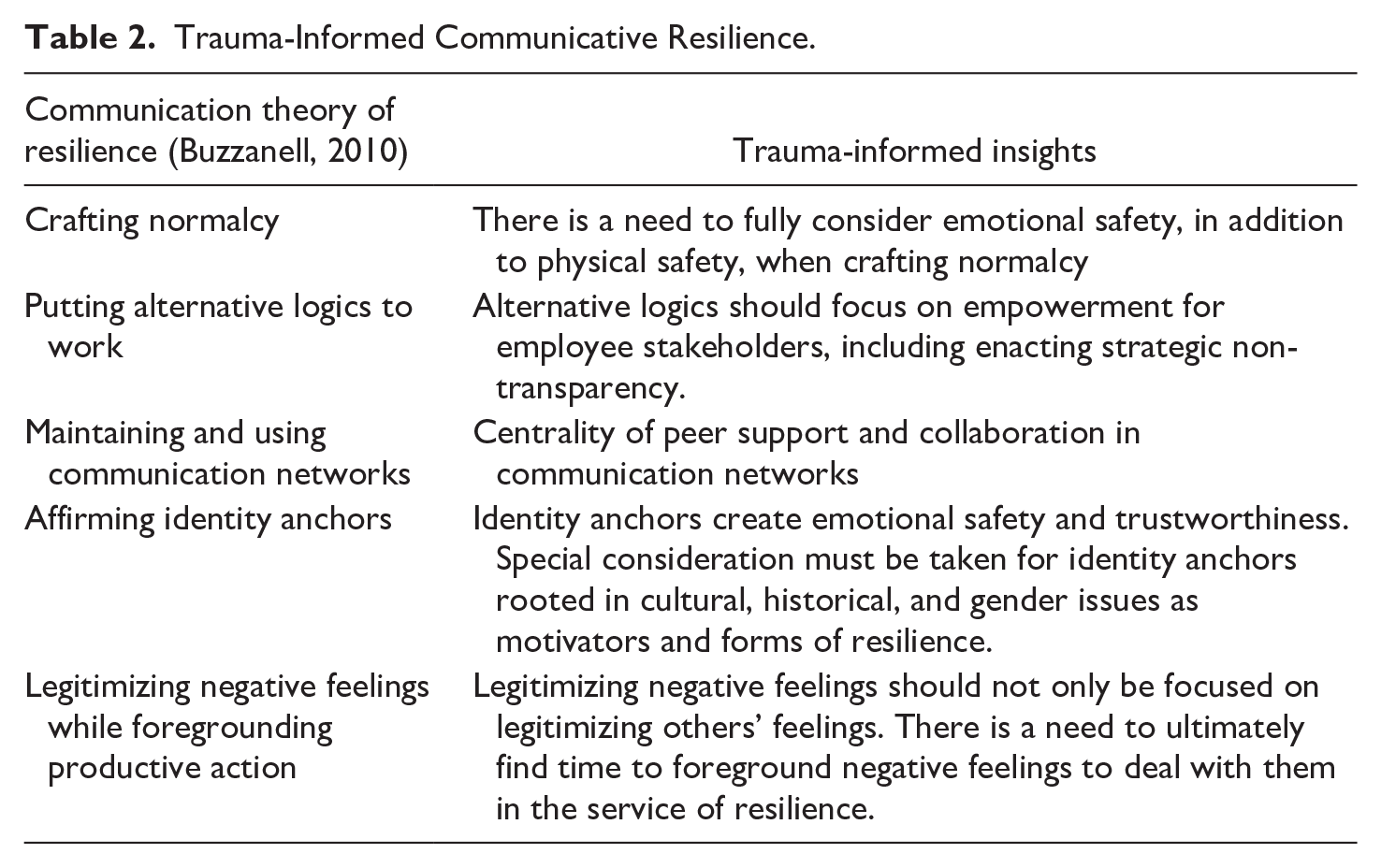
This study showed places where the CTR (Buzzanell, 2010) and established trauma-informed principles converged and diverged. As Wilson et al. (2024) argued, elements of communicative resilience do not work in isolation and can feed off each other. Our findings indicated that overlap between communicative resilience processes can at times limit trauma-informed practices. For example, we found that crafting normalcy focused primarily on physical safety to foreground productive action. However, this may be unintentionally causing less engagement with emotional safety. When emotional safety is considered in resilience messaging, it is more focused on legitimizing negative feelings to stakeholders (such as the students) rather than themselves. To help synthesize the findings from this research, Table 2 showcases our findings related to trauma-informed communicative resilience.
Trauma-Informed Communicative Resilience.
Crafting Normalcy
In conducting this research, the normalcy around issues such as school shootings caught us off guard. For school PR practitioners, they approach this as a “when and not if” situation. There is a need to consider emotional safety more fully, in addition to physical safety, when crafting normalcy. Crisis communication is a very normal part of the job for school PR, as indicated by the usage of templates and crisis plans by most communicators. The focus more on instructing information (Sturges, 1994) as opposed to adjusting information (Coombs, 2007) is not uncommon as physical safety and knowing how to physically react in a crisis is important. The pandemic did seem to show some school PR practitioners the need to include more adjusting information in messages to express concern and provide information about mental health resources in their communication. Trauma-informed approaches remind us that in crafting normalcy, there are multiple types of safety to consider.
Putting Alternative Logics to Work
School PR practitioners were enacting several alternative logics that focused on combating an overwork culture in PR because of the unpredictability of crises. Several participants talked about boundaries they set on their time, such as ensuring they did not check their emails on vacations. Participants also discussed avoiding the news altogether, which is antithetical to how many people are trained in PR because of the environmental scanning function. This was largely because issues such as school shootings had become so common that they felt like they could not have a degree of emotional safety about their jobs if they were aware of every situation. School PR practitioners who enacted these alternative logics had to have support from their school administration and leadership.
Another interesting alternative logic that was emphasized was strategic non-transparency. This might seem at odds with the trauma-informed practice that focuses on the importance of building trust through transparency. Yet, for school PR practitioners, transparency could at times create more harm because of the existence of groups looking to target them for specific political agendas. School PR practitioners were having to make decisions about whether to include words like “equity” in emails and agendas that could be requested by anyone because of the public nature of the organization. Additionally, school PR practitioners were making decisions about not communicating with students and parents regarding potential hoaxes as this could cause panic. As such, strategic non-transparency was an alternative logic focused on both emotional and physical safety.
Maintaining and Using Communication Networks
The CTR process of maintaining and using communication networks had a high degree of overlap with the trauma-informed principles of peer support and collaboration. For school PR practitioners, they discussed themselves as a tight-knit and supportive communicative, helping to craft messages during a crisis, offer additional media relations support, and just general emotional support for longer-term crises such as COVID-19. This is aligned with the process of resilience that draws upon bonds for emotional support, advice, and assistance (Biss & Barrett, 2024; Buzzanell, 2017). Connecting with people who have experienced similar trauma is a key component of trauma-informed practice (SAMHSA’s Trauma and Justice Strategic Initiative, 2014).
Affirming Identity Anchors
Identity anchors create emotional safety and trustworthiness. Special consideration must be taken for identity anchors rooted in cultural, historical, and gender issues as motivators and forms of resilience. Because of the contentious political climate discussed in many interviews, this leaves certain groups more vulnerable. For communicators who have identity anchors in marginalized communities, such as the LGBTQIA+ community, the history of their own struggle and resilience formed their strong connection to the work that they did and helped them find a purpose and emotional safety even on the hard days. Stakeholders felt like they could identify with school PR practitioners who had a shared identity, such as being parents of students in the same school district, which created an additional layer of trust that safety was a paramount concern.
Legitimizing Negative Feelings While Foregrounding Productive Action
While backgrounding negative feelings is not meant to suppress or deny them (Biss & Barrett, 2024; Buzzanell, 2010, 2017), in practice, we found that this was happening for school PR practitioners. Part of this may have come from professional training that many had in previous careers as journalists, where emotions were viewed as at odds with objectivity. In this PR roles, our interviewees felt more comfortable legitimizing negative feelings in their stakeholders, such as adding messages to their communication about resources for people who may feel upset by a crisis, but we found less of this turned toward themselves. With a trauma-informed perspective, we argue that legitimizing negative feelings can be a productive action instead at odds with it. This is not to say this should happen before people’s physical safety is secured in an active and ongoing crisis, but as part of anticipatory resilience (Wilson et al., 2024), school PR practitioners must ultimately deal with their own potential negative feelings and see this as a productive action. Several interview participants did utilize therapy and mental health resources for themselves, but as with the CTR we are not focused as much on individual-level behavior but communicatively changing the culture around crises and emotions for school PR practitioners.
Generational Shifts in Understanding Trauma
There may also be some generational shifts at play in understanding trauma and resilience, which will have ramifications for emerging workforces across sectors, including PR. It was interesting that several participants felt that amongst the student populations they serve, there might be an overuse of the language of trauma for their experiences. This may also just indicate different generational embrace of emotions and mental well-being; especially as socioemotional learning has become a formalized part of the K–12 curriculum.
This shift may have important ramifications for how we prepare our PR students in the classroom. As a profession, we must stay on top of the greater attunement toward mental health and emotional issues of upcoming generations of PR professionals, particularly for those who will be entering community relations oriented, public service, and advocacy communication roles. Trauma literacy is also highly salient for crisis communication responsibilities so that future PR professionals are equipped to engage in self-care and care for those impacted by the crisis. Like journalism has for so long (Arrey & Reynolds, 2023; Dworznik & Grubb, 2007; Seely, 2020), PR must embrace talking to our students about the potential trauma that can result from these types of positions. As interview participants noted, trauma is a part of life. Knowing this, we can better equip our students for inevitable workplace adversities and set them up for positive coping strategies leading to resilience. A tangible place to start with for educators is the work of Place et al. (2023) on trauma-informed listening in strategic communication. Findings from this qualitative research indicated the importance of listening with sensitivity toward trauma, understanding how communications work can inflict trauma, being attuned to invisible or unspoken trauma, power distance that may be involved between communicators and their publics, and compassion fatigue. All of these are topics that could be addressed in strategic communication courses.
Limitations and Future Research
There were certainly limitations to this study, particularly through sampling from school PR practitioners already heavily involved in state and national professional associations. As such, the emergence of those groups as vital sources of professional and personal support may not be indicative of how the larger swath of school PR practitioners feel. While an effort was made to recruit from across the United States, it would be important to get further geographical representation from additional states as well, including those without state school PR associations. These limitations of this present study present ample opportunities for future research, including survey research based on these findings to further understand how trauma is experienced by school PR practitioners more broadly. Furthermore, the experiences of other community-focused PR professionals, such as those in government affairs, would offer rich comparative opportunities and may help create better support systems for communities interested in public interest communication and community relations.
Conclusion
While stress and adversity are associated with any job, the unique context of school PR as a high-risk profession offers challenges that can open practitioners up to potential trauma. The heightened polarization around public education and the concomitant issues related to COVID-19 provided a watershed moment for the school PR profession to take stock of how practitioners are resolving the emotional toll the position can take and through trauma-informed communication resilience. PR scholars have an opportunity to further research and create tools for practitioners to address the emotional challenges this work can cause, as well as use our expertise to help advocate for additional mental health resources and training in PR curriculum.
Footnotes
Declaration of Conflicting Interests
The author(s) declared no potential conflicts of interest with respect to the research, authorship, and/or publication of this article.
Funding
The author(s) disclosed receipt of the following financial support for the research, authorship, and/or publication of this article: This project was supported by the Arthur W. Page Center for Integrity in Public Communication at the Donald P. Bellisario College of Communications at The Pennsylvania State University. Any opinions, findings and conclusions, or recommendations expressed in this material are those of the authors and do not necessarily reflect the views of Penn State.
