



Abstract
An increasing part of the public is distrustful toward journalism. Transparency has been advocated to counter this trend. Therefore, the question arises to what extent news outlets have implemented transparency. General content analyses of the implementation of transparency routines are scarce. We try to add to the literature by conducting a generic quantitative content analysis on the prevalence of a diverse set of transparency routines over multiple news outlets. We also assessed whether transparency not only differs between outlets but also within outlets; namely, between hard vs. soft news section items. We hypothesized that digital-native, public, and quality news outlets and hard news section items would be relatively more transparent. After analyzing 27,096 news items from six news outlets, we find that the outlets differed in the extent to which and areas in which they had implemented transparency: (a) The digital-native news outlet was more transparent than legacy news outlets, except for author transparency, (b) the public news outlet was more transparent in terms of news updates and source use compared to commercial news outlets, but less so in terms of authors and production processes, (c) no substantial systematic differences were found in the extent of transparency implementation between quality and popular news outlets, and (d) hard news section items were only more transparent in source use than in soft news section items. As being one of the only generic quantitative content analyses, this study has contributed to our understanding of the different patterns across news outlets in transparency implementation.
Fueled by a perception that the quality of news is lacking, distrust is rising among segments of the public toward legacy journalism (Newman & Fletcher, 2017). This leads more readers to consume alternative news sources, which tend to contain more disinformation (Andersen et al., 2023) or drastically reduce their news intake (Hameleers, 2022), resulting in a less well-informed public. Although academic findings have been mixed, transparency is increasingly being advocated as a means to regain public trust (Karlsson, 2020). The rationale is that by becoming more open about how news is created, the knowledge gap between sender and recipient would be reduced, potentially enabling readers to better judge whether the news has been properly created (Craft & Heim, 2008). The digitization of news also contributed to an increased focus on transparency (Karlsson et al., 2016). Unlike offline news, online news can and does change after publication (Timmerman & Bronselaer, 2022). This fluidity serves as an argument for implementing more transparency mechanisms about what has changed in an article and why (Karlsson, 2010).
Due to these developments, news media are increasingly convinced of the necessity of more transparent journalism (Loosen et al., 2020). The digitization of news also provides opportunities to do so (Vos & Craft, 2017): The absence of page limits in the online context provides room for disclosures, and digital features such as hyperlinks can contribute to a transparent use of sources. Yet, obstacles hamper the implementation of transparency: Among others, increased time pressure and decreased revenues frustrate the implementation of transparency (Deprez & Raeymaeckers, 2012). Besides, some point out potentially negative consequences, depending on the stakeholder (Karlsson, 2021). For instance, research has shown that too much transparency about faulty information in earlier article versions could reflect negatively on the diligence of journalistic work (Fengler et al., 2015).
These trade-offs beg the question of how news media have balanced the advantages and disadvantages of routinely implementing transparency. Hence, we pose the overarching research question: To what extent have online news outlets implemented transparency routines?
Prior research that mapped which transparency routines news media have implemented generally consists of case studies: Often qualitative descriptions of single news outlets at a particular moment in time (Karlsson, 2010). These are valuable to get a detailed picture of specific implementations of transparency routines, but cannot speak to the implementation of such routines in daily reporting over a broader landscape and a longer time period. Such general quantitative analyses of the prevalence of transparency routines in news items are scarce (with notable exceptions Humprecht & Esser, 2016; Karlsson, 2010). To contribute to this literature, we therefore quantitatively analyze how the implementation of transparency has been realized for six outlets, over a period of 1 year, and over a diverse set of routines in the Dutch news media landscape.
The studies by Humprecht and Esser (2016) and Karlsson (2010) revealed that the implementation of transparency differs at the outlet-level, based among others, on their business model. Beyond this, one might also consider whether a difference exists at the item level (i.e., different news articles within the same outlets). For instance, survey research suggests that readers perceive the level of transparency to vary from article to article (Uth et al., 2021). Moreover, experimental research indicates that a consistent implementation of transparency reinforces its beneficial impact in the form of reduced distrust (Masullo et al., 2021). Hence, this study will compare not only outlet-level features but also item-level features, namely whether a news item qualifies as hard or soft news.
Theoretical Background
From Norms to Routines
Transparency, in essence, comes down to the provision of information (Fengler & Speck, 2019). In the context of journalism, transparency involves providing greater insight into journalistic products and internal processes (Kovach & Rosenstiel, 2001). This may include offering background information about the authors, the rationale and motives behind reporting, and the sources and methods used (Craft & Heim, 2008; Ward, 2014). Transparency is not an end in itself but a means to realize a set of values. To begin with, openness about the choices behind reporting should generate more understandability for the public about how the news comes about (Fengler & Speck, 2019). This increases the accountability of news media, given that with more information, the public will be better able to evaluate and monitor how news media operates (Humprecht & Esser, 2016). Opening up internal processes to the public also provides more room for a dialogue between producer and consumer (Craft & Heim, 2008). By providing the reader with the empowerment to participate in the journalistic process, news media gain legitimacy (Karlsson, 2010). These values of transparency should lead to greater credibility and trust from the public (Phillips, 2010).
Whether transparency is an efficient means to achieve these goals remains to be seen, however. First, there are doubts about the effectiveness of transparency (Karlsson, 2021). Although readers are mostly positive about the idea of transparency (Karlsson et al., 2017), experiments to date tend to show no or small positive effects on credibility and trust in journalism (Curry & Stroud, 2021; Karlsson, 2020; Karlsson & Clerwall, 2018) and at times even negative effects (Karlsson & Clerwall, 2018; Tandoc & Thomas, 2017).
Second, there is uncertainty as to whether there are enough resources to implement transparency. For instance, news staff are increasingly experiencing time and work pressures (Deprez & Raeymaeckers, 2012). Journalists often argue that they simply do not have the time to add transparency to news coverage (Koliska & Chadha, 2018). Therefore, in light of efficiency, managers often direct journalists to limit themselves to low-effort methods of transparency (Chadha & Koliska, 2014; Gade et al., 2018) such as the heuristic use of timestamps to signal changes and indicating source usage via hyperlinks.
Finally, there are concerns regarding the desirability of the goals of transparency. One such question is whether transparency encourages “dis-accountability” rather than accountability: The demand for transparency stems, in part, from those who wish to discredit news media and gather as much intel to question the legitimacy of news media (Craft & Heim, 2008). It is also far from obvious what the optimum amount of transparency would be (Tandoc & Thomas, 2017): Too much transparency could overload the public with information that distracts from the understandability of the news, making it counterproductive (Craft & Heim, 2008).
Notwithstanding these concerns, there is a growing conviction within the journalistic profession itself that transparency is part of how journalists ought to do their work (Loosen et al., 2020). The focus on transparency has led to new journalistic routines (Karlsson, 2020); that is, “patterns of behaviors that form the immediate structures of media work” (Reese & Shoemaker, 2018).
Transparency Routines
Transparency routines can roughly be divided into routines of disclosure transparency and participatory transparency. Disclosure transparency centers on communicating to the public how the news was selected and constructed (Karlsson, 2010). This includes routines that lead to more background information about authors, openness about source use, disclosure of changes, and breaking down the news production process. Participatory transparency goes beyond this by not only communicating with the public but also allowing the public to participate (Karlsson, 2010). This can, for instance, be achieved by facilitating feedback opportunities for readers through comment sections, forums, blogs or polls, and by providing chances for readers to co-produce the news.
The current manuscript concentrates on disclosure transparency for several reasons. First, initial optimism regarding interacting with the public has largely been replaced by a more pessimistic view (Reimer et al., 2023), visibly evidenced by the widespread shutdown of comment sections (Rossini, 2022). This is quite understandable: The lack of resources to moderate comment sections has resulted in users mostly adopting an uncivil tone (Bowd, 2016). We also saw this reflected in our data, where only one out of six outlets (the digital-native outlet) has an active comment section. Second, the public itself is less enthusiastic about participatory transparency compared to disclosure transparency (Karlsson & Clerwall, 2018), which holds true within the Dutch context (Van der Wurff & Schönbach, 2014). Hence, participatory transparency might be less efficient in achieving its goals of increased credibility and trust among the public.
This study, moreover, investigates transparency routines at the level of the news-item and disregards other tools such as the publication of editorial statues and the like. After all, news items are the final result of the news production process in which routines manifest themselves (Karlsson, 2010). In addition, it is mostly news items on which readers base their evaluation of journalism (Mellado, 2015), making it a vital space to build trust and credibility.
We examine the disclosure transparency routines as described by Karlsson (2010). We have categorized these into the following four categories: Author (author name, contact, and biographical information), update (timestamps and update disclosures), source (hyperlinks and sources in text), and production transparency (process information). We discuss these in order of appearance in news items, working from the top to the bottom of the article. After describing how disclosure transparency can materialize at the news item level, we address why systematic differences in its implementation can be expected between and within outlets.
Author Transparency
The first category of disclosure transparency a reader may encounter is author transparency: Transparency about who wrote the article. Information about who wrote a
news article allows the audience to understand and identify who produced the article rather than making it appear whether the article has been created by an anonymous voice (Reich, 2010). Hence, providing author information could contribute to the credibility of the author, the news item, and the outlet (Curry & Stroud, 2021; Johnson & St John, 2021). Nevertheless, greater author information could potentially evoke the impression that the news is only an individuals’ account of the events that are being reported; that is, evoking the impression of subjectivity rather than objectivity (Tandoc & Thomas, 2017). Moreover, due to increasing online harassment against individual journalists, there is reluctance about exposing author information (Waisbord, 2020).
A starting point for author transparency is including the author’s name in the byline. Disclosing the author names of news articles followed the introduction of the byline, which makes it one of the oldest forms of transparency (Koliska & Chadha, 2018). Giving explicit full names of the authors creates more openness about who wrote the story. This openness is less forthcoming when abstract author names are used, such as organizational or generic names (e.g., “by the economy newsroom”), or when a name is completely absent. Although giving an author’s name would be a precondition for disclosing further author information, it has not yet been addressed in content analyses of transparency. Thus, little is known about the prevalence of author name transparency.
In addition, author contact information can be made available by supplementing the byline with either email addresses or socials. Disclosing contact information opens up the possibility for dialogue between consumer and producer (Chadha & Koliska, 2014). Previous research found this to be standard practice for major United States and European (United Kingdom and Sweden) news outlets (Chadha & Koliska, 2014; Karlsson, 2010).
Furthermore, author biography information can be provided (Chadha & Koliska, 2014). This is often limited to providing superficial information, such as purely linking to previous stories, education and/or employment of the author(s). Nonetheless, this can be a tool to communicate the competence and background of authors(s) (Uth et al., 2021).
Update Transparency
Second, disclosure transparency can be given about changes in an article, which is termed update transparency. Disclosing these changes is mostly evaluated positively by readers (Karlsson & Clerwall, 2018). There are two ways to communicate these changes: Providing detailed timestamps for both the initial publication date and the last update made. This is the most common, yet also a heuristic form, of update transparency (Chadha & Koliska, 2014): It signals transparency but does not provide what and why the article has changed. Complementary, textual update disclosures can be used: Explaining what and why it was changed in the text, to take responsibility for the content of a change (Karlsson, 2010). However, this type is less common (Chadha & Koliska, 2014).
Disclosing every update, for example, even typos, might backfire by causing skepticism about the quality of the news (Fengler et al., 2015; Vos & Craft, 2017). This resonates with the general perception journalists have of transparency: Something that should be applied mainly to major cases (Koliska & Chadha, 2018).
Source Transparency
Third, the body of the article can disclose source usage, known as source transparency (Fengler & Speck, 2019). Source transparency routines can, in part, enhance the credibility of the outlet (Johnson & St John, 2021), and such routines are likewise perceived favorably by the public (Karlsson & Clerwall, 2018). Source transparency can be reached by hyperlinking, adding original documents, and sourcing in text.
Through hyperlinking, the embedding of clickable links in text, the source usage of journalists becomes traceable (Karlsson & Clerwall, 2018; Vos & Craft, 2017). A distinction can be made between internal and external hyperlinking. Where internal hyperlinking guides people to items from the same website, external hyperlinking guides people to sources elsewhere. Internal hyperlinks are more prevalent than their external counterparts (Humprecht & Esser, 2016; Karlsson et al., 2015) because they are easier to insert: Internal stories are often tagged and thus easy to retrieve (Chadha & Koliska, 2014). Moreover, internal hyperlinking increases visitor duration, and hence, ad revenue. External hyperlinking lacks those advantages. Conversely, internal hyperlinking can obscure source traceability by, instead of linking directly to the external source, doing it indirectly, through an internal hyperlink, for profit. Still, the binary distinction of hyperlinks based on externality can be challenged. Increasingly, news outlets are run by the same parent company (Doyle, 2002). This blurs the commercial disadvantage of external hyperlinking: Although external hyperlinking sends people away, at the expense of ad revenue, this is less so when linking to an outlet that reverts profits to the same parent company. We will term these external hyperlinking patterns family hyperlinking.
Beyond linking to websites, outlets can also add original documents in news content to increase openness and credibility (Karlsson, 2010). However, the practice of doing so is rather limited compared to hyperlinking (Chadha & Koliska, 2014; Karlsson, 2010).
Source transparency can also be achieved through (textual) sourcing: Mentioning sources in the text itself (Chadha & Koliska, 2014). Presenting identifiable sources, termed explicit sources, is one of the core tasks of being open to the public (Kovach & Rosenstiel, 2001). It allows readers to infer the motives and thus independence of sources (Carlson, 2010). Nonetheless, unidentifiable unnamed sources (Chadha & Koliska, 2014) are also commonly used. The degree of unidentifiability can vary: There may be no denomination at all for the source (e.g., “insider”), as with anonymous sources. Due to the call for transparency, journalists are increasingly being criticized for using anonymous sources (Carlson, 2010). Journalists themselves argue that appeals to anonymity are sometimes too easily granted. However, anonymity, for instance of whistle-blowers, is sometimes a must to obtain crucial intel (Carlson, 2010). Moreover, convincing sources to go public would be too time-consuming (Kovach & Rosenstiel, 2001). Unnamed sources can however also be attributed with details or abstract identifiers (e.g., “highly-ranked government official”) (Carlson, 2010), henceforth referred to as opaque sources. In the latter form, this primarily adds credibility to the source (Stenvall, 2008).
Production Transparency
Finally, disclosure transparency can also be provided through openness about the production processes behind the news. We call this production transparency. Giving insights about the production of the news is appreciated by the audience and can foster understanding among them (Karlsson & Clerwall, 2018). Furthermore, the presence of production information increases the perceived credibility of the author, the news story and the outlet (Curry & Stroud, 2021; Johnson & St. John III), while a lack of production information can lead to accusations of bias (Gravesteijn et al., 2024). Nevertheless, such information is rarely shared (Chadha & Koliska, 2014; Kovach & Rosenstiel, 2001). Journalists argue that elaborating on production processes would create too much confusion among the public, as these processes would be too difficult to explain due to their messy nature (Chadha & Koliska, 2014). Using a fabricated article, Figure 1 offers an overview of all discussed disclosure transparency routines.
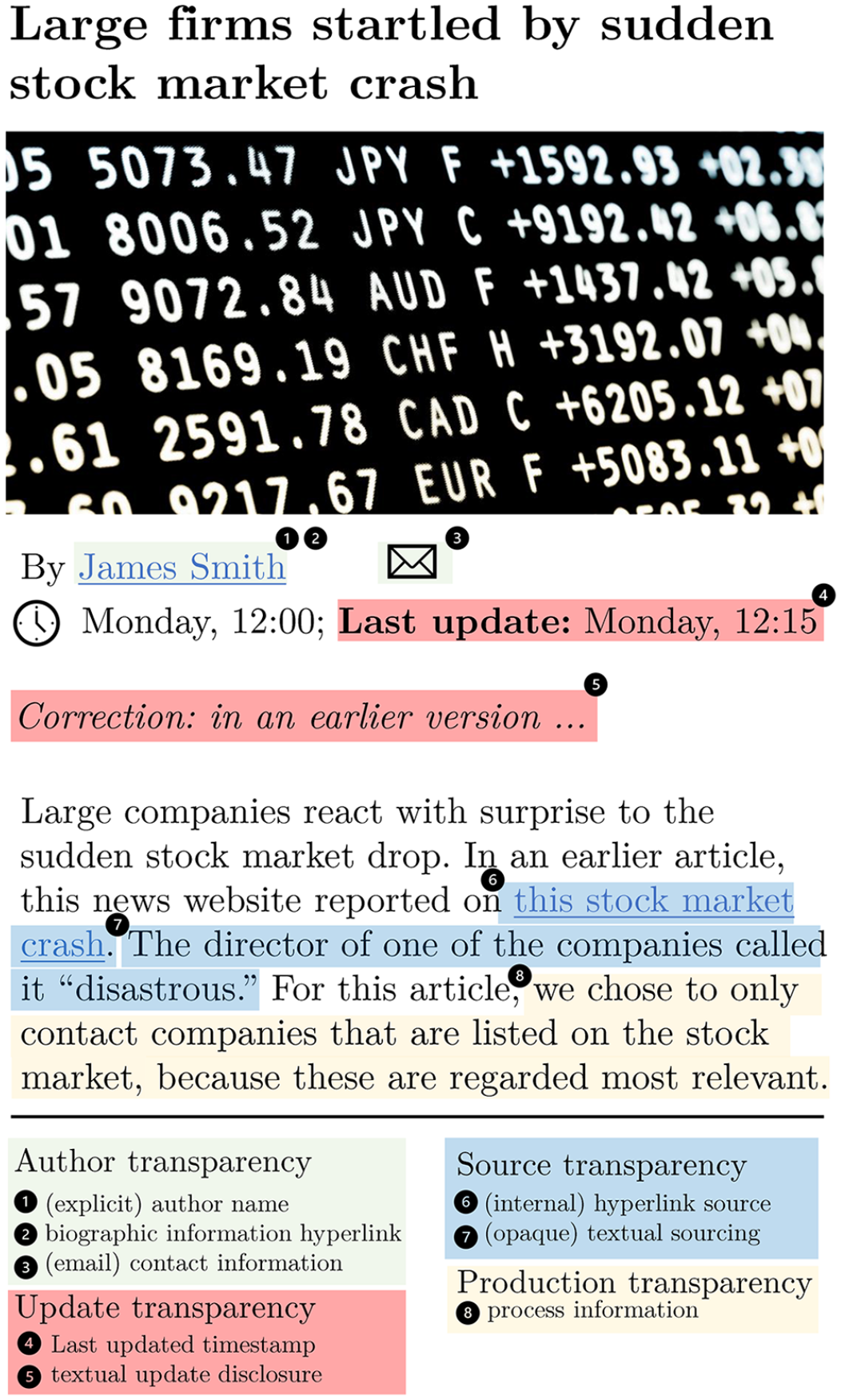
Fabricated Article Example Illustrating the Routines of Each Transparency Category.
External and Internal Differences
The implementation of the discussed disclosure transparency routines can differ greatly between outlet types (Karlsson, 2010). Prior work demonstrates that the origin (Salaverría, 2020), funding (Ryfe, 2021) and profile (Esser, 1999) of an outlet shape the routines and/or standards within the outlet. Likewise, these outlet-level features can explain the use of disclosure transparency routines.
Origin of Outlet
Although legacy news media, media that operated through television, radio or print, nowadays also own digital channels (Langer & Gruber, 2021), digital-native news media lack this analog history (Salaverría, 2020). Therefore, these digitally born outlets were never bound by the conditions, routines, and traditions that emerged from analog media (Karlsson & Clerwall, 2018). For instance, there is a lack of space to fulfill the norm of transparency in print, TV, and radio (Vos & Craft, 2017). This historical independence leads them to be more innovative, developing alternative workflows tailored to digital opportunities (Humprecht & Esser, 2016; Kashyap et al., 2022). Also, the survivability of new ventures is enhanced by focusing on distinctiveness from existing competition (Buschow, 2020), making them more likely to be at the forefront of making digital capabilities their own. For instance, through the use of hyperlinking and detailed timestamps. Although legacy media today also ventures online, the dominant analog workflow tends to persist, slowing down their digital innovation (Buschow, 2020). Previous research, for instance, found that digital-native news media were more active in disclosing their methods and linking to sources compared to legacy news media (Kashyap et al., 2022; Robles et al., 2023). In line with these findings, we expect:
Funding of Outlet
Second, the funding of a medium affects the content it produces. We distinguish between state-funded public media and commercial media. According to practice theory, “strips of activity [i.e., practices] serve as meso-level resources that mediate the impact of macro-level forces” (Ryfe, 2021, p. 61). Financial considerations are a macro-level force.
For commercial media, dependence on commerce can serve as a barrier to adopting time-consuming and thus costly transparency routines. Public media are deprived of this financial pressure. Less driven by commercial trends, they may put more emphasis on the future return of audiences that transparency can bring through trust repair. Moreover, Dutch public media, unlike commercial media, are even required by law to (a) be independent of commercial influences and (b) adhere to high journalistic standards (Van Es & Poell, 2020). Hence, given the state resources and legal obligations of public media, they can be expected to incorporate more disclosure transparency routines compared to commercial media (Humprecht & Esser, 2016). For instance, hyperlinking tends to be more prevalent in the content of public as opposed to commercial news media (Humprecht & Esser, 2016). We expect:
Profile of Outlet
Third, the implementation of disclosure transparency might similarly differ for popular and quality news media, as they differ in business goals and target audiences. Whereas popular news outlets aim to reach a mass-market audience, through entertaining and sensationalist reporting, quality outlets aim to reach a highly educated up-market, through informative and rationalistic reporting (Doyle, 2013). Journalists from popular outlets therefore experience more commercial pressure, making them focus more on personalization and sensationalism in news coverage and less on objectivity and relevance compared to other types of journalists (Skovsgaard, 2014). Likewise, we expect that due to the commercial drive of popular outlets, their journalists will pay less attention to disclosure transparency compared to those of quality outlets. To exemplify, hyperlinking is more present among quality news outlets as compared to popular outlets (Karlsson et al., 2015). Thus, we expect that:
Hard Versus Soft News
Previous comparative research on transparency routines mainly made between-outlet instead of within-outlet comparisons. Nonetheless, the implementation of transparency tends to differ even within outlets (Gade et al., 2018). This resonates with the perception of consumers that transparency varies from item to item (Uth et al., 2021).
Therefore, both outlet and article features need consideration. For example, the distinction between quality and popular media is blurring, a process termed tabloidization (Esser, 1999). With increasing dependence on advertisers, more focus is arising on attention-grabbing features, to generate more views and thus ad revenue. Consequently, hard news, news that seeks to inform through factual coverage, and soft news, more personalized and entertaining storytelling (Reinemann et al., 2012), come to exist side by side. Where hard news is mostly prevalent in highly societal relevant sections (e.g., politics, economy, science and technology), the soft-style format mostly occurs in sections such as sports, entertainment and regional (Curran et al., 2010).
Thus, the division between quality and popular can also be made at the article level: Even within quality outlets, some sections are more entertaining and mass-oriented than others, potentially at the cost of journalistic standards. As such, it is expected that hard-news-related sections pertain to higher news standards compared to soft-news-related sections, and thus implement more disclosure transparency routines:
Methodology
Data Collection
To make outlet comparisons, one digital-native (NU.nl), one public (NOS), two quality (NRC & Volkskrant), and two popular outlets (AD & Telegraaf) were selected.
These news websites are among the most-read in the Netherlands (Bakker, 2021). The determination of the class of the outlets followed previously made classifications (e.g., Louwerse & Van Dijk, 2022; Vliegenthart et al., 2011).
To collect the data, a two-step approach was employed. First, article links from 2023 were scraped from the sitemaps of the respective websites. 1 Sitemaps provide an overview of the hierarchical structure of pages within a website (Schonfeld & Shivakumar, 2009). For an example, see Figure 11 in the Appendix. For the NOS, no sitemap was available.
Instead, article IDs present in URLs were used (e.g., https://nos.nl/artikel/1234567). For all possible IDs between the first and last findable article of 2023, we assessed whether it yielded an existing URL, derived by returning an HTTP 200 status code.
URLs whose URL text showed that they referred to unconventional content were excluded (e.g., live, puzzle, podcast, video and newsletter pages). Of the remaining links, the content was scraped from a feasible random sample of 5,000 articles per outlet. 2 Articles that were too lengthy (> X– + 3 × σ = 10,206 characters; indicative for live content) or contained too many hyperlinks (> the 99.9th quantile = 14 hyperlinks; indicative for sports results overviews and travel tips) were excluded from further analysis.
Finally, the dataset was randomly downsampled to the least present news source (n = 4,516). Down-sampling was done to make balanced statements across the entire sample and led to a loss of only 9.68% of cases. This procedure eventually led to the inclusion of 27,096 news articles across six outlets for the main analyses.
Features
Article Features
Items from sections whose names correspond to conventional hard (domestic & foreign affairs, economy, politics and science) and soft news topics (entertainment, sports, celebrity and royalty) as described in the literature review by Reinemann et al. (2012) were automatically grouped into hard and soft news (62.42%). For items published on a section that cannot be clearly characterized as hard or soft news, rare sections and items published on multiple sections (37.58%), a procedure based on De León et al. (2023) was employed: A Naïve Bayes classifier was trained using the automatically grouped labels of a balanced sample in terms of outlet and hard versus soft news prevalence (n = 1,800). A Naïve Bayes classifier is a simple supervised machine learning algorithm, suitable to classify texts based on the occurrence of words (for an extensive introduction see Van Atteveldt et al., 2022). Here, the words occurring in the annotated sample were used to predict which classes the remaining items belonged to.
Compared to the automatically grouped labels, the classifier produced performance scores well above .7 (soft: F1 = .96, hard: F1 = .97), a common benchmark for good performance (Lombard et al., 2010). 3 For all metrics of the classifier and remaining classifiers, see Table 8 in the Appendix. In the final dataset, 60.53% of the articles consisted of hard and 39.47% of soft news.
Author Features
Explicit Author(s)
The presence of explicit author(s) in the byline was detected by a regular expression; “patterns for matching sequences of characters” (Van Atteveldt et al., 2022). The pattern assessed whether two capitalized words coexisted, indicative of giving full names. For the full translated pattern and other patterns, see Table 9 in the Appendix. For abstract author(s) solely the word(s) editor(s), correspondent(s), or reporter(s) were present. Just mentioning the name of a press agency was also labeled as “abstract.” If no author description was present, it was automatically coded as absent. An other category existed for conceptually difficult-to-classify author(s) (n = 197), such as for disclosed AI-generated news content.
Author(s) Contact Information
For contact information, we examined whether a social media handle or email address was present (yes) or absent (no) in the byline.
Author(s) Biographic Information
Biographic information was present if the byline provided a URL containing the name(s) of the author(s). This was solely done for individual author(s).
Update Features
To detect changes, the “dateModified” tag present in the HTML file of web pages was used. This tag provides no timestamp or a timestamp equal to the publication date (no change) or a timestamp that exceeds the publication date, indicating that the page has been updated after publication (changed). To validate whether the dateModified tag correctly indicates changes, a second dataset was collected in which the front pages of the websites were routinely scraped. The dateModified tag correctly changed in tandem whenever textual changes occurred, except for NOS: Between iterations, textual changes occurred, while the dateModified tag remained empty.
For the NOS articles with a blank dateModified tag, a validation procedure was employed: An article version close to publication was retrieved via the Wayback Machine (a free web archive which routinely snapshots web pages) and automatically compared to the later retrieved version. 4 This method revealed that 30.91% of the denoted “unchanged” articles, in reality, did change.
Update Timestamp Disclosure
Timestamp disclosures were absent if one timestamp appeared in the byline (change undisclosed), and present if more than one was present (change disclosed). We could not infer if the last-updated timestamp was equal to the dateModified tag, as sometimes modification was disclosed relative to access (e.g., “4 hours ago”). We could thus solely assess if an article ever changed and if a change was ever disclosed. Finally, an article could also not change (no change).
Update Textual Disclosure
To detect textual disclosures, a regular expression was used. Here, we searched whether the word “earlier” was near (within 20 characters) the word “version” (or synonyms). See Table 8 in the Appendix. This led to the detection of 221 items. From manually annotating a random sample from these hits (n = 30), 97% of cases proved to indeed contain an update textual disclosure.
Sourcing Features
Internal Hyperlinking
Internal hyperlinking was assessed by counting the number of hyperlinks containing the same base URL as the news website. As for every hyperlinking feature, this was later recoded to being present once (yes) or never (no).
Family Hyperlinking
For family hyperlinking the number of hyperlinks that referred to a website with the same parent company was counted. For an overview of the “family” of each outlet, the stems of related news websites are provided in Table 1.
Overview News Source Family.
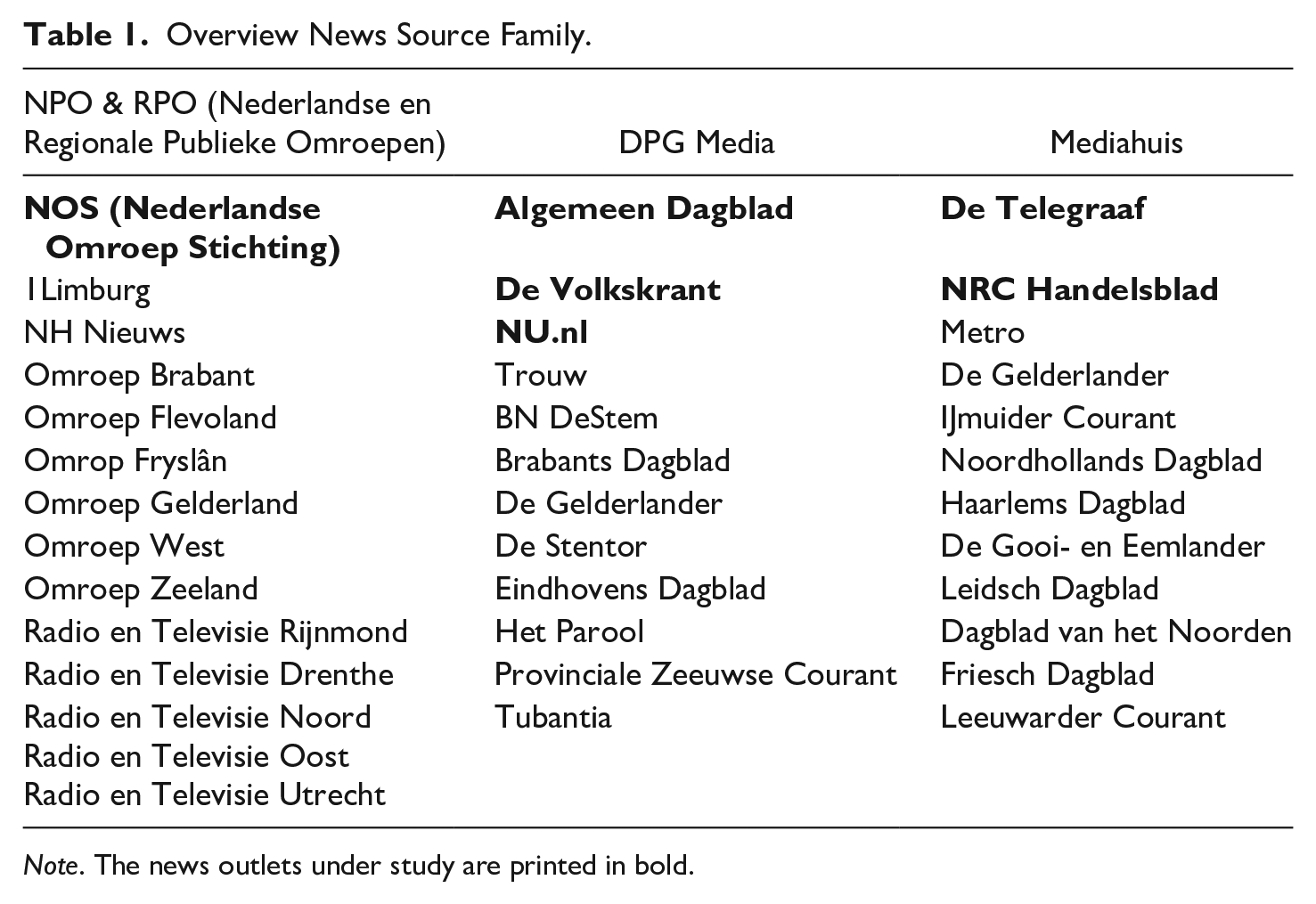
Note. The news outlets under study are printed in bold.
External Hyperlinking
External hyperlinking was the count of links referring to a website outside of the own website and “family.”
Document Hyperlinking
Document hyperlinks were detected by assessing whether the word “document” or any common file type extension appeared in the link (e.g., .pdf, .docx, .txt, et cetera).
Textual Sourcing
First, we examined whether sentences contained a source at all via a Large Language Model (LLM) prompt. LLMs are trained on vast amounts of text and can solve annotation tasks (Liu et al., 2023). We used the LLM google/flan-t5-xl (see Chung et al., 2022) as it can be stored locally; thereby, making it reproducible. We prompted the following: Does the text provide any form of sourcing? 5 This was asked about a randomly selected sentence of all sampled articles until each class (absent & present) contained 1,000 cases. 6 These 2,000 hits were verified by manual annotation performed by the first author. For the full codebook see the Sourcing presence codebook in the Appendix. The LLM “pre-selected” the annotated sentences to ensure that classes were equally represented (nabsent = 1051, npresent = 949).
Second, the manual annotations were used to fine-tune a transformer model by supplementing it with annotated data. We used the pdelobelle/robbert-v2-dutch-base model for this (see Delobelle et al., 2020). These 2,000 annotated sentences are commonly enough to fine-tune a model (Van Atteveldt et al., 2022). The training of the transformer model boosted performance compared to the LLM prediction (absent: F1 = .83, present: F1 = .81), producing even better performance metrics (absent: F1 = .96, present: F1 = .95; see Table 8 in the Appendix). The model was consequently used to predict source presence on the sentence level.
Third, for the predicted sentences containing sourcing, 2,000 sentences were further manually analyzed, asking the question: Which type of sourcing does the text provide? Based partly on the descriptions of named and unnamed sources by Carlson (2010), the answer categories were the following: Sources that are not identifiable (anonymous), partly identifiable (opaque) or fully identifiable (explicit). Since the transformer model was not always precise, it could also be that—contrary to prediction—no sources were present (absent). See the Sourcing category codebook in the Appendix.
Fourth, the annotated sentences were again used to fine-tune a transformer model. Three datasets were used to train the model: (a) The sentences without sources present (absent) from the first manual annotation round, (b) the sentences of the second manual annotation round, and (c) given low presence, anonymous sources detected by a regular expression. This expression examined whether the abstract sourcing terms “insider(s),” “anonymous(ly),” or “source(s)” were used in a sentence (see Table 9 in the Appendix). The detected anonymous sources were manually verified. The model was able to classify the sourcing categories well (absent: F1 = .89, anonymous: F1 = .99, opaque: F1 = .76, explicit: F1 = .86). The model was then used to predict the type of sourcing in all the sentences that contained sourcing.
Finally, considering that opaque and anonymous sources can become explicit in other sentences, classification was collapsed to the highest transparency tier at the article level: Explicit if at least one sentence was explicit, opaque if there were only opaque sources, anonymous if there were only anonymous sources, and absent if the article lacked sources. All steps taken can be found in Figure 2.
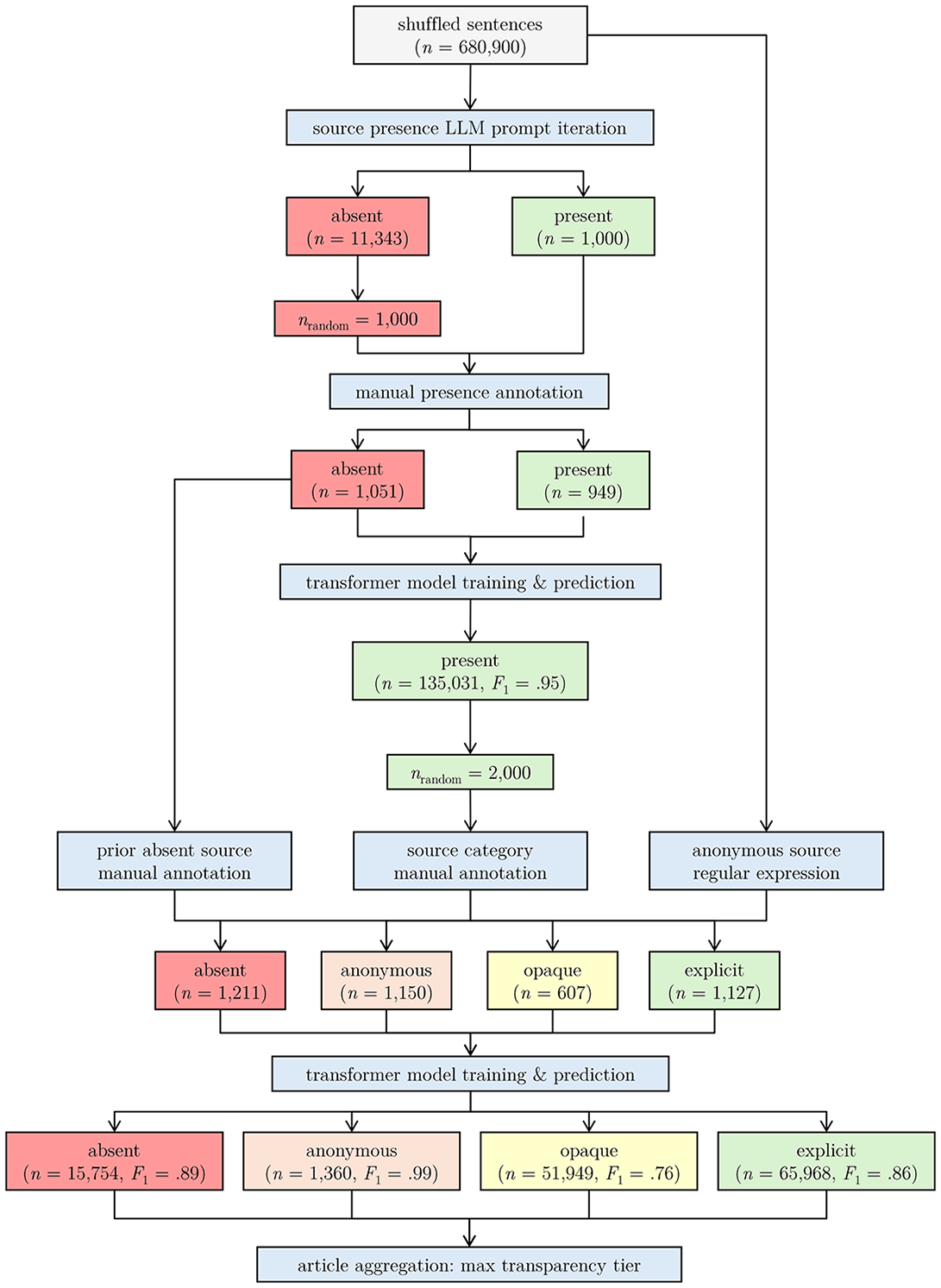
Textual Sourcing Detection Flowchart.
Production Features
To retrieve process information, we took a four-step approach. First, “self-reference sentences” were extracted from articles. We assume that to release process information, an outlet or journalist must refer to itself. Self-referential sentences included those mentioning (a) “we,” “us,” “our,” “I,” “me,” “my,” or “mine” outside of quotes and opinion pieces; (b) their outlet name; or (c) individual author names of the article. This led to the inclusion of 9,405 sentences.
Second, a balanced random sample based on outlet amount was manually annotated (n = 2,000) for having process information (yes or no). Drawing on the descriptions of Chadha and Koliska (2014), Karlsson and Clerwall (2018), and Kovach and Rosenstiel (2001), we used the following question: Does the text give any insight into when, why, how, or against which standards the article was created? Examples include disclosing information about the origin, selection process, internal standards, motives, decisions, source gathering and production processes behind the news. The full codebook, including examples, is in the Appendix (see the Process information codebook).
Third, once again the transformer pdelobelle/robbert-v2-dutch-base model was fine-tuned. 7 The model reached a good performance in both classes compared to the manually annotated data (no: F1 = .79, yes: F1 = .94; see Table 8 in the Appendix).
Finally, we predicted the presence of process information among all self-referential sentences. Consequently, the number of hits was divided by the entire number of sentences of an article (thus, including non-self-referential sentences.) This produces a
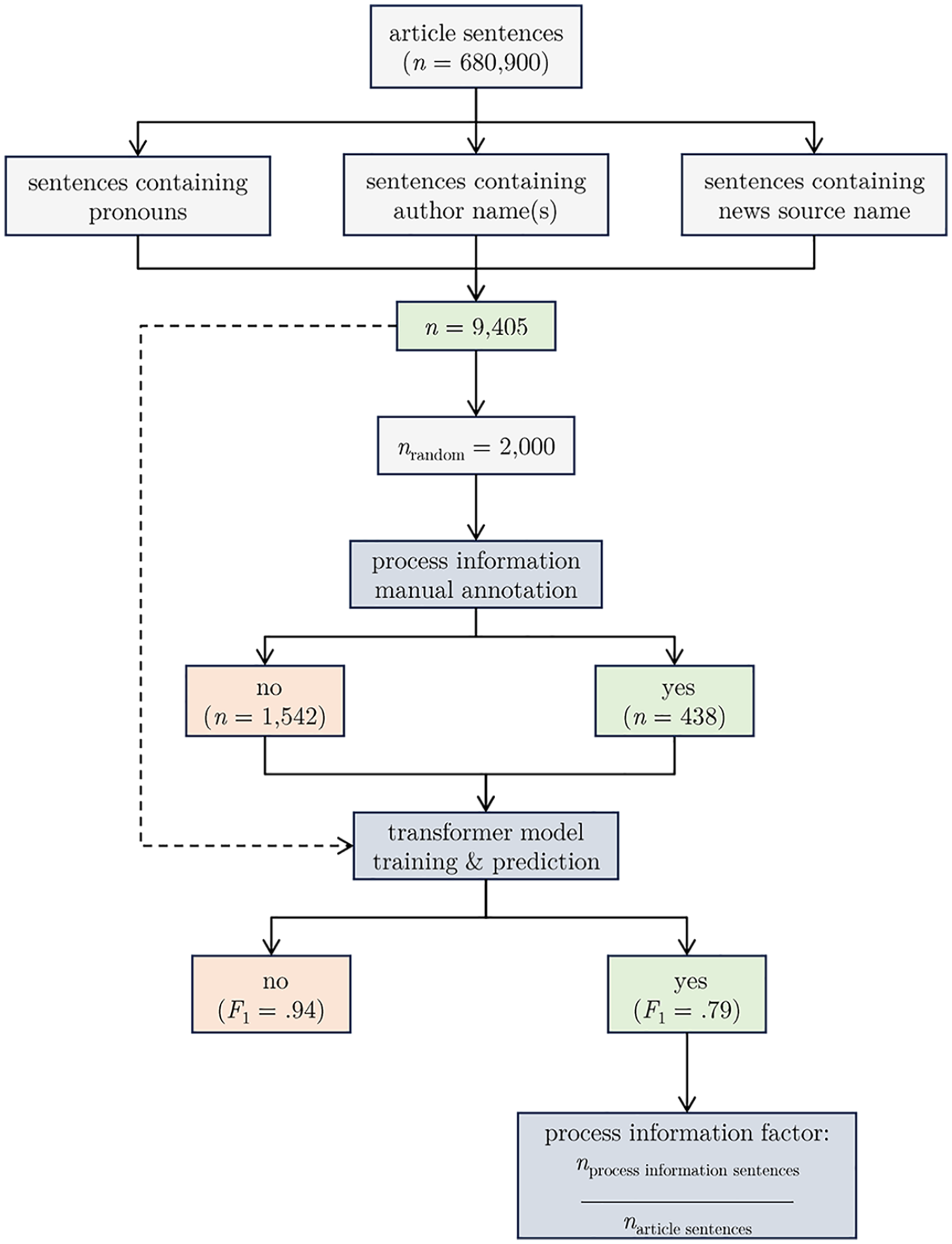
Process Information Detection Flowchart.
Indices & Scales
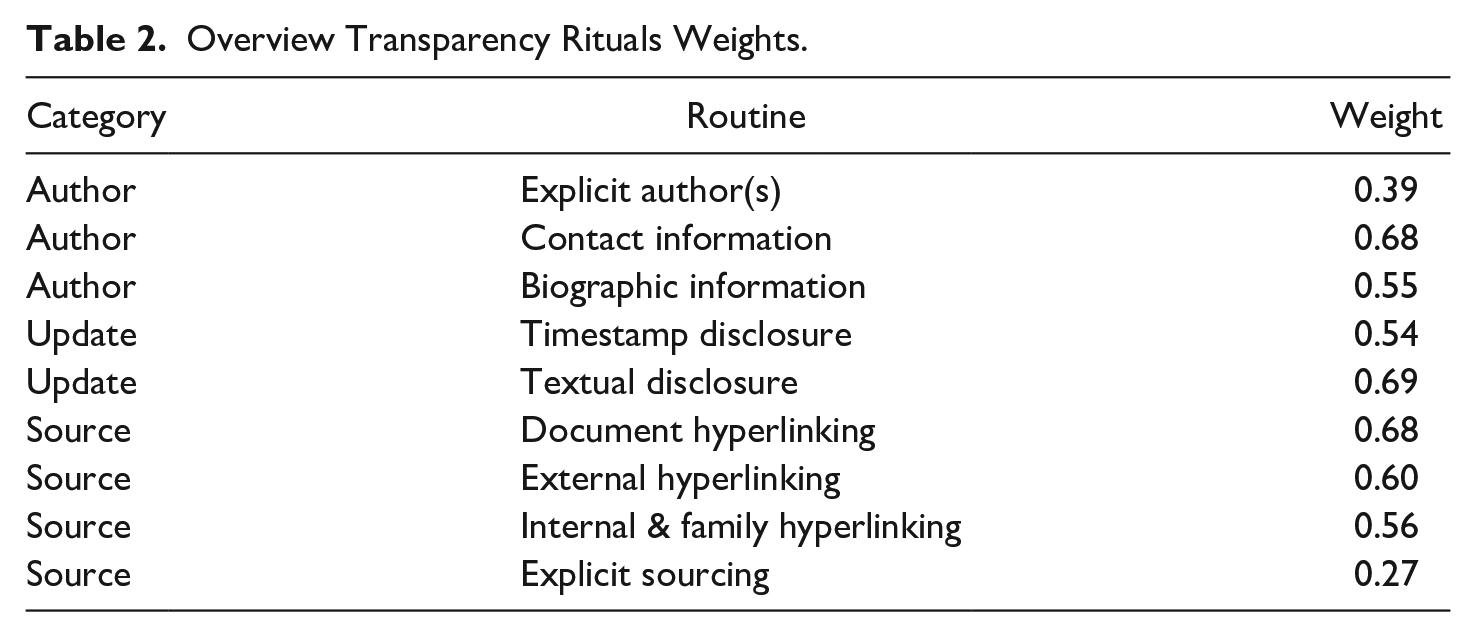
To analyze the impact of the category author, update and source transparency, weighted transparency indices were calculated. The proportional score of the presence of a transparency routine over the entire sample was subtracted from 2, and taking the logarithm of this score to produce (roughly) normally distributed weights, log(2 − pd=1). 8 The weights therefore now range between 0 and 1. By weighing we distinguish more common and thus, likely peripheral routines, from rare and thus, presumably costly routines. This theoretical distinction is often made in journalistic transparency literature (Chadha & Koliska, 2014). For an overview, see Table 2.
Overview Transparency Rituals Weights.
Consequently, the transparency routine dummies


Finally, for production transparency, a
Analytical Strategy
Pairwise independent samples t-tests are used to compare mean indices and scales between outlets. Adjusted p-values are presented in concordance with the strict Bonferroni correction: p-values have been multiplied by 15 since for each transparency category, 15 t-tests have been run, C(6, 2) = 15.
To test the effect of hard (vs. soft) news items on the (weighted) transparency indices and scale (yij), a multilevel model is run in which news items are clustered among outlets. The intercept is broken down into a fixed part (γ00), the constant between all news items, and a random part between outlets (u0j), given that the (weighted) transparency indices and scales vary between outlets. Likewise, the effect of hard (vs. soft) news is broken down into a fixed (γ10x1ij) and random part (u1jx1ij), as the effect may vary between outlets. By factoring in the intercept and effect variance, the effect of hard (vs. soft) news can be better isolated from the other factors in the model:

Results
Author Transparency Analysis
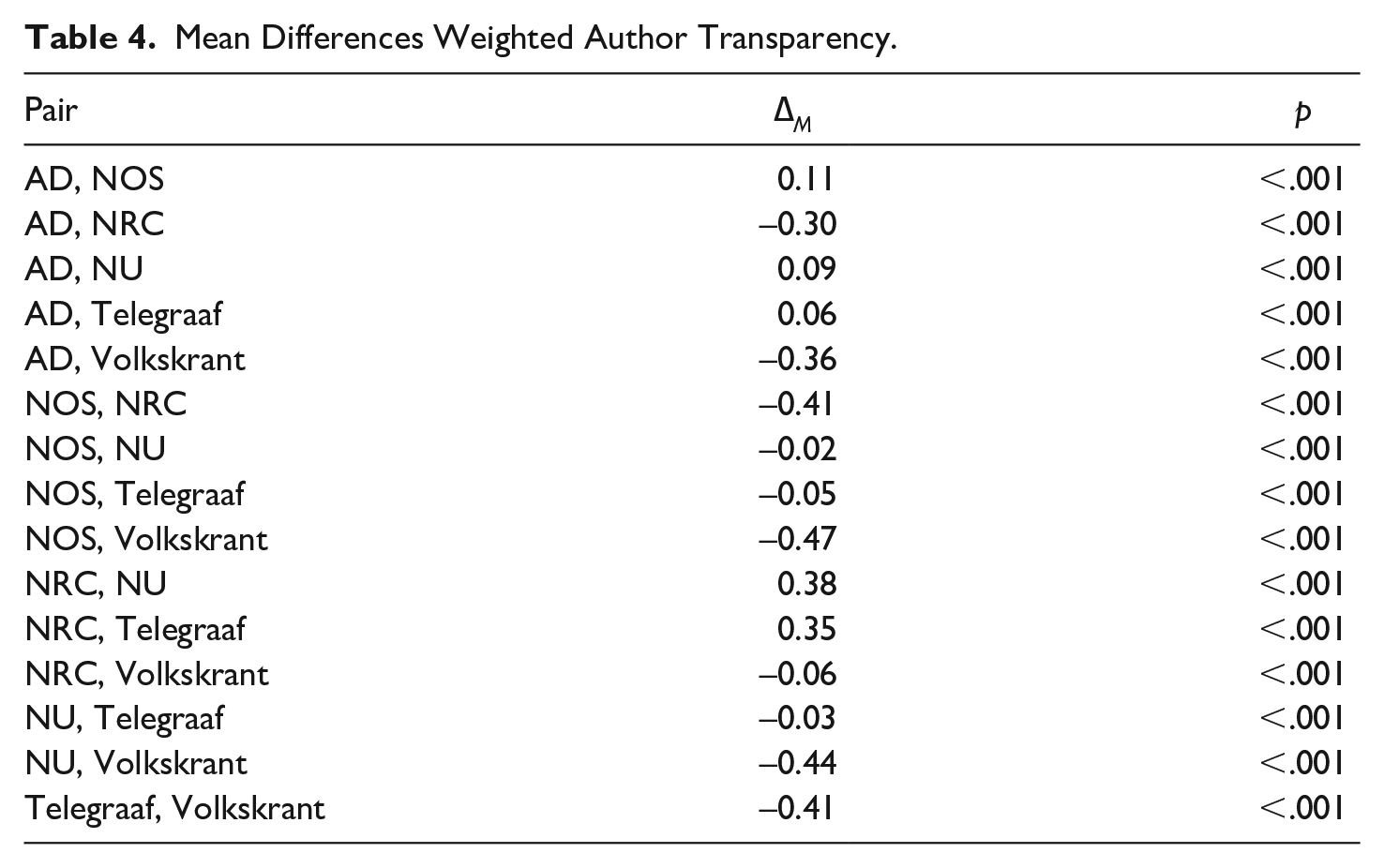
Against the expectations of Hypothesis 1a and 2a, digital-native outlet NU.nl (M = .08, SD = .12) and public outlet NOS (M = .06, SD = .17) have the lowest author transparency indices on average. In line with Hypothesis 3a, the quality outlets Volkskrant (M = .52, SD = .18) and NRC (M = .46, SD = .23) have higher mean transparency indices than the popular outlets Telegraaf (M = .11, SD = .13) and AD (M = .17, SD = .15). All mean differences at the outlet level are significant as shown in Figure 4. Regarding Hypothesis 4a we did not find an effect of hard (vs.) soft news on author transparency across outlets (β = −.018, p = .367, CI [−.018, .050]).
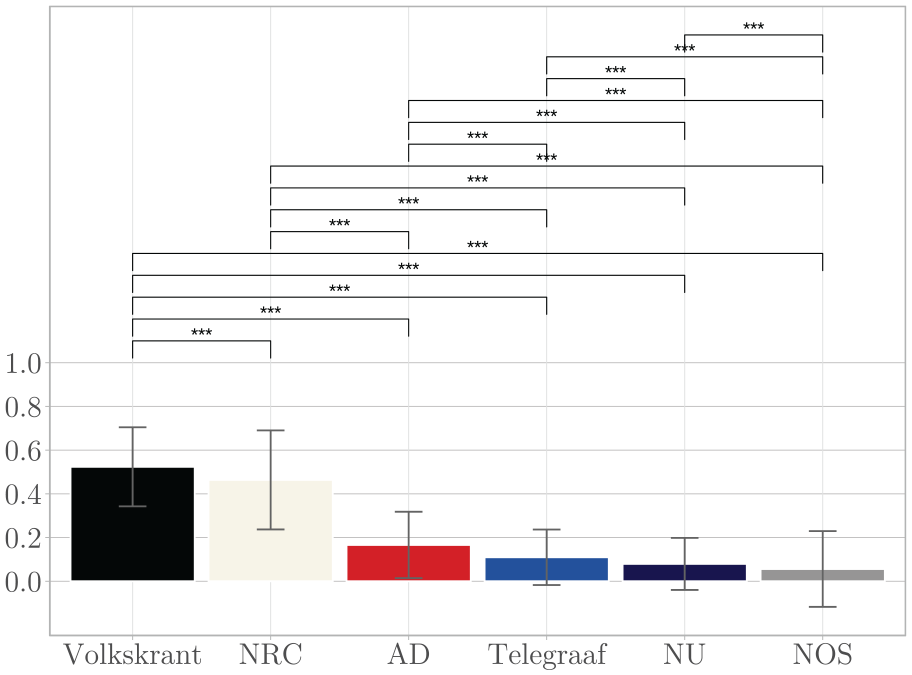
Mean Author Transparency Index Per Outlet.
Quality outlets Volkskrant and NRC score relatively high on the author transparency indices; this is especially evident in the explicit mentioning of author names (% Volkskrant = 89.59, % NRC = 73.91), see Figure 5. In other words, quality outlets most frequently give the first and last names of authors in the byline. The public outlet NOS, with the lowest index, does this the least out of all outlets (10.70%).
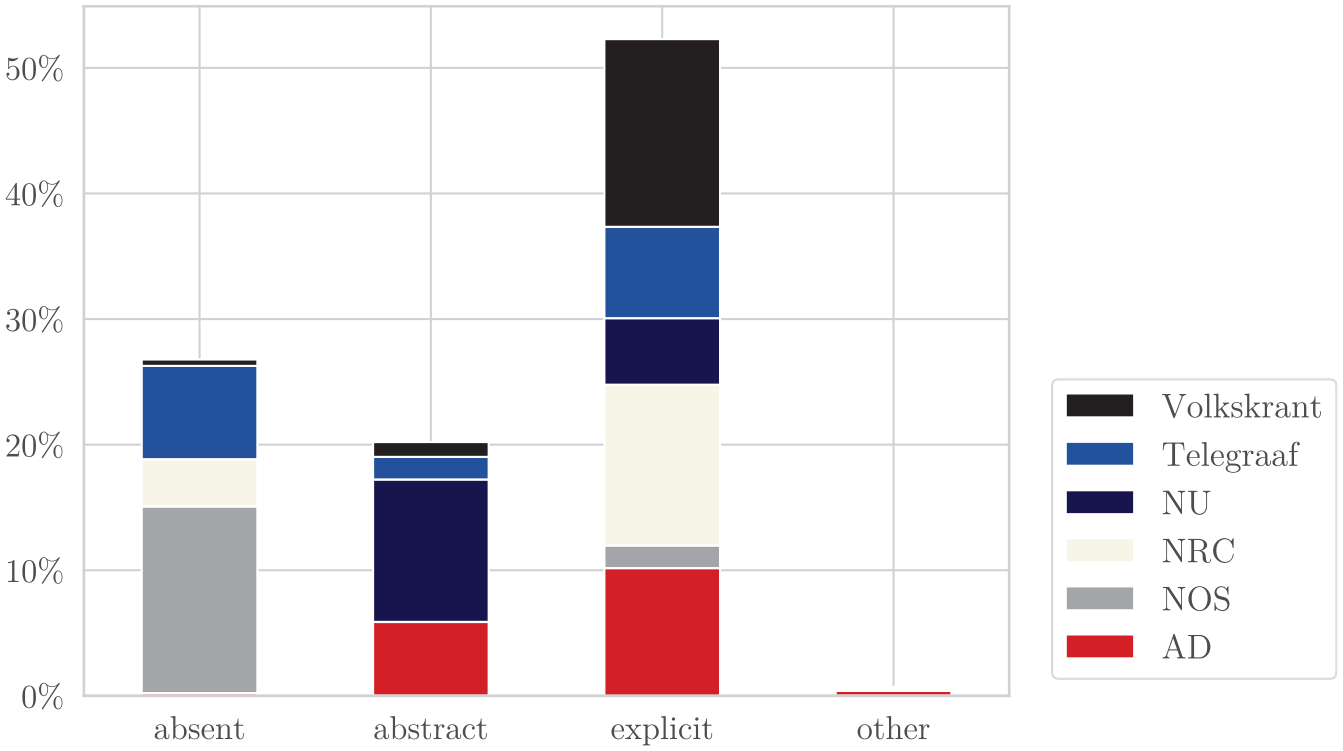
Author Transparency Class Per Outlet.
In contrast, the public outlet delivers contact information in 7.13% of all its articles, the highest percentage out of all outlets (% AD = 4.45, % NOS = 7.13, % NRC = 6.53, % NU = 0.53, % Telegraaf = 1.00, % Volkskrant = 0.75). This contradicts the relatively low percentage of providing explicit author names. Put differently, in the rare case in which the NOS provides an explicit author name, it is often complimented with contact information (ρPearson = .79). As for providing biographic information, solely the high-ranked quality news outlets do so and do so for most of their articles (% NRC = 73.91, % Volkskrant = 89.59).
Update Transparency Analysis
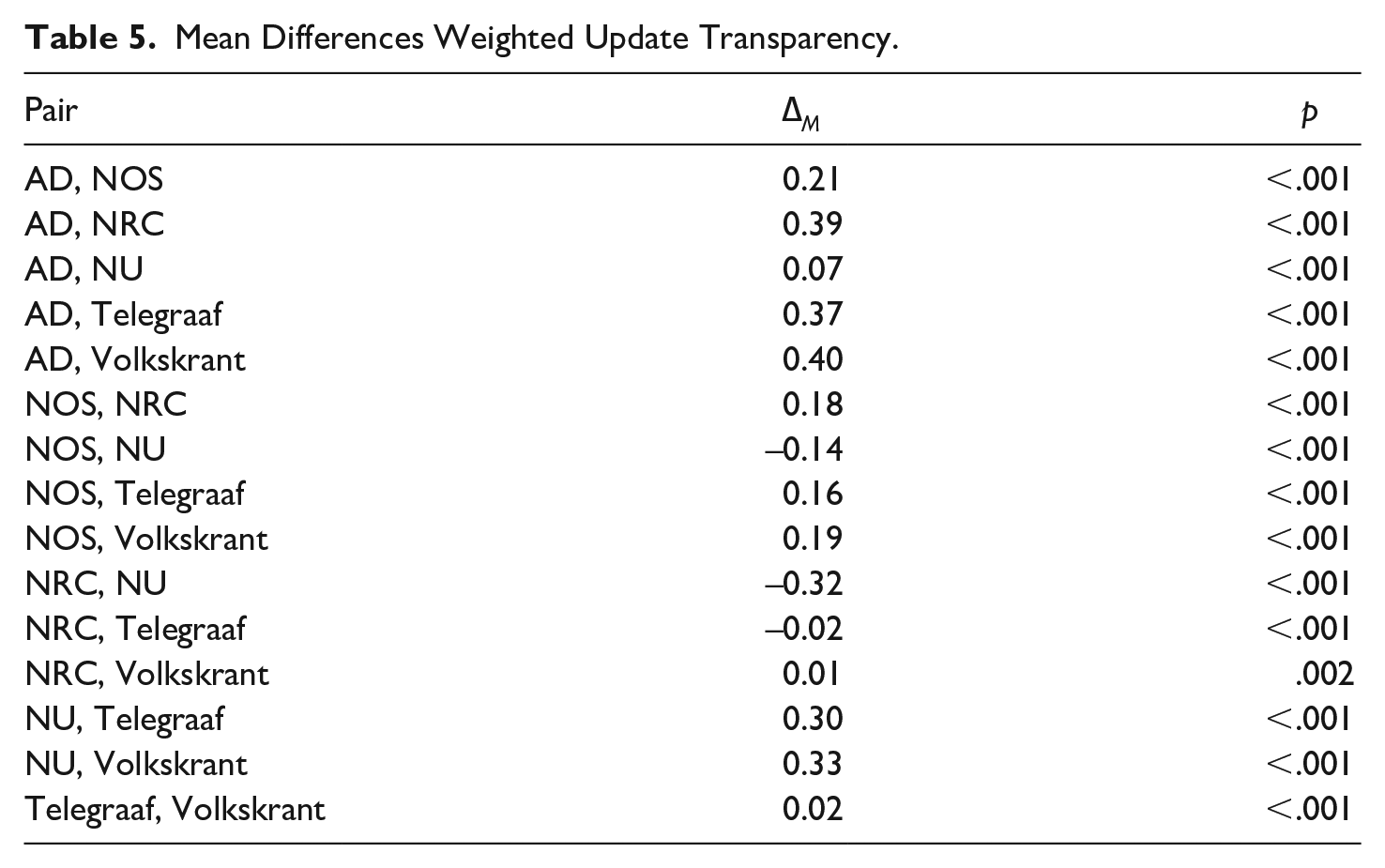
Excluding the unchanged items, in line with Hypothesis 1b and 2b, the digital-native outlet NU.nl (M = .34, SD = .19) and public outlet NOS (M = .20, SD = .22) score the second and third highest update transparency indices on average (see Figure 6). Contrary to Hypothesis 3b, quality outlets NRC (M = .02, SD = .10) and Volkskrant (M = .01, SD = .07) have the lowest average update transparency indices. Whereas popular outlet AD (M = .41, SD = .12) has the highest mean update transparency index, Telegraaf (M = .03, SD = .12) has one of the lowest. Regarding Hypothesis 4b, we did not find an effect of hard (vs.) soft news on update transparency across outlets (β = .007, p = .650, CI [−.025, .040]).
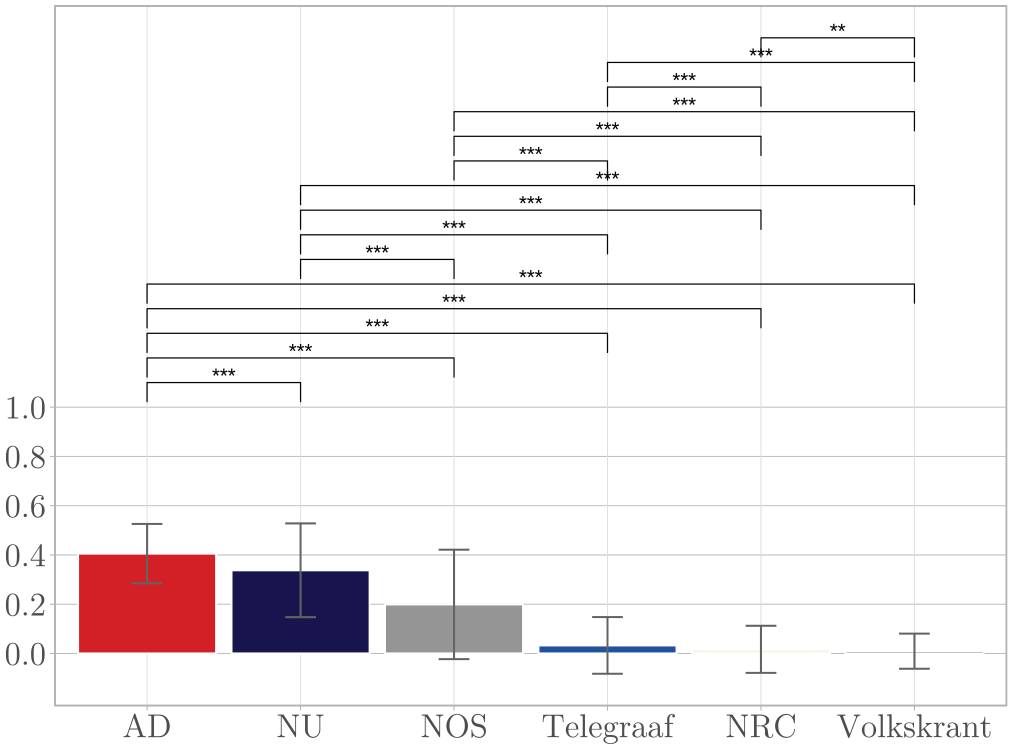
Mean Update Transparency Index Per Outlet.
Still, the high mean transparency indices of popular outlet AD, digital-native outlet NU, and public outlet NOS are mostly due to disclosing updates via timestamps, the more peripheral route (% AD = 63.91, % NOS = 23.38, % NU = 75.84, % Telegraaf = 7.44), see Figure 7. In the few cases that the low-ranked quality outlets Volkskrant and NRC reveal an update, they do so relatively most often via textual revelation (% NRC = 2.99, % Volkskrant = 0.93, % AD = 0.13, % NOS = 0.18, % NU = 0.44, % Telegraaf = 0.00).
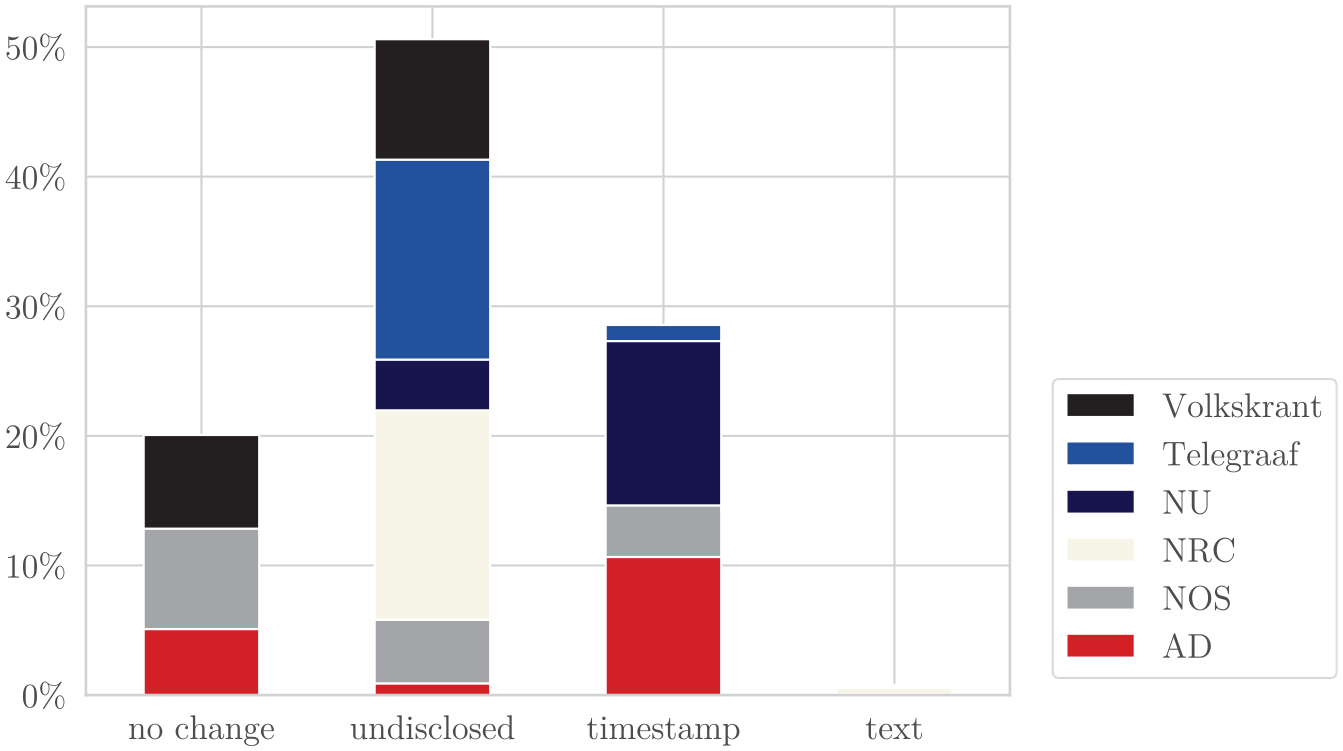
Update Transparency Class Per Outlet.
Source Transparency Analysis
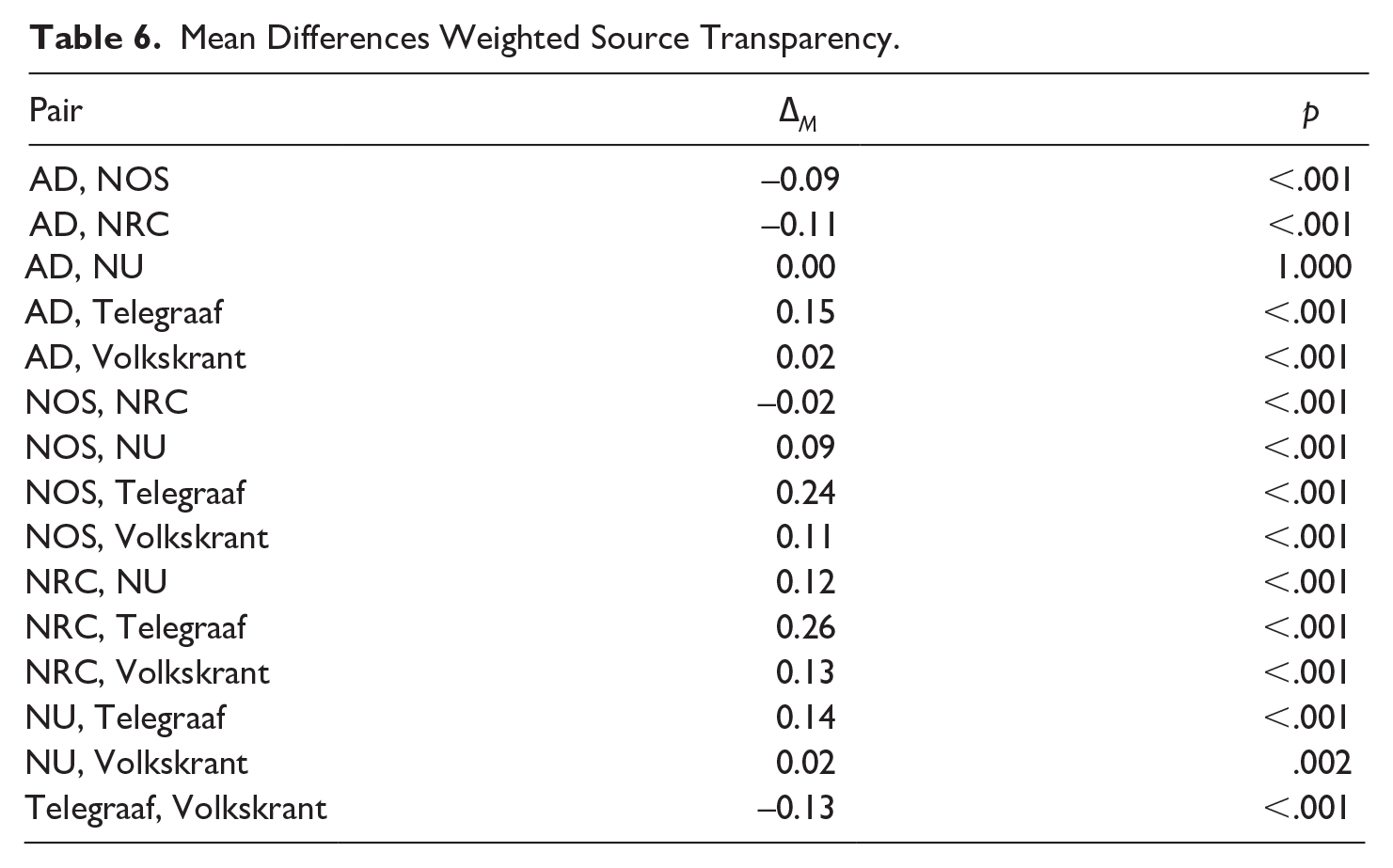
Although with small margins, contrary to Hypothesis 1c, digital native outlet NU ranks fourth in mean source transparency index (M = .20, SD = .18), see Figure 8. In line with Hypothesis 2c, public outlet NOS (M = .30, SD = .22) scores among the highest mean source transparency indices. As for Hypothesis 3c, quality outlet NRC has the highest mean source transparency index (M = .32, SD = .24). Yet, fellow quality outlet Volkskrant has the second lowest index (M = .19, SD = .19), falling between popularity outlets AD (M = .18, SD = .17) and Telegraaf (M = .08, SD = .10). In line with Hypothesis 4c, there is an effect of hard (vs.) soft news on source transparency across outlets (β = .080, p = .003, CI [.027, .132]).
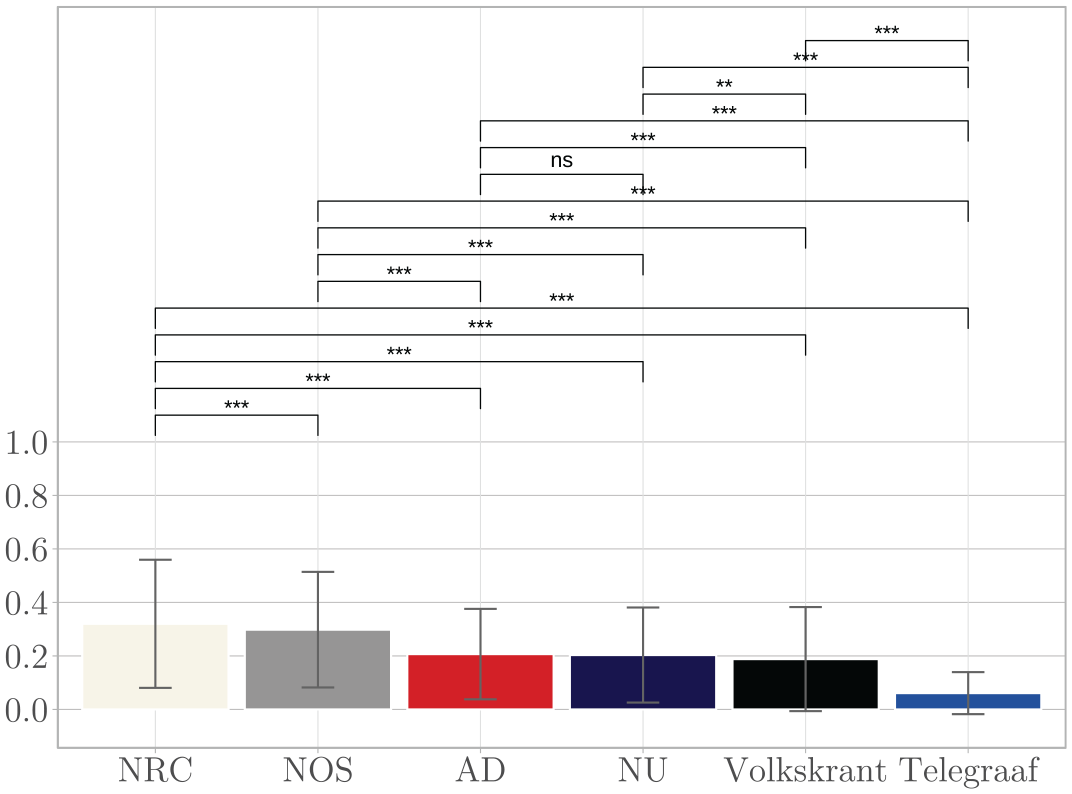
Mean Source Transparency Index Per Outlet.
The high mean transparency indices of quality outlet NRC and public outlet NOS is partly due to the highest presence of external hyperlinks in articles (% NRC = 40.48, % NOS = 21.86), see Figure 9. The NOS, then again, also uses the more peripheral internal hyperlinks (41.28%) and family hyperlinks (11.09%) most often. Linking to documents is a rarity, but again NRC and NOS score highest in this regard (% NRC = 5.91, % NOS = 2.41), complemented by fellow quality outlet Volkskrant (2.48%). Also, in terms of source use in text, NRC and NOS articles most often include an explicit source (% NRC = 81.86, % NOS = 77.02). The low source transparency of popular outlet Telegraaf is striking: It scores lowest on almost every indicator, whereas on the use of anonymous sources they score highest (2.02%).
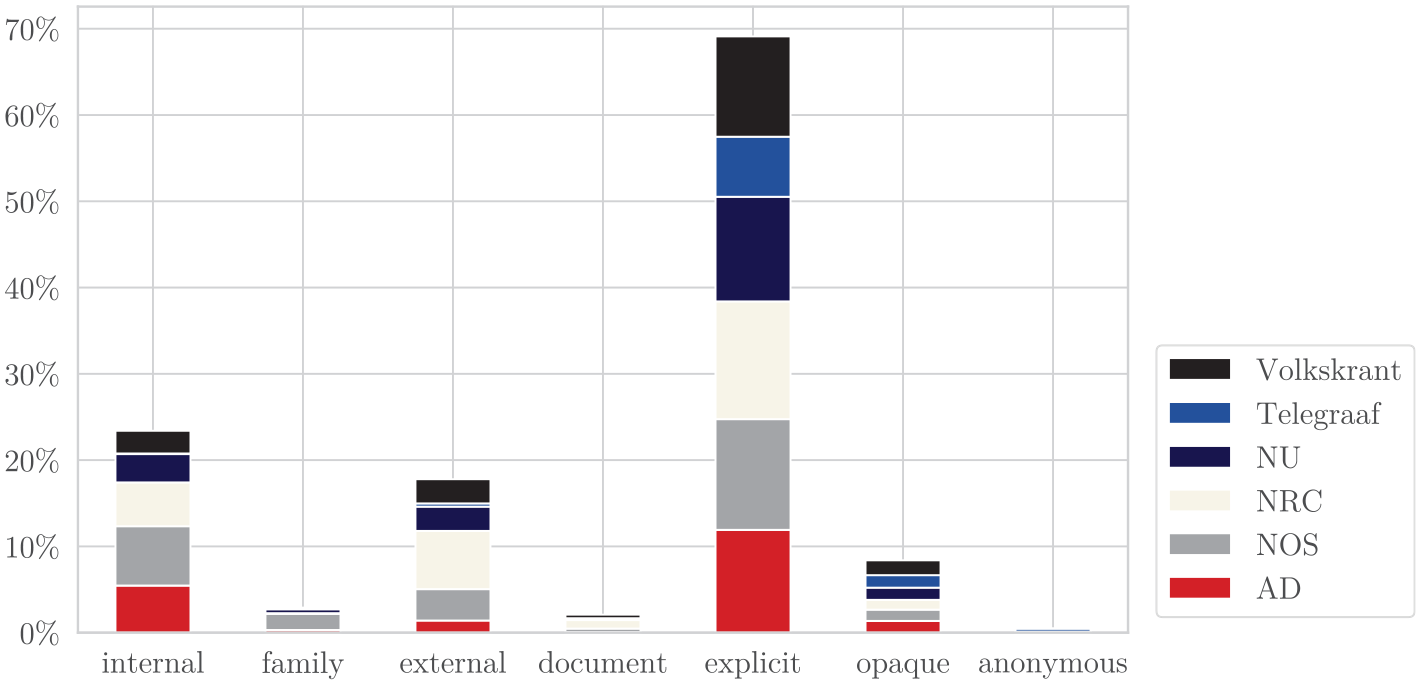
Source Transparency Class Per Outlet.
Production Transparency Analysis
Also concerning production transparency, in line with Hypothesis 1d, digital-native outlet NU.nl has one of the highest scores (M = .010, SD = .047), see Figure 10. In contrast, as for Hypothesis 2d, the public outlet NOS has the lowest average process transparency scale (M = .002, SD = .018). Again, regarding Hypothesis 3d, the quality outlets show a divergent pattern: NRC has the highest average process transparency scale (M = .015, SD = .052), while Volkskrant (M = .002, SD = .022) scores similar to popularity outlets AD (M = .004, SD = .032) and Telegraaf (M = .004, SD = .038). As for Hypothesis 4d, we did not find evidence of a hard (vs.) soft news on the process transparency scale (β = .026, p = .265, CI [−.020, .073]).
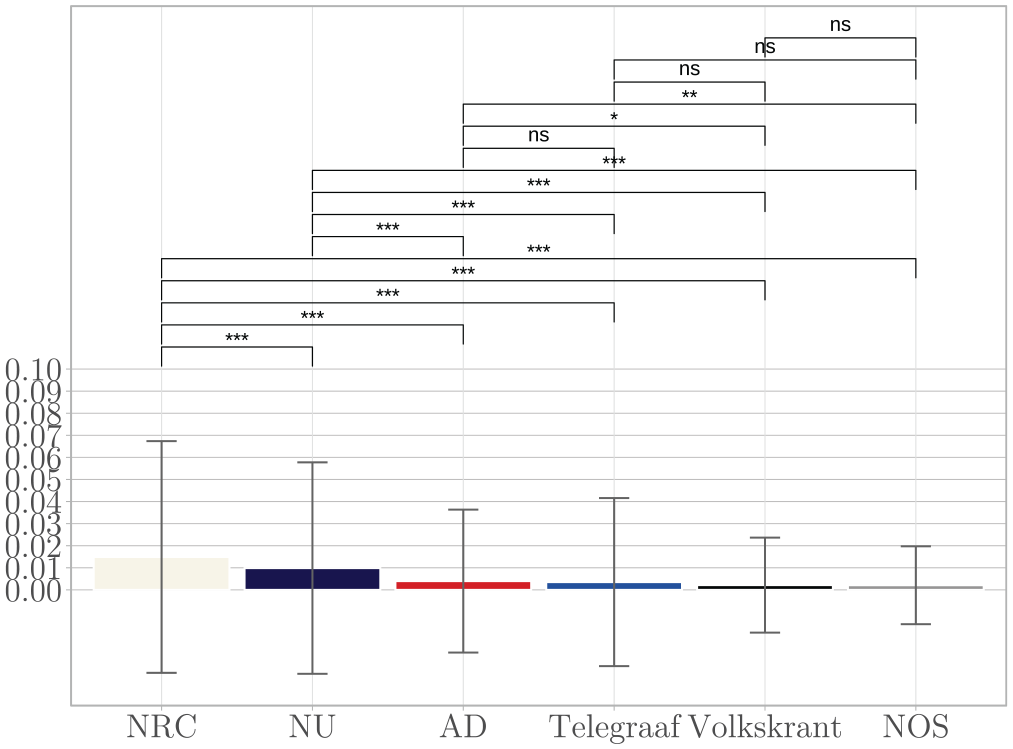
Mean Process Transparency Scale Per Outlet.
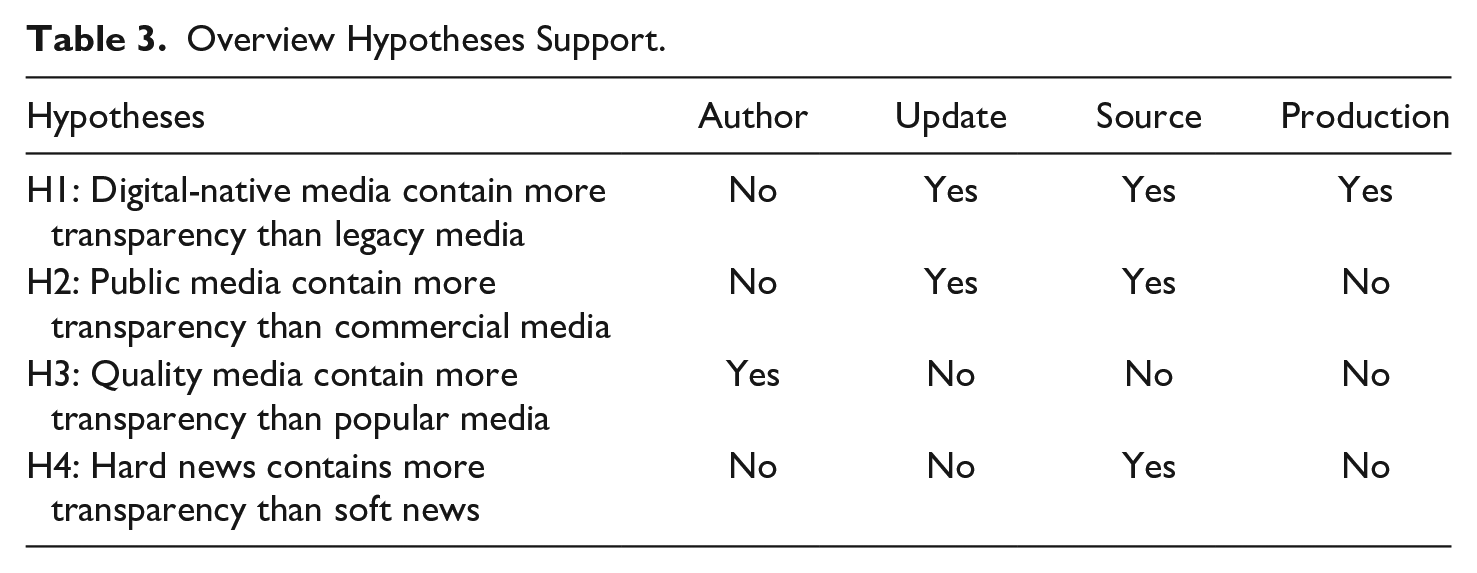
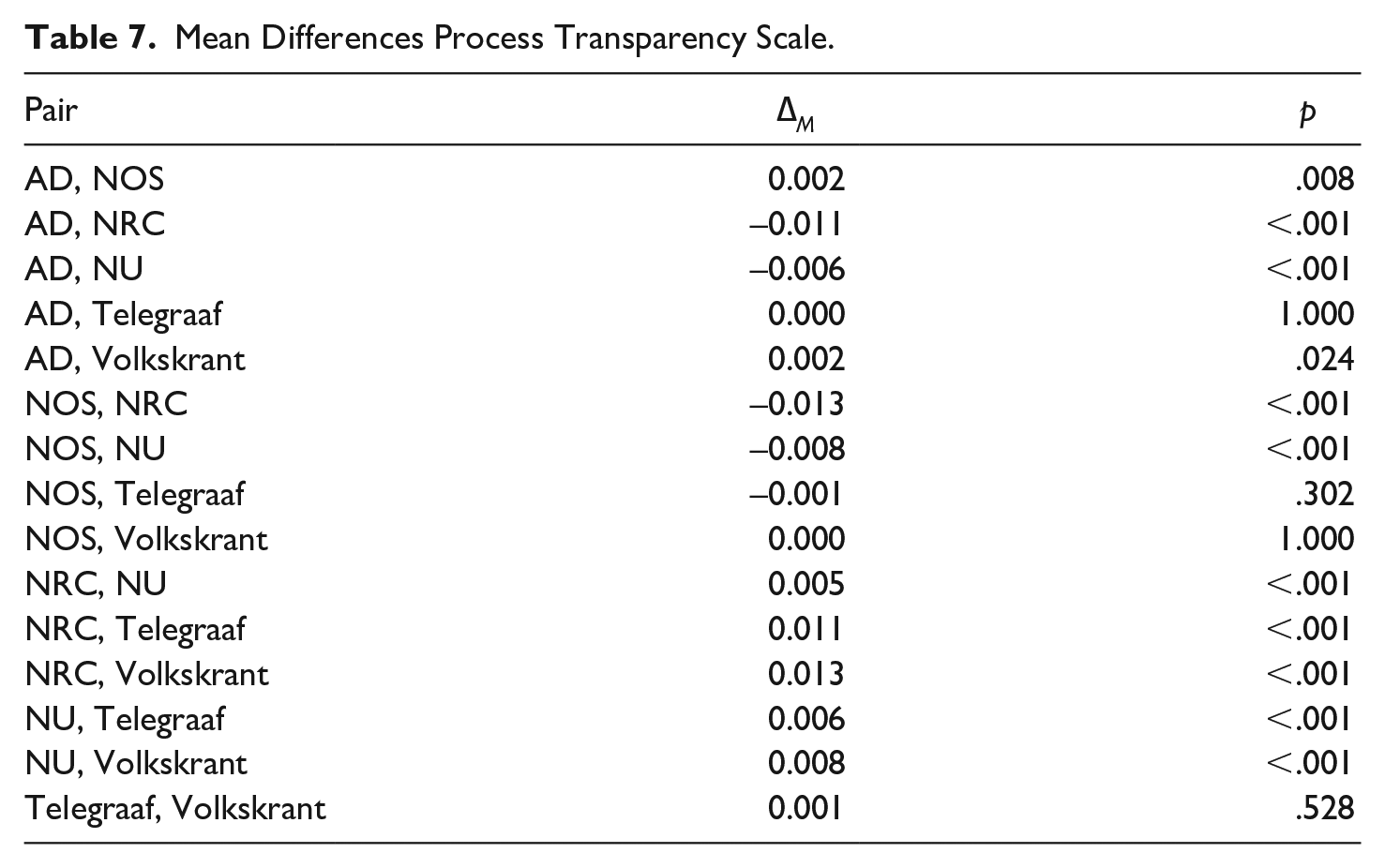
See Table 3 for an overview of the support of all hypotheses across author, update, source and production transparency. See Tables 4, 5, 6 and 7 for the mean differences for the indices and scale between each outlet combination.
Overview Hypotheses Support.
Mean Differences Weighted Author Transparency.
Mean Differences Weighted Update Transparency.
Mean Differences Weighted Source Transparency.
Mean Differences Process Transparency Scale.
Discussion
Given the increasing embrace of transparency in journalism as a means of building trust (Karlsson, 2020), we studied how six Dutch news outlets implemented transparency. Altogether, every news outlet tried to implement transparency in some way in the categories studied. However, through which routines and to what extent this was done differed from outlet to outlet.
First, the only digital-native outlet was more transparent than legacy news outlets, except for author transparency. This relatively high degree of transparency of the digital-native outlet can be explained, in part, by the need to distinguish oneself with the use of digital features (Humprecht & Esser, 2016; Kashyap et al., 2022). Indeed, in terms of update transparency, the digital news outlet NU stands out by using update timestamps most often. However, for virtually every hyperlink routine, NU is among those who use them least. Possibly the digital news outlet’s transparency is driven not so much by drawing from digital capabilities, but more by having a different value structure in which transparency is more central compared to the legacy news outlets. That legacy news outlets are leaders in hyperlinking may suggest that the analog workflow does not persist as dominantly on their digital platforms as much as previously assumed (Buschow, 2020). As for author transparency, it is a familiar pattern that digital-native outlets fall short in this regard (Carlson, 2010). Possibly digitization processes have called into question the definition of what constitutes a journalist and thus to whom freedom of the press belonged. Given the debate about whether this new generation was entitled to the same legal protections (Oster, 2013), author anonymity was, perhaps, at first, preferred. This behavior may have persisted.
Second, the public news outlet is more transparent than commercial news outlets in terms of updates and source use but is the least transparent in terms of authors and production processes. It was hypothesized that the public news outlet NOS would implement more transparency given that financial pressure is less of a consideration due to receiving state funding (Humprecht & Esser, 2016). This does not rule out the possibility that the NOS may well experience time pressure. Indeed, even in the areas where NOS is transparent, there seems to be a preference for less time-consuming transparency routines: The more superficial display of updates via timestamps rather than textual disclosures and hyperlinking the more easily retrievable internal and family hyperlinks rather than the more traceable external hyperlinks. That some commercial news outlets sometimes operate more transparently than NOS may demonstrate that they are less affected by short-term financial incentives than assumed. Thus, they might also pin their hopes on the future return of audiences by restoring trust through transparency. The low transparency of NOS in authors may be due to balancing it with their safety. Namely, during the pandemic, journalists of NOS experienced much harassment (NOS, 2020). Yet, this can potentially set in motion an undesirable cycle: Author anonymity does not allow the public to judge authors’ independence (Koliska & Chadha, 2018), fueling distrust and thereby, possibly the incidence of attacks.
Third, both quality news outlets are more transparent about their authors than the popular news outlets. For update transparency, the quality news outlets score lowest, while for source and production transparency, the quality news outlets show opposing findings: Whereas NRC is among the most transparent in these areas, Volkskrant is among the least. This inconsistency might be explained by further distinguishing the profiles of both outlets: Looking at how much hard news (vs. soft news) the outlets produce, the quality news outlets record the highest percentages, but NRC still produces substantially more hard than soft news compared to Volkskrant (∆% = 11.79). That no unequivocal conclusion can be drawn about the degree of transparency implementation of quality vs. popular news outlets may prove the tabloidization process in which the standards between quality and popular news outlets are blurring (Esser, 1999). At a more refined level, systematic differences do emerge: If transparent, quality news outlets tend to choose more informative routines compared to popular news outlets, such as providing authors their biographical and contact info and textual update disclosures.
Within outlets, only source use is systematically more transparent in hard news sections than in soft news sections. Again, the lack of systematic differences in transparency between hard and soft news sections signals a tabloidization process: Standards blur not only between but also within outlets, namely between hard and soft news sections. That hard-news sections are systematically more transparent about source use than soft-news sections may be due to the more human-interest orientation of soft-news, where sources are less pivotal compared to the more factual hard-news (Reinemann et al., 2012).
As one of the few generic content analyses into transparency routines, this study contributed to our understanding of how different outlets implement transparency. That outlets differ in the implementation of transparency, suggests that, in line with prior research (Humprecht & Esser, 2016), it stems from different value structures and policy choices between outlets. Given that the differences in transparency implementation between outlets do not always align with theoretical expectations, the question is raised to what extent they do align with the expectations of outlets’ own audiences. If these are not met, it can lead to disappointment among their audiences (Steindl et al., 2024), resulting in a decline of media trust. A linkage analysis—the pairing of survey and content analysis data (De Vreese et al., 2017)—could potentially reveal the extent to which audience expectations align with transparency implementation.
The implementation of transparency may also depend on the country context. As for Dutch news outlets, trust is relatively high compared to other countries (voor de Media, 2023). This may put less pressure on Dutch news outlets to make their current practices more transparent. Yet, as the Netherlands has many news outlets (Hallin & Mancini, 2004), this high degree of competition may contribute to the need to distinguish oneself through being more transparent than one’s competitors. Future research is needed to explore whether the transparency implementation patterns found in this study generalize, among others, for countries with other degrees of media trust and competition.
Footnotes
Appendix
Examples of sources are . . .
Examples of sources are . . .
Examples are providing explanations of . . .
Note: The role of the media company and or its workers must be proactively disclosed. For instance, whereas simply stating which sources are used does not constitute process information, indicating how sources were contacted by the media company and or its workers and/or why sources were used does.
Declaration of Conflicting Interests
The author(s) declared no potential conflicts of interest with respect to the research, authorship, and/or publication of this article.
Funding
The author(s) disclosed receipt of the following financial support for the research, authorship, and/or publication of this article: This work used the Dutch national e-infrastructure with the support of the SURF Cooperative using grant no. EINF-7673. This work was supported by the Dutch Research Council (NWO) with a Vidi grant under project number: VI.Vidi.211.101.
