



Abstract
In this study, we examine gender differences in political news coverage to determine whether the media employ stereotypical traits in portrayals of 1,095 U.S. politicians. Using a sample of over 5 million U.S. news stories published from 2010 to 2020, we study the media’s attribution of gender-linked (feminine, masculine) and political (leadership, competence, integrity, empathy) traits to U.S. politicians and present new longitudinal evidence for political gender stereotyping in the news. Our findings show that certain gender differences are present in news coverage (e.g., physical traits), some of which have remained unchanged over the past decade (e.g., integrity traits).
Keywords
Numerous studies have found that the media depict political candidates in terms of firmly established gender stereotypes. 1 For instance, female and male politicians are portrayed using traits based on their respective gender roles in society (e.g., Kahn, 1994; Kittilson & Fridkin, 2008). Mass media affect citizens’ perceptions of candidates’ traits (e.g., Eberl et al., 2017) and influence voter decision-making (e.g., Aaldering et al., 2018). Considering such effects of the media on citizens and the fact that politics is dominated by males and favors masculine traits (Koenig et al., 2011), gender stereotypes in news coverage can hurt women’s electoral chances and hinder female politicians from excelling in leadership positions, contributing to the underrepresentation of women in politics.
Despite existing evidence of political gender stereotyping in the media, some scholars suggest that women in modern American politics may be less affected by stereotypes due to recent shifts in women’s roles in society generally and in the political sphere particularly (Hayes & Lawless, 2015). Women’s general labor force participation rates have continuously increased since the middle of the past century (U.S. Department of Labor, Bureau of Labor Statistics, 2021). In addition, women have made remarkable progress in participating in the U.S. government in recent years. The number of female politicians serving in the U.S. Congress has increased by 50% in the current assembly compared with that of a decade ago (Pew Research Center, 2021b). In the 2020 U.S. presidential election, a record number of women ran for president, one of whom became the first female vice president in U.S. history.
These transformations in occupational roles, specifically the increasing number of women holding political positions, may change how female politicians are described in mass media and ultimately, how people perceive women in politics. Studies in social psychology consistently show that gender stereotypes about women, in general, have changed over the last century, with women becoming more strongly linked to masculinity (e.g., Diekman & Eagly, 2000; Donnelly & Twenge, 2017). Despite this insight, there has been little research on over-time changes in the media’s attributions of stereotypical traits to female and male politicians. Therefore, in this study, we introduce a longitudinal perspective on the current issue by analyzing the past 11 years (2010–2020) 2 of news portrayals of U.S. politicians by some of the major U.S. newspapers, magazines, and TV and radio broadcasting companies, with some outlets reaching an audience of about 25 million on average per week (Pew Research Center, 2021a). To measure gender associations in a large collection of journalistic texts, we employ an innovative and efficient computational method, namely neural word embeddings. This unsupervised machine-learning method captures the lexical meaning of words (Jurafsky & Martin, 2009) and is capable of accurately detecting subtle biases (Caliskan et al., 2017; Garg et al., 2018).
Media Coverage of Politicians’ Traits
Politicians’ traits have always been of great significance to politics. For instance, research shows that candidates’ traits affect citizens’ evaluations of politicians (Funk, 1999). As voters typically obtain political information from the media, news coverage of candidates’ personal qualities has been found to influence people’s perceptions of politicians and their electoral choices (Aaldering et al., 2018). Over time, political reporting has become strikingly personalized, meaning that more media attention is paid to political leaders and their leadership and personal traits that are irrelevant to their jobs (Langer, 2007). When coupled with political gender stereotypes, personalized news coverage can have harmful consequences. As politics is an overwhelmingly male-dominated field, with the highest positions of power almost exclusively held by men, the media may devote considerably more attention to male leaders than to female politicians. Moreover, if the media focus on candidates’ personal traits, the existing stereotype of women as unlikely and less capable political leaders can be reinforced. In this study, we focus on traits ascribed to candidates based on their gender, the most common measure of gender stereotypes (Hentschel et al., 2019). Investigating traits can be key to the public’s understanding of political gender stereotyping in general, as voters’ expectations about politicians’ policy expertise may be based on their perceptions of the candidates’ traits (Huddy & Terkildsen, 1993). Furthermore, stereotypical trait coverage of female politicians is found to be more harmful to female candidates than stereotypical coverage of their policy competencies (Bauer, 2020a).
Research distinguishes between two trait stereotypes: traits linked to expectations about women’s and men’s gender roles (gender-linked traits) and traits relevant to politicians’ careers (political traits; e.g., Schneider & Bos, 2014). According to social role theory, gender-linked traits stem from individuals’ observations of women and men in their family and occupational roles (Eagly, 1987). As women have traditionally been primary caregivers, they are typically viewed as more suited to fulfilling communal goals (e.g., willing to help others), whereas men, conventionally primary breadwinners, are expected to be more agentic (e.g., motivated to pursue a career; Eagly, 1987). Gender stereotypes do not only describe how women and men typically act but also dictate how they should act (Burgess & Borgida, 1999). Thus, gender stereotypes contribute to workplace sex discrimination by hindering women’s access to occupations typically associated with men (Burgess & Borgida, 1999). In addition, after entering a male-dominated occupation, women can experience disparate treatment if they fail to conform to gender stereotypes (Bornstein, 2016). As politics is dominated by men and favors masculinity (e.g., Rosenwasser & Dean, 1989), women may be discriminated against based on the mistaken belief that their qualities are incompatible with the traits needed for the job.
Scholars who study gender-differentiated political media coverage measure gender-linked stereotypes by analyzing associations between female and male politicians and feminine (e.g., compassionate, weak leader) and masculine (e.g., ambitious, aggressive) traits (Kahn & Goldenberg, 1991). Citizens consider masculine traits more important than feminine ones for holding public office (Rosenwasser & Dean, 1989) and perceive masculine candidates as more competent politicians (Huddy & Terkildsen, 1993). Research shows that political women face a double bind, a unique challenge where they are held to more stringent standards than their male counterparts (Bauer, 2020b; Eagly & Karau, 2002). On one hand, if female politicians exhibit gender-congruent traits, they are evaluated unfavorably on masculine traits, which in turn may reduce their chances to be elected or promoted to higher executive positions (Rosenwasser & Dean, 1989). On the other hand, if they emphasize their masculine traits, they are penalized for lacking femininity (Eagly & Karau, 2002).
According to Bauer (2015), voters do not automatically apply gender stereotypes to female candidates unless they are exposed to stereotypical campaign messages or media coverage. Studies analyzing the content of articles about candidates in specific newspapers (e.g., Meeks, 2013) and during specific types of elections (e.g., Kahn & Goldenberg, 1991) arrive at different conclusions. Previous evidence shows that female politicians are often described using stereotypical feminine qualities and that the media emphasize masculine traits when reporting on male politicians far more often than in the coverage of their female counterparts in various election types (e.g., Bjerre, 2018; Kahn, 1994; Kahn & Goldenberg, 1991; Kittilson & Fridkin, 2008). In addition, the media tend to focus on the personality traits and appearance of female candidates (e.g., Aday & Devitt, 2001; Heldman et al., 2005). In contrast, other studies find that female politicians are featured in the context of masculine traits more frequently than in terms of feminine traits (Zulli, 2019) and more often than their male colleagues (Meeks, 2012). However, women’s association with masculinity may result in more negative coverage and trigger skepticism toward women in politics for appearing too masculine (Meeks, 2012; Zulli, 2019). Finally, some evidence suggests that journalists may be less reliant on gender-linked stereotypes. For instance, in a content analysis of newspaper articles on the 2006 U.S. Senate race, Hayes (2011) finds that female and male politicians do not differ in the amount of reporting devoted to their traits. Similarly, mayoral (Atkeson & Krebs, 2008) and presidential (Meeks, 2013) candidates of both genders are equally likely to receive gender-linked coverage. In general, elections with female candidates tend to yield more news stories on politicians’ personal traits than their issue stances (Dunaway et al., 2013), with the media often paying significantly more attention to masculine than feminine traits (e.g., Meeks, 2013).
In contrast to gender-linked traits, political traits describe the qualities that are significant for the job. Political traits can be classified into four fundamental dimensions: leadership qualities, competence, integrity, and empathy (Funk, 1999; Kinder, 1986). Because political traits are aligned with masculinity (Koenig et al., 2011), the media can portray men as more viable candidates than women by paying disproportionately more attention to male politicians and unintentionally promoting the idea that women are less fit for public office (Van der Pas & Aaldering, 2020).
Similar to the case of gender-linked traits, previous research findings on gender differences in the media coverage of political traits are rather inconclusive. On one hand, some studies suggest that female politicians are less likely than their male colleagues to be featured by the media when discussing political traits. For instance, an analysis of Dutch newspaper articles from 2006 to 2012 finds that the media tend to feature qualities associated with political craftsmanship (competence), vigor (leadership), and communication skills (empathy), but not with integrity, more often when reporting about male politicians (Aaldering & Van der Pas, 2018). Similarly, other studies indicate that the media describe male politicians using traits pertaining to integrity (Bystrom et al., 2001), leadership, and empathy, while female politicians are discussed as more competent in problem-solving (Semetko & Boomgaarden, 2007). In their analysis of online news articles published between 2015 and 2016 by 250 media outlets, Bhatia et al. (2018) reveal that the media outlets visited by Clinton supporters associate Hillary Clinton with words pertaining to morality (integrity) more strongly in comparison to her main opponent Donald Trump, whereas the reverse situation is found for news media websites browsed by Trump supporters. On the other hand, some observations either find no gender differences in the coverage of female and male politicians with respect to political traits (Hayes & Lawless, 2015) or show that female leaders are more likely than their male counterparts to be mentioned in the context of these traits. However, media assessments of female politicians tend to be more negative and gendered (Wagner et al., 2019).
Present Study
Since research on the associations made between female and male politicians and gender-linked and political traits provides rather heterogeneous findings on the issue of gender-differentiated media coverage (Van der Pas & Aaldering, 2020), we identify two main research gaps. First, although most studies focus on the U.S. context (e.g., Bhatia et al., 2018), earlier research typically investigates the coverage of somewhat smaller samples of politicians (e.g., Heldman et al., 2005). This is unsurprising, considering the laborious manual examination required to analyze media reports and the large number of U.S. politicians serving on different levels of government. As a result, women, particularly female Republicans, are often underrepresented in the samples. Moreover, many studies draw inferences about gender-differentiated coverage from the analysis of highly prominent politicians, such as Hillary Clinton or Donald Trump (e.g., Zulli, 2019). However, as higher leadership positions are more strongly associated with the masculine stereotype (Koenig et al., 2011; Rosenwasser & Dean, 1989), the media may be more biased against female political leaders than less prominent female politicians. In view of these limitations, a systematic study of news stories reporting on a large number of female and male politicians in different positions can present a complete and more diverse picture of political gender stereotyping.
Next, most scholars examine stereotypical feminine and masculine traits; however, little is known about the role of gender in media representations of political leadership (Wagner et al., 2019). As previous studies argue that the ideal of leadership is gendered (e.g., Aaldering & Van der Pas, 2018; Schneider & Bos, 2014; Wagner et al., 2019), the existing approach may have potential limitations. For example, the operationalization of the feminine and the masculine trait categories varies across studies (e.g., Bjerre, 2018; Hayes, 2011). Some studies focus on the media coverage of female politicians’ personal traits, overlooking media representations of women’s leadership abilities (Wagner et al., 2019). Others represent feminine and masculine trait categories as a combination of gender-linked and political traits (e.g., Hayes, 2011; Meeks, 2013). While voter research shows that male politicians share a number of traits with men in general (Koenig et al., 2011), traits expected from women in general (e.g., honest, empathetic) may not be part of female politician stereotypes (Schneider & Bos, 2014). We construct our trait categories based on the research findings on voters’ perceptions of candidates (e.g., Schneider & Bos, 2014) by distinguishing between traits representing expectations about women’s and men’s appearance, personality, and cognitive abilities (gender-linked traits) and traits that voters consider important for politicians’ careers (political traits). By doing so, we strive to provide a clear picture of various trait categories and conduct a more fine-grained analysis of how these categories are associated with politicians. Therefore, we examine the associations made between 1,095 U.S. politicians and a large set of traits to address this research question:
Second, there has been little to no research on over-time changes in gendered media coverage, with the majority of existing studies focusing on a single election campaign (e.g., Bhatia et al., 2018) or on multiple election campaigns (e.g., Kahn, 1994). Existing longitudinal studies on gender bias tend to focus on the volume of media reporting devoted to female and male candidates, rather than on the ways that politicians are described in news stories (e.g., Hayek & Russmann, 2022). Social psychology studies suggest that women’s associations with masculine traits (Diekman & Eagly, 2000; Donnelly & Twenge, 2017), competence (Eagly et al., 2019), and intelligence (Garg et al., 2018) had considerably increased, while their associations with feminine traits had become weaker over the course of the 20th century (Bhatia & Bhatia, 2021). These changes in the content of gender stereotypes are often attributed to the growing number of women entering traditionally male-dominated occupations (e.g., Diekman & Eagly, 2000). Similar transformations may be occurring in the news coverage about women in politics, as the past decade was notable for the improvements in women’s representation in government (Pew Research Center, 2021b). Given the growing number of women running for and holding public office, female politicians may no longer be viewed as novelties and norm breakers (Zulli, 2019). Furthermore, as social media’s relevance to politics significantly increased over the past decade (Pew Research Center, 2016), female politicians may be using this opportunity to create and control their public image (Aronson et al., 2020; Woolley et al., 2010). Female politicians’ self-representations may be changing how journalists perceive women and subsequently, cover them in politics. Finally, as the #MeToo movement has resulted in public awareness of workplace sex discrimination and sexual harassment, leading to some changes in their respective laws (Hebert, 2018), it might have challenged the ways that women in general and female professionals in particular are viewed and treated and might have changed the existing gender stereotypes. As studying the political news coverage over the past decade is important for understanding how stereotypical associations have changed over time, we ask,
Method
In this study, we trained word embeddings in news reports to determine how traditional media associated female and male politicians with various stereotypical traits. With this objective in mind, we constructed word groups containing gender-linked traits (feminine and masculine personality, cognitive, and physical traits) and political traits (leadership, competence, integrity, and empathy). To assess the strength of the association between a politician and the cited traits, we computed the average vector of traits in each trait group and calculated the cosine similarity between the resulting vector and the vector representing a politician’s name. These measures of association with stereotypical traits were then compared by gender and over time. Data preprocessing and model training were performed in Python; statistical tests and visualizations were conducted in R. In the following subsections, we describe each of the above steps in detail. Complete information can be found in a comprehensive online appendix. 3
Sample
Politicians
We created a dataset of politicians that included their names, unique identifiers, gender, party affiliation, and political positions occupied between 2010 and 2020. The initial sample comprised 1,095 politicians, including members of the 111th to the 116th U.S. Congress 4 and members of the U.S. Cabinet from 2010 to 2021. 5 As we analyzed the quality of coverage (as opposed to quantity), the politicians who were mentioned less than 10 times a year in the collected news reports were excluded, resulting in the final set of 1,081 politicians. This total included 158 female Democrats, 55 female Republicans, and 3 non-partisan female politicians. More details on the sample are provided in Appendix A, Table A1 and Figures A1 and A2. 3
Media Reports
We collected the entire corpus of digital copies of news stories produced by the major U.S. newspapers, magazines, online outlets, and TV and radio broadcasting companies (n = 29) using LexisNexis Application Programming Interfaces (APIs). The dataset consisted of 5,038,916 news reports published between January 2010 and December 2020. 6 Identical news reports were removed from the corpus. The media sample was constructed to represent a more diverse media landscape. The collected news stories produced by various types of outlets were analyzed in aggregate to provide a comprehensive overview of potential gender stereotypes in the U.S. media environment.
Text Preprocessing
We converted each word in the collected news stories to lower-case letters and removed punctuations, numbers, and special characters. Next, since it was not our aim to investigate sentiments expressed in stereotypical associations, negated adjectives were not considered for further analysis. Thus, adjectives were identified using part-of-speech recognition, and the adverb not was prepended to every adjective after a token of logical negation, such as n’t, not, and no (e.g., Mary is not competent was transformed into Mary is not_competent). Dealing with logical negations is a basic and common technique that helps researchers avoid drawing wrong inferences from words modified by negations (Jurafsky & Martin, 2009). As politicians can be mentioned in news articles in various ways (e.g., Donald Trump, Donald J. Trump, or President Trump), each mention of every politician from our sample was replaced with the person’s unique identifier (e.g., donald_trump; detailed information can be found in Appendix A 3 ). For the training of word embeddings, full texts of the collected media reports were analyzed.
Word Embeddings
To detect subtle gender stereotypes in a large set of media texts, we employed neural word embeddings that represent words as numerical vectors by summarizing their contextual properties. Specifically, we used word2vec (Mikolov et al., 2013), a prediction-based model that creates a continuous vector representation using neighboring words as contexts to train a classifier on a binary prediction task (e.g., Is the word knowledgeable likely to appear near Trump?; Jurafsky & Martin, 2009). The advantage of neural word embeddings is that unlike count-based models, they do not only learn word meanings from the provided texts using contextual information but also capture implicit biases (e.g., gender and ethnic biases; Garg et al., 2018).
To train word embeddings on the collected corpora of news reports, we used the Python implementation of word2vec by gensim (Řehůřek & Sojka, 2010). We estimated word embeddings using the Continuous Bag of Words model with negative sampling, meaning that a target word (e.g., honest) is predicted from its context, that is, its neighboring words (e.g., Who thinks President Trump is [target word]?). Specifically, we considered a five-word context window within which a classifier determined the probability of how similar these neighboring words were to the target word. We calculated word vectors for each reviewed year of the news reports, resulting in 11 models. The words in the models were represented by 300-dimensional vectors. The remaining parameters of the word2vec algorithm were set to the standard values used in previous research (e.g., Levy et al., 2015; Mikolov et al., 2013).
To ensure that the selected parameters resulted in high-quality word embeddings, we compared the performances of widely used algorithms with various parameters using existing evaluation tests (e.g., Word-Similarity 353; Finkelstein et al., 2002). The results of the validation tests meet the benchmarks reported in previous studies (detailed information on the performance metrics and the results can be found in Appendix A 3 ).
Measures
Politician-Related Variables
Each politician’s gender (female, male), party affiliation (Democrat, Republican, none/other), position of power, and amount of news coverage were recorded. Regarding position, the politicians were assigned to one of the following three categories based on their status in each year of the reviewed period: no position (the politician did not hold any federal office and was neither a presidential nor a vice-presidential candidate), medium-level position (the politician was a member of the U.S. House of Representatives), and high-level position (the politician was a member of the U.S. Senate or Cabinet or a presidential or a vice-presidential candidate). Positions in state and local governments were not considered. The amount of news coverage was measured as the logarithm of the number of times that a politician was mentioned during a given year in the analyzed media coverage.
Measuring Trait Associations in the Media Coverage About Politicians
Selection and Validation of Trait Words
To analyze traits associated with politicians, we compiled a list of gender-linked (feminine and masculine personality, cognitive, and physical traits) and political traits (leadership, competence, integrity, and empathy) based on adjectives identified by previous research (Cejka & Eagly, 1999; Schneider & Bos, 2014). To include words similar to the selected adjectives and their synonyms, we manually reviewed the 10 words that were the most similar to each adjective from pretrained Google News word embeddings. 7 The newly added words were validated by 20 native English speakers, 12 of whom were women, in a survey conducted on the online data collection platform Prolific. The participants were asked to select words that were used interchangeably with the adjectives collected in the previous steps. Only words chosen by over 65% of the respondents were included in the final list of traits (see Table 1) to ensure that only the adjectives chosen by the majority of the participants would be included to represent our trait groups (Schneider & Bos, 2014).
Stereotypical Feminine, Masculine, and Political Traits Used in the Present Study.
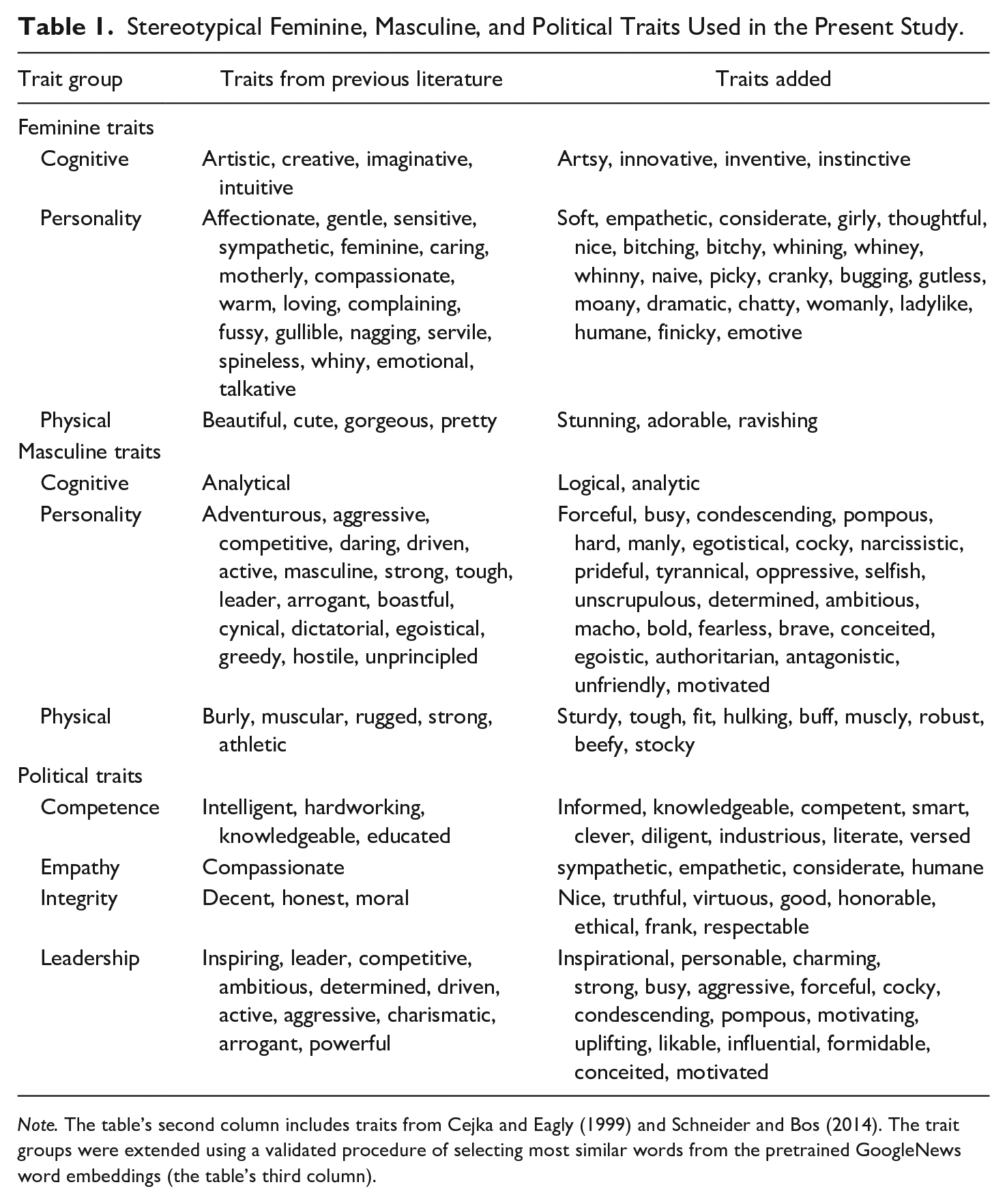
Note. The table’s second column includes traits from Cejka and Eagly (1999) and Schneider and Bos (2014). The trait groups were extended using a validated procedure of selecting most similar words from the pretrained GoogleNews word embeddings (the table’s third column).
Quantifying Stereotypical Associations Using Cosine Similarity
As similar words are embedded near each other in the vector space, their vectors produce higher cosine similarity values compared with the vectors of less similar words. Bias can be observed if gender-neutral words (e.g., competent) are closer to words that represent one gender (e.g., donald_trump) than to words that represent the opposite gender (e.g., hillary_clinton). Thus, to assess the strength of the association between female and male politicians and traits, we computed cosine similarity scores for all combinations of trait groups and politicians’ names and used those values as the dependent variables. First, as trait groups comprised multiple adjectives, the vectors of the respective words in each trait group were averaged. Subsequently, cosine similarity values were computed between the mean trait group vector and the vector of a politician, and the scores were multiplied by 100 to facilitate interpretation (the formula is included in Appendix A
3
). For instance, gender bias is observed if the cosine similarity value between
Table 2 summarizes the distributions of the 10 variables. Figure 1 presents an overview of how the associations made between male and female politicians and the variables were developed from 2010 to 2020. Clearly, the empirical range of the measures was not even close to the theoretical range of −100 to 100. Specifically, 90% of the observed associations between the politicians and a trait group in a given year fell approximately within a 10-point range; the standard deviations were 2–4 points. As the trait groups in this study are represented by multiple words, assumed to be similar, the average cosine similarity between words representing trait groups (e.g., leadership traits) and politicians is computed. This typically leads to the resulting value shrinking and approaching zero. For instance, in our embedding model for the year 2020, the cosine similarity value between joe_biden and forceful is 33.2, that between joe_biden and inspirational is 3.2, and that between joe_biden and active is -9.4. The strength of the association between joe_biden and the trait group leadership is equal to 9. The magnitudes of differences, visible between the genders and the years (Figure 1) and statistically estimated in the subsequent analyses, must be considered against this backdrop.
Distributions of the 10 Trait Group Measures.
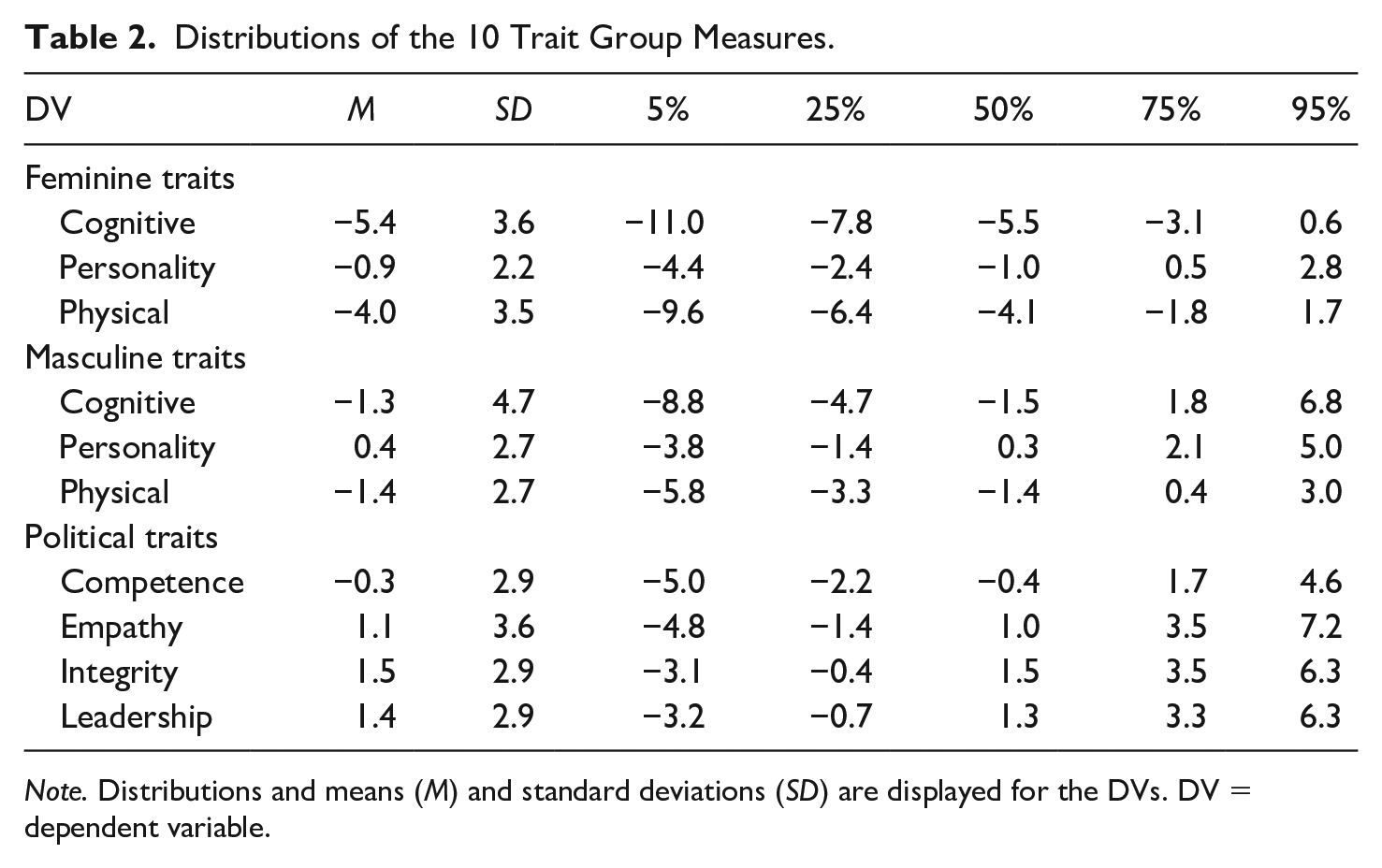
Note. Distributions and means (M) and standard deviations (SD) are displayed for the DVs. DV = dependent variable.
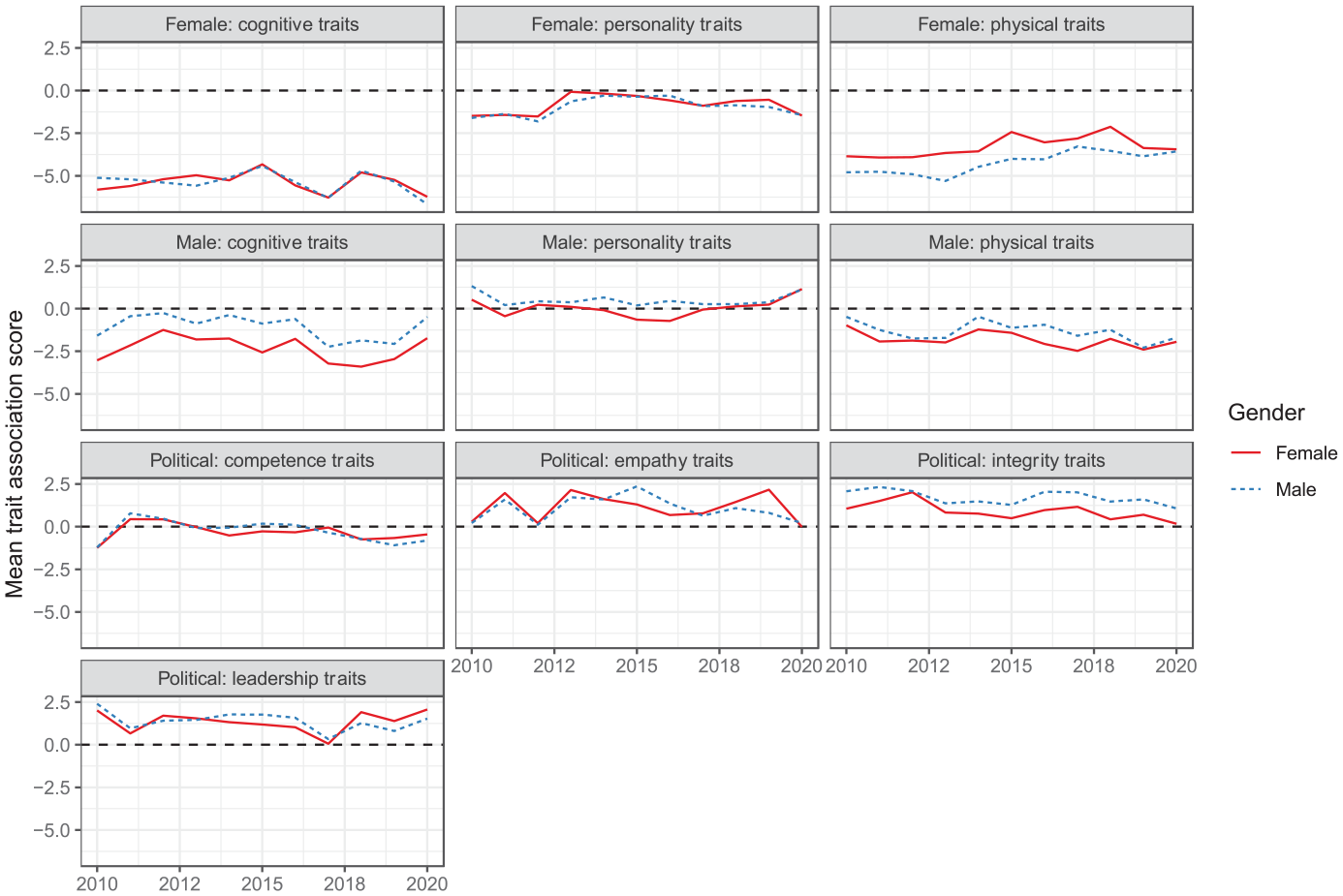
The Development of the Associations Between Male and Female Politicians and the Traits From 2010 to 2020.
Statistical Models
We analyzed a panel dataset that included 1,081 politicians and up to 11 repeated measures of each trait association for the years 2010–2020. We estimated two types of random-effect panel models. Gender was the focal predictor of interest; the 10 trait association measures (gender-linked traits: feminine and masculine personality, cognitive, and physical traits; political traits: leadership, competence, integrity, and empathy) were the outcomes. We estimated the differences between male and female politicians in the trait associations (
Results
Figure 2 presents the estimated differences between female and male politicians in their associations with the 10 traits when adjusting for year-to-year changes (
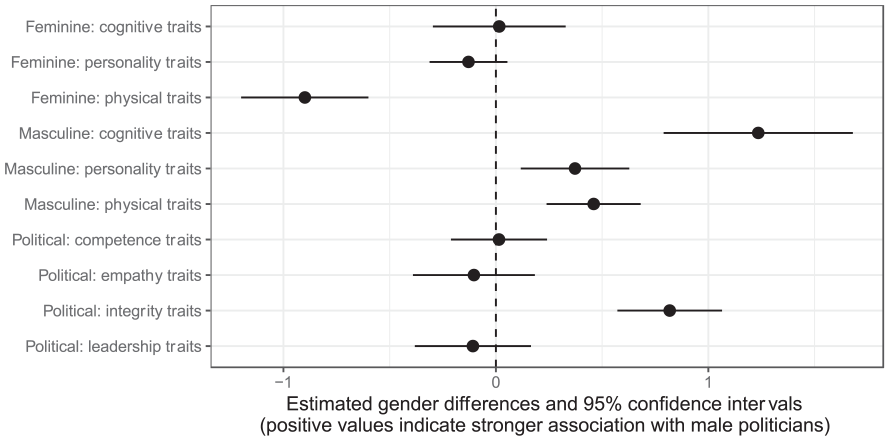
Differences Between Female and Male Politicians and Various Stereotypical Traits, Adjusting for Year-to-Year Changes (
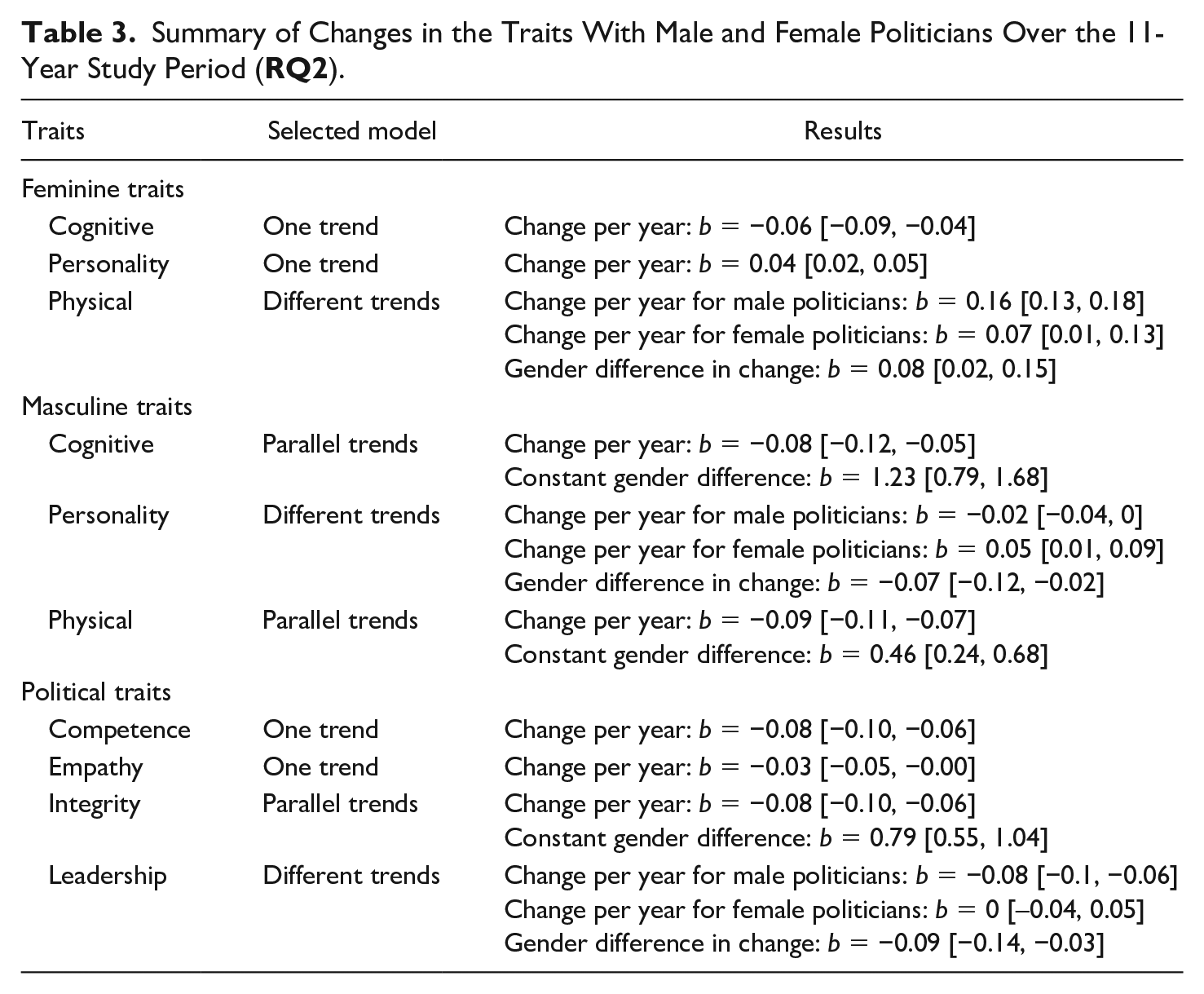
Table 3 and Figure 3 summarize the results regarding the changes in the associations between the traits and male and female politicians over the 11-year study period (
Summary of Changes in the Traits With Male and Female Politicians Over the 11-Year Study Period (
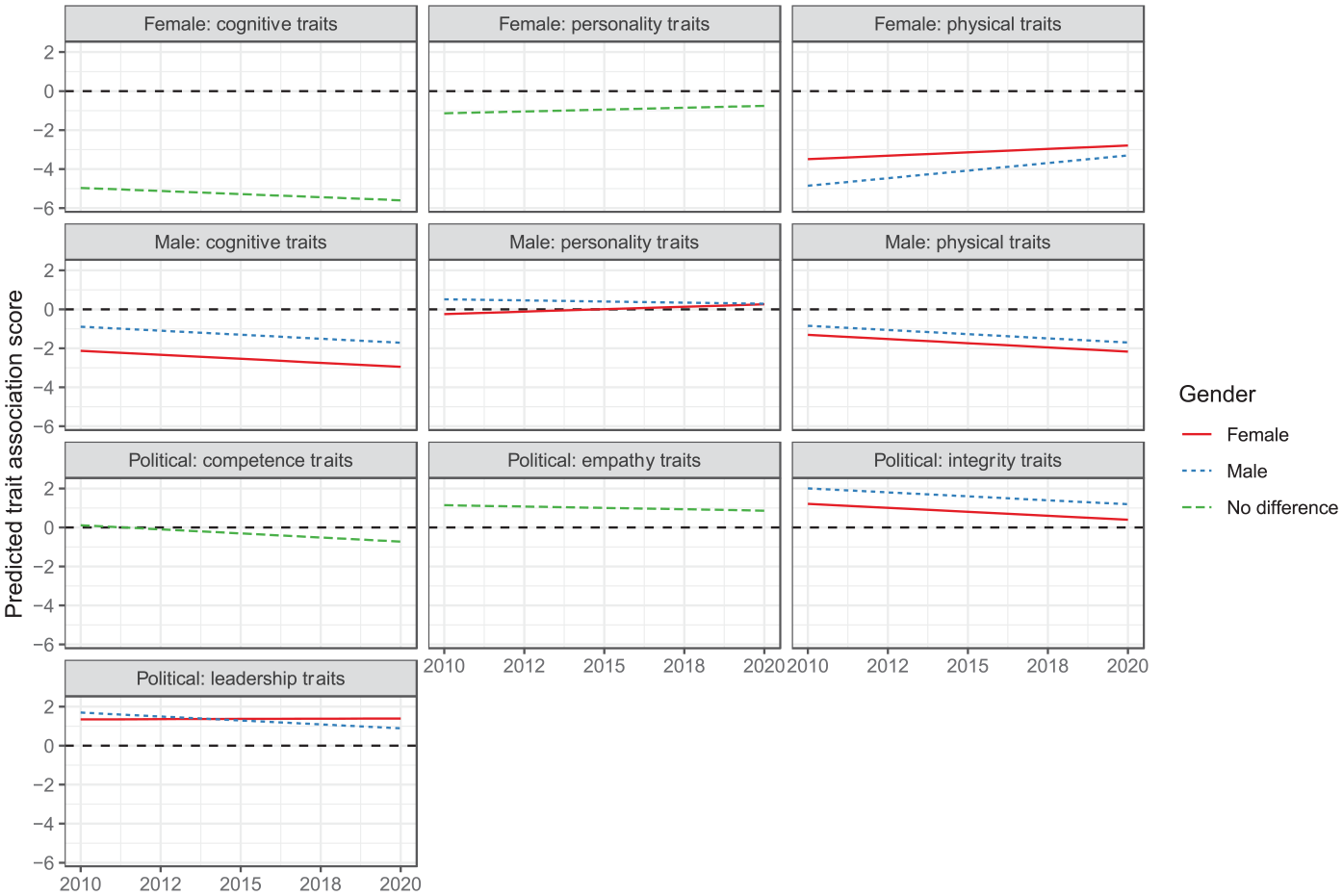
Predicted Changes in the Associations of the Traits With Male and Female Politicians Over the 11-Year Study Period (
Discussion
In this study, our main goals are to investigate the role of gender in trait attribution in news reports and to examine changes in gender stereotypes portrayed in the media over the past decade in the context of U.S. politics. Our findings from over five million U.S. news reports indicate rather small differences in the reporting about male and female politicians. Some of these differences have even diminished over the last 11 years. Next, we discuss these findings in detail.
Gender Differences in Stereotypical Associations
Examining how the strength of the association with gender-linked traits differs between female and male politicians (
Regarding the remaining gender-linked qualities, we find that neither female nor male politicians are associated with feminine cognitive and personality traits. This is partially in line with two studies’ (Atkeson & Krebs, 2008; Hayes, 2011) findings that show no gender-linked trait differences in the media coverage of female and male politicians. However, we uncover differences between female and male politicians with respect to the same groups of masculine qualities. This supports previous studies’ findings that the media use masculine traits more often to describe male politicians (Bjerre, 2018; Kahn, 1994; Kittilson & Fridkin, 2008).On one hand, the fact that female politicians are not associated with the above-mentioned groups of feminine traits is important and can indicate that journalists do not stereotype them as women. On the other hand, men in politics may benefit from being more strongly linked to masculine traits in the media, since these qualities largely overlap with some of the political traits and are considered more valuable for higher positions than feminine traits (Koenig et al., 2011).
With respect to political traits, we detect no meaningful differences in the associations made between either female or male politicians and leadership, competence, and empathy, consistent with the findings of Bhatia et al. (2018) and Hayes and Lawless (2015). There is considerable disagreement regarding which of these political traits are the most influential in voter decision making (e.g., Fridkin & Kenney, 2011; Holian & Prysby, 2014). Despite the unequivocal significance of these traits for politicians’ careers (Kinder, 1986), in view of the increasing personalization and polarization of modern politics (Langer, 2007), appearing honest, trustworthy, and authentic can be pivotal for candidates’ efforts to secure an elective office (Enli & Rosenberg, 2018). In our dataset, male politicians are found to be more strongly associated with integrity than their female colleagues. These findings confirm those of Bhatia et al. (2018) but contradict other studies’ results that show no difference in reporting about the integrity of female and male politicians in the United States (Hayes & Lawless, 2015) and elsewhere (e.g., Aaldering & Van der Pas, 2018). There are several possible explanations for these inconsistencies. The discrepancy may arise from the use of different methods to measure gender bias. While Aaldering and Van der Pas (2018) and Hayes and Lawless (2015) determine how often traits are discussed in the media, Bhatia et al. (2018) and we as well (in the current study) examine the strength of the association between politicians and traits using word embeddings that detect implicit biases rooted in sentence structure and invisible when simple count methods are applied. Another possible explanation is that many automated content analysis techniques (including neural word embeddings) are not adapted to the identification of ambiguity in texts. In certain situations, the context is of secondary importance. This is true for the gender-linked physical traits discussed above; the mere fact that in reporting about politicians, journalists mention traits irrelevant to public office serves as an indication of bias. However, the situation is different for political traits. In this case, understanding the context in which these traits are discussed can help researchers avoid drawing incorrect inferences. For example, male politicians can be more strongly associated with honesty than their female counterparts because journalists (a) discuss how truthful male politicians are (e.g., Donald Trump is an honest politician) or (b) question male politicians’ integrity (e.g., How honest was Donald Trump when he promised these policy changes?). In our study, the latter scenario may be the case, as previous research on voter perceptions of political candidates shows that citizens perceive female candidates as more honest than male politicians (e.g., Enli & Rosenberg, 2018). However, the results of studies using automated methods should be interpreted with caution. Since manual content analysis is not ideally suited to examining large datasets, scholars might design a supervised machine-learning classifier capable of distinguishing the context in which politicians’ traits are mentioned as a preliminary step before training neural word embeddings.
Over-Time Differences in Stereotypical Associations
Our dynamic analysis (
Our findings show that overall politicians in the analyzed dataset are more strongly associated with political traits than with gender-linked traits. This may indicate that the media discuss politicians in the context of the qualities that are more relevant to their profession. This is beneficial for both female and male politicians, as substantive coverage of candidates’ professional traits and competencies is more important for electoral success than the media attention to gender-linked qualities (Kinder, 1986; Langer, 2007).
Similar to the case of gender-linked traits, the gender differences in the associations with political traits described in the previous section have been stable over time, except leadership traits. The decreased likelihood of male politicians being mentioned in the context of leadership traits over the last 11 years has narrowed this specific gap between them and their female counterparts. This may be due to the increasing visibility of female leaders in recent years. The Democrat presidential candidate in the 2016 U.S. elections, Hillary Clinton, and the current U.S. vice president, Kamala Harris, are just two examples of female leaders who may have sparked conversations about women’s ability to perform in top leadership roles. In addition, the positive trend in the association between women and leadership traits may, to some extent, be attributed to the COVID-19 pandemic. For instance, media outlets have reported that female leaders are more successful than men in managing the health crisis (Johnson & Williams, 2020). However, this expectation may be linked to another gender stereotype positing that female politicians are better in handling soft policy issues, such as health care and education (Huddy & Terkildsen, 1993). This situation provides an invaluable opportunity for examining the interaction between trait and policy issue stereotypes, a topic that future studies may want to explore. Despite politicians being more strongly associated with political traits than with gender-linked traits, overall, the strength of the former associations has decreased over time. A possible explanation is that media attention to substantive political news has declined over the past 11 years. In their longitudinal study, Hayes and Lawless (2018) show that between 2010 and 2014, local news coverage of policy issues and candidate traits dropped by 10% and 33%, respectively. The declining political coverage also leads to reductions in citizens’ political participation (Hayes & Lawless, 2018). Therefore, in future studies, researchers should analyze whether the amount and type of national political news coverage have changed over time and how these changes have affected female and male politicians.
In addition to the imbalances in political media reporting detected in this study, there may be crucial differences in how female and male politicians are described in various media types. Future studies should examine whether portrayals of political women and men vary across media types and if so, whether these differences persist over time.
Limitations
In addition to the above-mentioned limitations, general methodological constraints may apply to our study. Although the computational approach of training word embeddings with word2vec that we used in this study proved to be efficient in detecting subtle biases in large, unstructured texts, it has its drawbacks. For instance, this method cannot reliably manage polysemy and homonymy in texts, resulting in words with multiple meanings being represented by a single vector. In addition, as word2vec has no way of handling unknown words, our average vectors of traits computed for each trait group and year can vary due to missing or rare words in certain years. To resolve these issues, future studies can use transformer-based architectures (e.g., Bidirectional Encoder Representations from Transformers (BERT); Devlin et al., 2018) that consider sub-word information to create a vector for an unknown word and are capable of capturing multiple meanings of a word. Regarding the average vectors that were computed to represent our trait groups, we followed previous literature in assessing the association strength between politicians and groups of stereotypical attributes (e.g., Kroon et al., 2021). However, as this approach may result in the final scores being affected by grouping attributes that represent different concepts, future studies should consider exploring other metrics and methods to represent stereotypical concepts (e.g., Charlesworth et al., 2021). Finally, when analyzing large datasets with automated content analysis techniques, scholars may face the issue of detecting highly similar content (e.g., a wire report that media outlets republished with some changes). Future studies can examine the influence of such highly similar content on the quality of word embeddings, for instance, by representing each document in the corpus as a vector and comparing the similarity between these vectors (Le & Mikolov, 2014). Nevertheless, neural word embeddings constitute an established, state-of-the-art method of detecting various implicit biases that is widely employed by computer scientists (e.g., Garg et al., 2018) and has gradually been adopted by communication scholars (e.g., Kroon et al., 2021). Unlike other automated computational models, this technique is capable of capturing semantic relationships between words and reflecting historic and biased cultural associations (Caliskan et al., 2017).
Conclusion
Are female and male politicians covered differently in news stories? Have their representations in the media evolved over the past decade? To answer these questions, we analyzed trait associations for over 1,000 politicians in a large set of news reports using a word-embedding-based computational method. The evidence from this study suggests that some gender differences remain present in political news coverage. Specifically, male politicians are more strongly associated with masculinity and integrity traits, whereas their female counterparts are more strongly linked to feminine physical qualities. These findings imply that female politicians may be disadvantaged by how they are portrayed in the media. As the media affect citizens’ perceptions of candidates (e.g., Aaldering et al., 2018), such coverage may reinforce voters’ gender stereotypes of female candidates as unfit for public office as they lack masculinity and traits relevant to their profession (Bauer, 2022), reducing their chances of being elected. However, the stereotypical associations may also be advantageous for candidates in certain election years. For instance, as abortion and gender have become essential issues raised in the 2022 U.S. midterm elections, some female candidates have emphasized traditionally feminine qualities related to motherhood in their campaign messages (Grudberg, 2022).
We find that over time, some gender differences in news reporting have remained stable (i.e., the associations with masculine cognitive and physical traits and integrity), while others have shown a positive trend toward gender-equal media coverage (i.e., declining gender differences in the associations between male politicians and feminine physical traits and increasing strength of the associations between female politicians and masculine personality attributes and leadership traits). We also observe no gender differences with respect to the remaining traits (feminine personality and cognitive traits, competence, and empathy). This may imply that journalists no longer consider politicians’ gender relevant. It is also possible that journalists are affected by women’s strategic, counter-stereotypical campaign messages (Hayes & Lawless, 2015). Less stereotypical depictions of female politicians may lead to more women running for and being elected to public office, as gender-equal news coverage may positively influence how citizens evaluate female candidates and determine their further electoral choices (Bligh et al., 2012). Previous research shows that introducing the gender quota, specifically with the placement mandates in quota rules, positively affects the descriptive representation of female politicians (Lühiste & Banducci, 2016), which in turn increases voters’ awareness of the female candidates and improves women’s perceived political viability (Aaldering et al., 2018). Thus, implementing policies aimed at increasing the number of women in government and parliament may help advance gender equality in politics and combat gender bias in the media coverage about female politicians. Given its encouraging results, this study represents a step toward enhancing society’s understanding of the nature of political gender stereotypes and their evolution over time.
Footnotes
Declaration of Conflicting Interests
The author(s) declared no potential conflicts of interest with respect to the research, authorship, and/or publication of this article.
Funding
The author(s) received no financial support for the research, authorship, and/or publication of this article.
