




Abstract
Restorative narratives describe a new form of journalism that attempts to overcome the detrimental effects of the more prevalent negative and destructive tone of news coverage. This study investigates the potentials and risks of restorative narratives in the coverage of crises with a 2 (restorative/negative) × 2 (COVID-19/climate crisis) experimental online study (n = 829) for emotional, cognitive, evaluative, and behavioral outcomes. For both crises, results demonstrate that restorative narratives evoked more positive emotional reactions to the news, were more likely to be endorsed, and improved quality ratings of the news article compared with negative narratives. We found no effects for elaboration and information-seeking.
Research has repeatedly shown that journalists and their news reporting have a stronger focus on negativity than positivity (Lengauer et al., 2012; Niven, 2001). This can be explained not only by a negativity bias, which refers to a general tendency of journalists to select negative over positive news (Galtung & Ruge, 1965), but also by the tendency of the audience to pay more attention to negativity in the news (Trussler & Soroka, 2014).
Negative news has an important societal function as one of the main roles of journalism is to make the public aware of threats and worrisome events (Lasswell, 1948). However, although the negative bias in the news serves a purpose, it comes with risks for the audience as well as for journalism. A study by Boukes and Vliegenhart (2017) investigated the effects of what they refer to as “hard news.” They find that being exposed to “hard news” causes negative effects on the mental well-being of news consumers (Boukes and Vliegenhart, 2017). Moreover, when confronted with coverage of serious events, people tend to experience increased feelings of depression, fear, and stress reactions (Pfefferbaum et al., 2014). As a result, driven mainly by the perception that it is too negative, they may actively choose to avoid news (Toff & Kalogeropoulos, 2020).
A potential solution that has gained significant attention in the field of journalism is to make news more constructive. Constructive journalism can be defined as “an emerging form of journalism that involves applying positive psychology techniques to news processes and production in an effort to create productive and engaging coverage, while holding true to journalism’s core function” (McIntyre & Gyldensted, 2017, p. 9). This means constructive journalism still emphasizes the democratic function of journalism but, in addition, highlights the role of positive values and emotions as well as possible solutions. This results in “affirmative, inspiring and often untold narratives” (Mast et al., 2019, p. 494) in news coverage. When communicating a crisis such as a natural disaster or the COVID-19 pandemic, constructive journalism suggests making use of restorative narratives (McIntyre & Gyldensted, 2017). Restorative narratives are a subtype of constructive journalism and include a shift of perspective in the coverage of negative events from suffering and tragedy to recovery and resilience (Dahmen, 2019). By focusing on coping strategies and the progress made by people who have to cope with dramatic events, restorative narratives have been shown to evoke more positive emotions and less apathy in news consumers compared with the negative narratives usually applied in crisis communication (Fitzgerald, Paravati, et al., 2020).
Constructive journalism and its various forms have become a thriving movement in journalism. This can be inferred from associations such as the Solutions Journalism Network and the Constructive Institute in Aarhus, Denmark. In addition, constructive journalism is discussed in empirical research with a focus on explaining the theoretical concept (e.g., Bro, 2018; Hermans & Gyldensted, 2019; McIntyre & Gyldensted, 2017) or investigating the use of elements of constructive journalism in different countries (e.g., Rotmeijer, 2019; Zhang & Matingwina, 2016). Experiments investigating the effects of constructive journalism are generally scarce; this holds true especially for restorative narratives (for exceptions, see Fitzgerald, Green, et al., 2020; Fitzgerald, Paravati, et al., 2020). Moreover, they focus solely on potentials and positive effects and, thereby, neglect the potential risks of this type of journalism. Implementing restorative narratives could be perceived as a violation of journalism’s watchdog function, which could, in turn, harm the perception of the quality of a news item. Also, according to the negativity bias (Rozin & Royzman, 2001), people intuitively use more cognitive resources for the encoding of negative stimuli. As a result, a more positive restorative narrative could, potentially, reduce attention to information and, consequently, interfere elaboration and learning.
Our study aims to address these gaps in previous research and apply an experimental study to learn how news coverage that has a focus on positive emotions, solutions, and coping mechanisms changes emotional reactions, cognitive responses, and the evaluation of news. We also want to find out if the behavioral intentions of newsreaders change if an article contains elements of constructive journalism. By behavioral intentions, we mean, for example, intentions to further engage with more news stories about a similar topic or to endorse an article on social media. Thereby, we consider the potential benefits as well as the risks that might occur. In sum, through this study, we hope to provide the first empirical evidence showing whether restorative narratives are a worthwhile way of covering long-standing crises and whether they contribute to better societal handling of such difficult situations.
Negativity in the News and Constructive Journalism
A widespread claim in the debate about the current state of journalism is that it needs to change and reinvent itself to be able to adequately meet audiences’ needs (Barnett, 2002; Waisbord, 2013; Witschge, 2013). For example, a qualitative study with journalists by Zahay et al. (2021) found that in light of the low levels of trust in journalism, journalists feel the need to implement techniques in their work that make journalism more engaging and inclusive for the audience. Several factors contribute to the gap between citizens and journalism. Among them is a strong focus on negativity in the news. Negativity comprises a focus on negative events, such as conflict and tragedy, as well as a generally negative tone in the news coverage (Lengauer et al., 2012) that could be confirmed in several content analyses of news (Kepplinger, 1998; Niven, 2001; Vliegenhart et al., 2011). As a result, people perceive news as too negative and depressing (Bendau et al., 2020; Newman et al., 2019; Patterson, 2001). Findings have revealed that following hard news reduces the mental well-being of news consumers over time (Bendau et al., 2020; Boukes & Vliegenhart, 2017). Moreover, the perception that news is too negative was found to increase news avoidance (Newman et al., 2019), which can lower societal knowledge and awareness and contribute to a general detachment between journalism and its intended audience. Other findings have indicated that negative news reduces trust in political leaders (Kleinnijenhuis et al., 2006), which supports the assumption that the dominance of negativity in the news can have harmful consequences for democracy.
To overcome these problematic outcomes of negativity in the news, constructive journalism has received much attention from journalists and researchers. The idea of constructive journalism is to make use of techniques of positive psychology in the news-production process to provide media coverage that is engaging and encouraging, without neglecting journalism’s core functions (McIntyre & Gyldensted, 2017). Positive psychology investigates conditions that help people to progress, strive, and flourish to optimize the (mental) state of individuals and groups of people (Gable & Haidt, 2005). Constructive journalism adapts this approach by providing news that is optimistic, includes solutions, and highlights positive emotions even when negative events are covered (McIntyre & Gyldensted, 2017).
Constructive journalism can be considered an “umbrella term” for various constructive news coverage techniques (McIntyre & Gyldensted, 2017). When it comes to reporting large-impact events such as crises, constructive journalism suggests the use of restorative narratives (Dahmen, 2019). Thereby, instead of relying on common negative narratives that stress the hopelessness and misery of people in a difficult situation, restorative narratives describe a way of telling the story that shifts the perspective toward coping strategies, progress, resilience, and the eventual recovery of those affected by tragic events (Fitzgerald, Paravati, et al., 2020). This means that negative events are still shared in an authentic way, but how those affected can act to overcome the difficulty is also highlighted (Fitzgerald, Paravati, et al., 2020). More precisely, this kind of narrative can be characterized by (a) a focus on ordinary people and their experiences in difficult situations, (b) solution-based descriptions, and (c) covering even negative events with meaningful and inspiring emotions such as optimism, gratitude, and resilience (Dahmen, 2019; Fitzgerald, Green, et al., 2020).
Constructive journalism has not yet become established in the mainstream news media. However, increasing numbers of online news outlets, TV news programs, and even Google Assistant now provide news that adheres to elements described in constructive journalism (McIntyre, 2020). In addition, journalism strives to raise awareness of the need for more constructive news, for example, through worldwide initiatives such as the Constructive Journalism Project, the World’s Best News, and the Solutions Journalism Network. However, there are also critical voices that can be heard claiming that constructive news contradicts the idea of an informed citizenry as it uses “sugar coating” in news reporting (Reith, 2019). Findings in regard to not only potential benefits but also risks related to constructive journalism are considered in the following sections.
Effects of Restorative Narratives
To be able to fully understand the potential benefits as well as the risks of constructive news, effects must be considered on several levels. The aim of this study is to determine how people react emotionally to restorative narratives, how they process them such narratives, and how they perceive to act on it. Thus, we first focus on the emotional outcomes of constructive news to determine whether constructive news is able to overcome the negative emotional reactions to news exposure. Second, we want to know how constructive news changes cognitive outcomes; this will help us to identify whether constructive news is effective in terms of learning. Third, we consider evaluative outcomes to learn whether people perceive constructive news as high-quality journalism, although negativity is less prevalent. And finally, we want to consider behavioral intentions. In this regard, we want to learn whether or not people think they would actively endorse constructive news in online environments (e.g., “liking,” sharing) and if it motivates them to engage further with news topics.
Restorative Narratives and Emotional Responses
It is frequently argued that constructive journalism and also restorative narratives have the potential to improve people’s well-being by increasing positive emotions and reducing negative emotions, even when reporting devastating (McIntyre & Gyldensted, 2017). This can be explained by processes described in cognitive appraisal theory (Lazarus & Folkman, 1984). Applied to a news context, the theory suggests that positive or negative news triggers different evaluative processes that determine the affective response to the news. These processes comprise (a) the assessment of the emotional valence and importance of a news event and (b) the control over the situation that is described in the news (Lazarus & Folkman, 1984). Restorative narratives suggest that, even when tragic events are reported, news should focus on coping, solutions, and the resilience of those affected instead of despair and tragedy. This way, a news story with a restorative narrative conveys more positive emotions that should elicit a greater feeling of control in readers. As a result, their effective reaction should also be more positive.
Indeed, research has found that different constructive elements in the news, such as including solutions and positive emotions, consistently lead to fewer negative and more positive emotional responses compared with excluding these elements. For instance, various studies found that providing a solution in news reporting evoked more positive and fewer negative emotional experiences compared with articles without solutions (Hermans & Prins, 2022; Kleemans et al., 2017, 2019; Mcintyre & Sobel, 2017; Meier, 2018). In addition, a recent study by McIntyre (2020) found that, after 2 weeks of using a Google Assistant that featured constructive news providing solutions for a topic of social relevance, people reported feeling more positive compared with those who received the usual, less positive news. Besides the effects of solutions, studies that also investigated outcomes of positive emotional wording in a stimulus (McIntyre & Gibson, 2016) and restorative narratives (Fitzgerald, Green, et al., 2020; Fitzgerald, Paravati, et al., 2020) reported an increase in positive emotions and a decrease in negative emotions after the news exposure episode.
Overall, there is sufficient and consistent evidence justifying the assumption that an article providing a restorative narrative when reporting a crisis should lead to more positively and less negatively valenced emotions. Previous studies were able to show positive emotional effects of restorative narratives for health messages and natural disasters (Fitzgerald, Green, et al., 2020; Fitzgerald, Paravati, et al., 2020). The aim of our study is to determine whether similar effects can be expected for long-lasting and ongoing crises with which people also have personal experience. Based on previous findings, we hypothesize that:
Restorative Narratives and Cognitive Responses
In regard to cognitive responses, we want to learn whether this kind of journalism affects how the elaboration of news changes. Elaboration is a concept of cognitive psychology and refers to information-processing strategies that people can apply to the encoding of information (Woehr & Feldman, 1993). Following the idea of dual-process models (Petty & Cacioppo, 1986), elaboration can be either systematic or heuristic. If information is elaborated in a systematic way, people focus on and think about this information, draw connections to existing knowledge, and reflect on the meaning of this information. If information is processed heuristically, people do not pay much attention to it and process it only superficially (Petty & Cacioppo, 1986). The elaboration strategy is especially important as it determines learning outcomes: Information is much more likely to be remembered if people process it systematically and thoroughly (Eveland, 2003). Negativity plays an important role in elaboration. The so-called and intensively investigated “negativity bias” postulates that negative cues generally have a greater impact on human cognition than neutral or positive cues (Baumeister et al., 2001; Rozin & Royzman, 2001). As a result, people pay more attention to bad news and process it more thoroughly (Baumeister et al., 2001), resulting in higher selection rates (Trussler & Soroka, 2014) and better memory performance (Baumeister et al., 2001) in regard to negative compared with positive content.
Applied to the question of consequences of restorative narratives for elaboration, it could be assumed that restorative compared with negative narratives reduce elaboration as they avoid negative emotions and focus on coping more than on the tragedy. Research on the effect of constructive elements in the news on elaboration and learning is scarce. An exception is a study by Mcintyre and Sobel (2017) that found a solution story in comparison to a shock-based story did not influence the understanding of the story overall. As learning outcomes did not differ in this case, it is also likely that elaboration was similar in both conditions of the study. However, other findings by Kleemans et al. (2019) found that, for a sample of children, the recall of information about a constructive TV news story decreased compared with the performance of children who saw a nonconstructive version. Since there is strong empirical evidence that negativity increases elaboration and the first experimental findings for constructive journalism point in this direction, we hypothesize that:
Restorative Narratives and Evaluative Responses
Concerning evaluative responses, the question arises whether this positive approach toward journalism is perceived as being high-quality journalism. After all, one of the core functions of journalism is to make audiences aware of threats, dangers, and conflicts that are inherently negative (Harcup & O’Neill, 2001; Shoemaker, 1996). The positive approach toward journalism might, therefore, fail to align with audiences’ expectations as they are accustomed to—and even demand—a rather negative, problem-focused form of journalism (Soroka & McAdams, 2015), especially in times of crises. Consequently, the perception of constructive journalism’s quality might be reduced.
However, results regarding how the audience perceives constructive journalism in terms of quality are inconclusive. Findings have indicated that the credibility of constructive news might decrease as people perceive negative information as more trustworthy (Hilbig, 2009). Indeed, it has been shown that an article including elements of constructive journalism was considered less credible (Rusch et al., 2021) and even made people feel more exposed to subliminal advertisements (Meier, 2018). By contrast, another study reported no significant difference between constructive and negative news concerning the perception of whether or not this type of journalism aligns with journalistic core functions (McIntyre, 2019). Another line of research even identified positive effects of constructive journalism for quality perception; for instance, solution journalism has been found to enhance favorable attitudes toward a news story (McIntyre, 2019). Similarly, users who chose to participate in a program that showed them more constructive news were in greater agreement with the statement that other news is generally too negative (McIntyre, 2020), thereby indicating that individuals who are more accustomed to constructive journalism evaluate it more positively in contrast to nonconstructive news content.
To summarize, even if people prefer a style of reporting that is more positive, solution-based, and generally constructive, they may still perceive this kind of news as less credible and trustworthy. The effects of restorative narratives on quality perceptions have not yet been investigated. As more research is needed to evaluate the potential benefits and risks of constructive journalism and, especially, restorative narratives for quality perception, we ask:
Restorative Narratives and Behavioral Intentions
As the broaden-and-build theory points out, being exposed to positive emotions may be able to contribute to a more active audience. The confrontation with positive emotions has a broadening effect, meaning that people develop new motivation and resources for approaching behaviors, making them more open to becoming active, and exploring their environment (Fredrickson, 2013).
Constructive journalism was developed with the idea of counteracting the downsides of predominantly negative news and, instead, eliciting processes described in broaden-and-build theory. With regard to news content, this might have positive outcomes for behavioral intentions, such as (a) information-seeking and (b) the endorsement of news.
When it comes to information-seeking, we assume that negativity in the news has different effects on the elaboration of news in the news use episode and the selection of additional information. While we assume that negative information draws more attention and, therefore, increases elaboration and learning, it is also likely to be the case that people reach a point more quickly when they need a break and, thus, do not want to further engage with news. Regarding the selection of news, this would indicate that people are willing to engage with more news if they read a constructive as opposed to a negative news item. Indeed, research has shown that providing elements of constructive journalism in news reporting has a positive effect on further engagement with news (McIntyre & Sobel, 2017), while the perception that news is too negative increases the avoidance of news (Siebenhaar et al., 2020). Thus far, two experimental studies have investigated the role of restorative narratives for further news engagement. Fitzgerald, Green, et al. (2020) found in one of two studies that participants showed increased intentions to read similar stories characterized as restorative narratives compared with the condition in which news about a tragic event was just negative. In addition, regarding health information, Fitzgerald, Paravati, et al. (2020) showed that people were more willing to read more of this kind of news if the story had a restorative narrative compared with one containing a negative narrative. Consequently, we also hypothesize that:
When it comes to endorsements of articles, meaning that articles are “liked,” shared, or commented on in social media environments, findings for constructive journalism and the distinct characteristics of this kind of journalism are mixed. Concerning positivity, several studies have confirmed that positive images in social media as well as positive news stories are shared more often (Keib et al., 2018; Kim, 2015). Moreover, Hermans and Prins (2022) found that participants reading a constructive article including a solution and utilizing positive phrasing were more likely to “like” a story; however, no significant effects for behaviors such as using an act button, sharing the article, or adding a comment were found. In addition, Meier (2018) showed that participants were more likely to endorse articles and radio news stories in a constructive version in contrast to a non-constructive version. However, several studies were unable to identify a significant effect on sharing a news story, either by including a solution (Mcintyre & Sobel, 2017) or by including positive phrasing (McIntyre & Gibson, 2016).
As previous studies have resulted in mixed findings and have not investigated restorative narratives, we pose the question:
(a) “liking,” (b) commenting on, and (c) sharing an article?
Finally, previous studies were able to show that the effects of constructive journalism depend on the specific topic being investigated (Dahmen et al., 2021; Hermans & Prins, 2022). To be able to determine the generalizability and robustness of our findings, we investigate the effects of restorative narratives for two different, globally prevalent crises: the COVID-19 pandemic and the climate crisis. Thus, the final research question asks:
Method
Procedure and Participants
We recruited 829 participants (sex: 54% female; age: M = 42.82, SD = 14.85; 25.20% with a college degree) through an access panel provided by the market research company Dynata in April 2021. Dynata is a global market research company headquartered in the United States; it delivers high-quality samples for countries worldwide (for more information, see Dynata, 2022). Participants were recruited from Dynata’s pool of panelists and invited to participate based on their sociodemographic characteristics (age, sex, and education) to obtain a sample representative of Austrian society. Participants who completed the survey were paid a small fee. The final sample for this study can be considered representative of Austrian society with regard to age and sex; however, it is slightly biased toward higher levels of education.
Before the data collection, we preregistered our study (https://osf.io/2aj6m) and conducted a pretest to ensure that the stimulus material would be understood as intended.
Regarding the procedure for our study, people were invited via email to participate in the online survey. There, they were first asked if they agreed to participate and were informed about the common privacy regulations regarding the use of their data. Immediately following this, those who agreed were randomly assigned to one of four groups (2 × 2 between-subject design; variation in the type of narrative: restorative/negative; topic: COVID-19 pandemic or the climate crisis) where they were exposed to different versions of the stimulus. Participants had to spend at least 100 s with the article before they were able to proceed to the survey. This was followed by questions for our dependent variables and sociodemographic information.
Stimulus
As stimulus, we varied whether an article contained restorative narratives or negative narratives for the coverage of the crisis. Here, we specifically modified (a) the valence of emotions used in the article (positive vs. negative), (b) whether or not a solution was provided (solution/no solution), and (c) the type of coping behavior described (positive coping/negative coping). Therefore, both narratives covered a crisis but each one provided a different perspective on the topic. This procedure and the specific elements that were varied are in accordance with previous experiments investigating restorative narratives (Fitzgerald, Green, et al., 2020; Fitzgerald, Paravati, et al., 2020) and the definition of restorative narratives (Dahmen, 2019). Moreover, a content analysis of the coverage of the COVID-19 pandemic showed that these elements exist in the coverage of a crisis and that we compare restorative narrative to a negative framing that is highly prevalent in articles about crises. An analysis of frames in news around the world during the first wave of the pandemic found that the most common frame was the “human interest” frame, which covers how people or single actors handle a crisis (Ogbodo et al., 2020). Thereby, the focus is mostly on negative stories. This was followed by the fear/scaremongering frame, which was also quite common in news about the pandemic (Ogbodo et al., 2020). This means that negative emotions and negative coping mechanisms as well as the lack of a solution during a crisis seem to be common elements in crisis coverage.
As crises, we chose an article about COVID-19 and an article about the climate crisis since they are both global and prevalent crises, although they affected the daily lives of the participants differently at the time of the data collection and also differ with regard to their duration. We collected the data in April 2021, a time when Austria was still in a lockdown and the pandemic was an omnipresent topic. The climate crisis, by contrast, is a permanent and pressing issue that has gained more attention with the outbreak of the pandemic but is not covered as dominantly as COVID-19. Both the differences and the similarities of the two topics contribute to a greater generalizability of our findings, especially with regard to applying the role of restorative narratives to other crises.
Although COVID-19 and the climate crisis are, per se, different topics, we attempted to keep the articles as similar as possible. For example, both articles first gave a general introduction to the nature of the crisis and then described how the village of Pichl in Austria was affected by the crisis. Then, the article continued by describing how Pichl is managing the crisis situation, using either restorative or negative narratives (the complete stimulus material is available at: https://osf.io/3mp7s/). To ensure that the stimulus material would be understood as intended, we conducted a pretest with 96 students at the University of Vienna. Each student read two articles, one about each topic, while the narrative version was randomly assigned. Immediately after reading the articles, participants answered several questions about their perception of the news item.
The results show that, for both topics, the differences between the narrative versions were clearly recognized by the participants. As intended, we found significant differences between the narrative versions with regard to (a) emotionality of the news item, (b) providing a solution, and (c) coping strategies of those affected by the articles about COVID-19 and the climate crisis (see Table 1).
Results of the Pretest.
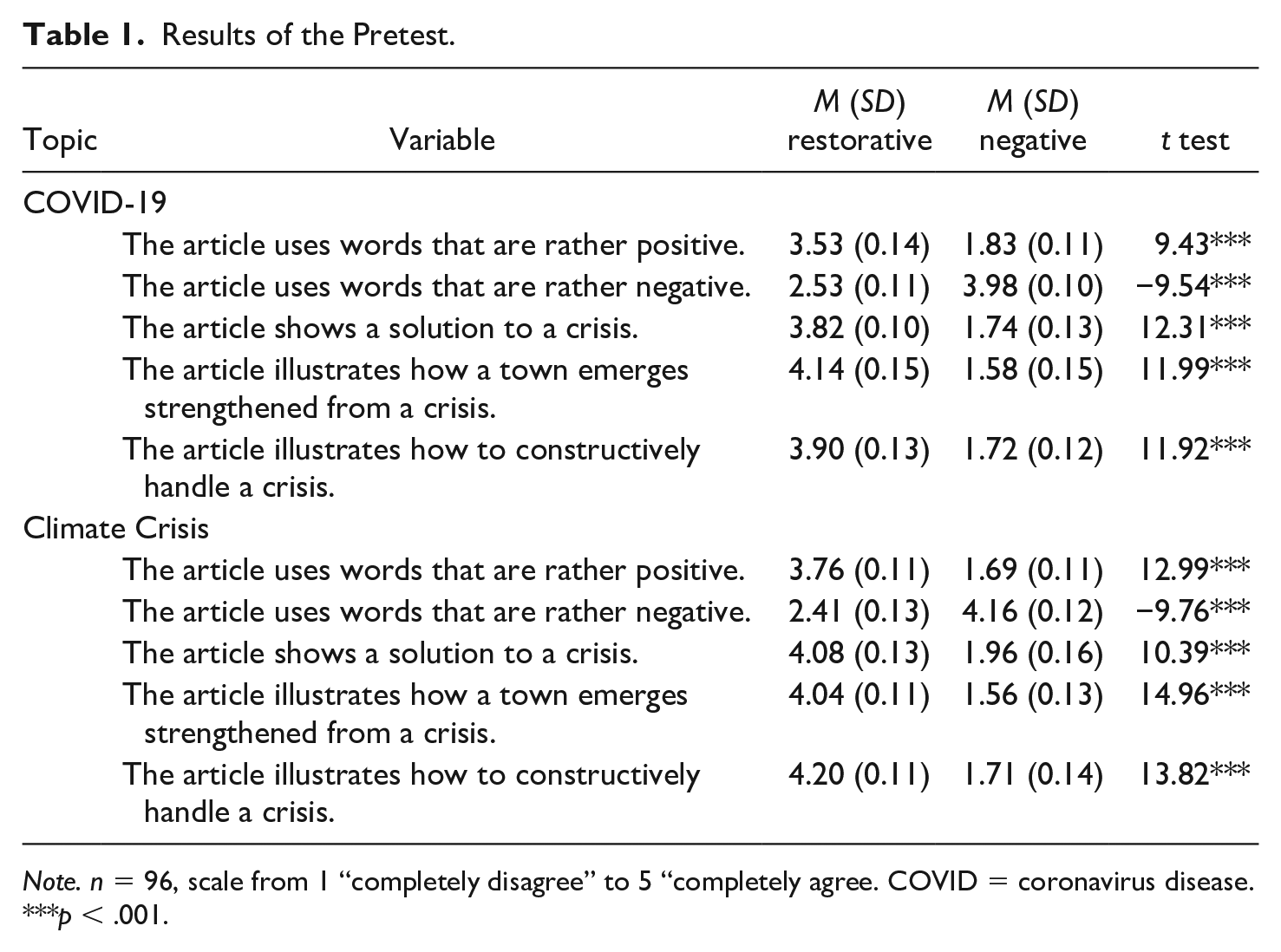
Note. n = 96, scale from 1 “completely disagree” to 5 “completely agree. COVID = coronavirus disease.
p < .001.
Measures
Positive and negative emotions
To measure positive and negative emotional reactions, we relied on the German version of the well-established scale, the Positive and Negative Affect Schedule (PANAS; Breyer & Bluemke, 2016) for our survey. This scale presents a range of different affective states (e.g., angry, proud, and nervous), and participants indicate the extent to which each of these applies to them. As response options, participants selected numbers on a 5-point scale ranging from “not at all” to “a little,” “rather,” “significant,” and “extremely.” The 10 items for positive emotions and the 10 for negative emotions were combined as an index. Reliability values showed satisfying internal consistency (positive emotions: Cronbach’s α = .89; M = 2.74; SD = 0.78, negative emotions: Cronbach’s α = .91; M = 1.98; SD = 0.82).
Elaboration
To measure the elaboration of the news article, we relied on a scale proposed by Johnson (2005) for the heuristic and systematic processing of information. This scale comprises a total of 6 items; three measure heuristic processing and three measure systematic processing. For example, we asked if people agree with the statements “I skimmed through the article” (heuristic processing) or “I thought about how what I read relates to other things I know” (systematic processing). We applied 5 items of the original scale and decided to drop the item “I thought about what actions I myself might take based on what I read” as we wanted to keep elaboration and behavioral intentions separate. This item also showed a rather low factor loading in the study by Johnson (2005). Instead, we used the item “I carefully read the news article” as an indicator for elaboration. Participants were asked to indicate the extent to which the 6 items applied to them on a 5-point scale ranging from “does not apply at all” to “fully applies.” For further analysis, we created an elaboration index that considered both heuristic and systematic processing in one value. This index also showed acceptable reliability (Cronbach’s α = .71, M = 3.76; SD = 0.64).
Quality perception of the news item
For quality perception, we used a scale that was proposed by Gaziano and McGrath (1986). The items were presented as a semantic differential and included unfair/fair, does not tell the whole story/tells the whole story, cannot be trusted/can be trusted, inaccurate/accurate, opinionated/factual, poorly presented/well presented. Responses could be indicated on 5 points between the poles of the scale. The reliability value of the index with the 6 items for quality showed an acceptable fit (Cronbach’s α = .76, M = 3.52; SD = 0.71).
Information-seeking
To measure information-seeking, we asked participants about the extent to which they agreed with the following statements: “I would like to get more information about [topic]”; “I would like to further engage with [topic]”; and “I would like to get more news about [topic].” A 5-point scale ranging from “does not apply at all” to “fully applies” was used for the three responses. The information-seeking index showed good internal consistency (Cronbach’s α = .93, M = 2.90; SD = 1.19)
Online endorsement
For online endorsement, we asked the participants how likely they were to leave a positive comment, give a “like” or positive emoji, or share the article if they saw it on social media or on a news website. Thus, we asked them about the most common ways to interact with news items in digital environments (Newman et al., 2020). Again, participants could respond by choosing from options on a 5-point scale ranging from “does not apply at all” to “fully applies (“Liking”: M = 2.34; SD = 1.38; Commenting: M = 2.11; SD = 1.20; Sharing: M = 2.15; SD = 1.28).
Results
To investigate our hypotheses and research questions, we calculated two-way analyses of variance (ANOVAs) that investigated the effects of the factors narrative and topic as well as their interaction with the dependent variables (for the data and R-script, see https://osf.io/3mp7s/).
Effects on Emotional Responses
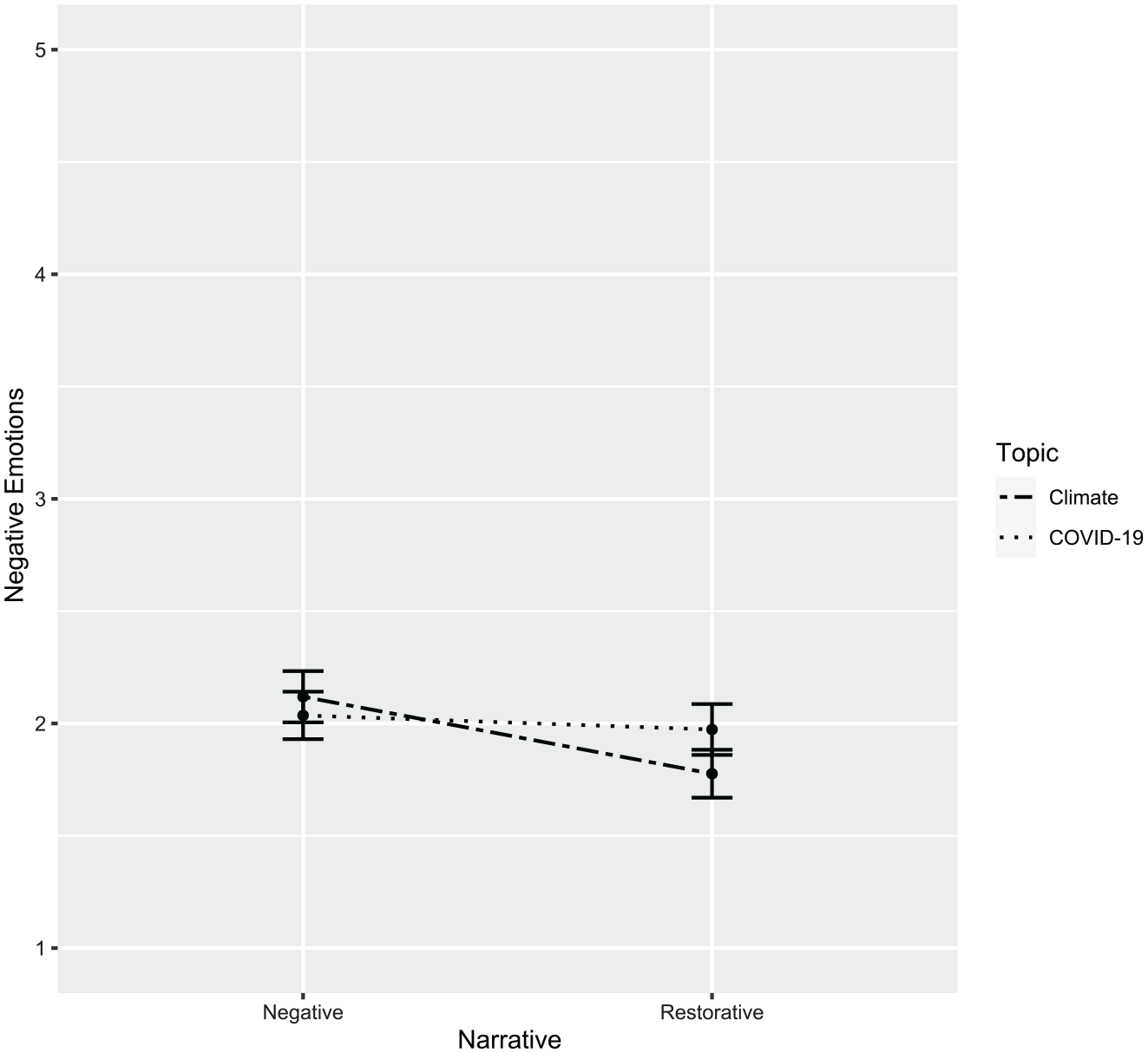
Interaction effect of the topic and the type of narrative on negative emotional reactions.
Effects for Cognitive Responses
Effects for Evaluative Responses
Effects on Behavioral Intentions
H4 assumed that restorative narratives positively influence information-seeking. The results show that there is no main effect for the narratives, F(1, 825) = 0.15, p = .70, while there is a main effect of the topic, F(1, 825) = 41.68, p < .001. People prefer to receive more information about the climate crisis (M = 3.16, SD = 0.06) than about COVID-19 (M = 2.64, SD = 0.06). The interaction between the topic and the narrative does not reach significance, F(1, 825) = 2.52, p = .11. Consequently, H4 is rejected.
Discussion
Constructive journalism describes a journalistic movement that is considered a valuable strategy for overcoming the negative effects of news exposure and, eventually, for narrowing the gap between journalism and the audience. For the coverage of crisis situations, constructive journalism suggests making use of restorative narratives that tell stories about ordinary people, provide solution-based descriptions, and cover even difficult situations with positive emotions (Dahmen, 2019). As the effects of restorative narratives have not been investigated for the coverage of long-lasting crisis situations, the current study was designed to narrow this gap in the research.
An online experiment investigated the effects of restorative narratives on outcomes related to readers’ emotional, cognitive, evaluative, and behavioral responses. Concerning emotional responses, our findings revealed that a news article providing restorative narratives makes people feel more positive after reading it. Although the effects were rather small, our findings are in line with numerous previous findings, thereby confirming that a more positive perspective on the news also makes people feel better (e.g., Baden et al., 2019; McIntyre, 2020). For negative emotions, the effects depended on the topic. We could confirm only for the climate crisis that a restorative narrative caused fewer negative emotional responses compared with a negative narrative. One possible explanation may be that the pandemic was still highly prevalent in the press and in the participants’ daily lives at the time of the data collection. Potentially, simply bringing up this topic elicited negative connotations that, in turn, influenced negative affective states, which could not be counteracted by a change in tonality and focus. Should this be the case, the way in which the news media cover future crises should be considered early on as it seems that once news consumers become accustomed to a certain negative perspective on a crisis, this perspective is difficult to overwrite. In summary, it can still be concluded that restorative narratives have the potential to overcome harmful effects for the affective state of the common negative narrative use in news stories. Due to the increase in positive emotions, it might even help to increase a feeling of efficacy over a situation (for initial indications, see Dahmen et al., 2021), foster resilience, and strengthen a positive outlook, which is especially important in challenging times such as the pandemic or the climate crisis.
Regarding evaluative outcomes, we found that, for both topics, people rated the restorative article higher in terms of quality, including credibility, trustworthiness, and objectivity. This might also offer indications about the form of journalism people actually want in times of crisis: a constructive form of news coverage that provides positivity, solutions, and coping strategies instead of an entirely negative perspective on a difficult situation. A potential argument against constructive journalism, that is, it is not what citizens expect of journalism, cannot be confirmed. Our findings, instead, point in the opposite direction.
Elaboration, the cognitive dimension that was part of the experiment, was not affected by the narrative. This means that whether the crisis was covered in a restorative or negative way did not influence how well people could concentrate on the news item or connect the information to what they already knew about the given topic. Here, at least two explanations are possible. First, it may be that the narrative does not make a difference in the elaboration process and is, instead, determined by factors such as interest or perceived relevance of a topic (Eveland, 2001). This would mean that restorative narratives are not beneficial but neither are they harmful for the elaboration of information in a news story. A second explanation could be that the instruction to carefully read the news story before the stimulus presentation led to higher levels of elaboration because of the participants’ increased attentional levels, which were then not altered by the different narratives in the news stories (Eveland, 2002). Future research might test the effects on elaboration in a different way, for example, in a longitudinal design and/or in a study presenting more than one news item, to further determine the role of restorative narratives for elaboration.
Concerning behavioral intention, for both topics, we found that restorative narratives neither increased nor decreased willingness to further engage with the news topic. While negative narratives might discourage people from further engaging with the news because of its depressing nature, restorative narratives may not make a change in this regard as they provide solutions for problems and describe how it is still possible to move on, even in times of crisis. As a result, participants may perceive the topic as less dramatic and threatening, resulting in lower attention to the topic and a decreased need for information (Baumeister et al., 2001). This could explain why we could not detect any differences between the narrative versions for information-seeking.
While information-seeking was not affected, we found that people demonstrated higher levels of intentions to endorse articles with a restorative narrative. Participants indicated that they would rather “like” and positively comment on an article with restorative narratives. Sharing was not affected. This finding points out that the different types of endorsements probably have different purposes: With the intention of “liking” and commenting, participants may want to show that they feel positively about a news story. In addition, with the intention to share an article, people may want to make others aware of something they believe is worth knowing, which might apply equally to positive and negative news stories. Trilling et al. (2017) coined the term “shareworthiness” and showed that both positivity and negativity increase the chances of an article being shared. This may explain why we did not find differences for the different narratives regarding the intention to share. Still, “liking” and commenting increase the visibility of news items in social media environments and, consequently, contribute to positive outcomes for journalism. This underlines the aforementioned claim that restorative journalism is a form of journalism that people like, want, and also reward.
Finally, we found hardly any differences between the two crises we investigated. As mentioned earlier, we found only an interaction effect between the topic and the narrative for negative emotions. In all other cases, the narratives either had a positive effect or did not make any difference for both topics, thereby indicating the robustness and generalizability of the effects we found. The main effects for the topic show only that participants had more positive emotional reactions, higher chances for further information-seeking and more intentions to endorse articles when they were about the climate crisis. This indicates that people did not like the article about COVID-19 as much, probably because they were generally fatigued by the topic; however, this did not result in any differences in the effects of the narratives except for negative emotional reactions. Thus, it can be concluded that the findings seem to be stable over different topics and are also likely to be similar for crises that were not addressed in our study.
Regarding the implications of our findings, we can conclude that, for the practice of journalism, it is advisable to integrate restorative narratives in crisis coverage. This way, journalism is perceived to be of higher quality and, thereby, might be endorsed to a greater extent in online environments. Although the reporting of negative news may sometimes be the only way to report a crisis, longer lasting crises that are featured beyond the primetime news settings offer many opportunities to provide constructive news, for example, in the form of documentaries or reportages. Providing constructive news, at least from time to time, seems to be more in line with what audiences want. Moreover, as described in the broaden-and-build theory (Fredrickson, 2013), the increase in positive emotions might be an indicator that constructive news can help to foster resilience in the audience and reduce apathy in society. Becoming active and being optimistic are even more important in times of crisis when people are experiencing insecurity, personal restrictions, and threatening situations. At the same time, the effective handling of a crisis depends on an active and collaborative society, and constructive news might be able to contribute to that.
Finally, from an audience perspective, it is advisable to actively seek news that reports crises—but also other news topics—in a constructive way. Although constructive news is not well-established in mainstream news, there is a growing number of online outlets that provide high-quality journalism that implements the core ideas of constructive journalism (e.g., perspective-daily.org). But in addition to these niche outlets, big media companies such as the BBC in Great Britain or the ZDF in Germany recently started initiatives that promote constructive news. Adding these types of news stories seems to be more aligned with the kinds of news that news consumers prefer. In addition, increased demand for constructive news is likely to be followed by its increased supply, which is necessary for this kind of news to make a change in a broader sense.
Naturally, our study has several limitations. First, our experiment tested the effects of a mock article that reported a crisis in a way that is not yet common in the news. This comes with limitations for the ecological validity and generalizability of our findings. Moreover, the context of the two topics should be taken into account. Both the COVID-19 pandemic and the climate crisis are topics that are frequently discussed in the news media. Therefore, participants were already familiar with the topics and the hard facts of the crises. It is possible that the findings of our study indicate that people want constructive journalism in addition to the more typical type of news reporting. Future studies should aim to discover if these results can be replicated for crises and topics that are less prominent in the news. Furthermore, although we attempted to keep the conditions for the two topics as comparable as possible, they have several inherent differences. Thereby, the variations in the topics resulted in various differences in their content, for example, with regard to the description of the course of the crisis, the consequences for the village of Pichl, or the future perspective. Moreover, while we identified similar patterns for both topics, the experimental setup has limitations for internal validity. Finally, restorative narratives describe a concept that has several characteristics, including more positive emotions in a news story, a solution for a crisis, and coping with a difficult situation. As we manipulated all these characteristics within the same experiment, we cannot discern how each of them contributed to the changes we found for our dependent variables. Thus, we are unable to determine whether they are equally relevant or whether the manipulation of just one of them would have caused similar results. As the pretest was able to show that people clearly recognize all three dimensions of restorative narratives, we have reason to assume that they all play a role in the outcome of the experiment. However, to provide proof of this assumption and to determine the role of each characteristic of restorative narratives, further research is needed that isolates the dimensions as separate factors.
In summary, it can be concluded that constructive journalism is a very promising technique for crisis communication that should be much more prevalent in the news. Our findings reveal that choosing a restorative narrative for news reporting in times of crisis only comes with benefits. It is perceived as a better form of journalism that provides the audience with an uplifting feeling and even increases the visibility of news in online environments—both highly beneficial for journalism. Moreover, on a societal level, it might offer positive effects as this type of journalism can help people cope with difficult situations by contributing to a more engaged and active audience. Thus, not only should journalism provide news that is more constructive, but it is also advisable for audiences to actively seek and demand news that provides perspectives such as restorative narratives.
Footnotes
Declaration of Conflicting Interests
The author(s) declared no potential conflicts of interest with respect to the research, authorship, and/or publication of this article.
Funding
The author(s) received no financial support for the research, authorship, and/or publication of this article.
