



Abstract
Numbers can convey critical information about political issues, yet statistics are sometimes cited incorrectly by political actors. Drawing on real-world examples of numerical misinformation, the current study provides a first test of the anchoring bias in the context of news consumption. Anchoring describes how evidently wrong and even irrelevant numbers might change people’s judgments. Results of a survey experiment with a sample of N = 413 citizens indicate that even when individuals see a retraction and distrust the presented misinformation, they stay biased toward the initially seen inaccurate number.
Numbers are all over political news. Statements like “96 percent of Google search results on ‘Trump news’ are written by the U.S. left-wing media,” or “31 refugees as opposed to 3 German citizens committed crimes against life within the last year” can be found daily in almost any TV news show or newspaper. Numbers convey an aura of objectivity and serve as prominent arguments in political debates. Yet, when subjected to the scrutiny of journalists, none of the examples presented above stood the test of facticity (Bender, 2018; Jacobson, 2018).
How does this spread of incorrect numbers affect the public? Studies on the continued influence effect (CIE) suggest that corrections can’t unring the bell—individuals will, to a certain extent, stay biased in their beliefs and attitudes due to misinformation (Lewandowsky et al., 2012; Thorson, 2016). However, when misinformation is counter-attitudinal or comes from untrusted sources, these effects can vanish (for a meta-analysis, see Walter & Tukachinsky, 2020). A second strand of research from cognitive psychology points to even more worrying effects. The so-called anchoring effect states that numbers can induce a bias in our judgments even when we find them inapplicable and irrelevant (Furnham & Boo, 2011; Tversky & Kahneman, 1974).
To shed light on this issue, this study investigates anchoring effects in the context of unsubstantiated statistics in news articles and as a function of disbelief in such figures. Current studies on the continued influence of misinformation rarely explore the specific role of numbers. This is surprising, as fact-checkers frequently uncover misrepresentations of numbers in political statements (e.g., Gensing, 2018a, 2018b; Jacobson, 2018; “The UK’s EU membership fee,” 2017). Therefore, this experimental study advances misinformation studies by shedding light on wrong numbers as a specific form of misinformation. In addition, it tests whether distrust—a concept which plays an especially important role in misinformation studies and news consumption contexts—constitutes a boundary condition to anchoring effects, which can be expected from the CIE literature (Walter & Tukachinsky, 2020), but is unlikely from the viewpoint of anchoring theory (Furnham & Boo, 2011). By choosing misinformation on asylum seekers in Germany, this study aims to contribute to a better understanding of the role of misinformation in opinion formation on this timely issue.
The Continued Influence of Misinformation
The harmful impact of misinformation, namely “information that is initially assumed to be valid but is later corrected or retracted” (Ecker et al., 2014, p. 292), has been studied for more than 30 years. Ideally, corrections should fully revise the impact of inaccurate claims on people’s beliefs and attitudes (Seifert, 2014). Against this expectation, different types of corrections only show limited effectiveness in experimental studies and panel surveys (Schaffner & Roche, 2017; Walter & Tukachinsky, 2020).
The continued influence effect serves as a label for this phenomenon, pooling research on the psychological underpinnings of why and how misinformation persists. Specifically, it describes that people continuously make inferences based on already corrected or retracted claims when they are asked to explain why and how events unfolded (Seifert, 2014). This bias is not only durable, but may also strengthen over time (Peter & Koch, 2016). Previous scholarship suggests that these effects root in cognitive heuristics and motivated reasoning processes. In part, the continued influence effect can be attributed to an increase in fluency and accessibility (Peter & Koch, 2016). Individuals may take information that comes to mind more easily as a cue for trustworthiness (Seifert, 2014; Song & Schwarz, 2008). Moreover, some people resist corrections on partisan grounds (for a review, see Flynn et al., 2017).
The majority of studies centers around misinformation presented in an unfolding story—for instance when a crime was attributed to the wrong person (Ecker et al., 2014; Thorson, 2016). What remains less understood, however, is the role of inaccurate numbers. In previous studies, numbers and narratives unfolded persuasive effects on people’s beliefs, attitudes, and behavior via different routes and to different degrees (Zebregs et al., 2015). In addition, cognitive psychology suggests that the judgment of numbers often involves highly complex considerations (Pedersen, 2017; Tversky & Kahneman, 1974). At the same time, figures are an influential part of public debates, may it be on migration, the labor market, or CO2 emissions. Therefore, this study will address this research gap by investigating the role of inaccurate numbers in the news on people’s beliefs about asylum seekers in Germany. To expand scholarship on this issue, we draw on theories of the anchoring effect, which provide an important framework for understanding the role of numbers that should be disregarded in later judgments.
The Anchoring Effect
In situations of uncertainty and information complexity, people use heuristics to reduce cognitive effort (Chaiken, 1980). While heuristics are vital to people’s day to day decision making, they simultaneously have been shown to induce systematic biases into judgments (Tversky & Kahneman, 1974). One of the most robust heuristic biases found in current literature is the anchoring effect (for a review, see Furnham & Boo, 2011). Anchoring describes a process in which individuals’ estimations of a number are skewed by a previously presented value, the so-called anchor. Even though the anchor may be wrong or even irrelevant to the estimation in question, people orient themselves along the lines of this number when subsequently asked to guess the correct figure. One prominent example is a classic experiment by Tversky and Kahneman (1974): The researchers let participants spin a wheel of fortune that was manipulated to arrive at a high or low number. Next, participants were asked for their estimate on the number of African countries that are part of the United Nations. The study found that the responses were biased toward the seemingly random number on the wheel of fortune, with high anchors leading to higher estimates and low anchors leading to lower estimates.
To date, there is evidence for anchoring effects across many critical domains and real-life situations. Studies found evidence of anchoring in price negotiations (see also Galinsky & Mussweiler, 2001; Northcraft & Neale, 1987), juridical sentences (Englich & Mussweiler, 2001; Mussweiler & Englich, 2005), and evaluations of sport-performances and restaurants (Critcher & Gilovich, 2008). However, there still is a dearth of research when it comes to figures of political importance (see Furnham & Boo, 2011) and misinformation. While there have been studies on anchoring effects for the likelihood of a nuclear war (Plous, 1989) and temperature rises due to climate change (Joireman et al., 2010), these studies operated under the classic paradigm of anchoring, asking individuals if a number is higher or lower than a presented value (e.g., “Do you believe the earth’s temperature will rise by exactly 10 degrees Fahrenheit over the next 30 years?”). Such experimental designs don’t reflect the reality of news consumption and of retracted numbers. Therefore, this study applies anchoring theory to examine the specific effects of numeric misinformation.
One reoccurring theme of numerical misinformation in Germany is the topic of asylum seekers. Although public media retracted these numbers in various instances (Bender, 2018; Bonnen, 2018; Gensing, 2018b; Weber, 2017b), they could still skew people’s perceptions of issues such as the educational attainments and the criminality of asylum seekers. As Tversky and Kahneman (1974) propose, anchoring is a process of insufficient adjustment away from initially given numbers, and thus “different starting points yield different estimates” (p. 1128). Therefore, we expect the following:
Theoretical Approaches to Anchoring
Three lines of reasoning describe the processes underlying anchoring effects: the anchoring-and-adjustment model, the selective accessibility model, and the persuasion or attitude model. Initially, anchoring was understood as a process in which people adjust away from the initially presented value in an effortful manner, but do so insufficiently (anchoring-and-adjustment). Consequently, more extreme anchors should result in more insufficient adjustments as compared to the control group (Tversky & Kahneman, 1974). Furthermore, the more able and motivated people are to reject a number, the more they might succeed in giving an estimation further away from the anchor (Simmons et al., 2010).
The selective accessibility model proposes an alternative view. In this process, the anchor acts as a prime that facilitates the retrieval of knowledge that is consistent with the anchor (Bahník & Strack, 2016; Mussweiler & Strack, 1999a). This approach parallels common theories in the area of communication science. Agenda setting, priming, and framing build on the assumption that mediated messages heighten the accessibility of certain concepts in individuals’ minds (Arendt & Matthes, 2014; Cacciatore et al., 2016; Price & Tewksbury, 1997). Previous research on gain- and loss-framing has shown that the way in which equivalent numerical information is presented—for example, speaking of a 6% unemployment rate or a 94% employment rate—elicits different emotional and cognitive responses (Lee et al., 2021). Similarly, presenting individuals with a high or low number might prime a sense of “bigness” or “smallness” that becomes more accessible in further judgments (Wegener et al., 2010). However, anchoring also produces robust and long-lasting effects which stand in contrast to the mostly small and short-lived effects found in the priming and framing literature (Arendt & Matthes, 2014; Blankenship et al., 2008; Mussweiler & Strack, 1999b). These durable anchoring effects suggest a more effortful process, in which individuals generate their own thoughts and knowledge in line with the anchor.
Finally, recent scholarship seeks to explain the anchoring effect in the light of attitude change and persuasion (Epley & Gilovich, 2010; Wegener et al., 2010). This model closely builds on the elaboration likelihood model (Petty & Cacioppo, 1986): In this line of reasoning, the anchor can be taken as a cue under conditions of low elaboration, or bias the retrieval of knowledge under conditions of high elaboration. While both processes make individuals arrive at biased estimates of the anchor value, high elaboration strengthens the durability of the effects and is theorized to lead to more resistance to change in the future (Blankenship et al., 2008).
Boundary Conditions of the Anchor Effect
Boundaries of a theory can be described as “a cutoff line across contexts that identifies the outer end of the range of a theory” (Busse et al., 2017, p. 580). In the context of anchoring, researchers have established several contexts in which the accuracy of anchoring theory is reduced or ceases to be valid.
Individuals’ pre-existing knowledge takes a central role. If individuals possess anchor-relevant knowledge and have the cognitive capacity to retrieve it, they might rely less on the anchor value as a cue. Second, and in line with the elaboration likelihood model, scholars have suggested that “anything that increases a person’s willingness or ability to seek more accurate estimates tends to reduce the magnitude of adjustment-based anchoring biases” (Epley & Gilovich, 2010, p. 316). While earlier studies found no effect of accuracy motivations (see e.g., Tversky & Kahneman, 1974), more recent findings support this hypothesis if individuals know the direction for adjustment (Simmons et al., 2010). Some moderators of anchoring effects have also been uniquely suggested under the framework of attitude change (Epley & Gilovich, 2010) such as the relevance of the anchor (Glöckner & Englich, 2015) and credibility of the source (Wegener et al., 2010). However, it is important to note that these factors could not eliminate the anchor effect, possibly due to automatic processes that take place simultaneously.
The domain of news consumption and political misinformation offers further potential to explore boundary conditions of anchoring. In the context of news consumption and misinformation, trust plays a vital role (see e.g., Zimmermann & Kohring, 2020). At the same time, articles on controversial issues create especially high levels of distrust due to conflicting knowledge, identity-defensive mechanisms or pre-existing trust structures (see e.g., Druckman & McGrath, 2019). Thus, the context of news reporting is well suited to examine whether distrust might constitute a boundary condition to anchoring effects. While studies on the continued influence effect often find that corrections work for those who distrust the source or oppose the misinformation (Walter & Tukachinsky, 2020), this can’t be taken for granted in the case of numbers, since anchoring theory suggests that even implausible numbers skew judgments (Wegener et al., 2001).
The Role of Distrust
So far, studies found that suspicion (Lewandowsky et al., 2005), distrust of the source (Walter & Tukachinsky, 2020) and warnings about the misinformation (Ecker et al., 2010) could substantially reduce the influence of misinformation on subsequent judgments. According to Schul and Mayo (2014), distrust in the initially given misinformation affects both encoding processes and the motivation to discount misinformation later on. First, when individuals are in a state of distrust, they might encode both congruent and incongruent information alongside and thus facilitate the retrieval of misinformation-inconsistent knowledge. Notably, the stage of encoding plays a major role in the size of bias induced by misinformation (Walter & Tukachinsky, 2020). Second, individuals with higher levels of distrust might also hold stronger concerns about information accuracy. This should lead them to scrutinize messages more carefully.
While pointing to a similar direction, testing the moderating effect of distrust in a misinformation context goes beyond previous studies on plausibility (Wegener et al., 2001) or pre-existing knowledge (Blankenship et al., 2008) as moderators, which have introduced participants to the anchoring number as a presumably randomly generated number in an anchoring question. This is not informative of anchoring in misinformation contexts, where individuals might first encode the misinformation as correct information (Schul & Mayo, 2014), have ideological motivations to disregard the number (Flynn et al., 2017), or might perceive ulterior motives of the sender after seeing the retraction—factors that could spur distrust regardless of the previous knowledge on and plausibility of the anchor.
In summary, by testing the moderating effect of belief in the misinformation, we can examine whether disbelief represents a boundary condition for the anchoring paradigm (Busse et al., 2017; Slater & Gleason, 2012). If distrust represented a contingent moderator, the anchoring effect would only take effect for individuals below a certain level of distrust. Alternatively, and considering that even implausible and irrelevant anchors influence judgment (Wegener et al., 2001), we suggest that distrust weakens, but does not eliminate biases induced by wrong numbers because of anchoring effects. Thus, we suggest a contributory moderation in which the effect of a high versus low anchor is attenuated by higher levels of distrust, but significant and positive at all levels of the moderator (Holbert & Park, 2020).
Change in Beliefs About Asylum Seekers
As Epley and Gilovich (2010) note, anchoring studies so far were mostly concerned with studying judgments of numbers. However, the line of reasoning proposed by selective accessibility and attitude change theories on anchoring would strongly suggest that the thoughts evoked by the anchor should also extend their influence beyond the mere judgment of a number (Epley and Gilovich, 2010). Therefore, we hypothesize that the presented number will also affect on people’s beliefs about the criminality and illiteracy of asylum seekers, mediated by the own estimate of the number:
Method
Case Under Study
The topic of asylum seekers in Germany was selected for two main reasons. First, attitudes on migration related topics have been shown to strongly link to media exposure (Eberl et al., 2018; Van Klingeren et al., 2015). Therefore, understanding media effects on this topic is especially important. Second, the issue of migration and asylum seekers is prevalent in fact-checks on misinformation. Wrong numbers, sometimes citing non-existing statistics, have been used by political actors in various instances and were retracted in traditional media outlets (Bonnen, 2018; Gensing, 2018a; Jacobsen & Völlinger, 2016; Weber, 2017a, 2017b).
Design
Drawing on previous studies of the anchoring effect, we implemented an experimental between-subjects design, comparing groups that see a high anchor, a low anchor, and a control group (Bahník & Strack, 2016; Mussweiler & Englich, 2005). Data collection took place between March 21, 2018, and April 9, 2018. The German participants were recruited by the survey company SSI. 1 Materials und questions were presented in German. Respondents who took less than five minutes to answer this survey and a subsequent, topically unrelated survey were excluded from the data. A total of N = 415 participants completed the questionnaire. Two cases were excluded due to implausible and missing answers to the open questions. The dataset of the final sample can be accessed via the Open Science Framework (https://doi.org/10.17605/osf.io/37w4g). The final sample (N = 413) exhibits a broad and balanced distribution in terms of age (aged 16–74, M = 47.41, SD = 15.28), gender (47.2% female), and education (17.6% academic degree, 16.2% high school degree or equivalent, 25.4% secondary school; 5.3% polytechnic school; 33.8 % compulsory school; 1.2% still in education; 0.5% without school diploma).
Stimulus Material
Our stimulus material was designed to mimic real articles in terms of style, content and typeset. We exposed individuals to two articles within each experimental cell. The two articles presented the issues of criminality among people with asylum status and the issue of a lack of education among asylum seekers. The manipulated misinformation draws on real instances in which wrong numbers on these issues were spread although no official statistics on these issues exist (Jacobsen & Völlinger, 2016; Weber, 2017a, 2017b; see Online Appendix A).
The wording of the high and low anchor group only varied in the presented number, holding all other parts of the message stable across conditions (“[65 percent / 2.2 percent] of asylum seekers in Germany are illiterate, they can’t read and write properly.”; “Across Germany, [51 percent / 5 percent] of crimes are committed by people who got asylum here”). The subsequent correction statement quoted that no official statistics on these topics exist.
Two pretests were used to define the exact anchor values used in the stimulus and ensure that the articles are equally trustworthy despite of correcting different numbers (see Online Appendix A).
Procedure
First, participants were presented with either two articles containing a low anchor, two articles containing a high anchor, or two control articles in counterbalanced order. After each article, they indicated their personal evaluation of the retracted number and rated the quality of the article and the trustworthiness of the correction and the misinformation. Next, they answered questions tapping their issue-specific beliefs. Then, they took a quiz on their political knowledge and numeracy. Before de-briefing, respondents filled in their demographical information.
Measures
If not stated otherwise, items were measured on a 7-point Likert-type scale (1 = lowest level, 7 = highest level).
Mediator
Participants gave their own estimation on the inaccurate numbers in an open question (Furnham & Boo, 2011). They answered questions on the illiteracy rate of asylum seekers (“Which percentage of asylum seeker is illiterate, thus can’t write and read properly?,” M = 38.57, SD = 27.20, range: 0–100) and the crime rate of asylum seekers (“Which percentage of crimes in Germany are committed by people who are granted asylum?”; M = 31.87, SD = 25.59, range: 0.1–100).
Dependent variable
A scale composed of five items tapped people’s beliefs on asylum seekers’ educational attainments, with higher scores indicating more negative beliefs (Cronbach α = .79, M = 4.77, SD = 1.32). Participants indicated how strongly they agreed with statements, for example, stating that “[t]he school qualifications of asylum seekers are worth less compared to the school qualifications of German citizens.” A similar scale of five items was employed to measure beliefs on the criminality of asylum seekers (Cronbach α = .89, M = 4.60, SD = 1.49). Respondents indicated if they, for example, agreed that “areas where many people with asylum status live are unsafe.” Similar items have been used in scales measuring attitudes, beliefs, and threat perceptions about refugees and migrants (Angelidou et al., 2019; Hercowitz-Amir et al., 2017; Park et al., 2011). The wording of all items can be found in Online Appendix B.
Moderators
Belief in the misinformation was measured with a single item. For the issue of illiteracy, participants indicated their agreement to the statement “I believe the statement by Welskop-Deffaa, according to which 5 percent of asylum seekers are illiterate” (M = 3.72, SD = 1.92). For the issue of criminality, the statement reads “I believe the statement by Dedy, according to which 2.2 percent of crimes are committed by people with asylum status” (M = 3.34, SD = 1.92). 2
Control variables
Participants’ general attitude toward asylum seekers was measured in a semantic differential indicating whether “my attitude towards asylum seekers” was “very negative” or “very positive” (M = 3.7, SD = 1.65). To measure numeracy, participants had to solve three calculation tasks taken from Peters and colleagues (2006). Correct responses were summed up and divided by the number of tasks, resulting in a numeracy scale ranging from 0 to 1 (M = 0.51, SD = 0.28, e.g., “A bat and a ball cost $1.10 in total. The bat costs $1.00 more than the ball. How much does the ball cost?”). Accordingly, political knowledge was measured on a scale from 0 to 1, combining correct responses to three closed questions on political facts (M = 0.68, SD = 0.28, e.g., “Which party holds most seats in parliament at the moment?”). The measure of urbanity of residence asked individuals for the number of inhabitants in their place of residence on a 7-point scale (M = 4.08, SD = 2.22). The lowest point marked less than 5,000 inhabitants, the highest point on the scale marked more than 500,000 inhabitants. In addition, models controlled for participants’ age and gender.
Manipulation check
A manipulation check was used to see whether people noticed the misinformation and whether the anchor groups differed in seeing the correction. As the control group saw no misinformation in the first place, the analysis compared the low anchor group to the high anchor group. The low anchor group was significantly more likely to report that they have seen the low inaccurate number compared to the high anchor group for the issue of illiteracy, χ2 = (1, N = 272) = 127.21, p < .001, and for the issue of crime, χ2 = (1, N = 272) = 191.30, p < .001. Accordingly, the high anchor group was more likely to report having seen the high number on illiteracy, χ2 = (1, N = 272) = 132.94, p < .001, and on crime, χ2 = (1, N = 272) = 168.35, p < .001. The high and low anchor group did not differ significantly in reporting that they have seen the correction.
Results
Randomization was successful: The experimental groups show no significant differences with regard to their attitude toward asylum seekers, F (2, 410) = 0.06, p = .943, numeracy, F (2, 410) = 0.25, p = .775, political knowledge, F (2, 410) = 0.01, p = .994, age, F (2, 410) = 0.32, p = .729, the urbanity of their residence, F (2, 410) = 0.73, p = .485, and gender, χ2 (2, N = 413) = 0.77, p = .679. In addition, there is no significant difference between the high and low anchor group in their ratings of the credibility of the misinformation on the illiteracy rate, t(270) = −0.97, p = .333, and crime rate, t(270) = −1.165, p = .245.
To see whether participants were influenced by low or high anchor numbers in their own estimates of crime rates and illiteracy rates among asylum seekers, we used regression models with indicator-coded experimental groups as independent variables. Both the low anchor group, b = −20.04, p < .001, 95% CI = [−25.60, −14.48], and the high anchor group, b = 6.23, p = .027, 95% CI = [0.73, 11.72], significantly differed in their estimates of the percentage of illiterate asylum seekers when compared to the control group (R2 = .28). A similar pattern arose for estimates on the percentage of crimes being committed by asylum seekers in the low anchor group, b = −22.04, p < .001, 95% CI = [−26.89, −17.19]. There was no significant effect of the high anchor for the issue of crime, b = 3.28, p = .179, 95% CI = [−1.52, 8.07]. The regression model accounted for 36.8% of the variance in people’s estimates on crime rates (R2 = .37). Thus, the effect of low anchors on readers’ estimations is consistent with our expectations (
Next, the moderating role of individuals’ belief in the inaccurate number (
Model of Moderated Mediation Predicting Beliefs on the Education of Asylum Seekers (Belief edu) via Estimations of the Illiteracy Rate of Asylum Seekers (Estimates illiteracy).
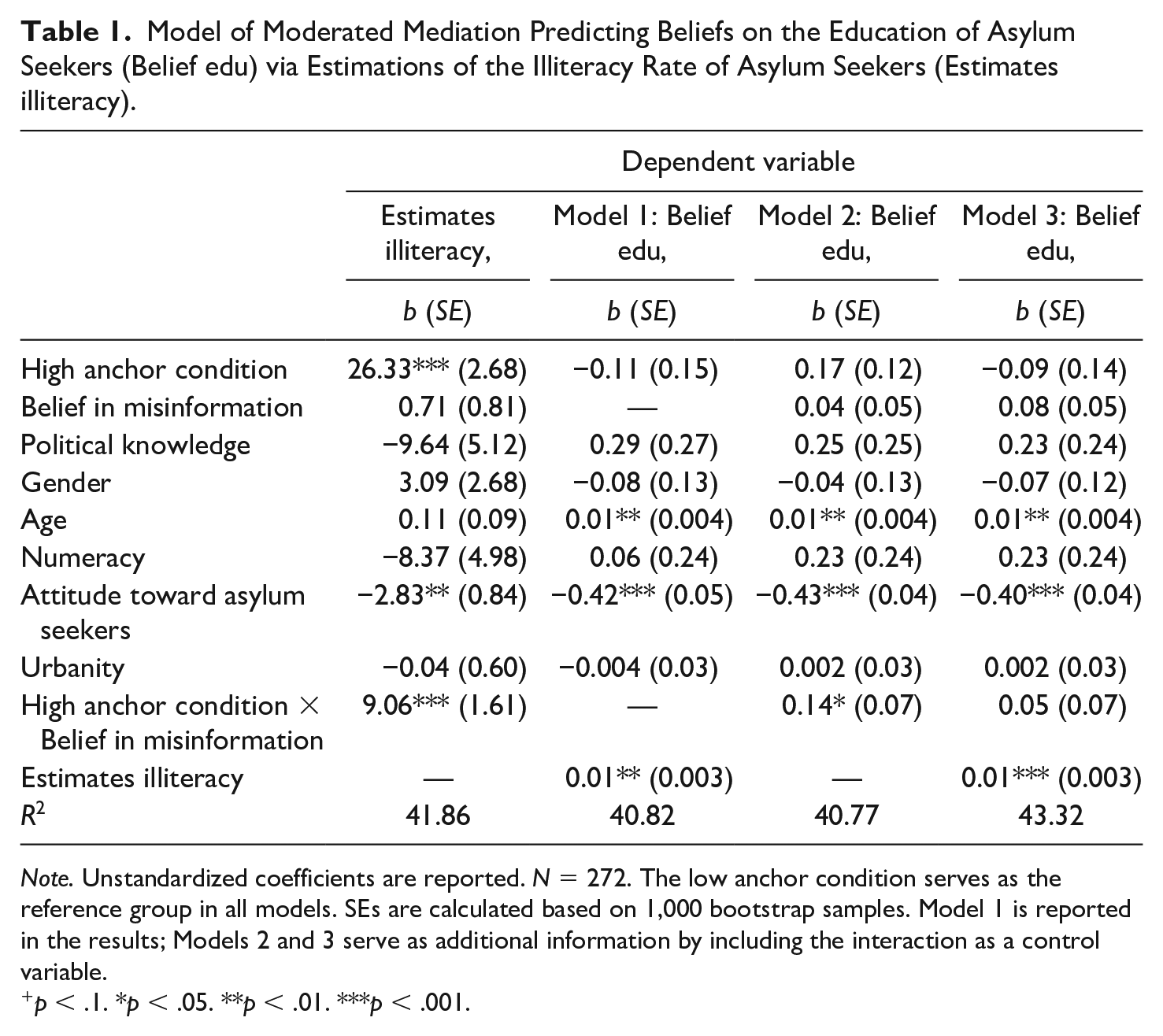
Note. Unstandardized coefficients are reported. N = 272. The low anchor condition serves as the reference group in all models. SEs are calculated based on 1,000 bootstrap samples. Model 1 is reported in the results; Models 2 and 3 serve as additional information by including the interaction as a control variable.
p < .1. *p < .05. **p < .01. ***p < .001.
Model of Moderated Mediation Predicting Beliefs on the Criminality of Asylum Seekers (Belief crime) via Estimations of the Crime Rate of Asylum Seekers (Estimates crime).
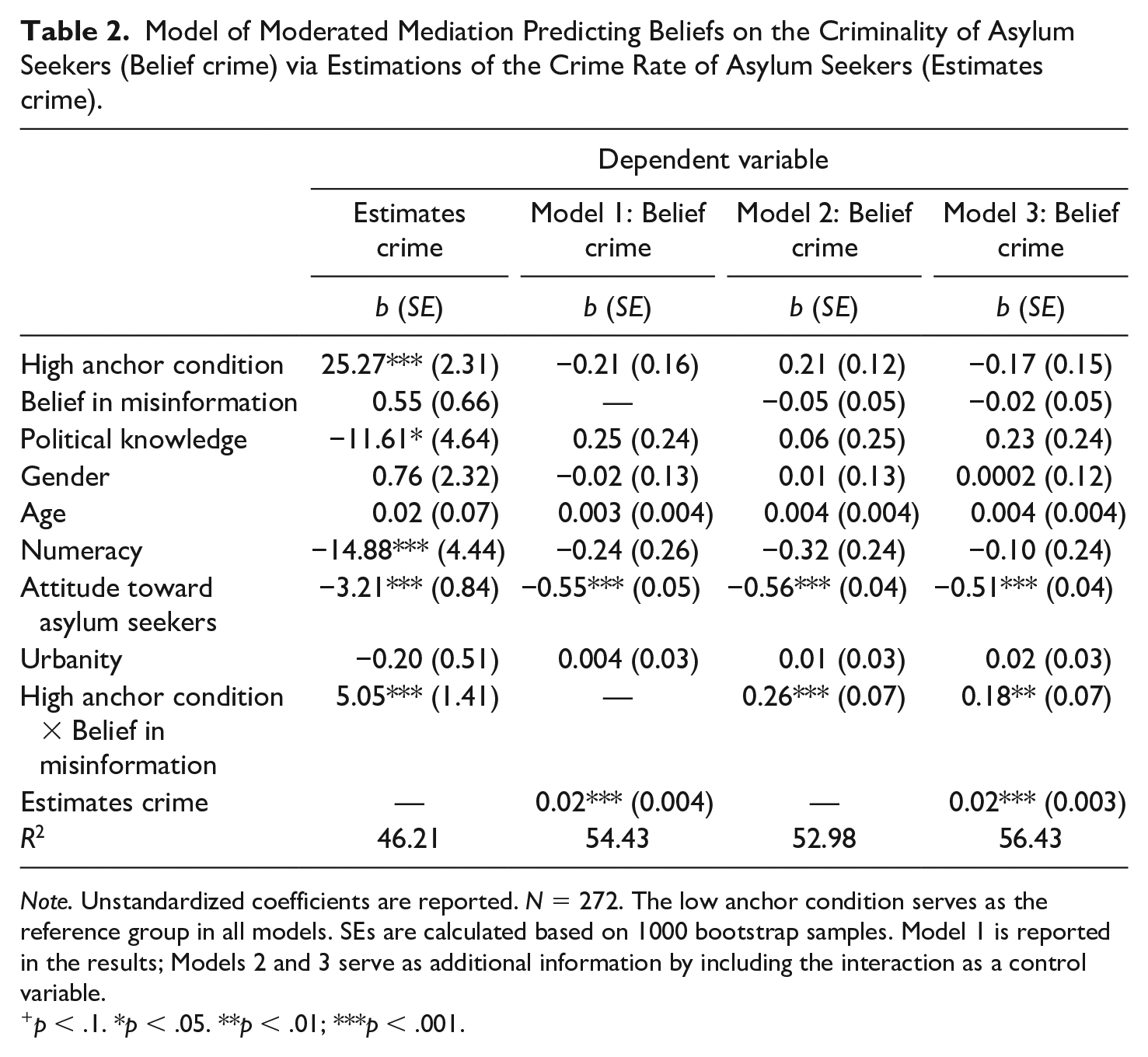
Note. Unstandardized coefficients are reported. N = 272. The low anchor condition serves as the reference group in all models. SEs are calculated based on 1000 bootstrap samples. Model 1 is reported in the results; Models 2 and 3 serve as additional information by including the interaction as a control variable.
p < .1. *p < .05. **p < .01; ***p < .001.
Finally, we examined if seeing a low or high anchor affected individuals’ beliefs through changed anchor estimates. The effect of the high anchor on people’s beliefs on educational attainments, mediated by biased estimations, probed statistically significant at each level of the moderator (see Table 3). The same pattern emerged for the moderated mediation model explaining beliefs on crime rates of asylum seekers (see Table 4). Generally, anchor estimations emerged as a significant predictor of beliefs on educational attainments, b = 0.01, p = .001, 95% CI = [0.01, 0.02], and criminality, b = 0.02, p < .001, 95% CI = [0.01, 0.02]. Thus,
Statistical Inference for Conditional Indirect Effects: Effect of the High Anchor Compared to the Low Anchor on Perceived Educational Attainments of Asylum Seekers at Different Levels of Belief in the Misinformation (N = 272).
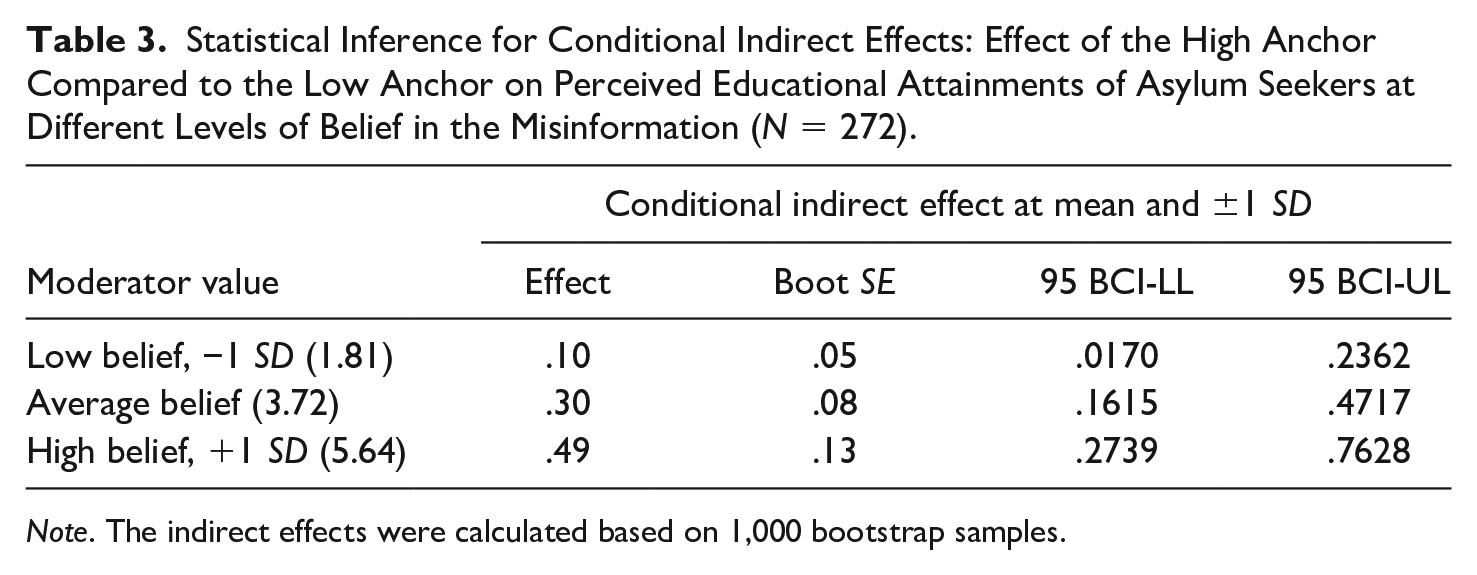
Note. The indirect effects were calculated based on 1,000 bootstrap samples.
Statistical Inference for Conditional Indirect Effects: Effect of the High Anchor Compared to the Low Anchor on Perceived Criminality of Asylum Seekers at Different Levels of Belief in the Misinformation (N = 272).
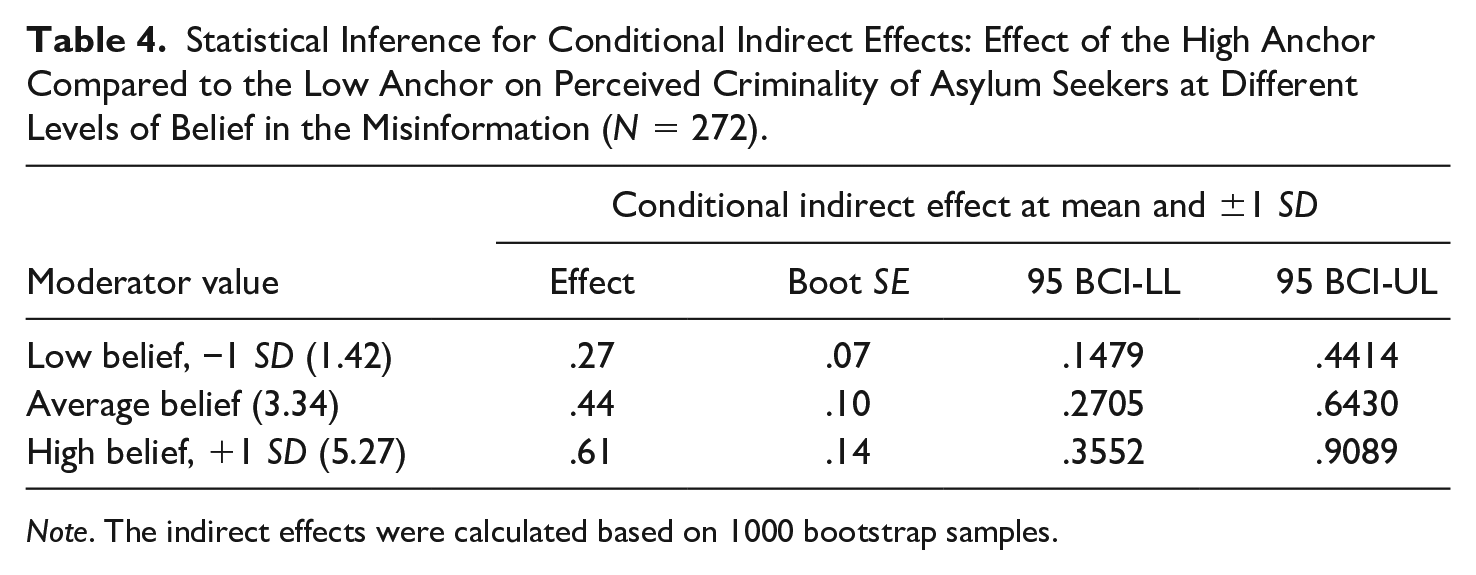
Note. The indirect effects were calculated based on 1000 bootstrap samples.
Discussion
For the first time to our knowledge, this study investigates the effects of wrong and retracted numbers in the news by bridging insights on the continued influence of misinformation and the cognitive bias of anchoring. Anchoring, as first systematically explored by Tversky and Kahneman (1974), describes how inaccurate and even irrelevant numbers can skew subsequent judgments. In sum, this study shows that anchoring also applies to numerical misinformation in the news: We find that wrong statistics might exert influence over individuals’ own estimates on the respective number and their beliefs even when such numbers are retracted and distrusted.
We tested our assumptions on the topic of refugees in Germany. Specifically, we found that individuals who are presented with a low number on the illiteracy rate or the percentage of crimes committed by asylum seekers arrive at lower estimates when asked for their guess despite of the retraction. Strikingly, the low anchor group rated the illiteracy rate by 22 percentage points lower as compared to the control group. In contrast, seeing a high retracted number on the illiteracy rate resulted in higher estimates. However, although pointing to the expected direction, individuals seeing a high number on the crime rate did not significantly differ from the control group in their judgments. A possible explanation for this null-result might be that the anchor value was set too low. In other words, the manipulated number could have been lower than what a decisive number of participants would have guessed without the anchor and thus might have lowered extreme estimations as a result. Considering that on average participants have guessed that 31.9% of crimes were committed by asylum seekers, this poses a plausible explanation. In addition, the low but not the high number on criminality might influence people’s judgment, because news consumers are already habituated to claims of high criminality among asylum seekers. This notion parallels previous findings which indicate a higher influence of positive as opposed to negative news on migration (Trilling et al., 2017; Van Klingeren et al., 2015).
Notably, participants were presented with a relevant anchor number as opposed to an issue-unrelated number that may elicit moderate emotional intensity. Both factors, relevance and emotionality, are known to enhance anchoring effects (Araña & León, 2008; Glöckner & Englich, 2015). There is also reason to belief that anchoring effects occur for political topics that are less ideologically loaded and are processed in a cue-based manner. In those cases, anchoring effects could be of similar strength but lack durability (Blankenship et al., 2008). However, these theoretical assumptions still await testing.
We extend previous scholarship on anchoring effects by taking individuals’ distrust of the initial information into account. In line with the persuasion model of anchoring, contextual and social factors such as relevance and trust might shape the strength of anchoring effects (Glöckner & Englich, 2015; Wegener et al., 2010). Our results show that individuals high in disbelief of the misinformation exhibit reduced anchoring effects. Nevertheless, the anchoring bias was significant at all levels of the moderator. This contrasts research from misinformation studies, which suggests that pre-existing attitudes and distrust against a source eliminate biases stemming from retracted misinformation (Walter & Tukachinsky, 2020). Consequently, distrust does not constitute a definite boundary condition of the anchoring paradigm.
There are two main explanations for the attenuation of anchoring effects through distrust: First, the results could indicate that the mental state of distrust can help individuals to later on discount unsubstantiated information. According to Schul and Mayo (2014), this might be due to the encoding of disconfirmatory thoughts alongside the misinformation and a heightened motivation to be accurate. Second, as an alternative explanation, the observed effects might stem from individuals’ pre-existing knowledge. Individuals that are high in issue specific knowledge might be more distrustful against the misinformation and simultaneously less influenced by anchoring effects due to their narrower range of plausible estimations. To disentangle these effects, future studies should control for or manipulate issue specific knowledge (see e.g., Blankenship et al., 2008) while also manipulating distrust (see e.g., Schul and Mayo, 2014).
The reasons leading to distrust might be an additional avenue to explore in future studies. While conflicting knowledge is one possible source of distrust, also motivations, perceived ulterior motives, pre-existing trust structures (Druckman & McGrath, 2019), and predispositions (Gollwitzer et al., 2013) might induce distrust.
Finally, the data suggests a correlation between people’s skewed estimations and their beliefs on two highly debated issues, the criminality and the educational attainments of asylum seekers. While we can’t prove a causal effect in our data, our findings still point to the importance of evaluating real-life consequences such as changes in overall beliefs or behavior due to the anchoring bias (Brewer et al., 2007; Epley & Gilovich, 2010). The observed difference in participants’ beliefs also sheds light on existing theories of anchoring. It supports the assumptions derived from the selective accessibility model of anchoring which suggest that knowledge in line with the presented value becomes more accessible and thus may be used in subsequent decisions (Bahník & Strack, 2016; Mussweiler & Englich, 2005; Mussweiler & Strack, 1999aa). However, also the attitude change model of anchoring would predict a similar outcome under the condition that people refrain from counterarguing the presented value (Epley & Gilovich, 2010; Wegener et al., 2001).
Our findings are also interesting in the light of framing, priming, and agenda setting theories in communication science. Paralleling the accessibility model of anchoring (Bahník & Strack, 2016; Mussweiler & Strack, 1999a), these theories propose that media messages make certain concepts more accessible in individuals’ minds and therefore can change attitudes and behaviors. Scholars have argued that accessibility effects “will operate, at least to some degree, among all members of a population” (Cacciatore et al., 2016, p. 13). In line with this assumption, in the current study, the presented numbers affected all individuals, even those with heightened distrust. These similarities raise the question whether anchoring theory can be consolidated with framing theory from communication science. However, important inconsistencies and open questions remain. First, anchoring effects are frequently found to last over several days, while priming and framing effects can rapidly vanish (Blankenship et al., 2008; Mussweiler & Strack, 1999b). Second, in regard to framing theory, a certain frame needs to be applicable, that is, the presented information needs to match an already existing schema in recipients’ minds (Cacciatore et al., 2016). In contrast, anchoring produces effects even when there is no logical relationship between the numerical stimulus and the outcome, such as the number on a wheel of fortune and the number of African countries that are part of the United Nations (Tversky & Kahneman, 1974). Third, anchoring involves substantive differences in the provided information, such that the presented high or low numbers carry conflicting information about the presented issue. Thus, the numerical information is neither identical (i.e., equivalency framing), nor presents different sides of the same issue (i.e., emphasis framing). Future research should nevertheless explore similarities between the underlying processes that produce framing and anchoring effects. Accessibility, applicability, the level of elaboration, and emotions and comprehension of the number as mediators (Lee et al., 2021) could be interesting areas for comparison in future studies.
Taken together, our findings give a first account on how inaccurate numbers in the news might influence citizens’ perceptions on debated issues such as the criminality and illiteracy of asylum seekers. From these results, we can tentatively deduce that wrong numbers, as presented in the context of migration, represent a critical challenge to public opinion formation despite of journalistic watchdogs.
Limitations and Future Research
Several limitations of this study need to be considered. First, the experimental design can only provide correlational evidence for the relationship between skewed estimates on numbers and beliefs. Based on previous literature, we expect that biased judgments on the number affect beliefs (Brewer et al., 2007; Epley & Gilovich, 2010). However, the causal chain could be reversed. To strengthen claims of causality, a panel study with autoregressive models that examines how changes in individuals’ estimates affect attitudes over time could be conducted. Furthermore, our findings were obtained in settings which might differ from real-word situations of news consumption.
Second, we only tested our hypothesis on one issue, namely on numbers concerning asylum seekers in Germany. As noted in the discussion, ideologically heated topics could lead to more durable effects that are even more difficult to correct. Therefore, future studies still need to test the robustness of our result in different contexts. In addition, we examined a specific kind of correction which stated that no statistics on this topic are available based on actual cases of fact-checking in the Germany news. While some studies suggest that corrections in form of negations (X did NOT happen) are more difficult to process (Lewandowsky et al., 2012), a recent meta-analysis found no significant difference to corrections that give a full alternative explanation (Walter & Tukachinsky, 2020). Moreover, the retraction we used did not present a correct number, as no such statistics are available. This might lead some individuals to fully disregard the number and numbers in its vicinity, while other individuals might still consider the misinformation as a possibly correct answer (see Schul & Mayo, 2014 for a discussion on negations). Therefore, also different forms of debunking misinformation would be worth further investigation, for example, when the correct number is presented.
Third, future studies could generate further insights by adopting the experimental set-up of studies on the continued influence effect. These studies include a group that is only presented with misinformation, but not with its correction. This allows the researchers to draw conclusions on whether or not the correction backfired among more extreme individuals. In addition, we were limited in testing our full model, as we could only compare the low anchor group and the high anchor group but not the control group at different levels of belief in the misinformation. In line with studies on the continued influence effect it would be interesting to further explore the role of defense motivations in the anchoring paradigm (see Nyhan & Reifler, 2010).
Next to the tested hypotheses, the role of numeracy deserves further attention. High scores on numeracy in our sample were associated with a significantly lower estimate on the crime rate of asylum seekers. Numeracy in our study was treated as a unidimensional construct using three items, thus the measure is only a rough approximation of numeric skills. Studies suggest that numeracy is a more complex and multilayered skill (Liberali et al., 2012). Objective numeracy, which includes individuals’ skills in judging probabilities, relative magnitudes and multiplication, is associated with a reduction in framing effects and anchoring effects (Helm et al., 2020; Peters, 2012). However, when issues are strongly polarized, numeracy might even strengthen existing biases (Kahan et al., 2012) and therefore lead to a higher acceptance of attitude-consistent anchors. In contrast, the numeracy-related concept of cognitive reflection, which is related to open-minded thinking (Liberali et al., 2012), did not affect the magnitude of anchoring effects (Bergman et al., 2010). In sum, future studies could test the robustness of bias-reducing effects of objective numeracy in more polarized contexts.
The effects found in our study have several implications. First, they point to the importance of media literacy and numeracy, as individuals were better at shielding themselves from the anchoring effect when they distrusted the initial number. A theoretical implication of our findings is the importance to examine the rich literature on cognitive psychology, which has already investigated various causes for biases and strategies to counteract them. The anchoring effect offers additional insights that could be worth incorporating and testing in future media studies on misinformation. Misinformation scholars could further build on the anchoring literature by drawing on findings that motivational and cognitive biases might co-occur (Simmons et al., 2010), so that certain biases might prevail even if individuals are motivated and able to resist them. Manipulating motivations and processing effort as well as directly testing the accessibility of certain concepts in individuals’ minds might shed light on the underlying processes of the persistence of misinformation. On a practical note, this study also points to the responsibility of media organizations to refrain from presenting unsubstantiated numerical information—even if just to retract it (see also Garrett & Weeks, 2013).
Supplemental Material
sj-docx-1-jmq-10.1177_10776990211021800 – Supplemental material for Why Retractions of Numerical Misinformation Fail: The Anchoring Effect of Inaccurate Numbers in the News
Supplemental material, sj-docx-1-jmq-10.1177_10776990211021800 for Why Retractions of Numerical Misinformation Fail: The Anchoring Effect of Inaccurate Numbers in the News by Marlis Stubenvoll and Jörg Matthes in Journalism & Mass Communication Quarterly
Supplemental Material
sj-docx-2-jmq-10.1177_10776990211021800 – Supplemental material for Why Retractions of Numerical Misinformation Fail: The Anchoring Effect of Inaccurate Numbers in the News
Supplemental material, sj-docx-2-jmq-10.1177_10776990211021800 for Why Retractions of Numerical Misinformation Fail: The Anchoring Effect of Inaccurate Numbers in the News by Marlis Stubenvoll and Jörg Matthes in Journalism & Mass Communication Quarterly
Supplemental Material
sj-docx-3-jmq-10.1177_10776990211021800 – Supplemental material for Why Retractions of Numerical Misinformation Fail: The Anchoring Effect of Inaccurate Numbers in the News
Supplemental material, sj-docx-3-jmq-10.1177_10776990211021800 for Why Retractions of Numerical Misinformation Fail: The Anchoring Effect of Inaccurate Numbers in the News by Marlis Stubenvoll and Jörg Matthes in Journalism & Mass Communication Quarterly
Footnotes
Declaration of Conflicting Interests
The author(s) declared no potential conflicts of interest with respect to the research, authorship, and/or publication of this article.
Funding
The author(s) received no financial support for the research, authorship, and/or publication of this article.

Supplemental Material
Supplemental material for this article is available online.
Notes
Author Biographies
References
Supplementary Material
Please find the following supplemental material available below.
For Open Access articles published under a Creative Commons License, all supplemental material carries the same license as the article it is associated with.
For non-Open Access articles published, all supplemental material carries a non-exclusive license, and permission requests for re-use of supplemental material or any part of supplemental material shall be sent directly to the copyright owner as specified in the copyright notice associated with the article.
