




Abstract
This study examines and compares requirements outlined in news reporter/anchor job postings and the curricula of 104 undergraduate journalism and broadcasting programs accredited by ACEJMC. Results indicated that while journalism education appears to meet the industry expectation, some discrepancies in required skills and abilities were found. Considering the dynamic landscape of the journalism industry, this study not only shows current human resource needs in the journalism industry but also provides practical implications for journalism education.
Introduction
A 2024 report from the Radio Television Digital News Association (RTDNA) found that employment at local television news stations was up from the previous 2 years and was nearly equal to the all-time record high (Papper & Henderson, 2024). While not universal among all journalism programs, many universities were seeing consistent or increasing enrollment among those majoring in the subject (Nelson, 2022). However, a study from 2013 found that, while nearly all journalism educators believed a journalism degree was important (96%), just over half of those working in the field agreed (57%) (Finberg, 2013). This disconnect led to a push for journalism schools to reinvent the curriculum to meet industry needs (Wenger et al., 2018).
As newsroom jobs continue to evolve with increasing technological and employment changes (Goetzl, 2012; Hull, 2022; Papper, 2021), it is worth examining if journalism education programs are preparing their students for the jobs that are currently being advertised. Utilizing a natural language processing approach, the study analyzed a substantial dataset of on-air job postings in the broadcast news industry and curricula from 104 undergraduate journalism programs in the United States (U.S.). Grounded in the Knowledge, Skills, Abilities, and Others (KSAO) framework from human resource management literature, this study accurately estimated KSAO ratings by parsing job descriptions and requirements. In addition, by comparing the data to current journalism and broadcasting course descriptions, this study seeks to bridge the gap between practice and education. Considering the dynamic landscape of the broadcasting industry and the need for rapid changes in journalism courses and curricula, this study provides important guidance for educators to help students prepare for the future job market. Moreover, organized information on desired job requirements based on the KSAO framework can be used to inform news industries in seeking and evaluating their future employees systematically.
Literature Review
Evolution of Local Television News Jobs
For decades, the job of a local television news reporter or anchor was focused on a few newscasts. These on-air broadcasters were tasked with delivering the day’s information in the early evening newscast and a late evening newscast. However, over the years, more newscasts were added and the amount of news on television stations nearly doubled from 3.7 hrs in 2003 per day to 6.6 hrs in 2022 (Papper & Henderson, 2023). In addition, in some cities in the United States, two previously competing television stations have entered into what is known as a shared services agreement in which they essentially become strategic partners and share news-gathering resources (Hull & Coffey, 2015). In this arrangement, an on-air personality might appear on the 10 p.m. news on one station and then the 11 p.m. news on another station. Therefore, news reporters often find themselves doing twice as much work as previously noted.
However, that is not all that has changed in the daily work routine of news reporters. Previously, many news stations employed videographers to work with reporters to gather news stories out in the community. The videographer would use the camera to capture the video, while the reporter would focus on interviewing and writing the script. In a 2001 study about newsroom employment, local television stations reported that videographers were the most often hired position in the newsroom (Papper & Garland, 2001). However, 20 years later, videographer was not ranked in the top four of a similar survey. Instead, the job of multimedia journalist (MMJ) had taken over the top spot as “most hired” (Papper, 2021). The MMJ position is one in which a reporter is expected to do a variety of tasks throughout the day, meaning they are not just appearing on television, but are often the ones shooting their own video for stories, writing the script, and editing the video.
In addition, the industry shifted to a “digital first” mentality in which the expectation is that websites and social media accounts should be updated throughout the day (Goetzl, 2012; Marszalek, 2012). This means that, in addition to now shooting and editing their own video, reporters are also writing a web story and posting on social media accounts. This concept of reporters doing a variety of different jobs that were previously handled by other employees, long referred to as “one man banding” in the television industry, leads to a full plate of work responsibilities (Hull, 2022).
Broadcast Journalism Education
The onus on teaching future broadcasters the skills needed to be successful in their career often falls on journalism programs at higher education institutions. Staring in the late-1800s, journalism education underwent a transformation from a few classes littered throughout a campus to entire programs housed inside a journalism school that were devoted to teaching the next generation of reporters, editors, and other newsroom staffers (Folkerts, 2014). In 2021, researchers found that 31.1% of those enrolled in a journalism and mass communication program in the United States were in a journalism sequence, an increase from both 2015 (24.9%) and 2018 (26.3%) (Cummins et al., 2023). For many years, having an education background that included journalism courses or a journalism degree was seemingly a prerequisite for those seeking newsroom employment (Frith & Meech, 2007).
As efforts to keep up with the fast-changing industry requirement, many journalism programs have adopted experiential learning courses (e.g., mobile journalism). Experiential learning is based on the idea of social learning theory (Lave & Wenger, 1991) indicating that individuals gain the skills through direct engagement in the process rather than abstract knowledge. Furthermore, the theory highlights the importance of learners’ participation in practice communities (Wenger, 1998). By participating in the communities of practice, individuals can deepen their knowledge and skill through interacting with groups of people (Lave & Wenger, 1991). This situated learning approach focuses on relational and interactive nature of learning activities within the community of practice. By creating professional media communities through hands-on courses, the journalism programs have been responding to industry needs. A plethora of studies have examined the positive correlations between experiential learning and students’ successful job placement in the journalism field (Brandon, 2002; Feldman, 1995; Fowler-Watt, 2014; Hendrickson & Ferguson, 2024; Rhodes & Roessner, 2009; Valencia-Forrester, 2020). Based on the data from journalism graduates’ survey, Wolfe (2014) argued that experiential learning helps journalism students secure job placements in the media industry.
However, research into journalism education has demonstrated that, despite access to specialized classes and programs, some broadcast employers believe that students have not been properly trained to enter the field. A 2013 report from Poynter, a leading journalism research organization, noted that 48% of newsroom leaders believe higher education programs were not keeping up with changes in the industry (Finberg, 2013). For many years, critics observed that journalism education “remained unchanged for decades” and that journalism schools were “unprepared” to meet the quickly changing realist of the profession (Mensing, 2010b, pp. 511–512). One went as far as to suggest that journalism education needed “a heart transplant” (Stephens, 2000, para. 11). In an attempt to prepare students for the changing profession, more than half of all journalism schools in the United States redesigned the curricula or created new classes between 1998 and 2002 (Huang et al., 2006). However, despite those updates, there remained a push to continue reinventing journalism education to meet employer needs (Mensing, 2010a; Wenger et al., 2018).
KSAO Framework in Human Resources and Broadcasting Job Requirements
The KSAO framework is a human resource-focused job analysis approach, indicating knowledge, skills, abilities, and other characteristics essential for effective job performance (Primoff, 1975). Job analysis and classification provide a foundation for employees (e.g., job search and career exploration) and employers (e.g., workforce evaluation and analysis; Brown & Lent, 2013). Consequently, the KSAO framework has been used to delineate human capital resources in different industries, vocations, and work settings (Ployhart et al., 2014). The framework has been adopted in management (Zwick et al., 2017), human behavior (Oberländer & Bipp, 2022), and public relations (Choi et al., 2025) research.
According to definitions by Noe et al. (2006) and Schmitt and Chan (1998), knowledge refers to the understanding of factual and procedural information necessary to perform a particular position. Knowledge often forms the foundation for developing further skills and abilities required for job performance. Skills represent an individual’s proficiency and capabilities to perform a job task, whereas abilities pertain to more cognitive and enduring capabilities. Skills are typically acquired through training, whereas abilities are considered more innate than skills. Other characteristics are a range of qualifications to perform a job such as values, personality, or work style.
Typically, knowledge is acquired through formal education, and degrees or certificates in particular areas are considered knowledge. In broadcasting jobs, degrees in journalism, mass communications, or communications are often essential. Regarding skills and abilities, changes have been observed in the requirements for journalism jobs over time. In a study published in 1978, broadcast journalists stated that three of the most relevant skills needed to prepare them for their job were writing, reporting, and typing (Fisher, 1978). By the mid-1980s, writing remained one of the top skills deemed necessary to be successful in television news, but video equipment skills were beginning to grow in importance (Hudson, 1986). By the 1990s, researchers noted the “blurring of the line between ‘print’ and ‘broadcast’ media,” necessitating a good foundation of writing and storytelling for both genres (Guerke & Hirst, 1996, p. 117).
As the calendar turned to the 2000s, an increase in multimedia skills were noted. This included a focus on working with online platforms such as the television station website and social media accounts were deemed essential (Wenger & Owens, 2013). That team of researchers also examined the change in job listings from 2010 to 2015 and found that job listings were more likely to list web and multimedia skills than they had in 2015, whereas previous professional experience and writing skills remained two of the most requested traits for those applying for jobs (Wenger et al., 2018). The need for previous experience was also a focus of a 2019 study that found that traditional expertise (such as news judgment, writing, and shooting video) and adaptive abilities (such as ethics, managing deadlines, and working long hours) were more likely to appear in broadcast news job advertisements than print or online news advertisements (Guo & Volz, 2019).
As new jobs emerge and evolve over time, maintaining up-to-date job analysis information and continually reviewing educational curricula will help academic institutions align their programs with the rapidly changing employment trends in the journalism industry. Although the KSAO framework provides a systematic understanding of job market demand and the current state of journalism programs, its application to the field remains limited. Thus, this study proposes the following research questions to address this gap:
Method
To investigate the job requirements in the current journalism job market, 655 job postings were collected from TVjobs.com between June 1, 2024, and January 31, 2025. The website’s administrators state that it is the “largest broadcast related employment company” on the internet and has been online since 1994 (TVJobs—Services, n.d.). Employers can post jobs for free on the website, whereas job seekers pay a subscription fee to see the listings. The databases are updated daily with new jobs straight from the employers or through internet searches of television station websites and ownership group. For this study, any job listing from the website that was considered an on-air news job at a commercial television station was saved as a PDF file. This included listings with job titles of reporter, anchor, or reporter/anchor. All new jobs were downloaded each Monday during the sample period to ensure that no posted employment opportunities would be omitted.
To identify the details of the journalism courses required by the journalism programs in the United States, information regarding journalism courses and their descriptions was collected from each website of the Accrediting Council on Education in Journalism and Mass Communications-accredited 104 undergraduate programs in the United States. All the required courses to attain a bachelor’s degree in journalism programs were collected, and a total of 3,299 courses from the programs were included in the final dataset.
To analyze the datasets based on KSAO frameworks, we took different approaches to Knowledge and Skills/Abilities. To parse out knowledge, all the degree requirements from job postings and all the bachelor’s degree titles from journalism programs were extracted. As degree titles often consist of multiple word units, we analyzed phrases with one, bi, and tri-grams so that two or three consecutive words are collected together as one phrase, such as journalism and mass communication, media and journalism, news sports media. NLTK and spaCy packages in Python were used for data cleaning and lemmatization. The Gensim package in Python was used to group and categorize degree titles. Skills/Abilities were analyzed using the word2vec algorithm. In word2vec algorithm, multiple dimensions are categorized based on similar concepts or sequential meanings of words. Each word from the dataset is placed into a vector space, comparing words using cosine similarity scores. Cosine similarity quantities the similarity between two words by calculating the cosine of the angle between their vectors in the multi-dimensional space (Hanifi et al., 2022).
Based on the existing literature, 35 categories of skills (Mumford & Peterson, 1995; Putka et al., 2022) and 52 Abilities were created (Putka et al., 2022). Then, each lemmatized word was compared with each category of SA using cosine similarity scores. These scores ranged from 0.0 (no similarity) and to 1.0 (direct similarity), meaning a high level of semantic similarity. Based on the initial data generated by the algorithm, two researchers closely inspected the qualitative data (e.g., specific words under each category). The researchers independently read all generated words under each category from skills and abilities. Next, the researchers compared the detected categories, discussed, and resolved any discrepancies. Any overlapping categories or irrelevant categories were grouped or deleted. For example, one of skills, customer service & support was not included in our final findings because the category was assigned as one category based on high semantic similarities with words like “supporting” colleagues or community “service” activities, which is not relevant to actual customer service & support skills. In addition, the public speaking category including skills like reporting, presenting, and storytelling was renamed as journalism skill to adjust the category to journalism job context.
Results
KSA in Journalism Program.
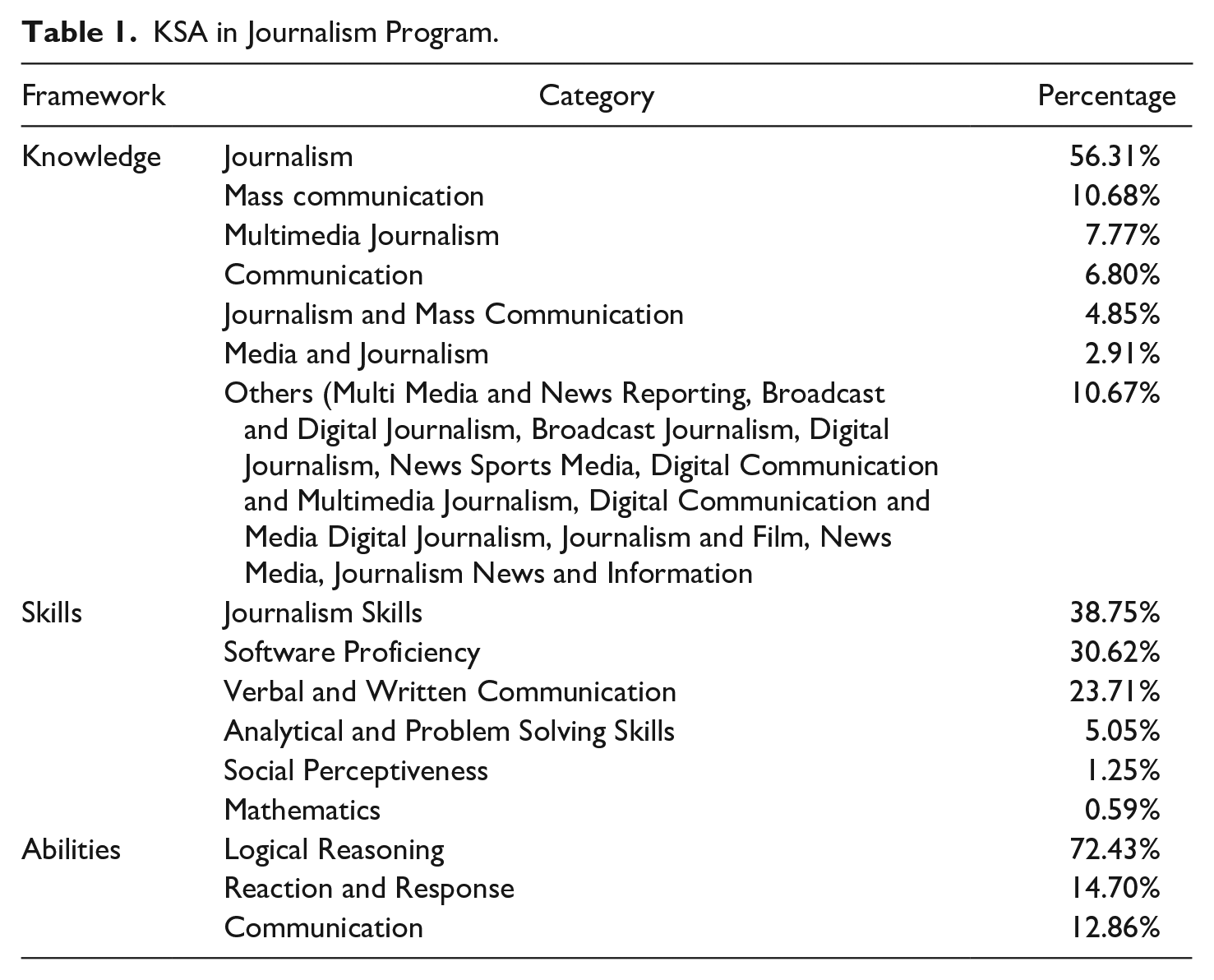
Regarding skills, journalism skills (38.75%), such as public speaking, communication, reporting, presentation, investigating, story development, and audience engagement are most frequently shown. Software proficiency (30.62%) is mentioned through photography, audio editing, digital platforms, ENPS (a newsroom production software), multimedia program/production, and content creation. This is followed by verbal and written communication (28.71%), including writing, editing, and verbal expression. Analytical and problem solving (5.05%) is taught through mass communication research methods, media/case studies/data analysis, data gathering, data journalism, and fact checking. Social perceptiveness (1.25%) is another present skill through key words involving diversity, cultural competence, inclusiveness, and cultural diversity. Finally, mathematics skill (0.59%) is mentioned through math and statistics for journalists and descriptive statistics.
Regarding abilities, logical reasoning ability (72.43%) is present through critical, ethical, and situational decision making; legal consideration; and ethical and legal decisions. Reaction response (14.70%) is mentioned with meeting deadline, deadline-driven work, and working under a deadline. Finally, communication ability (12.86%) is based on leadership, collaboration, collaborative learning, collaborative team, and collaborative production. No Other characteristics are found.
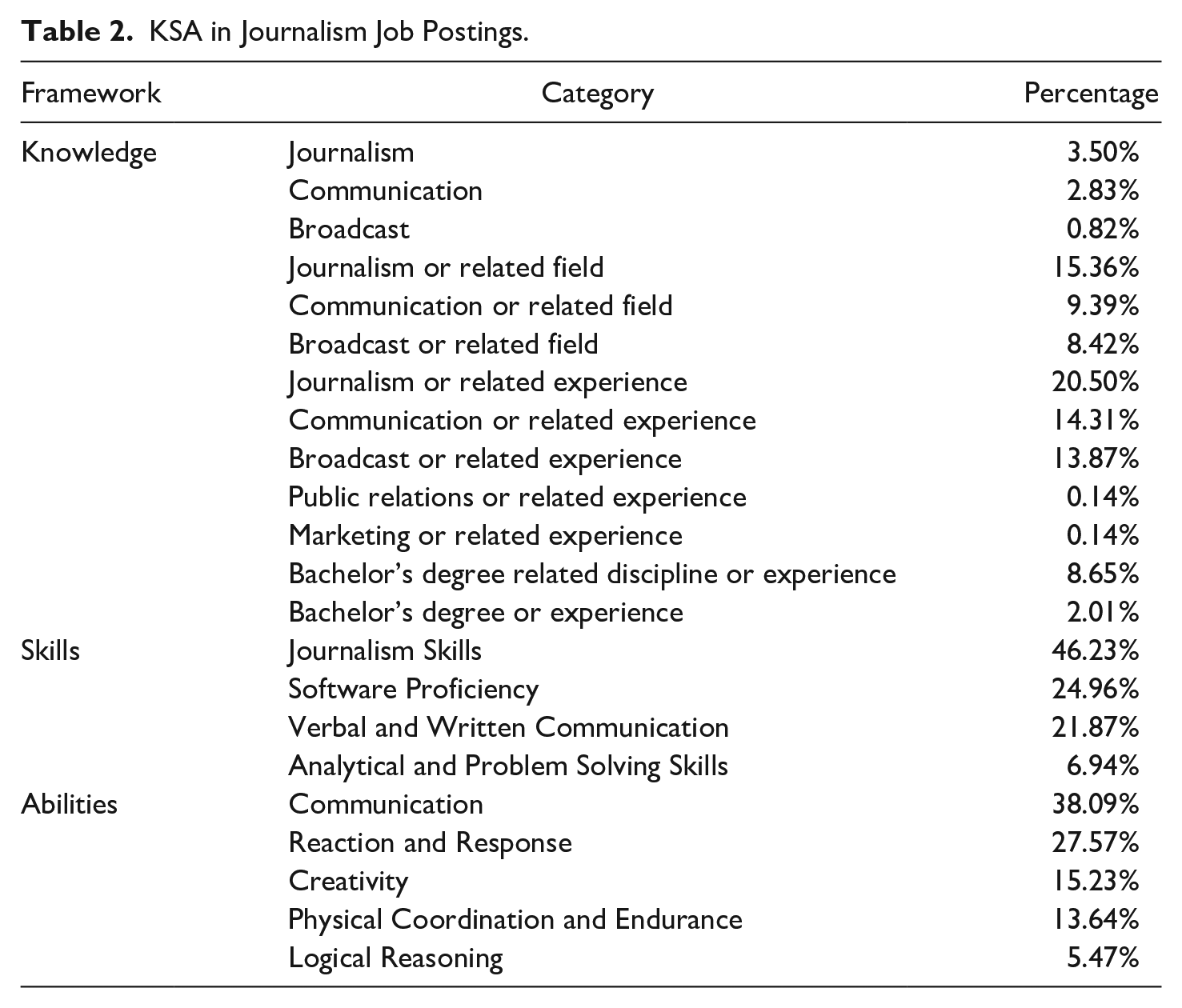
KSA in Journalism Job Postings.
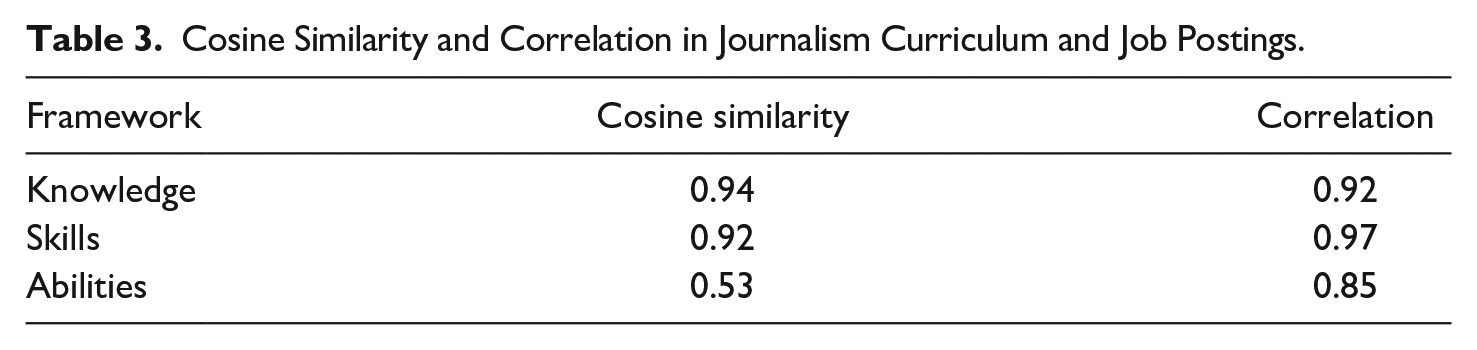
Cosine Similarity and Correlation in Journalism Curriculum and Job Postings.
Discussion
The study aims to examine prevailing job trends and requirements in the broadcast television news industry while assessing the state of broadcast journalism education in the United States. This comparative analysis can guide broadcast journalism programs in cultivating graduates equipped with knowledge, skills, and abilities required in the industry. The study also helps the journalism industry build a systematic approach to hiring and assessing human resources.
Helps to Be in a Journalism/Communications School
Administration and faculty in journalism programs should be encouraged that more than 90% of the degree names listed as job requirements are likely housed within journalism or communications schools. This finding implies that students who want to become television news anchors or reporters should enroll in a degree programs in journalism, broadcasting, or communications.
Considering that relevant experience could substitute for a degree requirement in journalism, broadcasting, or communication disciplines, our findings indicate that the job market demands graduates who are prepared to begin work immediately. This demand underscores the importance of a situated learning experience approach from journalism programs where students engage in practical work combined with valuable feedback and reflection (Kolb, 1984). Evans (2019) noted that this situated learning approach requires journalism programs to adapt quickly to the fast-evolving news industry by updating curricula and employing experienced professors and former broadcast professionals to simulate real newsroom environments and provide quality feedback. This approach may help journalism programs meet students’ needs to produce portfolio-worthy work through their coursework (Steel et al., 2007).
The results of this study may also cause journalism schools to rethink the importance of specialized degree titles. More than 10% of the schools sampled offered degrees with titles beyond “journalism” or “communications.” For example, some schools have added the word “digital” to their degree titles, such as “digital journalism” or “digital communications.” While schools may be creating these specialized titles with a goal of student recruitment, the local television news employers have not responded with demands for those degrees from applicants.
Meeting Skills Expectations
Another encouraging sign for those working at journalism/communication schools is that these results demonstrate that programs are doing a good job of introducing the skills that are listed in the job ads. Nearly every job post listed specific journalism skills such as storytelling as a requirement for the applicants, many of which are already being taught based on the course descriptions that were analyzed. This finding indicates that journalism programs are preparing students for the day-to-day tasks involved with being a television news reporter or anchor.
Although journalism skills are the most commonly required from job candidates, a large part of the data shows the need for very specific skills in breaking news coverage, live reporting, or on-scene correspondence. For example, one job advertisement stated that applicants “must demonstrate strong ad-libbing skills,” and another required that the journalist “excel at breaking news.” A possible addition to broadcasting curricula would be additional emphasis on teaching for breaking news and or live situations that involved ad-libbing by the on-air reporter. Those skills, while perhaps taught in some classes, were not listed specifically in the course descriptions. Given that job postings request highly specific skills, courses providing experiential learning (Lave & Wenger, 1991) in real broadcasting environments become crucial to ensuring graduates are well-suited for the job market.
While a large majority of U.S. adults (86%) obtain news from digital devices such as smartphones, computers, or tablets (Pew Research Center, 2024), 63% of Americans still consume television news simultaneously. With this multimedia news consumption trend, our data also show a high demand for MMJs in the job market. Job posts frequently mention requirements like “edit videos for all multimedia platforms,” “assist online staff in preparing for multimedia stories,” “produce and present reports for all platforms.” Advanced software skills are required, including computer literacy, social media proficiency across different platforms, photo and videography skills, and editing expertise. With the fast-changing digital age, the journalism industry requires schools to produce graduates who are better equipped to meet the industry needs related to technologies (Creech, 2021).
Although our results indicate that journalism schools currently meet overall requirements in digital journalism education, the findings related to demand for MMJs and software proficiency imply the need for constant and fast transformation for journalism programs. For example, Wenger et al. (2024) interviewed 14 ACEJMC accredited journalism school administrators in the United States regarding artificial intelligence (AI). They found that although journalism schools recognized the importance of incorporating AI into the curriculum, none had developed a decisive and comprehensive plan for AI instruction. Creech (2021) pointed out journalism education for being reactive and slow to adapt to the dynamic changes in the news industry. However, despite this reactive stance, universities provide arenas for in-depth discussions on ethical issues related to AI development and use (Borenstein & Howard, 2021), fake news, and digital misinformation (Carlson, 2020) based on scholarly efforts. By integrating these scholarly insights and practical approaches into their curricula, journalism programs can demonstrate their educational roles in terms of leading and shaping the visions for journalism education and industry practices.
No Law Class Needed for Job?
Although journalism programs meet industry needs for abilities in communication, logical reasoning, and reaction and responses, some discrepancies were found regarding connection to community services (communication ability). Considering that local journalists report various local and community issues and events, our result reveals the need for additional service-learning classes in the journalism program. With the emphasis on civic journalism and grassroots level reporting (Segun, 2024), journalists need to build trust in their local neighborhoods to overcome citizens’ wariness (Robinson, 2017). Through service-learning classes, students may experience and learn the role of journalists within their community, civil society, and democracy, thereby conceptualizing their vocational role in specific contexts (Robinson, 2017). This approach may enable students to create portfolio-worthy works.
Another notable discrepancy between journalism curricula and job postings is the presence of law and ethics classes despite there being no law-specific abilities mentioned in any of the job ads. However, some did list ethical decision making as being an important part of employment. Even with this disconnect, law and ethics classes remain a cornerstone, and often required, class in nearly every journalism school curriculum in the UnitedStates. Guo and Volz (2021) pointed out that journalism ethics, media law, media effects are important knowledge for editors. Although not explicitly required in entry-level job posts, logical reasoning based on media law and ethics becomes critical as journalists advance to higher positions, where they make decisions that affect media agendas. This finding indicates the importance of these courses in the journalism program. In addition, Kelley (2007) highlighted the need for a holistic journalism education that combines professional practice and academic discipline. Meeting the needs of the journalism industry is one of the core goals of journalism education, but journalism educators must also prioritize nurturing future journalists who can understand the role of journalists and media in a democratic society. Our findings reveal the ongoing efforts from journalism programs for a holistic journalism education.
“Life of a Reporter” Class
Job postings also list several behind-the-scenes qualities, personality traits, and attitudes that are likely not part of a traditional curriculum but worth incorporating into journalism programs. Some of these requirements include working flexible hours, having a positive personality, and collaborating well with others. While it may be difficult to teach someone to be a team player, schools can instead prepare students for the lifestyle traits that encompass the job. For example, a “Life of a Reporter” one-credit course can feature rotating guest speakers from various stages of their careers. Early-career reporters can discuss unexpected challenges during their first few months on the job, whereas newsroom leaders can explain the “soft skills” that many successful journalists possess. Considering the fast-changing job market requirements with the evolving media industry, implementing topic courses with flexible content and themes may help journalism programs respond quickly to industry needs.
Limitations and Future Research
While this research achieved the desired goal examining and comparing requirements outlined in news reporter/anchor job postings and the curricula of 104 undergraduate journalism and broadcasting programs, it is not without limitations. It should be noted that, while the anchors and reporters are often the “face” of a television station due to being the public facing component of a newsroom, they are far from the only important members of the staff. Future researchers should compare other newsroom jobs with broadcast curricula, such as producers, sports reporters, and videographers to examine the curricula of journalism programs and help better prepared for the future newsroom personnels.
In addition, while administrators at TVJobs.com tout the website as the primary online source to search for broadcast news jobs, it is not the only website that does so. Those looking to continue researching in this area can examine openings on the websites of both individual television stations and television station ownership groups.
Conclusion
This study examines how broadcast journalism education aligns with the current job trends and requirements in the news industry. This comparative analysis underscores a consistent alignment of broadcast journalism education with industry expectations. Overall, journalism/communications programs are adequately preparing students for careers as news reporters or anchors.
By adopting a data-driven approach, this study provides important pedagogical implications, such as situated and experiential learning, scholar–practitioner approach, community service learning, and attitude training through topic-based courses. The concept of journalism practice has been evolving with emerging new technologies and consequent rapid changes. Our findings indicate that although traditional roles and qualifications are still emphasized in practice and education, the industry demands continuous and quick adaptations from journalism schools. Furthermore, this study suggests that journalism programs constantly need to reconceptualize journalism education, industry, and practice based on scholarly and practical approaches.
Considering the ongoing demand for research on this topic, future studies may explore extensive data by incorporating one or more years of job postings from a job posting website. In addition, including a dataset from journalism courses outside the accreditation of ACEJMC may offer detailed comparative insights. Moreover, although the natural language processing approach effectively classifies and groups word corpus into specific categories, future studies may benefit from additional human coding to clearly distinguish the difference among KSAOs. Researchers may further parse out the qualifications that fall outside the KSAOs framework.
In an era where higher education institutions look for ways to attract, engage, and retain students, producing students prepared for the job market becomes instrumental in achieving these institutional goals. Given the need for constant updates on industry job requirements and relevant curricula, this study provides important insights and implications for the broadcast journalism education and industry.
Footnotes
Declaration of Conflicting Interests
The author(s) declared no potential conflicts of interest with respect to the research, authorship, and/or publication of this article.
Funding
The author(s) received no financial support for the research, authorship, and/or publication of this article.
