




Abstract
This study explores journalism students’ responses to hazards and hostility in the profession within a Safety of Journalists course. The research uses focus group interviews, field notes, study diaries, written tasks, and Teams’ chat logs of 11 students. Students’ reactions to the hazards highlight the importance of awareness for finding solutions and developing resilience. Proposed solutions include fostering self-assurance, enhancing interpersonal communication, setting boundaries to prevent burnout, and recognizing the significance of workers’ rights. However, finding some solutions was hindered by students’ experiences of media organizations neglecting worker well-being.
In recent years, there has been a growing concern for the safety and well-being of journalists, with attacks against them receiving increased attention from researchers (Carlson & Witt, 2020; International Women’s Media Foundation, 2016; Ivask & Lon, 2023; Kantola & Harju, 2021; Posetti et al., 2022). This concern has prompted a recognition of the need to prepare journalism students for hostile encounters and harassment (Eckert & Steiner, 2018; Heckman et al., 2022; Steiner, 2019). In addition, offering more solutions besides growing a “thick skin” which is a perceived solution witnessed in many newsrooms, among many journalists (Chen et al., 2020; Ivask et al., 2023).
Ogunyemi and Trifonova Price (2023) emphasize the recent recognition of the imperative to establish support systems for journalists’ well-being. In addition, Ogunyemi and Trifonova Price (2023) argue that journalism students are ill-prepared to cope with the challenges of reporting in the 21st century. This notion is substantiated by a study conducted by Specht and Tsilman (2018) as well as Hill et al. (2020), which underscore the existing gap in adequately preparing journalism students to cope with the challenges and demands associated with potentially hazardous reporting tasks.
Recent research has paid attention to preparing journalists for work-related challenges. For example, Šimunjak (2023) demonstrates that conducting focused workshops for journalists can yield positive outcomes regarding their resilience. In addition, Mesmer (2023) suggests that introductory-level classes for journalism students, who represent the profession’s future, could greatly benefit from practical tips on navigating and responding to anti-media rhetoric encountered from community members, potential sources, and online audiences.
This study adds to the existing research and presents the findings of a Safety of Journalists (SoJ) course, specifically focusing on journalism students’ reactions and responses to occupational hazards. While this article does not concentrate on the analysis of didactics or the teacher’s role as a researcher, it does provide a brief overview of the challenges encountered in teaching the course.
Resilience Training Among Journalists and in Journalism Education
Resilience, often described as a form of positive mental health instruction for individuals working in traumatic and high-stress environments, has gained prominence as a means to equip journalists with the ability to adapt to and recover from crisis situations (Martin & Murrell, 2020). Research in this field suggests that resilience training in journalism education primarily addresses two key aspects. First, it aims to build resilience in journalists when they encounter traumatic situations, requiring them to report on distressing events (see Markovikj & Serafimovska, 2023). Second, it seeks to cultivate resilience in journalists, enabling them to withstand and respond to various forms of attacks and threats directed at them (see Martin & Murrell, 2020).
Resilience training in journalism primarily focuses on individuals because, as demonstrated by Ivask and Lon (2023), Eberspacher (2019), and Holton et al. (2021), media organizations often face inherent difficulties in safeguarding their journalists. One major challenge stems from the diverse nature of attacks that journalists encounter, making it challenging to develop a one-size-fits-all protection strategy. In addition, a significant portion of these harassment and attacks occurs within the “personal domain” of journalists, outside the confines of the newsroom (Ivask & Lon, 2023). This underscores the vital role that journalists play in ensuring their own safety and well-being, emphasizing the imperative need for resilience and safety training in journalism education.
Resilience is a dynamic state influenced by individual psychology, circumstances, attitudes, knowledge, and skills (Lown et al., 2015). This variability extends to empathy, allowing individuals to emotionally engage with distressing events, which can differ based on their unique life experiences and worldviews (Martin & Murrell, 2020). Due to its multifaceted nature, resilience is challenging to observe, analyze, and teach (Robertson et al., 2015), which, then again, emphasizes the need for an open forum for discussion on how to teach it among practitioners and future practitioners and this article provides a perspective on it.
The Course and Experiential Learning Theory
Moving on to more empirical grounds, the course and its main principles are introduced. In line with Mesmer’s (2023) emphasis on the importance of students gaining a comprehensive understanding of the diverse situations they may encounter as journalists, it becomes crucial for them to recognize and be able to address potential hazards. This heightened awareness enables students to navigate challenging circumstances by exploring and formulating appropriate solutions effectively. Following a similar rationale, an SoJ course was introduced at Masaryk University (The Czech Republic) designed explicitly for journalism students, aiming to foster a culture of solution-seeking and resilience among future journalists.
The course was structured in a two-part format. The lecture portion, spanning 1.5 hr, provided an overview of the issues at hand, incorporating the latest research findings. In this segment, students were introduced to the complexities and challenges of the profession. The subsequent practical component, lasting 1.5 hr, focused on equipping students with coping strategies, self-defense techniques, and resilience-building approaches.
The foundation of the course was rooted in D. A. Kolb’s (1984, 2014) experiential learning theory (ELT), which has been used by a substantial number of journalism education researchers (e.g., Feldman, 1995; Jenkins & Clarke, 2017; Tanner et al., 2012). It asserts that the most effective learning occurs through reflection on experiences. Morris (2020) reconfigured the ELT model, highlighting the significance of critical reflection in individual development, especially when focusing on problem-solving (Collins et al., 2016).
It is important to recognize that learning from experience is a process that necessitates time, guidance, and willingness to set aside preconceptions, confront emotions, and extract valuable lessons (D. A. Kolb, 1984, 2014). Therefore, during the course, instructional coaching as a method of encouraging self-analysis and actualization among students was used. Though instructional coaching is often used in teacher education, it has also shown positive outcomes—efficiency in self-assessment, reflection, and goal setting—when used on students (e.g., Corti & Gelati, 2020; Robinson & Gahagan, 2010; Volet, 1991).
Instructional coaching employs “effective listening, dialogical questioning and other communication- and relationship-building strategies” (Knight & Van Nieuwerburgh, 2012, p. 103). Rather than providing direct answers, coaches foster dialogue, encourage reflection, and support the search for solutions, thereby emphasizing professional development (Desimone & Pak, 2016). Engaging in dialogue and collaborative discussions with instructors and peers provides an opportunity for profound and critical reflection (Collins et al., 2016), which is one of the main components of ELT.
When talking about ELT, Morris (2020) highlights the lack of consensus among researchers regarding the definition of “concrete experience.” He concludes that a concrete experience is one that involves hands-on learning in genuine real-world situations (Morris, 2020, p. 1070). Considering this, it is acknowledged in the course that not all students in the SoJ course may have had prior real-world experiences. To bridge this gap, there were meetings with actual journalists specializing in war journalism and correspondence, as well as tasks where students worked together in a group.
To foster critical reflection and context-specific abstract conceptualization, classroom discussions (both in-class and on Teams’ chat), interpersonal communication exercises, and maintaining a study diary were encouraged. These activities aimed to promote the fourth phase of experiential learning—pragmatic active experimentation—through tasks such as conducting micro-interventions on cyberspace (see Table 1). Micro-intervention is an individual-centered task that “can be performed in a relatively short time period without intensive contact with a trainer or counselor” and the aim is to create positive feelings in the person (Peeters et al., 2020, p. 2). Among journalism and communication students, it has been used to fight mis-, dis-, and mal-information and bullying on cyberspace to fulfill the students’ need for “standing up” and not feeling “helpless” on social media (Murumaa-Mengel, 2023, p. 71).
Course Curriculum.
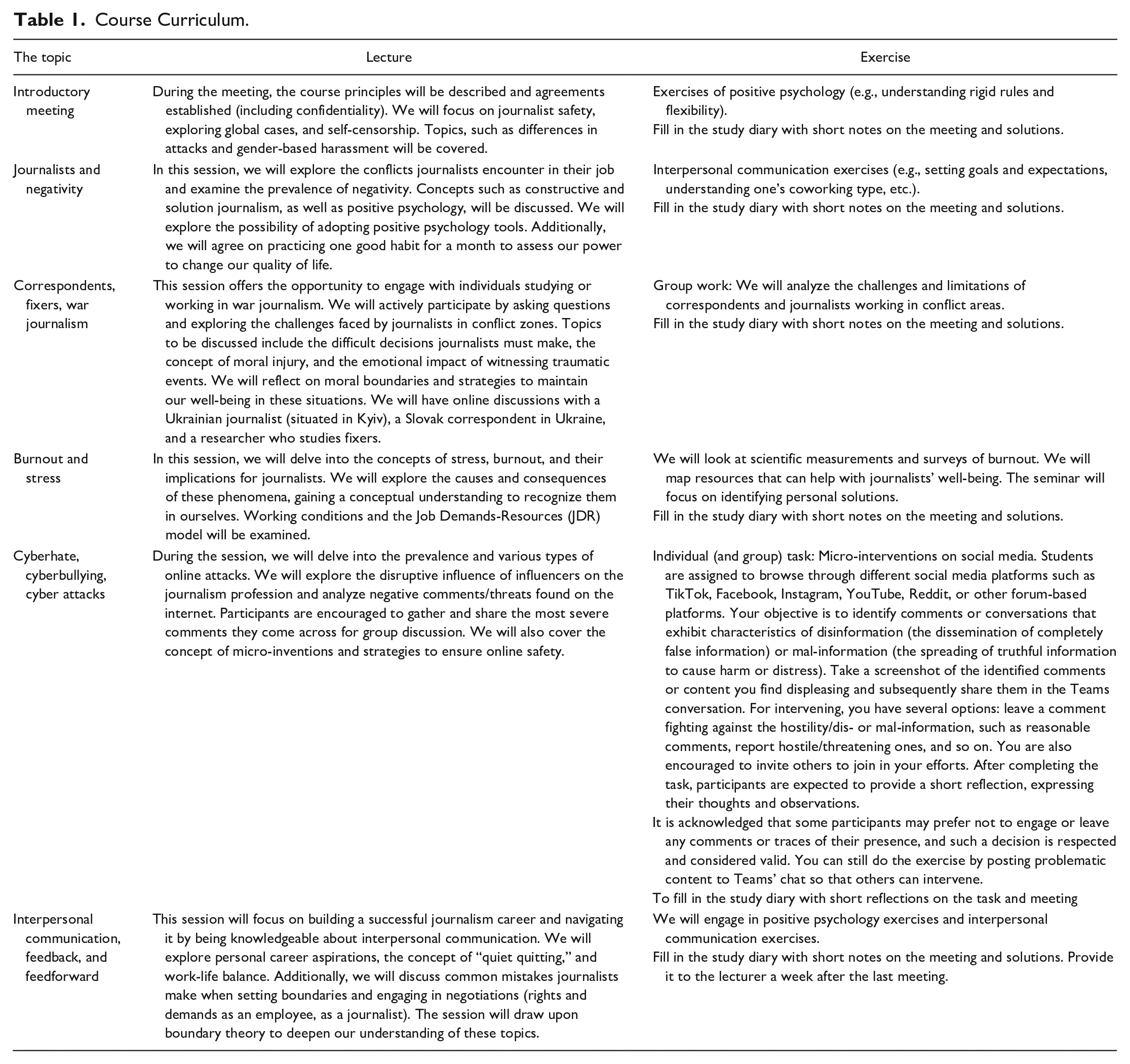
The course topics were selected by creating a literature overview of hostility of journalists and mapping the most occurring themes in the research in recent years within the context of the country where the course was carried out. The idea of this course was presented at a Journalists’ Safety conference at OsloMet in November 2022 and received feedback and ideas from researchers and educators in the field. To these topics, journalism students could also add what they see to be the most important topic from their personal experience as a journalist. The chosen topics and their brief descriptions are explained in Table 1.
This study relies on two main research questions:
The Study
The SoJ course took place at Masaryk University (The Czech Republic) during the spring semester of the 2022/2023 school year with the pace of twice per month, every other week. The course was taken by 11 journalism students, 9 from Czechia, and 2 from other countries. The course was taught in English. Most journalism students had experience as working professionals or as journalism interns.
Written notes of the course were taken by a colleague (who was introduced to the class at the beginning of the course) during the meetings and journalism students were asked to write in a study diary after every meeting (they were asked to answer questions such as, what issues were highlighted in the discussions? What do they think was most significant? What are the solutions to the problems in the lecture and discussions? How would they solve them? etc.) and present it to the lecturer at the end of the course.
As the researcher was in a position of lecturer as well, various factors were taken into account while conducting the research. According to Lankshear and Knobel’s (2004) handbook, research design needs to be thought through before the course begins. The research design for the SoJ course had been established before the course commenced, with approval from the program manager. To avoid unethical data gathering (Lankshear & Knobel, 2004), students were not only to sign a participation agreement but also provided with detailed information about the research design, the type of data to be collected, and the underlying reasons. All students received prior notification about the upcoming focus group interview and had a right to decline participation or ask their answers not to be included in the study. In addition, ethical standards in line with the university’s policies were followed.
There were written individual and group tasks at every meeting and Teams chat to lead students’ critical reflections and abstract conceptualizations (D. A. Kolb, 1984; Morris, 2020). At the final meeting, a focus group interview was carried out with all 11 students for 35 min. The interview plan consisted of questions about the course: What topics should be additionally covered, what should be changed, what should the course pay attention to next time, and so on, and about the preparation of journalists for the job.
All the data were analyzed in their written form: transcription of the focus group (40 pages), field notes (10 pages), study diaries (132 pages), written tasks (44 pages), and Teams’ chat (100 pages). Thematic analysis (Braun & Clarke, 2012) was utilized on the data. This method was chosen because it is appropriate for analyzing texts, systematically organizing, and identifying recurring themes, ideas, and topics (Braun & Clarke, 2006).
The process consists of six phases (Braun & Clarke, 2012). First, the data were read through multiple times. Second, initial codes such as “student expresses disappointment in colleagues” or “student analyses the threat in-depth” were created and marked within the text. Third, themes were formed based on the codes, such as “students” reactions “students” response and/or solution,’ and “challenge for the course.” Fourth, the themes were compared with the codes and dataset to make sure that they are themes, not codes. Then the themes were defined and a report was written.
All of the data were selected for analysis as the focus group provided explicit information on the students’ stances and feedback on the course. Field notes assisted in mapping the students’ in-class reactions and responses. Study diaries offered an overview of the students’ ability to reflect and find solutions. Other written tasks and the Microsoft Teams’ chat provided information on how the students perceived the tasks and their reflections on, for instance, defending themselves and others.
During the analysis, four main themes formed: journalism students’ experiences and reactions, reflections on understanding the experiences, finding solutions, and teaching challenges. To differentiate between students, 1-11 numerics are used.
Findings
The study’s findings are presented in the sequence of research questions, in certain instances, potential solutions are proposed.
Journalism Students’ Reactions to the Descriptions of Occupational Hazards
While the studies show the “thick skin” attitude toward hazards as normality among journalists (e.g., Chen et al., 2020; Ivask et al., 2023), students pointed out during the focus group interview that the reason might be the lack of skills in protecting or shielding oneself. In addition, the lack of time and opportunities to analyze how these attacks can influence a journalist. Another reason brought out by students was the negativity that lies in covering conflicts: There is always someone who is aggravated, either toward other people or journalists. In conclusion, students see the ability to be resilient toward unfair, abusive communication as a necessity.
The responses of journalism students to the description of hostility varied. Students expressed in their study diaries that the hazards and hostility associated with journalism were “not new to them” (e.g., S5), indicating that they were already aware of the challenges journalists face in their profession. These students seemed to have a realistic understanding of the potential hostility that journalists encounter.
On the contrary, students were surprised by the extent of hostility. S11 said in the study diary that the concept of self-censorship made them think about the unknowing reactions that journalists might have to hostility, including the not-so-good-journalistic practices to avoid abuse. It led them to recognize the ethical responsibilities of journalists and the need for self-reflection in the profession.
In addition, a student said in the focus group: I knew journalists were being attacked or targeted; we even discussed it during the second meeting, acknowledging the inherent negativity in this job. However, I never thought it could be so diverse—meaning there might be so many different attacks happening simultaneously.
The student refers to Ivask and Lon’s (2023) study about various types of attacks that can accumulate. For instance, the study (Ivask & Lon, 2023) mentions that journalists may face prolonged attacks, such as litigation, and simultaneously encounter shorter but more immediate hostilities like aggressive comments on their published stories. While the shorter attacks may come and go, the longer processes may persist in the background, affecting the journalists’ overall well-being and work conditions.
Students Finding Solutions
Students saw the necessity of developing self-assurance and assertiveness within oneself, which refers to the ability to confidently and appropriately express one’s thoughts, needs, and boundaries while respecting the rights and boundaries of others. S2 highlighted in their diary and during one of the exercises the importance of understanding the “I statement” technique and questioned if this could be the solution to take away feeling uncomfortable when standing up for themselves. Students found interpersonal communication skills (e.g., active listening) at a workplace necessary to ease tensions and gather information. They even argued that knowing how to stand up for themselves in an effective and thought-through manner, will help them to be a better colleague because they have the means to listen, react, and present their views more clearly and constructively in heated discussions.
Students frequently noted the absence of clear boundaries as a potential contributor to burnout among novice journalists, with this issue prominently recurring in their diaries. S3 and S4 mentioned setting boundaries as necessary to protect personal space and prevent cyberbullies from infiltrating one’s private sphere. Suggestions from the diaries were collected and categorized as follows:
Social media and personal boundaries: A practical solution is to establish and employ a dedicated work-related social media account while avoiding the acceptance of friend requests related to stories covered on personal accounts.
Mobile number and communication: It is advisable not to use one’s personal phone number for work-related calls, and if necessary, to acquire the knowledge of hiding one’s number when making such calls from a personal device.
Navigating the personal sphere: Managing forwarded hostility (Ivask & Lon, 2023). A recommended strategy is to communicate with close ones and discourage them from forwarding hostility directed at the journalist unless it is absolutely essential. Students emphasized that these boundaries are important during periods when they struggle the most or receive the most attacks and less important during stable periods.
S8: “They [family members] find something about me on social media or in a forum and then call me or write to me, saying, ‘they are doing this and saying that about you.’ . . /. . ./ I know they [family members] do not mean any harm by it, but it almost always happens after a workday when I am tired, and even the slightest bad word about me can trigger severe anxiety.”
Students said in the focus group interview that setting boundaries with close ones is difficult, as “they mean well” and “sometimes I really do want to know what is being said.” As a result, students came to the conclusion that they need to find their own means and rules. S8 mentioned in the diary that knowing how to set boundaries is essential for stress management, personal development, and well-being.
Students also mentioned learning how to properly self-analyze and assess oneself as a journalist to be a necessary skill. For example, S9 and S10 bring out that one key for journalists is to understand their own emotional state. It will help to analyze later the emotional connection to a story they cover, therefore the attachment to the story and hard reactions to any criticism or negative communication about the story. Also, understanding the emotional bounds to some of the stories can help the journalist to be more critical toward their work, meaning, keep an eye out for potentially biased coverage.
S9 emphasized the importance of taking care of one’s mental health as journalists need to be in good form to create ethical and high-quality journalism. S9 brought out individual solutions to maintain well-being and address emotional risks, such as discussing concerns with a trusted confidant, disconnecting from work, and engaging in outdoor activities. S8 said that “paying attention to oneself even when everything is good” is equally important.
As for more innovative solutions, S7 said they are considering a “sort of self-regulation” when working as a journalist. They revealed that focusing only on negative topics can be emotionally draining. Leaning on the solution and constructive journalism, they pointed out that it is journalists’ job also to recognize the positive events that occur around them. S7 said that they aim to regulate their work by paying attention to balancing conflict stories with positive ones when possible.
Finally, the students emphasized the importance of understanding their rights as workers during contract negotiations with management and in their daily work situations. Also, the regulatory rights of a journalist as well as the role of the newsroom in defending them during litigation. Although journalism students learn about the regulatory aspects of journalism and being a journalist at the university, they are more worried about how the situation is solved by the newsroom in real life. Knowing these aspects would help to rationalize litigation: “It does not probably take the stress fully away [when being sued] but knowing I have been practising within my rights and the newsroom backing me up in this can . . . I do not know . . . help me not think about it all constantly?” (S2).
Connected to finding solutions, the underlying question of whether it is possible to learn from others’ experiences was asked from the students during the focus group interview. One student, who had previously encountered hostility as a journalist, expressed that the course assisted them in rationalizing the hostility they had experienced. The other student said it is nice to know that “I am not alone in this.”
S1 said that it is important to talk about the challenges of the work, even if there are no one-size-fits-all solutions. S1 explained it as follows: Knowing about these situations and possible hazards makes people cautious about over-romanticizing the profession.
Students said that some young talented journalists might be disappointed once starting to work in the field: “/. . ./that the ‘fourth power’ does not mean they are appreciated by everyone, instead they can be attacked viciously for doing their job.” (S7). They said it helps to bring a sense of reality to the perception of the job.
Critical Reflection on Teaching the Course
One bigger “unsolvable” problem that arose during the course was students’ disbelief that the newsroom management and colleagues would care about journalists’ well-being—students had this type of an experience in the field already. Therefore, it was said to be also difficult to stand up for oneself or change the overall culture of journalists should have a thick skin or they should do something else.
The course was amazing and all, but how can we use the solutions when no one in the newsroom actually cares for journalists’ well-being? How can I draw the boundaries when no one cares for them? (S11).
Students also said that in many newsrooms they have firsthand experience, there is an attitude among newsroom management that “/. . ./if you do not like it here, leave, there are people waiting behind the door to enter!” (S6). In the focus group interview, the discussion revolved around the potential outcomes of students adopting the patterns of their older colleagues and their attempts to instigate change. S1 summarized the discussion by questioning: “Who else will change the system, if not us?” However, students still remained skeptical.
While students appreciated in their diaries the fact that they had space to express their feelings about various issues, there were cases of discomfort because of others’ openness. S3 reported in the diary that they felt pressured to imitate what their peers were doing: Although I knew I did not have to share, I still felt I needed to . . . afterward, I regretted sharing and was concerned about what others think of me.
As a solution to this situation, the topic of boundaries should be introduced during the first meeting, providing students already the tools and knowledge of creating a suitable setting for themselves. There was a certain degree of skepticism among the students who did not see the hazards as actual problems that need solving: People are different and perceive things differently, for example, being attacked and harassed, not everyone reacts the same and not everyone sees a need to do anything about them (S5).
This type of attitude was not very prominent; however, it did arise occasionally. The recommended solution is to promote dialogue on diverse viewpoints to facilitate students’ comprehension of varying perspectives. The instructor can explain that the aim of the course is to provide tools and approaches to find solutions when journalists are in need of them, rather than directly offering solutions.
One of the primary challenges is identifying the most crucial topics to cover during the course while remaining adaptable to changes in the field. For instance, at the end of the course, a scandal involving the sexual harassment of a woman journalist at her workplace surfaced in the country, necessitating an additional, separate meeting to address it. The proposed solution for the instructor is to remain adaptable to the changes occurring in the field during the course as well as during preparation for the course.
Finally, the lecturer has to work within their competences, they cannot assume the roles of a therapist or psychologist, if they lack qualifications. However, during the course, students may disclose personal struggles and stress related to their university workload. The proposed solution is that the course instructor can provide open-source materials, including scientific tests from psychologists’ associations, and a list of university resources to assist students in finding the support they need.
In sum, it is recommended that journalism educators pay attention to journalists’ personal means of keeping themselves safe, as the attacks tend to be personal, and in some cases, journalists cannot rely on their organization. It is also recommended that journalism educators talk to their students about the regulatory rights of journalists and rights as a worker. When asked if sharing the experiences and descriptions of occupational hazards and challenges helps future journalists, for a full answer, it is necessary to wait until the students have more experience as working journalists and then carry out a follow-up study.
As mentioned, throughout the course, the course structure and principles relied on Kolb’s and Morris’ ELT approach, where the phase of “active experimentation” was left incomplete—the students planned their solutions but did not reflect on whether they worked or not. It is important to recognize that learning from experience is a process that necessitates time, guidance, and the willingness to set aside preconceptions, confront emotions, and extract valuable lessons (D. A. Kolb, 1984, 2014). Given the complexity of this process, it becomes crucial to integrate resilience training into journalism education rather than relying solely on media organizations.
Footnotes
Acknowledgements
The research was conducted at Masaryk University, Czechia, during my tenure as an assistant professor in the Department of Media Studies and Journalism. I am very thankful to the reviewers for their ideas and comments! I would like to extend my heartfelt gratitude to my colleague at Masaryk University, Dr. Iveta Jansová, who not only facilitated the course but also provided invaluable assistance in carrying out the research. In addition, I extend a huge thank you to the associate professor Lenka Waschková Císařová, whose encouragement and provision of necessary resources were instrumental in putting together the course. I was supported by her unwavering hope and encouragement in preparing journalism students for the challenges they encounter in the field. Finally, I am grateful to all the students who participated in the course and contributed to its improvement.
Declaration of Conflicting Interests
The author(s) declared no potential conflicts of interest with respect to the research, authorship, and/or publication of this article.
Funding
The author(s) received no financial support for the research, authorship, and/or publication of this article.
