




Abstract
The paradox of documenting history through gruesome visuals depicting the prominence of stories intrigues media researchers. Foundational work on the dual representation theory explains trauma transference to brain functions following disturbing emotional triggers. The analysis suggests an existing link between exposure to disturbing information and trauma. In East Africa, trauma and related psychological effects thrive amid rigid newsroom structures devoid of intervention mechanisms. The scarcity of trauma mitigations is not just an issue in journalism, but in society, as mental health concerns and other deprivations become common. Data from in-depth interviews with journalists reporting trauma in Kenya, Uganda, and Rwanda indicate a positive correlation between a heightened frequency of exposure to violent visuals and an increased manifestation of trauma. Data also show a dearth in psychosocial support, indicating a need for alternative mitigation strategies.
Introduction
‘If It Bleeds It Leads’—Coining the Goriness of Media Images
The phrase “if it bleeds it leads” first appeared in the 1890s, when William Hearst and Joseph Pulitzer chronicled the first “media war” (PBS,1999). “If it bleeds, it leads” is a demonstration of the prioritization of horrific images in front-page news (Best, 2021). For example, during the Spanish-American War, sensational reports touched on violence and melodrama. The news portrayed sexual innuendos and exaggeration to make millions in newspaper sales. The documented events included horrific tales of killings of Cuban female prisoners, fearless insurgent wars, and devastating pictures of starving women and children (PBS, 1999).
The effect of gory images in news production borders on ethical news framing (Best, 2021). In her article on the clinical implications of fear-based programming in news media, Serani (2008) posits that repeated exposure to horrific images becomes the subliminal lens through which society understands and constructs the worldview (Serani, 2008). To illustrate, it took a split second for the Associated Press (AP) photographer Huynh Cong Ut to capture the image of Kim Phuc 40 years ago. The iconic image exposed horrors of the Vietnam War. Beneath the photograph was a less-known story of a child battling for life (Ives, 2020). In most cases, experiences of journalists are lost in silence as emphasis is placed on audience exposure to traumatic events (Feinstein et al., 2014). In a similar context, the Kenya Burning exhibition curated testimonies of post-2007 election violence (PEV) exposing visual narratives of human tragedies hidden beneath the election crisis (Kahora, 2008). Visual journalists are frequently confronted with disturbing images bearing unspoken psychological gravity. This article attempts to explore trauma inherent in experiences and narratives of journalists reporting traumatic events. The findings advocate for newsrooms in East Africa to institute procedural frameworks to support trauma journalists. These insights hold the potential to inform policy and practice within developing countries and explore alternative in Afrcan contexts.
Literature Review
The Vicious Cycle of Witnessing Horror
Frosh (2019) describes journalists who witness and produce visual frames of the dark side as visual rhetors. These firsthand witnesses to hard-core visuals of terror go through a rigorous process of framing, capturing, editing, and interpreting before dissemination to audiences. The story begins with familiar steps: getting the visuals, talking to witnesses and victims, recording evidence, packaging, and relaying the story. Every image is seared in the cerebral cortex. In this delicate space, images live and become part of the visual rhetors’ internal memory system. The images are a silent companion, a constant reminder of the visuals of horror the visual rhetor has witnessed. There are several studies that have delved into trauma and reporting in conflict zones (Feinstein, 2004; Markham, 2011; Matloff, 2004).
Other prominent studies in this field include the coverage of large-scale catastrophes, such as the September 11 terrorist attack on the World Trade Center (WTC) and Hurricane Katrina (Bull & Newman, 2003). In these studies, journalists are positioned as key witnesses to trauma (Dworznik, 2006; Massé, 2011). Research in the 1990s and early 2000s exposed inadequacies within the tradition of objective reporting that emphasize journalist’s emotional detachment (Backholm & Björkqvist, 2012; Knight, 2020; Obermaier et al., 2023). Feinstein (2014) recorded a prevalence of about 28% among war correspondents. This exceeded 7%–13% reported among law enforcement officers. Data on this topic are majorly derived from West-oriented Journalists (North America and Europe) and does not illuminate experiences of African journalists. In these studies, between 80% and 100% of war correspondents had been exposed to occupational trauma (e.g., Brayne, 2007; Dworznik, 2011; Feinstein, 2004; Feinstein et al., 2015). These studies conclude that trauma arose from covering events such as disasters, accidents, deaths, and violence. For instance, a 2015 study on Iraq war correspondents established that around 15% of the population studied had disturbing involuntary memories. About 7% of journalists from the study suffered depression after the event. Nearly one-third experienced psychological distress (Feinstein et al., 2015). The entrenchment of studies in Western European contexts illuminates a gap in trauma effects on journalists in Africa, which this research attempts to establish. A few studies that focused on journalists in Africa highlighted occupational experiences of journalists in South Africa (Marais & Stuart, 2005). In Kenya, one study focused on foreign correspondents covering post-election violence and not on local journalists. The study reported a considerable amount of psychological interference among foreign journalists. The symptoms ranged from flashbacks to startled responses, among visual rhetors (Feinstein et al., 2015). Data for this article found that journalists in East Africa covering trauma had post-traumatic stress disorder (PTSD) and were in a constant struggle to find psychosocial interventions.
Visual Witnessing
Giorgio Agamben (1999) in Remnants of Auschwitz describes visual witnessing as the viewing and consuming of images of violence. The consumption of visual frames of painful and traumatic history demands remembrance (Agamben, 1999). In situations of traumatic experiences, some authors have engaged in the search for psychosocial approaches to address historical traumatic events. In East African media practice, journalists exposed to violent conflict rarely talk or deal with the associated phenomenon of trauma. The cultural and psychological makeup of individuals determines reactions and processing of pain. The work of visual rhetors is significant and echoes Agamben’s (1999) argument that the dead are “the only true witnesses” (p. 13). He posits that the dead have no voice; therefore, photographs of victims oftentimes serve as the only existing testimony of their suffering. Therefore, textual and oral expressions cannot capture the intensity of trauma. Images freeze the moment disseminated in visual forms and transfer the pain and suffering of the victims to those capturing. Chare (2006) avers to remember the dead is to honor the dead, who cannot speak anymore by acknowledging the significance of their losses and looking for social and just ways to address crimes and atrocities committed. Visual witnessing is therefore a theoretic culture that gives the voiceless a chance for expression. For Agamben (1999), war photographers, artists, and filmmakers alike bear witness to traumatic experiences through composing narratives for intended audiences. Working through pain involves a purging process, yet language cannot concretely capture traumatic experiences. Visual testimony acts as firsthand evidence that brings injustices to light. Those who capture the moments have intensely experienced secondary trauma and should also go through the purging process (Randy, 2013).
Trauma Phenomenon Among Journalists
There are unknown silent voices of journalists in East Africa who have experienced trauma in the line of duty. The trauma emanates from the production of violent images aimed at recording atrocities against humanity and bringing action to perpetrators. Such reporting is essential for the media to perform its responsibility to society and is of public interest. The downside is gruesome visual content exposes journalists to untold traumatic experiences (Seely, 2017). In journalistic practice, visual storytelling stands as a pivotal element in the landscape of media production. Each narrative is intricately interwoven with visual representations that imbue depth, meaning, and interpretation. The inclusion of images serves to construct perceptions and furnish contextualization to the unfolding story. Furthermore, images play a crucial role in conveying harrowing narratives. The term “trauma phenomenon” in this article is used to describe a psychological consequence of exposure to traumatic events, referred to in most studies as PTSD (Feinstein et al., 2002, 2014; Goldstein, 2009; Papadopoulou et al., 2022; Pyevich et al., 2003; Seely, 2017). The codification of PTSD as a psychiatric condition is found in the third edition of the Diagnostic and Statistical Manual of Mental Disorders (DSM-III; American Psychiatric Association [APA], 1980). In the fifth edition of Diagnostic and Statistical Manual of Mental Disorders (DSM-V; APA, 2013), trauma is defined as exposure to actual or threatened death, serious injury, or sexual violence in one or more circumstances, regardless of direct involvement (APA, 2013, p. 355).
According to APA (2013), the individual must report symptoms that span four categories. These symptom domains include (a) intrusion symptoms (i.e., when the trauma is re-experienced in a sudden and involuntary manner), (b) avoidance of reminders of the trauma, (c) changes in cognition and mood, and (d) alterations in physiological arousal or reactivity. Of these symptoms, one should occur for at least 1 month to indicate PTSD. The covering of traumatic events magnifies the intensity of atrocities and gives voice to those victims who are not there to tell the story. Although empirical research has shown a connection between journalism and PTSD, media theorists and trainers rarely present a journalist as a human person with feelings and emotions. Rather, the emphasis is on objective reporting devoid of emotional depictions. Recent studies have focused on notions of “objectivity” within journalism, as well as existing ‘emotional silences (Knight, 2020; Schmidt, 2023; Wahl-Jorgensen, 2013, 2018). There is a thin veiled demarcation between emotional toll journalists experience and the attainment of objectivity. Wahl-Jorgensen (2013) highlights the strategic ritual of objectivity, which in essence profits organization structures but subjectifies experiences of journalists. Thus, emotionality in journalism becomes an institutionalized systematic practice of limiting the extent to which journalists can infuse their reporting with emotion. Wahl-Jorgensen (2018) further articulates the prevalence of emotion in the mediation process, the idea of an “emotional turn” in journalism studies. These developments have occurred in tandem with, and accelerated by, the emergence of digital and social media. Wahl-Jorgensen identifies specific modalities of journalistic objectivity (including procedural, ethical, and ideological). There are studies that have indicated a growing gluttony for violent and horrific news (Brayne, 2007). In these studies, there is no significant emphasis on how these traumatic events affect the social and emotional well-being of journalists.
Seely (2017) posits that research on the trauma experienced by domestic reporters working on local beats has been largely ignored. Simpson and Cote (2006) note that the public gluttony for violence-filled programs coupled with the political economy of the media practice has played its part in enhancing fierce competition among media organizations. This state has forced journalists and photographers to portray material with strong emotional content. Depiction of intense horrific content is advanced as attractive to audiences. Therefore, echoing Agamben’s (1999) words, “the dead are the only true witnesses,” it is impossible to describe what journalists covering trauma experience during immersion and after coverage of these events. While notions of objective reporting calls for a complete impartiality to personal effects, there is a thin line that separates how professional experiences affect personal lives of journalists. Obermaier et al. (2023) research among journalists in German-speaking countries found that journalists reporting on conflicts are at risk of experiencing trauma either directly as targets of violence or indirectly as eyewitnesses and as recipients of narrative accounts and vivid images of human suffering. Another study by Hughes et al. (2021) among journalists working in the Mexican areas of Tamaulipas, Puebla, and Mexico cities observed that professional identity and advocacy are sources of strength that should be supported.
Violent Images From East Africa
While images of horror are valid news scenarios that submit to the core news values and warrant priority coverage, the images served are disturbing to consumers and go through rigorous editorial and ethical checks (Brighton & Foy, 2007). The idealization of gruesome images in news production dehumanizes the subjects captured and often infringes on the vulnerabilities of visual rhetors. The rhetors are embodied in the coverage of stories and getting “the most bleeding” picture home (Blocker, 2009; Randy, 2013). Visual witnessing provides a different perspective of rhetorical witnessing that focuses on issues related to viewing and consuming images of violent conflicts. Trauma news is often themed as violence, terror, and crime emanating from sporadic, targeted, and emergent droves. Clearly, this suggests that journalists are engaged in perpetual and cyclic exposure to trauma. To explore the link between covering trauma events and psychological effects among journalists, the following section examines the dual representation theory.
Theory of Dual Representation
The dual representation theory (DRT) developed by Chris Brewin et al. (1996) explains symptoms of PTSD. Some symptoms, including nightmares, flashbacks, and emotional disturbances, are attributed to memory processing that happens after being exposed to a traumatic event. Brewin et al. (1996) acknowledge that negative feelings like grief and anger, as well as negative thoughts like guilt, are frequently associated with PTSD. DRT provides verbally accessible memory (VAM) and situationally accessible memory (SAM), as two separate memory systems that function simultaneously during memory formation. Brewin et al. (1996) claim that consciously processed knowledge capable of recall and reporting makes up the VAM system. On the other hand, unintentionally processed sensory data that are not capable of being purposefully remembered are stored by the SAM system. Following a traumatic event, the VAM system is harmed as conscious attention is drawn to relevant information. According to the authors, this causes trauma memory to be unduly preoccupied with fear, which impedes the processing of information. As a result, memory experiences of PTSD symptoms, including trauma-related thoughts, feelings, and assessments. The SAM system captures detailed sensory data during a stressful event, which are then automatically recalled upon exposure to stimuli associated with trauma. It is believed that the system manages nightmares and flashbacks as of PTSD symptoms. According to Brewin et al. (1996), there are three potential outcomes of processing trauma emotionally: effective completion, chronic processing, and early inhibition of processing. The hypothesis was revised to reflect advancements in cognitive neuroscience despite criticism (Brewin et al., 2010; Byrne et al., 2007). In the updated version, Pearson et al. (2012) state that imbalances or dissociations between sensory-bound and contextual representations are registered at the source of involuntary flashbacks as a PTSD symptom.
To test the theory, some studies have used the trauma film paradigm (Holmes & Bourne, 2008). In these tests, participants are exposed to portions of traumatic content screened for several minutes to include traumatic or disturbing elements. The trauma film paradigm is intended to draw and maintain people’s attention, elicit arousal, and provoke feelings of personal participation and empathy, all while simulating a real-life occurrence. In another study, Pearson et al. (2012) presented or withheld similar explanatory material connected with upsetting images (labeling them as “conflict” or “crime”). DRT emphasizes the relationship between the information received and how it is processed. For instance, findings in this article confirm the conclusion that sensory information from exposure to traumatic events is processed within the mental frames of visual rhetors depending on factors like resilience, frequency, and the intensity of the image. The theory indicates a connection between exposure to trauma and mental disturbances that affect journalists’ health. Journalistic production processes facilitate multifaceted interactions with images and, in the context of distressing visuals, may exacerbate the traumatic effects.
Methodology
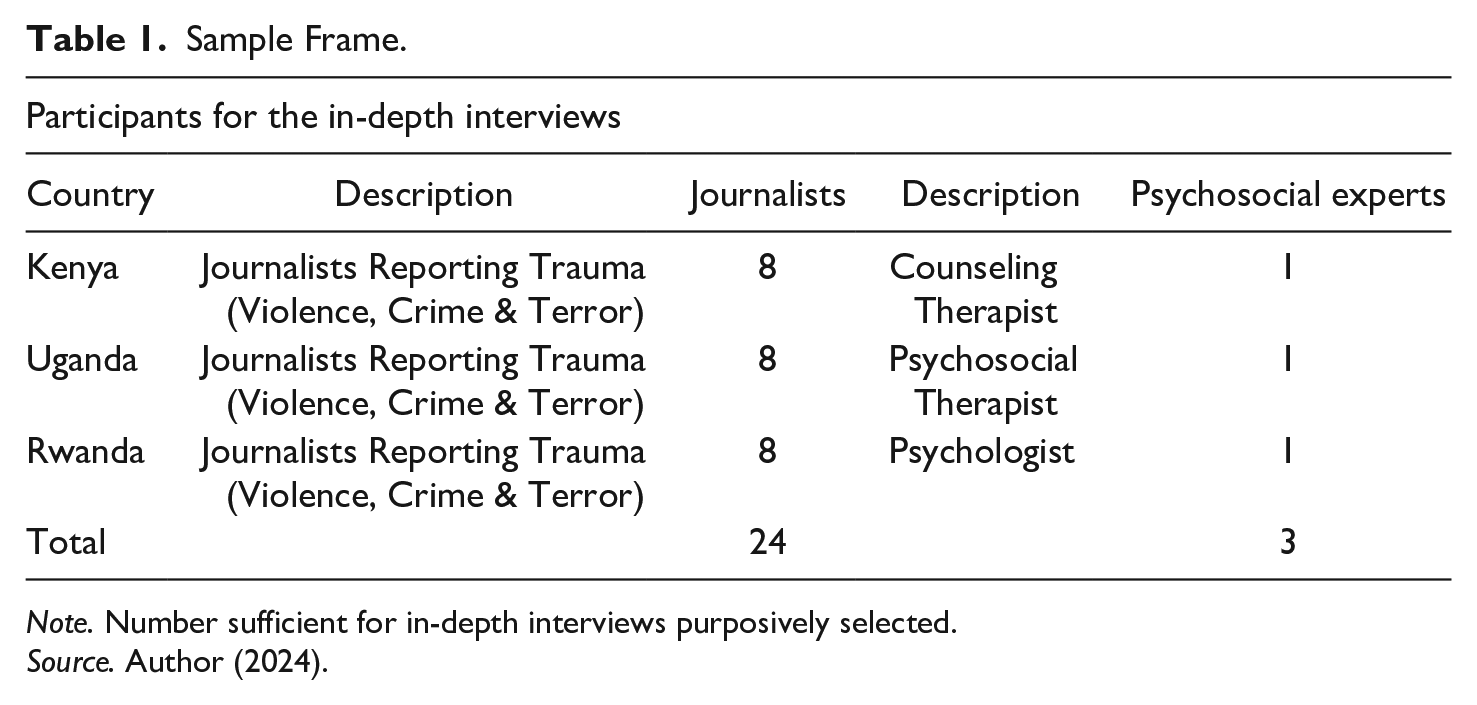
Purposive sampling was used for qualitative data collection through in-depth interviews with journalists and select psychosocial experts. Knowledge of existing journalism networks and associations in Kenya, Uganda, and Rwanda was a relevant guide in selecting journalists who have covered or are covering traumatic events such as violent crime and terror. The journalists were correspondence, freelance, or staffers. The interview questions were constructed from the following objectives: (a) to explore the relationship between visual witnessing and trauma phenomenon among journalists in East Africa; (b) to establish the prevalence of the trauma phenomenon from violent stories journalist cover from East Africa; (c) to propose support mechanisms for East African journalists covering trauma events; (d) to determine if exposure to visuals or the experience of journalists lead to trauma. The interest was to get narratives from journalists who had covered trauma-related stories that raged from violence, terror, and crime. Several strategies in purposive sampling like snowballing were utilized in selecting participants to limit biases. The following frame in Table 1 below depicts the sample population.
Sample Frame.
Note. Number sufficient for in-depth interviews purposively selected.
Source. Author (2024).
Narratives were obtained from in-depth interviews with 24 journalists. Eight participants from the networks of each country were selected. Three psychological experts were purposively selected to shed light on the trauma phenomenon and suggest mitigations. The psychologists were practitioners in East Africa who have dealt with the case of PTSD and recovery. Studies show fewer than 20 participants as sufficient for in-depth analysis (Crouch & McKenzie, 2006). Polkinghorne (1989) recommends at least between 5 and 25 participants for qualitative in-depth interviews. The data-collection process took up to 3 months, and ethical clearance and certification were approved in the three countries. The instruments were piloted with a small set of journalists not covering traumatic events. The testing was done on 5% of the sample size with approximately 3 journalists and at least one psychosocial expert. Perneger et al. (2014) used a prevalence of 5% or 0.05 to determine the right pre-test size that determined the efficacy of the tools and response tenancy for psychometric questionnaires. Adjustments were made; accordingly, the researcher visited the three countries to meet the participants to conduct the interviews.
Narrativity and Analysis
Narrativity involves eliciting stories from participants about their experiences, beliefs, and perspectives. Narratives can provide rich and nuanced insights into meanings and interpretations that people assign to their lives and contexts. According to Manfred (2021), narratives can reveal the complexities and contradictions that shape human behavior and identity. Narrativity allows for the exploration of multiple dimensions of reality, respects the agency and voice of the participants, and can foster empathy and understanding among researchers and audiences. It is a method that recognizes the vitality of storytelling and personal experiences in comprehending complex social phenomena. The data are analyzed by identifying key themes and patterns emerging from the stories shared by study participants. The analysis involved sorting for commonalities and differences between the narratives and examining how the study participants construct their stories and the meanings they ascribe to their experiences. The narrative analysis provided significant insights into the experiences of trauma among journalists and their struggles to find a voice to explore their personal experiences as well as a voice to negotiate trauma related to a culture of silence within newsrooms.
Results
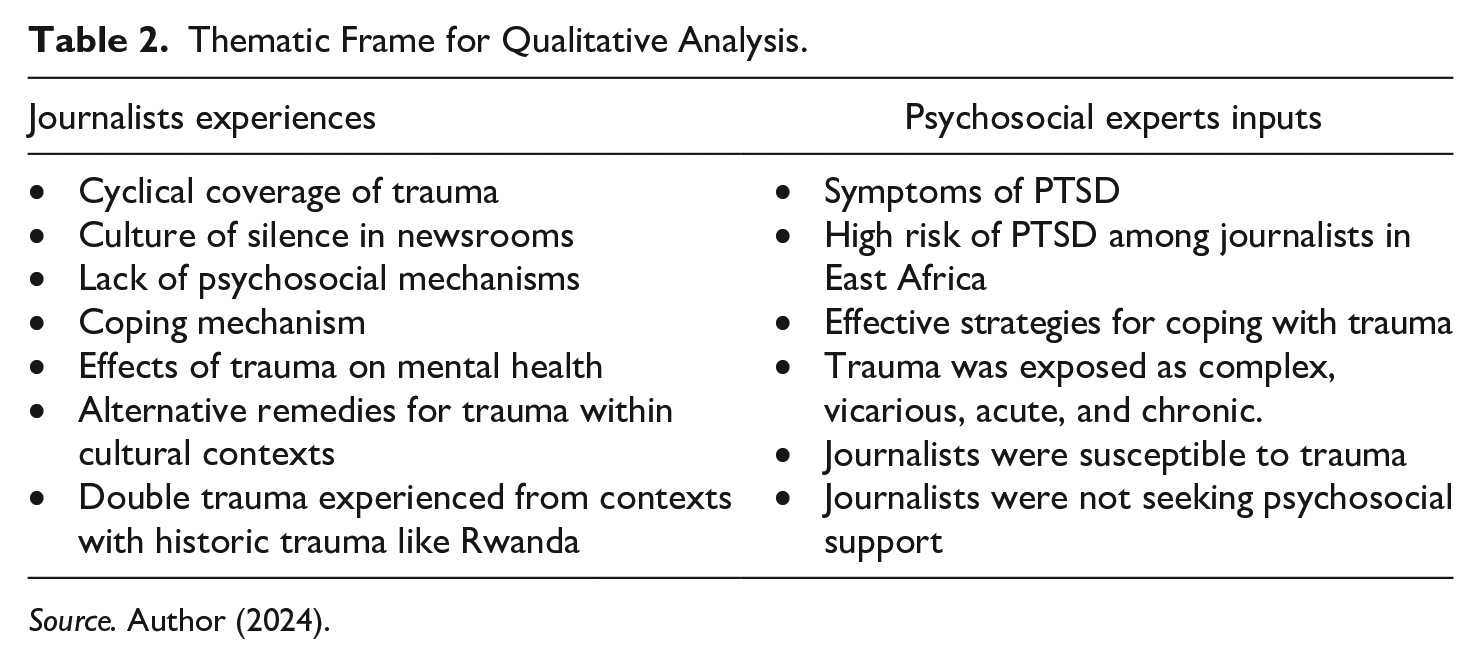
The analysis was shaped in three phases: line by line, thematically, and holistically by hand (Galloway et al., 2017). In the line-by-line analysis, major themes began to emerge including manifestation of trauma, PTSD symptoms, coping mechanisms, newsroom culture of silence, interventions, and alternative effective strategies. Excerpts were identified to descriptively fit within thematic codes. In the final phase, the codes were placed in larger categories determined from the research objectives on establishing the visual witnessing trauma phenomenon among journalists. The thematic results are presented in a sequence format in Table 2; thereafter, a sequential narrative analysis and interpretation of key findings is done.
Thematic Frame for Qualitative Analysis.
Source. Author (2024).
Narrative Analysis of Key Findings
Regarding outcomes from interviews with journalists and psychosocial experts (names protected for ethical reasons) on the visual witnessing trauma phenomenon among journalists in East Africa, it was evident that the news production process included a continuous cycle of accessing, gathering, processing, and disseminating horrific visual content that can cause or exacerbate trauma. After the line-by-line and thematic analysis, key themes that sustain the research objective are discussed as follows:
Cyclic Coverage and Exacerbation of Trauma
The witnessing of traumatic events to produce a visual story goes through four stages that include capturing images; in this stage, the quality and accuracy of the captured image depends on factors such as lighting, angle, focus, composition, and ethics. The process also takes into consideration notions under the criteria of news production that put emphasis on the goriness of images to ascertain claims that “If it bleeds, it leads” (Alm, 2019; Cooper & Roter, 2000). In the second stage, images are edited through selecting, cropping, enhancing, annotating, or manipulating to improve the clarity, relevance, and appeal of the communicated content. The third stage includes rendering; that is, converting the edited images into formats that can be displayed or published on different platforms such as print, web pages, television, or digital media. The findings were like Frosh’s (2019) contexts of trauma inherent in journalistic dealing with violent images. There also arguments that within the mediated technological space characterizing the production of stories, visuals offer a nuanced perspective that complements written narratives, affording a more comprehensive perception of the events being reported (Oliveira, 2002). Journalists revealed that when they returned from the field, they had to re-live the trauma while analyzing and selecting images. Moreover, through editing, images are refined to meet the ethical demands, but journalists deal with their rawness and extremity. In the previewing stage, images are checked for editorial errors, ethical slant, and readiness for usability. The four stages escalate levels of exposure: The four layers of production increased exposure therefore, transferring, and exacerbating trauma. You must follow those four layers of images you wish you would never see (Journalist Kenya April 2023).
Multiple exposures to complex and vicarious trauma are an indirect exposure to trauma that triggers PTSD and confirms (Brewin et al., 1996) linkage between triggers and cognitive memory. Louth et al. (2019) characterized vicarious trauma as a latent concern necessitating immediate and sustained attention to those who were not in the field.
Complex and Double Trauma
Journalists were forced to grapple with a conundrum of emotions from visual frames of trauma. In Rwanda, journalists suffered from complex and double trauma generated from a history of experiencing the genocide. Double trauma is evidencing a thin line that exist between journalist’s emotional turn and newsroom expectations of objectivity. Knight (2020) has demonstrated that this demarcation is fleeting, and sometime organizational management of emotions overrides the transient boundary. In their narratives, journalists in Rwanda evidenced a livid struggle between balancing these emotional stances and remaining impartial. Most indicated experiencing nightmares and flashbacks. There were narrations of extreme cases of out-of-body experiences (OBEs; Pederson, 2014), especially for journalists from a historical context of trauma like Rwanda.
The stories during the national commemoration of the genocide every year affect me very much. I always see the image of a brother I lost in the genocide, in a blink, he disappears (Journalist Rwanda March 2023).
Triggers prompted the visual rhetors to recall details or events long buried in their memories. The visual rhetors articulated this observation, stating: “There is this one event that I also remember was traumatizing . . . I don’t think about it, but often I dream of dead bodies, or searching for friends I lost in the genocide when I was fourteen.” In some instances, trauma theory emphasizes on the portrayal of OBEs. For example, Pederson (2014) analyzes the OBE as a common occurrence in trauma literature, where survivors feel themselves slipping out of their bodies. Another phenomenon identified by Pederson (2014, pp. 339–340) is the feeling of time passing more slowly during traumatic events. OBE is considered a mental self-defense strategy developed by traumatized individuals, according to the research of Rabeyron and Caussie (2016). Victims of trauma may find it easier to cope with the stress by distancing themselves from the traumatic event (Rabeyron & Caussie, 2016, p. 60). This implies that OBE should be regarded as a reflection of reality rather than merely a literary illusion or delusion.
Lack of Trauma Mechanisms
The effects of the trauma are felt after the story is done, in private spaces, in their minds in silence. Goldstein (2009) positions that silence is a coping mechanism where words do not offer adequate balance. In the DRT theory, Brewin et al. (1996) exposes imbalances that occur to the brain when processing information after exposure to trauma. The newsroom is depicted as a crisis center churning one traumatic story after the other. However, journalists on this beat said they have a personal obligation to fight social injustices even when traumatically triggered when telling the stories: I got very traumatized by a story I did in 2009, in the DRC. I met a woman who had been raped by a very young man. And for her to have borne the story in such a vulnerable way, you know I carried her story with me, and over the years. I would have nightmares; I would get very triggered when I watched stories on sexual violence (Journalist Kenya May 2023).
Goldstein (2009) claims that when dealing with the extreme degree of trauma, internal and external censoring occurs through silences setting up untellable stories in which witnesses are equally inclined to self-censor as to speak (Goldstein, 2009). In East Africa, newsrooms are devoid of systems to deal with trauma.
Effects of Trauma
Some of the journalists confirmed to have experienced feelings of guilt and helplessness for not being able to do something for victims of trauma who were sources of their stories. They claimed to experience visible health concerns like early graying of hair, insomnia, and a fixation on the sources and victims in the story long after the story was done and dusted. These symptoms were prominent in studies that have exposed PTSD (Feinstein, 2014; Papadopoulou et al., 2022; Seely, 2017). As in the DRT (Brewin et al., 1996), PTSD symptoms signal a disassociation with information processing. One journalist from Rwanda explained: I feel helpless, there is nothing I can do. I ask myself if I am worthy to be called a human being because, after I get the story, probably people will be killed the next day (Journalist Rwanda, March 2023).
Journalists’ practice demands bravery in the face of threats and risks to mental health. In East Africa, journalists are continuously exposed to various stress triggers, such as covering traumatic events, working under tight deadlines, facing online harassment, and coping with uncertainty and instability in the industry. They bear responsibility enforced in organizational structures (Newman, 2023; Possetti et al., 2023) of giving voice to silenced notions of injustices. Some journalists are beginning to question rigid newsroom structures and suggest re-invent the way stories are told.
Coping With Trauma
Some of the journalists confirmed disassociating from the traumatic experiences as a form of escapism. In some cases, the stories triggered a fearful disposition toward an impending danger, risk, or death. Other symptoms included hyperalertness, anxiety, and ruminating. Psychosocial experts outlined that symptoms experienced for 3–6 months would signal the existence of PTSD. Journalists listed symptoms like those in the APA manual on trauma (APA, 2013).
It reaches a point where you don’t care; you don’t attach value, you get immune, and you don’t feel like life is something. You wouldn’t mind someone has died is the story of the day and you don’t feel anything (Journalist Uganda, April 2023).
Journalists across the research sites said they seldom associate traumatic effects to PTSD. Some have covered the beat for more than 20 years, to make their names and advance positions, but the experience was emotionally damaging. Although research has been done on this subject, albeit in Western contexts, journalists interviewed in Germany (Obermaier et al., 2023), Mexico (Hughes et al., 2021), and those who covered Rwanda and Srebrenica (Knight, 2020) experienced similar reactional effects.
Culture of Silence
Male journalists dominated the trauma field and were cultured to suppress their emotions and disassociate from aspects that will portray them as weak and fallible. Editors were reluctant or nonchalant in sharing these experiences, while journalist were afraid that portrayal of infallibility was detrimental to their professional standing. Similar findings in the study by Knight (2020) among journalists who covered Rwanda and Srebrenica show a self-imposed silencing. In East Africa, journalists were cautious of risks in trauma reporting; therefore, freelance journalists were frequently taking the trauma beat. Those who report on trauma find strategies to survive without re-traumatization. One journalist from Uganda avoided post-field video editing to protect his mental state, as the editing process re-traumatized his field experiences.
When I returned to the newsroom my boss asked me if I saw that story anywhere. He did not think about the risk I had put in my life but was eager to get the story. I avoided the editing suite and kept myself busy after returning from the field
Feinstein et al. (2014) has since established that journalists reporting general stories were not as traumatized as those in the war zones. War reporting was an emotional process that made it difficult to navigate personal emotional strain and professional demands for objectivity (Massé, 2011).
Possible Remedies for Trauma
Through re-telling experiences of covering trauma-relieved memories, the manifestation of trauma experiences, Wahl-Jorgensen (2018) states that a support mechanism is essential in creating a system that helps journalists to navigate their trauma since this area of psychosocial effects had become a risk issue in journalism practice.
Talking about it not keeping quiet, talking about it with someone you trust, a therapist that you can call and talk to. In complex trauma get treatment and visit a psycho-social expert. Get treatment for anxieties or phobias that come up because of PTSD (Psychologist Uganda, April 2023).
There was a consensus on initiating workshops, creating awareness, and initiating conversations. The journalists demonstrated a desire to do something about it, for example, sensitize other journalists, editors, and media policy institutions. Although therapy was the most viable mitigation strategy, limitations on access included finances and social stigma. Trauma was normalized as a part of the work hazard. Therapy is a mitigation strategy in handling experiences that were emotional straining on journalism. Therapy research demonstrated how people with injuries resulting from relational interactions were able to navigate their pain (Goldstein, 2009). Psychosocial experts indicate a need for mental health awareness in East African newsrooms.
There is a need for more to explain and talk about mental health, there must be efforts to eradicate stigma, and people must be free to consult (Psychologist Kenya May 2023).
Alternative Strategies for Trauma Alleviation
Narratives from visual rhetors indicate that journalists sometimes found sharing with their spouses relieving. They noted that colleagues in the newsrooms were not open to engaging in conversations on trauma experiences, and it was considered a mundane detail of the job, developing a culture of meditation, which includes praying to relieve trauma. It was imperative to search for contexts that were relevant to journalists in Africa as they had other unique challenges. This entailed looking into societal and cultural contexts as well as community support (Mazama & Asante, 2005). A psychologist in Rwanda explained cognitive disorders as those detailed in the DRT related to trauma.
Because our thoughts are very powerful, if only you knew the power of thoughts there are thoughts you wouldn’t make. We help this person to know different eye movements, redirection, and experiential therapies used in relieving pain (Psychologist Rwanda March 2023).
Discussion
Agamben’s (1999) viewpoint demonstrates that visual witnessing is personal and that images signify the process that sheds light on painful and traumatic events. The author emphasizes that images simultaneously present a conundrum of objectivity. The photographer or visual rhetor dwells in a dominant space of recording images that are frozen on a frame, to capture the moment and translate the viewer’s gaze. In East Africa, stories that cover violent crime and terror reproduce traumatic experiences for visual rhetors; however, interrogation of trauma narratives in the contexts of East Africa is limited. Furthermore, an analysis of assorted images from East African media content shows the framing of gory images as a representation of news and submits to the adage assumption that “bad news is news.” However, the thesis here is that media analysts and researchers have yet to split open these frames to evaluate the negative visual impact on journalists.
Still, these images serve a place in documenting history (Frosh, 2019; Frosh & Pinchevski, 2014). The outcomes of the study among journalists and psychosocial experts in East Africa indicate violent images as exposing visual rhetors to trauma-related phenomena. Generally, the journalists suggested that counseling should be done before assignments to prepare particularly rookie reporters eager to go in the field on how to handle traumatic contexts.
There was an urgency for East African newsrooms to create an environment that does not marginalize the journalists central to organization economies. Journalists called for sensitivity to difficult topics such as those on trauma. Ethical guidelines provide for the protection from consequences of painful re-telling; however, this is seldom achieved. Alternative strategies like talk therapy, exercising, sports and recreational activities, prayer, and meditation could be used to negotiate trauma. Evidence of re-telling stories to relieve trauma was discussed and could latch on to African epistemologies (Mazama & Asante, 2005). Journalists supported the creation of contractual structures within media organizations to secure health and safety in the practice. Learning from this work, visual rhetors in Uganda, Kenya, and Rwanda are getting organized to create critical voices to address trauma.
Conclusion
Literature and data regarding journalists’ personal and work-related exposure to PTSD depict a prevalence of trauma among journalists in East Africa. The findings elucidate the psychological gravity of experiences and narrations from journalists developing PTSD symptoms. The outcomes give an impetus toward recommendations for newsrooms in East Africa to develop procedures and structures to support trauma journalists. These results could inform policy and practice within developing countries to adopt alternative methods in addressing negative traumatic effects among journalists. Through in-depth interviews with journalists and psychosocial experts, this article captured trauma experiences and demonstrated possibilities for visual witnessing to alter a rhetorical culture and provide a voice for those who cannot speak. The results point to the possibility of action-impact research that stimulates conversations with media practitioners, media policy leaders, and editors to find collaborative solutions for trauma visuals in journalism.
Supplemental Material
sj-docx-1-jmc-10.1177_10776958241242941 – Supplemental material for “If It Bleeds It Leads”: The Visual Witnessing Trauma Phenomenon Among Journalists in East Africa
Supplemental material, sj-docx-1-jmc-10.1177_10776958241242941 for “If It Bleeds It Leads”: The Visual Witnessing Trauma Phenomenon Among Journalists in East Africa by Lydia Ouma Radoli in Journalism & Mass Communication Educator
Footnotes
Author’s Note

Declaration of Conflicting Interests
The author(s) declared the following potential conflicts of interest with respect to the research, authorship, and/or publication of this article: The contributor certifies that there are no known potential conflicts of interest and has acknowledged that the article was written during a Research Fellowship at the Leuphana Institute of Advanced Studies in Culture and Society, Leuphana University Lüneburg.
Funding
The author(s) disclosed receipt of the following financial support for the research, authorship, and/or publication of this article: This article was written during the Research Fellowship period at the Leuphana Institute of Advanced Studies in Culture and Society, Leuphana University Lüneburg, which was funded by a grant from the Ministry of Research and Culture of the Lower Saxony Germany under the SPRUNG funding scheme (grant number: 1176251370312021).
Supplemental Material
Supplemental material for this article is available online.
Author Biography
References
Supplementary Material
Please find the following supplemental material available below.
For Open Access articles published under a Creative Commons License, all supplemental material carries the same license as the article it is associated with.
For non-Open Access articles published, all supplemental material carries a non-exclusive license, and permission requests for re-use of supplemental material or any part of supplemental material shall be sent directly to the copyright owner as specified in the copyright notice associated with the article.
