




Abstract
Academic associations play a vital role in the development of academic fields and their respective educational institutions. Using Critical Race Theory, this article reviews the Association for Education in Journalism and Mass Communication’s (AEJMC) ethnic/racial and gender diversity, DEI research, and leadership demographics to provide context for our analysis of the organization’s ethnic/racial and gender leadership between 2010 and 2022. Findings indicate AEJMC has made strides in its recruitment and retention of women and Black, Indigenous and People of Color (BIPOC) faculty. White females and Asian males are well represented in the organization’s highest leadership positions, and in the Council of Divisions. However, Hispanics and Native Americans continue to be underrepresented in top leadership positions. Study findings, proposed solutions, and best practices aim to help AEJMC and its members make a difference in addressing shortcomings related to DEI research, retention, and leadership cultivation.
Founded in 1912, the Association for Education in Journalism and Mass Communication (AEJMC) is the oldest and largest group of JMC educators and administrators. Its mission is to promote the highest possible standards for journalism and mass communication (JMC) education, to encourage the broadest possible range of communication research, to promote the implementation of a multicultural society in the classroom and curriculum, and to defend and maintain freedom of communication to achieve better a professional practice. The organization has more than 2,000 members in about 40 countries who teach and research journalism, public relations, advertising, digital media, film, and media literacy (https://www.aejmc.com/home/).
Through its various divisions, interest groups, research sponsorships, conference programming, and plenary sessions, AEJMC helps foster conversation on discipline-wide issues, including enhancing diversity in JMC education. Most notably, with its support, members publish academic journals, host national and regional academic conferences, sponsor awards/grants, offer teaching tips, and serve as a clearinghouse of information.
Given the significant role that an organization like AEJMC may play in cultivating DEI in higher education, there has been considerable interest in assessing various aspects of its diversity efforts (e.g., Adams & Bodle, 1995; Dates et al., 1999; Henry, 2004; Rush et al., 2004). Absent from the literature are studies that examine the organization’s leadership demographics in the current sociopolitical climate. The rise in anti-DEI sentiments has resulted in the closings of DEI offices, shifts in hiring practices, and curriculum changes in higher education. Understanding the characteristics of AEJMC’s leadership offers a snapshot of the association’s potential role in such matters.
Critical race theorists recognize and challenge racial inequality, as many Americans believe unequivocally that the legacy of racism has been eliminated–particularly after the election of the first Black president Barack Obama in 2008. The tenets of CRT argue that overt expressions of racism—no longer socially or politically acceptable—metamorphosed into subtler, more clandestine forms (Bell, 1992; Delgado & Stefancic, 2001). This form of racism dubbed “colorblindness” has enabled systemic racism and disenfranchisement to fester while public acknowledgment of race and prejudice has become socially taboo (Bell, 1992).
The value of using a CRT theoretical approach is its ability to highlight and give voice to marginalized groups within the context of the current sociopolitical climate. Examining current issues through a critical lens (enlightened by historical experiences) can help guide researchers in forming questions and finding practical solutions. Furthermore, continued research on AEJMC’s diversity efforts is important to assess the organization’s commitment to diversity in its membership, its support of minority research, and its promotion of minorities to leadership positions.
Review of the Literature
Research on AEJMC and diversity may be divided into several key subjects: history of structural diversity in the organization, minority scholars and scholarship, and membership and leadership demographics (Applegate et al., 2011; Barrow, 2004; Musambira, 2009; Ross et al., 2007). Our review of the literature is divided into three streams of knowledge to address these topics: history, scholarship, membership and leadership demographics, which albeit interrelated, merit separate review.
History
Articles in the first category offer an overview of different points in the history of the AEJMC organization and the changes in its divisions and organizational structure since its inception on November 30, 1912 (e.g., Barrow, 2004; Coleman & Gonzalez, 2019). Initial efforts include the establishment of an Ad Hoc Committee on Minority Education in 1968, followed by the creation of the Minorities and Communication (MAC) Division in 1971. AEJMC reaffirmed its ambition to increase participation by minorities and women with the launch of the Commission on the Status of Women (CSW) in 1973 and the Commission on the Status of Minorities (CSM) in 1978. This was in conjunction with an AEJMC resolution to help the American Society of Newspaper Editors (ASNE) 1 achieve its goal of minority employment equal to the proportion of minorities in the population. AEJMC established the Gay, Lesbian, Bisexual and Transgender (GLBT) Interest Group in 2003 to help foster dialogue and scholarship about GLBT concerns that should be discussed in classrooms.
These DEI-related efforts underscore the seriousness of AEJMC’s commitment to marginalized groups. Other structural efforts aimed at improving diversity throughout the association include the creation of leadership training programs, various diversity awards, and its accreditation arm, ACEJMC. In 1985, the Accrediting Council on Education in Journalism and Mass Communication (ACEJMC) adopted a new diversity standard and made it actionable in 1990. The standard mandates that programs must have a written diversity plan that expresses how the unit will achieve an inclusive climate and curriculum to be compliant. The accrediting body offers guidance and encourages programs to develop curricula and instruction that “educate faculty and prepare students with the multicultural knowledge, values and skills essential for professional practice.” The unit must also document how it will recruit and retain a diverse faculty and student population The diversity standard often ranks as the highest of the nine standards for non-compliance (Coleman & Gonzalez, 2019).
AEJMC established a series of awards to spotlight diversity throughout the association. These include the Equity and Diversity Award, established by CSM in 2009, to recognize journalism and mass communication academic units increasing equity and diversity among their faculty, curriculum, and overall educational activities. The award is one of the highest honors in diversity and inclusion or journalism and communication programs in the United States. The Dr. Lionel C. Barrow Jr. Award for Distinguished Achievement in Diversity Research and Education, an AEJMC award launched in 2010, is an initiative promoted by the CSM in collaboration with the Minorities and Communication (MAC) Division.
Other divisions have also set up their own awards to promote diversity. AEJMC’s Theory and Methodology Division, in collaboration with the MAC Division, founded the Dr. Lee Barrow Doctoral Minority Student Scholarship in 1972. The two groups continue to administer it. Likewise, the MAC division has launched several smaller programs, scholarships, and grants to foster research and to encourage graduate students to join the division. The Carolyn Stroman Awards Initiative, launched in 2016, gives free membership to each graduate student who has a research article accepted for presentation. In 2017, the division launched the Paula Poindexter Research Grant Awards to encourage faculty and students to continue research projects emphasizing minority-related topics.
Scholarship
CRT scholars note the importance of valuing diversity in research, a crucial element in diversifying academia itself, as it influences whether academics get tenured, promoted, or retained for employment by universities. Academics seeking tenure fear focusing on diversity issues because of limited venues for publication and being pigeonholed as diversity scholars. Barrow (2004) noted that only five of the 123 papers presented in 1968 were on minority topics. This also has an impact on the involvement of minorities in AEJMC leadership opportunities as many faculty wait for promotion or tenure before engaging in organizational responsibilities.
Focusing on gender-oriented assessments of journalism and mass communication scholarship production, Adams and Bodle (1995) found that although refereed convention scholarship rates for women had not yet reached the 50% target set in 1989 by AEJMC, that same year, women had managed to register higher convention paper productivity per capita than men. Ten years later, Applegate and Bodle (2005) found that between 1994 and 2003 women continued this trend of producing an amount of refereed convention research (42.9%) that exceeded their percentage of AEJMC membership (40%; Ross et al., 2007). In their study and timeline of essays highlighting the status of women in journalism, Bodle et al. (2011) indicated that although women were the minority in AEJMC article submissions, they produced research at rates near their numeric representation. In some instances, they produced research at per capita rates even higher than their male counterparts.
Musambira (2009) refined the research on this topic with an analysis of a specific division, looking at refereed convention papers sponsored by the AEJMC Magazine Division between 1999 and 2008. The author found a gender gap in top paper productivity and regular refereed paper productivity in that division. Females dominated top convention paper authorship, but males dominated regular refereed paper authorship. Applegate et al. (2011) analyzed levels of inclusion in refereed scholarship in AEJMC’s divisions, interest groups, and commissions. Based on their census of all blindly reviewed research accepted for presentation at AEJMC conventions from 1994 to 2003, they also concluded that women were authoring convention research at higher rates than their membership in AEJMC.
Membership and Leadership Demographics
Diversity in AEJMC’s leadership is essential for the association to play a role in supplying guidance in teaching, research, and public and professional service agendas. Our third main area of research, AEJMC’s membership and leadership demographics, is the primary focus of this paper. Ross et al. (2007) found that AEJMC’s focus on diversity through its accreditation arm, ACEJMC, had increased the number of women JMC faculty as well as the number of diversity courses in curricula, but had had much less effect on increasing faculty of color, and even less impact on leadership.
Other scholars have presented empirical evidence of gender and racial discrepancies in AEJMC’s membership, including Adams and Bodle (1995), Barrow (2004), Ross et al. (2007), Rush et al. (2004), Stephens (2003), and Subervi and Cantrell (2007). Barrow (2004) examined the role of minority women in AEJMC, noting that of the AEJ membership of 665 in 1968, only eight were minorities (1.4%). Similarly, of the eight minority members, only four were African Americans—including three women.
Theoretical Framework and Research Questions
The study of race, racism, and power appeared in the 1970s and 1980s as an outgrowth of the civil rights tradition (Bell, 1980, 1992; Crenshaw, 2011), which contributed to advancing the understanding of law as deeply connected to lived experiences and social power. Crenshaw (1995) defined CRT as a legal framework that embraces a movement of scholars, most of whom were law scholars of color, whose works challenged how race and racial power are constructed and represented in American legal culture and society. While CRT began as a branch of legal scholarship, it has been adopted by other disciplines, such as media studies, psychology, and political science (e.g., Brock, 2020; Delgado & Stefancic, 1993; Gooden, 2012; Ladson-Billings, 1998). Scholars from various disciplines use CRT to help explain how America’s legacy of racism was built on legislative harassment and discriminatory legal practices.
Post-racial discourses that emphasize a colorblind society fail to question the role of race in leadership dynamics. They ignore the historical context of systemic racism and perpetuate the myth of a post-racial society. Conversely, a CRT theoretical approach may be used to examine social relations of domination (Crenshaw, 2011). Gooden (2012) discussed the value of using CRT as the framework for examining the racial disparities in leadership, asserting that an organization’s environment must be a balance or reflection of the community it serves (Higgins, 2017). CRT research highlights historical racial trauma and gives a voice to marginalized groups to help contextualize modern sociopolitical issues using experiences from the past. In this case, we use CRT to examine AEJMC’s leadership makeup in this era labeled a post-racial society, as many Americans believe wholeheartedly that the legacy of racism has been abolished (Delgado & Stefancic, 2001; Gooden, 2012).
Racial Reckoning and the Backlash
Systemic racism and DEI-related issues have become even more critical since our first study was published in JMC Educator 12 years ago. In our first study on this topic, Moody et al. (2013) documented notable progress for women in attaining leadership positions but found limited presence and no positive trends regarding racial/ethnic minorities in AEJMC’s leadership.
Issues of particular significance for JMC educators include the backlash that ensued following the murder of George Floyd and the Black Lives Matter movement. The rise in DEI pushback, anti-diversity in hiring practices, and the resulting influence on faculty recruitment and retention in higher education is a concern facing AEJMC. These issues beg the question of if and how the leadership of the nation’s most important journalism education association might address such matters in its teaching, research, and public and professional service agendas.
The Current Study
The increasing importance of diversity in the workforce, as well as AEJMC’s influence on academia and the JMC profession, justifies the need for continued research on the organization’s DEI efforts if it is to remain relevant and help academia overcome decades of underrepresentation of America’s growing ethnic/racial populations. Research on this topic is urgent given that anti-DEI legislation has passed in several states (currently more than 30 bills across the U.S. target DEI initiatives at public colleges) while ethnic/racial minorities are predicted to become the national majority by 2050 (Frey, 2018).
While previous studies illustrate important aspects of AEJMC’s diversity in its history, scholarship, and demographics, with rare exceptions, they do not focus on the analysis of AEJMC’s leadership. The current study aims to update and extend the research on leadership and diversity in the organization. An examination of various aspects of AEJMC’s gender and diversity demographics offers a glimpse into the progress made but also notable shortcomings. AEJMC’s leadership diversity is particularly relevant if it is to continue to provide guidance to the academy, especially so in the context of the current racial reckoning in the United States. Scholars looking to conduct higher education leadership research should examine the differences in power relationships between groups, such men, women, and people of color (rather than continuing to focus exclusively on White, heterosexual men).
We use CRT to frame our research questions to examine AEJMC’s leadership. More specifically, we investigate diversity in the organization’s highest post—president—and the association’s Board of Directors to address the following questions:
Method
CRT scholars advocate for diversity in demographics, research, and leadership, as the three work closely to foster change. In 2020, we began our analysis by contacting the AEJMC business office to request a copy of the organization’s leadership demographics data for the last 10 years. 2 Office staff provided a spreadsheet with the names of leaders in divisions, interest groups, and commissions. The demographic data that AEJMC gathers from its members includes all the categories in our research design. 3 The ethnic/racial categories shown in our tables reflect the answers of the members to the options in the standardized demographic reporting form. After evaluating each group by race and gender, we created frequency and percentage tables that provide a visual summary of AEJMC’s Presidents and Council of Division members from 2010 to 2022. These tables are provided in our findings section.
Following our summary of data on AEJMC’s leadership, we offer best practices gleaned from our research on DEI strategies for AEJMC and its members, as solutions are a vital component of CRT research. These strategies help strengthen our discipline, as we continue to grapple with today’s socio-political climate and add to the CRT literature on DEI in journalism and mass communication in higher education.
Findings
AEJMC’s Leadership Demographics of Women and Minorities
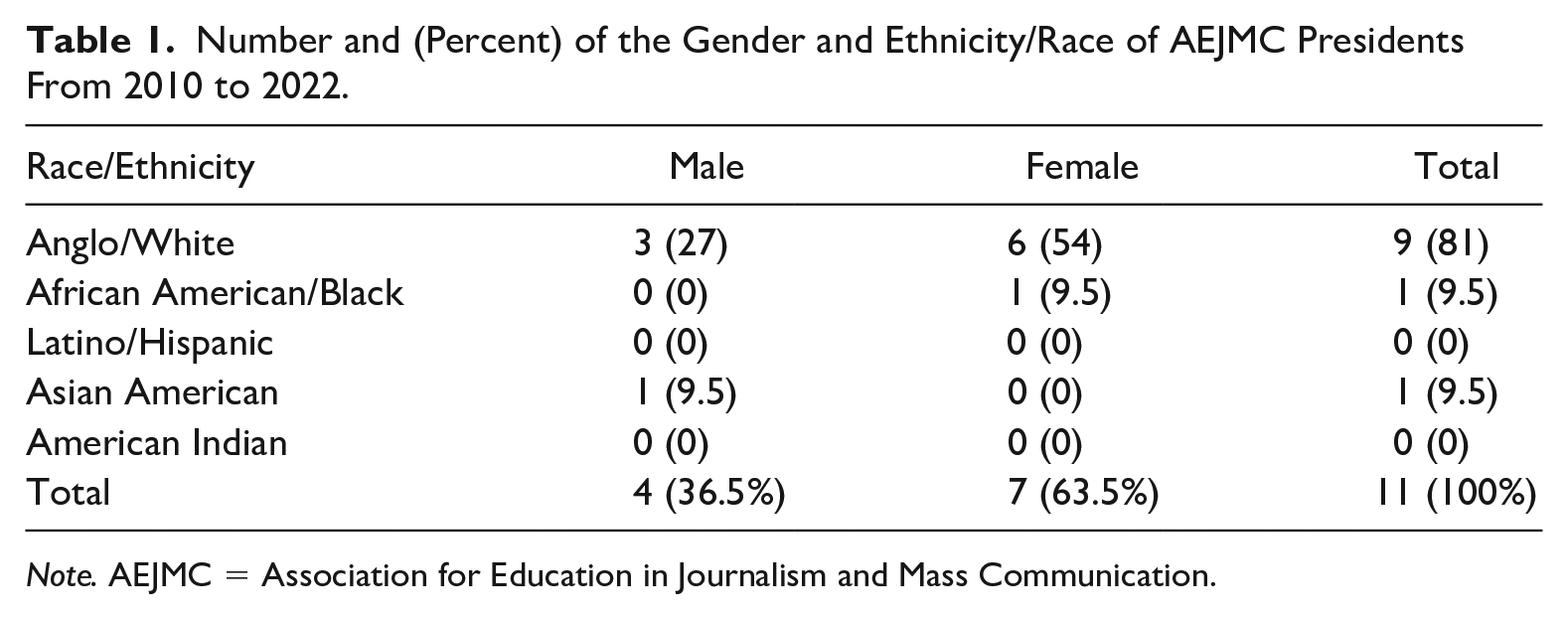
The first research question asked how the demographic makeup of AEJMC presidents has changed in the last decade. Table 1 indicates White females made up 54% (6) and White males made up 27% (3) of AEJMC presidents. Conversely Black females made up 9.5% (1). Likewise, Asians made up 9.5% (1).
Number and (Percent) of the Gender and Ethnicity/Race of AEJMC Presidents From 2010 to 2022.
Note. AEJMC = Association for Education in Journalism and Mass Communication.
The underrepresentation of ethnic/racial minorities is evident in the top level of leadership of AEJMC, a finding that has remained unchanged from our previous investigation. In its 100-year history, AEJMC has had one African American male (Tony Atwater, 1992-1993) two Asian American males (Alex Tan, 1997-1998; Kyu Ho Youm, 2012-2013), and one of Native American heritage (Joe S. Foote, 2002) in the position of President. This picture is brighter when looking at gender where the organization has achieved parity in its top leadership position. In the 30 years since the name change to AEJMC (in 1983), 15 of its 30 presidents have been female; in the 70 years prior, only one president had been female. In the 12 years since the turn of the 21st century—2001 to date—eight female members have held the post of president.
The association has had several minority female presidents, three of whom are of African American heritage (Marilyn Kern-Foxworth, 2000-2001 and Jannette Dates, 2004-2005 and Paula Poindexter, 2014-2015). Given the election process of this organization whereby vice president and president-elect move into the position of President in order, the female prevalence at the position of President therefore has meant strong female representation at those other top two positions—president-elect and vice president.
AEJMC Council of Divisions
The second research question asked how the demographic makeup of AEJMC Council members has changed in the last decade.
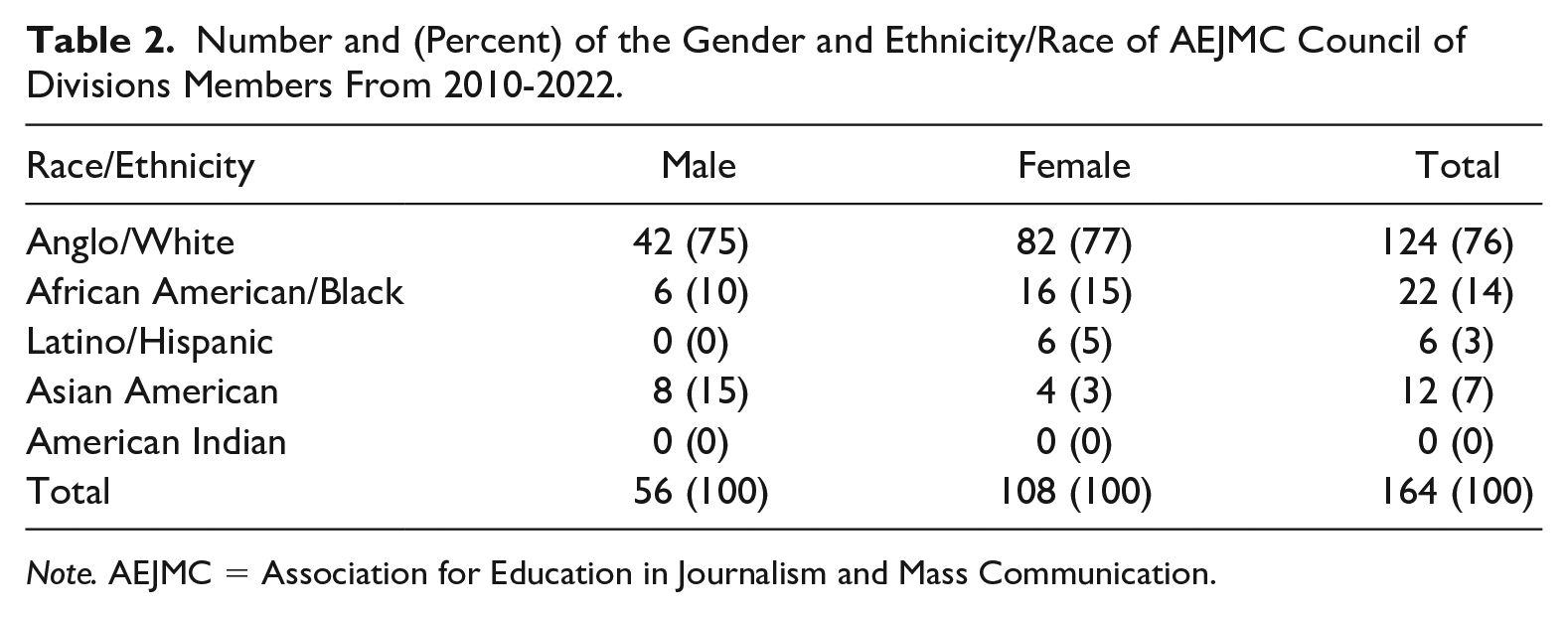
AEJMC is organized into 19 divisions, nine interest groups, and two commissions. Each one elects its own officers annually. As shown in Table 2, 76% (124) of the Council of Division members were White, followed by 14% (22) Black; 7% (12) Asian; and 3% (6) Latino. While there are still more people of color heading the divisions, interest groups and commissions; however, they are still under-represented in terms of their percentage. This is especially the case for Latinos and Native Americans. In fact, twice as many Asian American males have had leadership roles than Latinos, and the former group has slightly outnumbered African American males. Worth noting is that international members of AEJMC have outnumbered Latino/Hispanic males and females in leadership roles. Except for one female, Native U.S. people, of Indian, Alaskan, or Hawaiian heritage, are not represented as part of this organization’s second-tier leadership. 4
Number and (Percent) of the Gender and Ethnicity/Race of AEJMC Council of Divisions Members From 2010-2022.
Note. AEJMC = Association for Education in Journalism and Mass Communication.
Women have had a dominant presence in several other positions as well, including chair of the Professional Freedom & Responsibility Committee, and chair of the Teaching Standards Committee. Division, interest group, and commission presidents serve on the Board of Directors. The ethnic/racial categories shown in the tables reflect the answers of the members to the options in the standardized demographic reporting.
Contrasting the AEJMC Data and the 2020 Census
Research question three asked how AEJMC membership compares with the U.S. Census Bureau data regarding the nation’s ethnic/racial minority populations. Given the scarcity of data specifying the ethnicity/race of AEJMC’s members, it is impossible to properly answer this question. However, even with the partial data at hand, it is evident that the pattern of underrepresentation summarized above is repeated when comparisons are made of the U.S. general population.
The 2020 Census indicates the White population remained the largest race or ethnicity group in the United States, with 204.3 million people identifying as White alone; however, the White alone population decreased by 8.6% since 2010 (U.S. Census Bureau, 2020). The multiracial population has increased since 2010. It was measured at 9 million people (about half the population of New York) in 2010 and is now 33.8 million people (about twice the population of New York) in 2020, a 276% increase. The category of some other race alone or in a combination group (49.9 million) increased by 129% surpassing the Black or African American population (46.9 million) as the second-largest race alone or in a combination group.
The next largest racial populations were the Asian alone or in the combination group (24 million), the American Indian and Alaska Native alone or in the combination group (9.7 million), and the Native Hawaiian and Other Pacific Islander alone or in the combination group (1.6 million). The Hispanic or Latino population, which includes people of any race, was 62.1 million in 2020. The Hispanic or Latino population grew 23%, while the population that was not of Hispanic or Latino origin grew by 4.3% since 2010.
While in 2010 America’s ethnic/racial groups constituted 34.8 percent of the national total, AEJMC’s data for 2008 showed only 13.5, which is less than half what would represent parity in that approximate year. If AEJMC staff could produce data for 2010, the comparison would be more accurate; even more so if the ethnic/racial background of the membership were reported. However, it is doubtful that the ethnic/racial gap was closed in that period.
Best Practices in DEI for Journalism and Communication Program
CRT is not only concerned with representation and DEI efforts—advocacy and solutions to systemic racism are other components of the theory. The emphasis on improvement is essential in CRT scholarship. It is not enough to examine deficits in the system—one must also offer solutions. In our analysis, we found AEJMC has implemented several programs to reward diversity efforts and to create training programs. Three things that have worked well in helping to diversify AEJMC are awards, mentoring programs, and AEJMC’s accreditation arm, which includes a section on diversity.
In addition to mentoring programs offered by the CSM and the MAC Division, the tactics offered in Journalism and Mass Communication Leadership Institute for Diversity (JLID) have proven helpful in the advancement and retention of minority faculty. We note that the program was renamed the Institute for Diverse Leadership (IDL) in 2019. The revamped program identifies, recruits, mentors and trains future leaders and administrators (AEJMC Members Selected for New IDL Class, 2019). Each class begins work at AEJMC’s summer conference in August and participates in other sessions and activities throughout their fellowship year. Like JLID, the Institute is co-sponsored by AEJMC and the Association of Schools of Journalism and Mass Communication (ASJMC). Forty-one of its graduates are people of color (54%), 35 were Caucasian women (46%); with a gender representation of 17 males, 59 females. Forty-three graduates (56.5%) have become deans, directors, associate deans and department chairs. These placements represent 22 people of color and 21 Caucasian women, with a gender representation of 11 males and 32 females (AEJMC Members Selected for New IDL Class, 2019).
Both CSW and the MAC Division implemented mentorship programs for their members in 2016. The programs aim to help junior faculty and graduate students make the transition to teaching and successfully navigate the tenure process. MACD’s program has been revamped and renamed MAC to MAC. The MAC division pairs junior with senior faculty members based on similar interests or concerns they have regarding academia. In addition to individual meetings with mentors and mentees, participants meet throughout the semester via virtual technology to discuss pertinent issues, such as work-life balance, teaching, and advancement tips. This need for support is echoed by participants in the University of Texas’ Trailblazer’s project, many of whom joined AEJMC because there is a minority division that offers participants an opportunity to network with other academics of color. Felix Gutierrez said joining the MAC division offered him a new perspective and helped him realize that he is not alone in his research interests and concerns regarding issues around racial matters.
5
Minorities often feel lonely when they’re out there doing work and they’re not sure what they’re going to find or whether people are going to be interested in it or not. That’s where AEJMC comes in.
Accreditation has also been helpful in inspiring change around DEI efforts. Standard 4, formerly ACEJMC’s Standard 12, offers guidelines to help faculty, administrators, and staff provide a diverse learning environment and practices for students. While Standard 4 is the most elusive benchmark for academic units to conquer, it remains vital for programs that want to remain competitive. The accrediting body offers guidance and encourages programs to develop curricula and instruction that “educate faculty and prepare students with the multicultural knowledge, values and skills essential for professional practice.” It also emphasizes the significance of diversity and inclusion in faculty, staff, and students.
Advocacy and Support From AEJMC/ASJMC
Advocacy and support for diversity within an organization sends a powerful message to members. AEJMC leadership has played a key role in representing the interests of its members on topics, such as freedom of information, anti-DEI rhetoric, teaching, and academic freedom (AEJMC 2023 Resolutions: AEJMC). In 2023, on the heels of DEI pushback, the AEJMC Standing Committee on Professional Freedom and Responsibility (PF&R) endorsed a resolution, developed by the PF&R subcommittee on resolutions and members of the AEJMC Council of Divisions (CoD).
In October 2023, AEJMC’s Boards of Directors and the Association of Schools of Journalism and Mass Communication (ASJMC) published a statement “supporting minoritized and marginalized administrators and faculty in their efforts to lead universities in addressing their inclusive excellence goals, in the recruitment and retention of faculty from minoritized groups, and in the development of strategies that will further efforts and investments related to inclusive excellence (https://www.aejmc.com/home/2023/10/pac-101923/). The statement acknowledges trying and failing to reach its goals. It states that AEJMC has a long history of advocating for the recruitment and implementation of a diverse faculty and student body in media education and has invoked its membership to “make every effort to achieve 50 percent minority and/or female faculty and administrators by the year 2000.” . . . Current efforts in multiple state legislatures are threatening to undo any progress that has been made. Several state legislatures have considered or successfully passed bills banning diversity, equity, and inclusion programs at higher education institutions. Furthermore, a few states have gone so far as to restrict how race and gender topics can be taught in public higher education institutions. These efforts seek to change uncomfortable truths about the American experience to “convenient lies” which further undermine the experiences and accomplishments of minoritized populations in this country.
Likewise, AEJMC’s Resolution Four, (https://www.aejmc.com/home/2023/09/resolution-four-2023/) passed in October 2023, provides support for college and university offices, programs, and initiatives that focus on DEI. The resolution encourages AEJMC leaders to create spaces for training and development for association members that offer support for their research and teaching on topics related to DEI. AEJMC members are encouraged to remain steadfast in their efforts to recruit and retain faculty from marginalized groups (like gender identity, race, color, religion, age, ethnicity/national origin, disability/differently abled, sexuality or sexual orientation, marital status, family/parental status).
Signed in October 2023, the resolution refers to unfulfilled DEI parity in faculty and administrators in mass communication units and the successful passing of bills banning DEI programs at higher education institutions. Florida restricts how race and gender can be taught in Florida’s public higher education institutions and bans them from using state or federal funding for diversity programs; and a 2024 Texas law, mandates that Texas campuses must eliminate DEI offices, mandatory DEI statements, and training. In 2023, for the second time in two years, hiring decisions involving JMC faculty from racial minority groups were influenced by outside forces resistant to the faculty members’ points of view on DEI.
A 2023 statement from leaders in AEJMC’s MAC Division and Commission on the Status of Minorities addressed anti-diversity hiring practices. Its primary recommendation for AEJMC leadership is to expand support for AEJMC members of color and other marginalized groups. The report states that members should expect AEJMC to offer an “intentionally safe space for members to speak up when they experience discrimination.” The groups, which had signatories from other commissions and divisions, recommend the implementation of a rapid response team to mobilize when systemic practices occur that threaten DEI, access to resources and academic freedom.
Of utmost importance is the development of a system to document, map and monitor incidents and systemic practices that negatively impact AEJMC members of color and other marginalized groups. This system must help identify and respond appropriately when members are negatively impacted by laws targeting vulnerable populations.
Limitations and Future Research
As with any research project, this study has limitations. Most notably, many AEJMC divisions, commissions, and interest groups provided incomplete or no data on race/gender in the demographic forms provided to AEJMC. In these instances, we visited university websites or reached out to AEJMC members personally to gather information. Another limitation is the findings in this report are not generalizable to other organizations, as we only looked at AEJMC’s leadership demographics. Opportunities for future research might include examining the leadership composition of more JMC-related organizations, such as the National Communication Association (NCA) and the International Communication Association (ICA). Expanding our research to other professional organizations might provide a broader outlook on experiences specific to our discipline.
Future studies might also examine the connection between race, gender, and holding an AEJMC leadership position. In-depth interviews with current and former leaders might enlighten us on the importance AEJMC officers placed on diversity. Although AEJMC’s divisions, interest groups, and commissions often emphasize DEI-related topics, it is not clear how this translates to leadership in academic units.
Even with these limitations, this article answers key questions about minority leadership representation in AEJMC. CRT helped provide a lens for us to contextualize our findings. A common misconception of CRT is that the theory no longer applies in modern society because racism no longer exists. In this case, it was useful in examining AEJMC’s leadership demographics. CRT helps explain why people of color might be less likely to be elected to serve in positions of authority in an organization like AEJMC.
Discussion and Conclusion
In this analysis using a CRT lens, we examined the current demographic characteristics of AEJMC’s top leadership and then offered recommendations for addressing ongoing shortcomings. Understanding the characteristics of AEJMC’s leadership offers a window into the potential role of the association with respect to DEI matters. The 12-year span since our initial study of AEJMC’s leadership (Moody et al., 2013), and the social climate on race and gender created by sociopolitical developments since, have provided an optimal opportunity to analyze the organization’s diversity efforts.
Four generalizations can be drawn from the study findings. First, AEJMC’s membership continues to grow. Second, between 2005 and 2007, its minority membership also increased, but even more notable is the increase in the percentage of women. Third, female members have not only achieved parity in the percentage of leadership, but by many accounts, they have exceeded that parity. Finally, and critically most evident, is the fact that the percentage of minorities in AEJMC’s leadership positions is nowhere close to their percentages of the association’s membership. Moreover, Latinos have hardly been nominated (and never elected) to the top positions. Study findings are important as diversity in leadership positions can lead to the spread of ideas and acceptance of diversity in teaching. AEJMC’s leaders provide guidance by way of statements, code of ethics, and resolutions on trends in DEI topics.
AEJMC has done a tremendous job of strengthening its DEI efforts in the last decade. We note that CSM, CSW, and the MAC division often lead the way in developing DEI efforts, which include the encouragement of DEI research through competitions, leadership training through workshops and institutes, curriculum development throughout research and teaching efforts, and recruitment and retention through the promotion of women and faculty members of color. Faculty of color, in self-reports, mention developing leadership skills, research networks, and teaching skills as part of AEJMC’s mission and programming.
Despite various diversity outreach efforts, the leadership demographics have not changed much since our previous studies. Latino and Native American membership numbers remain the same—regarding leadership demographics. The numbers are still proportionately much less than what they should be given that demographic group’s representation in the United States. overall and in the student enrollment in JMC schools. The data and history presented suggest that reform that will change these patterns for ethnic and racial minorities must be intentional, lest 10 years from now, yet another leadership data analyses report documents once again that little or no significant positive change has occurred.
Footnotes
Declaration of Conflicting Interests
The author(s) declared no potential conflicts of interest with respect to the research, authorship, and/or publication of this article.
Funding
The author(s) received no financial support for the research, authorship, and/or publication of this article.
