




Abstract
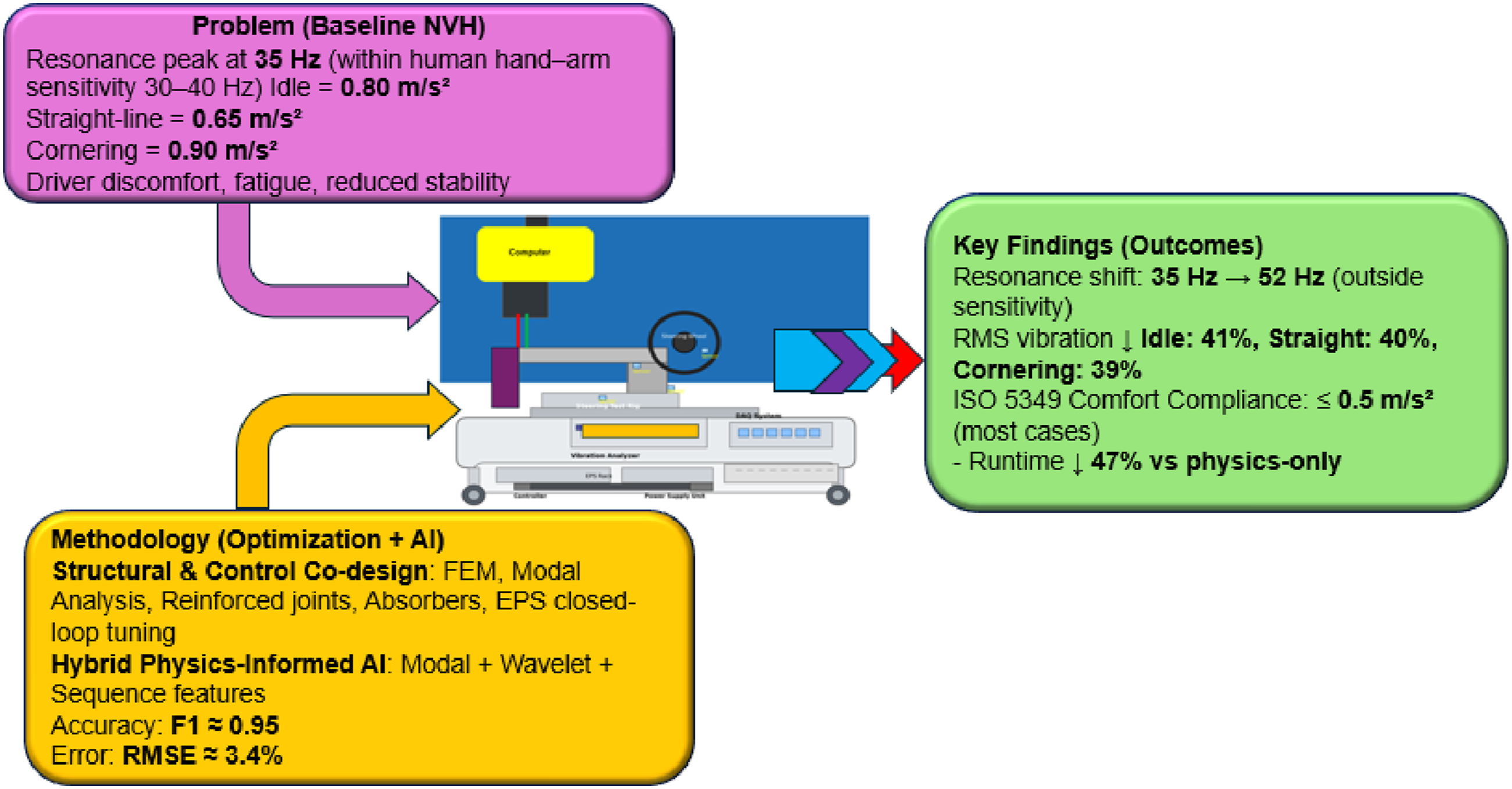
Steering noise, vibration, and harshness (NVH) remain critical challenges in autonomous and electric vehicles (AV/EVs), directly impacting comfort, safety, and system reliability. Subsystem-focused remedies for steering columns, suspensions, or EPS units often remain fragmented and fail to address system-level resonance, particularly within the hand–arm sensitivity band (30–40 Hz). This study presents a system-level NVH mitigation framework integrating finite-element/modal analyses, structural modifications, damping treatments, and EPS closed-loop control tuning. To enhance robustness, a physics-guided artificial intelligence framework was incorporated, combining modal indicators, wavelet features, and sequence learning for nonlinear vibration prediction. On-vehicle experiments under idle, straight-line, and cornering conditions validated the approach using triaxial accelerometers and high-resolution DAQ systems. Results show the baseline resonance peak at 35 Hz shifted to 52 Hz, moving outside the ergonomic sensitivity range. RMS vibration levels decreased by 41% at idle, 40% during straight-line driving, and 39% during cornering, approaching ISO 5349 thresholds. Mode-shape amplitudes were attenuated without altering nodal structure, confirming modal stiffening. The hybrid AI framework achieved F1 ≈ 0.95, RMSE ≈ 3.4%, and reduced runtime by ≈ 47% versus physics-only models. Findings establish resonance avoidance through integrated structural–control strategies and physics-informed AI, enabling scalable NVH-optimized steering for next-generation AV/EV platforms.
Keywords
Get full access to this article
View all access options for this article.