



Abstract
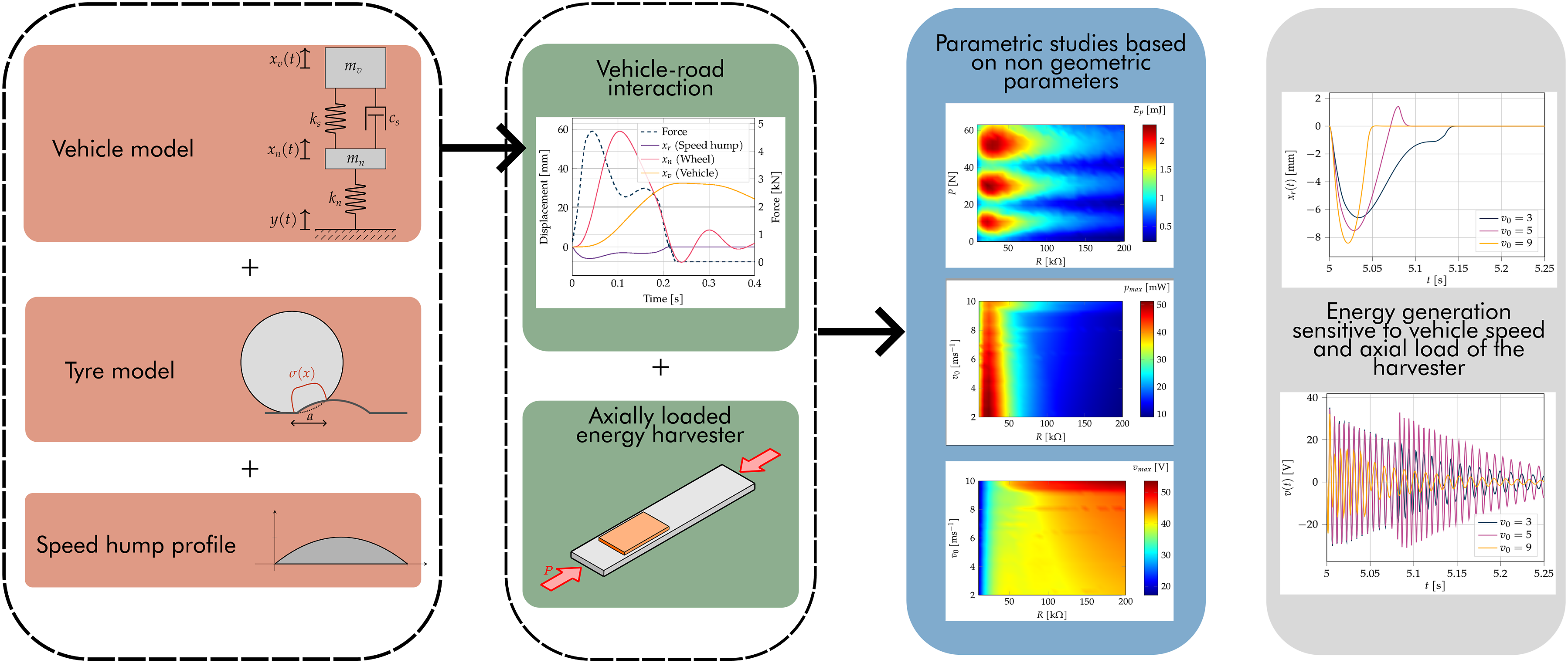
We present a numerical model to evaluate the feasibility of harvesting energy from the vertical vibration induced by a passing vehicle on a speed hump, using a piezoelectric transducer. We investigate the interaction between the vehicle and the speed hump by considering lumped parameters, comprising a quarter car model and a suspended mass for the speed hump. The speed hump displacement is used as base excitation for a beam-type clamped-clamped piezoelectric energy harvester subjected to an axial load, previously studied by the authors. The equations are temporarily solved using the Runge–Kutta method, and we conduct several parametric studies. Our findings indicate that the axial load applied to the harvester and the passing velocity have no significant impact on the peak transient values of voltage and power in the resistive load; however, they play a crucial role in determining the total energy harvested.
Keywords
Get full access to this article
View all access options for this article.