




Abstract
This article explores internally coupled resonators in metamaterial systems, focusing on mechanical and electromechanical coupling. The article provides a thorough examination of stability within the context of internally coupled resonators. It establishes stability criteria, emphasizing the importance of strictly stable systems in practical applications. Furthermore, it analyzes stability through simulations, revealing how various parameters impact system behavior and highlighting the challenges and benefits of achieving stability in metamaterial systems. Additionally, the article explores the impact of damping coefficients and resonator characteristics, on displacement and power generation profiles. Nonlinear behavior in internally coupled resonators is examined, revealing the presence of bifurcation in simulation and offering insights into multi-stability and system behavior.
Keywords
1. Introduction
Internally coupled resonators, integral in wave control, stability, and energy collection, are crucial in lumped parameter systems’ engineering. This article emphasizes the role of these resonators, highlighting the benefits of mechanical linear, nonlinear internal coupling, and electromechanical shunt capacitance circuits. These mechanisms allow for negative stiffness and refined system dynamic control. Electrical internal coupling, as shown through simulations, offers tunability and superior energy harvesting. Moreover, the article examines how parameters like damping coefficients and resonator traits influence displacement and energy output at varied frequencies. The nonlinear aspects of these resonators, leading to multi-stability and specific system behaviors, are also explored.
1.1. Internally coupled resonators exhibiting mechanical nonlinearity
The emergence of internally coupled resonators has been identified as a key element in recent dynamics and vibration control research. Through the complex interactions among internal structural components, these resonators exhibit a varied array of vibrational behaviors. These distinctive properties afford unprecedented capabilities in managing and directing wave propagation, establishing themselves as invaluable resources in various fields, such as structural health monitoring, acoustic metamaterials, and vibration mitigation. Notable research in this field, particularly exemplified by the studies of Hu et al. (2018), has traversed through metastructures featuring linearly coupled resonators. The discoveries from such investigations illuminate the existence of an additional narrow band gap in comparison to conventional metastructures, thereby highlighting the fascinating potentialities within this area of research.
While the concept of employing negative stiffness has been explored extensively in past research, Liu et al. (2022) delve into a diatomic-chain locally resonant acoustic metamaterial structure, underscoring the pivotal role of the negative-stiffness mechanism in enhancing vibration suppression. By utilizing additional band gaps and Bragg scattering, the structure exhibits superior management of vibration transmission, particularly in managing ultralow frequency vibrations in the lower frequency spectrum. The negative-stiffness mechanism proves vital for fine-tuning the metamaterial’s band gap characteristics and potential applications in vibration reduction, especially under specific material parameters.
1.2. Electromechanical internally coupled resonators
Electromechanical resonators, notably those incorporating piezoelectric elements and internal coupling of resonators, manifest a compelling complexity by merging mechanical and electrical aspects, thus enabling unique wave propagation properties. While their promising attributes are evident, an exploration into nonlinear, internally coupled electromechanical systems is relatively untapped. This discernible gap in research accentuates the need for an exhaustive study of these systems, which have the capacity to innovate vibration control and energy-harvesting sectors (Shu and Lien, 2006; Lefeuvre et al., 2005).
Despite their remarkable wave propagation features, metamaterials are often hindered by the limited bandwidth of their band gaps, impacting their performance in broad-spectrum vibration applications. To counteract this, research has pivoted toward developing metamaterial configurations with multiple band gaps and utilizing nonlinearity as a powerful tactic (Fang et al., 2017). The characteristics of piezoelectric shunt methods, marked by their mechanical–electrical conversion capabilities, have spurred research into dynamically tunable metamaterials. However, most studies predominantly utilize independent piezoelectric shunt circuits for each local resonator (Chatziathanasiou et al., 2022; Li et al., 2023).
The primary objective of this study is to comprehensively examine the band gap characteristics of the proposed lumped system, emphasizing the mechanical and electromechanical internal coupling through the shunt capacitance circuit and conceptualizing the circuit as a negative capacitor (Hu et al., 2017). Additional goals involve conducting a stability analysis of the piezoelectric elements model on the resonator and a pivotal comparison of power and energy harvested from the resonators, with a special focus on their impact on band gap formation in the chain mass structure.
1.3. Solution stability
The stability and singularity of nonlinear solutions in mechanical internally coupled resonators, electromechanical internal coupling, and other nonlinear periodic media have been somewhat overlooked. Stability analysis regarding wave responses in phononic media is documented in foundational systems (Newton and Keller, 1987), works addressing geometric nonlinearity (Liu et al., 2022; Murer et al., 2023), and studies on topological modes (Chaunsali et al., 2021). The introduction of nonlinearity often induces bifurcations, leading to dynamic solutions with multiple branches. Without a stability analysis, theoretical responses might not represent physical systems accurately. Investigations into the stability of harmonic excitations have revealed transitions between stable solutions with increasing amplitude, eventually leading to chaotic dynamics (Hoogeboom et al., 2013).
Meanwhile, stability analysis of plane waves in nonlinear phononics remains relatively unexplored. Newton and Keller (Newton and Keller, 1987) introduced an equation to assess the perturbation growth rate to ascertain the start and end of plane wave stability. Further studies by Fronk and Leamy (Fronk and Leamy, 2017, 2019) addressed plane wave stability in monoatomic and diatomic chains. These findings highlight that in 1D systems, stability is amplitude-dependent, and in 2D, it also depends on direction. Recent studies have also analyzed the stability of topologically protected modes (Mančić et al., 2023) in highly nonlinear systems, unveiling specific frequency–energy domains where the protected mode becomes unstable.
This research tackles the challenge of optimizing band gap characteristics and energy harvesting in linear and nonlinear internally coupled resonators, a significant gap in current metamaterial applications crucial for advancing energy efficiency and vibration control.
The primary contributions of this paper are summarized as follows: • Analyzed band gap and energy harvesting in nonlinear coupled resonators in lumped system. • Developed new stability analysis for nonlinear resonator systems. • Identified enhancements in band gaps specifically in internally coupled resonators. • Illustrated how internal coupling boosts energy harvesting and analyzed damping impacts. • Provided insights on optimizing metamaterials for energy harvesting. • Demonstrated advantages of electromechanical shunt circuits in tuning band gaps.
2. Method
Using the lumped parameter model, intricate physical systems are distilled into discrete points defined by parameters such as resistance, capacitance, or mass. This is suitable for systems where the wave propagation wavelength far exceeds structural dimensions.
Through the Lagrangian energy method, equations of motion are derived for metamaterials interfaced with internally coupled resonators. Given the system’s inclusion of negative stiffness, an essential stability analysis is executed, aiming for vibration suppression enhancements while ensuring stability and reliability.
2.1. Linear electromechanical resonators
In electromechanical systems employing piezoelectric elements, additional nonlinearity is introduced to the system dynamics, serving to dampen vibrations and enhance energy harvesting in resonators. When resonators are integrated with piezoelectric elements, a coupling between mechanical and electrical dynamics occurs, which enriches yet complicates system behavior. Utilizing Lagrange’s equation, governing dynamics can be obtained, with mechanical damping typically represented via Rayleigh damping and energy equations being linearly characterized. The resulting governing equations of motion are delineated accordingly.
2.2. Analysis of power output of standard piezoelectric circuit for energy harvesting
In investigating the nonlinearity properties in piezoelectric materials, this study utilizes a standard circuit paired with each nonlinearity type. This approach ensures that each nonlinearity is observed in isolation, unaffected by different circuit efficiencies. Here, the piezo voltage, v
p
(t), has a direct proportionality to the displacement, u(t). An in-depth analysis yields the average harvested power P in the system as
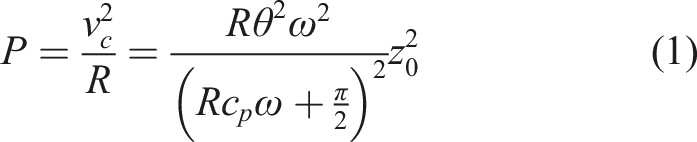
This formulation encapsulates the intricate interplay between electric charge storage, current dynamics, mechanical displacement, and the system’s power harvesting (Shu and Lien, 2006).
2.3. Internally coupled resonators with mechanical nonlinearity
The system, illustrated in Figure 1, embodies a nonlinear mechanical chain internally coupled, with a unit cell delineated by a dashed rectangle. The analysis simplifies the system dynamics by exclusively considering springs, assuming linearity for both the primary and resonator-associated springs while maintaining nonlinearities in the internally coupled springs, and disregarding damping and electromechanical elements. The primary dynamic behavior emerges predominantly from the nonlinear internal coupling amidst resonators within a generally linear spring system, thereby facilitating a concentrated exploration into the effects and potential benefits of nonlinearity in inter-resonator springs. A mechanically internally coupled resonator. The dashed rectangle signifies a unit cell.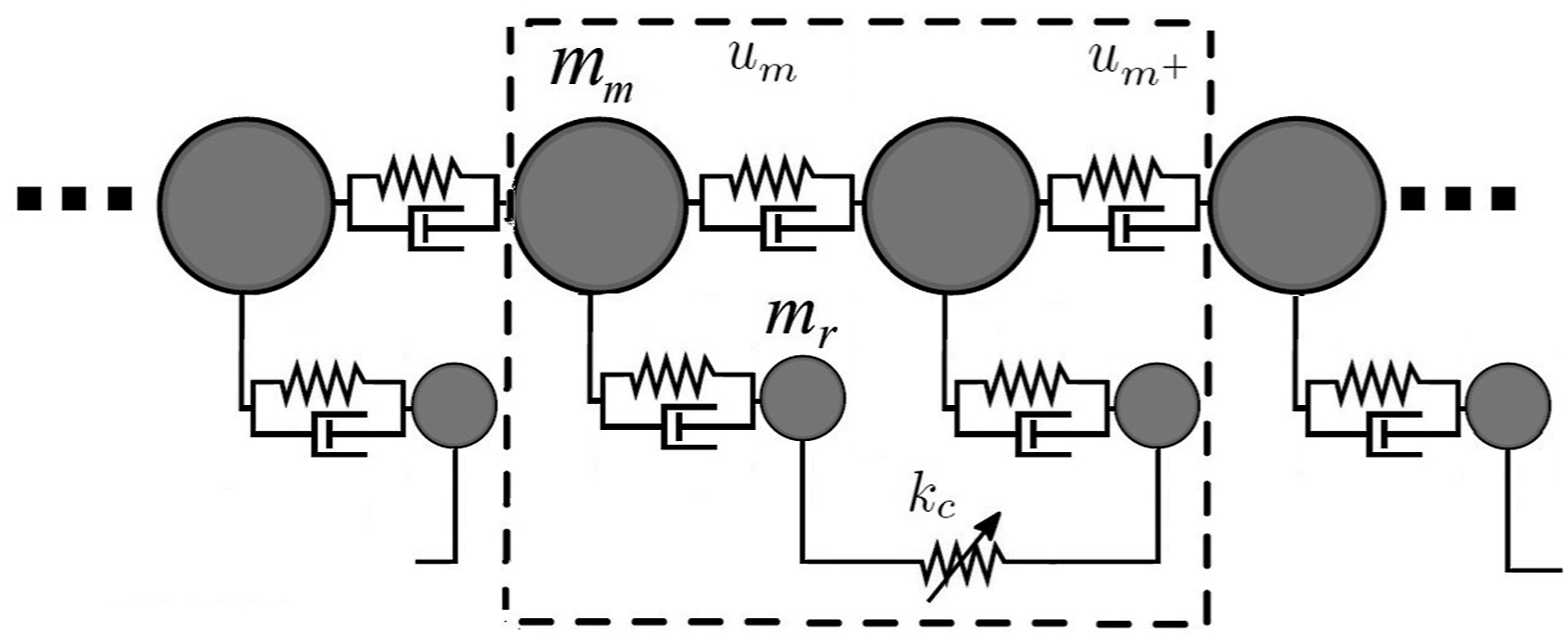
The kinetic energy, symbolized by T, includes the dynamic activities of both the main chain and the resonators and is expressed as follows:

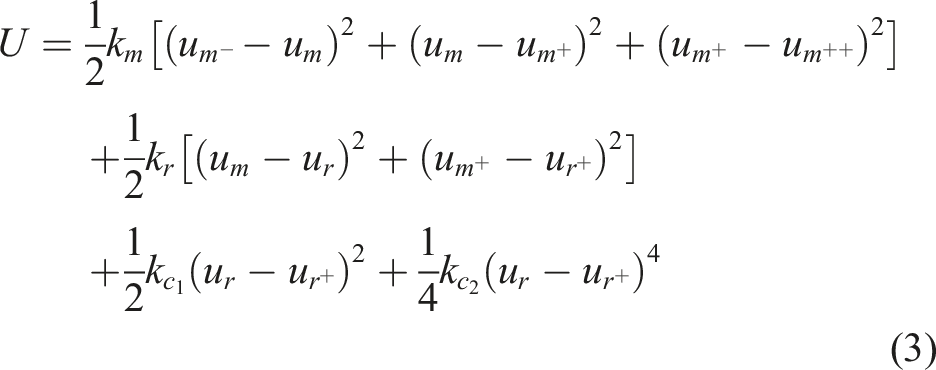
The potential energy, denoted by U, encapsulates the energy stored in various components of a mechanically coupled system: the main chain’s linear springs, coupling springs between the chain and resonators, and notably, the nonlinear springs internally coupling the resonators provide a comprehensive view of energy distribution and interplay in a predominantly linear mechanical chain with specific nonlinear interactions.
Here,




Here, m
m
represents the mass of the main chain, and the coefficient k
m
is the main chain’s stiffness, interacting with the relative displacements between the resonator and its neighbors, while k
r
characterizes the resonator’s inherent stiffness. The
2.4. Stability analysis for mechanical internally coupled metamaterial
The Jacobian matrix is commonly used to analyze the stability of equilibrium points for nonlinear systems. The idea is to linearize the nonlinear system around its equilibrium points and then analyze the stability of the resulting linear system. This provides insight into the local behavior of the nonlinear system around those points.
Considering equations (6) and (7) without the excitation force, the equilibrium points of the system can be ascertained. Setting the velocities
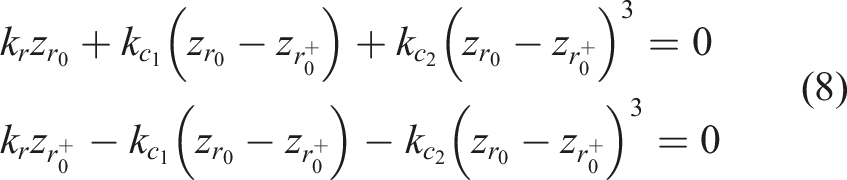
Introducing small perturbations around these equilibrium points results in the following expressions:

Upon linearization of the equations of motion around the equilibrium, terms of higher order in δz
r
and


A state vector is introduced to convert the second-order system into a system of first order:
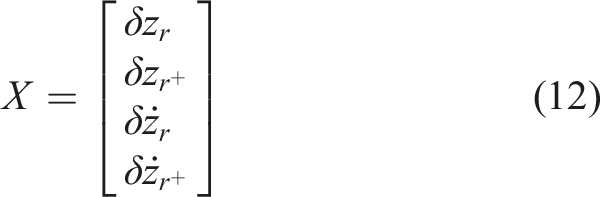
Differentiating the state vector yields
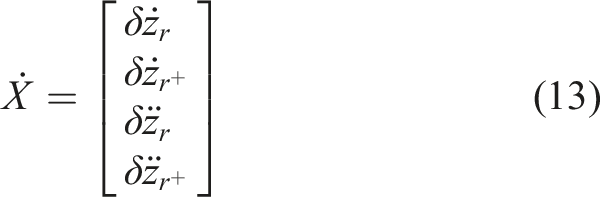
The objective is to represent
The eigenvalue for the nonlinear internally coupled resonators is determined by equations (14) and (15):

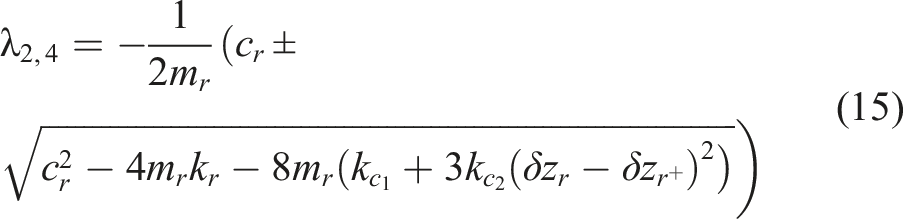
By omitting the nonlinear term


Stability scenarios for internally coupled systems:
2.4.1. Nonlinear systems
2.4.2. Linear systems
2.5. Electromechanical resonators with internal coupling via shunt capacitance circuit technique
In the preceding section, the metamaterial with internal resonator coupling was examined. Due to challenges in constructing and instructing the internal spring, especially when aiming for negative stiffness, an alternative is to utilize an electrical shunt circuit, specifically a prototype capacitance, offering behavior similar to the mechanically internally coupled resonator.
In this section, the shunt capacitance circuit technique is employed to model a two-degree-of-freedom electrical system with internal coupling, as illustrated in Figure 2. In this scenario, capacitance is incorporated as a key component instead of utilizing the resistance (R) as load. Internally coupled system with electrical shunt circuit: Forward (dashed line) and reverse (solid line) capacitance shunting configurations.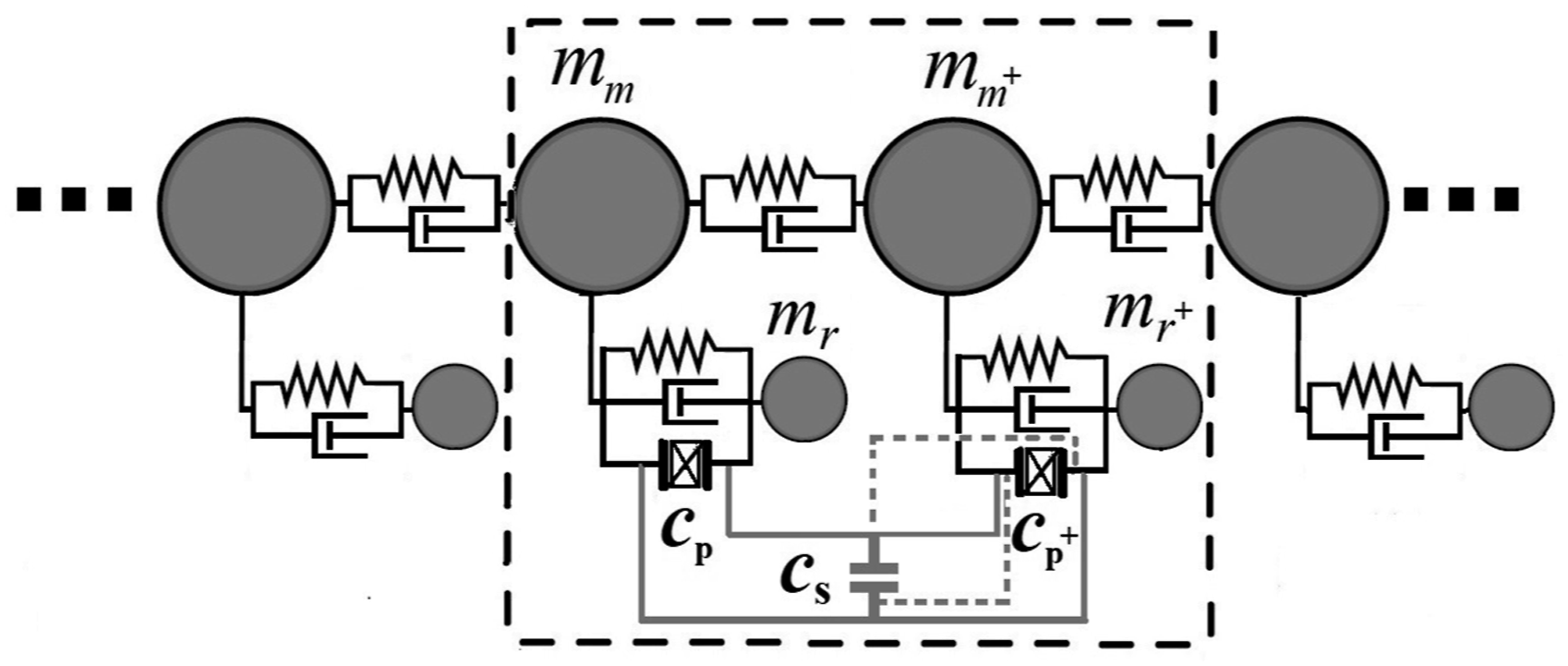
Figure 2 illustrates the forward and reverse shunt circuit setups. The forward pairs the top and bottom surfaces of piezoelectric transducers, whereas the reverse opposes them. Both configurations use a parallel capacitor and yield similar analytical conclusions, with the only difference being a sign change in the coupling stiffness. Despite their similarities, this study primarily focuses on the reverse setup due to its straightforward mechanical interpretation when no external capacitance is present. In terms of capacitance, positive values lower voltage during current discharge, while negative ones raise it. Drawing from the impedance analogy, the segments LRC and LRC+ correspond to resonators m
r
c
r
k
r
and
The voltage across the capacitance reflects force interactions between resonators. Current and charge shifts denote velocity and displacement variations. Essentially, the capacitor acts as a coupling spring, its stiffness determined by the capacitance sign. In the reverse setup for piezoelectric transducers, voltages possess equal magnitude but opposite directions, influenced by the current in the parallel capacitance c
s
, as Electrical analog of unit cell resonators with capacitance shunt circuit via impedance method.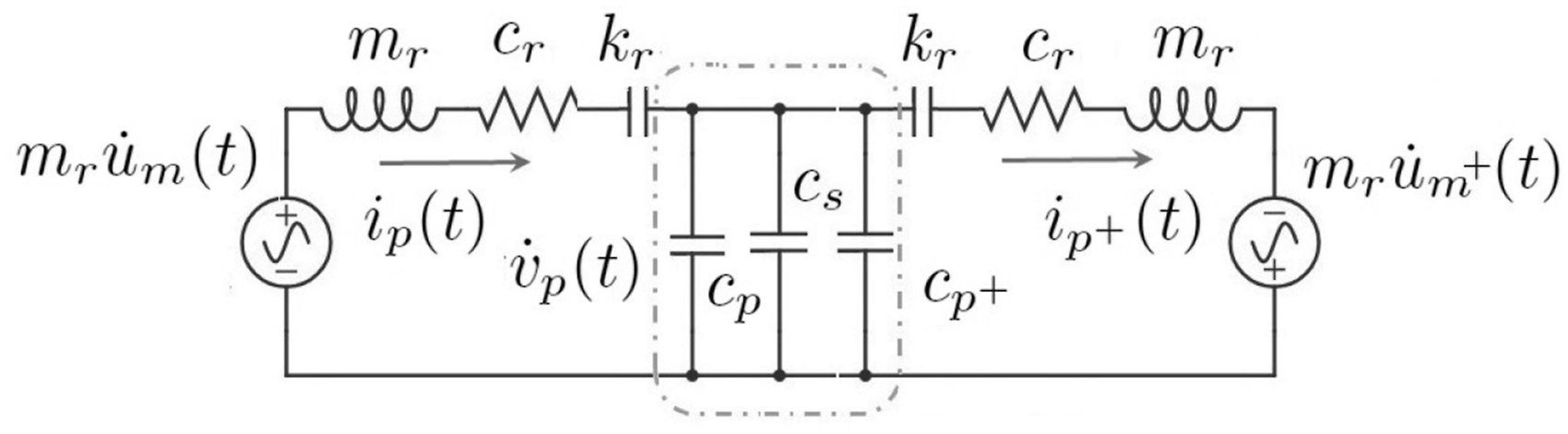

The design uses an internal shunt capacitance, tuned to act as a negative capacitor, to boost resonator performance and strengthen adjacent resonator coupling. Given identical properties for all resonators, including stiffness, damping, and mass, the governing equations for the motion of two resonators within a unit cell, as seen in Figure 2, are


Relative displacements of the resonators to the main structure can be defined as z
r
= u
m
− u
r
and


By substituting equation (18) into equations (21) and (22), expressions for currents i
p
(t) and


Substituting equation (23) and equation (24) into equation (18) and integrating with respect to time for zero initial condition yields


Substituting equation (25) and equation (26) into equation (19) and equation (20) yields the following expressions:


where



For identical electromechanical couplings and after substituting the relevant equations into equation (18), the integrated result yields the following condensed motion equations:


where

2.6. Stability analysis for electromechanical internally coupled resonators via shunt capacitance
The stability of the system hinges on k
s
, denoting electromechanical coupling through the shunt circuit. Instability might arise with negative shunt capacitance. For the dual-resonator setup, stability is gauged by linearizing its equations of motion and inspecting the eigenvalues of the Jacobian matrix. A system is stable if all its eigenvalues possess negative real parts. By analyzing the Jacobian matrix derived from linearizing around equilibrium, we discern system behavior. The system remains stable with all eigenvalues in the left-half complex plane. Achieving negative stiffness necessitates
For a system with positive electromechanical coupling, achieving a negative k
s
necessitates the combined c
p
and c
s
to be negative, indicating a need for negative capacitance. This can be realized using active circuits with operational amplifiers or ferroelectric capacitors. However, this introduces challenges such as potential destabilization. Ensuring system stability, especially with negative capacitance, is paramount, often verified using Jacobian analysis. Mathematically, a corresponding linear system is expressed as

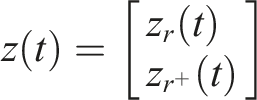
The system’s stability is influenced by the eigenvalues of the Jacobian matrix, determined by equation (36). These eigenvalues are shaped by the damping coefficient c
r
and shunt coefficients

Notably, the real component of λ, defined as −c
r
/2m
r
, predisposes the system to stability, but further analysis is essential for a full understanding.


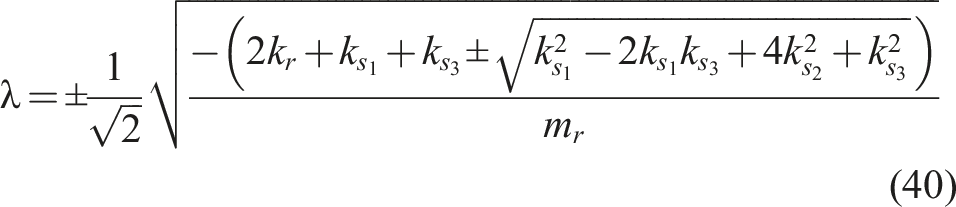
For a marginally stable system, damping is typically disregarded to establish boundaries of stability. As per equation (39), when the system’s eigenvalues are purely imaginary, it denotes a marginal stability condition. This equation delineates constraints on the stiffness coefficients k
r
and k
s
, defining the threshold between stable and unstable regimes.

The associated eigenvalues, representing the system’s characteristic frequencies, are given by
To identify criteria for c
s
that ensures a negative equivalent stiffness, equations (29), (30), and (31) are substituted into (37) and (38). The derived expressions are then analyzed to determine the conditions for c
s
that satisfy the stability conditions


Substituting a and b into equation (41) for the stability condition of a − b < 0 yields
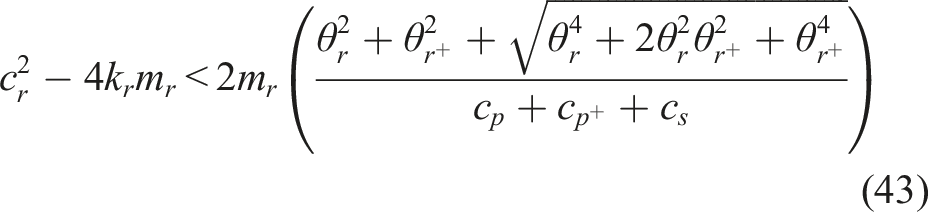
Taking into account the absolute values in equation (42), it becomes imperative to explore two scenarios due to the potential positivity or negativity of both a and b.

The inequalities (44) and (43) should be satisfied for stability, and c
s
appears in the denominator of the fractions in these expressions, implying that as c
s
changes, the values of these expressions will alter, potentially changing the sign of the inequalities. To derive explicit criteria, one could further manipulate these expressions or, depending on the specific application or system, analyze them numerically by substituting values of other parameters
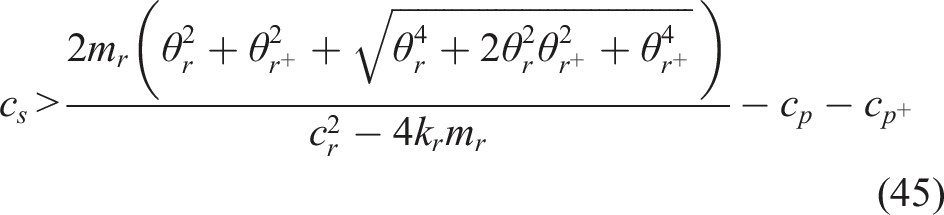
In the case of identical electromechanical coupling, and capacitance, the criteria for c
s
can be simplified as follows:

In the scenario devoid of damping, the eigenvalues of the system, representing its characteristic roots, are provided as follows:
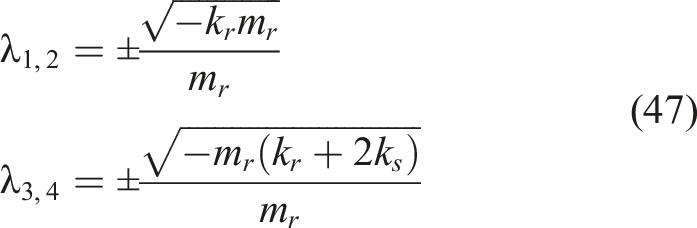
The system’s stability is defined by the real parts of its eigenvalues. When k
r
+ 2k
s
> 0, the system exhibits marginal stability, oscillating continuously without decay or growth. However, if k
r
+ 2k
s
< 0, the system has both positive and negative eigenvalues, indicating instability. This highlights the critical relationship between the resonator’s spring constant and the shunt capacitance stiffness (k
s
). If the feedback from the shunt is overly negative, it can destabilize the system. In most applications, full stability is preferred over marginal stability. The stability criterion for c
s
is

In contrast to purely mechanical internally coupled resonators, electromechanical shunt capacitance circuits provide benefits over solely mechanical resonators by allowing easy adjustments for negative stiffness. The system’s flexibility is further amplified by altering parameters like
3. Simulation analysis and discussion
Defined parameters for the piezoelectric model.
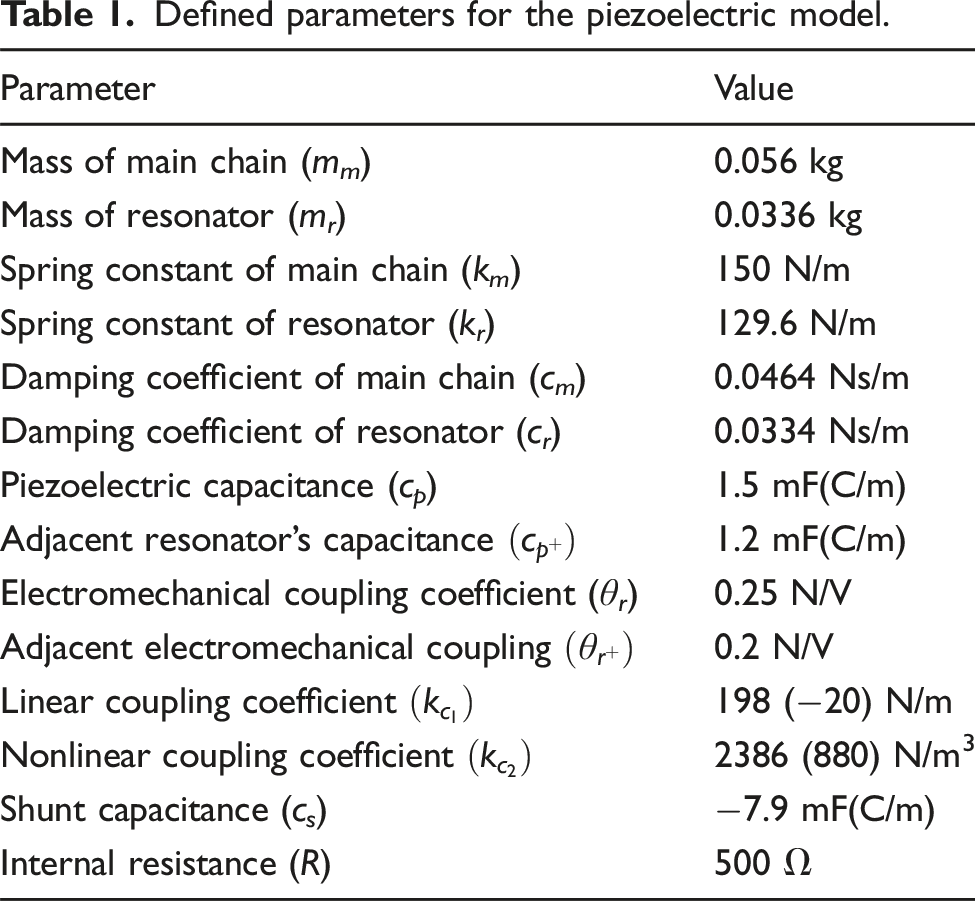
The model revealed four wavelengths (λ) for creating distinct dispersion curves stemming from the presence of four inertias within a unit cell, suggesting the potential for enhanced band gaps in internally coupled metamaterials as opposed to conventional ones. While our research concentrated on a select frequency range to delineate the variances between mechanical and electromechanical internal coupling, the broader implications of all band gaps across the entire frequency spectrum remain an open field for future exploration.
Incorporating real-world scenarios, our research encapsulates applications that harness high-capacitance piezoelectric materials. These include pedestrian energy-harvesting floor tiles in airports, vibration dampers in industrial machinery, structural health monitors for bridges and buildings, energy-recapturing systems in automotive suspensions, and self-charging phone cases. These case studies demonstrate the practical engineering scenarios where our research can be applied, emphasizing the transformative impact of our findings on sustainable engineering design and operation.
3.1. Shunt capacitance influence on system stability and energy-harvesting efficiency
Figure 4 illustrates the relationship from equation (48). For system stability, the equivalent internal coupling stiffness k
s
should exceed k
s
= −k
r
/2. The figure illustrates the relationship between k
s
and shunt capacitance c
s
. The light blue area denotes system stability, while the reddish color signifies instability. Given the parameters, stability is maintained for c
s
values from negative infinity to about −0.004 F and from around −0.003 F to positive infinity. However, there’s a brief unstable period in between. A zoomed-in view highlights the crucial c
s
values where the system behavior changes. Stability map for the electromechanical lumped system: interplay between equivalent stiffness k
s
and shunt capacitance c
s
. Parameters: n = 4, m
m
= 56 g, m
r
= 33.6 g, k
m
= 150 N/m, k
r
= 129.6 N/m, θ = 0.25 N/V, R = 500 Ω, and c
p
= 1.5 × 10⁻³ F.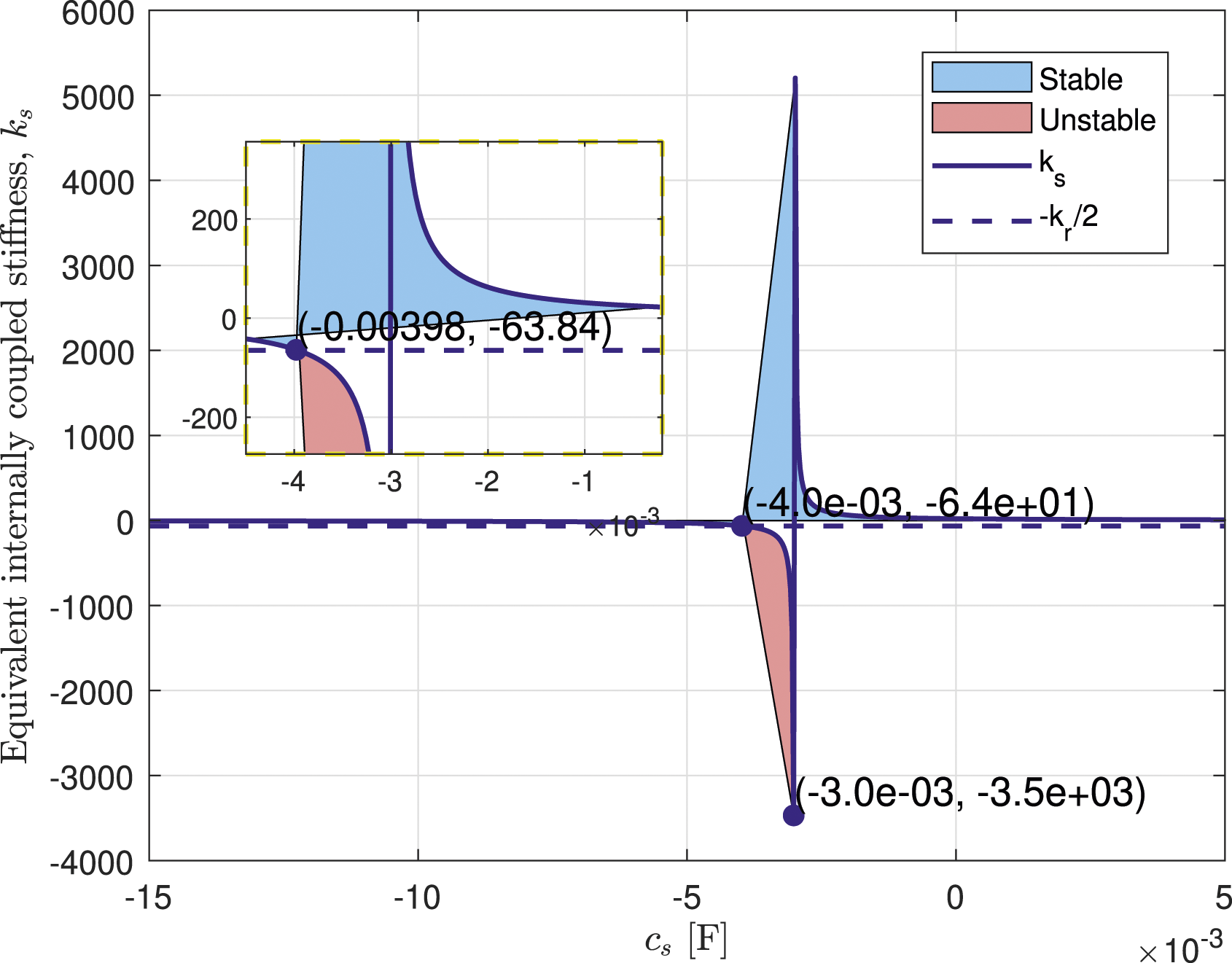
In the study of energy-harvesting systems, understanding the behavior of different parameters is essential for optimization. From the simulations, key insights have emerged. Figure 6 presents the harvested power and energy across a range of shunt capacitances. It clearly underscores the influential role of shunt capacitance on the system’s overall efficiency.
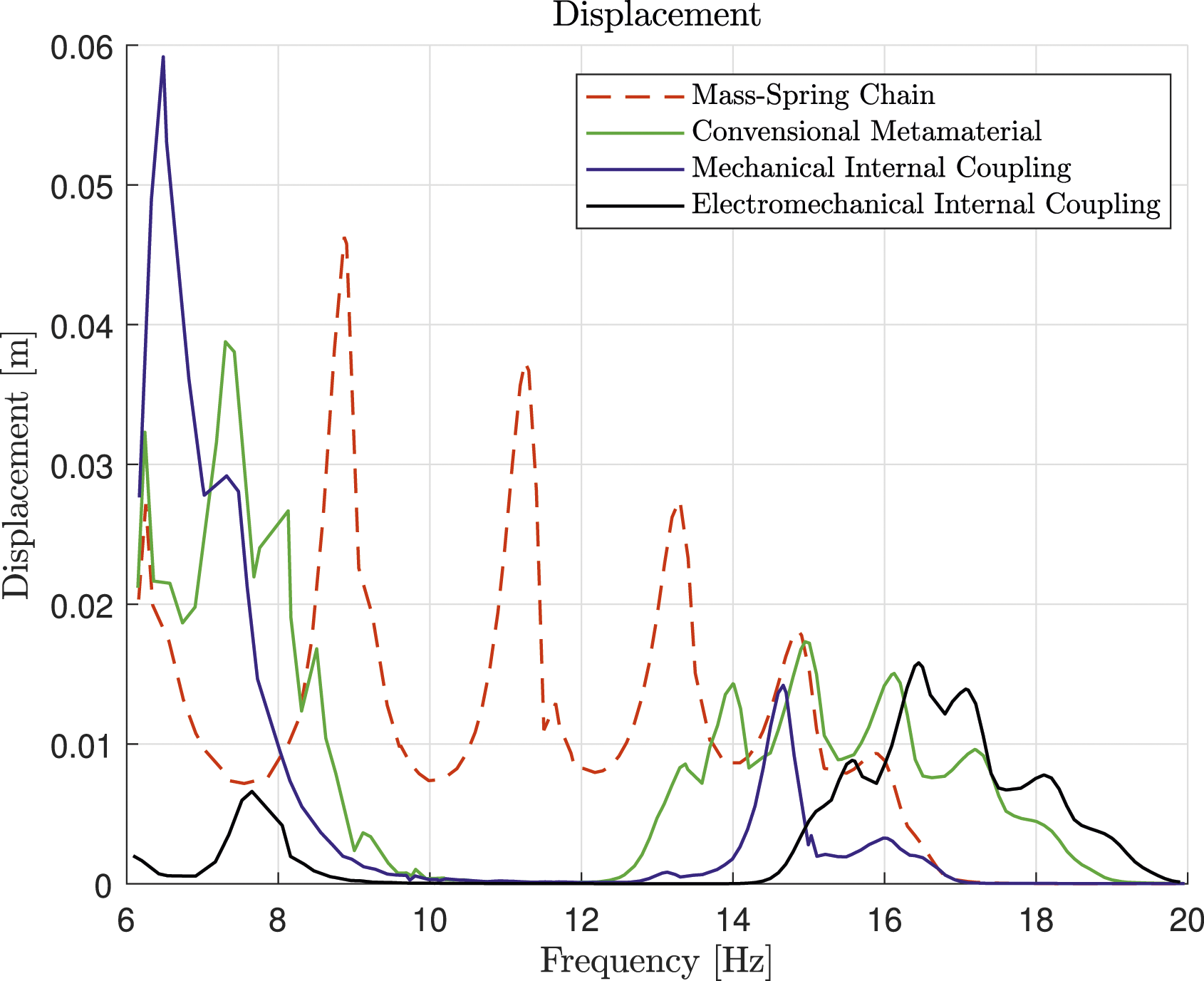
A pivotal observation made from the results is the superiority of electrical internal coupling via shunt circuits in terms of tunability. Specifically, electrical coupling seems to allow for easier tuning of the band gap compared to its mechanical counterpart. This is evident in Figures 5 and 6, where the chosen shunt capacitor facilitates a band gap at a notably lower frequency in comparison to a mechanically internally coupled system, as illustrated in Figure 7. Transmittance comparison of electrical internally coupling with shunt circuit for θ = 0.25 and c
p
= 1.5 mF, demonstrating the impact of an equivalent negative stiffness of k
s
= −30. Power and energy harvesting across various shunt capacitances with θ = 0.25 and c
p
= 1.5 mF. Frequency response analysis: comparative displacement profiles of mechanical, conventional metamaterial, and electromechanical internally coupled systems based on parameters in Table 1.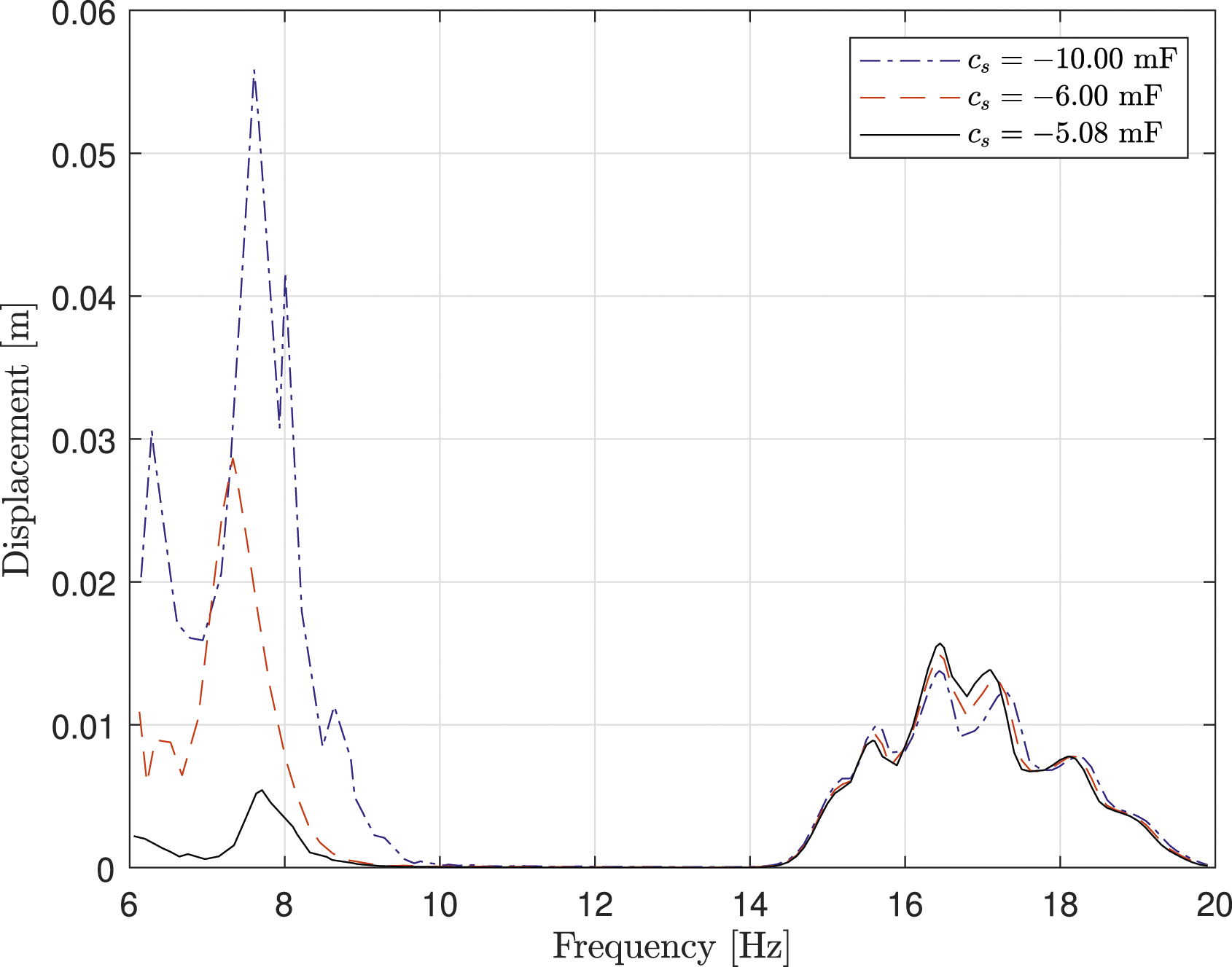
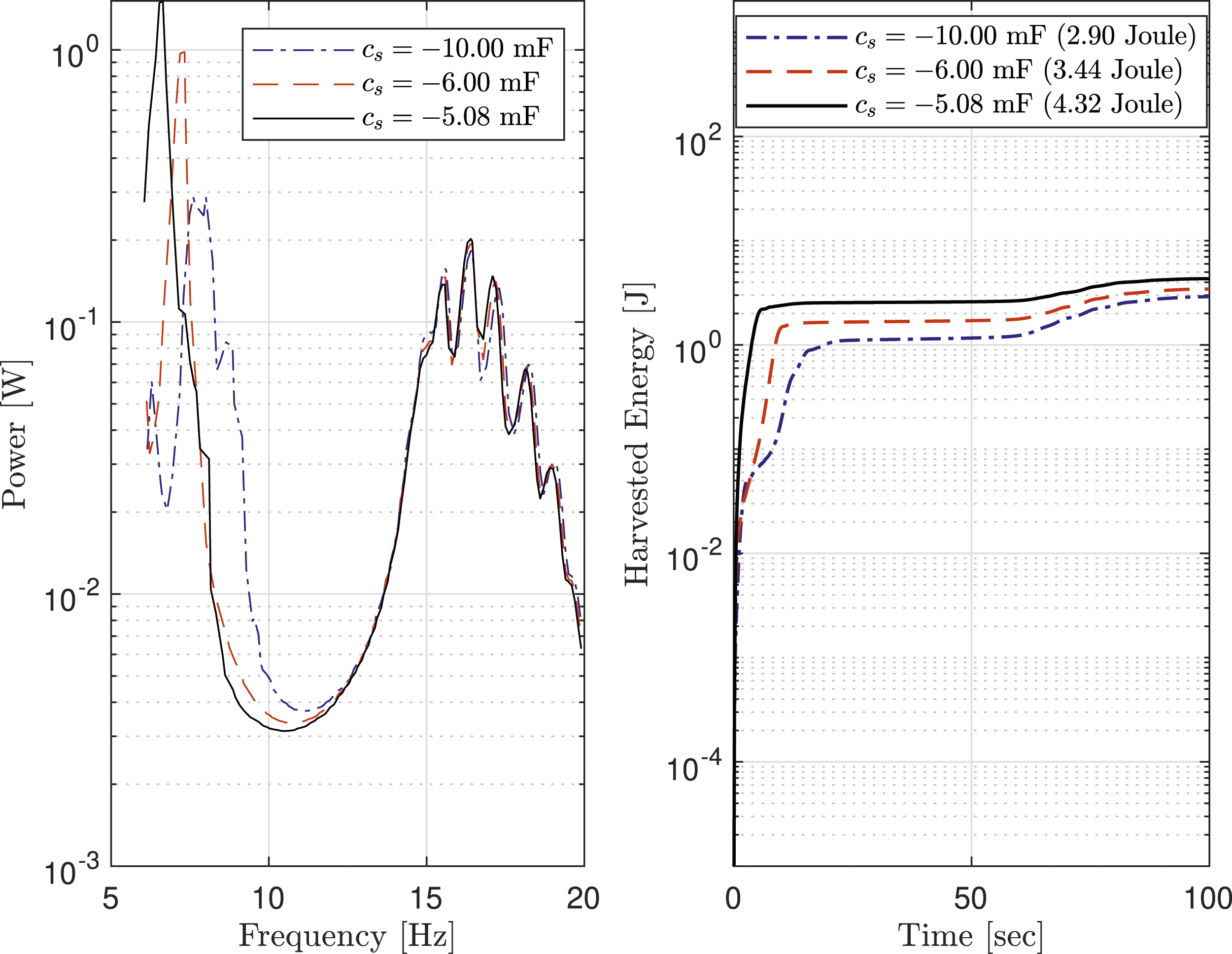
Selecting a shunt capacitance of c s = −5.08 mF results in an equivalent stiffness of k s = −30. This specific choice not only introduces an equivalent negative stiffness into the system, enhancing energy-harvesting capabilities across varied frequency spectrums, but also facilitates the creation of a band gap at a lower frequency (see Figure 5). Compared to mechanical internally coupled resonators, this allows for more flexible and straightforward tuning of the band gap across different frequencies.
3.2. Electromechanical internally coupled resonators
Figure 7 illustrates the displacement response across different frequency ranges for four distinct systems: mass–spring chain, conventional metamaterial, mechanical internal coupling, and electromechanical internal coupling. The mechanical internally coupled system has a dominant response at around 7 Hz, peaking at a displacement of approximately 0.06 m, but its effectiveness drops beyond 12 Hz. In contrast, the conventional metamaterial with linear resonators responds at multiple frequencies, especially around 12 Hz and 14 Hz. Both the mechanical and electromechanical internal coupling systems exhibit intricate frequency responses, with the latter demonstrating a wider range of resonances. Displacement magnitudes suggest potential energy-harvesting capabilities, with greater displacements indicating more energy conversion potential. Notably, while the electromechanical system might display a reduced displacement compared to its purely mechanical counterpart, its broader frequency response makes it versatile, though its energy-harvesting efficacy needs further examination as indicated in Figure 9.
From Figures 8 and 9, the damping coefficients of mass chain c
m
and resonator c
r
alter displacement and power generation profiles across frequencies. A higher damping smoothens the response, lessening peak displacements while broadening the frequency response. This results in decreased peak power but an enhanced ability to harvest energy across a wider frequency range. Observations show that a steeper curve corresponds to more energy harvested over time with a higher c
r
. For this case study, the electromechanical parameters, θ = 0.25 N/V, internal resistance R = 500 Ω, and shunt capacitance c
s
= −5 mF are selected. As seen in Figure 8, different values of c
r
lead to varied displacement, power, and energy profiles. It directly affects the sharpness of the resonance peak and the bandwidth of the system’s frequency response. A high c
r
broadens the response, suitable for environments with varied frequencies but at the cost of peak performance. Frequency response showcasing the influence of varying resonator damping coefficients Displacement profiles as influenced by the mass chain damping 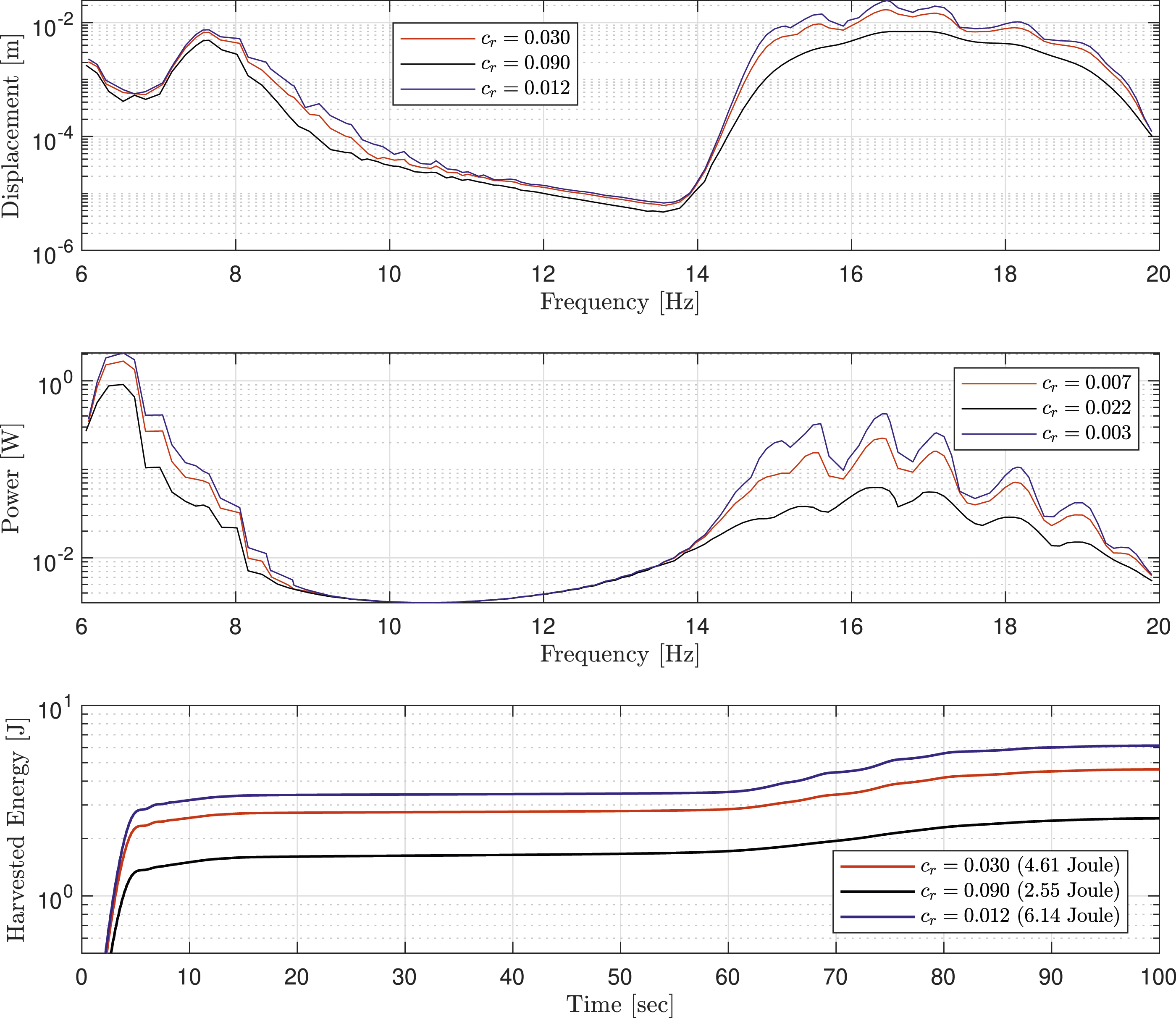
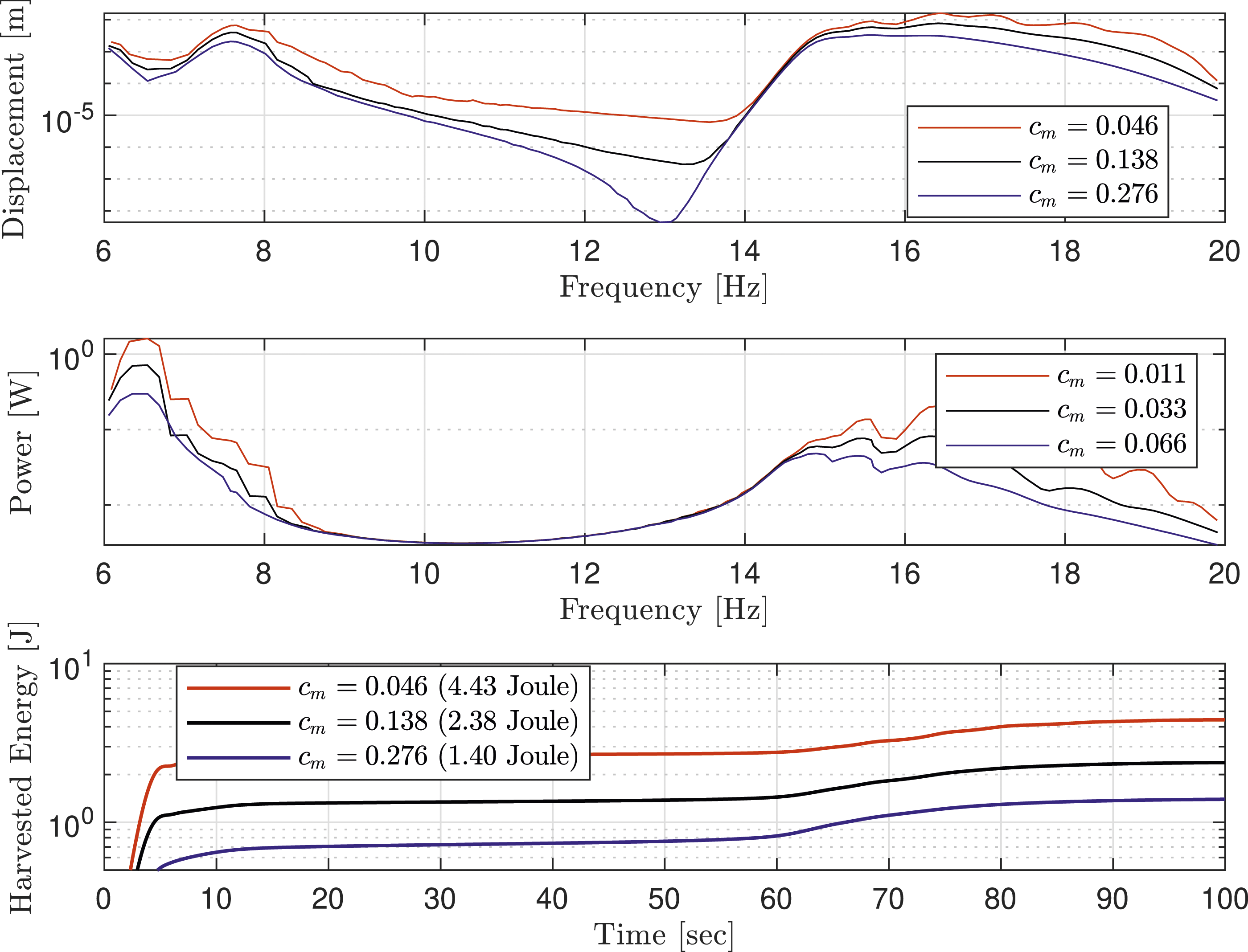
In comparing the displacements from Figures 8 and 9, it’s evident that the behaviors of c
m
and c
r
diverge. Specifically, c
m
prominently impacts the system’s transient response and settling time. Notably, even with piezoelements on the resonator, increased main chain damping
Figure 10 shows the displacement response of nonlinear mechanical internal coupling resonators over a frequency sweep. The plot contrasts the displacement during upward and downward frequency sweeps, revealing the nonlinear behavior and hinting at the presence of bifurcation around 15 Hz. This nonlinearity is influenced by the linear coupling coefficient Displacement response of nonlinear mechanical internal coupling resonators over a frequency sweep, with linear coupling coefficient 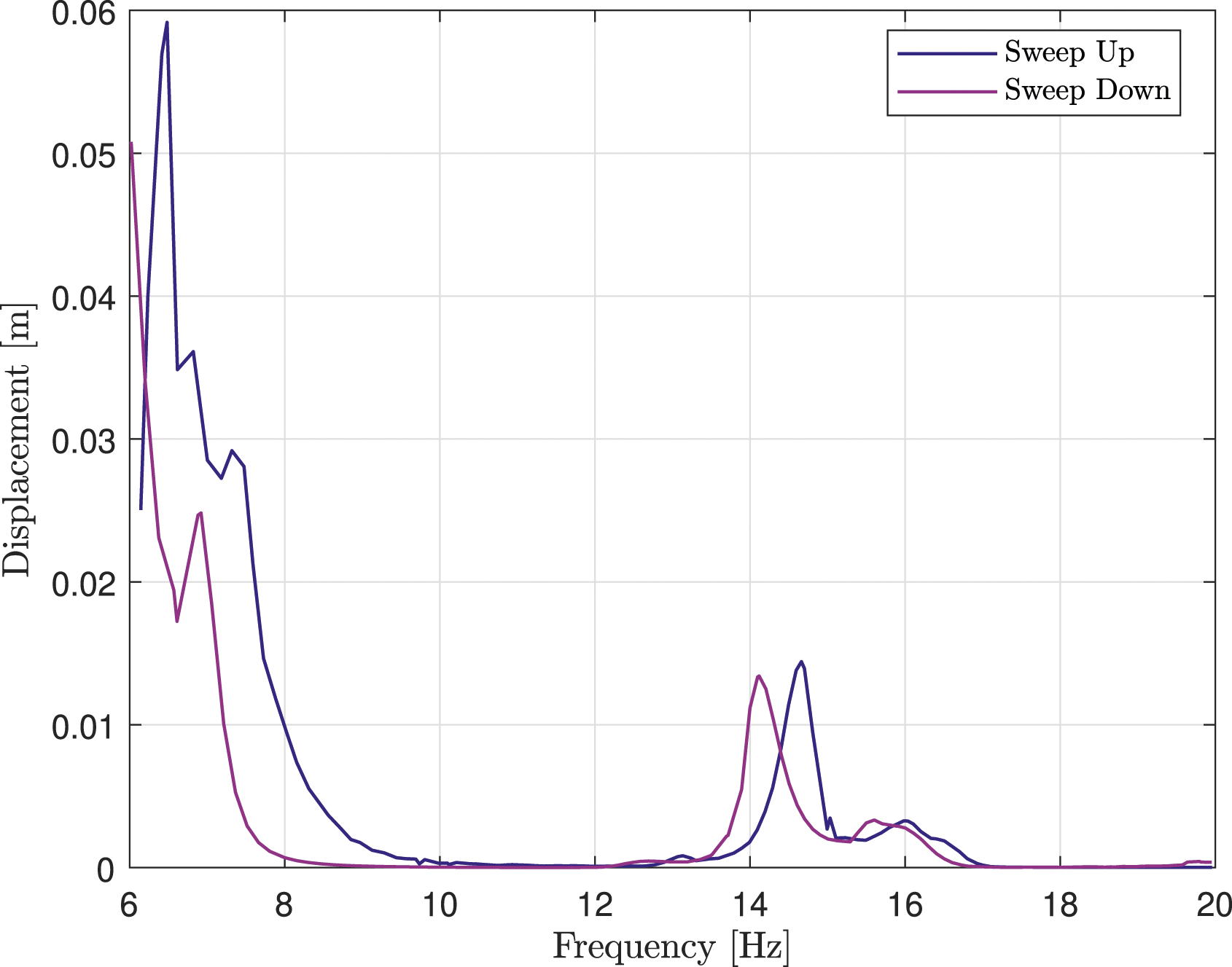
Figure 11 illustrates bistable-type nonlinear mechanical resonators with internal coupling. The parameters employed include linear coupling coefficient Displacement response of bistable nonlinear mechanical internal coupling resonators: linear coupling coefficient 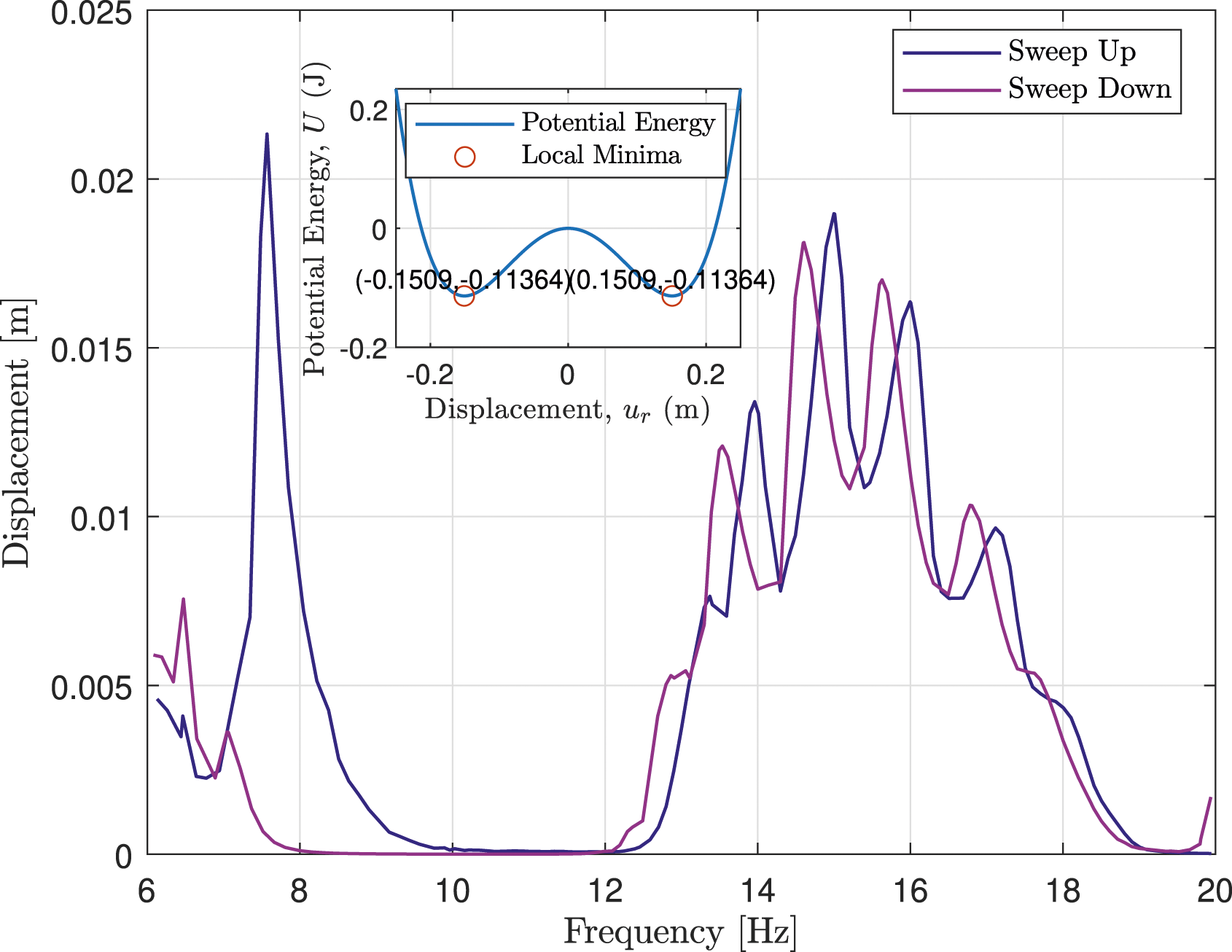
The inset plot within the main figure shows a graph of potential energy against displacement. This highlights the energy state of the system for different displacements. The presence of multiple local minima indicates that the system can occupy multiple stable states for specific energy levels. This behavior indicates multi-stability in the system, especially if the resonators encounter large fluctuation range. The peaks, especially those around 8 Hz and 15 Hz, show clear discrepancies between the sweep up/down traces. This difference highlights the system’s nonlinear hysteresis behavior. Beyond the 16 Hz mark, multiple peaks and valleys suggest that the system has several resonance frequencies or harmonics. These characteristics can arise due to the interplay of the system parameters and nonlinearities.
Leveraging bistability in phononic media can profoundly alter the wave response within band gaps via supratransmission, a phenomenon documented in bistable periodic chains both with and without resonators (Frazier and Kochmann, 2017), as well as in metastable modular metastructures (Wu and Wang, 2019). Nonetheless, in this context, the parameters of the bistable system are deliberately chosen to operate within a confined frequency range, aiming to exclusively simulate the system akin to negative stiffness found in electromechanical systems utilizing shunt circuits.
To enhance the validity of these findings, supplementary numerical simulations were executed, integrating decreased piezoelectric capacitance values. Specifically, c
p
and cp+ were adjusted to 800 nF. With other parameters kept constant (k
r
, m
r
, and c
r
), and the electromechanical coupling coefficients θ
r
and
4. Conclusion
In conclusion, this investigation into the dynamics of internally coupled resonators within metamaterial systems has underscored the critical balance between resonator stiffness and shunt capacitance stiffness, k s . Our stability analysis reveals that excessive negative feedback can lead to system instability, thus necessitating careful parameter tuning.
The simulations have demonstrated the significant advantages of electromechanical shunt capacitance circuits, notably in adjusting negative stiffness and facilitating lower operational frequency band gaps. These insights are invaluable for understanding system efficiency and the effectiveness of electrical internal coupling in energy harvesting. Furthermore, the study of nonlinear characteristics like bifurcation and hysteresis in resonators paves the way for innovative energy-harvesting device designs.
To further validate these findings, additional numerical simulations were conducted with lower piezoelectric capacitance values. This extension of the simulation framework reinforced the robustness of the initial results and confirmed the model’s practical applicability and relevance in realistic scenarios.
The applications of high-capacitance (millifarad-level) piezoelectric materials span various sectors. They enable energy-harvesting floor tiles in high-traffic areas like airports, vibration damping in industrial machinery, continuous structural monitoring in buildings and bridges, energy recapture in vehicle suspensions, self-charging solutions for personal electronics, and long-lasting power sources for wearable health monitors. These applications underscore the significant potential and real-world impact of advanced piezoelectric materials in energy harvesting and sustainability.
Guidance for augmenting the capacitance of piezoelectric materials involves selecting materials such as PZT or polymer-based composites with higher dielectric constants, optimizing the geometry of piezoelectric elements, employing multi-layer structures, and connecting multiple capacitors in parallel. These strategies cumulatively increase the overall capacitance available for energy harvesting and other applications.
The key contributions of this research include the analysis of band gaps and energy-harvesting capabilities within linear and nonlinear coupled resonators in lumped systems, a novel stability analysis approach for these systems, and insights into optimizing metamaterials for energy harvesting. A significant discovery is the identification of enhanced band gaps in internally coupled resonators. Our work demonstrates the advantages of electromechanical shunt circuits in fine-tuning band gaps for optimized performance, marking significant steps forward in harnessing the potential of piezoelectric materials for sustainable energy solutions.
5. Future works
This study offers significant insights into the stability and energy harvesting capabilities of internally coupled resonators within lumped parameter systems. Looking ahead, several suggestion for future research emerge: Firstly, there is a clear necessity for detailed investigation aimed at optimizing coupling parameters, such as capacitance values and nonlinear coefficients, with the aim of maximizing energy harvesting efficiency and bolstering system stability. Furthermore, extending our analysis to encompass networks of internally coupled resonators within distributed parameter systems will be invaluable. Such exploration is critical for deciphering how interactions among multiple resonators affect their collective stability and energy harvesting efficiency. Additionally, the exploration of adaptive control techniques presents an exciting frontier. By dynamically adjusting the coupling parameters in response to fluctuating system conditions, these techniques promise to significantly enhance the adaptability and performance of resonator systems.
Footnotes
Declaration of conflicting interests
The author(s) declared no potential conflicts of interest with respect to the research, authorship, and/or publication of this article.
Funding
The author(s) disclosed receipt of the following financial support for the research, authorship, and/or publication of this article: This work was supported by the European Union’s Horizon Europe research and innovation programme under the grant agreement No. 101120657, project ENFIELD (European Lighthouse to Manifest Trustworthy and Green AI), by the Estonian Research Council through the grant PRG658, and by the Estonian Centre of Excellence in Energy Efficiency, ENER (grant TK230) funded by the Estonian Ministry of Education and Research.
