



Abstract
In this article, an elastic foundation is used to study the characteristics of flexural edge waves propagating on a piezoelectric structure. The nonlocal elasticity theory is introduced to investigate the microscale effect on edge wave propagation. The traditional Kirchhoff plate hypothesis is used to determine the kinematics of the piezoelectric plate. By considering the sinusoidal waveform, a closed-form dispersion relation can be obtained. In the context of a flexural edge wave on a piezoelectric plate, an analytical and graphical comparison between the two boundary conditions (i.e. short circuit and open circuit) is discussed. In the presence of nonlocal elasticity, the dispersion relation is implied as an implicit function of frequency and wave number. A significant difference occurred between the dispersion curves for piezoelectric plates with different foundations and nonlocal parameters. Due to the Pasternak elastic foundation, an increasing rate of the fundamental mode of frequency is observed at the traction-free edge of a thin, semi-infinite piezoelectric plate. In contrast, the nonlocal elasticity tends to decrease this fundamental frequency mode for a particular wave number value. The corresponding phase velocity decreases rapidly within a short range of wave numbers.
1. Introduction
Surface acoustic waves that propagate along the edge of a semi-infinite thin elastic plate and localize near the edge of the plate are termed the edge wave. There are two kinds of edge waves: (a) flexural (dispersive in nature) and (b) extensional (similar to the Rayleigh surface wave). In 1960, Konenkov (1960) demonstrated that a thin elastic plate can produce a flexural wave, guided by the free edge of the plate, within the framework of classical plate theory. In spite of Konenkov’s contributions, the flexural edge wave was independently discovered after 14 years by Thurston and McKenna (Thurston and McKenna, 1974), and Sinha (Sinha, 1974). The displacement vector components of this surface acoustic wave are perpendicular to the plane of the wave propagation. It has an exponential decay rate as it moves away from the free edge of the plate. The thickness of the plate plays an essential role in analyzing the behaviour of the wave.
Plates resting on elastic foundations find many applications in various fields such as civil engineering, mechanical engineering, aerospace engineering, airport runways, raft foundations and road pavement. In particular, the travelling flexural waves at the free edge of a plate is used in the fields like non-destructive testing technology, that is, to find any damage or crack that has been initiated in the structure like a submarine hull, rotator blade and aircraft wings. Also, it is possible to detect defects in large structures more efficiently and faster using this type of guided wave because they propagate over longer distances and with relatively little amplitude decay. Due to this wide range of applications of the flexural edge wave, it is necessary to analyze the flexural edge wave with different types of plates together with different kinds of elastic foundations. However, in contrast, very few studies have investigated the general features of flexural edge wave propagation associated with the elastic foundation.
Duan and Kirby (Duan and Kirby, 2021) studied a three-dimensional numerical model for the bending wave at the free edge of a plate. The existence of such kind of wave in an orthotropic plate has been presented by Althobaiti et al. (2021) and Thompson et al. (2002). The influence of the Winkler foundation on flexural-type edge wave propagation is demonstrated by Kaplunov et al. (2016). On the other hand, Norris et al. (1998) has described the fascinating history of the discovery of edge waves. Alzaidi et al. (Alzaidi et al., 2019a, 2019b) studied the edge wave on thin isotropic plate structures reinforced with strip plate and beam. Fu (Fu, 2003) proved the existence of such a kind of wave in an anisotropic plate with a unique solution. Nie et al. (2021) have examined the behaviour of edge waves on a thin infinitely extended piezoelectric plate with an edge effect created by a bonded metal strip plate with the Reissner–Mindlin refined plate theory. Ukrainskii (Ukrainskii, 2018) investigated the effect of flexural waves on an isotropic thin circular type of plates. The propagation of this type of wave on the submerged plate has been investigated by Abrahams and Norris (David Abrahams and Norris, 2000). Piliposian et al. (2010) have proved the existence of the flexural edge waves on the transversely isotropic plate. The edge waves on an asymmetrically laminated plate have been studied by Brookes and Fu (Fu and Brookes, 2006). Althobaiti and Hawwa (Althobaiti and Hawwa, 2022) examined the characteristics of edge waves on a thin film by considering electromechanical coupling. Also, some recent contributions to this topic are given in Lawrie and Kaplunov (2012); Zernov and Kaplunov (2008); Kaplunov et al. (2014); Siddiqui and Hawwa (2021); Kaplunov et al. (2005).
In recent years, piezoelectric materials have gathered an increased amount of attention because of their application in structural health monitoring, electromechanical transducers, sensors, etc. The present study involves the extension of the previous work that has been done by Kaplunov and Nobili (Kaplunov and Nobili, 2017). This paper analyzes travelling flexural waves that propagate along the free edge of a thin piezoelectric plate, which is semi-infinite and supported by two parametric Pasternak elastic foundations. Both open and short circuit boundary conditions for piezoelectric plates are considered to examine the behaviour of the natural frequency in flexural wave propagation. A closed-form dispersion relation has been obtained, and the solution exhibits the effect of nonlocal elasticity and the foundation constant in the dispersion relation on the edge wave propagation. It shows from the analysis that as the nonlocal parameter value increases for different piezoelectric materials, the corresponding frequency value decreases. However, a contrasting behaviour is obtained with the change of the foundation parameter. We have used the MATHEMATICA and MATLAB software packages for analytic solutions and numerical computations, respectively.
This paper is written as follows: In section 2, a brief introduction to nonlocal elasticity is given, and then the mathematical formulation for the piezoelectric plate is presented. The equation of motion of the piezoelectric plate resting on two parametric elastic foundations with a nonlocal effect is derived using the plate flexural equation for the piezoelectric plate. The traction-free boundary condition at the free edge of the plate is introduced. In section 3, the flexural edge wave solution is obtained for a piezoelectric plate by considering a sinusoidal waveform, and corresponding decay coefficients have been determined. In section 4, the dispersion relation corresponding to the edge wave is derived, and it contains the effect of nonlocal elasticity and the two parametric elastic foundations. In section 5, some numerical results are discussed to validate the theoretical model, and finally, some conclusions have been drawn.
2. Mathematical model formulation
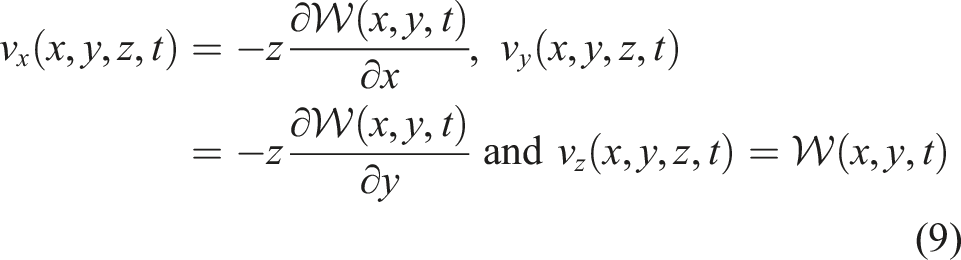
For a homogeneous material of volume V, the relations between local and nonlocal stress are given by (Eringen, 1983; Eringen, 1984; Manna and Bhat, 2022; Manna et al., 2022)


Consider a semi-infinite thin crystal piezoelectric plate that lies in the region |z| < h, |x| < ∞, 0 < y < ∞ (cf. Figure 1), whose mid-surface is on the xy-plane, having thickness 2h measured along the z-axis and free edge at y = 0. The z-axis is taken as a crystallographic axis of symmetry. Therefore, the dynamic equation of motion for nonlocal piezoelectric plate without body forces can be read as Geometry of the problem.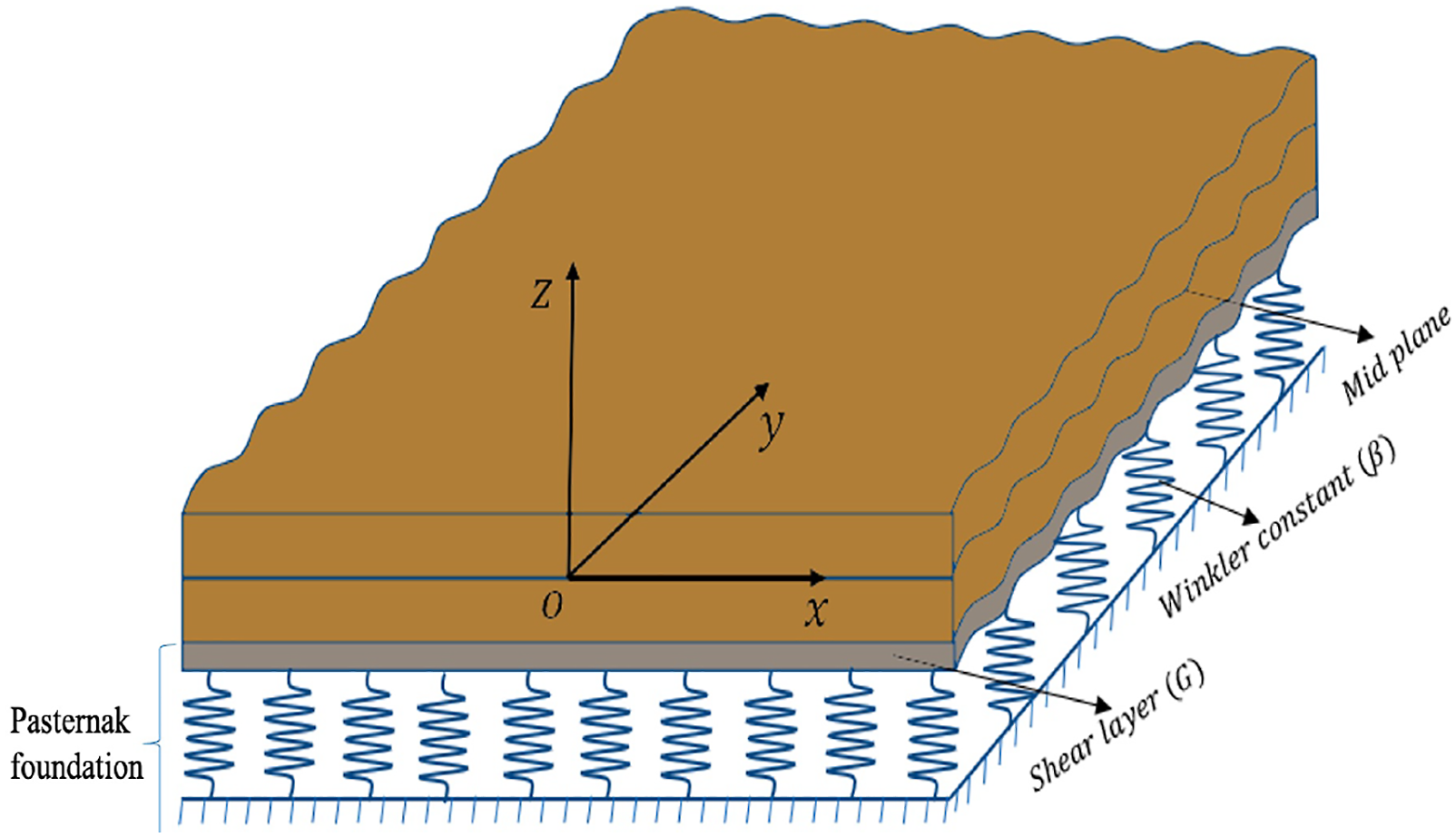
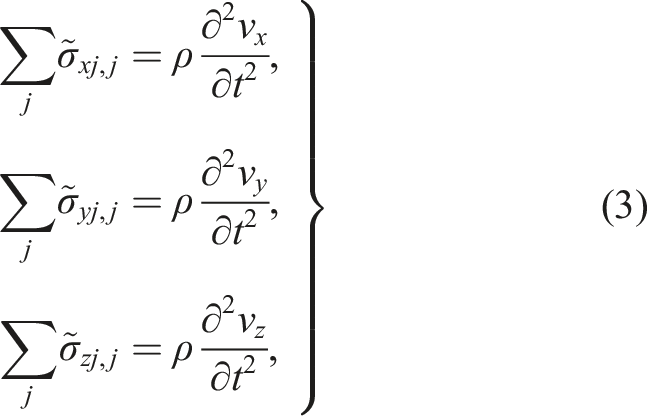

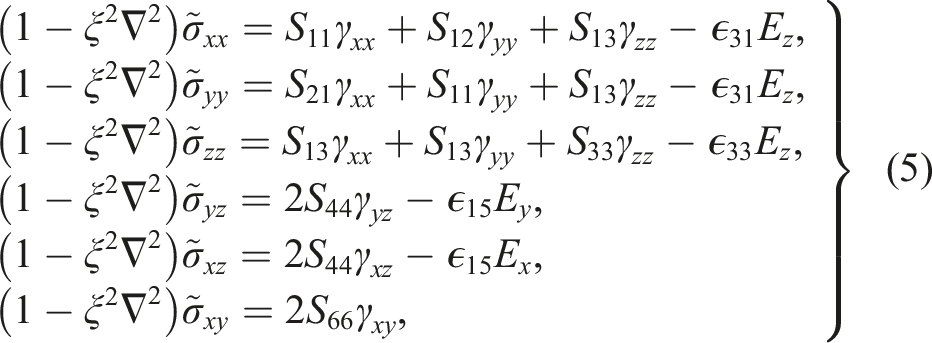
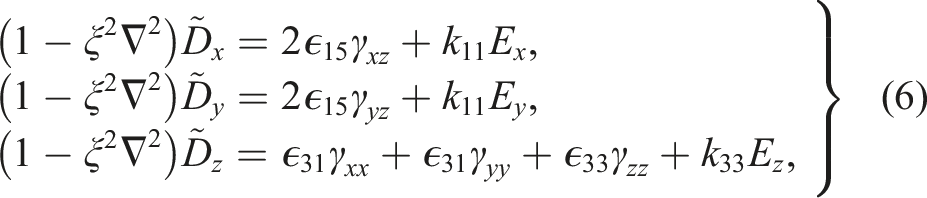



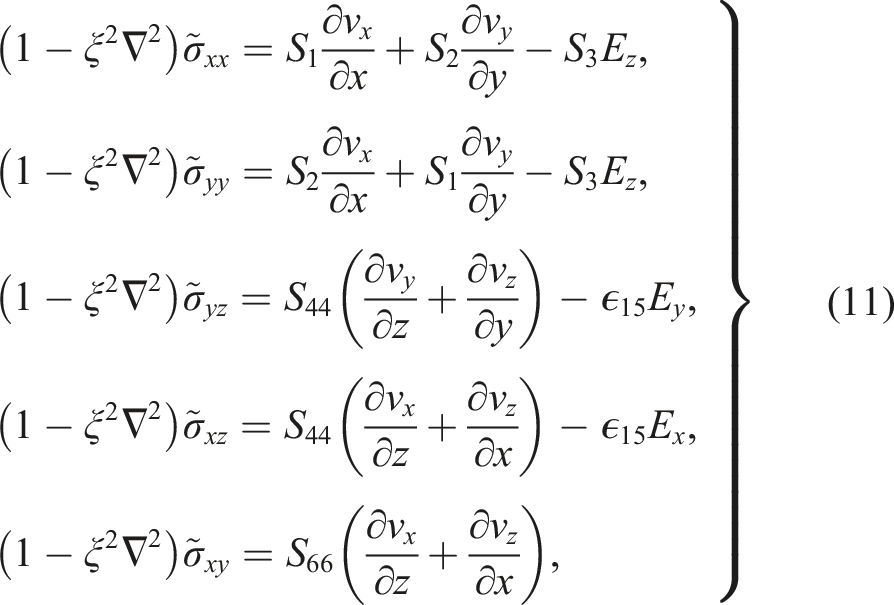
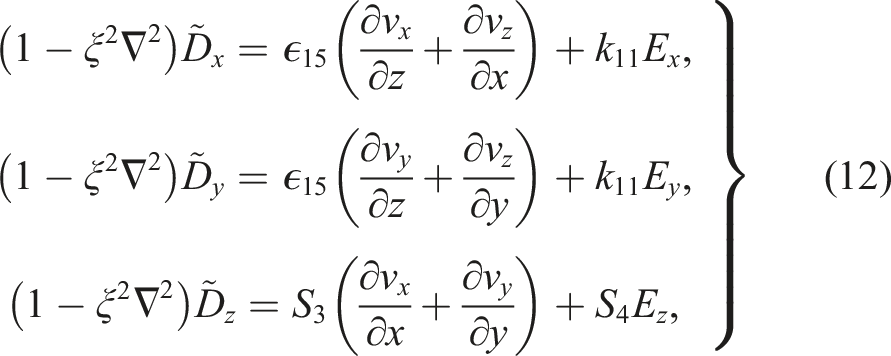
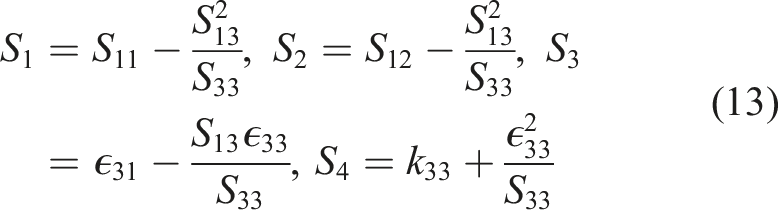
From equations (5)–(7) and (10), one can obtain the relation between local stress and electric displacement with plate displacement vectors as
Integrating equation (3) along the plate thickness and using



Therefore, the explicit form of bending moments and shear forces are given by
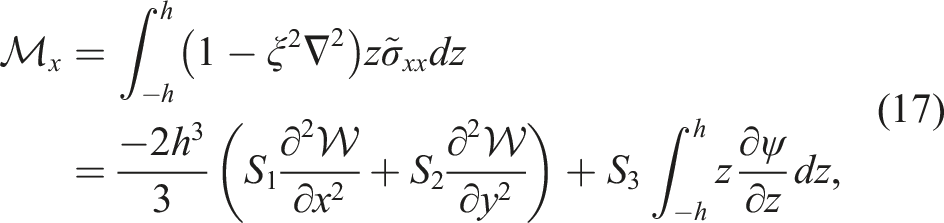
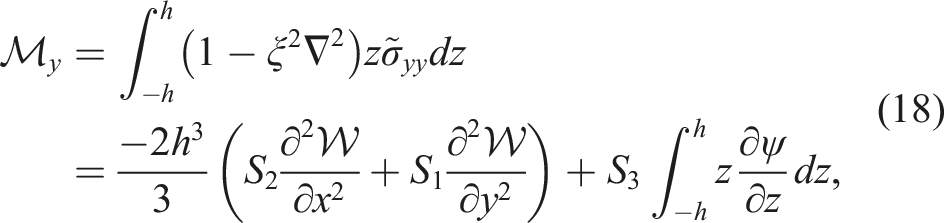



For the piezoelectric plate, the equation for electric potential is obtained by substituting equations (6)–(9) in equation (4), which is



Then, equations (14)–(16) take the following form
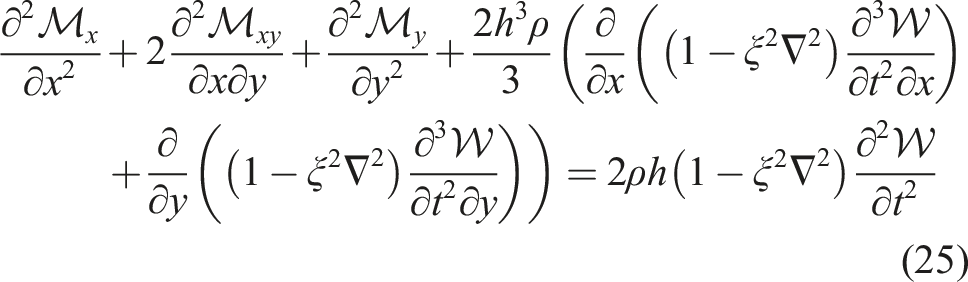
Now, let the semi-infinite piezoelectric plate be supported by a two-parametric Pasternak elastic foundation, whose foundation reaction force is given by
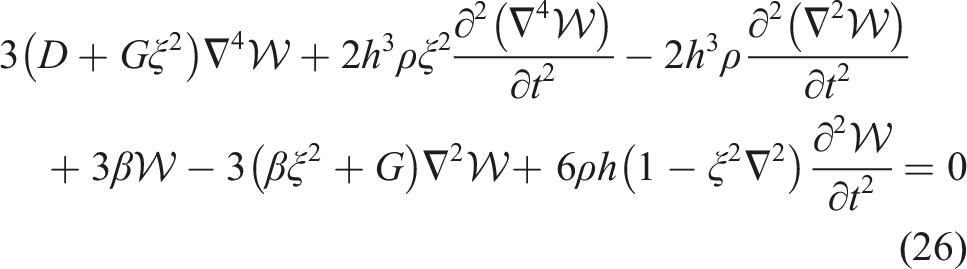
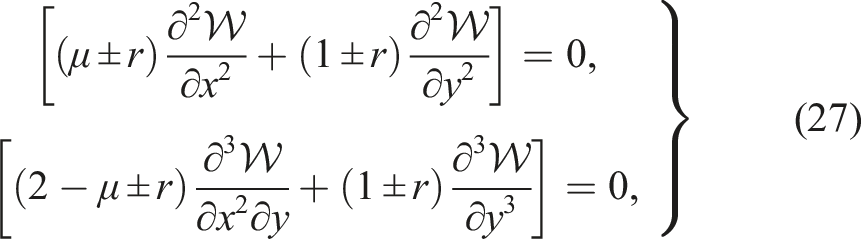
The boundary conditions at the stress free edge y = 0 for both open and short circuit cases are defined by
3. Solution of the problem
Let us consider the solution of equation (26) in the form of a harmonic wave propagating along x-axis as


From equation (29), we can obtain

Equations (27) and (28) give

4. Dispersion relation
The dispersion relation for the piezoelectric plate can be obtained from equations (30) and (31) in the implicit form of k and Ω as

If r = 0, that is, piezoelectric constant and dielectric constants are zero and also the nonlocal parameter ξ and foundation parameters β and G are zero, then from equation (31), one can obtain the Konenkov constant γ
e
, whose form is given by Kaplunov et al. (2016). The wave number and phase velocity relation may be obtained from equation (32) by replacing Ω by kc, where c is the phase velocity of the flexural edge waves. The corresponding form of flexural edge wave displacement for both open and short circuits are obtained as

5. Numerical calculations and graphical descriptions
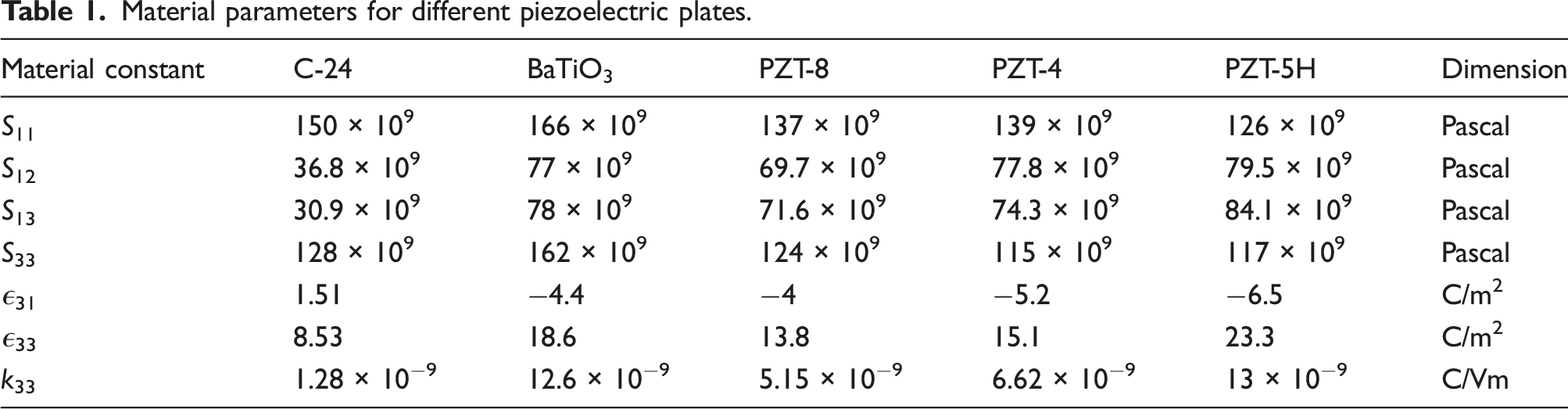
Material parameters for different piezoelectric plates.
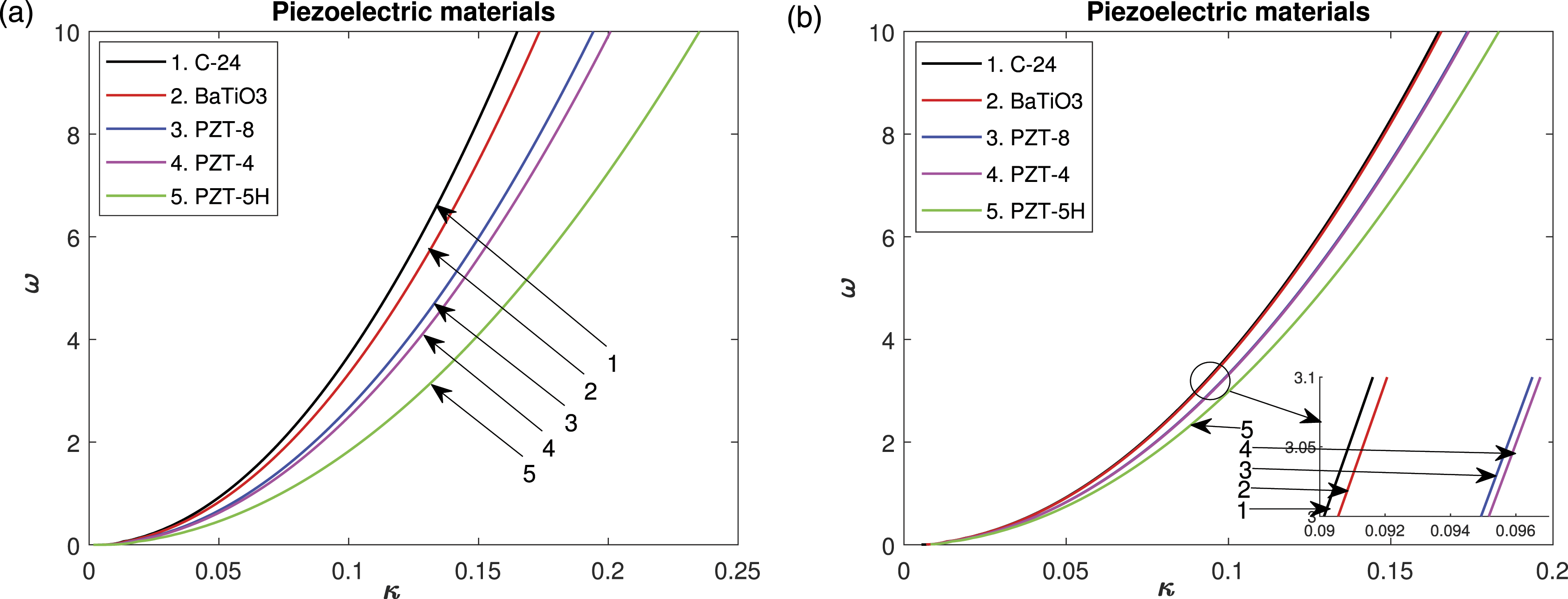
Dimensionless dispersion curves for different piezoelectric plates: (a) short circuit and (b) open circuit.
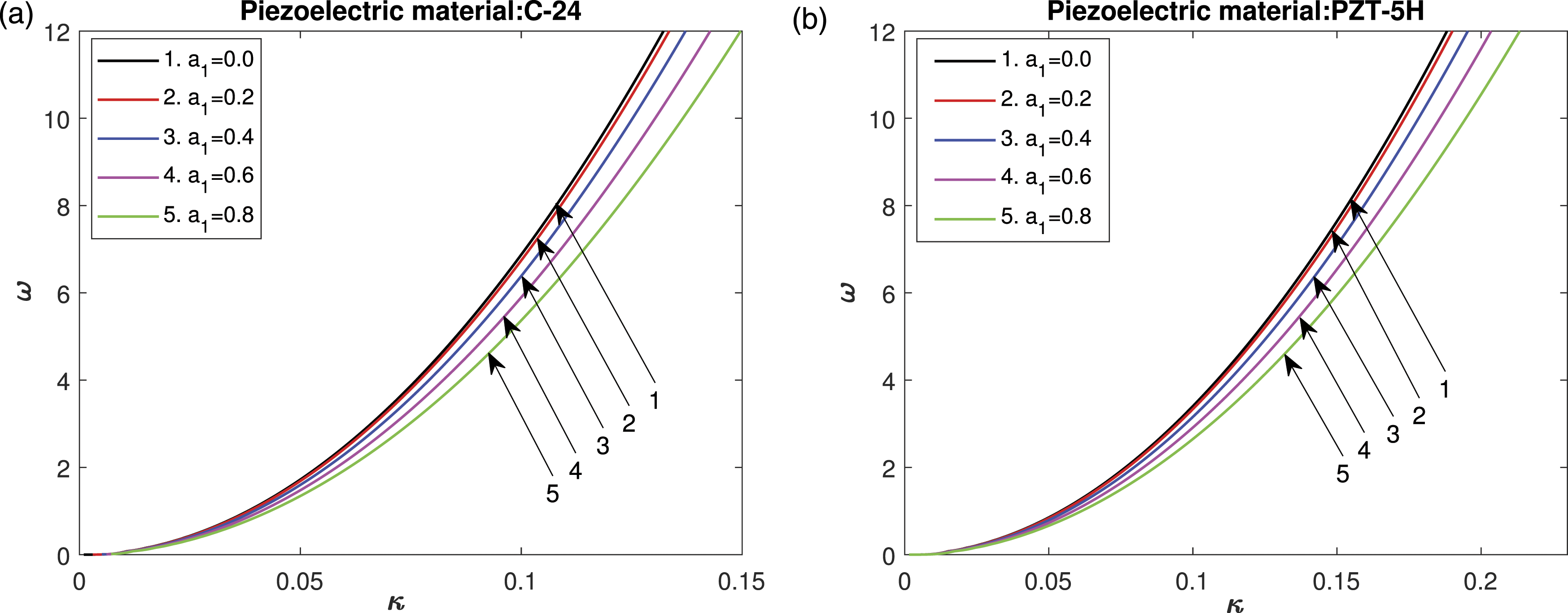
Dimensionless dispersion curves for two different piezoelectric plates: (a) C-24 and (b) PZT-5H, with varying nonlocal parameters.
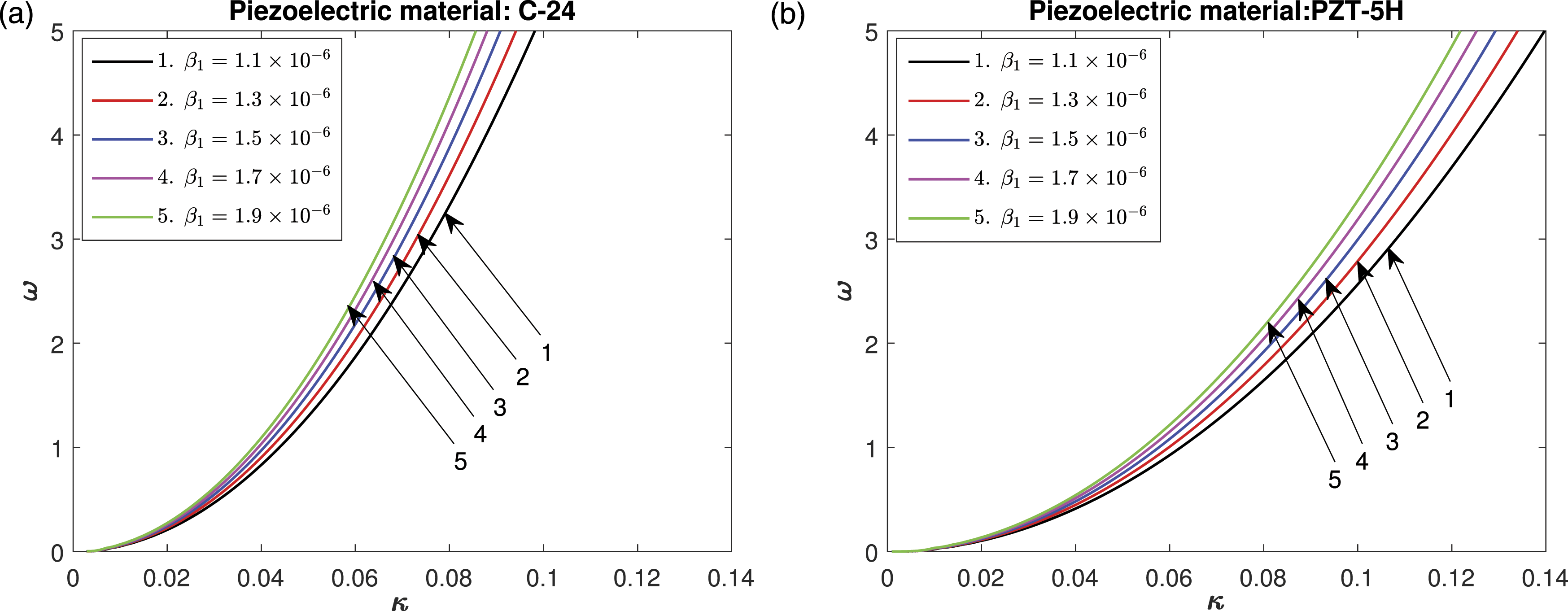
Dimensionless dispersion curves for two different piezoelectric plates: (a) C-24 and (b) PZT-5H with varying dimensionless foundation parameter.
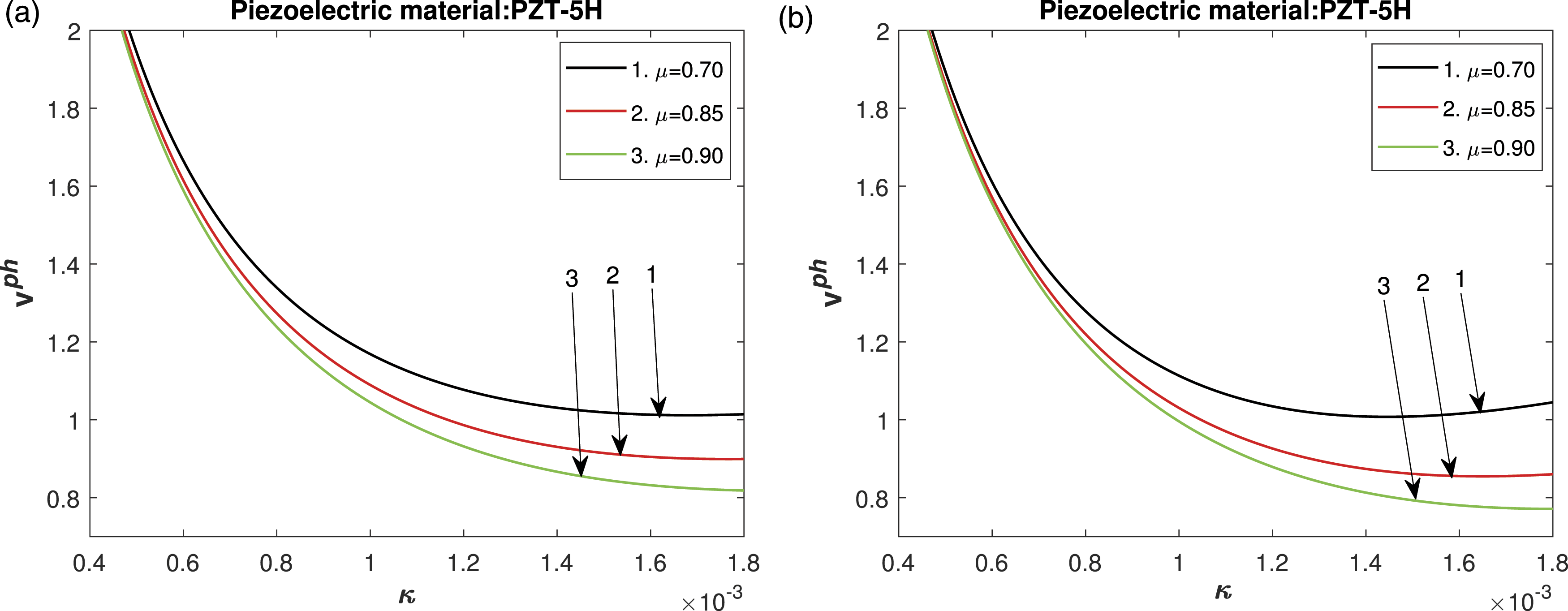
Dimensionless dispersion curves for PZT-5H material plate for different values of μ: (a) short circuit and (b) open circuit.
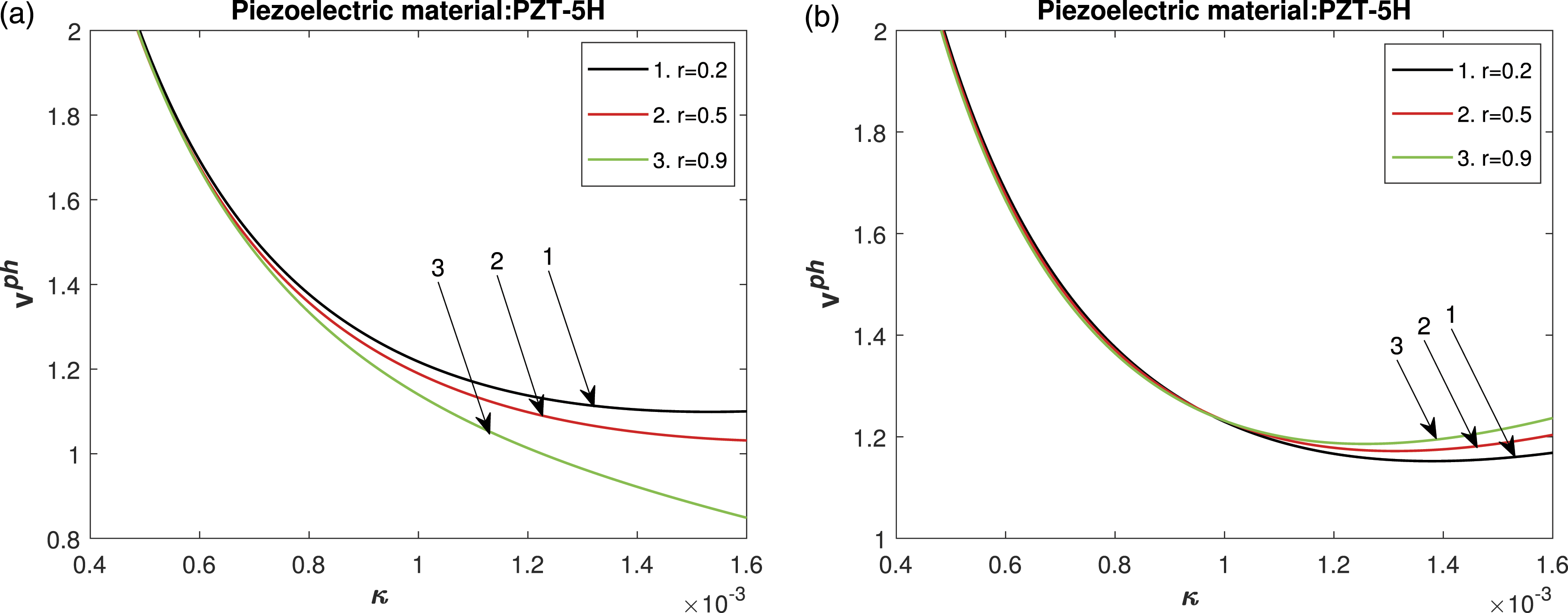
Dimensionless dispersion curves for PZT-5H material plate for different values of r: (a) short circuit and (b) open circuit.
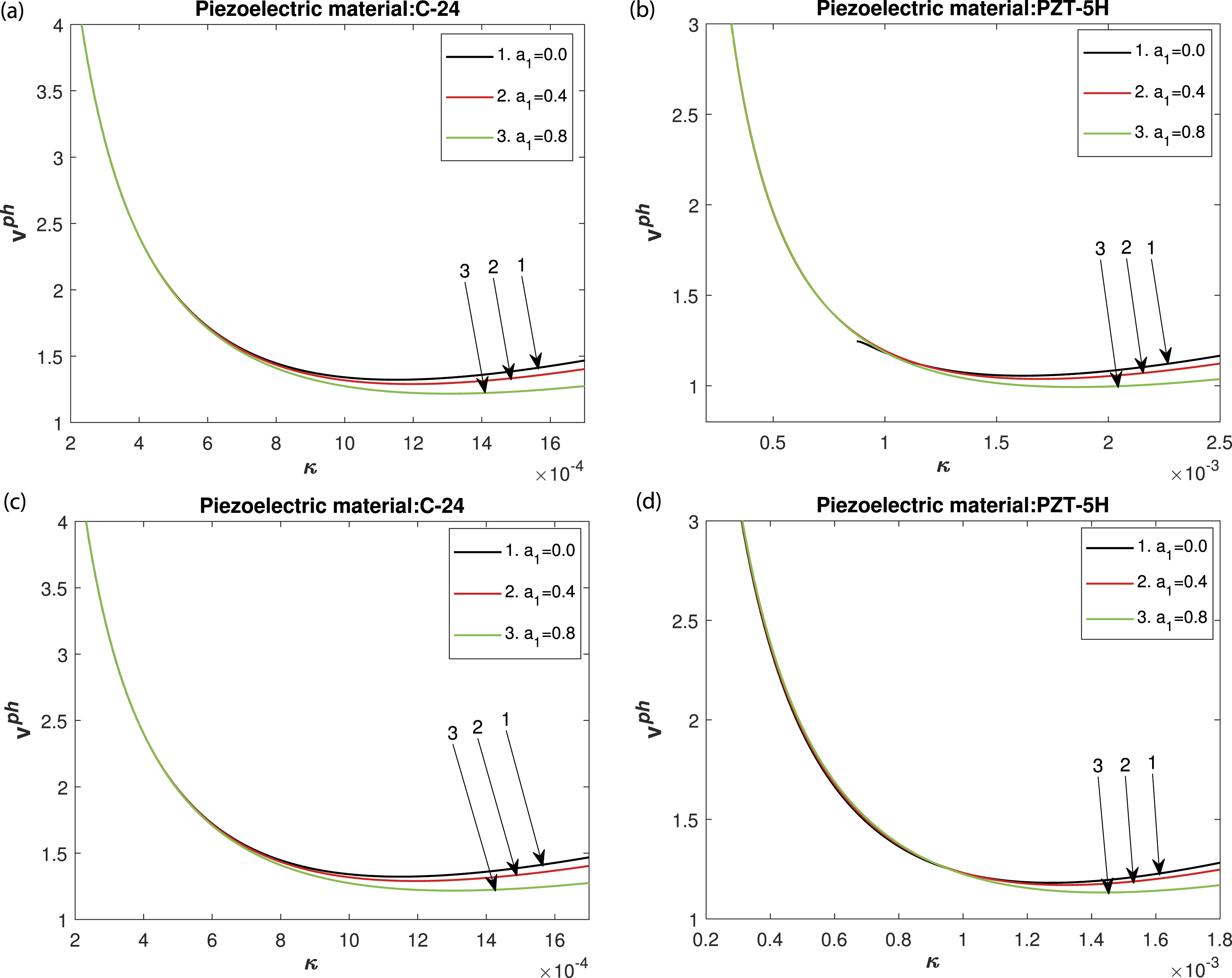
Dimensionless phase velocity against dimensionless wave number for different values of nonlocal parameters: (a), (b) short circuit and (c), (d) open circuit.
Figure 2 illustrates the effect of different piezoelectric thin plates on the propagation of flexural edge waves. Figure 2(a) and (b) plots dimensionless frequency ω against the dimensionless wave number κ for both open and short circuit cases. The values of Winkler modulus (β), Pasternak modulus (G) and dimensionless nonlocal parameter (a1) used in this figure are taken as 500 pa/m, 300 pa.m and 0.4, respectively. It has been observed that the frequency corresponding to PZT-5H is dominated by other materials, whereas C-24 has a higher frequency for the same wave number in both the cases. Figure (b) shows that in the case of open circuit, the frequency behaviour of C-24, BaTiO3 and PZT-8, PZT-4 are the same in nature.
Figure 3 depicts the changes in the frequency curves for local and nonlocal elasticity on the propagation of flexural edge waves on the plate. In the case of different piezoelectric material plates, the behaviour of the curve changes with changes in the values of the nonlocal parameter. The frequency decreases rapidly with the increase in nonlocal elastic parameter a1 for PZT-5H (cf. Figure 3(b)) while compared to that of C-24 material (cf. Figure 3(a)).
The influence of two parametric Pasternak elastic foundations on different types of the piezoelectric plate (C-24, PZT-5H) is shown in Figure 4. In this figure, the frequency curve is plotted for a particular dimensionless nonlocal parameter a1 = 0.4. Kaplunov and Nobili (Kaplunov and Nobili, 2017) analyzed the influence of infinite and semi-infinite Pasternak foundations on the phase velocity of edge waves on the semi-infinite isotropic plate. In the case of the piezoelectric plate, for a particular wave number, the frequency increases as the dimensionless foundation parameter β1 varies from 1.1 × 10⁻⁶ to 1.9 × 10⁻⁶ within the very short range of wave number, which is the opposite characteristic of the dispersion curve that has been obtained in case of different values of the nonlocal parameter.
Figure 5 examined the influence of the phase velocity due to the changes in the values of μ for both short and open circuit cases. It can be observed from Figures (a) and (b) that phase velocity decreases with an increase in the values of μ. The decrease of phase velocity is more rapid in the electrically shorted case compared to the open circuit condition corresponding to μ = 0.70.
The variation of phase velocity for different values of r (ratio of the material constants) is described in Figure 6. An interesting behaviour is observed in the figure. In the shorted circuit case, phase velocity decreases as the r values increase, and the phase velocity decreases rapidly as r approaches 1. On the other hand, in the electrically open circuit, the phase velocity increases as r increases, which is the reverse behaviour compared to the shorted one.
Figure 7 demonstrates the behaviour of the phase velocity of a flexural edge wave propagating along the thin piezoelectric plate. Here, two piezoelectric material plates (C-24 and PZT-5H) are considered to analyze the effect of electrically shorted and open circuit conditions on edge wave velocity. The nonlocal parameter (a1) in this figure is taken as 0.0, 0.4 and 0.8 and corresponding values of Winkler modulus (β) and Pasternak modulus (G) are 500 pa/m and 300 pa.m, respectively. It has been observed that for a small wave number, there is a negligible effect of nonlocal elastic parameter on the phase velocity. Whereas the phase velocity decreases as the nonlocal parameter increases, that is, as the wavelength of the edge wave increases, the corresponding phase velocity decreases, which is the natural characteristic of a dispersive elastic wave. A different behaviour appeared in the piezoelectric material PZT-5H. For electrically shorted circuit plate, the phase velocity corresponding to the lowest value of the nonlocal parameter appeared after a certain value of wave number, and this is due to the presence of an elastic foundation on the model. As the foundation parameters decrease, this type of behaviour will disappear. On the other hand, in case of electrically open circuit plate, phase velocity decreases rapidly for a1 = 0.0.
6. Concluding remarks
The present paper analyzes the characteristics of flexural edge waves on the piezoelectric plate. Two piezoelectric boundary conditions are considered to examine the behaviour of edge wave propagation. The dispersion relation obtained in the closed-form depends on the material parameters in both open and short circuit cases. Due to the nonlocal elasticity, the dispersion relation is an implicit function of frequency and wave number. The presence of two parametric Pasternak elastic foundations and nonlocal elasticity significantly influences the propagation of flexural edge waves along the free edge of a thin semi-infinite piezoelectric plate. The numerical analysis of the results led to the following conclusions: • A piezoelectric plate made with the materials C-24 and PZT-5H has the highest and lowest frequency, respectively, for a particular wave number. • In the transition from local to nonlocal elasticity, the frequency value for flexural edge waves on the piezoelectric plate is decreased. This is caused by increasing internal stress between the component parts of the material. • Two parametric elastic foundations imposed a significant effect on the frequency curves of the travelling edge wave. It has been observed that with the increase in the values of foundation parameters, the slope of the frequency curve also increases for a short range of wave numbers. And this increment rate is different for different piezoelectric plate. • A decreasing nature of the phase velocity has appeared with a change in the values of μ. The phase velocity decreases rapidly in the open circuit case. • The increase in the parameter r in the short circuit boundary condition tries to decrease the phase velocity, and in the open circuit condition, the phase velocity increases. • Phase velocity decreases with the increase in wave number for a very short range. The nonlocal elasticity effect arises after a particular value of wave number. Also, in the local elasticity theory, the phase velocity of PZT-5H material corresponding to the short circuit boundary condition starts after a specific value of wave number.
The present work could be useful to study the highway structures, mainly to find any damage in kinetic ramps. The proposed model can be further generalized in the thin semi-infinite piezomagnetic plate with different types of elastic foundation.
Footnotes
Acknowledgements
The authors convey their sincere thanks to Applied Mathematics and Geomechanics (AMG) Lab, Indian Institute of Technology Indore for providing the research facility. One of the authors, Rahul Som, is thankful to the UGC, Government of India for providing the PhD fellowship under the Benificiary ID. BININ04154309 A.
Declaration of conflicting interests
The author(s) declared no potential conflicts of interest with respect to the research, authorship, and/or publication of this article.
Funding
The author(s) received no financial support for the research, authorship, and/or publication of this article.
