This article investigates bending, buckling, and vibration analysis in viscoelastic functionally graded curved nanobeam embedded in an elastic medium under different boundary conditions. The stresses can be calculated based on not only the nonlocal stress field but also the strain gradient stress field according to the nonlocal strain gradient elasticity theory. The present higher order refined curved nanobeam theory which captures shear deformation influence does not need any shear correction factors. Two power-law models are used to describe the continuous variation of material properties of viscoelastic functionally graded curved nanobeam. Governing equations of nonlocal strain gradient viscoelastic functionally graded curved nanobeam are obtained using Hamilton’s principle. To establish the present model, the results are compared with those of functionally graded curved nanobeams. The effects of nonlocal parameter, length scale parameter, viscoelastic damping coefficient, spring stiffness, boundary conditions, and power-law exponent on the bending, buckling, and vibration responses of viscoelastic functionally graded curved nanobeam are discussed.
The nanostructures have at least one nanometer in scope because they are small, as they are made of nanosized structural elements. As a result of special features of particles on the nanoscale, nanobeams, curved nanobeams, nanoshells, nanorods, and nanoplates or nanorings have many technological applications of nanotechnology and microscopic devices. Nanobeams are very strong tools with special capabilities, used as actuators, sensors, and nanoelectromechanical systems.1–10 In controversy to the local continuum theory, based on the nonlocal elasticity theory for small-scale structures, the stress depends on all area points for a reference point. Reddy11 studied the nonlocal nonlinear formulations for bending of beams and plates using the classical and shear deformation theories. Nonlocal bending and vibration of plates using the third-order shear deformation have been discussed by Aghababaei and Reddy.12 Pradhan and Murmu13 have studied the nanoscale effect on the buckling of single-layered graphene sheets under biaxial compression via nonlocal continuum mechanics. Murmu and Pradhan14 have also discussed the nanoscale effect on the free in-plane vibration of nanoplates by nonlocal continuum model. Additional analytical studies on various behaviors of nanoplates15–27 and nanobeams6,28,29 have been presented. Qian et al.30 have discussed on the temperature independence of statistical model parameters for cleavage fracture in ferritic steels. Qian et al.31 have investigated the comparison of constraint analyses with global and local approaches under uniaxial and biaxial loadings.
It is certainly worth mentioning that functionally graded materials (FGMs) have been widely used in both nano- and microstructures. The functionally graded (FG) curved beams are generally used as structural elements of light-weight and heavy load-bearing components, and they are used to satisfy the design obligations of stiffness in industrial designs.32–38 Due to the extensive application of FG curved beams in several engineering areas, a deeper comprehension of the mechanical behavior of similar beams is required. The concept of FGM can be utilized for the management of microstructure of a material so that bending, buckling, and vibration behaviors of a nanobeam structure can be improved.11,39–41 So, FG curved beams are the requisite components of a structure when dealing with a set of important structures in the aeronautical, mechanical, and civil industries. As a result to gorgeous engineering properties, such as high stiffness or strength-to-weight ratios, the curved beam structures probably play a serious role in the applications of nanotechnology.
Analysis of plates and beams supported on an elastic medium in most cases is related to the design and analysis of various foundations such as individual footings, combined, and mat foundations. Although methods of analysis of plates and beams on elastic foundation have been developed for a long time, up-to-date, practical application of these methods is a difficult problem. Analytical methods such as method of initial parameters and method of superposition based on Winkler’s soil model are complex and cannot be used by practicing engineers. Analysis based on the soil model with two coefficients of subgrade reactions produces results close to those obtained from the analysis based on Winkler’s foundation and never used in practical applications. Extensive studies about elastic or viscoelastic foundations can be found in the literature.42–51
In this article, bending, buckling, and vibration behaviors of viscoelastic FG curved nanobeam embedded in an elastic medium are investigated based on nonlocal strain gradient theory. For the viscoelastic FG curved nanobeam, the material properties are graded in radial direction using two power-law forms. The nonlocal equations of motion of strain gradient viscoelastic FG curved nanobeam are derived based on Hamilton’s principle. The results are validated with those available in the literature. Effects of all parameters involving the nonlocal parameter, the structural damping of the FG curved nanobeam, coefficients of elastic foundation, and strain gradient length scale parameter on bending, buckling, and vibration behaviors of viscoelastic FG curved nanobeam are investigated separately.
Nonlocal strain gradient theory
Through theoretical and experimental observations, the nanostructures are in possession of both the stiffening and the softening behaviors. According to this theory by Aifantis,52,53 Lim et al.54 offered the stress tensor as follows
where and are the nonlocal and high-order nonlocal stress tensors, respectively, and given as
where , , , and are the elastic coefficients, strain gradient length scale parameter, and nonlocal parameters. The nonlocal functions and accompany the strain tensor and the first-order strain gradient , respectively. According to Eringen’s55,56 nonlocal theory and considering , the nonlocal stresses and appeared in equation (2) can be expressed as34
where and . Applying the operator to equation (1) and then substituting equation (3), the general constitutive relation is given as
where . For the present viscoelastic FG curved nanobeam, equation (4) can be expressed as
where the elastic coefficients for the Kelvin–Voigt viscoelastic FG curved nanobeam can be written as
where E is Young’s modulus, is the shear modulus, is Poisson’s ratio, and is the viscoelastic damping coefficient.
Basic formulation
Consider a viscoelastic FG curved nanobeam having thickness h and length L whose coordinates are illustrated in Figure 1. A refined three-variable viscoelastic FG curved nanobeam theory is used in this study. Based on this theory, the tangential displacement and the radial displacement can be written as
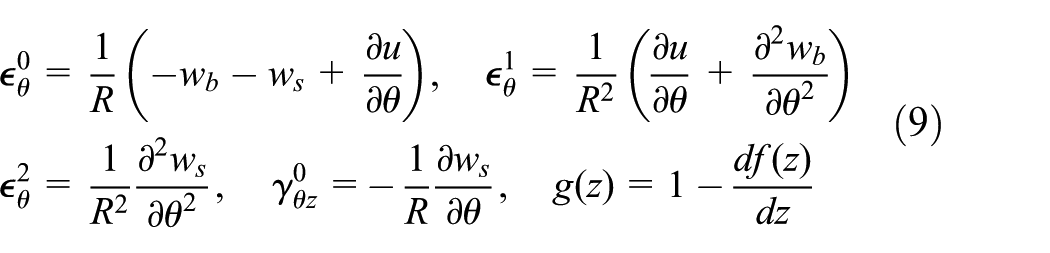
in which and the displacements u, , and are the functions of . Also, u is the tangential midplane displacement, and and are the bending and shear components of radial displacement, respectively. Nonzero strain components associated with the displacement model (7) are obtained as follows
where
Geometry and coordinates of viscoelastic FG curved nanobeam embedded in an elastic medium.
The material properties such as Young’s modulus of the viscoelastic FG curved nanobeam may be assumed according to the following two gradation models
where is the inhomogeneity parameter. Hamilton’s principle is employed to derive the equations of motion that can be expressed as
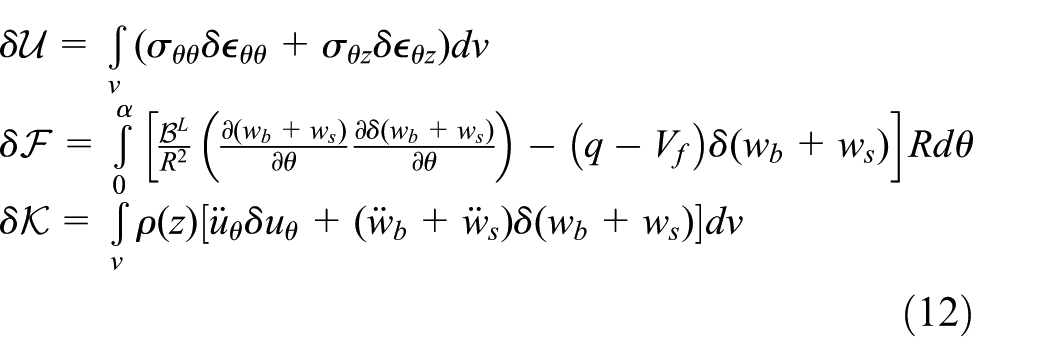
where is the strain energy, is the work done by external forces, and stands for the kinetic energy. They all are defined as
where is the applied buckling load and is the elastic foundation given by
where and are the linear Winkler and shear foundation stiffnesses, respectively. By incorporating equation (9) into equation (8), equations of motion are given as
where
The moments and forces explicit in equation (11) are given as
Applying operator to equation (14) and using equations (9) and (18), equations of motion in terms of displacements u, , and are given as
Solution procedure
Analytical solution for the present problem has been obtained by solving the nonlocal equations of motion of viscoelastic FG curved nanobeam with different boundary conditions:
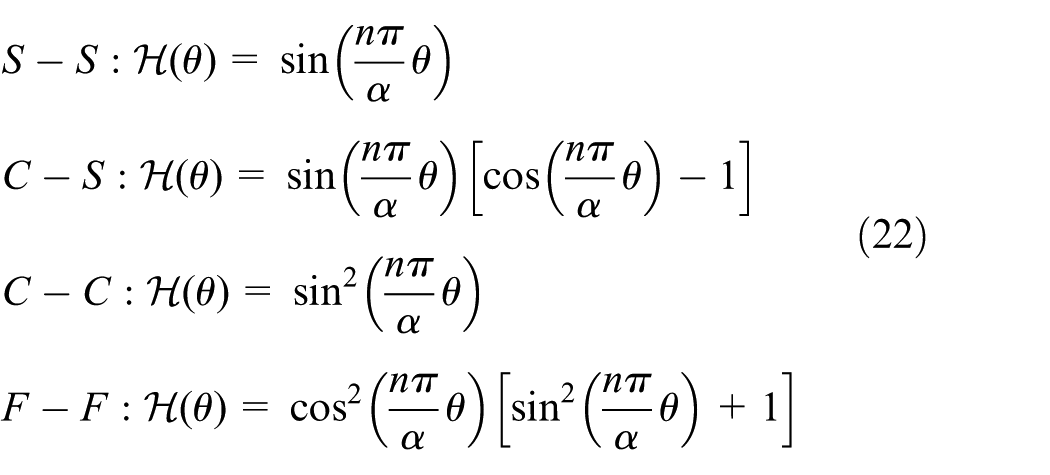
Simply-supported (S): at ;
Clamped (C): at ;
Free (F): at .
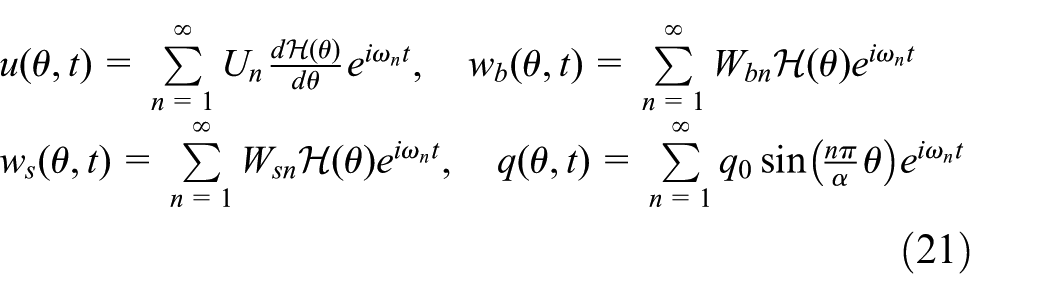
The generalized displacements have been assumed as34
in which is the intensity load, are unknown Fourier coefficients, and is a function which is selected for different boundary conditions as57
where the coefficients and for the viscoelastic FG curved nanobeam embedded in an elastic medium are given in Appendix 2.
For the bending problem of the viscoelastic FG curved nanobeam, the deflection and stresses are given by setting to zero and . Also, to obtain the buckling loads for viscoelastic FG curved nanobeam, we set the determinant equal to zero and , and for free vibration problem, we set to zero and .
Discussions
Bending, buckling, and vibration behaviors of nonlocal strain gradient for viscoelastic FG curved nanobeam embedded in an elastic medium under various boundary conditions are studied. The viscoelastic FG curved nanobeam is composed of steel , ; alumina , ; and has a length , , and . Figure 2 shows the variation of Young’s modulus E through the thickness of the viscoelastic FG curved nanobeam embedded in an elastic medium for different values of the power-law exponent according to the two gradation models: (a) model 1 and (b) model 2. For the present results, we used the dimensionless form as
Variation of Young’s modulus E through the thickness of the viscoelastic FG curved nanobeam embedded in an elastic medium for various values of the inhomogeneity parameter according to the two gradation models: (a) model 1 and (b) model 2.
All parameter values are in dimensionless form, and all figures are concerned with the boundary condition S–S, except for Figures 8, 9, and 11 which are plotted for all four boundary conditions. The bars are omitted for simplicity.
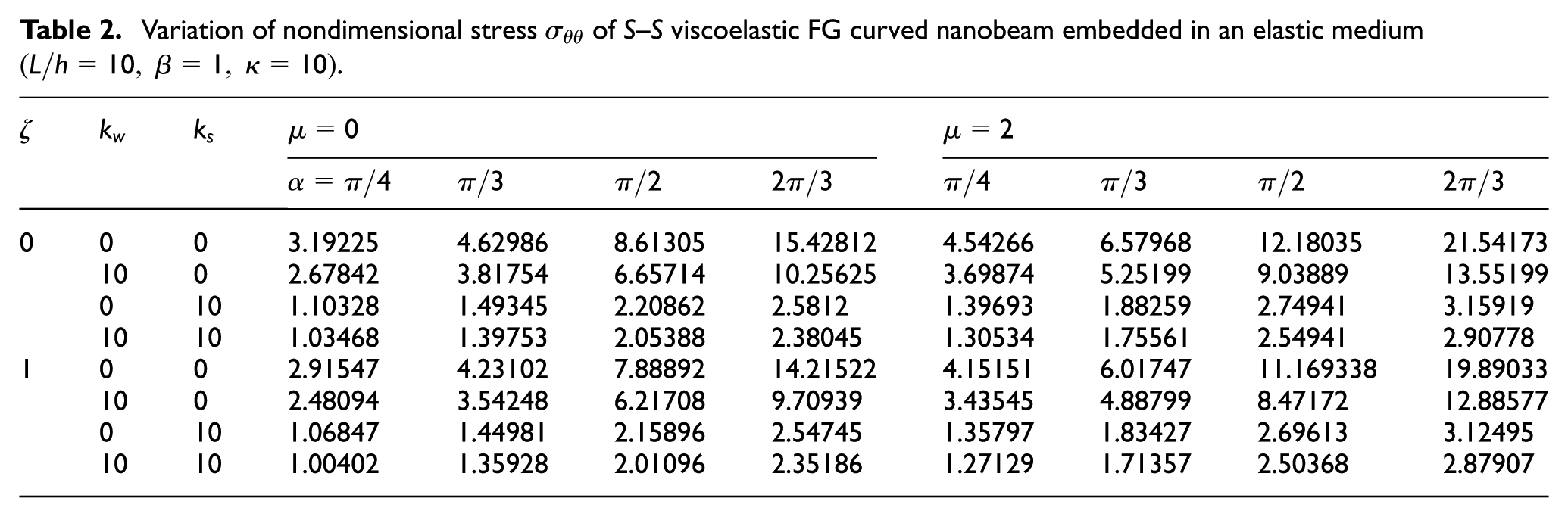
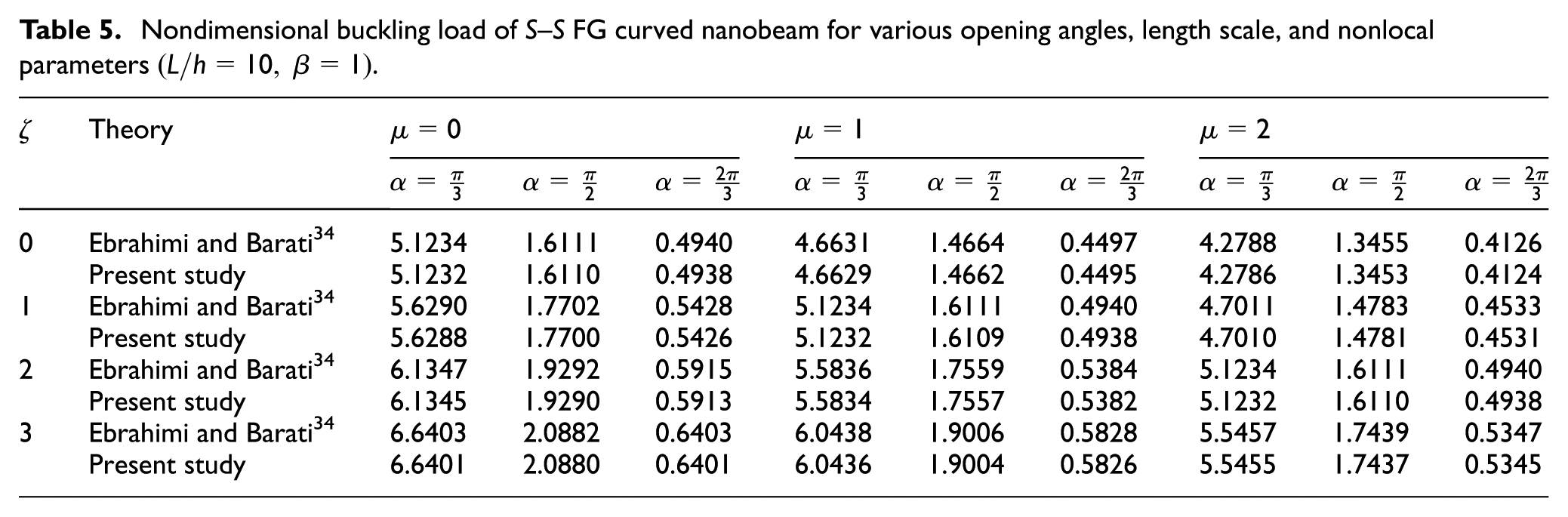
Tables 1–3 demonstrate the variation of deflection and stresses of S–S viscoelastic FG curved nanobeam embedded in an elastic medium for different length scale, opening angles, nonlocal, and Winkler–Pasternak parameters. Table 4 illustrates the vibration of S–S FG curved nanobeam embedded in an elastic medium for various opening angles, elastic medium coefficients, nonlocal, and length scale parameters. Table 5 shows the comparison with the study of Ebrahimi and Barati34 for the buckling load of S–S FG curved nanobeam for various parameters, which illustrates the agreement of our results. Tables 6 and 7 contain the values of the buckling load of S–S curved FG nanobeam embedded in an elastic medium for various elastic medium coefficients, opening angles, length scale, and nonlocal parameters.
Variation of nondimensional deflection of S–S viscoelastic FG curved nanobeam embedded in an elastic medium .
0
0
0
1.74576
1.93635
2.67364
4.58882
2.07630
2.30046
3.16269
5.36501
10
0
1.46476
1.59661
2.06649
3.05054
1.69057
1.83626
2.34699
3.37515
0
10
0.60336
0.62461
0.68559
0.76776
0.63849
0.65821
0.71389
0.78680
10
10
0.56584
0.58449
0.63756
0.70802
0.59663
0.61381
0.66197
0.72419
1
0
0
1.59385
1.76874
2.44709
4.22303
1.89674
2.10276
2.89767
4.94665
10
0
1.35629
1.48090
1.92849
2.88445
1.56959
1.70807
2.19783
3.20464
0
10
0.58412
0.60608
0.66969
0.75679
0.62043
0.64097
0.69946
0.77716
10
10
0.54889
0.56823
0.62379
0.69869
0.58083
0.59879
0.64953
0.71601
Variation of nondimensional stress of S–S viscoelastic FG curved nanobeam embedded in an elastic medium .
0
0
0
3.19225
4.62986
8.61305
15.42812
4.54266
6.57968
12.18035
21.54173
10
0
2.67842
3.81754
6.65714
10.25625
3.69874
5.25199
9.03889
13.55199
0
10
1.10328
1.49345
2.20862
2.5812
1.39693
1.88259
2.74941
3.15919
10
10
1.03468
1.39753
2.05388
2.38045
1.30534
1.75561
2.54941
2.90778
1
0
0
2.91547
4.23102
7.88892
14.21522
4.15151
6.01747
11.169338
19.89033
10
0
2.48094
3.54248
6.21708
9.70939
3.43545
4.88799
8.47172
12.88577
0
10
1.06847
1.44981
2.15896
2.54745
1.35797
1.83427
2.69613
3.12495
10
10
1.00402
1.35928
2.01096
2.35186
1.27129
1.71357
2.50368
2.87907
Variation of nondimensional stress of S–S viscoelastic FG curved nanobeam embedded in an elastic medium .
0
0
0
8.91277
9.34694
10.82618
13.68239
12.69399
13.29812
15.33723
19.16020
10
0
7.47814
7.70700
8.36770
9.09573
10.33574
10.61474
11.38158
12.05376
0
10
3.08037
3.01504
2.77612
2.28921
3.90356
3.80489
3.46199
2.80993
10
10
2.88883
2.82138
2.58162
2.11110
3.64763
3.54824
3.21016
2.58631
1
0
0
8.13683
8.53741
9.90800
12.58999
11.59555
12.15446
14.05063
17.66318
10
0
6.92409
7.14806
7.80827
8.59932
9.59553
9.87307
10.65712
11.44294
0
10
2.98200
2.92545
2.71152
2.25619
3.79293
3.70496
3.39163
2.77505
10
10
2.80214
2.74277
2.52565
2.08297
3.55084
3.46117
3.14954
2.55669
Nondimensional vibration of S–S FG curved nanobeam embedded in an elastic medium for various values of inhomogeneity parameter, opening angles, length scale, and nonlocal parameters .
0
0
13.12771
12.56589
11.16901
9.64355
13.39184
12.80334
11.33867
9.73755
2
12.67416
12.15878
10.87942
9.48405
12.90295
12.36405
11.02522
9.56421
0.2
0
11.84548
11.34662
10.12544
8.80721
12.06695
11.54515
10.26640
8.88477
2
11.46589
11.00683
9.88519
8.67573
11.65725
11.17805
10.00609
8.74179
1
0
10.10794
9.69362
8.69826
7.63889
10.27709
9.84466
8.80458
7.69685
2
9.81877
9.43572
8.51738
7.54066
9.96443
9.56558
8.60836
7.59002
3
0
9.22689
8.85917
7.97541
7.03448
9.37155
8.98823
8.06601
7.08373
2
8.97991
8.63907
7.82136
6.95096
9.10427
8.74986
7.89883
6.99293
5
0
8.98287
8.63046
7.77925
6.86945
9.12058
8.75335
7.86554
6.91636
2
8.74787
8.42094
7.63255
6.78988
8.86618
8.52639
7.70632
6.82987
Nondimensional buckling load of S–S FG curved nanobeam for various opening angles, length scale, and nonlocal parameters .
Nondimensional buckling load of S–S FG curved nanobeam embedded in an elastic medium .
0
0
0
10.15661
5.12103
1.61041
0.49380
11.15903
5.62645
1.76935
0.54254
10
0
11.96162
6.13634
2.06166
0.74763
12.96403
6.64177
2.22060
0.79637
0
10
27.97132
15.14180
6.06409
2.99899
28.97374
15.64723
6.22303
3.04773
10
10
29.77633
16.15712
6.51534
3.25283
30.77875
16.66254
6.67428
3.30156
0.5
0
0
9.67897
4.88019
1.53468
0.47058
10.63425
5.36185
1.68614
0.51702
10
0
11.48398
5.89551
1.98593
0.72441
12.43926
6.37717
2.13739
0.77085
0
10
27.49369
14.90097
5.98836
2.97577
28.44896
15.38263
6.13982
3.02222
10
10
29.29869
15.91629
6.43961
3.22960
30.25397
16.39795
6.59107
3.27605
Nondimensional buckling load of S–S viscoelastic FG curved nanobeam embedded in an elastic medium .
0
0
30.09904
16.34739
6.61055
3.31443
31.10146
16.85282
6.76949
3.36317
0.02
29.88514
16.23955
6.57663
3.30403
30.86645
16.73433
6.73223
3.35174
0.03
29.77819
16.18563
6.55968
3.29883
30.74895
16.67509
6.71359
3.34603
0.04
29.67125
16.13170
6.54272
3.29363
30.63144
16.61584
6.69496
3.34032
0.055
29.51082
16.05082
6.51728
3.28583
30.45519
16.52697
6.66702
3.33175
0.5
0
29.62140
16.10657
6.53481
3.29121
30.57668
16.58823
6.68628
3.33766
0.02
29.41756
16.00379
6.50249
3.28130
30.35272
16.47531
6.65077
3.32677
0.03
29.31565
15.95241
6.48633
3.27635
30.24074
16.41885
6.63302
3.32132
0.04
29.21373
15.90102
6.47017
3.27139
30.12877
16.36239
6.61526
3.31588
0.055
29.06085
15.82394
6.44593
3.26396
29.96079
16.27769
6.58863
3.30771
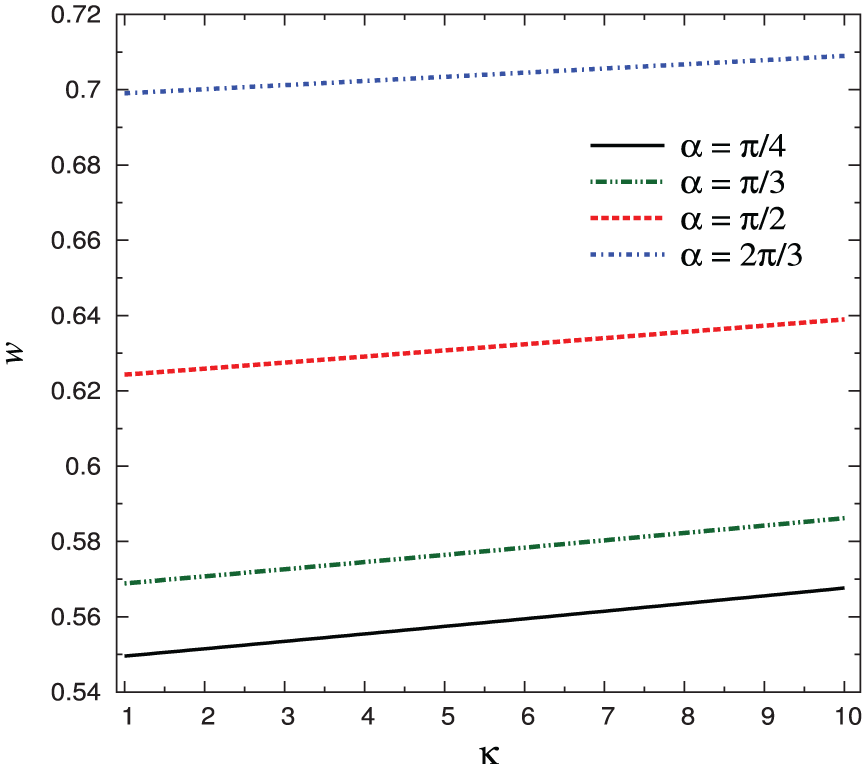
Figures 3–5 show the variations of the deflection w with the nonlocal parameter , strain gradient parameter (SGP) , and structural damping coefficient (SDC) of viscoelastic FG curved nanobeam, respectively, which indicates that, for all angles , w is a monotonic increase function of Figures 3 and 5 and decrease function of Figure 4. Also, we note that for the three parameters , , and , the value of deflection w increases with the decrease in the curved angle .
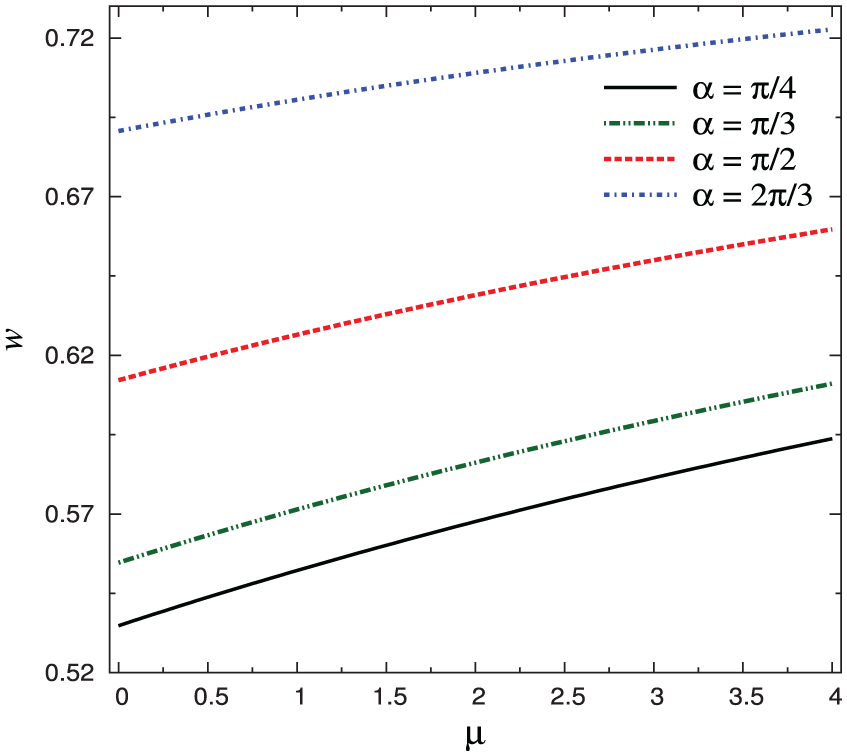
Influence of the nonlocal parameter and opening angle on the deflection w of viscoelastic FG curved nanobeam embedded in an elastic medium .
Influence of the SGP and opening angle on the deflection w of viscoelastic FG curved nanobeam embedded in an elastic medium .
Influence of the SDC and opening angle on the deflection w of viscoelastic FG curved nanobeam embedded in an elastic medium .
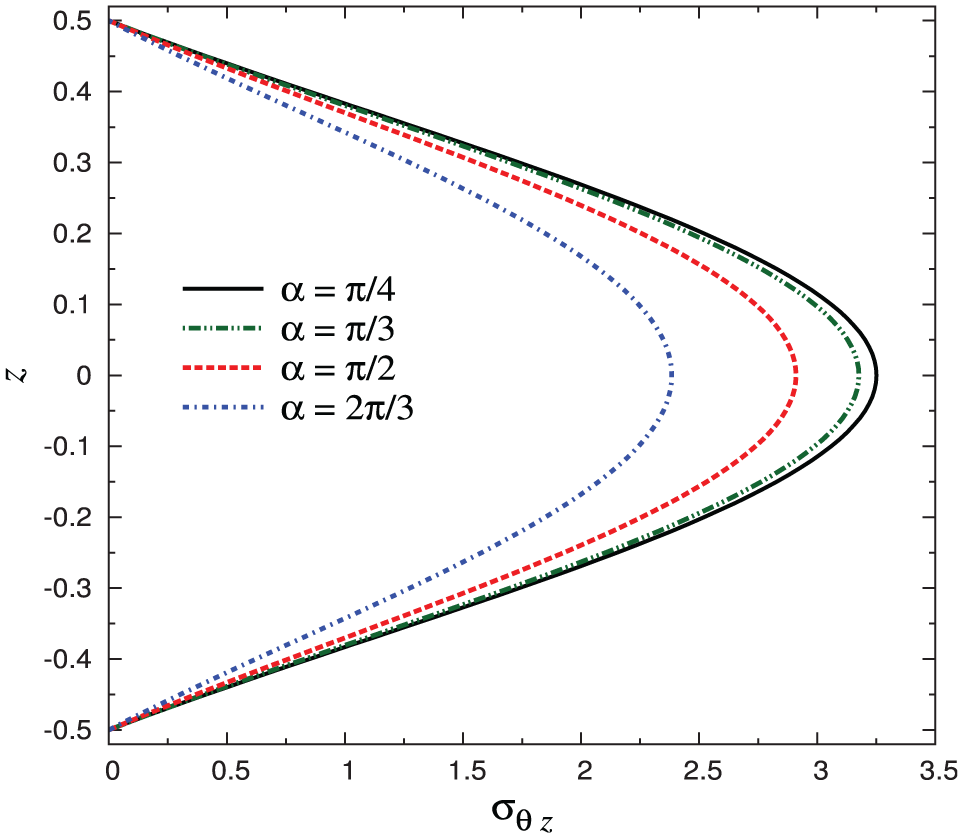
The influences of the different boundary conditions and different values of the angle on the normal and shear stress components () through the thickness or of viscoelastic FG curved nanobeam embedded in an elastic medium are shown in Figures 6–9, from which we can note the values of shear component . Figures 7 and 9 are symmetric about the middle surface at which the maximum values are attained and vanished at the curved surfaces of the beam for all values of , and all four boundary conditions. The values of normal component , for different boundary conditions, are changed between by some way as in Figures 6 and 8 from tension at the inner surface to compression at the outer surface .
Influence of on the normal stress through the thickness of viscoelastic FG curved nanobeam embedded in an elastic medium .
Influence of on the shear stress through the thickness of viscoelastic FG curved nanobeam embedded in an elastic medium .
Influence of different boundary conditions on the normal stress through the thickness of viscoelastic FG curved nanobeam embedded in an elastic medium .
Influence of different boundary conditions on the shear stress through the thickness of viscoelastic FG curved nanobeam embedded in an elastic medium .
Figure 10 demonstrates the variations of the frequency of vibration with the SDC , nonlocal and length scale parameters and , and opening angle on the vibration of viscoelastic FG curved nanobeam for two cases: the curved beam non-embedded and embedded in an elastic medium, from which the values of vibration decrease with the increase in , and seem to be straight lines (quasi-linear).
Influence of (a) SDC , (b) nonlocal parameter , and (c) SGP and opening angle on the vibration of viscoelastic FG curved nanobeam embedded and non-embedded in an elastic medium .
The effect is illustrated as follows: the SDC , and nonlocal and length scale parameters and , for four different boundary conditions on the variation of the vibration , are illustrated in Figure 11. One can note that is a monotonically decreasing function of , while is a monotonically increasing function, and the minimum values occur at the boundary condition S–S.
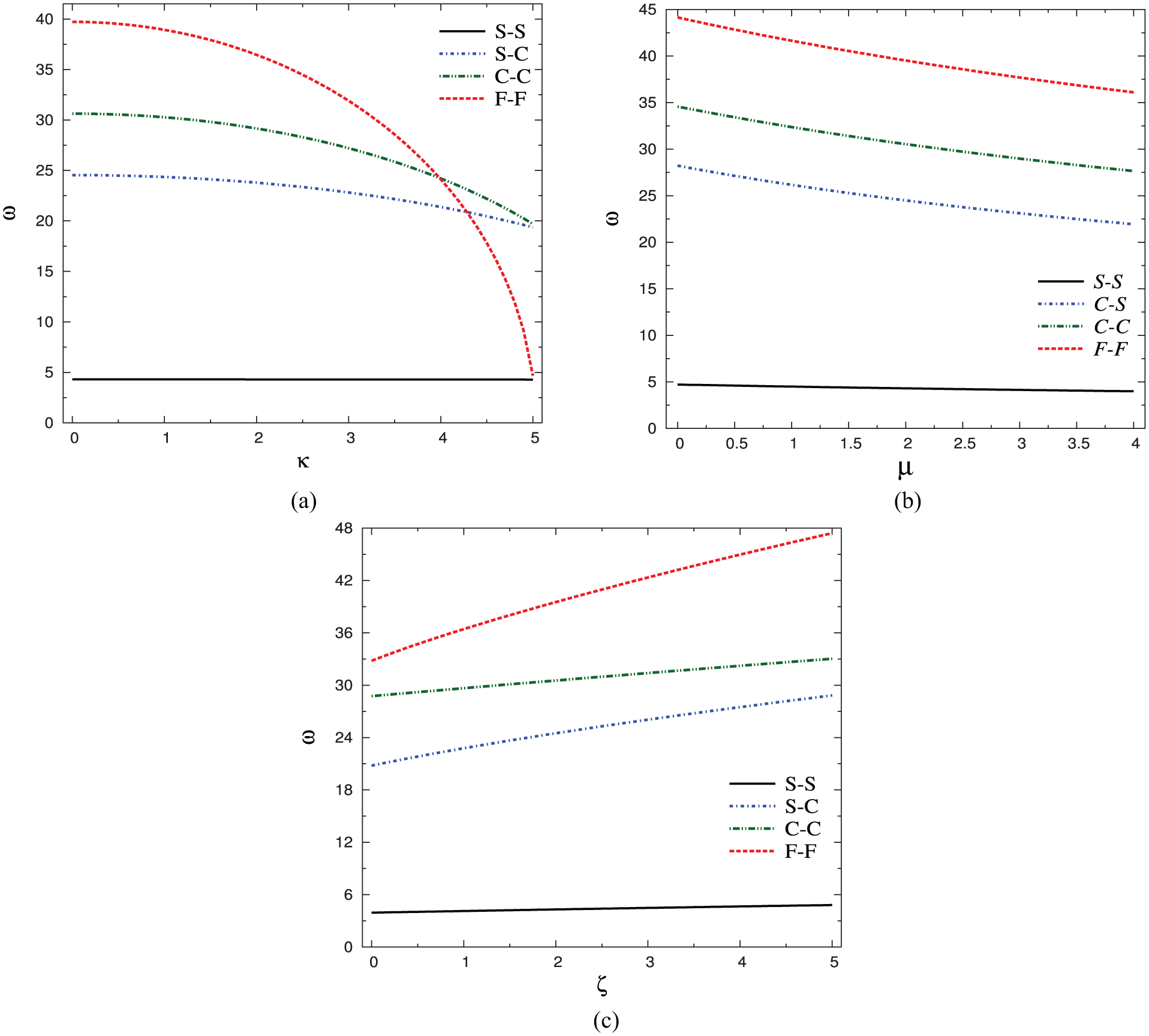
Influence of (a) SDC , (b) nonlocal parameter , and (c) SGP and boundary conditions on the vibration of viscoelastic FG curved nanobeam .
Figure 12 shows the influence of the nonlocal and length scale parameters and , and SDC for different values of on the buckling of the beam. We noted that the value of decreases with , while increases with ; all curves seem to be quasi-linear.
Influence of the (a) nonlocal parameter , (b) SGP , and (c) SDC and opening angle on the buckling of S–S viscoelastic FG curved nanobeam embedded in an elastic medium .
Conclusion
In this article, the bending, buckling, and vibration responses of viscoelastic FG curved nanobeam resting on elastic foundations with different boundary conditions are investigated based on the nonlocal strain gradient theory and the Kelvin–Voigt model. The following main conclusions are drawn:
The bending and shear components of radial displacement w are the increasing functions of the beam angle , and the shear component of stress is the symmetric function about the middle surface , and attained its maximum values on this surface for different and all boundary conditions.
The natural frequency of vibration increases or decreases with the beam angle for two cases: when the curved beam is embedded and non-embedded in an elastic media, moreover, the frequency changed slightly with the different nonlocal parameter , SGP , and SDC , but for different boundary conditions, shows significant changes with these parameters.
The buckling of the beam has significant changes with the beam angle , for all values of different parameters , , and .
The author(s) declared no potential conflicts of interest with respect to the research, authorship, and/or publication of this article.
Funding
The author(s) received no financial support for the research, authorship, and/or publication of this article.
ORCID iD
Mohamed NM Allam
References
1.
LimCW.On the truth of nanoscale for nanobeams based on nonlocal elastic stress field theory: equilibrium, governing equation and static deflection. Appl Math Mech: Engl2010; 31: 37–54.
2.
RoqueCMCFerreiraAJMReddyJN.Analysis of Timoshenko nanobeams with a nonlocal formulation and meshless method. Int J Eng Sci2011; 49: 976–984.
3.
ThaiH-T.A nonlocal beam theory for bending, buckling, and vibration of nanobeams. Int J Eng Sci2012; 52: 56–64.
4.
AnsariRSahmaniS.Bending behavior and buckling of nanobeams including surface stress effects corresponding to different beam theories. Int J Eng Sci2011; 49: 1244–1255.
5.
GheshlaghiBHasheminejadS.Surface effects on nonlinear free vibration of nanobeams. Compos Part B: Eng2011; 42: 934–937.
6.
PhadikarJKPradhanSC.Variational formulation and finite element analysis for nonlocal elastic nanobeams and nanoplates. Comp Mater Sci2010; 49: 492–499.
7.
MalekzadehPShojaeeM.Free vibration of nanoplates based on a nonlocal two-variable refined plate theory. Compos Struct2013; 95: 443–452.
8.
PradhanSCPhadikarJK.Nonlocal elasticity theory for vibration of nanoplates. J Sound Vib2009; 325: 206–223.
9.
AnsariRSahmaniSArashB.Nonlocal plate model for free vibrations of single-layered graphene sheets. Phys Lett A2010; 375: 53–62.
10.
LiewKMHeXQKitipornchaiS.Predicting nanovibration of multi-layered graphene sheets embedded in an elastic matrix. Acta Mater2006; 54: 4229–4236.
11.
ReddyJN.Nonlocal nonlinear formulations for bending of classical and shear deformation theories of beams and plates. Int J Eng Sci2010; 48: 1507–1518.
12.
AghababaeiRReddyJN.Nonlocal third-order shear deformation plate theory with application to bending and vibration of plates. J Sound Vib2009; 326: 277–289.
13.
PradhanSCMurmuT.Small scale effect on the buckling of single-layered graphene sheets under biaxial compression via nonlocal continuum mechanics. Comp Mater Sci2009; 47: 268–274.
14.
MurmuTPradhanSC.Small-scale effect on the free in-plane vibration of nanoplates by nonlocal continuum model. Physica E2009; 41: 1628–1633.
15.
WangY-ZLiF-MKishimotoK.Thermal effects on vibration properties of double-layered nanoplates at small scales. Compos Part B: Eng2011; 42: 1311–1317.
16.
WangJHuangQ-AYuH.Young’s modulus of silicon nanoplates at finite temperature. Appl Surf Sci2008; 255: 2449–2455.
17.
MalekzadehPSetoodehARBeniAA.Small scale effect on the thermal buckling of orthotropic arbitrary straight-sided quadrilateral nanoplates embedded in an elastic medium. Compos Struct2011; 93: 2083–2089.
18.
Karli čićDAdhikariSMurmucTet al. Exact closed-form solution for non-local vibration and biaxial buckling of bonded multi-nanoplate system. Compos Part B: Eng2014; 66: 328–339.
19.
JomehzadehESaidiAR.A study on large amplitude vibration of multilayered graphene sheets. Comp Mater Sci2011; 50: 1043–1051.
20.
AnjomshoaAShahidiARHassaniBet al. Finite element buckling analysis of multi-layered graphene sheets on elastic substrate based on nonlocal elasticity theory. Appl Math Model2014; 38: 5934–5955.
21.
AnsariRArashBRouhiH.Nanoscale vibration analysis of embedded multi-layered graphene sheets under various boundary conditions. Comp Mater Sci2011; 50: 3091–3100.
22.
LinRM.Nanoscale vibration characteristics of multi-layered graphene sheets. Mech Syst Signal Pr2012; 29: 251–261.
23.
ForoushaniSSAzhariM.Nonlocal vibration and buckling analysis of single and multi-layered graphene sheets using finite strip method including van der Waals effects. Physica E2014; 57: 83–95.
24.
PradhanSCPhadikarJK.Small scale effect on vibration of embedded multilayered graphene sheets based on nonlocal continuum models. Phys Lett A2009; 373: 1062–1069.
25.
AnsariRArashBRouhiH.Vibration characteristics of embedded multi-layered graphene sheets with different boundary conditions via nonlocal elasticity. Compos Struct2011; 93: 2419–2429.
26.
SobhyMRadwanAF.A new quasi 3D nonlocal plate theory for vibration and buckling of FGM nanoplates. Int J Appl Mech2017; 9: 1750008.
27.
RadwanAFSobhyM.A nonlocal strain gradient model for dynamic deformation of orthotropic viscoelastic graphene sheets under time harmonic thermal load. Physica B2018; 538: 74–84.
28.
MahmoudFFEltaherMAAlshorbagyAEet al. Static analysis of nanobeams including surface effects by nonlocal finite element. J Mech Sci Technol2012; 26: 3555–3563.
29.
BaratiMRZenkourA.A general bi-Helmholtz nonlocal strain-gradient elasticity for wave propagation in nanoporous graded double-nanobeam systems on elastic substrate. Compos Struct2017; 168: 885–892.
30.
QianGLeiWNiffeneggerMet al. On the temperature independence of statistical model parameters for cleavage fracture in ferritic steels. Philos Mag2018; 98: 959–1004.
31.
QianGCaoYNiffeneggerMet al. Comparison of constraint analyses with global and local approaches under uniaxial and biaxial loadings. Eur J Mech A: Solid2018; 69: 135–146.
32.
YeTJinGYeXet al. A series solution for the vibrations of composite laminated deep curved beams with general boundaries. Compos Struct2015; 127: 450–465.
EbrahimiFBaratiMR.A nonlocal strain gradiant refined beam model for buckling analysis of size-dependent shear-deformable curved FG nanobeams. Compos Struct2017; 159: 174–182.
35.
Rezaiee-PajandMRajabzadeh-SafaeiN.Nonlocal static analysis of a functionally graded material curved nanobeam. Mech Adv Mater Struc2018; 25: 539–547.
36.
ZenkourAMArefiMAlshehriNA.Size-dependant analysis of a sandwich curved nanobeam integrated with piezomagnetic face-sheets. Results Phys2017; 7: 2172–2182.
37.
ArefiMZenkourAM.Electro magneto elastic analysis of a three layer curved beam. Smart Struct Syst2017; 19: 695–703.
38.
AssadiAFarshiB.Size dependent vibration of curved nanobeams and rings including surface energies. Physica E2011; 43: 975–978.
39.
AydogduM.A general nonlocal beam theory: its application to nanobeam bending, buckling and vibration. Physica E2009; 41: 1651–1655.
40.
VodenitcharovaTZhangLC.Bending and local buckling of a nanocomposite beam reinforced by a single-walled carbon nanotube. Int J Solids Struct2006; 43: 3006–3024.
41.
ReddyJN.Nonlocal theories for bending, buckling and vibration of beams. Int J Eng Sci2007; 45: 288–307.
42.
ZenkourAM.The refined sinusoidal theory for FGM plates resting on elastic foundations. Int J Mech Sci2009; 51: 869–880.
43.
ZenkourAMAllamMNMShakerMOet al. On the simple and mixed first-order theories for plates resting on elastic foundations. Acta Mech2011; 220: 33–46.
44.
ZenkourAMRadwanAF.On the simple and mixed first-order theories for functionally graded plates resting on elastic foundations. Meccanica2013; 48: 1501–1516.
45.
ZenkourAMAllamMNMRadwanAF.Bending of cross-ply laminated plates resting on elastic foundations under thermo-mechanical loading. Int J Mech Mater Des2013; 9: 239–251.
46.
ZenkourAMAllamMNMRadwanAF.Effects of transverse shear and normal strains on FG plates resting on elastic foundations under hygro-thermo-mechanical loading. Int J Appl Mech2014; 6: 1450063.
47.
ZenkourAMAllamMNMRadwanAF.Effects of hygrothermal conditions on cross-ply laminated plates resting on elastic foundations. Arch Civil Mech Eng2014; 14: 144–159.
48.
SamaeiATAbbasionSMirsayarMM.Buckling analysis of a single-layer graphene sheet embedded in an elastic medium based on nonlocal Mindlin plate theory. Mech Res Commun2011; 38: 481–485.
49.
PradhanSCMurmuT.Small scale effect on the buckling analysis of single-layered graphene sheet embedded in an elastic medium based on nonlocal plate theory. Physica E2010; 42: 1293–1301.
50.
MurmuTPradhanSC.Thermo-mechanical vibration of a single-walled carbon nanotube embedded in an elastic medium based on nonlocal elasticity theory. Comp Mater Sci2009; 46: 854–859.
51.
RadwanAF.Effects of non-linear hygrothermal conditions on the buckling of FG sandwich plates resting on elastic foundations using a hyperbolic shear deformation theory. J Sandw Struct Mater2019; 21: 289–319.
52.
AifantisEC.On the role of gradients in the localization of deformation and fracture. Int J Eng Sci1992; 30: 1279–1299.
53.
AifantisEC.On the gradient approach-relation to Eringen’s nonlocal theory. Int J Eng Sci2011; 49: 1367–1377.
54.
LimCWZhangGReddyJN.A higher-order nonlocal elasticity and strain gradient theory and its applications in wave propagation. J Mech Phys Solids2015; 78: 298–313.
55.
EringenAC.Nonlocal polar elastic continua. Int J Eng Sci1972; 10: 1–16.
56.
EringenAC.On differential equations of nonlocal elasticity and solutions of screw dislocation and surface waves. J Appl Phys1983; 54: 4703–4710.
57.
ZenkourAMSobhyM.Nonlocal piezo-hygrothermal analysis for vibration characteristics of a piezoelectric Kelvin-Voigt viscoelastic nanoplate embedded in a viscoelastic medium. Acta Mech2018; 229: 3–19.