




Abstract
In this paper, an improved refined shear and normal deformation theory is used in order to investigate the vibration behavior of functionally graded rectangular plates. In this theory, displacements of various points of plate are assumed to be due to in-plane displacements of the middle plane and transverse displacement. Transverse displacement is divided into three parts: bending, shear, and thickness stretching. Using the Airy stress function, corresponding to the compatibility equation, and employing the extended Hamilton’s principle, in-plane displacements are omitted from the equations of motions. Thus, the proposed approach uses only three-unknowns in the displacement field. The results of vibration analysis using the proposed approach are in excellent agreement with three-dimensional and quasi-three-dimensional solutions containing a greater number of unknowns to consider the thickness stretching effect. Static and dynamic behavior of wide variety of thin and thick functionally graded plates can be studied using the proposed approach in which not only the number of variables is reduced, but also the contribution of bending, shear, and thickness stretching are completely clarified.
Keywords
1. Introduction
In uniform composite materials, delamination failure at high temperatures is observed. Functionally graded (FG) materials as a class of composites have continuous properties from one point to another, leading to lower thermal and residual stresses compared to the conventional homogenous and composite materials. Since FG materials are high thermal, wear, and corrosion resistant, they are widely used in many engineering applications, such as mechanical, aerospace, fire retardants, nuclear, civil, biomaterials, and automotive industries.
Various theories can be used to analyze FG plates. In classical plate theory (CPT), both transverse shear and normal strain effects are ignored. Mindlin (1951) developed the first order shear deformation theory (FSDT) accounting for the effect of shear deformation based on a linear variation of in-plane displacements along the thickness direction. Unlike FSDT, higher-order shear deformation theories (HSDTs) do not need shear correction factor, while they lead to more accurate shear stress distribution results. Higher-order variations of in-plane displacements or both in-plane and transverse displacements (i.e., quasi-three-dimensional (quasi-3D) theories) along the thickness direction are considered in them as well.
Based on the first order and third-order shear deformation theory (TSDT), Ferreira et al. (2006) investigated free vibration behavior of FG plates. Shahrjerdi et al. (2011) studied natural frequencies of FG rectangular plates using a second order shear deformation theory (SSDT). Yaghoobi and Taheri (2021) investigated free vibration, buckling, and static responses of sandwich plates using the refined shear deformation theory.
In order to study hygrothermal environment effects, Hellal et al. (2019) used a novel four-unknown HSDT considering a trigonometric variation of transverse shear stress. The effects of temperature rise, moisture condition, elastic foundation coefficients, and power law index on vibration and buckling of FG sandwich plates supported by elastic foundations were investigated. In other study, Mudhaffar et al. (2021) used an integral HSDT with a sine shape function for the displacement field to study hygrothermal and hygromechanical bending behavior of FG plates.
The idea of partitioning the transverse displacement into bending and shear components was first proposed by Huffington (1963) and subsequently adopted by Murty (1987) and Senthilnathan et al. (1987). Using this concept, the number of unknowns is reduced and furthermore the contributions due to shear and bending to the total displacement are clarified. By implementing this method, Shimpi (2002) developed a refined plate theory (RPT) for isotropic plates.
Based on RPT, Thai and Choi (2011) investigated bending, buckling, and free vibration behaviors of FG plates resting on elastic foundations using Navier and Levy approaches. Using various HSDTs neglecting the thickness stretching effect, Thai and Choi (2013) studied bending and free vibration behaviors of FG plates as well.
Vu et al. (2018) studied static deflection, free vibration, and buckling of FG plates based on a refined third-order shear deformation theory using a meshfree method. Rouzegar et al. (2020) investigated dynamic behavior of composite laminates integrated with a piezoelectric fiber-reinforced composite actuator layer using a four variable refined theory.
It should be noted that the above-mentioned studies neglected the thickness stretching effect (i.e.,
Vel and Batra (2004) studied vibration of rectangular FG plates based on an exact (3D) method. Kant et al. (2014) analyzed static and vibration behaviors of FG elastic plates using a higher-order shear and normal deformation plate theory (HOSNT). Jha et al. (2013) investigated free vibration behavior of thick FG elastic plates using various higher-order shear/shear-normal deformation theories (HOSTs/HOSNTs).
Based on a quasi-3D hyperbolic sine shear deformation theory and using the radial basis function method, Neves et al. (2012) investigated static and free vibration behaviors of FG plates. In another work, Neves et al. (2013) studied the static, free vibration, and buckling behaviors of FG plates using a quasi-3D higher-order plate theory.
Using a quasi-3D hyperbolic shear deformation theory, Thai et al. (2014) studied bending and free vibration of FG plates. Mashat et al. (2020) studied bending of FG porous plates laying on elastic foundations based on a quasi-3D higher-order plate theory including five number of unknowns. Based on a quasi-3D trigonometric plate theory, Abualnour et al. (2018) studied free vibration behaviors of advanced composite plates. It was concluded that considering the thickness stretching in thick and even moderately thick plates is vital.
To account for the thickness stretching effect, Thai and Choi (2014) proposed an improved refined plate theory (IRPT), to study static and linear vibration behaviors of FG plates. Bennoun et al. (2016) studied free vibration behavior of FG sandwich plates considering five variables in the RPT to include the thickness stretching effect.
Based on a hybrid quasi-3D theory, Van Vinh (2021) studied deflections, stresses, and free vibration of FG sandwich plates considering five variables. Shahsavari et al. (2018) studied free vibration of FG porous plates resting on Winkler/Pasternak/Kerr foundation based on a quasi-3D hyperbolic theory using a Galerkin method. Other kinds of HSDTs were also proposed to study different parameters of FG plates under various conditions (Bouafia et al., 2021; Mellal et al., 2021).
In this paper, a method based on the improved refined shear and normal deformation theory (IRSNDT) using Airy stress function is proposed. Since this approach excludes the in-plane variables, it contains only three state variables, considering transverse bending deformation, transverse shear deformation and the thickness stretching effect which is more pronounced in studying thick plate behaviors. The accuracy and effectiveness of the current model is shown by comparing the results with those of exact 3D and quasi-3D solutions containing a greater number of unknowns to express the displacement field.
Moreover, the contribution of bending, shear, and thickness stretching parameters to the total displacement in thin and thick FG plates are studied. Thus, using Airy stress function leads to reduction of equations of motions. Therefore, it is an effective instrument for studying dynamical behavior of FG plates.
2. Improved refined shear and normal deformation theory approach
The geometry of a rectangular FG plate is shown in Figure 1. Top and bottom surfaces of the plate are assumed to be ceramic and metal rich, respectively. Rectangular FG plate and coordinate system.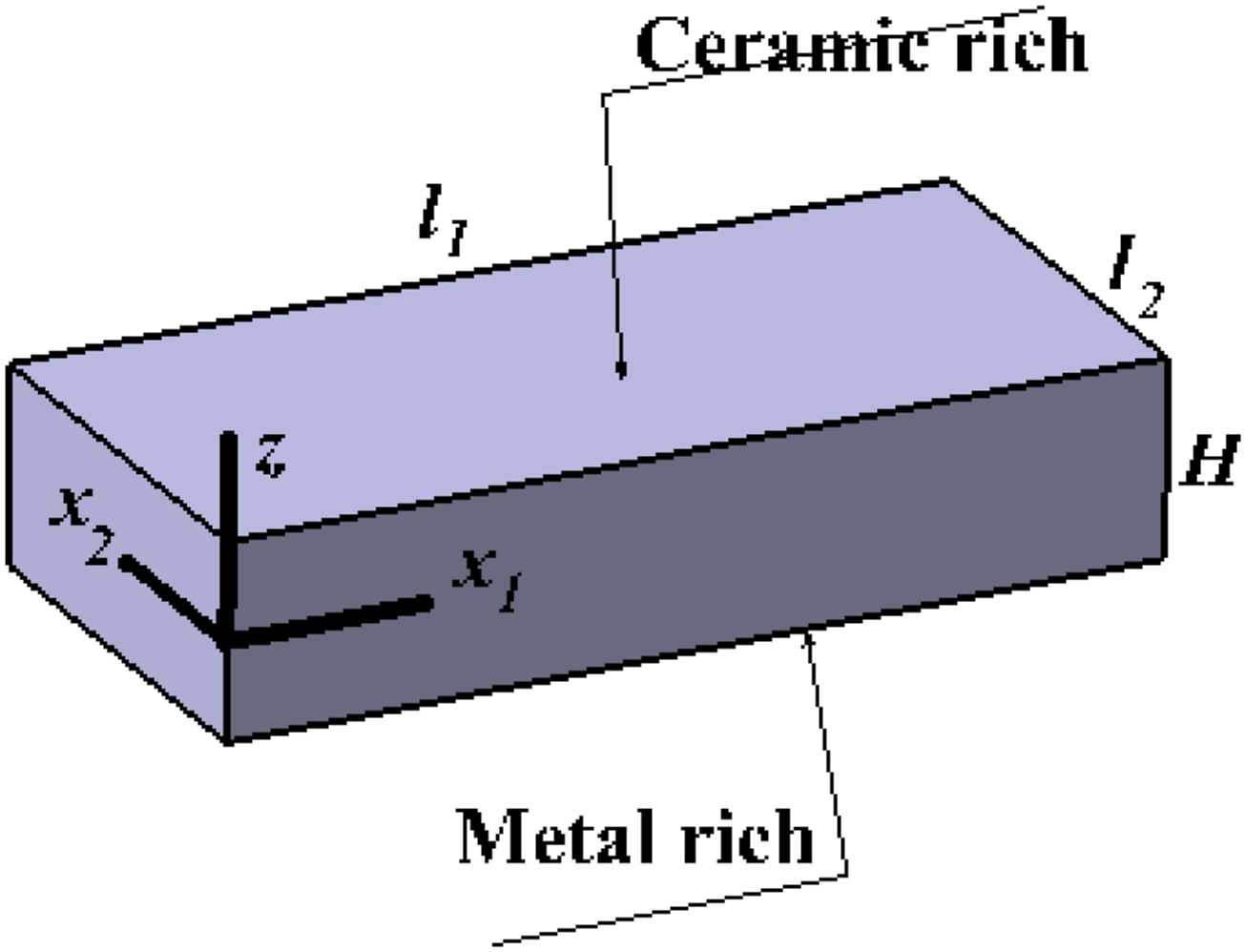
Considering the displacement field used by Senthilnathan et al. (1987) we have
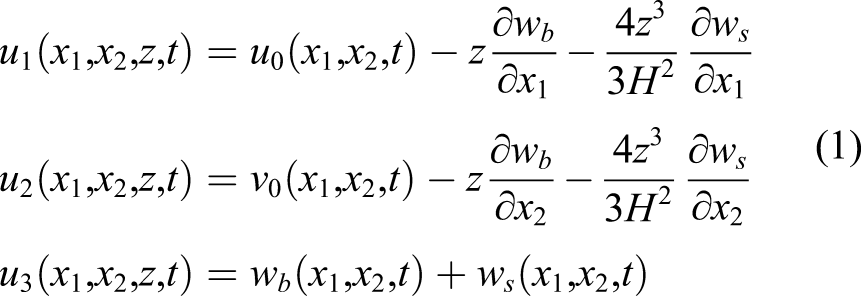
To consider the thickness stretching effect
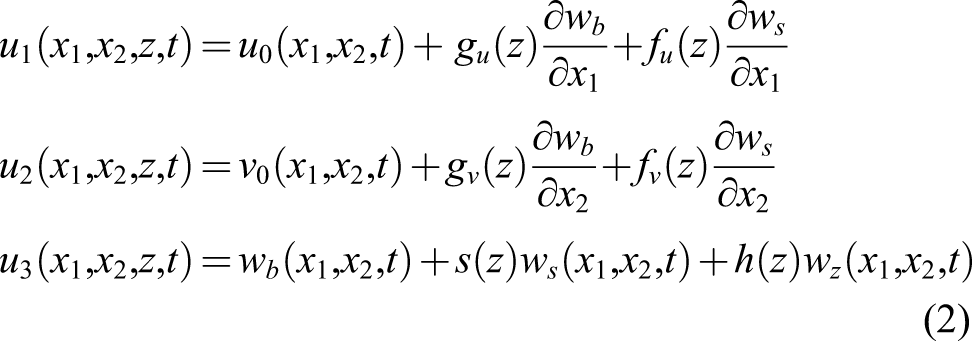
Functions

It should also be mentioned that omitting the thickness stretching effect
3. Material properties
Based on a simple power law distribution, functionally graded material (FGM) properties vary continuously along the thickness direction in the following form

4. Strain-displacement relations
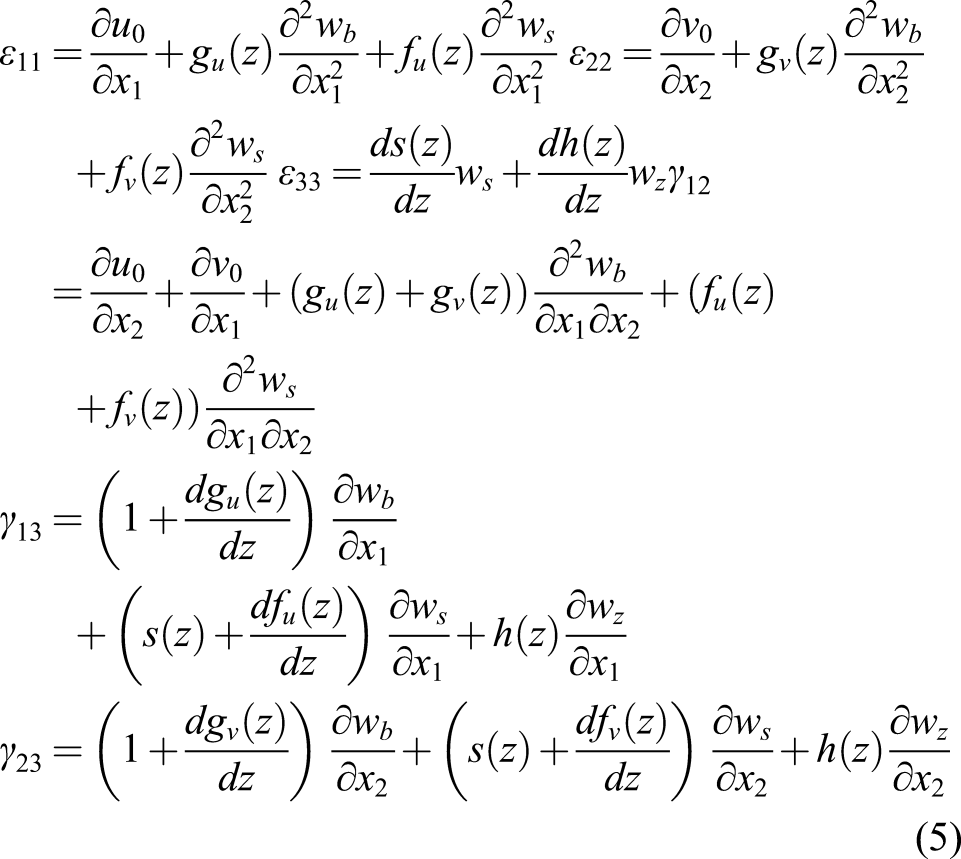
Linear strains according to the displacement field equation (2) are
5. Constitutive equations
Three-dimensional stress–strain relations can be presented as
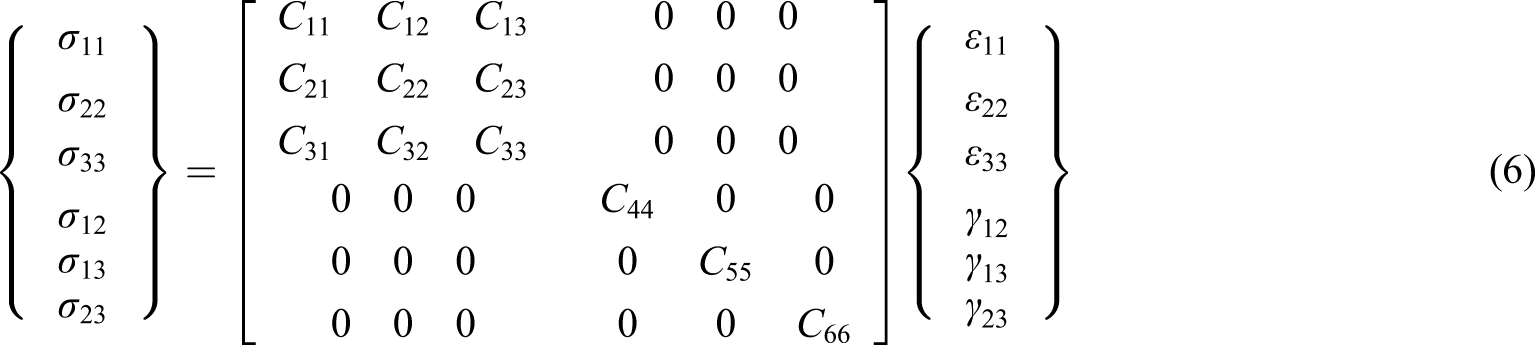
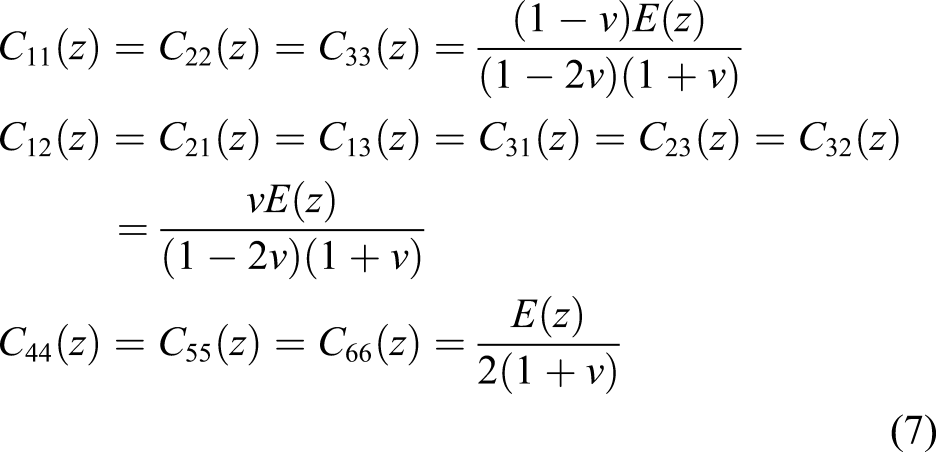
For elastic isotropic FGMs, the elastic constants
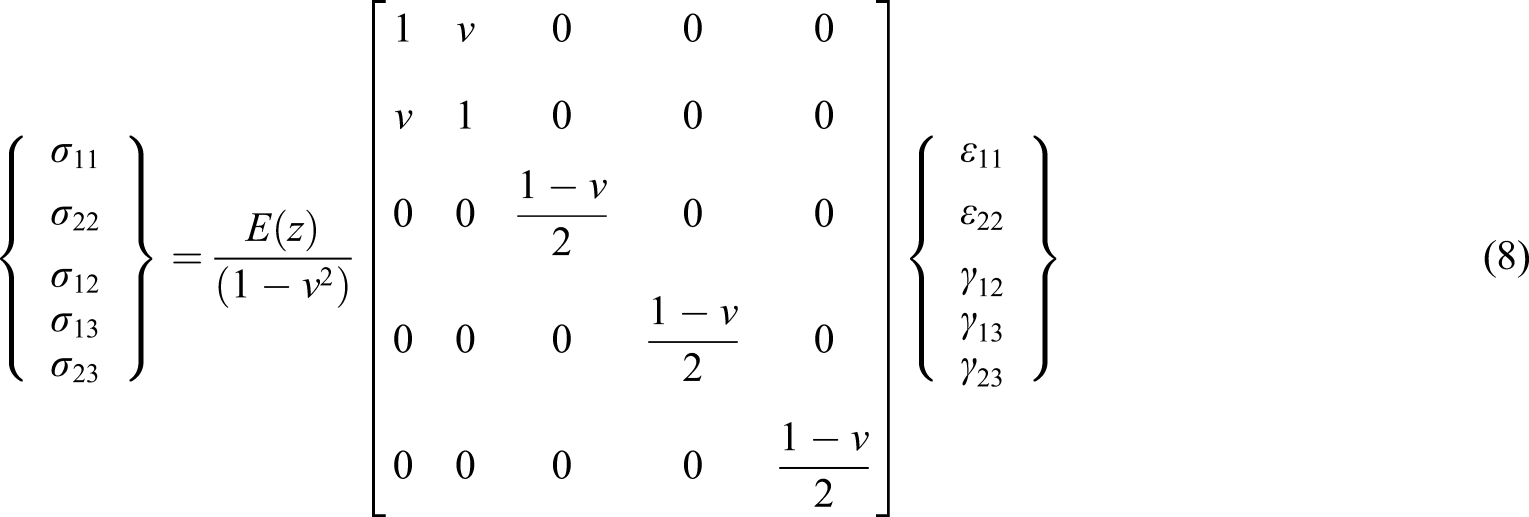
If the thickness stretching effect is neglected
6. Governing equations
To derive the governing equations of motion, the extended Hamilton’s principle can be used as

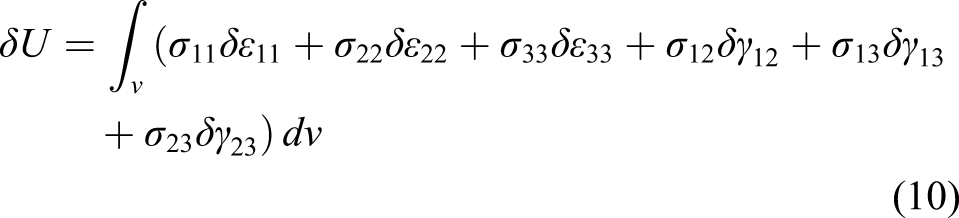
Variation of strain energy of the plate,
Virtual work done by the externally transverse distributed applied load, q, acting on the top surface of the plate

Kinetic energy of the plate is given by
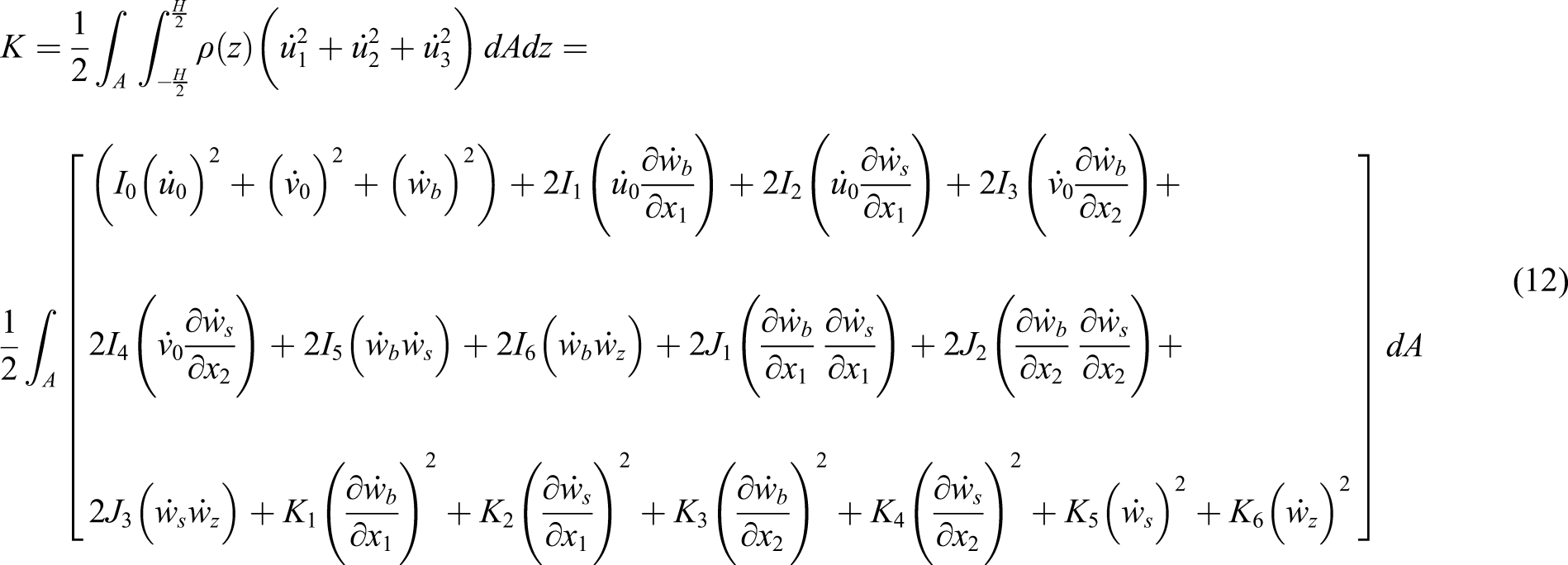
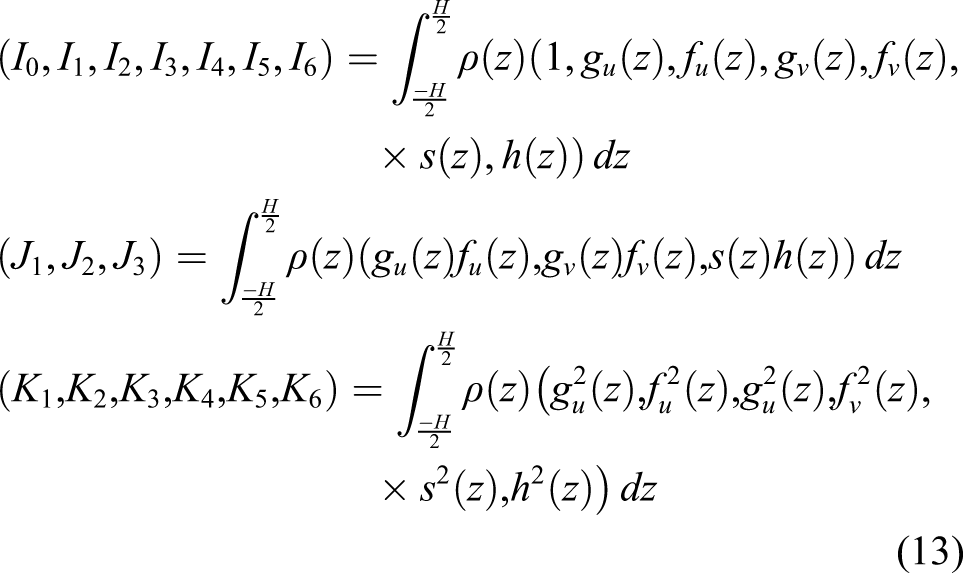
Substituting equations (5)–(7) into the extended Hamilton’s principle equation (4), using the divergence theorem and collecting the coefficients of each variable, the equations of motion are obtained as


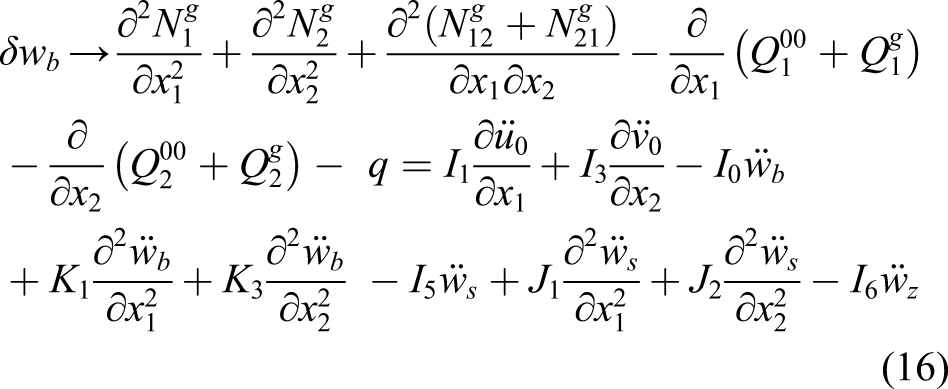
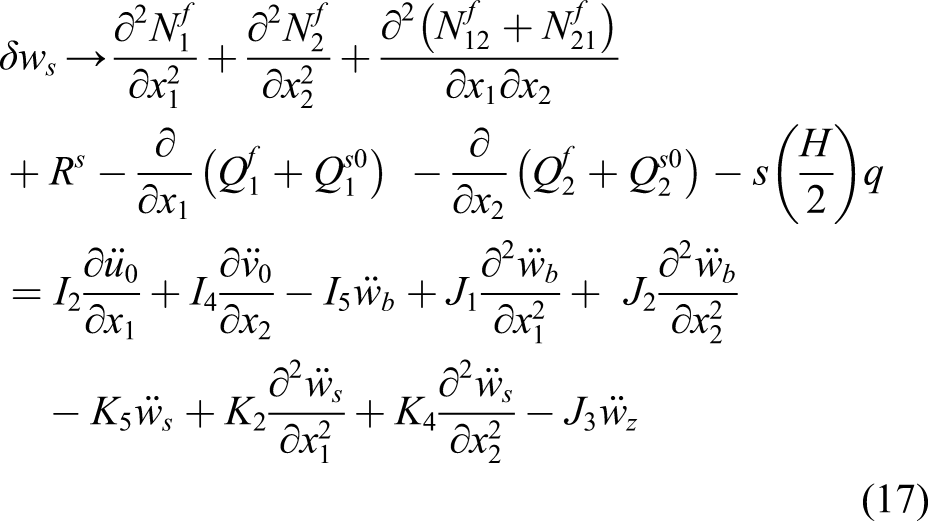

7. Solution procedure
The compatibility equation of an FG plate can be expressed as

An Airy stress function

Thus, the in-plane accelerations are obtained in terms of bending and shear components as

Therefore, the in-plane equations are omitted. Substituting equation (16) into equations 11–13, the in-plane accelerations are considered in those equations.
For movable simply supported boundary conditions, moments at the edges of the plate are zero and other boundary conditions are

The series solutions satisfying the aforementioned boundary conditions are
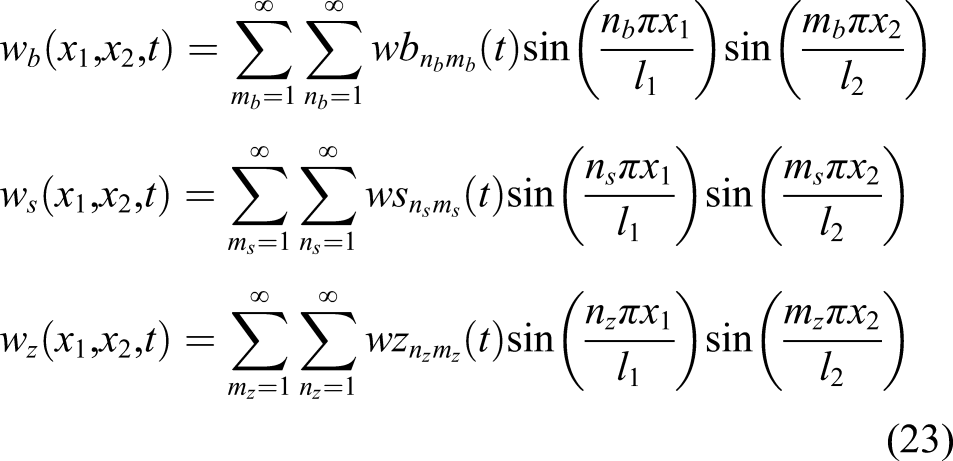
By using definition of the stress function (15) and the expression of normal strains and in-plane shear strain in terms of
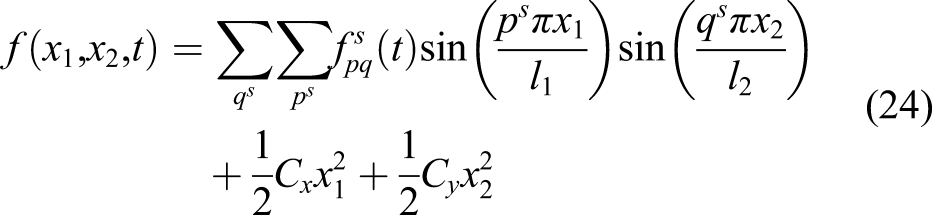
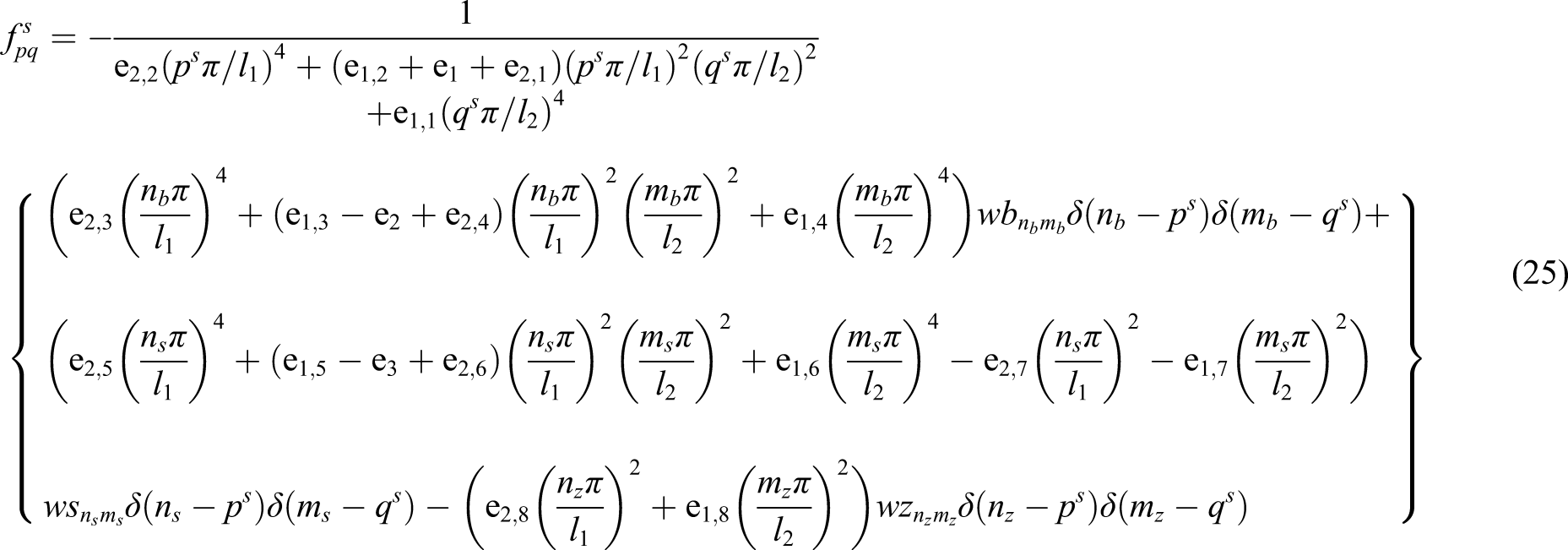

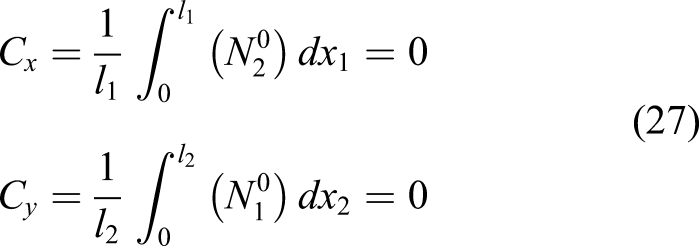
By using proper forms of functions in the displacement field equation (2), stress resultants defined in appendix A equation (A-1) are derived in terms of only

8. Validation
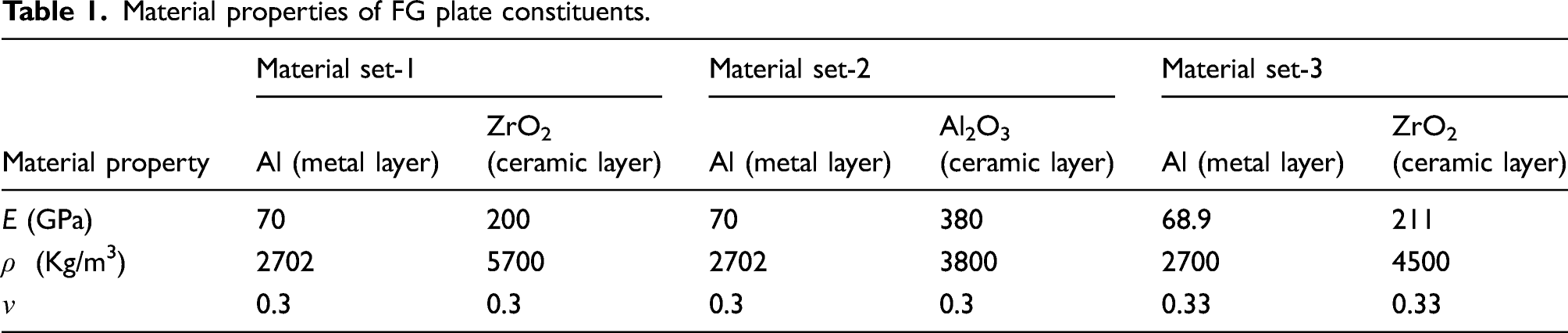
Material properties of FG plate constituents.
Dimensionless fundamental frequency
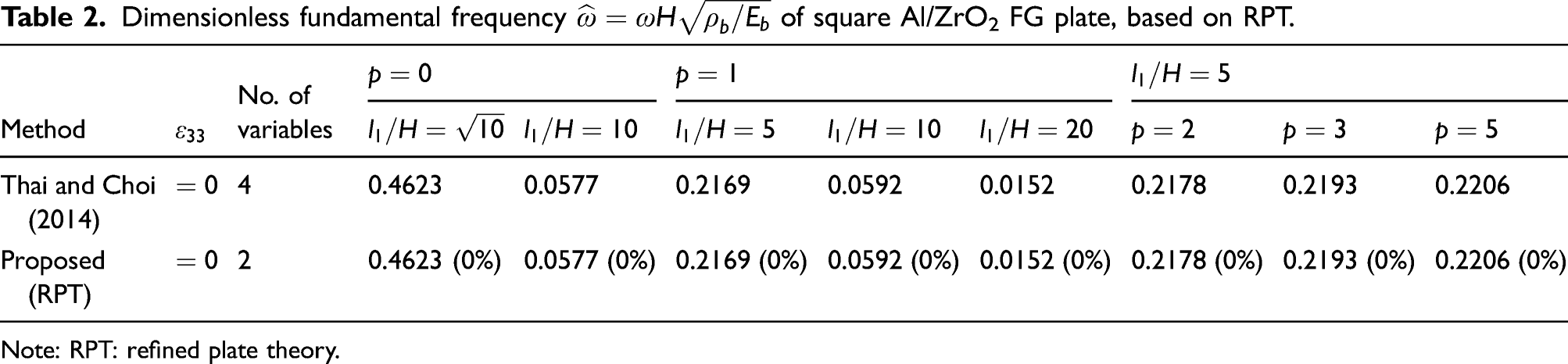
Note: RPT: refined plate theory.
Dimensionless fundamental frequency
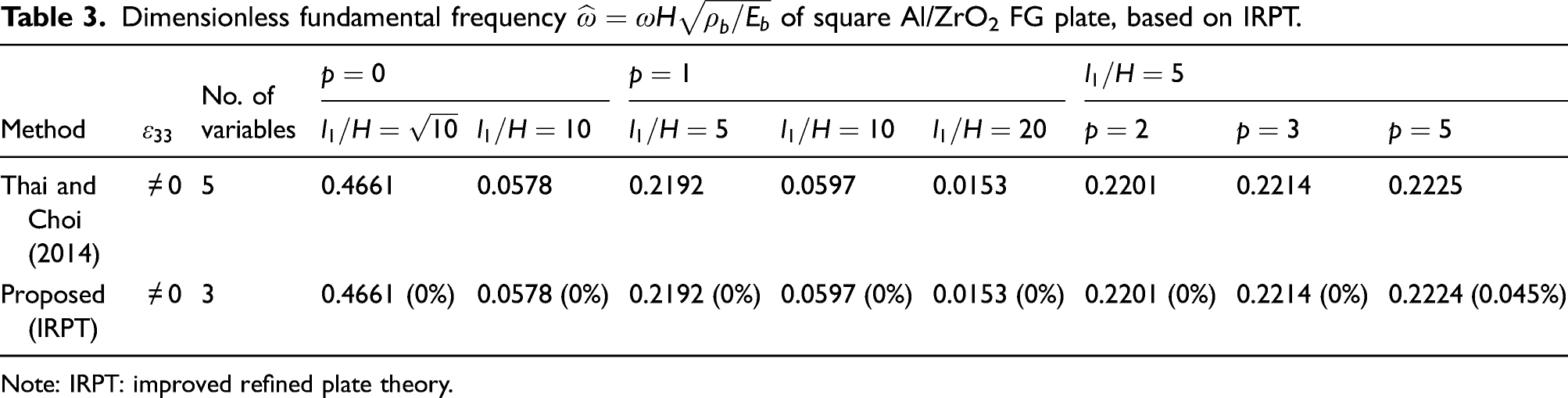
Note: IRPT: improved refined plate theory.
Both RPT and IRPT are considered to obtain the results. Movable simply supported boundary conditions using Material Set-1 as shown in Table 1 are used for the FG plate. Numbers shown in parenthesis demonstrate the difference percentages of the results of the proposed approach in comparison with Thai and Choi (2014). To be able to compare the results, functions defined in the displacement field of equation (2) should be the same as those in the aforementioned reference. Thus, for IRPT, functions should be selected as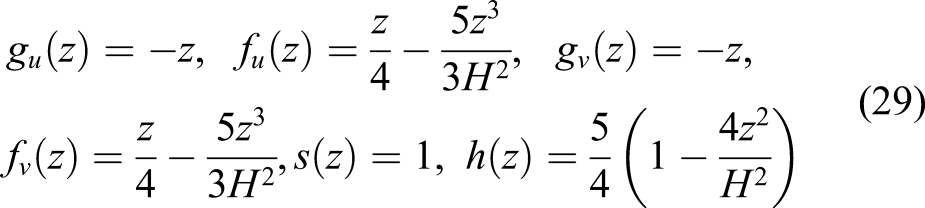
For RPT in which
Comparisons demonstrate excellent agreement of the proposed approach with those of Thai and Choi (2014) in which greater number of unknowns are used. Meaning that, implementing the stress function is not only effective, but also simplifies the model.
9. Results and discussions
To express the effectiveness of the proposed approach, natural frequencies of FG plates are compared with those of other references using HSDTs and neglecting the effect of thickness stretching. The natural frequencies are also compared with those of the mentioned theories containing through-the-thickness deformation effect. Material properties of the FG plates are tabulated in Table 1. In this study, the functions required for the IRSNDT approach, which are used in the displacement field equation (2) to satisfy equation (3), are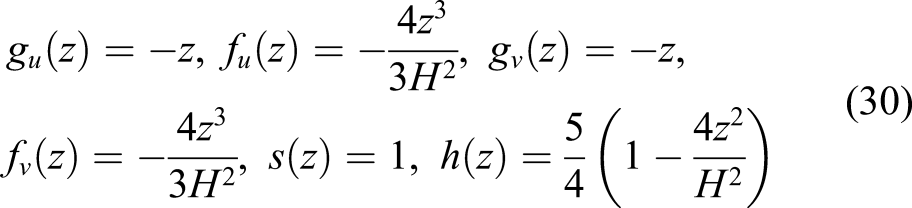
9.1. Fundamental frequencies comparison
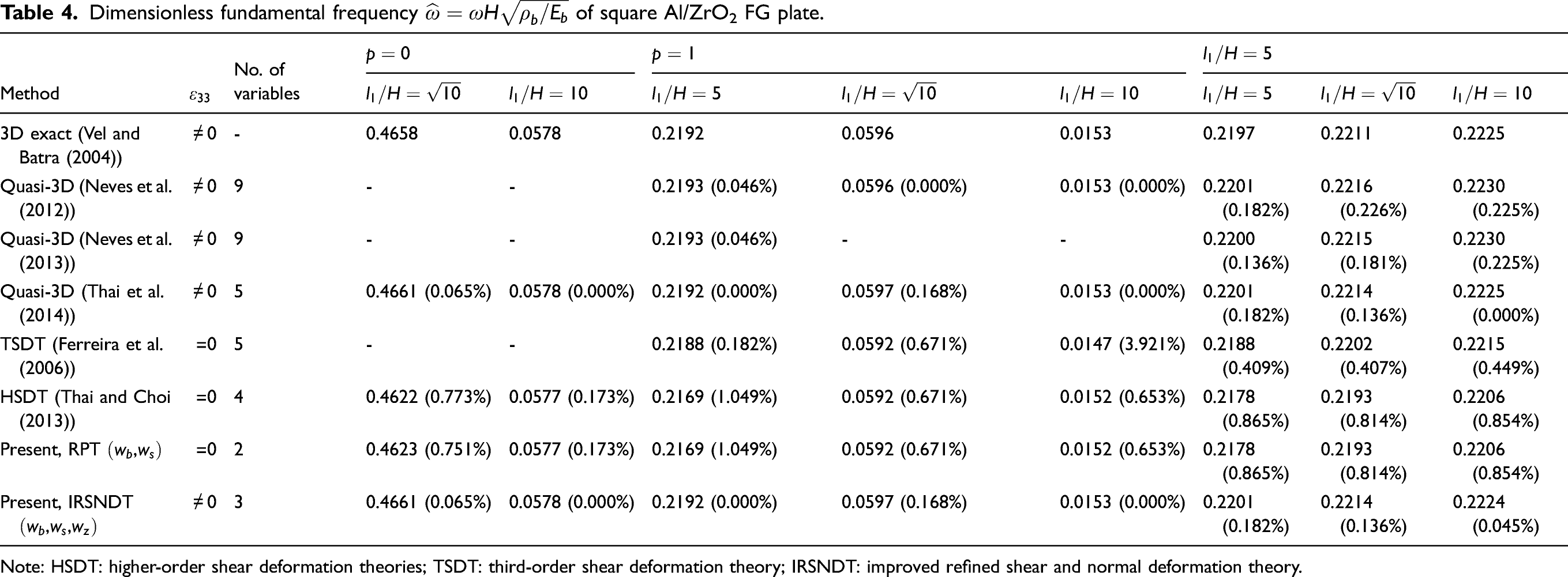
Dimensionless fundamental frequency
Note: HSDT: higher-order shear deformation theories; TSDT: third-order shear deformation theory; IRSNDT: improved refined shear and normal deformation theory.
By increasing the power law index
9.2. Natural frequencies comparison
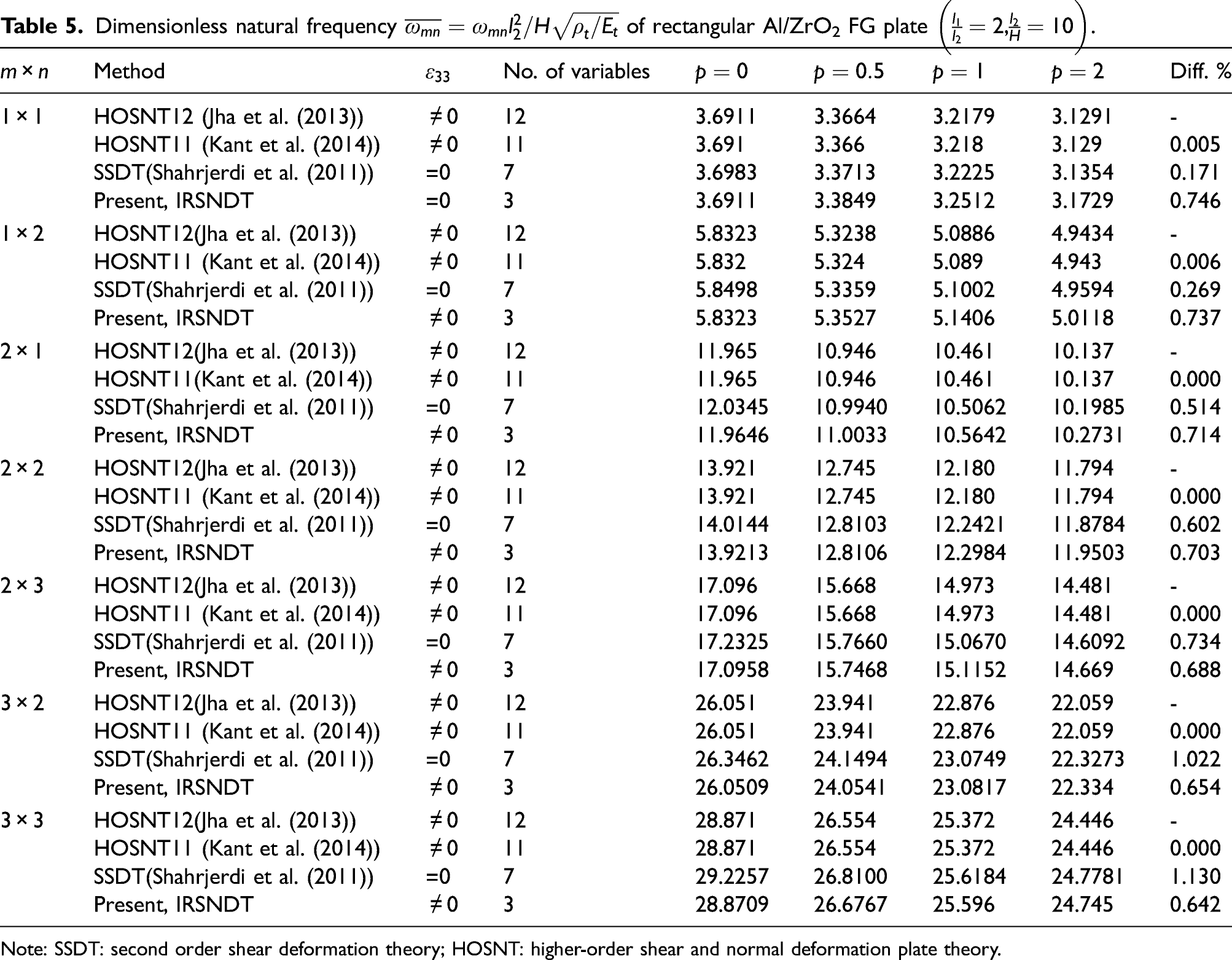
Dimensionless natural frequency
Note: SSDT: second order shear deformation theory; HOSNT: higher-order shear and normal deformation plate theory.
Also, results of Kant et al. (2014) and Jha et al. (2013) based on HOSNT including 11 and 12 variables are compared with those of the proposed approach. Higher-order shear and normal deformation plate theory 11 contains the expansion of in-plane displacements up to order 3 and transverse displacement up to order 2 along the thickness direction. Higher-order shear and normal deformation plate theory 12 contains the expansion of in-plane displacement up to order 3 and transverse displacement up to order 3 in along the thickness direction.
For this case, a simply supported movable rectangular FG plate using Material Set-3 is investigated. Average of difference percentages between frequency values of Jha et al. (2013) with other studies have been shown in the last column. Dimensionless natural frequency is obtained using the relation
Comparing values obtained by the proposed approach with only 3 variables with the aforementioned references shows that, natural frequencies of various modes are in excellent agreement. From the difference percentage column, it can be concluded that for higher modes of vibration, considering the thickness stretching effect becomes more important. This can be seen by comparing the results of the proposed approach using only 3 unknowns with those of Jha et al. (2013) using 12 unknowns, to account for thickness stretching effect.
Thus, this approach is not only accurate but also comparable with higher-order shear and normal deformation theories containing more variables (i.e., in this case 3 vs 12 DOFs).
9.3. Effect of transverse shear deformation and thickness stretching on natural frequencies
In this section, the importance of including transverse shear deformation and thickness stretching on the values of first four symmetric natural frequencies of FG square plates are investigated.
Material Set-2 is selected for the FG plate with movable simply supported boundary condition. Dimensionless natural frequency is obtained using the relation
Figures 2–4 show the first four natural frequencies of an FG square plate (with various power law indices Effects of Effects of Effects of 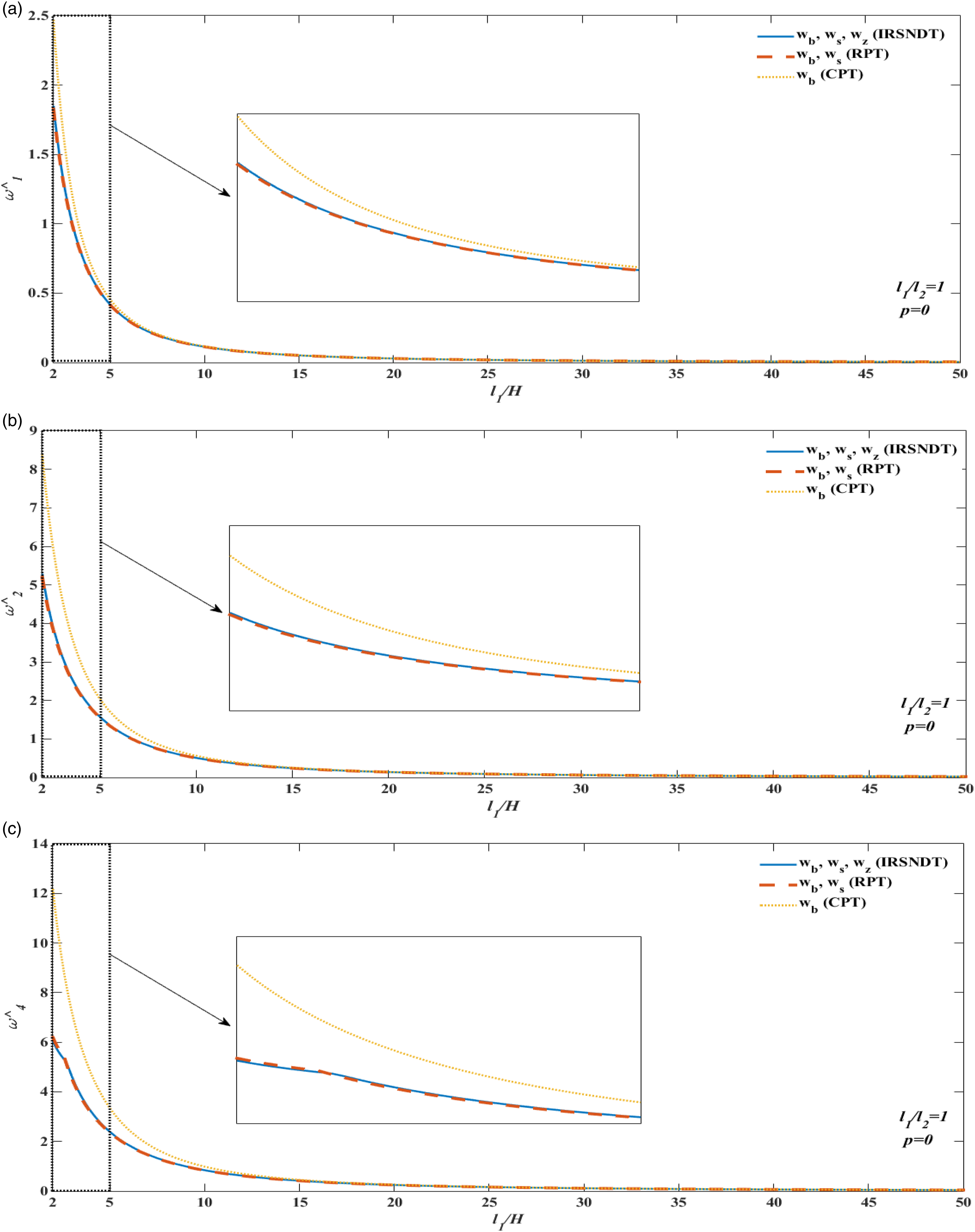
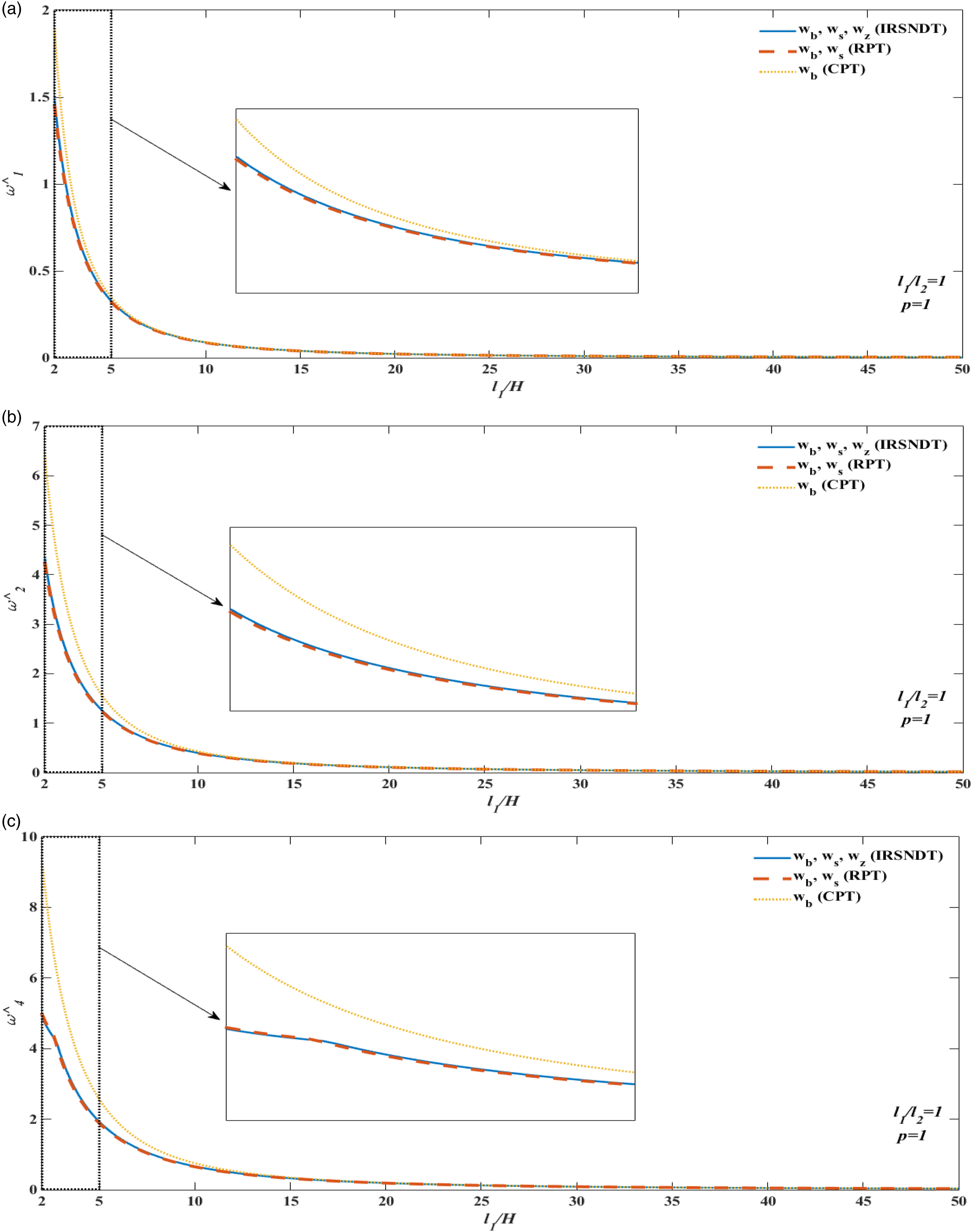
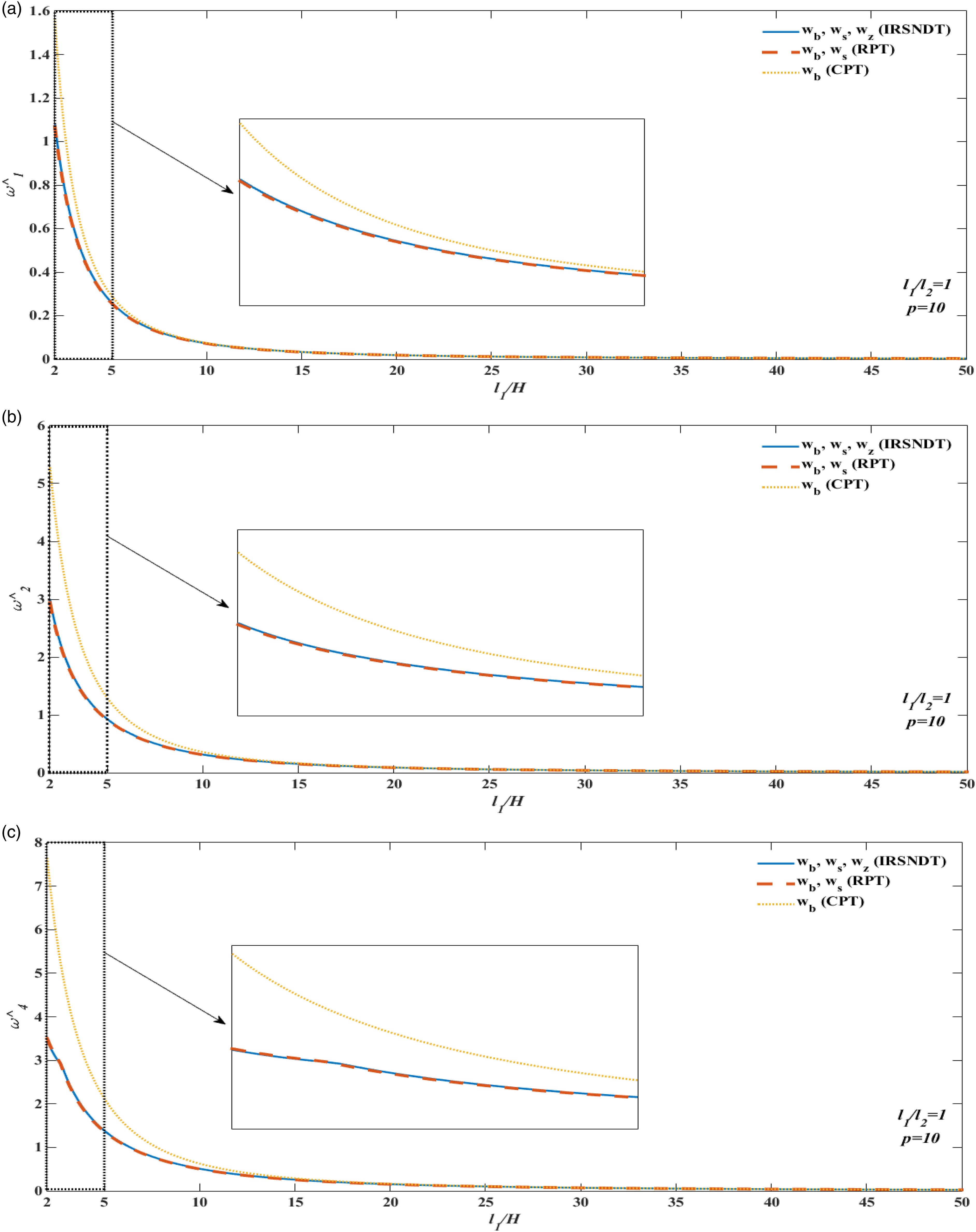
As can be seen, by increasing the plate thickness ratio and therefore thinning the FG plate, all three curves converge demonstrating that the bending has the most influence in thin plates. As the thickness of the plate increases, the difference between the three curves will increase. Furthermore, by increasing mode numbers, not only frequency values increase, but also larger distinction among three curves considering IRSNDT, RPT, and CPT can be observed.
For plates thicker than
The same results can be seen in Figure 5 by plotting frequency values versus power law index Effects of 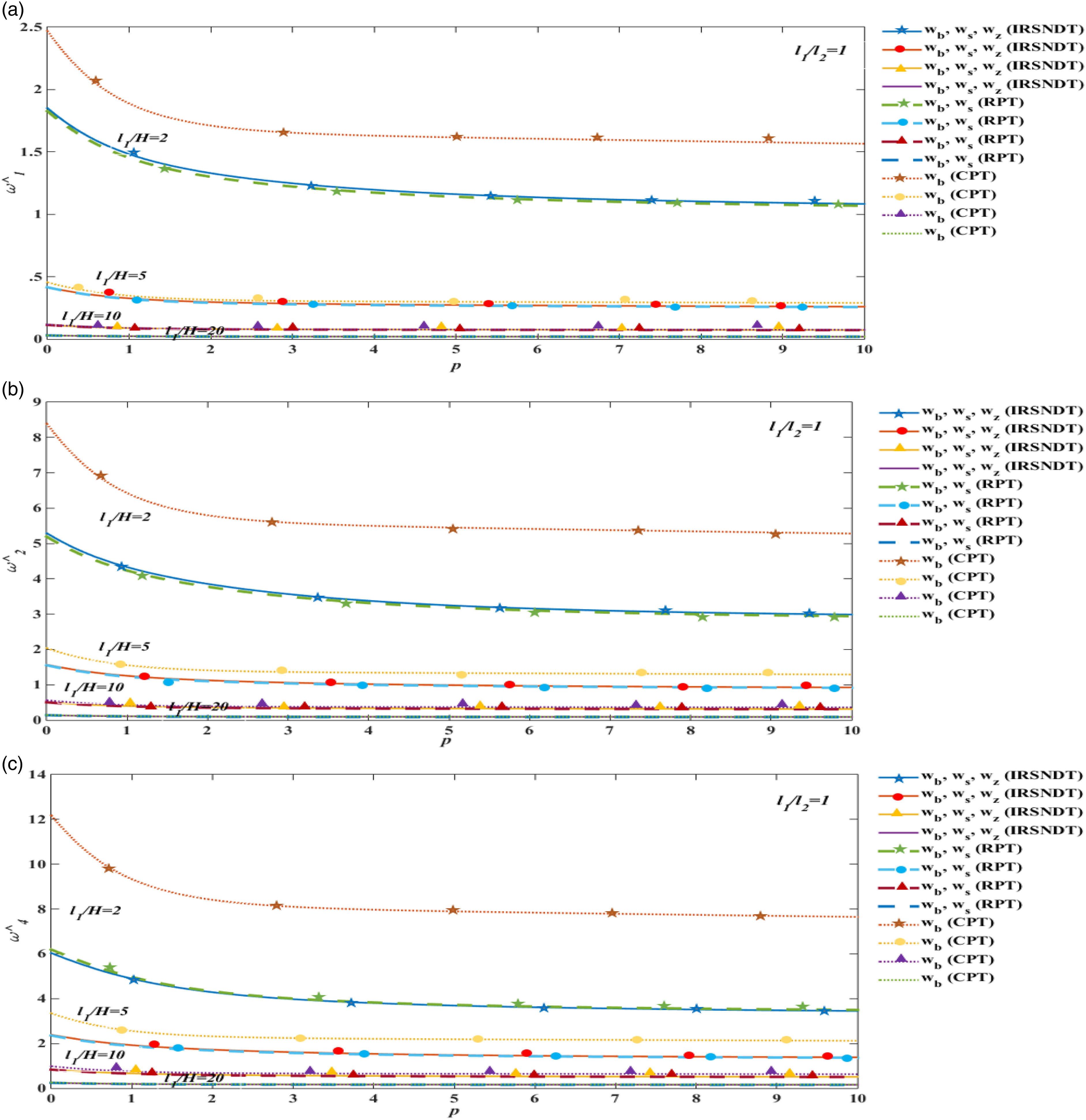
10. Conclusion
An IRSNDT approach including the effect of through-the-thickness deformation was proposed for vibration analyses of both thin and thick FG plates with movable simply supported boundaries. Through using the Airy stress function and omitting the in-plane displacements, number of unknowns was reduced to only three, including bending, shear, and thickness stretching effects. By using this approach, which simplifies the dynamic model, vibration behavior of FG rectangular plates, especially thick plates can be investigated. Validations and effectiveness of the proposed approach were shown by comparing the results with those of other theories whether including or excluding the thickness stretching effect. It was proven that this approach is capable of handling wide variety of other theories with selecting proper functions defined in the displacement field. Additionally, it was shown that natural frequencies obtained by the proposed approach are in excellent agreement with 3D and quasi-3D solutions containing more variables to consider the effect of thickness stretching.
The effect of transverse shear deformation and thickness stretching on values of first four symmetric natural frequencies of FG square plates were discussed. It was concluded that, for FG square plates thinner than
Footnotes
Declaration of conflicting interests
The author(s) declared no potential conflicts of interest with respect to the research, authorship, and/or publication of this article.
Funding
The author(s) received no financial support for the research, authorship, and/or publication of this article.

Appendix
Substituting strain-displacement relations equation (5) into the variation of strain energy equation (10), the stress resultants of the plate are expressed as
Substituting strain-displacement relations equation (5) and stress–strain relations equation (6) in definitions of stress resultants
According to definitions of